A Novel Celebration

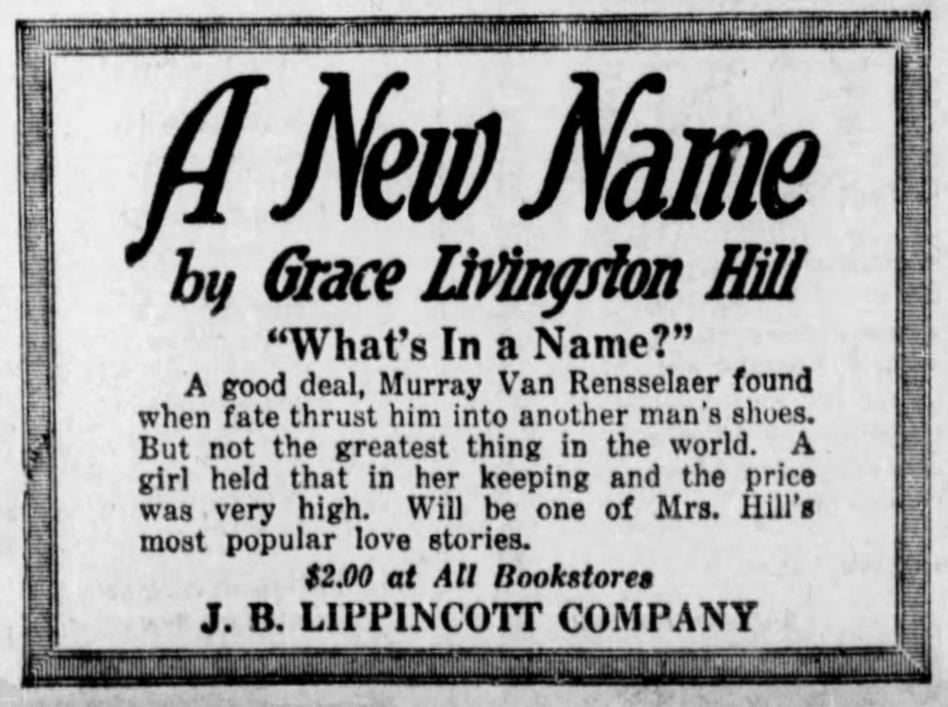
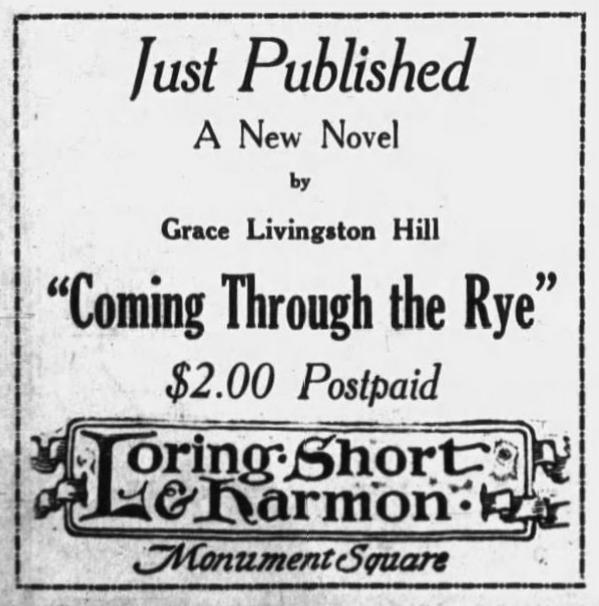
One hundred years ago, J. B. Lippincott Company published two new novels by Isabella’s niece, Grace Livingston Hill: A New Name (her 43rd novel) and Coming Through the Rye (her 44th novel).

The Philadelphia Inquirer, March 27, 1926

The mid-1920s were an interesting time for an author like Grace. While literary critics enthusiastically praised modernist writers like Ernest Hemingway and F. Scott Fitzgerald, everyday readers continued to turn to Grace for something entirely different: comfort, clear moral lessons, and stories that reminded them that life could have a noble purpose.  

Evening Express, Portland, Maine, September 28, 1926

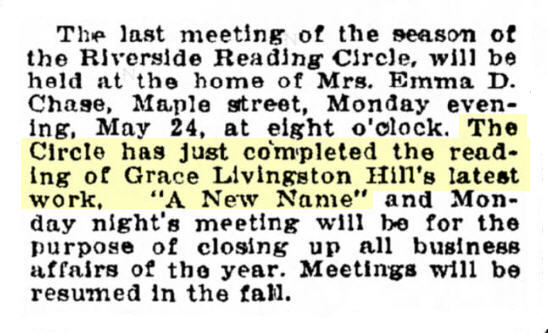
Community reading groups like the Riverside Reading Circle in Bridgeport, Connecticut, frequently placed her latest releases right at the top of their schedules:

Newspaper clipping: The last meeting of the season of the Riverside Reading Circle, will be held at the home of Mrs. Emma D. Chase, Maple street, Monday evening, May 24, at eight o'clock. The Circle has just completed the reading of Grace Livingston Hill's latest work, "A New Name" and Monday night's meeting will be for the purpose of closing up all business affairs of the year. Meetings will be resumed in the fall.
The Bridgeport Telegram, May 24, 1926.

That enthusiasm wasn’t limited to the 1920s. Decades later, readers were still discovering her work for the first time—and realizing their mothers and grandmothers had loved her, too. In April 2000, a newspaper in Kentucky published an article by a feature writer named Nancy Taylor, who wrote:

I discovered a small volume, Coming Through the Rye, and enjoyed it so much, I mentioned it to my mother as if I were telling her something she didn’t know.

“Grace Livingston Hill!” she said. “I’ve read so many of her books I don’t know where to begin. Matched Pearls is one of my favorite stories ever.”

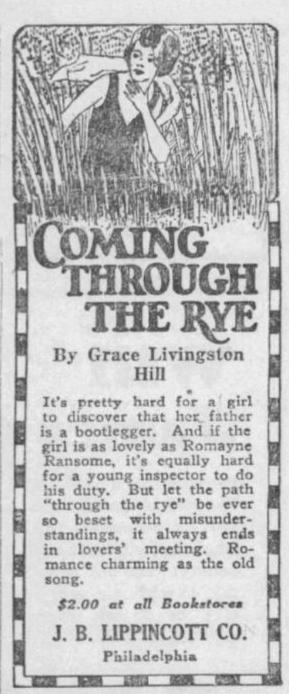
Newspaper Ad: "COMING THROUGH THE RYE By Grace Livingston Hill. It's pretty hard for a girl to discover that her father is a bootlegger. And if the girl is as lovely as Romayne Ransome, it's equally hard for a young inspector do do his duty. But let the path "trough the rye" be ever so beset with misunderstandings, it always ends in lovers' meeting. Romance charming as the old song. $2.00 at all Bookstores. J. B. LIPPINCOTT CO., Philadelphia.
Chicago Tribune, September 25, 1926.

Ms. Taylor went on to write:

My great-grandmother read them, my grandmother read them, my mother read them, I’ve read them, and my daughter reads them.

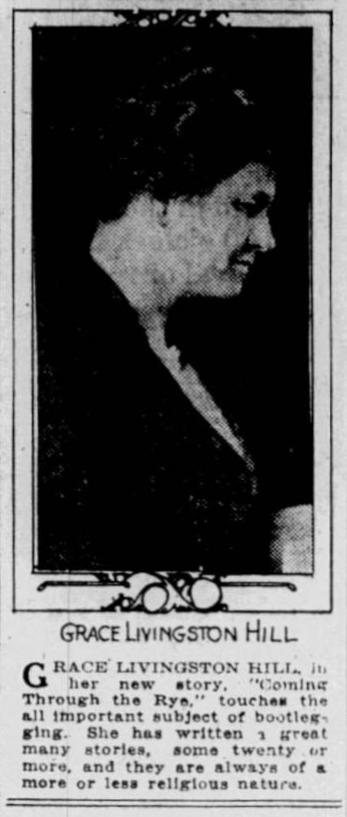
Black and white photograph of Grace Livingston Hill in profile. with this caption: Grace Livingston Hill, in her new story, "Coming Through the Rye," touches the all important subject of bootlegging. She has written a great  many stories, some twenty or more, and they are always of a more or less religious nature.
St Louis Globe-Democrat October 16, 1926

The old adage, “the more things change, the more they stay the same” is still true. Grace’s novels continue to hold the same place in readers’ hearts today as they did in 1926, and every year since. Perhaps Ms. Taylor said it best in the closing lines of her article published twenty-six years ago:

Where there is discouragement in the world, Grace sowed encouragement. Where there is yearning, Grace sowed hope, and she did it across generations. It is such a comfort to know that words which so long ago inspired our great-grandmothers are today an inspiration for our daughters. Grace Livingston Hill is the author of that gift.

LEAVE A COMMENT AND TELL US:

DO YOU SHARE GRACE LIVINGSTON HILL’S BOOKS WITH OTHERS?

DID YOU BECOME A FAN BECAUSE SOMEONE SHARED THEM WITH YOU?

A Bicycle, a Bulldog, and Rev. G. R. Alden

In 1918, Isabella’s husband, Reverend G. R. Alden was a healthy, hardy 86-year-old. Though retired from his ministerial duties in the Methodist church, he remained incredibly active. The Aldens were living in Palo Alto, California at the time, and because the Reverend didn’t drive, his bicycle was his primary mode of transportation. Seeing him pedaling his bike around town was a familiar and endearing sight in the neighborhood.

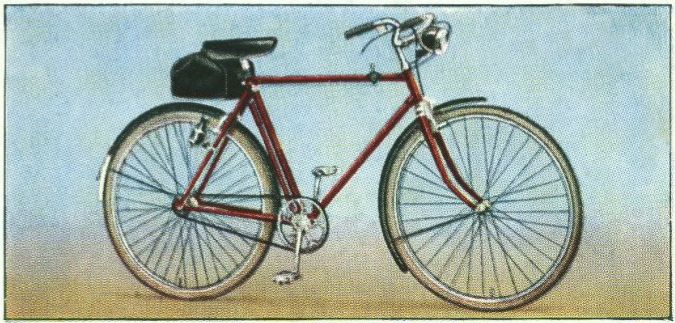
Illustration of a red men's bicycle with hand brake and a small black pouch attached behind the seat
A roadster bicycle from about 1915, described in advertisements as “admirably suitable for the young and middle-aged.”

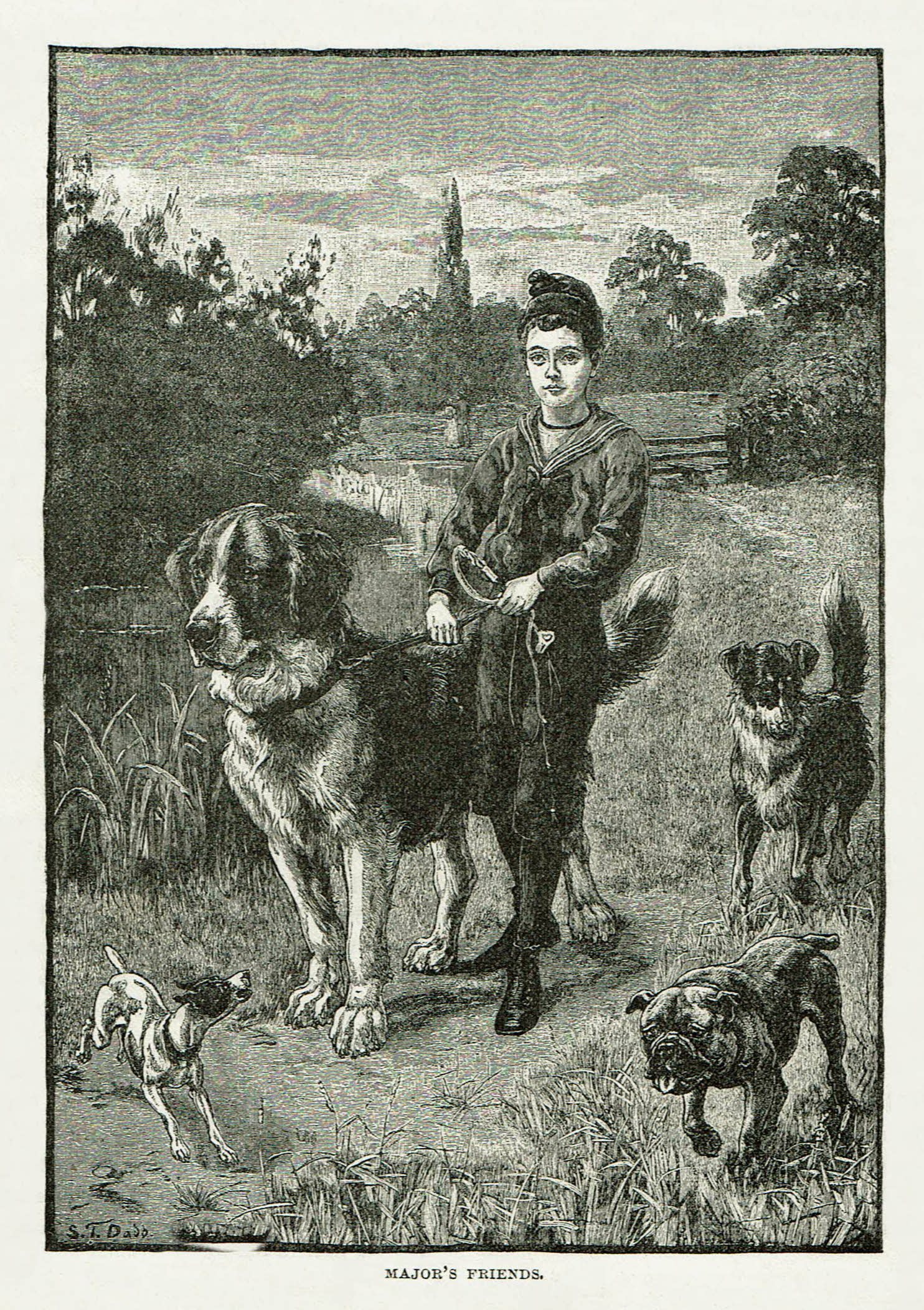
Rev. Alden was also a well-known dog lover. Years earlier, he had written two children’s novels centered around a canine protagonist named Major: Major’s Autobiography and Major’s Friends, were both serialized in the pages of The Pansy magazine in 1892.

Black and white illustration of a boy wearing a sailor style top, breaches, and ankle boots, holding a large dog by the leash as they walk through a field, while three small dogs cavort around them.
An illustration from the 1892 serial story, “Major’s Friends.”

He was very open about his affection for four-legged friends. In the opening lines of Major’s Friends he declared to his young readers:

“By this time you will begin to believe that I am fond of dogs. Well, I am, if they are good, and I am especially fond of large, intelligent dogs.”

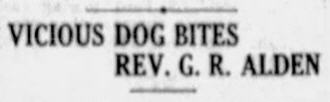
With such a deep affection for man’s-best-friend, it must have come as quite a shock to the Alden family—and the community—when the local papers ran a startling headline in July 1918.

Newspaper headline: VICIOUS DOG BITES REV. G. R. ALDEN

According to the July 17, 1918 issue of the Peninsula Times Tribune, Rev. Alden was riding his bicycle near his home one evening when he was suddenly “assaulted” by a vicious bull terrier. The dog bit him, leaving a painful injury on his left leg just above the ankle. The next morning, Rev. Alden reported the attack to the police, requesting that immediate action be taken to muzzle or properly handle the dangerous dog.

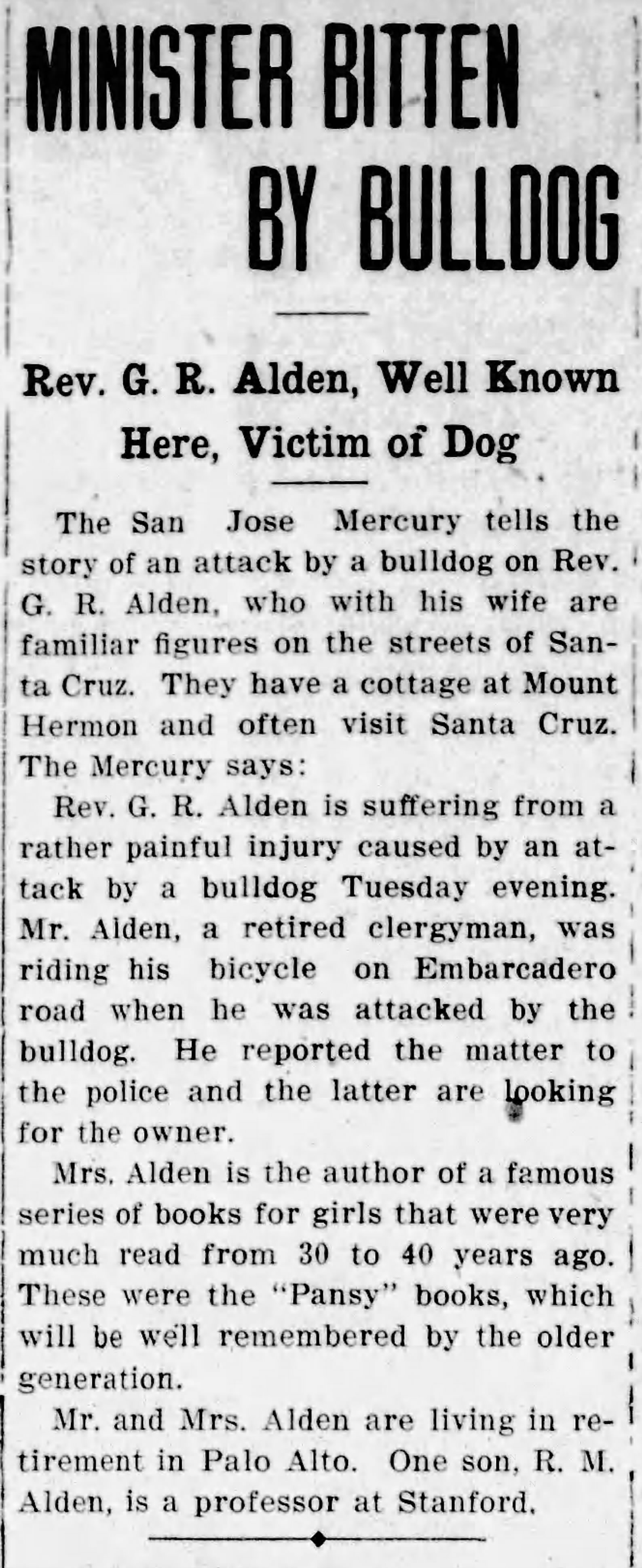
Because Isabella and the Reverend were such prominent figures in the region, the story quickly spread beyond Palo Alto to nearby San Jose. The Aldens were frequent visitors to the Mount Hermon Christian Camp in Santa Cruz, where they owned a cottage, so two days later, the Santa Cruz newspaper also picked up the story and added a few additional details for its readers.

Newspaper Article: MINISTER BITTEN BY bULLDOG. REV. G. R. ALDEN, WELL KNOWN HERE, VICTIM OF DOG. Rev. G. R. Alden is suffering from a rather painful injury caused by an attack by a bulldog Tuesday evening. Mr. Alden, a retired clergyman was riding his bicycle on Embarcadero road when he was attacked by the bulldog. He reported the matter to the police and the latter are looking for the owner. Mrs. Alden is the author of a famous series of books for girls that were very much read from 30 to 40 years ago. These were the "Pansy" books, which will be well remembered by the older generation. Mrs. and Mrs. Alden are living in retirement in Palo Alto. One son, R. M. Alden, is a professor at Stanford.

The article made sure to note that Mrs. Alden was the famous author of the beloved “Pansy” books, and proudly mentioned that their son, R. M. Alden, was currently serving as a professor at nearby Stanford University.

Thankfully, an injury above the ankle couldn’t keep a robust 86-year-old retired minister down for long, and Rev. Alden was soon back on his bicycle, pedaling around Palo Alto. It’s fascinating to see how a minor local mishap can reveal so much about the Aldens’ daily lives, their tight-knit family, and their enduring fame in California.

Did you know Reverend Alden wrote children’s stories about dogs? Have you ever read about Major’s adventures? Leave a comment below and share your thoughts!
Isabella and the Bottle that Took America by Storm

Between 1900 and 1910 American consumers were introduced to some revolutionary new inventions and products that would significantly change their lives. In 1903 the Wright Brothers powered their first sustained airplane flight at Kitty Hawk, North Carolina.

In 1908 the first Model T Ford automobile rolled off the production line in Detroit, Michigan.

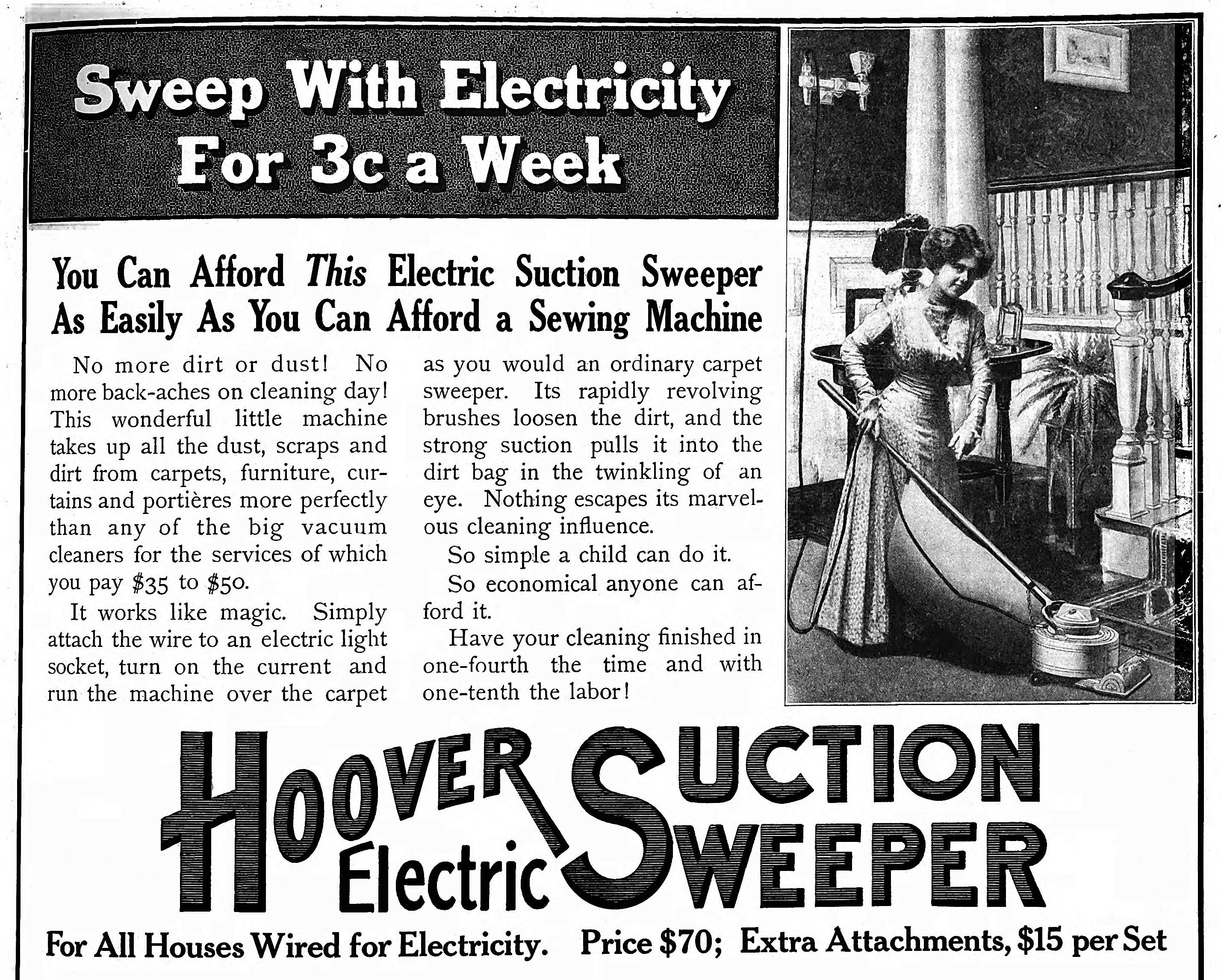
Other inventions during the decade included the safety razor (1901), Cornflakes (1907), teabags (1904), washing machines (1908), and vacuum cleaners (1901).

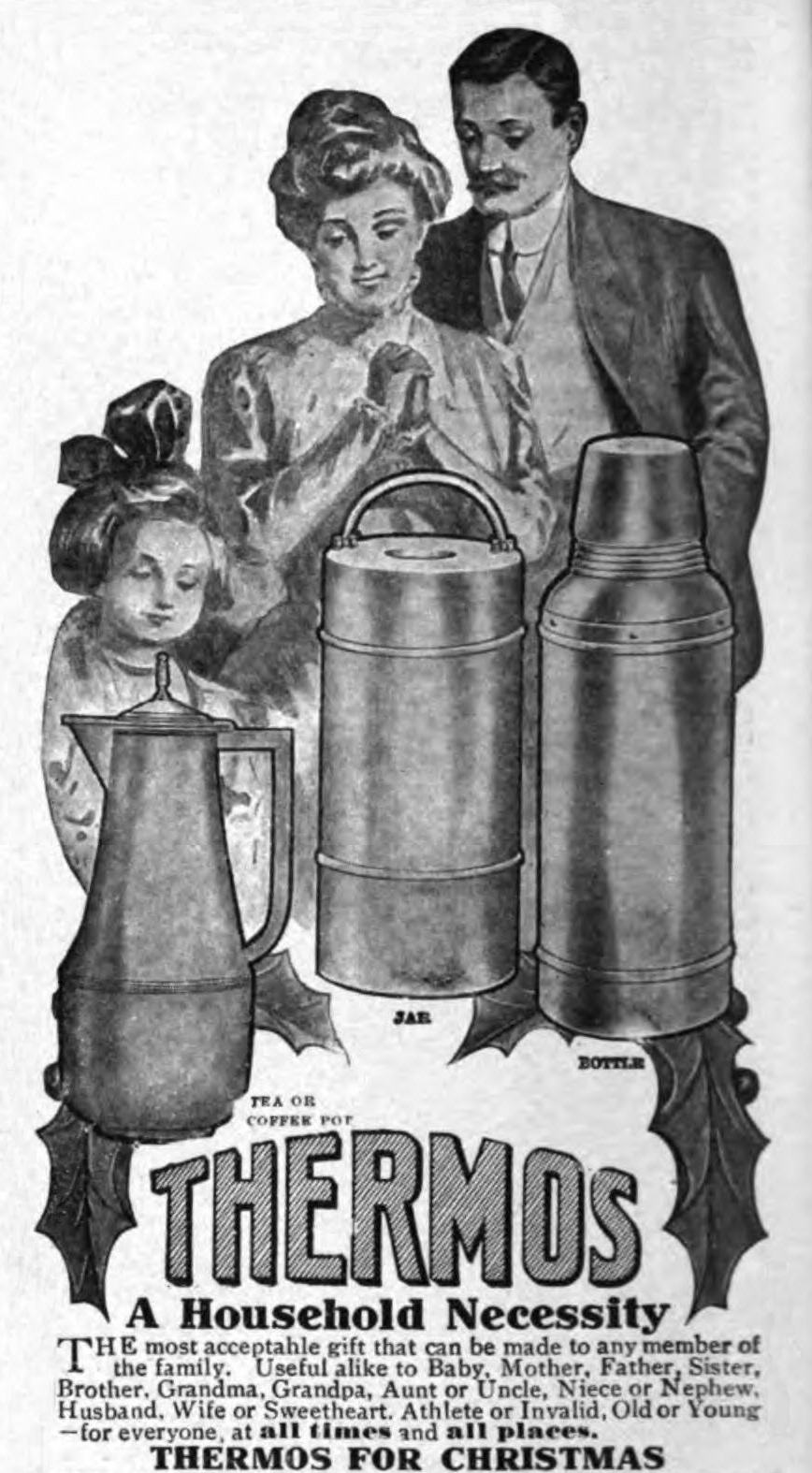
From a 1909 issue of The Saturday Evening Post.

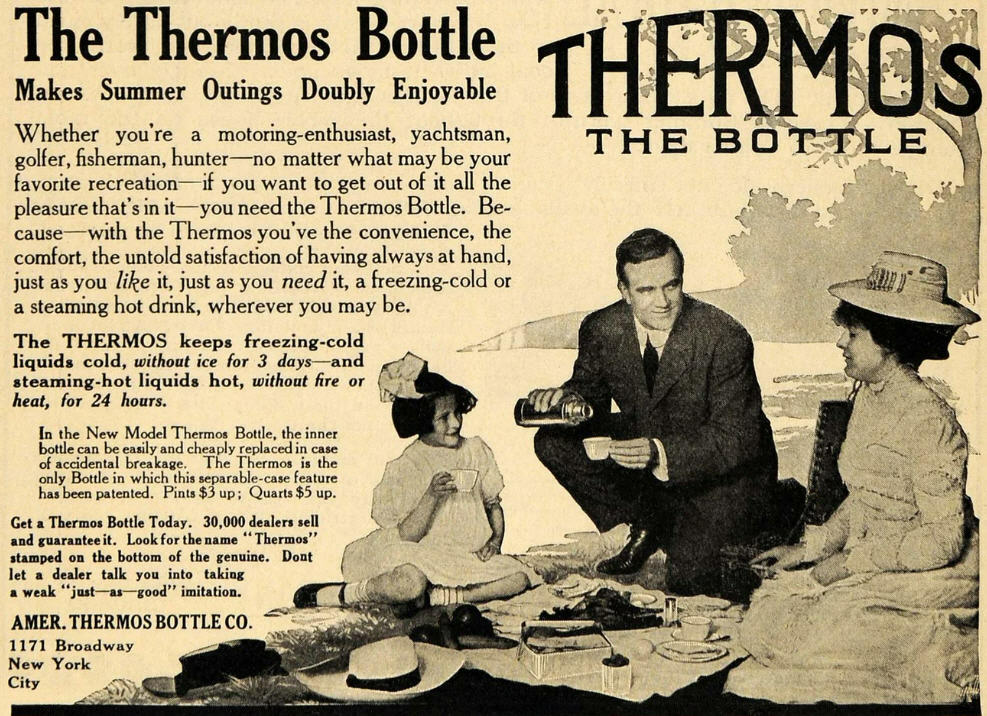
But in 1907, an entirely new product took the country by storm: the Thermos bottle. This cleverly designed vacuum bottle could keep drinks hot or cold for hours—something no other portable container could do.

Ad in a 1909 issue of Life magazine.

It’s easy to imagine Isabella Alden embracing this new invention, especially given the lifestyle she adopted after she and her family moved to California around 1901.

The Aldens settled in Palo Alto, where son Raymond was teaching at Stanford University. A few years later, Isabella and her husband became involved with the newly-founded Mount Hermon Christian camp near Santa Cruz. Mount Hermon reminded her of her beloved Chautauqua Institution, and it quickly became her summertime place of peace where she could rest, read, and worship among the giant redwood trees. Isabella recalled:

“Tent life seemed to belong to it as much as houses belong in most other places. We ate out of doors, and worked out of doors, and practically slept out of doors, with all the curtains of the tent looped high.”

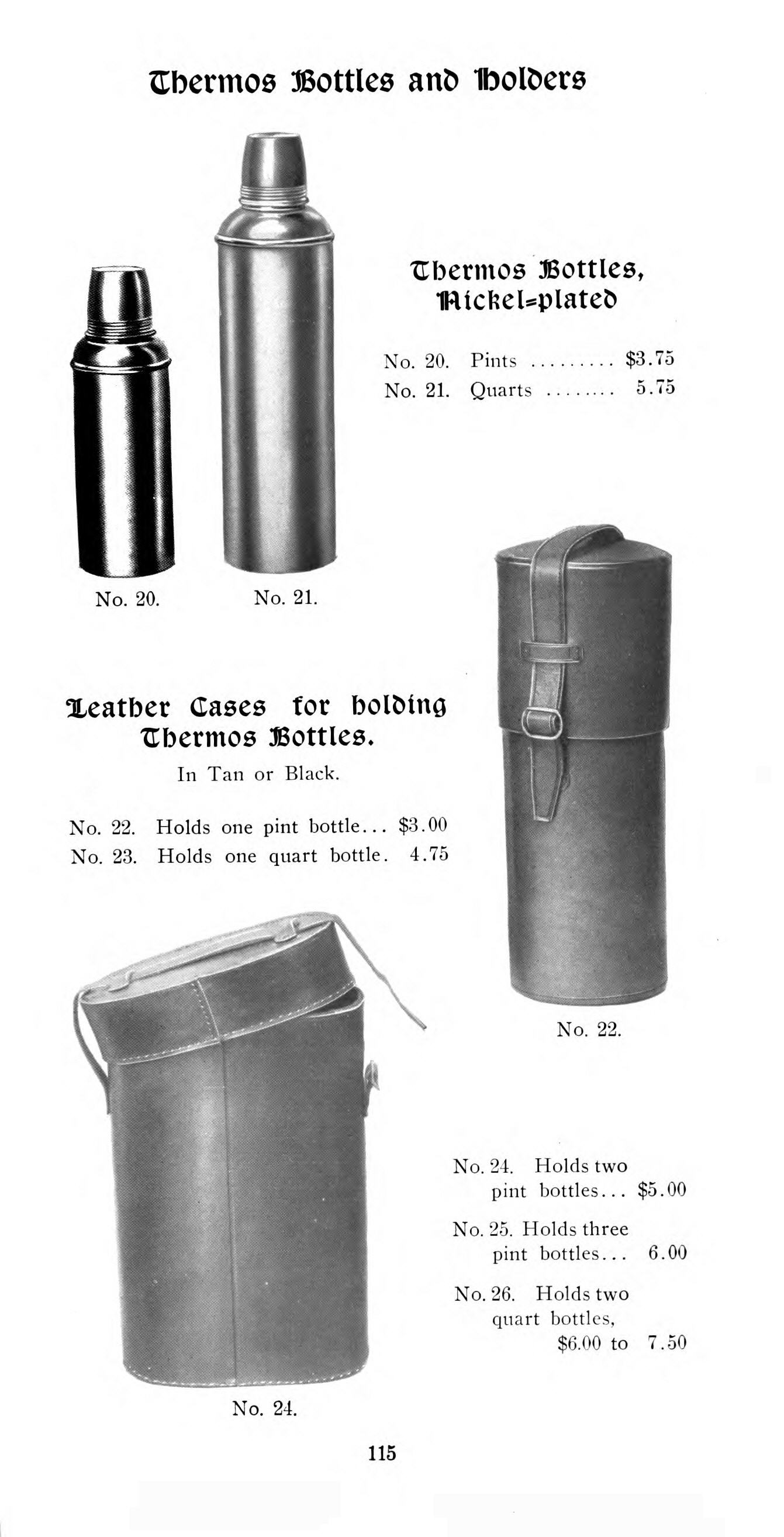
When Thermos bottles first appeared in stores, they were luxury items. Depending on size, prices ranged from $3.50 to just over $5.00—the equivalent of about $125 to $150 in today’s money.

From a 1908 booklet, “Everything for the Autoist but the Auto.”

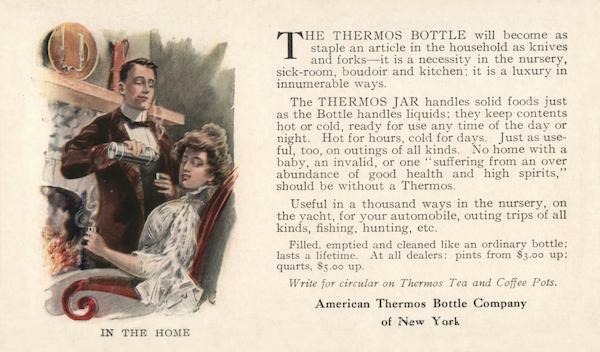
Travelers quickly embraced the Thermos bottle as a necessity worth the investment. Upper-middle class households purchased them, too, using Thermos bottles to keep food and drinks at stable temperatures without relying on wood-fire stoves, electricity, or refrigeration—all expensive options.

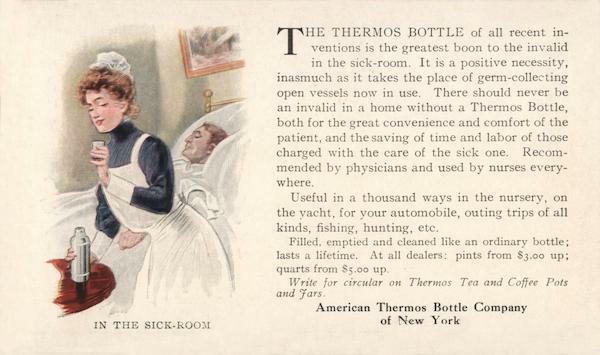
One in a series of trade cards distributed by The American Thermos Company.

The American Thermos Bottle Company of Norwich, Connecticut, launched a full ad campaign in magazines, trade journals, and newspapers. As sales increased, they launched additional products—pitchers and carafes, food storage bowls, and even completely furnished picnic baskets. With growing demand came increased production, and by the 1920s Thermos bottles were much more affordably priced.

Isabella never specifically mentioned a Thermos in her memoirs or her stories, but throughout her life she eagerly embraced new inventions and technologies. It seems probable that during those early rustic summer days at Mount Hermon, she might have had a Thermos bottle at her side for a cool drink of water.

Isabella’s niece, author Grace Livingston Hill, was also quick to embrace new inventions, and mentioned Thermos bottles in her novels, including The Prodigal Girl (1929) and The Street of the City (1942). In her novel Ladybird (1930), Grace wrote about the main character Fraley MacPherson marveling over a picnic lunch:

“There were other little packages with other sandwiches, some with fragrant slices of pink ham between them. There were hard-boiled eggs rolled in paper. There were olives and pickles, and chocolate cake and cookies, and white grapes and oranges—a feast for a king! There was coffee amazingly hot in a Thermos bottle. And in the wilderness!”

Thermos magazine ad from 1909

Whether or not Isabella actually owned a Thermos, she certainly lived during one of the most innovative decades in American history—and she took advantage of it. Her writing shows someone who was genuinely curious about new inventions and quick to see how they might improve her daily life. That openness to change and progress is just one more reason her work still feels surprisingly modern today.

You can read more about how Isabella embraced new inventions and technology in these posts:

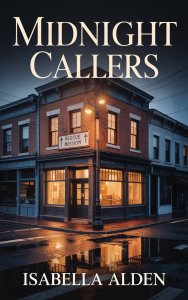
New Free Read: “Midnight Callers”
A New Luxury
iPhones and Isabella
It’s National Sewing Machine Day
The Edison Connection
“She’s a Beauty”

New Free Read: “Midnight Callers”

If Isabella Alden were alive today, there’s no doubt she would be a very tech-savvy person. From telephones to indoor plumbing, from typewriters to motor cars, she embraced new devices and technologies and incorporated them into her stories and her daily life.

In 1909 Isabella wrote a short story titled “Midnight Callers,” which was published in a Christian magazine. It’s a wonderful story about a young woman toiling in the Lord’s vineyard and wondering if her efforts make a difference.

Miss Rachel Holland is a weary Christian mission worker who can’t help questioning the impact of her tireless labor. But her world changes one night when a hopeless ruin of a man stumbles into her office, desperate for help. Will she stand by her faith and summon the energy to serve her heavenly Master yet again?

But “Midnight Callers” is also a story that shows us a snapshot of the world in which Isabella lived. Her characters in the story don’t live in a dusty old past we can’t relate to; instead, they live in a very “modern” world (by 1909 standards).

Rachel Holland, the heroine of the story, writes with a fountain pen, which was a newly popular writing instrument in 1909.

A 1910 advertisement for fountain pens.

Another character, the Rev. Dr. McKenzie, uses a telephone closet to call “Blue two double O”—a reference to an era of manual telephone exchanges and party lines.

Although fountain pens have long since been replaced by keyboards and “Blue two double O” is now a touch-key on our smart phone contact list, the core of “Midnight Callers” still has relevance for readers today.

The story reminds us that while technology may change, our human need for hope—and help from the “present Power” that never fails—is eternal.

You can read “Midnight Callers” for free!

Choose the reading option you like best:

You can read the story on your computer, phone, tablet, Kindle, or other electronic reading device. Just click here to download your preferred format from BookFunnel.com.

Or you can select BookFunnel’s “email” option to receive an email with a PDF version you can read, print, and share with friends.

You can learn more about how Isabella embraced and used new technologies and inventions in these posts:

iPhones and Isabella

A New Luxury: Indoor Baths

Typewriters and Writing Machines

What One Good Library Can Do

When Isabella Alden began writing her beloved “Pansy” books in the 1870s, the literary landscape looked very different than it does today. There were few public libraries like the ones we have now; instead, churches filled that role by establishing their own library systems.

The Sunday-school library was a powerful force in 19th-century America. They didn’t just lend books—they curated collections of books that shaped readers’ moral and spiritual development.

Not all Sunday-school libraries were created equal; some churches seemed to have unlimited resources to maintain a well-stocked library of five-hundred books or more, displayed in neat rows on well-built shelves; while others had only a few titles in their collection.

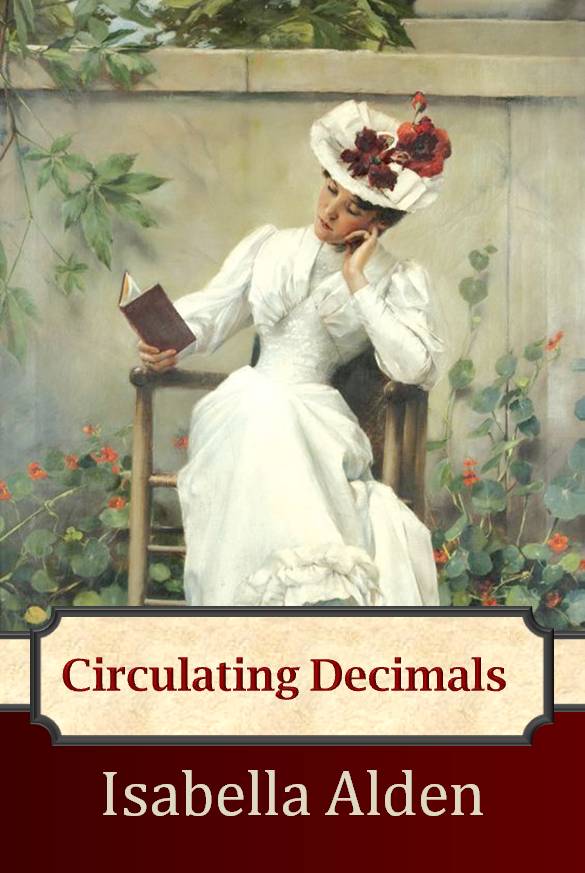
Cover of the story "Circulating Decimals" by Isabella Alden, showing a young woman dressed in the style of about 19095 wearing a white dress with white sleeves and a high color and floor-length skirt. On her head is a white hat with large red poppy flowers. She sits on a rustic wooden chair in a garden, holding a book in one hand, which she is reading, while her head rests on the other hand as her elbow rests on the arm of the chair. Behind her is a stone garden wall with vines and red flowers creeping up the wall.

Isabella’s short story, “Circulating Decimals” is about the efforts of a community to raise money for just such a church library that has fallen into a “disgraceful condition” due to neglect and lack of funds. (You can click here to read the story for free.)

But regardless of size or budget, church libraries had one mission in common: to offer readers books that supported religious instruction, moral development, and the spiritual growth of the congregation.

Churches established committees to evaluate each potential library addition against a set of religious standards. The minister often played a role in recommending or vetoing books, which were also chosen based on their theological soundness and ability to promote standards of Christian living.

The Grace Methodist Episcopal Church of Taunton, Massachusetts had a rather large library of over five-hundred books, and included some of Isabella’s novels, as well as books by Margaret Sangster, E.P. Roe, and other Christian fiction authors.

The church divided their book collection into categories and published a catalog for members of their congregation. The fact that Isabella had ten of her books included in the catalog shows how well the moral messages of her stories aligned with the church’s values and appealed to readers of all ages.

(You can click on the image above to see the entire Grace M.E. Sabbath-school Library catalog of 1904.)

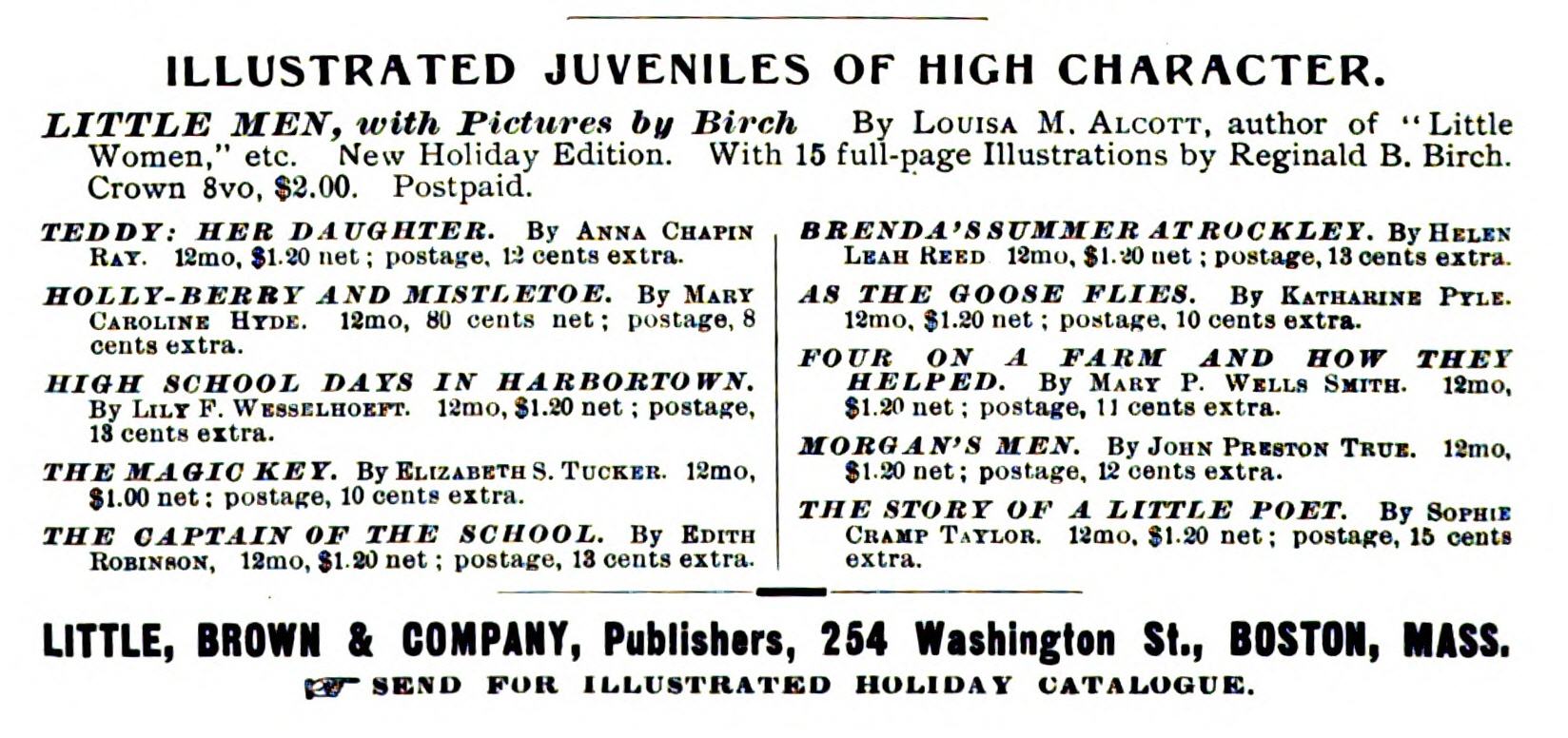
Mainstream publishers like Little, Brown and Company actively marketed their wholesome books to churches. This advertisement in “The Sunday School Library Bulletin” magazine shows their newest offering to churches included a new edition of “Little Men” by Louisa May Alcott:

Magazine ad for "ILLUSTRATED JUVENILES OF HIGH CHARACTER," listing "Little Men" by Louisa M. Alcott in large letters, as well as 10 other books. At the bottom is the name of the publisher, Little, Brown & Company of Boston Mass. with an address to write for an "illustrated holiday catalogue."

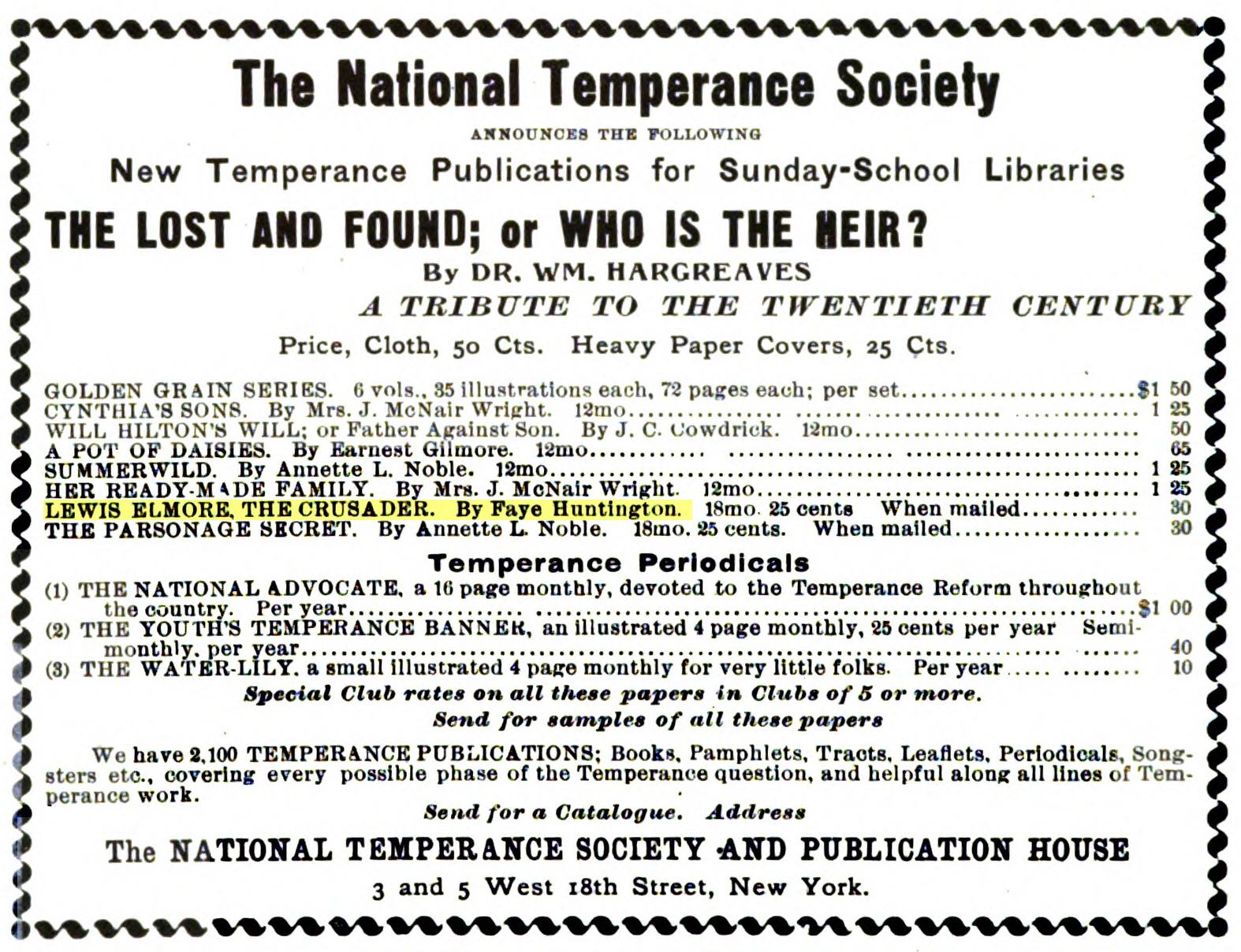
And organizations like The National Temperance Society also marketed their books directly to churches. Their ad below features a temperance novel by Isabella’s friend Theodosia Foster (who used the pen name of Faye Huntington):

Magazine advertisement for The National Temperance Society new publications for Sunday-School Libraries, listing "The Lost and Found; or Who is the Heir?" by Dr. Wm. Hargreaves. It also lists 8 other books, including Lewis Elmore, The Crusader by Faye Huntington, as well as 3 temperance periodicals. It offers "special club rates" and gives an address to send for a catalog and samples of the periodicals.

Church libraries established systems for inventorying and lending books. They assigned an inventory number to each book, and issued library cards to readers.

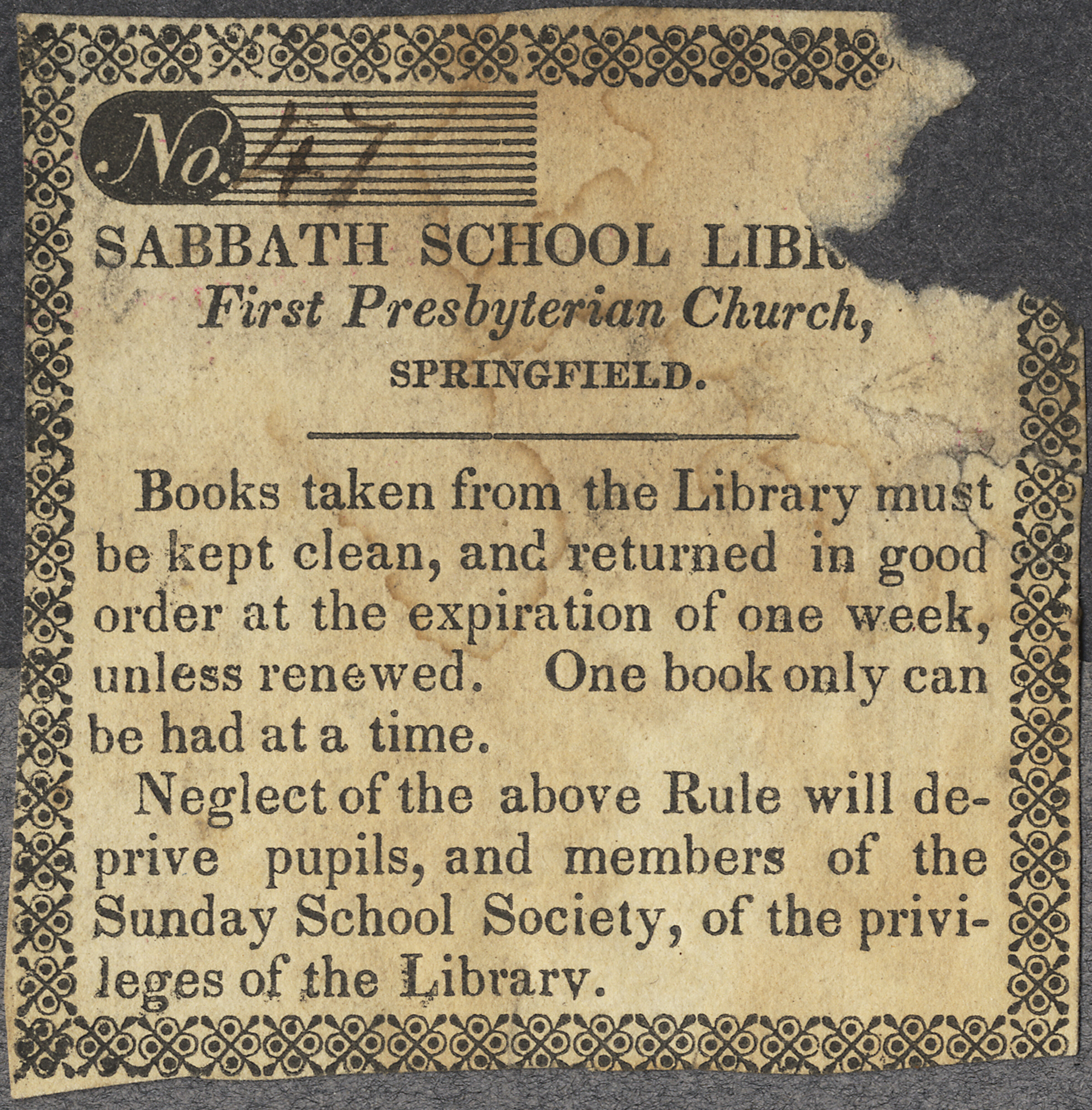
A square label affixed to the inside cover of a book. On the first line of the word "NO" with room to write a number; the number 61 was written and crossed out, and the number 77 written beside it. Below are printed "SUNDAY SCHOOL LIBRARY of the Evengelical [sic] Lutheran Church, Springfield, Ill." The text is surrounded by a fancy Victorian-era design of swirls and dots.
The numbered book plate from a book in the Sunday school library of the Evangelical Lutheran Church of Springfield, Illinois.

They also created rules for borrowing:

A square label affixed to the inside cover of a book. The top line has the book No. 47, then, "SABBATH SCHOOL LIBRARY, First Presbyterian Church, Springfield." Below is typed: "Books taken from the Library must be kept clean, and returned in good order at the expiration of one week, unless renewed. One book only can be had at a time. Neglect of the above Rule will deprive pupils, and members of the Sunday School Society, of the privileges of the Library."

Church libraries were a lifeline for readers, especially in smaller and frontier communities where there were no free public libraries. But that began to change in 1886 when wealthy steel magnate Andrew Carnegie began funding the building of public libraries across the country. By 1923 he had financed the building of over 1,600 public libraries where borrowers could choose from thousands of book titles, including the most popular books of the day.

Old colorized postcard of the public library in New York City showing a sprawling, multi-story building in classical Georgian style with stone steps leading to the entrance flanked by stone columns. The library is located on the corner of two intersecting streets with the tall buildings of the New York skyline in the background.
The New York City Public Library, opened to the public in 1911.

The “safe” books Isabella wrote went out of print, while modern novels by Ernest Hemingway, Edith Wharton, and F. Scott Fitzgerald filled the shelves at public libraries.

Sunday-school libraries still existed, but their influence waned to such an extent that in 1930 a newspaper in Greensboro, North Carolina published an editorial just after Isabella’s death. The editorial fondly recalled the church libraries of years gone by:

There were no sex novels; no crime novels; no filthy “realism,” which portrays the perversions of human nature as if it were life itself. Romance there was, in glorious gobs. Many of the books seeped sentimentality. And always there were happy endings.

He went on to write that Isabella’s books “made for clean lives and happy homes and good society.” In her stories, “the problems were the problems of everyday people trying to be good. If they were somewhat morbid and over-introspective, so was the era for which they were meant.”

Isabella truly did write for the era in which she lived; but it’s important to remember that her books succeeded in Sunday school libraries not just because they met church requirements, but because Isabella had a particular understanding of literature’s purpose—that stories should help readers have a closer walk with God and become better versions of themselves.

Maybe that’s why her “Pansy” novels, despite going out of print, are still read and loved by new readers today, and remembered fondly by those who discovered them on long-ago Sunday afternoons in church libraries.

Does your church have a library? What are the kinds of books it offers?