Everybody Likes Grace!

If you grew up prior to the 1990s, you may remember what life was like before the Internet brought the world into our homes. If you wanted to research a topic, get help solving a riddle, or find the latest best-seller, you went to your local library.

Librarians were the original “human search engines” of their communities. They were masters of the card catalog, date-stamped every book checked out and returned, and stood ready with recommendations to help neighbors find the perfect “good book” to read.

In Marion, North Carolina, county librarian Alice Bryan shared the joys and quirks of her librarian job in a weekly newspaper column. She quickly noticed that readers had some very unique strategies for choosing their next read!
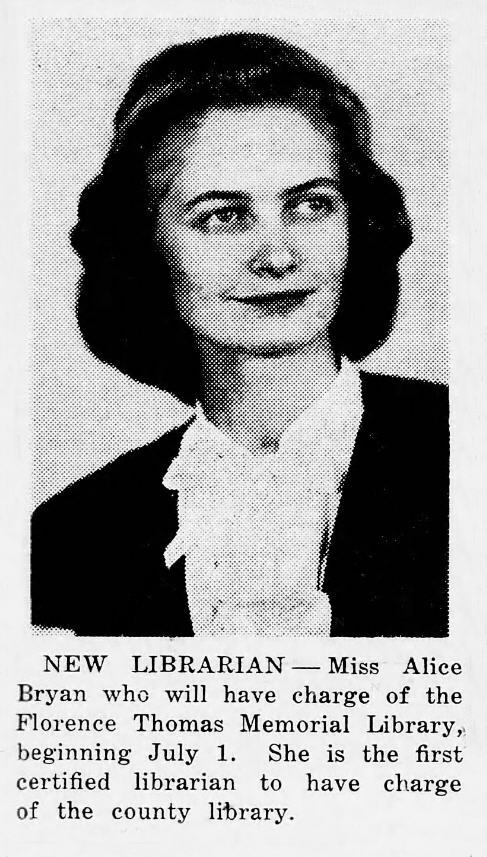
From the “Marion Progress” newspaper, 1946.

When one lady in the library asked, “How can I tell a good book when I see one?” another patron quickly spoke up: “See how many names are on the card!”

(For our younger readers: back then, every book contained a paper card that patrons physically signed when checking it out. A card packed full of names was the ultimate 1940s version of a five-star review!)

Other readers chose books based on its physical characteristics. “Lightweight books are the best,” one lady told Alice, while pre-schoolers often picked their books by size—the bigger, the better!

But when patrons weren’t judging books by their weight or size, an equally large number asked for them by author. Popular authors like Zane Grey, Agatha Christie, and Mary Roberts Rinehart were always in demand—but there was one name Alice Bryan saw flying off the shelves more than any other: Grace Livingston Hill.
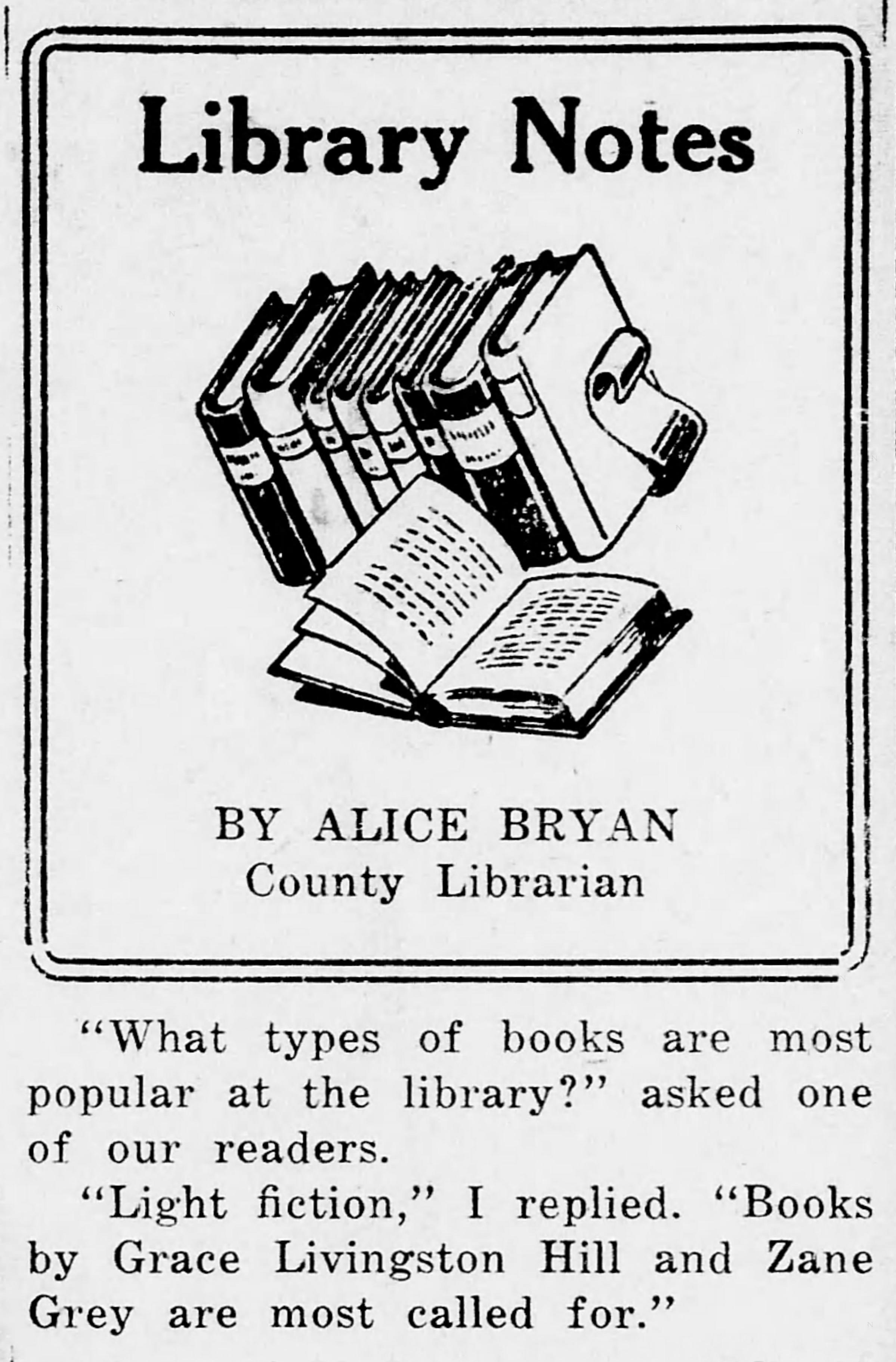
LIBRARY NOTES BY ALICE BRYAN. "What types of books are most popular at the library?" asked one of our readers. "Light fiction," I replied. "Books by Grace Livingston Hill and Zane Grey are most called for."
From the “Marion Progress” newspaper April 3, 1947.

Alice frequently highlighted Grace as a reader favorite for “light fiction.” The appeal of Grace’s books even seemed to cross generations. One day Alice overheard this conversation between a group of sixth-grade girls at the library:
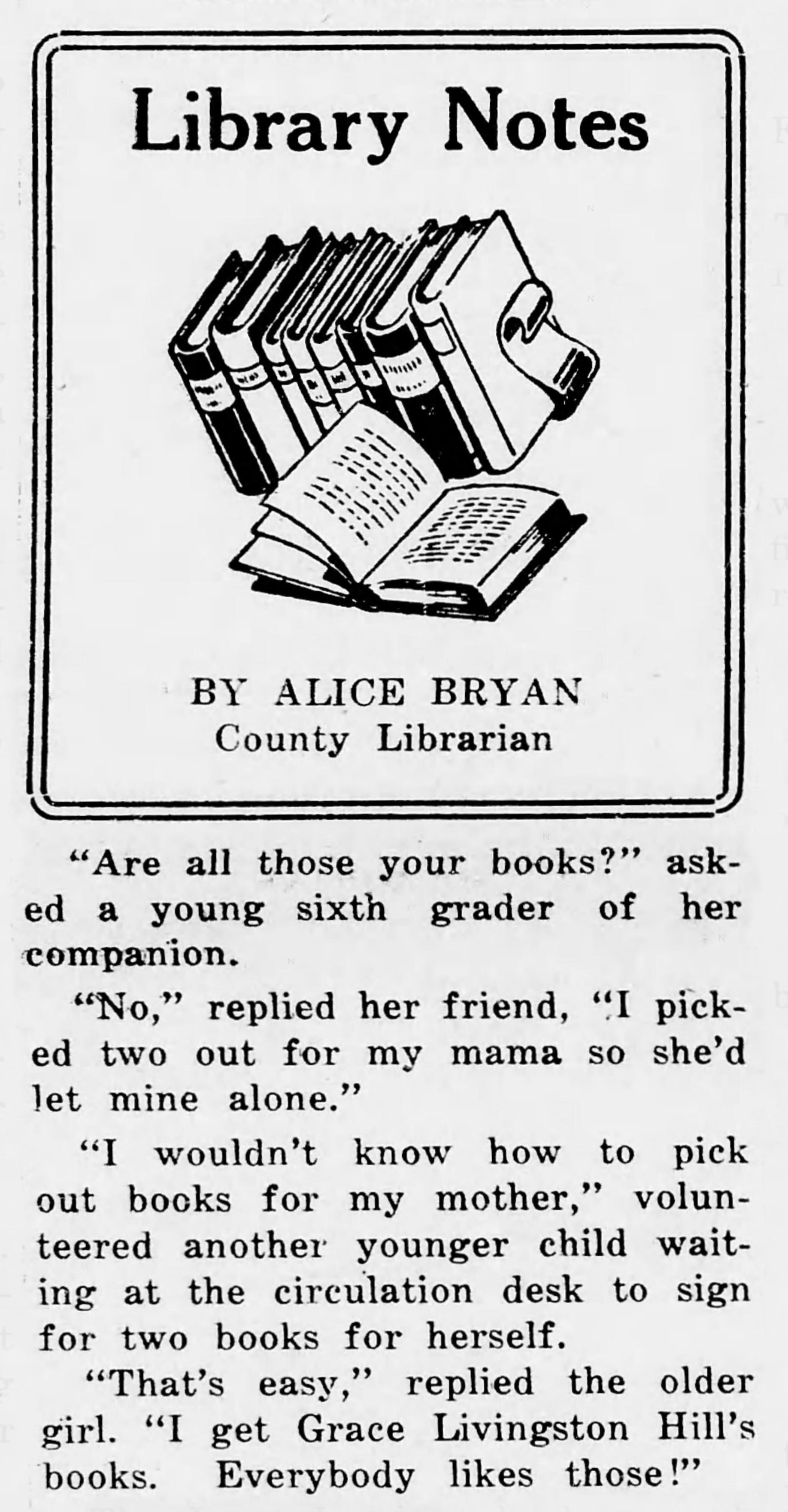
LIBRARY NOTES BY ALICE BRYAN. "Are all those your books?" asked a young sixth grader of her companion. "No," replied her friend, "I picked two out for my mama so she'd let mine alone." "I wouldn't know how to pick out books for my mother," volunteered another younger child waiting at the circulation desk to sign for two books for herself. "That's easy," replied the older girl. "I get Grace Livingston Hill's books. Everybody likes those!"
from the “Marion Progress,” April 17, 1947.

By the mid-1940s, Grace Livingston Hill was at the absolute peak of her writing career with almost one-hundred beloved novels to her credit. In an uncertain, complicated post-World War II climate, readers eagerly sought out her stories for their comfort, warmth, and reliable messages of eternal hope.

Of course, long-time readers of this blog know that Grace’s writing talent was practically a family trait—she was Isabella Alden’s cherished niece. Both women shared a remarkable gift for understanding what readers needed most. By seamlessly weaving messages of faith and comfort into their stories, they ensured that current and future generations of readers knew exactly where to turn for a truly “good book.”

Isabella and the Bottle that Took America by Storm

Between 1900 and 1910 American consumers were introduced to some revolutionary new inventions and products that would significantly change their lives. In 1903 the Wright Brothers powered their first sustained airplane flight at Kitty Hawk, North Carolina.

In 1908 the first Model T Ford automobile rolled off the production line in Detroit, Michigan.

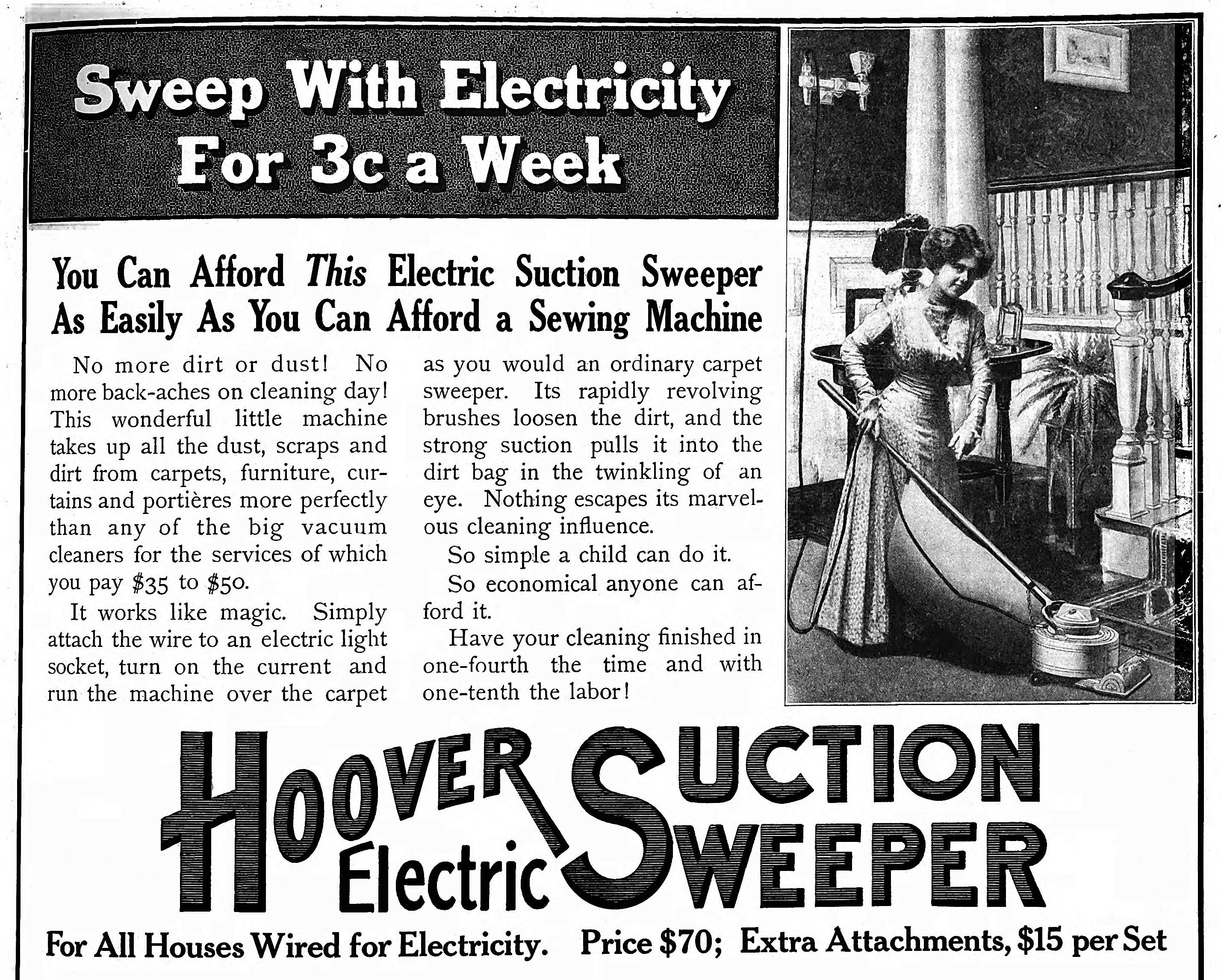
Other inventions during the decade included the safety razor (1901), Cornflakes (1907), teabags (1904), washing machines (1908), and vacuum cleaners (1901).

From a 1909 issue of The Saturday Evening Post.

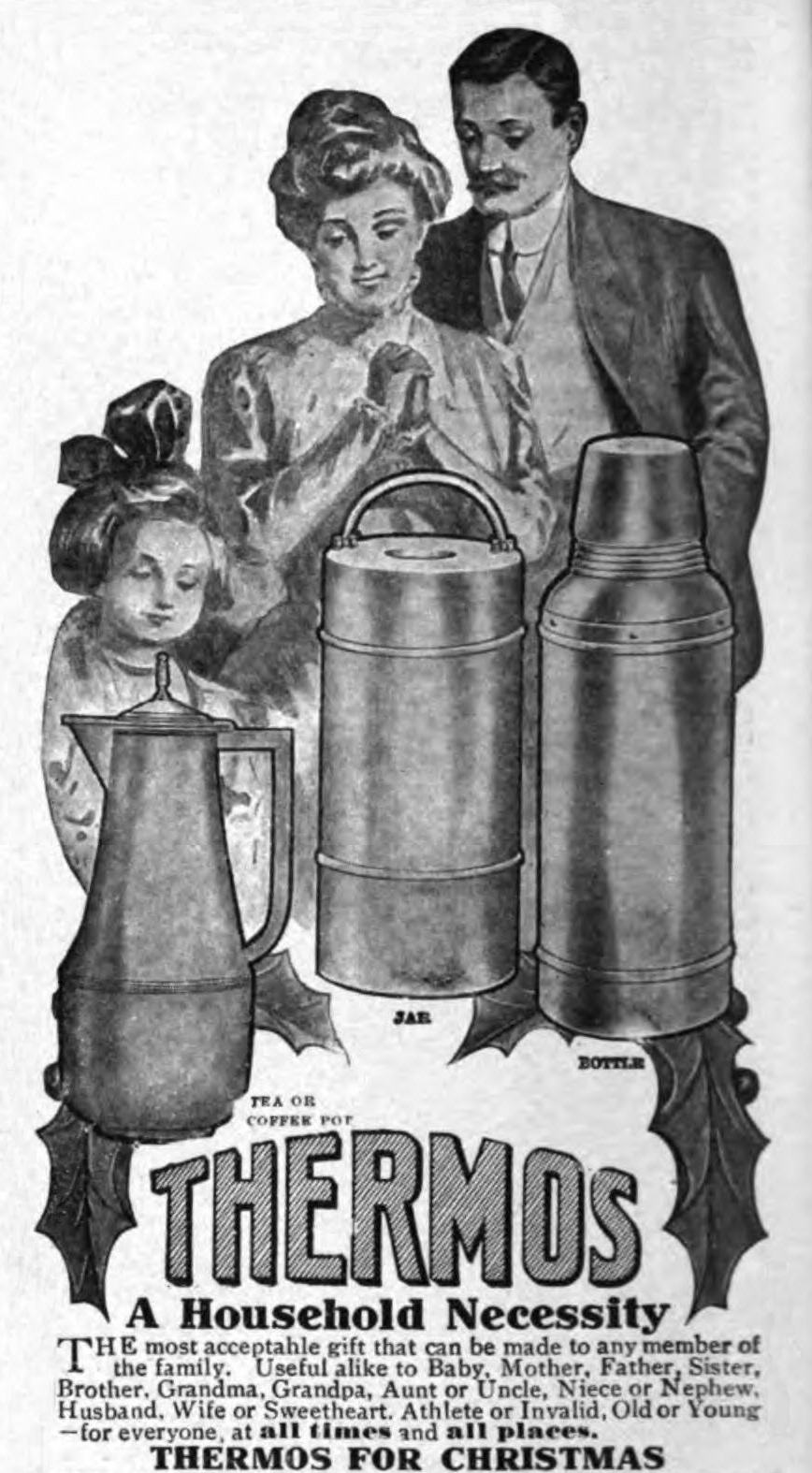
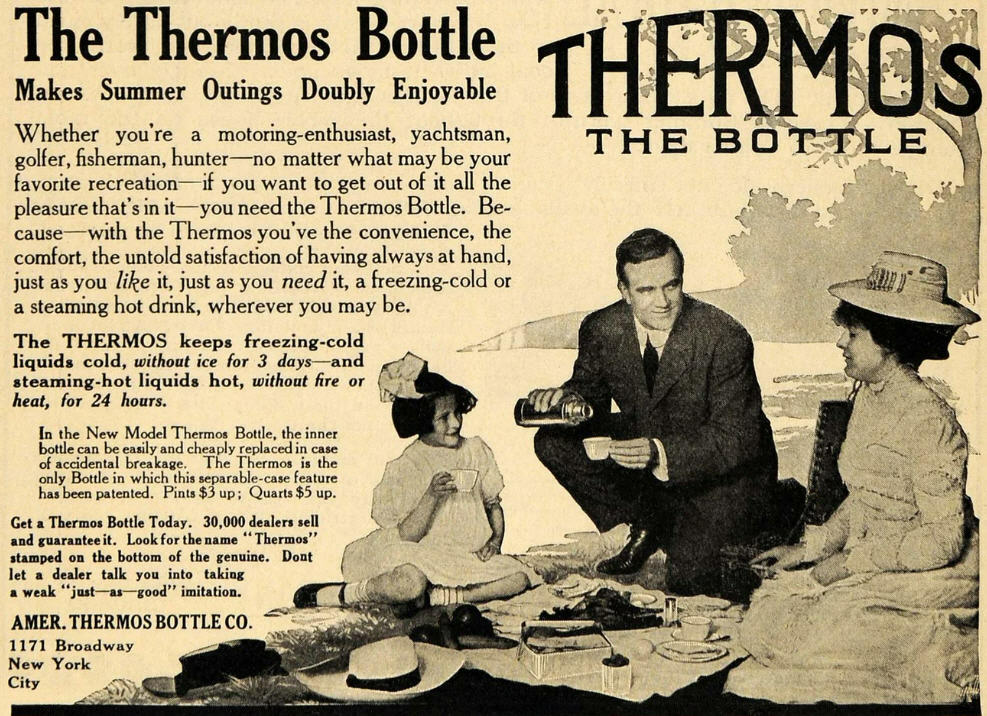
But in 1907, an entirely new product took the country by storm: the Thermos bottle. This cleverly designed vacuum bottle could keep drinks hot or cold for hours—something no other portable container could do.

Ad in a 1909 issue of Life magazine.

It’s easy to imagine Isabella Alden embracing this new invention, especially given the lifestyle she adopted after she and her family moved to California around 1901.

The Aldens settled in Palo Alto, where son Raymond was teaching at Stanford University. A few years later, Isabella and her husband became involved with the newly-founded Mount Hermon Christian camp near Santa Cruz. Mount Hermon reminded her of her beloved Chautauqua Institution, and it quickly became her summertime place of peace where she could rest, read, and worship among the giant redwood trees. Isabella recalled:

“Tent life seemed to belong to it as much as houses belong in most other places. We ate out of doors, and worked out of doors, and practically slept out of doors, with all the curtains of the tent looped high.”

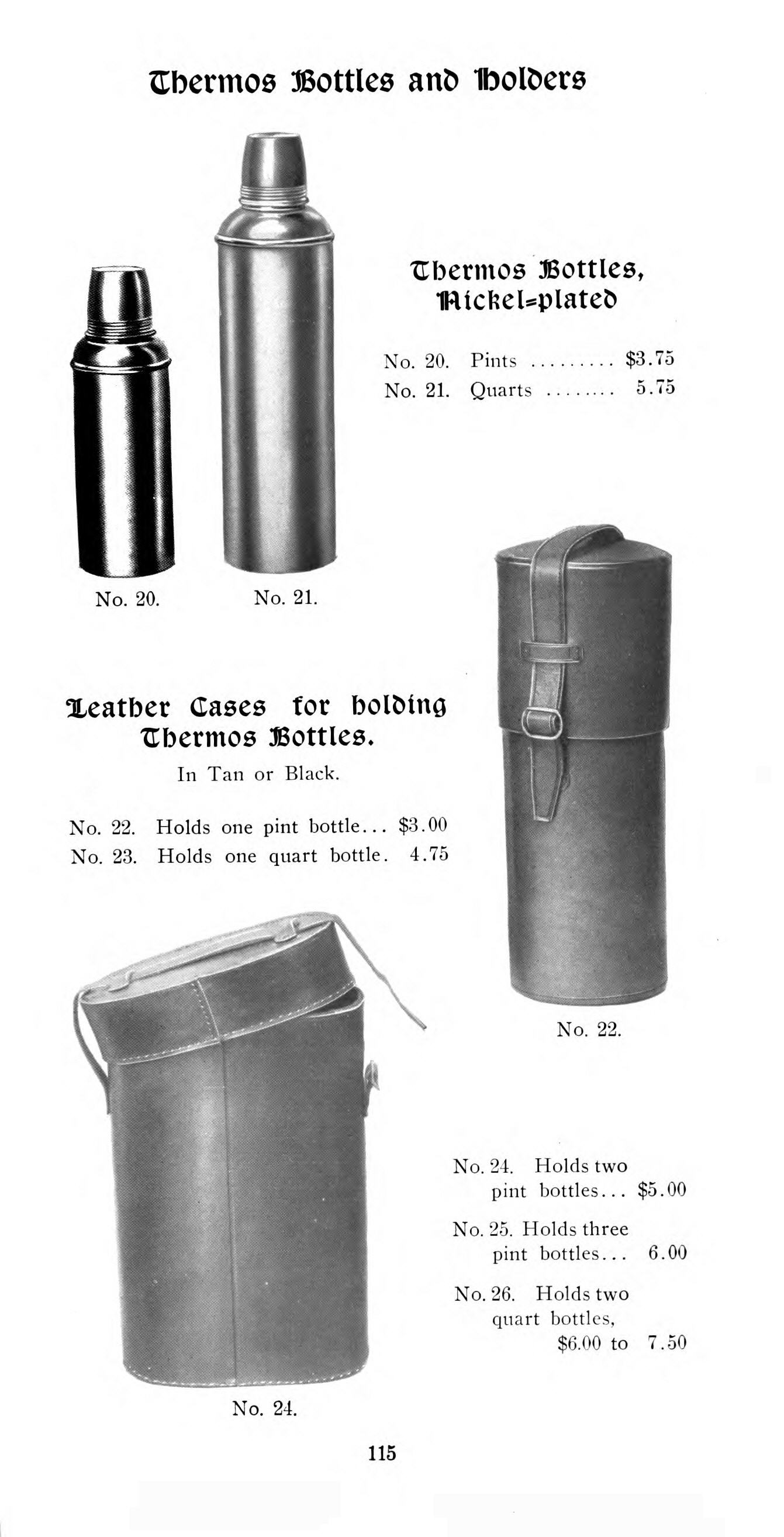
When Thermos bottles first appeared in stores, they were luxury items. Depending on size, prices ranged from $3.50 to just over $5.00—the equivalent of about $125 to $150 in today’s money.

From a 1908 booklet, “Everything for the Autoist but the Auto.”

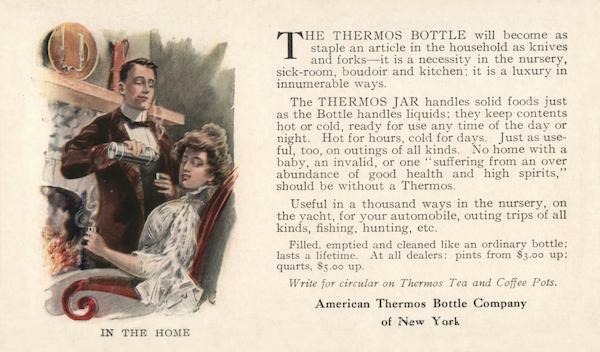
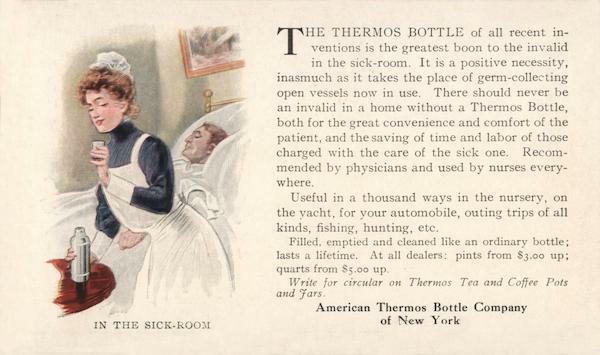
Travelers quickly embraced the Thermos bottle as a necessity worth the investment. Upper-middle class households purchased them, too, using Thermos bottles to keep food and drinks at stable temperatures without relying on wood-fire stoves, electricity, or refrigeration—all expensive options.

One in a series of trade cards distributed by The American Thermos Company.

The American Thermos Bottle Company of Norwich, Connecticut, launched a full ad campaign in magazines, trade journals, and newspapers. As sales increased, they launched additional products—pitchers and carafes, food storage bowls, and even completely furnished picnic baskets. With growing demand came increased production, and by the 1920s Thermos bottles were much more affordably priced.

Isabella never specifically mentioned a Thermos in her memoirs or her stories, but throughout her life she eagerly embraced new inventions and technologies. It seems probable that during those early rustic summer days at Mount Hermon, she might have had a Thermos bottle at her side for a cool drink of water.

Isabella’s niece, author Grace Livingston Hill, was also quick to embrace new inventions, and mentioned Thermos bottles in her novels, including The Prodigal Girl (1929) and The Street of the City (1942). In her novel Ladybird (1930), Grace wrote about the main character Fraley MacPherson marveling over a picnic lunch:

“There were other little packages with other sandwiches, some with fragrant slices of pink ham between them. There were hard-boiled eggs rolled in paper. There were olives and pickles, and chocolate cake and cookies, and white grapes and oranges—a feast for a king! There was coffee amazingly hot in a Thermos bottle. And in the wilderness!”

Thermos magazine ad from 1909

Whether or not Isabella actually owned a Thermos, she certainly lived during one of the most innovative decades in American history—and she took advantage of it. Her writing shows someone who was genuinely curious about new inventions and quick to see how they might improve her daily life. That openness to change and progress is just one more reason her work still feels surprisingly modern today.

You can read more about how Isabella embraced new inventions and technology in these posts:

New Free Read: “Midnight Callers”
A New Luxury
iPhones and Isabella
It’s National Sewing Machine Day
The Edison Connection
“She’s a Beauty”