Mrs. Dunlap is a model wife, mother, and homemaker. She’s the perfect hostess when guests enter her home, and out of the goodness of her heart she has taken a poor neighbor girl under her wing. Why, Mrs. Dunlap even teaches a Sunday-school class and remembers to keep the Sabbath holy!
Given such stellar qualities, Mrs. Dunlap must surely be a model Christian; but one unusually trying Monday begins to reveal the truth of Mrs. Dunlap’s character.
When Isabella wrote The King’s Daughter in 1873, she wrote a novel that was contemporary for her time. In the book, she referenced household items and songs that were popular in 1873.
For example, in chapter eight, Miss Dell Bronson tries to convince Sam Miller to attend a temperance meeting with her.
At first Sam—a man who described himself as having gone to wreck and ruin—is aghast at the idea, but Dell won’t take no for an answer.
Instead, she uses all her powers of persuasion to entice Sam to the temperance meeting:
“Go and try one. I don’t believe you have ever been. We are going to have singing. I know you are fond of music. I heard you singing ‘Molly Bawn’ this morning. I like your voice. I want you to come and help us sing.”
Of course, songs sung at a temperance meeting would not include Molly Bawn; but by mentioning the song in her book, Isabella referenced a popular song her readers would instantly recognize.
Oddly enough, there are many versions of the Molly Bawn song. An Irish version tells the story of Molly Bawn being shot by her lover when he mistakes her for a swan as she hides in the forest.
But the American version—which is probably the version Isabella had in mind—is about a young man hoping to rendezvous with the girl he loves: Molly Bawn.
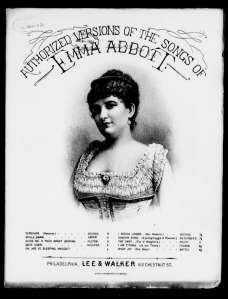
This sheet music, published in 1881, gives the lyrics to Molly Bawn:
The sheet music for Molly Bawn. Click on the image to see the music and lyrics.
.
Molly Bawn was an incredibly popular song that captured and held America’s imagination. The melody was easy; the lyrics were romantic; and if you happened to have the singing voice of an Irish tenor—which may have been true of Sam Miller—the song was practically written for you.
In 1878 a writer named Margaret Wolfe Hamilton (who published under the pseudonym Mrs. Hungerford) wrote a novel loosely based on the song.
The 1904 paperback version of the novel Molly Bawn.
.
The book version of Molly Bawn was an instant success in America. In fact, one of the novel’s characters utters for the first time in print, a phrase we still repeat today:
Beauty is in the eye of the beholder.
Hamilton’s novel was so popular, it remained in print for decades.
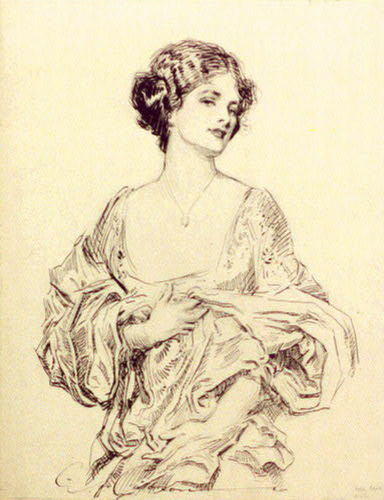
Artist Charles Dana Gibson—famed for his illustrations of The Gibson Girl—was so inspired by the story, he created his own depictions of Molly Bawn:
“Molly Bawn” by Charles Dana Gibson, 1911.
.
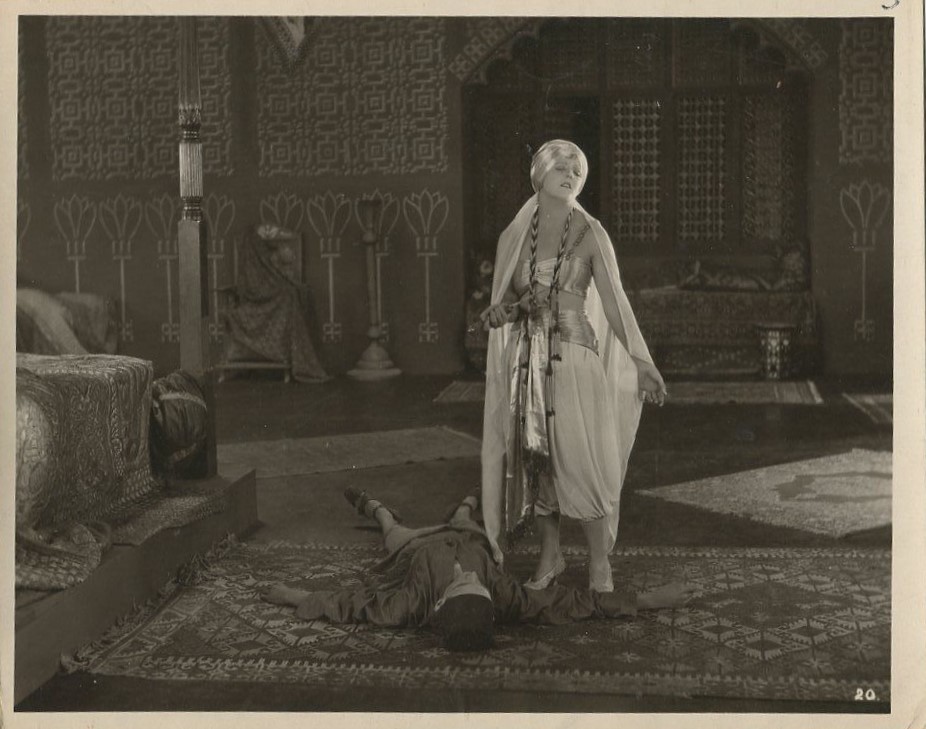
In 1916 a movie of the Molly Bawn story hit theaters. It starred silent film actress Alma Taylor in the lead role.
Film actress Alma Taylor in a scene from the 1924 silent film Shadow of Egypt. She played Molly Bawn in a 1916 film adaptation of the novel by Margaret Wolfe Hamilton (aka Mrs. Hungerford).
.
Clever Isabella! When she dropped the name of the song ‘Molly Bawn’ in chapter eight of The King’s Daughter, she knew she was giving her readers a reference they—and subsequent generations—would readily understand.
This is the second in a two-part series about Isabella Alden’s uncle, Horatio Gates Spafford. If you missed part 1, you can read it here.
After the loss of their children in the wreck of the Ville du Havre in 1873, Horatio and Anna’s sorrow was immense. They returned to Chicago and tried to pick up the pieces of their lives.
Dwight Lyman Moody, circa 1900, from the Library of Congress
.
Their dear friend, Reverend D. L. Moody, was their greatest support and comfort. He begged Horatio and Anna to stay busy, knowing that their silent, empty house would be a great and solemn reminder of the loss of their children.
“Annie, you must go into my work,” Rev. Moody said. “You must be so busy helping those who have gone into the depths of despair that you will overcome your own affliction by bringing comfort and salvation to others.”
Anna promised to follow his advice.
Two years after the tragedy, Anna gave birth to a son, Horatio, who died four years later from scarlet fever.
Horatio Goertner Spafford
.
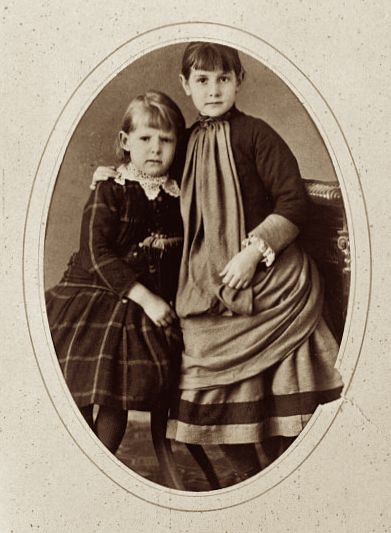
Then their daughter Bertha was born in 1878; two years later, in 1880, Grace was born. Both girls were healthy and hardy and brought them much joy.
Bertha (right) and Grace (left) Spafford
.
But with Reverend Moody’s advice in mind, Horatio and Anna found themselves pulled in a new direction. For years they had been holding prayer meetings and Bible studies in their home at Lake View. In those meetings, they emphasized optimism and God’s blessings in their lives, despite the hardships they had endured.
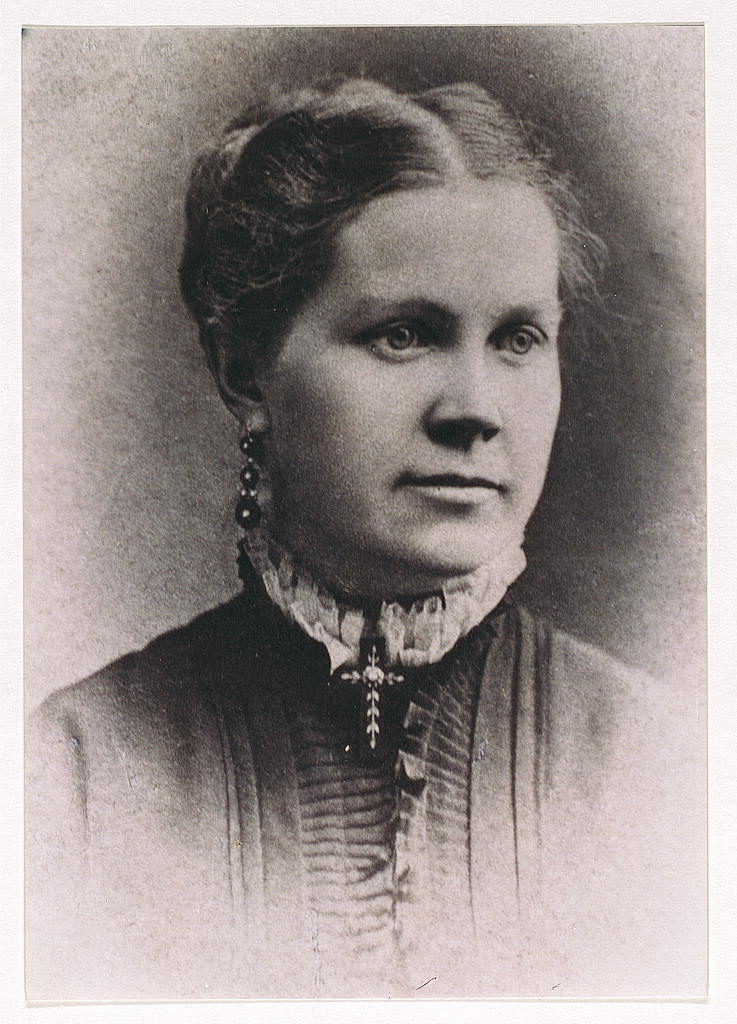
With prayer and reflection, Anna became convinced that she survived the sinking of the Ville du Havre for a purpose.
Anna Spafford
.
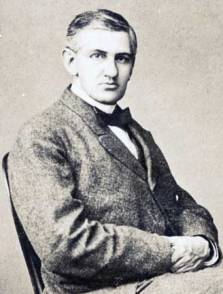
Horatio, too, began to search his life and his faith for an explanation of their loss. As a result, he felt increasingly drawn to a life of service to God, and he felt called to one special place in particular: Jerusalem.
Horatio Spafford
After all he had been through, Horatio wrote in a revealing letter:
“Jerusalem is where my Lord lived, suffered, and conquered, and I, too, wish to learn how to live, suffer and, especially, to conquer.”
After much prayer and thoughtfulness, Horatio and Anna decided to leave America. In 1881, when Grace was still an infant, they led a small group of like-minded American Christians to Jerusalem, where they established a Christian society known as the “American Colony.”
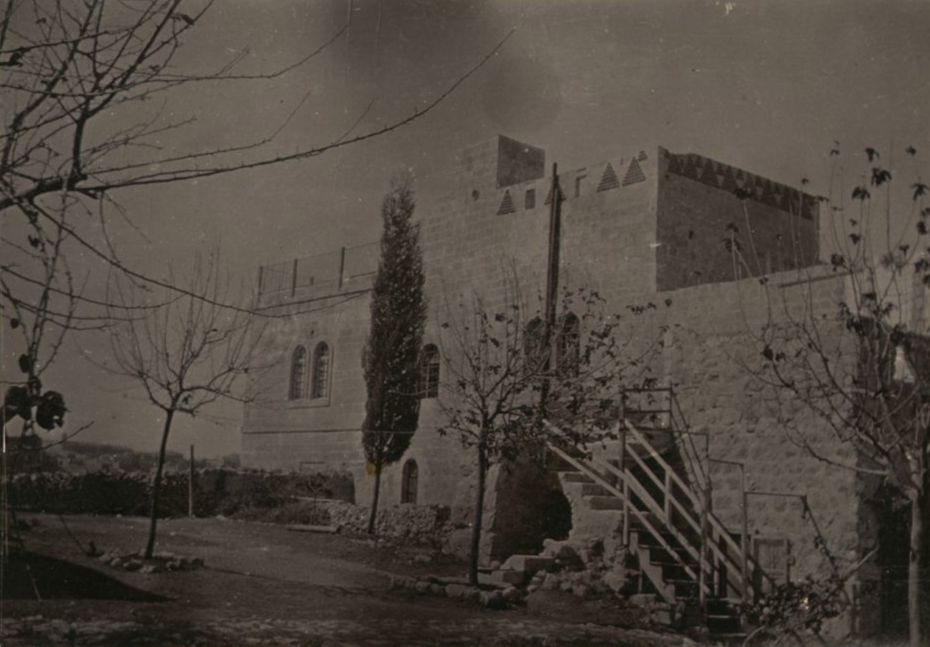
The original house of the American Colony
.
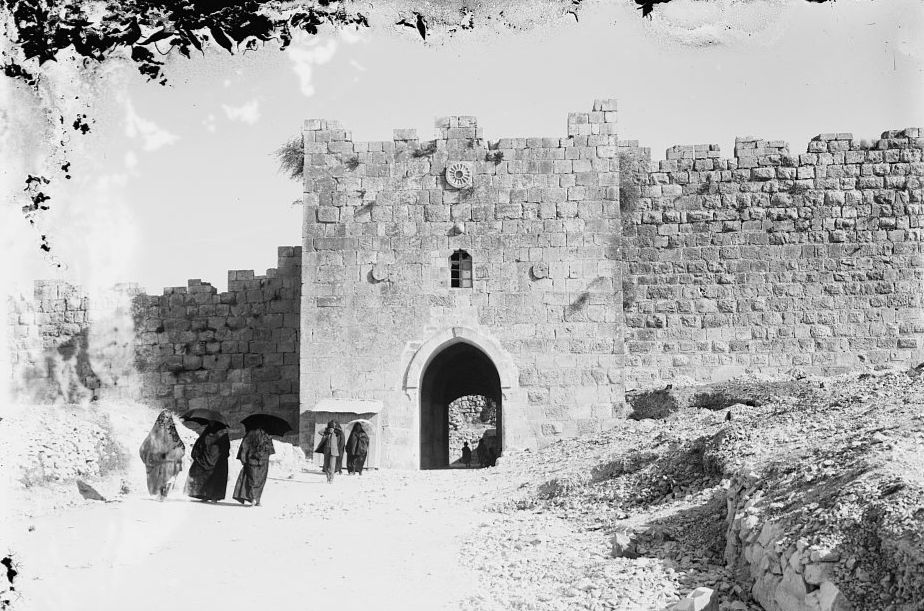
They found a large house in the Muslim Quarter, near Herod’s Gate; it sat high on a hill and all around the house were Muslim, Jewish and Mohammedan slums. This, Horatio and Anna decided, was the house from which they would minister to the people of Jerusalem.
They took the house, along with some property next to it that would make a nice garden; and the entire group moved in and pooled their resources to live under one roof.
Herod’s Gate as it appeared in 1898
.
It was Horatio and Anna’s vision of work to be done that gave the group direction. With the Spaffords as leaders, members of the American Colony devoted themselves to philanthropic work among the people of Jerusalem. Anyone who needed help received it, regardless of their religious beliefs.
Colony members did not preach or proselytize; instead, they first concentrated on building bridges to their new neighbors.
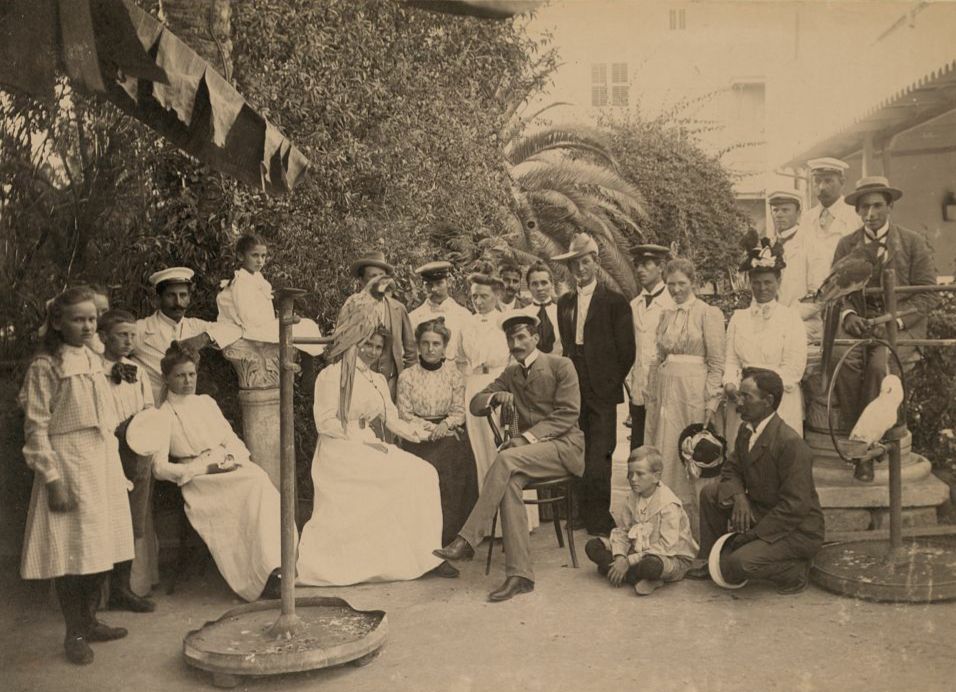
Members of the American Colony at the port city of Jaffa in 1902. Jaffa is famous for its association with the biblical stories of Jonah, Solomon, and Peter.
.
The American Colony provided service to others in any way they could. They ran soup kitchens, hospitals, and orphanages. They soon became trusted friends among the Muslim, Jewish, and Christian residents of Jerusalem.
One of their greatest and most enduring accomplishments was the Spafford Children’s Center, which is still run today by descendants of Horatio and Anna Spafford.
AN ENDURING LEGACY
Horatio Spafford’s efforts in Jerusalem were a success. His love for the Lord transformed his personal suffering into a ministry that helped tens of thousands of men, women and children, and brought countless souls to Christ.
Life in Jerusalem was not without its challenges and hardships. One of the group’s greatest trials came from other Americans who distrusted their motives and spread horrible and sometimes ugly rumors about the group and, in particular, about Horatio and Anna. Some of those rumors persist to this day. Horatio and Anna responded to their critics in the only way they knew how: by following Christ’s instruction to turn the other cheek.
In 1888 Horatio developed a persistent fever he could not shake, and eventually the illness developed into a malignant malaria. For many days he was too weak to get out of bed; the disease sapped his strength and appetite.
Bertha was only ten years old, and Grace was eight, when Horatio, unconscious and emaciated, lay dying. Anna held his hand; and at one point, he opened his eyes and said to her:
“Annie, I have experienced a great joy; I have seen wonderful things.”
He tried to say more, but weakness overcame him, and he fell to sleep again.
He died in his sleep on October 16, 1888 at the age of 59.
Horatio Gates Spafford.
.
Grief-stricken, Anna carried on, and sought comfort in her faith, just as she had on that horrible night at sea eight years before.
Bertha (top) and Grace (bottom) with their mother, Anna.
.
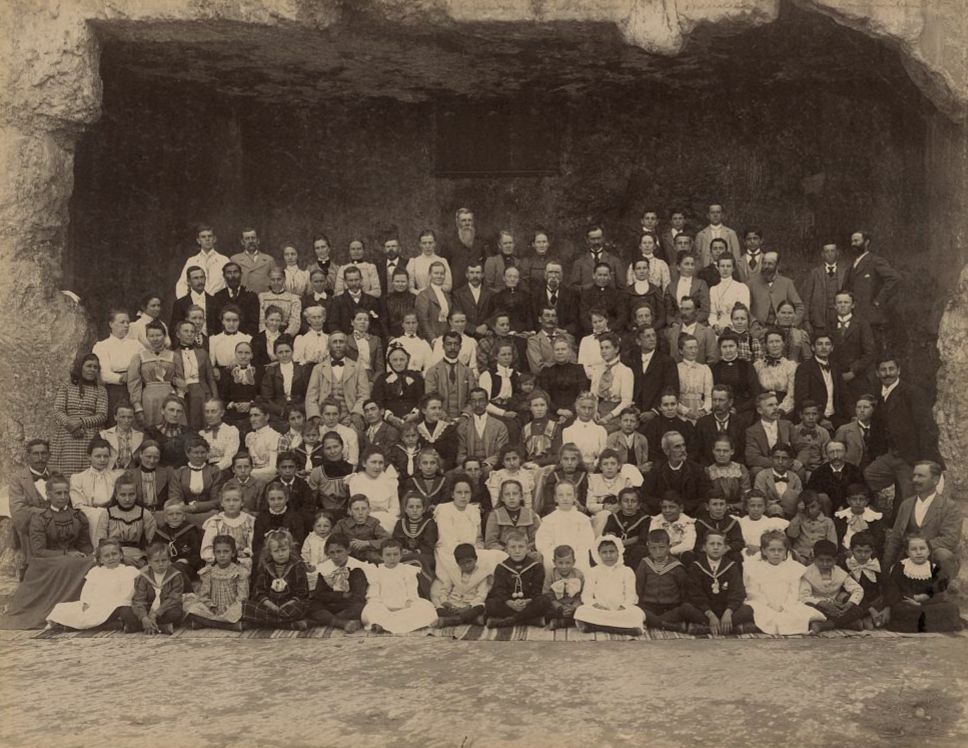
She assumed leadership of the Colony. Under her guidance, the colony swelled from 18 members to over 150. In 1896 the Colony moved to larger quarters near the Tomb of Kings in East Jerusalem.
American Colony members at Tombs of Kings 1901.
.
With Anna’s guidance, the American Colony expanded its ministries, as well. They sponsored an arts club, a drama club, and a literary society, at which everyone was welcome. They even formed a concert band, and gave music lessons.
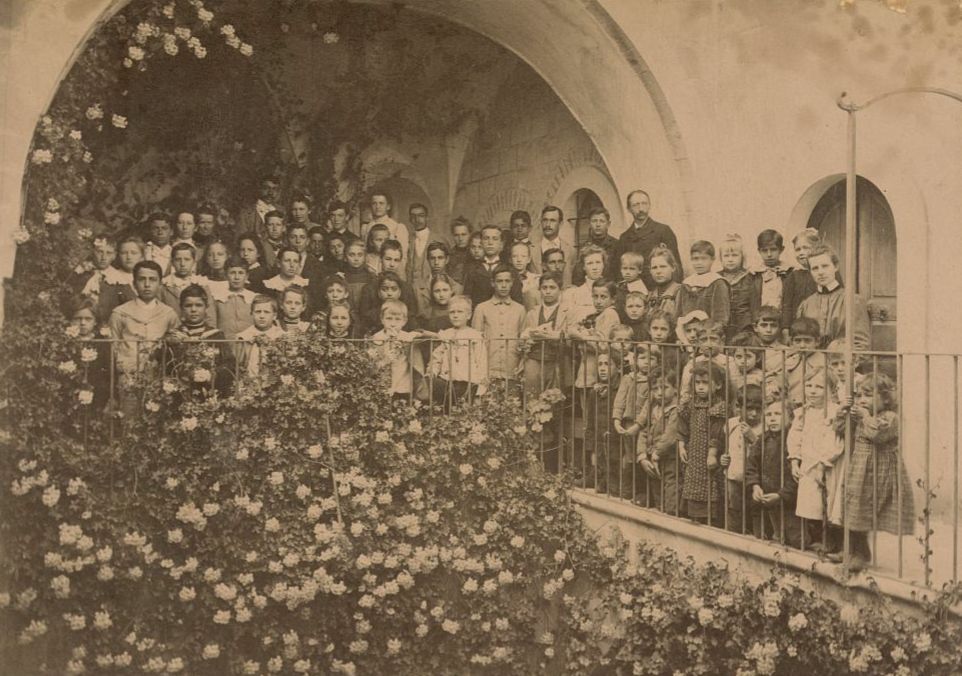
The American Colony school in 1899
.
They started the Moslem Girls School, which provided a basic education, as well as vocational training to young girls, in order to provide an alternative to their culture’s traditional early arranged marriages.
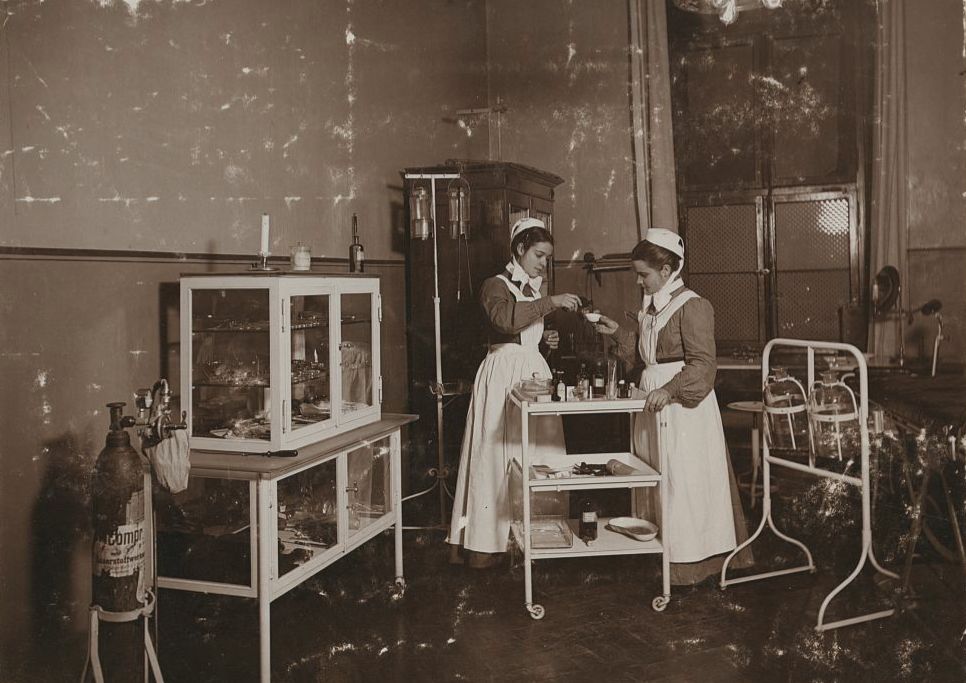
During World War I Colony residents worked in Jerusalem’s hospitals alongside Red Cross workers.
.
They opened the doors of the house, taking in anyone who needed a place to stay, no matter their religion or ability to pay.
As Bertha Spafford, Anna’s eldest daughter, grew into womanhood, she began to play a greater role in the Colony.
Bertha Spafford, age 19, in 1896.
.
Bertha worked beside Anna and later wrote:
My admiration for my mother was greater than all else.
In the spring of 1923 Anna was 80 years old, and her health began to fail. Bertha wrote:
The end came quietly. It was like a candle flickering and finally going out. We were determined that the only note sounded at her funeral should be one of praise for a useful life, which had been a blessing to many.
Hundreds attended her funeral service, while letters and telegrams poured in from all over the world.
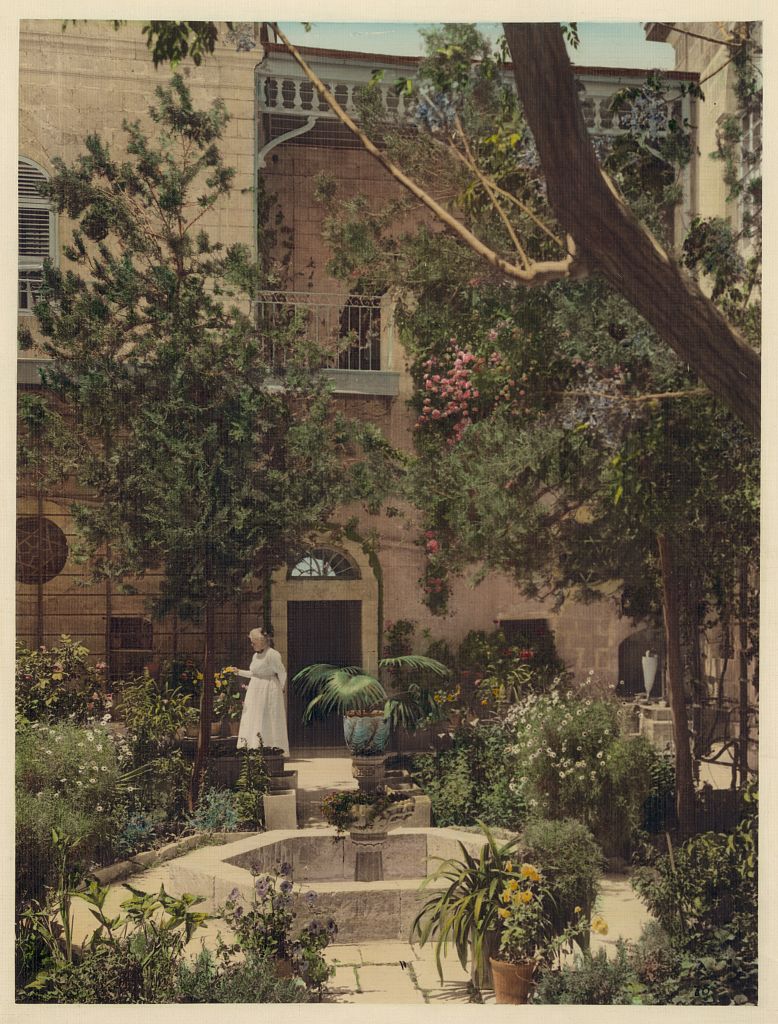
Anna Spafford in the Colony courtyard about 1920.
.
Years later Bertha recalled with clarity one of the prayers spoken at the service:
Life is eternal and love is immortal;
And death is only a horizon;
And a horizon is nothing,
Save the limit of our sight!
Bertha honored her mother’s memory by converting the original Colony residence into a children’s facility. Named the Anna Spafford Baby Nursing Home and Infant Welfare Center, it provided pediatric care and social services to children throughout Jerusalem.
The Anna Spafford Baby Home in Jerusalem.
.
In later years, the name of the Center would be shortened to the Spafford Children’s Center, which still operates today.
Like her mother, Bertha had a remarkable ability to see a need in her community and then work diligently to fill that need. She started an industrial school for boys and men, and a lace-making school for women and girls. During World War I she established an orphanage and foster care system for girls who had lost one or both parents through war, poverty or illness.
Bertha Spafford, about age 60 in 1938.
.
For over sixty years, the American Colony in Jerusalem continued the work Horatio and Anna Spafford began, and ministered to the people of Jerusalem.
Bertha led the way, always with her parents’ vision in mind. Through two world wars and many local armed conflicts, she never wavered in her work or in her selfless devotion to the inhabitants of the Holy City.
Today, the Spafford Children’s Center is still in operation, and provides medical treatment and outreach services for Arab children and their families in Jerusalem. You can read about their work on their website. Just click here.
Some of the residents of the American Colony in 1904.
.
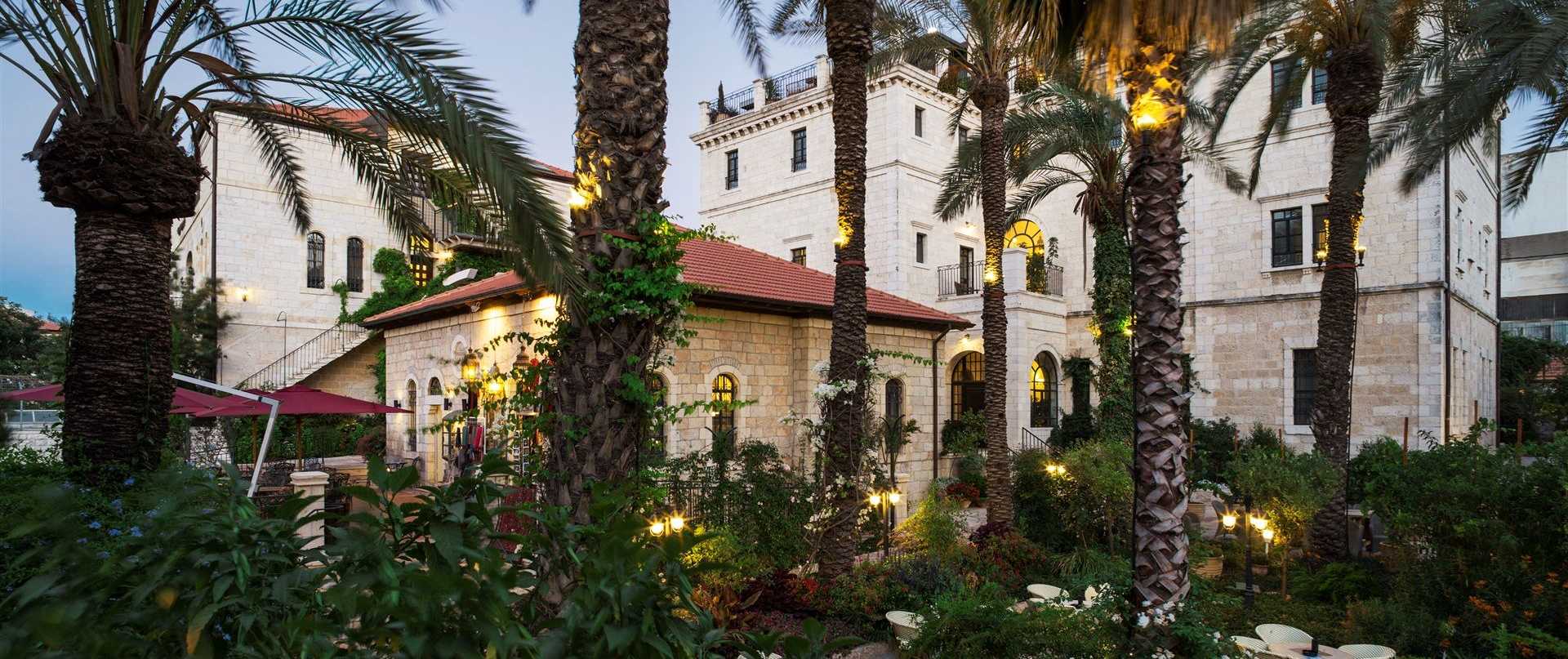
The house that served as the American Colony’s residence still stands with its doors open. It is a thriving hotel owned by the descendants of Horatio and Anna Spafford. It’s a favorite place for journalists, diplomats, and aid workers who visit the Holy City. Some famous guests include Sir Winston Churchill, T. E. Lawrence (Lawrence of Arabia), authors Saul Bellow and John Le Carre, actors Robert De Niro and Peter O’Toole, designer Giorgio Armani, and Soviet President Mikahil Gorbachev.
The hotel as it appears today from the garden.
.
In 1950 Bertha Spafford published Our Jerusalem, a wonderful book detailing her parents’ lives. In the book, she tells the story, as Anna described it to her, of the sinking of the Ville du Havre. It also includes many wonderful accounts of the good work Horatio and Anna Spafford did in Jerusalem. Our Jerusalem is a remarkable story of faith and good works, all done in Jesus’ name. You can read the book for free. Just click on the image below to begin reading.
Isabella’s mother Myra Spafford came from a large family. Her father married twice and Myra was one of twelve siblings from both marriages.
Myra was 25 years old and already a wife of four years by the time her youngest brother, Horatio Gates Spafford was born. Like Myra, Horatio was raised in a home where strong faith in God and service to others were qualities valued above all else.
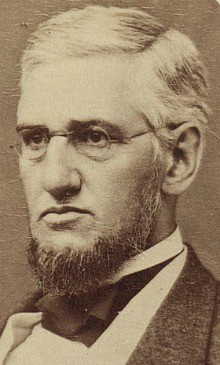
Horatio Gates Spafford
.
Horatio grew up to be an ambitious and energetic young man. A lawyer by trade, he was about 29 years old when he left his family in New York and headed to Chicago to practice law and earn his fortune.
Business card from Horatio Spafford’s law firm
.
Chicago was the perfect place for a man like Horatio. The city was booming—between 1871 and 1880 the population grew by 176,000 people—and Horatio saw opportunity.
While other builders and entrepreneurs concentrated on developing the marshy areas of Chicago close to Lake Michigan, Horatio invested in real estate north of the metropolis. By the time he reached his 42nd birthday, Horatio’s law practice and business investments had made him a very wealthy man.
He was also a husband to his wife Anna, and father to four little girls: Annie, Margaret, Elizabeth, and Tanetta.
Anna Spafford with her daughters Annie, Margaret, and Tanetta.
.
He owned a fine house at Lake View, a north suburb of Chicago. He employed household servants and a French governess for his children.
The Spafford “cottage” at Lake View, Chicago (from the Library of Congress)
.
And though he lived well, Horatio used the majority of his wealth in service to God. He was an active abolitionist prior to and during the Civil War, and he hosted many anti-slavery meetings in his home.
He made evangelical visits to inmates at jails and prisons, helped run prayer and revival meetings, and taught Sunday school at his church.
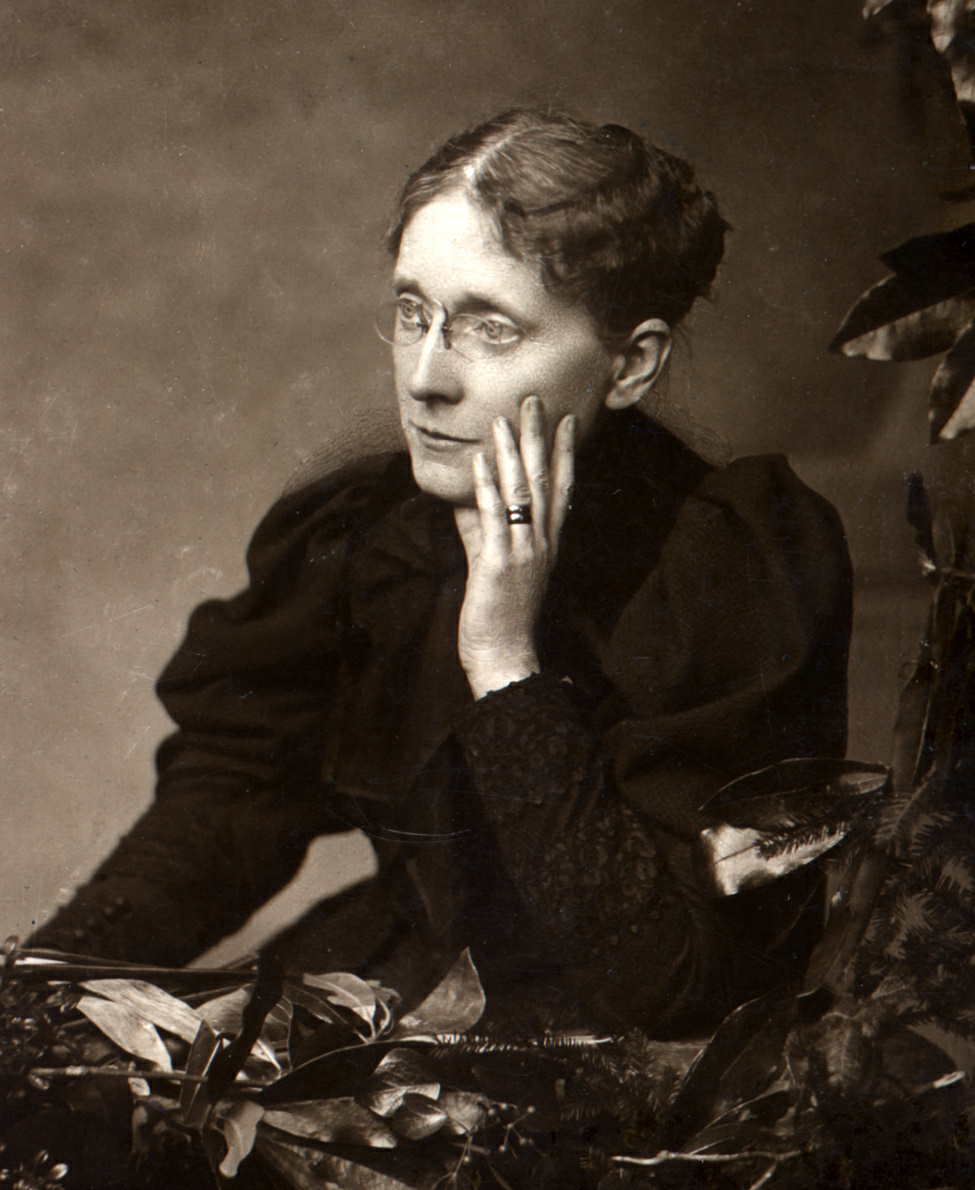
Frances Willard, President of the Women’s Christian Temperance Union.
.
He also supported causes that were dear to his heart, such as the National Women’s Christian Temperance Union. He often welcomed the organization’s president, Frances E. Willard, into his home for extended stays.
The same was true of Horatio’s support for evangelist Dwight L. Moody, who would become a dear and life-long friend.
Dwight Lyman Moody, circa 1900, from the Library of Congress
.
THE TIDE TURNS
Horatio’s youngest daughter Tanetta was only two months old on October 8, 1871, when fire broke out in the city of Chicago. With a poor alarm system, shabbily constructed buildings, and draught-like conditions due to lack of rain, the fire spread rapidly from one wooden structure to another. It raged for two days and destroyed over one-third of the city.
Chicago, after the great fire (from Library of Congress)
.
Although the Spafford home was somehow spared, the city was devastated.
Over 300 people lost their lives, and over 100,000 people were homeless, many of whom survived with nothing more than the clothes on their backs.
.
Horatio—who had invested in real estate in the area of the city that was hardest hit—suffered serious financial losses.
Still, he and Anna opened their home to many people who no longer had a home of their own, and he worked tirelessly to rebuild the city’s churches, businesses, and housing.
Laying the first cornerstone of a new building, as Chicago rebuilds after the fire.
.
In 1873, while he and his wife were still working to help the needy and displaced citizens of Chicago, Horatio received a letter from his friend, Dwight Moody, who was in Europe, igniting a religious revival. Dwight asked Horatio and Anna to join him in London.
Undated photo of Dwight L. Moody from the Spafford family album (from Library of Congress)
.
The invitation could not have come at a better time. Both Horatio and Anna were weary from the stress of their philanthropic work. To add to their troubles, Horatio’s financial condition had become dire, due to a national economic downturn that occurred in 1873.
Horatio and Anna decided to join Dwight in England and live abroad for a year. They set off for New York, along with their children’s governess. Also in their party was a boy named Willie Culver, the twelve-year-old son of close friends, who was returning to school in Paris.
THE VILLE DU HAVRE
When they arrived in New York, Horatio received word that a business deal was in danger of collapsing, and—given the precarious state of his finances—he decided to return to Chicago to salvage what he could of the venture.
Rather than postpone the trip, Anna and the children—along with their governess and Willie Culver—went on to Europe without him.
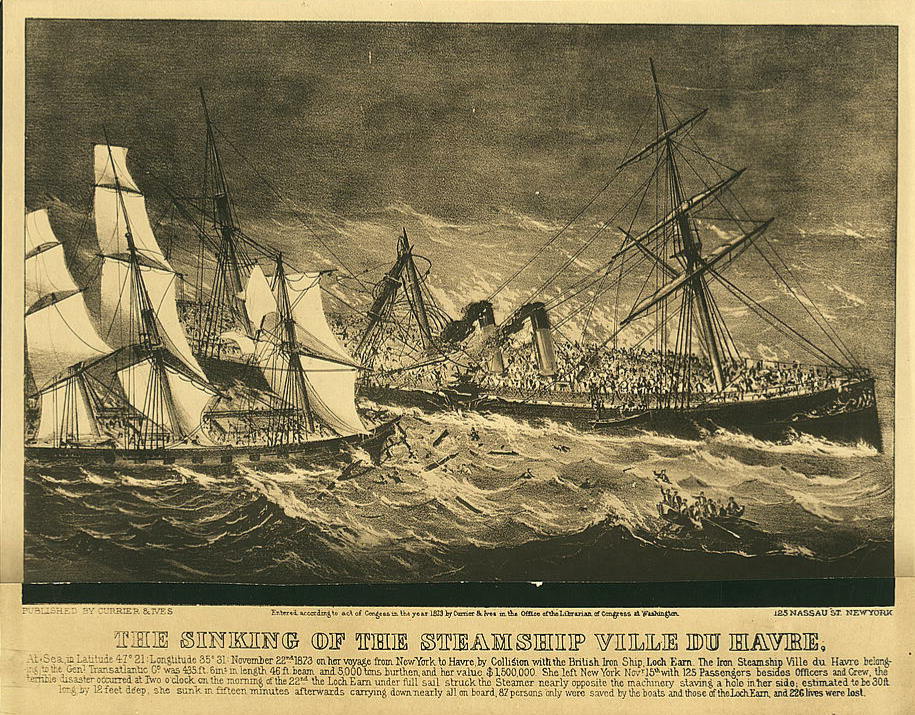
At about 2:00 a.m. the morning of November 21, 1873, in the frigid waters in the middle of the Atlantic Ocean, their ship, the Ville du Havre, collided with an English iron ship, the Loch Erne.
Headline from the Chicago Tribune, December 2, 1873.
.
The impact almost cut the Ville du Havre in two, and it began to sink immediately. Anna led her children, their governess, and Willie, to the deck to evacuate the ship.
.
But only two of the ship’s life boats were deployed, and they were filled primarily with the ship’s captain and crew. Of the roughly 350 people on board, only 87 survived; and of those survivors, 53 were crew members.
Artist’s rendering of the last moments of the Ville du Havre
.
The Loch Erne, badly damaged, turned around and deployed its own boats to find survivors. One of those boats plucked Anna Spafford, unconscious and badly hurt, from the water.
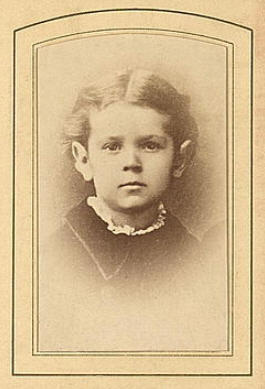
In the darkness of the night, her children Annie (age 11), Margaret (9), Elizabeth (5) and Tanetta (2) were never found.
Annie Spafford, from the Spafford family album.
.
Margaret Lee Spafford, from the Spafford family album
.
Elizabeth Spafford
.
Tanetta Spafford.
.
Also lost were the children’s governess and young Willie Culver.
In Chicago, Horatio received an early morning telegram from Anna that began with the heartbreaking words,
Saved alone.
What shall I do?
The telegram Anna sent Horatio, telling him of the tragedy.
.
Horatio immediately left on the next ship bound for Europe to join Anna. As he crossed the Atlantic, the captain of the ship—knowing of Horatio’s loss—called him to the bridge at one point, and solemnly told him they were about to pass the place where the Ville du Havre went down.
That evening, in his cabin, Horatio took up his pen and wrote the words to “It is Well with My Soul.”
When peace like a river attendeth my way,
When sorrows like sea billows roll;
Whatever my lot, Thou hast taught me to say,
“It is well, it is well with my soul!”
Though Satan should buffet, though trials should come,
Let this blest assurance control,
That Christ hath regarded my helpless estate,
And hath shed His own blood for my soul.
My sin — oh, the bliss of this glorious thought —
My sin, not in part, but the whole,
Is nailed to His Cross, and I bear it no more;
Praise the Lord, praise the Lord, O my soul!
And Lord, haste the day when the faith shall be sight,
The clouds be rolled back as a scroll;
The trump shall resound, and the Lord shall descend;
“Even so, it is well with my soul!”
The original manuscript. written on stationary paper from the Breevoort House, a hotel around the corner from Horatio’s law firm in Chicago. Horatio had some sheets with him while crossing the Atlantic and it was on these that he penned the words to the hymn.
.
In a letter to his sister-in-law a week later he wrote,
“On Thursday last we passed over the spot where she went down, in mid-ocean, the waters three miles deep. But I do not think of our dear ones there. They are safe, folded, the dear lambs.”
In 1876 Horatio’s friend composer Philip P. Bliss took the words Horatio had written and set them to music.
Composer Philip P. Bliss, from the Spafford family album.
.
Philip performed the hymn for the first time in public on November 24, 1876 before a large gathering of ministers, hosted by Dwight Moody.
Since then, “It is Well with My Soul” has become the most widely-used hymn of consolation in modern Christianity.
It has also had a profound impact on those who hear the hymn and learn the story behind it.
Many people have known tragedy and sorrow, reported a North Carolina newspaper in 1908; but even those who have faced hardships think again when they hear Horatio Spafford’s story. As one man told the newspaper reporter:
“I will never again complain of my lot. If Spafford could write such a beautiful resignation hymn when he had lost all his children, and everything else save his wife and character, I ought surely to be thankful that my losses have been so light.”
From The Commonwealth newspaper in North Carolina, February 2, 1908
.
You can read a detailed account of the sinking of the Ville du Havre as it appeared in an Ohio newspaper, the Holmes County Republican, on December 11, 1873. Just click on the image below and read the article in column 7 titled “A Horror at Sea.”
Horatio Spafford’s story doesn’t end here! Despite the many trials and setbacks he suffered, he never lost his faith in God or abandoned his calling to be of service to others.
It’s back to school time across the country, when millions of children return to the classroom.
As a teacher herself, Isabella Alden understood the tremendous influence a teacher had over the minds and hearts of young students.
In 1893 she wrote a short story about a young teacher, her sacrifice, and the rewards she reaped, simply because she did “what she could” for her students.
Now you can read the story for free! Just click on the book cover below to begin reading.
“Nevertheless, she suffered herself to be persuaded to go for a walk, provided Eurie would go to Palestine….Flossy explained to her that she had a consuming desire to wander along the banks of the Jordan and view those ancient cities, historic now.” (Four Girls at Chautauqua)
Sometimes, I really, really wish I could take the Way Back Machine and latch onto Pansy’s group as they enjoyed the apparently mesmerizing lectures by a flamboyant Middle Eastern-born tour guide named Augustus Oscar Van Lennep. Not content to introduce the lakeside miniature Holy Lands that are a relic of Chautauqua’s Sunday School Assembly days, this enterprising, creative fellow dolled up in “Oriental” costume to give his lectures. That’s our man below, lounging in Rajah-like style, while his indulgent friends retain their upright Victorian postures.
Courtesy of the Chautauqua Institution Archives.
.
Gus must have had an equally fun set of folks who joined him—witness his jolly crew of costumed believers at Palestine Park in 1875/6-ish. Can you imagine??? Oh, how much fun must that have been!
Courtesy of the Chautauqua Institution Archives.
.
Alas, today the Park is largely neglected and used more as a family playground than an instructional living map.
I’ve been studying a 1920’s Bible Atlas by Jesse Lyman Hurlbut (Chautauqua lecturer, founding father, and big-time booster) to gain a working knowledge of the Holy Lands. As Dr. Vincent believed, I think understanding the topography and layout, relative distances and terrain of Palestine environs is extremely helpful when reading Scripture. I mean, when you see how far Gideon and his 300 brave soldiers had to track the Philistines, you really do understand why he was so angered when the locals wouldn’t give them any foods to keep their strength up!
According the Pansy’s many charming references to the Palestine Park, students were treated to not only the basic layout, but tiny townscapes and identifying plaques dotted the carefully crafted map. Bible verses connecting each significant stop provided context—and reasserted the importance of the location for the Christ-following traveler.
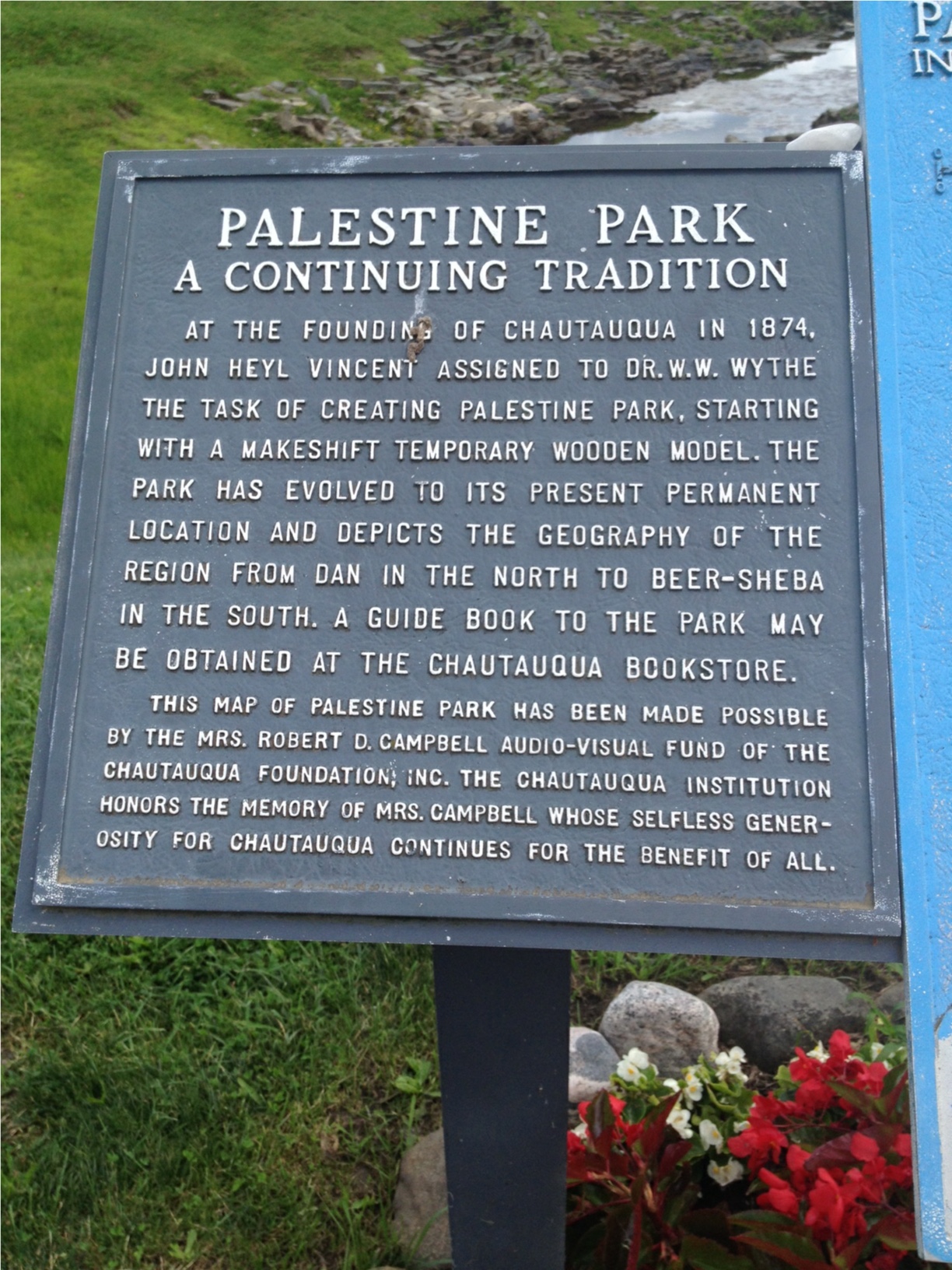
Today, in an effort to keep the residual charm of the place, small cast iron plaques are embedded along the landscape—they’re kept painted and somewhat landscaped. I understand there’s a “tour” each Sunday night and I hope to attend it someday.
I paced off various Bible place names made familiar by my Old Testament studies and was genuinely surprised to see how concentrated a radius these events encompassed. Here’s Jerusalem in relation to the Mount of Olives, only a stone’s throw from Bethany.
Mount Hermon in the distance provides the perfect “king of the hill” locale for the resort’s kiddie population. The impressive crevasse made me wonder if erosion hadn’t made the Jordan Valley a bit too deep?
“Here we are, on ‘Jordan’s stormy banks…I suppose there was never a more perfect geographical representation than this.” (Four Girls at Chautauqua)
Compared to the vintage postcards you’ll find in this blog’s archived Chautauqua posts (see the links at the conclusion of this post), I’d say the accuracy factor might be off a bit these days.
I found it charming that Jericho was in “ruins”—the flat-topped ancient buildings crumbled and scattered, like those of Hebron (though I’m not certain these ruins were intentional.)
Is someone is tending Jacob’s Well? Even on the dry day I visited, it was filled with water.
My favorite? The truly little town of Bethlehem.
I read the plaque as I exited the park, wistful at the thought of those tent-dwelling Sunday School teachers, nestling eagerly beside the “Mediterranean Sea” and along the shores of the Jordan, to understand more about the lands their spiritual ancestors walked.
What would they make of this rarely visited, gently poignant reminder of the Park’s original purpose? Today, no Bible markers or tablets grace the small stony stand-ins, no tiny replica buildings remain to represent scenes from the life of Jesus as they did in Pansy’s time. I turned my gaze to Chautauqua Lake, imagining the steamer pulling up to the nearby dock and unloading four lively 19th century girls, eager for fun, not knowing they would never be the same, thanks to their time in this beautiful place.
“Now, the actual fact is, that those three people wandered around that far-away land until the morning vanished … They went from Bethany to Bethel, and from Bethel to Shechem, and they even climbed Mount Hermon’s snowy peak and looked about on the lovely plain below. In every place there was Bible reading …” (Four Girls at Chautauqua)
Thanks for allowing me to share these mementos with you of my all-too-brief Chautauqua visit. My hope and prayer is to return soon to follow further in Isabella’s footsteps.
My fascination has led me to launch a tribute Chautauqua Literary & Science Circle reading plan—I’m pairing 19th century texts with contemporary works and next August, I hope to carry the Pansy Year banner in the Recognition Day parade. Interested readers can follow along with my literary journey at my blog, The Hall in the Grove.
Dusting off my sandals, Karen
.
If you missed previous posts about Chautauqua Institution, you can read them by clicking on the links below:
“I was coming down the hill, away off, you know, by the post office…” (Four Girls at Chautauqua)
A walk through Bestor Plaza, toward the fountain and the library beyond.
.
“All the younger portion of the congregation seemed to be rushing back up the hill again…” (Four Girls at Chautauqua)
On day two of my Chautauqua wanderings, I stopped for a breather in lovely Bestor Plaza (the perpetual hill-climbing here is murder!). This carefully tended, beautifully landscaped watering hole and gathering spot commemorates the life and contributions of Arthur Bestor, Chautauqua’s president from 1915 to until his death in 1944.
The keynotes of his presidency are struck in the centrally placed fountain, where monumental icons to Knowledge, Religion, Music, and Art dominate the waterworks.
While I cooled my heels and absorbed the view, I noticed a Post Office in one corner of the Plaza and followed my curiosity there.
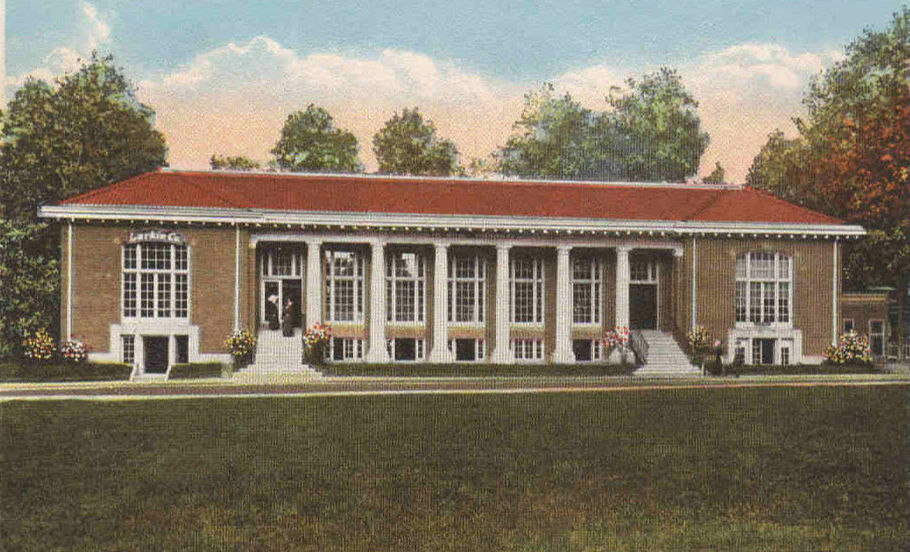
The Chautauqua post office, as it appeared in the 1920s
.
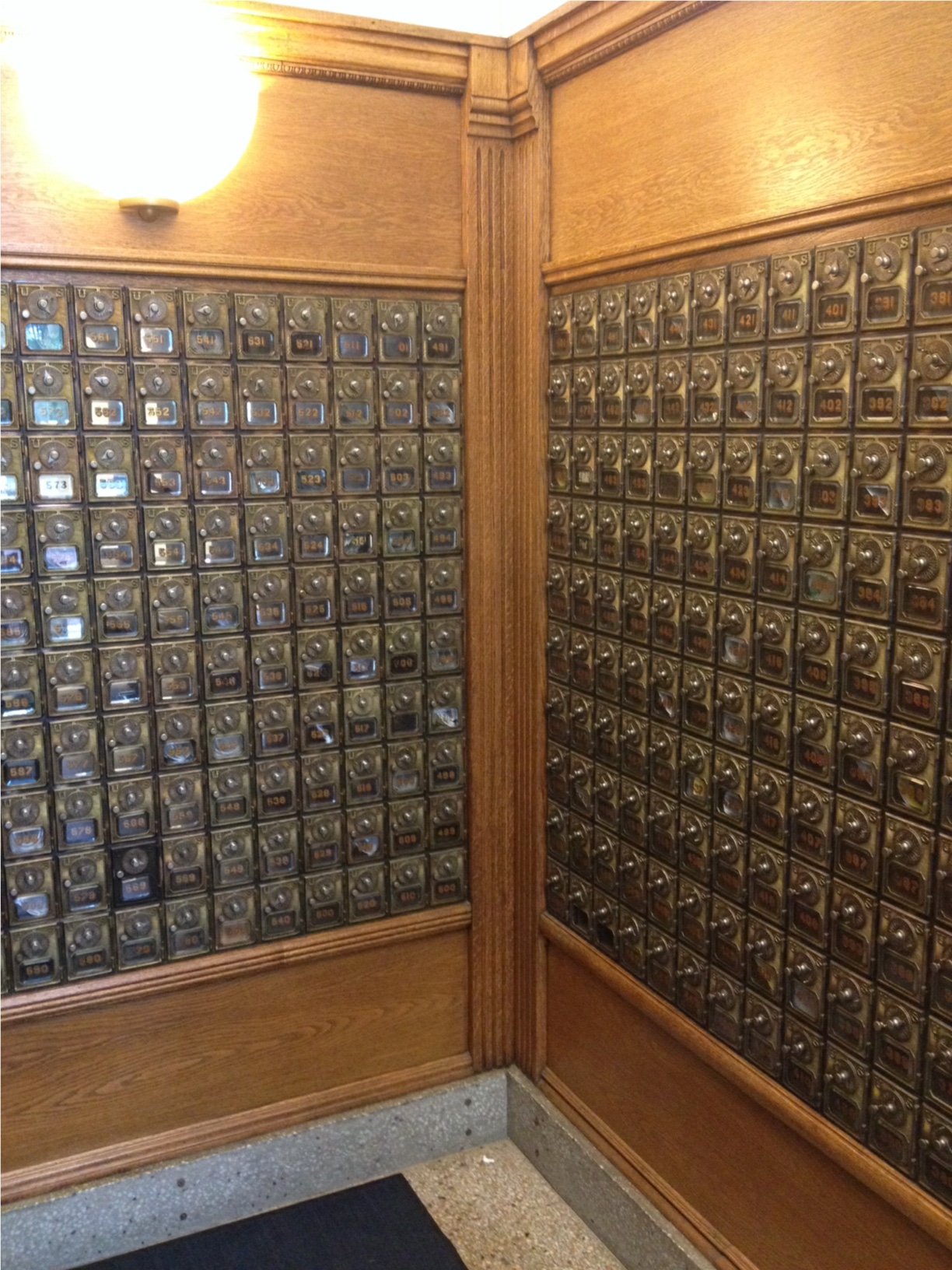
Hoping to find postcards, I instead found a delightful hybrid of contemporary governmental efficiency and mid-Victorian charm. No one was around to quiz about the dates and history, so I let my imagination wander as I snapped these personal postcards.
Did Isabella post a few notes to her friends from this window?
Did Pansy receive some of her fan mail via one of these charmingly designed post office boxes?
Did someone from the Alden household purchase stamps here?
Did Pansy send her niece Grace to claim a package here?
Did this busy hive of cubbies shelter a stirring new work by a favorite author for Pansy to read sitting on a lakeside rustic bench?
How many newspapers passed through here to enlighten and entertain the 19th century crowd?
Discovering artistically elaborate fittings like these for something as pedestrian as mailboxes confirms my belief that Chautauqua’s ongoing commitment to enriching every aspect of life is more than lip service. Their original ideals of glorifying each element of one’s life—dedicating it to the Lord and ennobling the humblest of tasks—is inspiring and convicting.
Take a close look at the door frame of the Postmaster’s office. See the totally unnecessary but utterly beautiful detail there? Maybe it’s time for us to imitate those who recognized that every moment of our days, no matter how mundane, can be an opportunity to worship the Creator Who made all things beautiful?
.
Finding my roots (and leaves and blossoms)
“The museum was not; it had not yet been evolved. Neither had the lovely hall. Where it stands was a grove…I dreamed out many a flower-strewn path leading to it…” (Eighty-Seven)
As I left the Post Office, I admired the plaza’s beautiful flower beds, brimming with summer’s prettiest blooms.
The flowers reminded me of yesterday’s pilgrimage to The Hall in the Grove and some touchingly innocent 19th century floral-themed mosaics that wreathed the speaker’s platform, celebrating the C.L.S.C.’s earliest classes. Can you even imagine a contemporary co-ed reading circle allowing themselves to be dubbed “The Pansy Class”? Hardly.
I loved all these timeless tributes, but one class year stopped me in my tracks. There they were, my spiritual, cultural, and literary “ancestors”—the C.L.S.C. Class of 1884: “Irrepressibles.” While I obviously feel a deep kinship with all things Pansy, I must admit everything in me said “Yes!” as I stood, motionless, before this joyful declaration of literary enthusiasm.
So, this day, while I enjoyed the blaze of seasonal glory, I nodded a special ‘hello” to my new favorite flower, the confident, courageous lily. The buoyant Class of 1884 couldn’t have a better floral representation than the trumpet-shaped blossom that symbolically celebrates Christ’s promise of eternal life.
.
Irrepressibly His, Karen.
.
In her final Postcards guest post, Karen guides us on a walk through Chautauqua’s miniature Holy Land.
If you missed previous posts about Chautauqua Institution, you can read them by clicking on the links below:
Karen Noske joins us again to share photos and descriptions of the Chautauqua landmarks she explored this summer, with Isabella Alden’s novels in mind. Welcome back, Karen!
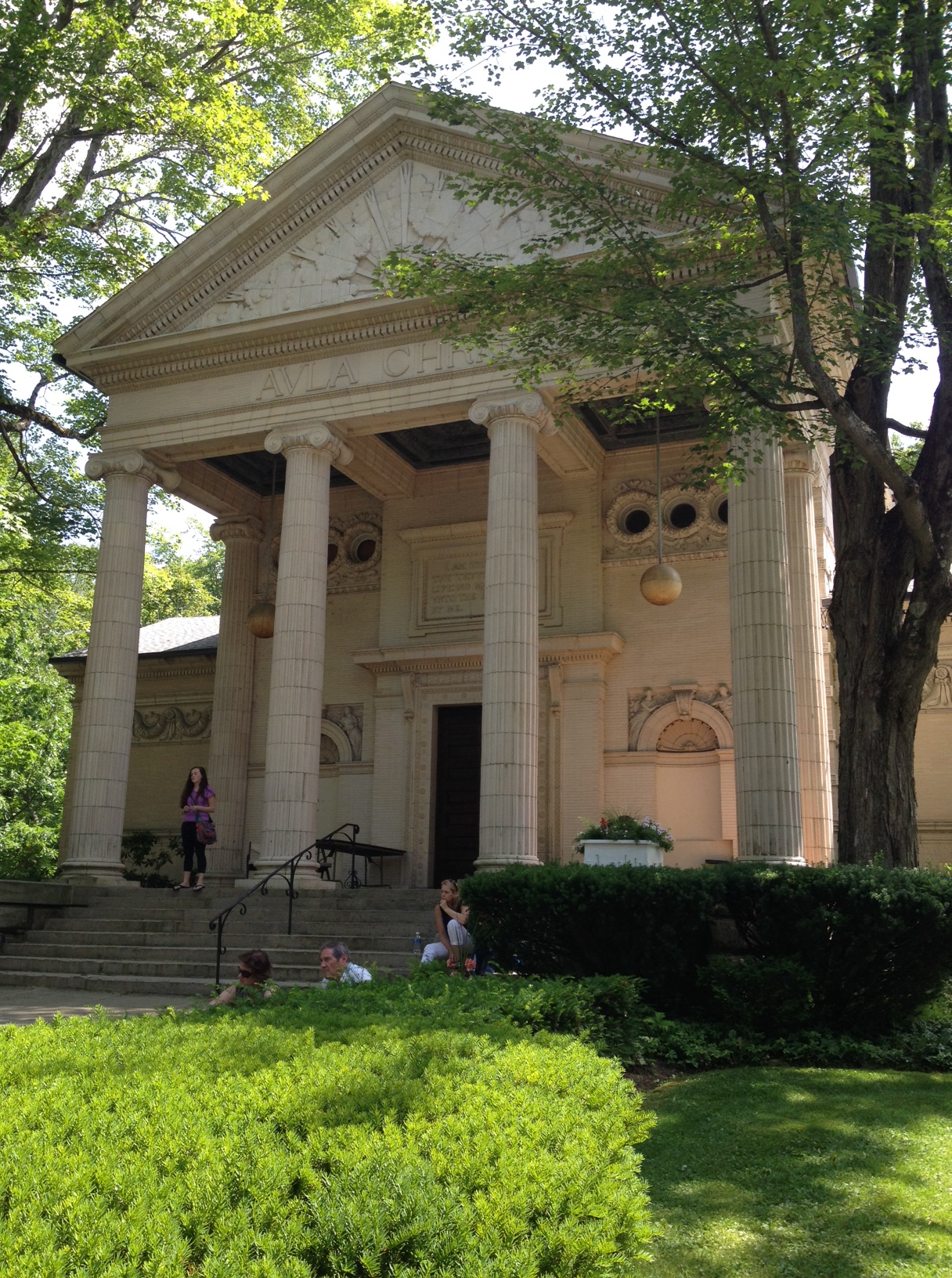
My next objective was the Hall of Christ, as there was an archival lecture to be given momentarily on one of the most influential early religious leaders at Chautauqua, the renowned Shailer Mathews.
I imagined how Isabella might have felt, sitting in this arena, listening to contemporary reflections on the man whose influence changed the course of the Institute in so many ways.
The Hall of Christ, as it appears today.
.
“The Hall of the Christ, is first of all, to stand in the center of Chautauqua to represent Christ as the center of all learning and all true living; the Key to the true and eternal wisdom…a Hall where Jesus Christ is enthroned; where only his story is allowed; told in print and picture and sculpture and the human voice. Isn’t it grand!”
(Four Mothers at Chautauqua)
The workmanlike interior of the unprepossessing Hall of Christ makes me wonder if there haven’t been many changes to it over the years.
The Hall of Christ as it appeared in 1909
.
The general atmosphere is one of beneficent neglect and exhaustion. A magnificent organ dominates the stage—sadly, it was eclipsed by the speaker’s screen and I only got this tantalizing glimpse of it.
.
Engrossing as the lecture was, I was glad to make my way out towards my next objective—the centerpiece of Chautauqua for Isabella and, as it turned out, for me.
The Hall in the Grove
Directly adjacent to the Hall of Christ is the cherished “Hall in the Grove.” I recognized it immediately by its prominence and its beauty:
“If you have up to this time been even a careless reader of this volume, you have doubtless discovered that the center of Chautauqua life was the ‘Hall in the Grove.’ A beautiful grove, with trees old enough and grand enough to be worthy of their baptismal name—”St Paul’s Grove.” White-pillared, simple, plain, yet suggestive of such a brilliant past and hinting of such a glorified future … this bit of green and white, with a glimmer of lake between.”
(The Hall in the Grove, page 286)
.
The dedication plaque on the “Hall in the Grove” reads, “Erected in 1900 on the site of an earlier wooden hall placed here in 1879. This building was erected by the generous gifts of members of C.L.S.C. classes and other friends of Chautauqua.”
.
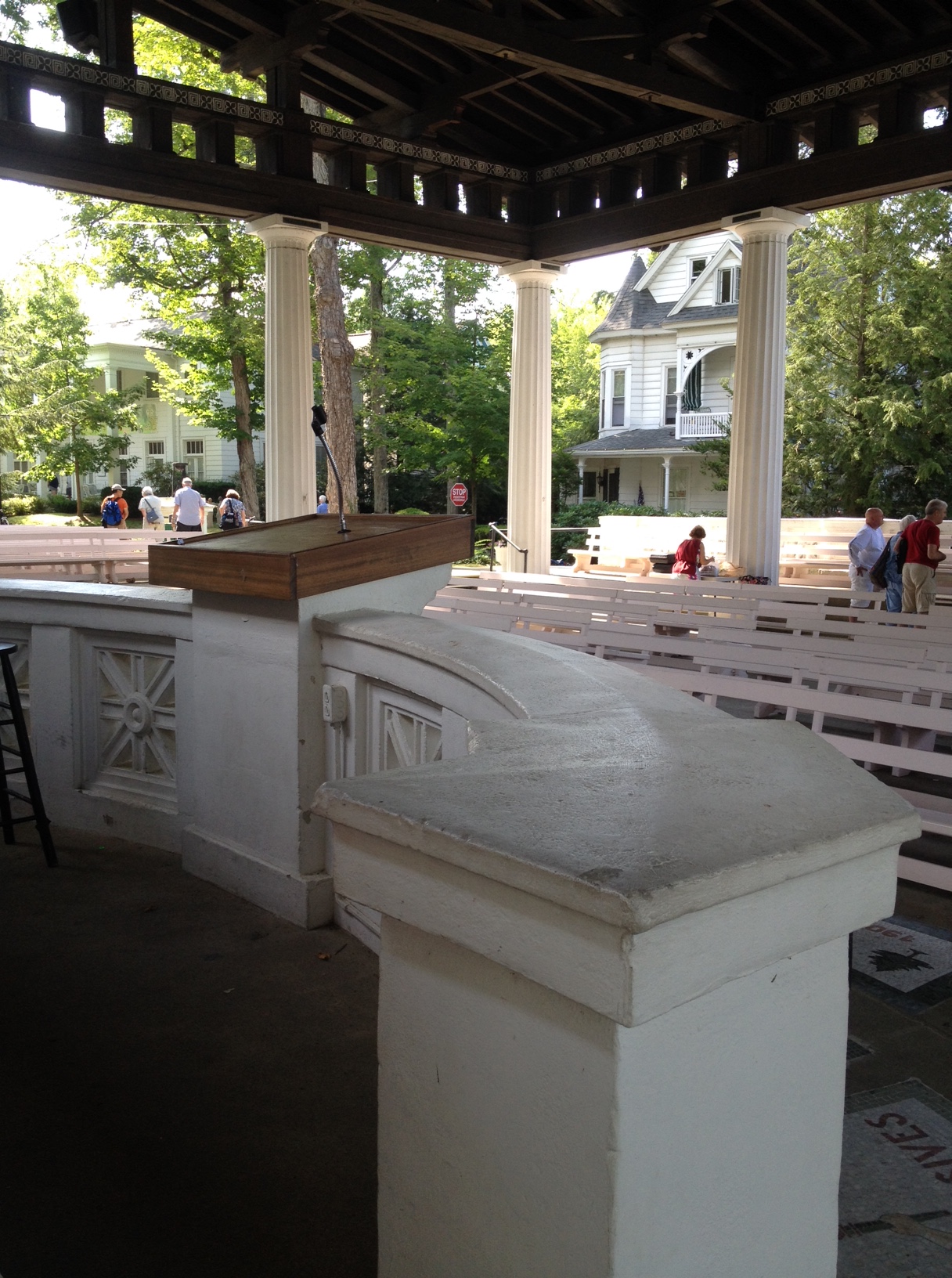
A talk by the very popular Bill Moyers (of CBS News fame) was just finishing up, so I crept in around the edges and starting following the elaborate and beautiful mosaics that frame the lecture hall’s floor.
“All was quiet there. The sunset meeting which had been held in that white, still place was closed sometime since, and their feet, as they stepped on the floor, resounded throughout the vacant Hall.”
(The Hall in the Grove, page 240)
I was delighted to find the shield of Pansy’s Class of 1887 in a place of genuine honor—nestled around the corners of the lectern.
The lectern platform itself is still a modest affair, virtually unchanged since Pansy’s class approached to celebrate their graduation. Let’s join Paul Adams from The Hall in the Grove here:
“Arrived at the white, quiet building, he entered it with soft tread, and, under an impulse which he did not in the least understand, uncovered his head. He stepped softly onto the platform, drew the armchair, which was the seat of honor, forward a trifle, and settled himself in it. Then he brought up before him in review the many and varied and wonderful experiences which the weeks had brought him in connection with that spot … Then he got down from the professor’s chair and … after a silent last look at the Hall, he walked home with Joe, they two speaking words together that were better than marble columns or millions of money, for they represented manhood.”
(The Hall in the Grove, page 382)
In The Hall in the Grove, Isabella shares a peek into her heart:
“…the gleaming pillars of the Hall of Philosophy rose up before him; something in the purity and strength and quaintness seemed to have gotten possession of him. Whether it was a shadowy link between him and some ancient scholar or worshiper I cannot say … but treading the Chautauquan avenues for the first time … his young heart thrill[ed] with a hope and a determination, neither of which he understood, every time he saw those gleaming pillars.”
(The Hall in the Grove, page 198)
When Caroline Raynor (another character in The Hall in the Grove) objects to the Hall being made in the style of a Temple of Minerva, she is vigorously corrected by her soon-to-be suitor, Robert:
“I like it exceedingly. Let the beautiful white temple be rescued from its heathen desecration and dedicated to the service of the good and true God our Father, and his Son Jesus Christ.”
(page 204)
I passed an ancient oak near one of entrances that was garmented in ivy and wondered … if I parted the ivy, would I find a lichen-crusted carving in the tree reading “Vine, 22, 1887”? (Eighty–Seven, page 12.)
I surely saw what Dr. Winter Kelland did when …
“he and Vine walked … around under the hill, and up the hill, and come out beside the white-pillared hall and stopped under one of the tallest trees, and looked about them, and were silent. Dr. Kelland took off his hat and looked up reverently to the very top of the tall tree, beyond the top, into the blue of heaven.”
(Eighty-Seven, page 318)
As I walked reluctantly away from the Hall, I looked up and felt sure I was seeing the same trees, the same sky, the same view Pansy enjoyed in Four Girls at Chautauqua:
.
“None of all … who spent the day within the shadow of that sweet and leafy place have surely forgotten how the quaint and quiet beauty of the place and its surrounding fell upon them; they know just how the birds sang among those tall old trees; they know just how still and blue and clear the lake looked as they caught glimpses of it through the quivering green of myriad leaves …”
(Four Girls at Chautauqua, page 180)
Next time, Karen makes a little visit to the Chautauqua Post Office before trekking to the “Holy Land.”
If you missed previous posts about Chautauqua Institution, you can read them by clicking on the links below:
For Isabella Alden there were few places on earth more dear to her than Chautauqua Institution. She spent many summers there, and was greatly involved in the Chautauqua Literary and Scientific Circle (C.L.S.C.).
You can judge just how great an impact Chautauqua had on her by the loving manner in which she described the place in her Chautauqua books, which she wrote in the late 1890s and early 1900s.
Chautauqua Institution is still a thriving summer destination for thousands of people. Earlier this month, Karen Noske, a regular reader of this blog, took a trip to Chautauqua. Today she is sharing the highlights of her quest to see for herself the beloved Chautauqua locations Isabella so dearly loved and faithfully described in her books.
Take it away, Karen!
Like many of Pansy’s fans, I’ve longed to walk the “tree-shaded” avenues of her hallowed Chautauqua, and decided to take the plunge this summer, as I live only about 3 hours east.
I’ve limited my review to those seminal books as they hold some of the richest treasures for modern-day Chautauquans and fans.
(For much more detailed information about this cultural retreat, you can find a list of previous posts about Chautauqua at the end of this post.)
Climbing ever higher
I should have paid more attention to the carefully worded descriptions of Isabella Alden’s favorite summer retreat, Chautauqua. In her marvelously descriptive and touching books about its lakeside, forested environs, she often mentioned that her characters “went down” to the lake or “went up” to the dining tent or the grove.
As I breathlessly labored to keep from running pell-mell down the steep inclines that make up 90% of the avenues here, I realized she’d been remarkably coy about this physical aspect of the grounds. Mountain goats would love this place.
After stowing my meager luggage in one of the many charming cottages that cling defiantly to the nearly vertical hillside, I hiked up to my first stop—the Archives, where I hoped to meet Pansy by way of her works.
This small brick building houses the full complement of the C.L.S.C. volumes, from the year of this reading circle’s inception (1878) to the present day.
Her eyes lighted with pleasure as she recognized it. This, at least, was an old friend: Philosophy of the Plan of Salvation. She did not need to read the letters on the title page to make sure that the book—so like her own—bore that name. “C.L.S.C?” she said, hardly realizing that she said it.
(The Hall in the Grove, pg 202)
.
I was delighted to find Pansy’s The Hall in the Grove (required reading for the C.L.S.C. class of 1881-82) snuggled between weightier academic tomes shown here.
.
I hunted for, and found the impossibly dense (reportedly dry, according to more than one The Hall in the Grove character!) Merivale’s History of Rome … one brief dip into it made me admire “Paul Adams,” “James Ward,” and “‘Pick ‘Em Up’ Caroline Raynor” all the more for virtually memorizing its contents.
How utterly hopeless it looked to him! He read over the first sentences six times without having an idea as to their meaning…
(The Hall in the Grove, pg 90)
.
I learned from the very helpful, very gentlemanly guardian of these treasures that one can indeed become a member of C.L.S.C. without having to limit oneself to the current crop of books! He assured me that I could “graduate” with a future Chautauqua class by reading a specified number of ANY C.L.S.C. materials, from any year!
“We are bound in honor to undertake all manner of work which will develop the spirit of Christian love and fellowship; it is the central feature of our organization … always with a view to reaching hearts as well as intellects. Why don’t you join us?”
(Eighty-Seven, pg 188)
.
Karen’s next Postcard from Chautauqua will feature The Hall of Christ and the Hall in the Grove.
If you missed previous posts about Chautauqua Institution, you can read them by clicking on the links below:
Bathing at Chautauqua, 1908, in swim suits popular in Isabella’s lifetime.
.
In 1960 Brian Hyland hit the top of the U.S. music charts with his song, Itsy Bitsy Teeny Weeny Yellow Polka Dot Bikini.
The song, about a woman who was too shy to wear her new bikini on the beach, was an instant hit. Many women at the time identified with the song’s lyrics. Although the bikini had been popular in Europe for years, Americans were slow to adopt it, believing the tiny two-piece was too risqué to be worn in public.
Those who dared to wear a bikini on an American beach or at a public pool quickly found themselves on the wrong side of the law. Some American cities banned the two-piece swimsuits and issued citations to any woman caught wearing one.
Other cities skipped the citation process and immediately took women to jail for violating local decency laws. But even in more progressive areas of the country, modesty and fear made women reluctant to wear bikini swimwear.
It wasn’t until 1962 when Ursula Andress emerged from the surf in the popular James Bond movie Dr. No that opinions began to change.
The original 1962 movie post for Dr. No showing a bikini-clad woman.
.
A modified movie poster for Dr. No, displayed in movie theaters in conservative areas of America.
.
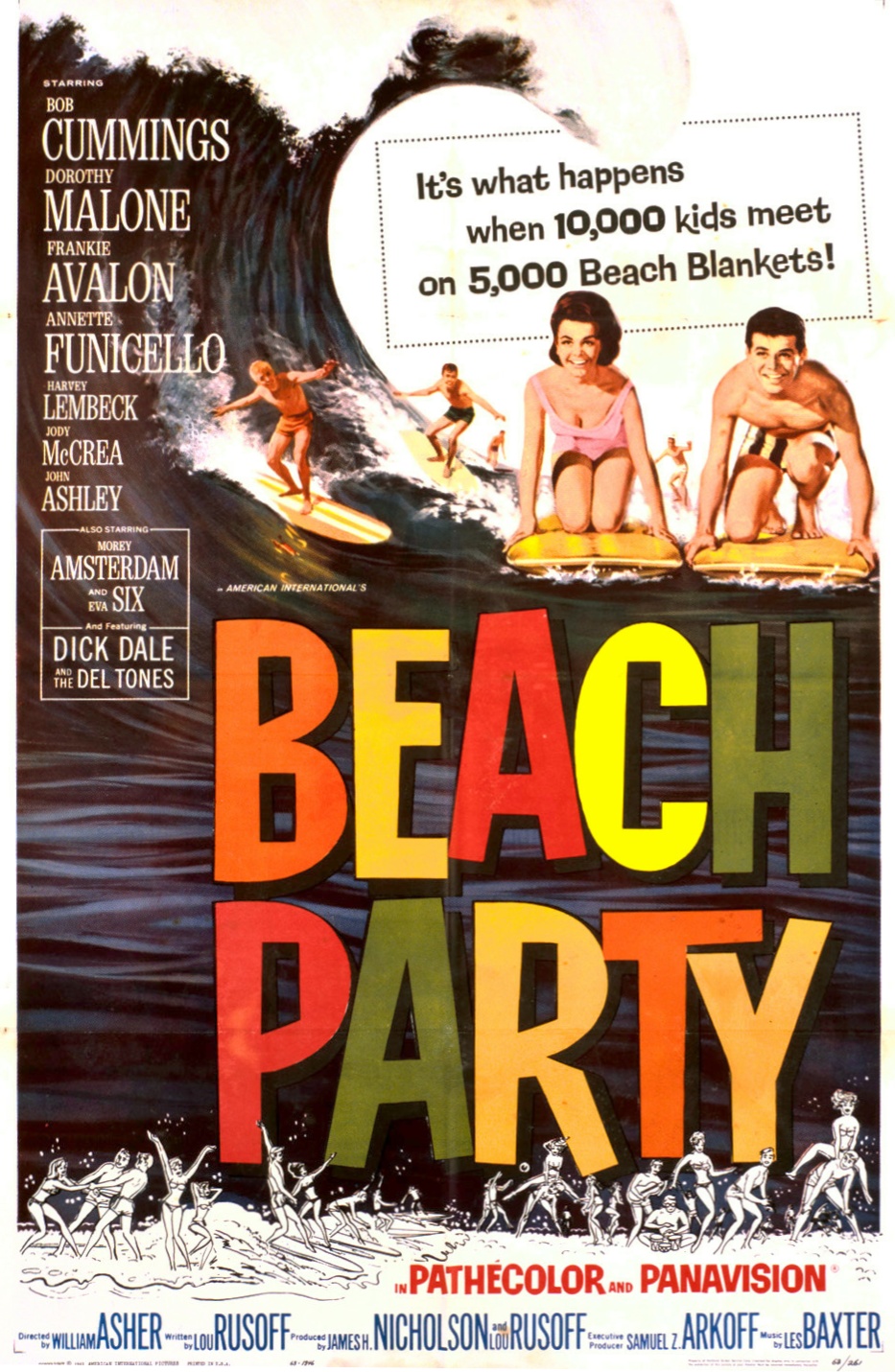
Helping turn the tide was a series of “beach party” movies produced in the early 1960s. They featured wholesome, fun-loving teenagers—like America’s sweetheart Annette Funicello—cavorting on beaches and arguing over boyfriends, all while wearing two-piece and bikini swim suits.
Movie poster for 1963’s Beach Party.
.
Movie poster for Bikini Beach, which hit American theaters in 1964.
.
Then, in 1964, Raquel Welch wore a deer-skin bikini in the movie One Million Years B.C. and caused a sensation. The result: the bikini instantly became must-have swim attire for women across the country.
The early 1960s wasn’t the first time Americans had contended with notions of risqué swimwear. The same thing happened at the turn of the 20th Century.
A new design for swimwear, from the Fashion Page of the July 25, 1897 issue of the Los Angeles Herald. Beneath the skirt was a pair of waist-to-knee bloomers.
.
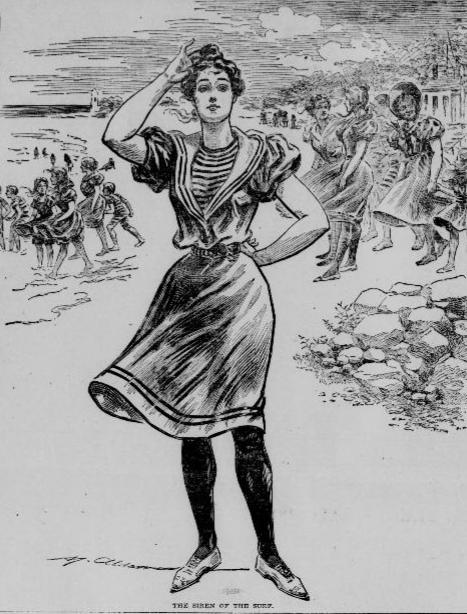
Women’s swimwear in Isabella Alden’s time was designed to hide the woman’s body and protect her modesty. In fact, most public bathing areas at the time were segregated by gender.
From a summer fashion article showing a new style of bathing suit. The San Francisco Call, April 30, 1899.
.
While men boldly walked into the surf and swam freely, some municipalities confined women to specific areas of the beach.
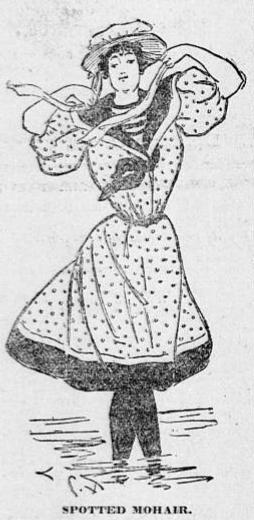
And they required women be covered from head to toe at all times. Swimsuit designers expected women to swim in hats, leggings, bloomers, shoes, and puffy-sleeved dresses.
An 1896 swim suit made of mohair. From an article in the May 24, 1896 issue of the Salt Lake Herald.
.
And because those dresses were usually made of wool, they were heavy when they got wet and weighed women down. Even worse, the long skirts tangled in their legs, preventing women from doing little more than wading into the water.
That began to change in the early 1900s when a professional swimmer from Australia arrived in the United States. Her name was Annette Kellerman, and she brought with her a one-piece swimsuit she had created herself and wore in competitions.
Annette Kellerman in a 1907 photograph.
.
By American standards, Annette’s swimsuit was downright indecent. It showed way too much skin and it hugged the curves of her body. When Annette dared to wear it on a public beach in Boston in 1907, she was arrested for violating indecency laws.
Annette may have run afoul of Boston city ordinances, but she also fired the imagination of American swimwear designers.
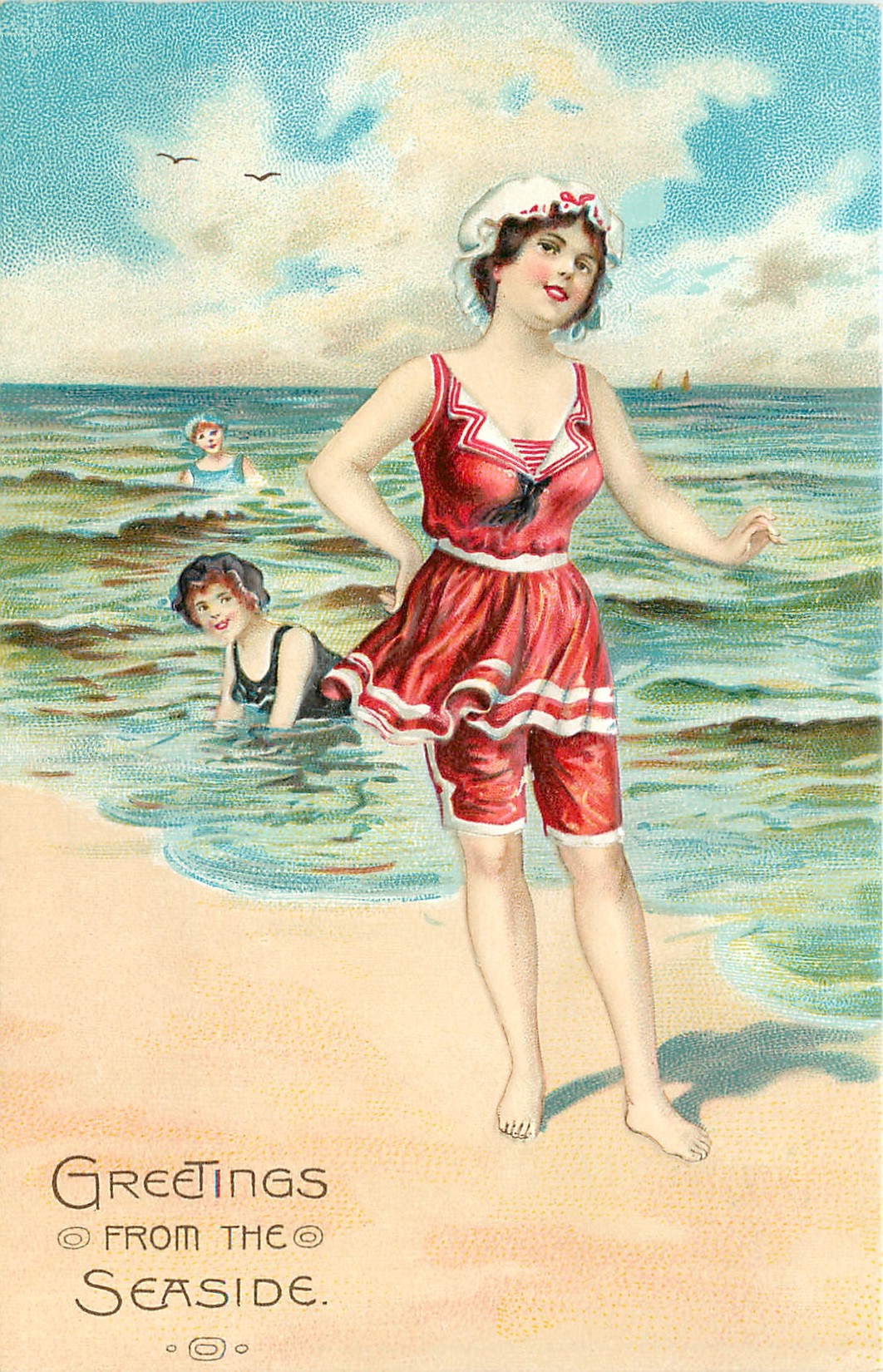
By the following year stores carried new designs in swimwear fashion. Those new designs weren’t quite as revealing as Annette’s one-piece suit, but they were certainly more comfortable and practical.
A 1908 postcard for Atlantic City, New Jersey.
.
Gone were the heavy leggings; the new styles allowed ladies to bare their legs and lose their high-laced shoes. And the skirts were shorter; beneath them bloomers were replaced by fitted shorts that allowed women to move freely in the water.
A 1908 postcard for Atlantic City, New Jersey.
.
Many people didn’t take kindly to the new styles. Americans formed protests on beaches, and newspaper editorials decried the swim fashions as emblems of the breakdown of American morals.
A 1910 editorial cartoon showing women in swim suits carrying Satan, hero-like, on their shoulders.
.
By 1920, some cities had tightened their swimsuit laws. New York recruited female officers to monitor the swim suits worn on beaches and issue citations if women were found in violation of city regulations.
From the New York Times, May 30, 1919.
.
In In Chicago the city by-passed the citation route and—as a precursor to the bikini dust-up of the 1960s—simply took women off to jail if they judged them to be indecently dressed.
Chicago swimmers being forced into police paddy-wagon before being taken to jail in 1922.
.
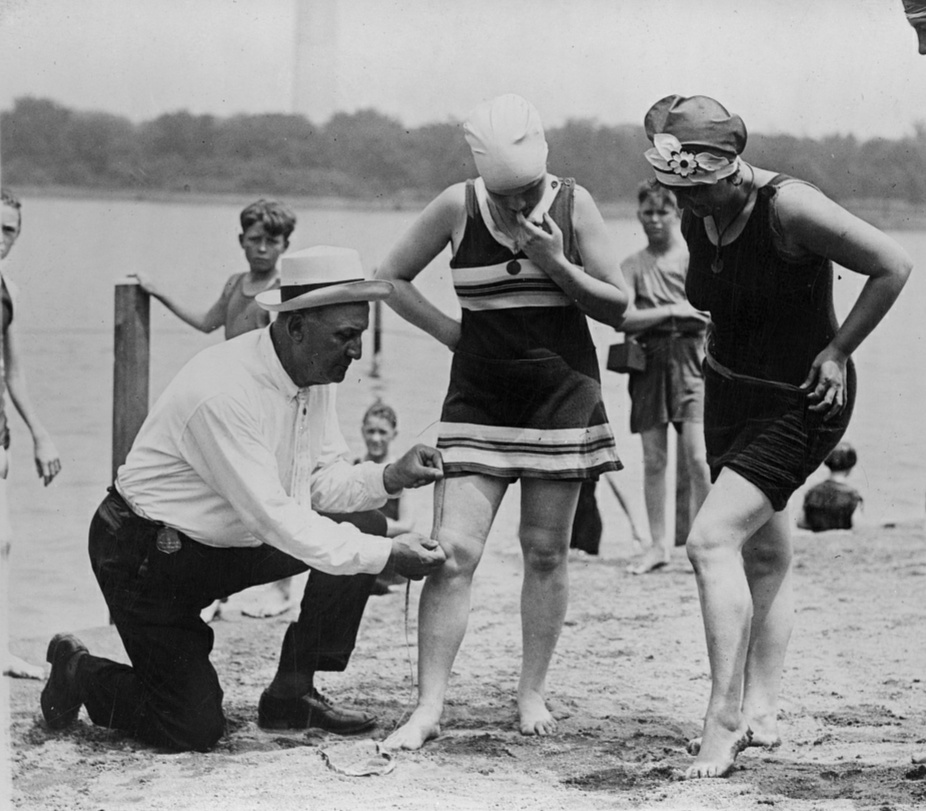
In Washington, D.C. one male officer made a name for himself as The Bathing Beach Cop by using a tape measure to ensure the distance between a female bather’s knee and the bottom of her bathing suit met with local regulations.
Bill Norton, the D.C. Bathing Beach Cop on duty.
.
By the 1930s the hue and cry over women’s bathing suits had, for the most part, shrunk to a whisper. Swim suits that had been scandalously indecent in 1920 became mainstream by 1930. After that, women’s swim suits changed very little through the 1950s.
Then came the 1960s and the little bikini, and Americans have never looked back. But what a far cry today’s swim suits are from the head-to-toe garments Isabella’s contemporaries wore!
Reviews and giveaways for Christian fiction and sweet, clean fiction. Bringing readers information on great stories and connecting authors with their readers.

 Mrs. Dunlap is a model wife, mother, and homemaker. She’s the perfect hostess when guests enter her home, and out of the goodness of her heart she has taken a poor neighbor girl under her wing. Why, Mrs. Dunlap even teaches a Sunday-school class and remembers to keep the Sabbath holy!