A Visit to Asbury Park

Because of her popularity as an author of both Christian novels and Presbyterian Sunday school lessons, Isabella Alden was often invited to speak at churches, women’s groups, and community events. She and her husband, Rev. G. R. Alden, did their best to accept as many invitations as possible. During the years they lived in Ohio, Pennsylvania, and New York, they frequently traveled up and down the mid-Atlantic states, going from one engagement to another.

One of their favorite places to visit was Asbury Park, New Jersey. Accompanied by Isabella’s sister and brother-in-law, and niece Grace, the Alden’s enjoyed church services held in the open air of the Asbury Park Auditorium.
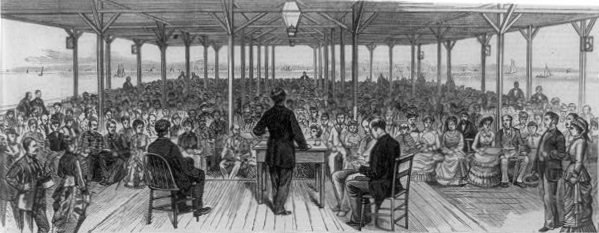
The Seaside Sabbath School at Asbury Park, from a sketch in Frank Leslie’s Illustrated Newspaper, August 1881.

On the first Sunday of the summer every year, Isabella would formally open the Sabbath school program for children, often assisted by her husband.
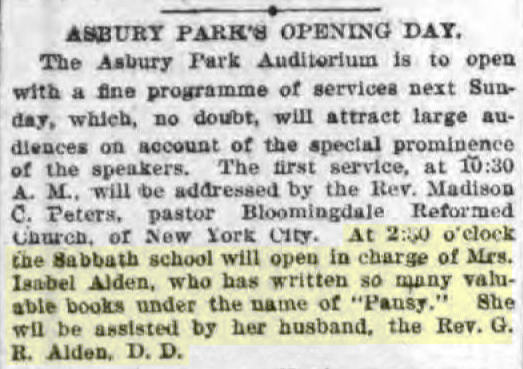
from the Brooklyn Standard Union, June 22, 1892

One of their trips to Asbury Park was particularly memorable, and Isabella described what happened in an article for her young readers in The Pansy magazine.  
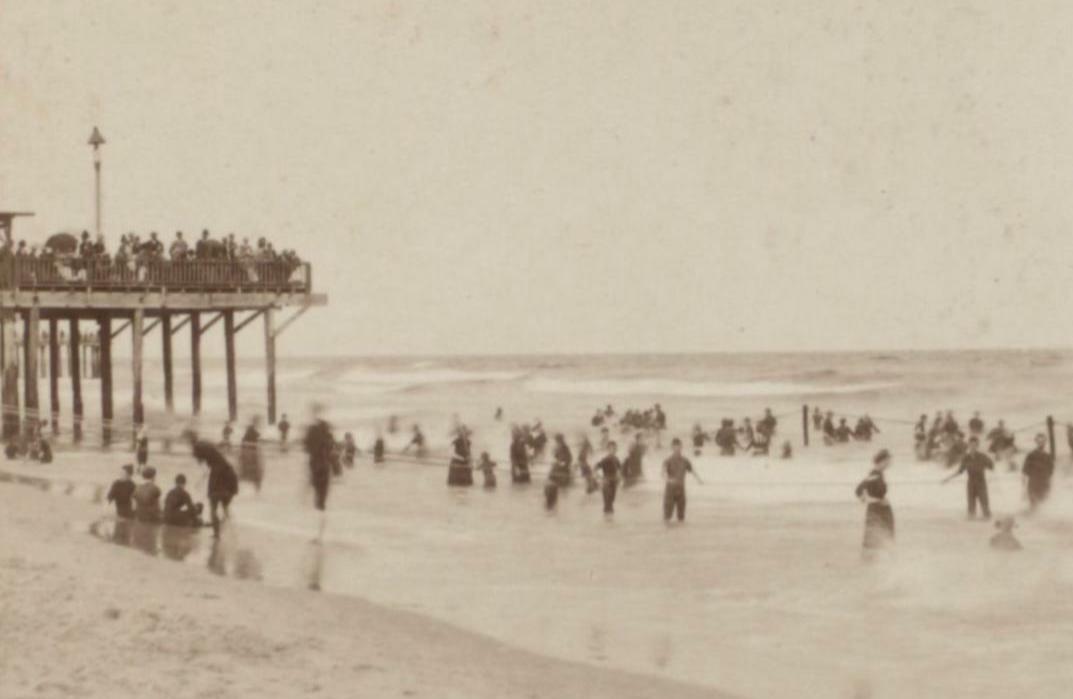
On the beach at Asbury Park in 1875 (New York Public Library).

As you read Isabella’s account below, you’ll notice it takes an unexpected turn at the end. What begins as a fascinating rescue story becomes a temperance lesson—a reminder of how differently some writers approached storytelling in the 1880s and how central the temperance movement was to Christian writers and publishers of that time.

I’m not going to tell you about Asbury Park; at least not much. Some other time I may say a good deal about this pretty city by the sea, but just now I’m anxious to tell of what happened at night. The day had been pleasant enough; not summer, but late spring, bright and sunshiny; we rejoiced over the thought of getting sight of the beautiful beach; reminding each other how lovely the sea looked by moonlight.

Alas, there was no moon for us that night! At least she did not once show her silver face; instead, the sky was black with clouds, and the sea took on its sullen look, and roared as it lashed the shore constantly with great angry waves. We shivered and tugged at our wraps as the wind tried to whirl them away, and said, as we turned to go home, how glad we were that we had no friends at sea.

“The ocean looks cruel,” said Grace; “I don’t like him tonight.”
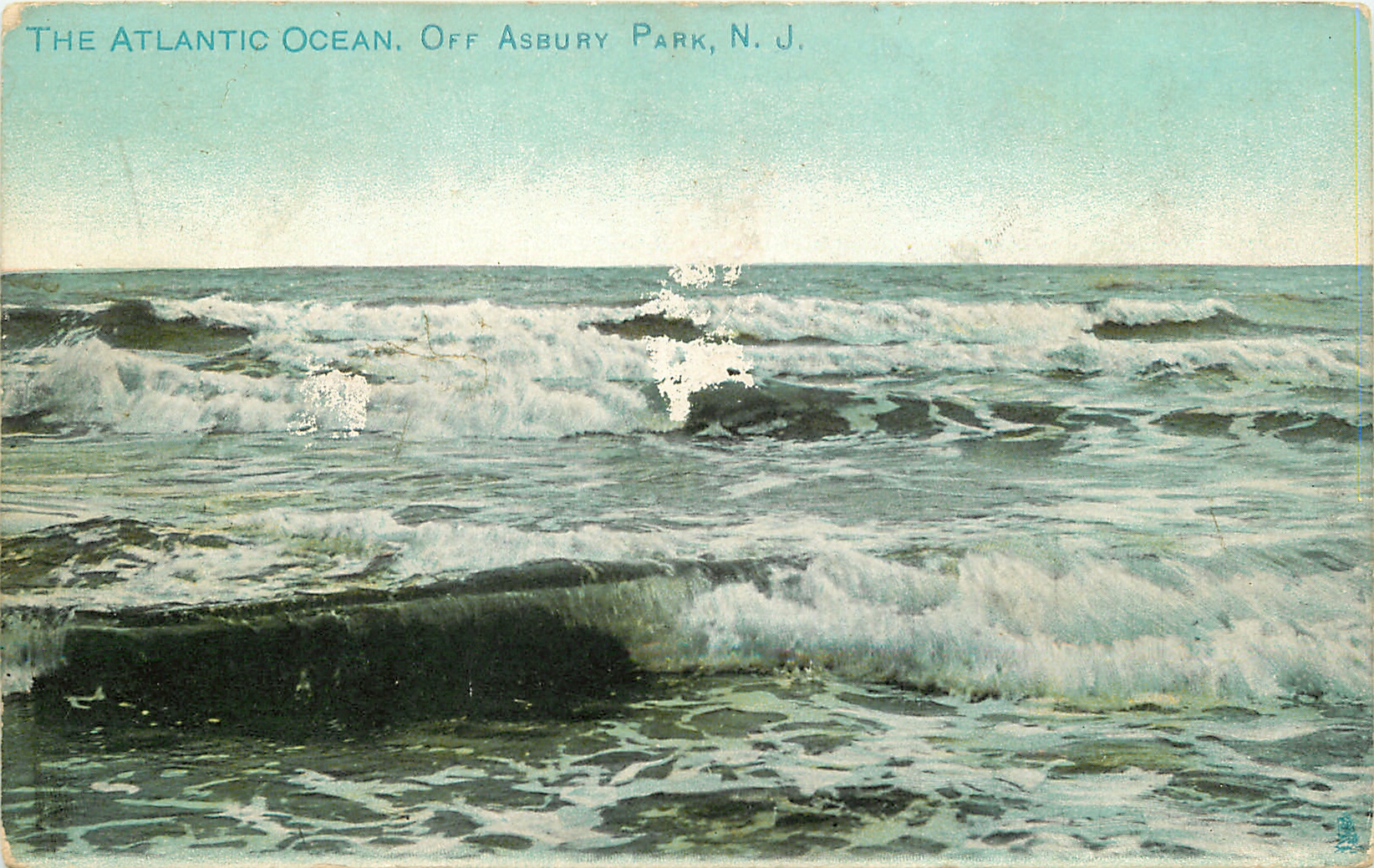
The Atlantic Ocean off Asbury Park in 1907

Then we went home to our bright room; drew the curtains, closed the shutters, stirred the fire to a cheery blaze, and chatted and laughed and were happy, quite shutting out the roar of the angry sea.

But he did not calm; the waves ran high, and the sullen roar kept increasing, until, by midnight, we knew it was what seamen call a gale. Occasionally we heard the fog bell toll out, and once more we were glad that we had no dear ones at sea.

Somebody had, though; and while we slept quietly, knowing nothing of it, brave men were awake and at work. A danger signal was seen just off shore; what excitement there was! How did the men of the life-saving crew know that they were needed? They had been disbanded for the summer, the dangerous season being supposed to be over; and here was blowing one of the worst storms of the winter! I don’t know how they heard the news. Their hearts waked and watched, perhaps; anyway, they came, great stalwart men, and in a twinkling opened their boathouse, and got out their apparatus which had been carefully put away, and before the third signal went up through the stormy water, were ready for action.
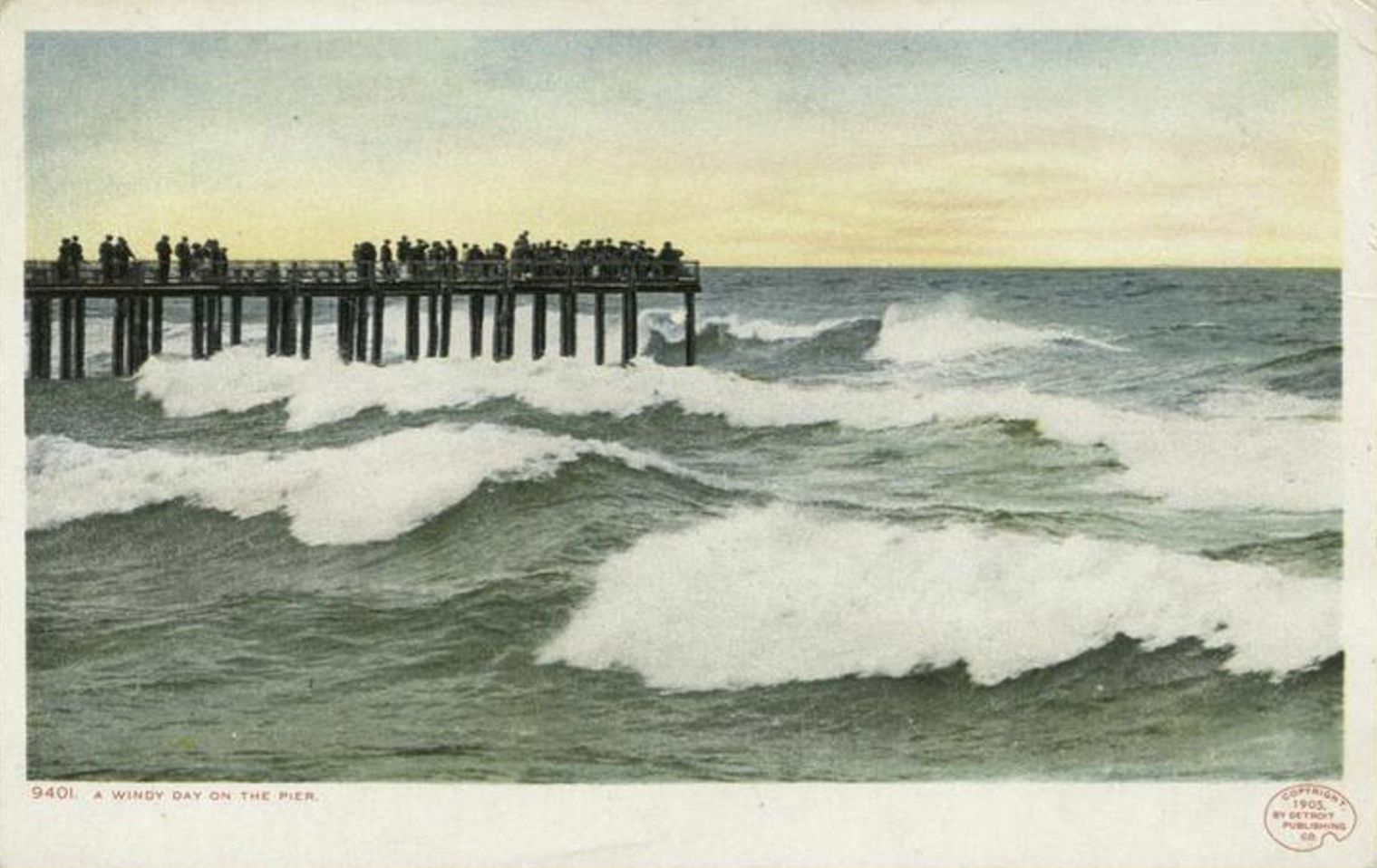
A windy day on the pier in 1905 (New York Public Library)

I don’t know how they did it. At this time of which I write, they had no regular lifeboat such as is now in use; they were not regularly manned for work in any way. Never mind, they did it. One, two, three, four, five, six, seven. Oh, I do not know how many people rode, some way, over the stormy water, on a rope, and reached the shore. Drenched, powerless, almost breathless, yet alive!

Who do you think was one of the first to arrive that night? Why, a little baby less than three months old! What! She did not cling to ropes! Oh, no. All she did was to lie in utmost quiet in the hands of a great strong man; he was lashed to the rope in such a way that the men on shore could pull him in, but the baby he held in his two strong hands, as high above the fury of the waves as the hands would reach. What if he had dropped her? Then the sea would have swallowed her in an instant! An awful journey, but the baby did not know it. She must have gasped a little for breath, and she may have cried, but no one heard her; the roaring ocean took care of that.

You don’t see how she lived through it? They did not think she could; not even the mother, when she took a second to kiss her, before she gave her into the strong arms, thought that she should ever see her darling again. But it was the only possible way of escape; they could but try.

So the baby rode into shore, and I think as many as a hundred mothers stood waiting to receive her, with hot blankets enough to smother her, and warm milk enough to drown her in; for it had gotten abroad in some way that a baby was on board the sinking ship. If you could have heard the shout that went up when the baby was landed in the arms of one mother, who said, after a second of solemn hush: “Yes, she is living!” you would have felt as though you almost knew what a life was worth.

The next morning what a walk we had along the coast! How still the sea lay; the waves crept up softly one after another as if so ashamed of their last night’s work that they would rather not be seen or heard at all. Bits of board, and old tarred rope, and barrel staves and seaweed lined the beach for miles, and coffee sacks by the hundred kept washing in to shore. The vessel had been laden with coffee.

People were very busy putting the beach in order, planning how to reach the wreck, wondering whether she could be gotten off, or would have to lie half-buried in the sand and slowly fall to pieces. Here and there were groups of people, listening, while one man talked excitedly; he was a sailor and had his wonderful story to tell of danger and escape.
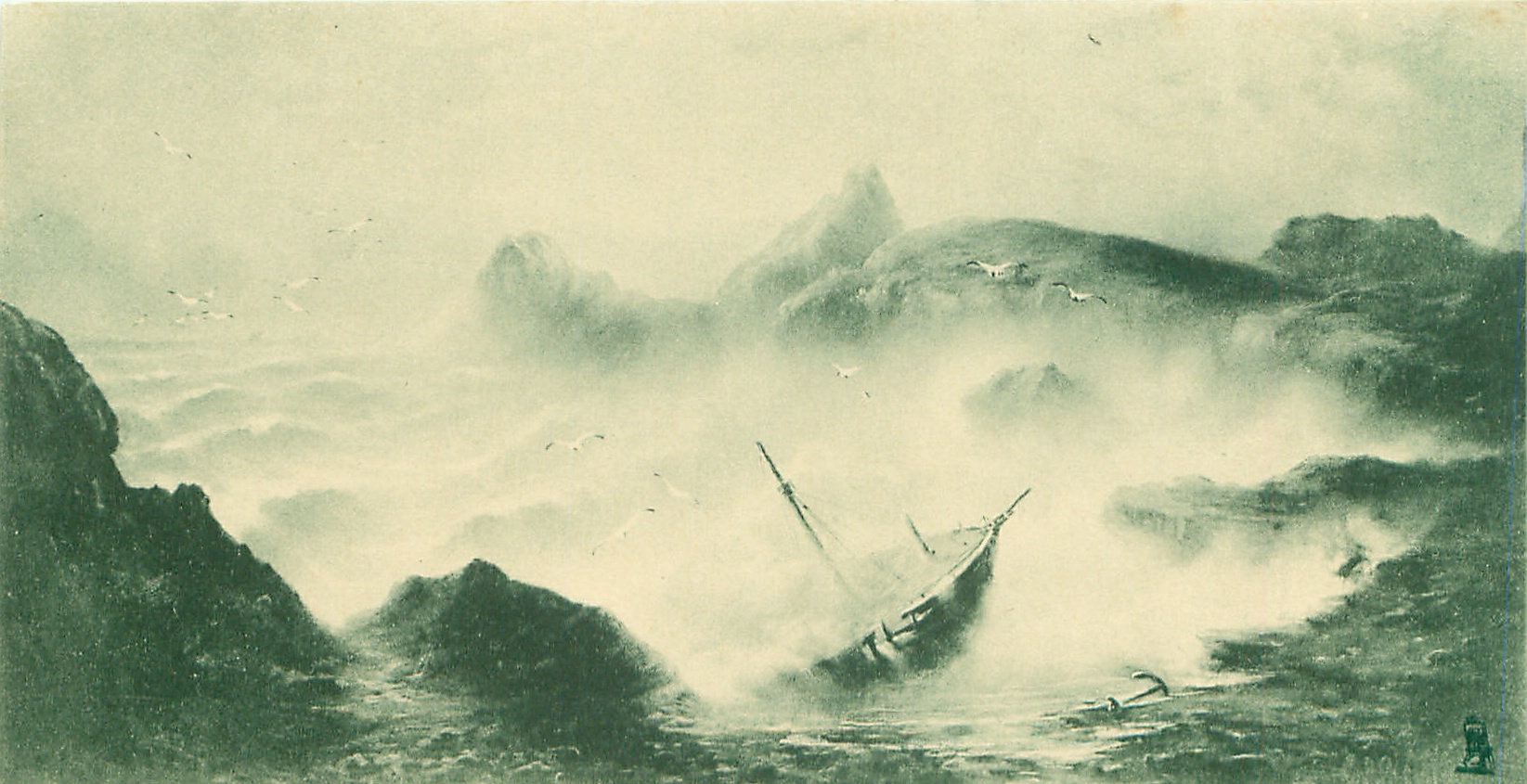
Shipwreck in a Rocky Bay, 1904

But the happiest man on the beach that morning was one who rubbed his hands in actual glee, and smiling broadly on every one who came up to him, would say in a loud, glad voice:

“Yes, I lost everything I had in the world, but my wife and children are all here; yes, baby and all!” and then he would wipe the great tears from his eyes, and laugh so loud and glad a laugh that all the people around would have to join in.

All his children safe! They clustered around him, several sturdy-looking boys, and I watched them with eager interest. Were they all safe? Could the father be sure? The ocean had not swallowed them, but suppose some awful rum saloon caught them in its clutches and drew them in until they went down in a storm of drunkenness to utter ruin! What was an ocean storm to that? Pitiless ocean, rave as it might, could not touch the soul; but the rum saloon has power to destroy both body and soul.

What joy there was over the three-months-old baby! And yet she may live to be a drunkard’s wife, or a drunkard’s mother, and to cry out in bitterness of soul because the ocean did not swallow her flint night. Isn’t it strange and sad to think of? The father thought his children safe, and yet sit many oceans of temptation lay ready to engulf them! none more bitter, more fierce, more wide-spread in its raging, than this ocean of alcohol. Dear boys and girls, what can we do to help save the children for their fathers? Will you all join the life-saving crew, and work with a will, to rescue victims from this ocean?

Pansy

Isabella’s abrupt shift from celebrating the baby’s rescue to warning about “the ocean of alcohol” might feel a little jarring to us today, but it reflects the deep anxiety many families felt about alcohol in the 1880s—when alcohol contained some highly-addictive ingredients.

And she never missed an opportunity to teach. She couldn’t tell a story about saving a baby from the sea without thinking about all the other ways children needed saving—and she used her platform as “Pansy” to rally her young readers to join the temperance fight.

You can read more about alcohol’s secret ingredients in the nineteenth century by following these links:

The Dangers of Soda Fountains

Just What the Doctor Ordered

Isabella’s Uncle and the Hymn that Changed America

Isabella’s mother Myra Spafford came from a large family. Her father married twice and Myra was one of twelve siblings from both marriages.

Myra was 25 years old and already a wife of four years by the time her youngest brother, Horatio Gates Spafford was born. Like Myra, Horatio was raised in a home where strong faith in God and service to others were qualities valued above all else.

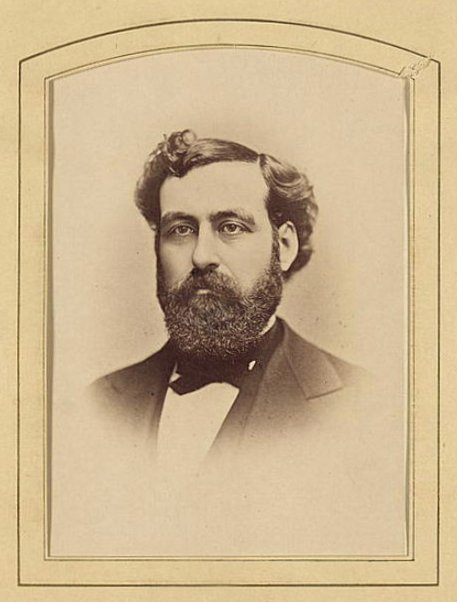
Horatio Gates Spafford

.

Horatio grew up to be an ambitious and energetic young man. A lawyer by trade, he was about 29 years old when he left his family in New York and headed to Chicago to practice law and earn his fortune.

Business card from Horatio Spafford’s law firm

.

Chicago was the perfect place for a man like Horatio. The city was booming—between 1871 and 1880 the population grew by 176,000 people—and Horatio saw opportunity.

While other builders and entrepreneurs concentrated on developing the marshy areas of Chicago close to Lake Michigan, Horatio invested in real estate north of the metropolis. By the time he reached his 42nd birthday, Horatio’s law practice and business investments had made him a very wealthy man.

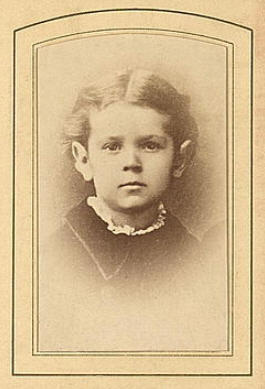
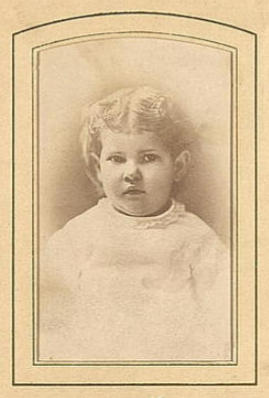
He was also a husband to his wife Anna, and father to four little girls: Annie, Margaret, Elizabeth, and Tanetta.

Anna Spafford with her daughters Annie, Margaret, and Tanetta.

.

He owned a fine house at Lake View, a north suburb of Chicago. He employed household servants and a French governess for his children.

The Spafford “cottage” at Lake View, Chicago (from the Library of Congress)

.

And though he lived well, Horatio used the majority of his wealth in service to God. He was an active abolitionist prior to and during the Civil War, and he hosted many anti-slavery meetings in his home.

He made evangelical visits to inmates at jails and prisons, helped run prayer and revival meetings, and taught Sunday school at his church.

Frances Willard, President of the Women’s Christian Temperance Union.

.

He also supported causes that were dear to his heart, such as the National Women’s Christian Temperance Union. He often welcomed the organization’s president, Frances E. Willard, into his home for extended stays.

The same was true of Horatio’s support for evangelist Dwight L. Moody, who would become a dear and life-long friend.

Dwight Lyman Moody, circa 1900, from the Library of Congress

.

THE TIDE TURNS

Horatio’s youngest daughter Tanetta was only two months old on October 8, 1871, when fire broke out in the city of Chicago. With a poor alarm system, shabbily constructed buildings, and draught-like conditions due to lack of rain, the fire spread rapidly from one wooden structure to another. It raged for two days and destroyed over one-third of the city.

Chicago, after the great fire (from Library of Congress)

.

Although the Spafford home was somehow spared, the city was devastated.

Over 300 people lost their lives, and over 100,000 people were homeless, many of whom survived with nothing more than the clothes on their backs.

.

Horatio—who had invested in real estate in the area of the city that was hardest hit—suffered serious financial losses.

Still, he and Anna opened their home to many people who no longer had a home of their own, and he worked tirelessly to rebuild the city’s churches, businesses, and housing.

Laying the first cornerstone of a new building, as Chicago rebuilds after the fire.

.

In 1873, while he and his wife were still working to help the needy and displaced citizens of Chicago, Horatio received a letter from his friend, Dwight Moody, who was in Europe, igniting a religious revival. Dwight asked Horatio and Anna to join him in London.

Undated photo of Dwight L. Moody from the Spafford family album (from Library of Congress)

.

The invitation could not have come at a better time. Both Horatio and Anna were weary from the stress of their philanthropic work. To add to their troubles, Horatio’s financial condition had become dire, due to a national economic downturn that occurred in 1873.

Horatio and Anna decided to join Dwight in England and live abroad for a year. They set off for New York, along with their children’s governess. Also in their party was a boy named Willie Culver, the twelve-year-old son of close friends, who was returning to school in Paris.

THE VILLE DU HAVRE

When they arrived in New York, Horatio received word that a business deal was in danger of collapsing, and—given the precarious state of his finances—he decided to return to Chicago to salvage what he could of the venture.

Rather than postpone the trip, Anna and the children—along with their governess and Willie Culver—went on to Europe without him.

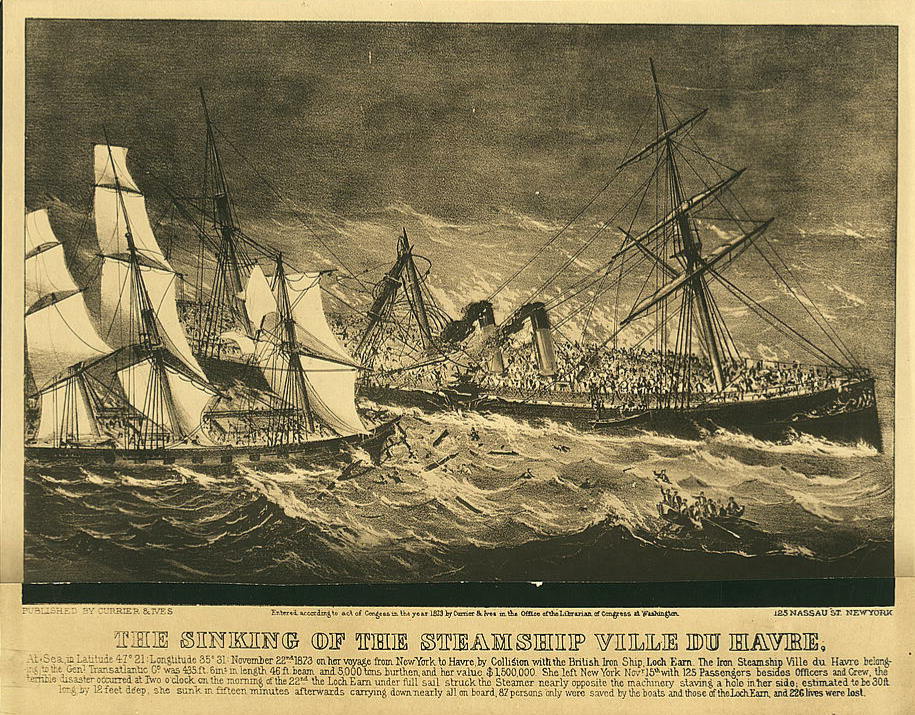
At about 2:00 a.m. the morning of November 21, 1873, in the frigid waters in the middle of the Atlantic Ocean, their ship, the Ville du Havre, collided with an English iron ship, the Loch Erne.

Headline from the Chicago Tribune, December 2, 1873.

.

The impact almost cut the Ville du Havre in two, and it began to sink immediately. Anna led her children, their governess, and Willie, to the deck to evacuate the ship.

.

But only two of the ship’s life boats were deployed, and they were filled primarily with the ship’s captain and crew. Of the roughly 350 people on board, only 87 survived; and of those survivors, 53 were crew members.

Artist’s rendering of the last moments of the Ville du Havre

.

The Loch Erne, badly damaged, turned around and deployed its own boats to find survivors. One of those boats plucked Anna Spafford, unconscious and badly hurt, from the water.

In the darkness of the night, her children Annie (age 11), Margaret (9), Elizabeth (5) and Tanetta (2) were never found.

Annie Spafford, from the Spafford family album.

.

Margaret Lee Spafford, from the Spafford family album

.

Elizabeth Spafford

.

Tanetta Spafford.

.

Also lost were the children’s governess and young Willie Culver.

In Chicago, Horatio received an early morning telegram from Anna that began with the heartbreaking words,

Saved alone.

What shall I do?

The telegram Anna sent Horatio, telling him of the tragedy.

.

Horatio immediately left on the next ship bound for Europe to join Anna. As he crossed the Atlantic, the captain of the ship—knowing of Horatio’s loss—called him to the bridge at one point, and solemnly told him they were about to pass the place where the Ville du Havre went down.

That evening, in his cabin, Horatio took up his pen and wrote the words to “It is Well with My Soul.”

When peace like a river attendeth my way,
When sorrows like sea billows roll;
Whatever my lot, Thou hast taught me to say,
“It is well, it is well with my soul!”

Though Satan should buffet, though trials should come,
Let this blest assurance control,
That Christ hath regarded my helpless estate,
And hath shed His own blood for my soul.

My sin — oh, the bliss of this glorious thought —
My sin, not in part, but the whole,
Is nailed to His Cross, and I bear it no more;
Praise the Lord, praise the Lord, O my soul!

And Lord, haste the day when the faith shall be sight,
The clouds be rolled back as a scroll;
The trump shall resound, and the Lord shall descend;
“Even so, it is well with my soul!”

The original manuscript. written on stationary paper from the Breevoort House, a hotel around the corner from Horatio’s law firm in Chicago. Horatio had some sheets with him while crossing the Atlantic and it was on these that he penned the words to the hymn.

.

In a letter to his sister-in-law a week later he wrote,

“On Thursday last we passed over the spot where she went down, in mid-ocean, the waters three miles deep. But I do not think of our dear ones there. They are safe, folded, the dear lambs.”

In 1876 Horatio’s friend composer Philip P. Bliss took the words Horatio had written and set them to music.

Composer Philip P. Bliss, from the Spafford family album.

.

Philip performed the hymn for the first time in public on November 24, 1876 before a large gathering of ministers, hosted by Dwight Moody.

Since then, “It is Well with My Soul” has become the most widely-used hymn of consolation in modern Christianity.

It has also had a profound impact on those who hear the hymn and learn the story behind it.

Many people have known tragedy and sorrow, reported a North Carolina newspaper in 1908; but even those who have faced hardships think again when they hear Horatio Spafford’s story. As one man told the newspaper reporter:

“I will never again complain of my lot. If Spafford could write such a beautiful resignation hymn when he had lost all his children, and everything else save his wife and character, I ought surely to be thankful that my losses have been so light.”

From The Commonwealth newspaper in North Carolina, February 2, 1908

.

You can read a detailed account of the sinking of the Ville du Havre as it appeared in an Ohio newspaper, the Holmes County Republican, on December 11, 1873. Just click on the image below and read the article in column 7 titled “A Horror at Sea.”

Horatio Spafford’s story doesn’t end here! Despite the many trials and setbacks he suffered, he never lost his faith in God or abandoned his calling to be of service to others.

Next Post: Horatio Spafford’s Second Chapter