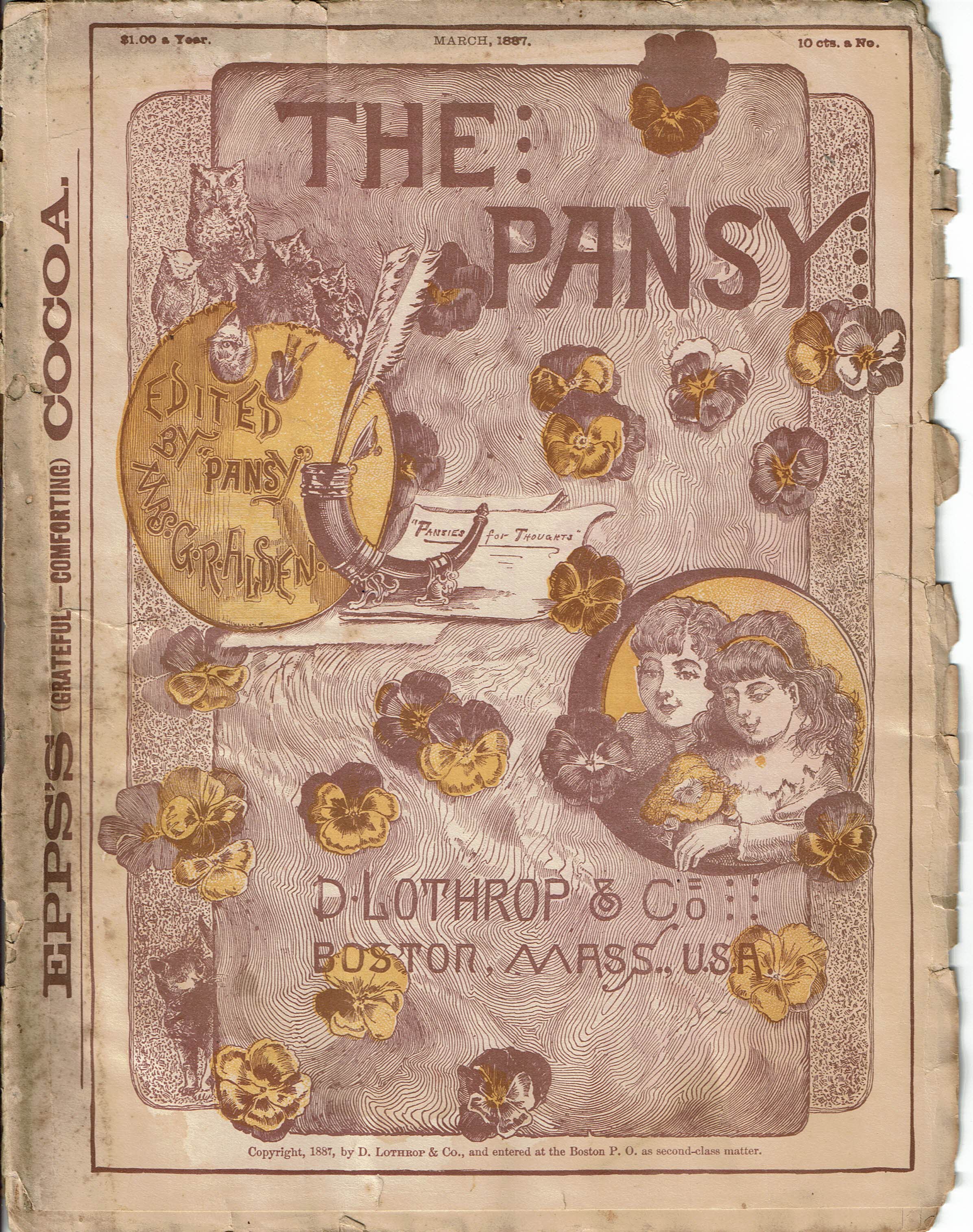
New Year’s Day Calls in Pansy’s Books

“I have spent this New Year’s day in receiving calls,” wrote Miss Docia Myers (in Isabella’s novel Docia’s Journal). “The whole thing is a sham. I don’t believe in that sort of calls. If one could see only one’s good friends, and exchange greetings, it would be pleasant; but this passing compliments with people for whom one doesn’t care a pin, is utterly distasteful to me.”

Not everyone shared Docia’s opinion. In the mid-to-late 1800s, the tradition of paying New Year’s calls was one of the most entertaining—and least formal—of society conventions. Isabella was very familiar with the custom and wrote about it in several of her novels.
Here’s how New Year’s Day calls worked:

On New Year’s Day ladies—married and unmarried—remained at home to receive the calls of their gentlemen friends. The ladies dressed in their finest, and made their parlors as bright and cheerful as possible so as to welcome the gentlemen in from the cold.

Waiting for Calls on New Year’s Day by Winslow Homer.

Julia Ried (in Isabella’s novel of the same name) wore her very best for the occasion:

Didn’t I blossom out on New Year’s morning! Talk of Solomon arrayed in all his glory; it didn’t seem to me that he could have compared with me.

According to custom, ladies began receiving New Year’s calls beginning at 10:00 a.m. and had to be prepared to welcome and entertain any man who presented himself for the next twelve hours.
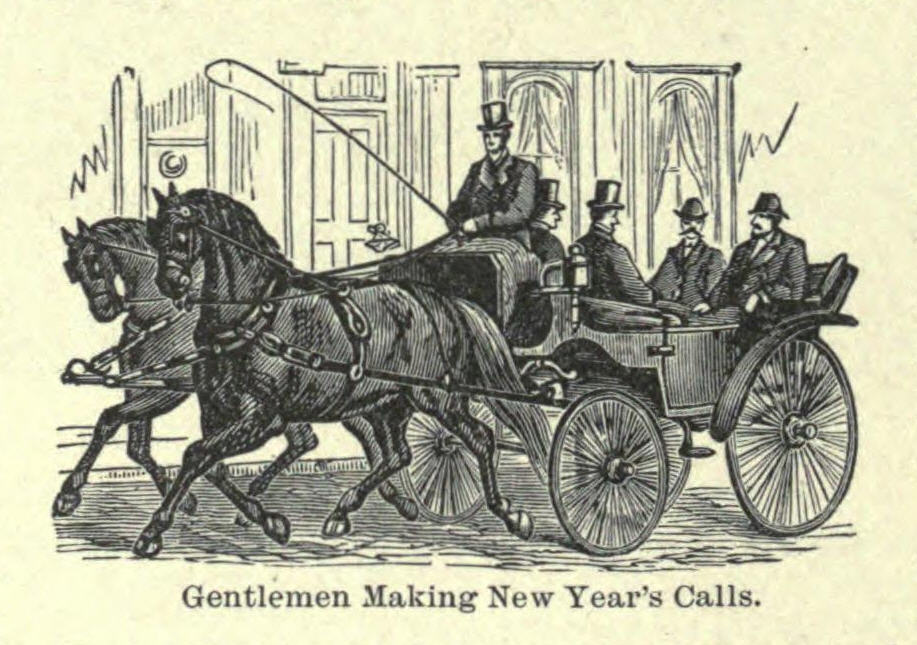
Gentlemen making New Year’s Day calls, from Hill’s Manual of Social and Business Forms (1888).

Gentlemen were responsible for calling upon every woman of their acquaintance. They could pay their calls alone, or they could join a group of friends and call upon the ladies together. The calling card below—printed especially for 1877 New Year’s calls—shows the names of six young men who made the rounds together.
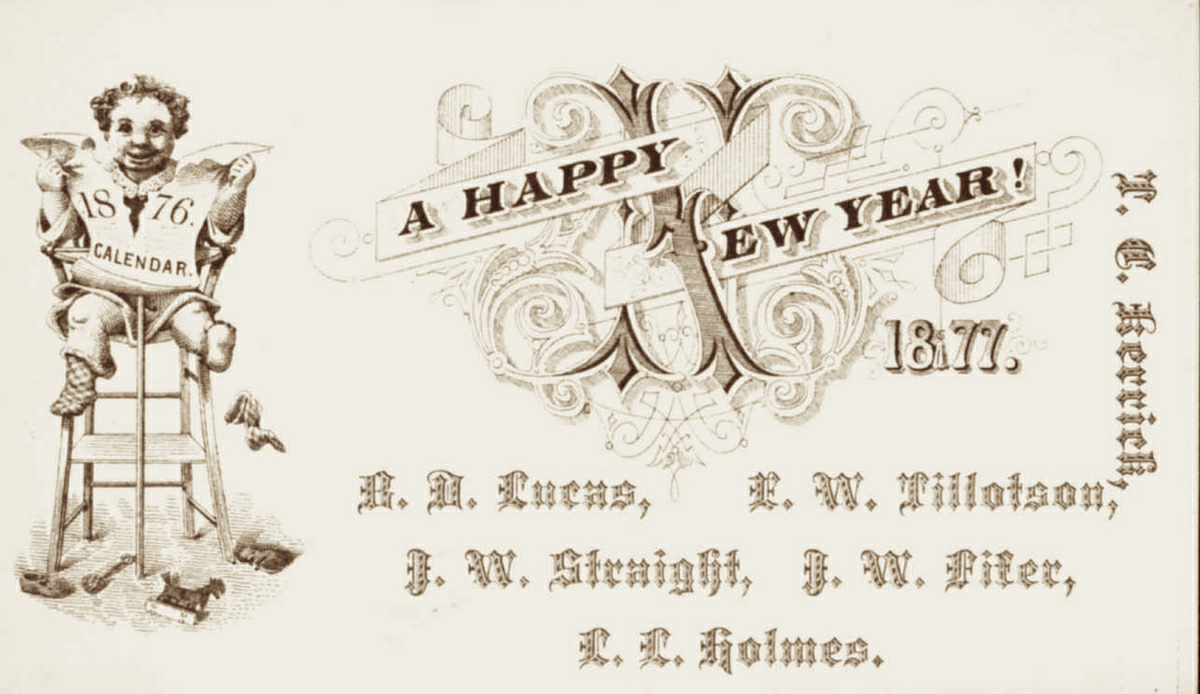
The men went from house to house, their visits lasting only about ten or fifteen minutes before they were off to pay their next call. In some cases a gentleman’s visit was so short, he didn’t even take off his hat, coat, or gloves.

Julia Ried enjoyed the whirlwind, saying:

It was my first experience in that scene of the whisking in and out of half a dozen gentlemen at a time, so constantly followed by half a dozen more, that presently one lost one’s balance, and ceased to remember people as individuals, but as number forty-five or sixty-two, as the case might be, and, as the day whirled on, was dimly conscious of but one idea—an eager desire to reach a higher number than Mrs. Symonds or Miss Hervey, and Mrs. or Miss anybody else. I thought it delightful.

While the gentlemen discussed the weather, paid the ladies compliments, and wished them a prosperous new year, the ladies served refreshments.

Some women offered simple plates of fruits, cakes, and breads, with coffee and tea.
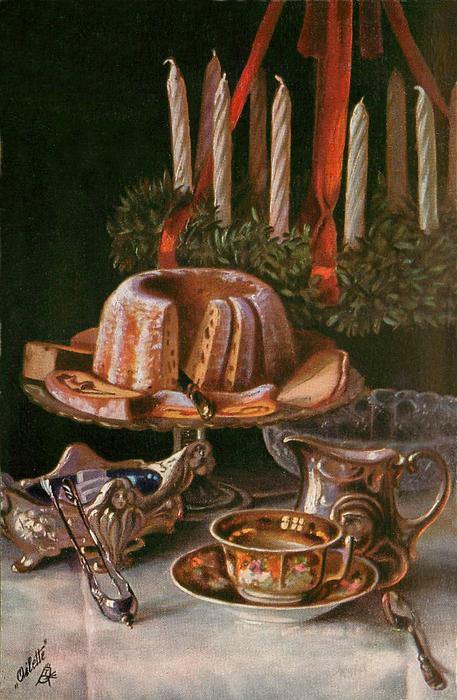
Fresh fruit, something of a rarity in winter, was also a welcome offering.

More ambitious hostesses set out full buffets, with a menu that might include turkey, oysters, ham, or roast beef, as well as hot side dishes.
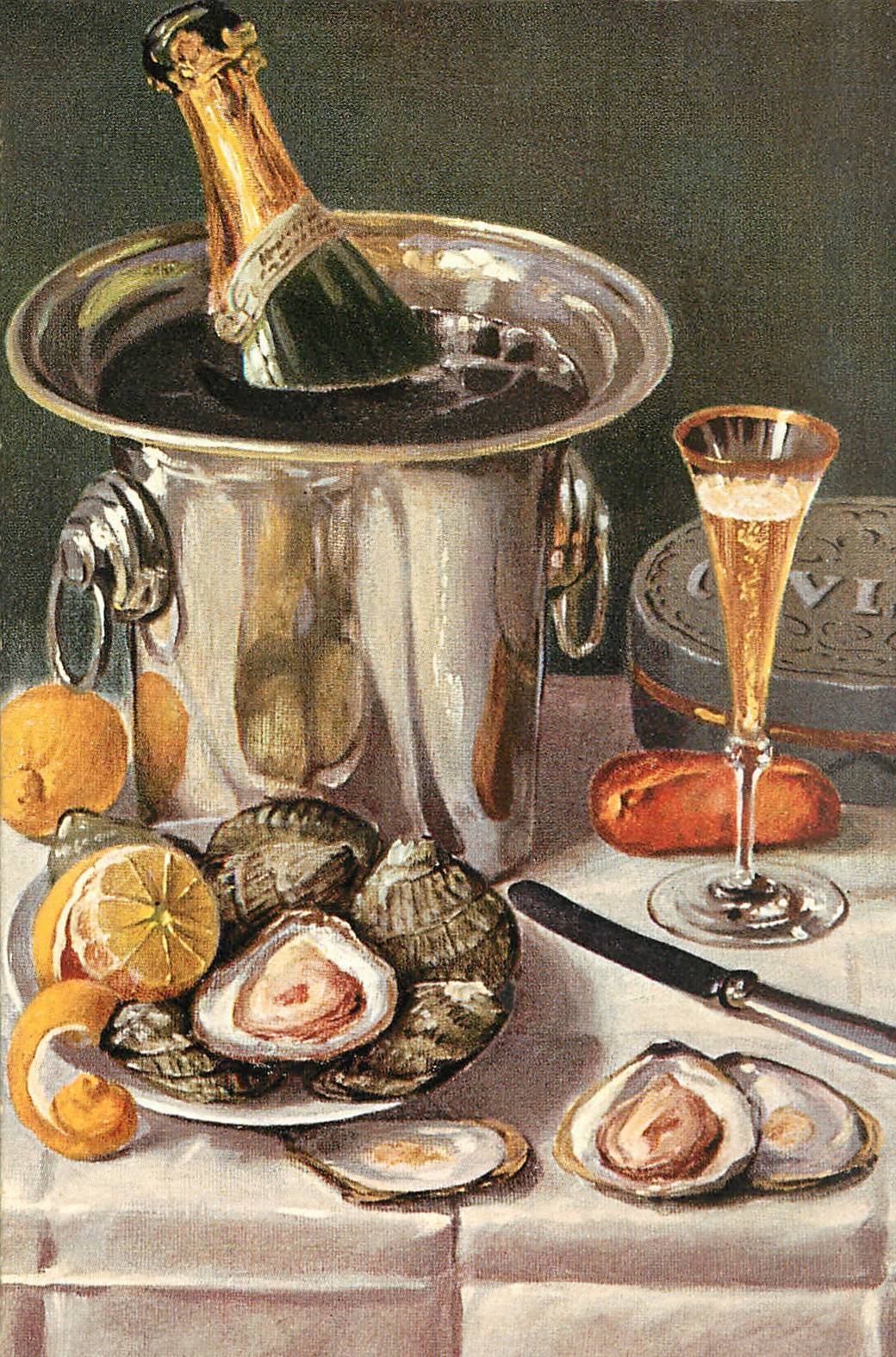
The larger the menu, the more chances it included alcohol. Ale, wine, champagne, or a festive punch made with a whiskey base were regularly served by hostesses.
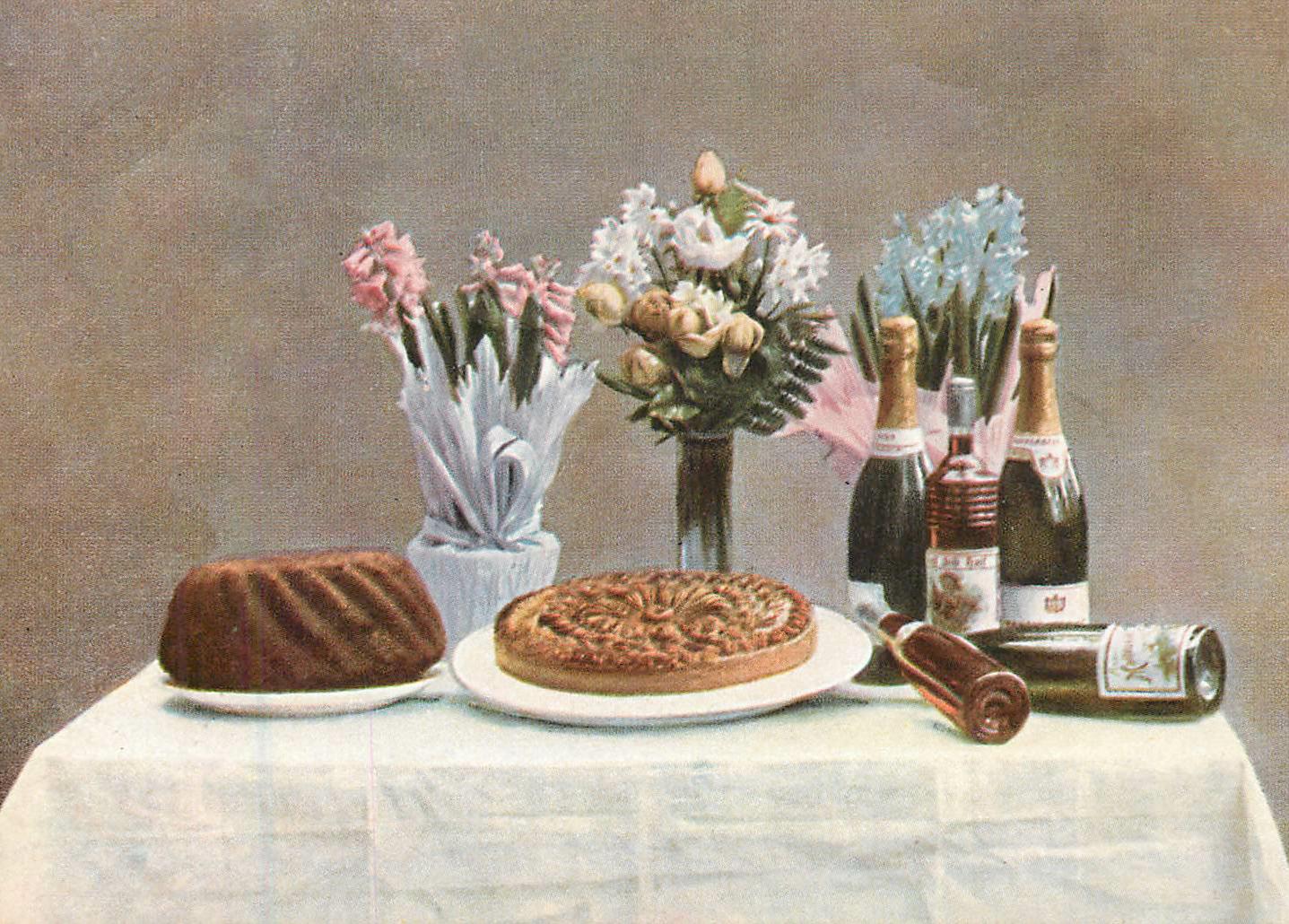
It’s not hard to imagine that if a gentleman was acquainted with thirty young women and visited each in quick succession on New Year’s Day, sampling food and drinking to the health of his hostess as he went along, there was a very good chance the gentleman might be a little tipsy by the time he finished his calls that evening.

Isabella recognized that danger. In Julia Ried she wrote about a young man named Norman Mulford who called upon Julia on New Year’s Day. Norman was “a bright, handsome boy of nineteen, fair-faced, except for a slightly unnatural flush. He was fresh from college honors, and seemed almost intoxicated with triumph and wine—just the sort of a boy to be led into all sorts of temptation.”

Unfortunately, Norman couldn’t resist the temptation of the “glittering glasses and sparkling liquid” offered him by every hostess at each stop along his way that day. Norman’s loving father was deeply aware of his struggle, saying, “I would have been thankful, I think, for almost anything that would have shielded him from the dangers and temptations of this day.”

But by the time Norman visited Julia, he was feeling defiant and resentful of his father’s efforts to keep him from drinking. When Julia and her friend, Mrs. Tyndall, explained to Norman that they promised his father they wouldn’t offer him any wine, Norman’s eyes took on a “stormy glare” and “his voice shook with suppressed passion as he spoke.”

“I am very grateful to my father, I assure you. I wouldn’t have you break your promise; but, I suppose you did not also promise that I should not help myself at your hospitable table?”
Whereupon he walked directly over to the refreshment table, and deliberately poured for himself a goblet of wine, drained the glass, and then immediately made his adieus.

Norman wasn’t alone in his struggles. Many young men found that as their social circles widened, the list of calls they had to make also grew, and the number of men who finished their New Year’s calls thoroughly intoxicated became a very real problem for society.

That may be one of the reasons the practice eventually fell out of favor. By the 1900s, the custom of paying New Year’s Day calls had been replaced by the New Year’s Eve celebrations we know today.

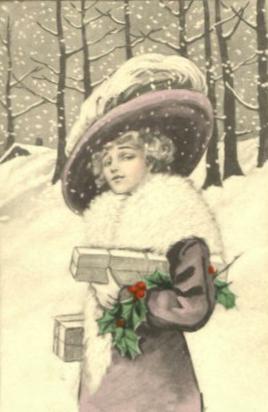
Christmas Shopping with Isabella

Julia Ried (in Isabella’s novel of the same name) had ten dollars with which to purchase Christmas gifts for her family and friends.

She knew exactly what she wanted to give her mother, sister Sadie and brother Alfred for Christmas; and since this would be her first Christmas away from home, she even thought out how she would ship the gifts to her family:

I had packed them in imagination in a neat little box, and written the accompanying letter scores of times.

In our modern world, ten dollars doesn’t seem like a lot of money, but in 1873, when Julia Ried was published, those ten dollars went much further than they do today.

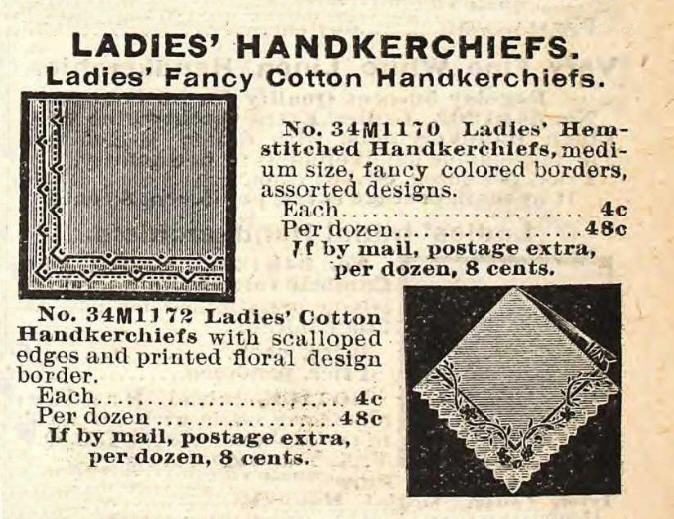
For example, Julia could purchase a set of six handkerchiefs to give to Sadie at a cost of only thirty cents:

And since a lady could never have enough handkerchiefs, Julia might instead have opted to give Sadie a dozen of them (with fancy colored borders) at a cost of just 48 cents:

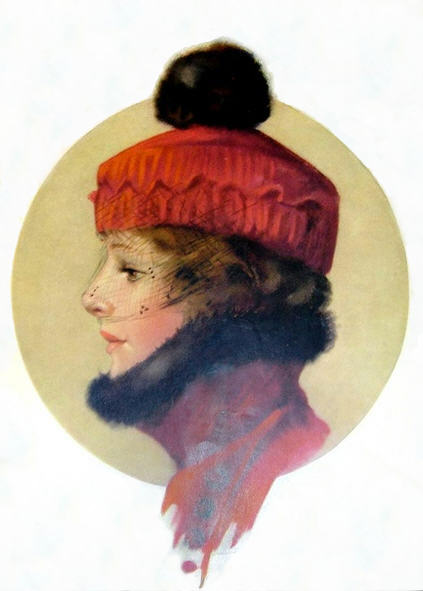
Or, Julia might have purchased for Sadie a knitted cap and scarf set, since such sets were just as popular in the late 1800s and early 1900s as they are now.

For Alfred, Julia might have purchased a new shirt to wear to his job as a store clerk (or even two shirts at these prices):

This full-page newspaper ad from 1912 illustrates other affordable gifts Julia might have chosen for Alfred, from a sturdy pair of gloves to a warm sweater to a new cap (click on the image to see a larger version):

When it came to selecting a gift for her mother, Julia knew no ordinary gift would do. She wrote:

Dear mother, she seemed to think that her first and greatest duty in life was to toil for and spare her children. Patient, faithful, tender mother! Tonight, as I recall her sweet, pale, tired face, I can think of no frown of impatience or anger that ever marred its sweetness. I can think of nothing left undone, that she could do, to smooth the path in which her children trod.

Clearly a special gift was in order for Mrs. Ried. A very pretty sewing box, covered in a sturdy but lovely patterned fabric (called “cretonne”) might have been the perfect gift:

Or she might have chosen for her mother a lovely ladies’ hat pin to add some sparkle to her life:

All of these would have been thoughtful gifts for Julia to send home to her family; but …

If you have read the book, you know that that Julia succumbed to an entirely different temptation when it came to spending her ten dollars—a temptation that left her with no money to buy gifts she wanted to give her family!

As the characters in Isabella’s novels so often did, Julia Ried had to learn many lessons about the dangers of peer pressure and placing trust in the wrong person—lessons that are just as relevant today as they were in 1873.

What do you think of the Christmas gifts in these ads from the late 1800s/early 1900s?

Which gifts would you purchase to give loved ones?

Pansy, the Enigma

In the nineteenth century, crossword puzzles had not yet been invented, nor had Sudoku and word search games that are popular today. Instead, “enigma” puzzles were in fashion. They were printed in newspapers and magazines for readers’ enjoyment, much like crossword puzzles are today.

Enigmas were puzzles within a puzzle. First, readers had to solve individual word clues that tested their knowledge and cleverness before they could solve the overall puzzle.

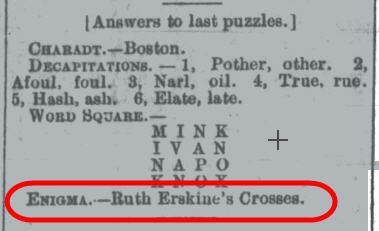
In 1882 Isabella Alden was the subject of an enigma puzzle that appeared in newspapers across the country.

Here’s how the puzzle appeared in the newspaper:

Think you can solve this enigma? It’s challenging!

First, solve each of the four riddles.

Then, using the letters from those four words, rearrange them to find the answer to the whole puzzle: a nineteen-letter title of one of Isabella’s books.

Need some help getting started? Click here for Hint #1

Click here for Hint #2

Click here for Hint #3

Good luck!

Click here to download a Word version of the puzzle to print and share with others.

Scroll down to see the answer to the whole puzzle, as it appeared in the newspaper the following week.

.

.

.

.

.

.

.

.

.

.

.

.

If you solved the puzzle . . .


A Quick Bite to Eat

In her novels, Isabella wrote about all kinds of people: from heroic physicians to ladies of wealth and leisure; from mischievous boys to angelic little girls.

But of all the character types who appeared in her novels, the working class clerk was the most common.

Clerks in a grocery store stand by, ready to serve customers.

Alfred Ried (in Ester Ried Yet Speaking) worked long hours for little pay in a busy downtown shop.

Robert Parks and Hester Mason did the same in Workers Together; an Endless Chain.

Clerks pose outside their hardware shop (about 1915).

Isabella seemed to have quite a bit of sympathy for these overworked, underpaid young people. Around the turn of the Twentieth Century the average man earned about $11.00 per week; but young men, like Alfred and Robert, who were just starting out in their careers, earned considerably less.

Because she was female, poor Hester would have earned only half (sometimes less) of what her male counterparts earned.

Shop clerks wait on customers in a department store (around 1910).

After they paid rent for their lodgings, they had little left to live on.

During the work day, when it came time for their mid-day meal break, they had to return to their lodging house for their meal, which was often included in the cost of their rent.

But if their rented rooms weren’t close to the shop where they worked, they had to find a nearby place to eat with menu items they could afford.

Luckily, some small restaurants in large cities catered to working people in that very situation.

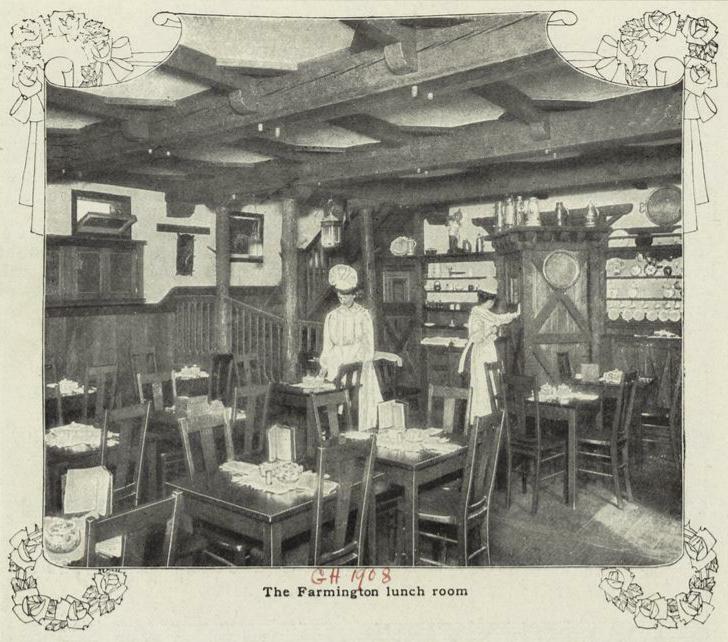
Workers prepare to serve diners at The Farmington Lunch Room in 1908.

Haim’s Quick Lunch Restaurant in New York City was one such place. Every dish on their menu was designed to be served quickly, so working clerks like Robert, Hester, and Alfred could have a simple meal and get back to work.

Trade card for the Riverside Tea Room in New York.

So what kind of dishes did Haim’s serve? Here’s their 1906 lunch menu:

Their heartiest dishes were the most expensive. For about ten cents Alfred could have two eggs cooked to order. And Robert might have a bowl of milk toast or a sandwich.

Since Hester had to make her pitiful wages go farther than Robert or Alfred, she might have ordered one of the less expensive items on the menu, like griddle cakes.

A crowded ladies’ lunch room at A. T. Stewart’s in New York City (about 1875).

Or she might have ordered a bowl of Force, Malta Vita, or Power, which were very much like cold cereal we eat today.
Excerpt from a 1902 Malta Vita newspaper ad.

What do you think of Haim’s menu choices?

If you were a shop clerk and had only 15 or 30 minutes to grab a quick bite of lunch, which Haim’s menu item do you think you would order?


If you’d like to learn more about any of Isabella’s novels mentioned in this post, click on the covers below:


A View from the Top of the World

In Isabella’s novel We Twelve Girls, Edith told her friends about a special treat she received from her Aunt Mattie, who was recently married.

When Mattie and her new husband were on their wedding trip, they stopped in Edith’s hometown for a short visit. Edith was thrilled when Mattie and her new husband invited her to go with them for a portion of their journey. Edith said:

Where do you think they took me? Why, to the very tip-top of Lookout Mountain. We rode all day, and stopped in Chattanooga at night, and the next morning went up the wonderful incline. Up, and up, and up, ever and ever so far! You go up by an endless chain railroad; then when you have got away above the houses and church steeples . . . you see perfectly lovely views. We got out at Sunset Rock, and went to see where the sun sets, when it is time for it. Uncle took me close to the edge of some great rocks, and let me look down. He would have taken me very closer yet, but Aunt Mattie screamed, and he said it would not do for him and me to frighten her. He is just as nice as he can be.

I wish I could describe the mountain to you, and tell you how I felt when I went up. I had some real strange thoughts; it seemed to me I was bidding good-bye to this world—like going to Heaven, you know—and I could not help feeling a little bit disappointed when I came down again.

It sounds like Edith caught a little bit of “mountaineer fever” on that trip; and it’s possible she might have grown up to be an excellent mountaineer herself.

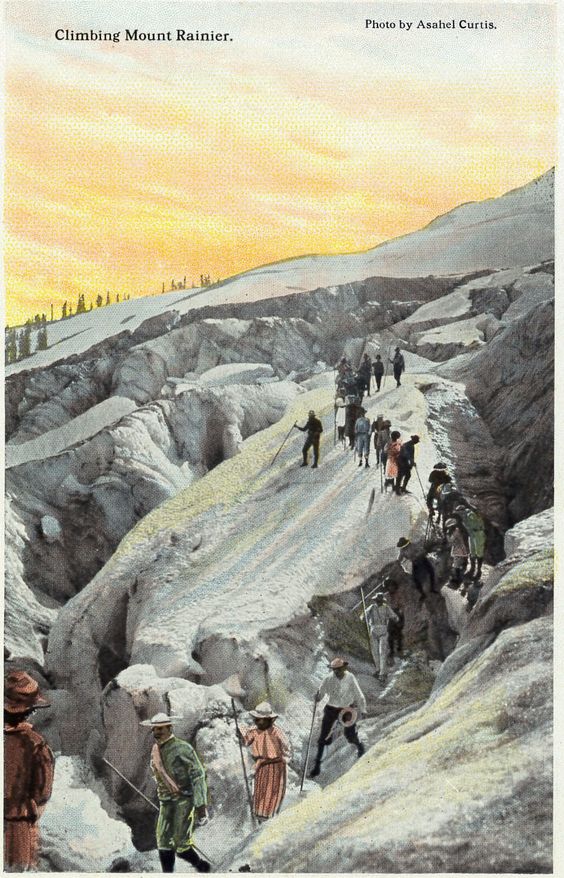
Several women joined this climb up Mount Rainier in 1913.

During Isabella’s lifetime there were quite a few women who enjoyed mountain climbing as a pastime.

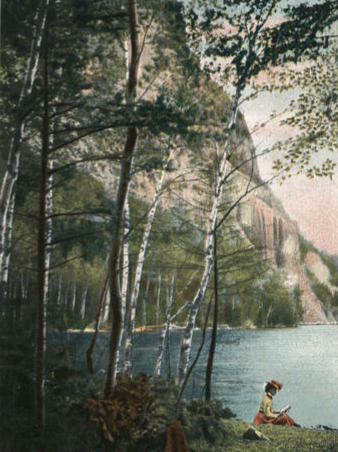
Relaxing in the shadows of Kineo Cliff near Moosehead Lake, Maine.

One of the most famous mountain climbers in the world was Marie, Queen of Bavaria. She not only founded a mountaineering society, she designed what she called a “practical” climbing outfit for women, which shockingly exposed a lady’s ankles.

Marie of Prussia, Queen of Bavaria, dressed for mountaineering. Note her canteen and water cup beside her.

In 1858 Julia Archibald Holmes became the first Caucasian woman to reach the summit of Pikes Peak in Colorado. An avid climber, she, too, wore a special “American costume” she designed to make the climb: a short dress, bloomers, moccasins, and a hat.

Julia Archibald Holmes in the mountain climbing costume she designed.

Fay Fuller wore a similar costume when she made the treacherous trek to the summit of Mount Rainier in 1890 (but with far fewer petticoats). She went on to become a founding member of the Washington Alpine Club.

Fay Fuller.

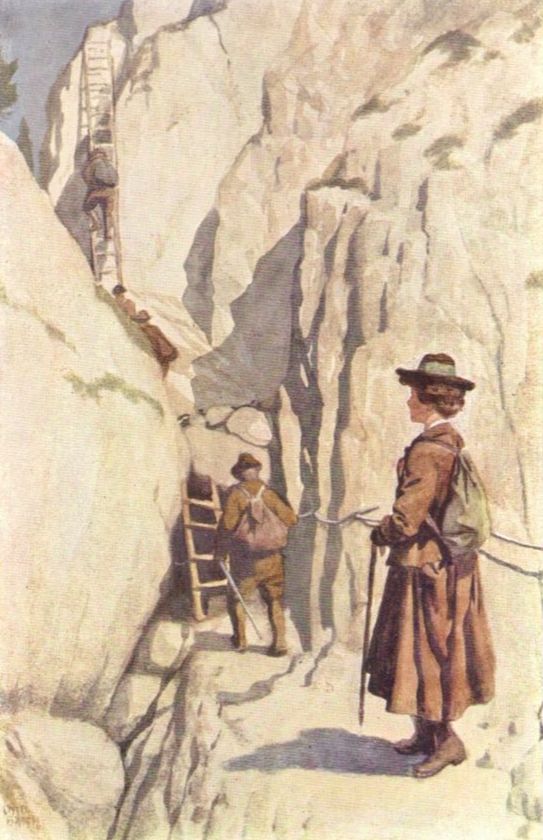
Not every woman adopted a mountaineering “costume.” Short skirts and exposed ankles were quite risqué for the time; but modesty didn’t require women stay at home; they still climbed mountains, but did so while wearing modest but cumbersome skirts.

Crossing a treacherous chasm in a skirt.

One of those women was Katharine Lee Bates. She was not a trained mountain climber, but after spending a summer teaching classes at Colorado College, she joined friends on a climb of nearby Pike’s Peak.

Katharine Lee Bates

Katharine later wrote:

One day some of the other teachers and I decided to go on a trip to 14,000-foot Pikes Peak. We hired a prairie wagon. Near the top we had to leave the wagon and go the rest of the way on mules. I was very tired. But when I saw the view, I felt great joy. All the wonder of America seemed displayed there, with the sea-like expanse.

A view of Pike’s Peak near Colorado Springs, Colorado.

Katherine’s experience inspired her to author the poem “America the Beautiful,” which was later set to music composed by Samuel A. Ward.

By the turn of the century, more women than ever were involved with mountaineering, and their attire evolved, becaming more sensible for the task at hand.

A woman mountain climber, about 1908.

Some avid female climbers left their long skirts behind at the base of the mountain and climbed in breeches, just like the men did.

Female climbers, 1907.

Perhaps when Isabella wrote about Edith’s experience at the top of Lookout Mountain she knew first-hand what it was like to look down upon a beautiful vista from a high place. There were certainly hills near where she grew up in New York that she might have climbed as a girl.

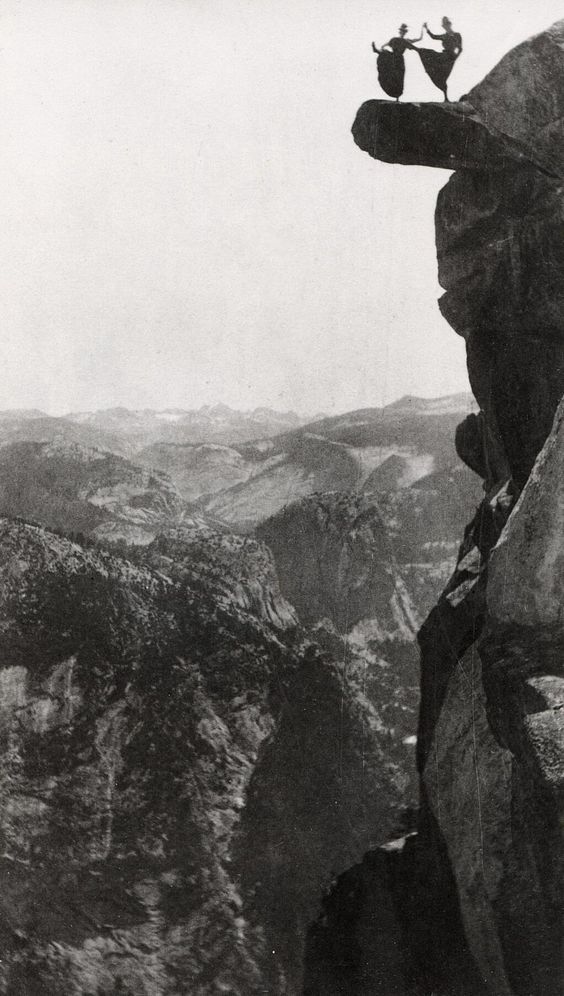
Women on Overhanging Rock at Glacier Point, Yosemite National Park, 1900.

And perhaps Isabella knew that wherever there were mountains, there were plenty of women—just like Edith—who were willing to climb them.

A Perfect Gown

Do you enjoy seeing examples of clothing Isabella and her characters might have worn? This afternoon gown from the 1890s holds a little secret.

With its stuffed bodice and skirt made of ruffled rows that drape up into a small bustle at the back of the waist, it’s very typical of the 1890s style.

And the smocking at the shoulders and waist indicate the gown was tailored to exactly fit the lady who owned it.

But don’t let the muted tones of the fabric fool you. This gown holds a surprise.

If you look closely, you can see pink roses and cherubs—symbols of love—woven into the fabric design.

Doesn’t that make this the perfect gown for a young lady with summer romance on her mind?

Which of Isabella’s characters do you think would have worn this afternoon gown?

Isabella’s Right to Vote

Today women across America are celebrating a major anniversary!

One hundred years ago—on August 18, 1920—the 19th Amendment to the U.S. Constitution was ratified, granting women the right to vote.

Isabella was a long-time advocate for the women’s vote, and even mentioned the subject in her books.

For example, in her 1876 novel Four Girls at Chautauqua Miss Eurie Mitchell was thrilled to attend a lecture by Dr. John Vincent, saying:

“Girls, look at Dr. Vincent! I declare, Chautauqua has paid, just to watch him! He ought to be the president himself. I mean to vote for him when female suffrage comes in.”

In One Commonplace Day, published in 1886, Miss Wainright, a staunch temperance fighter, tells Mr. Durant:

“I am nothing but an old maid, Mr. Durant; haven’t even a husband to talk for me, or vote for me; which perhaps is fortunate, for ten chances to one that he would talk and vote the wrong way, if I had.”

And in 1879’s My Daughter Susan, Susan Carleton encouraged the women of her church to join the Temperance movement, saying:

“I wear a blue ribbon on my watch chain, and a white one on my muff, or fan, or whatever happens to be convenient. I’m a crusader, and a no-license woman, and I will be a voter, on that subject at least, if I ever get a chance. I’m anything, and everything.”

Maryland women marching for the right to vote.

Isabella was something of a crusader, too. She was an active member of the Women’s Christian Temperance Union, and actively supported the prohibition movement. She strongly believed that if women won the right to vote, they would vote to enact a nation-wide prohibition law. And she was right.

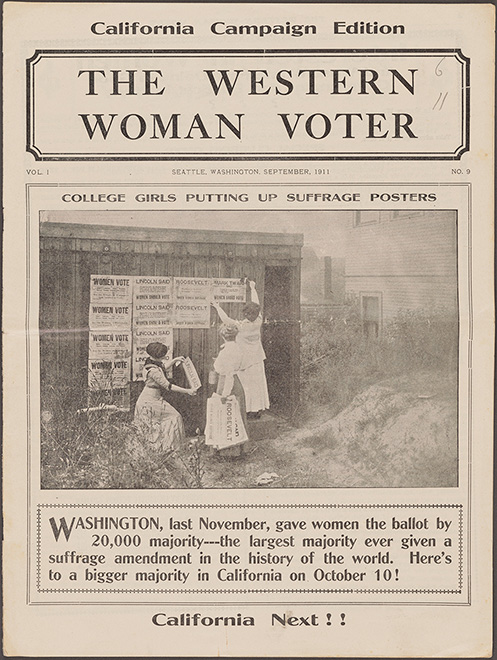
Suffrage wins in Washington, California, and Oregon paved the way for hard-fought victories in Arizona, Kansas, Nevada, and Montana.

By the end of 1914, more than four million women had voting rights equal to men in eleven states, all in the West; but they could not vote in national elections.

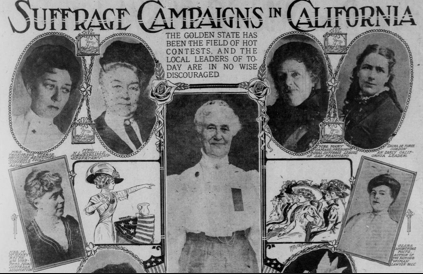
In 1911 when women gained the vote in California, Isabella was a resident of that state. Here’s Isabella’s name (along with the names of her husband, her son Raymond and daughter-in-law Barbara) on the 1916 list of California registered voters. You can see she claims affiliation with the Prohibition Party.

With western states leading the way, support for suffrage continued to gain momentum , as more and more women and men joined the movement. By 1919 enough States supported the Amendment to qualify it for a vote.

Women picket in front of the White House for the right to vote (1917).

On June 4, 1919 Congress sent the proposed 19th Amendment to the Constitution to the individual states for ratification. Wisconsin was the first state to ratify the Amendment on June 10, 1919.

Kentucky governor Edwin P. Morrow signing the 19th Amendment.

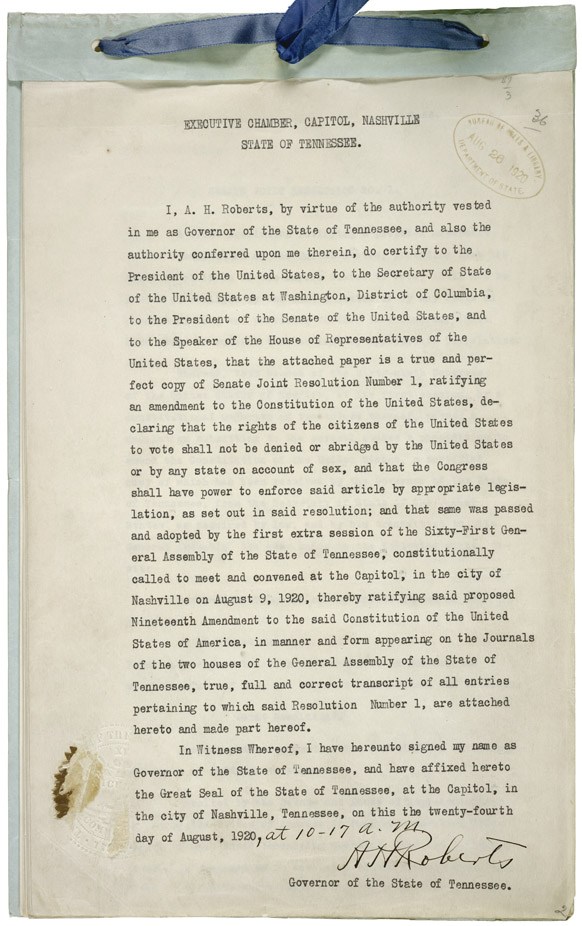
On August 18, 1920 the state of Tennessee ratified the 19th Amendment, ensuring the right to vote could not be denied based on gender. Four days later, with the stroke of Tennessee Governor Albert H. Roberts’ pen, the eighty year struggle was over.

Tennessee Ratification of the 19th Amendment signed August 24, 1920.

Despite her own involvement and efforts, Isabella didn’t mention the historic day in her memoirs, but she must have been proud to see women across the country gain the right to vote in local, state, and national elections.

If you haven’t yet read My Daughter Susan, you can read it for free! Just click here to begin reading.

About Pansy, By Pansy

It’s safe to say that few places on earth celebrate fame more than the state of California.

When Isabella and her husband Ross moved to Palo Alto, California in 1901, she joined a community of talented authors, artists, musicians, and actors already in residence.

The California State Library had a system for documenting famous and notable residents through a series of biographical index cards.

Some of the cards date as far back as 1781. Each card detailed the names, birthplaces and accomplishments of artists, soldiers, statesmen, “and other notables.” In most cases, the cards were completed by the person in their own handwriting.

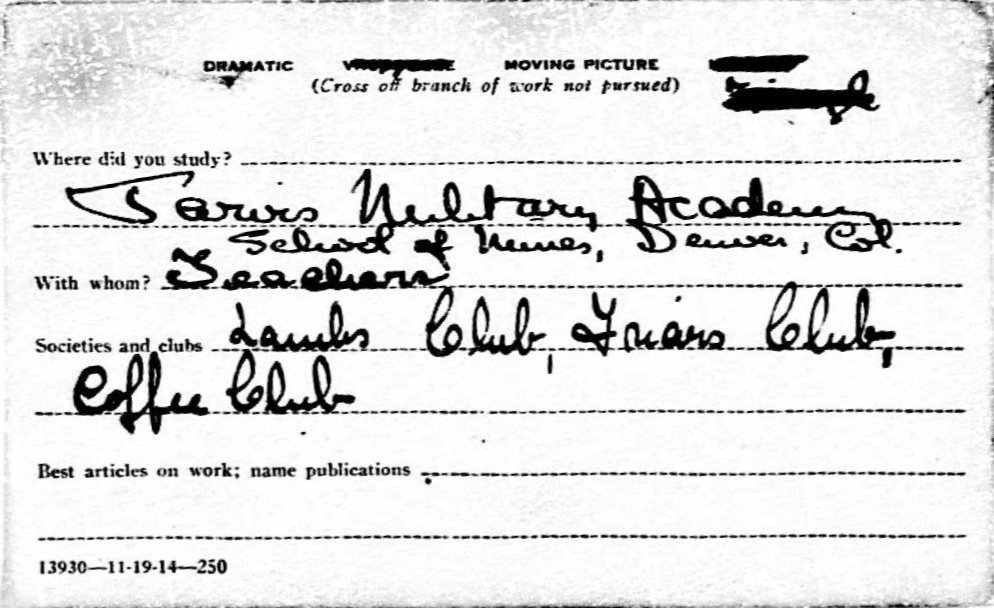
Here’s a biographical card completed by silent film star Douglas Fairbanks in 1916:

California State Library card dated 1916. Stage name: Douglas Fairbanks. Name in Full: Douglas Elton Fairbanks. Place of birth: May 23, 1883.

Interestingly, Fairbank’s education—first at a military school, then as an engineering major at Denver’s School of Mines—could not have been more contrary to his ultimate career as one of early Hollywood’s most beloved actors.

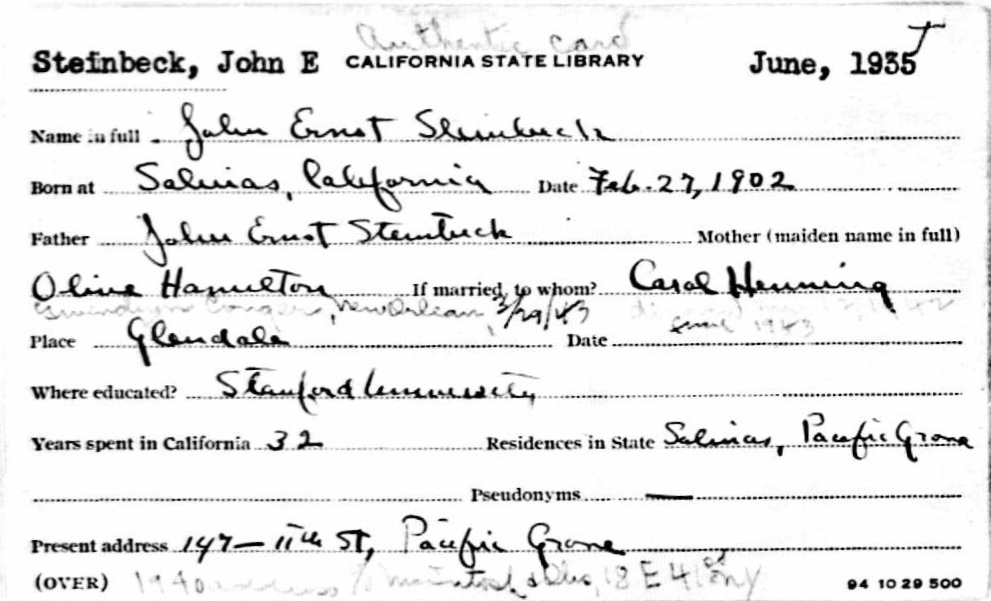
Author John Steinbeck was only 33 years old when he completed his card:

His most famous novels, Of Mice and Men and The Grapes of Wrath, had not yet been published.

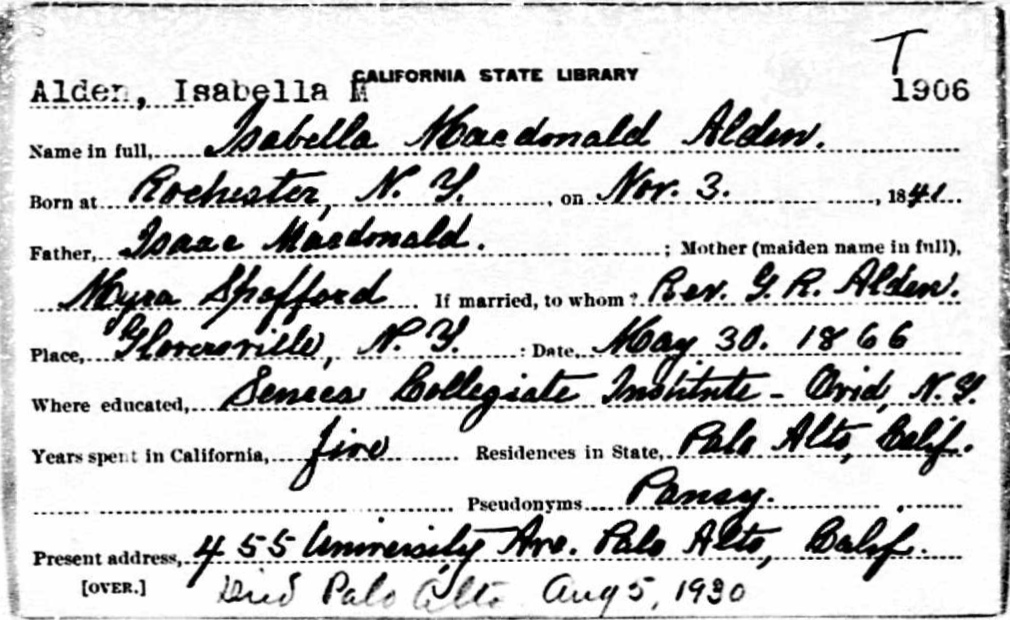
In 1906 the State of California asked Isabella to complete a biographical card.

In her own handwriting Isabella wrote out her personal information on the front of the card:

Name in full: Isabella Macdonald Alden
Born at Rochester, N.Y., on Nov. 3, 1841.
Father, Isaac Macdonald
Mother (maiden name in full), Myra Spafford.
If married to whom? Rev. G. R. Alden
Place, Gloversville, N.Y.
Date, May 30, 1866
Where educated, Seneca Collegiate Institute – Ovid, N.Y.
Years spent in California, five
Residences in State, Palo Alto, Calif.
Pseudonyms: Pansy
Present Address, 455 University Ave., Palo Alto, Calif.
(A state employee noted on the card Pansy’s date of death, August 5, 1930.)

The back of the card is also written in Isabella’s hand.

It reads:

Published works and periodicals for which you have written:

I enclose with this card a printed list of my books. I was for 25 years editor of a juvenile monthly magazine – named The Pansy; and for the same length of time I was the Editorial staff of the Westminster S. S. Teachers. I am now on the Editorial staff of the Herald & Presbyter, Cincinnati, with which paper I have been associated for 33 years.

I have for the past twelve years had a department in the Christian Endeavor World — As to Clubs, etc. I have been honored by being elected to a number of local literary clubs, and to membership in the Women’s Press Association.

When Isabella completed this card in 1906 her novel Ester Ried’s Namesake was published. In the following years she would go on to publish Ruth Erskine’s Son, The Browns at Mount Hermon, Four Mothers at Chautauqua, and five more novels.

This sample of Isabella’s handwriting reveals a few things about her. For example, the distinctive way she forms her capital letters—especially C, M and H—indicates she was taught to write script in a style that was popular around 1850. In particular, she forms her capital letters with a finishing loop that could easily be mistaken for a lower case “a” or “o.”

In this handwriting example from the 1850 United States Federal Census, you can see the census taker had a similar slant to his writing and formed his capital letters in the same way Isabella did.

Her card also shows she was very proud of her work as editor of The Pansy and other Christian publications. Unfortunately, we haven’t been able to find a copy of the list of published works she referenced on her card; it would be interesting to see if there were any titles she listed that aren’t among Pansy’s known published works we’ve compiled!

Sometimes people who filled out the cards also submitted photographs, pertinent letters, and copies of published books. While there’s no record that Isabella submitted such items, it’s clear the State of California has an extensive and rich collection that would be interesting and fun for any researcher or fan to explore.

You can click on any of the images in this post to see a larger version.


Daily Thoughts for January

Isabella Alden strongly believed in spending a few minutes with the Bible every morning; and that even one verse, thoughtfully read, helped fortify and strengthen Believers in their daily walk with God.

Several of her novels were based on that premise, including:

Frank Hudson’s Hedge Fence

Her Mother’s Bible

The Exact Truth

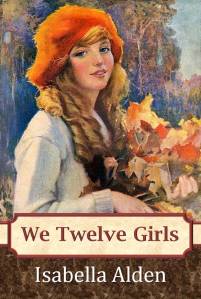
We Twelve Girls

In each story, the main characters committed to memory and relied upon a single verse of scripture every day to help them in their daily lives. She called these stories “Golden Text” novels.

Isabella brought the same concept to The Pansy magazine. In 1895 she began publishing a regular monthly feature in The Pansy called “Daily Thoughts.”

“Daily Thoughts” was printed on the first day of each month, and consisted of a list of Bible verses meant to be read individually, one each day.

She chose each verse carefully, with the prayerful hope that each one would inspire her readers to live their lives for Jesus’ sake.

With each verse she offered a brief comment or question to help her readers better understand the text.

Her verses for January 1895 all came from the book of Psalms. You’ll notice she didn’t print the actual verse, but only gave the citation. She hoped doing so would encourage readers to open their Bibles each day and look up the verses for themselves.

You can click here to open a full-size PDF version of Isabella’s Daily Thoughts for January, which you can use, print, save and share with others.

Or click here to download a simplified Word version.

Click here to see Isabella’s “Daily Thoughts” for the month of February.
If you’d like to know more about Isabella’s novels mentioned in this post, click on the any of the book covers to learn more:


A Perfect Partnership: Isabella and Daniel Lothrop

In additional to writing novels, Isabella Alden wrote articles and short stories for many different publications.

Her stories and articles were so popular she found herself in a unique position for a writer: She never had to submit her work for publication.

Instead, publishers went to her. Elias Riggs Monfort, the long-time editor of The Herald and Presbyter (a weekly Presbyterian newspaper), gave her a lifetime contract to publish any serials she wrote.

Elias Riggs Monfort, about 1870 (Wikipedia).

Mr. Montfort was such a fan of Isabella’s, he wrote to his friend, Daniel Lothrop, full of praises about Isabella and her stories.

Daniel Lothrop was the owner of D. Lothrop & Company, a Boston publishing house that specialized in books for young people.

Daniel Lothrop.

Daniel Lothrop had been a great reader from his childhood; while he was still a boy himself he developed an ambition to publish books specifically written for children—a novel idea at the time. Even more radical: he believed the books should be beautifully illustrated to serve the story and keep children’s attention.

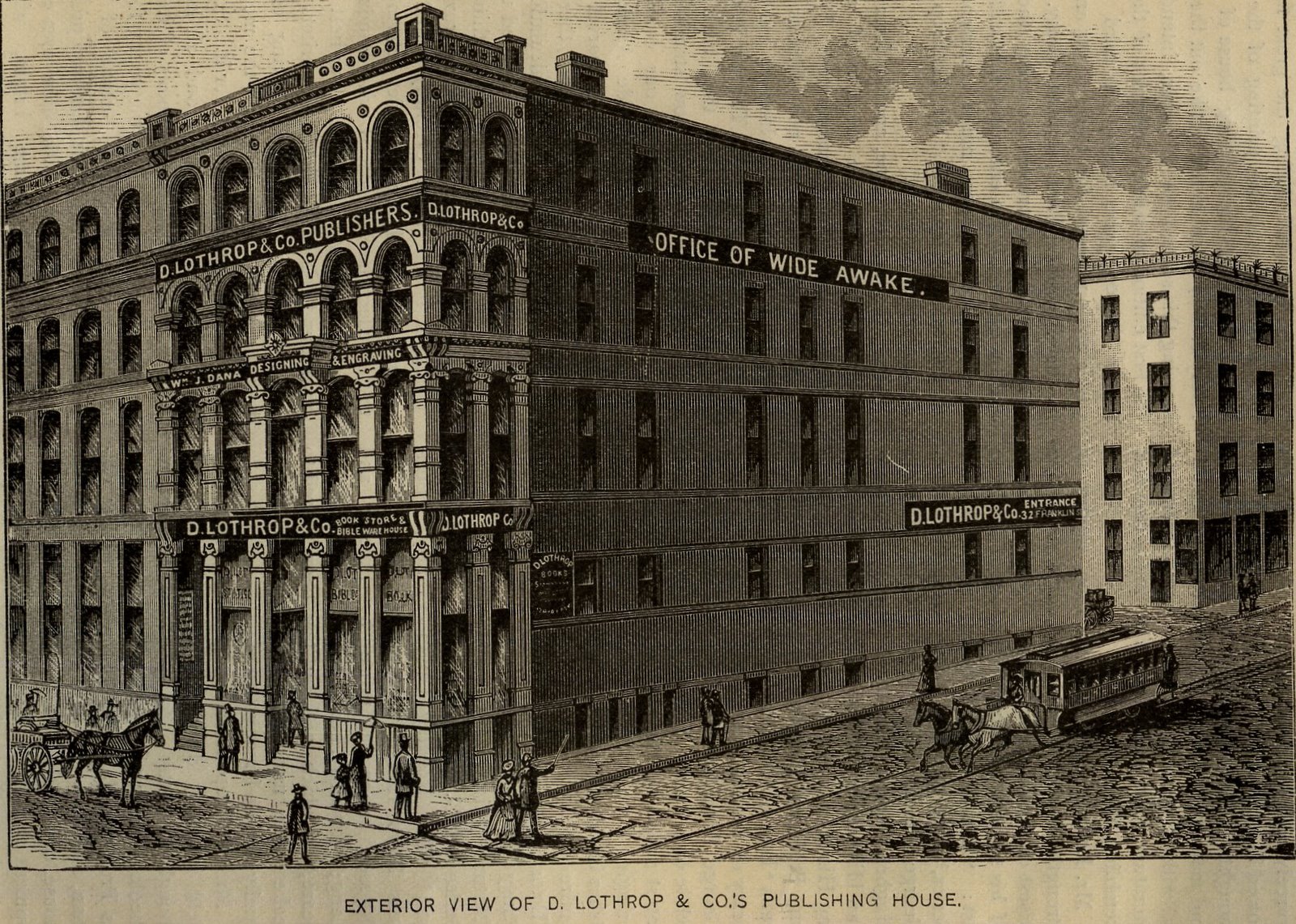
An undated artist’s rendering of the D. Lothrop and Co. Publishing building in Boston, Massachusetts.

But he persisted, believing that it was possible to publish children’s books that were not only entertaining, but encouraged “true, steadfast growth in right living.”

The interior of D. Lothrop and Company.

He often said to the people in his employ: “I publish books to do good as well as to make money. I always ask first, ‘Will this book help the young people?’ rather than ‘How much money is there in it?’”

His long partnership with Isabella began around 1874. After Elias Monfort sang Isabella’s praises to him, Daniel Lothrop invited Isabella to contribute stories to be published in a small weekly Sunday School newspaper he published.

Little One’s Friend, one of D. Lothrop and Company’s beautifully illustrated books for children.

By 1877 that short weekly paper had grown considerably in size and content—and Isabella was its editor!

Called The Pansy, each issue was filled with inspiring stories, delightful illustrations, short poems, and descriptions of exotic and far-away places to spark children’s imaginations.

Isabella wrote a short story for each issue, and other members of her family did, too, including her husband, her sister Marcia, niece Grace Livingston, and later, once he was old enough, her son Raymond.

Another frequent contributor was Daniel Lothrop’s wife Harriett, who wrote under the pen name “Margaret Sidney.”

Author Harriet Stone Lothrop, who wrote under the name “Margaret Sidney.”

Isabella wrote that Mr. Lothrop always had “a very warm place in his great warm heart” for The Pansy magazine.

Not only was he fertile in suggestions calculated to make it better, but he was ready always to heartily second the suggestions of others, and to aid in carrying them out.

The Pansy Society in particular was very dear to him. He was interested in everything about the Society, from the content of the letters children wrote to the magazine, to the design of the badges that Isabella sent to Pansy Society members. Isabella said:

“It would be difficult—impossible, indeed—to tell you in how many ways he helped along the cause of truth and right in the world.”

Another common interest Isabella and Lothrop shared was the Christian Endeavor Society. From the early days of the Society, Daniel Lothrop saw an opportunity to use his publishing company to further the Society’s message. He recruited authors to write books of interest to Christian Endeavor members. Margaret Sidney, Faye Huntington, and Grace Livingston were among those who answered the call.

An 1897 newspaper ad showing new Lothrop books by the company’s prized authors.

Isabella’s novels, Chrissy’s Endeavor and Her Associate Members were written and published especially for C.E. members.


Isabella’s long partnership with Daniel Lothrop lasted almost twenty years. It ended when he passed away in 1892.

Isabella was heartbroken. In her memoirs she wrote:

“Mr. Lothrop was my true, strong, faithful friend all his life.”

She gently told readers in an issue of The Pansy about the passing of “our friend who loved us, and worked for us and with us.”

It’s impossible to know how many lives were influenced for good by Isabella’s partnership with Daniel Lothrop. Her books alone sold more than 100,000 copies a year, and The Pansy magazine had thousands of subscribers all around the world.

They had formed a perfect partnership. Both Isabella and Daniel Lothrop must have been proud of their accomplishments and the knowledge that they always produced books and stories that were consistently wholesome, pure, and elevating.


You can learn more about The Pansy magazine, The Christian Endeavor Society, and The Pansy Society by reading these previous posts:

The Pansy Magazine

The Christian Endeavor Society

The Pansy Society