Isabella Alden was particularly close to her niece, Grace Livingston Hill. Grace was a writer, too, and her books were incredibly popular and are still widely read today.
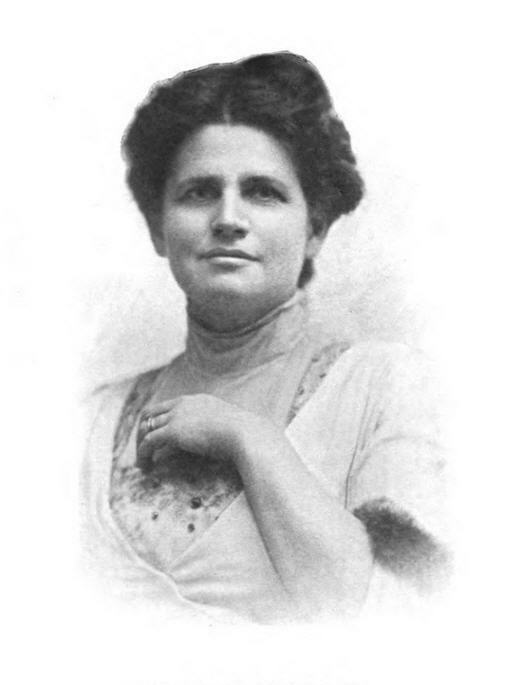
Grace Livingston Hill-Lutz, about 1912
But Grace wasn’t merely a best-selling authoress; Grace was also a teacher. She was dedicated to teaching Sunday-school classes at her church, and when her daughters Margaret and Ruth were old enough to attend school, Grace decided to teach them at home, just as her parents had taught her.
Grace’s desire to teach wasn’t limited to her family. For years Grace ran a Bible class for children at a nearby Presbyterian church. She was the guiding spirit in establishing a mission Sunday School for immigrant families, and she personally paid to send innumerable young people to Pinebrook School, a well-known Christian Bible conference in the Poconos.
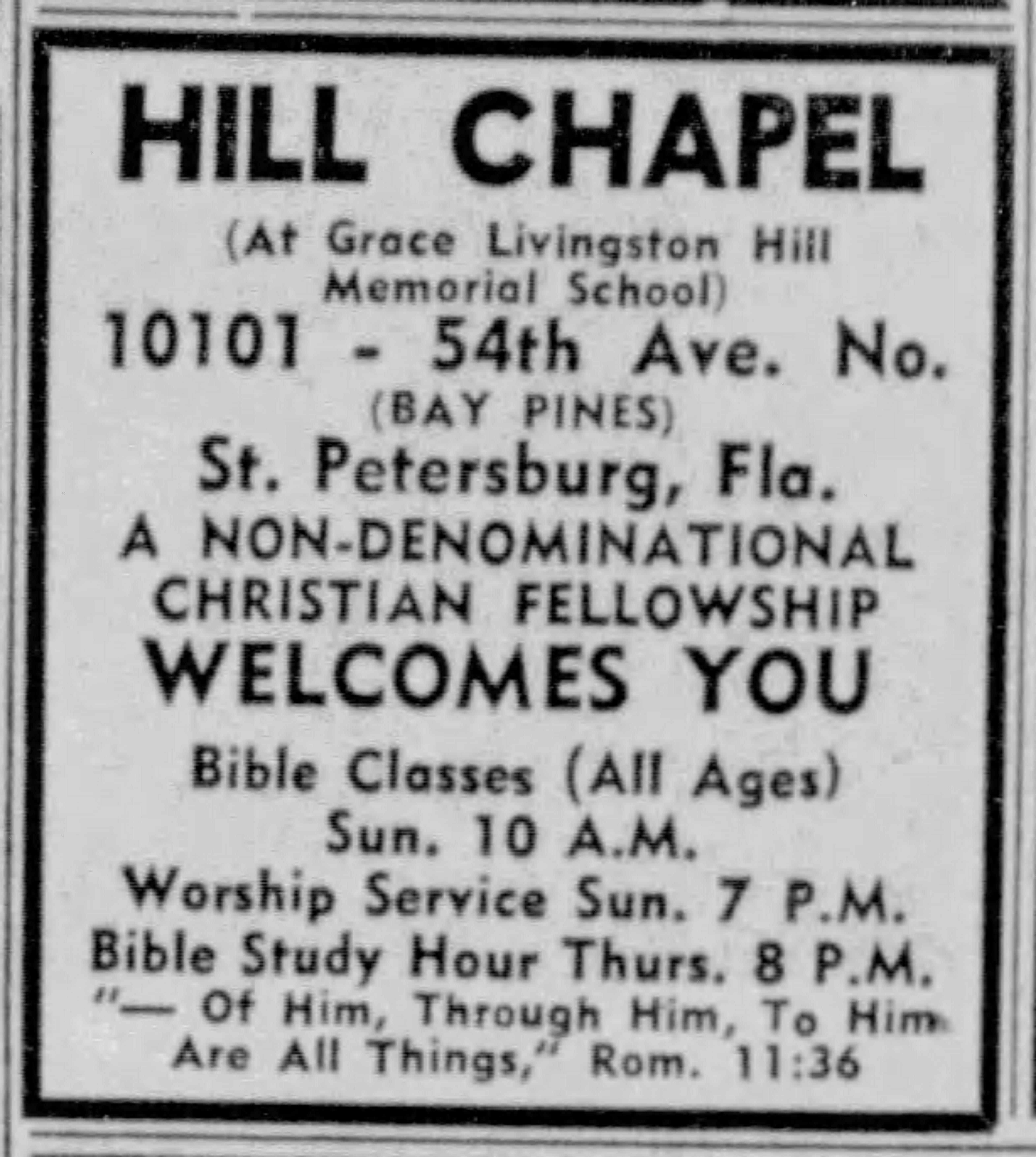
Notice of class registration for Grace Livingston Hill Memorial School; from the Tampa Bay Times, May 20, 1954.
Education was something Grace was passionate about, and when she passed away in 1947 her daughter Ruth Hill Munce took steps to honor Grace’s teaching ministry. Ruth purchased a 30-acre site in St. Petersburg, Florida and built a school, which she named after their mother.
An ad for Sunday services at Grace Livingston Memorial School chapel. From the Tampa Bay Times, October 22, 1955.
Grace Livingston Hill Memorial School had just four classrooms and 75 students when it officially opened in 1953, but the Christian day school grew with each passing year. Ruth served as the school principal for 15 years. Under her direction, she ensured that Christian education was at the core of every class, saying, “God would be the sum of the equation, the Bible a textbook.”
Grace Livingston Hill Memorial School graduates, class of 1961, from the Tampa Bay Times, June 7, 1961.
In 1962 the school changed its name to Keswick Christian School, and it’s still operating today under that name. But it had its roots as a tribute to Grace Livingston Hill, who loved God and used her talents for writing and teaching in order to serve Him.
You can read some of Grace’s short stories for free on this site. Just click on one of the images below to begin reading.
During the late 1800s and early 1900s no true lady ever left home without being properly attired. Isabella Alden would have abided by that rule.
When paying calls or shopping, Isabella, like all women at the time, wore gloves as well as long sleeves and high collars to cover her arms and neck.
Even more importantly, ladies always wore bonnets.
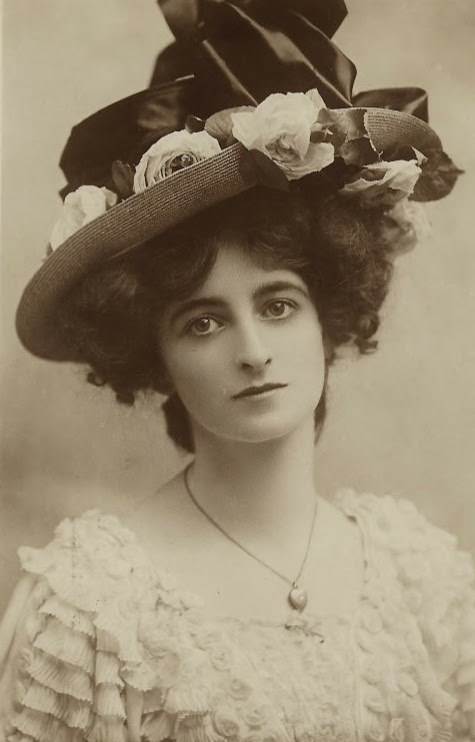
The fashion in 1895: A black straw hat trimmed with artificial roses, lily of the valley, and violets. Courtesy of HistoricNewEngland.org.
Bonnets were de rigeur for any lady in the out of doors; and while styles of bonnets changed from year to year, one constant was decoration; with few exceptions, ladies’ hats were decorated with ribbons, netting, swashes of fabric and—most commonly—with artificial flowers.
Hat styles in 1914, depicted in The Ladies Home Journal.
Woman of the era loved artificial flowers. From small dainty buds to cabbage-sized blooms, women wore them not just on their bonnets, but in their hair and on their gowns, as well.
Artificial flowers were in heavy demand; companies that supplied them were constantly adjusting their prices to gain an upper hand over their competition.
Business card for a dealer in artificial flowers.
In Isabella’s lifetime, the American manufacturing industry was in its infancy; there were no machines that could make artificial flowers. So the flowers were constructed by human fingers, petal by individual petal.
It was tedious, painstaking work that was typically performed by women and children for paltry wages.
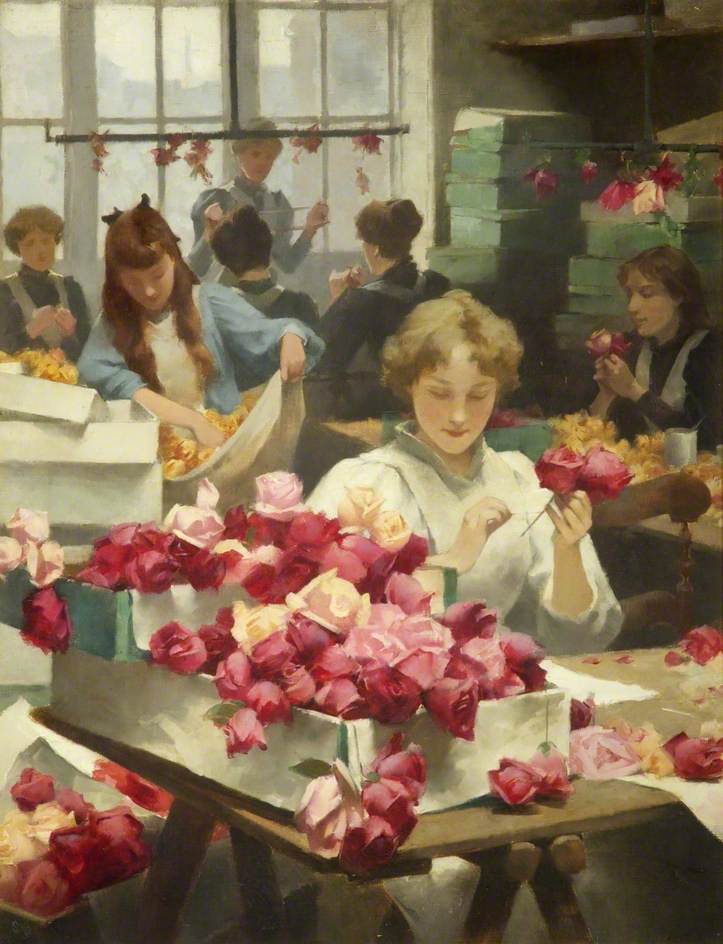
Artist Samuel Melton Fisher memorialized flower makers in his 1896 painting
Flower Makers by Samuel Melton Fisher, 1896.
But Mr. Fisher’s painting shows an idealized setting, with women and girls in crisp white aprons happily gluing the petals of flowers together or attaching blooms to stems.
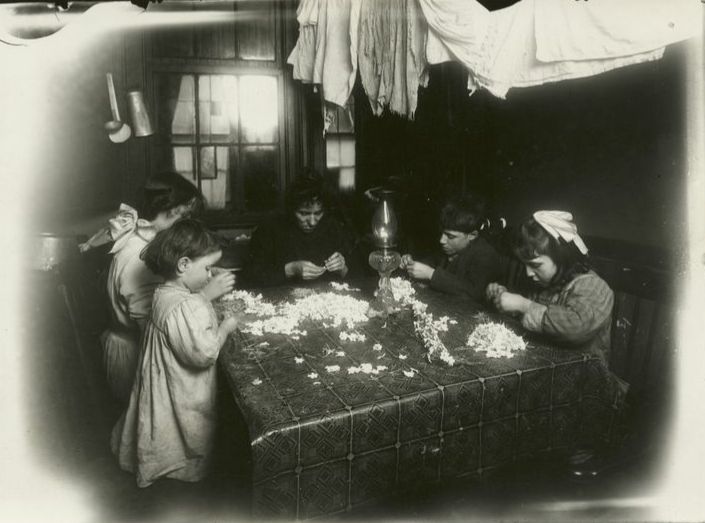
The truth was that the majority of artificial flowers were made as piecework in women’s homes.
A mother and her children making artificial flowers in their home (1910).
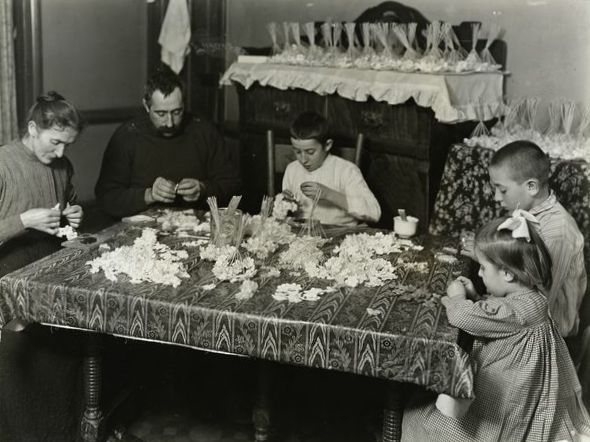
In 1908 the city of New York conducted a study of people living in city tenements. As part of the study, they published this photograph depicting Frank, a fourteen-year-old, and his family, who lived in a tenement building:
The city used this caption for the photo:
Frank, 14, John, 11, and Lizzie, 4, work with their parents at home making artificial flowers. The father helps because his health is too poor to do other work. The boys work from Saturday afternoon and evening until 10 or 11 p.m. Lizzie separates petals. They make regularly from ten to twelve gross a week for which they are paid 6 cents a gross.
At 6 cents a gross, Frank’s family earned between 60 and 72 cents a week. To put that amount into perspective, a loaf of bread at the time cost 5 cents; a quarter of milk cost 6 cents, and a dozen eggs cost 22 cents. Given the amount Frank and his family earned, they were able to afford just enough food to survive.
Young women making artificial flowers.
The demand for artificial flowers remained high for decades. Some unscrupulous suppliers rounded up street children and locked them in rooms, forcing them to make flowers for 12 to 14 hours a day. The children were give little food and allowed minimal rest before they were made to begin work again.
Eleanor H. Porter, the popular author of the Pollyanna series of classic children’s novels, wrote about the plight of such children in her book, Cross Currents.
Although many of the children in Isabella’s novels had jobs or worked to help support their families, none of them assembled flowers; still, it was such a wide-spread cottage industry, Isabella was probably very aware of the practice.
There’s no available photograph of Isabella to tell us whether she liked artificial flowers on her bonnets; but in her memoirs, Isabella mentioned that when she was a young bride, she wore a hat that a woman at church felt was “too gay” for a minister’s wife to wear. The woman went so far as to send Isabella an incredibly ugly hat for her to wear instead.
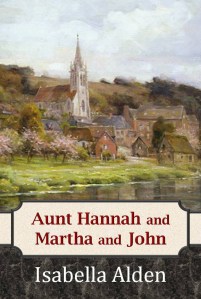
Isabella even wrote about the incident in her novel Aunt Hannah and Martha and John. In the story (just as it happened in Isabella’s real life) an anonymous person sends newly-wed Martha Remington a very unattractive hat. Martha’s struggles in deciding whether to wear the horrid creation to church reflected the very same struggles Isabella endured in the very same situation!
You can read more about the books mentioned in this post by clicking on the book covers.
Much has been written about Isabella’s first book, Helen Lester, and how it came to be published.
Less has been written about her last novel, An Interrupted Night. Here’s an interesting fact about the book: in the same way her first novel Helen Lester was published with the help of her best friend, Theodosia Toll Foster, Isabella’s last novel was published with the help of her beloved niece, Grace Livingston Hill.
Isabella Alden
Here’s how it happened. In 1924 Isabella was 82 years old. During that year she suffered great loss: her dear sister Marcia, her husband Ross, and her son Raymond all died within months of each other. Isabella’s writing took a back seat as she made her way through that difficult time.
Ross and Isabella Alden with their son Raymond in 1916
Two years later, in 1926, Isabella was seriously injured in an automobile accident in Palo Alto, California, where she was residing. She lived with the pain of her injuries for years afterward.
Then, in 1929, due in part to those old automobile accident injuries, Isabella fell and broke several bones including her hip. From that point on, Isabella was confined to a wheelchair and in constant pain.
Still, despite everything she had been through, at the age of eighty-seven she had one more story to tell.
Between intervals of constant pain and visits from friends and well-wishers, Isabella began writing her last novel. But even with her best efforts, she struggled to complete the story because, as she said, her body . . .
. . . was unfit for the work that needed to be accomplished.
Finally, determined to get her promised manuscript into the hands of the publisher, Isabella called upon her niece Grace Livingston Hill for help.
Grace Livingston Hill, 1915.
By that time, Grace was a successful novelist in her own right. Still, Grace said of her aunt’s request:
I approach the work with a kind of awe upon me that I should be working on her story! If, long ago in my childhood, it had been told to me that I should ever be counted worthy to do this, I would not have believed it. Before her I shall always feel like the little worshipful child I used to be.
But Grace took up the task, and helped her Aunt Isabella — by then confined to her bed — finish the book.
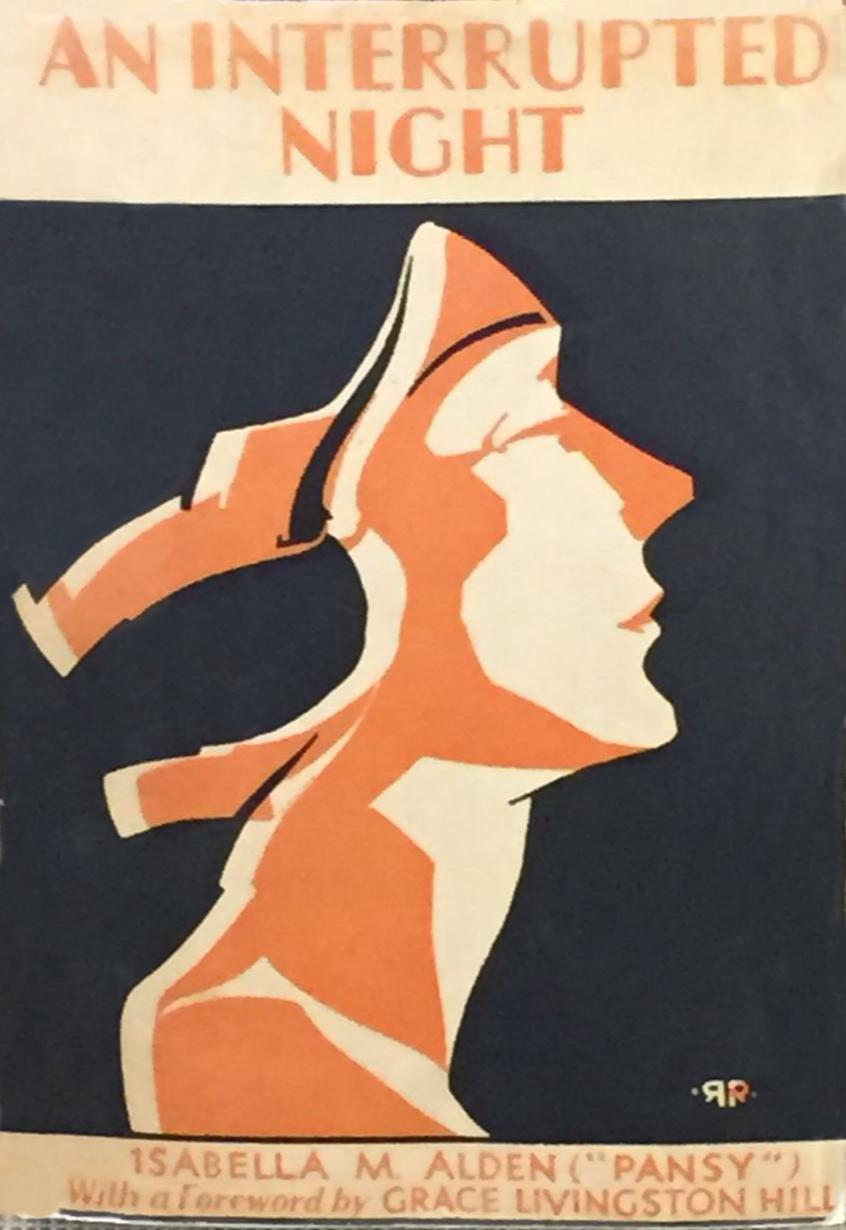
The novel was titled An Interrupted Night. Isabella said the story was based on actual facts, told to her by one of the people characterized in the story as “Mrs. Dunlap.”
The cover for Isabella’s 1929 novel, An Interrupted Night.
The novel was published by J. B. Lippincott Company in 1929 and received very favorable reviews.
One particular review, found in the Fort Lauderdale News on July 12, 1929, begins with this this sentence:
Old readers must have gaped with surprise and thought that their glasses were at fault when they read that a new book by Pansy, Mrs. G. R Alden, will be published soon by Lippincott’s. Shades of sainted grandmothers and all the dear old ladies of the Presbyterian fold, who reveled and doted upon Pansy when they were little girls!
That’s quite a beginning to a book review, isn’t it? Although the review begins with a rather sarcastic tone, it ends on a more respectful note. You can read the entire review by clicking here or on the image below.
Because it’s still protected by copyright, we can’t make An Interrupted Night available to you, but copies of the book do surface in libraries and book stores on a fairly regular basis.
If you find a copy of An Interrupted Night, you’ll be treated to a marvelous story about Mrs. Dunlap and her efforts to convince a young woman to abandon her plans to elope with a man who seems, on the surface, to be her ideal mate.
It’s a Pansy story in the truest sense, with a wonderfully sweet ending, engaging dialog throughout, and important life lessons for her characters —and readers! — to learn along the way.
This is the last post in our Blogiversary Celebration! Leave a comment below or on Isabella’s Facebook page to be entered in a drawing for a $25 Amazon gift card! We’ll announce the winner tomorrow.
Isabella Macdonald Alden was born the youngest child in a loving, and very tight-knit family.
She and her sisters were especially close, even though there was a vast difference in their ages.
For example, Isabella celebrated her first birthday the same year her eldest sister, Elizabeth, married and moved into a home of her own. But since Elizabeth’s new house was only a few steps from the Macdonald’s front door, Isabella and Elizabeth shared a close relationship.
The same was true of Mary, who was 14 years older than Isabella. When Mary wed and set up housekeeping, her home was built on property that abutted the Macdonald’s back garden. As a result, Isabella spent a lot of time with Mary and they, too, had a special bond.
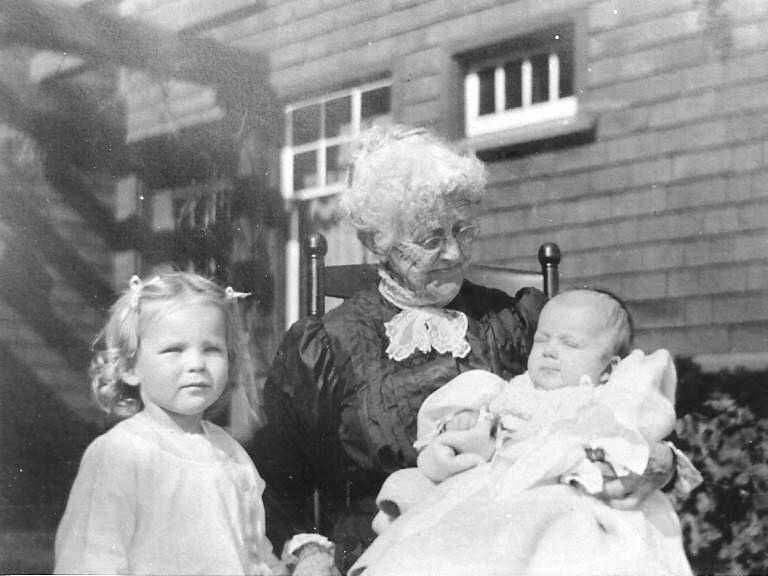
Isabella’s sister, Mary Macdonald Williamson (age 87) with two of Isabella’s grandchildren in Palo Alto, California (1914).
It’s no wonder, then, that when Isabella married and began keeping a house of her own, she made certain the door was always open to family members. She wanted her sisters to feel the same welcoming spirit in her house as she had always felt in theirs.
When her son Raymond was young, Isabella and her husband Ross began taking him to Florida, hoping the southern climate would benefit Raymond’s health. To their relief, Raymond’s health did improve, so the Aldens decided to make Florida their winter home.
The Aldens and the Livingstons in Florida. Front row left to right: Julia Macdonald (in white blouse), unidentified man, Margaret Hill, Ruth Hill, Grace Livingston Hill and her husband, Frank Hill. Second row (in light-colored dress) Marcia Macdonald Livingston and her husband Charles Livingston. Back row, third from left: Isabella Macdonald Alden, Raymond Alden, Ross Alden.
They bought a plot of land in the new town of Winter Park, and began building a house that would be big enough to accommodate plenty of family members.
Interlachen Avenue in the 1890s. Bicycles appear to be a favorite mode of transportation.
They built on an oversized lot on the corner of Lyman and Interlachen avenues, right across the street from All Saints Episcopal Church.
An 1888 photo of All Saints Episcopal Church. You can see the front half of Isabella’s new house peeking from the left side of the church.
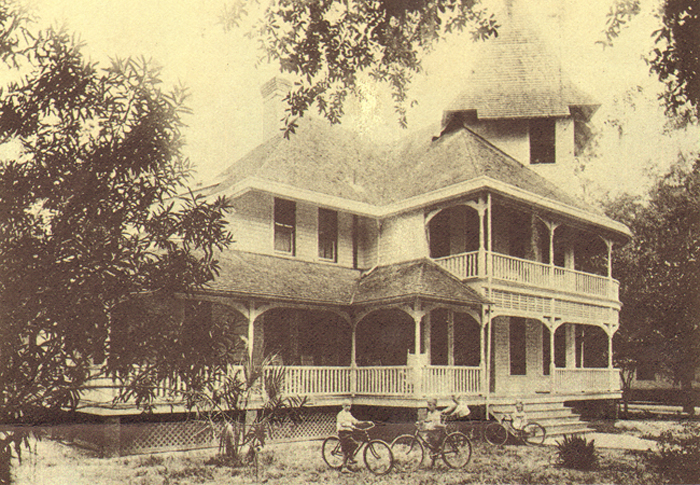
The house was completed in 1888. Ross dubbed it “Pansy Cottage,” a name that stuck and was soon known all over town. This photo shows the size of the “cottage”:
The inviting home was three stories tall, with large yards in front and back, and a wrap-around porch that invited family, friends and neighbors to sit down and enjoy a cozy chat. It was the perfect place for the family to gather, far away from the cold New York winters.
In this photo you can see family members on the front steps and porch, in the yard, and even peeking out of the top-most windows. They look like they’re having fun!
Isabella and her family members spent many happy winters at the Pansy Cottage; and the Florida climate did improve Raymond’s health.
A side view of Pansy Cottage, with children riding their bicycles.
In 1906 Ross and Isabella began their preparations for retirement. They sold Pansy Cottage and moved to their new house in Palo Alto, California where, once again, everyone was welcome in Isabella’s new home.
In fact, she and Ross shared the California house with their son Raymond, and his wife and children, as well as Isabella’s sisters Julia and Mary.
Julia Macdonald (about 1875).
After Ross and Isabella sold Pansy Cottage, it was passed along to different owners. Eventually, it was turned into a rooming house; and in 1955 Pansy Cottage was demolished. But thanks to photos like these, we can still peek into Isabella’s world and imagine a bit of her life with those she loved in turn-of-the-century Florida.
This post is part of our Blogiversary Celebration! Leave a comment below or on Isabella’s Facebook page to be entered in a drawing for a $25 Amazon gift card! We’ll announce the winner on Friday, September 28.
If you love stories that feature believable characters trying to find their way through life’s struggles, look no further than Isabella Alden’s books!
This word search puzzle features the names of some of Isabella’s most beloved characters, who ultimately learned to trust God to guide their daily steps in life. See how many names you can find!
Words can go horizontally, vertically, and diagonally, backwards and forwards.
Once you complete the puzzle, let us know how you liked it by leaving a comment here or on Isabella’s Facebook page.
Choose how you want to play:
To play online, click here. Then, click on a letter and drag to reveal each listed character name. You can play the puzzle online until October 30.
This post is part of our Blogiversary Celebration! Leave a comment below or on Isabella’s Facebook page to be entered in a drawing for a $25 Amazon gift card! We’ll announce the winner on Friday, September 28.
Welcome to the final week of our 5 Year Blogiversary Celebration!
We thank each of you for joining us in celebrating Isabella Alden’s life and Christ-centered novels and stories.
Today’s free short story is “Our Church Choir,” which was first published in 1889.
You can read “Our Church Choir” on your phone, ipad, Kindle, or other electronic device.
Or you can read it as a PDF document on your computer screen. You can also print the story to share with friends.
To begin reading, just click on the book cover to choose your preferred format from BookFunnel.com.
This post is part of our Blogiversary Celebration! Leave a comment below or on Isabella’s Facebook page to be entered in a drawing for a $25 Amazon gift card! We’ll announce the winner on Friday, September 28.
Yesterday you read a lovely letter Isabella wrote to the students of an elementary school, thanking them for planting a tree in her honor.
Isabella’s writings—her books, stories, letters, and lessons—are filled with quote-worthy lines. Here’s an example from her novel, Tip Lewis and His Lamp:
In the story, The Reverend Mr. Holbrook asked that question of young Tip Lewis to help him realize that his resentment toward another boy was jeopardizing his own standing with God.
It was Isabella’s way of illustrating the Bible verse: “If ye forgive not men their trespasses, neither will your Father forgive your trespasses.”
That was Isabella’s genius: she had a talent for explaining the Bible in terms anyone—young or old—could understand.
One of the greatest admirers of Isabella’s talent was her niece, Grace Livingston Hill. When Grace was twenty-three years old, she was the newly published author of her first book, A Chautauqua Idyll. And she was ready for her next project.
Grace turned her attention to her Aunt Isabella’s books. She combed through them, selected inspiring quotes, and organized them into a daily devotional, with each quote accompanied by an applicable verse from the Bible.
The result of Grace’s efforts was called Pansies for Thoughts, and it became her second published book.
The original cover for Grace’s 1888 devotional, Pansies for Thoughts.
Isabella wrote a brief Preface for the book, with a prayer that . . .
The Holy Spirit would use these pages in a way to lead some souls daily higher, and higher, even into the “shining light” of the “perfect day.”
Pansies for Thoughts is a wonderful daily devotional, and you can read the book for free! Click here to download the e-book version for your Kindle, Nook, or tablet. Or you can download a PDF version to print or read on your computer.
This post is part of our Blogiversary Celebration! Leave a comment below or on Isabella’s Facebook page to be entered in a drawing for a $25 Amazon gift card! We’ll announce the winner on Friday morning, September 21!
Publishing The Pansy magazine was a family affair. Every two weeks Isabella and her husband edited a new issue of the juvenile magazine. Each issue featured stories that were both instructive and entertaining, as well as articles about foreign lands and lessons on nature and science.
But perhaps the feature Isabella loved most was “The P. S. Corner.” In this column she printed letters she received from members of The Pansy Society. Children joined the society simply by pledging to overcome a fault (such as arguing with a sister, or shirking chores) with Jesus’ help.
Every month, hundreds of children wrote letters to The Pansy to tell of their pledges, their successes and their failures. Isabella treasured the letters, and called Pansy Society members her “blossoms.”
Even more importantly, Isabella answered all the letters! Sometimes she replied with congratulations, sometimes with encouragement and sympathy, as in this short note to Bessie from Nebraska:
Poor little blossom! It is very hard work to be unselfish, especially when so many grown people set us a bad example. Try hard, my dear.
Her “blossoms” adored her. So when an elementary school in Ravenna, Ohio planned an Arbor Day celebration in 1884, the children decided to plant a tree and name it Pansy, in honor of their favorite author.
Arbor Day at Fremont School, Santa Rosa, California; 1917
Isabella found out about it, and a few days after the Arbor Day ceremony, she sent the school a lovely letter.
Dear Young Blossoms:
How shall Pansy thank you for the sweet thought which made you choose out her from among all the people in this full world for the honor bestowed?
Oh, I hope the tree will grow, and grow, and spread out its branches, and cast its cool, restful shadows just as far as God meant it should, and do its own pleasant work in the world.
An Arbor Day ceremony at a small school in Massachusetts; 1915.
Later in the letter, Isabella reminded the young arborists that there was another tree—the tree of life—that was even more important:
Fair young blossoms, will you grow in beauty and bloom always for Jesus? Shall we gather, all of us, some day, under the branches of the tree of life, and talk the earth-story over?
She closed the letter to the children as she always did—with an earnest invitation to one day meet her in Heaven.
I do not know that I can ever stand under the shade of the green tree that you have so kindly named for me, but I feel sure of that other one. Will you all meet me there?
Your grateful friend, Pansy
Her sweet letter to the children was printed in the local newspaper. You can read the entire letter by clicking on the image below.
This post is part of our Blogiversary Celebration! Leave a comment below or on Isabella’s Facebook page to be entered in a drawing for a $25 Amazon gift card! We’ll announce the winner on Friday, September 21!
Reviews and giveaways for Christian fiction and sweet, clean fiction. Bringing readers information on great stories and connecting authors with their readers.