Our July free read is a short story by an author who may be new to you. Margaret Marshall Saunders was a Canadian writer of children’s stories and a passionate advocate for animal welfare. She was thirty-two years old and just starting her writing career in earnest when her novel Beautiful Joe was published in 1893 under her pen name “Marshall Saunders.” The book quickly became a worldwide bestseller and made history as the first book by a Canadian author to sell over a million copies.
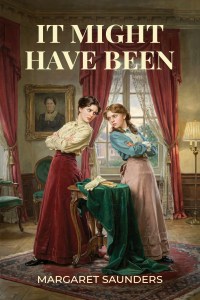
Margaret Saunders was a talented writer, and when she submitted her short story “It Might Have Been” to Isabella Alden for publication in The Pansy magazine, the story must have touched Isabella’s heart.
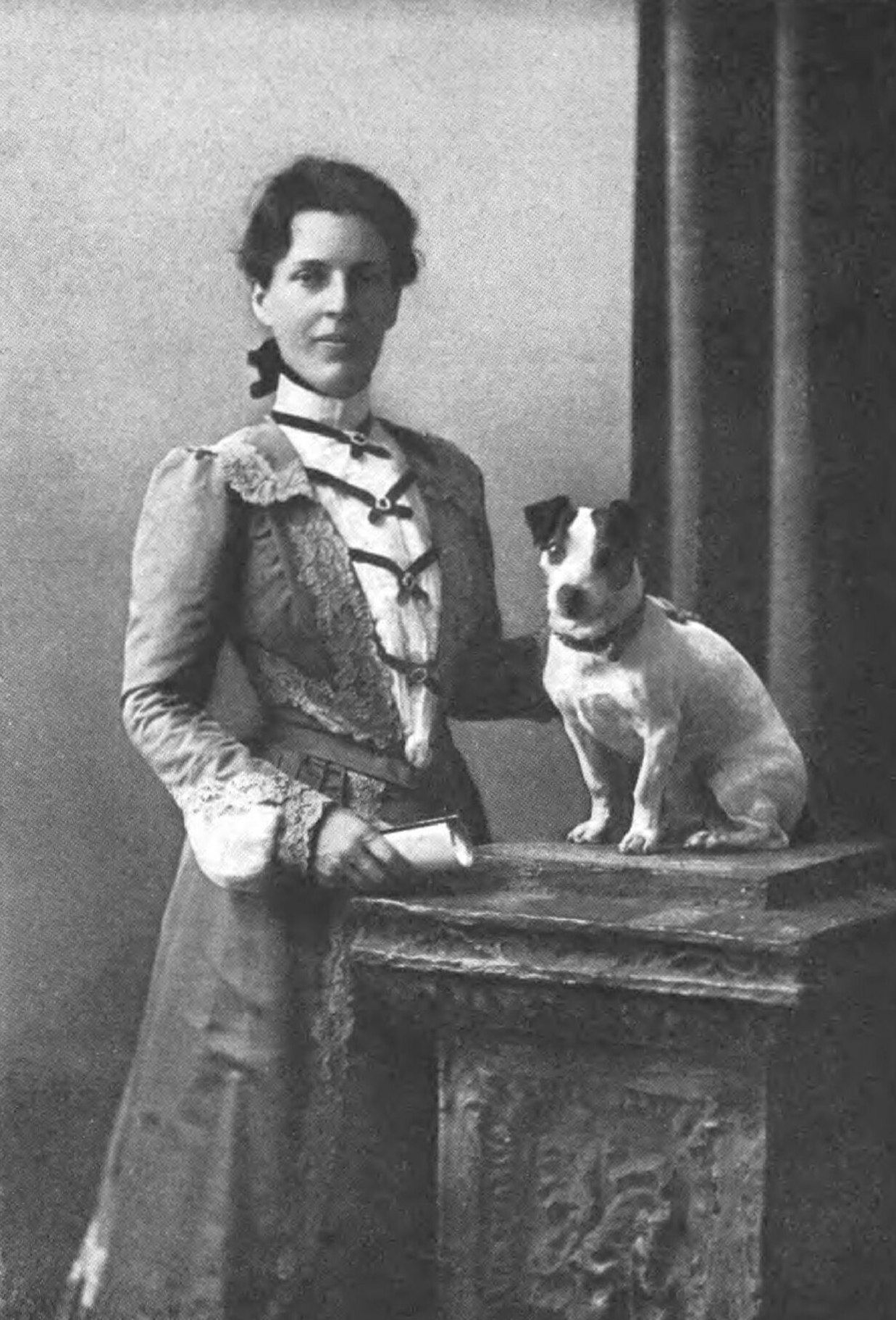
Margaret Marshall Saunders with her dog, Billie Sunday.
Like the character of Ella Crouse in the story, Isabella had a temper! Throughout her life Isabella candidly shared times when her quick flare-ups and uncontrolled anger often got the best of her, leading to situations she later regretted. It’s easy to see how she identified with Margaret Saunders’ beautifully written story. She undoubtedly knew that this tale of regret and sisterly love would resonate deeply with her readers.
Published in the June 1895 issue of The Pansy, “It Might Have Been” by Margaret Marshall Saunders is a lovely short story that reminds us that building character is a slow process—earned through daily patience, forgiveness, and love.
Ella and her sister, Jessie, are opposites in every way. While Jessie is calm and fragile, Ella possesses a fierce, volatile temper that she struggles to master. One chaotic morning, a minor misunderstanding over a pair of gloves escalates into a passionate argument that Ella regrets. But when an unexpected crisis strikes the family later that day, Ella is forced to confront the terrifying reality of what might have been if she never got the chance to say “I’m sorry.”
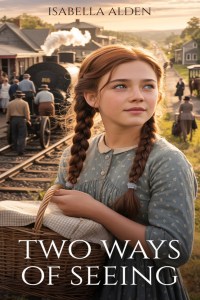
This month’s free read is a short story Isabella wrote for an 1876 issue of The Pansy magazine about Janie Smith, a miller’s daughter who can’t help comparing her own plain life with another girl’s seemingly charmed one.
Janie Smith has never ridden the stage coach, never seen the city, and never owned anything half so fine as the traveling costume Miss Josephine Jennings wears. Watching the elegant young heiress board the train one morning, Janie can’t help but feel the world has been very unfair. But the express-man’s quiet words — “Poor little thing!” — are about to change everything Janie thinks she knows about fairness and God’s blessings.
When it came to writing stories, Isabella sometimes relied on “real” life for inspiration. She’d take an actual occurrence—an overheard conversation, an event she attended, or something as simple as a family gathering—and use it as the basis for her story.
Other times, a story she wrote was inspired by a lesson she wanted to convey, or a kernel of truth around which she fashioned a story. That was the case in 1887 when she published a little story called “Monuments,” about a young girl who visits a cemetery in New York with her Aunt Joanna.
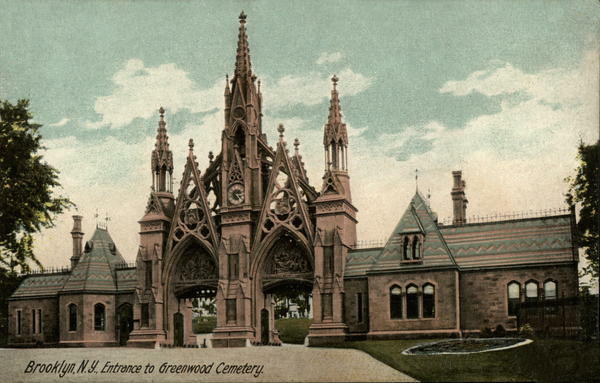
The entrance to Green-Wood Cemetery in Brooklyn, New York.
The story draws on fact: Green-Wood in Brooklyn, New York is a real place that Isabella very likely visited because of its famed monuments.
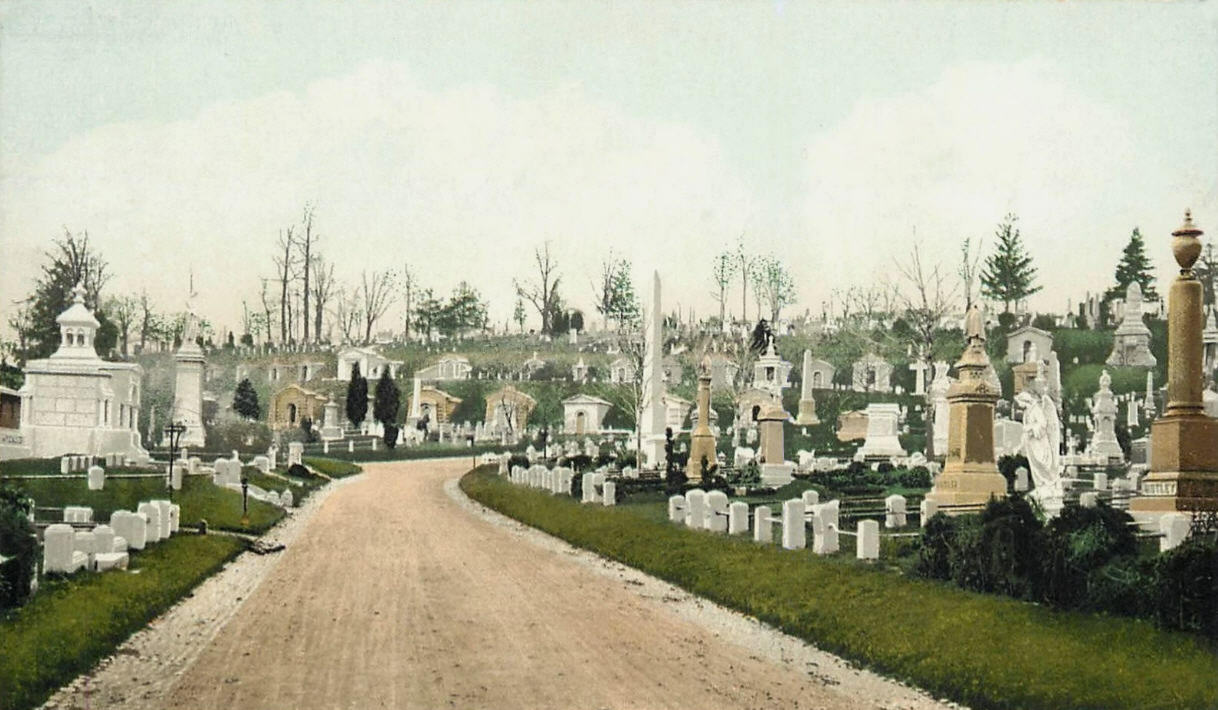
Monuments and headstones at Green-Wood Cemetery, about 1900.
In the 1800s Green-Wood Cemetery, with its extraordinary grave markers and lush, rolling hills, was a popular tourist destination. People came to spend the day with their picnic baskets and marvel over the sculpted monuments.
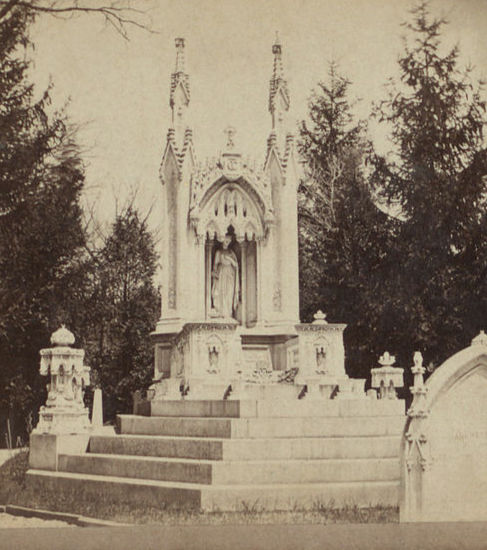
In her story, Isabella mentions one of the most magnificent monuments that marks the grave of Miss Charlotte Canda, a seventeen-year-old bride-to-be who was tragically killed after falling from a run-away carriage.
Charlotte Canda’s tomb, photographed about 1910.
She also mentions a monument dedicated to the brave firefighters of New York City and, in particular, Andrew Schenck, who perished in 1854 while trying to save people and his fellow firefighters from a burning department store.
The Firemen’s Monument mentioned in the story, topped by fireman’s boots and hat.
As a creative storyteller, Isabella took these tales of tragedy and heroism and crafted them into a story about a completely different kind of ‘monument’—one built not of marble and stone, but of transformed lives and acts of service.
Here’s the short story Isabella wrote:
It was my first visit to New York. A few days after my arrival uncle took me to Green-Wood, the most beautiful cemetery I ever saw. We visited the many points of interest. As we stood gazing at the fireman’s monument, uncle told me the story of his heroism; how in one of the fierce fires this brave man lost his life while rescuing a woman from the flames. Then we spent a long time looking at the monument to Miss Canda, the beautiful young heiress who was thrown from a carriage and killed; and her fortune was built up in this wonderful marble.
The next morning aunt said, “You will go with me today to another Green-Wood and see grander monuments than any you saw yesterday.”
I wondered how that could be, but we were soon on our way. At length we turned into narrow, dirty streets, growing worse and worse. I shuddered at such sights and sounds of human beings, never before dreaming that in grand New York there could he so much wretchedness. I drew closer and closer to aunt, fearing one of the human demons that leered at us would seize me and carry me off.
Such people! Such places to live in! Such language! Why, it almost makes my hair stand on end to think of it. Aunt did not seem to mind them. Maybe they knew her, for everyone stood aside for us to pass.
“Here it is,” she said at length. “Here is the other Green-Wood.”
“This?” I answered, looking around for gravestones and monuments, and seeing nothing but dreadful houses and miserable objects. “This is Green-Wood?”
She simply answered, “Yes; come right in and you shall see the monuments.”
I could only follow, wondering all the while if aunt was not losing her mind.
A sweet-faced girl met us with a warm welcome to aunt and an earnest look at me. As she led the way within, aunt whispered:
“One of the monuments, Clara.”
“What? I don’t know what you mean.”
“Her name is Maggie,” she quickly whispered back; “used to be called ‘wild Maggie;’ was one of the worst girls in this region. Never mind now, I will tell you more hereafter. Take a good look at her, you’ll see her again.”
Then I heard singing like the songs of many angels. A door swung open. We entered. It was a great company of children, black and white, some with sweet sad faces; others with evil looks, but all singing. Soon Maggie came in from another door and sat among them and I could hear her voice ring out in joyful strains, leading the rest.
There was prayer and Bible reading, and such a good talk by a gentleman. It seemed like heaven, while many of the children, some partly blind, some lame, some pale and sad-faced, gathered around after meeting was out and seized Aunt Joanna’s hand, and seemed so happy. Another lady was there to whom they all pressed for a smile and a word.
“That lady,” said aunt, “is Sir Christopher Wren.”
“What can you mean?” I asked. “Sir Christopher Wren was a man who died in England more than a hundred years ago.”
Aunt Joanna only laughed and said, “And came to life again, my child. This is he, only greater.”
“What?” said I, more and more bewildered.
But she went on: “Look around here at the monuments. You knew Sir Christopher was the architect of the great Westminster Abbey of London, and that kings and statesmen and poets are buried there, and their names and deeds are written there; but if anyone inquires for Sir Christopher Wren’s monument, he is told to look at the wonderful building of which he was the architect.”
“I see,” said I, “that lady has ‘built up’ Maggie.”
“Exactly,” said Aunt Joanna, “and more than one hundred other miserable, sick and wicked children. See that frail girl over there coming toward her? It would take a book to tell how this lady used to come daily here and bend over her crib, sometimes holding her in her arms for hours fearing each moment would be her last. But come and I will introduce you, and you shall see a monument greater than Christopher Wren.”
After we were on our way home, aunt told me the story of this lady; how one day curiosity led her to go through this worst part of New York. Her heart was so touched at the wretchedness of the people that she resolved to do something for them. Her friends tried to dissuade her. Some said the people would kill her; some said it was no use to try to help them. But she went right forward, and now after years of labor and sorrow there is her monument: saved children.
Before my return home in the country, Aunt Joanna gave a treat to the children of the Home all at her own expense.
Maggie, once “Wild Maggie,” and I served. How many sandwiches I passed around, how many cups of milk Maggie filled, how some of the urchins were dressed, how they laughed, or chattered, or stared, what they all said to aunt Joanna about the “treat,” would fill a book.
You can read more about Green-Wood Cemetery by clicking here.
Click on these links to read the stories behind the monuments for:
One of Isabella’s fondest memories was from a time when she was very young and her father taught her about “due bills.” (You can read more about that here.) Isabella’s father used that unremarkable, every-day event to teach Isabella a lesson she would never forget about the power of prayer.
Isabella’s friend, Theodosia Toll Foster (a teacher by profession) also used common incidents to reinforce lessons. Her children’s short story “Up in Mrs. Kelsey’s Attic” (which she wrote under the pen name “Faye Huntington”) is an example of just such a teachable moment.
When Carrie Kelsey helps her mother clean the attic, she discovers a treasure trove of interesting curiosities, including an old spinning wheel. Little does Carrie know that the history of the long-forgotten spinning wheel will teach her a valuable lesson.
YOU CAN READ “UP IN MRS. KELSEY’S ATTIC” FOR FREE!
It’s the time of year when many people make resolutions—to study their Bible more often, lose weight, or spend more time with family and friends. But how many people resolve to change their life in order to benefit a stranger? That’s the premise of our January free read.
Grace Livingston Hill wrote “The Weak Brother for Whom Christ Died” in 1897, and it was based on true events. At that time, French actress Sarah Bernhardt was a theatrical titan, who enjoyed world-wide fame.
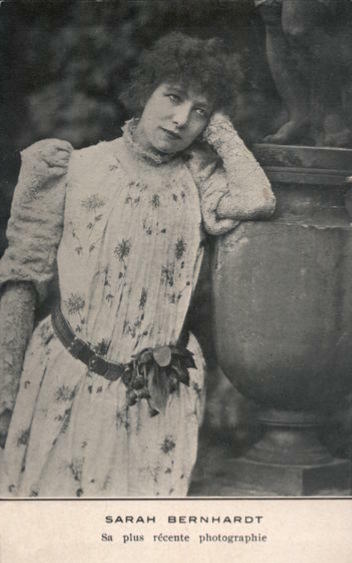
Undated photo of Sarah Bernhardt in character.
She toured the globe in plays she produced and starred in. She was a master of self-promotion and cultivated a larger-than-life persona that the newspapers and magazines of the time eagerly reported to their readers. She was, arguably, the world’s first true international superstar.
Undated photo of Sarah Bernhardt as Cleopatra.
Bernhardt first performed in America in 1880, when Grace was fifteen years old. Bernhardt’s American tour lasted several months. She performed in cities across the country, and each performance was met with thunderous applause and critical acclaim.
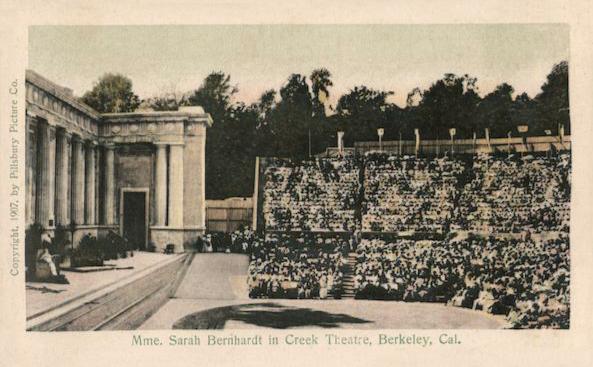
Bernhardt performing onstage in Berkeley, California, 1906.
In 1897 Bernhardt toured England, where she was so much in demand that she sometimes appeared in multiple plays at once, performing a matinee in one theater, then playing the lead in an entirely different play in a different theater that same evening!
From The Times, London, June 16, 1897.
But not everyone embraced Sarah Bernhardt with open arms. Despite her talent and riveting performances, conservative members of society and many religious groups viewed the theater as a morally corrupting influence, especially for women.
A promotional poster for Bernhardt’s 1905/1906 American tour.
Female actors were frequently stigmatized as immoral or promiscuous. Sarah Bernhardt—with her unconventional lifestyle, her bold stage performances, and numerous love affairs both within and outside of her marriage—scandalized a good portion of the population.
Bernahrdt as Napoleon. Her costume, with its form-fitting pantaloons, was considered quite scandalous.
Grace Livingston Hill knew about Sarah Bernhardt and probably read many of the newspaper articles about her. She also had strong opinions about Bernhardt and theater entertainments, which she used as the theme of her story, “The Weak Brother for Whom Christ Died.”
“Did you go out to see Bernhardt last evening, Murray?”
When three young men meet to pass a Sunday afternoon together, they never imagine that such a simple question can spark a very complicated discussion! But Frank Murray has read his Bible, and he is willing to forego some of the world’s pleasures if it means he will never be a stumbling-block to fall in another Christian brother’s way. Will Frank be able to explain his position to his new friends so they, too, will strive to help a weak brother in Christ?
You can read “The Weak Brother for Whom Christ Died” for free!
Choose the reading option you like best:
You can read the story on your computer, phone, tablet, Kindle, or other electronic device. Just click here to download your preferred format from BookFunnel.com.
Or you can select BookFunnel’s “email” option to receive an email with a version you can read, print, and share with friends.
In 1888 Isabella added a hint of romance to this short story about two little girls who wanted to give their favorite aunt a very merry Christmas.
Something is wrong with Aunt Mary, and Kate and Hattie are determined to find the perfect Christmas gift to make their dear aunt smile again. But with only ten cents to spend, the girls seek advice from the wisest man in town, and end up receiving a Christmas surprise of their own!
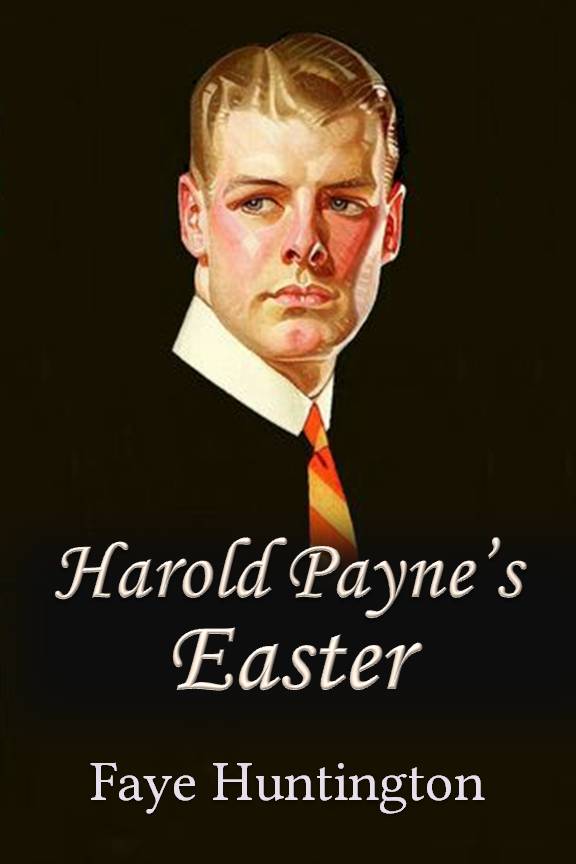
Isabella’s friend Theodosia Toll Foster was widely published as a novelist and short-story writer. Under the pen name “Faye Huntington” she wrote for the sole purpose of winning souls for Christ. Her story, “Harold Payne’s Easter” was published in the April 1909 issue of a Christian magazine.
Easy-going, self-indulgent Harold Payne never took church or anything else in life too seriously. But one day, while day-dreaming his way through a sermon, something the minister said caught his attention: “May our religion put the stamp of Christ upon the things we do.”
For some reason, those words broke through Harold’s indifference and stuck in his thoughts—and left him with the realization he had, at most, only made a faint impression of Christ’s stamp upon the world. Was it too late for Harold to change his ways?
Isabella often wrote stories that illustrated the far-reaching effects a single act of kindness can have on a person, a family, or a community. This month’s free read is a short story titled “Their Day at the Beach,” and it fits Isabella’s “kindness” theme nicely!
Frances Farnham and Sherman Kennedy have been friends since childhood, although careers and Life’s interruptions have kept them apart for years; but that’s about to change. For different reasons, Frances and Sherman will both be in Florida—she for pleasure, he for business. They have a single afternoon to spend together on the beach, to catch up on each other’s news and rekindle their old friendship. But a chance encounter on a train will change their plans—and their lives—forever.
Welcome to the final week of our 5 Year Blogiversary Celebration!
We thank each of you for joining us in celebrating Isabella Alden’s life and Christ-centered novels and stories.
Today’s free short story is “Our Church Choir,” which was first published in 1889.
You can read “Our Church Choir” on your phone, ipad, Kindle, or other electronic device.
Or you can read it as a PDF document on your computer screen. You can also print the story to share with friends.
To begin reading, just click on the book cover to choose your preferred format from BookFunnel.com.
This post is part of our Blogiversary Celebration! Leave a comment below or on Isabella’s Facebook page to be entered in a drawing for a $25 Amazon gift card! We’ll announce the winner on Friday, September 28.
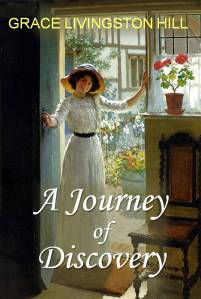
This short story by Isabella’s niece, Grace Livingston Hill, first appeared in a Christian magazine in 1917.
In “A Journey of Discovery” Louise Hasbrouck knows what everyone expects of her. She just received an offer of marriage from Halsey Carstairs, one of the city’s most eligible bachelors. Louise should feel honored and happy; instead she feels restless and anxious to talk to her old friend, Cecilia, who became a bride herself just two years before.
But when Louise arrives at Cecilia’s sweet little cottage in the country, and sees the life she leads away from the city’s whirling social scene, Louise begins to question the path society has plotted for her. Should Louise accept Halsey’s proposal, or will she find the strength to follow her heart?
You can read this story on your phone, ipad, Kindle, or other electronic device.
Or you can read it as a PDF document on your computer screen. You can also print the story to share with friends.
Click on the book cover to choose your preferred format from BookFunnel.com.
This post is part of our Blogiversary Celebration! Leave a comment below or on Isabella’s Facebook page to be entered in a drawing for a $25 Amazon gift card! We’ll announce the winner tomorrow!
Reviews and giveaways for Christian fiction and sweet, clean fiction. Bringing readers information on great stories and connecting authors with their readers.