New Year’s Day Calls in Pansy’s Books

“I have spent this New Year’s day in receiving calls,” wrote Miss Docia Myers (in Isabella’s novel Docia’s Journal). “The whole thing is a sham. I don’t believe in that sort of calls. If one could see only one’s good friends, and exchange greetings, it would be pleasant; but this passing compliments with people for whom one doesn’t care a pin, is utterly distasteful to me.”
Not everyone shared Docia’s opinion. In the mid-to-late 1800s, the tradition of paying New Year’s calls was one of the most entertaining—and least formal—of society conventions. Isabella was very familiar with the custom and wrote about it in several of her novels.
Here’s how New Year’s Day calls worked:

On New Year’s Day ladies—married and unmarried—remained at home to receive the calls of their gentlemen friends. The ladies dressed in their finest, and made their parlors as bright and cheerful as possible so as to welcome the gentlemen in from the cold.

Waiting for Calls on New Year’s Day by Winslow Homer.

Julia Ried (in Isabella’s novel of the same name) wore her very best for the occasion:

Didn’t I blossom out on New Year’s morning! Talk of Solomon arrayed in all his glory; it didn’t seem to me that he could have compared with me.

According to custom, ladies began receiving New Year’s calls beginning at 10:00 a.m. and had to be prepared to welcome and entertain any man who presented himself for the next twelve hours.
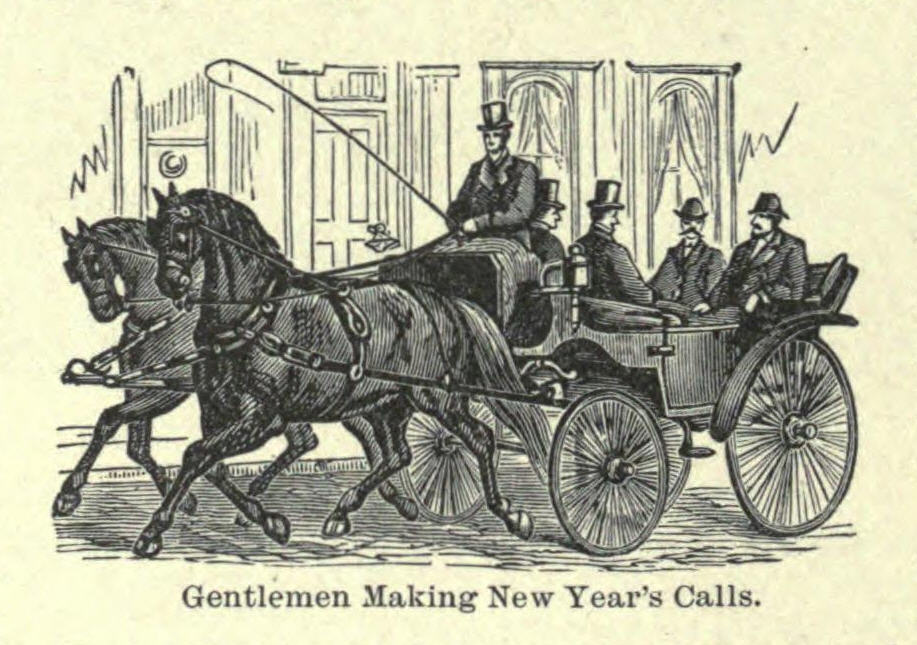
Gentlemen making New Year’s Day calls, from Hill’s Manual of Social and Business Forms (1888).

Gentlemen were responsible for calling upon every woman of their acquaintance. They could pay their calls alone, or they could join a group of friends and call upon the ladies together. The calling card below—printed especially for 1877 New Year’s calls—shows the names of six young men who made the rounds together.
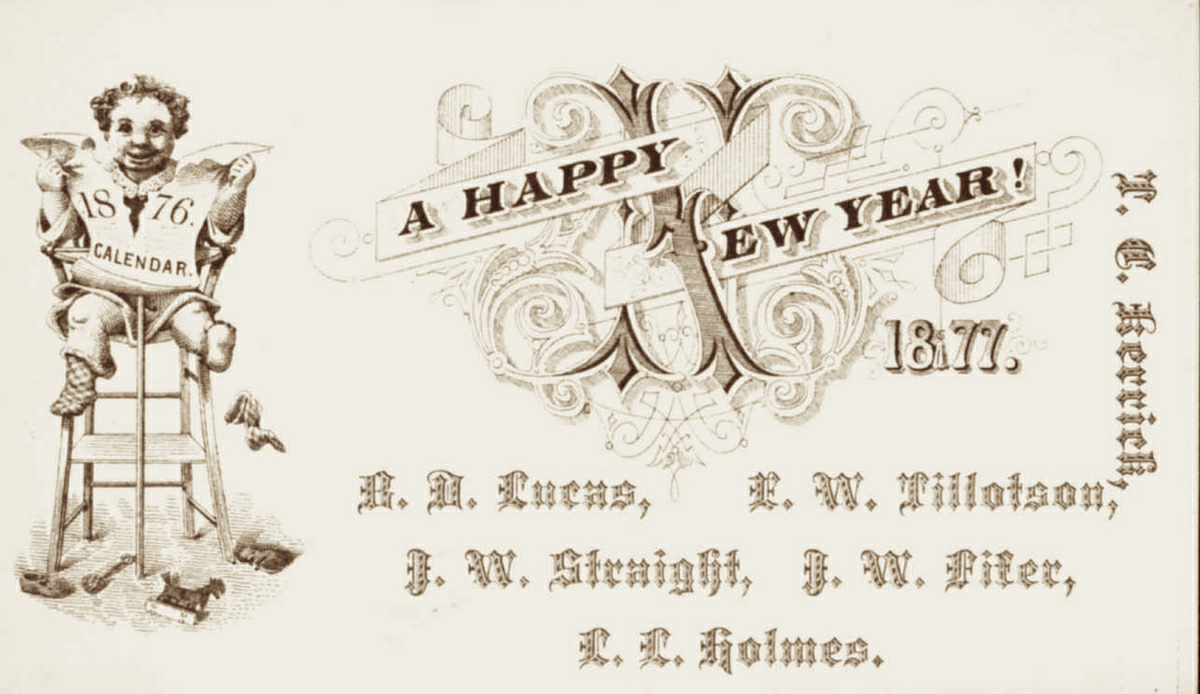
The men went from house to house, their visits lasting only about ten or fifteen minutes before they were off to pay their next call. In some cases a gentleman’s visit was so short, he didn’t even take off his hat, coat, or gloves.

Julia Ried enjoyed the whirlwind, saying:

It was my first experience in that scene of the whisking in and out of half a dozen gentlemen at a time, so constantly followed by half a dozen more, that presently one lost one’s balance, and ceased to remember people as individuals, but as number forty-five or sixty-two, as the case might be, and, as the day whirled on, was dimly conscious of but one idea—an eager desire to reach a higher number than Mrs. Symonds or Miss Hervey, and Mrs. or Miss anybody else. I thought it delightful.

While the gentlemen discussed the weather, paid the ladies compliments, and wished them a prosperous new year, the ladies served refreshments.

Some women offered simple plates of fruits, cakes, and breads, with coffee and tea.
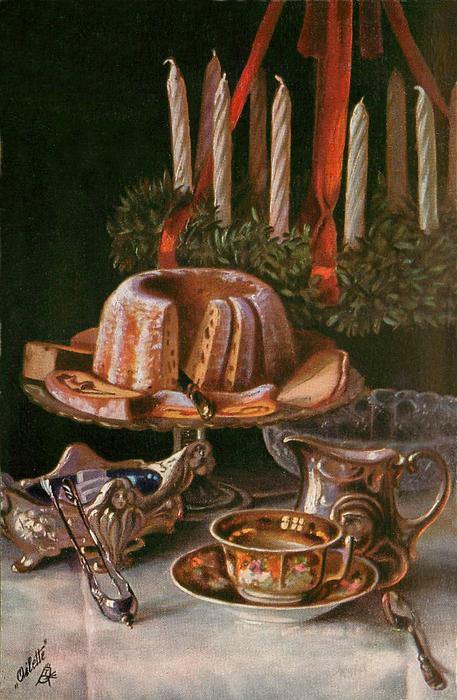
Fresh fruit, something of a rarity in winter, was also a welcome offering.

More ambitious hostesses set out full buffets, with a menu that might include turkey, oysters, ham, or roast beef, as well as hot side dishes.
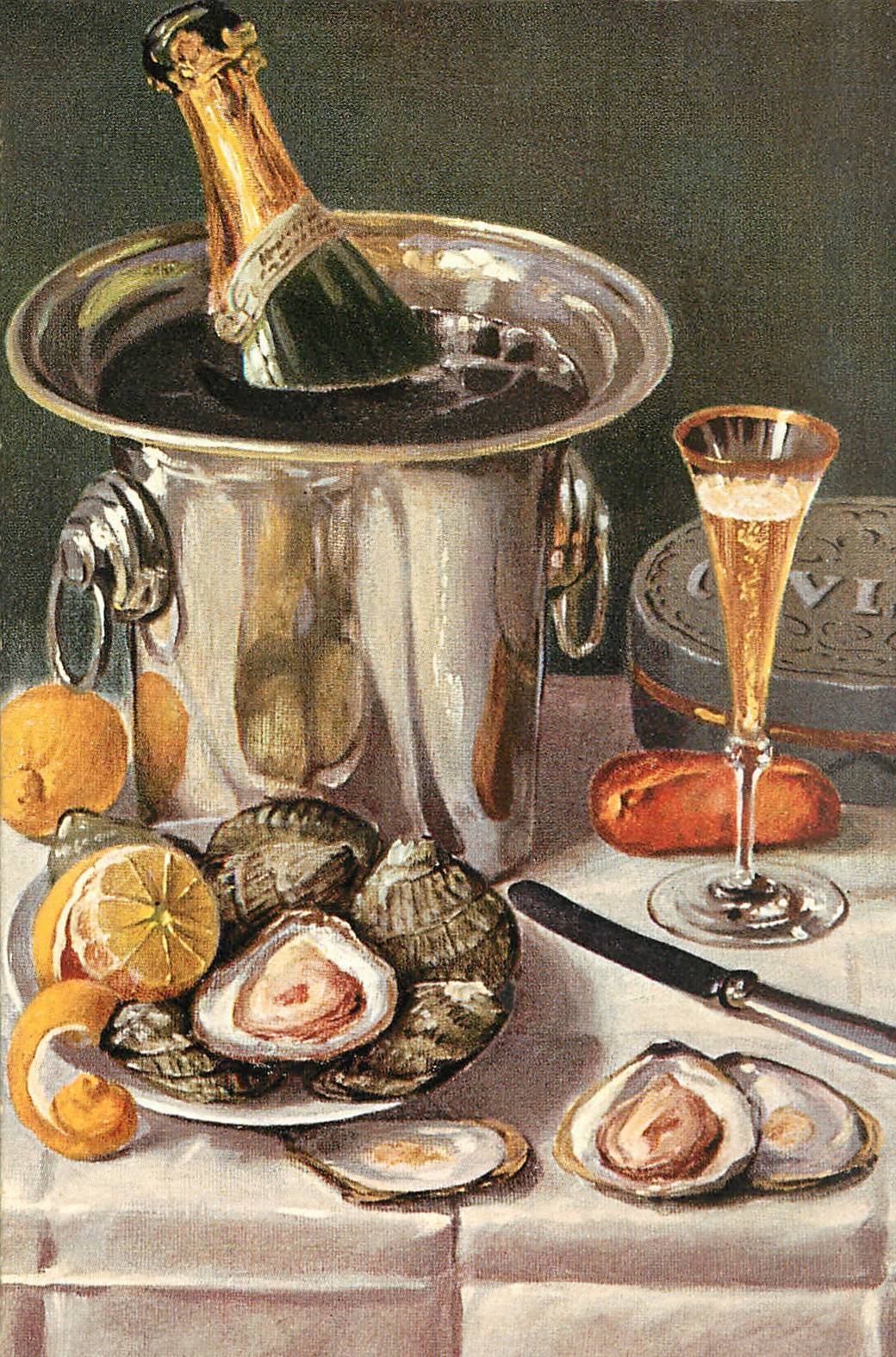
The larger the menu, the more chances it included alcohol. Ale, wine, champagne, or a festive punch made with a whiskey base were regularly served by hostesses.
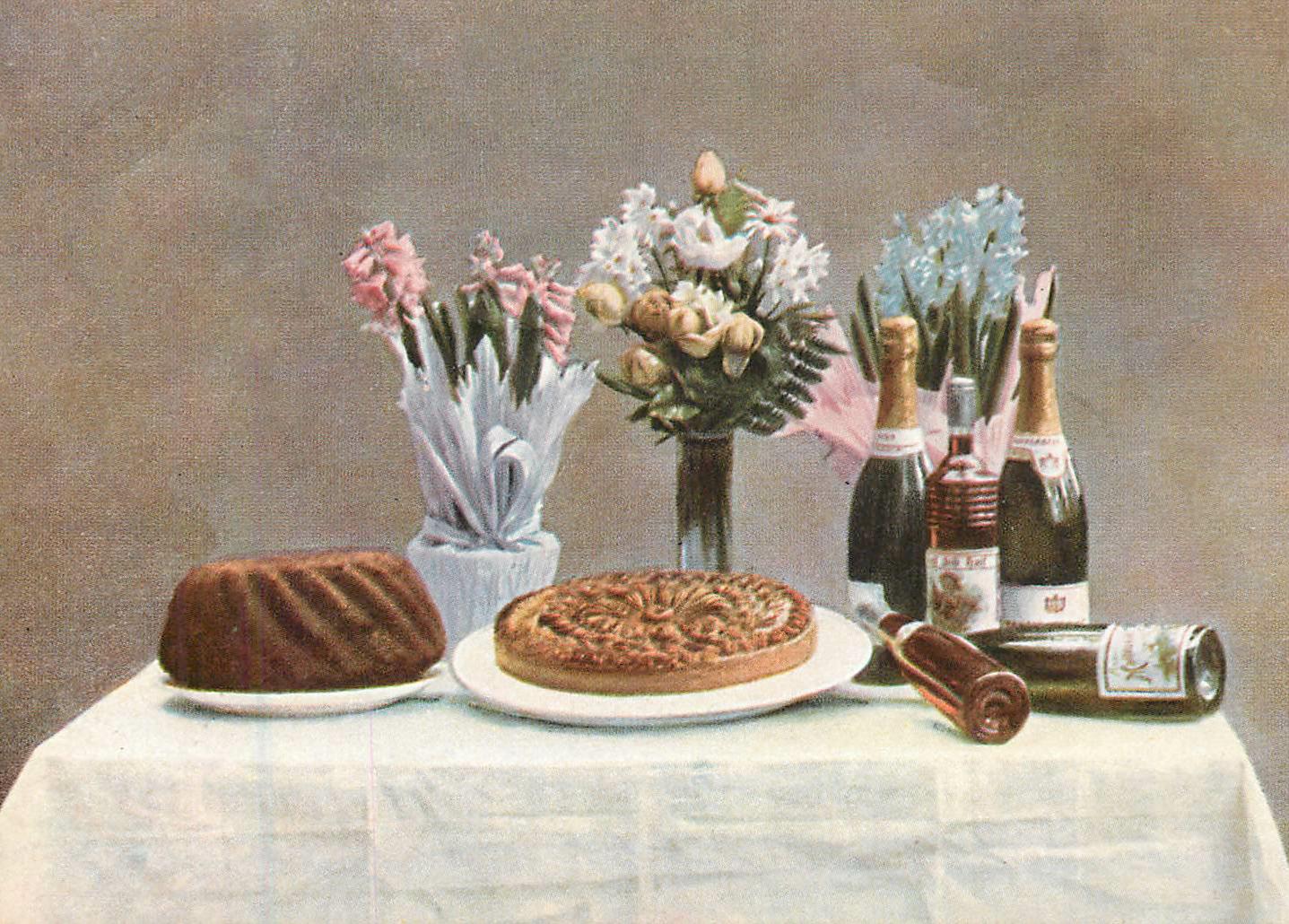
It’s not hard to imagine that if a gentleman was acquainted with thirty young women and visited each in quick succession on New Year’s Day, sampling food and drinking to the health of his hostess as he went along, there was a very good chance the gentleman might be a little tipsy by the time he finished his calls that evening.

Isabella recognized that danger. In Julia Ried she wrote about a young man named Norman Mulford who called upon Julia on New Year’s Day. Norman was “a bright, handsome boy of nineteen, fair-faced, except for a slightly unnatural flush. He was fresh from college honors, and seemed almost intoxicated with triumph and wine—just the sort of a boy to be led into all sorts of temptation.”

Unfortunately, Norman couldn’t resist the temptation of the “glittering glasses and sparkling liquid” offered him by every hostess at each stop along his way that day. Norman’s loving father was deeply aware of his struggle, saying, “I would have been thankful, I think, for almost anything that would have shielded him from the dangers and temptations of this day.”

But by the time Norman visited Julia, he was feeling defiant and resentful of his father’s efforts to keep him from drinking. When Julia and her friend, Mrs. Tyndall, explained to Norman that they promised his father they wouldn’t offer him any wine, Norman’s eyes took on a “stormy glare” and “his voice shook with suppressed passion as he spoke.”

“I am very grateful to my father, I assure you. I wouldn’t have you break your promise; but, I suppose you did not also promise that I should not help myself at your hospitable table?”
Whereupon he walked directly over to the refreshment table, and deliberately poured for himself a goblet of wine, drained the glass, and then immediately made his adieus.

Norman wasn’t alone in his struggles. Many young men found that as their social circles widened, the list of calls they had to make also grew, and the number of men who finished their New Year’s calls thoroughly intoxicated became a very real problem for society.

That may be one of the reasons the practice eventually fell out of favor. By the 1900s, the custom of paying New Year’s Day calls had been replaced by the New Year’s Eve celebrations we know today.

Christmas Shopping with Isabella

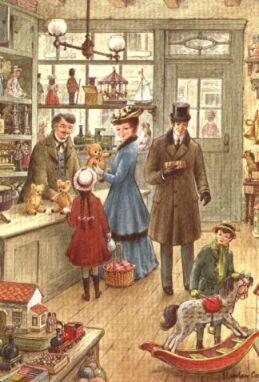
Julia Ried (in Isabella’s novel of the same name) had ten dollars with which to purchase Christmas gifts for her family and friends.

She knew exactly what she wanted to give her mother, sister Sadie and brother Alfred for Christmas; and since this would be her first Christmas away from home, she even thought out how she would ship the gifts to her family:

I had packed them in imagination in a neat little box, and written the accompanying letter scores of times.

In our modern world, ten dollars doesn’t seem like a lot of money, but in 1873, when Julia Ried was published, those ten dollars went much further than they do today.

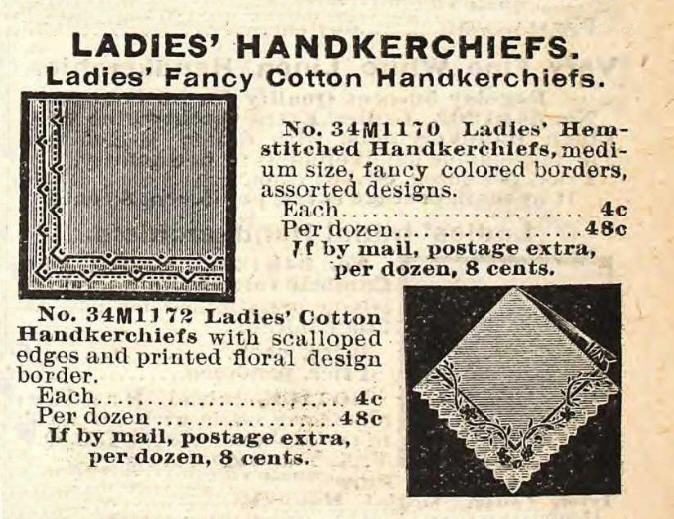
For example, Julia could purchase a set of six handkerchiefs to give to Sadie at a cost of only thirty cents:

And since a lady could never have enough handkerchiefs, Julia might instead have opted to give Sadie a dozen of them (with fancy colored borders) at a cost of just 48 cents:

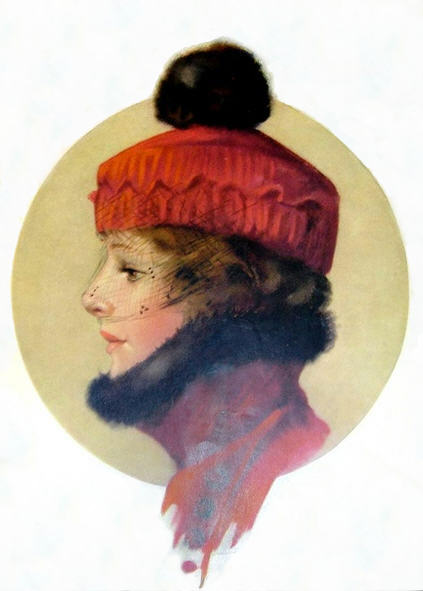
Or, Julia might have purchased for Sadie a knitted cap and scarf set, since such sets were just as popular in the late 1800s and early 1900s as they are now.

For Alfred, Julia might have purchased a new shirt to wear to his job as a store clerk (or even two shirts at these prices):

This full-page newspaper ad from 1912 illustrates other affordable gifts Julia might have chosen for Alfred, from a sturdy pair of gloves to a warm sweater to a new cap (click on the image to see a larger version):

When it came to selecting a gift for her mother, Julia knew no ordinary gift would do. She wrote:

Dear mother, she seemed to think that her first and greatest duty in life was to toil for and spare her children. Patient, faithful, tender mother! Tonight, as I recall her sweet, pale, tired face, I can think of no frown of impatience or anger that ever marred its sweetness. I can think of nothing left undone, that she could do, to smooth the path in which her children trod.

Clearly a special gift was in order for Mrs. Ried. A very pretty sewing box, covered in a sturdy but lovely patterned fabric (called “cretonne”) might have been the perfect gift:

Or she might have chosen for her mother a lovely ladies’ hat pin to add some sparkle to her life:

All of these would have been thoughtful gifts for Julia to send home to her family; but …

If you have read the book, you know that that Julia succumbed to an entirely different temptation when it came to spending her ten dollars—a temptation that left her with no money to buy gifts she wanted to give her family!

As the characters in Isabella’s novels so often did, Julia Ried had to learn many lessons about the dangers of peer pressure and placing trust in the wrong person—lessons that are just as relevant today as they were in 1873.

What do you think of the Christmas gifts in these ads from the late 1800s/early 1900s?

Which gifts would you purchase to give loved ones?

Free Read: A Gingham Patch

This month’s free read by Grace Livingston Hill is a wonderful short story about a minister in need, answered prayers, and the spirit of giving.

You can read “A Gingham Patch” for free!

Just follow this link to go to BookFunnel.com. Then, choose whether you want to read the story on your computer, phone, iPad, Kindle, or other electronic device.

Or choose the “My Computer” option to print the story as a PDF document to read and share with friends.

Daily Thoughts for December

This post contains the final installment of Isabella’s monthly Bible devotional series titled “Daily Thoughts,” which she wrote for The Pansy magazine in 1885.

Isabella’s “Daily Thoughts” for the month of December focus on Chapters 139 and 46 of the Book of Psalms.

Please Note: You will see that the PDF version of the original 1885 “Daily Thoughts” for December contains two errors:

  1. There is no verse for December 31 (unfortunately for us!).
  2. The verses for December 25 through 30 are incorrectly attributed to Chapter xli (Chapter 41) of the Book of Psalms. This was probably just a printing error in the original issue of The Pansy magazine. The correct chapter is Psalms xlvi (Chapter 46).

Click here to open a PDF version of Isabella’s “Daily Thoughts” for December, which you can read, print, save, and share with others.

Or, click here to download a simplified Word version.

If you missed Isabella’s “Daily Thoughts” for previous months, you can find them here: January  February  March  April  May  June  July  August  September  October November

Advice to Readers about Ornaments

In the early 1900s Isabella wrote a regular column for a Christian magazine in which she answered reader letters and offered advice—from a Christian perspective—on a variety of subjects.

The column gives us a wonderful insight into Isabella’s personality and her plain, straightforward manner of communicating.

In one of her 1911 columns, Isabella shared this letter from a reader named Nannie:

I want to have a little talk with you about what will seem to you, I suppose, a small matter, but it is giving me a good deal of trouble.

Do you think it is wrong to wear any kind of jewelry? I have a very dear friend who has given me a gold ring with a pearl in it, and I want to wear it; chiefly for the friend’s sake, although I do think it looks pretty on my hand. But my aunt, with whom I live, is a very religious woman, and she thinks it is wrong for me to wear rings; she says it is going contrary to plain Bible commands, and she quotes that verse about braiding the hair and wearing jewels of gold. Now, is she right? Is it wicked to curl my hair, for instance, when it is less work to curl it than to keep it smooth? And to wear my dear ring that I have promised to keep forever?

I want to be good, but— Can God care about such trifles? My aunt says that my dear dead mother thought just as she does about these things, and that I am showing disrespect to her memory. But my mother did not seem like that to me; she used to trim my little dresses, and she curled my hair around her finger. She died, though, when I was eight, and now I am eighteen. Will you tell me if you think I am wicked?

Nannie.

Here’s how Isabella responded to Nannie’s letter:

My Dear Nannie:
What a deal of trouble! Five questions, are there not? But they all hover about one central thought. Let us look at them separately.

“Do I think it wrong to wear jewelry?” No; if I did, I would not wear it. I have worn my wedding ring for more than forty years, and it is dearer to me, I dare to think, than even your pearl one, so, you see, I can understand your feeling. I pin my collar with a gold pin as naturally as I comb my hair, and find it vastly more convenient than a common pin would be. I wear my watch whenever I think a watch will be a convenience; and there are sundry other trifles that would come under the general head of jewelry which I call into service from time to time. All this is an easy way of stating my position. Quiet, unostentatious pieces of jewelry, keepsakes, or conveniences, or those articles that custom has made symbolic, like engagement and marriage rings, are, in my judgment, entirely appropriate for Christians to wear.

It is an altogether mistaken idea that to be religious one must cease to love the beautiful. Do you remember the lines in Mary Howitt’s verses on beauty?

God might have made the earth bring forth
Enough for great and small,
The oak tree and the cedar tree.
Without a flower at all.

The Bible verse to which you refer has caused trouble for a few conscientious people because they do not understand its environment. Study the times in which Peter wrote those words, and the fashions that were then in vogue if you want to get the spirit of his advice. Take note that it is advice, and not command. Peter is really making a comparison between two classes of ornaments—the outward and inward—and urging upon Christian women to give their attention to the latter. By way of illustration he mentions the plaiting of hair which was at that time carried to such wild excess.

Notice, too, Peter’s next phrase after mentioning the wearing of gold, “or of putting on of apparel.” Our literal friends who frown upon even the plain gold ring would surely not have us go a step farther in literal interpretation and refuse to wear clothing! I speak of this only to show you how easy it is to become absurd, even in our interpretation of Bible words.

“Is it wicked to curl your hair?” Why, child, according to your own statement the Lord has done this for you. My own opinion about it is, that so far as you and God are concerned you have a perfect right to arrange your hair in the way that you consider most becoming to you, provided it does not require an unreasonable expenditure of time or means to do so. Other things being equal, this would be a fair rule to go by.

“Can God care about such trifles?” My dear, you are speaking of the One who said: “Even the very hairs of your head are all numbered.” There are no “trifles” in his sight. Yet I am glad to believe that he does care in the way you are thinking of it, and that he does care in a very real and helpful sense, even for rings and curls.

Now, having made all these admissions and proved myself to be clearly on your side, suppose we go back and consider the entire question from another standpoint.

Did you take notice, back there, of that somewhat obscure phrase “other things being equal,” and wonder what in the world I meant? Let me see if I can explain. A word about that dear aunt who does not think as you do. Of course, she is much older than you. As I understand it she is trying to fill the place of mother to you; you live with her; that is, she has made a home for you. Then what do you owe her in return? You want to “be good”; this is no trifle. To be good is almost the greatest thing in the world, and to want to be is one step toward it; be sure God cares for this. What has God said about those who stand as parents? “Honor” is a great word, comprehensive and far reaching; also, it is practical.

“Here, for illustration, is a ring, a lovely ring with a pearl in it. The ring is mine and I want to wear it. And here is God, interested in me, and in my ring. Does he think it wrong for me to wear it? Other things being equal, no. But here is my aunt, she thinks it wrong; she thinks that God thinks so; to have me wear it would hurt her. Would it hurt me not to wear it? That is, do I believe I would be doing wrong?”

“N-o, but—”

“Yes, I understand, but we are talking about honor now; and we have found that ‘things’ are not equal. Could I possibly, for the sake of my aunt’s feelings—for the sake of my aunt’s conscience, pack away my ring in pink cotton in its white velvet box until such time as—? Ought I to do that?”

Ah, now you have reached a question that you, that the individual conscience, must answer for itself. The illustration is only to clear the way for thought: all these questions, whether rings, or curls, or what not, swing on the same hinges.

“All things are lawful for me,” said one, “but all things are not expedient.”

“Ye have been called unto liberty.” said one, “only, use not liberty for an occasion to the flesh, but by love serve one another.”

Suppose the Bible read in this way: “But curls commend us not to God, for neither if we wear them are we the better, neither if we wear them not are we the worse; but take heed lest by any means this liberty of yours become a stumbling block to them that are weak.” Would it make the argument plainer?

What do you think of Isabella’s “advice column?”

Do you think she gave the right advice to Nannie?

Pansy’s Busy Schedule

As the wife of a Presbyterian minister, Isabella moved house frequently, depending on when and where the Presbyterian Church assigned her husband. One of those moves occurred in 1876 when Isabella was 37 years old.

For a period of three short years (from 1876 to 1879), the Aldens lived in Greensburg, Indiana, where her husband had the ministry of Greensburg’s Presbyterian congregation.

A view of Greensburg Indiana, from the 1894 Illustrated Souvenir Book of Greensburg, Indiana.

In typical Pansy fashion, Isabella probably got right to work in her new community, serving the members of her husband’s congregation, writing stories intended to win souls for Christ, and speaking out on matters of importance to women.

In addition, Isabella maintained a very busy travel schedule. Here are just a few entries from her calendar that year:

February 28:

Isabella was in Cincinnati, Ohio, delivering a lecture “for the benefit of the Benevolent Society.”

The Cincinnati Daily Star, February 21, 1878.

June 26:

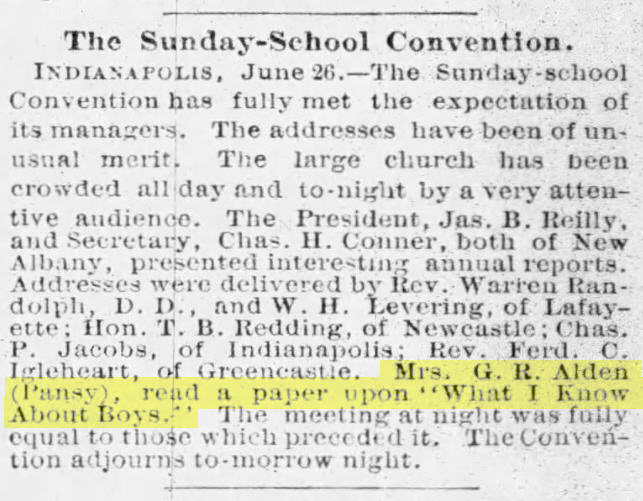
Her schedule took her to Indianapolis, Indiana, where she read a paper titled “What I Know about Boys” at the state’s annual Sunday-School Convention:

From the St Louis Globe-Democrat, June 27, 1878.

August 1:

The first week of August saw Isabella at the Methodist Sunday-School Assembly at Lakeside, Ohio, where she was one of a number of teachers who led daily children’s classes throughout the week.

The Tiffin Tribune (Tiffin, Ohio), August 1, 1878.

September 26:

Isabella was in New York in her home town of Gloversville, where she read one of her short stories—“What She Said and What She Meant”—to an audience at the Baptist Church.

From the Gloversville Intelligencer, September 26, 1878.

November 15:

Isabella was back in Indiana, this time giving a temperance reading to an audience in Indianapolis, about forty-eight miles from her Greensburg home.

The Indianapolis News, November 9, 1878.

At a time when the fastest way to travel was by train or horse-drawn carriage, Isabella sure got around!

By the way, Isabella’s story “What She Said and What She Meant” was published in 1880 and you can read it for free! Just click on the book cover below to begin reading.

New Free Read: The Wife’s Dilemma

This month’s Free Read may strike a chord with anyone who tried to cook something that didn’t turn out right (like a Thanksgiving turkey)!

“The Wife’s Dilemma” is a sweet short story written by Isabella’s sister (and Grace Livingston Hill’s mother) Marcia Livingston. Marcia was a prolific author in her own right. She published many short stories in a variety of magazines, and co-wrote stories with Isabella.

Here’s the blurb for “The Wife’s Dilemma”:

Newlywed Dora Avery is well educated in math and science, and speaks several languages; but Dora has never learned the fine art of keeping house. No matter what dishes she sets before her new husband, they’re either burnt or sour. It isn’t long before Dora realizes that all her logical plans and recipe books won’t fill her husband’s empty stomach!

Somehow she must hire an experienced cook or learn the proper way to prepare meals herself; but how?

You can read “The Wife’s Dilemma” for free!

Just follow this link to go to BookFunnel.com. Then, choose whether you want to read the story on your computer, phone, iPad, Kindle, or other electronic device.

Or choose the “My Computer” option to print the story as a PDF document to read and share with friends.

Daily Thoughts for November

In 1895 Isabella published a monthly Bible devotional series titled “Daily Thoughts,” which appeared the first day of each month in The Pansy magazine; and we’re reprinting them in 2020!

Isabella’s “Daily Thoughts” for the month of November are from Chapter 40 of the Book of the Prophet Isaiah.

Click here to open a full-size PDF version of Isabella’s “Daily Thoughts” for November, which you can read, print, save, and share with others.

Or, click here to download a simplified Word version.

If you missed “Daily Thoughts” for previous months, you can find them here: January  February  March  April  May  June  July  August  September  October

Click here to read “Daily Thoughts” for December.