On this day in 1933 Prohibition ended in the United States. It had begun thirteen years earlier with passage of the 18th Amendment to the United States Constitution; that Amendment prohibited the manufacture, sale and transportation of intoxicating liquors.
Sheet music for a popular temperance song in 1900.
Isabella Alden was a staunch supporter of Prohibition, and her best friend, Theodosia Foster, dedicated her writings to the temperance movement by ensuring there was a strong anti-alcohol message in every story and novel she published.
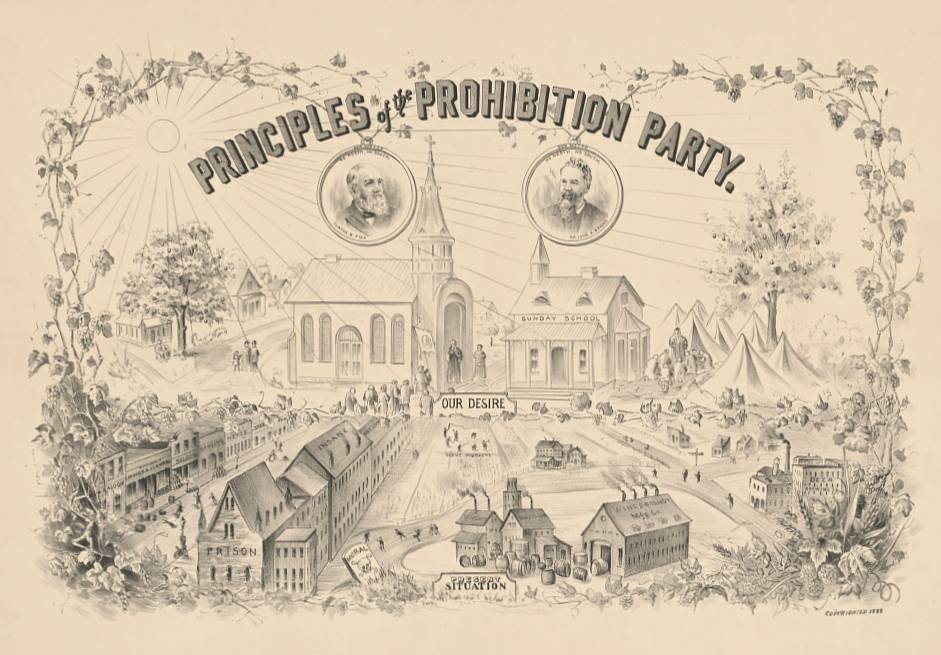
An 1888 illustration of the principles of the prohibition party, showing Americans abandoning saloons, prisons, wineries, and insane asylums for a moral life centered around Sunday school and church.
Like Isabella and Theodosia, supporters of Prohibition believed that Prohibition was a “Noble Experiment” that would improve the nation’s moral and physical health, and curb the growing incidents of violence against women and children.
In many ways, the 18th Amendment achieved those goals, but there were some unintended consequences, too.
It overwhelmed police with enforcement duties and gave rise to organized crime.
Two men and a still.
The number of deaths from poisoning skyrocketed, as Americans resorted to improperly brewing their own alcohol or resorted to drinking industrial alcohol, with deadly consequences.
Perhaps most significant were the financial consequences. In cities like Milwaukee, Seattle, and St. Louis, thousands of people found themselves out of work when the breweries shut down. And many states, as well as the Federal government, became cash strapped when they could no longer collect liquor taxes. New York was especially hit hard; almost 75% of that state’s revenue was derived from liquor sales.
In the end, the “Noble Experiment” failed. The few benefits achieved by prohibition weren’t enough to offset the proliferation of organized crime and the hard financial consequences for average Americans. The 18th Amendment was repealed by passage of the 21st Amendment on December 5, 1933.
There’s a great website you can visit to learn more about life in America during Prohibition. Click here.
Not long after Isabella married Ross Alden she became ill. She never specifically named her ailment, but in her memoirs and in her auto-biographically-based stories, she often mentioned trouble with her eyes and that she suffered greatly from what we would today know as migraine headaches.
She wrote:
“It must be understood that although I was at times a great sufferer, I was by no means a helpless invalid. But the intervals between days of terrible pain might have been described as times of dull and wearisome inanity. I could read only a few minutes at a time, with long intervals between the minutes.”
A Victorian-era wheelchair (from Pinterest)
She saw a number of physicians all over the New York area, all of whom agreed that, if she was ever to get well, Isabella should take a “water cure” from Dr. Greene at the Castile Sanitarium in New York. Ross encouraged her to follow the doctors’ instructions.
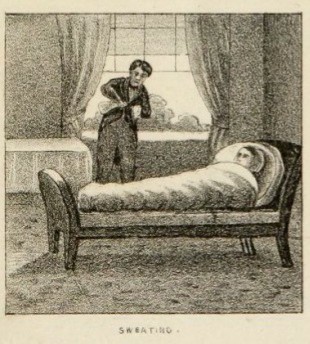
Illustration of a “water cure,” circa 1860.
But Isabella rebeled. She told Ross, “You needn’t think I’m going to stop and see Dr. Anybody! I’m going home!”
So Ross helped her from the doctor’s office and took her to the next departing train. He tucked her into heavy robes so she would be warm while they traveled, and urged her to nap on the train.
When Isabella awoke she found they had reached their destination: The sanitarium and the famous doctor!
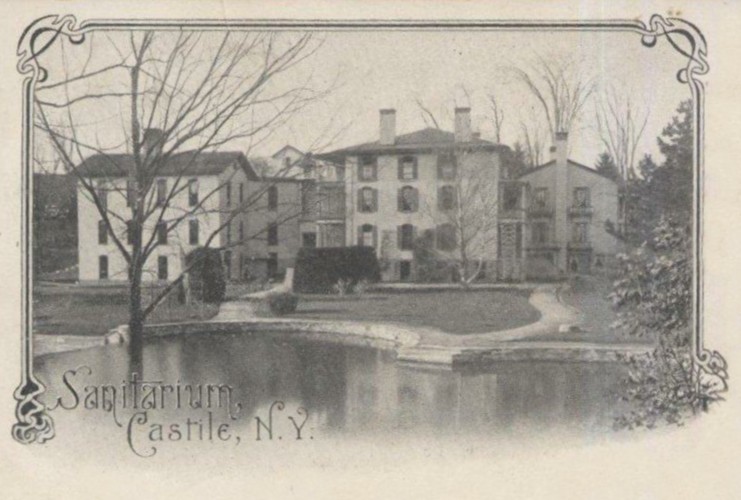
The Castile Sanitarium in 1905.
Isabella demanded an explanation.
Kindly and quietly Ross answered, “We are going to spend the night here and seek this doctor’s advice. Could conscientious people do otherwise?”
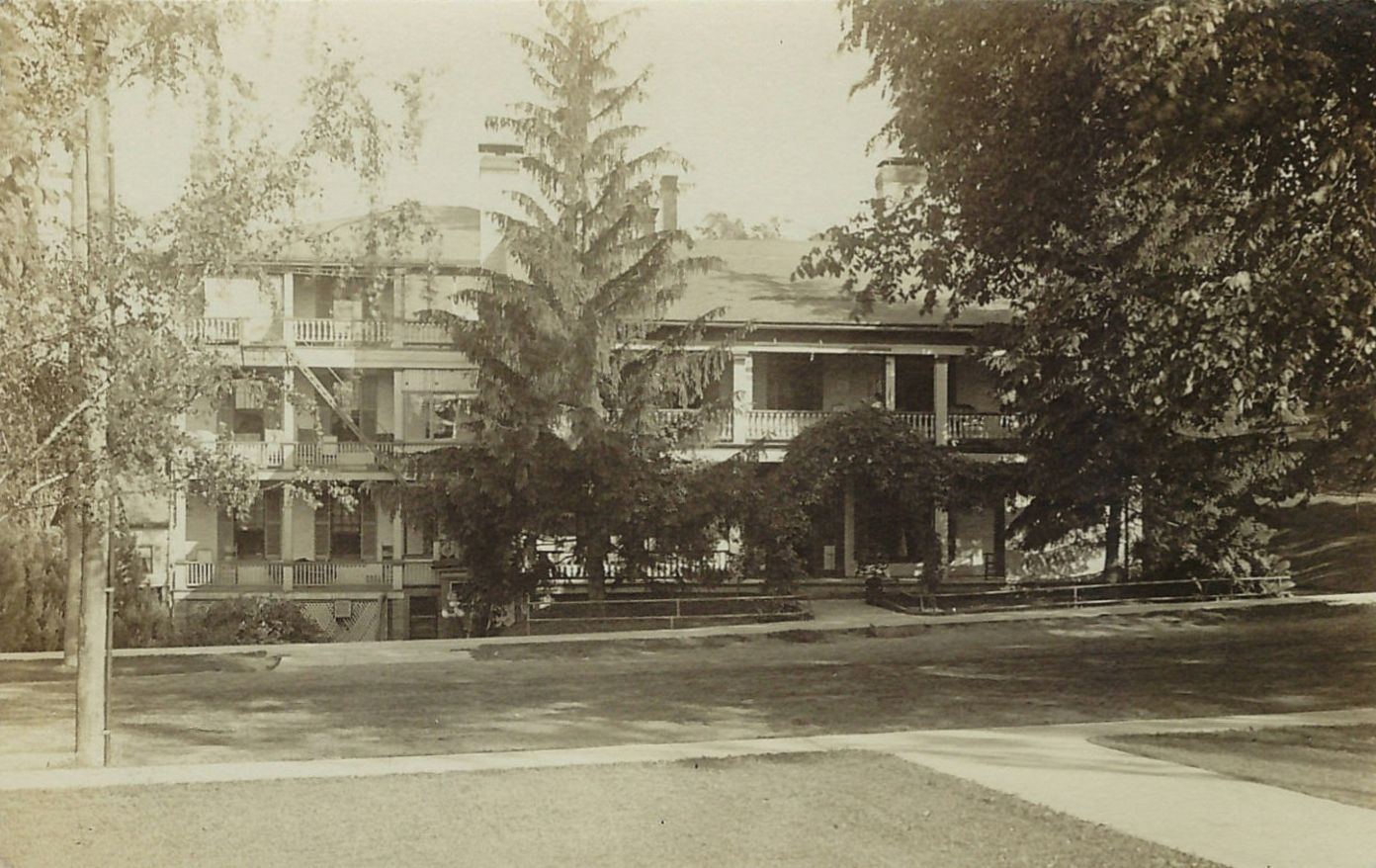
Another view of the Castile Sanitarium, as it appeared in 1910.
When Isabella finally met the famous Dr. Greene she was probably very surprised—first, because the esteemed Dr. Greene was very young (only about thirty-five years of age), and second—Dr. Green was a female!
Dr. Cordelia Agnes Greene, in an undated photo.
Female doctors were very uncommon in the late 1860s when Isabella first visited Castile Sanitarium. But Dr. Cordelia Greene was a very impressive young woman. At the age of sixteen she began supporting herself as a teacher in order to earn the money to put herself through medical school. She worked long hours in large sanitariums to gain experience; and she helped her father, also a physician, open a small “water cure” facility on property he purchased in Castile, New York.
When her father died, Dr. Cordelia Greene took over his enterprise, and used the sulphur springs on the property to expand the practice’s offerings. Under her management, the sanitarium became one of the premier facilities in the country.
The Sanitarium in an undated photo.
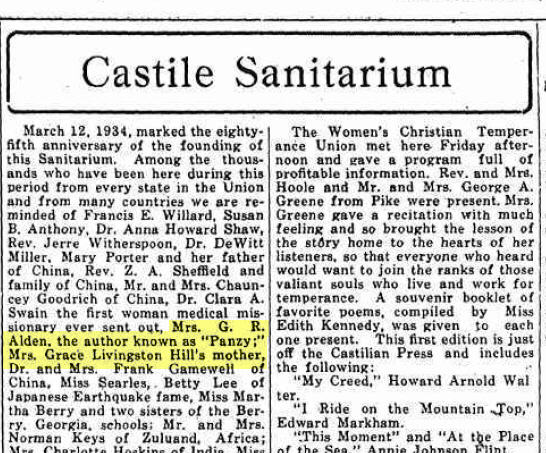
Famous patients flocked to her doors, including Frances Willard, the founder of the Women’s Christian Temperance Union; Susan B. Anthony, the noted leader of the suffrage movement; and Dr. Clara Swain, who opened the first hospital for women on the continent of Asia.
From a 1938 edition of The Castilian, the local newspaper (before the days of patient privacy laws).
Dr. Cordelia believed in the importance of deep breathing, vigorous exercise, and proper hydration of the body. She started every day by visiting patients’ rooms and personally delivering a pitcher of water to ensure each patient drank a full glass of water before breakfast.
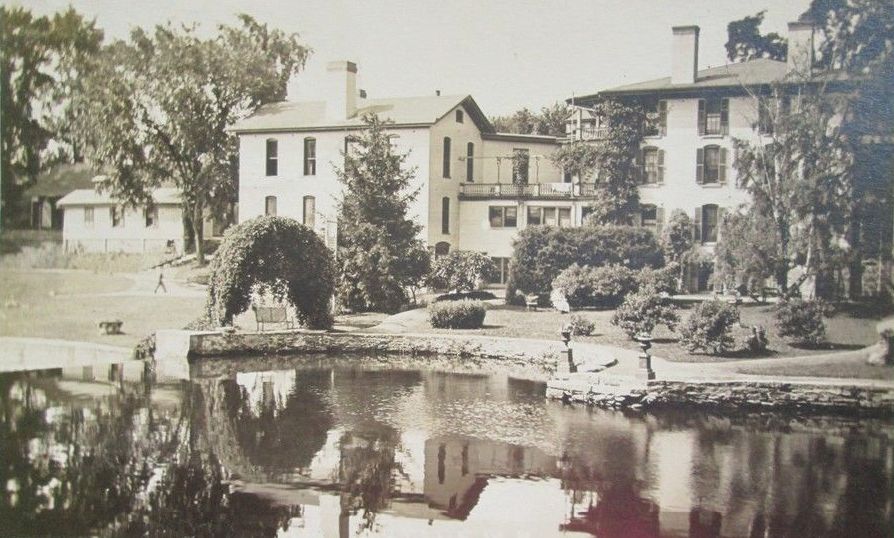
A view of the Sanitarium showing the pond and walking paths, about 1913.
Dr. Cordelia made certain patients who were strong enough spent plenty of time out of doors. They gardened and played croquet, walked and swam, in between their scheduled hydrotherapy treatments.
The Maples, where the nursing staff lived on the Sanitarium grounds.
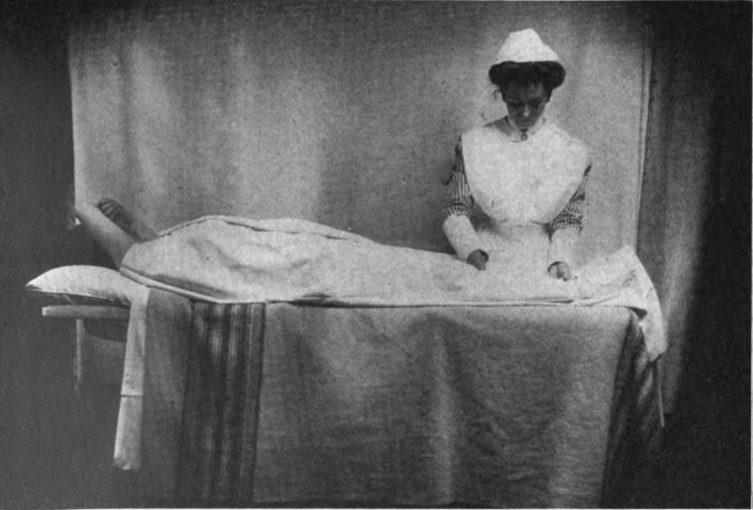
One of the hydrotherapy treatments Dr. Cordelia prescribed for Isabella was a wet sheet pack. The purpose of the wet sheet pack was to draw toxins from the body and increase blood circulation.
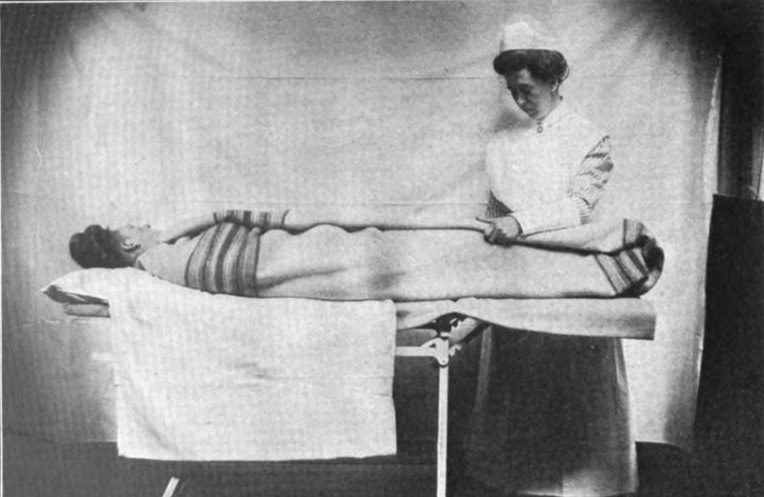
A wet sheet pack is accomplished by wrapping the patient from head to toe in a wet (usually with cold water) sheet. The patient’s arms are straight at their sides, and the sheet is tightly wrapped around the patient like a cocoon.
Over this are wrapped several layers of woolen blankets, again from head to toe.
As the patient sweats, the secretions from her pores are trapped in the sheet, as the wool blankets prevent moisture from evaporating into the air.
Isabella wrote that she was glad to have gone to the sanitarium; and said that “the thing that seemed so hateful soon became pleasant.” She grew to love and greatly admire Dr. Greene, saying:
“She was the life and power and heart and soul of that great water cure—a doctor of wonderful skill, a woman whom everybody respected and loved and obeyed.”
Isabella stayed on at Castile Sanitarium for five months; and when she left, she rejoiced. She was cured!
“Never since that time have I had to bear for even a single hour that peculiar form of pain which had been my almost constant attendant for more than five years!”
You can learn more about Dr. Cordelia Greene and her accomplishments by following these links:
Isabella was very close to her niece, Grace Livingston. She was 24 years old when Grace was born, and she did her best to spend as much time with little Gracie as she possibly could.
She was especially fascinated with Gracie’s developing personality. When the child was only three years old, Isabella said that Grace was as “full of fun and frolic as a mortal child could be. Oh, the mischief that that morsel could get through in a day! It seemed to me that the little feet and hands and tongue must ache at night; but they were never quite ready to have night come—in fact, as it drew toward bedtime she seemed to have more to do than before, and many a nice plan was spoiled right in the best of it by the call to bed.”
Many times Isabella and her sister Marcia (Grace’s mother) had long talks about Gracie’s willfulness and the odd way she had of looking at the world.
Isabella wrote that when Grace was about three years old, she developed the habit of waking in the morning and announcing her mood. “Gracie is a naughty baby this day.”
She seemed to think that this made everything all right, and nobody had a right to complain as long as she took the pains to explain to them what she meant to do up front.
Isabella wrote, “Sure enough, from morning until night everything went wrong. If she had planned everything that was to happen, with the direct aim of helping her to be a naughty girl, she could not have done it better; so that we grew to dread the days that were begun with that sentence, “Gracie is a naughty baby!” The worst thing about it was her serene unconsciousness of having done anything wrong. Hadn’t she told us that she meant to be naughty?”
The family looked forward to the days when Gracie would announce, “Gracie is a good girl today!” But those days sometimes seemed few and far between.
“Why can’t you always be such a sweet, pleasant little girl?” Isabella asked after one of Gracie’s sunshiny days.
“Why, Auntie Belle, this is my good day. I’m not a naughty baby today at all. But I can’t always be good, you know.”
Isabella wrote that on one of Gracie’s naughty days, she had got into a great deal of mischief, even burning her finger after getting hold of a candle she knew she was not supposed to touch. Marcia bandaged the injured finger in cotton, while Gracie wailed and cried; then mother and aunt took Gracie upstairs to get her ready for bed. Here, in Isabella’s own words, is what happened when it was time for Gracie to say her nightly prayers:
“Well,” Gracie said, looking into her mother’s face, and speaking slowly and solemnly, “I’ve got a good deal to say tonight, haven’t I? Mamma, which do you think is the baddest thing that I did today?”
“I don’t think I can tell,” Marcia said, with a sober, troubled face; “and that isn’t the thing that you are to think about, anyway. It makes no difference which is the worst thing; everything that you knew was wrong to do has made Jesus feel badly, and you want to ask him to forgive you for them all; besides, you want to ask for a new heart, so that you will be willing to try not to be so naughty.”
There was never a time in her little life that Gracie wasn’t ready for an argument. She tried to get one up now.
“But, mamma, if I could find out which was the very baddest thing that I did, I could make up my mind that I certainly true would never do that again, and then I would be sure not to be so bad next time. Don’t you see?”
I shall have to confess that I felt very much like laughing. She was such a little bit of a mouse, and she was trying so hard to be wise. But her poor troubled mamma did not smile.
“I see that you don’t know what you are talking about,” she said. “I can only hope that when you are older you will be a great deal wiser.”
This was certainly hard for a little girl who thought she made a very sensible remark. She gave a little bit of a sigh, and then knelt down beside her mamma. Very slowly and reverently she went through the prayer that I think every little girl in the world must know, “Now I lay me down to sleep.” After the “Amen” she always added a little prayer that she said came right out of her own heart; and tonight it was, “Dear Jesus, please bless Gracie; make my heart not feel so bad; make me feel just as though I was a very good girl, and take away my naughty sins and give me some good sins.”
That was really the most that Gracie knew about it. There seemed to be no use in trying to make her understand that everything that wasn’t right was wrong, and that God thought so.
Isabella wrote that Marcia was troubled that her daughter might actually believe there was such a thing as “good sins.” But in her heart, Isabella wasn’t worried. When she looked at Gracie, she saw independence, the ability to reason things out for herself, and a true knowledge of what was right and wrong. She had no fear for Gracie’s future. She knew that Gracie’s parents—and all of the members of their tight-knit family—would raise Grace to be a woman of faith who followed Christ in her everyday life.
You can read more about Isabella and her niece, Grace Livingston Hill, in these posts:
The year 1886 was a banner year for Isabella. In that year she had six books published, including Spun from Fact and One Commonplace Day.
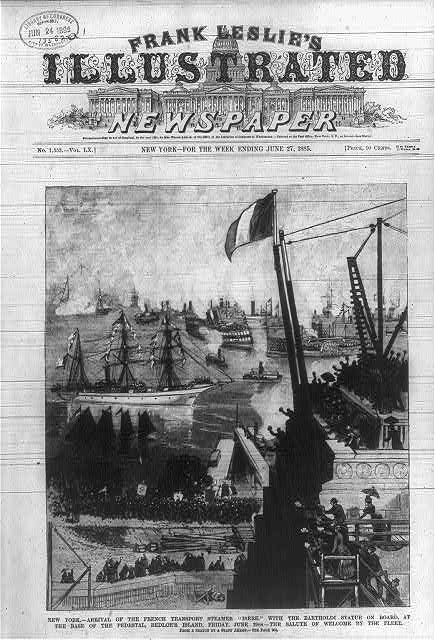
1886 was a banner year for America, too. A wave of patriotism was surging through the country, thanks to the long-awaited unveiling of the Statue of Liberty on a small island in New York’s harbor.
Frank Leslie’s Illustrated Newspaper for June 27, 1885, chronicling the New York arrival of the French transport steamer, Isere, with the Statue of Liberty on board.
Newspapers and magazines were full of descriptions of the statue and of the pedestal that was being constructed for it on Bedloe Island in New York harbor. Americans were intrigued by the sheer size of the statue. They marveled over its engineering and wondered how the torch would remain lit.
An 1884 print illustrating the proposed location of the Statue of Liberty in New York harbor.
The statue was the brainchild of French sculptor Frederic Auguste Bartholdi. He originally envisioned presenting the statue to the United States on the one-hundred year anniversary of the signing of America’s Declaration of Independence, but he did not have enough of the statue completed by that deadline.
An 1882 photo of workmen constructing the Statue of Liberty in Bartholdi’s Paris warehouse.
Instead, he sent America pieces of the statue. For example, in 1876 he sent to America the hand holding the torch and one of the feet of the Statue of Liberty. Those pieces toured American cities as part of the centennial celebration, and helped raise the funds needed to erect the pedestal on which the Statue of Liberty would ultimately stand.
The torch and part of the arm of the Statue of Liberty on display at the 1876 Centennial Exhibition in Philadelphia.
Ten years later, the pedestal was in place. Bertholdi was finally able to assemble the statue on top, and America set the date for the unveiling for October 28, 1886.
That day dawned cold and misty. A light fog hung over the city; it had rained the day before, so areas that were not paved were muddy. But wet pavement and mud and chilly temperatures couldn’t dampen America’s enthusiasm.
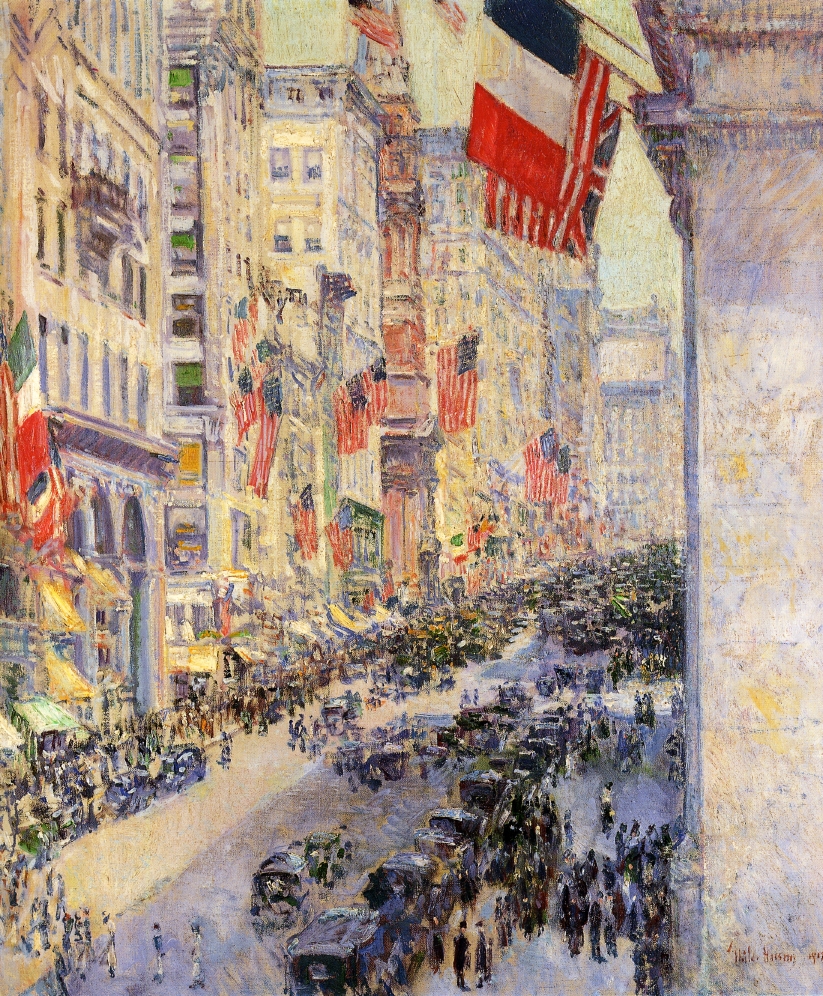
“Up the Avenue from 34th Street” by Frederick Childe Hassam (1917)
Everywhere the city was decorated with buntings and flags. French flags flew from the tops of American households, and American flags fluttered from almost every window.
People came from all over the country to fill the New York streets. Businesses shut down and public schools closed as all New York joined in the celebration.
A New York parade, circa 1899
One visitor in the crowd later related that “every place that a person could get to see was occupied; the tops of lamp posts, telegraph poles, trees, and the housetops were all filled.”
The festivities began with a parade. Newspaper accounts estimated between 25,000 and 30,000 men paraded through the city. It took over two hours for the head of the parade to reach the Battery.
A New York Parade, about 1910.
The parade featured canon and carriages filled with dignitaries, like President Cleveland and members of his cabinet. Civic organizations, military companies, police battalions and the Army Engineering Corps marched through the streets. Band after band paraded playing the “Marseillaise.”
Volunteer firemen’s associations, Knights of Pythias, federal judges, local mayors, and veterans of 1812 joined the ranks of marchers. They paraded down Fifth Avenue, past Central Park to Madison Square, then on to the review stands on Twenty-Fourth Street.
Undated photo of the Masons of Pyramid Temple on parade.
When President Cleveland stepped up on the stand, the crowd cheered; but then the people close enough to the stage caught sight of the sculptor, Monsieur Bartholdi, who was waiting to be introduced. The crowd instantly recognized him because his likeness appeared on the programmes and in illustrated newspapers.
A promotional image of French sculptor Frederic Auguste Bartholdi, with the Statue of Liberty and a sculpture of a lion.
Those nearest the stand began to chant his name, “Bartholdi, Bartholdi.” Crowds on the avenue up and down heard the name and passed it to the people in the park, and they passed it to the people on the side streets, until the air was “shaken with the roar of cheering” the sculptor’s name.
Monsieur Bartholdi accompanied President Cleveland aboard the steamship Dispatch, to make the short journey across the bay to Bedloe Island. As soon as the Dispatch got under way, over 100 vessels, decorated with flags and bunting, blasted their whistles and followed behind.
Undated photo of the Statue of Liberty in New York Harbor, viewed from the north.
When they reached Bedloe Island the official unveiling ceremony took place. A large French flag had been placed over the head of the statue, but at the signal, the flag was pulled away, to the sound of a salute of gun fire by all the batteries in the harbor, afloat and ashore.
“Unveiling the Statue of Liberty,” by Edward Percy Moran, 1886.
President Cleveland formally accepted the statue on behalf of the United States, after which there followed an address by a representative of France, then music, and a benediction.
When the ceremony concluded there was a one-hundred-gun salute, and the steamers in the bay blew their whistles. The guns on Governor’s Island and other forts fired for a full half an hour.
By this time the rain had begun to fall, but the crowds did not disperse. Over a million people filled every available space from Wall Street to Pearl Street and to the Battery. They stood in the drenching rain and driving winds and cheered themselves hoarse.
A view of the “Statue of Liberty from Castle Garden,” New York, by Andrew Melrose, 1887.
That rainy October day in 1886 was a great day for the city of New York and for the American people, who received a gift that would go on to epitomize the spirit of liberty and refuge for people all over the world.
This video provides more detail about the Statue of Liberty and how it came to reside on Bedloe Island.
Toward the end of Isabella’s life, her niece, Grace Livingston Hill, encouraged her to write “just one more book.” Grace suggested that it be about Ester Ried’s grand-daughter or great-grand-daughter, in order to bring the great message of the original Ester Ried novel to a whole new generation of readers.
Isabella Alden in an undated photograph.
Isabella’s fertile imagination still had plenty of stories waiting to be told. She recognized that there were some loose ends from the Ester Ried series that needed to be tied up, as Grace suggested.
She also knew, based on the letters she received, that fans of her books wanted to know more about some of the other characters she had created.
But Isabella chose not to write those sequels. In 1927 she told Grace:
I am not capable of writing a story suited to the tastes of present day young people. They would smoke a cigarette over the first chapter, and toss it aside as a back number. I haven’t faith in them, nor in my ability to help them.
Cover of a 1925 edition of Life magazine.
It’s unfortunate that Isabella was so disillusioned with the “present day young people” of the 1920s. She didn’t understand the new generation of young people, and she strongly believed she had nothing in common with them.
While Isabella still dressed modestly in long gowns with high collars and full sleeves, young women of the 1920s wore short, sleeveless dresses.
A 1920s dress, from Pinterest.com
They rouged their knees and polished their shoulders.
A 1920s advertising flier for the Bassett’s Ice Cream stand located in the Reading Terminal Market, Pennsylvania.
They plucked their eyebrows, painted their lips, and lacquered their fingernails.
Actress Clara Bow on the cover of a 1920s magazine.
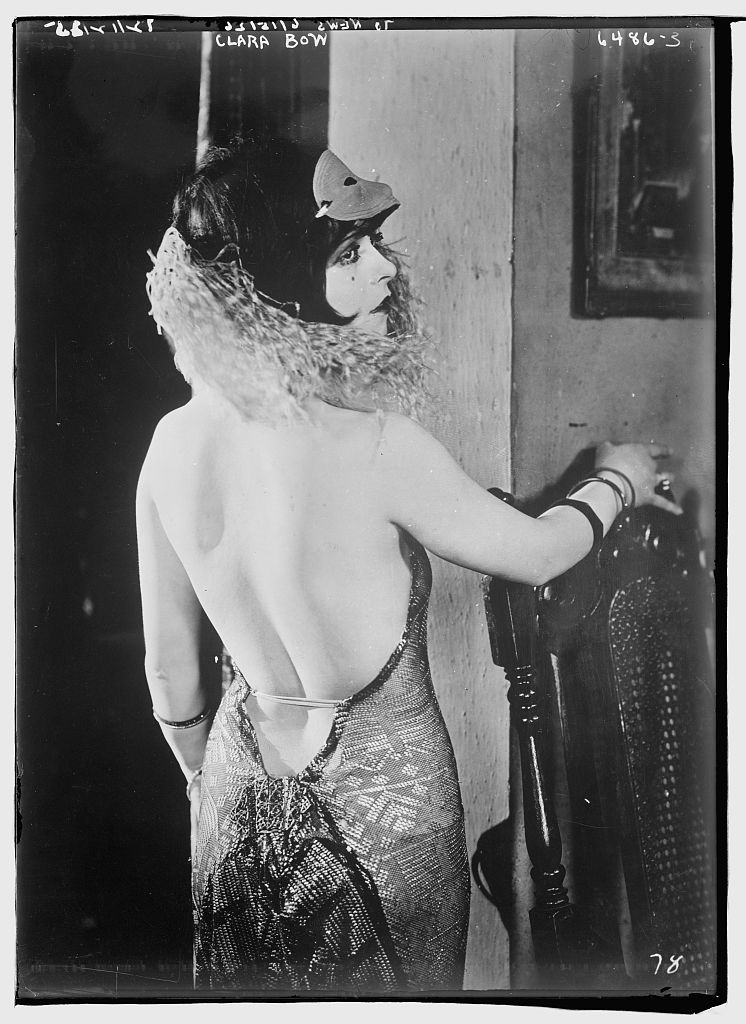
Hollywood star Clara Bow set the trends. She was nicknamed the “It Girl” for playing the role of a plucky shop girl who made good. She was the first Hollywood sex symbol, and Americans couldn’t get enough of her.
A 1922 photograph of actress Clara Bow in a daring backless dress. From the U.S. Library of Congress.
Teenaged girls and grown women copied her make-up and clothes. If Clara Bow smoked cigarettes in a movie, they smoked, too.
Life magazine cover from the 1920s.
Like Clara, they challenged social mores by drinking alcohol and driving fast cars, just like men did.
A 1920s flapper and her flask of alcohol. From the U.S. Library of Congress.
And like many of the characters Clara Bow played on screen, they were headstrong and modern and fond of nightlife.
A cover of Puck magazine.
Isabella couldn’t understand it. She wrote:
I saw the trend away from Christ long ago. I recognized the downward trend not only in girls and boys, but in their mothers and teachers and pastors. I came by degrees to understand that the class of young people to whom I had dedicated my life had made a distinct descent, and that for me to do the same in my writing would be to dishonor Jesus Christ.
So Isabella watched with sadness as a new generation of readers turned to the novels of F. Scott Fitzgerald, Warner Fabian, and Virginia Woolf, while her own novels gradually fell out of favor.
Original cover of Unforbidden Fruit by Warner Fabian. The 1928 novel was shocking in its day for depicting single women’s sexuality.
Grace and others urged her not to give up her life work, but Isabella was adamant: she would not write except to try to win souls for Christ.
I think we all realize in these days that even Jesus Christ is not popular. Therefore we who want to follow Him closely must not try to be.
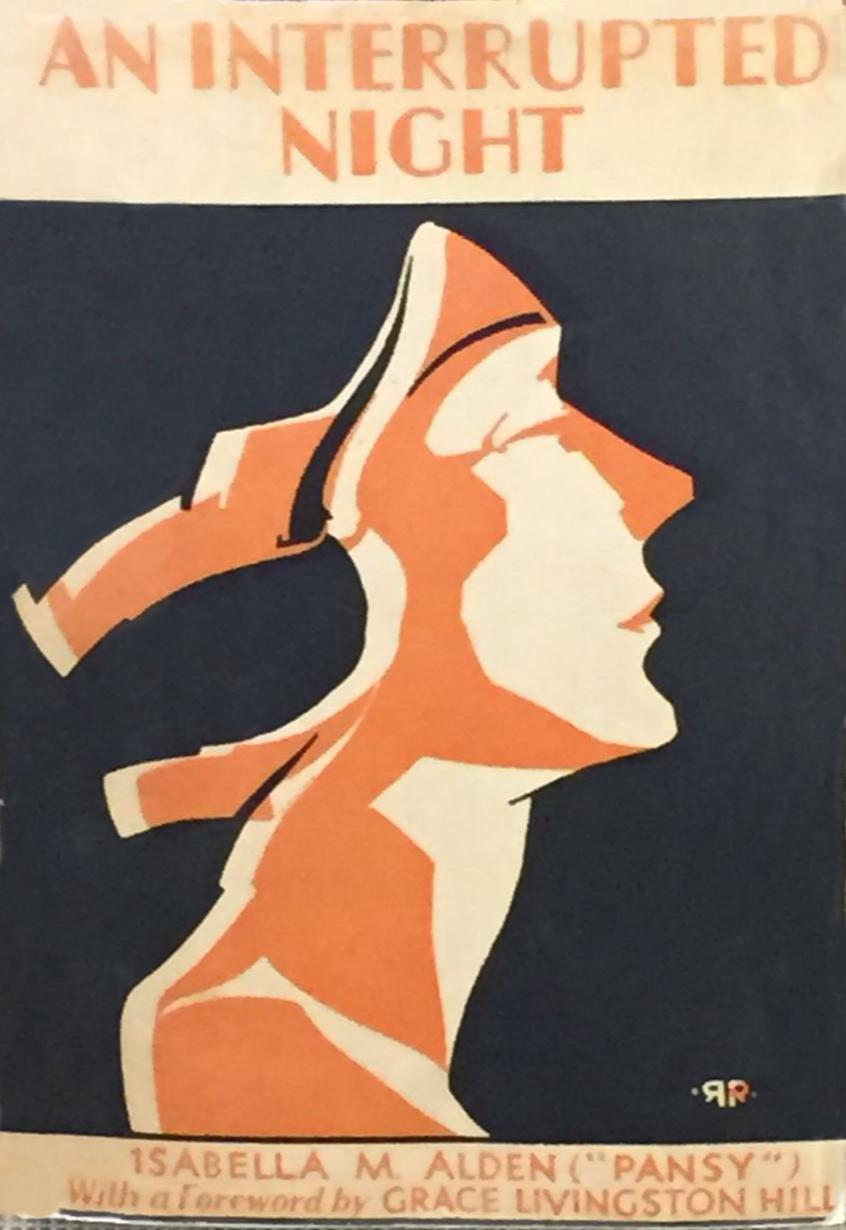
In 1929 Isabella published An Interrupted Night. Like her novel, Unto the End, An Interrupted Night was written for adults and dealt with issues of love, marriage, infidelity, and sacred vows. The book received good reviews, but it would be Isabella’s final novel.
The cover for Isabella’s 1929 novel, An Interrupted Night.
Unfortunately, Isabella Alden passed away the following year, in 1930, never knowing that—almost one hundred years later—an entirely new generation of “present day young people” would love and cherish her books.
In The Ester Ried Series, Isabella chronicled the transformation of a young man named Jim Forbes. Jim first appeared in The King’s Daughter as a member of a wild bunch of boys who showed up at church for the sole purpose of terrorizing the Sunday-school teachers.
Homer Nelson, who was in charge of the Sunday-school classes, described Jim and his friends:
“Oh, they swear outrageously, and smoke profusely, and gamble whenever they get a chance, not often for money, for they have very little of that article about them; but for raisins, or pins, or straws, or anything that is convenient, and they use liquor freely, every one of them.”
But by the end of The Ester Ried books, Jim was a different person. In fact, he came to be so well regarded, his friends at church gave him a gift: “a dainty and elegant, and altogether perfect gold watch and chain.”
A young gentleman with his gold watch and chain. From OldFamilyPhotos.com
Jim was astonished to receive the watch, not only because of its beauty and cost, but because of what it represented. In the times in which Isabella lived, a man who carried such a watch and chain was considered a gentleman of the first order.
During the late 1800s and early 1900s, true gentlemen followed a very strict code of dress that was based, in large part, on the model promoted by Britain’s Lord Chesterfield, who famously said:
“I cannot help forming some opinion of a man’s sense and character from his dress.”
A Victorian Gentleman, by Vittorio Matteo Corcos, 1890.
Isabella agreed whole-heartedly. In her books, Isabella dressed her gentlemen in neat, conservative, well-fitting suits. Even the wealthy men who populated her stories (like Edward Stockwell in The Ester Ried Series, Judge Burnham in The Chautauqua Books, and Mr. Burton in Christie’s Christmas) dressed in a way that did not call attention to themselves or their wealth.
Dressing in the “height of the fashion,” Isabella believed, was better left to dandies and pretenders.
A Paris dandy, circa 1890. His multiple watch chains, quizzing glass, elaborate buttons, and overly-shiny shoes would have been considered vulgar by American standards.
There were essential elements of a gentleman’s attire. In addition to a well-fitting coat and trousers, a gentleman always appeared in a waistcoat and tie.
Portrait of Henry Cabot Lodge, by John Singer Sargent, 1890.
Even when they were relaxing around the house or engaging in leisure activities, men wore coats, ties, and waistcoats.
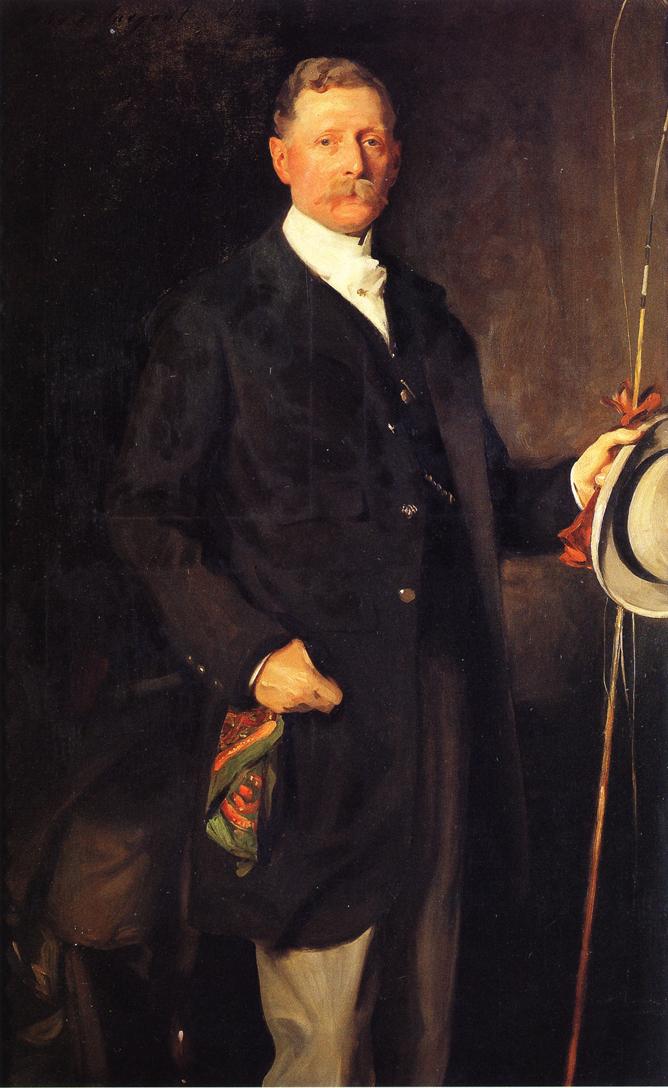
Captain John Spicer, dressed to go fishing, by John Singer Sargent, 1901.
.
Portrait of the artist’s brother, dressed for riding, by Arthur Hacker, 1882.
Another essential element of a gentleman’s appearance was an appropriate amount of facial hair. Beards and moustaches were considered to be a symbol of masculinity.
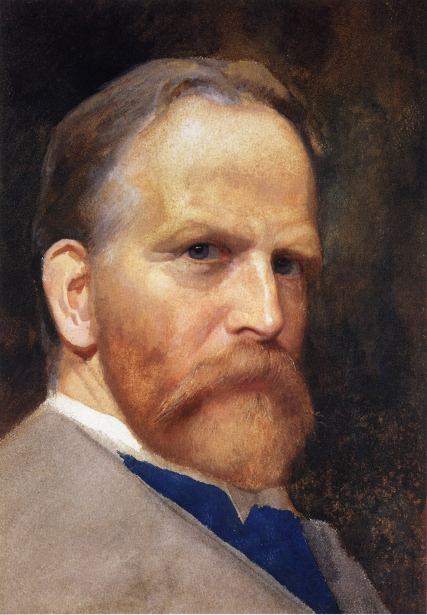
Self-portrait, by James Wells Champney.
Isabella’s men wore beards and moustaches, as well. In Helen Lester, Helen’s dashing older brother Cleveland returned home from Europe looking very handsome and “heavily bearded.”
Portrait of Leon Delafosse, by John Singer Sargent, 1898.
And charming Ralph Ried wore a full beard in The Ester Ried Series of books.
Undated photo of young man with a full beard and moustache. From Pinterest.
Coats, ties, waistcoats, and beards—they were all essential to a man’s attire in Isabella’s world, but a popular 1866 book on “etiquette and true politeness” carried this reminder:
Gentility is neither in birth, manner, nor fashion—but in the MIND. A high sense of honor—a determination never to take a mean advantage of another—an adherence to truth, delicacy, and politeness toward those with whom you may have dealings—are the essential and distinguishing characteristics of A GENTLEMAN.
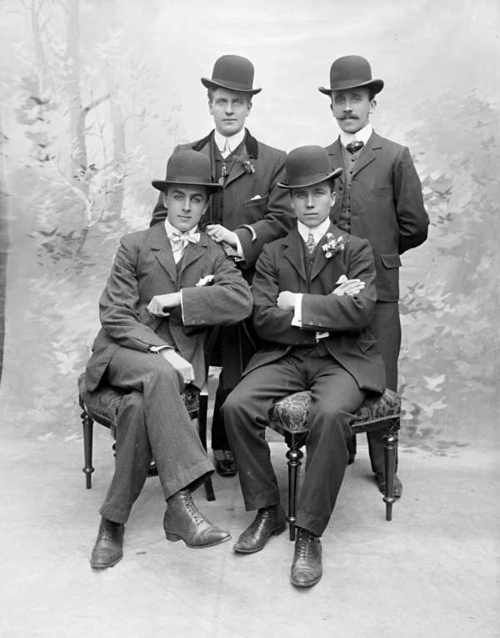
A 1901 photo of a fashionably dressed gentleman.
You can click on the links below to find out more about Isabella’s books mentioned in this post.
Isabella Alden’s series of books about the Ried family were her most popular novels. In Julia Ried, book 2 of the series, the Ried family falls on hard times, and daughter Julia decides to strike out on her own. She takes a job as a bookkeeper in a paper box factory in the neighboring town of Newton.
In choosing Julia’s career, Isabella was on solid ground. She was able to write convincingly about Julia’s job and work environment, because Isabella’s father, Isaac Macdonald, operated a paper box factory in Gloversville, New York.
Page from an 1870 Fulton County New York Business Directory.
Gloversville, the little village where Isabella grew up, was celebrated for its glove-making industry.
A 1908 postcard of Gloversville showing the intersection of Main Street, with its many retail glove shops, and Fulton Street, where Isaac Macdonald’s box factory was located.
Between 1890 and 1950, Gloversville supplied nearly 90 percent of all gloves sold in the United States.
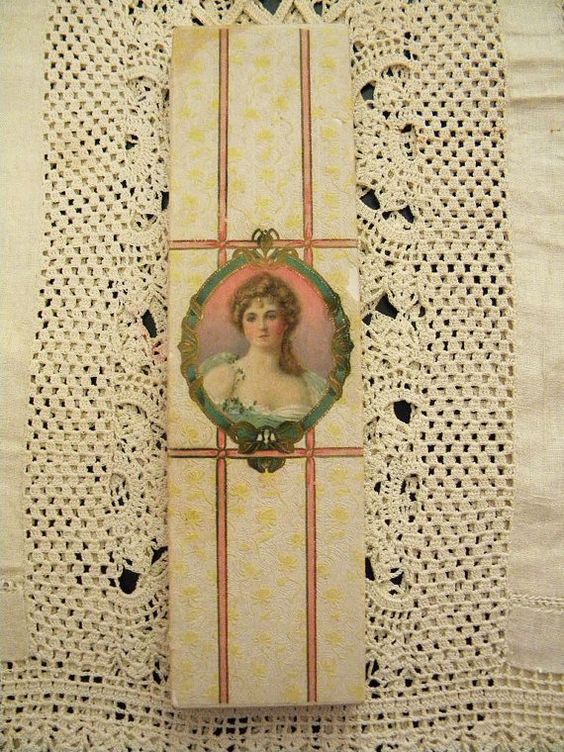
1913 paper glove box; from Pinterest.
Besides the many “skin mills” and glove manufacturing business in the little village, the industry spawned a host of supporting businesses, such as box makers, tool and die manufacturers, and dealers in buttons and threads.
Box for Silkateen brand ladies gloves. From Etsy.
Isabella’s father, Isaac Macdonald owned one of four or five box-making factories in Gloversville. While there’s no record that Isabella ever worked in her father’s factory, she had a good grasp of the working conditions, and she conveyed her thorough knowledge of the business in Julia Ried.
Women workers at a box factory, about 1890.
In Julia Ried, Isabella gave lively descriptions of the “shop-girls” who folded and pasted the cardboard boxes together. According to Frank Hooper, one of those shop-girls in the book, they worked ten hours a day, six days a week.
A 14-year-old girl at work in a paper box factory. From National Archives.
Pasting cardboard boxes together was a sticky, messy, exhausting job; but it was a job that was often performed by women and children.
A young girl working alongside a woman in a paper box factory, 1912. From National Archives.
Small boxes especially—like those that contained gloves for ladies and children—needed to be assembled and pasted by women or children with small hands.
From the Gloversville Daily Leader, March 12, 1900.
Yet in the glove-making industry—and its supporting businesses—women and girls earned half as much as men.
The work could be dangerous. Accidents were common, and some injuries could be severe.
From the Gloversville Daily Leader, May 12, 1898.
A young box factory worker after an accident with a veneering saw; 1907.
Isabella drew on her knowledge of the box-making business to create some of her most beloved characters. The characters of Frank Hooper and Jerome Sayles (whose father co-owned the box factory in the story) made return appearances in other books in the Ester Ried Series.
Women and girls working in a box factory, 1910.
You can learn more about Gloversville, Isabella’s home town, by reading these related posts:
At the height of her popularity, Isabella Alden was one of the most widely-read authors in the world. One of the things that made her so popular—and unique—was the varying ages of her readers: she had just as many children who were dedicated fans of her books as she had adult fans. And they all wrote letters to her.
She received letters by the thousands, addressed to her publisher, to her home, and to the offices of her magazine, The Pansy. And she answered them all!
Isabella Alden in an undated photograph.
Some fans wrote to request her autograph and a photo. Others asked for advice on how to become a great author or they sent their own manuscripts and asked for her opinion.
Some asked for advice on other topics, from how to get a good husband to the best way to stop fingernail biting. One fan even asked for pieces of her best dress so they could be sewn into a patchwork quilt the fan was sewing!
An early cover for Ester Ried
But the fan mail Isabella received most often was about her book Ester Ried. Ester Ried was incredibly popular and prompted scores of readers to send Isabella letters thanking her for the book’s message.
New cover for the 2016 release of Ester Ried
Fans wrote to Isabella about how they saw themselves in Ester’s struggles and her impatience with life’s daily annoyances. But mostly, readers identified with the lessons Ester learned; they took to heart the promise that God would bring peace and happiness to their lives, if only they trusted in Him.
What started as a single book soon blossomed into an ongoing series. The Ester Ried series gave fans of the original book glimpses into the lives of the characters they loved. Readers grabbed up each new story about the Ried family members and their trials as they grew up, married, and learned to trust God to help them through a sometimes difficult world.
Two years after Ester Ried was published came Julia Ried, a sequel that focused on Ester’s younger sister Julia and the lessons she learns about faith in times of temptation. It also brought readers up to date on Abbie Ried’s story after the tragic turn her life took in Ester Ried.
The following year Isabella published the third book in the series, The King’s Daughter. In this book Isabella introduced the character of Miss Dell Bronson. Unlike Ester or Julia, Dell was rock solid in her faith and trusted God in her daily life, but she still had challenges to face. And she still had lessons to learn in Wise and Otherwise, the next book in the series.
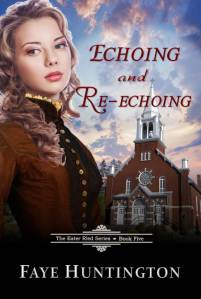
Isabella commissioned her best friend Theodosia Foster to write book five. Echoing and Re-Echoing (written under Theodosia’s pen name Faye Huntington) centers around Ralph Ried, Abbie’s brother, who, as a new minister, struggles to reach his flock through his Sunday sermons.
Isabella’s fans particularly loved the sixth book in the series, Ester Ried Yet Speaking, because it included the character of Flossy Shipley. Flossy was originally introduced to readers in Four Girls at Chautauqua. In Ester Ried Yet Speaking readers got to find out what happened to Flossy after her marriage to Evan Roberts. They also met Dr. Everett, Hester Mason, and Joy Saunders, who were the main characters in Isabella’s later book, Workers Together; An Endless Chain.
Isabella waited nine years before she published Ester Ried’s Namesake. It was intended to be the last book in the series, but fans wrote to beg for more.
Even Isabella’s niece, Grace Livingston Hill, encouraged her to write “one more long story.” Grace suggested she write about Ester Ried’s granddaughter or great-granddaughter, and thereby reach an entirely new generation of readers with the original book’s message.
But by that time, Isabella was 86 years old and in failing health. One more “long story” was beyond her abilities, she told Grace. “You have altogether too high an opinion of me.”
Many fans of the series think the Ester Ried books are perfect, just as they are; the only difference is that today’s readers have the option to read the books electronically. A new generation of Ester Ried e-books is available on Amazon and other e-book retail sites.
Boxed set e-book cover for Ester Ried, the Complete Series.
Have you read the books in the Ester Ried Series? Which book is your favorite?
You can click on any of the book covers in this post to find out more about each title.
Isabella Alden was very close to her sister Marcia, who married the Reverend Charles Livingston. For many years Isabella’s and Marcia’s families lived together under the same roof.
Isabella Alden (left) and her sister, Marcia Livingston in an undated photo.
In the summer months the Aldens and the Livingstons traveled to Chautauqua, New York and shared a cottage on the grounds of the Chautauqua Institution.
In the winter they made the pilgrimage to Florida, where the two families lived in a large house in Winter Park.
The Alden house in Winter Park. (From Winter Park Public Library archives.)
Isabella’s son Raymond and Marcia’s daughter Grace attended Rollins College in Winter Park, and Grace went on to teach physical education classes there.
Grace Livingston Hill in her early twenties.
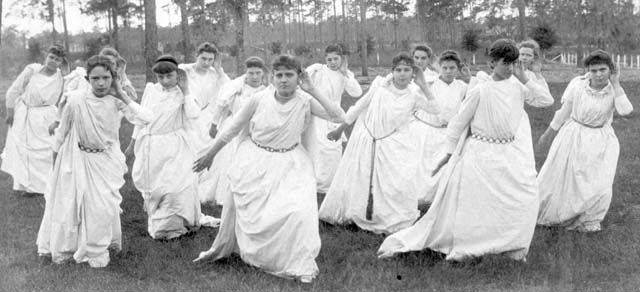
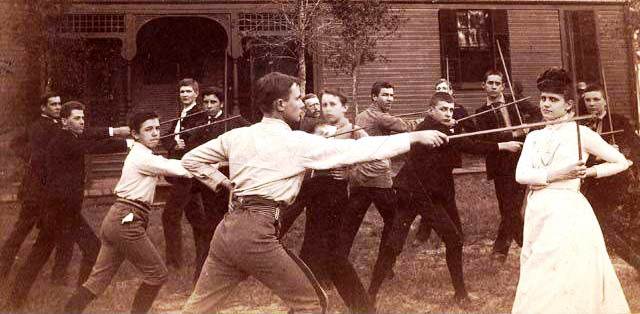
Before Grace took up her pen to write some of America’s most beloved novels under the name Grace Livingston Hill, she was one of the first teachers at Rollins College. She was also a true advocate for the “physical culture” movement that was sweeping the country at the time. She recognized the freedom it gave women to pursue physical health in a way they hadn’t been able to before. At Rollins she taught ladies’ classes in calisthenics, basketball, gymnastics, and fencing.
Grace Livingston (front and center) with her Greek Posture Class, about 1889. (From Rollins College Archives.)
She also taught men’s classes in physical culture, such as fencing and Greek Posture:
Grace teaching a fencing class in 1890. (From the Rollins College Archives.)
Men’s Greek Posture Class, about 1890. (From Rollins College Archives.)
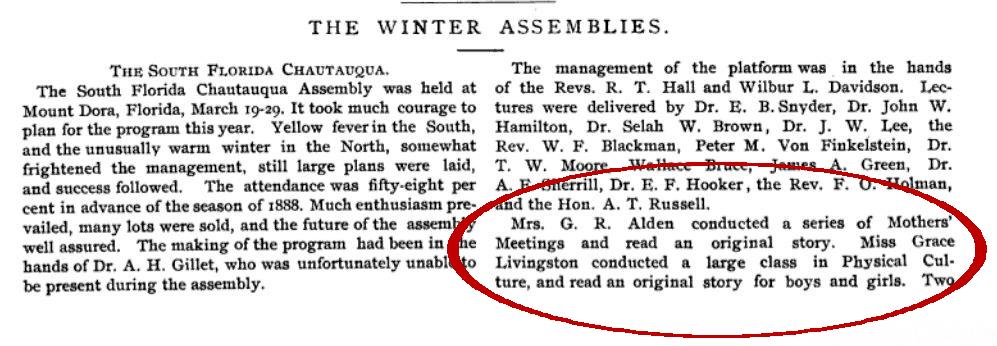
And when she wasn’t teaching at the college, she taught physical culture classes at the Florida Chautauqua.
An 1889 announcement from the Florida Chautauqua.
Like her niece, Isabella appreciated the physical culture movement. She even featured the craze in one of her short stories, “Agatha’s Uknown Way.”
And she wrote “Too Much of a Good Thing,” a story about how one young girl got so caught up in the physical culture craze, that she made life difficult for her entire family. You can read “Too Much of a Good Thing” for free below.
Would you like to learn more about Grace Livingston’s teaching years at Rollins College? Click this link to read a fun story about one of her biggest challenges at the school, and how she convinced the faculty to see things her way.
You can read Isabella’s short story, “Agatha’s Unknown Way” for free. Just click this link.
You can also read a previous post about the birth of gymnastics at Chatuauqua Institution.
Enjoy Isabella’s story, “Too Much of a Good Thing”:
Too Much of a Good Thing
Downstairs everyone was busy. Uncle Morris and his entire family, just from Europe, were coming by an earlier train than it had been expected they could take, and many last preparations for making them comfortable had still to be attended to.
Mrs. Evans had been up since daylight, planning, directing, and helping to the utmost that her small strength would admit.
Indeed, her eldest daughter Laura had constantly to watch, to save her mother from lifting something heavy, or reaching for something high. Often her clear voice could be heard with a “Oh, mother, don’t! Please—I’ll take care of that.” And often the gentle answer was:
“Dear child, you cannot do everything, though your will is strong enough. Where is Millie?”
“Millie has gone to sweep and dust the hall room; you know we didn’t think we should need that, and I used it as a sort of store room; but since Arthur is coming with them, we shall have to get it ready; and he will need to go at once to his room, since he is an invalid, so I sent Millie to put it in order. I told her just what to do, and she will manage it nicely. She must be nearly through now, and I’ll have her finish dusting here, so I can help you with those books; they are too heavy for you to handle.”
No, Millie wasn’t nearly through. In fact, she could hardly have been said to have commenced. The truth is, she had been thrown off the track. It was an old print which fell out of an, unused portfolio that did it. The print showed the picture of a girl in fun Greek costume, and reminded Millie of what was not long out of her mind, that in the coming Physical Culture entertainment she was to chess in a costume which was supposed to be after the Greek order.
“Let me see,” she said, bending over the print, “this girl has short sleeves and low neck. Why, the dress is almost precisely like the one which Laura wears with her lace over-dress; I might wear that. It would be too long, of course, but it could be hemmed up. I am almost sure Laura would let me have it; and with her white sash ribbon tied around my waist it would be just lovely. Then that would save buying anything new, and save mother any trouble. I mean to go this minute and try on the dress, before I say anything about it.”
Away dashed the Greek maiden to one of the guest chambers which Laura had left in perfect order, dragged from a seldom used drawer the elegant white mull dress with its lace belongings, all of which saw the light only on state occasions, and rushed back to the hall room again, where she had left the print she was trying to copy. In her haste, she dragged out with the dress various articles of the toilet. Laura’s white kid gloves which she wore when she graduated, a quantity of laces, and a handkerchief or two, to say nothing of sprays of dried flowers. These she trailed over the carpet, seeing nothing of them. The important thing in life just now was to get herself into that dress.
It was accomplished at last, not without a tiny tear having been made in the delicate stuff, but which Millie’s fingers were too eager to notice. She tied the white sash high up about her waist, after the fashion of the picture, seized the dust brush in one hand as if it were a dumb bell, or an Indian club, and struck a graceful attitude with her arm on the corner of the mantel.
“There!” she said, “I would like to have my picture taken in this dress; I have a very nice position now for it. I wish the girls were here to see me. Laura must let me wear this; it fits exactly. I don’t believe it is much too long for a Greek maiden. I should like to wear my dresses long; it must be great fun. I wonder if we couldn’t have our pictures taken in costume? I think it would be real nice; and our folks would each want to buy one. Perhaps we could make some money.”
There were hurried steps in the hall, and the Greek maiden’s musings were cut short. Laura came forward rapidly, talking as she
came.
“Millie, aren’t you through here? You have had plenty of time, and mother needs your help right away. Hurry down just as quickly as you can; she is over-doing, and it is growing late; the carriage may come any minute now. Why, Millie Evans!”
She stopped in amazement, for the Greek maiden was still posing. She smiled graciously and said: “Don’t I look fine? I borrowed it a minute to see if it will do to wear to the entertainment. It is just the thing, isn’t it? You will lend it to me, won’t you? Just for one evening? I’ll be awfully careful of it.”
“And you have been to that drawer where all the nice things are packed, and dragged them out! There is one of my white gloves under your feet, and my only lace handkerchief keeping it company! I must say, Millie Evans, you deserve to be punished. Here we are trying our best to get ready for company, and keep mother from getting too tired, and you neglect your work to rig up like a circus girl; and go to a drawer which you have no right to open. I shall certainly tell father of this.”
The Greek maiden’s cheeks were in an unbecoming blaze. Laura was hurried and tired, and spoke with more severity than was her custom. It certainly was trying to find the room in disorder, and her best dress in danger.
“Take care,” she said, as Millie’s frantic efforts to get it off put it in greater danger. “Don’t quite ruin that dress. Indeed you shall not wear it. I am astonished at you for thinking of such a thing; when father hears what you have been doing, I doubt if you will need a dress for the entertainment.”
Then Millie lost all self control. “You are a hateful, selfish thing!” she burst forth. “Take your old dress; I don’t want to wear it; and I won’t be ordered about by you as though you were my grandmother. I’m nearly fourteen, and you have no right to manage me. I’ll just tell father myself that I—”
“What is all this?” Mr. Evans’ voice was sternness itself, and he looked at the girl with blazing cheeks, in a way that made her angry eyes droop.
“What does it mean, Millicent? I heard you using very unbecoming language to your sister, and to judge from your appearance you have been about some very inappropriate work.”
“Well, father, Laura burst in here and—”
“Never mind what Laura did, Millicent. Unfortunately for you, I know which daughter tries to care for and spare her sick mother in every possible way. I overheard enough to show me which one is to blame. Laura may tell me what is the trouble, and you may listen.”
But Laura was already sorry that she had spoken so sharply, and tried to soften the story as much as truth would permit.
“Her mind is so full of the Physical Culture entertainment, father, that she does not stop to think. I know she did not mean to hinder and make trouble.”
“I see,” said Mr. Evans, speaking grimly. “I have heard a good deal about this Physical Culture business. If everyone is as much carried out of common sense by it as our Millicent is, I should say it was high time to have some moral culture. Millicent, you may put yourself into a suitable dress for sweeping, and do the work you were sent to do, at once; and you will not need to think any more about a dress for the entertainment, for you are to be excused from attending it. You may tell your teacher that I said so.”
Poor Millie! The hall bedroom floor might almost have been washed, if that were desirable, with the tears she shed. No hope had she of any change of mind on her father’s part. He rarely interfered with his children, but when he did, his word was law.
And poor Laura! She went downstairs heavy-hearted and miserable. Why had Millie been so silly, and why had she allowed her vexation to make matters worse?
The poor frail mother actually cried when she heard of Millie’s disappointment. “Yet I really cannot ask her father not to notice it,” she said sorrowfully. “Millie has been so remiss in her duties for weeks, all on account of the hold which that Physical Culture craze has upon her. It is too much of a good thing. I am afraid her father is doing right.”
It’s summertime, and that means events at Mount Hermon Christian camp are in full swing. Nestled in the mountains of Santa Cruz, California, Mount Hermon is a place of quiet beauty, where people can renew and build on their relationship with Jesus Christ.
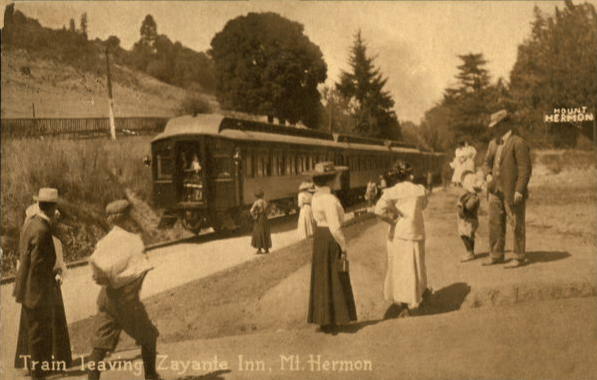
The train station at Zayanta Inn, Mount Hermon, California; 1915.
One hundred years ago, Isabella Alden was a frequent summer visitor at Mount Hermon. She and her husband Ross moved to the Santa Clara area in 1901. When Mount Hermon opened four years later, they were overjoyed to have a nearby place of rest and retreat similar to their beloved Chautauqua Institution.
The Lake at Mount Hermon, 1913.
Isabella Alden loved Mount Hermon, and she had many happy memories connected with it. She wrote:
I wish I could give you a picture of Mount Hermon, a blessed place where I have spent precious weeks living out under the great redwood trees. It was wild and quaint and beautiful.
Bean Creek at Mount Hermon, 1910.
As she had in the old Chautauqua days, Isabella spent as much time in the out of doors as possible at Mount Hermon:
Tent life seemed to belong to it as much as houses belong in most other places. We ate out of doors, and worked out of doors, and practically slept out of doors, with all the curtains of the tent looped high.
Giant California Sequoias.
Nestled among the mammoth California redwoods of Mount Hermon, Isabella rested, read and worshipped.
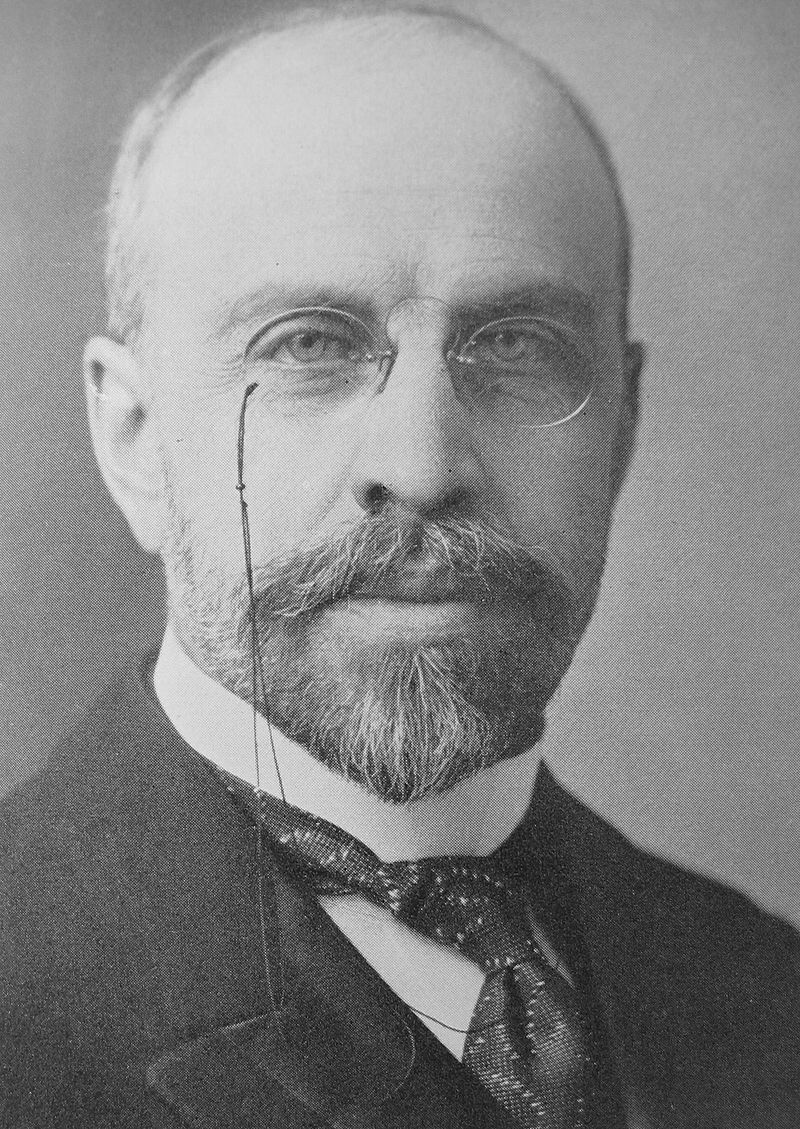
Reverend James Gray, D.D., 1910.
Her spirit was fed by some of the world’s most prominent theologians who spoke at the camp: Dr. James Gray, dean of the Moody Bible Institute; evangelist Reuben Archer Torrey; and Reverend A. B. Pritchard of Los Angeles.
Reverend R. A. Torrey, 1907.
Reverend A. B. Pritchard, 1903.
Isabella reveled in Mount Hermon’s program of Bible study. She immersed herself in classes about the Second Coming of Christ, and the Pentecost. She spent a week studying Colossians, and said afterward that she felt “as though I had a new Bible.”
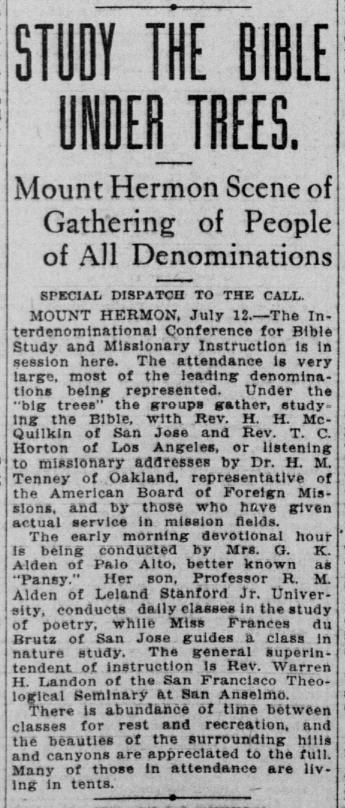
An inviting announcement in the San Francisco Call, July 13, 1906.
Amid all the conference meetings, presentations, and Bible studies, she found time for her own writing.
I had a little retreat where I used to take refuge when I wanted quiet for writing or study. It was the burned-out stump of a sequoia tree. The space left was forty feet in diameter with a wall of stump all around. New branches had formed and had climbed till they reached away up toward the sky, and interlaced overhead to form a room of green. The sequoia leaves are odorous and make a lovely soothing atmosphere in which to rest.
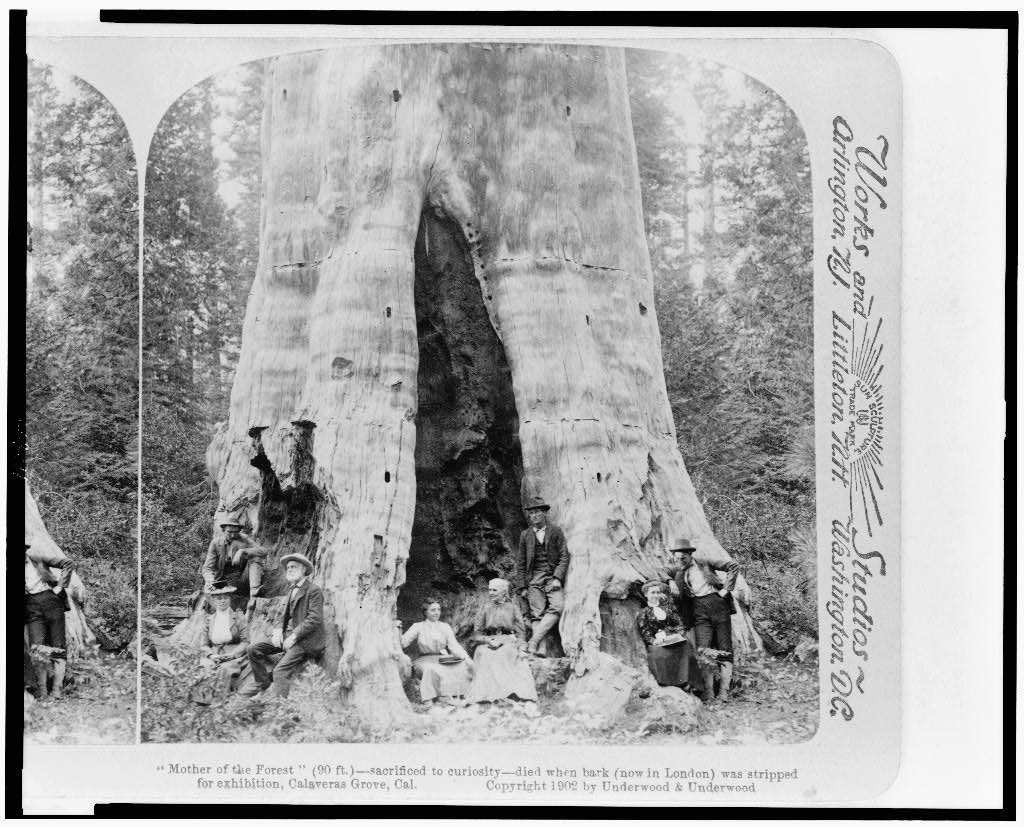
Giant Sequoia in nearby Calaveras Grove, California; 1902.
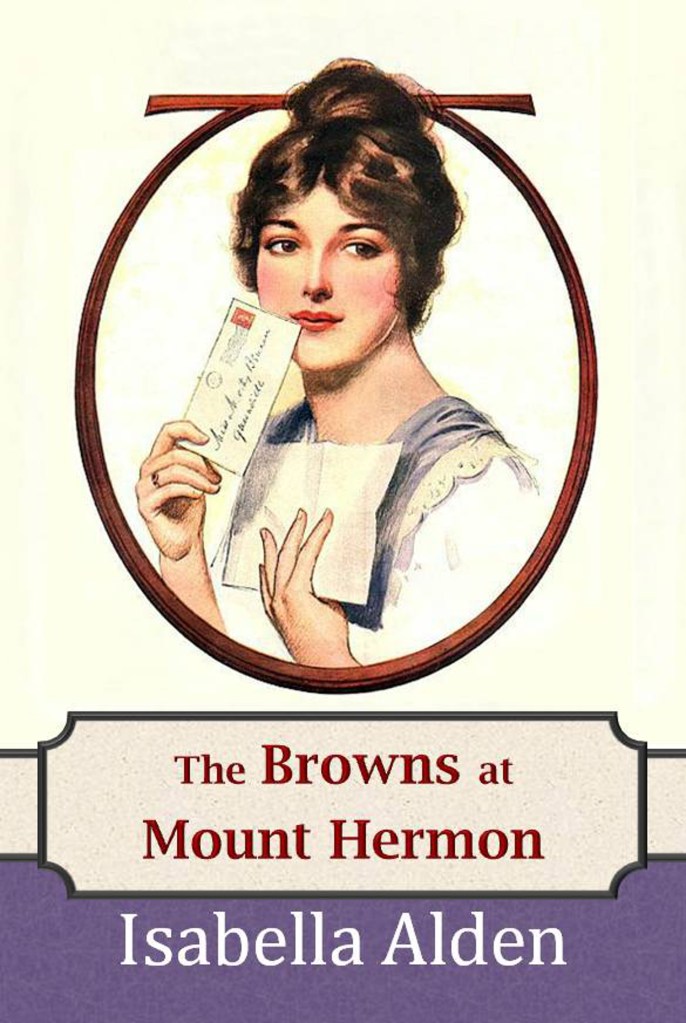
It was in this atmosphere that Isabella was inspired to write The Browns at Mount Hermon, which was published in 1907; and her experience at Mount Hermon even inspired her novel’s premise. During one specific summer, over 60 people with the surname Brown attended Mount Hermon; Isabella used that bit of trivia as the catalyst for a merry mix-up of people named Brown in her novel.
Isabella cherished every lesson and every sermon she heard at Mount Hermon. Each summer for the remainder of her life—health permitting—she made the short trip to Mount Hermon, the beautiful place of worship and rest nestled in the mountains of Santa Clara.
Did you know Mount Hermon is still an active Christian camp and retreat? Find out more about Mountain Hermon by visiting their web site:
Reviews and giveaways for Christian fiction and sweet, clean fiction. Bringing readers information on great stories and connecting authors with their readers.


























































 Isabella Alden