One of Isabella’s great talents (out of many!) was her ability to state Christian truths simply and meaningfully. You can find examples of this in all her writings, from stories and Sunday school lessons, to daily Bible studies.
This “quotable” comes from her Daily Thoughts for June, a monthly column she wrote for The Pansy magazine:
You can find more of Isabella’s words of wisdom like the one above, which you can print and share. Just enter “quotables” in the search box on the right to see more.
For many years Isabella served as an editor and contributor to a Christian magazine in which she had a very popular advice column. She used the column to answer readers’ concerns—from a Christian perspective—on a variety of topics.
This letter came from a teen in Kansas:
I want to ask if there is any way to overcome being painfully bashful. I am really a sufferer with this disease. I get good marks in school when the work is largely in writing, but as sure as I am called upon to talk, I am scared out of my wits.
In Voice Culture class it is the same. I am said to have a fine voice and my teachers say my “scares” are all that keep me back. I am always swallowing at the wrong place. I have been so humiliated by this drawback that there are times when I think I would like to run away where no one who knows me would ever see me again.
My dear mother is planning to have me go to college, and I know I shall fail on account of timidity; that is the only drawback, for I like to study.
Kansas.
Here is Isabella’s Reply:
Yours is by no means an uncommon affliction, dear friend. Indeed, it sometimes seems as though the world of young people was made up of two classes: those who have no timidity about anything and rush in where thoughtful persons hesitate, and those who, as the letters quoted from express it, are “painfully bashful.”
Before the remedy can be applied with any degree of success, the cause of the disease must be determined; and at the risk of having some of the afflicted start back in protesting dismay, I am going to diagnose it as pride, overweening self-esteem, egotism, any of the words by which we define undue self-consciousness.
I know that to some it will sound like a contradiction to say that a timid person has too much self-esteem, yet I believe that in nine cases of “bashfulness” out of ten, this will be found to be the case. The remedy, therefore, suggests itself. Anything that will help us to forget ourselves entirely will go far toward removing the trouble: and there is really nothing else that is likely to do much good.
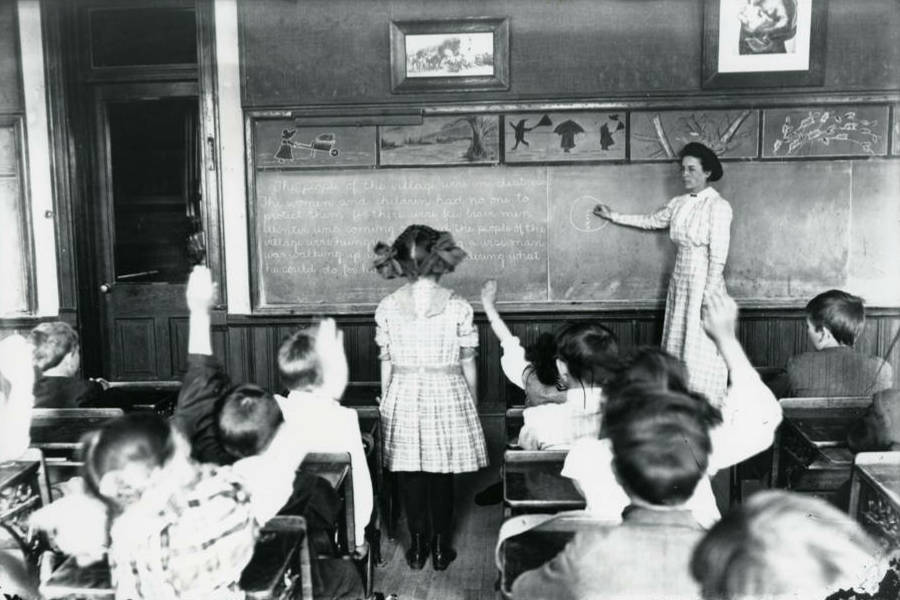
A student recites in history class. (Credit: Keystone-Mast Collection, UCR/California Museum of Photography, University of California at Riverside.
In a school recitation, if we have made such close and careful preparation that the subject has got hold of us and we are filled with admiration (or indignation, or curiosity) over the thoughts expressed by the author we study, it will be those thoughts and not ourselves that we will think about when we recite.
In Voice Culture this is harder, because the inane syllables on which the pupil is compelled to practice afford no chance for thought; but as soon as one is allowed to sing words—if they are worth singing—the performer can train himself to be absorbed in the thought they express, and in the wonder that the human voice has power to render varying feeling and emotion; and in curiosity to see what range of expression he has himself, until he forgets entirely to wonder, or to fear, what other people think of his performance, and becomes an artist, lost in his art. Such a singer will not be troubled with timidity. Ordinary singers can train toward this height, and overcome self by degrees.
In social life the ideal way to overcome the form of self-consciousness that expresses itself in timidity, is to fix one’s attention on some other person, a stranger perhaps, or one not accustomed to society, who, for these or other reasons, is not having a good time; and resolve that he or she shall have a pleasant evening. The reflex result will astonish those who try it for the first time.
I knew a timid, shrinking girl, given to fancying herself awkward or stupid or conspicuous in some unpleasant way, who was one evening roused to sympathy for a young woman not so well dressed as the others, and evidently painfully aware of it. In struggling to make that one forget her too short dress and gloveless hands and other defects of costume and have a good time in spite of them, she forgot all about herself.
Here is what she told her mother on reaching home.
“We had a lovely time, mamma; and Miss Haven says I sang better than she ever heard me; that my voice didn’t tremble a bit. And don’t you believe I forgot all about being scared! I asked that Bennett girl to take the alto, and I was so interested in having her do well that I never once thought of how I was singing!”
All of which goes to prove that the old, old rule which, being freely translated is: ”Think always of others and never mind about yourself.” It’s a good one to apply to the great, and the trivial acts of our lives. Once, a girl told me that she thought it would be irreverent to try to imagine what the Lord Jesus Christ thought of her when she stood up in class, or whether he was pleased with her work.
Do you know, I want no such Savior as that girl must have thought she had? I want one who knows our infirmities, “was tempted in all points” as we are, who is interested in the very hairs of our heads, and in the minutest trivialities of our daily lives. Suppose we thought much more about what he is thinking of us than we do? Would it help?
Pansy.
What do you think of Isabella’s advice to the teen in Kansas?
For Isabella, springtime in California was a season of cheer and beauty. She and Reverend Alden moved to Palo Alto, California in 1901. With their grown son Raymond and his wife Barbara, they built a beautiful duplex home for the entire family not far from Stanford University where Raymond taught English Literature. (Read more about their house here.)
Isabella’s home in Palo Alto, California. She and her husband lived in one side of the duplex; her son Raymond and his family lived in the other.
One of Isabella’s best memories was sitting on the porch of her Palo Alto house and seeing the variety of roses growing in her yard.
Red, cream, salmon, pure white, and every shade of pink. Hundreds and hundreds and hundreds of them! The world [seemed] made of roses!
In fact, Palo Alto’s relaxed atmosphere must have seemed like the perfect place for a retired couple like Isabella and her husband. She wrote:
For the most part our university town works late at night and sleeps late in the morning.
Isabella quickly adapted to doing things on “Palo Alto time.” So it was that in the early morning hours of Wednesday, April 18, 1906, Isabella was still in bed. Her husband was away, staying with his sister Beulah in the Midwest, and gaining some much-needed rest after an illness. Her son Raymond and his wife Barbara, along with their five-month-old son Donald (Isabella’s first grandchild) were sleeping next door in their half of the duplex.
Then, at 5:12 a.m. without warning:
A strange rumbling noise like unto no other noise this old earth can make, broke upon our slumbers and startled us into bewilderment. The noise was accompanied by a strong swaying motion, the frightening sound of the timbers and walls of her house creaking and tinkling like breaking glass, and the “thud, thud, thud” of heavy pieces of furniture falling.
Isabella was experiencing an earthquake!
Fallen columns and debris clog the road in front of City Hall, San Francisco, California
She wrote:
We found ourselves in our beds, skidding across the rooms, now this way, now that, in the most erratic and bewildering fashion.
The earthquake lasted only forty-five seconds, but for Isabella it seemed much longer; and when she was able to gather her wits, her first thought was for her family.
When the house finally stopped swaying and she could get out of bed, she met Raymond, Barbara and the baby in the common hall that separated the two dwellings. That’s when she began to understand the force of the earthquake.
Our hall and stair landing was lined with bookcases which were prostrate, the books scattered everywhere!
Every hour, every minute, brought a fresh discovery of ruin and dismay. … Milk pans overturned and broken glass jars swimming about in rivers of fruit juice.
Isabella made some odd damage discoveries, too: On a high shelf several cut-glass pieces—vases and bowl and pitchers—had all crashed down to the floor, rolling about the room in confusion, and yet only two of them broke!
Yet down in my preserve closet nearly every jar was smashed and the luscious juices mingled with the broken glass in a menacing and heart-breaking sight after all our hard work of putting up that fruit!
While the Aldens were assessing the damage in their own home, awful news reached them from nearby Stanford University, where Raymond taught.
The library at Palo Alto University destroyed.
The university library was destroyed. Even worse, a memorial chapel—which Isabella described as “the wonder and admiration of all the world”—had collapsed, killing two people.
The interior of the Memorial Chapel at Stanford in ruins.
Then they began to hear terrible rumors of the damage in San Francisco, just thirty miles away—news of burning buildings, and no water to douse the flames. Everywhere electricity was out, as was all communications. Buckled roads made even walking dangerous.
Fire and smoke in San Francisco after the earthquake struck on April 18, 1906.
Frightening aftershocks trembled the ground throughout the day. Isabella wrote:
Seven times during that unforgettable day were those ominous sounds and throbs repeated, enough to warn us that the earth was not at rest, and that at any moment the experiences of the morning might be renewed.
By evening Isabella and her neighbors had to make do with what they could salvage from their damaged homes. She, like many others, was afraid of going back into a house that might collapse at any moment.
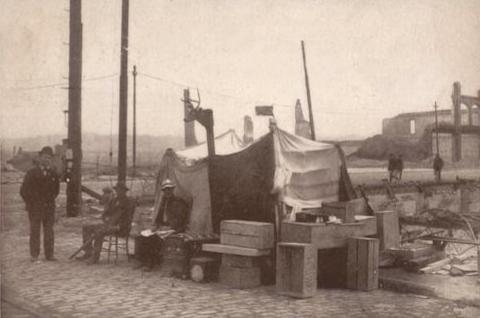
Refugees’ make-shift home after the earthquake.
She wrote:
Tents made of all sorts of strange material rose in yards and vacant lots; and mattresses, couches, easy chairs, cots, cushions, anything that would afford a chance for a little rest, were carried into any open spaces that could be found.
A refugee camp with the ruins of San Francisco in the background.
At his sister’s house in Minnesota, Reverend Alden learned of the earthquake and was anxious for news of his family. It took four days for Isabella to get word to him that everyone was safe, and two more days for him to finally purchase a ticket for a train heading west toward California.
Meanwhile, residents of San Francisco and surrounding communities quickly realized that with no communication lines and few railroad tracks left undamaged, they were virtually cut off from the rest of the world. City leaders and everyday residents stepped forward to begin organizing relief efforts in their neighborhoods.
Men manually clearing the debris near Market Street, San Francisco
They established committees to render first aid, clear debris, and restore clean water supplies. They pooled resources to care or the homeless, the hungry, and the wounded.
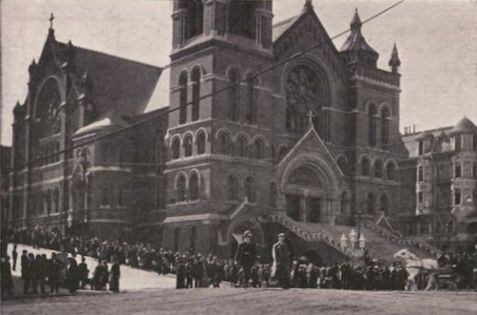
A bread line at St Mary’s Cathedral, the only San Francisco church not destroyed on April 18, 1906.]
Nearby states sent physicians, nurses, and supplies by train; and when the trains were forced to stop because of damaged tracks, residents went out to meet them with cars, wagons, and any other vehicles that could convey the helpers to where they were needed most.
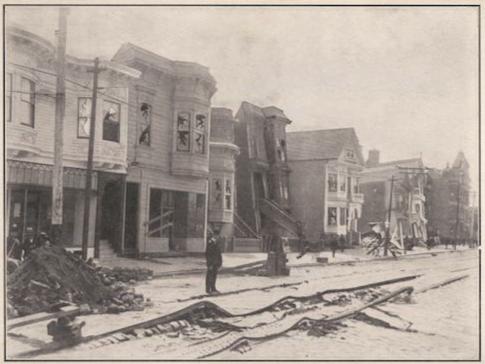
The damage on Howard Street, with broken windows, houses pushed off their foundations, and buckled roads.
Residents whose homes were spared took in strangers. Others ministered to the people fleeing San Francisco’s devastating fires. They set up stations along roads and handed out sandwiches, pillows, coffee, bundles of clothes, and blankets—anything they could think of to help the people who were suddenly homeless.
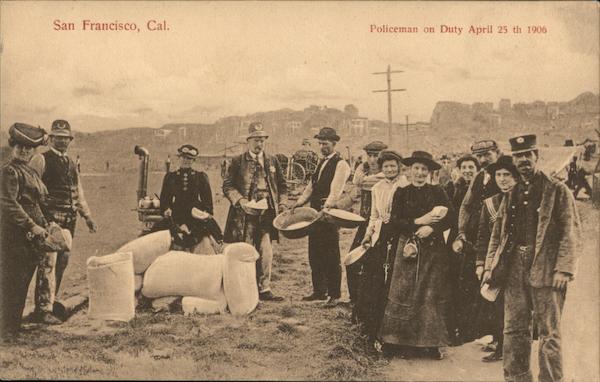
Policemen help distribute flour to refugees.
Isabella said that “almost hourly” she heard such stories, full of “thoughtful alertness and quiet endeavor.” More than anything else, those stories of goodness and kindness were what she most remembered about the earthquake many years later. She wrote:
When we had a chance to draw a long breath and look about us, out of all the peril and pain of the hour, certain facts stood out in glowing lines. God is good and in the creatures of His hand there is a touch of God-likeness.
Isabella and her family survived the earthquake, as did their lovely home. Years later, when she was writing her memoirs and the time came to recount the events of April 18, 1906 and the weeks and months that followed, she said:
Oh, there is no use trying to forget the earthquake. And yet—I would rather talk about the roses.
As Mr. Landis said in Isabella’s novel Unto the End:
“Any change is better than eternal sameness.”
In our world, technology is constantly changing, and Isabella’s website is keeping up with the times!
You’ll soon see new layouts and features so Isabella’s website can be viewed more easily on different devices.
That means the overall look of the website will change. For example, a plain white background will replace the polka-dot pattern you see now. Fonts and colors will change, too, so they’ll be more accessible for people who are visually impaired. Here’s a little preview of how things will look:
The next blog post you read on Wednesday, April 14 will be in the new format! We hope you’ll like it; and if you ever have a suggestion for changes you’d like to see, please leave a comment on any post or page.
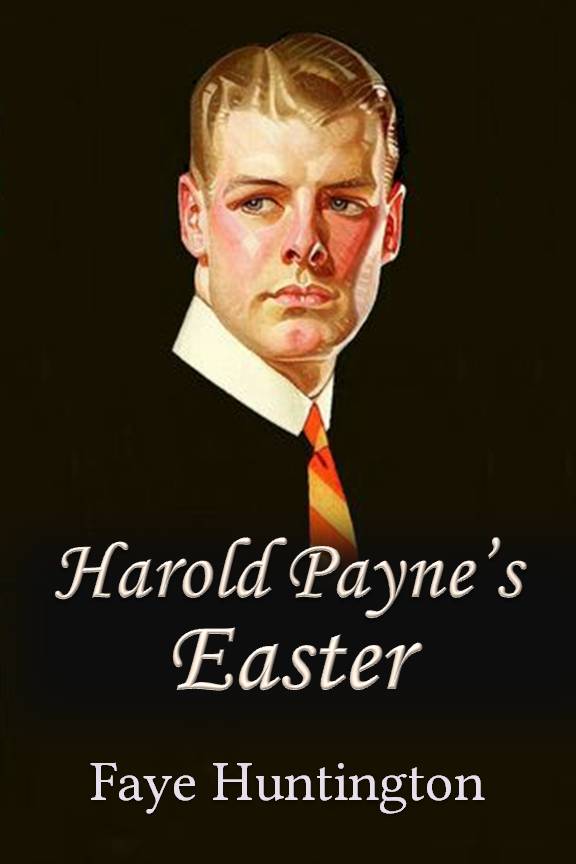
Isabella’s friend Theodosia Toll Foster was widely published as a novelist and short-story writer. Under the pen name “Faye Huntington” she wrote for the sole purpose of winning souls for Christ. Her story, “Harold Payne’s Easter” was published in the April 1909 issue of a Christian magazine.
Easy-going, self-indulgent Harold Payne never took church or anything else in life too seriously. But one day, while day-dreaming his way through a sermon, something the minister said caught his attention: “May our religion put the stamp of Christ upon the things we do.”
For some reason, those words broke through Harold’s indifference and stuck in his thoughts—and left him with the realization he had, at most, only made a faint impression of Christ’s stamp upon the world. Was it too late for Harold to change his ways?
Isabella was surrounded by writers. Her sister, niece, son, and friends all wrote stories, articles and lessons for publication.
Her husband, the Reverend Gustavus Rossenberg Alden—“Ross” for short—was no exception. In addition to writing his Sunday sermons, he wrote many short stories for The Pansy magazine, authored a memoir of stories about his boyhood while growing up in Maine, and (with his brother-in-law Charles Livingston) wrote a series of weekly Bible study lessons.
Ross was also an accomplished poet. He created lovely rhymes about a wide variety of subjects.
Here’s Ross’s poem “April” to help us welcome a new month:
APRIL
O Spring is coming now, don’t you see?
The birds will be followed by the humble bee.
The frogs are singing their evening song,
The lambs are skipping with their dams along,
The buds are out on the pussy-willow tree,
On the bough of the birch sings the chickadee.
The cows come lowing along the lane,
With suppers all ready for us again.
Old Speckle scratches for her chickens ten,
New piggies are squealing in their pen,
From the top of the tree the robin calls,
From the top of the dam the water falls,
And everything to the eye or ear,
Tells to old and young that April is here.
It’s Spring! With the change of season comes certain rituals, like going to our closets to see how we can incorporate the latest styles and fashion trends into our wardrobes.
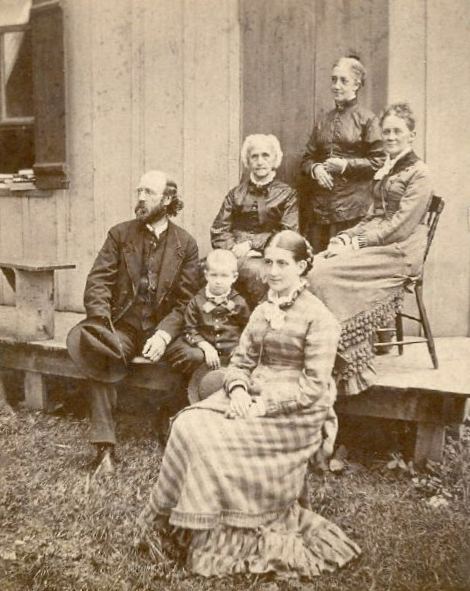
Isabella Alden lived to be eighty years old, and in her lifetime she saw many Spring fashion trends come and go. One of the earliest photographs of Isabella was taken about 1877 when she was 36 years old.
The Aldens and Macdonalds at Chautauqua in about 1877. Left to right: Gustavus “Ross” Alden (Isabella’s husband), Raymond Macdonald Alden (Isabella’s son), Myra Spafford (Isabella’s mother), Isabella Macdonald Alden, Julia Macdonald (Isabella’s sister), and an unidentified woman.
That’s Isabella sitting in the foreground of the photo, along with her husband, the Reverend Gustavus “Ross” Alden” and their son Raymond. The photo was taken in front of the Alden’s first cottage at Chautauqua Institution.
Isabella’s dress, with its lacy collar, long sleeves, and modest train, was very much in keeping with the style of the day.
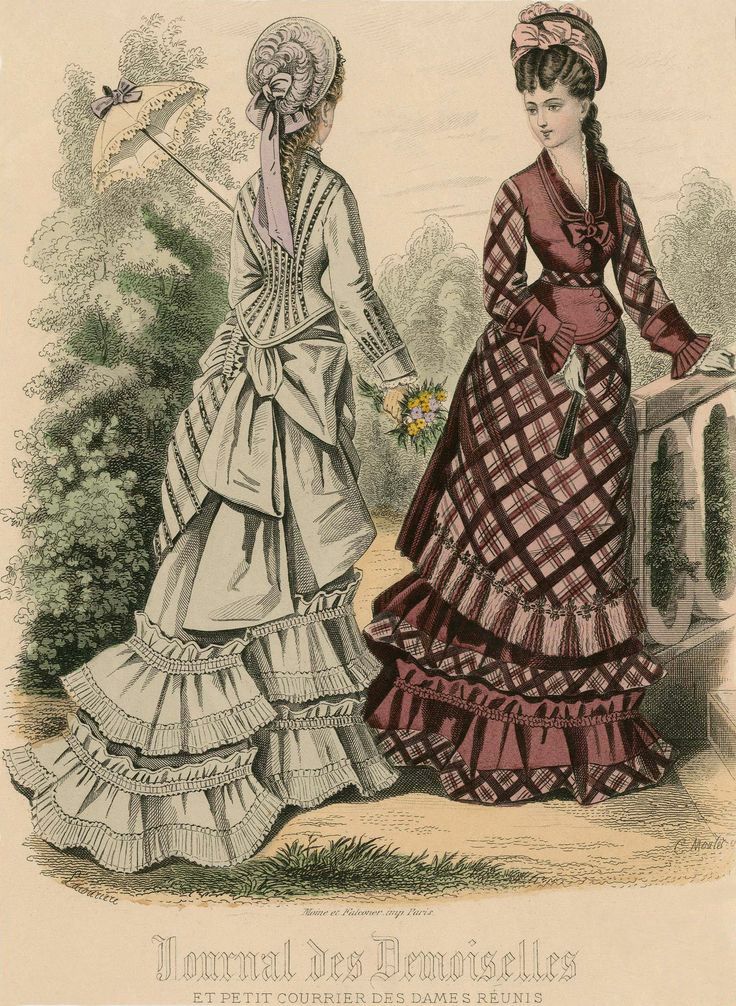
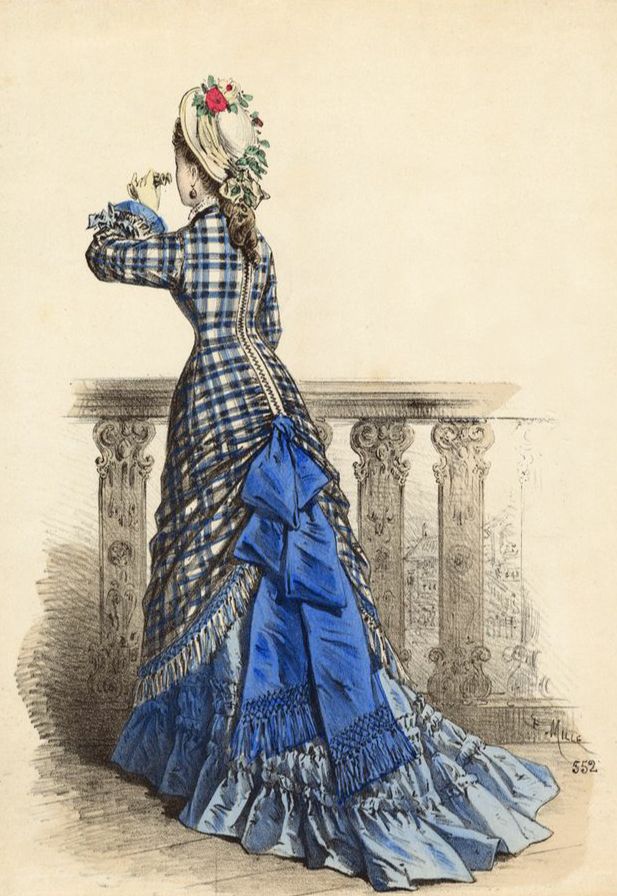
Her choice of a plaid fabric for her gown indicates Isabella kept up with current styles, such as the plaid gown in the 1875 fashion plate above, or the plate dated 1877 below:
By 1891 women’s fashions began to change dramatically. Skirts took on slimmer silhouettes, and sleeves went the opposite direction—instead of slim and fitted, they were gathered to form puffs at the shoulders before tapering to fitted cuffs like these:
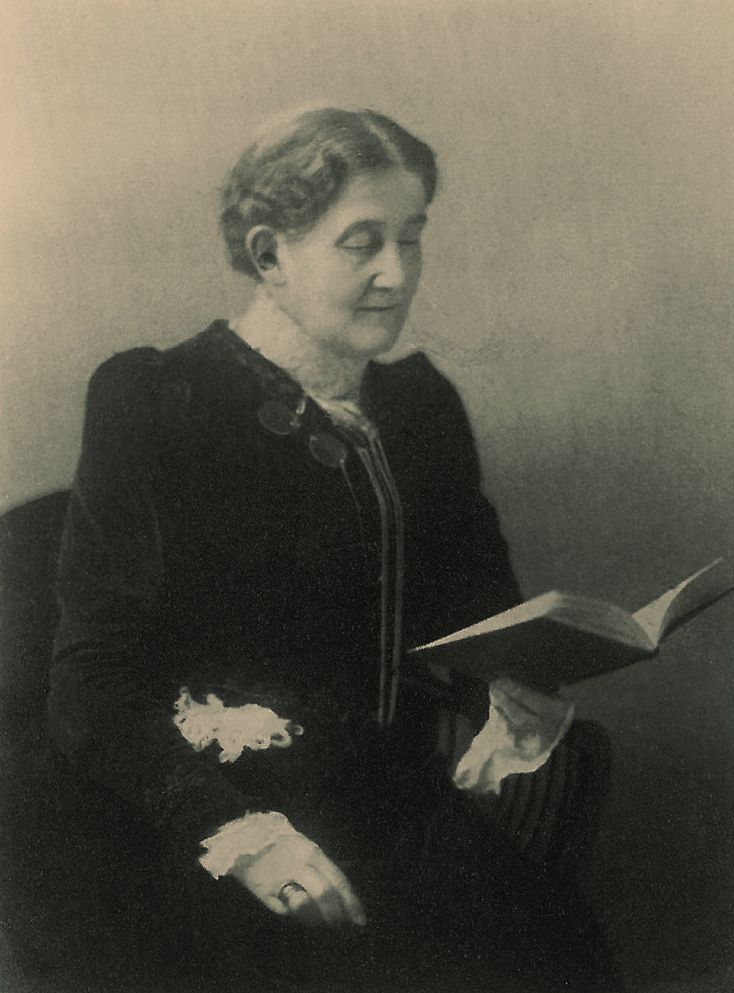
Once again, Isabella’s attire reflected those fashion trends. In the photo below, taken about 1895 when she was in her fifties, Isabella is wearing a dark, solid-color gown, with a standing lace collar and sleeves that gathered at the shoulders.
In keeping with the clothing construction of the time, Isabella’s gowns would have been either a single, one-piece garment consisting of a bodice, sleeves and skirt; or her gowns might have been made up of two pieces, consisting of a bodice—sometimes called a waist—and a skirt; both pieces were typically made from matching fabric and styled so they appeared, when worn together, to be a single garment.
But in the late 1890s an entirely new innovation hit women’s fashion: The shirtwaist.
Today we’d call it a blouse, but in the late 1890s, shirtwaists revolutionized the way women dressed. Shirtwaists buttoned down the front or back and were constructed of lightweight fabrics such as silk, cotton, or linen for summer; flannel and wool for winter.
More importantly, shirtwaists instantly gave women many more clothing options. They were suitable to be worn with tailored suits, or with a simple skirt for housework or playing sports. Dressier versions were suitable for afternoon receptions, going to the theater or evening wear.
Styles varied, too; from impeccably tailored shirtwaists, like this one:
To highly decorated styles with lace, embroidery or pleats.
Isabella readily adopted the new fashion. This publicity photo, taken in 1900 when she was about fifty-nine years old, shows her wearing a very feminine shirtwaist with ruffled collar, pleats, and lace:
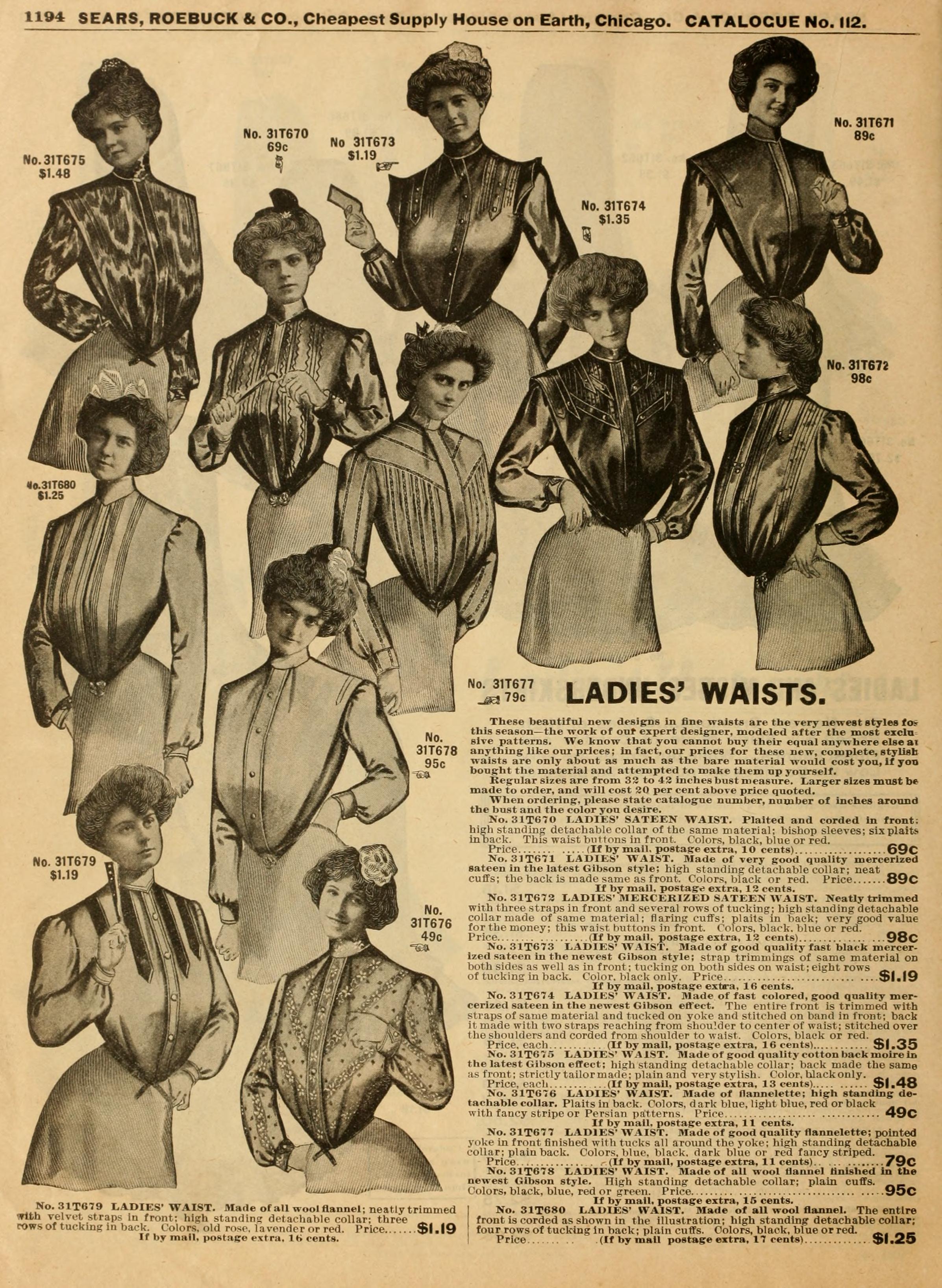
Shirtwaists were versatile and affordable. The Sears catalog of 1902 offered ladies’ shirtwaists starting at sixty-nine cents, which is equivalent to about $20.50 today.
With those kinds of prices, it was easy for women to enlarge their wardrobes simply by alternating different shirtwaists with their skirts and suits.
By 1905 shirtwaists were firmly entrenched as must-have garments for every woman’s wardrobe. Their production helped launch the ready-to-wear industry that we know today.
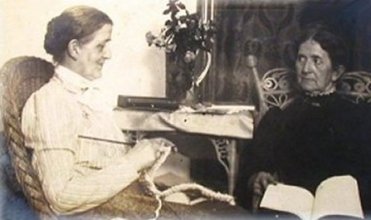
Isabella, on the left wearing a shirtwaist and skirt, with her sister, Marcia Livingston.
During her lifetime, Isabella embraced innovation, from gadgets (such as typewriters and telephones) to automobiles and women’s suffrage. And while she knew that, as a minister’s wife, she had to set an example for the manner in which Christian women should dress, she still seemed to keep up with the times when it came to fashion.
For many years Isabella served as an editor and contributor to a Christian magazine in which she had a very popular advice column. She used the column to answer readers’ concerns—from a Christian perspective—on a variety of topics.
This letter came from a teen named Betsy:
Do you think there is any harm in girls of, say, fifteen to seventeen or eighteen, giving parties and inviting their boy friends? Some people seem to think so; what do you think?
I wish you would name a list of books for girl to read. Father doesn’t like me to read “Little Women” and such stories, and I’m sure I don’t know what is good if they are not.
Betsy.
Here is Isabella’s reply:
About the parties, Betsy, they belong to the class that the logicians call an “open question.” There are parties, and “parties.” A girl of fifteen, or sixteen, or seventeen, whose mother heartily approves the plan and joins with her daughter in making ready and in preparing the list of invitations—giving careful consideration to the names of the boys— and whose father and mother are to act as host and hostess, may safely give a party such as all her friends will approve and enjoy. In short, a party thoroughly mothered and fathered is, as a rule, a safe and pleasant place for young people to gather occasionally.
Note the use of that word “occasionally.” Even under the most favorable circumstances, with fathers and mothers as wise as serpents, parties are like rich cake; as an occasional luxury it is delicious and comparatively harmless; but used as a steady diet, interfering with substantial food, the normal appetite soon turns from it with dislike; and for the abnormal one, it works mischief.
Do you know, Betsy, I don’t more than half believe in the party that your question is planning. I more than half believe that either mother or father, or both, have been trying to convince you that you have not time, or, perhaps, strength, for such functions; perhaps, that there have already been too many parties in your circle this season; perhaps, that they cannot afford to indulge you in this matter; perhaps, that some of the boys, and even, possibly, certain of the girls, whom you wish to invite, are not such as they like to welcome as your friends; and you have not been convinced by them; hence your question.
If I am wrong in reading between the lines of your letter, forgive me; I may be wrongly judging you by others. I know such girls; indeed, I am answering their letters at this moment. through yours. I want to say to them that nothing is safer in this world than for girls of sixteen or seventeen, or any age that marks them as girls, to be guided by the judgment, by the fears, by the notions, even, of good mothers and fathers; and that just as surely as they break away from such advice and guidance, whether in the matter of parties or anything else, just as surely the day is coming when they will regret it. I am an old woman, and I am saying what I know is true. I have seen it bitterly regretted when it was too late.
About books. Lists, when they come from strangers, are doubtful helps. Personal tastes and acquirements, as well as the environment of the readers, must be taken into consideration to make them helpful.
I do not know your father’s reason for objecting to Little Women, but my personal objection to that and other volumes by the same gifted author is that, while charmingly written, they present views of life that are fascinating and false. Many of the characters described live beautifully, unselfishly, sacrificially, not for the sake of love, but for the sake of duty; and they do it steadily, climbing to the heights of self-abnegation, growing day by day in all the graces of the Christian religion, but they do it without a Savior. Jesus Christ is to them a friend, a guide, a beautiful pattern, but never a Redeemer. Such living is impossible. For this reason I deplore the charms of that class of books.
Betsy, dear, why not get that good father of yours to make a list of books that he would like you to read? I’m nearly certain that he would do it if you asked him, and equally certain that he would be gratified at the request.
When you get your list, let me beg you to begin at the beginning and read the books through carefully, conscientiously; not skimming a page, not skipping a line; even though they be as dry as chips baked in a summer’s sun and you fall asleep over them a dozen times. If he is the father that I think he is, I can predict the result with the certainty of a prophet.
I can even imagine a typical scene; a day when you will stand with one of the time-worn volumes in your hand, a dreamy look on your face, a tenderness in your voice, and an undertone of pathos, as you say:
I can never be grateful enough to my dear father for persuading me when I was a girl of sixteen to read this old book, and the others that were on the list he gave me. Some of them have had an abiding influence over my life. I truly believe that my taste for real literature of the best kind began to be formed while I was struggling through this first volume, for father’s sake. Dear father! He did a great deal more for me than he knew.
Believe me, Betsy, now is the time to plant seeds that may bloom, some day, over father’s grave. It will be blessed for you if you do such gardening now that if, in the faraway future, you stand one day beside the resting places of father and mother, there will be flowers of memory in your heart, instead of that thorny plant: “Oh, I wish I hadn’t!”
It’s that time of year again, when Americans turn their clocks forward one hour.
The original Daylight Savings law was first enacted in the United States in 1918 when Isabella was 77 years old. In the years before it became law, proponents of the bill had to sell the idea to the American public. For years lawmakers and lobbyists ran ads and articles in newspapers and magazines to tell Americans how good life could be if they just turned their clocks ahead one hour.
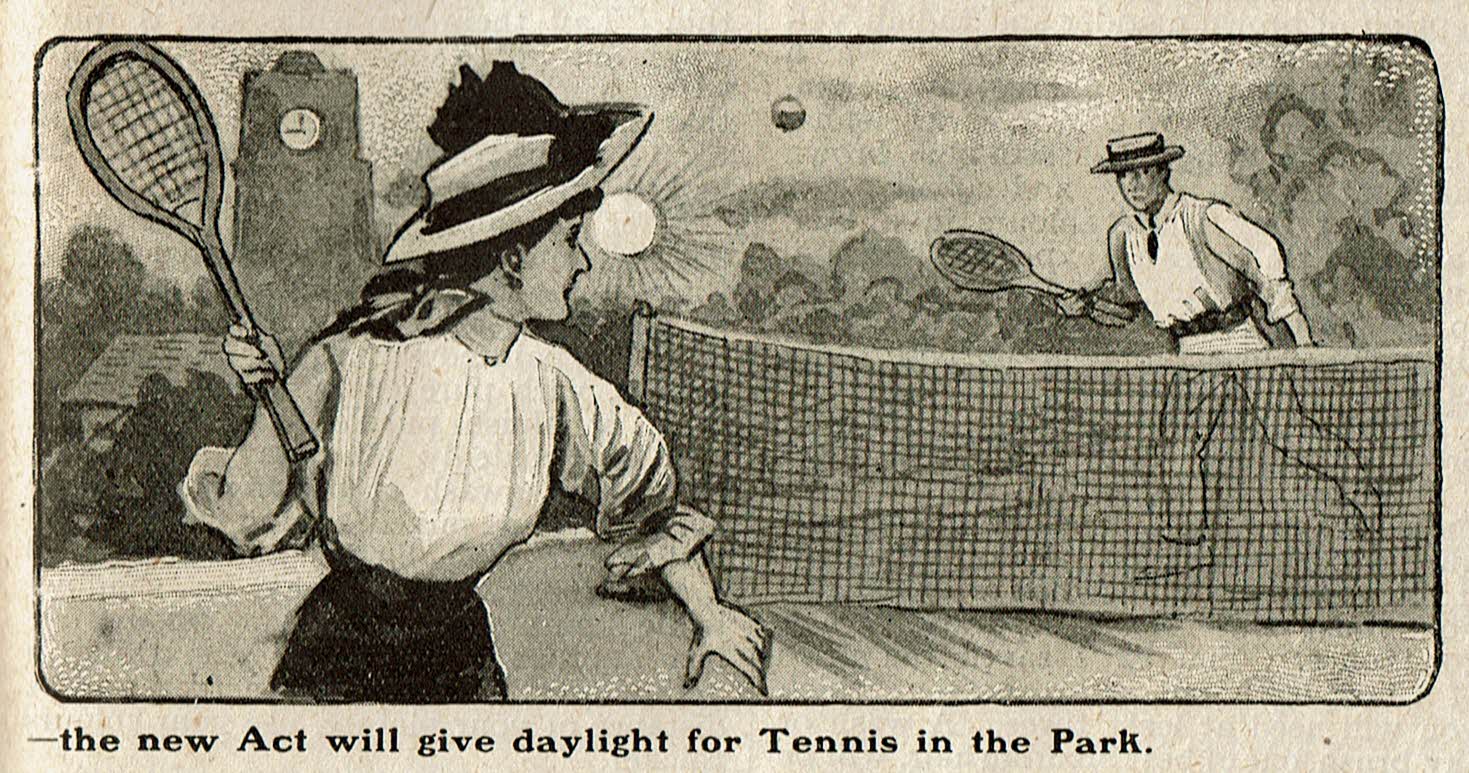
Sometimes the ads highlighted how a longer day would benefit the simple things in life:
Often when I get my evening paper it is too dark to read, but—
—the new Act will give daylight for Tennis in the Park.
Backers of the bill encouraged average Americans to “think of evening walks in the park, or games out of doors, instead of being indoors, with only gas or electric light.”
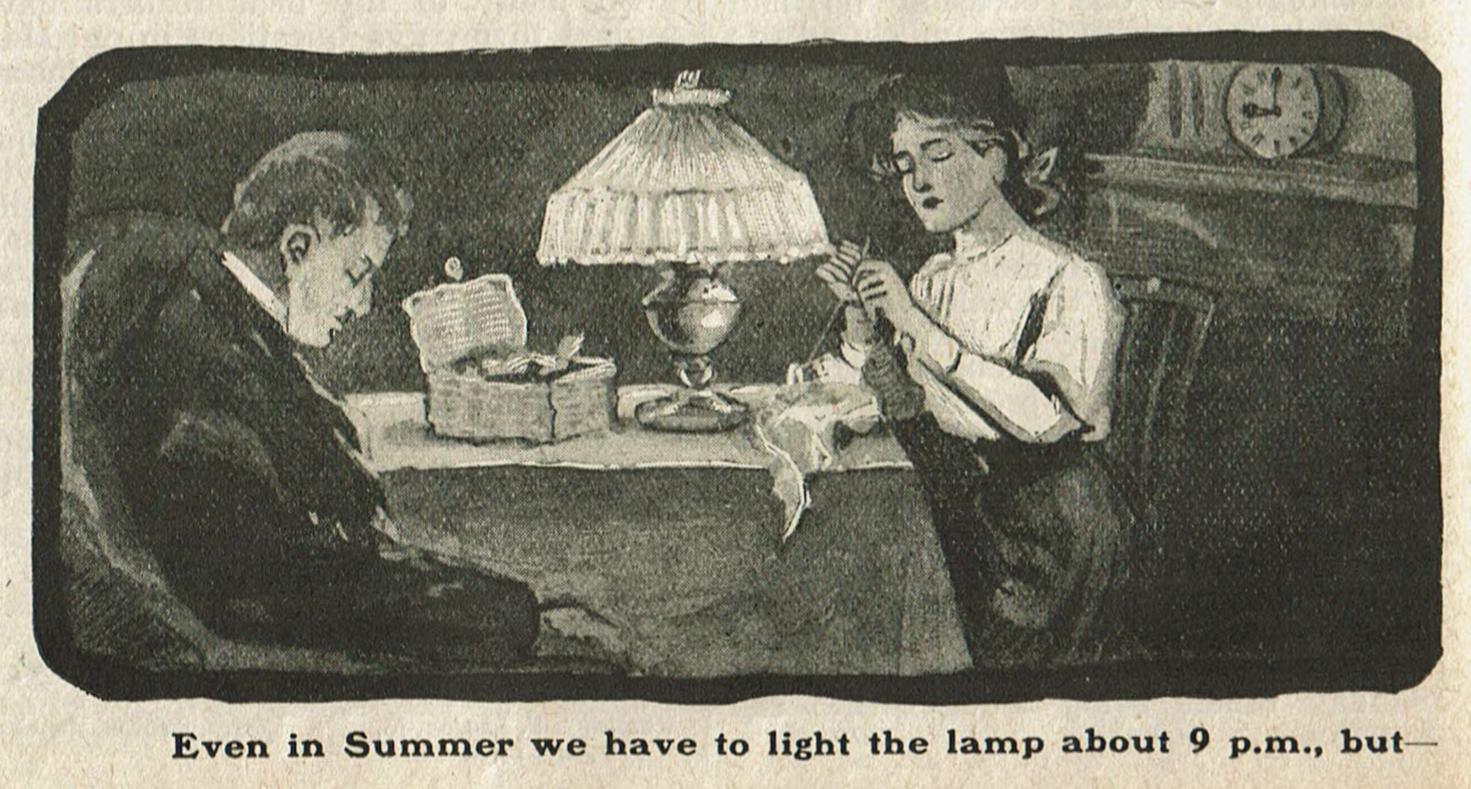
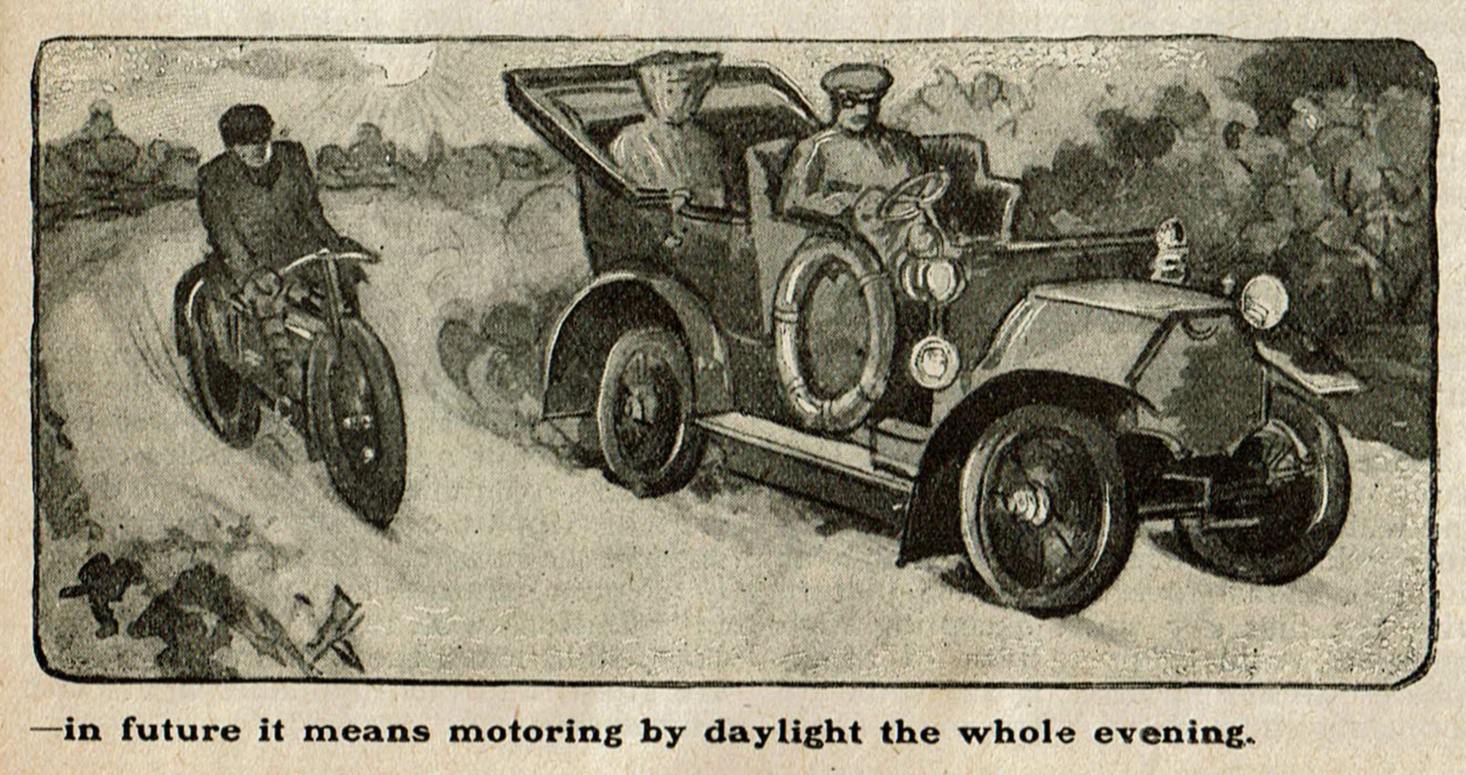
Even in Summer we have to light the lamp about 9 p.m., but—
—in future it means motoring by daylight the whole evening.
The scientific community liked the idea, too, and pointed out the advantages one additional hour of recreation would have on school children, and the effect it would have “in the preservation of eyesight.”
All the ads and arguments worked; Congress enacted the Daylight Saving Time law on March 9, 1918, and Americans have been arguing about it ever since!
Do you like Daylight Savings Time? What do you do with your extra hours of sunshine?
Don’t forget to turn your clocks ahead on Sunday, March 14!
Isabella often wrote stories that illustrated the far-reaching effects a single act of kindness can have on a person, a family, or a community. This month’s free read is a short story titled “Their Day at the Beach,” and it fits Isabella’s “kindness” theme nicely!
Frances Farnham and Sherman Kennedy have been friends since childhood, although careers and Life’s interruptions have kept them apart for years; but that’s about to change. For different reasons, Frances and Sherman will both be in Florida—she for pleasure, he for business. They have a single afternoon to spend together on the beach, to catch up on each other’s news and rekindle their old friendship. But a chance encounter on a train will change their plans—and their lives—forever.
Reviews and giveaways for Christian fiction and sweet, clean fiction. Bringing readers information on great stories and connecting authors with their readers.



























 Isabella Alden