Isabella was born and raised in upstate New York, so she was very familiar with east coast winters.
After she and Reverend Alden married, they served congregations in Pennsylvania, Ohio, New Jersey, and Washington D.C. where winter storms often brought snow, wind, and dangerous ice.
Fortunately, Isabella’s book sales allowed the Alden family to sometimes spend a portion of their winter months in sunny Florida; still, there were times Reverend Alden’s duties kept them in the cold and snowy north instead.
When the good reverend retired in 1910 the Aldens moved to California, where they built their dream house in Palo Alto (click here to read more about their house).
Never again did they have to deal with harsh winters, extreme cold, or deep drifts of snow that had to be cleared from walkways and roads.
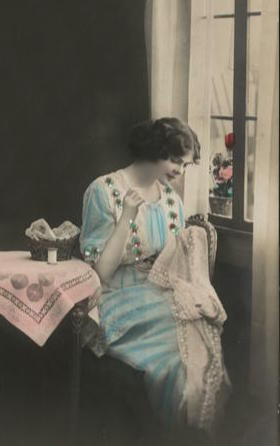
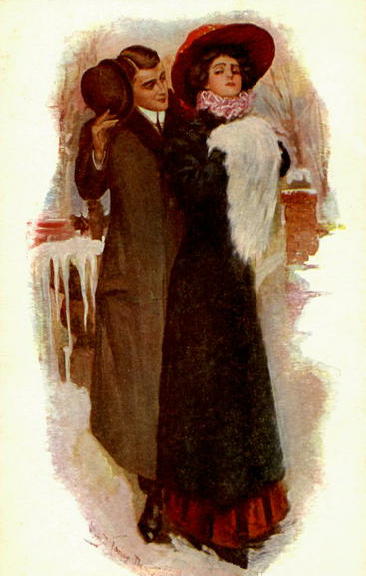
A postcard Isabella might have sent from California.
The Aldens found California winters delightful. Januarys were warm and mild; Februarys boasted average temperatures around 60 degrees. For them, snow banks and ice dams were things of the past.
A 1918 postcard.
In her letters to old friends and relatives in the east, Isabella might have mentioned the perfect weather she enjoyed, free of “fierce storms and slushy spring thaws.”
And when she hadn’t time to write letters, she could send off a quick postcard that made her point for her about California winters.
Sunshine, Fruits, Flowers, and Snow.
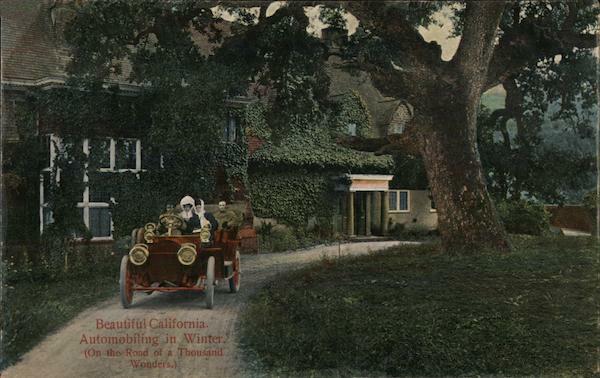
Picture postcards made up a large portion of the California printing industry. They featured color photographs that depicted what it was like to spend a winter in that state.
Beautiful California. Automobiling in Winter, about 1909.
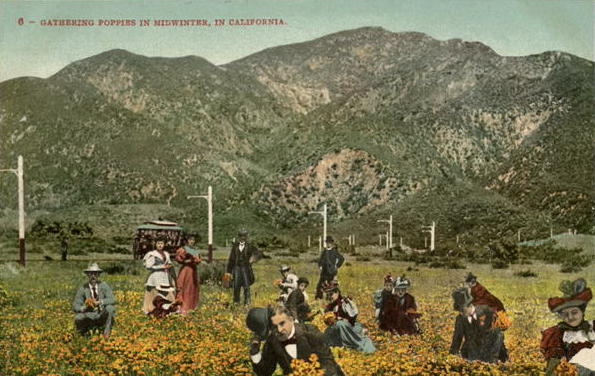
Some postcards featured images of flowers that bloomed in the winter months, like poppies and bougainvillea.
Gathering poppies in midwinter in California.
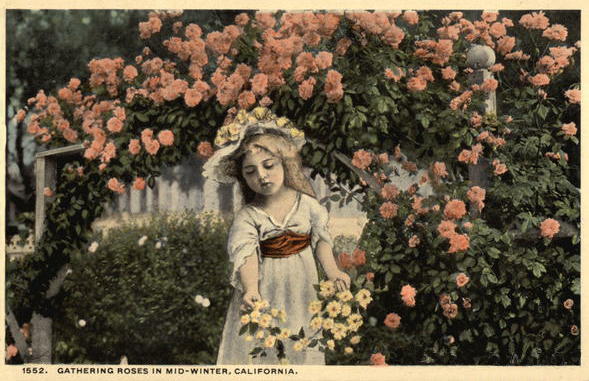
Isabella loved flowers and often marveled over the varieties of roses that bloomed beside her porch in California:
“Red, cream, salmon, pure white, and every shade of pink. Hundreds and hundreds and hundreds of them! The world seems made of roses!”
Gathering Roses in Mid-Winter, California
Other postcards showed people boating on lakes or swimming in the ocean in the middle of winter.
A winter’s day in Westlake Park about 1909.
Each postcard was like a little advertisement for the state of California, teasing and enticing people to come live the good life among the orange groves and poppy fields of the west coast.
Isabella was an ambassador for the state, as well, because California life certainly seemed to agree with her. One day in November she wrote to her niece, Grace Livingston Hill:
“Today is glorious sunshine, and the grass and trees glow in their freshly painted garments of green after the rain of yesterday.”
It sounds like Isabella was very happy in her California home!
For many years Isabella had an advice column in a popular Christian magazine in which she answered readers’ questions—from a Christian perspective—on a variety of topics.
While the commercialization of Christmas seems like a twenty-first century problem, this letter from a young woman shows it was a concern in Isabella’s lifetime, too.
Here is the letter:
I know that it is quite too late—or too early—to talk about Christmas, and yet that is just what I want to talk about, or, rather, I want you to.
Ought not something be done about all this Christmas business to give us a different state of things from that which now exists? Why, I know homes whose happiness is simply wrecked by this mania for giving costly presents that they cannot afford, and giving multitudes of them, at that!
But I need not tell you about these things; you know just how people go on.
What can be done? Ought the custom of exchanging Christmas gifts to be abolished? Won’t you tell us what you think?
—A Grown-up Sister
Here is Isabella’s reply:
I am going to draw from my own observations for my talk about Christmas.
I know a home where are father and mother, four daughters in various stages of growing up, a married son with his wife and baby, and two boys of high-school and grammar-school ages—a large family circle.
There is not a wealthy nor hardly well-to-do member of this household. A good deal of management is required to meet the necessary monthly bills with anything like comfort. Yet they are, as a rule, a cheerful, happy family; busy from morning until night with school duties, household duties, and, on the part of the father and his eldest son, work that requires strength and brain-power.
This family has planned, whenever it is possible for them to do so, to spend three evenings of each week in the home circle, with music and pleasant talk, or with one reading aloud while the others sew, and mend disabled books and toys, and all sorts of things.
Popped corn and taffy, or apples and nuts, are occasional accompaniments of these pleasant evenings, and the cicle is often enlarged by the dropping in of a neighbor; those who have dropped in once, seeming eager to repeat the experience.
Many enjoyable books—not only of the kind that leave a pleasant flavor, but help to strengthen an underlying purpose—have been read aloud in this circle, to the enjoyment of all and the lasting helpfulness of some. These evenings always close with a favorite hymn, the repeating of a choice Bible verse by each one present, and a good-night prayer, led by the father. All things considered, this is as wholesome and delightful a family circle as one could find among our American homes.
That is, until three or four weeks before Christmas. By that time the spirit of unrest steals into this home and gets possession, more or less, of almost every member of the family.
The social evenings are entirely broken up; no one has time for family life. As soon as possible after dinner, the girls retire to their own rooms to struggle with secret preparations.
The mother works rapidly and with nervous glances toward the door, and the quick hiding of something every few minutes, for she has countless interruptions. She frankly declines to be read to, owning herself too busy thinking and planning to listen.
The father, who himself looks over-tired, tries with poor success, after he has skimmed the daily news, to be interested in his paper; and yawns and wishes they could get to bed early, and knows they won’t.
The school boys, their study-hour over, look in, ask for the others, lounge about uneasily for a few minutes, whistle a little, their mother wishing, meantime, that they would go, for one of the “things” she is trying to make is for them; and they do, finally, take themselves elsewhere in search of “something to do.”
The young mother upstairs wrestles with an unusually wakeful and nervous baby, and explains wearily to the tired father that the child has acted all day as though his Christmas plans were going crooked, just as most of hers are. Somehow, even the baby has caught the spirit of Christmas unrest.
Oh, the pity of it, that all this should be because the birthday of the Christ-child draws near!
Still, if the interrupted family gatherings and the pressure of a little extra work were all, these might cheerfully be borne for the sake of the greater good to come. But it is very far from being all. With unrest comes dissatisfaction in various lines.
One of the girls, who is a teacher, and whose duties in the school room press more heavily as the Christmas vacation nears, snatches minutes between times to join the throngs of Christmas shoppers and is jostled and bumped and pushed from counter to counter, and does not find the things she wants, and cannot afford to buy the things she sees, and is, by no means, sure any of the time just what she does want, only that she “must have something!”
The second daughter, who is learning dressmaking and sews in a shop where they have the “Christmas rush” upon them in full force, has no time for shopping, and comes home after hours, ready only for rest, and shuts herself up and tries to sew on her attempts at pretty secrets; and hasn’t the material she needs, and cannot afford to buy it, and stains the ribbon she is struggling over with a few rebellious tears, and wishes that she could ever have anything that she wanted! And “what on earth is she going to give Aunt Melissa, anyway?” That girl has been heard to say that she wishes Christmas did not come but once in twenty years.
I might continue the description, but I am only too sure that there is no need. You are all acquainted with homes where the true spirit of Christmas is all but lost in the pressure of added cares, and responsibilities, and expenses, and disappointments, and longings, and vain struggling, and over-wrought nerves, until there are hours when it becomes a dreaded thing, a nightmare, and ever increasing hopeless burden from which at any cost, some would escape.
Yet it is the anniversary of the coming of the King! The harbinger of peace and good will. Oh, the pity of it!
Now, what was the question? “Ought the custom of exchanging Christmas gifts be abolished?”
Oh, no, no! Abolish a good and beautiful and helpful custom because it has been warped and twisted into ugliness? A thousand times, no!
But it needs reformation. I am deeply interested in this problem, and I could fill this reply with quotes from those who are groaning under the burden. I think I know the remedies, if we could get them applied. If we could persuade all the dear people who have large hearts and many friends, with little time and less money, to begin their Christmas plans on the first, or, at the latest, the second day of the new year the problem would be largely solved.
I read last week in a daily city paper an account of a girl who was highly commended for putting aside a dollar of her earnings each week for a Christmas frolic. She said that when Christmas week came, she took her fifty dollars and went out and had a good time shopping. The writer of the article explained that she was a girl who earned eighteen dollars a week. She was living at home, but was “paying a dear price for her board, as every self-respecting girl whose father was poor would want to do.”
Some definite sum set apart each week for Christmas plans by those who have an allowance or are wage earners, is, undoubtedly, an excellent solvent of part of the Christmas problem.
The next thing is to have plans. A little blank book for Christmas notes as they grow in one’s mind should be kept in a secret drawer, to be taken out on occasion. One can imagine its record growing after this manner:
“Jimmie’s heart is set on a mechanical register bank that will register as high as ten dollars.”
“An electric toaster would be nice for mother, if I don’t think of something better.”
“Father ought to have a larger-type Bible.”
“Aunt Carrie very much wants Holman Hunt’s picture of Christ to hang in the room where the girls meet.”
“The Light of the World” by William Holman Hunt.
“Christmas Hints,” the book could be called, and it would make very interesting and helpful reading as the days passed. There could be pages set apart for the names of little trifles as they occur to mind or might be pretty for someone. It is a great relief when one starts out on Christmas shopping to have two or three entirely satisfactory alternatives, provided the first choice is not available.
Next: Wide open eyes, as one passes shop windows or takes a trolley ride to another town, or has a week’s vacation at the shore.
“There’s that very abalone pin that Emma admired so much, or one just like it!” exclaimed a friend of mine as we were viewing a shop window. “And it’s marked only one dollar. Isn’t it handsome? I mean to get it; I’ve been looking for one a long time.”
While she made her purchase the group of girls that I was chaperoning waited for her outside and discussed her. They wanted to know as soon as she appeared if her sister Emma was to have a gift of it then, for it certainly wasn’t her birthday.
“Oh, it isn’t for now,” said the shopper, showing her pin with great satisfaction. “This is to go into my locked box, against next Christmas.”
There were shouts of laughter and exclamations. “Christmas! But this is only July.”
“Yes, my dear, but December will come here as sure as fate, and I shall be serenely ready for it, while you are hopping about upsetting yourselves and all your acquaintances. I’ve done quite a bit of my Christmas shopping already.”
I knew a dear girl whose leisure and play were scarce and who, on one January day, planned the very kind of dress that she would make for her mother ready for the next Christmas. In the early fall she chose her material, and two weeks before Christmas Day had the dress finished and folded ready for mother.
“Made it!” I hear you exclaim. “Then she was a dressmaker; I should as soon think of making a house as a dress!”
No, she was not. She was simply a clever daughter. She selected her fabric from samples and sent her measurements to a dress-making company; they sent the dress to her, cut and fitted, ready for plain sewing. The result was a satisfactory and useful dress that cost no more than the materials would have cost in any store. How did she know about such a system? She had been keeping her eyes open, watching out for ideas and opportunities.
When I began this article my chief desire was to say an earnest word against the growing habit of indiscriminate Christmas giving. The “commercial habit,” we might call it, is the spirit that says, “I must give Mrs. Blank something, I suppose, because she sent me a book last year; but I’m sure I don’t know what it will be; I don’t care enough for her to waste my money on her.” That is a quote I heard from the lips of a thoughtless girl.
A great deal of our Christmas trouble derives from the fact that we do not carry the real Christmas spirit into our giving. If all planning and all buying and all presenting were done as in his sight, and in his name, we should be held from extravagance of expenditure, from selfishness as regards time and strength, from anything that would mar the joy of the Christmas morning in the eyes of him whose love and sacrifice we celebrate.
What do you think of Isabella’s advice?
Do you think her advice would work today to help people feel less stressed about christmas?
Christmas may be over, but the spirit of the season continues with this Isabella Alden short story from 1889.
Miss Louie Chalmers just turned eighteen, and she’s ready to throw a party! She wants to impress her friends by serving only the best food and drink; but when she happily embarks upon a lavish shopping spree, an unexpected encounter makes Louie rethink all her party plans.
You can read “Louie Chalmers’ New Year’s Table” for free!
Choose the reading option you like best:
You can read the story on your computer, phone, iPad, Kindle, or other electronic device. Just click here to download your preferred format from BookFunnel.com.
Or you can select BookFunnel’s “Read on My Computer” option to print the story and share it with friends.
For many years Isabella had an advice column in a popular Christian magazine. She used the column to answer readers’ concerns—from a Christian perspective—on a variety of topics.
In 1897 she received a surprising letter from a young woman who regretted turning down a marriage proposal.
Here is the letter:
Suppose a gentleman had proposed marriage to a lady by letter, although he lived in the same town with her, and she, vexed at this, had simply returned the letter without other reply. Yet suppose that she loved the man, and believed him in every way worthy. What could she do to right matters?
Here is Isabella’s reply:
Yours is an extremely difficult question to answer. If I were the gentleman, it would take a good deal to “right matters.”
I am simply amazed at the number of young women who seem to be interested in a question of this kind. Why, in the name of common sense, should not a gentleman propose marriage by letter if that method suits him best? Certainly there is no discourtesy in such a letter. If he felt that in the quiet of his own room he could express the thought and desire of his heart better than he could by speech, the probabilities are that he is a thoughtful, earnest, sensible man. For such a man to condone the discourtesy of returning him his honest letter without other answer would, I should think, be very difficult.
Honestly, the possibilities are that he would decide that he had been mistaken in the character of the lady, and had made a narrow escape.
It is all very well to cultivate dignity and a certain fine self-respect; every true woman, even though she be quite young, should be enveloped by these as with a garment; but there is in some natures a tendency to let these degenerate until the persons become—what shall I say? Finical? Over nice? Neither of these quite covers the thought, but perhaps you understand me.
Do you not know people who seem to be on the watch for something at which to take offence, people who will not hesitate to stab the deepest feelings of their dearest friends because of some fancied slight or discourtesy? I know young ladies who pride themselves upon their extreme sensitiveness in such directions, and seem to think that they are made of finer grain than others, when the fact is that there is really no trait easier to cultivate. To think much about one’s self, and to imagine that others do not think enough about us, seems to be first, instead of second, nature to many.
Now, after this lengthy digression, let me try to answer the question, “What can be done to right matters?”
My dear, if you are really a sincere, self-respecting girl, and the gentleman has the character that you ascribe to him, write him a letter stating frankly that you unwittingly insulted him; that you are ashamed of yourself, and want to be forgiven. That may “right matters” in your individual case, and it may not. It depends on whether the gentleman is high-minded and unselfish, and so deeply attached to you that he is able to overlook your faults.
Oh, dear! Isabella wasn’t very sympathetic to the young lady’s plight, was she?
Do you think Isabella gave her good advice?
How would you react if you received a marriage proposal by mail?
Last week’s post was about some of the ways Isabella’s encouraged readers to “remember the poor always, but especially at Christmas.” Our December free read continues that theme.
“A Long Christmas” is a short story Isabella wrote in 1891 about a group of children—all cousins in the same family—who discovered their enjoyment of Christmas lasted much longer when they focused on giving instead of getting.
“We have everything imaginable already. We need Christmas presents less than any young folks in the kingdom, I suppose.” That’s what sixteen year old Holly tells his cousins when they gather together on Christmas morning, and his cousins agree! But which child should receive the cousins’ unwanted toys and books?
You can read “A Long Christmas” for free!
Choose the reading option you like best:
You can read the story on your computer, phone, iPad, Kindle, or other electronic device. Just click here to download your preferred format from BookFunnel.com.
Or you can select BookFunnel’s “Read on My Computer” option to print the story and share it with friends.
Isabella Alden knew all about the Christmas shopping season. She had a large extended family, and she either bought or made gifts for each family member.
Her niece, author Grace Livingston Hill, recalled what it was like when the Aldens, Livingstons, and Macdonalds got together:
Our Christmases were happy, thrilling times. There were many presents, nearly all of them quite inexpensive, most of them home-made, occupying spare time for weeks beforehand; occasionally a luxury, but more often a necessity; not any of the expensive nothings that spell Christmas for most people today.
Isabella—being a clever and creative person—made many of the gifts she gave.
Sometimes she got gift-making ideas from magazines. She subscribed to The Ladies’ Home Journal and Harper’s Bazar, both of which regularly printed directions for making items to use or give as gifts. Sometimes she passed those ideas and directions on to her own readers.
For example, an 1898 issue of The Ladies’ Home Journal published instructions for making this pretty wall pocket:
Isabella liked the idea so much, she wrote simplified instructions that children could follow and printed them in an issue of The Pansy magazine. She told her readers how to make the wall pocket from pine board, calico, buttons, and felt, and hinted it would make a lovely gift “for mamma.” She wrote:
I get the idea and most of the details from Harper’s Bazar. The article from which they are taken says the contrivance is for an invalid, but let me assure you that mamma will like it very much, or, for the matter of that, papa also.
At Christmas she encouraged boys and girls to make gifts not only for family members and friends, but for strangers, too. She wrote this to readers of The Pansy magazine:
How many Pansies are planning the Christmas gifts they will make? In all the merry bustle and happy, loving thoughts, don’t forget to throw a bit of kindly cheer into those poor little lives darkened by distress and want.
If every member of The Pansy Society would make some little gift as a loving reminder to one who otherwise would have none, how many children, think you, would be made happy?
Remember, you do it “For Jesus’ sake.”
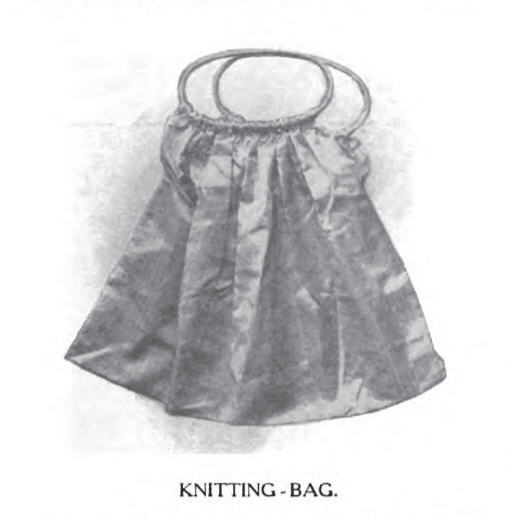
There were instructions for making this simple knitting bag, made of fabric, ribbon, and embroidery hoops:
And this case, made from pieces of cardboard and colored ribbons, to hold photos, greeting cards, or pictures cut from magazines.
She wrote:
What a delightful present that will be when you get it done! I can imagine an ingenious girl and boy putting their heads together, and making many variations which would be a comfort to the fortunate owner.
Isabella always knew how to give those gentle reminders that children (and adults!) sometimes need about the true spirit of Christmas.
What is your favorite way to share the message of Christmas with people in need?
Have you ever made a Christmas gift for someone? How was it received?
“Look, mamma, this is the lace I want; just the right pattern,” said Eva Dunlap in Isabella’s short story, “Mrs. Dunlap’s Commentary.”
“Is it real?”asked Mrs. Dunlap, bending over it with anxious eyes.
“That is what I don’t know,” said the daughter, lowering her voice. “I wonder if Mrs. Stuart is a judge?”
On being appealed to, Mrs. Stuart came forward and bent over the lace with careful gaze. “It is really quite impossible to tell;” she said at last. “The imitations are so very perfect, nowadays; I have to judge by the price of the article. Do you want real?”
“Oh, yes indeed!” chorused mother and daughter, emphatically.
“Well I buy the imitation, nowadays; it is just as good, and no one can tell them apart.”
“I won’t have imitation,” said Miss Eva, with decision.
“I never buy imitation,” said her mother, with firmness. “I dislike shams of any sort. I take real things or none.”
The Stuarts, mother and daughter looked at each other, and directly they were on the street they said, “How awfully extravagant the Dunlaps are! I don’t see how Mr. Dunlap endures the drain.”
And said the mother: “I don’t see how a Christian woman can think it is right to spend so much on things; the idea that she won’t wear anything but real lace—and she can’t tell it from the imitation—that is nothing but pride. I don’t understand how Christians justify themselves in these things.” There was actually an undertone of complaisance that she, at least, was not a Christian.
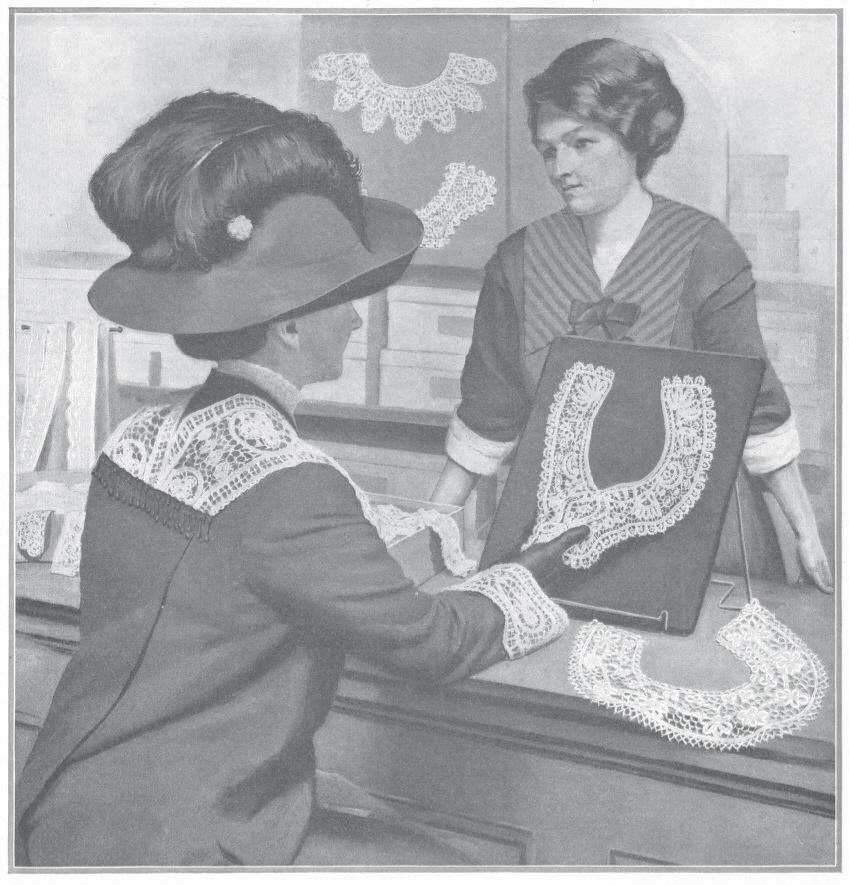
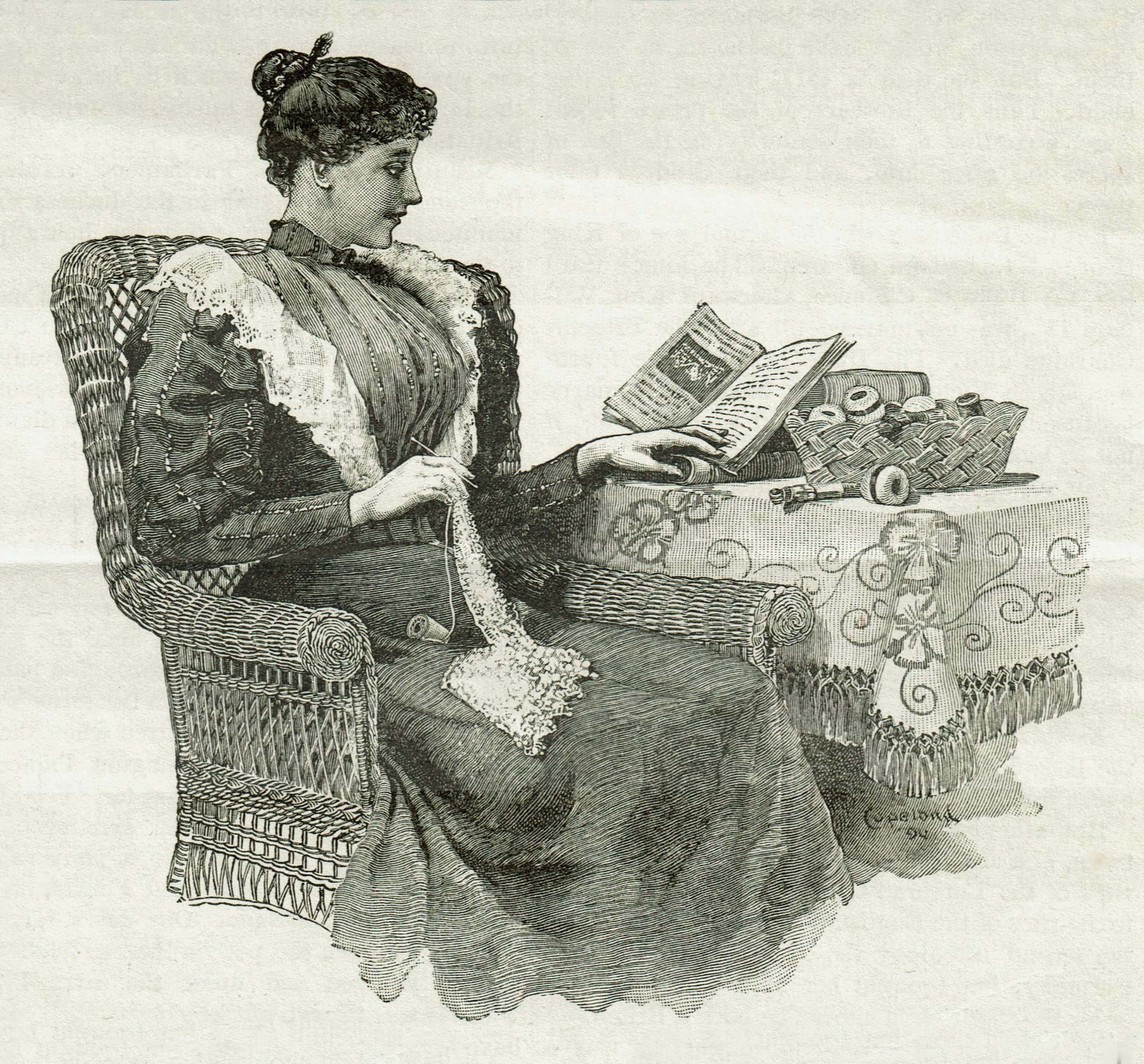
In Isabella’s world, when people mentioned “real lace” they meant hand-made lace. Skilled lace makers used fine threads to create delicate motifs—such as flowers, leaves, animals, urns, and even people—in their designs.
But machine-made lace was also available (and had been for over one hundred years). As Mrs. Stuart said in the excerpt above, it was difficult to tell machine-made laces from “real” hand-made laces, but a sharp eye could tell the difference.
One hint was the feel of the lace. Hand-made lace had texture; there was a rise and fall to the stitches, while machine lace felt flat when you ran your fingers across it.
The stitches were another tell; machine lace could unravel because large areas were made from one continuous thread.
Unlike Mrs. Dunlap, Mrs. Solomon Smith (in Mrs. Solomon Smith Looking On) was something of an expert when it came to lace. She had a keen eye and knew the value of a dollar. But when she attended her niece’s wedding in the big city, she went shopping in a department store for the first time, where she found herself dealing with a less-than-honest sales clerk when she tried to buy “real lace:”
[He was] showing me cotton laces of half a dozen kinds, and imitation laces, calling this machine-made stuff ‘real Valenciennes,’ and this cotton imitation ‘real Spanish lace,’ until I got out of all sort of patience with him, and says I, at last, ‘I don’t bear you no ill-will, but for your own sake, if I was you, I would get out of this habit of telling lies. Now I knew real lace of almost every kind you can think of long before you was born, and it is real lace and no other that I’m after, and if you’ve got any I’d like to see it.’
In Household Puzzles, another one of Isabella’s novels, Helen Randolph’s love of fine things was well documented. Helen insisted upon buying only the most expensive trims and “real lace” for her gowns, even if it meant her family had to go without basic necessities.
But on the eve of her wedding day Helen read a Bible verse that made her realize how wrong she had been to value earthly possessions:
“Whereas ye know not what shall be on the morrow. For what is your life? It is even a vapor that appeareth for a little time, and then vanisheth away.”
She closed the book suddenly, and laid it back in its place. If this were all there were of life—a vapor—of what use were lavender silks and real lace, after all?”
In each of these passages from Isabella’s books, she used “real lace” as a way to show readers her characters’ personalities and priorities, and to illustrate Christian life lessons.
What lesson do you think Isabella intended readers to learn when she wrote the exchange between the Dunlaps and the Stuarts? On the surface, she might have wanted to illustrate the Dunlap women’s love for finery, and the Stuart women’s more practical approach to shopping.
Or maybe she wanted to show that Mrs. Dunlap took a strong stand for truth, not realizing that her behavior could be interpreted as extravagant and proud by others.
In the scene with Mrs. Solomon Smith, she may have wanted to show how wrong it is to judge a person based on their appearance. Or maybe she wanted to show that everyone is deserving of respect and kindness.
That’s the beauty of Isabella Alden’s novels; her stories always give readers something to think about. And the lessons her characters learn make us examine our own actions.
Is there an Isabella Alden story that made you pause and reflect on your own behavior?
Has one of her stories made you think of changes you can make in your own life?
By the way, Isabella mentioned “real lace” in these stories, too:
Reviews and giveaways for Christian fiction and sweet, clean fiction. Bringing readers information on great stories and connecting authors with their readers.