Safe at Home

In August 1914, the world Isabella knew was rapidly changing. The assassination of Archduke Franz Ferdinand weeks earlier had set off a domino effect across Europe, throwing nations into war and leaving thousands of travelers scrambling to return across the Atlantic.

For most Americans, the conflict in Europe seemed a world away. But for Isabella the outbreak of World War I brought a sudden and very personal concern.

Her son, Dr. Raymond Macdonald Alden, was in the middle of it all.
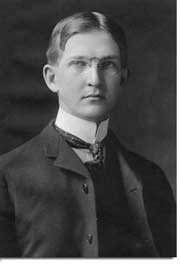
Raymond Alden in an undated photo

Raymond was a brilliant scholar and head of the English department at Stanford University. He was an accomplished author in his own right, best known for his classic short story “Why the Chimes Rang.”

In early 1914 Raymond traveled to England to spend several months conducting research in the historic archives of the British Museum and Oxford University. It was a dream trip for an American  professor of English literature. But as summer drew to a close, the gathering clouds of war suddenly broke over Europe.

Duke Humfrey’s Library, the oldest reading room at the Bodleian Library at the University of Oxford. Courtesy http://www.oxfordvisit.com

Germany declared war in early August, and almost overnight, the Atlantic Ocean became a danger for travelers as German U-boats began patrolling major shipping lanes.

Before matters could escalate further, Raymond wisely booked passage home on an ocean liner called the SS Arabic that departed Liverpool on July 28, 1914.

The SS Arabic of The White Star Line, 1904.

Raymond’s journey across the ocean was anything but peaceful. For most of the voyage, a British cruiser sailed alongside the Arabic as an escort to protect the liner from a potential u-boat attack.

While the Arabic made it safely across the Atlantic that summer, the ship would not always be so fortunate. Just one year later, in August 1915, the Arabic would be torpedoed and sunk by a German submarine off the coast of Ireland, an event that made international headlines and brought the United States to the brink of entering the war. But in August 1914, Raymond’s ship docked safely in Boston, delivering him back to America unharmed.

While Raymond was braving the ocean crossing, his parents were eagerly waiting for him in New York. The Aldens had always been a close-knit family, but given the circumstances in Europe, Isabella and her husband decided to travel clear across the country to New York so they could be close by when Raymond’s ship docked. The area where they stayed held a special place in their hearts

Isabella was born in Gloversville, New York, and had attended school at Oneida Seminary. It was there that she met Theodosia Toll Foster (who would write under the pseudonym Faye Huntington), and they became lifelong best friends, sharing a bond of faith and friendship that spanned decades.

Black and white newspaper photo of a large two-story home with a wide covered front porch and mature trees beside it.
Locust Shade, the Toll Family Homestead as it appeared before it was demolished in 1952 (from The Rome Sentinel, August 13, 1952

That August of 1914, while waiting for Raymond’s return, Rev. and Mrs. Alden stayed as guests at the Toll Homestead in Verona, New York. They also spent time in nearby New Hartford, where Rev. Alden had served as a beloved pastor of the First Presbyterian Church nearly forty years earlier.

But lurking beneath the family visits and conversations with friends, Isabella and her husband must have felt a good deal of anxiety over the safety of their son. Their prayers and the bond of faith they shared with family and friends must have been a comfort and support during that time.

After nine stressful days at sea, Raymond’s ship docked at Boston Harbor and he at last joined his parents in New York. He gave the local newspaper a brief (and very understated) account of his Atlantic crossing, describing it as “a somewhat exciting trip.”

Newspaper Article: Verona, Aug. 14. Dr. R.M. Alden of the department of English of Stamford [sic] University, Palo Alto, Cal., has been the guest of Mrs. T. M. Foster and family. Dr. Alden was en route from London to Palo Alto. He reports a somewhat exciting trip by the steamer Arabic.  A British cruiser was near at hand the great part of the way, as it was suspected that a hostile cruiser was following the Arabic. Dr. Alden has been in England several months studying in the libraries of the British Museum and Oxford. His parents, Dr. and Mrs. G. R. Alden, have been visiting friends in Verona and New Hartford for the past week, and the party left for their California home on Monday. Dr. G. R. Alden was pastor of the New Hartford Presbyterian Church about 38 years ago.
from the Daily Sentinel (Rome, New York) on August 14, 1914

Four days later, the Alden family boarded a train together for the long journey back to the home they shared in Palo Alto, California.

To the residents of Verona and New Hartford, the war across the Atlantic might have felt distant. But Raymond’s close call on the Arabic was a reminder of how quickly major world events could reach right into the homes of American families.

For Isabella and her family, facing uncertainty with steady faith and holding fast to deep friendships brought them through another trial, surrounded with love and support until they were, at last, safe at home together.

YOU CAN READ MORE ABOUT ISABELLA’S EARLY LIFE IN GLOVERSVILLE IN THESE POSTS:

LEARN MORE ABOUT ISABELLA’S FRIENDSHIP WITH THEODOSIA TOLL FOSTER IN THESE POSTS:

DISCOVER MORE ABOUT RAYMOND MACDONALD ALDEN IN THESE POSTS:

Isabella and the Great Quake

For Isabella, springtime in California was a season of cheer and beauty. She and Reverend Alden moved to Palo Alto, California in 1901. With their grown son Raymond and his wife Barbara, they built a beautiful duplex home for the entire family not far from Stanford University where Raymond taught English Literature. (Read more about their house here.)

Black and white photo of Isabella's home in Palo Alto, California.
Isabella’s home in Palo Alto, California. She and her husband lived in one side of the duplex; her son Raymond and his family lived in the other.

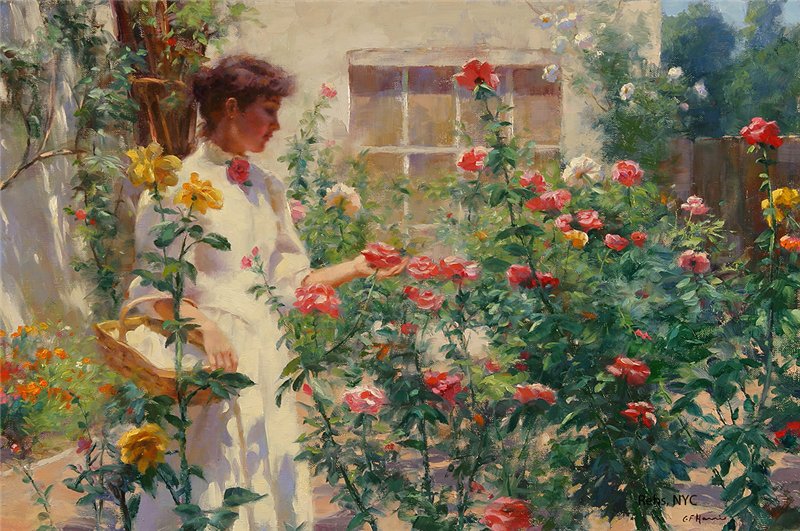
One of Isabella’s best memories was sitting on the porch of her Palo Alto house and seeing the variety of roses growing in her yard.

Red, cream, salmon, pure white, and every shade of pink. Hundreds and hundreds and hundreds of them! The world [seemed] made of roses!

Painting of young woman dressed in white gown in style of 1910, standing amid a cluster of tall rose bushes of different colors. Over her arm she carries a basket. With her other hand she cups a pink rose.

In fact, Palo Alto’s relaxed atmosphere must have seemed like the perfect place for a retired couple like Isabella and her husband. She wrote:

For the most part our university town works late at night and sleeps late in the morning.

Isabella quickly adapted to doing things on “Palo Alto time.” So it was that in the early morning hours of Wednesday, April 18, 1906, Isabella was still in bed. Her husband was away, staying with his sister Beulah in the Midwest, and gaining some much-needed rest after an illness. Her son Raymond and his wife Barbara, along with their five-month-old son Donald (Isabella’s first grandchild) were sleeping next door in their half of the duplex.

Then, at 5:12 a.m. without warning:

A strange rumbling noise like unto no other noise this old earth can make, broke upon our slumbers and startled us into bewilderment. The noise was accompanied by a strong swaying motion, the frightening sound of the timbers and walls of her house creaking and tinkling like breaking glass, and the “thud, thud, thud” of heavy pieces of furniture falling.

Isabella was experiencing an earthquake!

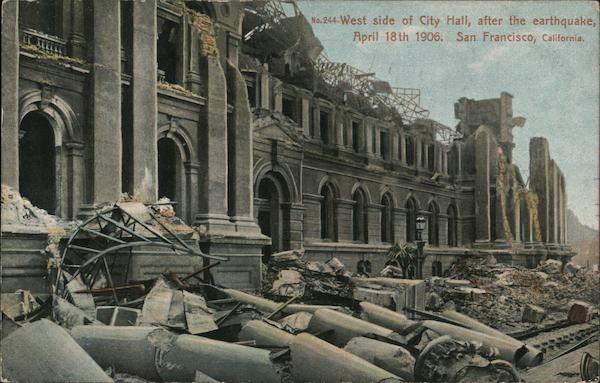
Photo of San Francisco City Hall. The roof has collapsed and portions of the building have fallen away. Stone columns from the building and other debris lie in the street.
Fallen columns and debris clog the road in front of City Hall, San Francisco, California

She wrote:

We found ourselves in our beds, skidding across the rooms, now this way, now that, in the most erratic and bewildering fashion.

The earthquake lasted only forty-five seconds, but for Isabella it seemed much longer; and when she was able to gather her wits, her first thought was for her family.

When the house finally stopped swaying and she could get out of bed, she met Raymond, Barbara and the baby in the common hall that separated the two dwellings. That’s when she began to understand the force of the earthquake.

Our hall and stair landing was lined with bookcases which were prostrate, the books scattered everywhere!

Every hour, every minute, brought a fresh discovery of ruin and dismay. … Milk pans overturned and broken glass jars swimming about in rivers of fruit juice.

Isabella made some odd damage discoveries, too: On a high shelf several cut-glass pieces—vases and bowl and pitchers—had all crashed down to the floor, rolling about the room in confusion, and yet only two of them broke!

Yet down in my preserve closet nearly every jar was smashed and the luscious juices mingled with the broken glass in a menacing and heart-breaking sight after all our hard work of putting up that fruit!

While the Aldens were assessing the damage in their own home, awful news reached them from nearby Stanford University, where Raymond taught.

The library at Palo Alto University after the quake. The central dome of the building still stands, but the walls and ceilings have collapsed.
The library at Palo Alto University destroyed.

The university library was destroyed. Even worse, a memorial chapel—which Isabella described as “the wonder and admiration of all the world”—had collapsed, killing two people.

Interior photo of the ruins of the Memorial Chapel.
The interior of the Memorial Chapel at Stanford in ruins.

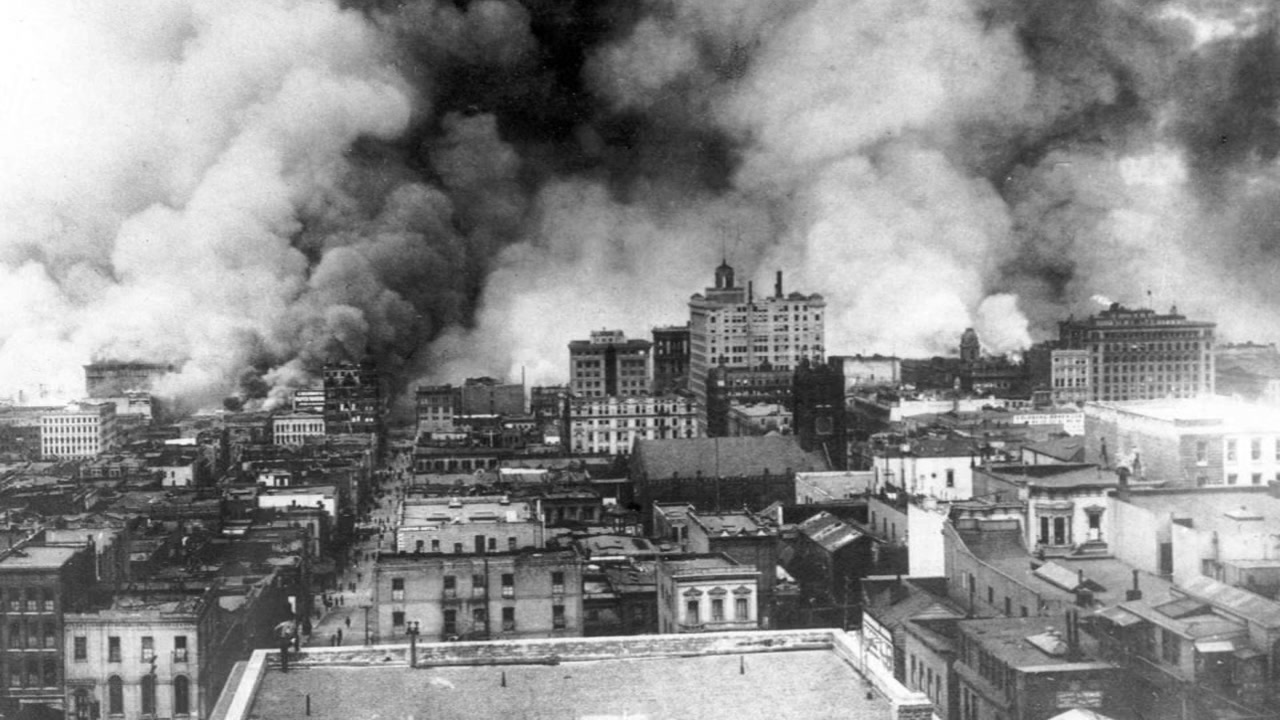
Then they began to hear terrible rumors of the damage in San Francisco, just thirty miles away—news of burning buildings, and no water to douse the flames. Everywhere electricity was out, as was all communications. Buckled roads made even walking dangerous.

Black and white photo of smoke billowing up from the burning city.
Fire and smoke in San Francisco after the earthquake struck on April 18, 1906.

Frightening aftershocks trembled the ground throughout the day. Isabella wrote:

Seven times during that unforgettable day were those ominous sounds and throbs repeated, enough to warn us that the earth was not at rest, and that at any moment the experiences of the morning might be renewed.

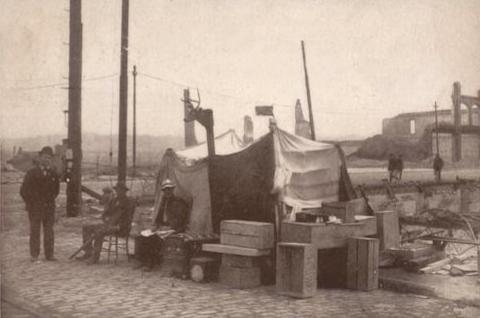
By evening Isabella and her neighbors had to make do with what they could salvage from their damaged homes. She, like many others, was afraid of going back into a house that might collapse at any moment.

A man standing beside his make-shit home made of piled crates and sheets.
Refugees’ make-shift home after the earthquake.

She wrote:

Tents made of all sorts of strange material rose in yards and vacant lots; and mattresses, couches, easy chairs, cots, cushions, anything that would afford a chance for a little rest, were carried into any open spaces that could be found.

A group of tents and make-shift homes set up in an open park with a few nearby partially-collapsed buildings. In the background the tall downtown buildings have disappeared; only a single dome stands out against the skyline.
A refugee camp with the ruins of San Francisco in the background.

At his sister’s house in Minnesota, Reverend Alden learned of the earthquake and was anxious for news of his family. It took four days for Isabella to get word to him that everyone was safe, and two more days for him to finally purchase a ticket for a train heading west toward California.

Meanwhile, residents of San Francisco and surrounding communities quickly realized that with no communication lines and few railroad tracks left undamaged, they were virtually cut off from the rest of the world. City leaders and everyday residents stepped forward to begin organizing relief efforts in their neighborhoods.

Men with shovels work to clear debris from the street and trolley tracks.
Men manually clearing the debris near Market Street, San Francisco

They established committees to render first aid, clear debris, and restore clean water supplies. They pooled resources to care or the homeless, the hungry, and the wounded.

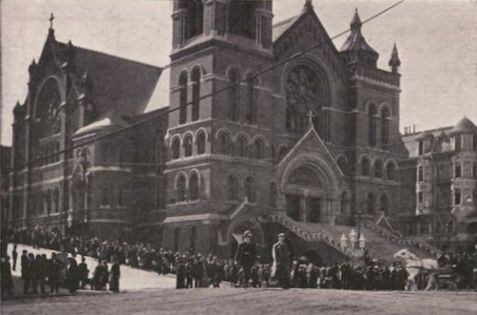
Lines of people stand outside a large cathedral.
A bread line at St Mary’s Cathedral, the only San Francisco church not destroyed on April 18, 1906.]

Nearby states sent physicians, nurses, and supplies by train; and when the trains were forced to stop because of damaged tracks, residents went out to meet them with cars, wagons, and any other vehicles that could convey the helpers to where they were needed most.

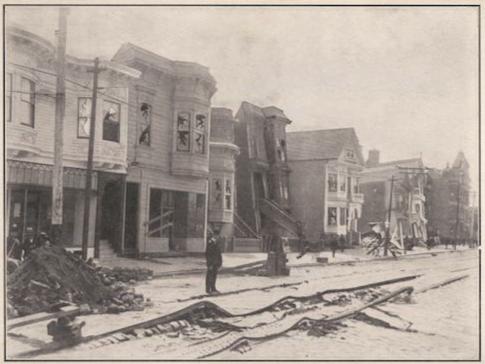
Black and white photo of houses damaged in the quake. The paved road in front of the homes is buckled.
The damage on Howard Street, with broken windows, houses pushed off their foundations, and buckled roads.

Residents whose homes were spared took in strangers. Others ministered to the people fleeing San Francisco’s devastating fires. They set up stations along roads and handed out sandwiches, pillows, coffee, bundles of clothes, and blankets—anything they could think of to help the people who were suddenly homeless.

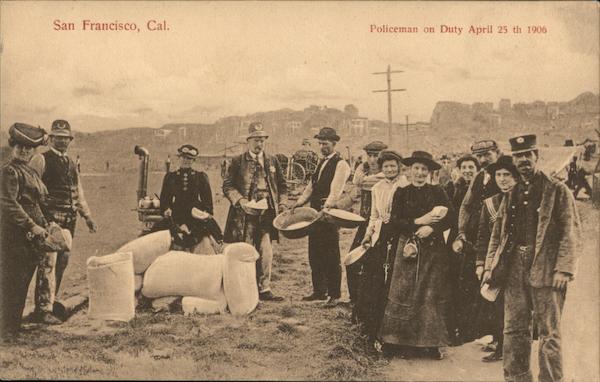
In an open field police officers and a group of people stand beside large white sacks of flour. One policeman holds a small bowl in which are white packets; beside him is a man holding out a large bowl to receive the packets. Other people in the photo are also holding out bowls. One woman and one man are holding small packets they have already received.
Policemen help distribute flour to refugees.

Isabella said that “almost hourly” she heard such stories, full of “thoughtful alertness and quiet endeavor.” More than anything else, those stories of goodness and kindness were what she most remembered about the earthquake many years later. She wrote:

When we had a chance to draw a long breath and look about us, out of all the peril and pain of the hour, certain facts stood out in glowing lines. God is good and in the creatures of His hand there is a touch of God-likeness.

Isabella and her family survived the earthquake, as did their lovely home. Years later, when she was writing her memoirs and the time came to recount the events of April 18, 1906 and the weeks and months that followed, she said:

Oh, there is no use trying to forget the earthquake. And yet—I would rather talk about the roses.