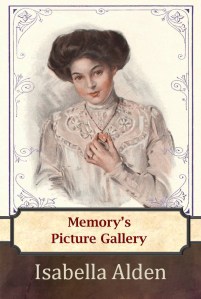
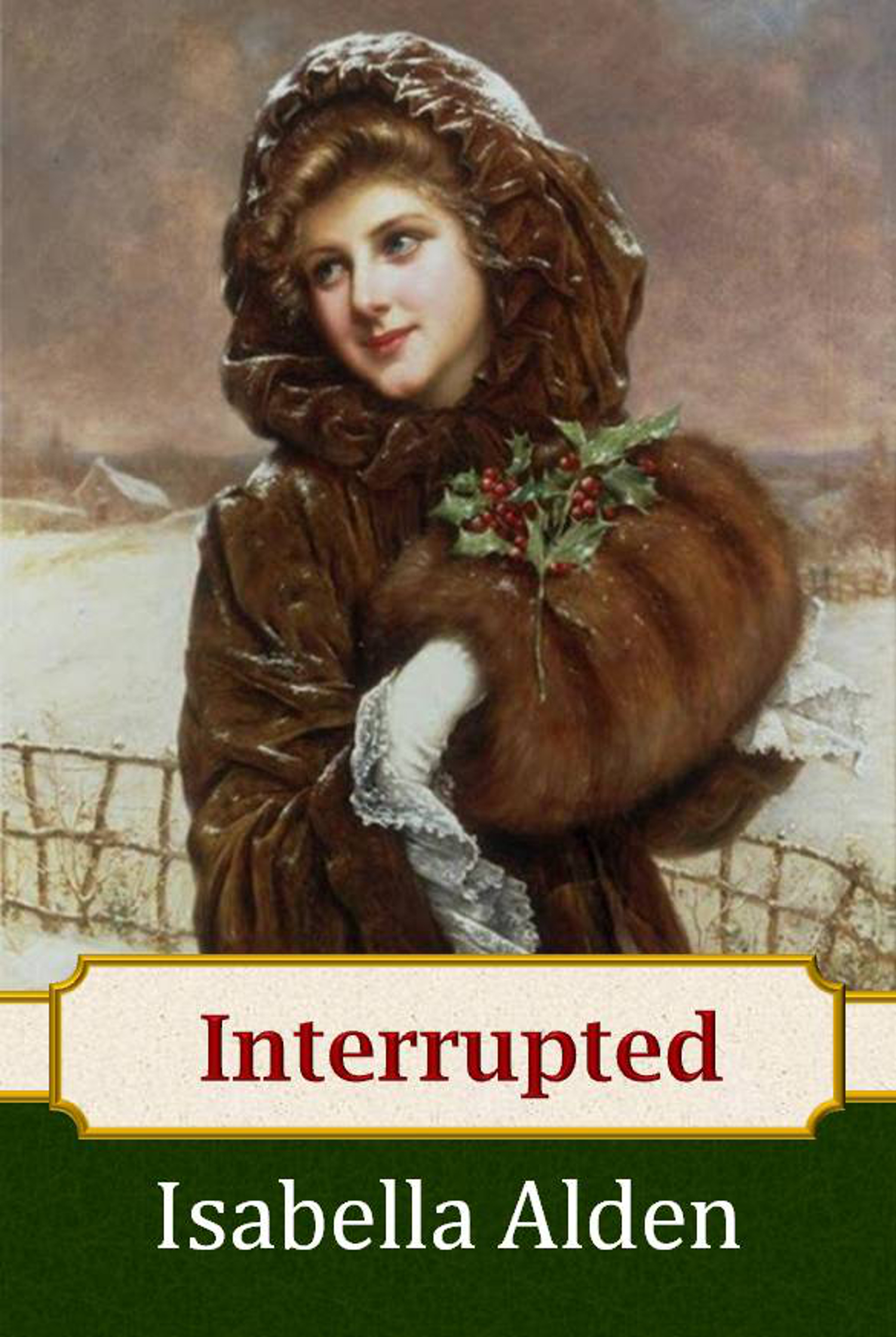
In the book Interrupted, Claire Benedict asked Louis Ansted if he was a Christian. When he said he was not (in a round-about way), Claire asked if he believed Christ “once lived in person on this earth, and died on a cross, and went back to heaven, and is to come again at some future time?”
Louis replied:
“Oh, yes; I have no particular reason for doubting prophecy or history on those points. I’m rather inclined to think the whole story is true.”
“Do you think his character worthy of admiration?”
“Oh, yes, of course; it is a remarkable character. Even infidels concede that, you know; and I am no infidel. Bob Ingersoll and his follies have no charm for me. I have had that disease, Miss Benedict. Like the measles and whooping-cough, it belongs to a certain period of life, you know, and I am past that. I had it in a very mild form, however, and it left no trace. The fellow’s logic has nothing to stand on.”
She ignored the entire sentence, save the first two words. She had not the slightest desire to talk about Bob Ingersoll, or to let this gay young man explain some of Bob’s weak mistakes, and laugh with her over his want of historic knowledge. She went straight to the center of the subject.
“Then, Mr. Ansted, won’t you join His army, and come over and help us?”
Undated photo of Robert G. Ingersoll
Bob Ingersoll wasn’t just a character in Isabella’s book. He was a living, breathing person and a very well-known figure of the time. Born in 1833 in New York, he had a reputation for being extremely intelligent. He educated himself and was admitted to the bar at the age of 21; his gift of oratory earned him a reputation as a brilliant lawyer.
But it was his talent for speech-making that gained him fame. He lectured across the country on free speech, women’s rights and, most notably, Christian doctrine. At a time when there were laws in some States that made it a crime to deny Christianity, Bob Ingersoll openly argued for a separation of church and state. He expounded on what he considered to be inaccuracies and fallacies of the Bible, and published several books that outlined his agnostic position. He had political aspirations, but his stance on religion made both the Republican and Democratic parties leery of nominating him for any elected office; however, at the age of 33 he was appointed Attorney General of Illinois.
When Interrupted was published in 1885, Ingersoll’s book The Mistakes of Moses was very popular. In the book, he collected passages from the Pentateuch that contradicted scientific thinking of the time, and even contradicted each other. He used those passages to build a case against the Pentateuch, which Ingersoll called “a record of a barbarous people, in which are found a great number of the ceremonies of savagery, many absurd and unjust laws, and thousands of ideas inconsistent with known and demonstrated facts.”
So when Louis Ansted mentioned Bob Ingersoll, Claire knew exactly who he was talking about. He was known as The Great Agnostic and one newspaper characterized his growing school of followers as “light minded [people] whom brilliant oratory can persuade to most anything while the voice lasts and who are as easily dissuaded by the next fluent speaker.”
When Robert Ingersoll died in 1899, an obituary in The Courier (Lincoln, Nebraska) described him as:
neither better nor worse than the ordinary man. In his youth he became convinced that the Bible was a lie and he hated … the God whose existence he denied.
He was not a saint, neither was he an incorrigible sinner, but just an ordinary man who had lost his bearings in the relations of God to man and overestimated the significance of his own opinion of God and man.
Robert Ingersoll’s writings have found new life on the Internet; several sites make electronic versions of his lectures and books available for free. You can follow this link to The Huffington Post to read more about Robert Ingersoll’s life.
This YouTube link provides an audio recording of Ingersoll’s book, Why I am an Agnostic:
Isabella Alden was a busy woman. She had full-time duties as a minister’s wife, visiting members of the congregation, leading ladies’ prayer meetings, organizing mission bands, and teaching Sunday school classes. She wrote stories for and edited The Pansy magazine every month—all this at a time when she was producing an average of two books a year!
Somehow, she also found the time and energy to lecture before large audiences at Sunday School conventions, Chautauqua Assemblies, and women’s groups. She regularly addressed members of local CLSC chapters and traveled the country to meet with devoted readers of her books and The Pansy magazine.
This notice of one of Isabella’s lectures appeared in the Brooklyn Daily Eagle (New York) on January 14, 1882:
.
And this announcement for one of Isabella’s addresses before a Sabbath-school convention appeared in The Bloomfield Record (New Jersey) on March 11, 1882:
.
When she could, Isabella combined her speaking engagements with visits to family and friends. That was the case in 1878 when she visited her home town of Gloversville, New York.
Reverend Gustavus Rossenberg Alden
Years before (in 1866) Isabella married Reverend Gustavus “Gus” Alden and moved away from Gloversville; but her family remained in the area and she visited them as often as possible. In that late summer of 1878, she was able to visit her family in combination with an author speaking tour.
Isabella had just finished writing a short story she called, “People Who Haven’t Time.” The story was not yet published but she was ready to share it with her fans.
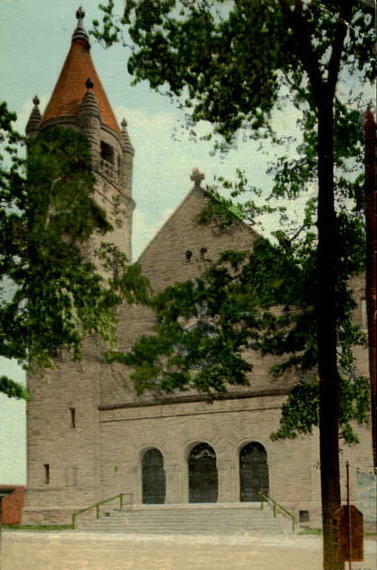
On Friday, September 20, 1878, she appeared at the Gloversville Baptist Church to give a public reading of the story.
Undated photo of the Baptist Church in Gloversville, New York
.
The local paper, The Gloversville Intelligencer, announced the event and encouraged attendance:
.
In the next edition, the newspaper gave a full account of the evening and proudly listed the many accomplishments of Gloversville’s favorite home-town girl. Here’s the full 1878 article from The Gloversville Intelligencer:
The story Isabella read at the church that night would eventually be given a final edit and named “People Who Haven’t Time and Can’t Afford It.” In 1880 the story was published in a volume that included another Pansy short story, “What She Said … and What She Meant.”
Original cover of Isabella’s book What She Said, published in 1880
.
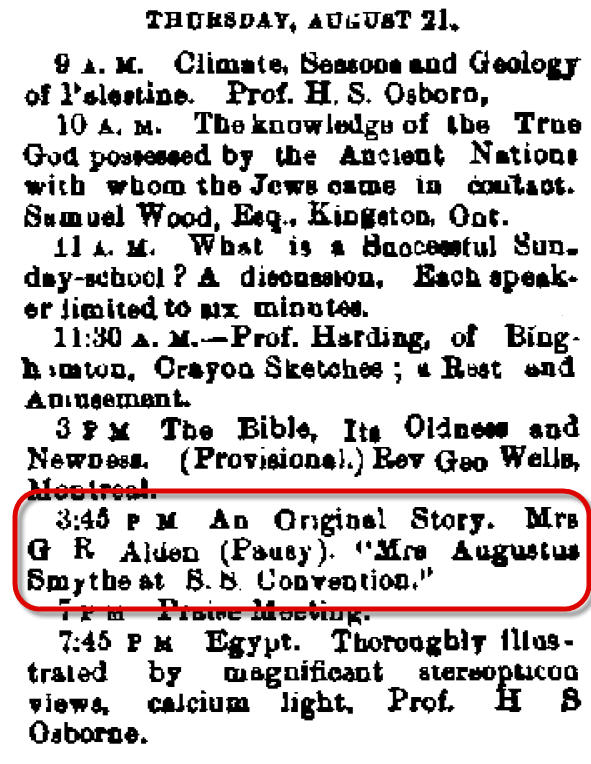
There are other accounts of Isabella reading her stories before audiences. For example, in 1879 she appeared before a Sunday-School convention in New York to read an original story:
And in 1895 she read her story “Miss Priscilla Hunter” to an audience at the Presbyterian church to help raise funds for the Young Ladies’ Missionary society:
From the Gloversville, New York “Daily Leader,” September 18, 1895
.
If you haven’t yet read Isabella’s story, “What She Said . . . and What She Meant,” you can read it for free. Click here to begin reading the stories mentioned in this blog post.
The heroine in an Isabella Alden book was a strong woman. She may not have known how strong she really was; but when trouble struck, it was the heroine of the story who stepped up and took action in order to save the family.
That’s what Claire Benedict did in Interrupted. She bravely took on the responsibility of supporting her mother and sister by taking a job as a music teacher in a far-away city.
.
Ad in The Daily Pioneer, Bermidji, MN, December 4, 1903
.
In Four Mothers at Chautauqua, Isabel Bradford also decided to teach. She opened a School of Expression where she taught physical exercise techniques and grace of movement to women in New York City.
And in Pauline, Constance Curtiss supported herself (after rashly running away from her husband) by offering a variety of homemaking services, from laundering cuffs and collars to canning fruits and vegetables for busy housewives.
At the time Isabella’s books were written, women, as a rule, weren’t trained to take their place in the business world. They couldn’t vote and in many states they couldn’t own property. It was unusual for a woman to own her own business and even more unusual for her business to succeed.
A news item in an 1892 edition of the Buffalo Courier, expressing surprise that a woman could 1) own a business, and 2) be successful at it
.
Starting a business that involved working in other people’s homes—as Constance Curtiss did—or opening an exercise studio—which was Isabel Bradford’s plan—may have been viable for some women; but for a few Alden heroines, working outside the home posed a problem. For starters, opening a shop or renting studio space required investment capital, as this ad in a 1908 edition of The Delineator magazine shows:
In other instances the heroines lacked marketable skills or they had unique family responsibilities that demanded they remain at home.
That was the case with Joy Saunders in Workers Together. Her very protective mother didn’t want to see her lovely daughter toil for wages out in the world; but with hard work and clever management, Joy and her mother ran a flourishing boarding house.
In Household Puzzles and its sequel, The Randolphs, Maria Randolph supported her entire family by running a laundry business out of her kitchen.
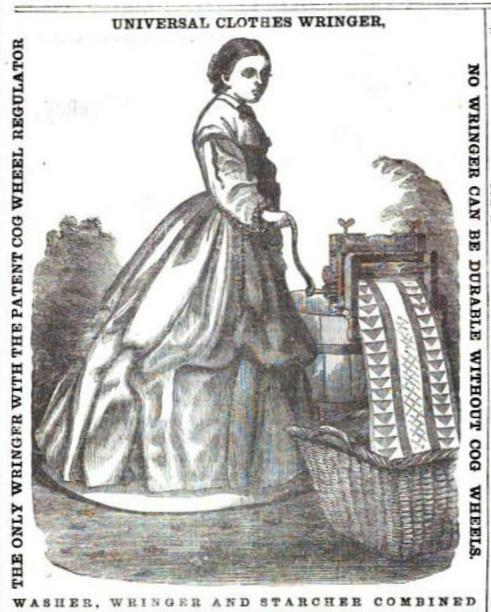
1864 ad for a clothes wringer
.
Constance Stuart did laundry, too. In the book Pauline, Constance specialized in laundering women’s delicate lace collars and cuffs, and she had a knack for laundering worn curtains and old linens so they looked almost brand new.
Illustration of a ladies’ collar and cuff. From Myra’s Threepenny Journal, March 1882
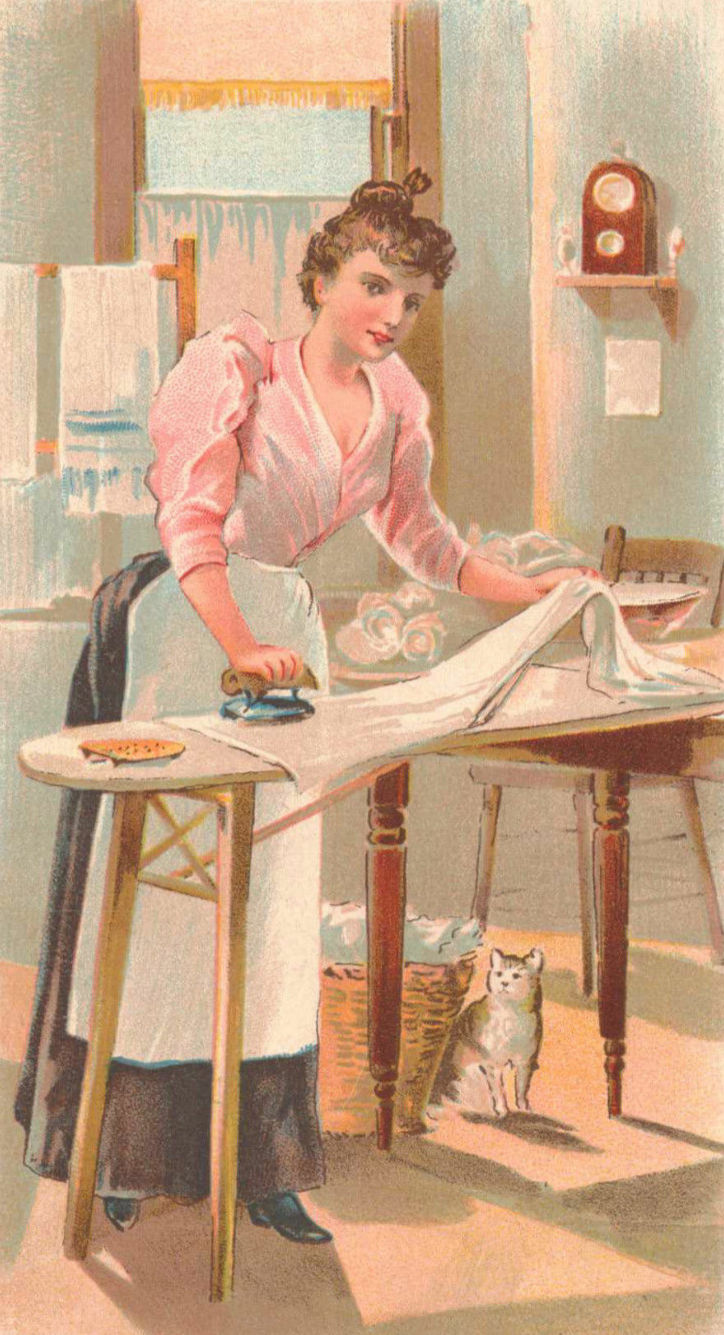
And in Her Associate Members, Mrs. Carpenter earned a living by ironing other peoples’ clothes in her sparse little kitchen.
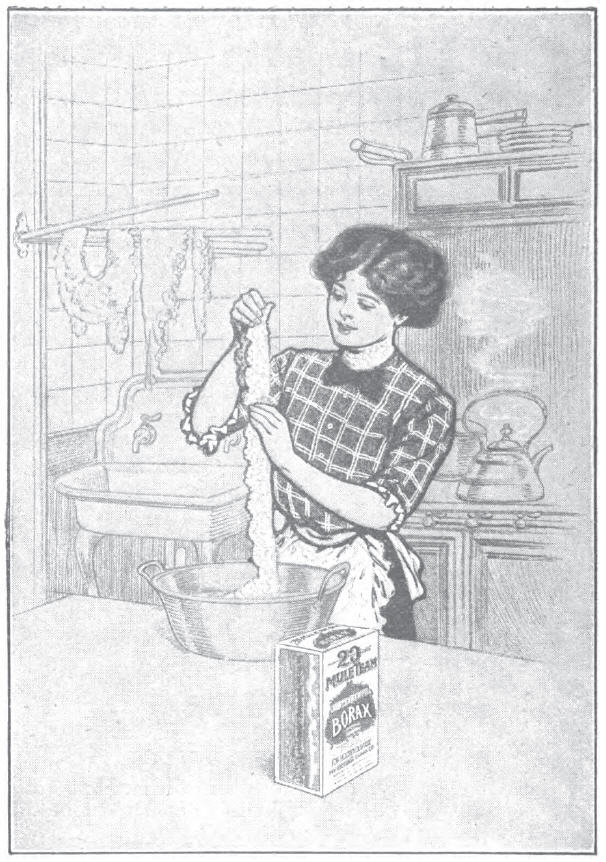
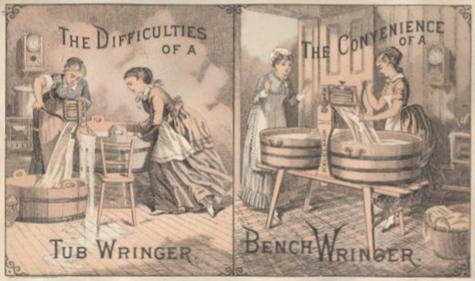
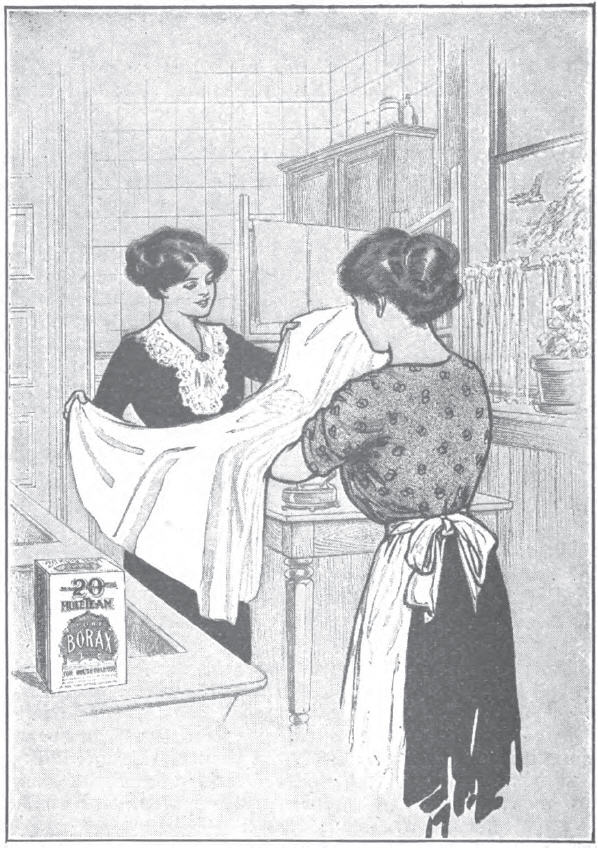
Doing laundry and ironing as a way to earn money was fairly common for women in Isabella Alden’s time. That’s because doing the laundry was such time-consuming work, even for small families, that homemakers across the country struggled to accomplish the task on their own. Modern conveniences, like wringers and ironing machines did little to ease the load.
Trade card from the 1880s
.
“Monday is the washing day of all good housekeepers,” declared The Household, A Cyclopaedia of Practical Hints for Modern Homes. This book, published in 1886, promised to make washing day easier by setting out step-by-step instructions for accomplishing every phase of the task: from making starch to eradicating fruit stains and bleaching white goods.
.
The volume of laundry to be done was often staggering. In Victorian-age America people wore layers of clothing, beginning with long drawers and undershirts for men; corset covers, chemises, drawers and petticoats for women. Often these items were made of wool, which made them extremely heavy once they were wet.
.
1882 magazine ad showing the detail and trimmings on underclothing. Click on the image to see a larger version.
.
Over these layers they wore shirts and shirtwaists, trousers and skirts, jackets and coats. Collars and cuffs gave the finishing touch to every outfit, but because collars and cuffs were easily soiled, they were changed a minimum of two or three times a day. Collars and cuffs also required the most care and skill in laundering.
Illustration of a ladies’ collar in an 1882 fashion magazine.
.
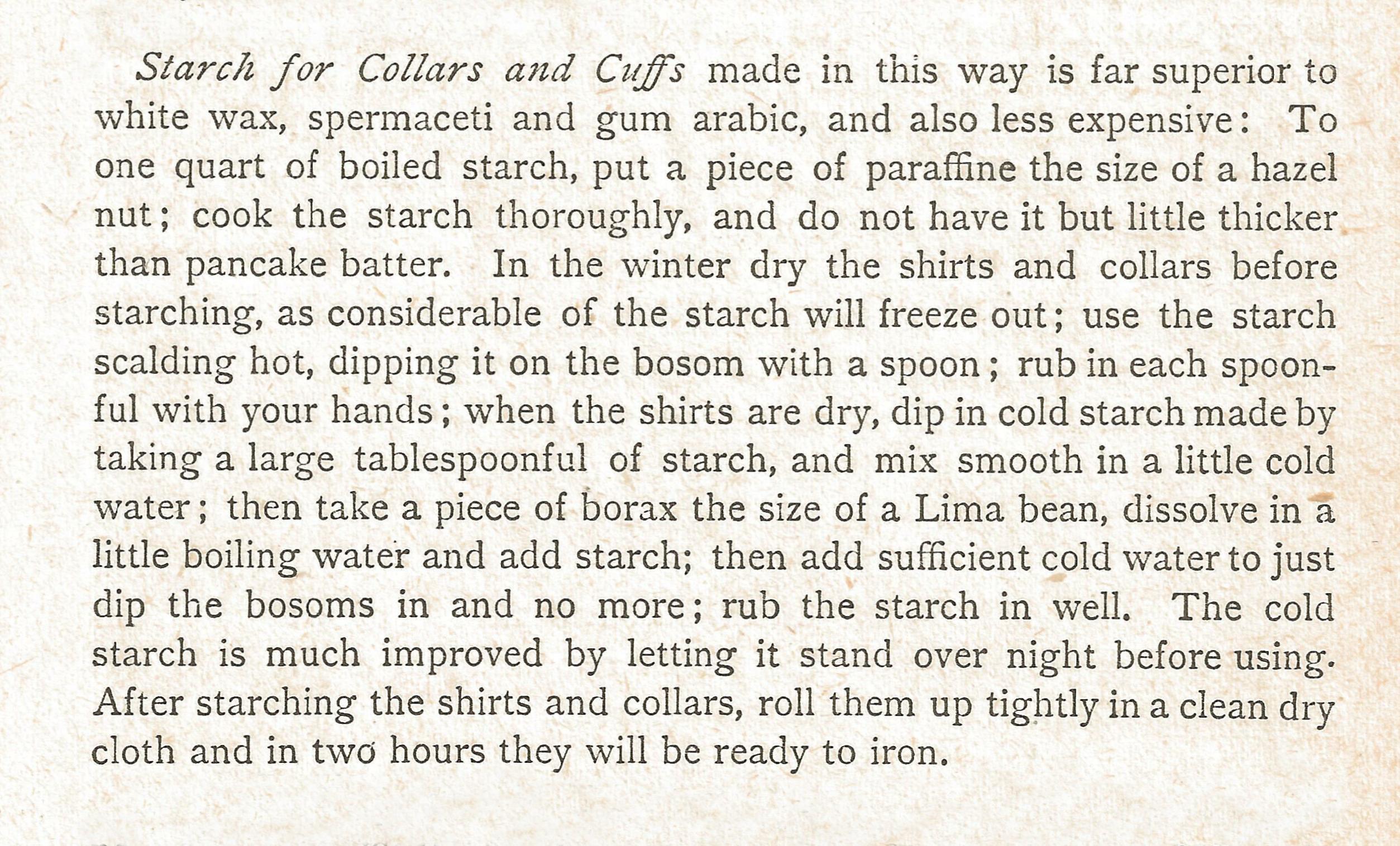
Men’s collars and cuffs were heavily starched until they could stand on their own. This paragraph from The Household instructed homemakers on how to make and apply the starch:
.
With such heavy starch, the best laundresses knew that men’s collars and cuffs had to be ironed over a rounded form; otherwise, if ironed flat, they were likely to crack when they were fitted around the throat or wrist.
A 1905 Street Car advertisement
.
Women’s collars and cuffs were just as challenging to launder and finish. Fluted fabric was a popular detail in ladies’ fashion, and it was difficult to keep the flutes crisp and well-shaped after washing.
Illustration of a Chemisette with lace and fluting, from a 1882 ladies’ magazine.
.
Laces were easily scorched if an iron was too hot and they were just as easily discolored if they were pressed with an iron that wasn’t perfectly clean.
An 1882 illustration of a linen and lace collar
.
With so much preparation required and a good deal of heavy lifting, it usually took two women working all day to get the laundry done in an average household. And if the lady of the house didn’t have a family member or neighbor to help her, she often hired a portion of the work out.
But finding a good laundress was a challenge. Isabella Alden commented on that fact in The Randolphs:
While the world seems to be full of people who are willing to teach our children to strum on the piano, to draw impossible-looking trees and people, to jabber in a dozen different tongues, the lamentable fact remains that in every town and city it is really a difficult matter to get one’s collars and cuffs starched and ironed decently without paying a fabulous price for it.
The need for an extra pair of hands on laundry day opened the door for talented and hard-working women like Constance and Maria to earn a living.
To promote her new business, Constance Curtiss washed and mended the curtains that were “just falling to pieces before our eyes” in her landlady’s house, much to the landlady’s amazement:
“The girl darned them and washed them and rinsed them in starch water and stretched them till they looked as though I had put my hand in my pocket and paid for them out of the store, as I expected to. She does beat all!”
The landlady was so impressed she told her friends and neighbors of Constance’s skill. In very short order, Constance had more work than she could handle and had to write polite notes every evening to decline any new engagements.
In Household Puzzles, Maria Randolph started her laundry business after her brother Tom told her that his co-workers admired his clothes:
Tom needed assistance in the matter of a button and was glad to find Maria at liberty for a minute to sew it on. During the operation he laughed outright at his own thoughts, and then proceeded to explain.
“One of my brother drivers came to me last night for a confidential chat. I wish you could have seen his puzzled and important face. He is that Jerry that you think is so good-natured. What do you think he wanted?”
“I’m sure I don’t know. This button has split in two, Tom.”
“Well, here’s another. I couldn’t imagine what he was coming at. He called me aside and looked so important. He begged my pardon for troubling me—they are all remarkably polite to me—and he said that four or five of them had been having a time with their washerwoman because she didn’t use starch enough. They’re wonderfully particular fellows on Sunday. She ironed in wrinkles, too, he said; and then, after considerable stammering, he managed to get out that a number of them had been talking over the immaculateness of my linen, and had decided to get me to negotiate with my washerwoman, whoever she was, to see if she would do their work. The poor fellow was utterly crestfallen when I told him that my laundress was my sister.”
Industrious Maria saw an opportunity to earn money to pay for the medicine and medical care her father needed.
So she washed and ironed for the street-car drivers exactly as she had planned to do. They had few clothes to spare for the wash, but it must have been a delight to them to see the smoothness and whiteness of those few. Maria took great pains with them for two reasons: one, because she liked to hear Tom tell of their exclamations of delight, and the other, that she had a habit of doing well what she did at all. This new way of earning money was very helpful, and added not a little to the comfort of the invalid who was slipping away from them in such a quiet fashion. Sometimes it took all her resolution and a fond remembrance of how much her father enjoyed the oranges and strawberries to keep her heart in the work.
Doing a family’s laundry alone was a strenuous task and in Maria Randolph’s case, the hard, physical labor of the work took a toll on her health. But the work also had its rewards.
As Maria had a great deal of pride of execution, and an indomitable determination, and a secret plan to make herself and her father independent thereby, she worked with a will.
Before long, Maria’s business expanded enough so she could hire several “hard-working girls who were glad to be taught that which she had worked out by her own wits and the help of her eyes when she visited certain famous laundries.”
A 1910 laundry class for girls
.
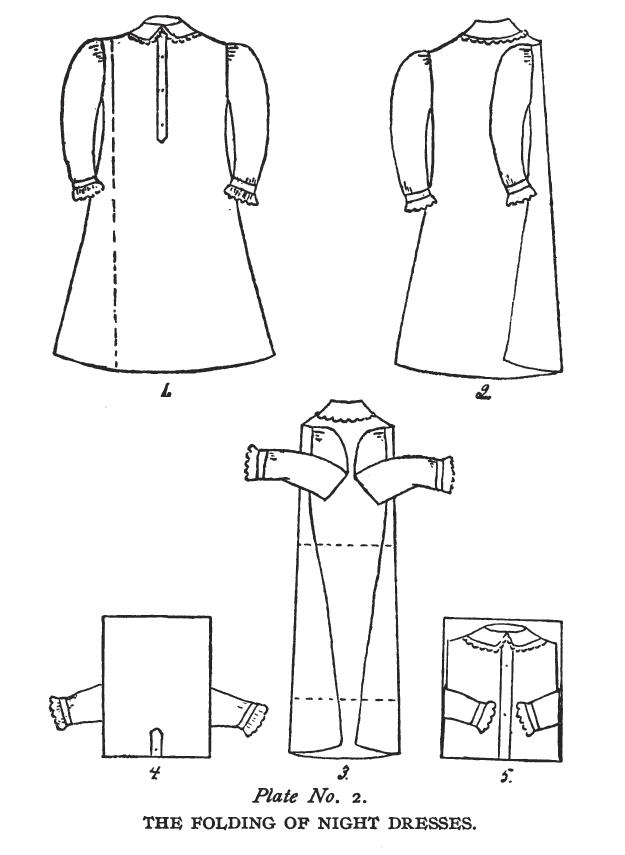
As part of their laundry duties, Maria probably taught her employees the proper way to fold clothes for customers. These plates from a laundry manual published in 1900 illustrate the correct procedure for folding drawers, shirts, and night clothes:
.
.
.
And though her family and friends were appalled when Maria decided to advertise her business, she was proud to hang a small sign outside her home, “tacked in a conspicuous spot, and the letters on it were unmistakably clear and plain:
Would you like to know more about sad irons and how they were used? Click here to view an article at Collectors Weekly.
Read our previous post about The School of Expression that inspired Isabel Bradford in Four Mothers at Chautauqua.
Click here or return find out more about Isabella’s Books mentioned in this post.
Many of the women in Isabella Alden’s books had to earn a living to support themselves or their families. That was the case with Maria Randolph in Household Puzzles, who took in laundry so she could buy medicine for her father and pay the family’s bills.
And in Miss Dee Dunmore Bryant, Mrs. Bryant supported her children by sewing late into the night, when she wasn’t working long hours at the local canning factory.
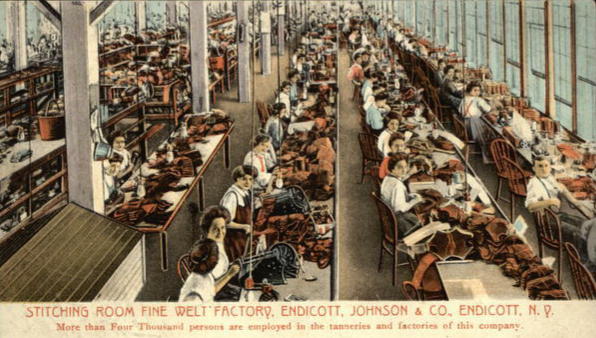
Women working at the Endicott Johnson tanning factory in New York
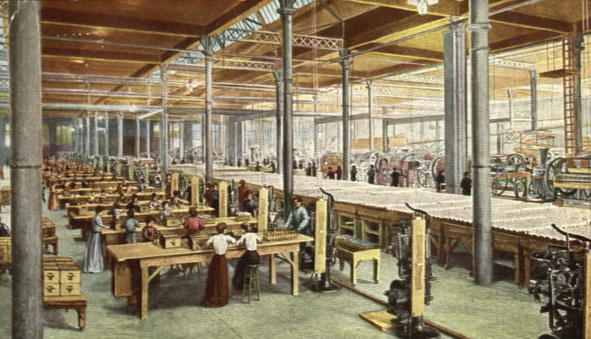
Earning a living wage wasn’t an easy thing for women to do in the years between 1880 and 1920. Competition for jobs was fierce, as more and more women entered the job market and took over low-paying, repetitive jobs that men once held—and they earned considerably less than men did for performing the same work.
Women performing manual labor at the Anheuser Busch Bottling Company
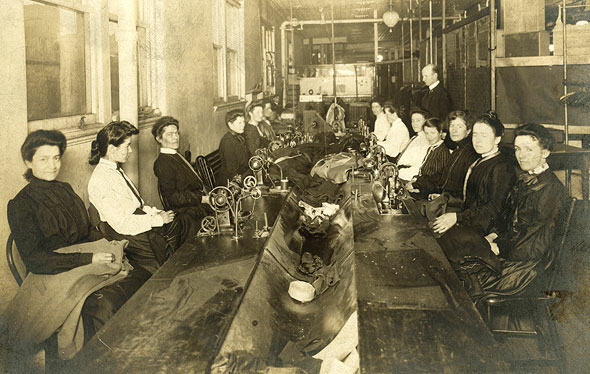
The majority of jobs open to women were manual factory work and service employment. Both were physically demanding. If a woman was lucky enough to find a position, she could count on working long hours in often poor conditions.
New York hat makers, 1907
In factories there were few breaks in the long work day. Employers commonly boarded up windows to keep employees from being distracted; and they blocked doors to discourage workers from leaving their posts before the workday was done.
Seamstresses at Eaton’s Department Store, Toronto
Those were some of the conditions that lead to one of the worst work-place disasters in American history: the 1911 Triangle shirtwaist fire. A New York clothing manufacturer, The Triangle Waist Company, locked its workers inside their assigned work areas so they couldn’t leave. Most of the workers were young women and girls as young as fourteen. When a fire broke out, their only means of evacuation was a dilapidated fire escape that collapsed under the weight of the first few workers who scrambled to safety.
Click on the image to view a pdf of the full page.
The fire took a horrific toll: 147 people burned to death or died as a result of jumping or falling from the upper floors of the burning building.
Work in private service had its own set of challenges. Women worked long hours as house maids, cooks, and charwomen (women who clean other women’s houses).
Cooks in the kitchen of a private home.
.
The work was physically demanding and they were often treated poorly. Isabella Alden gave an example of such treatment in her book, Pauline. In the story, Constance Curtiss had to fight off the unwanted advances of her employer’s eldest son because he thought a working woman wasn’t due the same level of courtesty as a lady who was his social equal:
She had always taken the position that no self-respecting young woman need fear being treated other than respectfully by men; that girls probably had themselves to thank for carelessness when any man attempted familiarity. Yet the only excuse that she had given Mr. Emerson was the fact that she had chosen to make herself useful, on occasion, in his mother’s kitchen, and accept payment in money. This, it seemed, not only shut her out from Mrs. Emerson’s parlor as a caller, which she had expected, but made the son feel privileged to call her “Ellen” and treat her with a familiarity that could have been justified only by long and intimate acquaintance. She felt that such a state of things was a disgrace to American civilization.
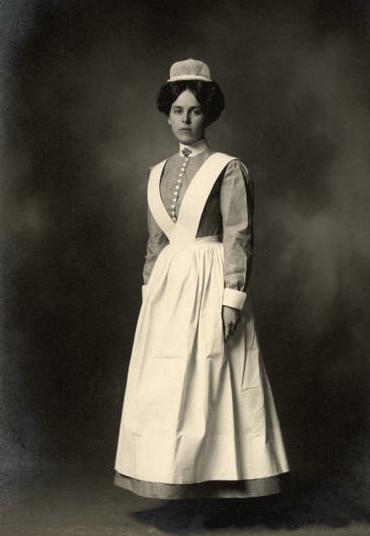
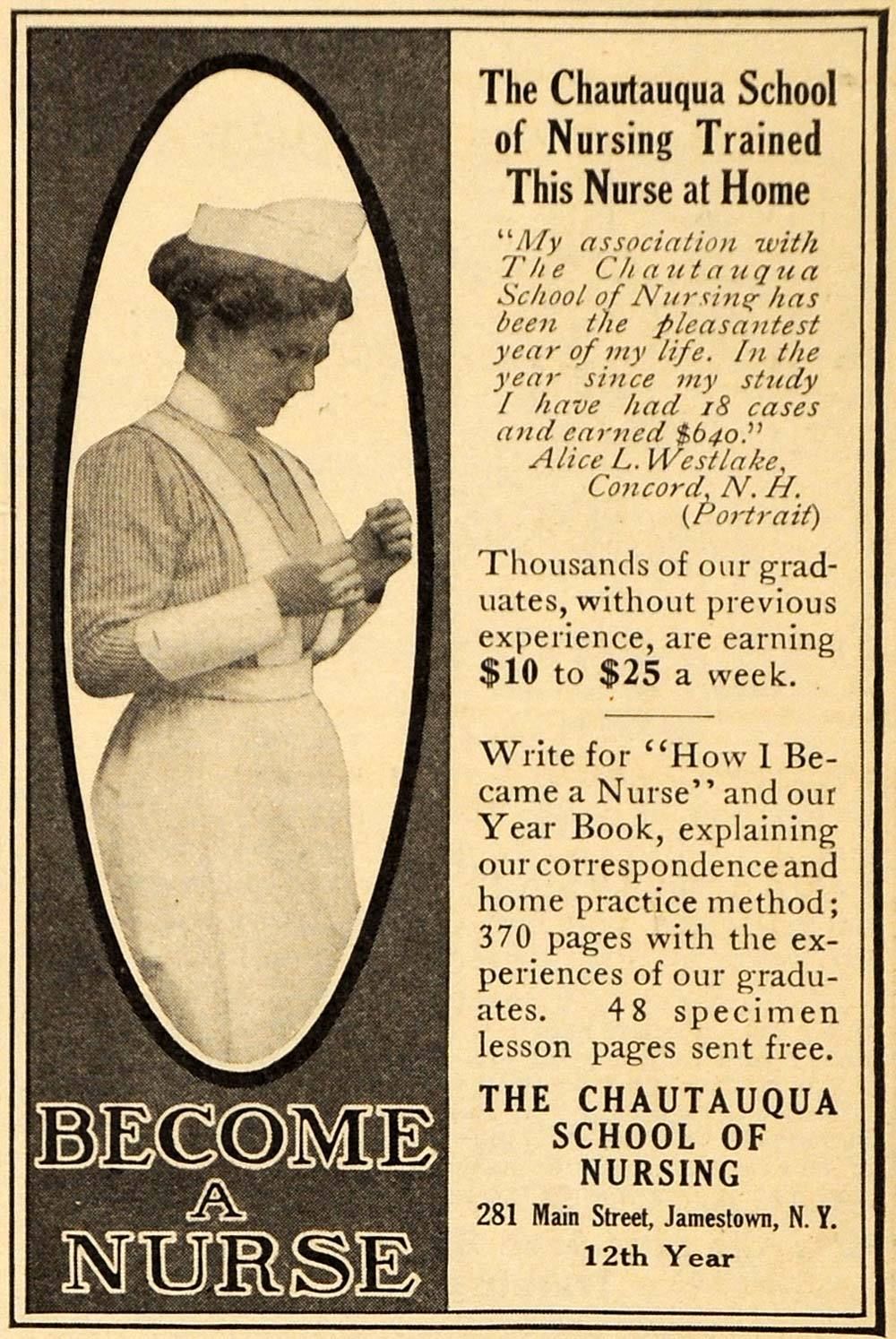
For a woman who was lucky enough—and had the financial means—to afford an education, she could go to school and be trained to work in a more skilled capacity as a teacher or nurse.
Newspaper ad for a New York nursing school
.
Summer residents at Chautauqua Institution could take advantage of courses in stenography, teaching and library science—training that opened up new job opportunities for women. (Click here to read more about courses at Chautauqua Institution.)
But that kind of training cost money. Women who had to support themselves and their families often took whatever work they could get, leaving them at the mercy of their employers’ whims and wage structures.
As Constance Curtiss discovered in Pauline, she had to put up with long hours and some embarrassing mistreatment if she wanted to keep her job.
She meant to be brave and true, and to demonstrate that the religion of Jesus Christ was of sufficient strength to bear any weight; but in order to do this she need not accept the attentions and take pleasure in the scenes that other women of her age would naturally accept and enjoy. God did not ask this of her; she was thankful that she felt sure of it. How, then, was she to ward off such attention?
On her knees that night she gave herself solemnly to the work; and the sense of humiliation that Henry Emerson’s treatment of her had induced, passed. It had come to her that she might in this way have been permitted a glimpse of his true character for a purpose.
Constance’s prayers were answered. With patience and God’s help, she found a solution to the dilemma of her employer’s son, and in the process, she became God’s agent in saving a young soul.
Next week’s post: Lady Entrepreneurs in Isabella’s Books
Want to learn more about the Triangle Shirtwaist Fire? This brief video from CBS marked the 100 year anniversary of the tragedy:
.
And this documentary video provides a more comprehensive look at the fire and its aftermath:
.
Click on the book covers to read more about Isabella’s books mentioned in this post.
It’s hard to imagine a world without Isabella Alden’s wonderful books and stories; but, left to her own devices, Isabella never would have become a published writer.
From a young age she had been taught to let her imagination soar. She began keeping a diary at the age of six, filling it with records of daily events and bits of stories. And even before she could write, Isabella’s mother encouraged her to make up little stories—perhaps from a picture Isabella would show her, or out of a few toys or some flowers. “Make a story out of it for mother,” was a most familiar sentence.
Out of those beginnings, Isabella developed her writing skills, and she continued to craft stories for the amusement of her friends and family. Her talent showed in school assignments, too; her compositions always earned good grades and won her recognition and prizes.
It was at school that Isabella Alden met her good friend, Theodosia Toll, nicknamed Docia. They were students together at Oneida Seminary in New York. After they graduated, Isabella returned to the school as a teacher; and since Docia’s family home was nearby in a neighboring town, the young women saw each other often.
After the close of one particular school year, Docia arrived to help Isabella pack up her things. Isabella was leaving the next morning to spend the long vacation at her family’s home, some eighty miles away.
While Isabella packed, she tasked Docia with sorting through the papers and books she had stored in a large trunk. As Docia went through the trunk, she came across a story Isabella had written as an entry for a writing contest. Here is Isabella’s description of what happened next:
“Why, Belle!” she suddenly exclaimed. “Here is that story you were to send to Cincinnati! Didn’t you do it after all?”
“No, I didn’t,” I said.
“But you promised!”
“No, not exactly. I said I would, if I didn’t change my mind, and I changed it.”
“Well! I think you were a perfect simpleton! It might have taken the prize. I thought it was the best thing you had written. What do you want done with it? Oh, say! Don’t you believe! The time for sending manuscripts isn’t up yet! Here is the printed slip that tells about it. There are seven days yet. Now do be sensible and send it on. Just think what fun it would be if it should win the prize!”
Then I appeared in the doorway and spoke with decision.
“I’ll do no such thing. If I can’t write a better story than that, it proves that I ought never to write at all. Tear the thing into bits and throw it in the grate with the other rubbish. I’ll set fire to them tonight.”
Luckily, Docia saw the promise in that story and instead of tearing it to bits so it could be set on fire, she submitted it to the contest under Isabella’s name.
Two months later, Isabella was shocked to receive a letter from the Western Tract & Book Society in Cincinnati, congratulating her on her win. Enclosed with the letter was a check for fifty dollars!
After she got over the initial shock of winning a prize for a story she thought she had burned, Isabella realized that Helen Lester was something to be proud of—especially once the contest judges explained the reason the story won:
“In the opinion of the carefully chosen committee of award, it met the condition imposed by the grand old Christian gentleman who offered the prize. It was to be given for the manuscript that would best explain God’s plan of salvation, so plainly that quite young readers would have no difficulty in following its teachings if they would, and so winsomely that some of them might be moved to take Jesus Christ for their Saviour and Friend.”
Original 1865 Cover of Helen Lester
And how did Isabella spend that fifty-dollar prize money? She made two packets, each containing “the enormous sum of twenty-five dollars.” She placed one of the packets inside a bound volume of her first book, Helen Lester. On the fly leaf she wrote:
“Presented to my honored father.”
The second packet went into another copy of the book; and on the fly leaf she wrote:
“To my precious mother.”
Then, in both books she wrote those “wondrous words that must have trembled with excitement, and ought to have been written in capitals”:
“From the Author.”
Helen Lester was published in 1865 and with it, Isabella’s writing career was launched. The following year she published another children’s book, Nanie’s Experiment; Jessie Wells was published in 1867, quickly followed by Tip Lewis and His Lamp. After that, she published multiple titles each year, demonstrating both her talent and her discipline as a writer.
Since then, her stories that explain salvation through Christ and the rewards of abiding faith in God have enlightened and entertained generations of readers around the world.
You can read Helen Lester for free. Click on the cover to begin reading.
You can learn more about Isabella’s friendship with Docia by clicking here.
I think if I could help to lead one person to understand and love the Lord Jesus Christ as much even as I understand Him now, so that He would be that soul’s eternal salvation, it would be ambition enough to fill a lifetime.
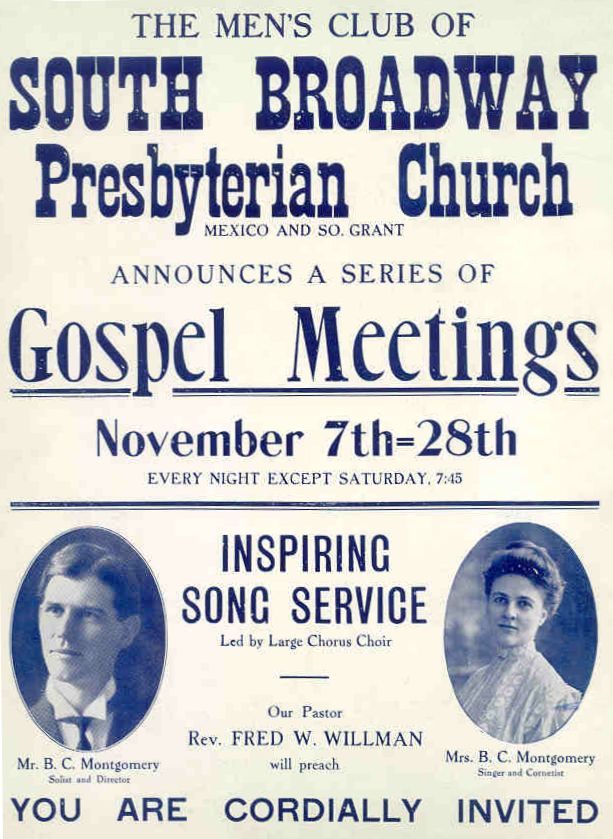
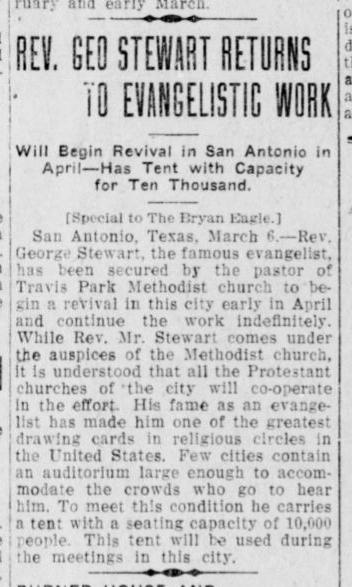
In 1911 a resurgence of spiritual awakening was sweeping across the United States. Even in the mid-west states—where “that old time religion” was firmly entrenched—people were undergoing a revival of spirit and rededication to the Christian life.
A revival meeting announcement in The Bryan Eagle (Bryan, TX) newspaper; March 9, 1911
.
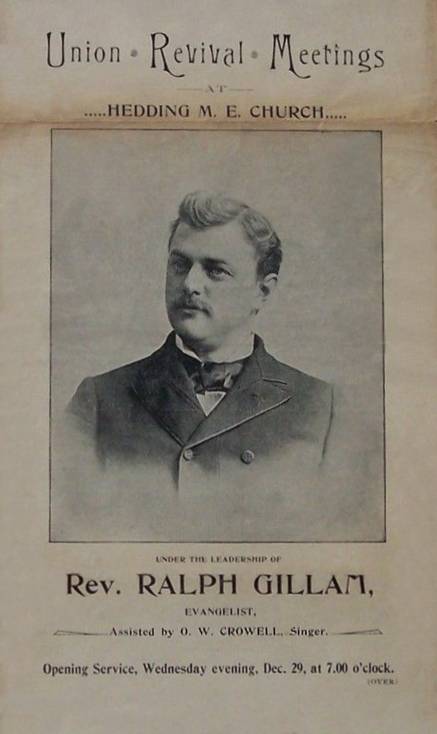
When Isabella Alden wrote Lost on the Trail in 1911, the concept of tent revival meetings wasn’t new. Only four years earlier a great Christian revival had spread across the U.S. and Canada, led by two Australian ministers who traveled the Americas converting thousands of souls.
1897 newspaper announcement of a revival meeting
.
And in 1897, when America suffered a tremendous economic crash, people turned to revival meetings for hope and comfort in a very tough time.
But by the early 1900s the Christian revival meeting had reached new levels, thanks, in many ways, to the emergence of great revival preachers and the power of the American newspaper.
Billy Sunday in 1906
.
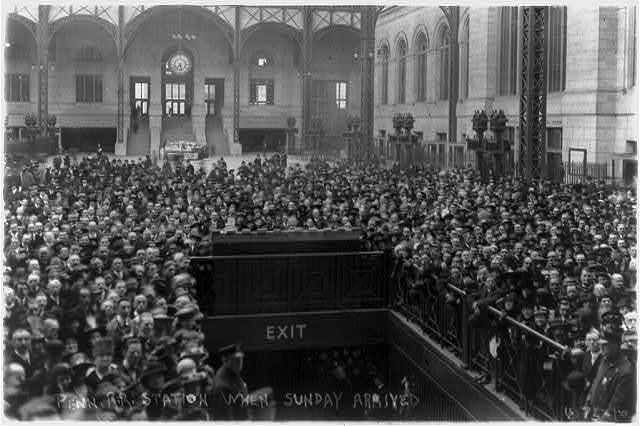
Many popular ministers traveled the country and drew large crowds, but Billy Sunday was the rock star of the revival circuit.
A crowd awaits Billy Sunday’s arrival at Penn Station, New York City
.
When Billy Sunday preached, forty to fifty thousand people went to hear him each day. He spoke in tents, open fields, and huge tabernacle structures built especially for him in Michigan, Indiana, Ohio, and New York. Newspapers reported that wherever he went, the crowds were so great police could not control them.
In Pittsburgh, the newspaper reported 3,000 club women paraded down the main street of town to a Billy Sunday revival meeting. In Chicago, the entire office force of the courthouse abandoned their desks to march to the meeting tent, accompanied by a brass band.
.
In the 1880s Billy Sunday was a baseball player. He played outfield, first for the Chicago White Sox and then the Pittsburgh Alleghenies (later, the Pittsburgh Pirates). He was a good player; he had a .291 battering average and he set a record for stolen bases. But his real calling, he believed, was giving regular locker-room sermons to his teammates about the evils of alcohol and tobacco.
After he left baseball, Billy Sunday was ordained by the Presbyterian Church, and embarked on a career as an evangelical minister.
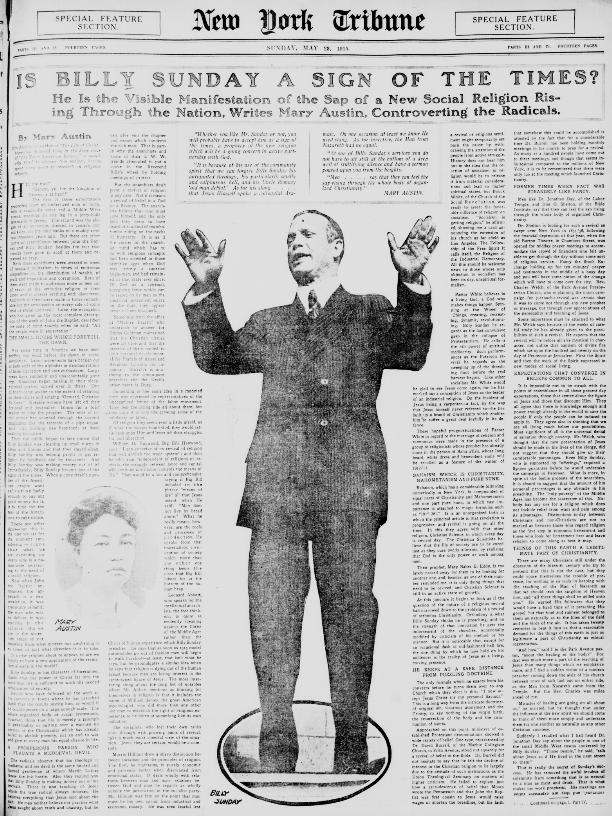
New York Times article on Billy Sunday. May 23, 1915
.
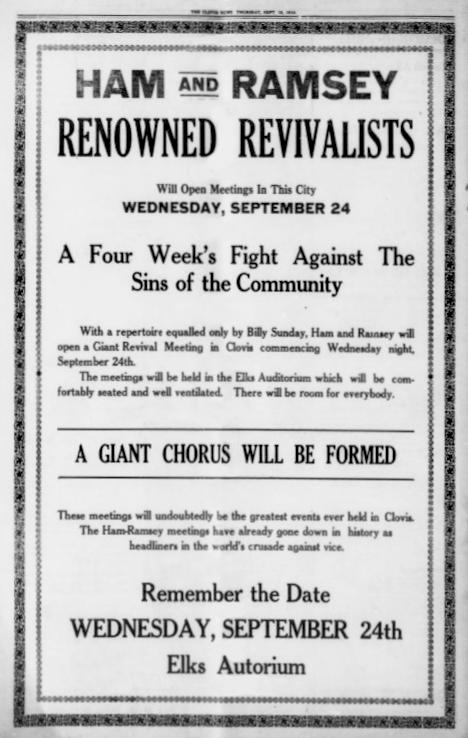
Not every revival meeting was led by a minister of Billy Sunday’s calibre. In small towns and large cities across the country, revival meetings of every size popped up during spring and summer months.
The Clovis News (Clovis, NM), September 18, 1919
.
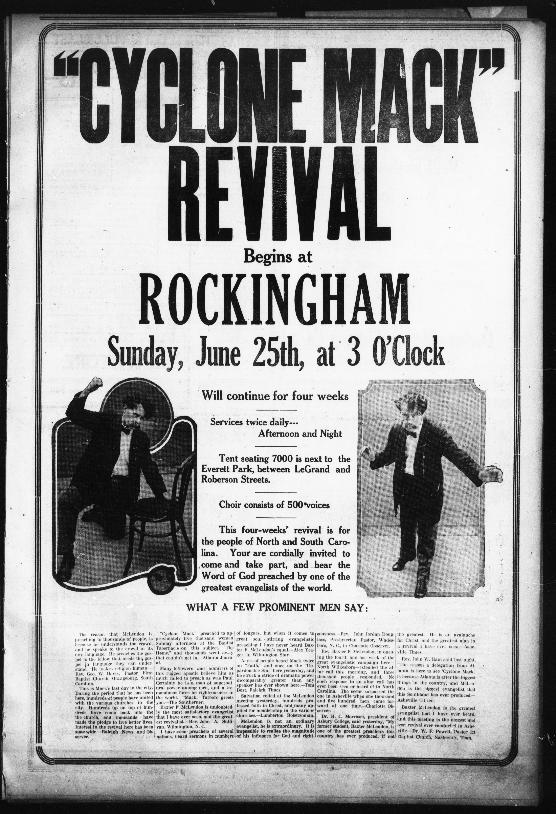
While Billy Sunday might spend up to six weeks in a single city and convert forty thousand people, most small revivals lasted one to two weeks with considerably fewer attendees—but the effect was the same: people found new faith and hope by becoming Christians, and established Christians renewed their walk with God.
Rockingham Post Dispatch (Rockingham, North Carolina), June 22, 1922
.
Revival meetings were big news. Newspapers promoted them and reporters covered the events. In 1905 The Seattle Republican actively encouraged readers to attend an upcoming revival meeting led by Reverend J. Wilbur Chapman, writing:
The thing to do is attend. Let us attend these meetings and, as Mr. Chapman says, feel every time he speaks that he is addressing you individually. Then we will be able to measure ourselves by the standard he represents and see if we are found wanting. The meetings are for the rich and the poor, for the people who are and would become Christians.
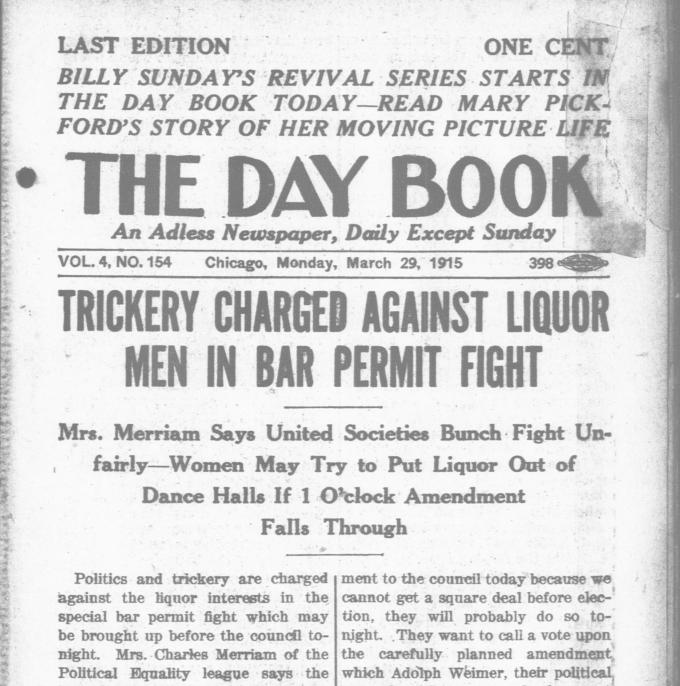
And in 1915 the Chicago Day Book invited Billy Sunday to “preach” a revival sermon via a daily column of the newspaper for five consecutive days. The Day Book promoted Rev. Sunday’s guest column in front page headlines and full-page spreads:
The Chicago Day Book announced Billy Sunday’s written sermons with the same enthusiasm it gave an interview with Mary Pickford; March 29, 1915
Full-page promotion of Billy Sunday’s written sermons to be published in upcoming editions of the Chicago Day Book. March 27,1 915
.
Newspapers in smaller towns and throughout America’s Bible belt gave revival meetings front-page attention:
Front Page of the Guthrie Leader (Guthrie, OK) ; March 7, 1914
.
Front page coverage of an evangelical revival in the Pacific Commercial Advertiser (Honolulu, HI); April 6, 1905
.
Isabella Alden drew on her experience with tent revival meetings in her allegorical novel, Lost on the Trail. In the book, a young woman named Weewona was raised from an early age by people in an isolated mountain cabin.
Announcement of a Methodist revival meeting in the Bismarck Daily Tribune (Bismarck, ND), November 26, 1910
.
But one day Weewona ventured down the mountain and stumbled upon a tent revival meeting where she heard the Christian message for the first time. Isabella used Weewona’s story to illustrate the ignorance and uncertainty we all suffer until we accept salvation through Christ.
After that first taste of God’s message, Weewona felt compelled to seek God. She headed down the mountain again, determined to learn more about the message of the revival meeting.
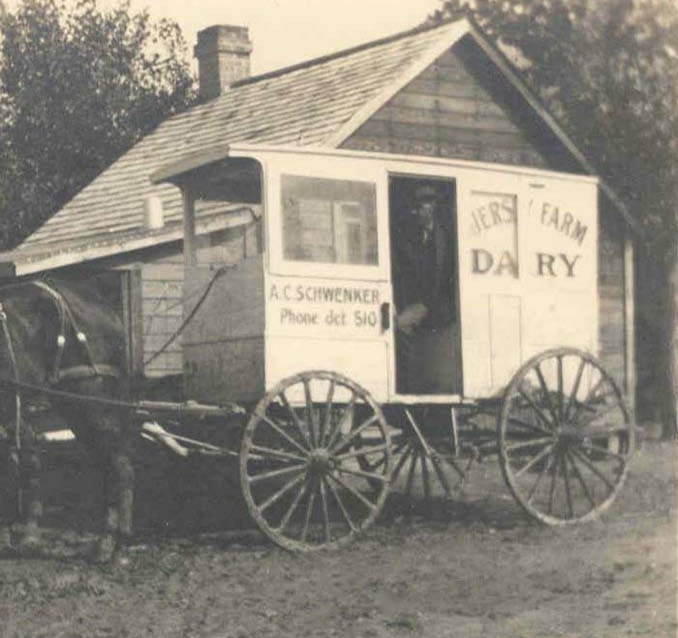
For the first time in her life she was entirely on her own and unschooled in the ways of the civilized world. Finally, a kindly milk man helped her find a home . . . and took her on her first wagon ride. After Mr. Best got her settled in his milk wagon, he tried to put her at ease by asking if she’d traveled far.
“Y-yes,” said Weewona, breathlessly, for they were in motion now, and she had never felt anything like it. Pete had told her much about horses and wagons, but it is one thing to be told about a horse, and quite another not only to see one for the first time, alive and moving, but actually to be seated on a board behind him!
“Don’t it make you afraid?” she gasped, holding on firmly with both hands.
The old man looked at her curiously; then threw back his head and laughed, an entirely fearless, reassuring laugh.
“Afraid of Old Gray!” he chuckled. “Well, now, if that ain’t a joke! I shall have to tell mother that, sure. Why, Old Gray is the gentlest, reliablest horse that ever put foot on the ground! He wouldn’t hurt a fly, even after it had bit him, if he could help it. I guess you ain’t used to horses, are you?”
She answered with a single word, but her voice made the old man look closely at her again, and speak soothingly: “You needn’t be a mite scared. There ain’t anything going to happen to you as long as Old Gray and Stephen Best have you in charge.”
Riding in the dairy wagon was the first of Weewona’s adventures, but as she learned more about God and what it meant to live a Christian life, she blossomed and found the courage, with God’s help, to make a place for herself in the world.
You can read Billy Sunday’s five-part revival sermon as it appeared in the Chicago Day Book in 1915. Click on the image to begin reading:
.
.
Here’s a short video that illustrates Billy Sunday’s style of preaching:
Find out more about Lost on the Trail by clicking on the book cover:
When Chrissy Hollister arrived to spend the summer with her friend Grace, she was shown to a guest room that was decorated in blue and white and was “just as sweet and cool and charming as it can be.”
Presently her eyes rested on the blue satin pincushion, covered with white lace. Across it lay a ribbon—a badge of some sort. Chrissy laughed as she noticed that even the ribbon, which had evidently been dropped there by accident and forgotten, partook of the general character of the room, being of white satin, and bearing on its surface, painted in delicate tints of blue, five mystic letters: “Y. P. S. C. E.”
Chrissy studied them curiously, admiring the graceful curves of the rustic work, but wondering much what those letters could represent.
As Chrissy would later discover in a rather embarrassing way, those initials stood for Young People’s Society of Christian Endeavor. She would also discover just how important that distinctive pin was.
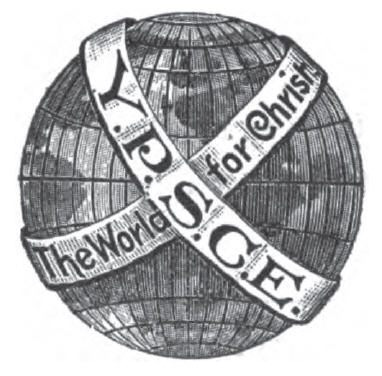
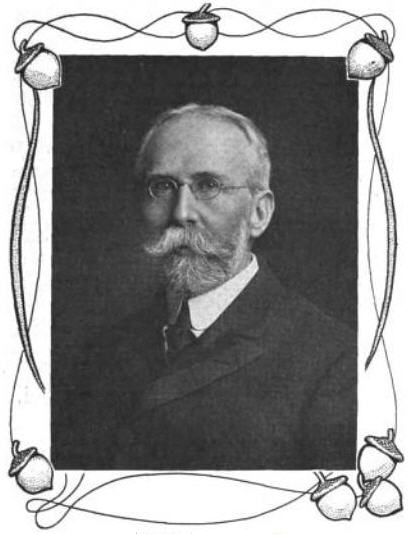
The design of the official Christian Endeavor emblem is attributed to Reverend Howard Benjamin Grose, a Baptist minister and editor of The Home Mission Monthly magazine. As a Christian Endeavor trustee, he felt strongly that the Society needed to adopt an official emblem, but the designs he’d seen were either too elaborate or expensive to produce. He wanted a simple design and felt, given the long name of the organization, the letters C and E should be made prominent.
Reverend H. B. Grose
.
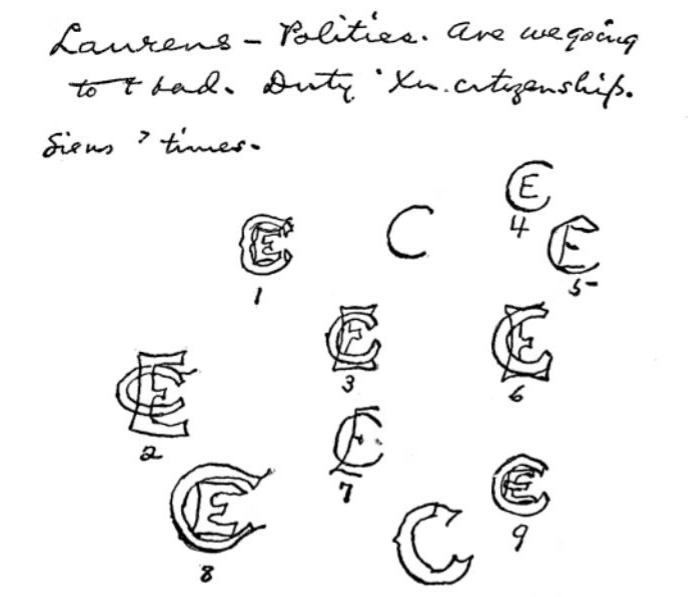
Reverend Grose began to doodle, putting the C and E together in different ways:
He proposed sketch No. 9 to the trustees, and the monogram pin was unanimously adopted in 1887.
The C embraces the E. The Endeavor is all within the Christ.
Many emblems are more showy, more glittering, more ornamental, perhaps; but I see none that satisfies me so well, or that awakens so many feelings of affection, gratitude, consecration, and hope, as the strong, simple, speaking monogram in which the E that means Endeavor is made sublimely significant by the encompassing C that marks it all as Christian.
—Rev. Francis Bell, Founder, the Society of Christian Endeavor
.
Once adopted, the Christian Endeavor emblem remained unchanged for generations. The distinctive design was enhanced only slightly for pins produced for the children’s society and Christian Endeavor organizations in other countries, such as this pin from Scotland:
The ribbon badge Chrissy saw in the guest room at Grace’s house may have been a local Christian Endeavor badge. Many state and local societies adopted their own unique Christian Endeavor colors, which they wore as ribbons on their lapels. The ribbons were usually printed or embroidered with the state name, as well as the initials Y.P.S.C.E. and the words Christian Endeavor.
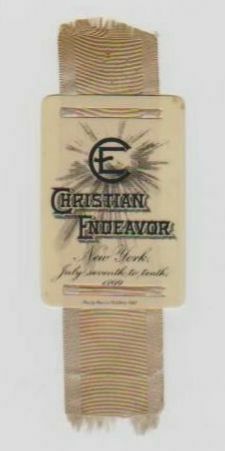
Ribbon badges were also created to commemorate Christian Endeavor annual conferences. Below is an example of the badge worn by attendees at the 1892 annual conference in New York:
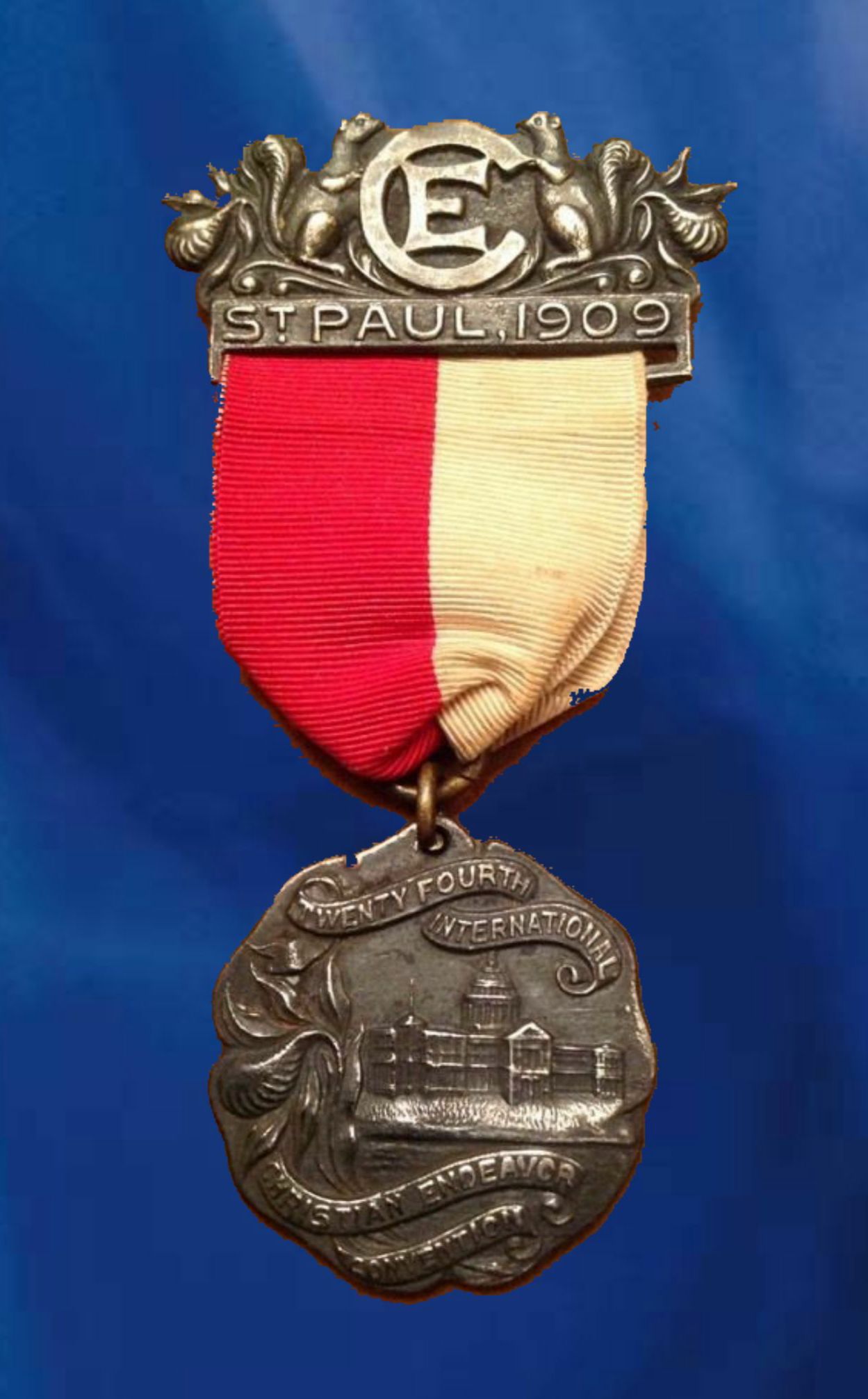
And this badge is from the 1909 national convention in Minnesota:
After Chrissy became a Christian and organized a Christian Endeavor Society in her own town, she learned the power of the little pin while riding the streetcar one day:
A plainly-dressed girl of about her own age, with a good earnest face, sat opposite her, watching her with an intentness that was only excusable because of the absorbed and almost tender light in the girl’s eyes, which lifted her act far above the commonplace stare. At last, seeming to have gathered courage for a resolve, she arose and took a vacant seat beside Chrissy.
“I beg your pardon,” she said in low, well-bred tones, “may I speak to you? I am a stranger, but I see that we are kindred.” Touching as she spoke, the tiny silver badge she wore, bearing the magic letters “C. E.,” and glancing significantly at the corresponding one of gold, which fastened Chrissy’s linen collar.
There was an instant clasping of hands, and an exchange of cordial smiles.
The plainly-dressed girl explained that a friend of hers had attended a Christian Endeavor meeting—the very Christian Endeavor Chrissy organized in her town.
‘And she liked it all so much, that she came home and told about it, and did not rest until she had started a society out of our class in Sunday school. I joined as an associate member, because I was ready to do whatever the others did, but I got acquainted in that society with Jesus Christ. I signed the pledge, and gave myself to Him forever; and I’ve had a good winter.”
Chrissy was surprised and humbled to know that her efforts resulted in a soul being won for Christ. “Unfaithful, unreliable in every way, yet He had used her in the harvest field!” wrote Isabella Alden.
Members of two Christian Endeavor Societies pose on the steps of Antioch College in the shape of the CE monogram, circa 1895.
.
Isabella and her husband, Reverend Alden were tireless workers for Christian Endeavor. Isabella featured the society in her books Chrissy’s Endeavor, Her Associate Members, Pauline, and What They Couldn’t. She also wrote several short stories about Christian Endeavor: One Day’s Endeavoring and A Christian Endeavor Revenge were published in the Christian Endeavor magazine, TheGoldenRule. And her book GraceHolbrook was a compilation of several short stories that illustrated the principles of Christian Endeavor for children.
You can learn more about today’s Christian Endeavor by clicking here to visit their site.
Click on the book covers below to find out more about the books mentioned in this post.
In The Browns at Mount Hermon, Mrs. Roberts was overjoyed when her most fervent prayer was answered—her daughter, Ailene gave herself to the Lord. Mrs. Roberts wanted to celebrate the blessing in the best way she knew how: by preparing a special breakfast for everyone to enjoy.
“Oh, well, we won’t mind if we don’t have muffins for breakfast tomorrow morning. What does it matter what we have to eat? Yes, it does, it matters a great deal. We want the best breakfast tomorrow morning that was ever had in this house. I should like to feed everybody on roses! Though after all, I don’t suppose they would like them to eat half so well as they do muffins. Or Sally Lunn; I’ll have Sally Lunn tomorrow, whole sheets of it. Mr. Brown says nothing was ever better to eat than my Sally Lunn; and Ailene likes it better than anything else; I wonder I didn’t think of it the first thing. Oh, Mary Brown! I’m that happy tonight over the child, that it is a wonder I can think of anything to eat! I feel as though I could fly, without wings. Don’t you think she’s settled it! She belongs to the Lord!”
Sally Lunn was a type of cake that originated in England; and there are American versions of the Sally Lunn recipe in cook books dating back to early 1800s. By 1907, when The Browns at Mount Hermon was written, Sally Lunn had become a favorite pastry on American tables, too.
Henry’s Cook Book and Household Companion (1883)
There were as many versions of Sally Lunn as there were cooks; but, in general, Sally Lunn was a rather dense cake, much like sponge cake, that could be baked in a variety of ways.
For breakfast, it was usually made up in loaves, then served toasted and spread with butter.
A Sally Lunn cake, pictured in The Winston Cook Book by Helen Cramp (1913)
It was also baked in muffin tins and served as tea-cakes with honey, fruit jelly, or sweet sauce.
Sally Lunn tea cakes. From Good Housekeeping magazine, 1907
If you made several sheets of Sally Lunn, as Mrs. Roberts planned to do, and it happened to go stale because you didn’t eat it fast enough, never fear. A 1903 edition of The Epicure magazine recommended cutting stale Sally Lunn cake into small slices or shapes, soaking then in a thin custard, and frying them in clarified butter. Sprinkle the top with sugar, and “you had very good Beignets.”
Here’s a recipe from 1913 that may have been close to the recipe Mrs. Roberts followed for her Sally Lunn cake:
Click on the image to see a larger version you can print out.
You can learn more about the history of Sally Lunn cake. Click here to read a post at Smithsonian.com about Sally Lunn cake.
Click on the book cover to find out more about The Browns at Mount Hermon.
Reviews and giveaways for Christian fiction and sweet, clean fiction. Bringing readers information on great stories and connecting authors with their readers.

 In the book Interrupted, Claire Benedict asked Louis Ansted if he was a Christian. When he said he was not (in a round-about way), Claire asked if he believed Christ “once lived in person on this earth, and died on a cross, and went back to heaven, and is to come again at some future time?”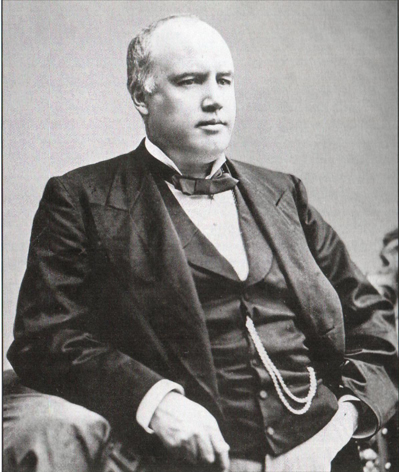
 When Interrupted was published in 1885, Ingersoll’s book The Mistakes of Moses was very popular. In the book, he collected passages from the Pentateuch that contradicted scientific thinking of the time, and even contradicted each other. He used those passages to build a case against the Pentateuch, which Ingersoll called “a record of a barbarous people, in which are found a great number of the ceremonies of savagery, many absurd and unjust laws, and thousands of ideas inconsistent with known and demonstrated facts.”