A Life-Changing Accident

December 8, 1925—almost exactly 100 years ago—started as any ordinary Tuesday afternoon in Palo Alto, California. Isabella Alden was 83 years old, and was living in the beloved double-home that she and her husband Ross built a decade before on Embarcadero Road.

Ross and her son Raymond had died the year before, so only Isabella and her daughter-in-law Barbara (Raymond’s widow) and her five children were left to share the rambling house.

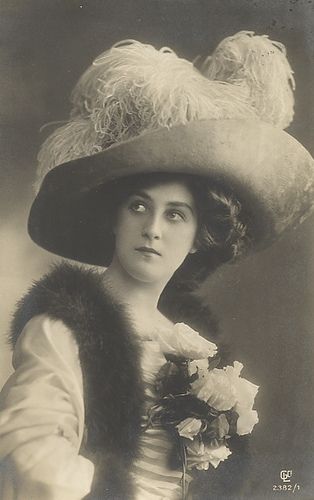
Barbara Hitt Alden, about 1910.

That afternoon, Isabella, Barbara, and Barbara’s youngest son, Raymond Jr., set out together in the family car. Barbara was behind the wheel. None of them could have known that their simple outing would dramatically change the remainder of Isabella’s life.

Black and white photo of a side-view of an old automobile with four doors and a woman seated in the driver's seat.
A 1925 Lincoln sedan, a popular car style in the 1920s.

At a street intersection a little less than a mile from their home, another car collided with the Alden vehicle, striking it with enough force to cause it to overturn. The impact shattered the windshield and windows, showering the passengers with broken glass.

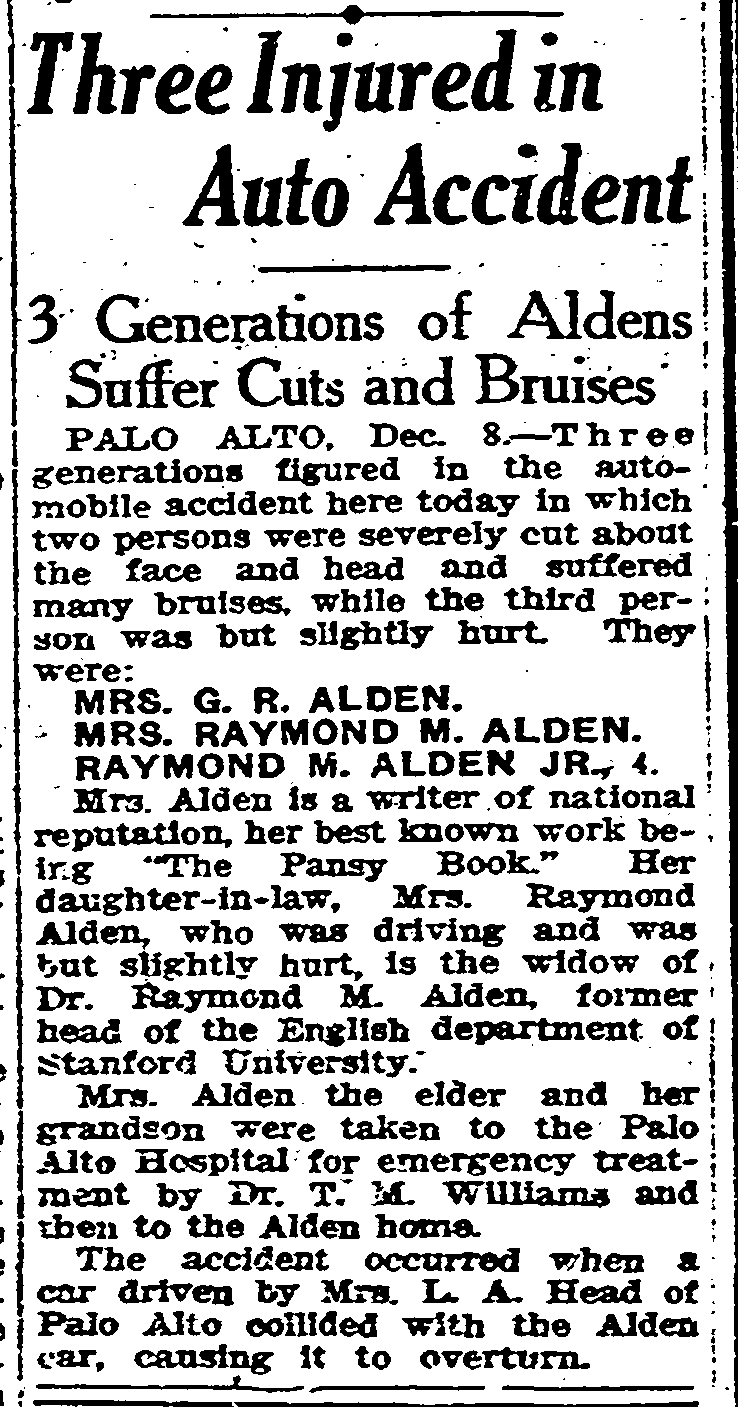
Newspaper Clipping: 3 Generations of Aldens Suffer Cuts and Bruises. Three generations figured in the automobile accident here today in which two persons were severely cut about the face and head and suffered many bruises, while the third person was but slightly hurt. They were: Mrs. G. R. Alden, Mrs. Raymond M. Alden, Raymond M. Alden Jr., 4.
The San Francisco Chronicle, December 8, 1925.

Barbara was only slightly hurt. But Isabella and her young grandson suffered “severe cuts about the face and head, and many bruises.” After receiving first aid from a nearby physician, Isabella and Raymond Jr. were taken to Palo Alto Hospital for treatment.

Palo Alto Hospital in the 1920s.

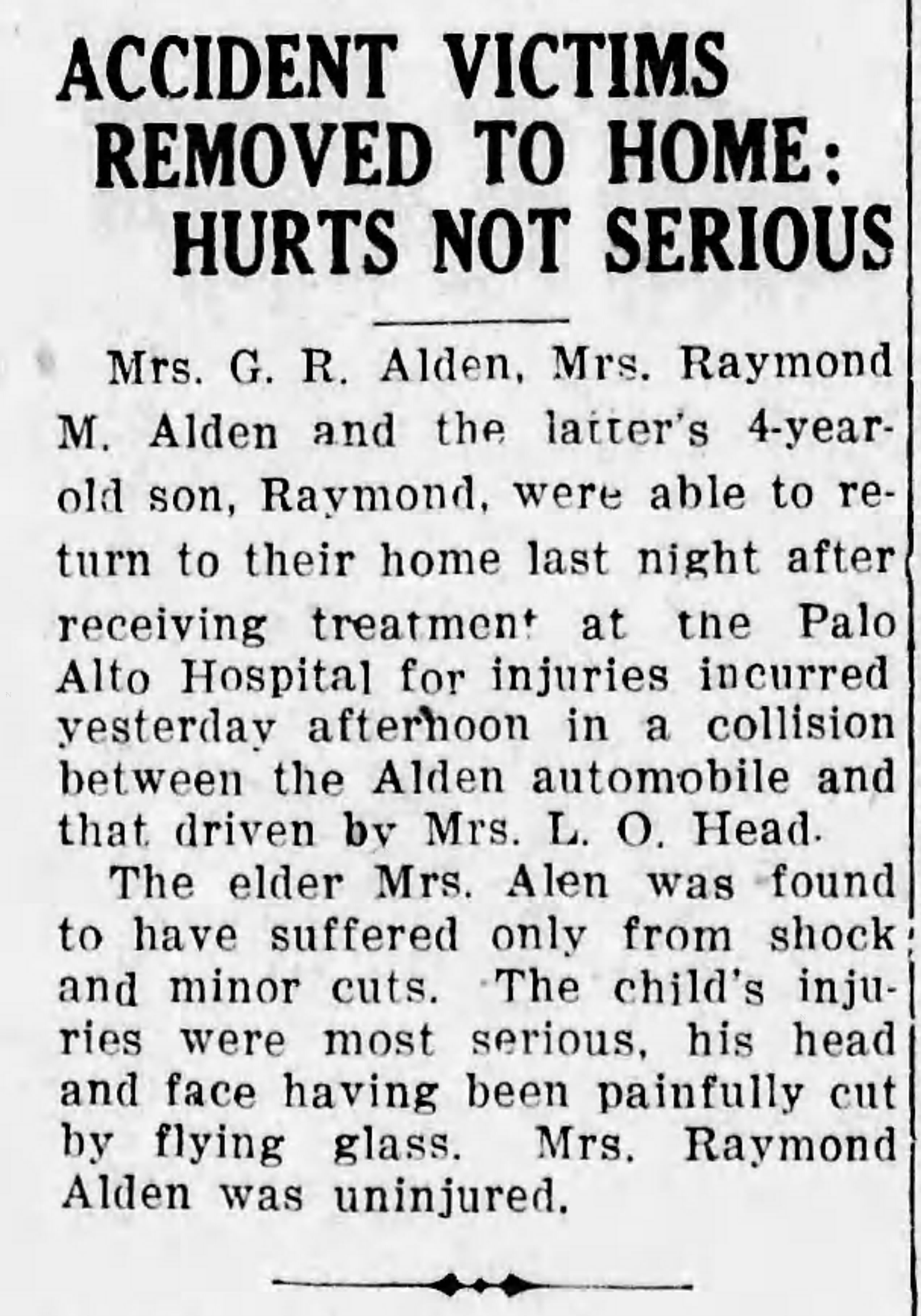
The next day’s newspaper reported reassuring news: the accident victims had returned home, and Isabella “was found to have suffered only from shock and minor cuts.” Her grandson’s injuries were described as the most serious of the three.

Newspaper Clipping: Accident Victims Removed to Home: Hurts Not Serious. Mr. G. R. Alden, Mrs. Raymond M. Alden, and the latter's 4-year-old son, Raymond, were able to return to their home last night after receiving treatment at the Palo Alto Hospital for injuries incurred yesterday afternoon in a collision between the Alden automobile and that driven by Mrs. L. O. Head. The elder Mrs. Alden was found to have suffered only from shock and minor cuts. The child's injuries were most serious, his head and face having been painfully cut by flying glass. Mrs. Raymond Alden was uninjured.
The Peninsula Times Tribune, December 9, 1925.

But that assessment would prove tragically wrong.

What those initial medical evaluations missed was the true extent of Isabella’s injuries. The accident left her in considerable pain and, ultimately, confined to a wheelchair for most of the remaining years of her life.

Until the accident, Isabella was a woman who had been remarkably productive well into her eighties—still writing, still engaged with her work and family. The accident didn’t just slow her down; it fundamentally altered how she could live her remaining years.

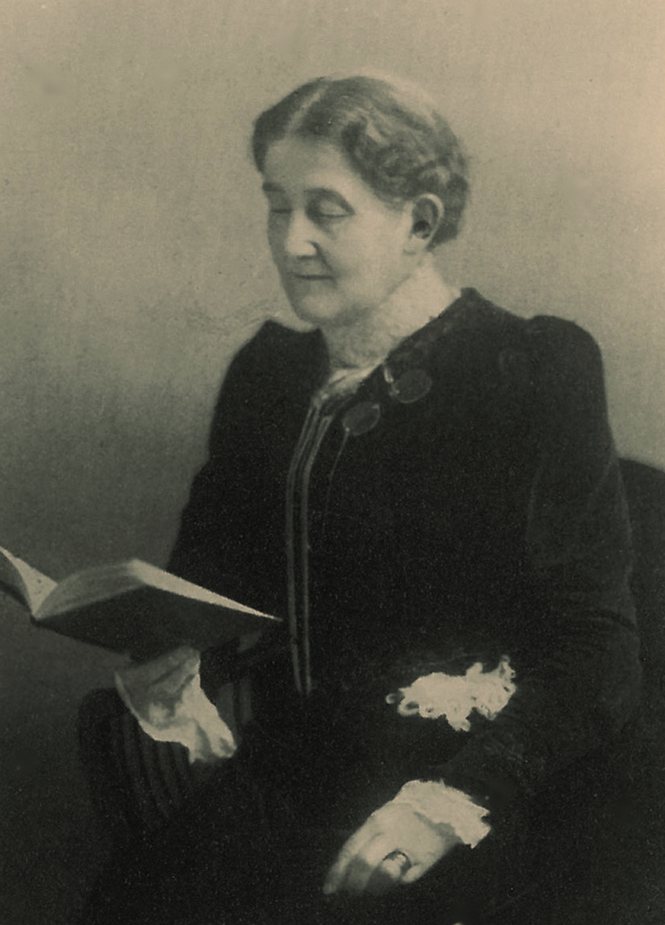
Isabella in later years.

In her memoir “Memories of Yesterday,” which she finished writing after the accident, Isabella documented the physical pain she endured. For a woman who had spent her life in service to others, who had quietly helped so many navigate their own difficulties, those final years must have been particularly difficult for her.

Isabella lived for nearly five more years after the accident, passing away in 1930 at age 88. Those years, spent largely in a wheelchair and dealing with chronic pain, were a far cry from the active, engaged life she had led for more than eight decades.

What is striking about this incident in Isabella’s life isn’t just the tragedy of the accident itself, but what it reveals about her character during her final years. Despite her pain and limitations, she continued to write. She finished her last novel, An Interrupted Night, and entrusted it to her niece, Grace Livingston Hill, to guide it through the publishing process.

She also completed her memoir, Memories of Yesterdays, candidly sharing her memories and reflections on a life well-lived. Even when her body was confined to a wheelchair, her mind and spirit remained active.

That’s the Isabella Alden we’ve come to know through her writings—someone who lived out the principles she wrote about, even when circumstances became difficult. She had spent decades writing about faith, perseverance, and finding purpose in adversity. In her final years, she had to draw on those very principles herself.

A hundred years ago this month, Isabella’s life changed forever on a Palo Alto street corner. While the accident limited her physical abilities, it couldn’t diminish the legacy she’d built through decades of faithful work—or the strength of character that sustained her until the end.

Click on the links below to read more about:
The house on Embarcadero Road
The deaths of Ross and Marcia Livingston
The death of Raymond Alden
Isabella’s final novel, An Interrupted Night

A Feather in Her Hat

Rebecca’s dress was entirely appropriate and becoming. She had gone out from her father’s house very well supplied with clothes, and her ability to re-make them herself had stood her in good stead, so that now her dress of fine black cloth, made severely plain, but with minute attention to details, became her well. So did the black felt bonnet, with its three stylish plumes, which she had herself dressed over.

from Wanted, by Isabella Alden, published in 1894

In her stories, Isabella often used the latest fashion to define a character’s financial and social status, and Rebecca Meredith’s outfit was an excellent example. Because her dress was plain and black, her bonnet “with its three stylish plumes” was the centerpiece of her outfit and called attention to her pretty face.

Bonnets with plumes were very much in style when Wanted was published in 1894. Women’s magazines, like Godey’s Lady’s Book and The Ladies Home Journal showed that hats were be made from a variety of materials—straw, for example, or stiffened fabrics like velvet—and that they were quite modest in size.

Black and white illustration of a young woman wearing a long gown in the fashion of 1895 with extremely large puffed sleeves, and a high collar with a large bow at the back. On her head is a bonnet with a short brim, decorated on top with flowers, gathered ribbons, and an aigrette of short bird plumes.
From Godey’s Lady’s Book, August 1895.

Though small, hats at that time were heavily adorned with ribbons, bows, artificial flowers and, most importantly, bird plumes.

A black and white drawing of a woman wearing a short belted coat with long sleeves and a collar that stands up to cover her neck. On her head is a small hat with a short brim, adorned with ribbons, flowers and a cluster of curled bird feathers at the top.
From Godey’s Lady’s Book, October 1897.

Bird feathers were the most desirable decorative elements on a lady’s hat. In 1894 The Ladies Home Journal predicted that actual wings displayed on bonnets would be “all the rage,” while another magazine wrote that “almost every second woman one sees in the streets flaunts an aigrette of heron’s plumes on her bonnet.”

Color illustration of a woman dressed in a coat and hat from about 1900. Her hat has a wide brim and is piled on top with arrangements of ribbons and two long bird feathers set at an angle pointing toward the back of the hat. A wide red ribbon tied beneath the woman's chin keeps the bonnet in place.

Milliners used feathers from egrets, hummingbirds, herons, and even song birds of all kinds as adornments.

Black and white photo of a woman wearing a dress from the 1890s. On her head is a flat brimmed hat; the crown of the hat is covered with flowers, gathered ribbon, and a single large bird feather in the front. The feather stands straight up on its stem and is adorned with beads.
From Godey’s Lady’s Book, 1898.

The more exotic the bird, the more desirable their feathers; and the millinery industry was willing to pay top dollar to anyone who would supply them, no questions asked.

But some people did ask questions and raise alarms, after nature lovers in England and the United States discovered that some birds, like ospreys and egrets, were hunted so mercilessly, ornithologists feared they would soon be extinct.

Newspaper clipping: BIRDS VICTIMS OF PRIDE. We have received some letters from our readers enforcing the words of Mrs. Aria as the the cruel price that has to be paid for the osprey's feathers, which are in vogue just now in women's headgear. Mrs. Phillips writs to point out that these feathers can only be obtained at breeding time. The plumage is torn from the living parent birds on the nest, which are then flung aside to die, while the young birds are left to starve. Could anything be fore horrible! The bare recital of these facts should be enough to put an instant stop to such a merciless trade.

In London, a Society for the Protection of Birds was formed. Members pledged to never wear feathers of any bird not killed for the purpose of food. Similar organizations were formed in Europe, Canada, and the U.S.

Newspaper clipping: BIRDS IN OUR BONNETS. In response to many inquiries, we would draw attention to the Society for the Protection of Birds, 29 Warwick Road, Maida Hill, London, of which Miss Hannah Poland is the secretary. There is no subscription fee, but any one wishing for a card of Membership can have one by sending two stamps to Miss Poland. Members promise not to wear feathers of any bird not killed for the purpose of food, the ostrich excepted.

The public outcry began to pay off, as women around the world pledged to stop wearing hats with real bird feathers, and American lawmakers enacted state and federal laws to protect certain species of birds by banning them from use in hats and garments.

One bird that was exempt from protection was the ostrich, because its feathers could be harvested without killing the bird. So it was natural that the millinery industry would turn its attention to ostriches as a source for adornments.

Black and white photo of a woman wearing a hat with a wide brim of 12 to 14 inches deep. The crown of the hat is covered in ostrich feathers that are piled about 12 to 14 inches high, giving a waterfall effect.

Ostrich farms that had been established in the southern United States in the late 1890s in hopes of selling feathers to the millinery industry suddenly saw an increased demand for their wares.

Color photo of a herd of about 40 ostriches running across a fenced enclosure.
An ostrich farm in southern California.

And because ostrich feathers could be plucked every eight or nine months, ostrich farmers with large herds enjoyed a regularly replenished inventory they could sell.

Black and white photo of a woman wearing a short-brimmed hat. A wide ribbon circles the crown of the had and is arranged in multiple loops in front. The stems of two long ostrich feathers are tucked into the ribbon arrangement and the feathers drape back cross the crown of the hat.

With the turn of the century, hat styles changed, and the small bonnets that were popular when Isabella wrote Wanted fell out of fashion. The new bonnet styles of the 1900s featured wide brims and brilliant colors.

Ostrich plumes suited the new styles beautifully. Because of their size, the plumes could cover a large hat’s crown and brim.

Hand-colored photo of a woman wearing a hat with a wide brim of 12 to 14 inches deep. The crown of the hat is covered in ostrich feathers that are piled high, with some parts of the feathers spilling over the brim of the hat.

Even more importantly, ostrich feathers could be dyed to match almost any color. Women and conservationists rejoiced, feeling confident that they could use ostrich feathers for fashion without feeling guilty.

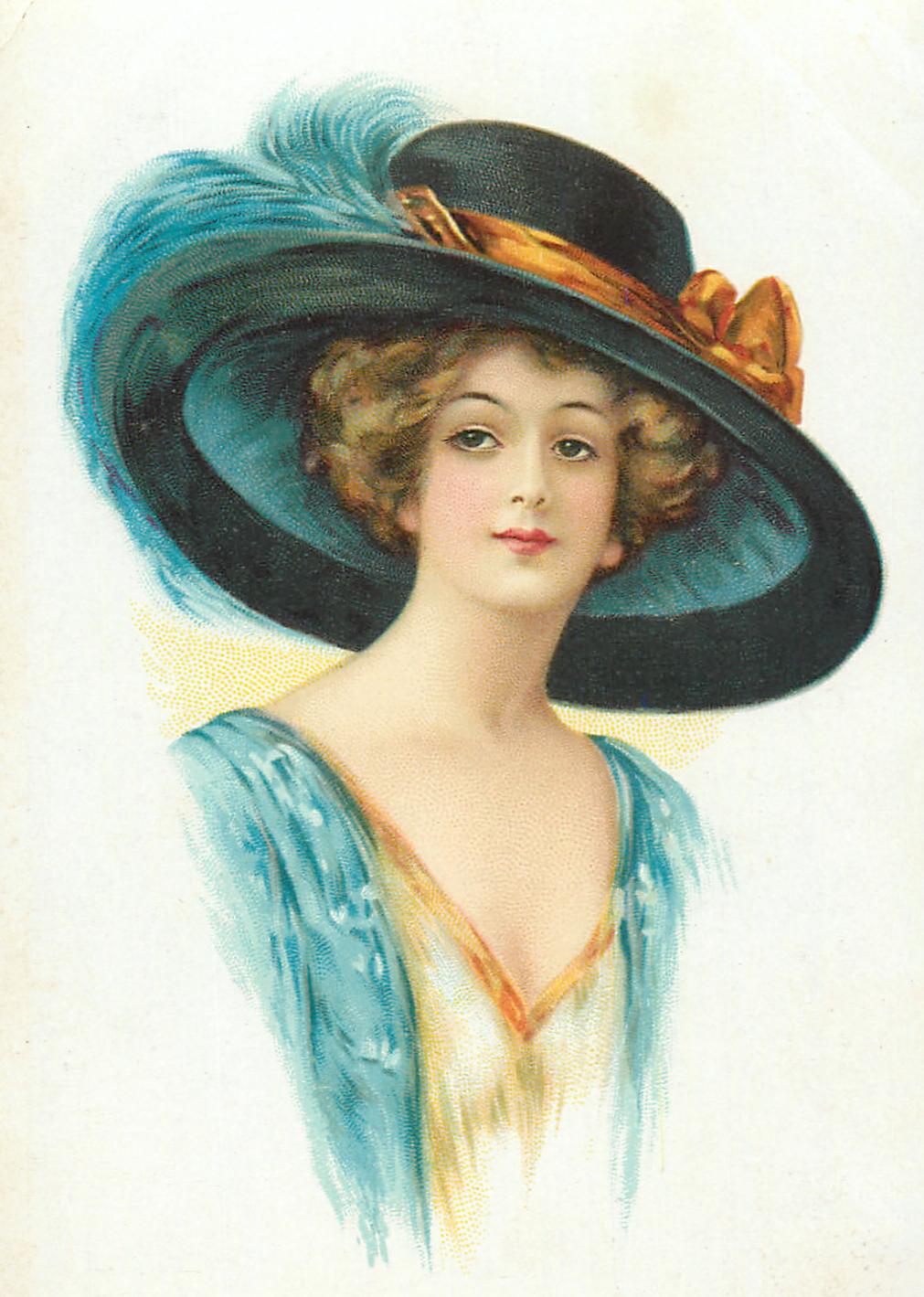
Color illustration of a woman wearing a wide brim bonnet about 14 to 18 inches deep. The bonnet is black but the lining is a brilliant blue. A wide orange-gold ribbon circles the crown of the hat and is tied with a large bow. On the opposite side of the crown feathers of the same brilliant blue are arranged in a cluster across the brim.

In her 1912 novel The Long Way Home Isabella made sure her fashionable characters wore the latest style in bonnets. Newlywed Ilsa Forbes wore a wide-brimmed hat when she boarded the train with her new husband Andy:

But Andrew had no words, just then; never was the heart of bridegroom more filled to overflowing, and he could not yet think about decorations or supper.
“My wife!” he murmured, as his arm encircled her. “Really and truly and forever my wife. Do you realize it, darling?”
She nestled as closely to him as her pretty, new traveling hat would permit and laughed softly.

There was, however, a problem with those stylish large hats adorned with ostrich feathers. In 1908 a letter to the editor of the Oregonian newspaper applauded the ban on exotic bird feathers, but raised a new and troubling concern about ostrich feathers:

Newspaper clipping: The only plumage I have cared to wear is the ostrich feather, and I may yet become convinced that this practice is incompatible with my convictions. Having witnessed many times the plucking of ostriches in Southern California, I have been unable to see that there was any special cruelty attached, though I have no doubt the sensation experienced by the ostrich might be much like we would feel in having a deep-rooted molar drawn.

The letter-writer wasn’t the only one wondering if an ostrich felt pain when its feathers were plucked. Soon the Audubon Society and other conservationists began asking the same question and took their findings to state legislators.

In California, where Isabella was living and where many of the country’s ostrich farms were located, the question was answered by lawmakers. In 1900 the state updated its penal code to make it a crime to intentionally mutilate or torture a living animal, which included plucking live birds like ostriches.

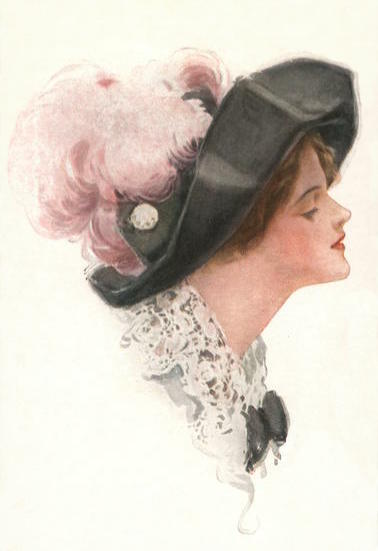
Profile of a young woman wearing a black bonnet with a wide brim turned up in the front. At the back of the crown is a cluster of long, fluffy, pink ostrich feathers.

So ostrich farmers stopped plucking and began snipping feathers, instead. A 1911 article in the Dallas Morning News explained the process:

Newspaper clipping: While the term "plucking' is given to the harvesting of the feathers, the fact is that they are not plucked or pulled out, but are snipped off by means of shears. This process is gone through every eight months, and the quality of the plume depends largely upon how it is cut. There are twenty-five long white plumes on each wing of the male bird. The rest of the feathers are black on the male and a grayish color on the female. Harvesting the plumes is no easy task.
From The Dallas Morning News, November 12, 1911.

Once again, stylish ladies (and Isabella’s equally stylish characters) could wear hats adorned with feathers and maintain a relatively clear conscience.

It’s interesting how Isabella’s attention to details, like hat sizes and adornments, brought her stories to life. While she didn’t preach about fashion in her novels, she paid close attention to these niceties, and used them to bring authenticity to her characters and their world. Contemporary fans of her novels would have noted the subtle changes as keeping up with the times.

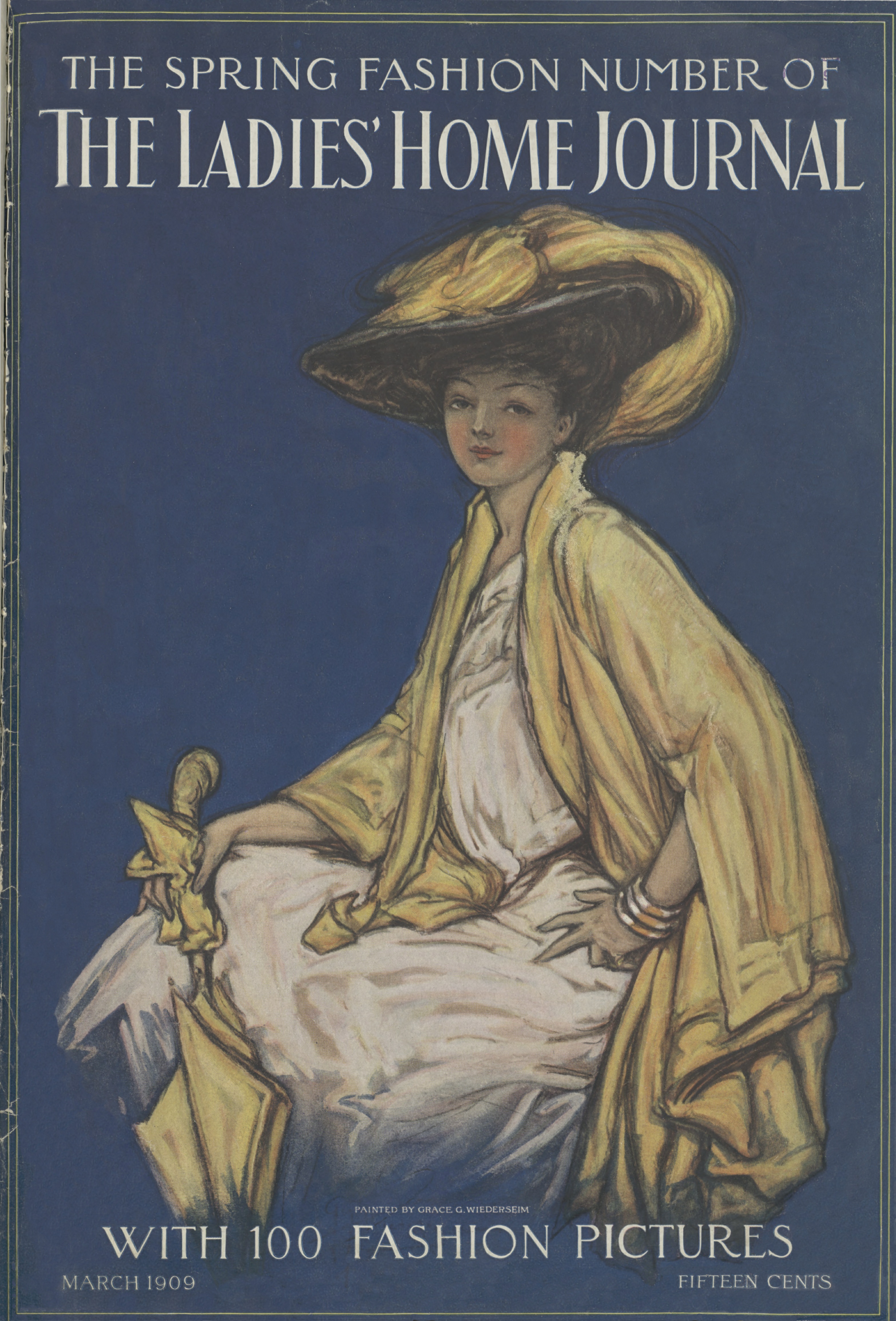
Cover of The Ladies' Home Journal magazine. The color illustration shows a stylish young woman seated, wearing a white dress. A gold colored cape is drawn open with one of her hands. In the other hand she holds a matching pair of gloves and an umbrella. On her head is a wide-brimmed hat fashionable in 1909. Covering the brim of the hat and cascading over the brim at the back is an arrangement of feathers dyed gold to match her outfit.

For us in 2025, it’s fascinating to learn there’s a whole complicated history behind Rebecca Meredith’s feathers—a history about women who were determined to write wrongs and find ways to be fashionable without compromising their conscience.

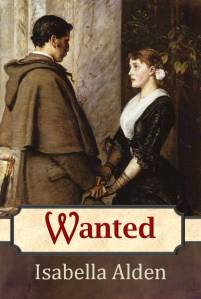
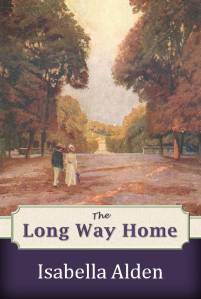
You can learn more about Isabella’s novels mentioned in this post by clicking on the book covers below:

Full disclosure: these are Amazon affiliate links, which means if you decide to purchase through them, this blog will receive a small commission. It doesn’t cost you anything extra, but it helps us keep this site running and researching Isabella’s life and the fascinating world in which she lived.

What One Good Library Can Do

When Isabella Alden began writing her beloved “Pansy” books in the 1870s, the literary landscape looked very different than it does today. There were few public libraries like the ones we have now; instead, churches filled that role by establishing their own library systems.

The Sunday-school library was a powerful force in 19th-century America. They didn’t just lend books—they curated collections of books that shaped readers’ moral and spiritual development.

Not all Sunday-school libraries were created equal; some churches seemed to have unlimited resources to maintain a well-stocked library of five-hundred books or more, displayed in neat rows on well-built shelves; while others had only a few titles in their collection.

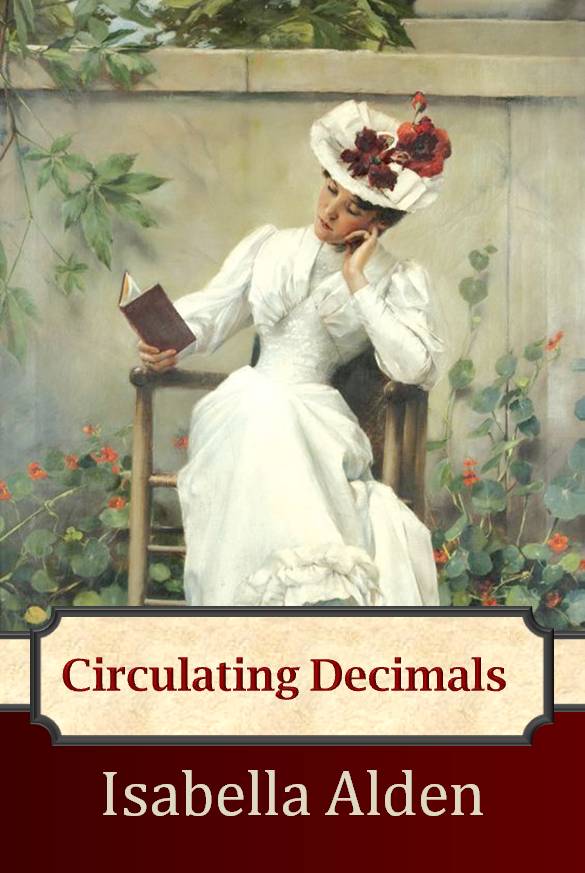
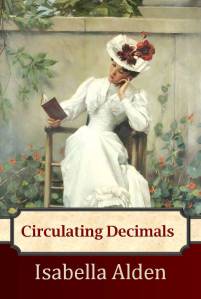
Cover of the story "Circulating Decimals" by Isabella Alden, showing a young woman dressed in the style of about 19095 wearing a white dress with white sleeves and a high color and floor-length skirt. On her head is a white hat with large red poppy flowers. She sits on a rustic wooden chair in a garden, holding a book in one hand, which she is reading, while her head rests on the other hand as her elbow rests on the arm of the chair. Behind her is a stone garden wall with vines and red flowers creeping up the wall.

Isabella’s short story, “Circulating Decimals” is about the efforts of a community to raise money for just such a church library that has fallen into a “disgraceful condition” due to neglect and lack of funds. (You can click here to read the story for free.)

But regardless of size or budget, church libraries had one mission in common: to offer readers books that supported religious instruction, moral development, and the spiritual growth of the congregation.

Churches established committees to evaluate each potential library addition against a set of religious standards. The minister often played a role in recommending or vetoing books, which were also chosen based on their theological soundness and ability to promote standards of Christian living.

The Grace Methodist Episcopal Church of Taunton, Massachusetts had a rather large library of over five-hundred books, and included some of Isabella’s novels, as well as books by Margaret Sangster, E.P. Roe, and other Christian fiction authors.

The church divided their book collection into categories and published a catalog for members of their congregation. The fact that Isabella had ten of her books included in the catalog shows how well the moral messages of her stories aligned with the church’s values and appealed to readers of all ages.

(You can click on the image above to see the entire Grace M.E. Sabbath-school Library catalog of 1904.)

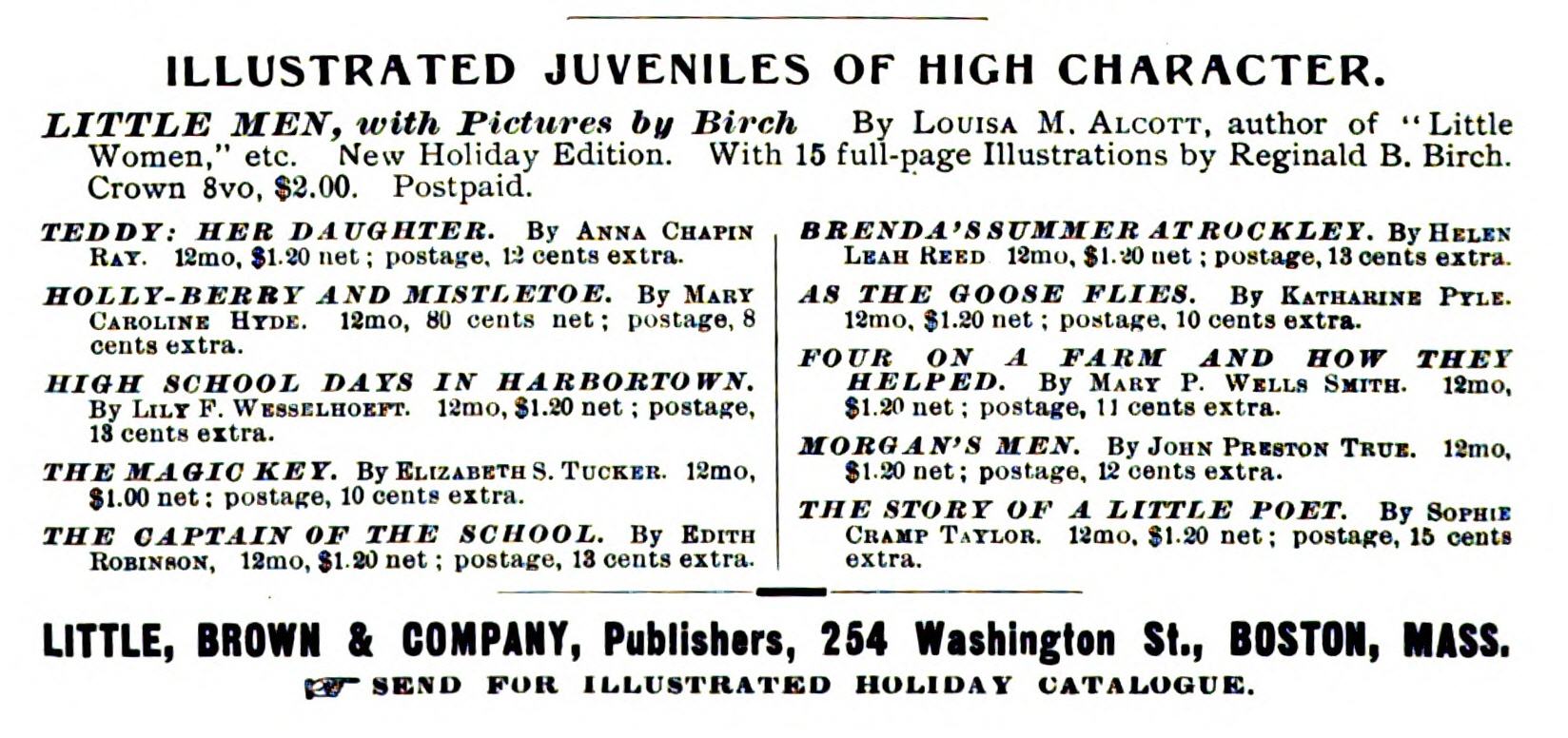
Mainstream publishers like Little, Brown and Company actively marketed their wholesome books to churches. This advertisement in “The Sunday School Library Bulletin” magazine shows their newest offering to churches included a new edition of “Little Men” by Louisa May Alcott:

Magazine ad for "ILLUSTRATED JUVENILES OF HIGH CHARACTER," listing "Little Men" by Louisa M. Alcott in large letters, as well as 10 other books. At the bottom is the name of the publisher, Little, Brown & Company of Boston Mass. with an address to write for an "illustrated holiday catalogue."

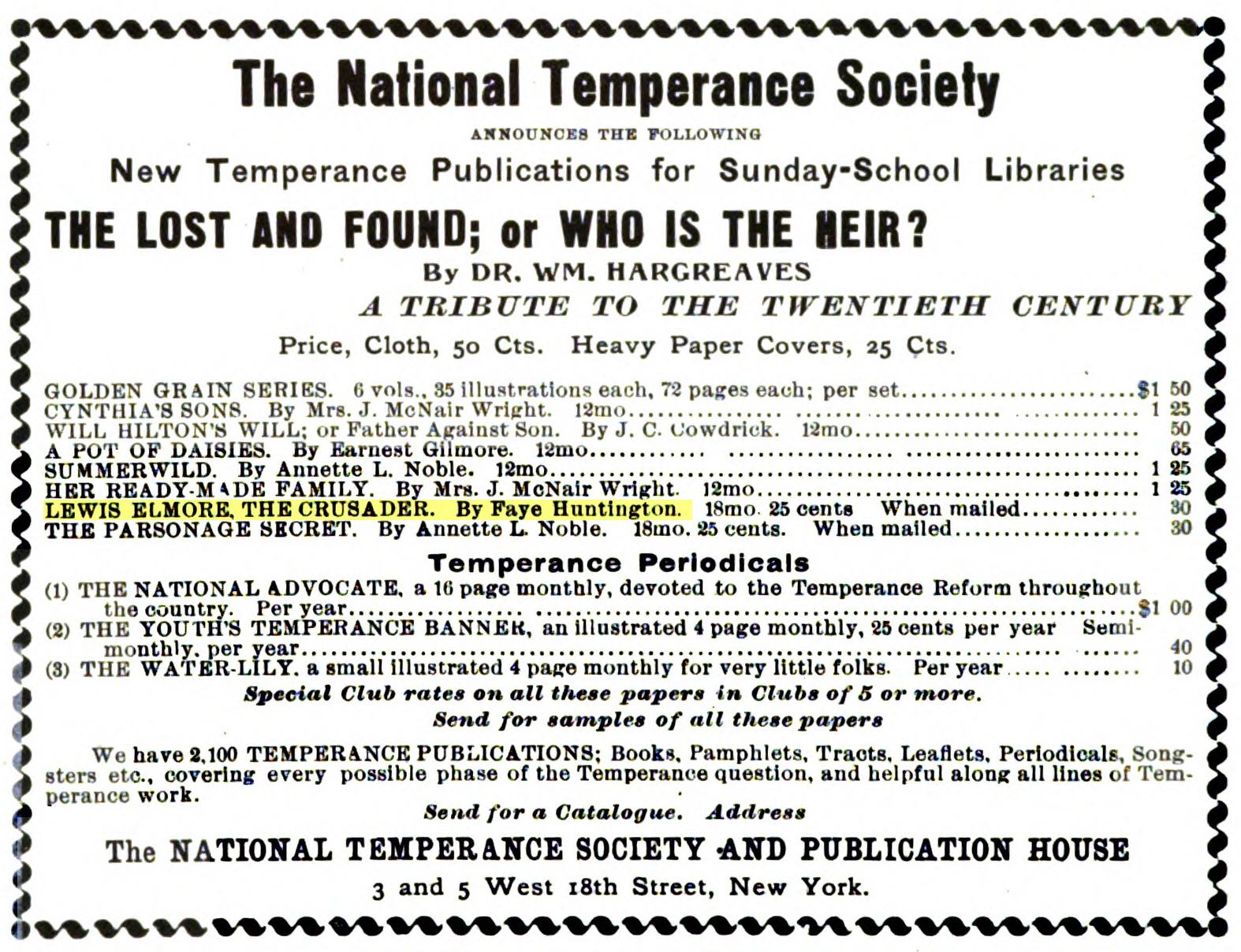
And organizations like The National Temperance Society also marketed their books directly to churches. Their ad below features a temperance novel by Isabella’s friend Theodosia Foster (who used the pen name of Faye Huntington):

Magazine advertisement for The National Temperance Society new publications for Sunday-School Libraries, listing "The Lost and Found; or Who is the Heir?" by Dr. Wm. Hargreaves. It also lists 8 other books, including Lewis Elmore, The Crusader by Faye Huntington, as well as 3 temperance periodicals. It offers "special club rates" and gives an address to send for a catalog and samples of the periodicals.

Church libraries established systems for inventorying and lending books. They assigned an inventory number to each book, and issued library cards to readers.

A square label affixed to the inside cover of a book. On the first line of the word "NO" with room to write a number; the number 61 was written and crossed out, and the number 77 written beside it. Below are printed "SUNDAY SCHOOL LIBRARY of the Evengelical [sic] Lutheran Church, Springfield, Ill." The text is surrounded by a fancy Victorian-era design of swirls and dots.
The numbered book plate from a book in the Sunday school library of the Evangelical Lutheran Church of Springfield, Illinois.

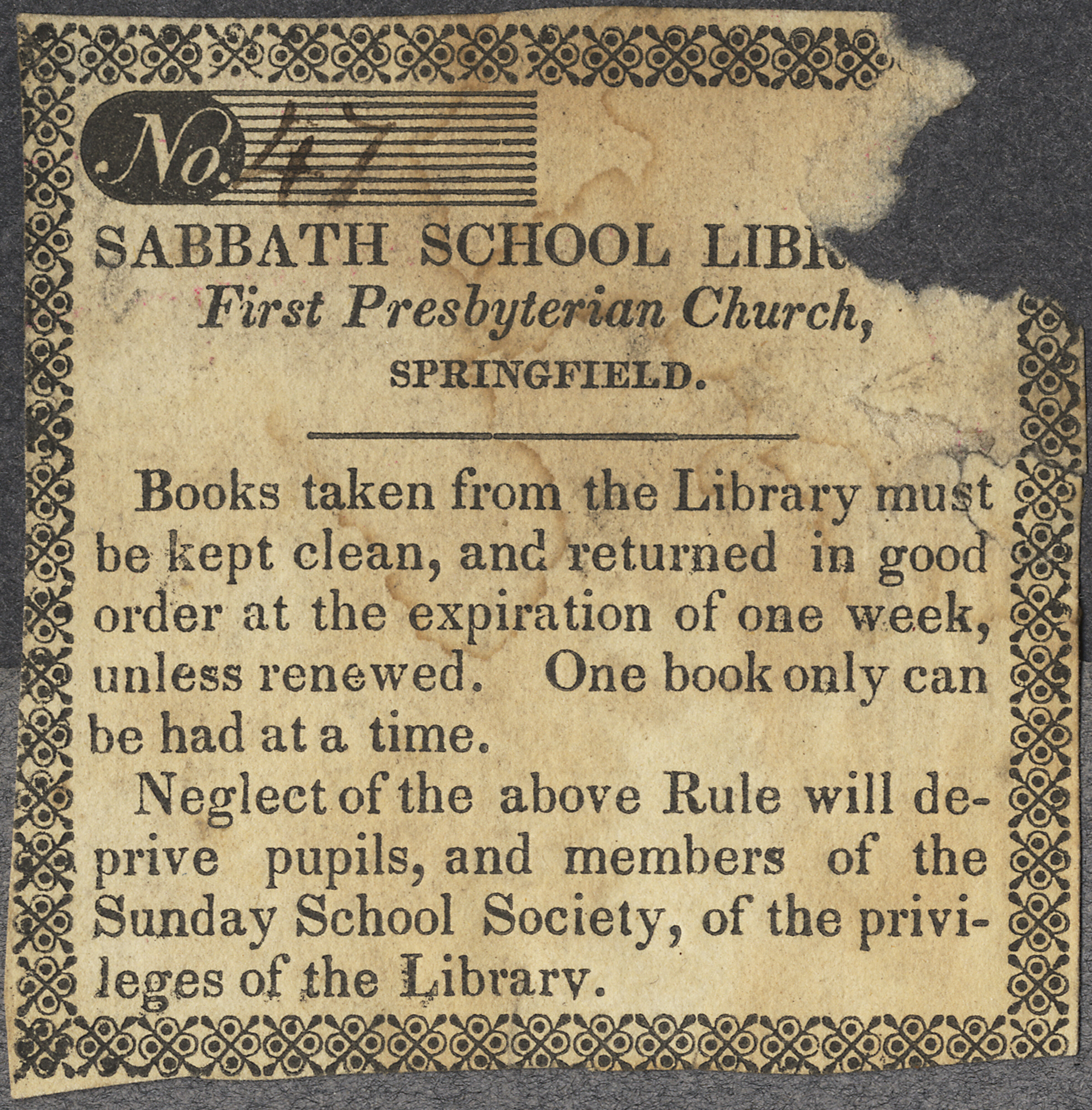
They also created rules for borrowing:

A square label affixed to the inside cover of a book. The top line has the book No. 47, then, "SABBATH SCHOOL LIBRARY, First Presbyterian Church, Springfield." Below is typed: "Books taken from the Library must be kept clean, and returned in good order at the expiration of one week, unless renewed. One book only can be had at a time. Neglect of the above Rule will deprive pupils, and members of the Sunday School Society, of the privileges of the Library."

Church libraries were a lifeline for readers, especially in smaller and frontier communities where there were no free public libraries. But that began to change in 1886 when wealthy steel magnate Andrew Carnegie began funding the building of public libraries across the country. By 1923 he had financed the building of over 1,600 public libraries where borrowers could choose from thousands of book titles, including the most popular books of the day.

Old colorized postcard of the public library in New York City showing a sprawling, multi-story building in classical Georgian style with stone steps leading to the entrance flanked by stone columns. The library is located on the corner of two intersecting streets with the tall buildings of the New York skyline in the background.
The New York City Public Library, opened to the public in 1911.

The “safe” books Isabella wrote went out of print, while modern novels by Ernest Hemingway, Edith Wharton, and F. Scott Fitzgerald filled the shelves at public libraries.

Sunday-school libraries still existed, but their influence waned to such an extent that in 1930 a newspaper in Greensboro, North Carolina published an editorial just after Isabella’s death. The editorial fondly recalled the church libraries of years gone by:

There were no sex novels; no crime novels; no filthy “realism,” which portrays the perversions of human nature as if it were life itself. Romance there was, in glorious gobs. Many of the books seeped sentimentality. And always there were happy endings.

He went on to write that Isabella’s books “made for clean lives and happy homes and good society.” In her stories, “the problems were the problems of everyday people trying to be good. If they were somewhat morbid and over-introspective, so was the era for which they were meant.”

Isabella truly did write for the era in which she lived; but it’s important to remember that her books succeeded in Sunday school libraries not just because they met church requirements, but because Isabella had a particular understanding of literature’s purpose—that stories should help readers have a closer walk with God and become better versions of themselves.

Maybe that’s why her “Pansy” novels, despite going out of print, are still read and loved by new readers today, and remembered fondly by those who discovered them on long-ago Sunday afternoons in church libraries.

Does your church have a library? What are the kinds of books it offers?

Isabella’s Authentic Faith

Despite her popularity as a best-selling author, Isabella gave very few interviews. She made an exception in 1892 when a magazine called The Ladies Home Journal (which was quickly becoming the most widely-read magazine in the world) came calling.

The interviewer, Denny Johnson, asked Isabella the usual interview questions about her home life, her childhood, and what inspired her to write. But in the process of sharing Isabella’s answers to those very standard questions, Johnson’s article reveals the quiet power of Isabella’s Christian principles.

Reading the article, you get the sense that what made Isabella extraordinary wasn’t just her prolific writing career; it was the way in which her personal character was very much reflected in the stories she published.

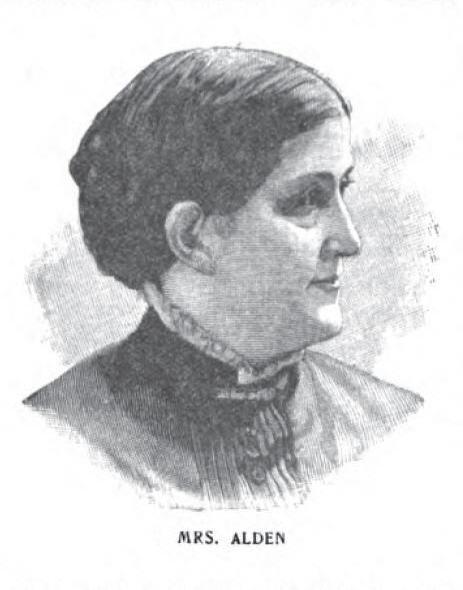
A black and white pencil and charcoal drawing of Isabella Alden in profile. Her hair is parted in the middle and shaped in a braided bun at the back of her head. She wears a high-collared dress or blouse with lace trim. She wears no jewelry.
The image of Isabella that was published with the 1892 article in The Ladies Home Journal.

So, here are four things The Ladies Home Journal interview revealed about Isabella’s personal character:

1. Isabella Lived Her Message

Johnson wrote that Isabella’s Christian principles weren’t “mere theories, existing only on paper.” Instead, they were “the rules that govern her own daily life.”

In those few words, Johnson revealed what is essentially the foundation of Isabella’s stories. Readers don’t just admire her characters’ moral courage—they can sense it comes from the reality of Isabella’s life.

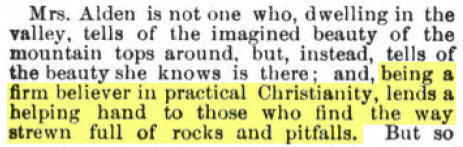
Isabella believed in what Johnson called “practical “Christianity”—faith that rolled up its sleeves and got to work.

She quietly helped others navigate life’s difficulties, often so unobtrusively that people didn’t realize she was the one who had “smoothed this bit of path, or pushed aside that jagged stone.” To Isabella, that was genuine Christian service.

Article excerpt: "In manner she is unassuming, genial, refreshingly natural, and possessed of a gentle dignity that, while repelling undue familiarity from effusive strangers, yet invites confidence from any who  may need her help or sympathy.

2. Isabella had Humility in Success

By 1892 Isabella had already authored over one hundred books that were beloved by readers around the world, yet the article describes her “as unspoiled as when she signed her name for the first time ‘Pansy.'” She shrank from publicity and seemed genuinely surprised by the impact of her work.

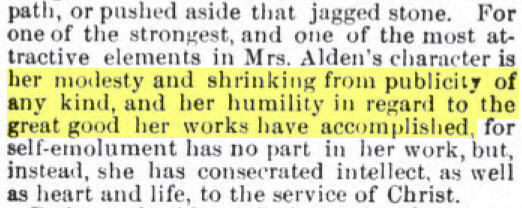
Article excerpt: "One of the most attractive elements in Mrs. Alden's character is her modesty and shrinking form publicity of any kind, and her humility in regard to the great good her works have accomplished."

Her modesty wasn’t false humility; it reflected Isabella’s belief that her talents were gifts meant for service rather than self-promotion. As Johnson wrote, “self-emolument has no part in her work,” but instead she had “consecrated intellect, as well as heart and life, to the service of Christ.” In other words, she didn’t write stories for personal gain.

3. Isabella was Consistent

What gave Isabella her unique influence over young people wasn’t just her writing skill, but her consistent character. The same “high standard of right and wrong,” the same genuine care for others, the same joy in her faith that readers found in her books—all of this could be witnessed in her daily life.

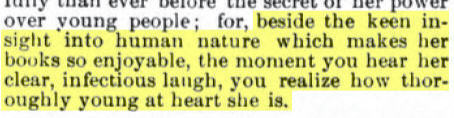
The article said she had an infectious laugh and youthful spirit that weren’t manufactured for her audience.

Excerpt from magazine article, "beside the keen insight into human nature which makes her books so enjoyable, the moment you hear her clear, infectious laugh, you realize how thoroughly young at heart she is."

She would pause her important work to meet with any child who came to visit, demonstrating that her love for young people was authentic, not merely professional.

article excerpt: "her great lover for children is evinced by the cheerfulness with which she will pause in the midst of her work, to meet a child who has come to visit her."

4. Isabella’s Example is Timeless

In our present world of personal brands and influence marketing, Isabella’s story feels refreshingly honest. Her success didn’t come from clever marketing; it came from being the same person in private that she was in public. She wrote from who she actually was, not who she thought her audience wanted her to be.

Maybe that’s a big part of why her books are still being read today, long after other, flashier authors have been forgotten. There’s still something powerful about the simple consistency of Isabella’s authentic faith and the honest life she lived that still shine through when we read her stories.

You can click here to read the entire article about Isabella that appeared in The Ladies Home Journal.

What do you think? Did Denny Johnson capture the essence of Isabella’s personal character?

Flossy and the Street Children

Isabella Alden never actually said so, but there’s an argument to be made Flossy Shipley Roberts may very well have been her favorite character. Of all the characters Isabella created, Flossy made the most appearances in her novels.

Flossy first appeared in Four Girls at Chautauqua. She was also a key character in The Chautauqua Girls at Home, Ruth Erskine’s Crosses, Four Mothers at Chautauqua, and Echoing and Re-echoing.

Cover of Ester Ried Yet Speaking showing a close-up of a young woman with blonde hair dressed in a high-neck red gown. In the background is a large three-story home set amid trees and gardens.

And while she was only mentioned in Judge Burnham’s Daughters and Ruth Erskine’s Son, Flossy made her final appearance—and played a major role—in Ester Ried Yet Speaking.

Perhaps one reason Flossie was so well-loved—by Isabella and by her readers—was that she was honest and truthful, yet deceptively strong. People constantly underestimated Flossy because she was soft spoken and was willing to please others.

But Flossy also had a strong moral sense of right and wrong. She relied on her Christian faith to give her the strength she needed to always do right rather than what others wanted her to do.

She was also kind hearted, especially when it came to children. Flossy was just as willing to teach a Sunday school class full of ragged orphaned street boys as she was to serve tea on her best china to a wealthy church deacon and his wife.

That was the case in Esther Ried Yet Speaking, when Flossy took on the task of teaching a Sunday-school class of rough street boys. During the first class, Flossy took an interest in one of those boys, Dirk Colson and his sister Mart. In the story, Flossy’s concern for them and the rest of the boys—and the actions she took to help them—reflected Isabella’s own principles.

Black and white photo of a narrow alley between two multi-story brick buildings. In the foreground are trash cans and debris, a water pump and buckets. A group of six boys stand in the center of the photo. Behind them are two women wearing long dresses and aprons  from the time period, as well as more children. On the left side of the photo are two young girls, wearing short dresses that appear to be patched.
Boys in Mullens Alley, New York, 1888, by Jacob A. Riis

Isabella was keenly interested in the problem of street children living in large urban areas like New York City. In 1889 she wrote:

There is, in New York City, a meeting known as the “Woman’s Conference.” On the second Friday of every month they meet together to discuss matters of importance and see what they can do to help along the good work which is being done in this world. A few weeks ago they took for their subject the “Street Children’s Sunday,” their object being to see what they can do to help these miserable, neglected, almost forgotten, children to something better than their sorrowful lives have yet known.

The Sun (a New York newspaper) covered that women’s conference and published an account of the meeting, including this paragraph:

At the meeting, which was presided over by Mrs. Lowell of the State Board of Charities, Mrs. Houghton, literary editor of the Evangelist, introduced a subject of the Sunday Life of tenement-house children, a large class of whom do not attend the Sunday schools, and whose Sundays, owing to the drunkenness of their parents, which is more general on that day than any other, and also to the overcrowding of the small rooms in which they live by the presence of the entire family on that day, are full of wretchedness and discomfort. “The children do not laugh enough,” Mrs. Lowell said. “They did not know how to play or to be happy.” This subject has been long of great interest to Mrs. Houghton, and out of this discussion germinated a plan to do something for those little wretched waifs of humanity to brighten their lives, and ultimately to make of them better men and women and more intelligent and worthy citizens.

Isabella strongly believed in the last line of the article: that making the lives of poor boys and girls better will ultimately help them grow to be better men and women.

Black and white photo of three young children sleeping close together in an outdoor alcove of a stone-facade building. The children are barefoot and two are wearing short pants with patches on the knees, as they sleep with their arms around each other.
Children sleeping on Mulberry Street, 1890, by Jacob A. Riis

She also had the example of Jacob Riis, a newspaper reporter who documented living conditions in New York slums. Through his written articles and photographs, he almost single-handedly educated Americans about the necessity of better living conditions for the poor. He advocated for clean drinking water, public parks, and child labor laws, and he was instrumental in implementing these and many other reforms in New York City. Riis and Isabella both attended Chautauqua Institution at the same time, and Riis was close friends with Bishop John Vincent, one of Chautauqua’s co-founders.

Black and white photo of a middle-aged man seated in a chair. He has short, light-colored hair and a mustache, an wears wire-rimmed glasses. He wears a tie and three-piece suit. The chain of a pocket watch is visible on his vest.
Jacob A. Riis in 1904 (from Library of Congress)

Isabella may very well have been thinking of Riis when she wrote about Flossy’s efforts to reach and influence the street boys in her Sunday-school class.

Black and white photo of a row of three two-story attached houses in dilapidated condition, with broken windows and clothes-lines strung from one building to another. The roof of the center home sags dangerously. In the background, a multi-story building hows broken windows and objects cluttering the metal fire escape.
Dwellings of Death by Jacob A. Riis

In one scene, Flossy gets lost in the slums while trying to visit Dirk, and a street boy named Nimble Dick helps her find Dirk’s house.

Mrs. Roberts uttered an exclamation. The house was one of the most forlorn in the row, seeming, if the miserable state of the buildings would admit of comparison, to be more out of repair than the others. It came home to her just then, with a sudden, desolating force, that human beings such as she was trying to reach, and such as she hoped would live in heaven forever, called such earthly habitations as these homes. What possible idea could they ever get of heaven by calling it “home”?

“Do they have the whole of the house?”

She asked the question timidly, for the building looked very large, but she was utterly unused to city tenement life.

“The whole of that house?” Dick fairly shouted the sentence, and bent himself double with laughter. “Well, I should say not, mum! As near as I can calculate, about thirty-five different families have that pleasure. The whole of the house! Oh, my! What a greeny!” And he laughed again.

Mrs. Roberts exerted herself to laugh with him, albeit she was horror-stricken. Thirty-five families in one house! How could they be other than awful in their ways of living?

“I know almost nothing about great cities,” she said. “My home was in a much smaller one.”

This was the truth, but not the whole truth. Instinct kept this veritable lady, in the truest sense of the word, from explaining that she knew nothing about the abject poor, when she was speaking to one of their number.

But Flossy quickly set about learning all she could about Dirk, his sister, and their neighbors because she felt a distinct calling to help them. When she returned a second time to Dirk’s tenement building—this time accompanied by her husband—other residents of the tenement warned her to stay away from Dirk.

It was strange, she could not herself account for it; but with every added word of misery that set poor Dirk Colson lower and lower in the scale of humanity, there seemed to come into this woman’s heart, and shine in her face, an assurance that he was to be a “chosen vessel unto God.”

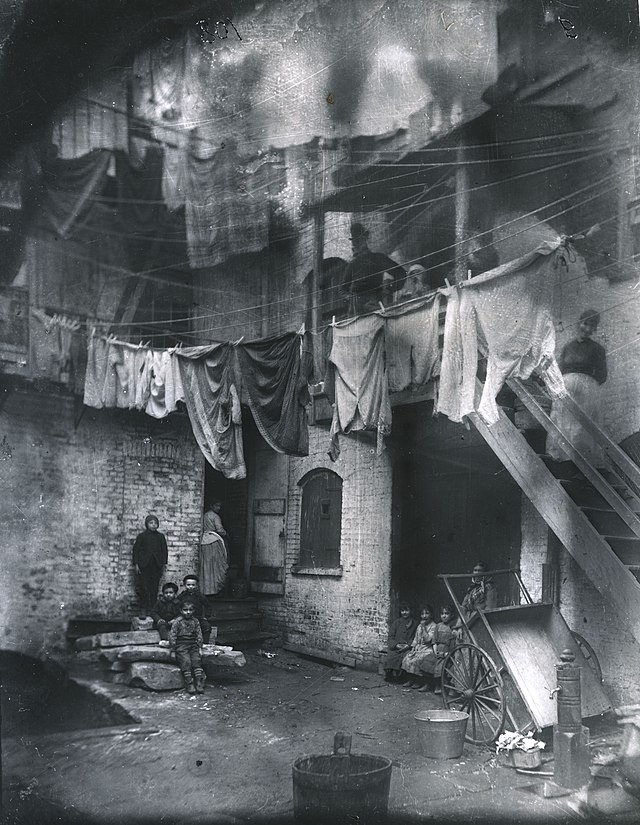
Black and white photo showing a small open area surrounded by four brick buildings. A shaft of light from above illuminates several clothes lines where clothing and blankets have been hung out to dry. On an upper balcony a man stands with children behind him. A woman wearing an apron stands on the stairs leading from the balcony to the count. On the ground an apron-clad woman stands in the doorway with four children of different ages nearby. In another doorway stands a woman with three little girls seated beside her. In the foreground is a two-wheeled pushcart, buckets, a water pump, a and debris.
A Tenement Yard by Jacob A. Riis

To Flossy, helping Dirk and the rest of “her boys” was essential. And when someone tried to change her mind by asking what good Flossy could possibly do for such creatures, she replied:

“Don’t you think that Jesus Christ died to save them? And don’t you think he wants them saved? And will he not be pleased with even my little bits of efforts if he knows that my sincere desire is to save these souls for his glory?”

Her “little bits of efforts” may seem small at first, but Flossy soon begins to see results with “her boys.”

You can read all about the plan Flossy came up with, and how the boys responded, in Isabella’s novel, Ester Ried Yet Speaking.

You can read Isabella’s novel Ester Ried Yet Speaking for only 99 cents! Choose your favorite e-book retailer. (Your purchase from The Pansy Shop helps support this blog.)

God is Greater Than

In Isabella’s early days of teaching Sunday school, the blackboard was an innovation. In her books, Isabella often wrote about how intimidating the blackboard was for many teachers, and some refused to use it.

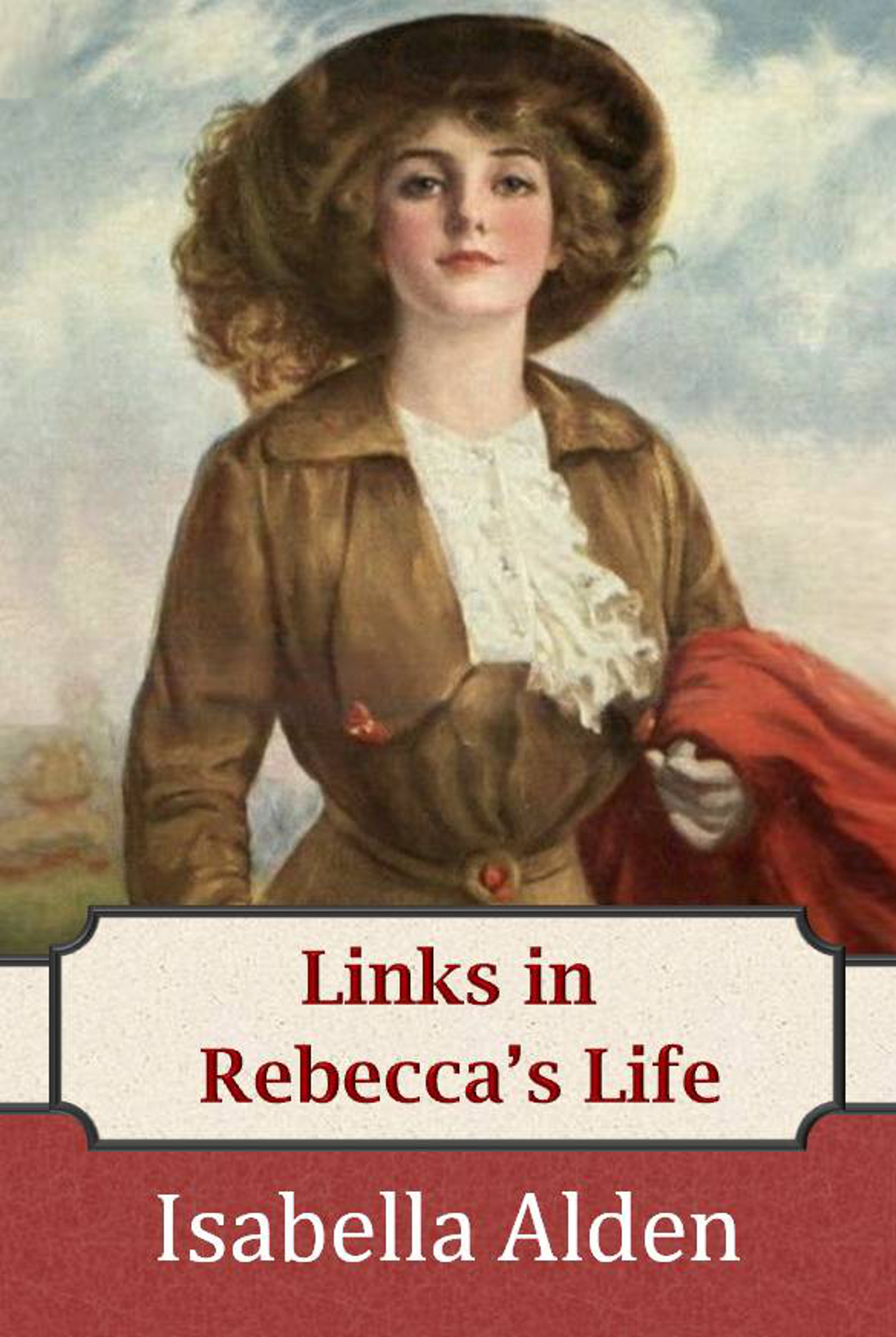
That’s what happened in her 1878 novel Links in Rebecca’s Life. In the story, a young woman named Almina had the charge of teaching young children their Sunday-school lesson, but she refused to use a blackboard:

“It is quite the fashion to rave over them … but I won’t have one. What could I do with it? I don’t know how to draw, and as for making lines and marks and dots … I am not going to make an idiot of myself. What’s the use?”

Isabella saw things differently. With inspiration from her old Chautauqua friend Frank Beard (creator of “Chalk Talks”), Isabella embraced the blackboard as a teaching tool, especially for her youngest students who were just learning to read.

Of course, not all Sunday-school teachers had Frank Beard for a friend and guide. And not all teachers had a talent for drawing and diagramming.

Publications like The Sunday School Times recognized that, and published “Blackboard Hints” in many issues of their magazine, showing teachers that simple lettered blackboard illustrations could be just as effective:

It was Isabella’s opinion that any lesson could be better taught by the use of a blackboard or a slate.

“Children are invariably more impressed with what grows into being before their eyes then with what is brought in a completed form before them,” she said.

In her Sunday school lessons, Isabella used pictures and objects whenever she could to illustrate her lessons, but she liked the blackboard better.

“I never attempt elaborate drawings. In the first place, I cannot draw anything. In the second place, but I would not if I could, in a Sunday school room. There is not time. The barest outline is all you can spare time for in all that you need. A blackboard used constantly throughout the lesson — a mark for this one, a dot for that, a crooked line for a river, and oval for a lake — that is better for an [children’s] class than a careful summing up of the lesson at the close.”

So Isabella often began her lessons by putting a dot or a simple symbol on the blackboard, just to get the attention of everyone in her class—at least until they found out what that mark was for.

“If I need such a dot or mark or line as the most mischievous and troublesome [child] there can make for me, I have won him as a rule for that day.”

You can learn more about Frank Beard and his “Chalk Talks” by clicking here.

You can read Isabella’s novel Links in Rebecca’s Life for only 99 cents! Choose your favorite e-book retailer. (Your purchase from The Pansy Shop helps support this blog.)

A Kiss at Chautauqua

The 2025 Chautauqua Institution officially opens on June 21. Much has changed at the institution in the last 151 years, but thanks to Isabella Alden and her contemporaries, we can piece together what it was like to spend a summer at Chautauqua in its early days.

Before there were cottages and meeting halls, Isabella and her family spent their summers sitting on rough wooden benches as they listened to lectures in the open air, and sleeping under the stars or in tents.

The photo below was taken about 1876, which was the second year of Chautauqua’s existence. Isabella was only thirty-five years old, but she was already quite famous.

She was the best-selling author of over a dozen novels, including the first four books of her “Ester Ried” series. And The Pansy magazine was in its third year of publication, with Isabella as editor and chief contributor of stories and articles.

In those early years The Pansy magazine was sent every month (it later became a weekly magazine) to thousands of children. Isabella called each of her young subscribers her “Pansies.”

While at Chautauqua one day that summer of 1876, Isabella was walking through the grove, which was one of her favorite spots at Chautauqua. She wrote:

Chautauqua is so beautiful this year. Don’t you know, I met today one of the little Pansies! As I was walking through the grove, there came a sweet-faced little girl to me, and she said in a low, sweet voice:

“If you please, I live in Ohio, and I’m going home today, and I’d like so very much to kiss you, then I could tell all the little girls that I kissed Pansy.”

You may be sure that I gave her the very warmest kiss I had, and told her to tell all her little Pansy friends that part of the kiss was for them.

A ladies’ magazine once printed an article about Isabella and commented that one of the strongest and most attractive elements of her character was her humility in regard to the great good she accomplished through her writing. But in truth, she was keenly aware of the power she had over her readers, and she always used that power to help them come to know and love the Lord Jesus Christ. Just think of the story the little girl in the grove told to her friends back in Ohio! How many of her little friends do you think were influenced to know and love Jesus, all because of Isabella’s kindness to a child and that one little kiss?

A Feast of Good Things

Have you ever wondered what it would be like to be famous?

Black and White photo of a woman almost in profile. Her hair is a light color, parted in the middle of her head, and pulled back to form a large braided bun at the back of her head. She wears a dress with a high ruffled collar trimmed in white lace; a white lace jabot falls from the high collar down the front of her dress.
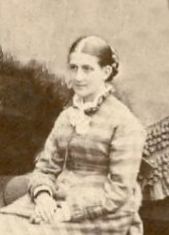
Isabella Alden circa 1880

Imagine walking into a room filled with people who burst into applause as soon as you enter. Then imagine that you’ve agreed to speak at an assembly that’s filled to overflowing with people, seated and standing in every available space, who hang on your every word.

That’s a little taste of what life was sometimes like for Isabella Alden. Today it might be hard for us to understand just how famous and beloved she was by people across the country. In a time before social media, television, and radio, Isabella had a nation-wide reputation as both an author and as a respected and knowledgeable public speaker on a variety of topics, including the development of Sunday-school lessons.

In 1886 Isabella and her husband, Rev. G. R. Alden, were living in Cleveland, Ohio, where Rev. Alden was pastor of a Presbyterian church. But when he wasn’t preparing sermons, and she wasn’t writing novels and stories for Christian magazines, the Aldens traveled the country to help churches design and implement well-organized, robust Sunday-school curriculums.

In June of that year they were invited to attend a conference in Wellington, Kansas, where the local churches hoped to find a way to better manage their Sunday-school offerings to children and adults. The Aldens accepted.

Newspaper clipping: A Sunday school institute will be held at the Presbyterian church June 13th, 14th, and 15th. The services of Mrs. Alden of Cincinnati, the well-known authoress of the "Pansy" books, has been secured, and it is expected that the interest of the institute will be greatly increased by her presence. She will also take part in the celebration of children's day on Sunday, the 13th. All Sunday school workers of the city and country are invited to attend and participate in the work of the institute.
From The Conway Springs Star (a Kansas newspaper) on June 11, 1886

As soon as the local newspapers announced that Isabella Alden would be among the featured speakers, the churches were guaranteed to have an excellent turnout for their conference.

Newspaper clipping: The committee in charge of the arrangements make this further announcement: “We desire again to call the attention of all parents, Sunday School workers, and especially all young people, to this unlooked for opportunity to meet and greet Mrs. G. R. Allen [sic], “Pansy.” She is known and loved as the author of such helpful and thrillingly interesting books as “Ester Ried,” “Four Girls at Chautauqua,” “The Hall in the Grove,” “One Commonplace Day,” etc. Her engagement with the State Sunday School Assembly at Ottawa, Kansas, brings her west at this time and we trust that a “crowded house” will show our appreciation of the extra effort she is making to come to Wellington. The other speakers from abroad, and those among us who have kindly agreed to assist in these meetings, will give us a feast of good things. Come everybody and enjoy the feast.
from The Monitor-Press (Wellington, Kansas) June 11, 1886

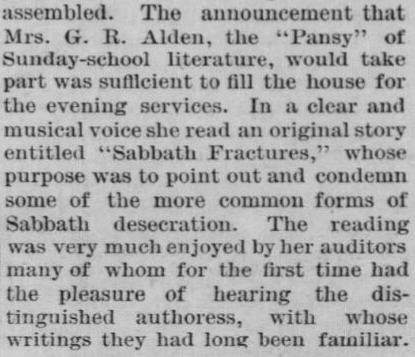
Here’s how the local newspaper described the scene on the first night of the conference when Isabella made her appearance:

Newspaper clipping: The announcement that Mrs. G. R. Alden, the "Pansy" of Sunday-school literature, would take part was sufficient to fill the house for the evening services. In a clear and musical voice she read an original story entitled "Sabbath Fractures," whose purpose was to point out and condemn some of the more common forms of Sabbath desecration. The reading was very much enjoyed by her auditors many of whom for the first time had the pleasure of hearing the distinguished authoress, with whose writings they had long been familiar.
from The Wellington Monitor, June 18, 1886.

The meetings began on a Monday afternoon and Isabella took an active role, according to the agenda:

Newspaper Clipping: "Mention was made last week of the county Sunday school institute which will be held at the Presbyterian church on Monday and Tuesday, June 14th and 15th. The programme as published below shows many features of interest that ought to attract a large attendance of the active Sunday school workers of the county:" Follows an agenda including a "Primary conference" on Monday afternoon and a "Paper" reading Monday evening by Mrs. G. R. Alden, "Pansy."
from The Wellington Monitor, June 11, 1886

In one of the sessions she spoke about how to design Sunday-school lessons for children in the Primary Class age range of four to eight years:

Newspaper clipping: She sketched briefly and clearly a plan of work among the younger classes in the Sunday school that long experience had shown to be attended with the best results. She favored the division of the primary pupils into small classes of not more than seven members each, which should be taught if possible in a room separate from the rest of the school.
from The Wellington Monitor, June 18, 1886

In another session she participated in a discussion on the proper way to prepare teachers for the work of teaching meaningful lessons:

Newspaper clipping: Mrs. Alden conducted a conference on her favorite theme of primary work, of one hour’s duration. The spoke strongly against teaching children misty doctrines of general truth, of which the teacher lacked the skill to make definite application. The children’s quickness of apprehension, even at the earliest age when they enter the primary class should not be underrated. The danger of simply interesting the children with recitations of Bible stories, without bringing out the spiritual lessons they were meant to teach, was one point to be guarded carefully against.
from The Wellington Monitor, June 18, 1886

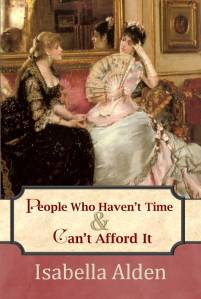
On Monday evening she read one of her short stories, “People Who Haven’t Time and Can’t Afford It,” which, the newspaper reported, “held the close attentions of the audience in spite of the discomforts of the crowded room.”

The rest of the conference was similarly busy for Isabella. The last night of the conference was “attended by an audience larger than the seating capacity of the church.” Isabella closed the evening session by reading a paper she wrote about “the Penn Avenue Church” and the difficulty the church had raising money for Sunday school purposes and for books to stock a small church library.

Eventually, Isabella revised that “paper” into a short story called “Circulating Decimals,” which was published two years later.

By every measure, the 1886 Sunday School Institute in Wellington, Kansas was a resounding success.

Newspaper clipping: The institute from every point of view was a great success, both as arousing new interest in the cause on the part of the Sunday-school workers of the city and county, and acquainting them with new methods of instruction. It will undoubtedly lead to the formation of a permanent county organization and the frequent and regular holding of similar institutes and conventions in the future.

And with Isabella’s many contributions—from offering practical advice to reading stories with a message—it truly was a “feast of good things.”

One final note:

Isabella may have been a famous celebrity, but when she and Reverend Alden made these trips, they rarely stayed in a hotel. Instead, they were usually invited to stay in the home of one of the local church members. In Wellington, Kansas, they stayed in the home of George and Laura Fultz. Mr. Fultz was a leading businessman in Wellington, and he and his wife were active members of the Presbyterian church.

Black and white photo of a man in profile. He wears wire rimmed glasses and his hair is wavy and dark. He is dressed in a dark suit of clothes that would have been in fashion in the 1890s. He wears a dark bow tie and has a high starched shirt collar.
George Fultz

How lucky were Mr. and Mrs. Fultz! Isabella and her husband stayed with them for five nights. Imagine having your favorite author sit at your dinner table, join you in a morning cup of coffee, or share an evening on your front porch, relaxing and watching the sun set together after a full day of meetings.

If you were fortunate enough to have Isabella as a guest in your home, what kind of questions would you ask her?

All of the short stories mentioned in the post are available for you to read for free. Just click on any of the highlighted titles or cover images to download your copy from Bookfunnel.com.

The Voices in Isabella’s Head

There’s no question that Isabella Alden was a talented writer. The plots for her novels were inventive and realistic, and each of her characters were carefully drawn.

Her niece, author Grace Livingston Hill, wrote that when she was old enough to learn to read, she “devoured [Isabella’s] stories chapter by chapter.” And when Isabella wrote the final chapter to one of the novels she’d been writing, the family often crowded around her, knowing Isabella would read her work aloud. Grace said:

“We listened, breathless, as she read, and made her characters live before us. They were real people to us, as real as if they lived and breathed before us.”

Four young women sit in a Victorian era room with bookcases lining one wall. One woman reads a book with her back to the others. Another woman reads a book aoud to two others.

They were probably real people to Isabella, too. When she was interviewed in 1892 for a Philadelphia newspaper, she talked about her writing process. For many years she used a typewriter to write her stories (you can read more about that here), but by the time she was interviewed for the newspaper article, she was using dictation. It greatly increased the speed with which she wrote her books, and added an inadvertent element of entertainment to the task. Here’s how it was described in the article:

“The morning hours are devoted by Mrs. Alden to her literary work, and a person standing in the hall in front of the studio door is highly amused to hear the animated conversation with the varying tones indicative of stern displeasure, then of baby prattle, to be followed soon by the earnest and softened accents of the lover’s pleading; a monologue by Mrs. Alden as she personates her various characters. They are all seen in life, they must all appear in her books.”

A young woman sits in a room near a fireplace where a fire is burning. She wears an orange dress from about the year 1910 and holds a large sheet of paper she is reading.

Isabella’s characters seem alive and real to us because she wrote about the kind of average people we meet every day; and when her characters come to a crossroads in their lives and face tough decisions, we understand what they’re going through because we (or someone we know) has dealt with similar situations. Her characters cause those of us who read her books to search our own hearts and “see ourselves as God saw us.”

In a dimly lit room, a woman stands near a table with a lamp on it. She holds a piece of paper she is reading. On the table is a tea pot and two tea cups and saucers. Seated at the table is another young woman who is listening.

Grace wrote that Isabella’s characters “still live within our memories like people we have known intimately and dwelt among. Ester Ried and Julia Ried, the Four Girls at Chautauqua, Mrs. Solomon Smith—I almost expect to meet some of them in Heaven.”

Do you have a favorite character from Isabella’s books?

How to Have a Good Prayer Meeting

Isabella often drew on her own life experiences when writing her stories and novels.

For example, Isabella’s husband G. R. “Ross” Alden was a seminary student when he and Isabella were courting. On the very day of their wedding, Isabella and Ross boarded a train to take them to a new town where Ross was assigned his first church as a minister. Isabella used the very same circumstance in her 1890 novel Aunt Hannah and Martha and John. In the story, newly married Martha also left her parents’ home immediately after her wedding to go with her new minister husband to his first church.

And just as Isabella had to learn the best she could to be a good minister’s wife, Martha had to do the same in the novel. One scene in the book tells what happens when Martha attends a ladies’ prayer meeting soon after she and John arrive at the new church. Here’s how Martha described the meeting to John later that day:

It wasn’t pleasant, John. It was, well, dreadfully stiff; I don’t know any other word that will describe it. Almost everyone was late, yet the meeting did not begin; they sat around solemnly and looked at one another. At last someone ventured to ask Mrs. Jones to lead. She said that she was not prepared, and that she didn’t feel competent to lead a meeting, anyway. Of course that made all the others feel as though they ought not to be ‘competent,’ and one and another refused. Then our next neighbor said she thought the minister’s wife was the proper person to lead; but by that time I was so sort of frightened that it seemed to me I couldn’t lead anything, and I said I did not feel competent, either.

Mrs. Green was finally persuaded to lead; she selected a long hymn and read the whole of it. Think of reading a hymn, John, in a little informal prayer-meeting that is to last only an hour! Then they had a time getting someone to start the tune. Mrs. Jones said she was hoarse, and Mrs. Brown did not know any tune that would go with the words. At last I grew ashamed of myself, and started a tune that I thought everybody in the world knew, but hardly anyone sang, and that frightened me. But they all looked as solemn as though they were at a funeral.”

Poor Martha! She felt she disgraced herself as the new minister’s wife. If only she had been trained in how to lead a prayer meeting!

A pencil and charcoal portrait of Dwight L. Moody, showing a middle-aged man with close-cropped hair and a full beard and mustache.

In her real life, Isabella had to learn the same lesson. Fortunately for her, she had expert advice from a close friend of the Alden family: Reverend Dwight Lyman Moody.

Rev. Moody was a world-renowned minister and evangelist. In 1897 he wrote this bit of advice about prayer meetings, which Isabella published in a Christian magazine she edited:

A banner set in old fashioned type/font that reads "HOW TO HAVE A GOOD PRAYER MEETING by D. L. Moody."

Several important matters must be considered in order to have a good, live prayer meeting. Of course, the all-important thing is the presence of the Spirit of God, without whom no spiritual blessing can come. But there are certain things on the human side that help or hinder success.

First of all, the physical conditions. I do not believe even the angel Gabriel could infuse life into a meeting that is held in a dull, close room. Let there be plenty of fresh air. Make the room bright and cheerful, and there will be little chance of people’s falling asleep.

The meeting should begin and end promptly on time. Announcement should be made on Sunday, and a cordial invitation given to everybody to attend. If the prayer meeting is held in contempt, it is useless to expect a blessing there. I know some churches where they look forward to it more (if anything) than to the Sabbath services.

It is a good plan to allow about a quarter of an hour at the beginning for singing, another quarter for the leader to read Scripture and introduce the subject of the evening, another quarter for prayer and testimony, and the remainder of the hour for special prayer. But I do not suggest this as a permanent division of the time. Avoid falling into ruts of any kind. If some leading minister can attend, let him occupy the whole time; and introduce variety in other ways.

The music should not be neglected. Paul says, “In everything, by prayer and supplication with thanksgiving, let your requests be made known unto God.” I take it that thanksgiving and praise can best find expression in songs in which all can join. It is therefore important to have an active, earnest leader of the singing, who is able to read the pulse of the meeting, and by striking up suitable and familiar hymns, bridge over a pause, if need be.

A GOOD LEADER.

The success of the meeting depends largely on the leader. If he is full of life and of the Spirit, the audience will catch his enthusiasm: but a cold, listless manner throws a wet blanket over the proceedings.

He should be there ten minutes before the meeting begins, in order to see that everything is in good order, and he should come prepared to lead. If there is one thing that will kill a meeting sooner than another, it is to have the leader stand up and state that he has not come prepared. If a subject has been announced, it is his duty to study it so that he can introduce it intelligently. If he is not limited to any special subject, let him introduce one that appeals to the hearts of the people, and that they can speak upon without special preparation. When I was in charge of a work in Chicago, I used to say, “I am going to take up the Good Shepherd (or some such topic) tonight,” and then got friends to quote texts or make remarks on that subject. Let the leader set an example by being short and to the point in his opening remarks.

Image of a young woman dressed in a style typical of the late 1800s. She wears a black dress with long sleeves and white lace cuffs and collar. Her hair is loosely pulled to the back of her head in a braid that wraps around her head. Her hands are folded together and rest on an open Bible that rests on the table before her.

As at all other services, I believe the best thing to do is to feed the people with Scripture. Why is it we have so much backsliding, so little growth in grace? Because of the lack of food for the soul. If one neglects the Bible, his soul becomes starved and easily stumbles. “As newborn babes desire the sincere milk of the Word, that ye may grow thereby.” The more men love the Scriptures, the firmer will be their faith. And if they feed on the Word, it will be easy for them to speak; for out of the abundance of the heart he mouth speaketh.

Like everything else, the plan of announcing a topic beforehand can be abused. The objection is raised that in many meetings they go together, have one or two prayers, and discuss a topic. There is no need to pervert the meeting in this way. Let there be full liberty to all to tell their joys and sorrows, and give their testimony along any line.

A GOOD FOLLOWING.

The success of the meeting must also depend largely on the audience. The leader is not a Goliath, to go forth alone. Of all church services, the prayer meeting is the one specially intended for church-members to take part in, and the subject should be such as to draw them out. The leader should try to bring in fresh voices, even if he has to hunt them up beforehand.

The members should come to the meeting in the spirit of prayer. It ought to be on their hearts from week to week, so that they are thinking about it and praying about it. If a spirit of unity prevails, such as we read of in the case of those early Christians who “all continued with one accord in prayer and supplication,” blessing will surely follow.

Image of a young woman kneeling in prayer in church. She is dressed in clothing typical for the year 1910; she wears a black dress with long sleeves and white cuffs and collar. Her hair is dressed in an ornate style with curls on top of her head and her long hair hanging in tendrils down the back of her head past her shoulders.

I have no sympathy with the excuse that people have not time to attend. Of course there are certain ones whose circumstances or duties keep them away; but with many the excuse is due to sheer carelessness or indifference. Daniel was a busy man. He was set over the princes of a hundred and twenty provinces. Yet he found time to retire to his chamber three times a day to pray and give thanks before his God.

When the meeting is thrown open, friends should be brief and pointed in their remarks. Bible prayers are nearly all short. Christ’s prayers in public were short. When he was alone with God, it was a different thing, and he could spend whole nights in communion. Solomon’s prayer at the dedication of the temple is one of the longest recorded, and yet it takes only six or eight minutes in delivery.

“Lord, help me.”
“Lord, remember me when thou comest into thy kingdom.”
“Lord, save us.”

Such are the prayers that never failed to bring an answer. The prayer that our Saviour left his disciples is a model in its brevity, its recognition of God and desire for the glory of his kingdom, its sense of dependence upon him for daily needs and for deliverance from the guilt and power of sin.

BE DEFINITE.

Beware of vagueness. It is a sure sign that the prayer is heartless and formal. Beware of praying about everything that can possibly be touched upon. Leave something for those who follow to pray about. Beware of falling into ruts. Dr. Talmage says that if we were progressing in our Christian life, old prayers would be as inappropriate for us as the hats and shoes and clothes of ten years ago. Mr. Spurgeon said that some men’s prayers are like a restaurant bill of fare—ditto, ditto, ditto.

I believe in definite prayer. Abraham prayed for Sodom. Moses interceded for the children of Israel. How often our prayers go all around the world, without real, definite asking for anything! And often, when we do ask, we don’t expect anything. Many people would be surprised if God did answer their prayers.

Image of a woman kneeling in church, holding a Bible in her hands. She is dressed in clothing typical for the year 1910. She wears a black bonnet, a dark red dress with long sleeves, and a white knitted shawl around her shoulders.

As it is the members’ prayer meeting, special prayer should be offered on behalf of the church in all its varied activities, the pastor and all in authority. Other subjects for special prayer are the sick and sorrowing, the unconverted, and the services of the coming Sabbath.

Before the meeting is closed, an opportunity might be given for the unconverted (if there are any present) to make a confession or rise for prayer. I have one church in mind where they have conversations right along at the prayer meeting. Some testimony, some personal experience of God’s grace and blessing, will often convince a man where sermon and argument fail.

The greatest need of the church today is more of the presence and power of the Spirit of God. O that Christians were roused to greater earnestness and importunity in prayer! I believe that the greatest revival the church has ever seen would result. God help us, each one, to be faithful in doing our share.


What do you think of Rev. Moody’s advice about prayer meetings?

What other advice would you give about how to lead a prayer meeting?

Have you ever been to a prayer meeting like the one Martha experienced?

Click here to read more about Rev. Moody’s friendship with Isabella’s family.

You can learn more about Isabella’s novel Aunt Hannah and Martha and John by clicking here.