Safe at Home

In August 1914, the world Isabella knew was rapidly changing. The assassination of Archduke Franz Ferdinand weeks earlier had set off a domino effect across Europe, throwing nations into war and leaving thousands of travelers scrambling to return across the Atlantic.

For most Americans, the conflict in Europe seemed a world away. But for Isabella the outbreak of World War I brought a sudden and very personal concern.

Her son, Dr. Raymond Macdonald Alden, was in the middle of it all.
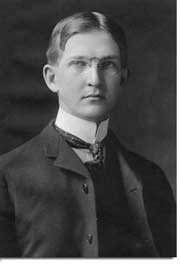
Raymond Alden in an undated photo

Raymond was a brilliant scholar and head of the English department at Stanford University. He was an accomplished author in his own right, best known for his classic short story “Why the Chimes Rang.”

In early 1914 Raymond traveled to England to spend several months conducting research in the historic archives of the British Museum and Oxford University. It was a dream trip for an American  professor of English literature. But as summer drew to a close, the gathering clouds of war suddenly broke over Europe.

Duke Humfrey’s Library, the oldest reading room at the Bodleian Library at the University of Oxford. Courtesy http://www.oxfordvisit.com

Germany declared war in early August, and almost overnight, the Atlantic Ocean became a danger for travelers as German U-boats began patrolling major shipping lanes.

Before matters could escalate further, Raymond wisely booked passage home on an ocean liner called the SS Arabic that departed Liverpool on July 28, 1914.

The SS Arabic of The White Star Line, 1904.

Raymond’s journey across the ocean was anything but peaceful. For most of the voyage, a British cruiser sailed alongside the Arabic as an escort to protect the liner from a potential u-boat attack.

While the Arabic made it safely across the Atlantic that summer, the ship would not always be so fortunate. Just one year later, in August 1915, the Arabic would be torpedoed and sunk by a German submarine off the coast of Ireland, an event that made international headlines and brought the United States to the brink of entering the war. But in August 1914, Raymond’s ship docked safely in Boston, delivering him back to America unharmed.

While Raymond was braving the ocean crossing, his parents were eagerly waiting for him in New York. The Aldens had always been a close-knit family, but given the circumstances in Europe, Isabella and her husband decided to travel clear across the country to New York so they could be close by when Raymond’s ship docked. The area where they stayed held a special place in their hearts

Isabella was born in Gloversville, New York, and had attended school at Oneida Seminary. It was there that she met Theodosia Toll Foster (who would write under the pseudonym Faye Huntington), and they became lifelong best friends, sharing a bond of faith and friendship that spanned decades.

Black and white newspaper photo of a large two-story home with a wide covered front porch and mature trees beside it.
Locust Shade, the Toll Family Homestead as it appeared before it was demolished in 1952 (from The Rome Sentinel, August 13, 1952

That August of 1914, while waiting for Raymond’s return, Rev. and Mrs. Alden stayed as guests at the Toll Homestead in Verona, New York. They also spent time in nearby New Hartford, where Rev. Alden had served as a beloved pastor of the First Presbyterian Church nearly forty years earlier.

But lurking beneath the family visits and conversations with friends, Isabella and her husband must have felt a good deal of anxiety over the safety of their son. Their prayers and the bond of faith they shared with family and friends must have been a comfort and support during that time.

After nine stressful days at sea, Raymond’s ship docked at Boston Harbor and he at last joined his parents in New York. He gave the local newspaper a brief (and very understated) account of his Atlantic crossing, describing it as “a somewhat exciting trip.”

Newspaper Article: Verona, Aug. 14. Dr. R.M. Alden of the department of English of Stamford [sic] University, Palo Alto, Cal., has been the guest of Mrs. T. M. Foster and family. Dr. Alden was en route from London to Palo Alto. He reports a somewhat exciting trip by the steamer Arabic.  A British cruiser was near at hand the great part of the way, as it was suspected that a hostile cruiser was following the Arabic. Dr. Alden has been in England several months studying in the libraries of the British Museum and Oxford. His parents, Dr. and Mrs. G. R. Alden, have been visiting friends in Verona and New Hartford for the past week, and the party left for their California home on Monday. Dr. G. R. Alden was pastor of the New Hartford Presbyterian Church about 38 years ago.
from the Daily Sentinel (Rome, New York) on August 14, 1914

Four days later, the Alden family boarded a train together for the long journey back to the home they shared in Palo Alto, California.

To the residents of Verona and New Hartford, the war across the Atlantic might have felt distant. But Raymond’s close call on the Arabic was a reminder of how quickly major world events could reach right into the homes of American families.

For Isabella and her family, facing uncertainty with steady faith and holding fast to deep friendships brought them through another trial, surrounded with love and support until they were, at last, safe at home together.

YOU CAN READ MORE ABOUT ISABELLA’S EARLY LIFE IN GLOVERSVILLE IN THESE POSTS:

LEARN MORE ABOUT ISABELLA’S FRIENDSHIP WITH THEODOSIA TOLL FOSTER IN THESE POSTS:

DISCOVER MORE ABOUT RAYMOND MACDONALD ALDEN IN THESE POSTS:

A Life-Changing Accident

December 8, 1925—almost exactly 100 years ago—started as any ordinary Tuesday afternoon in Palo Alto, California. Isabella Alden was 83 years old, and was living in the beloved double-home that she and her husband Ross built a decade before on Embarcadero Road.

Ross and her son Raymond had died the year before, so only Isabella and her daughter-in-law Barbara (Raymond’s widow) and her five children were left to share the rambling house.

Barbara Hitt Alden, about 1910.

That afternoon, Isabella, Barbara, and Barbara’s youngest son, Raymond Jr., set out together in the family car. Barbara was behind the wheel. None of them could have known that their simple outing would dramatically change the remainder of Isabella’s life.

Black and white photo of a side-view of an old automobile with four doors and a woman seated in the driver's seat.
A 1925 Lincoln sedan, a popular car style in the 1920s.

At a street intersection a little less than a mile from their home, another car collided with the Alden vehicle, striking it with enough force to cause it to overturn. The impact shattered the windshield and windows, showering the passengers with broken glass.

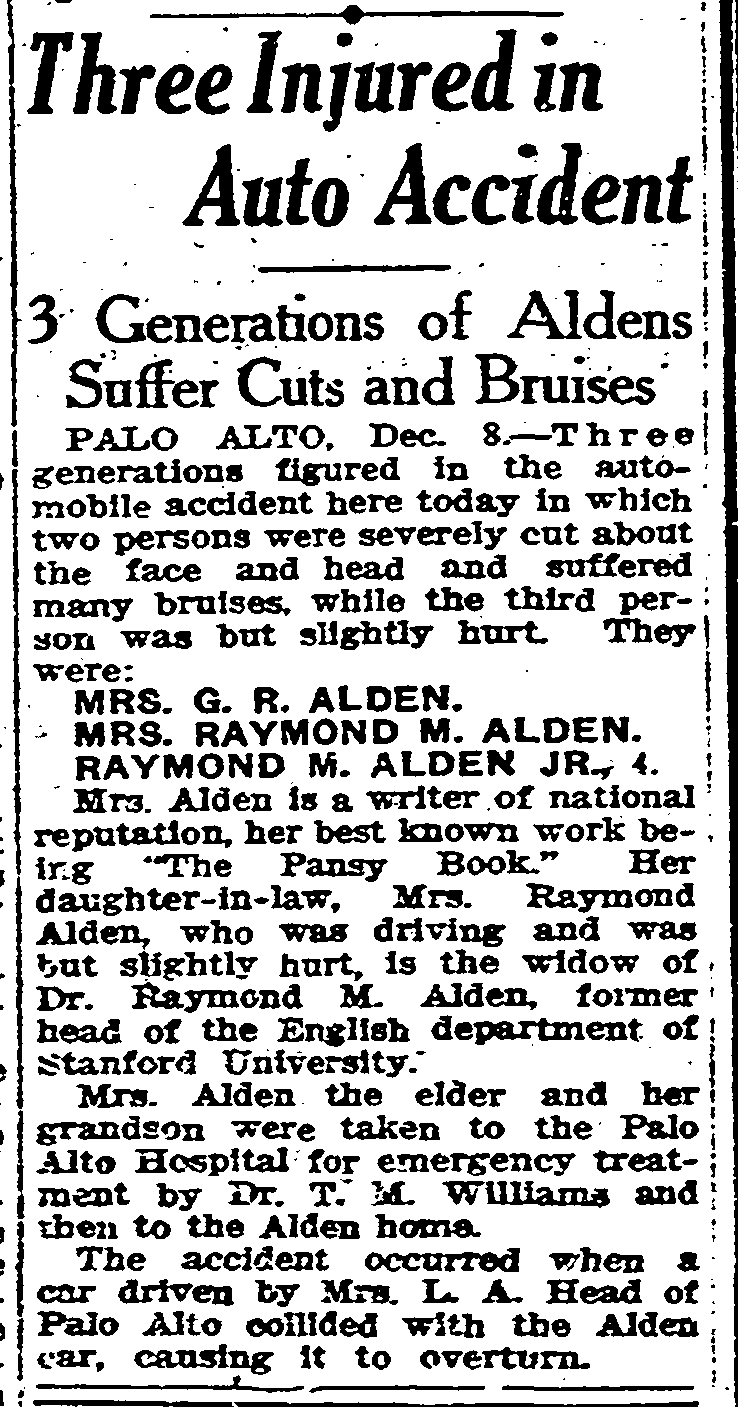
Newspaper Clipping: 3 Generations of Aldens Suffer Cuts and Bruises. Three generations figured in the automobile accident here today in which two persons were severely cut about the face and head and suffered many bruises, while the third person was but slightly hurt. They were: Mrs. G. R. Alden, Mrs. Raymond M. Alden, Raymond M. Alden Jr., 4.
The San Francisco Chronicle, December 8, 1925.

Barbara was only slightly hurt. But Isabella and her young grandson suffered “severe cuts about the face and head, and many bruises.” After receiving first aid from a nearby physician, Isabella and Raymond Jr. were taken to Palo Alto Hospital for treatment.

Palo Alto Hospital in the 1920s.

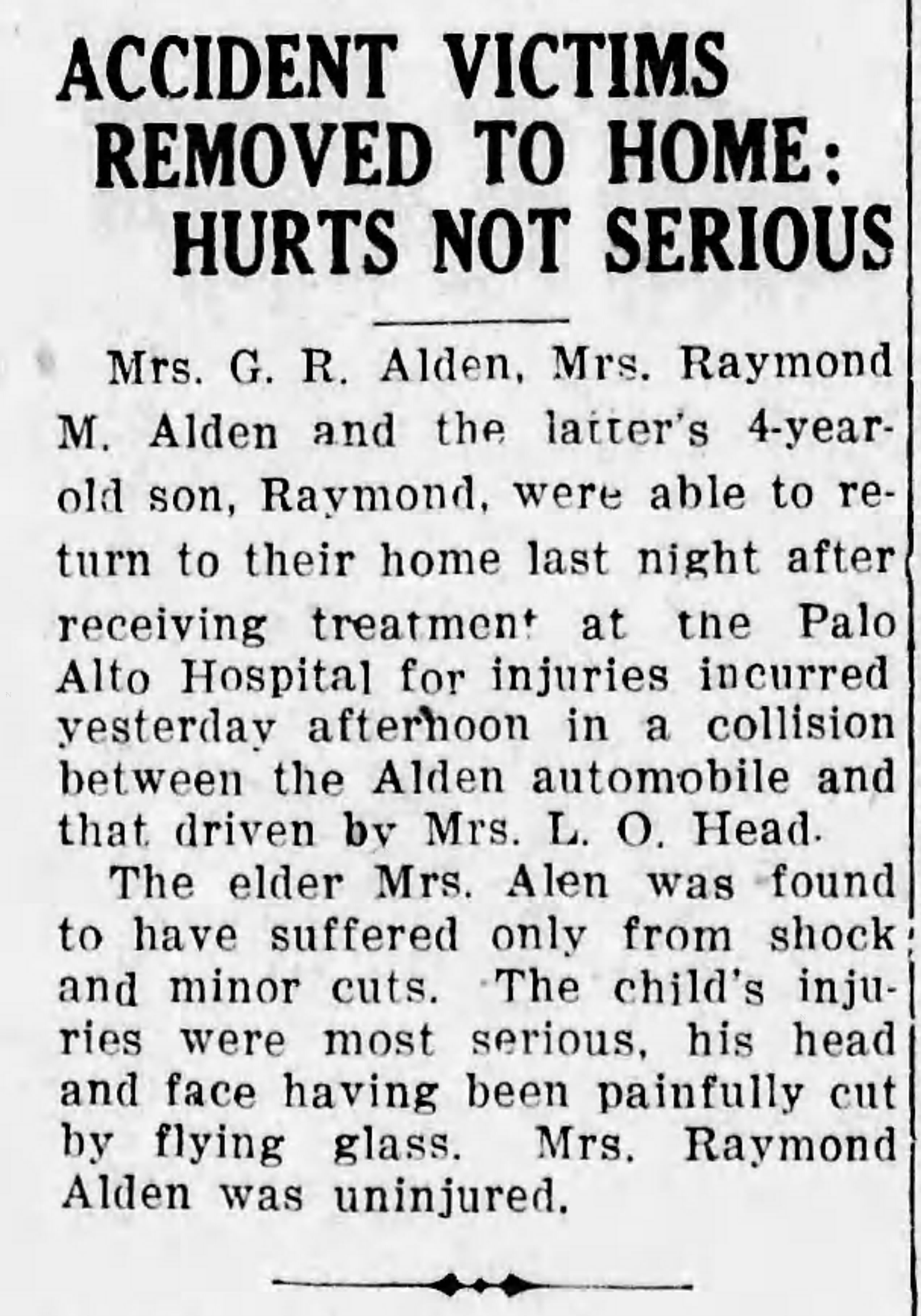
The next day’s newspaper reported reassuring news: the accident victims had returned home, and Isabella “was found to have suffered only from shock and minor cuts.” Her grandson’s injuries were described as the most serious of the three.

Newspaper Clipping: Accident Victims Removed to Home: Hurts Not Serious. Mr. G. R. Alden, Mrs. Raymond M. Alden, and the latter's 4-year-old son, Raymond, were able to return to their home last night after receiving treatment at the Palo Alto Hospital for injuries incurred yesterday afternoon in a collision between the Alden automobile and that driven by Mrs. L. O. Head. The elder Mrs. Alden was found to have suffered only from shock and minor cuts. The child's injuries were most serious, his head and face having been painfully cut by flying glass. Mrs. Raymond Alden was uninjured.
The Peninsula Times Tribune, December 9, 1925.

But that assessment would prove tragically wrong.

What those initial medical evaluations missed was the true extent of Isabella’s injuries. The accident left her in considerable pain and, ultimately, confined to a wheelchair for most of the remaining years of her life.

Until the accident, Isabella was a woman who had been remarkably productive well into her eighties—still writing, still engaged with her work and family. The accident didn’t just slow her down; it fundamentally altered how she could live her remaining years.

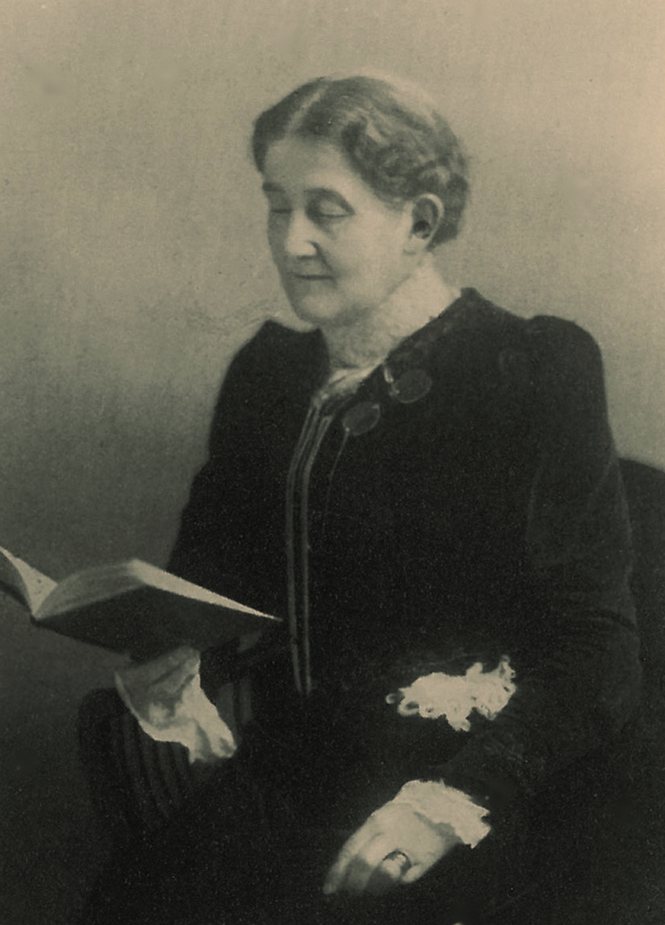
Isabella in later years.

In her memoir “Memories of Yesterday,” which she finished writing after the accident, Isabella documented the physical pain she endured. For a woman who had spent her life in service to others, who had quietly helped so many navigate their own difficulties, those final years must have been particularly difficult for her.

Isabella lived for nearly five more years after the accident, passing away in 1930 at age 88. Those years, spent largely in a wheelchair and dealing with chronic pain, were a far cry from the active, engaged life she had led for more than eight decades.

What is striking about this incident in Isabella’s life isn’t just the tragedy of the accident itself, but what it reveals about her character during her final years. Despite her pain and limitations, she continued to write. She finished her last novel, An Interrupted Night, and entrusted it to her niece, Grace Livingston Hill, to guide it through the publishing process.

She also completed her memoir, Memories of Yesterdays, candidly sharing her memories and reflections on a life well-lived. Even when her body was confined to a wheelchair, her mind and spirit remained active.

That’s the Isabella Alden we’ve come to know through her writings—someone who lived out the principles she wrote about, even when circumstances became difficult. She had spent decades writing about faith, perseverance, and finding purpose in adversity. In her final years, she had to draw on those very principles herself.

A hundred years ago this month, Isabella’s life changed forever on a Palo Alto street corner. While the accident limited her physical abilities, it couldn’t diminish the legacy she’d built through decades of faithful work—or the strength of character that sustained her until the end.

Click on the links below to read more about:
The house on Embarcadero Road
The deaths of Ross and Marcia Livingston
The death of Raymond Alden
Isabella’s final novel, An Interrupted Night