Fashion and Isabella

It’s Spring! With the change of season comes certain rituals, like going to our closets to see how we can incorporate the latest styles and fashion trends into our wardrobes.

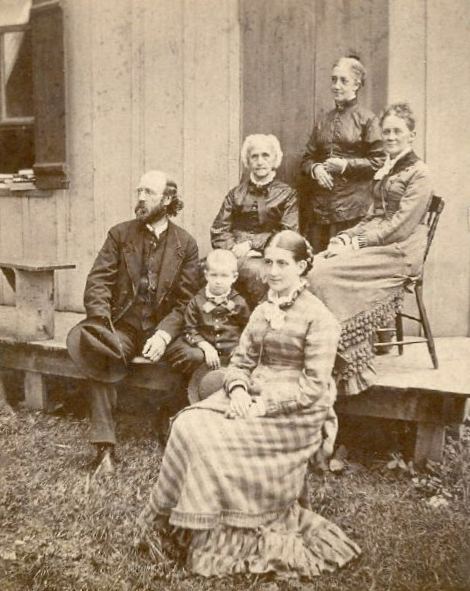
Isabella Alden lived to be eighty years old, and in her lifetime she saw many Spring fashion trends come and go. One of the earliest photographs of Isabella was taken about 1877 when she was 36 years old.

The Aldens and Macdonalds at Chautauqua in about 1877. Left to right: Gustavus “Ross” Alden (Isabella’s husband), Raymond Macdonald Alden (Isabella’s son), Myra Spafford (Isabella’s mother), Isabella Macdonald Alden, Julia Macdonald (Isabella’s sister), and an unidentified woman.

That’s Isabella sitting in the foreground of the photo, along with her husband, the Reverend Gustavus “Ross” Alden” and their son Raymond. The photo was taken in front of the Alden’s first cottage at Chautauqua Institution.

Isabella’s dress, with its lacy collar, long sleeves, and modest train, was very much in keeping with the style of the day.

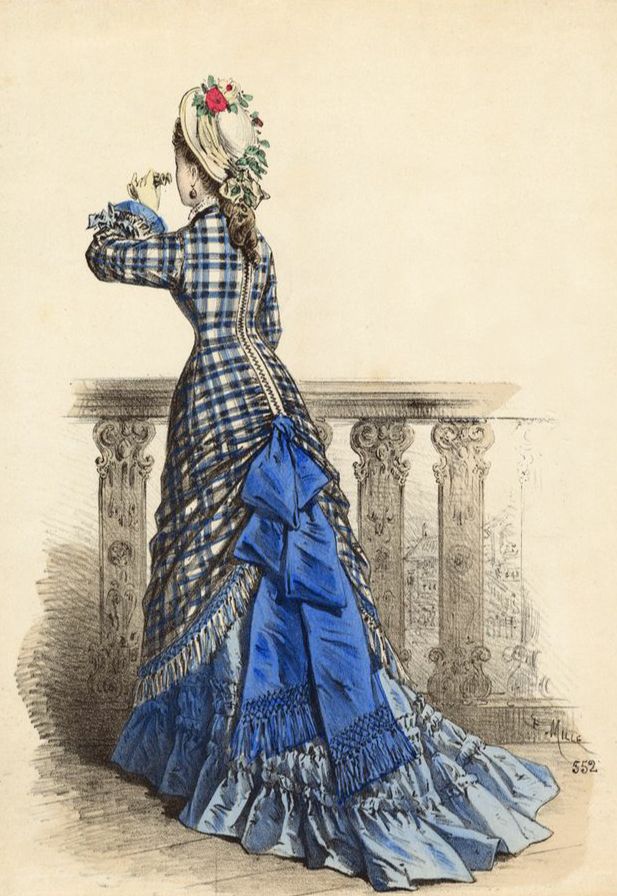
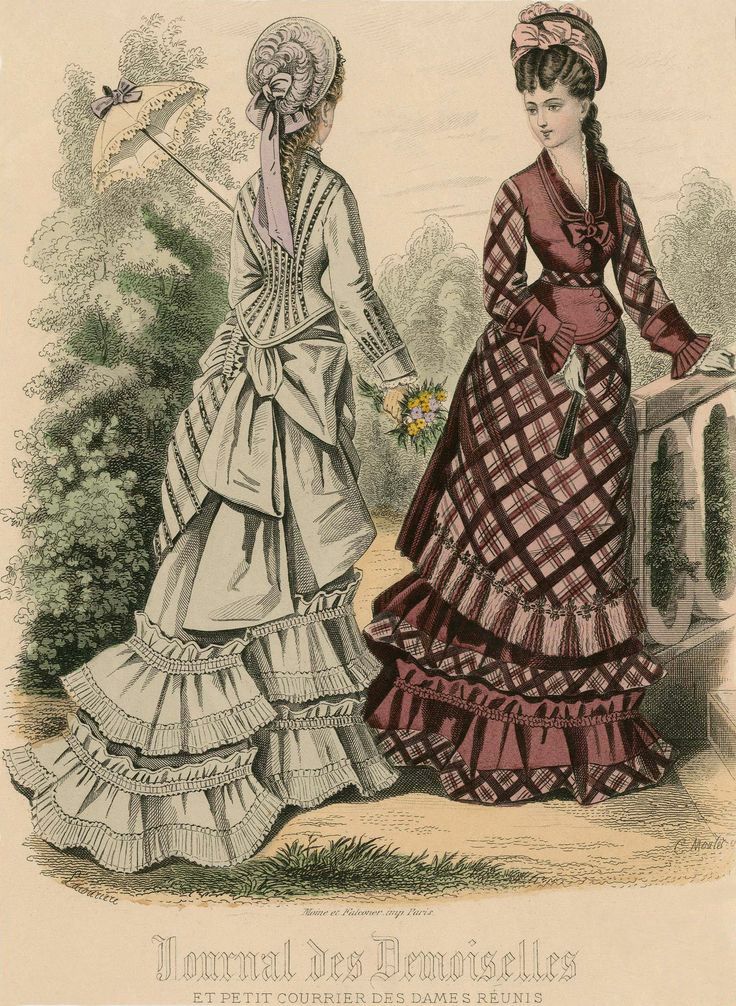
Her choice of a plaid fabric for her gown indicates Isabella kept up with current styles, such as the plaid gown in the 1875 fashion plate above, or the plate dated 1877 below:

By 1891 women’s fashions began to change dramatically. Skirts took on slimmer silhouettes, and sleeves went the opposite direction—instead of slim and fitted, they were gathered to form puffs at the shoulders before tapering to fitted cuffs like these:

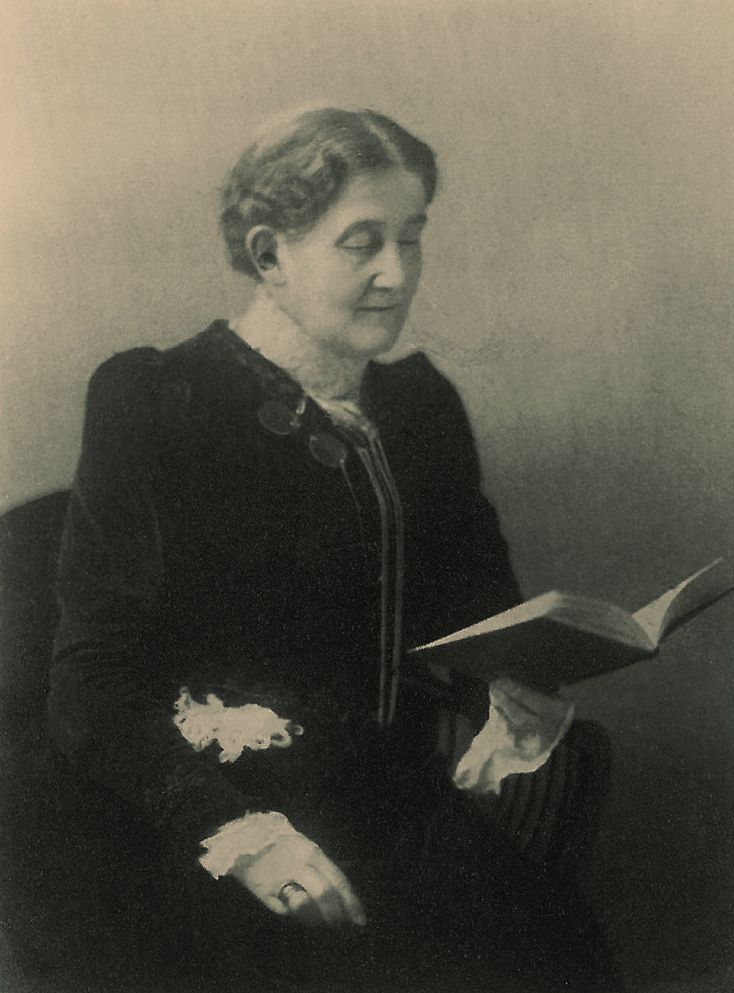
Once again, Isabella’s attire reflected those fashion trends. In the photo below, taken about 1895 when she was in her fifties, Isabella is wearing a dark, solid-color gown, with a standing lace collar and sleeves that gathered at the shoulders.

In keeping with the clothing construction of the time, Isabella’s gowns would have been either a single, one-piece garment consisting of a bodice, sleeves and skirt; or her gowns might have been made up of two pieces, consisting of a bodice—sometimes called a waist—and a skirt; both pieces were typically made from matching fabric and styled so they appeared, when worn together, to be a single garment.

But in the late 1890s an entirely new innovation hit women’s fashion: The shirtwaist.

Today we’d call it a blouse, but in the late 1890s, shirtwaists revolutionized the way women dressed. Shirtwaists buttoned down the front or back and were constructed of lightweight fabrics such as silk, cotton, or linen for summer; flannel and wool for winter.

More importantly, shirtwaists instantly gave women many more clothing options. They were suitable to be worn with tailored suits, or with a simple skirt for housework or playing sports. Dressier versions were suitable for afternoon receptions, going to the theater or evening wear.

Styles varied, too; from impeccably tailored shirtwaists, like this one:

To highly decorated styles with lace, embroidery or pleats.

Isabella readily adopted the new fashion. This publicity photo, taken in 1900 when she was about fifty-nine years old, shows her wearing a very feminine shirtwaist with ruffled collar, pleats, and lace:

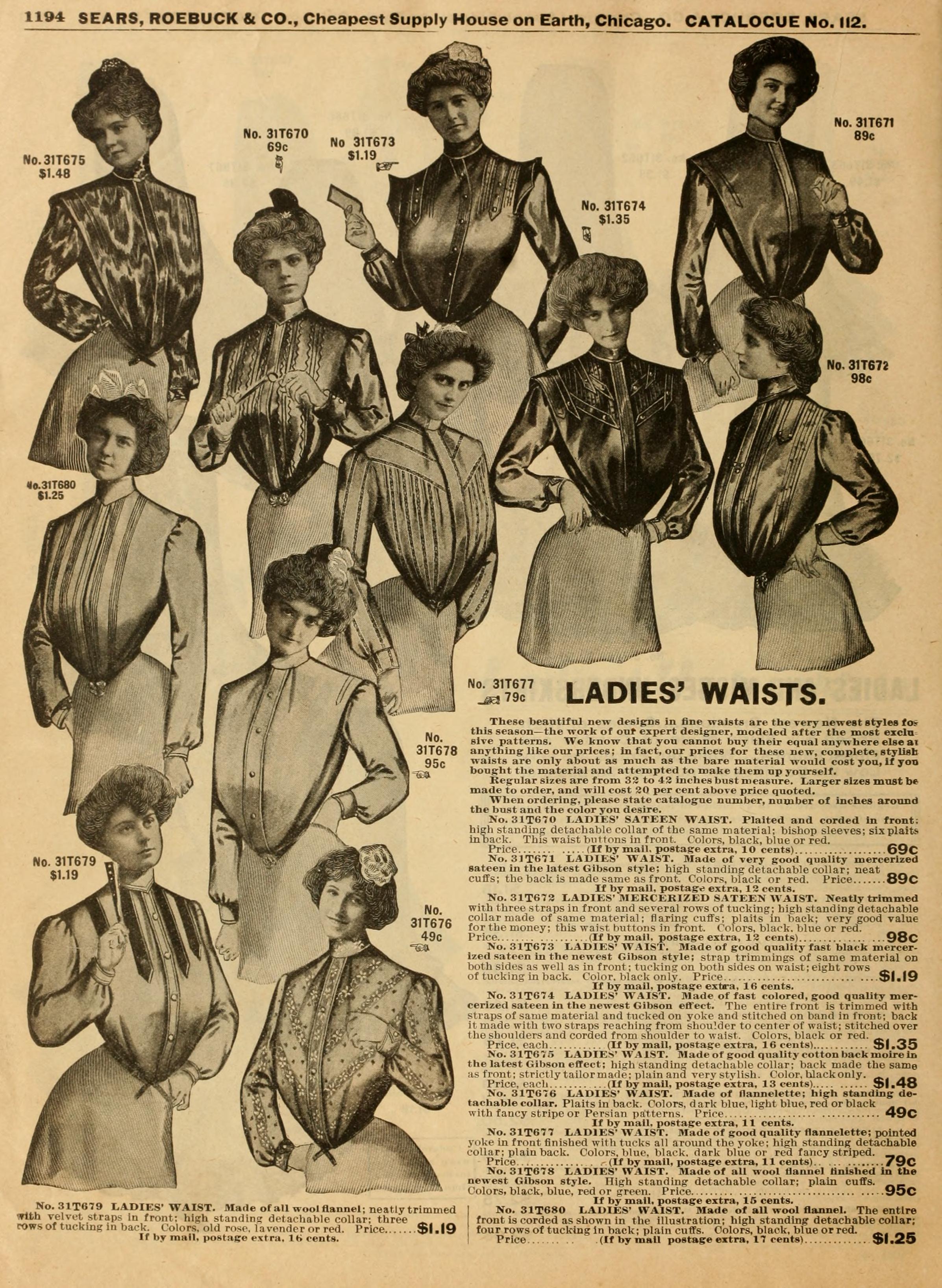
Shirtwaists were versatile and affordable. The Sears catalog of 1902 offered ladies’ shirtwaists starting at sixty-nine cents, which is equivalent to about $20.50 today.

With those kinds of prices, it was easy for women to enlarge their wardrobes simply by alternating different shirtwaists with their skirts and suits.

By 1905 shirtwaists were firmly entrenched as must-have garments for every woman’s wardrobe. Their production helped launch the ready-to-wear industry that we know today.

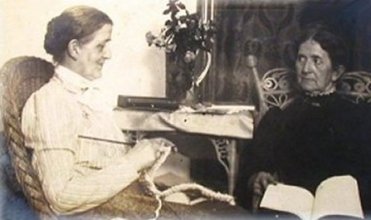
Isabella, on the left wearing a shirtwaist and skirt, with her sister, Marcia Livingston.

During her lifetime, Isabella embraced innovation, from gadgets (such as typewriters and telephones) to automobiles and women’s suffrage. And while she knew that, as a minister’s wife, she had to set an example for the manner in which Christian women should dress, she still seemed to keep up with the times when it came to fashion.

Advice to Readers about Boys and Books

For many years Isabella served as an editor and contributor to a Christian magazine in which she had a very popular advice column. She used the column to answer readers’ concerns—from a Christian perspective—on a variety of topics.

This letter came from a teen named Betsy:

Do you think there is any harm in girls of, say, fifteen to seventeen or eighteen, giving parties and inviting their boy friends? Some people seem to think so; what do you think?

I wish you would name a list of books for girl to read. Father doesn’t like me to read “Little Women” and such stories, and I’m sure I don’t know what is good if they are not.

Betsy.

Here is Isabella’s reply:

About the parties, Betsy, they belong to the class that the logicians call an “open question.” There are parties, and “parties.” A girl of fifteen, or sixteen, or seventeen, whose mother heartily approves the plan and joins with her daughter in making ready and in preparing the list of invitations—giving careful consideration to the names of the boys— and whose father and mother are to act as host and hostess, may safely give a party such as all her friends will approve and enjoy. In short, a party thoroughly mothered and fathered is, as a rule, a safe and pleasant place for young people to gather occasionally.

Note the use of that word “occasionally.” Even under the most favorable circumstances, with fathers and mothers as wise as serpents, parties are like rich cake; as an occasional luxury it is delicious and comparatively harmless; but used as a steady diet, interfering with substantial food, the normal appetite soon turns from it with dislike; and for the abnormal one, it works mischief.

Do you know, Betsy, I don’t more than half believe in the party that your question is planning. I more than half believe that either mother or father, or both, have been trying to convince you that you have not time, or, perhaps, strength, for such functions; perhaps, that there have already been too many parties in your circle this season; perhaps, that they cannot afford to indulge you in this matter; perhaps, that some of the boys, and even, possibly, certain of the girls, whom you wish to invite, are not such as they like to welcome as your friends; and you have not been convinced by them; hence your question.

If I am wrong in reading between the lines of your letter, forgive me; I may be wrongly judging you by others. I know such girls; indeed, I am answering their letters at this moment. through yours. I want to say to them that nothing is safer in this world than for girls of sixteen or seventeen, or any age that marks them as girls, to be guided by the judgment, by the fears, by the notions, even, of good mothers and fathers; and that just as surely as they break away from such advice and guidance, whether in the matter of parties or anything else, just as surely the day is coming when they will regret it. I am an old woman, and I am saying what I know is true. I have seen it bitterly regretted when it was too late.

About books. Lists, when they come from strangers, are doubtful helps. Personal tastes and acquirements, as well as the environment of the readers, must be taken into consideration to make them helpful.

I do not know your father’s reason for objecting to Little Women, but my personal objection to that and other volumes by the same gifted author is that, while charmingly written, they present views of life that are fascinating and false. Many of the characters described live beautifully, unselfishly, sacrificially, not for the sake of love, but for the sake of duty; and they do it steadily, climbing to the heights of self-abnegation, growing day by day in all the graces of the Christian religion, but they do it without a Savior. Jesus Christ is to them a friend, a guide, a beautiful pattern, but never a Redeemer. Such living is impossible. For this reason I deplore the charms of that class of books.

Betsy, dear, why not get that good father of yours to make a list of books that he would like you to read? I’m nearly certain that he would do it if you asked him, and equally certain that he would be gratified at the request.

When you get your list, let me beg you to begin at the beginning and read the books through carefully, conscientiously; not skimming a page, not skipping a line; even though they be as dry as chips baked in a summer’s sun and you fall asleep over them a dozen times. If he is the father that I think he is, I can predict the result with the certainty of a prophet.

I can even imagine a typical scene; a day when you will stand with one of the time-worn volumes in your hand, a dreamy look on your face, a tenderness in your voice, and an undertone of pathos, as you say:

I can never be grateful enough to my dear father for persuading me when I was a girl of sixteen to read this old book, and the others that were on the list he gave me. Some of them have had an abiding influence over my life. I truly believe that my taste for real literature of the best kind began to be formed while I was struggling through this first volume, for father’s sake. Dear father! He did a great deal more for me than he knew.

Believe me, Betsy, now is the time to plant seeds that may bloom, some day, over father’s grave. It will be blessed for you if you do such gardening now that if, in the faraway future, you stand one day beside the resting places of father and mother, there will be flowers of memory in your heart, instead of that thorny plant: “Oh, I wish I hadn’t!”

What do you think of Isabella’s advice to Betsy?

An Extra Hour of Sunshine

It’s that time of year again, when Americans turn their clocks forward one hour.

A Coming Boon. For an hour of darkness - an hour of sunshine. Title from a newspaper article on Daylight Savings.

The original Daylight Savings law was first enacted in the United States in 1918 when Isabella was 77 years old. In the years before it became law, proponents of the bill had to sell the idea to the American public. For years lawmakers and lobbyists ran ads and articles in newspapers and magazines to tell Americans how good life could be if they just turned their clocks ahead one hour.

Sometimes the ads highlighted how a longer day would benefit the simple things in life:

Often when I get my evening paper it is too dark to read, but—

Newspaper illustration of a man standing under a street lamp at night trying to read a newspaper. In the background a clock on a church tower shows nine o'clock.

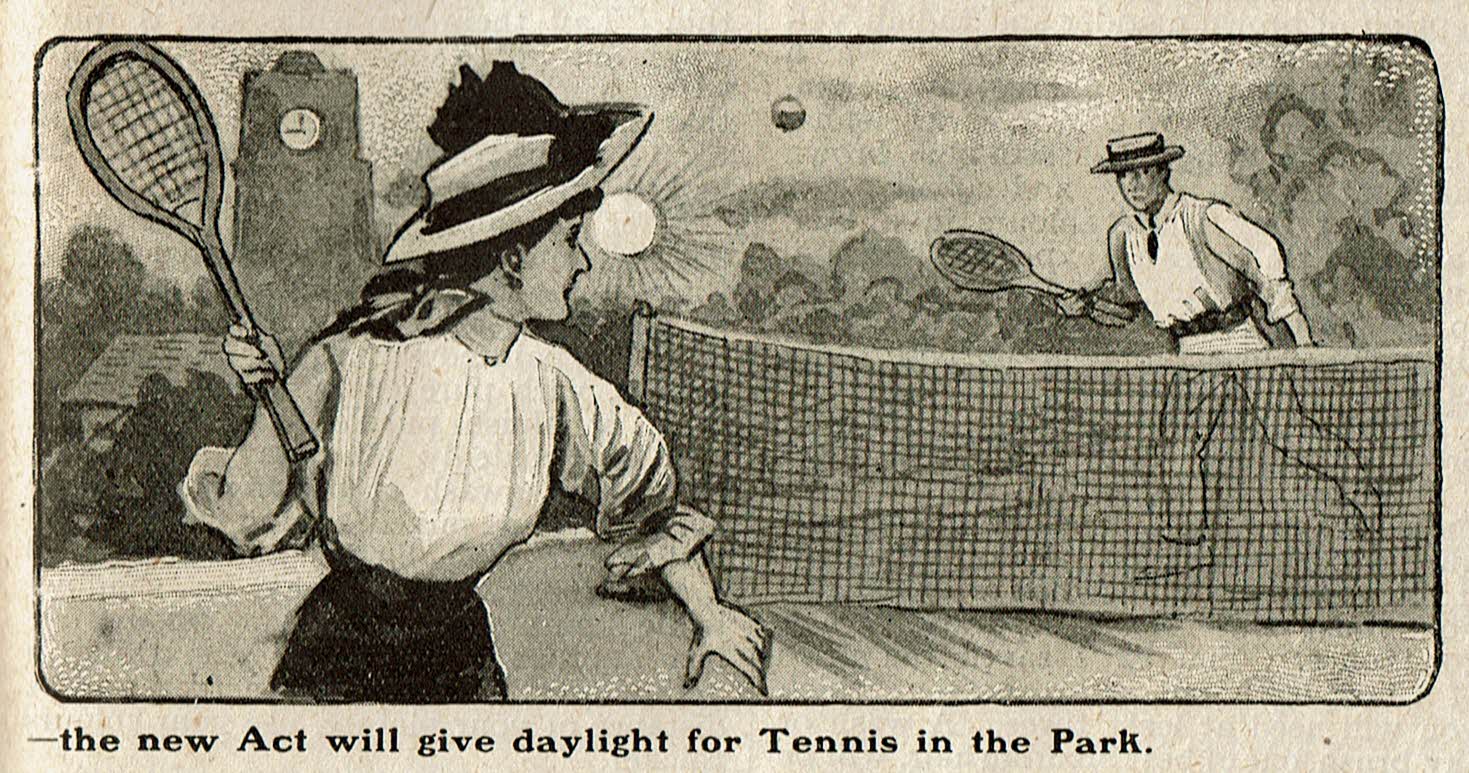
—the new Act will give daylight for Tennis in the Park.

Newspaper illustration of a man and woman playing tennis. In the background the sun in still shining brightly in the sky and a clock on a building shows the time is nine o'clock.

Backers of the bill encouraged average Americans to “think of evening walks in the park, or games out of doors, instead of being indoors, with only gas or electric light.”

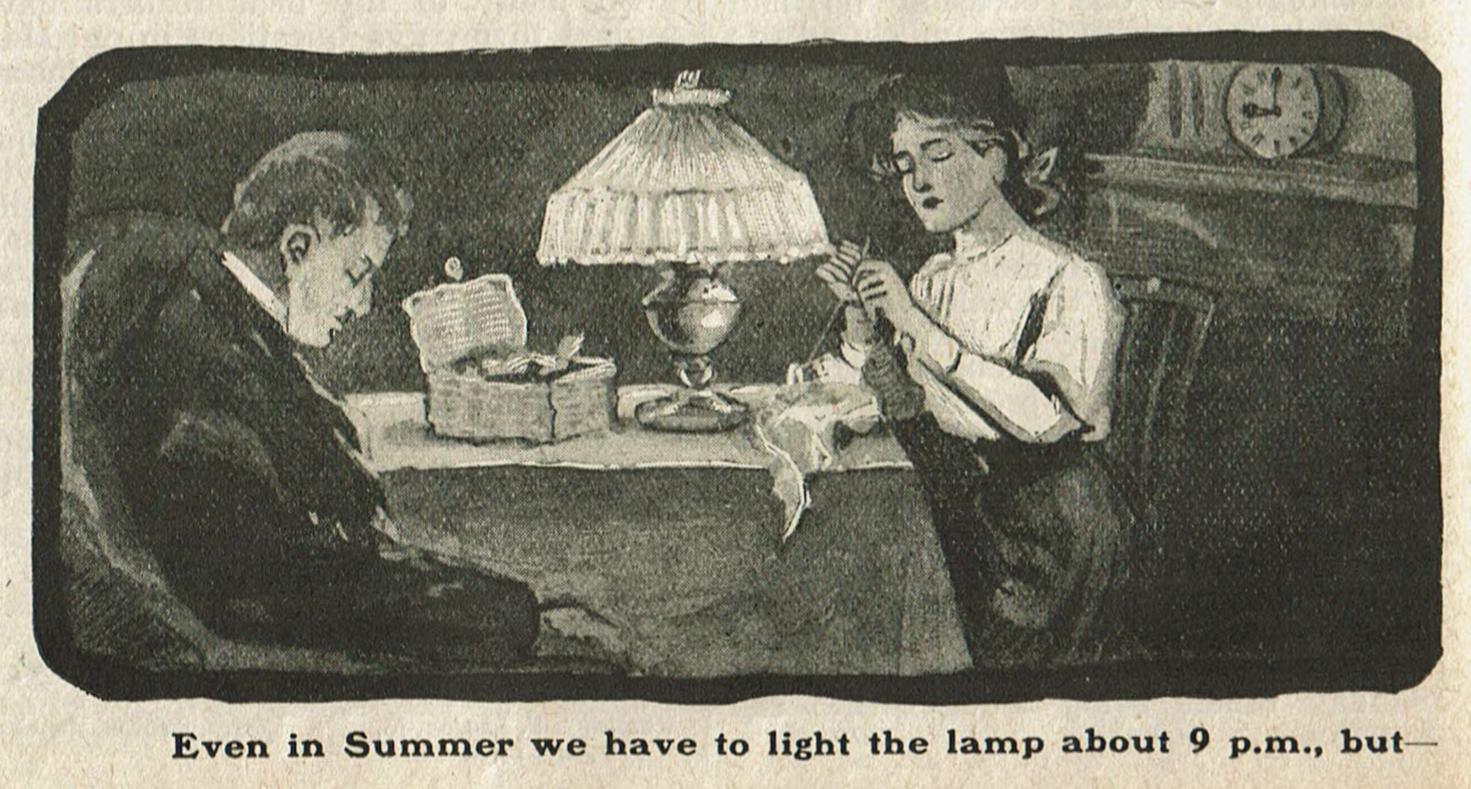
Even in Summer we have to light the lamp about 9 p.m., but—

A man and woman sit at a table in a darkened room. The woman is sewing under a single lamp on the table. In the background a clock on a mantel shows the time is nine o'clock.

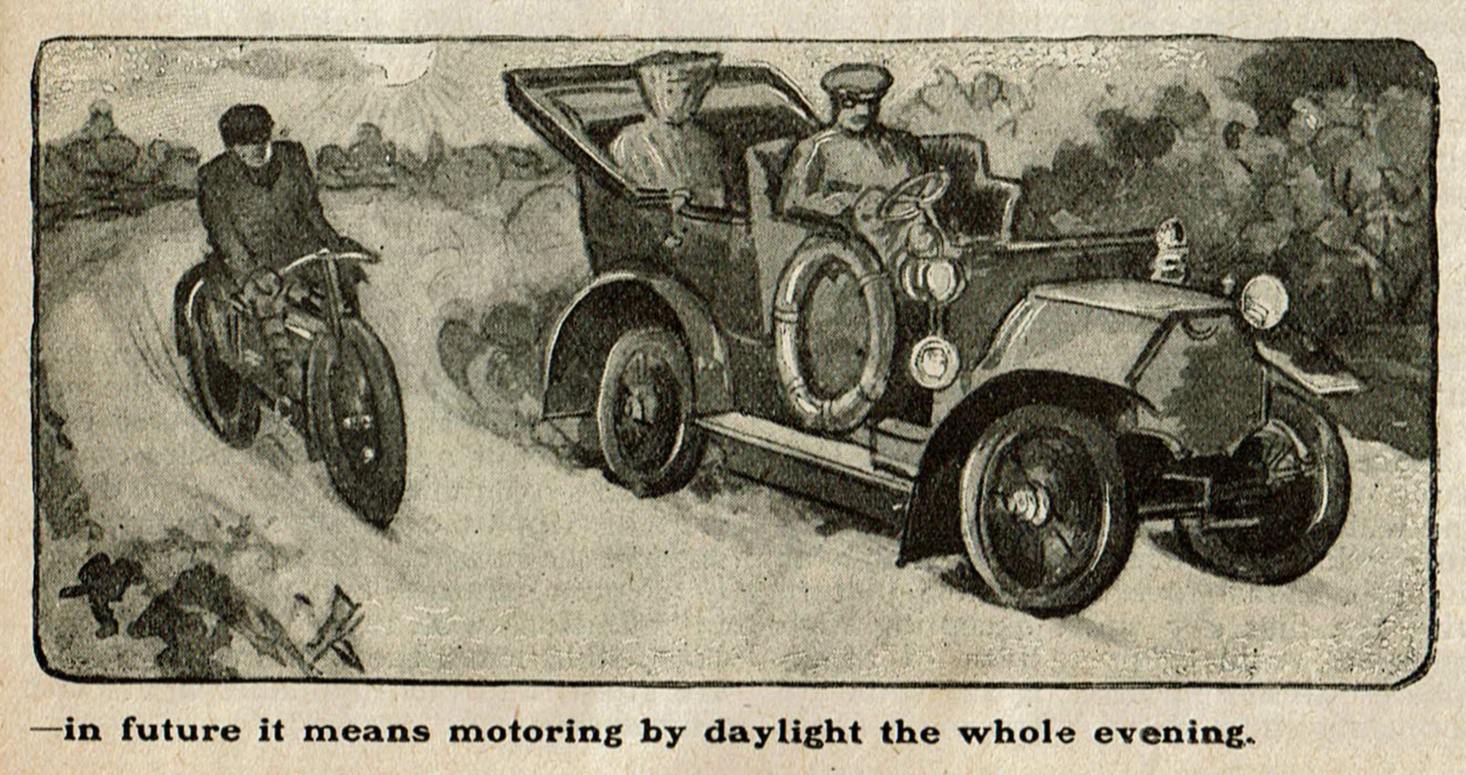
—in future it means motoring by daylight the whole evening.

Newspaper illustration showing a man on a motorcycle passing a woman and her chauffeur driving an automobile. In the background the sun shines brightly in the sky.

The scientific community liked the idea, too, and pointed out the advantages one additional hour of recreation would have on school children, and the effect it would have “in the preservation of eyesight.”

Newspaper excerpt: It is estimated that 210 hours of daylight are now wasted every year! Let us not be so faint-hearted nor unwise as to oppose the change, when the cost is so trifling, and when the reward is likely to be such a grand physical, mental, moral and economic advantage for our nation.

All the ads and arguments worked; Congress enacted the Daylight Saving Time law on March 9, 1918, and Americans have been arguing about it ever since!

Do you like Daylight Savings Time? What do you do with your extra hours of sunshine?

Don’t forget to turn your clocks ahead on Sunday, March 14!

Fun on a Cold Winter Evening

Isabella didn’t have television or electronic devices during her lifetime (even radios weren’t common in homes until the 1930s). So on long cold winter days and evenings, when people had to stay indoors out of necessity, they had to come up with ways to entertain themselves.

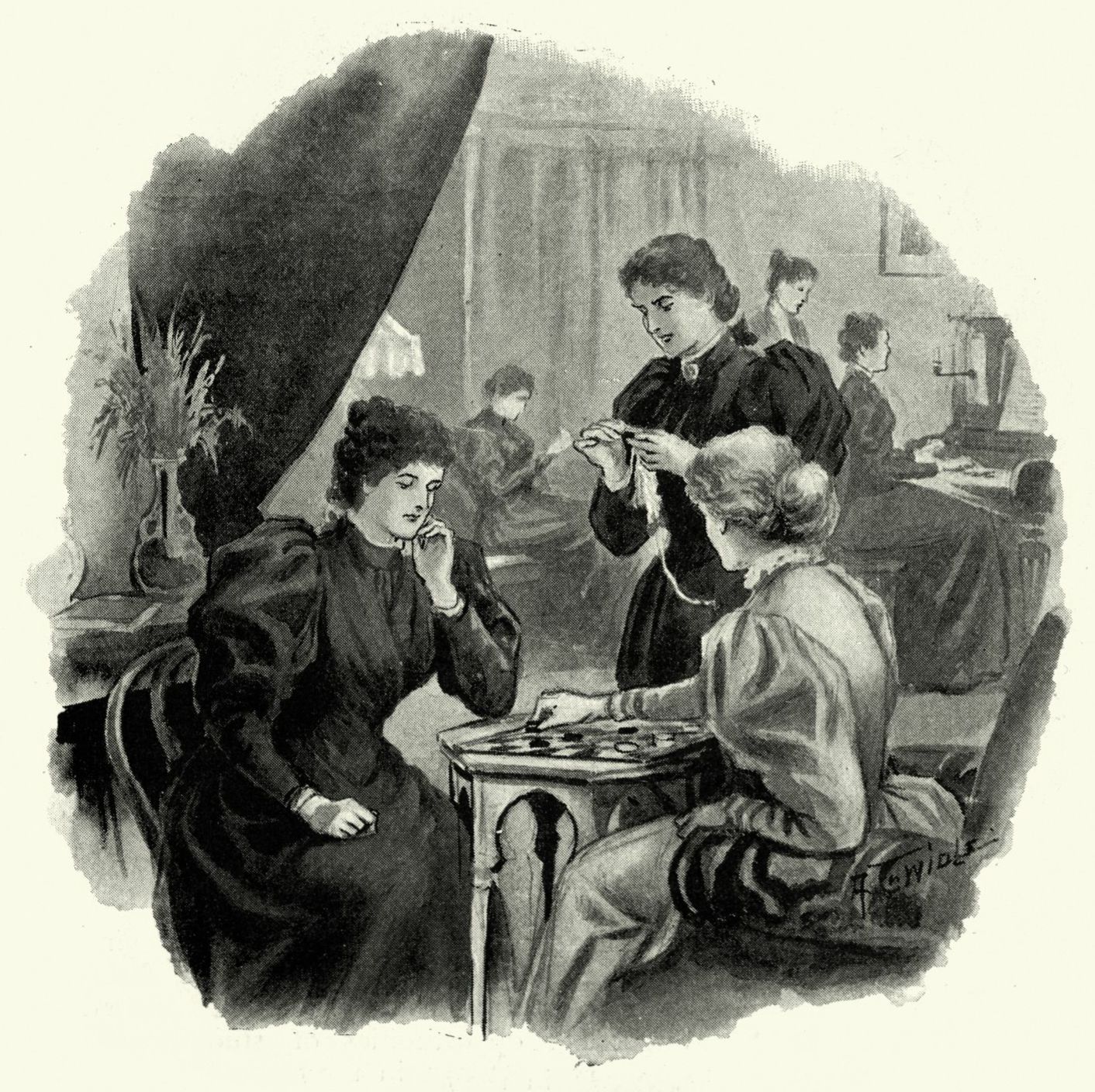
Then, as now, board games like chess, checkers, and backgammon were popular; but they limited play to only two people. What was a family to do to pass the time?

Family members often read aloud to each other (click here to read more about Isabella’s skill at reading aloud) or joined together to sing hymns or popular songs.

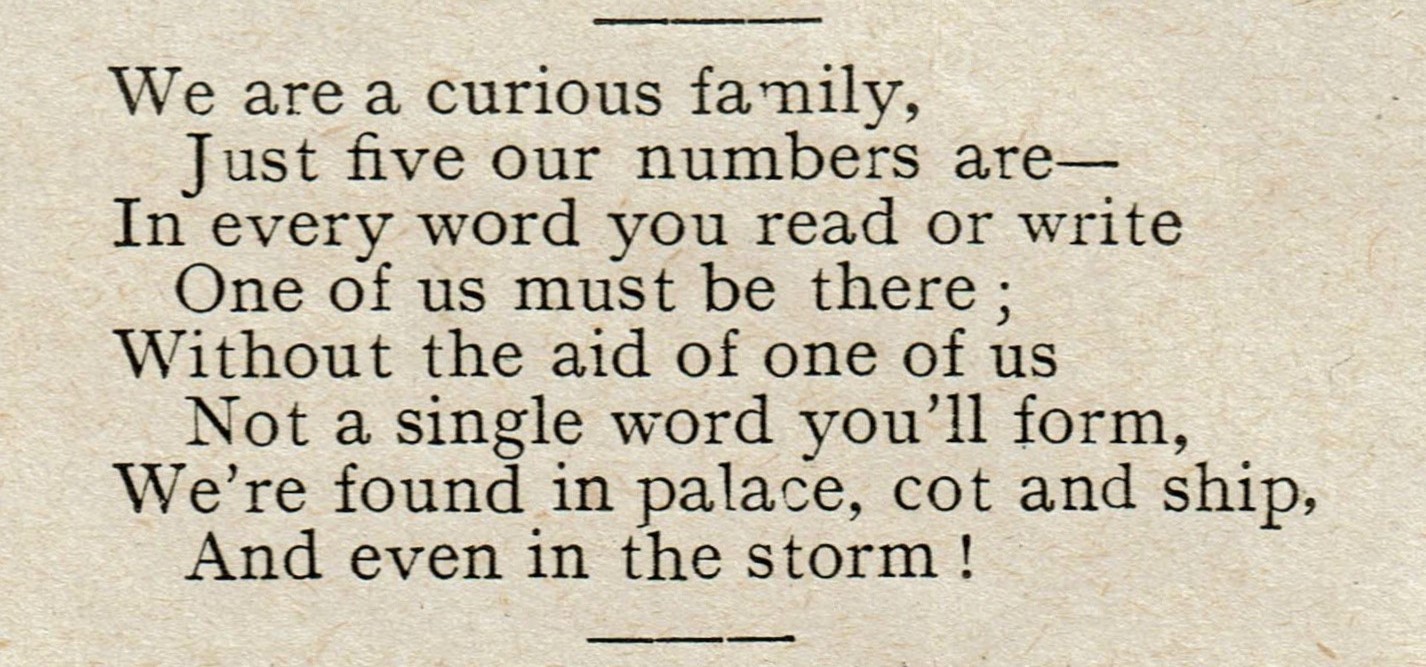
Newspapers and magazines published word games, and families often joined together to solve riddles like this:

We are a curious family, Just five our numbers are. In every word you read or write one of us must be there; without the aid of one of us, not a single word you'll form; we're found in palace, cot and ship, and even in the storm!

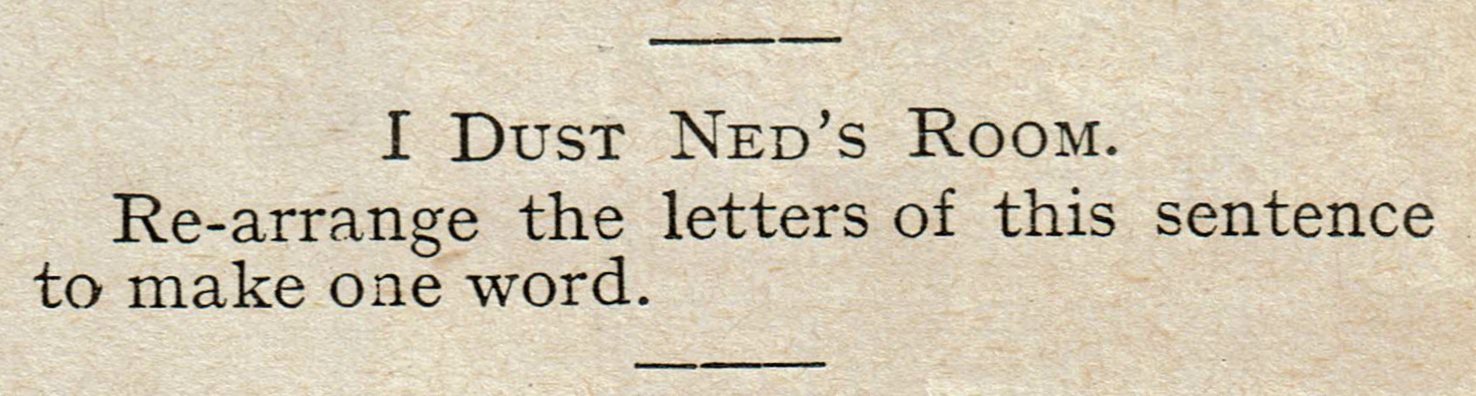
Or this word scramble from a 1907 magazine:

I Dust Ned's Room. Re-arrange the letters in this sentence to make one word.

(Scroll to the bottom of this post to see the answers to these two puzzles.)

But when friends came to call, or neighbors got together, playing parlor games was the most common way for people to pass those cold winter evenings.

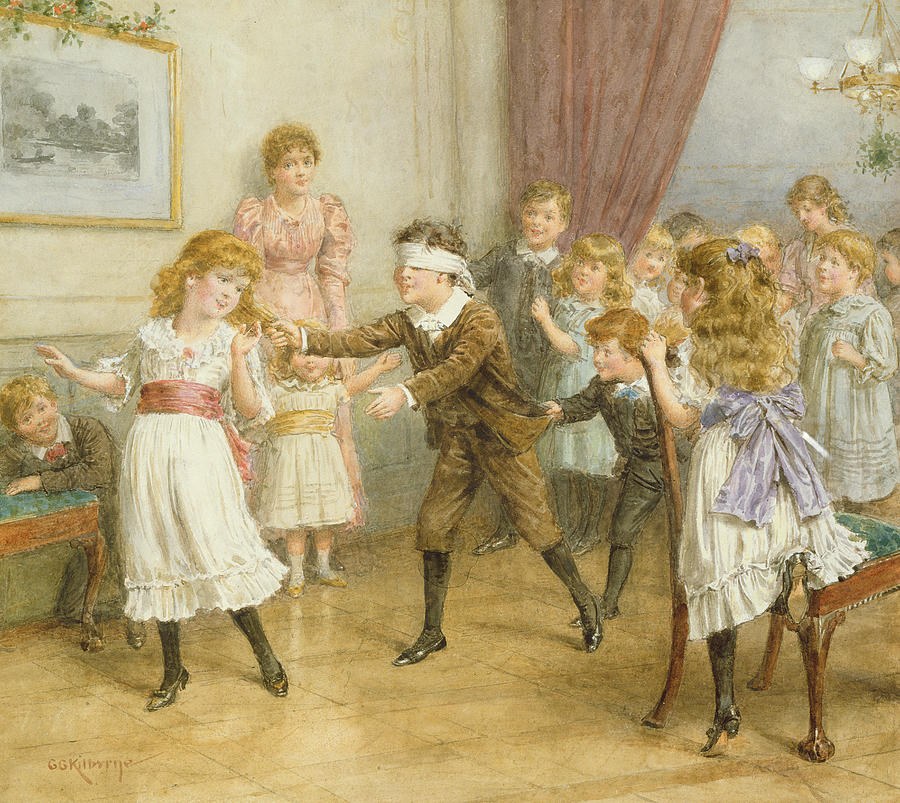
Children playing Blind Man’s Bluff.

The rules for most games were simple, and the games could accommodate any number of players, so they were ideal for entertaining children and adults. Here are a few parlor games that were in vogue during Isabella’s lifetime:

Blind Man’s Bluff:

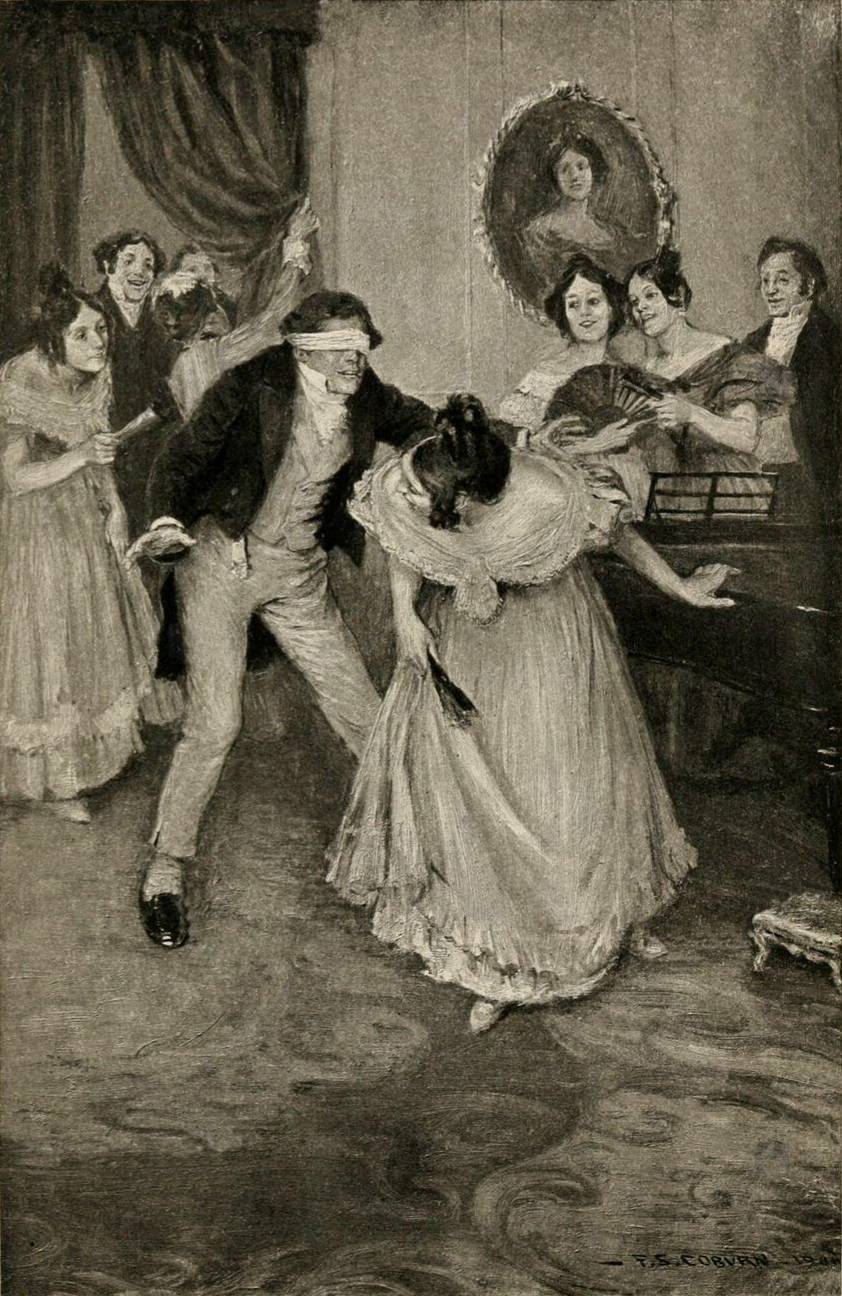
Versions of Blind Man’s Bluff have been around since ancient Greece. The rules were simple; players were confined to a single room or space; one player was blindfolded and roamed the room/space freely, trying to catch one of the players. Once a player was caught, the “blind man” had to correctly identify him or her in order to win the round.

Savvy parents and alert chaperones usually limited this game to children, because teenagers and adults too often used it as a thin excuse to lay hands on each other.

Isabella hinted at Blind Man’s Bluff in her novel, As in a Mirror, when teenaged Elfrida Elliott snuck out of her parents’ house to join a group of friends for a night of games:

Very foolish games they seemed to be for the most part, having the merest shred of the intellectual to commend them, and that so skillfully managed that the merest child in intellect might have joined in them heartily. But the distinctly objectionable features seemed to be connected with the system of forfeits attached to each game. These, almost without exception, involved much kissing. Of course the participants in this entertainment were young ladies and gentlemen. There seemed to be a certain amount of discrimination exercised by the distributor of the forfeits, yet occasionally such guests as “Nannie” and “Rex” and others of their class would be drawn into the vortex, and seem to yield, as if to the inevitable, with what grace they could. [There was] a laughing scramble between the said Nannie and an awkward country boy, who could not have been over fifteen. He came off victorious, for she rubbed her cheek violently with her handkerchief, and looked annoyed, even while she tried to laugh.

Pass the Parcel:

A favourite game for all ages was Pass the Parcel. Here’s how it’s played: a small object is wrapped in multiple layers of paper or cloth, and passed around the circle to music. Each time the music stops, the person caught holding the parcel gets to remove one layer of wrapping. The win goes to the first person who can correctly identify the object before it is unwrapped; or to the person who ultimately removes the final wrap to reveal the object.

Wink Murder:

Another favorite was Wink Murder. To play, everyone sits in a circle and closes their eyes, while one person walks around the circle of players, choosing a murderer by tapping him or her once on the head. They then choose the detective by tapping a player twice on the head.

The players then open their eyes and engage in conversation, while the detective moves to the center of the circle and is allowed three tries to guess who the murderer is. Meanwhile, the murderer “kills” the other players by making eye contact and winking at them, trying not to be caught by the detective in the process.

To add to the fun, the victims “die” dramatically before they leave the circle. If the detective doesn’t identify the murderer in three attempts, he or she remains detective for the next round. If the detective guesses correctly, the murderer becomes the detective for the next round.

Have you played any of these parlor games before? What are your favorite games to play with your family, friends, or church group?

The answer to the word riddle is: Vowels

The answer to the word scramble is: Misunderstood

When Pansy Was a Girl: The Scarlet Fever Scare

In 1889, when Isabella was 47 years old, she shared a memory from her childhood that holds many parallels to our situation today.


When I Was a Girl

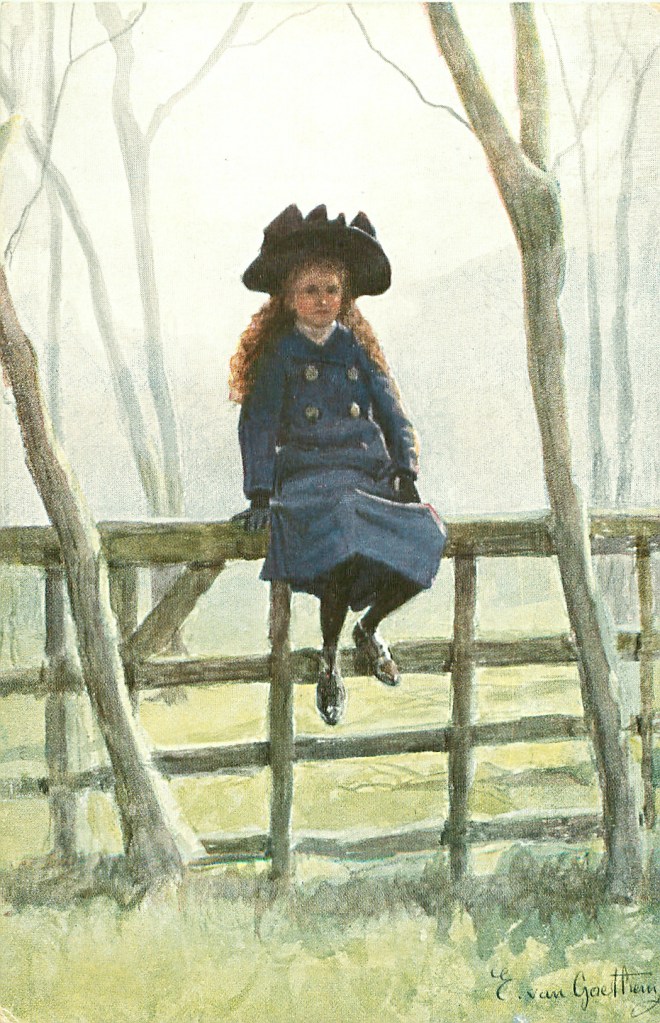
I suppose it would hardly be possible to find a girl who looked less as I did than the one whose picture I present to you. Nor for that matter, one whose surroundings were more unlike the things which surrounded me.
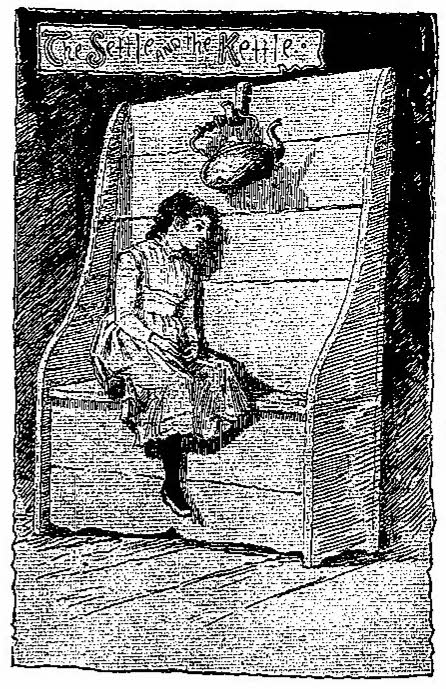
It is true we had a garden where old-fashioned flowers bloomed the summer through, and it is also true that there was a wide old seat which for some reason was called the “settle,” out in the sunshine very near the bowers, and there I used often to sit. But no such ugly back had our wide, low “settle,” nor did there ever hang an ugly black kettle just over our heads.

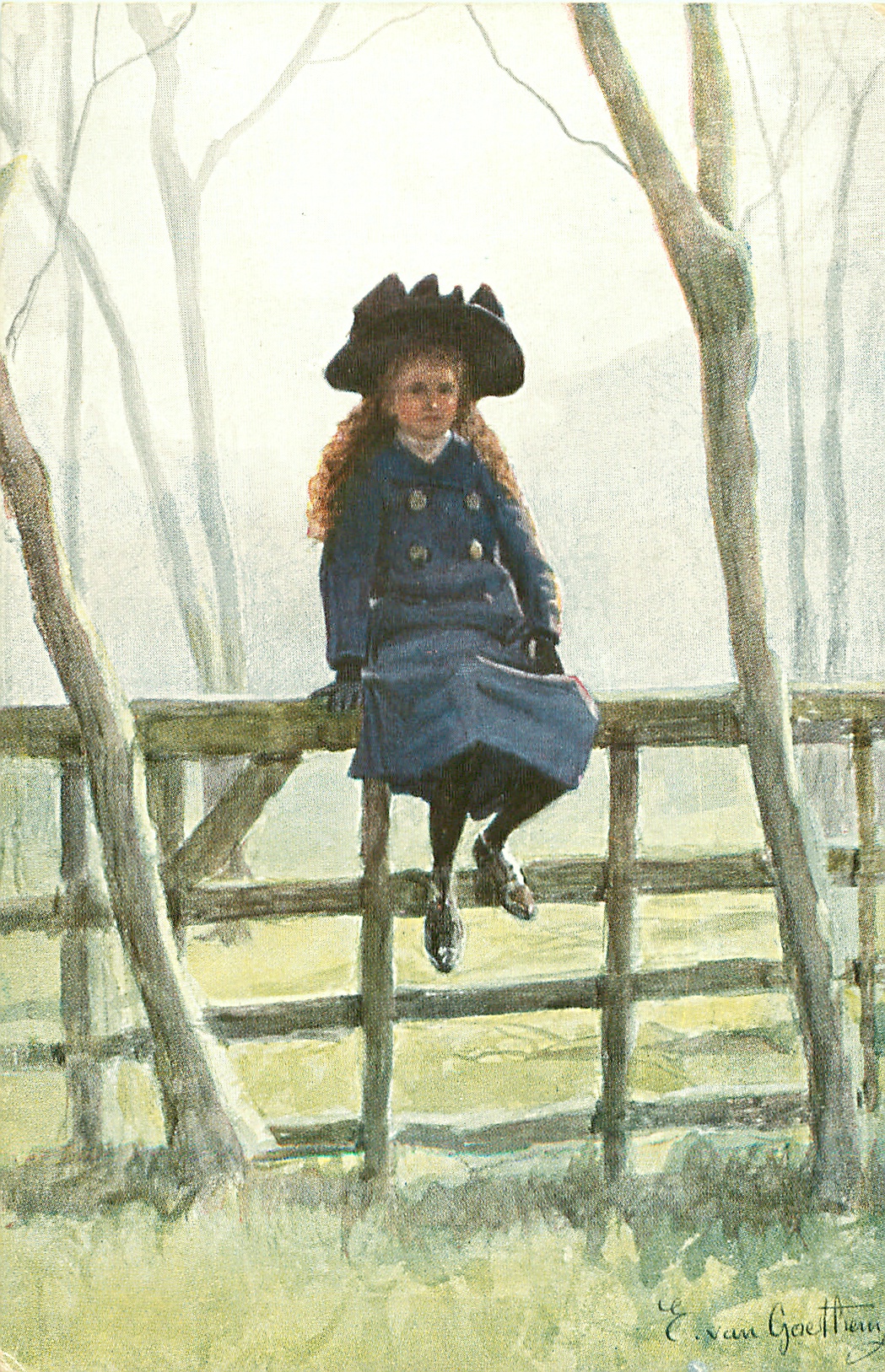
Yet for all that, there is something about the forlorn little girl sitting curled up on the settle that reminds me of myself. Perhaps it is the position—one foot under her, the other resting on nothing, the hands clasped drearily in her lap, the whole attitude one of deep dejection—which recalls a summer morning of long ago so vividly.

At any rate, I sat one morning on our settle and felt, and doubtless looked, as disconsolate as this little girl does. I was not by nature a dreary little girl, and my childhood was a very happy one. Perhaps for this reason I remember all the more clearly the gloomy days.
I will tell you about them. In the first place, mother was away from home. I think I have hinted that this was always a trying experience to me; but during these long, bright May days it seemed to me that my mother was always away, and in truth I saw very little of her from morning till night. It is a short story to tell, though it was a long story to live.

Into our pretty village sickness had come in a serious form—scarlet fever, which used to be less understood, I think, and dreaded even more than it is now. At least it had come among us in its most dangerous form, and many little children as well as older ones had been stricken. People were very much afraid of the homes where it had broken out. The day-schools had closed, and children who were well were kept closely at home, lest they should come in contact with the disease.

For myself, I remember I was not allowed to go outside the gate without some member of the family. Still I was happy enough. The yard was large, and my playhouse well stocked with broken dishes, and life did not seem weariful to me until one evening when father came home with a face graver than usual, and told about the family living near the saw-mill. Very poor they were, and with a house full of children. And the dreaded fever had appeared among them; two of the children were lying very low, one was dead, and tonight he had heard that two more were stricken. Yet even this was not the worst. The poor, half-sick mother had given out utterly and gone to bed.

No help could be had from any source; the people who were at leisure were afraid to go near the house, and there was so much sickness that really good help was very scarce.
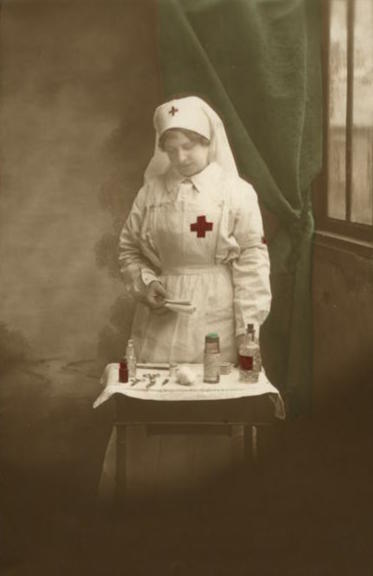
There was actually no one to do for that miserable, half-starving family but the poor father, who had left the work which alone had kept them from starvation to do what he could.

How well I remember the look on my mother’s face when father ceased speaking, as she said, after, a moment of silence, “There are three of ours who have never had the fever, you know.”

“I know it, but—” and then he stopped.

I wondered why he did not finish his sentence, and what he could have been going to say. But mother seemed to understand. She asked no questions; they said not a word for several minutes. I was busy about my play and had forgotten to give them attention, when my mother spoke again in a grave tone which some way, I did not understand why, arrested my thoughts.

“I will go and help them out, if you say so.”

Then indeed I was startled. Mother had been very careful; she had cautioned my older sisters, she had given strict orders to the younger ones; she had even said anxiously to father, “Remember the children, and don’t go where you would be likely to bring the fever to them.”

Now she was calmly proposing to go herself. Of course father would not “say so.”

I looked for him to say, “No, indeed.” But instead he smiled—a smile I think my mother must have been pleased with—and said, “It is like you. And there seems to be no one else; they may die—in fact will die, for want of care, if someone does not go.”

“I will go,” mother said again, in the same quiet tone. “I will take every precaution, and the children need not see me until I have bathed and changed my clothing.”
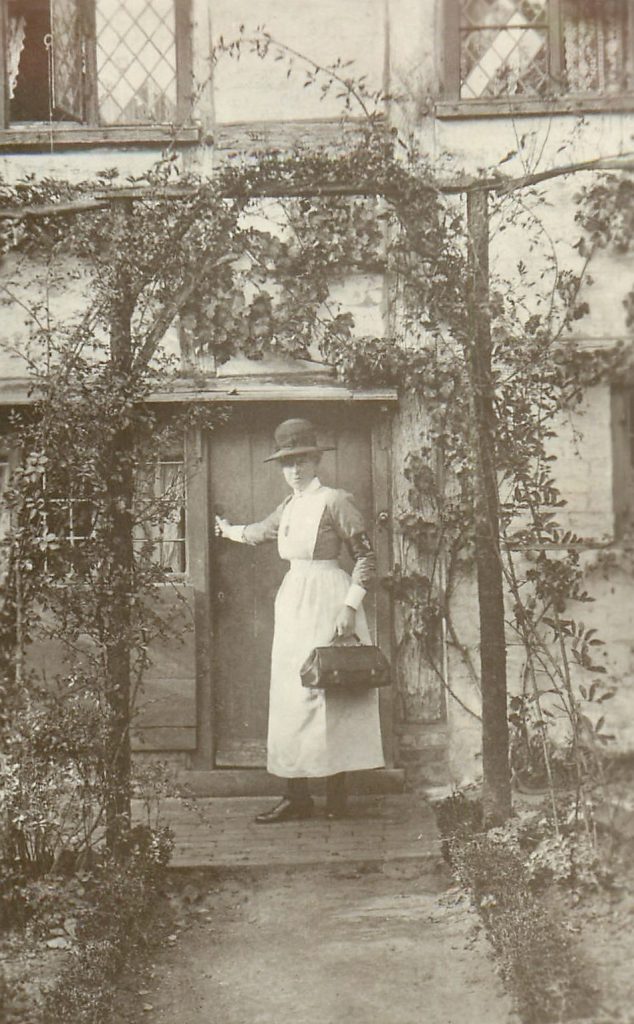
That was the beginning of it, but by no means the end. She was true to her words, and the weary days which followed stretch themselves out even in my memory, and seem long. No mother at the table, no mother to run to a dozen times a day, no mother to kiss at night; for as the disease waxed fiercer, mother came less and less frequently, sometimes not at all, even for her night’s rest, which she had planned to take at home. When she came, we were often not allowed to see her—we younger ones—nor even to go to that part of the house where she was. Do you wonder that I sat often with one foot tucked under me on the old settle and swung the other listlessly, and wished that the summer would go faster?

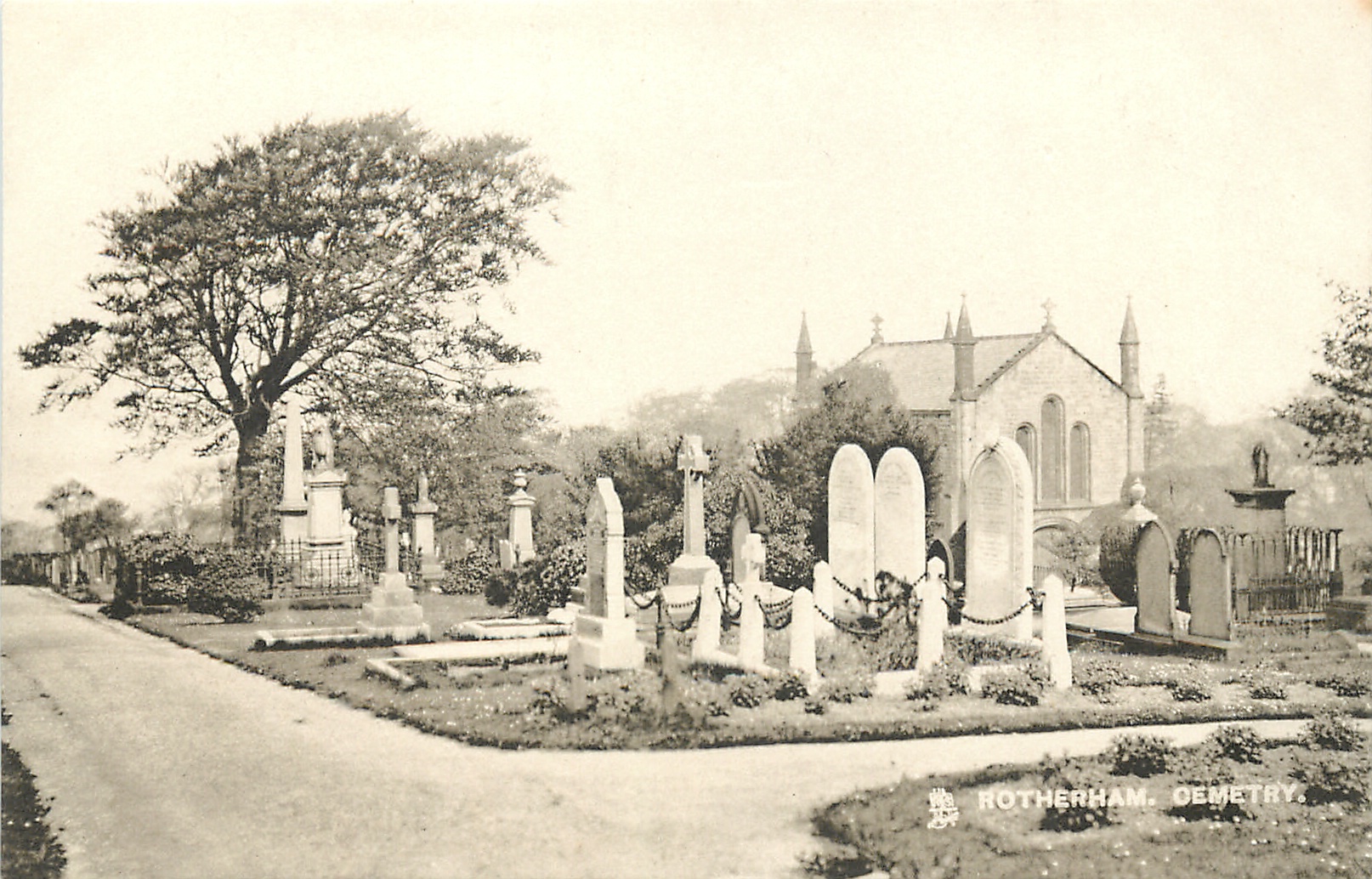
Nor was this all; I began to be afraid. The fever continued to spread—to grow more virulent—and day after day the bell tolled and tolled for still another whose body was being carried to the village cemetery; for in those days the church bell used to toll in long, slow sobs as the procession, always on foot, wound its slow way around the curve near our home, with sometimes four and sometimes six men leading the way, bearing a coffin. I can close my eyes and see it all again.

Mother came home at last, her self-appointed duty done. Two of the children she had nursed recovered, one had died. Mother was too worn to go to others—there was some comfort in that. We had her at home once more; but she was grave, and I could see that she held us, her treasures, very closely those days, and watched us almost sternly, lest we should step unawares into danger.

And at times, when the bell would toll, she would look around for us, and put her hand suddenly to her heart, as though the breath came heavily. Day and night through the dreaded ten days in which she kept herself reminded that perhaps she had brought the poison to us, she told me afterwards that we were not out of her thoughts for a moment, sleeping or waking, it seemed to her.

A season to be remembered. I did not understand or at least appreciate my father and mother’s courage and sacrifice and faith as I have since. I knew they were criticized, my father and mother. I knew the neighbors said they were “tempting Providence,” and I wondered what that could mean.

I knew one woman said that when it came my mother’s turn to hang over her own children she would be sorry she had so coolly brought death to her door; that for her part she thought it was hard enough to take it when it came, without going out to bring it.

I pondered over all these things and was afraid. I did not know that I, as a middle-aged woman, would one day recall the disconsolate little girl swinging one foot in the sunshine and wishing for mother, and feel great throbs of joy that I had such a mother to wish for!

But there was one part of the story which impressed me then, and impresses me now.

The disease spent itself at last. The long, slow summer moved away, and life began to be more like itself; and we had this to think about and wonder over, almost with awe, even then:

All about us the fever had been. On either side of us the houses were close; the windows of one room where the sick were lying almost looked into the windows of our sleeping-rooms.

On our right, on our left, across the road from us, away up and down the streets on both sides of us, the fever came. In every home there was a victim; in many two or three. From many of them that slow procession moved, while the bell tolled. And on all the long street ours was the only house where no sickness came!

Did the dear Lord send a protecting angel to guard the home of the mother and father who put their trust in Him, and went forward in the hard road where they believed duty pointed?

Isabella also lived through the Spanish Flu Pandemic of 1918. You can read more about it by clicking here.

What To Do with Christmas Cards?

In a February 1883 issue of The Pansy magazine, Isabella turned an average question—What shall we do with Christmas cards we receive?—into a lesson for children in being thoughtful of others.

What Shall We Do with Our Christmas Cards?

All those bright pretty affairs that came flying in from the postman’s fingers at Christmas time to make us so happy—why can’t we make them give happiness to someone else the whole year? Someone sick and suffering, with little to brighten and amuse? Why, they would be very messengers of sweet charity to such.

Here is work for you, dear little Pansies who belong to the “P. S. Society.” Make a scrap book of all those cards which you think it right to give away, saying your whisper motto, For Jesus’ Sake, as you tuck in the dainty bit of color, and the pretty verses, then send it all on loving wing to the Children’s Ward of the hospital of your city.

Think of the eyes that will rest on it when the pain makes the tears come; think of the little ones who must lie on their beds, weary day after weary day, when you are running, and skating, and sleigh-riding!

And best of all, think how the children will love the book, just because some other child made it for them.

How many members of the “P. S.” will do this? Who will be first, I wonder?

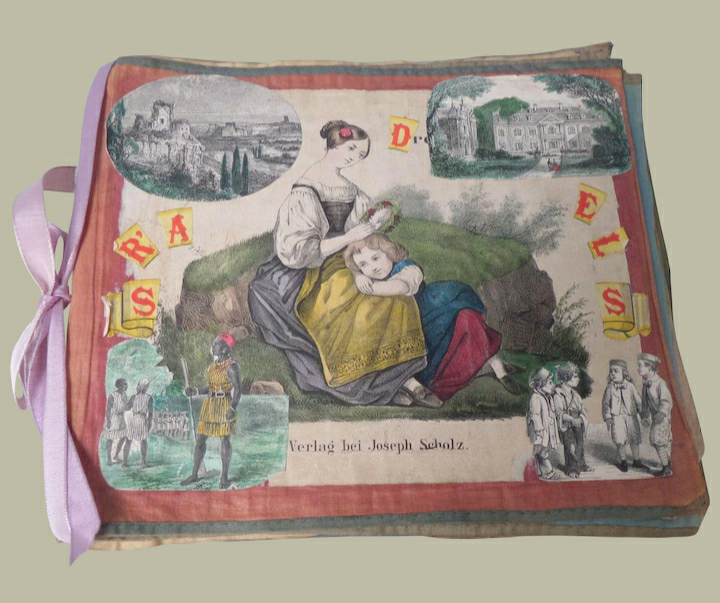
If you want to make a very pretty book, cut leaves of white, and pink, and light blue cambric or sateen; tie them together at back with ribbon or braid, putting strings of same on front.

An 1869 home-made cloth scrapbook (from Worthpoint.com).

Paste all dark pictures on the white cloth; all delicately tinted ones on the colored cloth. The effect will be very lovely—I know the “Children’s Ward” will think so.

A cloth scrapbook from the 1860s (from RubyLane.com).

You can learn more about the “P.S. Society” and the “whisper motto, “For Jesus’ Sake” by clicking here.

Do you send and receive Christmas cards each year?

What creative things have you done with them once the holiday is over?

Pansy’s Typical Day

In 1892 Isabella’s husband was made assistant pastor of a brand new church in Washington, D.C. The Eastern Presbyterian Church was only blocks from the nation’s Capitol, and the Capitol dome could be seen from the top of the church’s 130-foot bell tower.

Eastern Presbyterian Church, about 1920 (from the Library of Congress).

The Aldens moved into a house about four blocks away on Maryland Avenue.

A view of U. S. Capitol from Maryland Avenue, which was unpaved until about 1930 (from the Library of Congress).

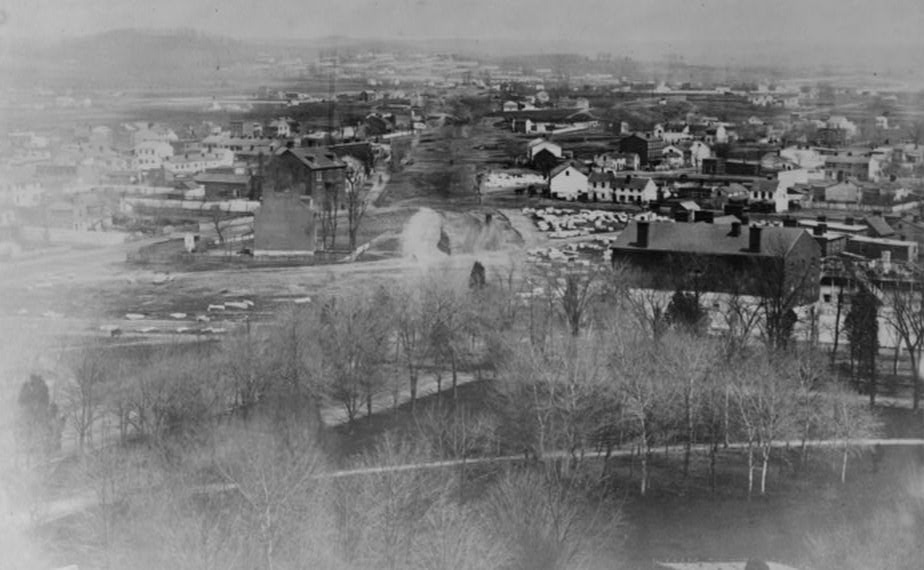
It’s likely the Aldens lived in a single-family house, instead of one of the row houses that were erected on Maryland Avenue and on many other streets in the District in the early 1900s. The photo below—taken from the top of the Capitol Dome looking northeast—shows a view of the Alden’s neighborhood.

View from Capitol Dome looking northeast toward Maryland Avenue (from the Library of Congress).

In an 1893 interview, Isabella spoke about how much she “dearly loved” her D.C. home. It was “cheery” and “bright” and Isabella took great care “in all that pertains to its comfort and happiness.”

The Aldens—Isabella, her husband Ross, and their son Raymond—had a daily routine in their Maryland Avenue home. Early in the morning, the family gathered in the back parlour of the house before breakfast “to sing a few verses of praise, to read a chapter in the Bible, and to ask God’s help and blessing on the work to be done.”

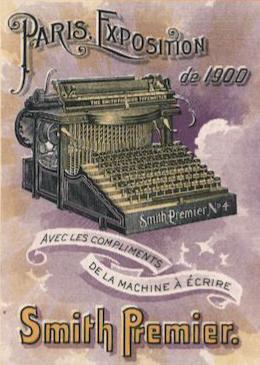
After breakfast, Isabella went right to work in her study—a place that was off limits to visitors or interruptions (except in a case of emergency). For the remainder of the morning, Isabella was at her typewriter, typing stories, writing Sunday-school lessons, working on a chapter of her next novel, or answering the volumes of fan mail she received daily—some days quickly turning from one task to another.

An advertising card for a Smith Premier model typewriter from 1900.

Isabella once said that she didn’t have to “think” when she typed. Much of her thinking, plotting and composing was done in her head as she went about her household chores. Then, when she sat down to write, her thoughts were “drilled like a well-ordered army, ready to march at the word.”

A comfortable study, about 1910.

An interviewer once described Isabella’s workplace as “a pretty study, lined with books.” In the room were two typewriters—one for Isabella, and one for her husband; they often worked side by side.

Typewriters weren’t the only modern gadgets in her home. Isabella employed all kinds of appliances and machinery, and was always on the look-out for a new labor-saving device. One reason: from a young age Isabella suffered from constant headaches (you can read more about her condition and the treatments she sought for it here), and she was seldom able to use her typewriter more than a few hours a day.

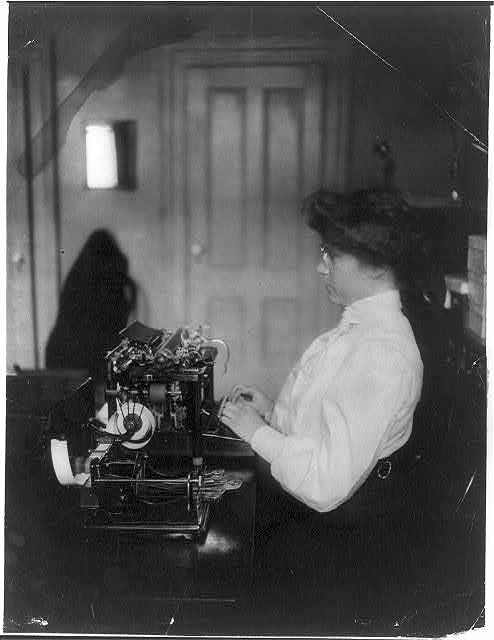
But she found that she could instead use a stenograph machine (similar to the ones court reporters use today) because her eyes didn’t tire as they did when she used a typewriter.

She taught herself to use a stenograph, and was soon able to extend her working hours a little longer each day. When she was done with work in the early evening, she handed the machine’s cryptic shorthand to a secretary, who transcribed it on the typewriter.

Bartholomew Stenograph machine, 1882 (from Typewritercollector.com).

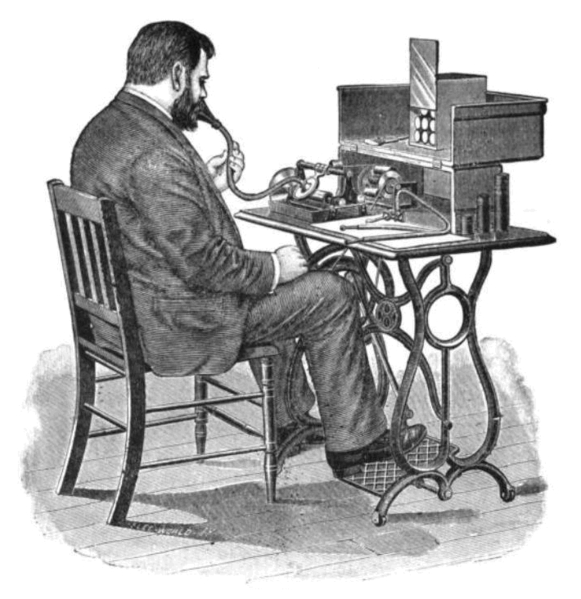
Dictation machines were another type of equipment that was just coming into use during the time Isabella lived in Washington D.C.

An early wax cylinder phonograph for dictation, 1897 (from Wikicommons).

The early machines were expensive, but effective; and, as she did with her stenograph machine, Isabella could employ a secretary to transcribe the recorded text for her.

A typist transcribing a stenography printout, 1904.

Isabella sometimes wove descriptions of new and innovative appliances into her stories. She wrote about early typewriters in her novel Miss Dee Dunmore Bryant (read a previous blog post about it here).

And in the sequel, Twenty Minutes Late, she described Caroline Bryant’s astonishment upon seeing an early dish washing machine.

An 1896 magazine ad for The Faultless Quaker Dish Washer.

After the work day was done, Isabella and her family gathered again in the back parlour of the house. If they did not have a special engagement to attend, the family spent the evening reading together. More often than not, Isabella read aloud to Ross and Raymond, and anyone else who happened to be a guest in the house.

Different newspaper accounts of her public readings describe Isabella as a charming reader, with a “sweet voice” and “perfect intonations” that must have been delightful to hear.

What do you suppose Isabella read aloud to her family in the evenings?

Are you surprised to learn Isabella used the latest technology to work efficiently and streamline her housekeeping tasks?

Which of our 21st Century devices or appliances do you think Isabella would be most likely to use?

Advice to Readers about Ornaments

In the early 1900s Isabella wrote a regular column for a Christian magazine in which she answered reader letters and offered advice—from a Christian perspective—on a variety of subjects.

The column gives us a wonderful insight into Isabella’s personality and her plain, straightforward manner of communicating.

In one of her 1911 columns, Isabella shared this letter from a reader named Nannie:

I want to have a little talk with you about what will seem to you, I suppose, a small matter, but it is giving me a good deal of trouble.

Do you think it is wrong to wear any kind of jewelry? I have a very dear friend who has given me a gold ring with a pearl in it, and I want to wear it; chiefly for the friend’s sake, although I do think it looks pretty on my hand. But my aunt, with whom I live, is a very religious woman, and she thinks it is wrong for me to wear rings; she says it is going contrary to plain Bible commands, and she quotes that verse about braiding the hair and wearing jewels of gold. Now, is she right? Is it wicked to curl my hair, for instance, when it is less work to curl it than to keep it smooth? And to wear my dear ring that I have promised to keep forever?

I want to be good, but— Can God care about such trifles? My aunt says that my dear dead mother thought just as she does about these things, and that I am showing disrespect to her memory. But my mother did not seem like that to me; she used to trim my little dresses, and she curled my hair around her finger. She died, though, when I was eight, and now I am eighteen. Will you tell me if you think I am wicked?

Nannie.

Here’s how Isabella responded to Nannie’s letter:

My Dear Nannie:
What a deal of trouble! Five questions, are there not? But they all hover about one central thought. Let us look at them separately.

“Do I think it wrong to wear jewelry?” No; if I did, I would not wear it. I have worn my wedding ring for more than forty years, and it is dearer to me, I dare to think, than even your pearl one, so, you see, I can understand your feeling. I pin my collar with a gold pin as naturally as I comb my hair, and find it vastly more convenient than a common pin would be. I wear my watch whenever I think a watch will be a convenience; and there are sundry other trifles that would come under the general head of jewelry which I call into service from time to time. All this is an easy way of stating my position. Quiet, unostentatious pieces of jewelry, keepsakes, or conveniences, or those articles that custom has made symbolic, like engagement and marriage rings, are, in my judgment, entirely appropriate for Christians to wear.

It is an altogether mistaken idea that to be religious one must cease to love the beautiful. Do you remember the lines in Mary Howitt’s verses on beauty?

God might have made the earth bring forth
Enough for great and small,
The oak tree and the cedar tree.
Without a flower at all.

The Bible verse to which you refer has caused trouble for a few conscientious people because they do not understand its environment. Study the times in which Peter wrote those words, and the fashions that were then in vogue if you want to get the spirit of his advice. Take note that it is advice, and not command. Peter is really making a comparison between two classes of ornaments—the outward and inward—and urging upon Christian women to give their attention to the latter. By way of illustration he mentions the plaiting of hair which was at that time carried to such wild excess.

Notice, too, Peter’s next phrase after mentioning the wearing of gold, “or of putting on of apparel.” Our literal friends who frown upon even the plain gold ring would surely not have us go a step farther in literal interpretation and refuse to wear clothing! I speak of this only to show you how easy it is to become absurd, even in our interpretation of Bible words.

“Is it wicked to curl your hair?” Why, child, according to your own statement the Lord has done this for you. My own opinion about it is, that so far as you and God are concerned you have a perfect right to arrange your hair in the way that you consider most becoming to you, provided it does not require an unreasonable expenditure of time or means to do so. Other things being equal, this would be a fair rule to go by.

“Can God care about such trifles?” My dear, you are speaking of the One who said: “Even the very hairs of your head are all numbered.” There are no “trifles” in his sight. Yet I am glad to believe that he does care in the way you are thinking of it, and that he does care in a very real and helpful sense, even for rings and curls.

Now, having made all these admissions and proved myself to be clearly on your side, suppose we go back and consider the entire question from another standpoint.

Did you take notice, back there, of that somewhat obscure phrase “other things being equal,” and wonder what in the world I meant? Let me see if I can explain. A word about that dear aunt who does not think as you do. Of course, she is much older than you. As I understand it she is trying to fill the place of mother to you; you live with her; that is, she has made a home for you. Then what do you owe her in return? You want to “be good”; this is no trifle. To be good is almost the greatest thing in the world, and to want to be is one step toward it; be sure God cares for this. What has God said about those who stand as parents? “Honor” is a great word, comprehensive and far reaching; also, it is practical.

“Here, for illustration, is a ring, a lovely ring with a pearl in it. The ring is mine and I want to wear it. And here is God, interested in me, and in my ring. Does he think it wrong for me to wear it? Other things being equal, no. But here is my aunt, she thinks it wrong; she thinks that God thinks so; to have me wear it would hurt her. Would it hurt me not to wear it? That is, do I believe I would be doing wrong?”

“N-o, but—”

“Yes, I understand, but we are talking about honor now; and we have found that ‘things’ are not equal. Could I possibly, for the sake of my aunt’s feelings—for the sake of my aunt’s conscience, pack away my ring in pink cotton in its white velvet box until such time as—? Ought I to do that?”

Ah, now you have reached a question that you, that the individual conscience, must answer for itself. The illustration is only to clear the way for thought: all these questions, whether rings, or curls, or what not, swing on the same hinges.

“All things are lawful for me,” said one, “but all things are not expedient.”

“Ye have been called unto liberty.” said one, “only, use not liberty for an occasion to the flesh, but by love serve one another.”

Suppose the Bible read in this way: “But curls commend us not to God, for neither if we wear them are we the better, neither if we wear them not are we the worse; but take heed lest by any means this liberty of yours become a stumbling block to them that are weak.” Would it make the argument plainer?

What do you think of Isabella’s “advice column?”

Do you think she gave the right advice to Nannie?

Pansy’s Busy Schedule

As the wife of a Presbyterian minister, Isabella moved house frequently, depending on when and where the Presbyterian Church assigned her husband. One of those moves occurred in 1876 when Isabella was 37 years old.

For a period of three short years (from 1876 to 1879), the Aldens lived in Greensburg, Indiana, where her husband had the ministry of Greensburg’s Presbyterian congregation.

A view of Greensburg Indiana, from the 1894 Illustrated Souvenir Book of Greensburg, Indiana.

In typical Pansy fashion, Isabella probably got right to work in her new community, serving the members of her husband’s congregation, writing stories intended to win souls for Christ, and speaking out on matters of importance to women.

In addition, Isabella maintained a very busy travel schedule. Here are just a few entries from her calendar that year:

February 28:

Isabella was in Cincinnati, Ohio, delivering a lecture “for the benefit of the Benevolent Society.”

The Cincinnati Daily Star, February 21, 1878.

June 26:

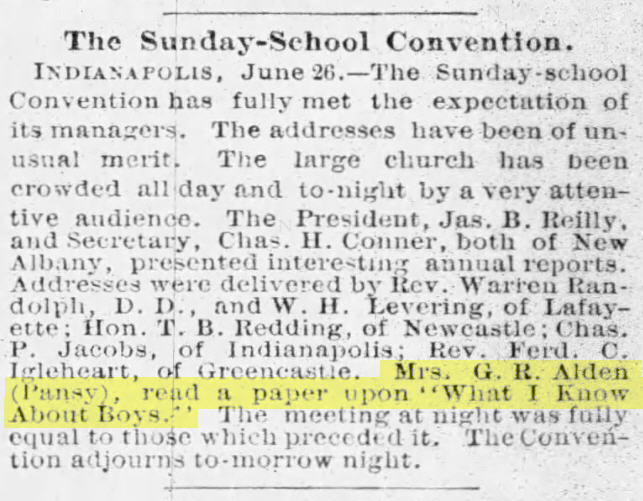
Her schedule took her to Indianapolis, Indiana, where she read a paper titled “What I Know about Boys” at the state’s annual Sunday-School Convention:

From the St Louis Globe-Democrat, June 27, 1878.

August 1:

The first week of August saw Isabella at the Methodist Sunday-School Assembly at Lakeside, Ohio, where she was one of a number of teachers who led daily children’s classes throughout the week.

The Tiffin Tribune (Tiffin, Ohio), August 1, 1878.

September 26:

Isabella was in New York in her home town of Gloversville, where she read one of her short stories—“What She Said and What She Meant”—to an audience at the Baptist Church.

From the Gloversville Intelligencer, September 26, 1878.

November 15:

Isabella was back in Indiana, this time giving a temperance reading to an audience in Indianapolis, about forty-eight miles from her Greensburg home.

The Indianapolis News, November 9, 1878.

At a time when the fastest way to travel was by train or horse-drawn carriage, Isabella sure got around!

By the way, Isabella’s story “What She Said and What She Meant” was published in 1880 and you can read it for free! Just click on the book cover below to begin reading.

Daily Thoughts for November

In 1895 Isabella published a monthly Bible devotional series titled “Daily Thoughts,” which appeared the first day of each month in The Pansy magazine; and we’re reprinting them in 2020!

Isabella’s “Daily Thoughts” for the month of November are from Chapter 40 of the Book of the Prophet Isaiah.

Click here to open a full-size PDF version of Isabella’s “Daily Thoughts” for November, which you can read, print, save, and share with others.

Or, click here to download a simplified Word version.

If you missed “Daily Thoughts” for previous months, you can find them here: January  February  March  April  May  June  July  August  September  October

Click here to read “Daily Thoughts” for December.