Blog

Won by a Sister’s Prayers

In Isabella Alden’s books she often includes a character who is a “sort of” Christian. In Mrs. Solomon Smith Looking On, Laura Leonard was just such a Christian.

Laura had been brought up in a good home by good, Christian parents. She went to church every Sunday and attended Sunday-school. Laura was kind and knew right from wrong, but she had never accepted Jesus Christ as her Saviour. To the contrary, Laura rebelled against the mere thought of taking such a step . . . until Mrs. Solomon Smith helped show Laura that being a Christian and loving the Lord was the only way Laura would find real and lasting happiness in her life.

When Isabella wrote about Laura Leonard, she wrote from experience. Like fictional Laura, Isabella had been raised by loving Christian parents. She, too, attended church every Sunday, and joined the family in home worship every evening.

Beginning at a young age Isabella was carefully taught what the Bible says about who will be able to enter the Kingdom of Heaven, and that the only way to have eternal life is through Jesus Christ; yet Isabella never took the ultimate step of choosing to accept Christ as her Saviour.

Then the unthinkable happened. When Isabella was twelve years old, she fell seriously ill. For several days neither her parents nor the doctor believed she would live. But, miraculously, the crisis passed, and Isabella began to recover.

Her sister Marcia, who was nine years older than Isabella, had stayed by Isabella’s side throughout her illness. She had watched over Isabella, and slept in a chair by her bed, never leaving Isabella’s side for more than a few minutes.

When Isabella began to feel better, Marcia asked her one day:

“Would you have gone to live in heaven if God had called you when you were so ill?”

Isabella was genuinely surprised by the question, but Marcia said, “The thought of parting from you forever was one of unceasing agony to me; and my constant prayer during all those days and nights of illness was that you might be spared until you could choose Christ.”

These words made a lasting impression upon Isabella. They came to her with all the power and force of a sudden revelation: for though she had been carefully trained, and knew in a theoretical way the plan of salvation, she had never given the matter five minutes serious thought, until her sister appealed to her as she did.

Isabella tried to put the subject aside again, feeling that it darkened the day and made her uncomfortable; but the Holy Spirit had carried it home to her soul, and over and over again Marcia’s words rang in her ears.

Isabella could no longer deny the truth. She wrote, “It is not enough for me to believe in Christ as a Saviour, I must ‘choose’ Christ as my Saviour.”

Soon she began to feel that in a strange and wonderful way her sister’s earnest and loving prayer that she might be spared to “choose” had been answered. And with it came the conviction that she was compelled to make a definite choice.

Not long afterward, she did choose the Lord Jesus Christ as her personal Saviour.

What a blessed decision that was for the millions of readers of her books!

Isabella Alden at her writing desk.

In 1902 Isabella wrote:

“In a few more years it will be half a century since I chose Christ. I have had abundant reason to thank God for sparing my life at that time, and for giving me a faithful sister.”

Isabella and Marcia remained close, loving sisters for the rest of their lives.

And Isabella used her experience of being a “sort of” Christian as a device to show her fictional characters—and her readers—that believing in Christ wasn’t the same as choosing to make Christ the center of one’s life.


Isabella originally shared her story of how she became a Christian in a 1901 edition Christian Herald newspaper.

Did She Stump the Minister?

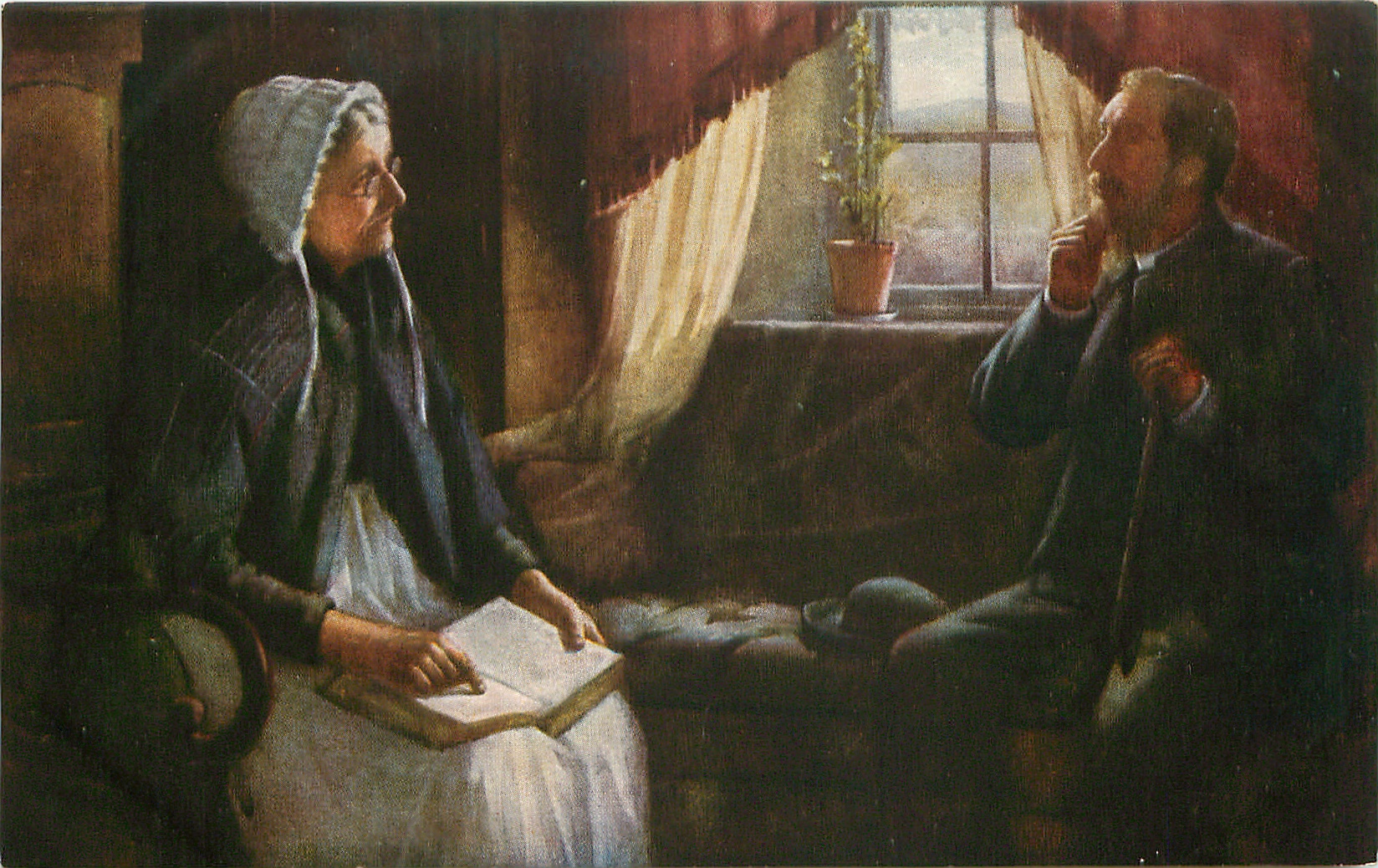
“A Difficult Text” is the title of this 1907 painting by John Henry Dobson. All the little details help tell the story of a minister’s visit to a member of his congregation. Do you think the minister looks a trifle perplexed?  If only we knew which Bible verse she’s pointing to!

p.s. You can click on the image to see a larger version.

Corsets at Chautauqua

Facing Miller Park at the intersection of Pratt and Morris avenues, The Colonnade was the business center of Chautauqua Institution.

The Colonnade as it appeared in 1909. You can see the vine-covered pergola on the right.

.

Visitors approaching The Colonnade from the south passed through a lovely, vine-covered pergola.

The pergola with The Colonnade beyond it and to the left.

.

The Colonnade was a busy place. Nearby was the post office, where residents retrieved and sent mail.

The Colonnade itself was a favorite place for friends to gather. It housed a grocery, a dry-goods store, a hair salon, a barber shop, a drug store, and various other merchants.

One retailer that managed to secure a prime location in The Colonnade was an establishment called Spirella Parlour, which was a genteel store name for the Spirella Corset Company.

A Chautauqua post card modified by the Spirella Corset Company to show the location of their shop at The Colonnade, Chautauqua, New York.

.

The Spirella Corset Company had factories established in Pennsylvania and Canada when they set up shop in The Colonnade at Chautauqua. Wedged between a ladies’ dress shop on one side and the main hall, their’s was an ideal location. The store was staffed by “skillful corsetières” (more on them in a moment).

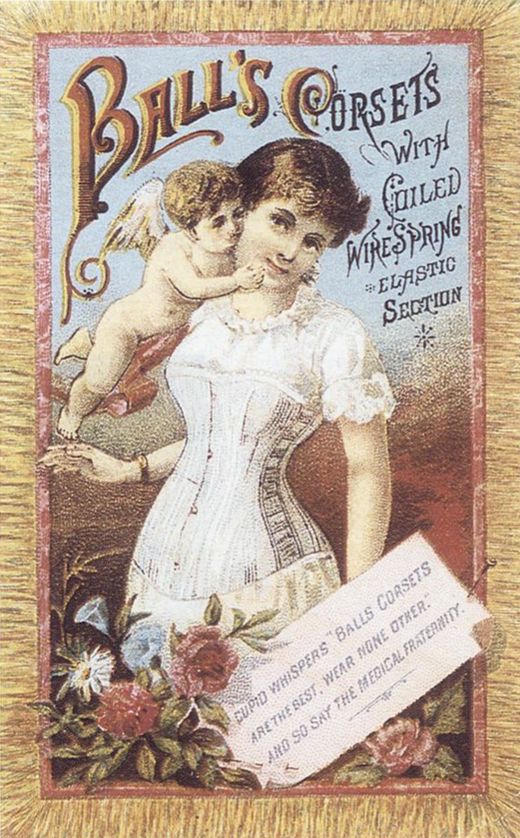
A trade card for Ball’s “health preserving” corsets, from about 1880.

.

In Isabella’s time, every woman—and many girls—wore corsets. They were an essential element of a lady’s undergarments.

Trade card for the Bortree Adjustable Duplex Corset by Bortree Manufacturing Company, about 1890.

.

But corsets did not last very long. Their stays had a tendency to break; and since corsets were worn over only a thin muslin chemise or slip, perspiration and natural skin oils often stained the corset fabric or rusted the stays.

Magazine ad for Warner’s corsets, about 1917.

.

Corset garter hooks often broke, and their long lacing ribbons often snapped off. For women, access to a store such as Spirella’s on Chautauqua’s premises was practically essential, since the nearest town where a lingerie store might be found was miles away.

Trade card for Dr. Strong’s Tampico Corset.

.

Once a lady had donned her chemise or slip (sometimes called a shift), she put on her corset. Then she added other layers of undergarments:

Corset cover
Drawers
Bustle(s)
As many as 5 layers of petticoats

Over all of that she donned her dress or skirt with shirtwaist.

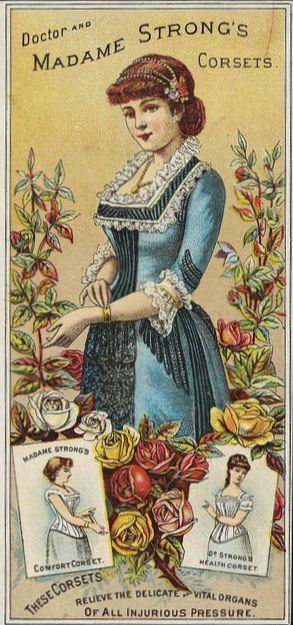
Doctor and Madame Strong brand corsets touted the medical benefits of wearing their corsets.

.

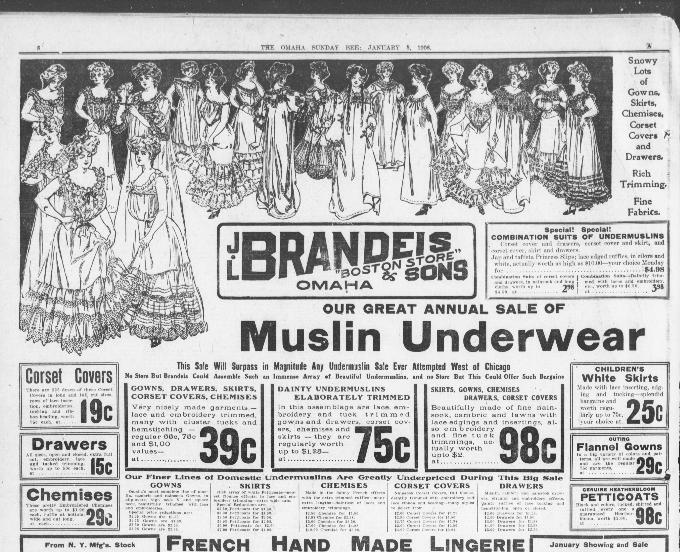
This 1908 newspaper ad in the Omaha Daily Bee shows some of the many different undergarments women wore under their clothes.

A woman’s corset was essential; she wore a corset wherever she went, no matter what she was doing.

.

Of course, The Spirella Company was not the only corset manufacturer in the United States. There were many such companies, each vying for their share of the corset market.

F. C. Corset Company trade card from about 1890.

.

What set Spirella apart from their competition was that they specialized in custom-made corsets.

In fact, the Spirella Parlour at Chautauqua is the only known retail location for Spirella Corsets in America. Instead of opening stores, The Spirella Company hired a legion of women called corsetières who were sent to customers’ homes. The corsetières took the customer’s measurements and consulted on the correct model of Spirella corset based on the lady’s figure type.

Spirella Corset Company diagram showing the many body measurements their corsetieres took in order to achieve a perfect fit.

.

According to Spirella’s 1913 customer brochure:

“The secret of being well dressed lies in your figure, and your figure is made or ruined by your corset.”

You can see The Spirella Corset Company’s 1913 brochure distributed by their corsetières to customers. The booklet is filled with nice illustrations of the different models of corsets they offered, and offers guidance on how to select the proper corset based on body type. Just click here.

You can also watch this fun video that shows the many layers of undergarments women wore in the late 1800s and early 1900s:

Did you know . . .

. . .  as essential as a corset was to every woman’s wardrobe, Isabella never mentioned corsets in any of her many books and stories. She did mention shifts and petticoats, but never made mention of corsets.


Happy Thanksgiving and a New Free Read!

Tomorrow is Thanksgiving and in honor of the day, we’re sharing one of Isabella’s short stories from 1894.

About the Story:

When Miss Florence Percival comes upon a kitten in the snow, she soon learns the kitten belongs to a girl named Hetty. It doesn’t take long for Florence to realize that Hetty is patiently bearing quite a few burdens. Poor Hetty lives with her very cross Aunt Jane who can’t say a kind word; and Hetty’s injured knee prevents Hetty from taking even a single step.

With Thanksgiving only days away Florence Percival wants to make a difference in Hetty’s life. And in the process, she just might be able to soften Aunt Jane, and find a cure for Hetty’s knee.

Just click on the cover to begin reading.

No Simple Case of the Flu

It’s autumn in the United States, and for most Americans, that means shorter days and colder temperatures.

It also means the start of the flu season, when about 20% of the population can expect to suffer feeling feverish, achy and just plain crummy for about a week between now and April of 2018.

Influenza season was troublesome in Isabella’s time, too; especially because Americans didn’t have the advantage of the flu vaccines and anti-viral drugs we have today.

But in 1918, when Isabella was 77 years old and living in Palo Alto, California, Americans suffered through a terrifying epidemic of influenza known as the Spanish Flu.

United States Health Service flyer from 1918

.

The first documented wave of Spanish Flu struck the U.S. with a vengeance in the fall of 1918. Americans quickly realized this strain of flu was not the usual variety that brought chills, fever and fatigue that lasted a few days.

This new strain of flu was highly contagious, and it proved particularly fatal to healthy young adults—an alarming complication. Previous strains of flu usually resulted in death for children and the elderly; and health officials were baffled by the fact that the healthiest segment of the population seemed to be the most vulnerable.

A nurse takes a flu patient’s pulse at Walter Reed Hospital in Washington, D.C., 1918.

.

Another terrible consequence was the speed with which the flu struck. Victims died within hours or days of their symptoms appearing. In fatal cases, the victims’ skin turned blue and their lungs filled with fluid; nothing could be done to save them.

The first wave of the epidemic struck the eastern part of the United States hard.

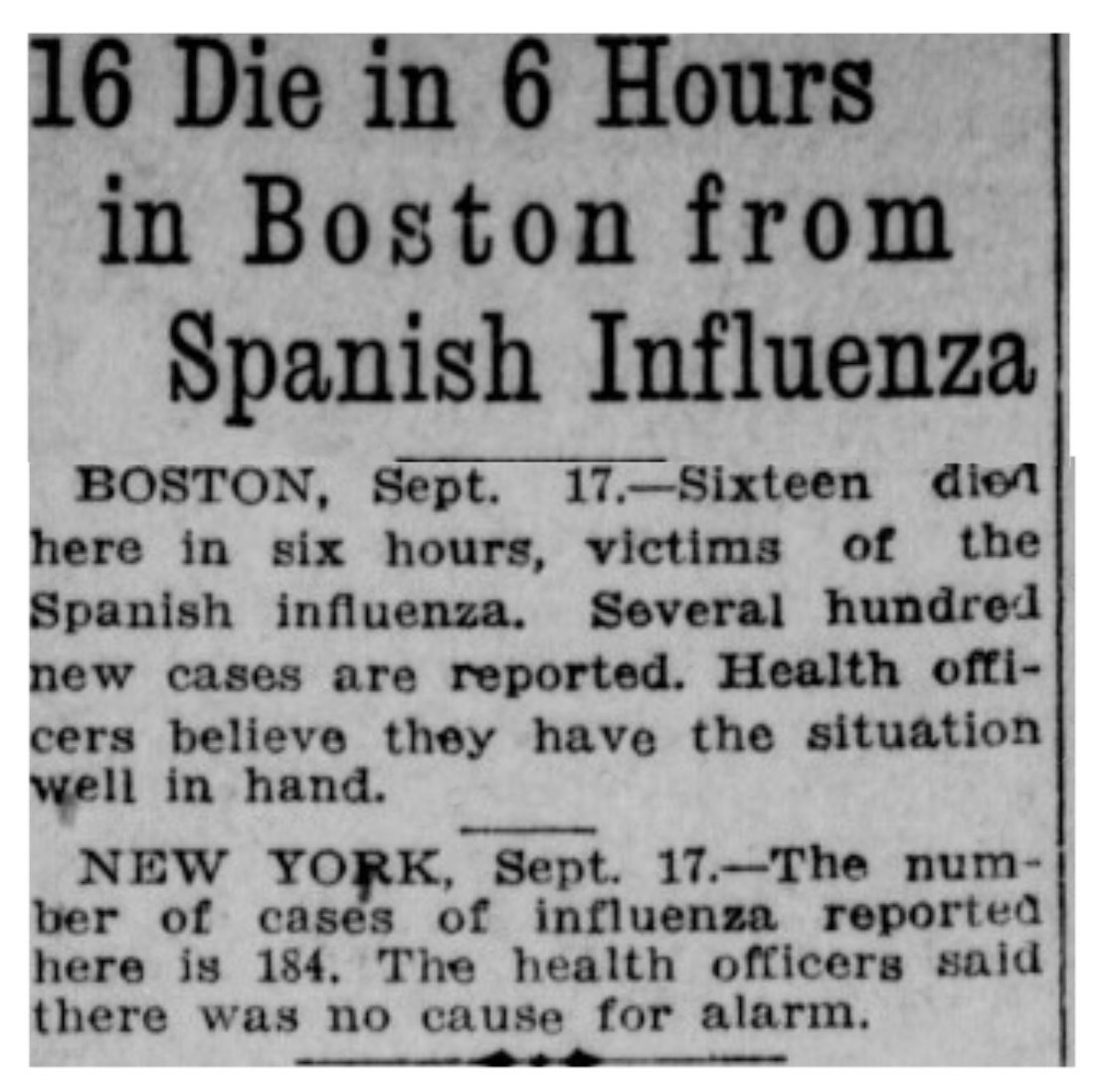
From the Los Angeles Times, September 17, 1918.

.

Large cities, small towns, and rural areas suffered equally. One physician at an Army station in Massachusetts wrote:

“These men start with what appears to be an attack of la grippe or influenza, and when brought to the hospital they very rapidly develop the most viscous type of pneumonia that has ever been seen. Two hours after admission they have the mahogany spots over the cheek bones, and a few hours later you can begin to see the cyanosis extending from their ears and spreading all over the face, until it is hard to distinguish the coloured men from the white. It is only a matter of a few hours then until death comes, and it is simply a struggle for air until they suffocate.

“It is horrible. One can stand it to see one, two or twenty men die, but to see these poor devils dropping like flies sort of gets on your nerves. We have been averaging about 100 deaths per day, and still keeping it up. There is no doubt in my mind that there is a new mixed infection here, but what I don’t know.”

In very short order, hospitals were overrun with patients. Health officials had to commandeer meeting halls, golf courses, large private homes, and any other places that could be converted into temporary hospitals to house victims of the epidemic.

Make-shift hospital tents set up to hold influenza patients in 1919. From the Centers for Disease Control.

.

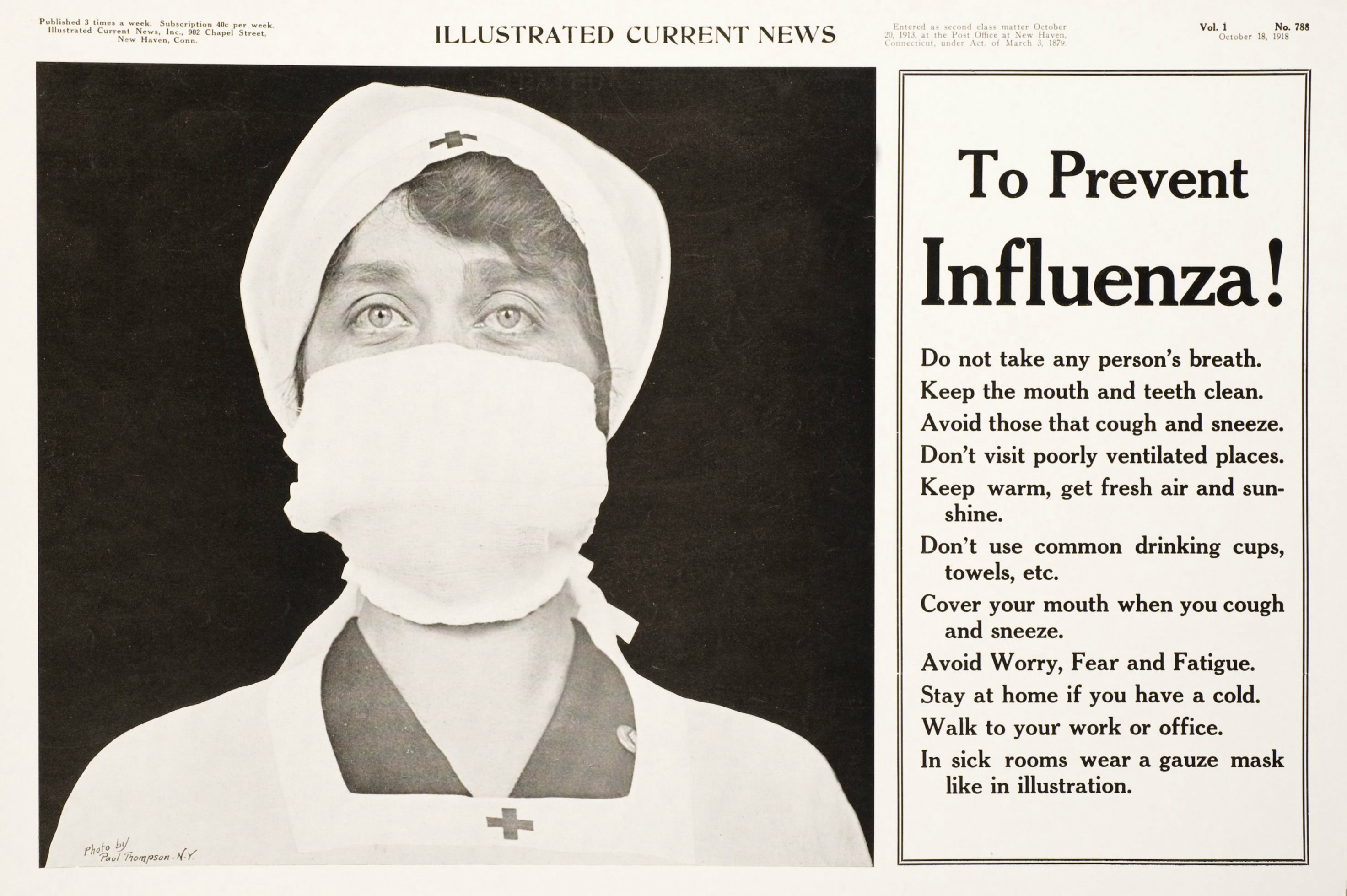
In some towns officials shut down all public places, including schools and churches, and ordered citizens to wear masks at all times.

An ad printed in the October 18, 1918 edition of Illustrated Current News.

.

The numbers of fatalities increased steadily. In some places entire families were wiped out. Physicians, nurses, and healthcare workers couldn’t keep up with the numbers of patients that needed their care, and they soon became patients themselves. By October 1918 New York City’s health department estimated that over 20% of the city’s nurses were sick.

Mortuaries were also overwhelmed; bodies piled up. Morticians and cemetery workers were struck down with the flu like everyone else, and some communities had to resort to disposing of bodies in mass graves. In other places, grieving family members had to dig graves for their own loved ones.

A family posing while wearing masks during the influenza epidemic.

.

Entire cities came to a virtual halt; so many people were ill there was no one to deliver mail, collect garbage, or harvest crops. Businesses closed and government agencies shut down because there was no one well enough to report to work.

A New York City street sweeper on an almost-deserted street in 1918.

.

Health officials and town leaders fought against the disease in the only ways they knew how. They told citizens to stop shaking hands. They ticketed anyone who coughed or sneezed or spat in public.

Health Department poster on the back of a trolley car.

.

They closed theaters and barred libraries from circulating books.

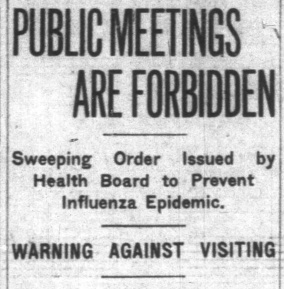
They passed ordinances prohibiting people from gathering, hoping to stop the virus from spreading.

Headline in the October 7, 1918 edition of the Indianapolis News.

.

Some cities required residents to wear masks any time they stepped outside the doors of their homes.

Meanwhile, residents in mid-west and west coast states of the country—such as in California, where Isabella was living at the time—could do little more than hope the deadly epidemic would remain confined to the east coast.

Students at Brigham Young University wear hygienic masks during a lecture in 1918.

.

Their hopes were bolstered by uninformed health officials who, in an effort to keep the public calm, spread incorrect information about the deadly virus.

Misinformation printed in the Los Angeles Herald, September 27, 1918.

.

But in truth, mid-west and west coast states could do little to halt the epidemic’s march toward their cities and towns.

Red Cross workers in St. Louis report for duty with their ambulances, October 1918.

.

It didn’t take long before the first confirmed cases of Spanish Flu were reported in Northern California.

From the Los Angeles Herald, October 12, 1918.

.

In the Santa Clara Valley, where Isabella lived with her husband and family, the first documented cases of Spanish Flu hit in November, 1918.

County officials and town leaders imposed quarantines and prohibited residents from congregating, hoping to stop the spread of the virus.

Like other places in the country, Isabella’s neighborhood hospitals were soon over-crowded with patients. Health officials cancelled all school classes and converted the newly-built San Jose Normal School into hospital wards.

Aerial view of San Jose Normal School, 1909.

.

By the time the epidemic ran its course in the spring of 1919, fifteen residents of Isabella’s community had died, and over 300 had been infected.

Volunteers at San Jose Normal School prepare meals for patients and healthcare workers.

.

The impact of the flu on the country was staggering. One out of every four Americans had been infected by the time the Spanish Flu epidemic ran its course in  1919. Over 550,000 Americans had died, and more than 50 million people worldwide were killed.

Isabella’s family was spared. While she and her family may have taken ill, no members of the Alden or MacDonald families died from the Spanish Flu. Still, it must have been a frightening and anxious time for Isabella, as it was for all Americans.

Here’s a brief video that explains the impact the Spanish Flu had on residents of South Carolina, especially its small communities, like Isabella’s:

And this video (from PBS’s American Experience series) includes interviews with Americans who survived the epidemic and give first-hand accounts of its impact on their families and neighborhoods:


Free Read: “Sunday Fractures”

Isabella Alden often collaborated with her sister Marcia Livingston on many books and stories. In 1880 they combined their talents to produce a collection of short stories titled Divers Women.

Divers Women offers ten different stories about ten different women who face struggles in their lives until they put their faith in God to bring them the peace and happiness they’re unable to find on their own.

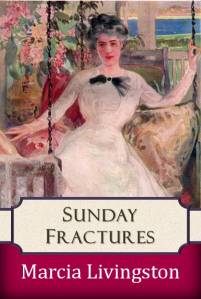
Marcia’s story “Sunday Fractures” is the first story in the book, and you can read it for free! Just click here or on the book cover to begin reading now.


You can find the complete collection of Divers Women on Amazon. Just click here to order.

A Most Remarkable Communion Service

On Tuesday, October 11, 1910 delegates to a national Christian church convention assembled in Topeka, Kansas for their annual meeting. The convention came to order on Wednesday night, October 12, and continued full-tilt until the following Monday.

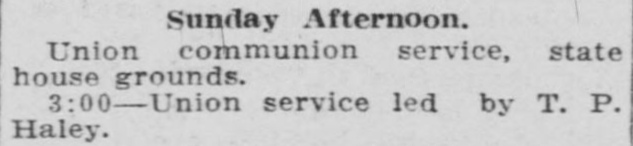
The local newspapers published the convention agenda. In a busy week filled with scheduled prayer meetings, missionary society board reports, temperance education workshops, and a host of lectures, there was this agenda item:

Organizers expected a good turn-out for the Sunday communion service, which was set to begin at 3:00.

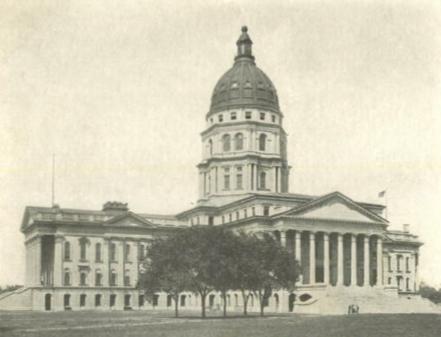
But long before the appointed hour, people began assembling at the capitol building in Topeka. They first congregated on the State House steps, until there was no more room.

The Kansas State Capitol building in 1905

.

Workers quickly placed some benches along the east side of the capital building. But as more and more people arrived, those benches were quickly filled.

And still the people came. Hundreds more benches were added, along with chairs and stools, and anything else the organizers could find to accommodate the growing crowd.

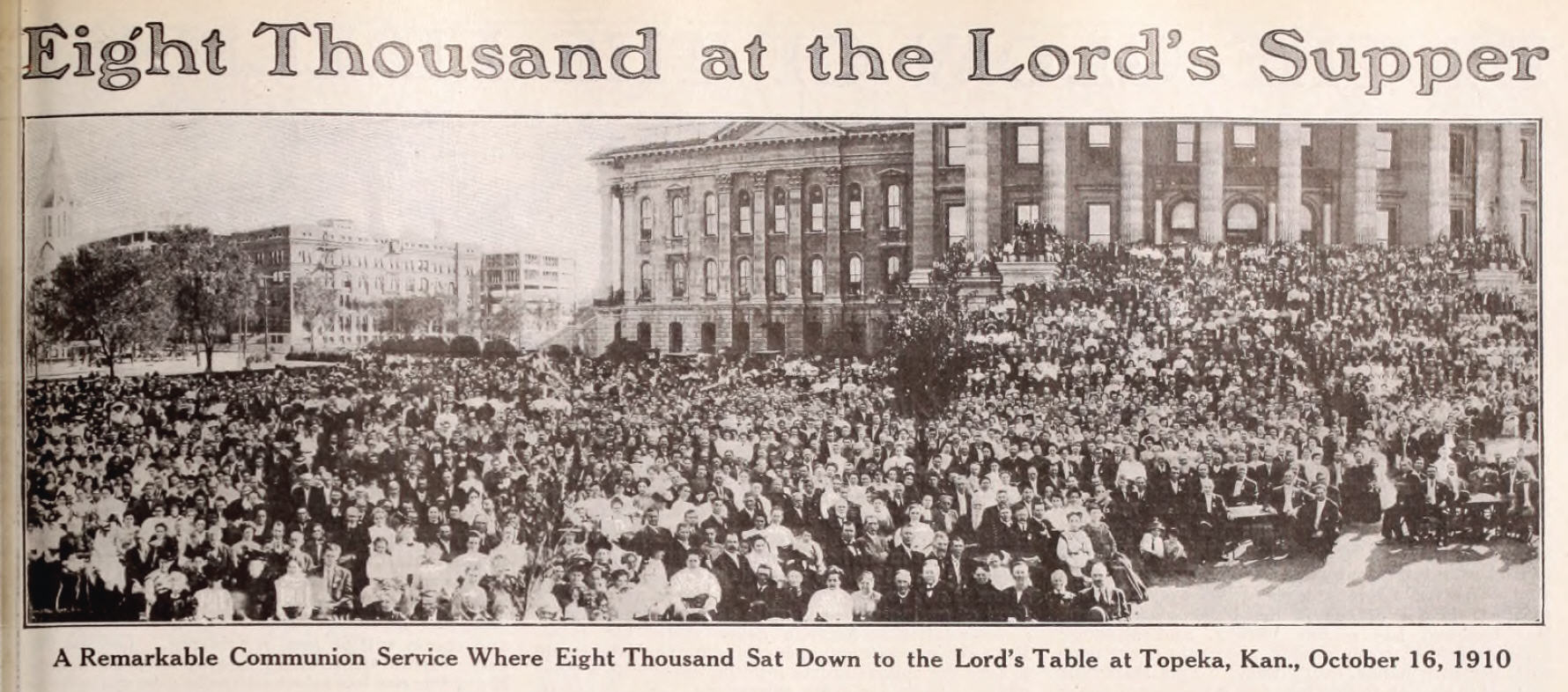
By the time the communion service began at 3:00, over eight thousand people had assembled on the State House grounds.

The service opened with almost everyone present joining their voices to sing the hymn “Nearer My God to Thee.”

Ministers from different churches across Kansas took a turn stepping up to the podium to offer prayers, read scripture, and bless the communion bread and wine.

Twenty church elders and forty-eight deacons assisted with the communion. The crowd was so large it took over an hour to serve the Lord’s Supper to everyone.

The Christian Herald magazine, which covered the event, wrote that there was a “reverent attitude” throughout the service that made it one of the most remarkable gatherings ever assembled on the State House grounds. The reporter wrote:

An ice driver broke bread with a great divine and a banker leaned out of his chair to hand the cup to a butcher. A Texan sat beside a Negro, and gentle society women held the babies of char-women.

The governor of Kansas, Walter Roscoe Stubbs, spoke about prohibition in Kansas, and reaffirmed his pledge to drive liquor sales and manufacturing out of the state (Kansas enacted its own law of prohibition in 1880). In his speech, Governor Stubbs promised:

“I say to you today that I don’t know of an open saloon in the State, and if any man shows me one and tells me of it and I don’t close it I’ll resign my position.”

The crowd cheered.

Walter Roscoe Stubbs, about 1920.

.

Another well-received speaker that day was Dr. Charles M. Sheldon, pastor of Central Congregational Church in Topeka, and author of the enormously popular Christian novel, In His Steps.

Dr. Charles Monroe Sheldon

.

He brought his Social Gospel message to the crowd, and exhorted everyone to work diligently toward world peace, saying:

“I hope to live to see the [day] our battleships are turned into missionary vessels and filled with missionaries to go out to all parts of the world to teach the Gospel of Christ.”

The Christian Herald published this photo of the crowd in the November 9, 1910 issue of the magazine (click on the image to see a larger version):

Photograph printed in The Christian Herald magazine, November 9, 1910.

.

One-hundred, seven years ago today this remarkable communion service took place on a Sunday afternoon in Kansas, on the grounds of the State Capitol building. It was an event the like of which may never be seen again.

Do you wish you could have been there? Please leave a comment and share your thoughts!

Will the Real Russia Please Stand Up?

Karen, a long-time reader of this blog, asked a question about Isabella’s novel, Interrupted.

Twice in the book, Isabella used the term “real Russia.”

The first instance occurs when our heroine, Claire Benedict, and her Sunday school class take it upon themselves to renovate the church, and they turn their attention to fixing up the cast-iron stove that heats the sanctuary.

As the ladies try to decide what improvements to make next, one of the girls says:

“Look here! Don’t you think our very next thing, or, at least, one of the next, ought to be a furnace? I don’t like those stove pipes, if they are Russia. A furnace would heat more evenly, and with less dust.”

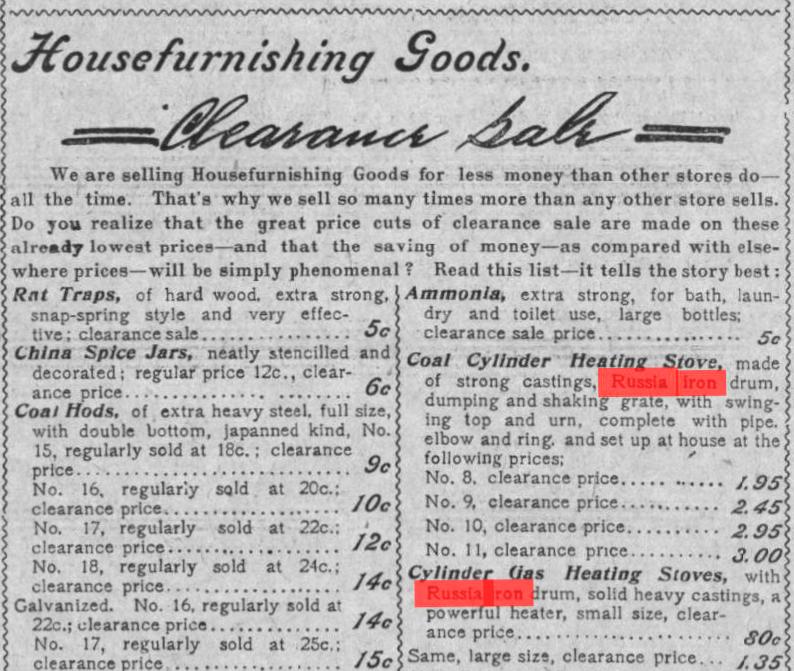
That’s the first mention of “Russia” in the book, referring to the pipes that vent the stove.

An 1899 newspaper ad for Siegel Cooper Department Store (New York) featuring Russia iron heating stoves.

.

Later, Isabella used the same Russia reference in describing the stove after the ladies cleaned it up:

And really, the stove pipe, though it wandered about according to some wild freak that was considered necessary in order to “draw,” did not look so objectionable now that it was real Russia; and nothing could glow more brilliantly than the stove, which smoked no more.

No wonder Karen was curious! “Real Russia”—whatever that is—played a big role in the ladies’ efforts to beautify the sanctuary.

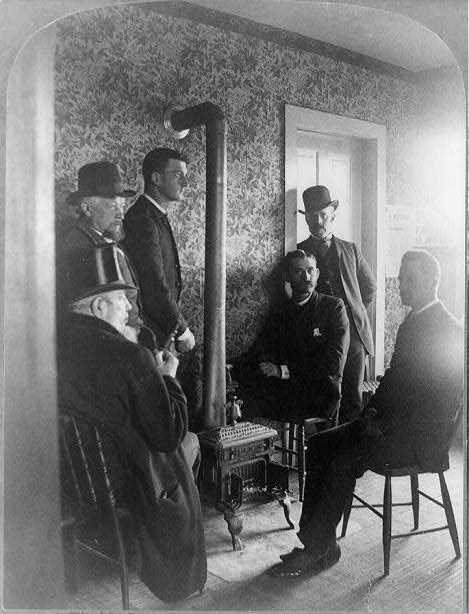
Men gathered around a cast iron heating stove in 1886.

.

So, what was “real Russia”?

Isabella was referring to Russia iron. It was produced in Russia and was highly prized throughout the world for its ability to resist rusting and protect engines, boilers and stoves.

Another key feature that made Russia iron the wonder of its time was that it did not flake or lose any of its protective properties when it was bent, as American iron did.

For many years Russia iron could only be obtained from Russia. The manufacturing process was highly secretive, which kept demand high and prices even higher.

In the mid-1800s American engineers finally cracked the code for manufacturing Russia iron; and by the latter part of the century, American foundries were gearing up to produce their own version of the much-sought-after sheet iron.

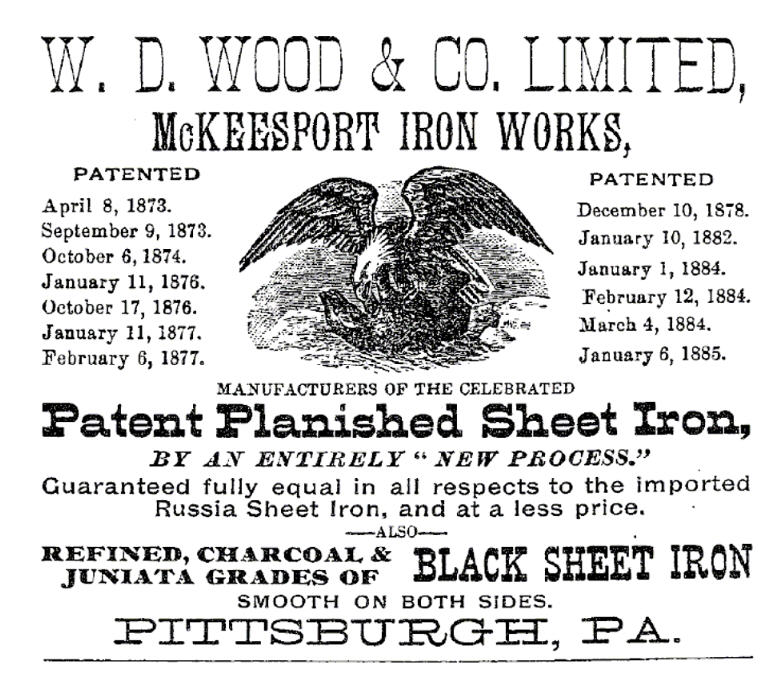
Ad from Pittsburgh and Western Pennsylvania-Their Industries and Commerce, published in 1885 by the Pittsburgh Chamber of Commerce; found at Penn state Universities library.

.

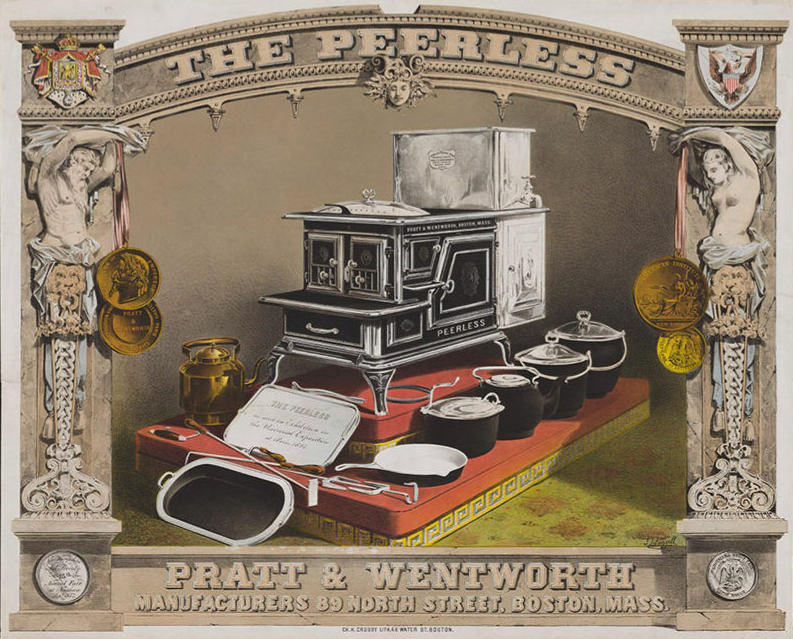
There was, after all, real money to be made from such a product. Sheet iron was used in the manufacture of many things, such as parlor stoves and cooking ranges.

An 1867 ad for Peerless kitchen stoves.

.

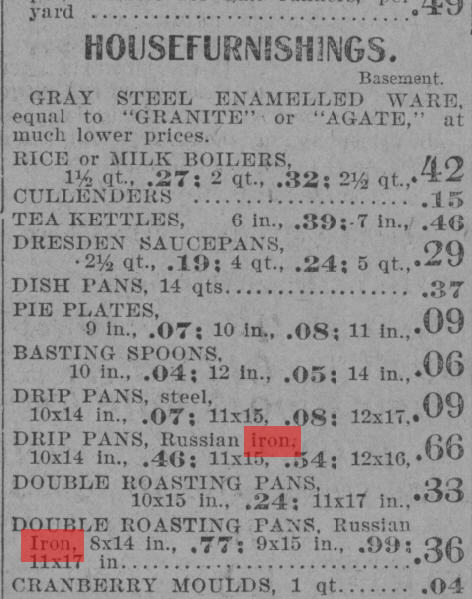
In addition to stoves, consumers used iron pots and pans on their iron cooking ranges.

Portion of a Macy’s Department Store ad in the New York Journal, November 21, 1897

.

Commercially, sheet iron was used to clad boilers and the engines on locomotives.

Even though American business was producing a creditable version of Russia iron by the 1880s, most consumers and industries were not fooled. They often referred to American iron products as “imitation Russia iron.”

A 1906 postcard showing a portion of the sprawling Carnegie Steel Works in New Castle, Pennsylvania.

.

But as more and more American-made products began to be advertised as made of Russia iron, consumers had a difficult time distinguishing between “real Russia” and the imitation. In many cases, the only way to tell the difference between the genuine product and the American version was to find the tell-tale Cyrillic characters embossed on the original full sheets of iron. Click here to see a sample of those Russian characters.

It took many years for American industry to overcome the stigma of producing “imitation” Russia iron; but in 1885, when Interrupted was written, Russia iron was still the gold standard by which all other iron was measured.

So when Isabella wrote that the stove pipes in the church were made of “real Russia,” she was actually commenting on the high quality of the improvements Claire Benedict and her friends made to the church sanctuary.

Would you like to learn all the ways Claire and her friends beautified the church sanctuary in Interrupted? Click here to read the post.

You can also read about other unique terms Isabella used in her different novels. Just click on “Pansy’s Dictionary” under the Categories header on the right side of this page.

.

.