In Lesson One Mr. Moody diagnosed the disease (Understanding Sin) and in Lesson Two, named the cure (The Remedy of the Gospel). Now, in Lesson Three, Mr. Moody outlines the five essential steps of genuine repentance:
Conviction Contrition Confession of Sin Conversion Confession of Christ
Using the biblical examples of King Saul’s shallow confession, David’s broken heart, and Joseph of Arimathea’s courageous stand at Calvary, Mr. Moody explains the difference between true and counterfeit repentance.
You can read Lesson Three for free!Click here to download a large-print PDF version you can print or share with friends.
Then, join us again on January 27, 2026 for Lesson Four of Mr. Moody’s Bible Class.
If you missed Lessons One and Two, you can find them by clicking on the Free Reads tab above.
December 8, 1925—almost exactly 100 years ago—started as any ordinary Tuesday afternoon in Palo Alto, California. Isabella Alden was 83 years old, and was living in the beloved double-home that she and her husband Ross built a decade before on Embarcadero Road.
Ross and her son Raymond had died the year before, so only Isabella and her daughter-in-law Barbara (Raymond’s widow) and her five children were left to share the rambling house.
Barbara Hitt Alden, about 1910.
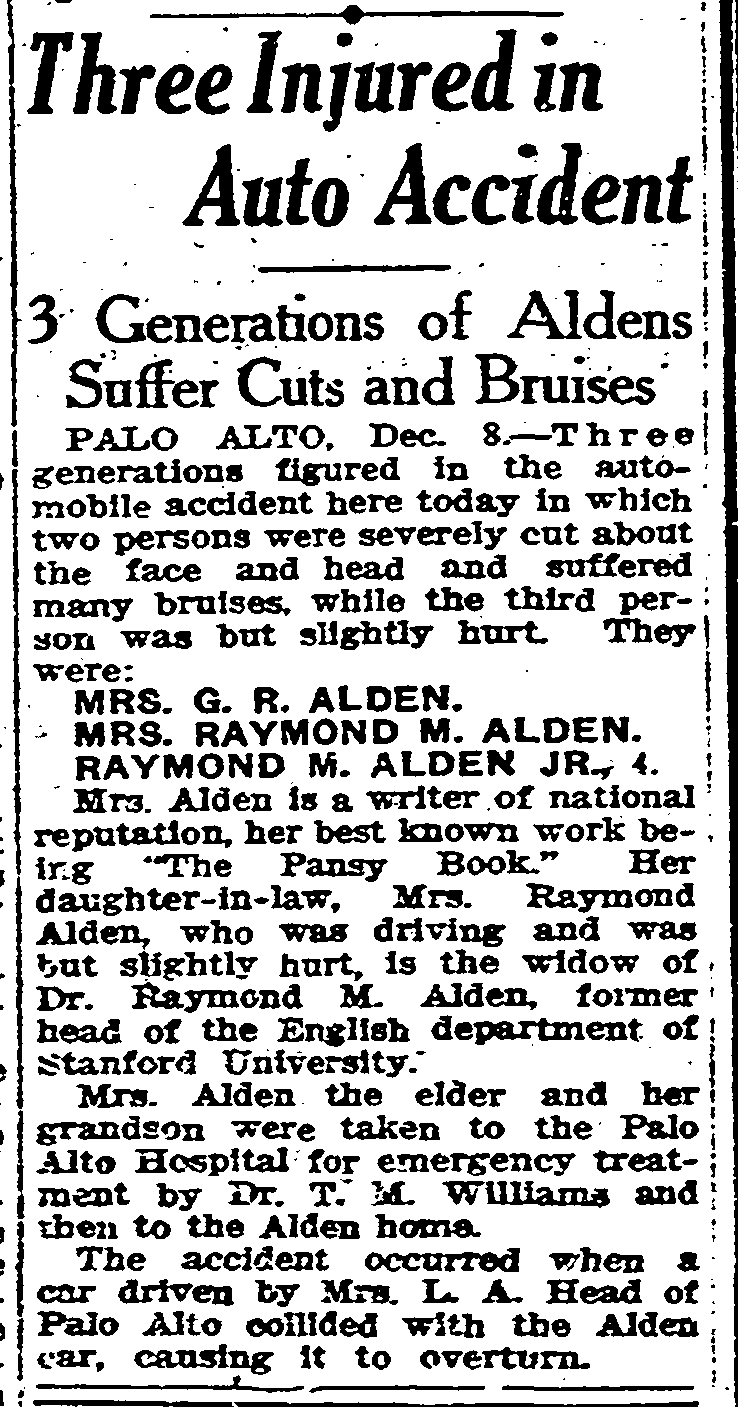
That afternoon, Isabella, Barbara, and Barbara’s youngest son, Raymond Jr., set out together in the family car. Barbara was behind the wheel. None of them could have known that their simple outing would dramatically change the remainder of Isabella’s life.
A 1925 Lincoln sedan, a popular car style in the 1920s.
At a street intersection a little less than a mile from their home, another car collided with the Alden vehicle, striking it with enough force to cause it to overturn. The impact shattered the windshield and windows, showering the passengers with broken glass.
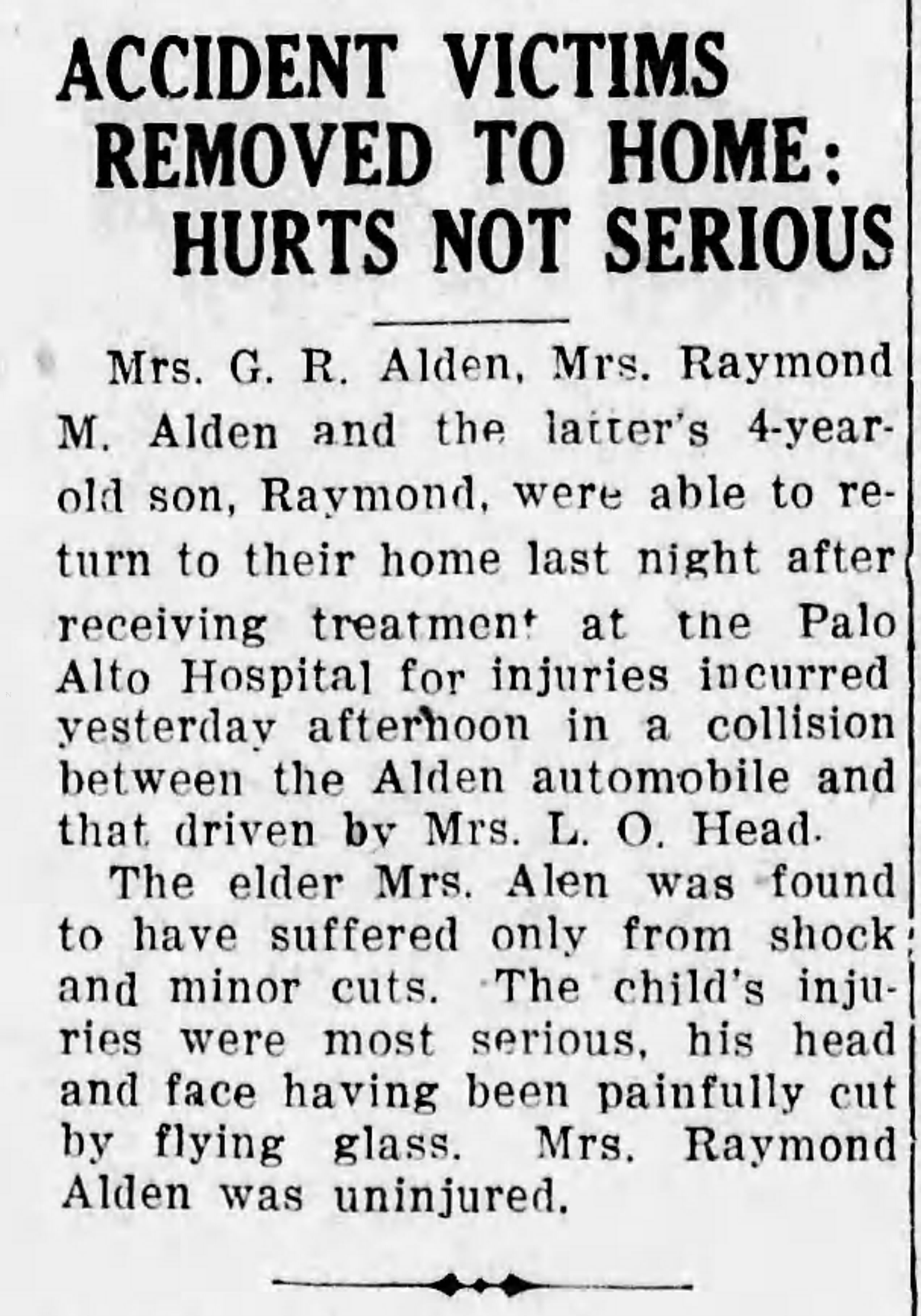
The San Francisco Chronicle, December 8, 1925.
Barbara was only slightly hurt. But Isabella and her young grandson suffered “severe cuts about the face and head, and many bruises.” After receiving first aid from a nearby physician, Isabella and Raymond Jr. were taken to Palo Alto Hospital for treatment.
Palo Alto Hospital in the 1920s.
The next day’s newspaper reported reassuring news: the accident victims had returned home, and Isabella “was found to have suffered only from shock and minor cuts.” Her grandson’s injuries were described as the most serious of the three.
The Peninsula Times Tribune, December 9, 1925.
But that assessment would prove tragically wrong.
What those initial medical evaluations missed was the true extent of Isabella’s injuries. The accident left her in considerable pain and, ultimately, confined to a wheelchair for most of the remaining years of her life.
Until the accident, Isabella was a woman who had been remarkably productive well into her eighties—still writing, still engaged with her work and family. The accident didn’t just slow her down; it fundamentally altered how she could live her remaining years.
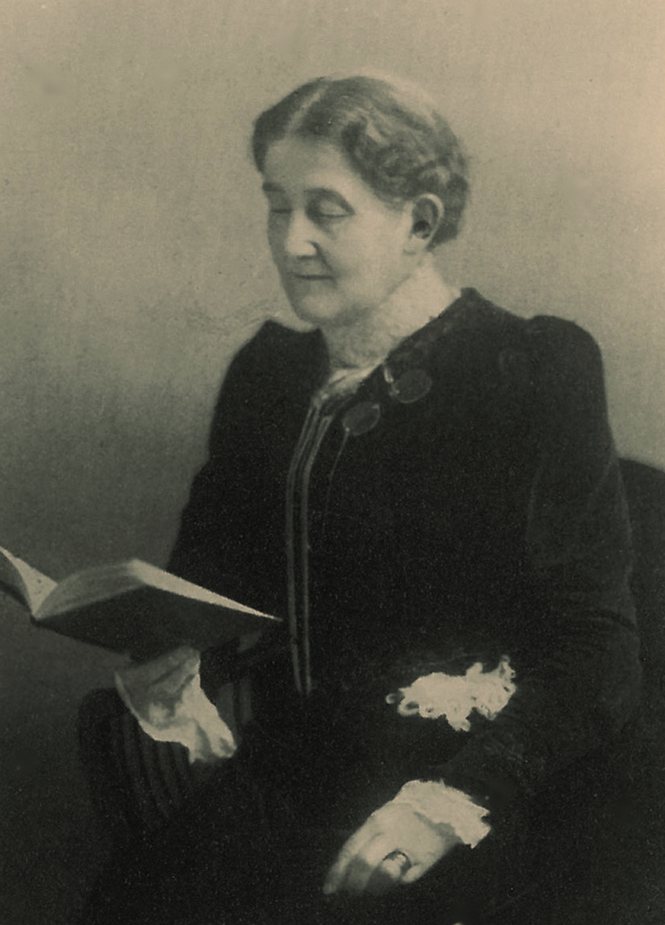
Isabella in later years.
In her memoir “Memories of Yesterday,” which she finished writing after the accident, Isabella documented the physical pain she endured. For a woman who had spent her life in service to others, who had quietly helped so many navigate their own difficulties, those final years must have been particularly difficult for her.
Isabella lived for nearly five more years after the accident, passing away in 1930 at age 88. Those years, spent largely in a wheelchair and dealing with chronic pain, were a far cry from the active, engaged life she had led for more than eight decades.
What is striking about this incident in Isabella’s life isn’t just the tragedy of the accident itself, but what it reveals about her character during her final years. Despite her pain and limitations, she continued to write. She finished her last novel, An Interrupted Night, and entrusted it to her niece, Grace Livingston Hill, to guide it through the publishing process.
She also completed her memoir, Memories of Yesterdays, candidly sharing her memories and reflections on a life well-lived. Even when her body was confined to a wheelchair, her mind and spirit remained active.
That’s the Isabella Alden we’ve come to know through her writings—someone who lived out the principles she wrote about, even when circumstances became difficult. She had spent decades writing about faith, perseverance, and finding purpose in adversity. In her final years, she had to draw on those very principles herself.
A hundred years ago this month, Isabella’s life changed forever on a Palo Alto street corner. While the accident limited her physical abilities, it couldn’t diminish the legacy she’d built through decades of faithful work—or the strength of character that sustained her until the end.
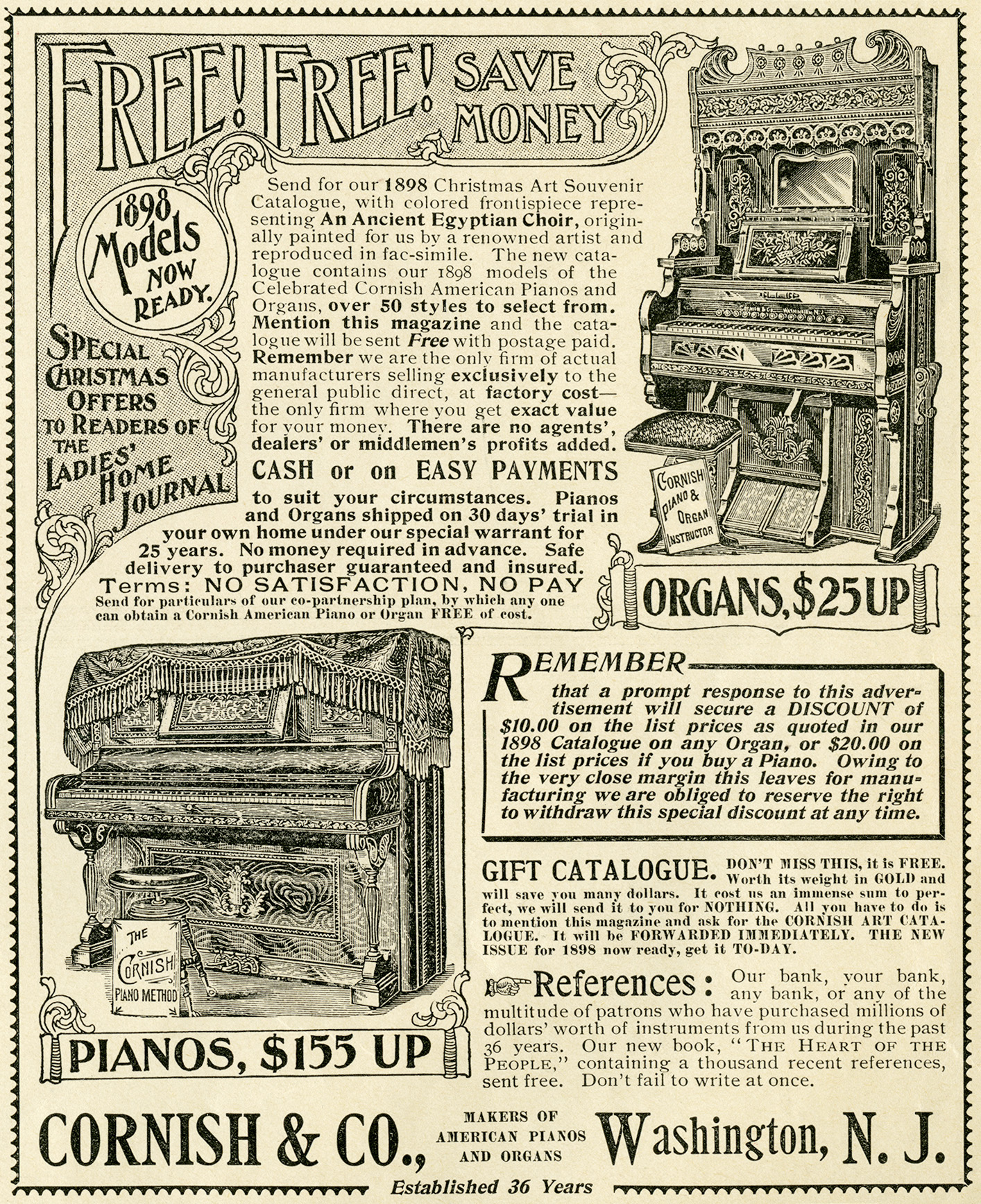
It’s Christmas time, and shopping for the holiday is now in full swing. During Isabella’s lifetime, Christmas ads filled the issues of newspapers and magazines, tempting shoppers with bargains and gift ideas.
Among the many advertisements for books, handkerchiefs, slippers, and gloves were ads for a gift the whole family could enjoy: a piano.
The idea wasn’t as extravagant as it might sound; by the late 1890s pianos were quite affordable. Dealers and manufacturers offered consumers credit or payment plans that made purchasing a piano within the reach of families with more modest incomes.
Families weren’t the only ones who took advantage of these arrangements. In Pansy’s Advice to Readers, Isabella wrote about a group of school girls who bought a piano for their gymnasium by raising the money themselves and making regular payments to the dealer.
Such arrangements meant pianos were no longer an article of luxury available only to the wealthy. As more families were able to purchase pianos, American social life began to change. Previously, people gathered at churches, concert halls, and other public places to enjoy music; but affordable pianos allowed people to enjoy music at home and within their own family circle.
But even affordable pianos presented a challenge: someone had to learn how to play them.
Once a piano was installed in a home, there were lessons to be had and endless hours of practice in order for a player to become proficient. But in the 1890s self-playing devices came on the market that again changed how families brought music into their homes.
There were two kinds of self-playing devices: those that attached to pianos, and those that were placed inside them.
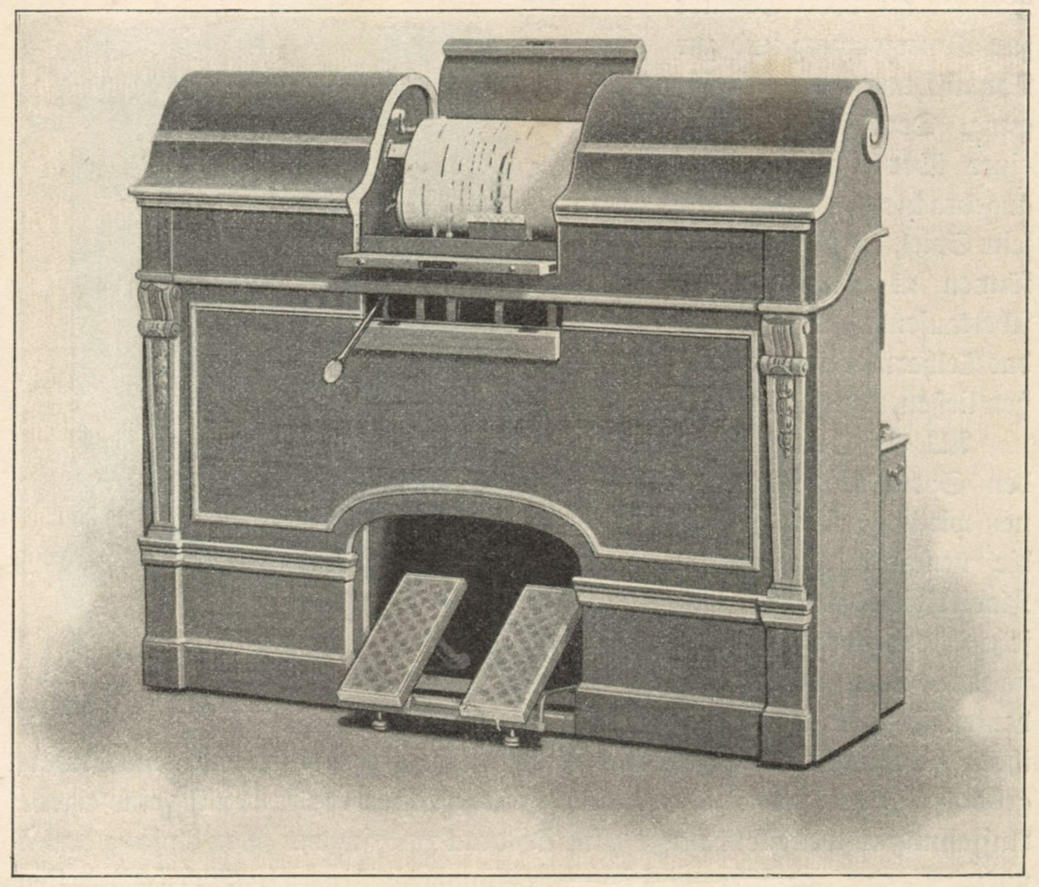
Invented in America, the pianola was a cabinet-type device that was pushed up against a piano keyboard. It depressed the piano keys with protruding felt-covered levers controlled by a perforated paper roll. A person had to be seated at the device to work the pumping pedals so air pressure created suction to rotate the roll.

Pianola cabinet style in 1890.
The other type—the player-piano—operated in the same manner with a rotating perforated roll, but the device was installed within the piano itself.
According to the editor of The Piano and Organ Purchaser’s Guide for 1908, these devices “made tens of thousands of pianos eloquent with good and popular music”—pianos that formerly were silent, except when there was a dance at home, or on a Sunday, when a few hymns were played.
“The present of a pianola is a present to every member of the family.” So declared a magazine advertisement in 1904 that urged consumers to consider buying a mechanical piano player for Christmas.
It wasn’t just families that could now listen to beautiful music in their homes. This ad in a 1904 issue of Booklover’s Magazine suggested a pianola cabinet player was the ideal gift for a bachelor’s home.
Those self-playing piano devices opened up whole new musical worlds for people. Many who never visited the opera or a concert before became thoroughly acquainted with world-class musical and orchestral compositions.
Sales of pianolas and player pianos peaked in the mid-1920s when gramophone recordings and the arrival of radio caused their popularity to wane.
But while in their heyday, pianos, pianolas, and player pianos made an important mark on American culture, bringing music and joy to thousands of families. Isn’t that a wonderful gift to receive?
You can learn more about pianolas and player pianos by clicking here.
This month’s free read is a sweet story about faith and Christmas blessings by Isabella’s sister, Marcia Livingston.
Wealthy Mr. Thornton finds his greatest pleasure in carrying out the quiet, unseen work of “his Friend.” With Christmas fast approaching, he has renovated a beautiful cottage to bestow upon an as-yet-unknown person who is homeless and friendless. When his path crosses that of Lily Winthrop and her grandfather, Mr. Thornton sees a clear object for his charity. Will his act of giving remain anonymous, or will Lily and her grandfather discover the secret donor of their miraculous Christmas gift?
In his first lesson, evangelist D.L. Moody diagnosed humanity’s deepest problem: the universal reality of sin and its separating power. Now, in this second lesson, Mr. Moody presents the remedy: the Gospel of Jesus Christ.
Through scripture and stories, including a powerful account from a Civil War hospital, Mr. Moody shows how Christ came to heal the broken-hearted, deliver captives, restore sight to the blind, and liberate the bruised. As he reminds us, “The Gospel of Jesus Christ is all that we choose to make it.”
This week, as we approach Thanksgiving, we’re sharing a lovely poem Isabella published in The Pansy magazine in 1886. “Miss Marion’s Thanksgiving Day” is about a wealthy but lonely lady who looks across the hills at the local almshouse and finds her purpose.
MISS MARION’S THANKSGIVING DAY
Two big houses broad and high, Outlined against an autumn sky.
Set on two hills, the houses stand, One grim and cheerless, one fair and grand;
One teems with life throughout its walls, One silent in all its stately halls.
One is of wood, and one of stone, Each set in broad acres all its own.
One is the almshouse, gaunt and gray, One the beautiful home of Miss Marion Ray.
Miss Marion Ray—her kith and kin All to their rest have entered in.
Now she dwells with servants in lonely state, In the mansion behind the iron gate.
A lady tall, and sad, and fair, With a quiet face and a gentle air—
A sweet, worn face, and hair of gray, Was the lonely lady, Marion Ray.
Sometimes in the night, when all is still, She has looked at the lights on the other hill,
And wondered much if it were sadder fate To live in the house with the wooden gate.
But something happened, the other day, That has stirred the heart of Miss Marion Ray:
A mother went out of the almshouse door, Went out of it to go back no more;
Went out to be buried under the leaves, While the wind of November moans and grieves,
And left a wee blossom with eyes of brown, To the tender mercies of all the town.
Miss Marion has thought of the baby's fate Till love and pity have grown so great
She has opened her Bible there to see: "As ye did it to Mine, ye did it to Me;"
And so, on the morn of Thanksgiving Day, In the early morn, when the sky is gray,
At the almshouse door a carriage stands, With shining horses in gleaming bands;
And into the eyes of the little child, The sad-eyed lady looked and smiled.
On the silken shoulder the glittering head, Then —"I love 'oo, lady," the baby said.
Gathered close to the hungry heart, The child and the lady never to part—
Carried home to the mansion grand, The proudest and richest in all the land.
Never a pauper, the lovely child Into whose face the lady smiled.
"Done to the least it is done to Me." What grander honor on earth could be?
Oh, a sweet and joyous Thanksgiving Day Has come to the home of Miss Marion Ray.
The heart of this story—and of so much of Isabella’s work—is the quiet call to charity, the simple act of extending kindness to those in deepest need.
What do you think? Does this poem illustrate Christ’s instruction from Matthew 25:40: “Inasmuch as ye have done it unto one of the least of these my brethren, ye have done it unto me”?
Under Isabella Alden’s tenure as editor, The Pansy magazine went from a monthly children’s magazine to a weekly publication. The content also changed; from the early days of short stories, poems, and Bible lessons, the variety of articles expanded to include lessons in science, nature, and geography.
The cover of September 17, 1892 issue of The Pansy magazine
In a regular column devoted to geography, Isabella cleverly turned what could have been a run-of-the-mill travelogue into a fun experience for her readers. Each month she chose a U.S. city as a topic; but instead of writing about the city herself, she invited children who had visited that city to write to her and tell about their trip and the sites they saw. Sometimes the children’s assessments and side-comments were more interesting than their descriptions of the city itself.
For example, when Isabella asked children to write about Minneapolis, Minnesota, she received this response from a boy named Harry Denning:
My uncle is a lawyer and lives in Minneapolis. He says the City Hall is just splendid. It cost three million dollars. Its great tower is three hundred and forty-five feet high, and there are only two others in the United States which can get above that. There isn’t any danger that this building will ever burn up, for it is made fire proof. I wonder why they don’t make all buildings fire proof? Then we would not have to buy engines, and pay firemen, and keep great splendid horses doing nothing all day long but wait for fires. This City Hall which I began to tell you about is three hundred feet square and fills up a great block on four streets. I am going to be a lawyer, and I shall have an office in Minneapolis.
Didn’t Harry have a good idea for building fire-proof buildings? The magazine included this illustration of the Minneapolis City Hall and Court Square:
City Hall and Court Square
Another letter was written by Minnie Andrews:
I have an aunt who is very fond of visiting churches. When she goes to a new place, if it is only a village, she wants to see all the churches and know about them. When she was in Minneapolis first, years ago, it was a little bit of a place, and my aunt is an old lady, and does not read the newspapers much, and did not realize that Minneapolis had grown a great deal. She went there last spring to visit a nephew. She reached there in the night, and was taken in a carriage to her nephew’s house, and did not realize the changes at all. The next morning at breakfast, when her nephew asked her what she would like to see in the city, she said she would like to visit the different churches if she could, and that perhaps as the day was pleasant they could go that morning.
“Very well,” said her nephew; “to which ones shall we go?”
“Oh, to all of them,” answered my aunt; “we can take a few minutes for each and see them all this forenoon, can we not?”
“Certainly,” said her nephew; “just as well as not. There are only about a hundred and sixty, I believe.”
And that was the first time my aunt knew that she was in a big city instead of the little town she had left thirty years or so before. But I don’t think her nephew was very polite to an old lady. She saw a good many of the churches, among them Dr. Wayland Hoyt’s, which she said she liked the best of all. It is the First Baptist Church of Minneapolis, and cost two hundred thousand dollars. It will seat about fifteen hundred people. I thought the Pansies would like to hear about it.
Perhaps the best part of Minnie’s letter is how caring she was in regard to her aunt’s feelings and how quickly she came to her aunt’s defense.
Another boy named Thomas Bailey Atwood wrote that when he and his sister visited their uncle in Minneapolis, they went to the Public Library:
It is a very handsome building. They say it cost a good deal—over three hundred thousand dollars. We sat in one of the elegant reading-rooms and read books while our uncle was looking up something in books of reference. There are thousands and thousands of volumes there. The street cars in Minneapolis are all electric. My sister did not like to ride on them when there was a thunderstorm, but I was not afraid. I think I like Minneapolis better than any place I was ever in.
The magazine included this illustration of the city’s impressive public library:
Public Library.
These letters give us a delightful peek into the minds of children from the 1890s. Harry’s practical question about fire-proof buildings, Minnie’s fierce defense of her aunt, Thomas’s brave stance on riding electric streetcars during thunderstorms—each letter reveals not just facts about Minneapolis, but the personalities of the children writing them.
Every child who wrote to her about a city shared real experiences. Isabella understood that children learn best when they’re engaged and when their own voices are valued. By inviting her young readers to become contributors, she turned geography lessons into something personal and memorable. It’s just one more example of why The Pansy magazine resonated with so many children during Isabella’s years as editor. And it’s no wonder children loved writing to her.
Like her younger sister Isabella, Marcia Macdonald Livingston was a talented writer. Her stories always contained a message of faith and a happy ending; and she excelled at writing about the trials—small and large—that husbands and wives face together.
This month’s free read is about one of those couples who must learn to cope with an empty nest.
Mrs. Warner is in despair. After her beloved daughter marries a young pastor and moves away, the once-cheerful woman cannot muster a smile for her husband, the Deacon. It will take a lonely November evening and the comforting strains of a few old hymns for this devoted couple to rediscover their faith and their gratitude for one another.
Isabella had a special bond with evangelist Rev. D.L. Moody. They were contemporaries who shared a common mission: bringing biblical truths to everyday Americans through accessible, compelling writing.
While Isabella wove Christian principles into her novels and short stories, Mr. Moody taught them directly through his preaching and writing.
In 1896, Mr. Moody published a twelve-part Bible study series in The Ladies’ Home Journal, a magazine that regularly published sermons, essays on religion and faith, and stories with Christian themes. He called his series, “Mr. Moody’s Bible Class.”
Each month for twelve months, Mr. Moody filled the pages of the magazine with lessons on the fundamental doctrines of Christianity, from sin and redemption to prayer and Heaven. His accessible writing style and practical approach made theological truths understandable to every-day readers, while he challenged them to examine their own faith.
From The Ladies’ Home Journal, October 1896.
“Mr. Moody’s Bible Class” is now available for a new generation. Each of his lessons has been carefully formatted for modern readers, with added reflection questions and organized Scripture references.
Whether you’re studying alone, with a small group, or teaching a Sunday school class, Mr. Moody’s lessons offer rich yet practical insights into the foundations of Christian doctrine. Click on the link below to view or download the first lesson:
Reviews and giveaways for Christian fiction and sweet, clean fiction. Bringing readers information on great stories and connecting authors with their readers.