Twelve months ago, we began this Bible study with D.L. Moody’s teaching on sin. Today, we close it with his teaching on Heaven. They are fitting bookends; the problem that started this series finds its ultimate resolution in the home Christ has prepared for those who love Him.
In this final lesson, Mr. Moody reminds us that the world “is not our home; this is only our training place.” Then, he gives us a vision of the heavenly home that awaits us, which far surpasses every earthly treasure.
As a minister’s wife for over four decades, Isabella Alden knew firsthand what D.L. Moody describes in this month’s Bible class: how quickly a congregation’s criticism can wear down a pastor’s spirit, and how “the Holy Spirit will not work in an atmosphere of criticism.”
In Lesson 11, Mr. Moody introduces us to both the Person and work of the Holy Spirit — His conviction of sin, His gift of hope, His call to love the unlovely, and His power to bring true liberty to a captive soul.
This is a lesson for anyone who wants to better understand the Holy Spirit’s work in daily life.
Dwight L. Moody was unlike any preacher of his era. Other celebrated evangelists of the nineteenth century (including his contemporary Charles Spurgeon) preached with scholarly precision and theological authority.
Mr. Moody took a different approach. He talked to his audiences the way a trusted friend might talk across a kitchen table — warmly, personally, and without pretense. It was a style he probably carried with him from his early days as a shoe salesman in Boston, where he learned that persuasion begins with a human connection, not an argument.
His simple, conversational style is evident throughout Lesson Ten of Mr. Moody’s Bible Class.
He doesn’t begin the lesson with a Scripture text or a theological declaration. Instead, he opens with a lovely description of the view from his study window at his home in Northfield, Massachusetts. He describes the Connecticut Valley stretching out before him and his view of the distant Vermont hills after an early mist has burned away. It’s a short and ordinary paragraph, and that is precisely his point. From that gentle opening he moves into one of the most profound doctrines of the Christian faith: the resurrection of the dead.
Mr. Moody’s home in Northfield, Massachusetts in 1904.
Half way through the lesson, Mr. Moody shares more about his personal life and admits that when he was a child he was terrified of death. He describes how he would pause whatever he was doing and anxiously count the strokes of the church funeral bell (one toll for each year of the deceased’s life) and feel a cold dread whenever the count was low. It’s a tender and relatable confession of fear from a man who regularly preached to millions of people.
That is what makes this lesson so powerful and so relevant for readers today. Mr. Moody doesn’t lecture us about the Resurrection from a safe theological distance. Instead, he tells us what it cost him personally to believe it — and what it gave him in return.
Dwight L. Moody was one of the most beloved evangelists of the nineteenth century, who preached to millions on both sides of the Atlantic. For Isabella Alden, Mr. Moody was more than a famous name; he was part of her world.
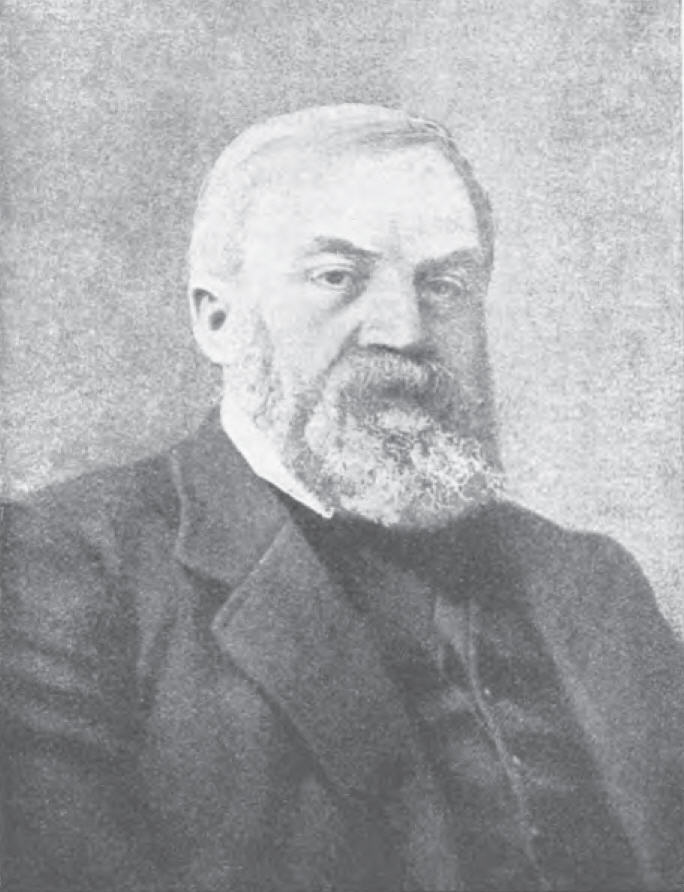
Dwight Lyman Moody (portrait by Edward Clifford)
The connection ran deep in her family. Isabella’s uncle, Horatio Spafford, was a close personal friend of Mr. Moody’s, a supporter of his evangelistic campaigns, and a fellow laborer in Chicago’s Christian community. It was a personal letter from Moody (then preaching in Europe) that invited Horatio and his family to join him in England in 1873, a voyage that ended in tragedy and gave the world the hymn “It Is Well With My Soul.” Mr. Moody himself traveled to be with the grieving Spaffords in the aftermath of that loss. (You can read more about that here.)
Closer to home, Mr. Moody was a contributor to Isabella’s own work. In 1897 — the same year he was writing these monthly Bible lessons for a popular women’s magazine — he contributed a piece on prayer meetings to a Christian magazine Isabella edited, a collaboration that speaks to the mutual respect and shared mission between them.
What makes lesson nine of Mr. Moody’s Bible Class so interesting is that its central message was one Isabella had been sharing for decades in her stories and novels. Mr. Moody teaches that love is not a feeling reserved for the lovable — it is the very essence of God, extended unconditionally to the unworthy, and expressed in small acts of grace that leave impressions that last a lifetime.
If you have read any of Isabella’s novels, you’ll recognize that theme immediately. Her stories are populated with difficult people — the prickly neighbor, the harried, impatient mother, the unlovable child, the proud and self-righteous churchgoer — and her heroes and heroines choose to love them anyway, to speak a kind word, and to see the person beneath the surface. Isabella was writing fiction; Mr. Moody was preaching theology; but they were both saying the same thing.
In his ninth Bible class, Mr. Moody explains how God’s love differs from man’s love, and he shares the ultimate way in which we can show our love for God in return.
What does it really mean for Christians to hope? D.L. Moody — Isabella’s friend and one of the most beloved evangelists of the nineteenth century — taught that biblical hope isn’t just optimism and positive thinking. It is the soul’s confident anchor in the promises of God.
Mr. D.L. Moody in 1897.
In his eighth Bible class, Mr. Moody explores the difference between false hope and the Christian’s true hope—and why the difference matters today more than ever.
In Lesson Six, D.L. Moody taught that assurance is the privilege of every believer. But how does faith—the root from which assurance grows—actually work?
In this month’s lesson, Mr. Moody explains that “faith is the simplest and most universal experience in the world,” yet Christians often overcomplicate it or misplace it entirely.
Through memorable illustrations Mr. Moody shows that biblical faith consists of three essential elements: knowledge, assent, and action. “Without action they accomplish nothing,” he writes. He also shares a powerful story from his own life when he discovered that “Faith cometh by hearing, and hearing by the word of God.”
Isabella Alden was blessed with two striking talents: she was a gifted storyteller and a skillful teacher. She used those God-given talents to explain sometimes difficult Biblical truths in simple terms her readers could understand. In 1895 she wrote this short but effective letter to readers of The Pansy magazine about what it means to be intimate with Jesus:
DEAR YOUNG PEOPLE:
Why should we pray, do you think?
I have been looking in the Bible for a reason. I find a splendid one; it is because God hears, and helps. Look at the seventeenth verse of the thirty-fourth Psalm and see if it does not say so.
“The righteous cry, and the Lord heareth, and delivereth them out of all their troubles.”
To be sure it begins, “The righteous cry,” but that means the people who try to do right. There isn’t much use in the prayers of other people; because, of course, if we do not mean to try to do right, what use in asking God to help us? But now, what a wonderful thing it is that he is ready to hear us at any time and at all times! You know people, I presume, who are often too busy to hear what you have to say. Suppose God were so. Suppose he had to wait until he had answered twenty-five thousand other prayers before he could listen to yours!
When should we pray?
I know a girl who is troubled over the verse:
“I will bless the Lord at all times; his praise shall continually be in my mouth.”
“I can’t do that; “she said. “I have to think of lots of other things, and talk about them. How can anybody?”
It happens that this girl has a young friend about whom she talks a good deal. When she has any company her friend is sure to be one of them; if she has a gift she is sure to share it with her, if possible; and her brother said to her once, “You are always talking about Fannie Pierce.”
I reminded her of this, and of how much she made people realize that she loved Fannie, and said to her that I supposed the verse meant something like that. There were people who loved Jesus so much that they thought about him whenever any question came up as to where they should go, or what they should do, or be; wondering what would please him, and going to him about it, and thanking him for help. There is a sense in which they might be said to be “always thinking about him;” yet they think of many other things; only they are sure not to plan things which will not be pleasant to their friend.
I think she understood me, for she said, “Oh, I know how I feel about Fannie. Do you really think I could be as intimate with Jesus as that?”
What do you think? Doesn’t he call us to be very intimate with Him?
Isabella’s “Letter about Prayer” reminds us that the best lessons are often the simplest. Although it was written for children, Isabella used a very relatable example of a girl’s friendship with “Fannie Pierce” to explain a spiritual concept. For today’s readers, Isabella’s words still challenge us to consider if we are truly as “intimate with Jesus” as we are with those we love most on earth.
Do you think Isabella’s letter accomplished its purpose?
“Confidence is essential to success in every pursuit of life,” evangelist D.L. Moody writes in his April 1897 Bible lesson—and this truth applies equally to spiritual matters. Many Christians, he tells us, live imprisoned in what John Bunyan called “Doubting Castle,” experiencing weary, gloomy faith instead of joyful certainty.
Through the Apostle John’s five tests and some very memorable illustrations, Mr. Moody shows how every Christian can move from doubt to confident trust in their salvation.
Then, join us again on April 28, 2026 for Lesson Seven of Mr. Moody’s Bible Class. If you missed Lessons One through Five, you can find them by clicking here or on the Free Reads tab above.
What does it really mean to be “born again”? In this fifth installment of Mr. Moody’s Bible Class, evangelist D.L. Moody tackles one of Christianity’s most essential — and most misunderstood — doctrines: Regeneration.
Mr. Moody teaches that forgiveness alone is not enough — God must give us an entirely new nature.
“Heaven,” he writes, “is a prepared place, for a prepared people.”
Through stories and the dramatic example of Saul’s transformation on the Damascus road, Mr. Moody explains what regeneration is, what it is not, and why it is not an arbitrary demand but an absolute necessity.
And he concludes his lesson with a question every soul must answer: “Have I been regenerated through the atonement made on my behalf?”
In previous lessons we’ve journeyed from understanding sin’s devastation to embracing the Gospel’s remedy to practicing true repentance. Now, in this Bible lesson he wrote in 1897, D.L. Moody explains the central doctrine of Christianity: the Atonement.
“For nineteen hundred years,” Mr. Moody writes, “the chief point of controversy between faith and unbelief has been the doctrine of the Atonement.” Yet it remains “the very foundation of Christianity.”
In this month’s Bible Class, Mr. Moody uses vivid Old Testament examples—Abel’s sacrifice, Abraham on Mount Moriah, and the Passover lamb—to trace the “scarlet line” God wove through Scripture to prepare humanity for Christ’s ultimate sacrifice. He reveals six precious benefits of Christ’s blood and concludes the lesson with the greatest question facing every person: “What is my relation to the Atonement?”
You can read Lesson Four for free! Click here to download a large-print PDF version you can print or share with friends.
Join us again on February 24, 2026 for Lesson Five of Mr. Moody’s Bible Class.
If you missed Lessons One through Three, you can find them by clicking on the Free Reads tab above.
Reviews and giveaways for Christian fiction and sweet, clean fiction. Bringing readers information on great stories and connecting authors with their readers.