A Sunday School Lesson and a Free Read

Though we often think of her as a writer of Christian fiction, Isabella Alden had another demanding career: she was an acknowledged expert in developing Sunday-school lessons for children. In her years growing up in a Christian home and, later, as a minister’s wife, she had plenty of opportunities to judge the effectiveness of Sunday-school programs.

sunday-school-classes-ed

She knew that many Sunday-school teachers had no training at all.

She had seen teachers who didn’t know what the Sunday-school lesson was until Sunday morning when they sat down in front of their class to teach.

She had also seen teachers who didn’t even know the Bible verse on which the Sunday lesson was based.

Isabella knew there was a better way to teach young children the lessons of the Bible in a way they could understand; so she developed a program of education for Sunday-school teachers of young children, in which she gave teachers step-by-step instructions, telling them everything they needed to know … from what to write on the chalkboard, to when to have the children stand and sit.

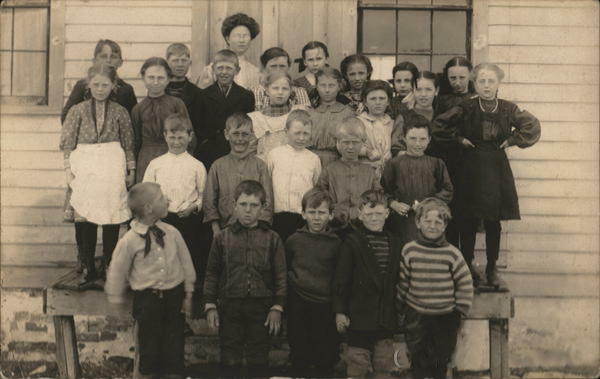
Undated photo of a teacher and her class.

She shared her program at the Chautauqua summer assemblies, and she spoke at churches about the method. Her Sunday-school lessons were published in regular weekly columns in Christian magazines, such as The Sabbath School Monthly and The National Sunday-School Teacher.

sabbath-school-monthly-title-page

Click on this link to see an excerpt from an 1877 issue of Sabbath School Monthly with one of Pansy’s lessons.

Isabella was convinced that children should be shown that the Bible had meaning for them. She believed children were not too young to learn that the Bible could be a help to them in their day-to-day lives.

cover_hedge-fenceIt was that premise that inspired her to write three of her most popular children’s books. In Frank Hudson’s Hedge Fence, Frank (a boy of about ten or twelve years old) is constantly getting into trouble. One day an acquaintance convinces him that learning a Bible verse a month will help guide him through the temptations he faces and help him make wise decisions. The story tracks Frank’s progress for several months as he learns the Bible really can help him make good choices in his life.

cover_we-twelve-girls-05We Twelve Girls is similar to Frank Hudson’s Hedge Fence. In this story, twelve young teenaged girls, all close friends at boarding school, are separated over the summer months; but they each pledge to learn a new verse every week and find a way to apply the verse to their lives. Over the course of the book, each young lady learns what it means to live a God-centered life according to the Bible.

Another example is A Dozen of Them. In this book, twelve-year-old Joseph has many challenges in his life; but he made a promise to his older sister he would read at least one Bible verse each month and make it a rule to live by. To Joseph it’s a silly promise—how can reading one Bible verse a month make any difference? But to his astonishment, Joseph begins to see changes in his own life and in the lives of those around him, all because of the verses he reads and memorizes.

Frank Hudson’s Hedge Fence and We Twelve Girls are both available as e-books on Amazon. A Dozen of Them was originally published in 1886 as a serial in The Pansy magazine, and we thought it would be nice to reproduce it on this blog, in the same serial format as the original.

Each week you can read a new chapter of A Dozen of Them here and here’s Chapter One:

A Dozen of Them

Chapter 1

And Thomas answered and said unto him, My Lord and my God.
He saith unto him, Feed my lambs.
If we walk in the light, as he is in the light, we have fellowship one with another, and the blood of Jesus Christ his Son, cleanseth us from all sin.
I am he that liveth, and was dead; and behold, I am alive forevermore.

divider-05

Young Joseph sat on the side of his bed, one boot on, the other still held by the strap, while he stared somewhat crossly at a small green paper-covered book which lay open beside him.

“A dozen of them!” he said at last. “Just to think of a fellow making such a silly promise as that! A verse a month, straight through a whole year. Got to pick ’em out, too. I’d rather have ’em picked out for me; less trouble.

“How did I happen to promise her I’d do it? I don’t know which verse to take. None of ’em fit me, nor have a single thing to do with a boy! Well, that’ll make it all the easier for me, I s’pose. I’ve got to hurry, anyhow, so here goes; I’ll take the shortest there is here.”

And while he drew on the other boot, and made haste to finish his toilet, he rattled off, many times over, the second verse at the head of this story.

The easiest way to make you understand about Joseph, is to give you a very brief account of his life.

He was twelve years old, and an orphan. The only near relative he had in the world was his sister Jean aged sixteen, who was learning millinery in an establishment in the city. The little family though very poor, had kept together until mother died in the early spring. Now it was November, and during the summer, Joseph had lived where he could; working a few days for his bread, first at one house, then at another; never because he was really needed, but just out of pity for his homelessness. Jean could earn her board where she was learning her trade, but not his; though she tried hard to bring this about.

At last, a home for the winter opened to Joseph. The Fowlers who lived on a farm and had in the large old farmhouse a private school for a dozen girls, spent a few weeks in the town where Joseph lived, and carried him away with them, to be errand boy in general, and study between times.

Poor, anxious Jean drew a few breaths of relief over the thought of her boy. That, at least, meant pure air, wholesome food, and a chance to learn something.

Now for his promise. Jean had studied over it a good deal before she claimed it. Should it be to read a few verses in mother’s Bible every day? No; because a boy always forgot to do so, for a week at a time, and then on Sunday afternoon rushed through three or four chapters as a salve to his conscience, not noticing a sentence in them. At last she determined on this: the little green book of golden texts, small enough to carry in his jacket pocket! Would he promise her to take—should she say each week’s text as a sort of rule to live by?

No; that wouldn’t do. Joseph would never make so close a promise as that. Well, how would a verse a month do, chosen by himself from the Golden Texts?

On this last she decided; and this, with some hesitancy, Joseph promised. So here he was, on Thanksgiving morning, picking out his first text. He had chosen the shortest, as you see; there was another reason for the choice. It pleased him to remember that he had no lambs to feed, and there was hardly a possibility that the verse could fit him in any way during the month. He was only bound by his promise to be guided by the verse if he happened to think of it, and if it suggested any line of action to him.

“It’s the jolliest kind of a verse,” he said, giving his hair a rapid brushing. “When there are no lambs around, and nothing to feed ’em, I’d as soon live by it for a month as not.”

Voices in the hall just outside his room: “I don’t know what to do with poor little Rettie today,” said Mrs. Calland, the married daughter who lived at home with her fatherless Rettie.

“The poor child will want everything on the table, and it won’t do for her to eat anything but her milk and toast. I am so sorry for her. You know she is weak from her long illness; and it is so hard for a child to exercise self control about eating. If I had anyone to leave her with I would keep her away from the table; but everyone is so busy.”

Then Miss Addie, one of the sisters: “How would it do to have our new Joseph stay with her?”

“Indeed!” said the new Joseph, puckering his lips into an indignant sniff and brushing his hair the wrong way, in his excitement; “I guess I won’t, though. Wait for the second table on Thanksgiving Day, when every scholar in the school is going to sit down to the first! That would be treating me exactly like one of the family with a caution! Just you try it, Miss Addie, and see how quick I’ll cut and run.”

But Mrs. Calland’s soft voice was replying: “Oh! I wouldn’t like to do that. Joseph is sensitive, and a stranger, and sitting down to the Thanksgiving feast in its glory, is a great event for him; it would hurt me to deprive him of it.”

“Better not,” muttered Joseph, but there was a curious lump in his throat, and a very tender feeling in his heart toward Mrs. Calland.

It was very strange, in fact it was absurd, but all the time Joseph was pumping water, and filling pitchers, and bringing wood and doing the hundred other things needing to be done this busy morning, that chosen verse sounded itself in his brain: “He saith unto him, feed my lambs.” More than that, it connected itself with frail little Rettie and the Thanksgiving feast.

In vain did Joseph say “Pho!” “Pshaw!” “Botheration!” or any of the other words with which boys express disgust. In vain did he tell himself that the verse didn’t mean any such thing; he guessed he wasn’t a born idiot. He even tried to make a joke out of it, and assure himself that this was exactly contrary to the verse; it was a plan by means of which the “lamb” should not get fed. It was all of no use. The verse and his promise, kept by him the whole morning, actually sent him at last to Mrs. Calland with the proposal that he should take little Rettie to the schoolroom and amuse her, while the grand dinner was being eaten.

I will not say that he had not a lingering hope in his heart that Mrs. Calland would refuse his sacrifice. But his hope was vain. Instant relief and gratitude showed in the mother’s eyes and voice. And Joseph carried out his part so well that Rettie, gleeful and happy every minute of the long two hours, did not so much as think of the dinner.

“You are a good, kind boy,” said Mrs. Calland, heartily. “Now run right down to dinner; we saved some nice and warm for you.”

Yes, it was warm: but the great fruit pudding was spoiled of its beauty, and the fruit pyramid had fallen, and the workers were scraping dishes and hurrying away the remains of the feast, while he ate, and the girls were out on the lawn playing tennis and croquet, double sets at both, and no room for him, and the glory of everything had departed. The description of it all, which he had meant to write to Jean, would have to be so changed that there would be no pleasure in writing it. What had been the use of spoiling his own day? No one would ever know it, he couldn’t even tell Jean, because of course the verse didn’t mean any such thing.

“But I don’t see why it pitched into a fellow so, if it didn’t belong,” he said, rising from the table just as Ann, the dishwasher, snatched his plate, for which she had been waiting. “And, anyhow, I feel kind of glad I did it, whether it belonged or not.”

“He is a kind-hearted, unselfish boy,” said Mrs. Calland to her little daughter, that evening, “and you and mamma must see in how many ways we can be good to him.”


Next week: Chapter 2


Earle’s Afterwards Tree; Part 2

Earle and his friends plan to make the days after Christmas special for one deserving family in Part 2 of “Earle’s Afterwards Tree.” If you missed Part 1 of the story, you can read it here.

titlem-in-jpg

.

Part 2

Perhaps the Crawfords never had a busier day than that one in which the Hunters went to help keep Grandmother’s birthday. It was such an important day that Mr. Crawford actually stayed from the office for several hours to help!

The Hunters’ sitting-room was found to be in good order, and with so little furniture in it that very little was to be done to make it ready for the tree. But after that was dragged in, and set up in state in the very center of the room, business began.

Christmas Tree

No “afterwards,” surely, had ever grown after the fashion of this one! There were dollies, and books, and slates, and drawing paper, and Christmas cards, and jackknives, and stockings, and dresses, and caps, and mittens, and hoods, and sacks, and—but what is the use of trying to tell it? One present must be described. It filled Earle Crawford’s heart full almost to overflowing with joy. Robbie Hunter, although he was nearly six years older than Earle, was nevertheless a dear friend of his. Now, Robbie Hunter had remarked to him perhaps twenty-five times already this winter that if he only had a bicycle he could get lots of errands to do for folks and earn a good deal of money.

“You see,” he would say, “we have so little snow here, that a bicycle can be used almost all winter; and things are stretched so far apart that a fellow can’t do many errands before the day is done, if he has to depend on his feet; and as for the street cars, why, they take all the profits.”

bicycle-01

Earle had listened and been convinced, and the two had wearied their brains trying to plan some way by which a bicycle might be secured; all to no purpose up to this time. Yet here, standing under the tallest branches of this “afterwards” tree was a first-class bicycle in perfect order, although not quite new, and marked:

Robert E. Hunter; from Santa Claus’ cousin.

“Because,” said the giver, “Santa Claus is supposed to come this way only at Christmas time, but his first cousins scurry over the country for the ‘afterwards’ things.”

When Mrs. Crawford saw that bicycle, she said, “Oh, poor boy! That must have been hard. But wasn’t it noble in him?”

That needs explaining. The bicycle had belonged to Dr. Holland’s only son, Fletcher. It had been a present to him on his last birthday.

“A trifle too large for him just now, perhaps,” his uncle had said, “but I wanted to get one that would last; and he’ll grow to it.”

No, he wouldn’t. The accident which had broken his leg and hurt his hip, happened months before Robbie Hunter was hurt, and now Robbie was out on crutches, and with a fair prospect of throwing them aside in a few days. But Fletcher Holland would never be able to do without his. Oh, worse than that; he knew his father feared that even crutches could not be used much; and that by and by he would be unable to step at all. It was some trouble about the hip which Fletcher did not understand, but he knew the fact as well as though they had told him, which they tried not to do. Yes, it had been hard. It took him one long, bright morning, sitting in his easy chair, with one hand on his crutch and the other just covering the quiver on his lips while he gazed out of the window at nothing, and thought. Should he? Could he? Why not? It was his very own to do with as he would. Robbie Hunter needed it; could help support the family with it, and he, Fletcher …

Then there was a long break even in the thoughts, and Fletcher let go his crutch to brush away the tears lest mama should come in and see them. But he settled it that morning, and sent the bicycle in the afternoon around to the Crawfords, to be ready for the tree.

Well, the busy day was done at last; so was the work. None too soon, although the Hunter family did not get back until after five o’clock. They had not meant to stay so late; but Grandma had cried when they talked of going, and said it was probably her last birthday with them, and they had lingered to comfort her. Because of this, and some other things, the ride home was a quiet one. They had had a good day, and a good dinner. Grandma’s son-in-law was far from wealthy, but he had a farm, and a good many things can be raised on a farm to make a dinner table inviting. Aunt Jane had done her best, and everybody enjoyed it. Yet, in spite of it, the Hunters were getting hungry again. Dinner had been quite early in the day for Grandma’s sake; now it was five o’clock, and it was found to be impossible to forget that they had almost nothing in the house for supper. Oh, yes, they had bread, of course, and some butter; they were not starving; but stale bread and butter which one needed to remember was scarce and high-priced, did not make a very inviting meal. Mrs. Hunter, as she tucked her shawl closer about the baby and snuggled him to her, could not help thinking how dingy and desolate the little kitchen would look tonight with its fireless stove, and the chill of a day alone upon it. Other people too, looked at the Hunter cottage and thought somewhat the same thoughts.

farmhouse-in-winter

“Isn’t that a gloomy little house where the Hunters live?” Carl Burton asked his father as they drove by on their way from school. Mr. Burton nearly always stopped at the school-house for Carl and Alice; he had them with him now, tucked among the bright-colored robes, and done up in costly furs. The Burtons all turned and looked at the little house.

“Yes,” said Mr. Burton, “it does look rather desolate. The Hunters are having a hard time, I hear. I suppose they will not have much of a supper tonight; and here you and Alice are fretting because I forgot to order the angel cake; when we shall probably have cold turkey and muffins, and I don’t know what not, I presume the Hunters will have to be contented with plain bread and butter.”

Much he knew about it! Mrs. Crawford’s cook, Nannie, and Mrs. Holland’s second girl, Kate, were at that moment engaged in putting the finishing touches to as dainty a tea table as the Burtons themselves could desire.

snfw_152

There was even cold turkey, in delicate pink and white slices, and angel cake, besides. This supper had been Earle Crawford’s final stroke of preparation. “Because, you know, mama, they always have splendid Christmas suppers; and an afterwards Christmas ought to be just as nice.”

Just as Nannie set a plate of muffins on the corner of the stove to keep warm, Kate exclaimed: “There they are! Now let’s scud!”

Away they scurried, out of the back door and down the hill, just as Clara Hunter blew around the corner holding to her bonnet with both hands lest the wind carry it away.

“Give me the key, father,” she had said, “and I’ll run around and unlock the back door so that mother can get in quick, with Baby. And I’ll have a fire in a—Why-ee! We didn’t lock this door, after all! Why, there is a fire, mother! There’s—Oh, mother, mother! What does it mean?”

They were all in the kitchen by this time, Father, and Robbie, and all. For the first minute they stood and stared. There was the table laden with dainties, aglow with light from a new lamp which did not smoke, and had come to stay!

“I didn’t know there were witches nowadays,” said Father Hunter, and he rubbed his eyes.

Robbie hobbled around the table to investigate. “Look here!” he said, “Here’s a card; and it says on it: ‘An Afterwards Christmas from Santa Claus and his friends.’”

At last they got down to that table; the horse having been come after by an unusually obliging fellow from the Works, who said he wanted her right away, and it would be all right to leave the wagon in the back yard for the night; Mr. Crawford said so.

“Good!” said Robbie, rubbing his hands. “Now we can sit right down and eat this supper which the witches have brought, while it is hot. Mother, I wouldn’t be afraid to wager my old hat that Mrs. Crawford’s Nannie made those muffins; they look just like her.”

Muffins

Whoever made them, the Hunters voted them and everything else splendid; and were not too busy wondering and guessing, to eat heartily.

Once Mrs. Hunter said, with a bit of a sigh, “There is enough on this table tonight to have been spread over several days.” But a clamor of voices silenced her, father joining in.

“Some of our friends,” he said, “have intended it for a Christmas treat; and we’ll enjoy it and be grateful, even if we should be hungry next week.”

It was Mary who finally said that it was getting very warm in the kitchen; shouldn’t she open the door to the other room a crack? Which she did, and exclaimed, and threw it wide open, and behold! There was the “afterwards” tree in all its glory!

I wish I could describe that tree, and the things which lay about it and under it and behind it; and the bewilderment and joy of the Hunter family.

“What can it all mean?” first one Hunter said, then another. And when each had had his turn, they began again and said it over, for nobody knew how many times. By and by Robbie discovered the bicycle; then he shouted so loud that his mother said:

“Robbie, if you were not on crutches you would almost deserve to have your ears boxed! See how you have frightened Baby!”

Then Robbie sat flat on the floor, and laughed, and laughed, until Mary said, “Why, I believe he is crazy!”

Then what did he do but plump his head into a cushion which was under the tree for the baby, and actually cry! He had wanted a bicycle so dreadfully, and had not expected one any more than he expected to have the moon.

Father Hunter, however, had not heard this last uproar at all. He had found a letter. The very letter which Earle Crawford had feared he would not care for, and was reading and re-reading it, and wiping his eyes and saying, “God bless him! That will help us through. I can see daylight.”

It was a very short letter; only a receipt for eight months rent; the two which he was behind, and the six which were to come before the year would close.

Meantime, Mary, and Clara, and Minnie, were finding packages which read: “From your loving classmates,” or, “For a dear girl, from another girl,” or some such equally bewildering statement.

“Here is another letter,” said Mrs. Hunter.

She leaned over her husband’s shoulder to read, and drew a long breath of intense relief as she said: “Oh, children! It is Dr. Holland’s bill, receipted!”
Christmas Tree and Letter

There! I’m going to give it up. I wanted to tell you about it, but I cannot do the subject justice. Earle Crawford declared months afterwards that the very best time he ever had in his life, had to do with that “Afterwards” tree; and every Hunter in the company agreed with him.

“A capital idea,” said Dr. Holland; “a worthy tribute to a good family who had been unfortunate, and needed only a lift over a hard place. And it cost very little time or money. Everybody gave the little that they could get along without, as well as not. There wasn’t a sacrifice in it; except yours, my boy.” And he laid his hand tenderly on Fletcher’s shoulder, his eyes dimming with tears. But the boy looked up brightly and said:

“Never mind, father, I’m getting used to it.”

bells-in-png

Merry Christmas to you!


Earle’s Afterwards Tree; A Christmas Story

One little boy makes Christmas a special day for the entire town in this Isabella Alden story first published in 1895.

titlem-in-jpg


Part 1

Christmas was quite over at last, although it had lasted a longer time than usual. In the Crawford family there had been two Christmases, as the children expressed it; at least, there had been two Christmas trees. One at Grandma’s house on Christmas eve, as usual; and then, because Uncle Richard lived twelve miles away and two of his young people had been ill and could not come to the frolic at Grandma’s, all the family went there on Christmas day, and in the evening had frolic number two, with a second tree as much like the first as possible. Even Earle, who was the youngest of the group which gathered at Grandma’s, admitted that perhaps he had had presents enough for once. He could not think of a single “’nother” thing that he truly wanted. Morever, he was quite tired out; so much so, that in the midst of talk in Grandma’s room, after dinner, he curled up in Grandpa’s chair with the down pillow at his head and fell asleep.

And perhaps because they had been talking about the Hunter family just before that, he dreamed of the Hunter family. Never perhaps was there a more vivid dream. Earle’s head bobbed forward quite away from the pillow, although Grandma tried twice to make him more comfortable. His neck was rather stiff when he awoke, much astonished to find that he had been sleeping a long time, and all the family had scattered to their various duties or pleasures; except only Grandma, who sat knitting.

Earle rubbed his stiff neck thoughtfully, busy with his dream. At last his thoughts took shape in a question.

Dreaming of Christmas“I have had such a funny dream! Grandma, why do they hang  Christmas presents on trees? How came they to?”

Said Grandma, after a thoughtful pause, “I don’t really know, dearie; I have heard all about it, but I can’t remember the reason. It has been a custom for a long time, and I think it comes from the Germans; but Grandma has forgotten a good many things.”

While she knitted and mused over the unfortunateness of not being able to answer all the questions of all her grandchildren, Earle continued thinking. Then another question:

“Grandma, do they never have afterwards trees?”

“Afterwards trees! What kind would they be, dearie?”

“Why, you know—Christmas is quite gone for a whole year; and so is New Year’s, but couldn’t there be a tree made like a Christmas one, and all trimmed up and everything, if there was a reason for it, any time along through the month?”

Grandma admitted that if there were sufficient reason this might be done; but hinted that the reason ought to be very large, as people were generally tired of Christmas trees after they were all over, and quite willing to wait a year before they got another one ready.

“I’m not tired of them,” said Earle, meditatively; “and, Grandma, I had such a funny dream. I dreamed about Clara and Minnie Hunter, and all the Hunters.”

Grandma remarked that that was not at all strange, as they had been talking about all the Hunters, she remembered, just before he  dropped to sleep.

“I know it,” said Earle, “and the last thing I heard was Aunt Kate saying it was a shame the children were not remembered in some way. She said she should never vote again to give up the Christmas tree of the Sunday-school, just on account of people like the Hunters. And then, Grandma, I went to sleep and dreamed that we had a tree at the Hunters’, or for the Hunters; I don’t see where it could have been, because it was in a large room—larger than any they have in their house, but all the things on the tree were for them. Oh, such lots and lots of things, Grandma! Some were queer; I couldn’t tell what they were—I guess they were just dream things—but some of them I knew. I saw Laura’s dollie, Augusta Jane, there, just as plain as day; and my last year’s building blocks, and Jack’s great ball, and Susie Perkins’ transparent slate, and ever so many things! Now, Grandma, why wouldn’t that be a good plan? We might have an afterwards tree just for the Hunters; and we might each put something on it of our own that we did not need any more. We’ve got such lots and lots of new ones.”

2011_02_19_17_47_58

That was the way it began. Surely never was a plan made, awake or dreaming, which took hold of the hearts of the people better than this one did.

The Hunters belonged to that class of whom our elders say when they talk about them, that they “have seen better days.” They were not wretchedly poor; that is, they lived in a fairly comfortable house, and managed by great care to have enough very plain food to eat each day. But the winter had been, thus far, one of the hardest of their lives. Mr. Hunter had begun it by being ill, and losing his place in the Iron Works. When he was ready to work again, after three months’ time, he had to take a different place in the Works, and receive less pay. Then Robbie had broken his leg and suffered no end of pain, and caused much expense. Last of all, the baby had the scarlet fever and lay for days so near death that the school children hushed their voices as they passed near the corner, and wondered if that baby was alive yet. Baby was alive and doing well; but her long illness made heavy bills; not only to the doctor and druggist, but at the grocer’s as well; for Mrs. Hunter and her oldest daughter, Mary, who were used to sewing steadily all day and every day to help support the family, had not been able to do a thing since Robbie broke his leg.

There were other troubles, too. Mr. Hunter’s brother who owed him fifty dollars, could not pay one cent; and the man of whom he bought feed for his cow was determined to have his pay. All things considered, the Hunters had never come to such a dreary, discouraged place before in their lives. Mr. Hunter, who was a good man, tried to be brave; but he could not help being quieter than usual, and saying occasionally, even before the children, that he did not know what was to become of them if the Iron Works shut down, as there were rumors that they would, for a few weeks. They would have to beg, or starve, he was afraid.

Mrs. Hunter sewed steadily, trying to make up for lost time; but she often wiped away tears, and Mary’s eyes, when she came downstairs after doing the morning work, sometimes looked red. Of course there had been no Christmas tree nor Christmas dinner nor Christmas gifts of any sort, except for Baby. Robbie went out on his crutches for the first time since the accident, and bought a rubber doll for her; and she eagerly sucked the red paint from its cheeks in less than five minutes thereafter. This was the only attempt at gifts. The children, even the younger ones, Clara and Minnie, had been very good; they had not once wished before their father, that they could have a Christmas like other girls; but they had looked sober over that and other things, more than once. Perhaps they would have looked more sober still, had they been able to realize just how hard a struggle their father and mother were having.

So now you are made acquainted with the family about which Earle Crawford dreamed. His “afterwards tree” was hailed by father and mother and aunts, uncles and cousins, as “just the thing.”

The members of the Sabbath-school class to which Clara and Minnie Hunter belonged, all took hold of it with a will; the A-Division of the graded school where Clara went, said they should be delighted to help; and the grammar school to which Robbie Hunter belonged, heard of it and offered to join.

Dr. Holland heard his boy describing what was to be done, and asked a few questions, and said that was a bright thought, he would help it along; the Hunters were worthy people who meant to do their best.

Old Mr. Ames, who owned the house in which the Hunters lived, heard of it, and laughed and said it was the best “afterwards” he had ever known of, and he would write them a letter to put on the tree. To be sure, Earle Crawford looked grave and a bit troubled over this, and said he did not believe the Hunters would care for a letter from old Mr. Ames, and he wanted only real nice things on the tree; but his father advised him not to worry. At last the “afterwards” was ready.

20130222132712-ed

It was delightful to think how things “happened” just right for their plans. Only the day before the tree was to be dressed, and while they were still planning where they should stand it, Mr. Hunter came to Mr. Crawford with a request. Mrs. Hunter’s mother was an old woman, and a lame one. She lived five miles away in the country; and had been used for thirty years to have her children come to spend her birthday with her. Tomorrow she would be eighty-three years old, and her son-in-law had sent for them all to come, as usual; he had only half-time now at the Works, and his wife had no sewing for tomorrow; so they could go if they could get a wagon. Old Billy, the horse at the Works, could be had for the day, but the wagon was in use elsewhere. Would Mr. Crawford be so kind as to lend his old farm wagon? They could all pile into it, and they were rather anxious to go, because the children had gotten along without Christmas this year. They usually went up on the train, but it cost ten cents apiece, and there were eight of them, and—well, they couldn’t this year.

Never was a man more pleased to lend his wagon. He could hardly wait until evening to tell Earle the delightful news. When they heard it a shout went up at the Crawford tea-table. The Hunters were to take themselves off early in the morning. What was to hinder planting the tree in their own little front room, then closing the house and leaving them to discover it as best they might when they reached home?

bells-in-png

How did their plan work? Join us for Part 2 on Thursday!

A Free Read by Grace Livingston Hill

beginning-at-jerusalem-coverGrace Livingston Hill, Isabella’s niece, is often credited with creating the Christian romance novel, but in her early writing days Grace wrote and published many short stories.

She was just 28 years old when her story, “Beginning at Jerusalem” was published in Home Missionary Monthly magazine in 1893.

Now you can read Grace’s heartwarming story for free. Just click on the book cover to begin reading.

Grace Livingston Hill and the Very Bad Day

Isabella was very close to her niece, Grace Livingston. She was 24 years old when Grace was born, and she did her best to spend as much time with little Gracie as she possibly could.

Baby in Swing

She was especially fascinated with Gracie’s developing personality. When the child was only three years old, Isabella said that Grace was as “full of fun and frolic as a mortal child could be. Oh, the mischief that that morsel could get through in a day! It seemed to me that the little feet and hands and tongue must ache at night; but they were never quite ready to have night come—in fact, as it drew toward bedtime she seemed to have more to do than before, and many a nice plan was spoiled right in the best of it by the call to bed.”

Frances Brundage_Birthday Wishes

Many times Isabella and her sister Marcia (Grace’s mother) had long talks about Gracie’s willfulness and the odd way she had of looking at the world.

Isabella wrote that when Grace was about three years old, she developed the habit of waking in the morning and announcing her mood. “Gracie is a naughty baby this day.”

baby-on-bed

She seemed to think that this made everything all right, and nobody had a right to complain as long as she took the pains to explain to them what she meant to do up front.

Isabella wrote, “Sure enough, from morning until night everything went wrong. If she had planned everything that was to happen, with the direct aim of helping her to be a naughty girl, she could not have done it better; so that we grew to dread the days that were begun with that sentence, “Gracie is a naughty baby!” The worst thing about it was her serene unconsciousness of having done anything wrong. Hadn’t she told us that she meant to be naughty?”

mischief-1905

The family looked forward to the days when Gracie would announce, “Gracie is a good girl today!” But those days sometimes seemed few and far between.

“Why can’t you always be such a sweet, pleasant little girl?” Isabella asked after one of Gracie’s sunshiny days.

“Why, Auntie Belle, this is my good day. I’m not a naughty baby today at all. But I can’t always be good, you know.”

Naughty

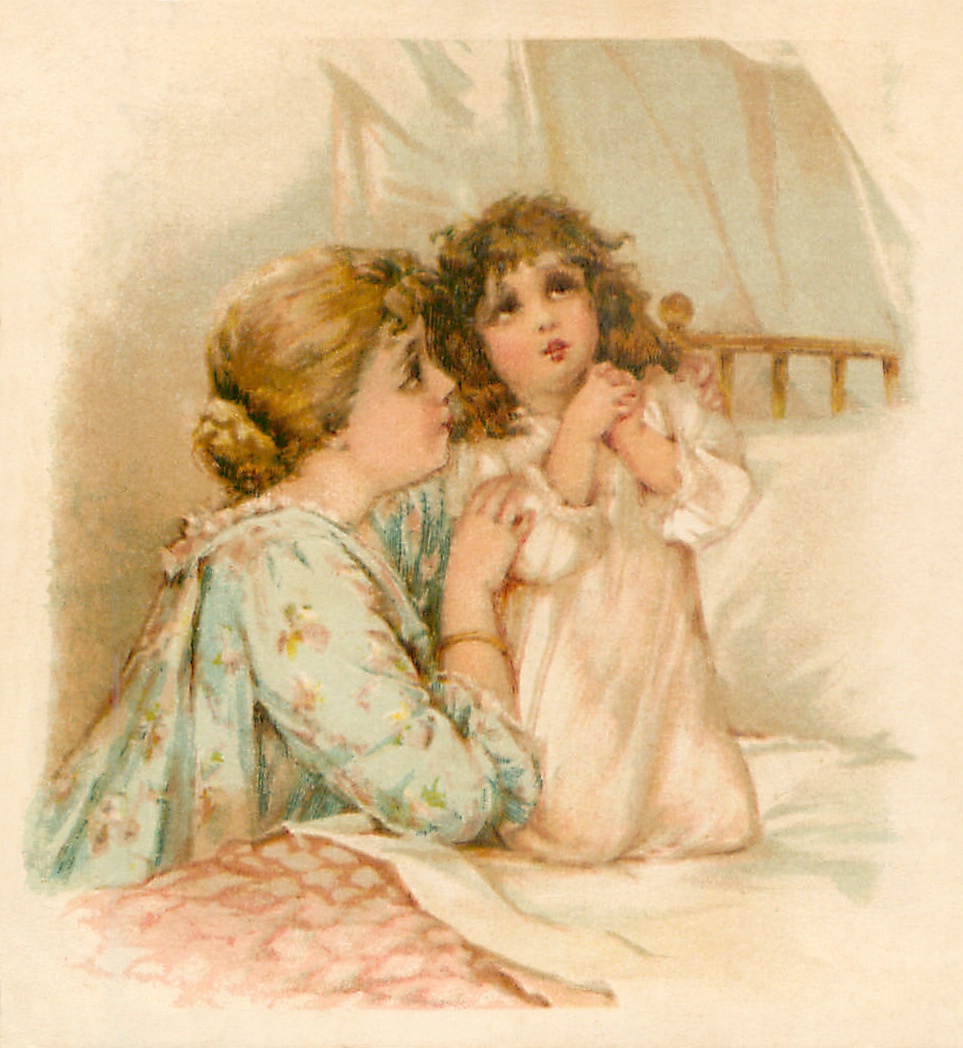
Isabella wrote that on one of Gracie’s naughty days, she had got into a great deal of mischief, even burning her finger after getting hold of a candle she knew she was not supposed to touch. Marcia bandaged the injured finger in cotton, while Gracie wailed and cried; then mother and aunt took Gracie upstairs to get her ready for bed. Here, in Isabella’s own words, is what happened when it was time for Gracie to say her nightly prayers:

Frances-Brundage_Mother-holding-baby-1901

“Well,” Gracie said, looking into her mother’s face, and speaking slowly and solemnly, “I’ve got a good deal to say tonight, haven’t I? Mamma, which do you think is the baddest thing that I did today?”

Frances-Brundage_Mother-and-child-1904

“I don’t think I can tell,” Marcia said, with a sober, troubled face; “and that isn’t the thing that you are to think about, anyway. It makes no difference which is the worst thing; everything that you knew was wrong to do has made Jesus feel badly, and you want to ask him to forgive you for them all; besides, you want to ask for a new heart, so that you will be willing to try not to be so naughty.”

Making a wreath for baby's hat

There was never a time in her little life that Gracie wasn’t ready for an argument. She tried to get one up now.

“But, mamma, if I could find out which was the very baddest thing that I did, I could make up my mind that I certainly true would never do that again, and then I would be sure not to be so bad next time. Don’t you see?”

The-knitting-lesson

I shall have to confess that I felt very much like laughing. She was such a little bit of a mouse, and she was trying so hard to be wise. But her poor troubled mamma did not smile.

“I see that you don’t know what you are talking about,” she said. “I can only hope that when you are older you will be a great deal wiser.”

Evening-prayer

This was certainly hard for a little girl who thought she made a very sensible remark. She gave a little bit of a sigh, and then knelt down beside her mamma. Very slowly and reverently she went through the prayer that I think every little girl in the world must know, “Now I lay me down to sleep.” After the “Amen” she always added a little prayer that she said came right out of her own heart; and tonight it was, “Dear Jesus, please bless Gracie; make my heart not feel so bad; make me feel just as though I was a very good girl, and take away my naughty sins and give me some good sins.”

Frances-Brundage-prayers-1902

That was really the most that Gracie knew about it. There seemed to be no use in trying to make her understand that everything that wasn’t right was wrong, and that God thought so.

Isabella wrote that Marcia was troubled that her daughter might actually believe there was such a thing as “good sins.” But in her heart, Isabella wasn’t worried. When she looked at Gracie, she saw independence, the ability to reason things out for herself, and a true knowledge of what was right and wrong. She had no fear for Gracie’s future. She knew that Gracie’s parents—and all of the members of their tight-knit family—would raise Grace to be a woman of faith who followed Christ in her everyday life.

dreamland

You can read more about Isabella and her niece, Grace Livingston Hill, in these posts:

Isabella’s Christmas Tradition

The Pansy Magazine

Too Much of a Good Thing

New Grace Livingston Hill Book

New Free Read by Grace Livingston Hill

.

.

.


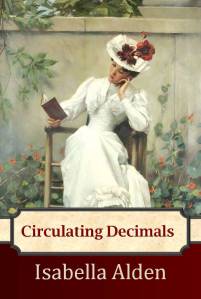
New Free Read: Circulating Decimals

cover_circulating-decimals-01

Circulating Decimals

The Sabbath-school library at the Penn Avenue Church is in shocking condition. Book covers torn, pages curled or scribbled on—and some of the books have just gone missing. With the library in disgraceful condition, is it any wonder boys and girls view the church library with contempt?

Soon the ladies of the congregation are busy working up lavish plans to replenish the library with suitable books, but will their plans succeed?

You can read Isabella’s charming story, Circulating Decimals, for free. Just click on the book cover to begin reading.


Too Much of a Good Thing, and a New Free Read

Isabella Alden was very close to her sister Marcia, who married the Reverend Charles Livingston. For many years Isabella’s and Marcia’s families lived together under the same roof.

Isabella Alden (left) and her sister, Marcia Livingston in an undated photo.

In the summer months the Aldens and the Livingstons traveled to Chautauqua, New York and shared a cottage on the grounds of the Chautauqua Institution.

In the winter they made the pilgrimage to Florida, where the two families lived in a large house in Winter Park.

The Alden house in Winter Park. From Winter Park Public Library archives.
The Alden house in Winter Park. (From Winter Park Public Library archives.)

Isabella’s son Raymond and Marcia’s daughter Grace attended Rollins College in Winter Park, and Grace went on to teach physical education classes there.

Grace Livingston Hill in her early twenties.

Before Grace took up her pen to write some of America’s most beloved novels under the name Grace Livingston Hill, she was one of the first teachers at Rollins College. She was also a true advocate for the “physical culture” movement that was sweeping the country at the time. She recognized the freedom it gave women to pursue physical health in a way they hadn’t been able to before. At Rollins she taught ladies’ classes in calisthenics, basketball, gymnastics, and fencing.

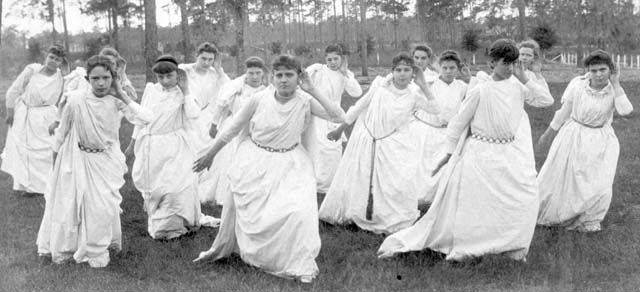
Grace Livingston (front and center) with her Greek Posture Class, about 1889.
Grace Livingston (front and center) with her Greek Posture Class, about 1889. (From Rollins College Archives.)

She also taught men’s classes in physical culture, such as fencing and Greek Posture:

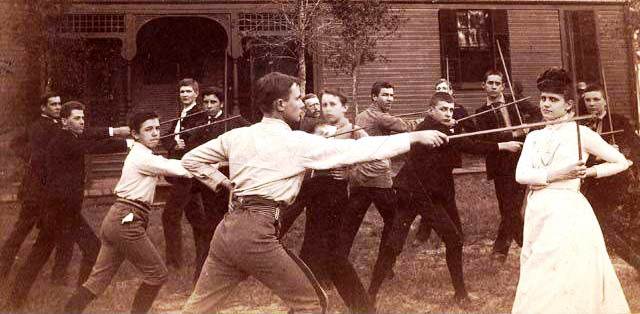
Grace teaching a fencing class in 1890. (From the Rollins College Archives.)


Men's Greek Posture Class, about 1890. From Rollins College Archives.
Men’s Greek Posture Class, about 1890. (From Rollins College Archives.)

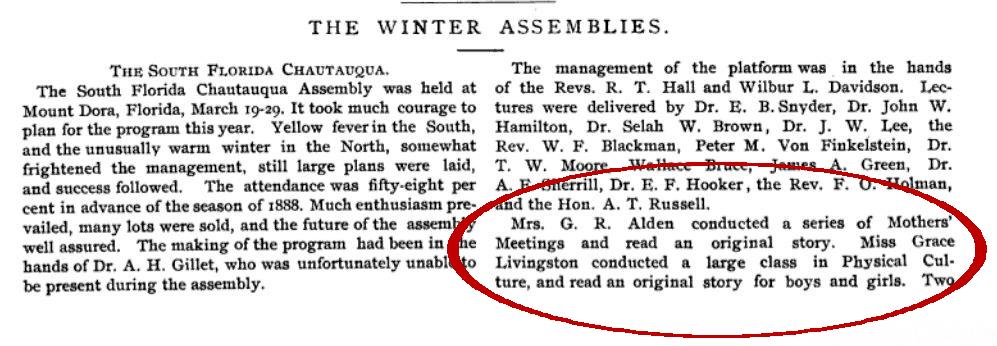
And when she wasn’t teaching at the college, she taught physical culture classes at the Florida Chautauqua.

An 1889 announcement from the Florida Chautauqua.

Like her niece, Isabella appreciated the physical culture movement. She even featured the craze in one of her short stories, “Agatha’s Uknown Way.”

Image of the cover for Agatha's Unknown Way

And she wrote “Too Much of a Good Thing,” a story about how one young girl got so caught up in the physical culture craze, that she made life difficult for her entire family. You can read “Too Much of a Good Thing” for free below.

Would you like to learn more about Grace Livingston’s teaching years at Rollins College? Click this link to read a fun story about one of her biggest challenges at the school, and how she convinced the faculty to see things her way.

You can read Isabella’s short story, “Agatha’s Unknown Way” for free. Just click this link.

You can also read a previous post about the birth of gymnastics at Chatuauqua Institution.

Enjoy Isabella’s story, “Too Much of a Good Thing”:


Too Much of a Good Thing

Downstairs everyone was busy. Uncle Morris and his entire family, just from Europe, were coming by an earlier train than it had been expected they could take, and many last preparations for making them comfortable had still to be attended to.

Mrs. Evans had been up since daylight, planning, directing, and helping to the utmost that her small strength would admit.

Indeed, her eldest daughter Laura had constantly to watch, to save her mother from lifting something heavy, or reaching for something high. Often her clear voice could be heard with a “Oh, mother, don’t! Please—I’ll take care of that.” And often the gentle answer was:

“Dear child, you cannot do everything, though your will is strong enough. Where is Millie?”

“Millie has gone to sweep and dust the hall room; you know we didn’t think we should need that, and I used it as a sort of store room; but since Arthur is coming with them, we shall have to get it ready; and he will need to go at once to his room, since he is an invalid, so I sent Millie to put it in order. I told her just what to do, and she will manage it nicely. She must be nearly through now, and I’ll have her finish dusting here, so I can help you with those books; they are too heavy for you to handle.”

No, Millie wasn’t nearly through. In fact, she could hardly have been said to have commenced. The truth is, she had been thrown off the track. It was an old print which fell out of an, unused portfolio that did it. The print showed the picture of a girl in fun Greek costume, and reminded Millie of what was not long out of her mind, that in the coming Physical Culture entertainment she was to chess in a costume which was supposed to be after the Greek order.

“Let me see,” she said, bending over the print, “this girl has short sleeves and low neck. Why, the dress is almost precisely like the one which Laura wears with her lace over-dress; I might wear that. It would be too long, of course, but it could be hemmed up. I am almost sure Laura would let me have it; and with her white sash ribbon tied around my waist it would be just lovely. Then that would save buying anything new, and save mother any trouble. I mean to go this minute and try on the dress, before I say anything about it.”

Away dashed the Greek maiden to one of the guest chambers which Laura had left in perfect order, dragged from a seldom used drawer the elegant white mull dress with its lace belongings, all of which saw the light only on state occasions, and rushed back to the hall room again, where she had left the print she was trying to copy. In her haste, she dragged out with the dress various articles of the toilet. Laura’s white kid gloves which she wore when she graduated, a quantity of laces, and a handkerchief or two, to say nothing of sprays of dried flowers. These she trailed over the carpet, seeing nothing of them. The important thing in life just now was to get herself into that dress.

It was accomplished at last, not without a tiny tear having been made in the delicate stuff, but which Millie’s fingers were too eager to notice. She tied the white sash high up about her waist, after the fashion of the picture, seized the dust brush in one hand as if it were a dumb bell, or an Indian club, and struck a graceful attitude with her arm on the corner of the mantel.

“There!” she said, “I would like to have my picture taken in this dress; I have a very nice position now for it. I wish the girls were here to see me. Laura must let me wear this; it fits exactly. I don’t believe it is much too long for a Greek maiden. I should like to wear my dresses long; it must be great fun. I wonder if we couldn’t have our pictures taken in costume? I think it would be real nice; and our folks would each want to buy one. Perhaps we could make some money.”

There were hurried steps in the hall, and the Greek maiden’s musings were cut short. Laura came forward rapidly, talking as she
came.

“Millie, aren’t you through here? You have had plenty of time, and mother needs your help right away. Hurry down just as quickly as you can; she is over-doing, and it is growing late; the carriage may come any minute now. Why, Millie Evans!”

She stopped in amazement, for the Greek maiden was still posing. She smiled graciously and said: “Don’t I look fine? I borrowed it a minute to see if it will do to wear to the entertainment. It is just the thing, isn’t it? You will lend it to me, won’t you? Just for one evening? I’ll be awfully careful of it.”

“And you have been to that drawer where all the nice things are packed, and dragged them out! There is one of my white gloves under your feet, and my only lace handkerchief keeping it company! I must say, Millie Evans, you deserve to be punished. Here we are trying our best to get ready for company, and keep mother from getting too tired, and you neglect your work to rig up like a circus girl; and go to a drawer which you have no right to open. I shall certainly tell father of this.”

The Greek maiden’s cheeks were in an unbecoming blaze. Laura was hurried and tired, and spoke with more severity than was her custom. It certainly was trying to find the room in disorder, and her best dress in danger.

“Take care,” she said, as Millie’s frantic efforts to get it off put it in greater danger. “Don’t quite ruin that dress. Indeed you shall not wear it. I am astonished at you for thinking of such a thing; when father hears what you have been doing, I doubt if you will need a dress for the entertainment.”

Then Millie lost all self control. “You are a hateful, selfish thing!” she burst forth. “Take your old dress; I don’t want to wear it; and I won’t be ordered about by you as though you were my grandmother. I’m nearly fourteen, and you have no right to manage me. I’ll just tell father myself that I—”

“What is all this?” Mr. Evans’ voice was sternness itself, and he looked at the girl with blazing cheeks, in a way that made her angry eyes droop.

“What does it mean, Millicent? I heard you using very unbecoming language to your sister, and to judge from your appearance you have been about some very inappropriate work.”

“Well, father, Laura burst in here and—”

“Never mind what Laura did, Millicent. Unfortunately for you, I know which daughter tries to care for and spare her sick mother in every possible way. I overheard enough to show me which one is to blame. Laura may tell me what is the trouble, and you may listen.”

But Laura was already sorry that she had spoken so sharply, and tried to soften the story as much as truth would permit.

“Her mind is so full of the Physical Culture entertainment, father, that she does not stop to think. I know she did not mean to hinder and make trouble.”

“I see,” said Mr. Evans, speaking grimly. “I have heard a good deal about this Physical Culture business. If everyone is as much carried out of common sense by it as our Millicent is, I should say it was high time to have some moral culture. Millicent, you may put yourself into a suitable dress for sweeping, and do the work you were sent to do, at once; and you will not need to think any more about a dress for the entertainment, for you are to be excused from attending it. You may tell your teacher that I said so.”

Poor Millie! The hall bedroom floor might almost have been washed, if that were desirable, with the tears she shed. No hope had she of any change of mind on her father’s part. He rarely interfered with his children, but when he did, his word was law.

And poor Laura! She went downstairs heavy-hearted and miserable. Why had Millie been so silly, and why had she allowed her vexation to make matters worse?

The poor frail mother actually cried when she heard of Millie’s disappointment. “Yet I really cannot ask her father not to notice it,” she said sorrowfully. “Millie has been so remiss in her duties for weeks, all on account of the hold which that Physical Culture craze has upon her. It is too much of a good thing. I am afraid her father is doing right.”

.

.

New Free Read: Her Mother’s Bible

Cover_Her Mothers Bible 05“Reading Bible verses doesn’t amount to much, you know, unless you do what they say.”

When Mrs. Selmser inherits her mother’s beloved Bible, she’s overjoyed. All the marked verses—in red and green and blue—are wonderful reminders to her of her mother’s Christian walk; so it seems natural to have her son Ralph read one of those marked verses each day as part of their family worship.

But Ralph knows enough about the Bible to realize it’s sometimes a hard book to live up to. With God’s help, can he learn to apply the teachings of the Bible to his everyday life?
This 1880 story was first published as  a serial in The Pansy magazine. Click on the cover to begin reading Her Mother’s Bible now.

.

.

New Free Read: The Exact Truth

Cover_The Exact TruthThe Bible is full of golden texts of inspiration and maxims of sound doctrine, but Zephene Hammond thinks they’re just words on a page. Although she considers herself a Christian, she doesn’t think those Bible verses have any real meaning in her life.

So when her Sunday school teacher challenges Zephene to look at the golden texts with fresh eyes, Zephene reluctantly takes up the challenge. Before long, Zeph sees that the Bible really can fit into her daily life and help her become a girl who always tells the exact truth.

This 1890 classic Christian novel was first published as  a serial in The Pansy magazine. Click on the cover to begin reading The Exact Truth now.

.

.


The Victorian Man Cave

In upper- and middle-class homes across America at the turn of the last century, the man of the house had one room that was his exclusive domain: The study.

Old photo of Ralph Waldo Emerson's study, Concord, Massachusetts
Old photo of Ralph Waldo Emerson’s study, Concord, Massachusetts

The study was a place where the man of the house took quiet refuge. In his study he took care of business matters, wrote letters, or read his newspaper or favorite book in solitude. In some of Isabella’s books, like Jessie Wells, the local minister locked himself away in his study to work on his sermon or write letters to the members of his church.

Another view of Emerson's study.
Another view of Emerson’s study.

In Isabella’s books, the rooms designated as studies had common characteristics: a bookcase filled with books, a desk or large study table, and sufficient light to read by once the sun went down. In her novel As in a Mirror Isabella Alden described John Stuart King’s study this way:

The walls were lined with many rows of well-filled shelves, and a searcher among them would hardly have failed of finding every choice book of the season, as well as the standard volumes of the past. A bookcase devoted to standard magazines was crowded almost to discomfort, and the large study table was strewn with the very latest in newspaper and magazine.

The president's study at a small training college
The president’s study at a small training college

Even little Daisy Bryant understood that the study was a special room in the house. The eight-year-old heroine of Miss Dee Dunmore Bryant lived with her mother and siblings in cramped quarters; but Daisy designated one small section of their main room to be their study:

The floor had a neat strip of rag carpeting over in the part which Daisy called “the study.” There was also a little square table over there, with the Bible on it, and Daisy’s geography, and Ben’s arithmetic, and a tiny basket that held Line’s crochet work. At first, Daisy had objected to the crochet work—that it did not belong to a study—but one evening, in the very middle of Miss Sutherland’s study table, what did she see but a fluffy ruffle with Miss Sutherland’s needle set in its hem, and her thimble lying beside it! Since that time the crochet basket had held peaceable possession.

In the story Miss Sutherland lived in the big house on the hill; and since Daisy’s mother often did sewing for Miss Sutherland, Daisy had seen the Sutherland’s study when she delivered completed work to her. Daisy dreamed of one day living in a home with a real study, just like the Sutherland’s had, with plenty of books, and with framed mottoes on the walls.

Undated photo of Henry Wadsworth Longfellow's study, Cambridge, Massachusetts
Undated photo of Henry Wadsworth Longfellow’s study, Cambridge, Massachusetts

There was a common understanding—sort of an unwritten rule—that no one but the man of the house was allowed in the study except by invitation. After Perry Harrison had an argument with his wife in From Different Standpoints, he retreated to his study, where he knew he would not be interrupted, and he could calm down after their angry exchange:

When Perry came back from the station, after seeing the party off, he shut himself up in the study, not seeing his wife until dinner-time. Then all traces of emotion had disappeared, and he was the affable gentleman exerting himself to be entertaining.

Retailer Jordan Marsh advertisement for a suite of home furniture appropriate for a study or library.

Because the study usually was the bastion of the man of the house, it was only natural that others did not find the place calming and comfortable. If a father had to scold a recalcitrant son or daughter, he called the child into his study. If a minister felt the need to counsel a wayward congregant, he did so in private in his study. Under those circumstances, the study became less like a quiet refuge and more like a place where wrong-doers were brought to account and punishments were doled out.

That thought was uppermost in the minds of Eurie, Marion, Ruth, and Flossie in The Chautauqua Girls at Home when they had to summon their courage to visit their minister, Dr. Dennis, in his study.

“Doesn’t it make your heart beat to think of going to him in his study, and having a private talk?”

“Dear me!” said Flossy. “I never shall think of such a thing. I couldn’t do it any more than I could fly.”

Early photo of the study at the Adams mansion in Quincy, Massachusetts.

Later, when Ruth went to speak with Dr. Dennis about finding work she could do for the church, she found herself alone with him in that dreaded room:

It was a place in which she felt as nearly embarrassed as she ever approached to that feeling. She had a specific purpose in calling, and words arranged wherewith to commence her topic; but they fled from her as if she had been a school girl instead of a finished young lady in society; and she answered the Doctor’s kind enquiries as to the health of her father and herself in an absent and constrained manner.

Charles Dickens' study, about 1922.
Charles Dickens’ study, about 1922.

But in one of Isabella’s books, the tables were turned on the man of house. In The Hall in the Grove, Dr. Monteith—the driving force behind the town’s Chautauqua Literary and Scientific Circle—was in his study when Paul Adams complained to him that the Circle put more emphasis on studying books about ancient Rome than on studying the Bible. Dr. Monteith was shocked.

Seated in the beautiful little study, by the green-covered table, under the shaded light, the Doctor looked full into the earnest troubled face of his visitor. “Now, my friend, do I understand you to mean that the experiences which you have had with the Circle led you to think that we gave the most important place to other books, and shoved the Bible out?”

You would have been sorry for Dr. Monteith, could you have seen his distressed face. He arose and began to walk back and forth in the little study, pondering how he could best undo what his heart told him had been grave mischief.

Dr. Monteith knew that the Bible was “first, best, purest, highest; incomparably above any and all other books.” He had to do some quick soul searching to figure out how he had misled Paul Adams—as well as an entire Chautauqua Literary and Scientific Circle—so far away from the foundation of all knowledge, the Bible.

Once Dr. Monteith realized his error, the atmosphere in his study changed dramatically. He apologized to Paul Adams and assured him that reading and knowing about the Bible was not the same as reading and knowing the Bible. And before Paul left his study, Dr. Monteith led the young man to make a momentous decision concerning his future and his soul.

So the study was sometimes an important setting in Isabella’s books, as well as in her short stories. In 1888 Isabella published “Papa’s Study”, and you can read it here for free:


PAPA’S STUDY

It was a very beautiful room, so crowded with books, and papers, and conveniences of all sorts, that you would have supposed its owner could have nothing to wish for, and must be a happy man. Yet on the morning about which I am telling you, he did not look in the least happy; on the contrary, if you had counted the wrinkles between his hair and his eyes, and could have seen the puckers around his lips, which were hidden by a heavy moustache, you would perhaps have called him cross; and you would not have been very far from the truth. Something had happened that morning which made him feel like being cross with everybody.

“To think that I should have forgotten it!” he was saying to his wife, speaking in an injured tone, as though somebody was certainly to blame. “I would not have had it happen for ten, no, not for fifty dollars; and there he was, I suppose, at the depot, looking in all directions for me, and the train waited here fully twenty minutes for the down express. We might have had time enough to settle the whole business. It is too provoking to endure.”

Nevertheless, he knew it would have to be endured, for the train had been gone at least an hour.

“Why didn’t you make a memorandum of it?” his wife asked, taking fine stitches in the ruffle she was making, and speaking in that calm , even tone which is sometimes really irritating to excited people.

“Why, I did, of course; and this morning I looked for my diary to see if there was anything which needed attention before mail time, but I had changed my coat and left it in the the other pocket. A diary is simply a nuisance, anyway; it is always in some other pocket when one wants it the most. I’d like to know how a busy man like myself, who has three ways to go at once, can be expected to remember everything.”

Nobody had told him that he was expected to do any such thing, but he spoke as sharply as though someone had, and walked the floor, and looked wrathful.

Poor man! He had been sadly disappointed. Besides missing a very important bit of business by his forgetfulness, he had missed the sight of a friend whom he very much wanted to see.

Now, his little daughter Almina was in the library annex, hidden from view by heavy curtains, but within distinct hearing; and if you could have seen her I am afraid you would have thought she acted very strangely. Instead of looking thoughtful and sympathetic over her father’s troubles she clasped her two pretty hands together and indulged in a series of happy little giggles. You see, she knew something which her father did not.

In order to have you understand, I shall have to go back a few days. The father’s birthday was coming, and Almina knew it; I am not at all sure that the father did, for he was so busy a man that he forgot even that. And Almina had, with her own hand, written, and, what was much harder, addressed a letter all herself, to a certain “Mr. Frank Smith, Toledo, Iowa.” Truth compels me to state that she spoiled three envelopes before accomplishing it to her satisfaction. In the first one she made the letter F look so much like a T that it read like Mr. Trunk Smith, and she felt sure that would not do; and then, because she had visited once in Toledo, Ohio, and heard about it all her life, and had never heard of Toledo, Iowa, what did she do but write it out nicely on the second envelope—Toledo, Ohio. Of course that wouldn’t do. By this time she was nervous, and blotted the third one badly, but at last it was well done, and the letter was sent.

On the very morning of which I write, there had come an answer to her letter, in the shape of a lovely business-like looking package, done up in heavy paper, and packed in burlap and excelsior, and when her eager fingers reached the treasure thus carefully guarded, it was the prettiest walnut affair, with a lock and key, and inside, a row of compartments bearing the names of the months and the dates; and so arranged that memoranda of what ought to be done, even weeks ahead, could be slipped in, and would remain out of sight until the morning of the day when they were needed, when they would drop into view, and beg to be looked at.

“If papa had only had his lovely little Office Tickler,” she said to herself, as she giggled musically, “he wouldn’t have missed seeing Mr. Felt this morning, I mean to tell him that if he had been forty-three last week, instead of tomorrow, it would have been all right. Oh! I do wonder if there is something he ought to remember tomorrow, and might forget. I mean to ask mamma.”
So the moment she could get a private audience with mamma, they two put their heads together over the fat old diary, whose sides were bursting with important papers too heavy for it to carry. They looked carefully down the page for April 11th, papa’s birthday, but it seemed to be an unusually quiet one. However; the next day made up for it; item after item of business crowded itself in to receive attention; foremost was this:

“MEM. Be sure to remember to send Seward’s note to the bank before three o’clock. It is in the left-hand drawer of the lower secretary.”

“Oh! look,” said Almina, “that is very important, isn’t it? Because papa has underlined it; and yet it is hidden in between so many other things to do, he will be quite likely to forget it. Oh, mamma! Couldn’t you get it for me to put in the Office Tickler?”

Mamma promised to try, and she tried, and accomplished it. There was great fun in the pretty library the next morning. Papa admired the beautiful walnut box to even Almina’s satisfaction, and assured her that it was the most ingenious little creature he had seen in many a day, and he was sure it would save him much time and patience. And then he heard all about how she earned the money to buy it, and “wrote the letter her own self,” and “had it come by express to her own address;” and he called her a dear little woman of business, and kissed her as many times as he was years old.

And all the time the important paper which was to be remembered the next morning without fail, was hiding behind its partition, biding its time.

The next morning Almina had forgotten all about it, but at eleven o’clock her father came hurriedly into the music-room where she was practising, and stooped down and kissed her.

“Papa ought to be tickled now in good earnest,” he said with a curious mixture of fun and earnestness in his voice. “What will my little girl think when I tell her that her Office Tickler has saved me at least five hundred dollars? I did forget all about the note, important as it was. This is a very busy, anxious day with me; but just as I was hurrying to go to the bank, I caught sight of my new possession, and saw I had not changed the date; I had not begun to use it yet, but I determined to gratify you by leaving it in order; and the moment I touched the card, out dropped that very forgotten note. I’m in great haste, little daughter, but I felt as though I must stop and tell you what a valuable selection you had made for my birthday present.”

A very happy little girl was Almina, then.

Ad for Office Tickler
An actual 1887 newspaper advertisement for F. E. Smith’s Office Tickler.

.

.