 When Claire Benedict sprains her ankle while walking in the snow in Interrupted, she is immediately rescued by handsome, wealthy Louis Ansted. He scoops her up in his arms and carries her to the nearby Ansted mansion, where the family takes her in and befriends her while her injury heals. Claire takes advantage of her sojourn in the Ansted home to encourage the family to attend the village church and get involved in the community.
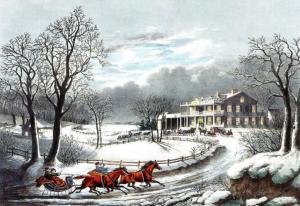
While most of the Ansted family politely tolerates Claire’s penchant for charitable works, Louis is intrigued; and when her ankle has healed, he personally assists her into the sleigh to be taken home … and asks permission to call on her in a few days’ time.

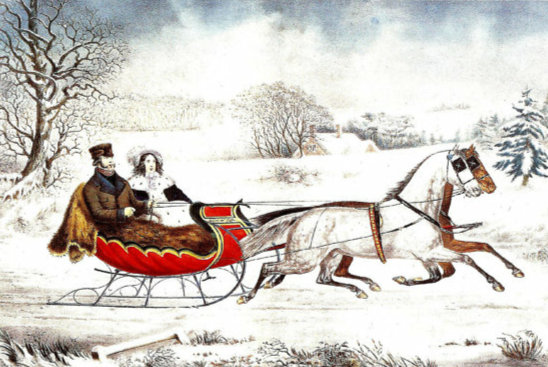
Later in the book, after Claire and the Ansteds finish a day of work at the village church, they prepare to leave amid a snow storm. Louis asks Claire if he can drive her home in his sleigh … an invitation she declines because she has already arranged for another young man to walk her home:
“Bud,” she said, “are you going to see me home through this snow-storm? Or must you make haste up the hill?”
It gave her a feeling of pain to see the sudden blaze of light on his dark, swarthy face. What a neglected, friendless life he must have led, that a kind word or two could have such power over him!
“Me!” he said. “Do you mean it? I’d like to carry your books and things, and I could take the broom and sweep along before you. Might I go? Oh, I haven’t got to hurry. My work is all done.”
She laughed lightly. What a picture it would be for Dora, could she see her plunging through the freshly-fallen snow, Bud at her side, or a step ahead, with a broom!
“I don’t need the broom,” she said. “It has not snowed enough for that; and I am prepared, if it has. See my boots? I like the snow. You may carry my books, please, and we will have a nice walk and talk. The girls are all ready now, I think. You put out the lamps, and I will wait for you at the door.”
Out in the beautiful, snowy world, just as Bud’s key clicked in the lock, Louis Ansted came up to Claire.
“Miss Benedict, let me take you home in the sleigh. I am sorry to have kept you waiting a moment; but my blundering driver had something wrong about the harness, and the horses were fractious. They are composed enough now, and Alice is in the sleigh. Let me assist you out to it, please.”
If it had been moonlight, he might have seen the mischievous sparkle in Claire’s eyes. It was so amusing to be engaged to Bud, while his master held out his hands for her books, as a matter of course, and poor Bud stood aside, desolate and miserable. Evidently he expected nothing else but to be left.
Claire’s voice rang out clear, purposely to reach Bud’s ear:
“Oh, no, thank you, Mr. Ansted! I am fond of walking. I don’t mind the snow in the least, and I have promised myself the pleasure of a walk through it with Bud. Thank you!” as he still urged. “My ankle is quite well again, and I have had no exercise today; I really want the walk. We thank you very much for your help this evening, Mr. Ansted. Good-night! Are you ready, Bud?”
And they trudged away, leaving the discomfited gentleman standing beside his pawing horses.

The next day, Claire stands at the window of her room at the Academy and “watched the sleighs fly past,” wondering if she had missed an opportunity to witness to Louis the night before.
Throughout the story, Claire looks for opportunities to make a difference in her community and in the lives of the people she meets. 
For Claire, even a simple sleigh ride is a chance to encourage a soul for Christ or engage a new worker in the Master’s service.















 I know I love the Lord, and I know that He will not destroy me, for I have in my heart the assurance of His promise.


 Isabella Alden