Blog

“She’s a Beauty”

In Miss Dee Dunmore Bryant, Ben Bryant’s life was changed when he met Miss Webster and she, in turn, introduced him to her neighbor, Mr. Reynolds. It was due to Mr. Reynolds that Ben got his first glimpse at what he called a “writing machine.”

Remington No. 5 Model 1886.

What Ben actually saw was a typewriter, probably a machine like the Remington 1886 model here (click on the images to see a larger version). Like most machines of the time, the keys struck upward against the paper. The machine also had four rows of keys: two rows of upper case letters and two rows of lower case letters.

Mr. Reynolds happily showed him how it worked.

 “She’s a beauty,” Mr. Reynolds said, seating himself before her, “a regular beauty. I’ve never worked one who behaved quite so well; some of them get rather confused in their minds after being knocked about on the railroad for a few weeks, especially if they are not carefully packed; but this one is as clear-headed as she was the day we left home. Did you ever see one work, young man? Then we’ll start her off.”

Bar-Lock No. 4

 Mr. Reynolds spoke of the little creature as though she were alive, and really it almost seemed to Ben that she was. He bent over her with parted lips and quick breathing, amazed beyond measure, when after the lapse of a few seconds the performer lifted the roller, and revealed in neat print the words:

 “John quickly extemporized five tow bags.”

Mr. Reynolds had to lift the roller to show Ben what he had typed. Early typewriters required “blind typing” because the roller and mechanics of the machine blocked the typist from seeing the page as it was typed. By necessity, accurate typing was a treasured skill.

An ad for the Underwood Typewriter Company, featuring their innovative design that allowed typists to see printed words as they were typed.


Ben’s intelligent and perceptive questions prompted Mr. Reynolds to let Ben try the typewriter himself.

“I don’t understand,” he said. “Where is the ink?”

“Not a bit of ink about it,” Mr. Reynolds declared, enjoying the puzzled face.

“Then it isn’t a self-inker? But it prints with ink! Is that a ribbon running through there? Why, it rolls itself up on those wheels, and the ribbon is inked, or colored, or something; I begin to understand. But where are the type?”

Mr. Reynolds silently lifted the roller, then the ribbon, and pointed to the type with his finger, at the same time going through a pantomime which told Miss Webster that he considered the boy’s intelligence and curiosity worthy of response.

The Crandall Universal No. 3 was one of the first typewriters to feature a QWERTY keyboard.

Before long, Mr. Reynolds invited Ben to sit down and type out his mother’s name. Ben did just that, and took to the machine so quickly, Mr. Reynolds offered to teach him how to use the typewriter in exchange for helping him with his work. Ben jumped at the chance.

Ben learned to use the typewriter by fashioning a template of the keyboard, which he used to practice typing at home. He told his friend, Rufus all about the experience:

“I wrote mother’s name. I’m going to learn to write on it; that is, if I can spare the time; he offered me the chance. He wants some work done, and he says if I will give him two evenings, part of the time, I can write on the machine the other part and learn how. Isn’t that a good chance?”

“Humph!” said Rufus. “A dirt cheap way of getting a fellow to work for you, I should say. Of what earthly use does he suppose it will be for you to learn to write on that machine? In two months at the latest he will take it away, and you’ll never see another, and what good will your knowledge do you?”

“How do you know I’ll never see another? Perhaps I’ll have one of my own, some day.”

“Oh, well! Perhaps I’ll have a balloon and take a ride in it to the moon some day, but I don’t believe I will.”

“I don’t either,” said Ben, with a good-natured laugh, “because you wouldn’t know how to manage one; if you ever had a chance to learn, you would say ‘What’s the use?’ and let it slip.”

“I know the difference between chances and shams, I hope,” Rufus said sharply. “I call this a sham—to get a fellow to work for nothing. He offered it to me, and I let him know what I thought about it—at least I hope he understood.”

“I think he did,” Ben said significantly. “Good-night, old fellow! I’m at home, and, as the man in the paper said, ‘I wish you were.’ Just because you hate to walk alone so badly, you know, and have been walking out of your way to keep me company.” And Ben went in at the kitchen door, confirmed in his resolve to learn to run the writing machine, if possible.
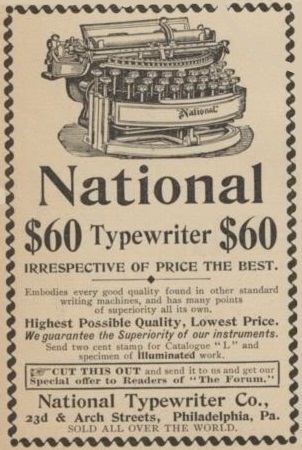
1899 Advertisement


When Miss Dee Dunmore Bryant was published in 1890, typewriters were in use in many offices, but at $95 to $100, their cost prohibited most individuals and many small businesses from owning a one.

A few years later, the cost had dropped to more affordable levels, fueling Ben’s ambition to someday own his own typewriter, and use it to make his living.
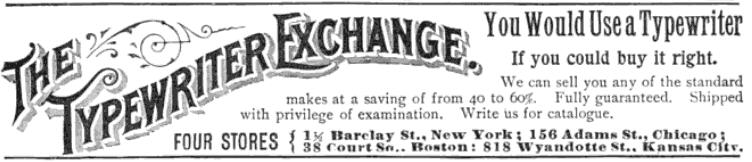
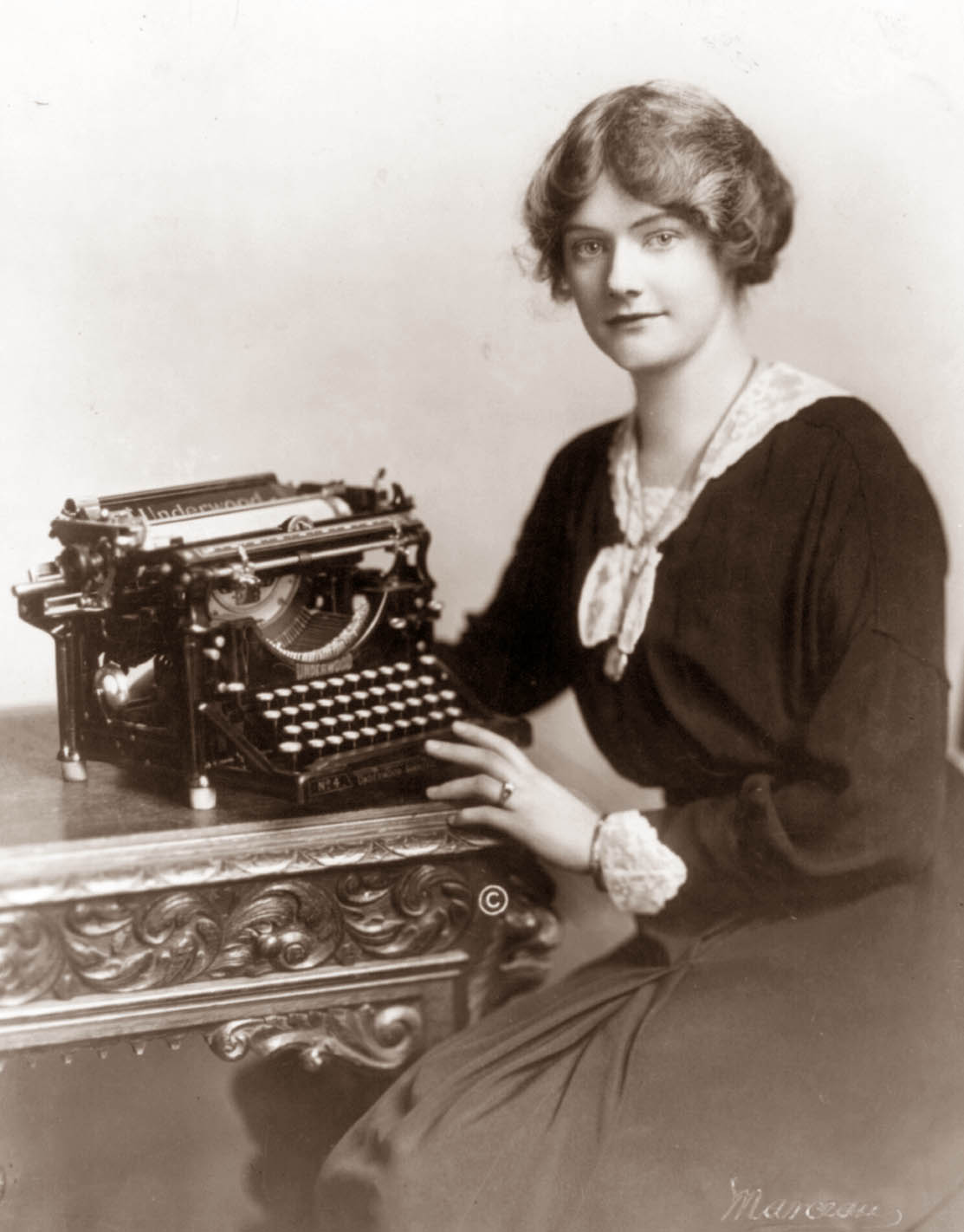
Typewriter ad 1896

Advertising Card for Underwood Typewriters


Light the Lucifer

Cook

In Household Puzzles, practical Maria Randolph took on the responsibility of cooking the family’s meals.

.

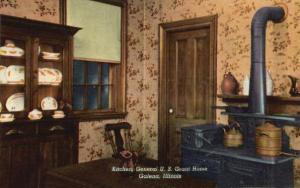
Her kitchen in 1874 might very well have looked like the kitchen in the photograph below of the Ulysses S. Grant home in Galena, IL.

U S Grant Kitchen 1865

The iron cook stove in the picture was typical for 1865 (nine years before Household Puzzles was published) but its fittings, including the warming oven and iron kettles, were built to last and would have remained in operation for decades.

Lucifer Matches 2

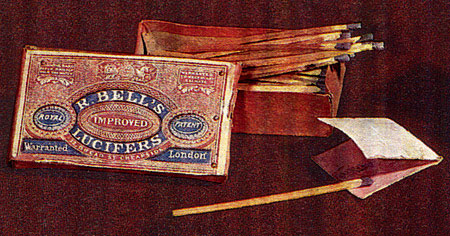
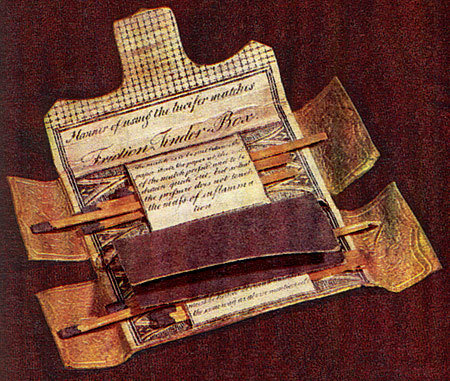
Stoves of the period were fueled by wood or coal. To light the fuel, cooks like Maria used friction matches, commonly called lucifers. Originally, Lucifer matches were developed by a man named Samuel Jones in 1830. Like many other match manufacturers, Mr. Jones made his Lucifers with sulphur tips which were then dipped in phosphorus; but Mr. Jones’s real claim to fame was his packaging. He was the first to sell his matches in small, rectangular cardboard boxes along with sandpaper on which to strike the match. The box even included instructions (in case there was any doubt) on how to light a match.

Lucifer Matches

The packaging proved so popular, “lucifer” soon became a generic name for matches.

In addition to instructions, the lucifer box also included a warning:

“If possible, avoid inhaling gas that escapes from the combustion of the black composition. Persons whose lungs are delicate should by no means use the lucifers.”

In fact, the phosphorus tips not only gave off fumes, they were deadly if swallowed. Ingesting match heads was a common method of committing suicide and small children were often accidentally poisoned by swallowing match heads.

 Household Puzzles describes how Maria fumbled for the match-safe on the kitchen table and muttered “as the vile fumes of the lucifer curled into her nose.”

Maria was a smart housekeeper to hold her matches in a match safe. Because lucifers were highly combustible, they were kept in match safes made of metal. These examples of match-safes hung on the wall and kept lucifers dry, safe, and out of reach of children’s fingers.

Match Safe 2    Match Safe 1860

New Free Read Available

Cover_Spun from Fact resizedIn 1886 Isabella Alden published Spun from Fact. The book is a fictional tribute to a young woman Isabella admired for her unwavering faith and courage during times of trial.

Spun from Fact is an inspiring story, unlike any other Isabella Alden novel.

Click on the book cover to begin reading Spun from Fact. Enjoy!

Taking the Pledge

Cover_Interrupted resized

Claire Benedict, the main character in Interrupted, is a woman who is dedicated to making a difference in people’s lives. She regularly prays for friends and acquaintances; and when she meets someone new, she immediately begins looking for opportunities to help that person.

That’s certainly the case with Harry Matthews. As soon as Claire meets him, she realizes Harry may have a problem with alcohol.

Alcohol drunk men

Later in the book, Harry finds himself indebted to Claire and tells her that if he can ever do anything for her, she has only to ask and it will be done.

.

There was a flush on Claire’s cheeks as she replied, holding forward a little book at the same time.

She could think of scarcely anything else, so easily done, that would give her greater pleasure than to have him write his name on her pledge book; she had an ambition to fill every blank. There was room for five hundred signers, and she and her sister at home were trying to see which could get their pledge-book filled first. Would he give her his name?

And so, to his amazement and dismay, was Harry Matthews brought face to face with a total abstinence pledge. What an apparently simple request to make! How almost impossible it seemed to him to comply with it!

He made no attempt to take the little book, but stood in embarrassment before it.

Page from Pledge Book 2
Click on the image to enlarge

“Isn’t there anything else?” he said, at last, trying to laugh. “I hadn’t an idea that you would ask anything of this sort. I can’t sign it, Miss Benedict; I can’t really, though I would like to please you.”

“What is in the way, Mr. Matthews? Have you promised your mother not to sign it?”

The flush on his cheek mounted to his forehead, but still he tried to laugh and speak gaily.

“Hardly! My mother’s petitions do not lie in that direction. But I really am principled against signing pledges. I don’t believe in a fellow making a coward of himself and hanging his manhood on a piece of paper.”

This was foolish. Would it do to let the young fellow know that she knew it was?

“Then you do not believe in bonds, or mortgages, or receipts, or promises to pay, of any sort—not even bank-notes!”

He laughed again.

“That is business,” he said.

“Well,” briskly, “this is business. I will be very business-like. What do you want me to do, give you a receipt? Come, I want your name to help fill my book, and I am making as earnest a business as I know how, of securing names.”

“Miss Benedict, I am not in the least afraid of becoming a drunkard.”

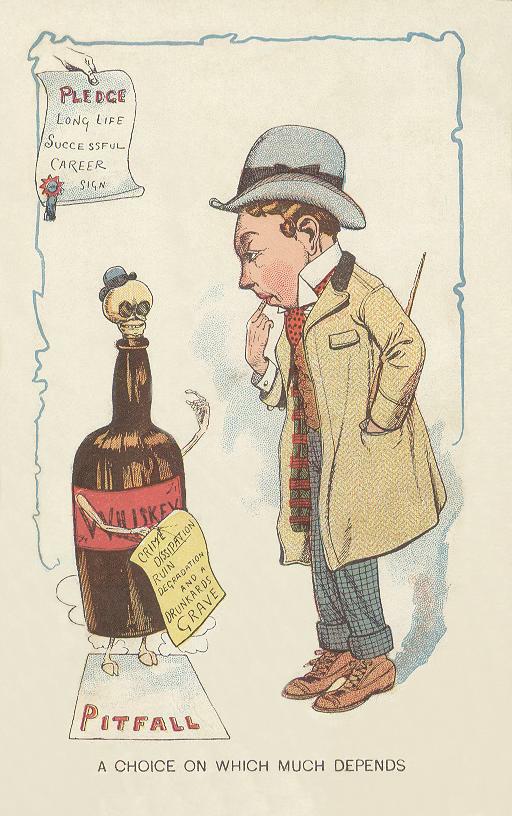
Alcohol Choice

“Mr. Matthews, that has nothing whatever to do with the business in hand. What I want is your name on my total abstinence pledge. If you do not intend to be a drinker, you can certainly have no objection to gratifying me in this way.”

“Ah, but I have! The promise trammels me unnecessarily and foolishly. I am often thrown among people with whom it is pleasant to take a sip of wine, and it does no harm to anybody.”

“How can you be sure of that? There are drunkards in the world, Mr. Matthews; is it your belief that they started out with the deliberate intention of becoming such, or even with the fear that they might? Or were they led along step by step?”

“Oh, I know all that; but I assure you I am very careful with whom I drink liquor. There are people who seem unable to take a very little habitually; they must either let it alone, or drink to excess. Such people ought to let it alone, and to sign a pledge to do so. I never drink with any such; and I never drink, anyway, save with men much older than I, who ought to set me the example instead of looking to me, and who are either masters of themselves, or too far gone to be influenced by anything that I might do.”

Was there ever such idiotic reasoning!

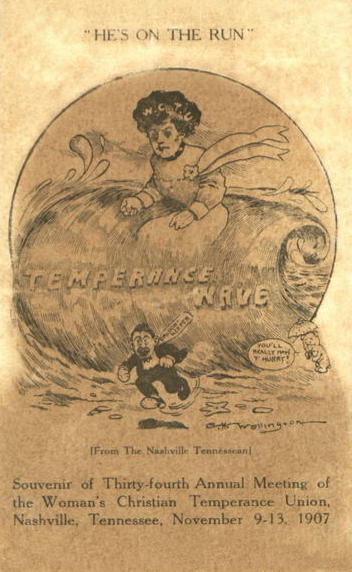
WCTU 1907

When Isabella Alden wrote Interrupted in 1885, there was a strong temperance movement sweeping across America. Driving that wave was the Women’s Christian Temperance Union (WCTU), which worked tirelessly toward the elimination of alcohol “with a mother’s love.”

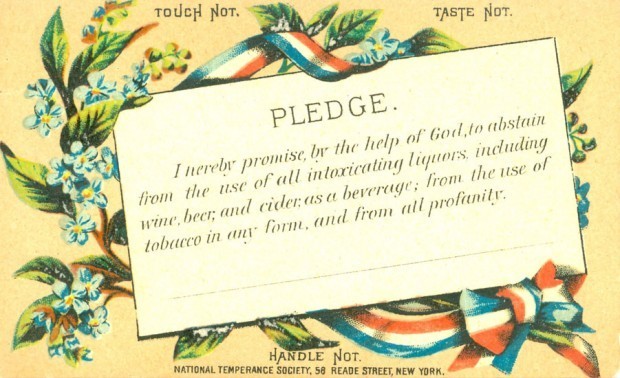
The WCTU and other Christian temperance organizations used temperance pledges as a device to secure individuals’ promises to abstain from the consumption of alcohol.

.

.

Alchol Temperance Pledge Card
Click on the card to enlarge

The WCTU and organizations like them distributed pledge books and pledge cards liberally. Click on each of the pledge cards to see a larger image.

Alcohol WCTU pledge card 1917    Alcohol WCTU pledge card

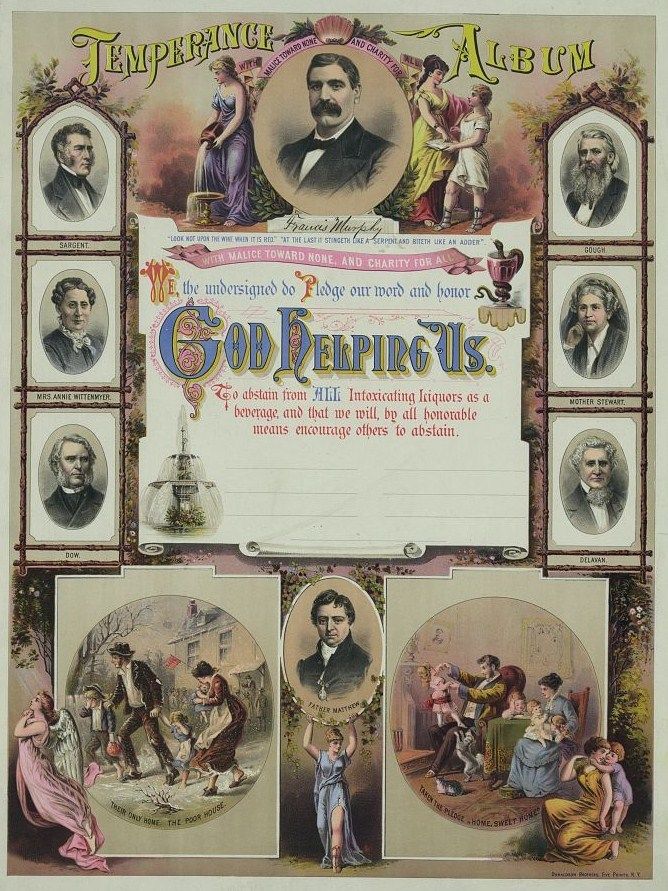
Alcohol WCTU& pledge card 1887    Pledge Album

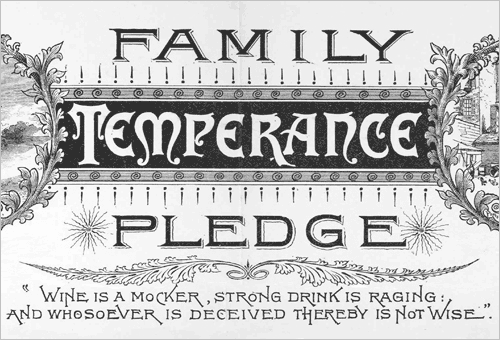
Family pledge documents were also distributed so entire families could take the pledge together, with family members often serving as witnesses to each others’ signatures.

Alcohol Temperance Pledge

Once signed, the pledges were often kept in family Bibles at a time in America when the family Bible was the most important possession in the home.

Family Pledge
Click on the image to enlarge

The temperance pledge was an effective tool for the WCTU because it tied abstinence to virtue, morality, and, most importantly, a pledge before God.

The Browns at Mount Hermon

Cover_The Browns at Mount Hermon resizedThe Browns at Mount Hermon is now available for Kindle and Nook!

Mary Brown may have fortune and beauty, but she’s the loneliest heiress in town. She longs for a family and close friends, but she has only her bank account to keep her company. Then she receives an unexpected invitation to spend the summer at Mount Hermon, a Christian camp in California. It doesn’t take long for Mary Brown, the heiress, to realize the misdirected invitation is actually meant for a different Mary Brown—but that doesn’t stop Mary’s imagination from running wild.

Before she can change her mind, Mary is on her way to California, determined to spend her summer living in a tent at Mount Hermon … even if it means she must pretend to be the “other” Mary Brown. It’s a radical change for Mary, and she enjoys every minute of her new life. But is a summer at Mount Hermon the only change Mary needs, or will her soul be made new, as well?

Click on the cover to read sample chapters and find out more about The Browns at Mount Hermon.