
Happy birthday, America!

Happy birthday, America!


In the early days of Chautauqua, there were no hotels or boarding houses where visitors could stay. Instead, visitors rented tents or small cottages erected on the grounds. Some cottagers with room to spare rented out rooms to paying guests, but Chautauqua rules prohibited anyone from providing meals for pay.
If you were not lucky enough to have a kitchen of your own in which to prepare your meals, you had to eat in the dining-hall, which was a long, open-air building furnished with rough, unpainted tables and benches.
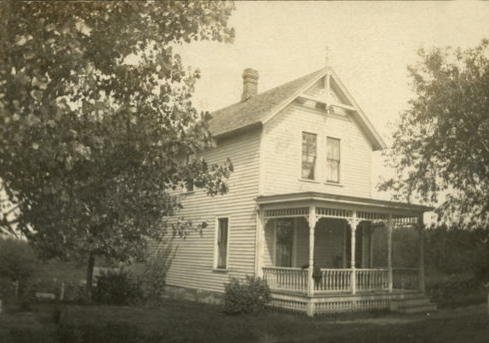
Visitors often complained that the roof leaked and the backless benches were uncomfortable, but the dining hall was the only place visitors could have meals unless they prepared food themselves.
In Four Girls at Chautauqua, Isabella Alden used the no-board-for-profit rule to show the difference in personalities between practical Marion and wealthy Ruth as they ate in the dining hall:
It was a merry dinner, after all, eaten with steel forks and without napkins, and with plated spoons—if you were so fortunate as to secure one. The rush of people was very great, and, with their inconvenient accommodations, the process of serving was slow.
Marion, her eyes being opened, went to studying the people about her. She found that courteous good-humor was the rule, and selfishness and ungraciousness the exception. Inconveniences were put up with and merrily laughed over by people who, from their dress and manners, could be accustomed to only the best.
Ruth did not recover her equanimity. She was rasped on every side. Those two-tined steel forks were a positive sting to her. She shuddered as the steel touched her lips. She had no spoon at all, and she looked on in utter disgust while Eurie merrily stirred her tea with her fork. When the waiter came at last, with hearty apologies for keeping them waiting for their spoons, and the old gentleman said cordially, “All in good time. We shall not starve even if we get no spoons,” she curled her lip disdainfully, and murmured that she had always been accustomed to the conveniences of life, and found it somewhat difficult to do without them.
In 1876, the meal restriction was removed and anyone could provide rooms and meals for a fee, as long as a specified percentage of the amount charged was given to the Institution. Within a year, boarding houses had sprung up as if by magic, while a vast number of individual cottages sported signs offering “Rooms and Board.”

In Four Mothers at Chautauqua, Mrs. Bradford and her daughters rented a cottage for the summer, despite the fact they could ill afford it. Mrs. Bradford was always on the look-out for ways to economize and found one way to make her pennies go further at Chautauqua:
.
Before Mrs. Bradford’s table economies reached what Josephine called the “starvation point” a method of relief was discovered. It was learned that among the numerous boarding houses scattered over the grounds, certain of them furnished fairly good meals for twenty-five cents. They were named lunches, to be sure, but on occasion they would serve excellently well for dinners. Pencil and paper together with a vigorous exercise of Josephine’s computation powers proved that seventy-five cents would afford three of them better dinners than that sum would produce in the kitchenette.

The Longfellow Cottage was a large boarding house. Centrally located on Roberts Avenue, it was only one block away from The Amphitheatre, the C.L.S.C. Building, the Children’s Temple,the Administration Building, The Colonnade and the Post Office (which will be featured in the next leg of our tour).
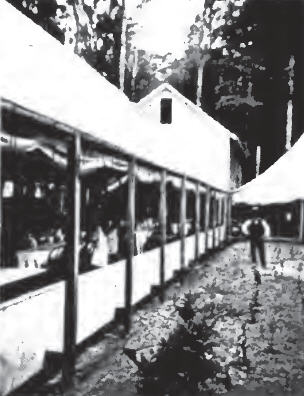
The Palace Hotel was the first hotel on the Chautauqua grounds, but it was far from luxurious. It was little more than a three-story, wood-framed tent, with canvas partitions to divide the guest “rooms.”

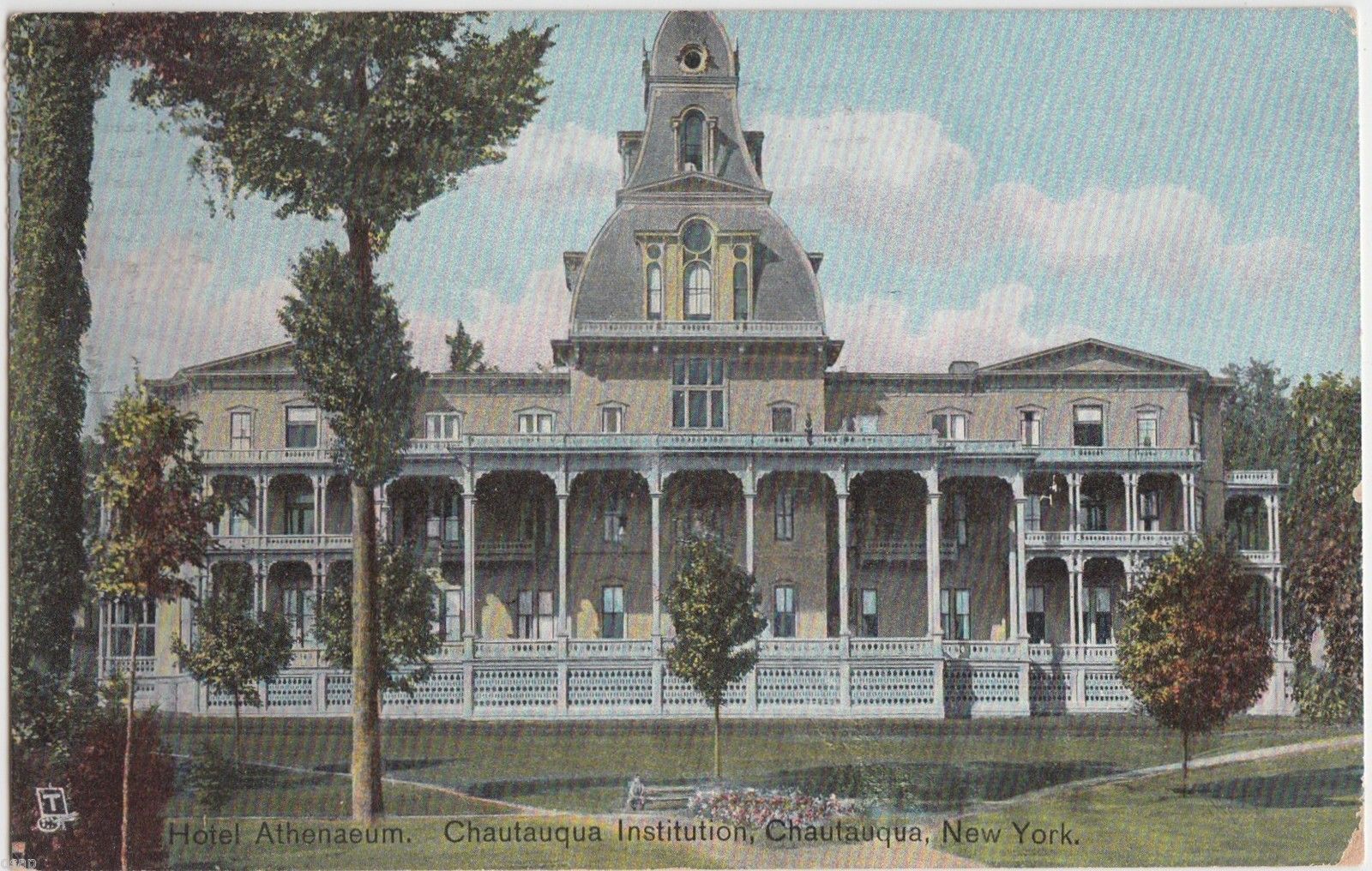
In 1881 the Palace Hotel was replaced by The Athenaeum, a proper hotel that featured elegant accommodations and beautiful views of the lake.

As the Athenaeum attracted more guests, the cottages and boarding houses grew in number, size and comfort in order to compete for their share of paying boarders.
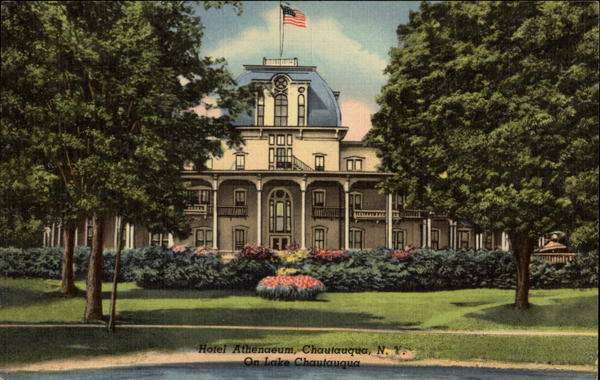
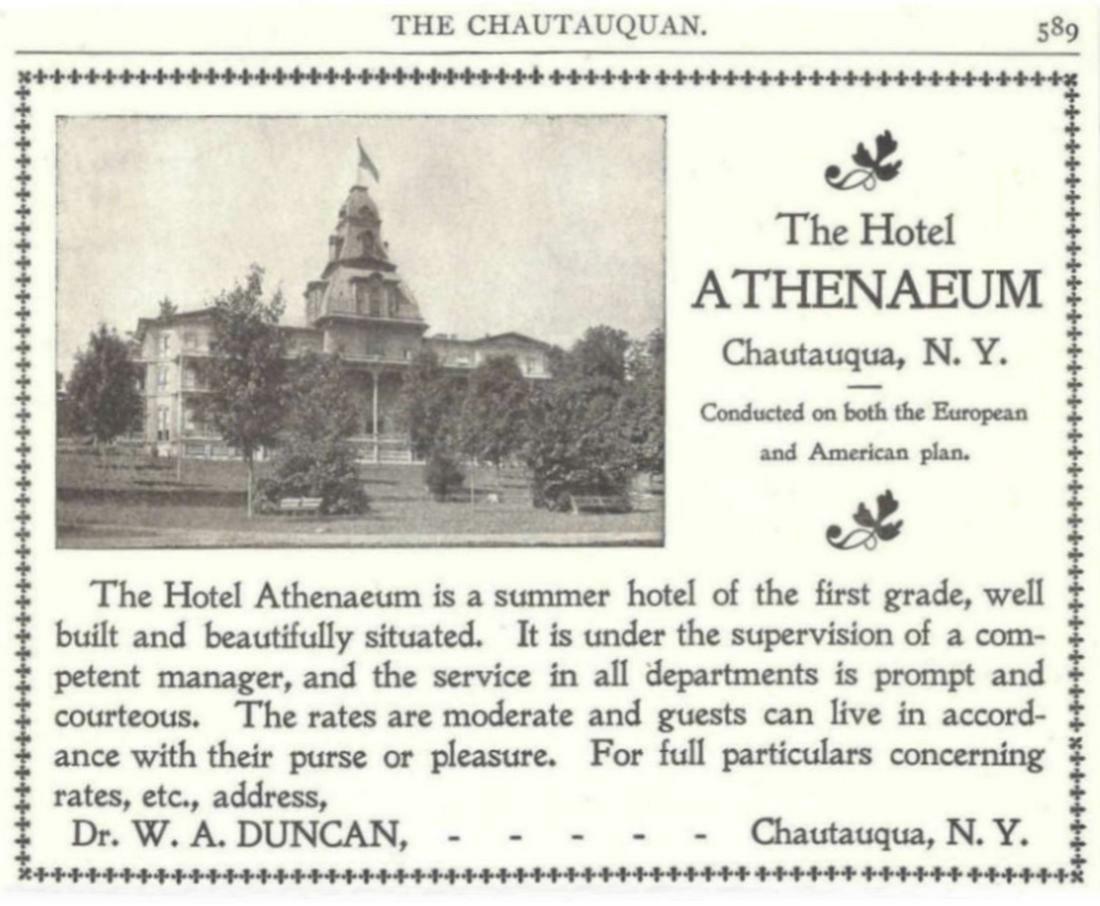
When the Four Mothers returned to Chautauqua with their children and grandchildren, they stayed at a hotel that sounded very much like The Athenaeum. Isabella Alden set many scenes on the hotel’s upper and lower verandas and her characters made great use of the lush lawns that led from the hotel down to the lake.
.
This image of The Hotel Athenaeum and its verandas is dated 1911, just two years before Four Mothers at Chautauqua was published.
Visitors to Chautauqua used a Handbook of Information to locate places to stay. These sample pages from the 1908 Handbook list hotels and boarding houses on the grounds, their addresses, and the owners of the establishments. The Longfellow boarding house (pictured earlier in this post) is listed on the top of the second page.

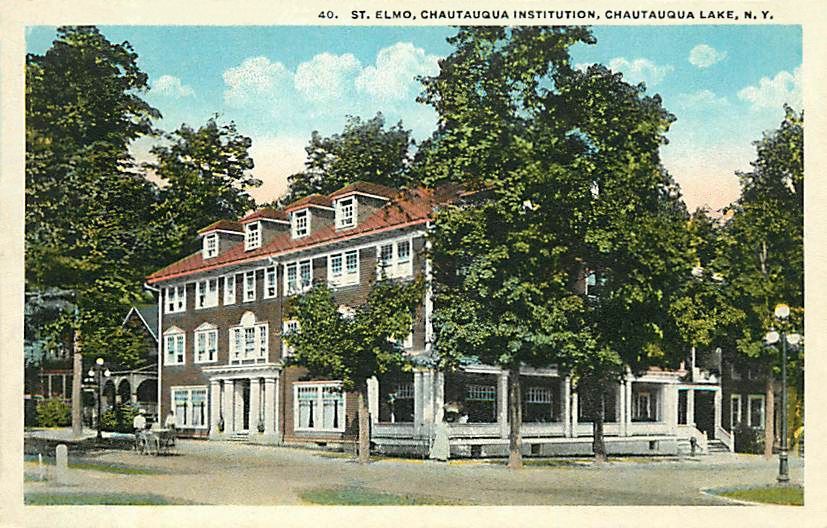
The St. Elmo was another hotel on the Chautauqua Institution grounds that was listed in the 1908 Handbook. Here’s how The St. Elmo looked in 1920, as it stood at the corner of Ames and Pratt Avenues.
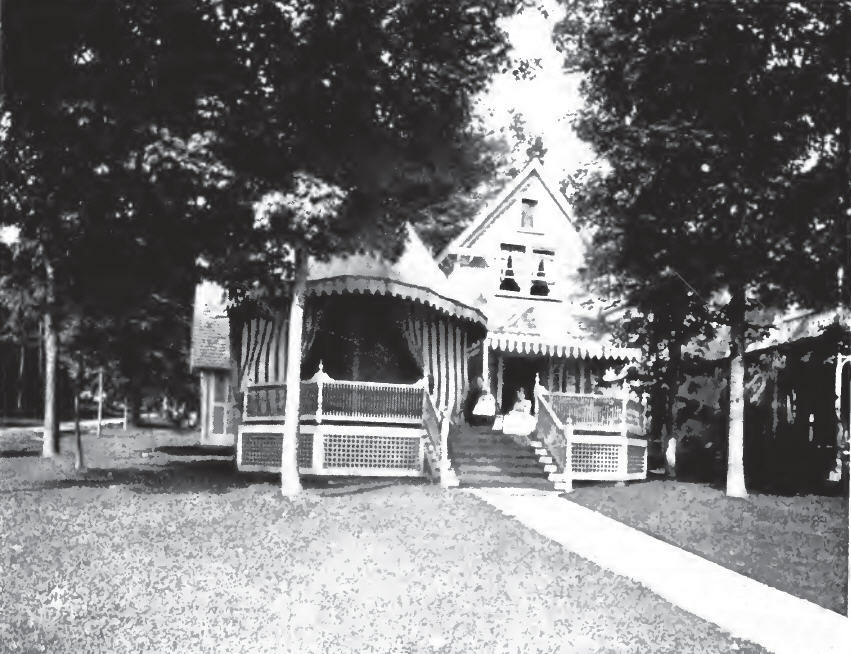
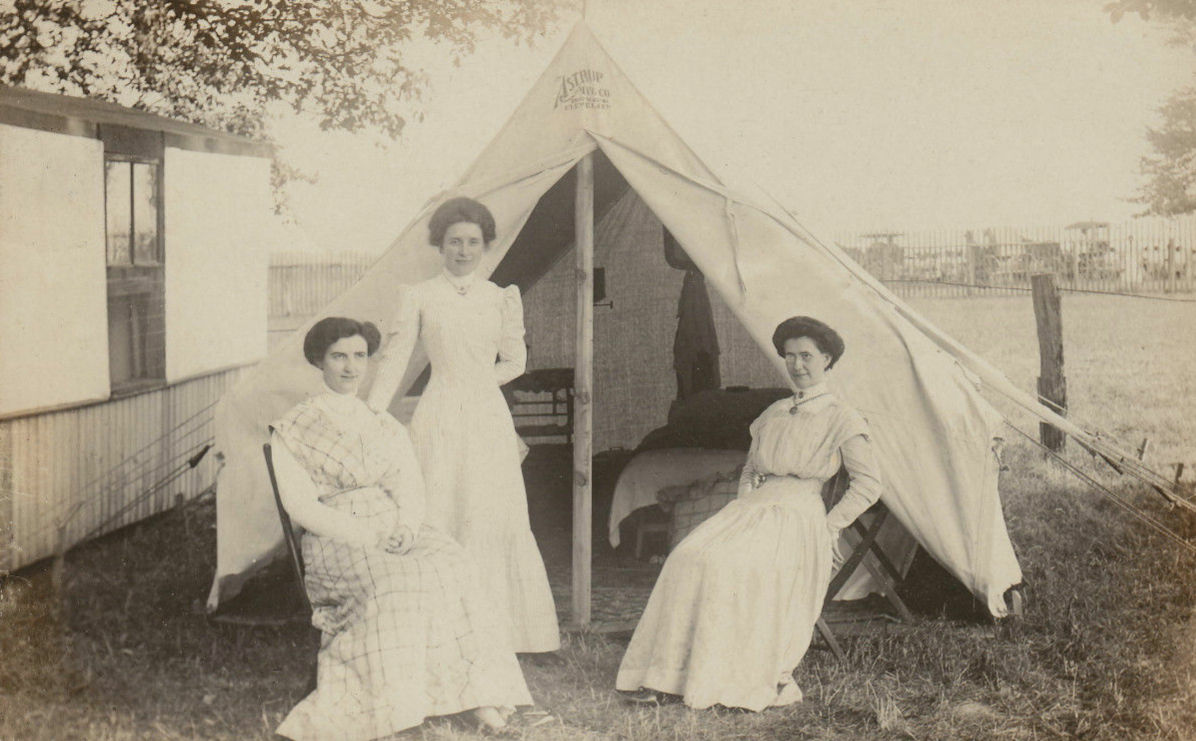
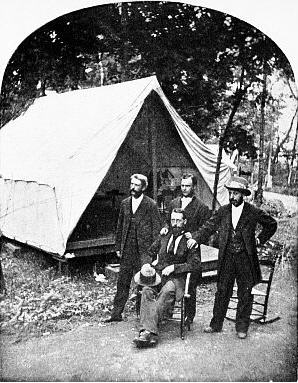
With all the boarding and hotel options, tent living still thrived. Chautauqua’s founders, John Heyl Vincent and Lewis Miller, maintained residences that were hybrids of cottage and tent.

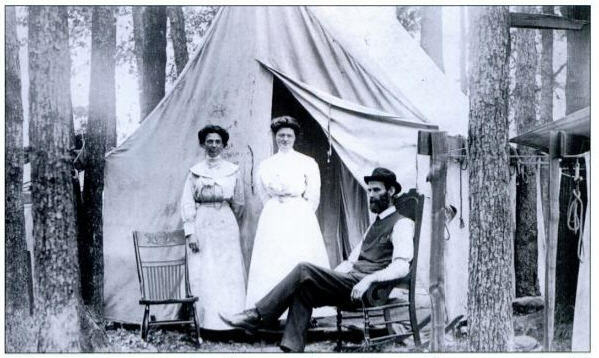
As Chautauqua grew and offered more and more styles of accommodations, many visitors still chose a simple summer of tent life in God’s great outdoors.
Next on our Tour of Chautauqua: Touring the Grounds

Learning to live with her mother-in-law was an understandable challenge for Rebecca Edwards, but never more so than when Mrs. Edwards’ constant criticisms and complaints drove her cook to quit on the very day guests were expected for dinner.

Sensing the woman’s dilemma, Rebecca confidently said:
“I can get dinner—as good a one as Mr. Romaine gets at a New York boarding-house, I dare say. Just install me in the kitchen for the day, and see what I can do.”
Mrs. Edwards had no choice but to accept Rebecca’s offer . . . even if her acceptance was somewhat ungracious.
Here’s how Rebecca described her day in her mother-in-law’s kitchen:

Mrs. Edwards was there, looking distressed and perplexed over every single thing that I touched. It was in vain that I assured her that I was perfectly well acquainted with legs of lamb, and that I had cooked as many fishes as there were in the sea, and that the summer Mrs. Demarest, of Boston, boarded with us, she asked me for the recipe for our fish sauce, because it was the best she ever tasted.
With the question of dessert came up new trouble. It so happens that, not having had much time for studying the accomplishments common to girls, I gave much time and fuss to the getting up of especially dainty desserts. During the season we kept those dreadful Boston boarders I really became an adept at that sort of work.

But Mrs. Edwards didn’t believe it. She hovered over those eggs and that butter and sugar, and was sure I had too little butter and too much powder, and not the right kind of flavoring. I became almost distracted. Several times my tongue fairly ached to drop egg-beater and spoon, and say: “Well, now, Mrs. Edwards, if you understand this business better than I do, please attend to it, and I will go and take my ride.” I am so glad I didn’t do it.
We nearly quarreled over the merits of soda and cream of tartar versus baking powder. Mrs. Edwards is certain that powder is an out-growth of this degenerate age; says the cake is neither so nice-looking nor so delicate that is made of it; that she always tastes the powder, and that she would never use it, if she went without cake. I was really obliged to be firm in that, for I understand the art of making cake with powder, and I don’t know how to make it with those other vile articles that must be balanced just so or they make a fuss.
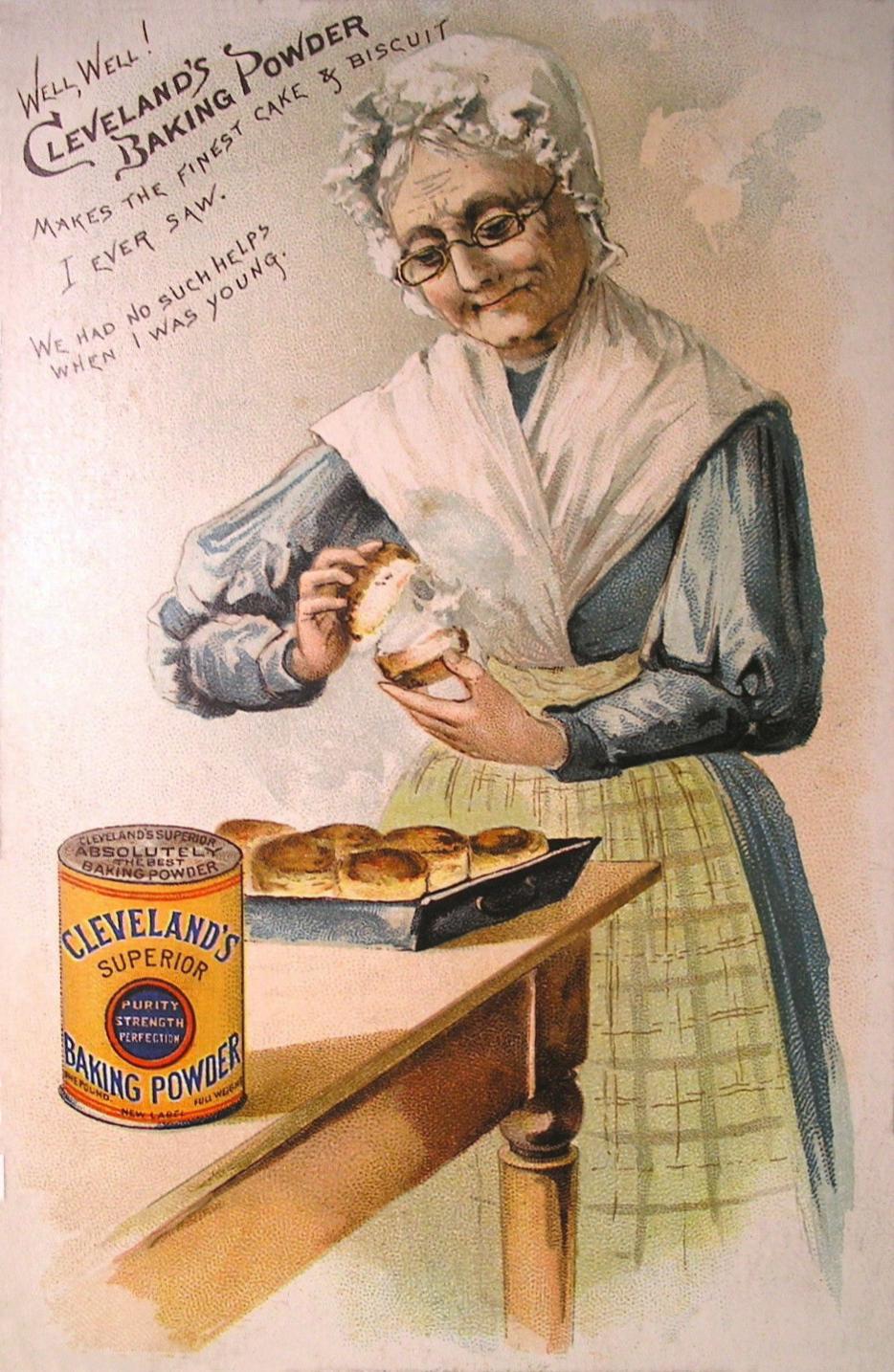
Still, I might have got along without saying: “So far as that is concerned, I can tell at the first mouthful whether there is cream of tartar in cake. I always taste it.”
Whenever I say anything of that sort, Mrs. Edwards is sure to remind me of my youth.
“Young people are, and always have been, remarkable for their discernment,” she said, very dryly. “Their mothers managed to make very palatable cake with the despised stuff before they were born, and long afterward. But as soon as the daughters get so they can stir up a gingerbread they, of course, know more than their elders ever did.”

Now, what had that to do with the subject under discussion? I am sure I can’t see.
The simple truth is that Mrs. Edwards can’t even stir up a gingerbread. She knows nothing about cake-making; she has never been obliged to know. And I confess myself unable to see why, because a person has lived sixty years, she should be deferred to by one who has only lived twenty years, on a subject of which she knows nothing, while the other has given six or eight of her twenty years to the learning of that subject.
I wanted to tell my respected mother-in-law that such was my opinion, but I forbore, and meekly asked her if Jane, the second girl, could be trusted to set the table, or whether she would rather have me do it.
Rebecca’s dinner was a success. The guests ate serenely, and Mrs. Edwards, after the first taste, lost her anxious expression and regained her quiet composure that was so much admired in the fashionable world. In the end, Mrs. Edwards discovered that Rebecca really could cook a delicious dinner and Rebecca discovered that she could keep her temper in the face of her mother-in-law’s taunts and complaints.
You can read more about Rebecca Edwards’ life with her mother-in-law in Links in Rebecca’s Life.


Are there things too small for His notice, when He himself refers us to the fading wild flowers for lessons?
—A New Graft on the Family Tree

When Eurie, Marion, Ruth and Flossy embarked on their journey to Chautauqua in August, 1875 they traveled by railroad to Mayville. From there they took a steamer to Chautauqua. The map below shows the towns that lined Chautauqua Lake in 1906 (several years after the girls first journeyed there). You can see Mayville on the far left side of the map (click on the map to see a larger version).
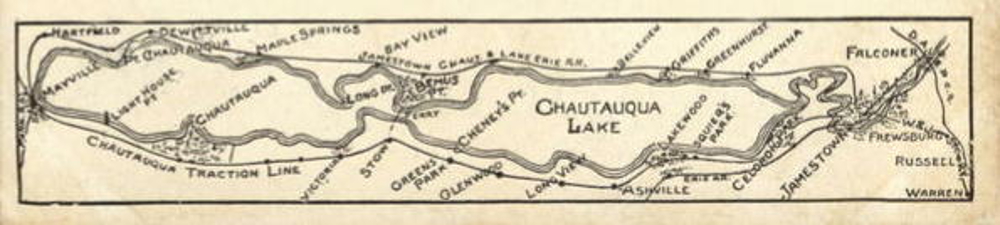
In Mayville, the girls boarded a steamer named, The Colonel Phillips, and boated along the southern shore of the lake to Chautauqua. As luck would have it, they arrived at Chautauqua under less than perfect conditions: it was raining and well past dark when they reached their destination.
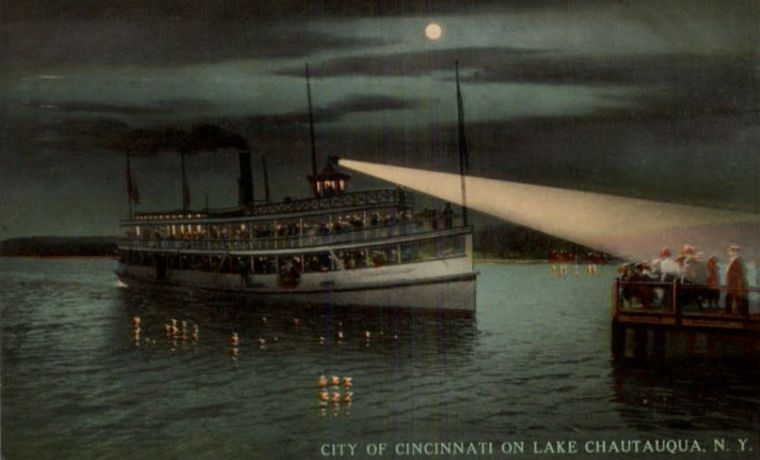
From the deck of The Colonel Philips, their first glimpse of the institute was probably the Chautauqua Institution dock, which stood at the tip of a point that jutted out into the lake. Incoming steamboats used the dock to let passengers on and off. The vintage postcard below shows the steamer, City of Cincinnati, docking at Chautauqua after dark, in much the same way as The Colonel Phillips would have docked (click on any of the images below to see a larger version).
In 191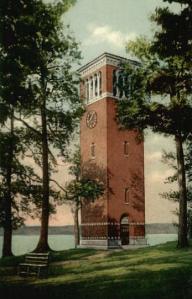 1 the Miller Bell Tower was erected alongside the dock. It was built to commemorate the life and contributions of Chautauqua co-founder Lewis Miller. When the girls returned in 1913 (as described in Isabella Alden’s book, Four Mothers at Chautauqua), they would have seen the beautiful new bell tower as they approached the dock; and they would pass it as they stepped off the boat and entered the Institute grounds.
The hand-colored postcard below shows the tower and dock looking northeast toward the direction from which the girls’ steamer would have arrived from Mayville. The postcard also shows South Lake Drive, which ran along the shore from the bell tower to the south end of the Institute grounds. From the vantage point presented in this picture, the Chautauqua Auditorium was just out of view to the left.

During the girls’ first visit to Chautauqua, The Auditorium was an open-air arena with “rows and rows and rows of heads, men and women, and even children. A tent larger than they had imagined could be built and packed with people.” Here’s how Isabella Alden described it in Four Girls at Chautauqua:

For the benefit of such poor benighted beings as have never seen Chautauqua, let me explain that the auditorium was the great temple where the congregation assembled for united service. Such a grand temple as it was! The pillars thereof were great solemn trees, with their green leaves arching overhead in festoons of beauty. I don’t know how many seats there were, nor how many could be accommodated at the auditorium. Eurie set out to walk up and down the long aisles one day and count the seats, but she found that which so arrested her attention before she was half-way down the central aisle that she forgot all about it, and there was never any time afterward for that work. I mean to tell you about that day when I get to it. The grandstand was down here in front of all these seats, spacious and convenient, the pillars thereof festooned with flags from many nations. The large piano occupied a central point; the speaker’s desk at its feet, in the central of the stand; the reporters’ tables and chairs just below.
The Auditorium was used for the first four years, then the Amphitheatre—a more permanent, open-air structure—was erected that could hold many more people. The Amphitheatre’s crowning glory was its magnificent pipe organ. The seats behind the Amphitheatre stage were typically occupied by speakers, performers, choirs and orchestras.

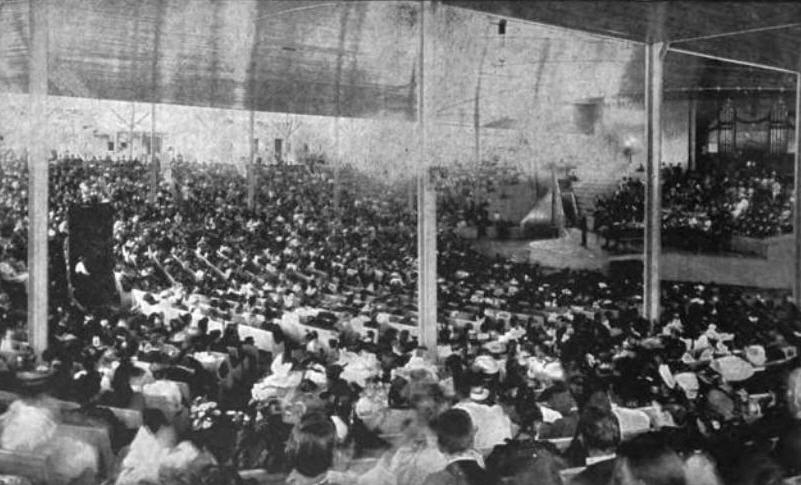
The photo below from about 1895 shows The Amphitheatre in service, with every possible seat taken. The view looks across The Amphitheatre, with the stage and speakers on the right. You can just make out the shape of the huge organ pipes.
After the girls attended their first lecture in the Chautauqua Auditorium, they decided to stay on the grounds, rather than at a nearby hotel. They appealed to the Institute President to help them find a suitable place to stay. As he showed them the available tents to rent, Ruth couldn’t hide her dismay.
“Why, the bed isn’t made up! Pray, are we to sleep on the slats?”
“Oh, no. But you have to hire all those things, you know. Have you seen our bulletin? There are parties on the ground prepared to fit up everything that you need, and to do it very reasonably. Of course, we cannot know what degree of expense those requiring tents care to incur, so we leave that matter for them to decide for themselves. You can have as many or as few comforts as you choose, and pay accordingly.”
“And are all four of us expected to occupy this one room?” There was an expression of decided disgust on Miss Erskine’s face.
“Why, you see,” explained the amused President, “this tent is designed for four; two good-sized bedsteads set up in it; and the necessity seems to be upon us to crowd as much as we can conveniently. There will be no danger of impure air, you know, for you have all out-doors to breathe.”
“And you really don’t have toilette stands or toilette accommodations! What a way to live!”
Another voice chimed in now, which was the very embodiment of refined horror. “And you don’t have pianos nor sofas, and the room isn’t lighted with gas! I’m sure I don’t see how we can live! It is not what we have been accustomed to.” This was Marion, with the most dancing eyes in the world, and the President completed the scene by laughing outright. Suddenly Ruth discovered that she was acting the part of a simpleton, and with flushed face she turned from them, and walked to a vacant seat, in the opposite direction from where they were standing.

“We will take this one,” she said, haughtily, without vouchsafing it a look. “I presume it is as good as any of them, and, since we are fairly into this absurd scrape we must make the best of it.”
“Or the worst of it,” Marion said, still laughing. “You are bent on doing that, I think, Ruthie.”
By a violent effort and rare good sense Ruth controlled herself sufficiently to laugh, and the embarrassment vanished. There were splendid points about this girl’s character, not the least among them being the ability to laugh at a joke that had been turned toward herself.
The girls survived their first night in the tent. The next day, they split up, each going in different directions; and Flossy soon found herself lost and alone on the grounds.
Meantime Flossy was being educated. The morning work had touched her from a different standpoint. She had not heard Dr. Walden; instead she had wandered into a bit of holy ground. She began by losing her way. It is one of the easiest things to do at Chautauqua. The avenues cross and recross in an altogether bewildering manner to one not accustomed to newly laid-out cities; and just when one imagines himself at the goal for which he started, lo! There is woods, and nothing else anywhere. Another attempt patiently followed for an hour has the exasperating effect of bringing him to the very point from which he started. Such an experience had Flossy, when by reason of her loitering propensities she became detached from her party, and tried to find her own way to the stand. A whole hour of wandering, then a turn into perfect chaos. She had no more idea where she was than if she had been in the by-ways of London. Clearly she must inquire the way.
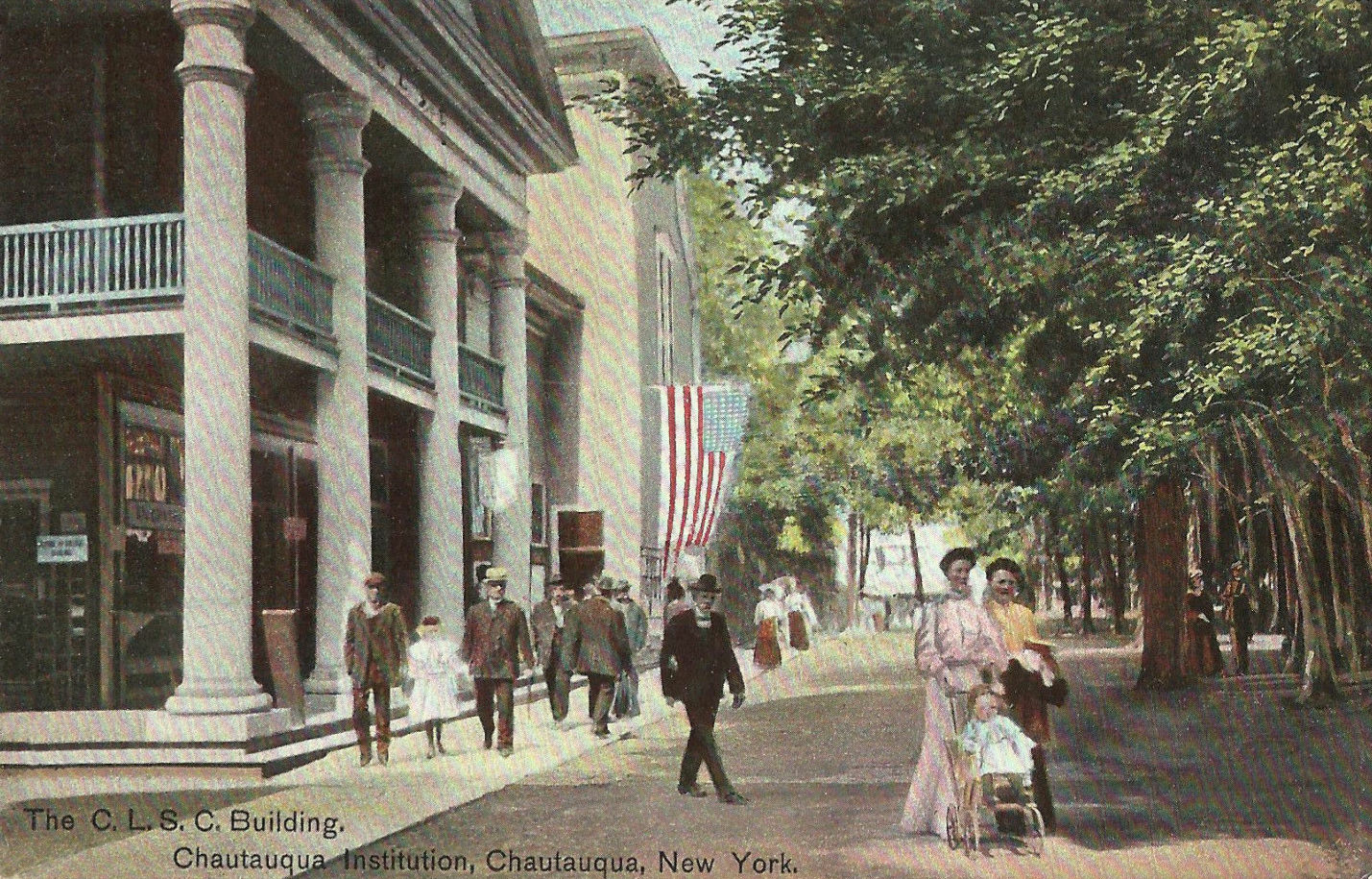
While trying to find her way, Flossy may have walked down Clark Street, which is pictured below in 1907, looking south from Miller Avenue (named after Lewis Miller). The Chautauqua Literary and Scientific Circle (C.L.S.C.) building is on the left.

Here’s a closer view of the C.L.S.C. building, as it looked in 1908:
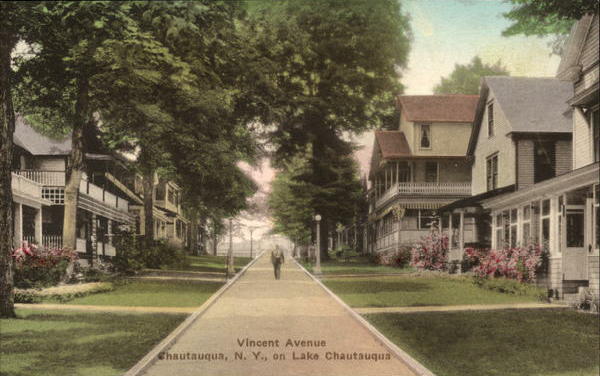
And below is a photo of Vincent Avenue, named for Methodist Bishop John Heyl Vincent, one of the founders of the Chautauqua Institute. The photo was taken in 1930, long after the girls’ first visit.
Little did Flossy, Ruth, Eurie and Marion know that those first days in Chautauqua were the prelude to life changing experiences for each of them!
Next on our Tour of Chautauqua: Where to Stay

Links in Rebecca’s Life is now available on Amazon!
Rebecca Harlow is an eager and tireless worker for the church. She never misses a prayer meeting, she dutifully prepares for each Sunday school lesson, and she schedules social calls with friends to encourage them to attend church.
But not all lessons are learned on Sunday; and not all Christian witness is delivered by appointment. When her careless words spread like wildfire through town, Rebecca must learn that it’s her everyday actions that have the power to influence others for Christ.
Click on the cover to read sample chapters on Amazon and learn more about Links in Rebecca’s Life.

 I have unquestioning faith in the truth that even our mistakes He will overrule for our good.
—The Randolphs

In Miss Dee Dunmore Bryant, Ben Bryant’s life was changed when he met Miss Webster and she, in turn, introduced him to her neighbor, Mr. Reynolds. It was due to Mr. Reynolds that Ben got his first glimpse at what he called a “writing machine.”

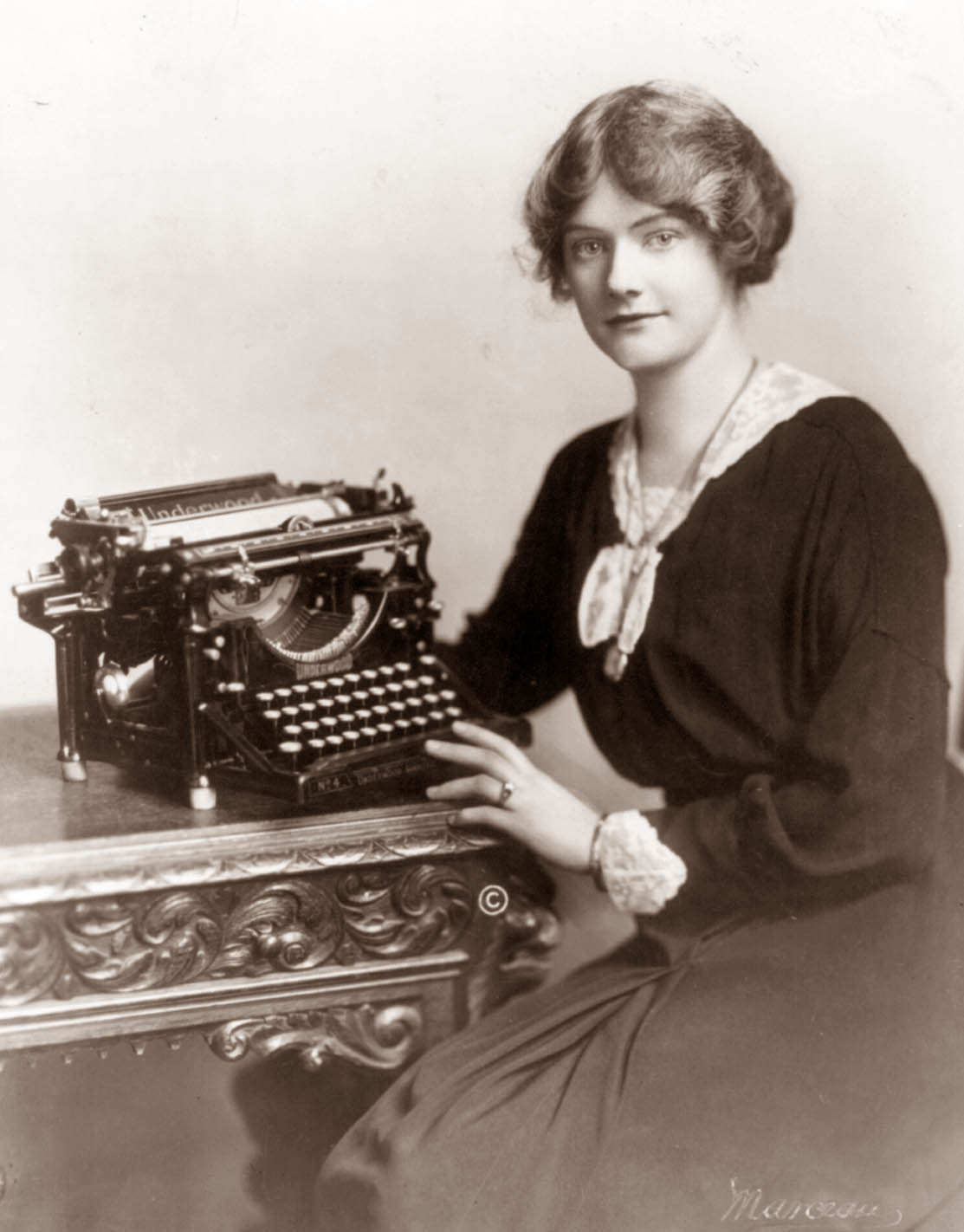
What Ben actually saw was a typewriter, probably a machine like the Remington 1886 model here (click on the images to see a larger version). Like most machines of the time, the keys struck upward against the paper. The machine also had four rows of keys: two rows of upper case letters and two rows of lower case letters.
Mr. Reynolds happily showed him how it worked.
“She’s a beauty,” Mr. Reynolds said, seating himself before her, “a regular beauty. I’ve never worked one who behaved quite so well; some of them get rather confused in their minds after being knocked about on the railroad for a few weeks, especially if they are not carefully packed; but this one is as clear-headed as she was the day we left home. Did you ever see one work, young man? Then we’ll start her off.”

Mr. Reynolds spoke of the little creature as though she were alive, and really it almost seemed to Ben that she was. He bent over her with parted lips and quick breathing, amazed beyond measure, when after the lapse of a few seconds the performer lifted the roller, and revealed in neat print the words:
“John quickly extemporized five tow bags.”
Mr. Reynolds had to lift the roller to show Ben what he had typed. Early typewriters required “blind typing” because the roller and mechanics of the machine blocked the typist from seeing the page as it was typed. By necessity, accurate typing was a treasured skill.

Ben’s intelligent and perceptive questions prompted Mr. Reynolds to let Ben try the typewriter himself.
“I don’t understand,” he said. “Where is the ink?”
“Not a bit of ink about it,” Mr. Reynolds declared, enjoying the puzzled face.
“Then it isn’t a self-inker? But it prints with ink! Is that a ribbon running through there? Why, it rolls itself up on those wheels, and the ribbon is inked, or colored, or something; I begin to understand. But where are the type?”
Mr. Reynolds silently lifted the roller, then the ribbon, and pointed to the type with his finger, at the same time going through a pantomime which told Miss Webster that he considered the boy’s intelligence and curiosity worthy of response.

Before long, Mr. Reynolds invited Ben to sit down and type out his mother’s name. Ben did just that, and took to the machine so quickly, Mr. Reynolds offered to teach him how to use the typewriter in exchange for helping him with his work. Ben jumped at the chance.
Ben learned to use the typewriter by fashioning a template of the keyboard, which he used to practice typing at home. He told his friend, Rufus all about the experience:
“I wrote mother’s name. I’m going to learn to write on it; that is, if I can spare the time; he offered me the chance. He wants some work done, and he says if I will give him two evenings, part of the time, I can write on the machine the other part and learn how. Isn’t that a good chance?”
“Humph!” said Rufus. “A dirt cheap way of getting a fellow to work for you, I should say. Of what earthly use does he suppose it will be for you to learn to write on that machine? In two months at the latest he will take it away, and you’ll never see another, and what good will your knowledge do you?”
“How do you know I’ll never see another? Perhaps I’ll have one of my own, some day.”
“Oh, well! Perhaps I’ll have a balloon and take a ride in it to the moon some day, but I don’t believe I will.”
“I don’t either,” said Ben, with a good-natured laugh, “because you wouldn’t know how to manage one; if you ever had a chance to learn, you would say ‘What’s the use?’ and let it slip.”
“I know the difference between chances and shams, I hope,” Rufus said sharply. “I call this a sham—to get a fellow to work for nothing. He offered it to me, and I let him know what I thought about it—at least I hope he understood.”
“I think he did,” Ben said significantly. “Good-night, old fellow! I’m at home, and, as the man in the paper said, ‘I wish you were.’ Just because you hate to walk alone so badly, you know, and have been walking out of your way to keep me company.” And Ben went in at the kitchen door, confirmed in his resolve to learn to run the writing machine, if possible.
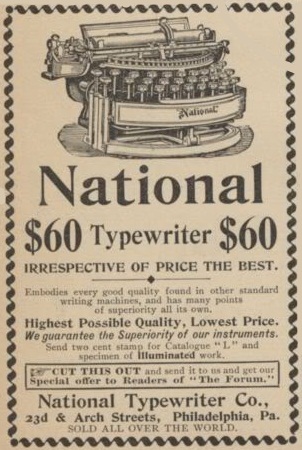
When Miss Dee Dunmore Bryant was published in 1890, typewriters were in use in many offices, but at $95 to $100, their cost prohibited most individuals and many small businesses from owning a one.
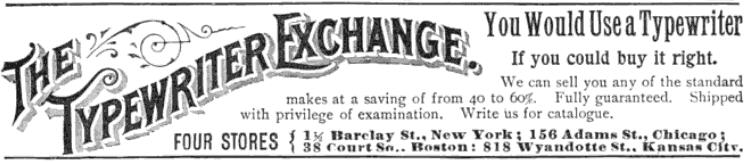
A few years later, the cost had dropped to more affordable levels, fueling Ben’s ambition to someday own his own typewriter, and use it to make his living.

 When one is in the mood for grumbling, there is no easier thing in the world than to find food for that spirit.


Affordable Christian Fiction
Faith, romance, and a place to belong
Author of Classic Christian Fiction
Author of Classic Christian Fiction
Reviews and giveaways for Christian fiction and sweet, clean fiction. Bringing readers information on great stories and connecting authors with their readers.

