Blog

Frank Beard’s Chalk Talk

Chalk Talk

Frank Beard was one of the most popular lecturers at Chautauqua Institution. His Chalk Talk lectures drew standing-room-only crowds because of their pitch-perfect blend of humor, art and Biblical truths.
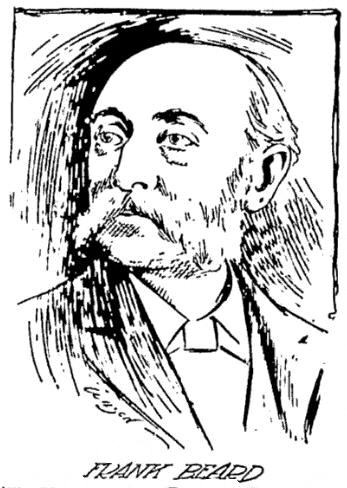
Black and white sketch of the artist Frank Beard.In an 1895 interview, Frank recalled how his Chalk Talks came to be:

“I was a young artist in New York, and had just been married. My wife was an enthusiastic churchgoer; and a great deal of our courtship was carried on in going to and from the Methodist church. The result was that I struck a revival and became converted. This occurred shortly after I was married, and like other enthusiastic young Christians, I wanted to do all I could for the church.”

Soon after he joined the church, the congregation put together an evening of entertainment. The ladies, knowing of his talent, suggested that Frank draw some pictures as part of the program. Frank agreed, but he felt that just standing in front of an audience and sketching without saying anything about the pictures “would be a very silly thing.”

He decided instead to make a short talk and draw sketches to illustrate his points. The talk was to be given as part of a Thanksgiving celebration, and Frank later joked that he rehearsed in front of his wife, his mother-in-law, and the turkey. “Well, my wife survived, my mother-in-law did not die while I was talking, and the turkey was not spoiled.”

Black and white sketch of Frank Beard drawing at an easel. Seated in chairs watching are a young woman, an older woman and a plucked, headless turkey strapped in the third chair.

When he gave his talk in front of the congregation, it was a great success. Soon, other churches asked him to repeat his talk, and in very short order he had more invitations to speak than he could ever hope to accept. His wife suggested charging a fee for each lecture, hoping that the cost would deter organizations from inviting him to talk at their functions. So Frank dutifully began charging $30 per talk. The requests continued to pour in. He increased his fee to $40, then $50, but his talks continued to be in great demand.

Newspaper announcement of a Freank Beard lecture from the 10 Mar 1890 edition of the Rock Island Argus
Announcement in the March 10, 1890 edition of the Illinois newspaper, The Rock Island Argus

That was the birth of the Chalk Talk, and Frank soon hit the lecture circuit. He was one of the first speakers at Chautauqua Institution in New York; and he lectured at many of the daughter Chautauquas. This 1899 clipping from the Los Angeles Herald recounts Frank’s Chalk Talk at the Long Beach Chautauqua (which named July 19, 1899 Frank Beard Day):

Announcement of Frank Beard Day at the Long Beach Chautauqua; from The Los Angeles Herald, 20 Jul 1899

The topics of his Chalk Talks ranged from morality tales to stories from the Bible, each told in a casual, funny, but reverent, way. He knew that people who wouldn’t listen to a “sermon” would listen to his Chalk-Talk if the truths were presented in an entertaining fashion.

In Four Girls at Chautauqua, Eurie Mitchell proved that very point. Eurie was so opposed to listening to “sermons” at Chautauqua, she refused to go to any of the lectures; but when she heard about Frank Beard’s caricatures, she decided to go see him for herself.

If you have never seen Frank Beard make pictures, you know nothing about what a good time she had. They were such funny pictures! Just a few strokes of the magic crayon and the character described would seem to start into life before you, and you would feel that you could almost know what thoughts were passing in the heart of the creature made of chalk. Eurie looked and listened and laughed.

In Isabella’s book, Frank’s Chalk Talk was able to do what no other lecture at Chautauqua could: reach Eurie’s heart and lead her, ultimately, to salvation through Christ.

“Pictures can often tell stories quicker and better than words,” Frank once said, “and I believe that cartoons can be used in the service of religion, righteousness, truth, and justice.”

Black and white drawing of a man standing at a blackboard drawing a circle by moving his arm in a wide round motion

To prove his point, he once asked, “If you were commissioned to teach a child the nature of a circle, would you begin by stating that a circle is an area, having for its center a point, and bounded by a circumference in the nature of an endless imaginary line, which at all points is at an equal distance from the center? No! You would do nothing of the sort, but you would [show] its nature and properties [by drawing a circle] in black and white.”

Sometimes the subjects of his Chalk Talks were very simple. He told a story, for example, of how a blackboard and chalk could be used to teach a Sunday-school class of young children who had never before seen the Christian symbol of a cross inside the shape of a heart. He started by drawing the simple outline of a heart on the blackboard.

A simple sketch of a heart-shape in white chalk against a black background“What is this?”

“A heart!”

“Yes, a heart. Now, I mean this to represent a particular heart—I mean it for my heart. What is it now?”

“Your heart!”

“Don’t forget that. Now, see what else I will draw.” And he drew a child’s face within the heart.

“Now what have I made?”

Drawing in white chalk of a child's face inside the shape of a heart“A little boy!” “A little girl!” “A little child!” Variously cried the children.

“Yes, a little child; but where is the child?”

“In the heart.”

“In the heart?”

“In your heart.”

“That’s right. Now, what does it represent? When I tell you that I have a little child in my heart, what does it mean?”

A chalk sketch of a cross inside the shape of a heart against a black background“You mean you love the child.”

“Exactly. Now I will rub out the child and put a cross in the heart. What does that mean?”

“You love the cross.”

Then he went on to explain in a simple way what loving the cross meant.

He also shared an example of one of his lessons for older children and adolescents. He used this lesson to illustrate the concept of the narrow Christian path described in Matthew 7:13-14:

A young man is attracted by the appearance of beauty and the pleasure along the broad way. Timidly at first, for he is not bad and rather fears evil—but he loves play and pleasure—so he steps into it. He knows it is not the right way to take but he thinks to himself:

Chalk drawing of the head of a nicely-dressed young man wearing a hat.

“After a while, after I have had a good time, I will go over to the right path and come out all right after all.”

Chalk Drawing of the head of a frowning young man wearing a hat and smoking a cigarette

Frank went on to explain how the young man fell in with evil companions and was drawn further away from the good path.

Chalk drawing of the head of an old man with disheveled clothes and hat, smoking rumbled cigarette.

The young man learned to smoke and chew tobacco and read books “which mislead and give us wrong notions in life, that make heroes of scamps, thieves and liars.”
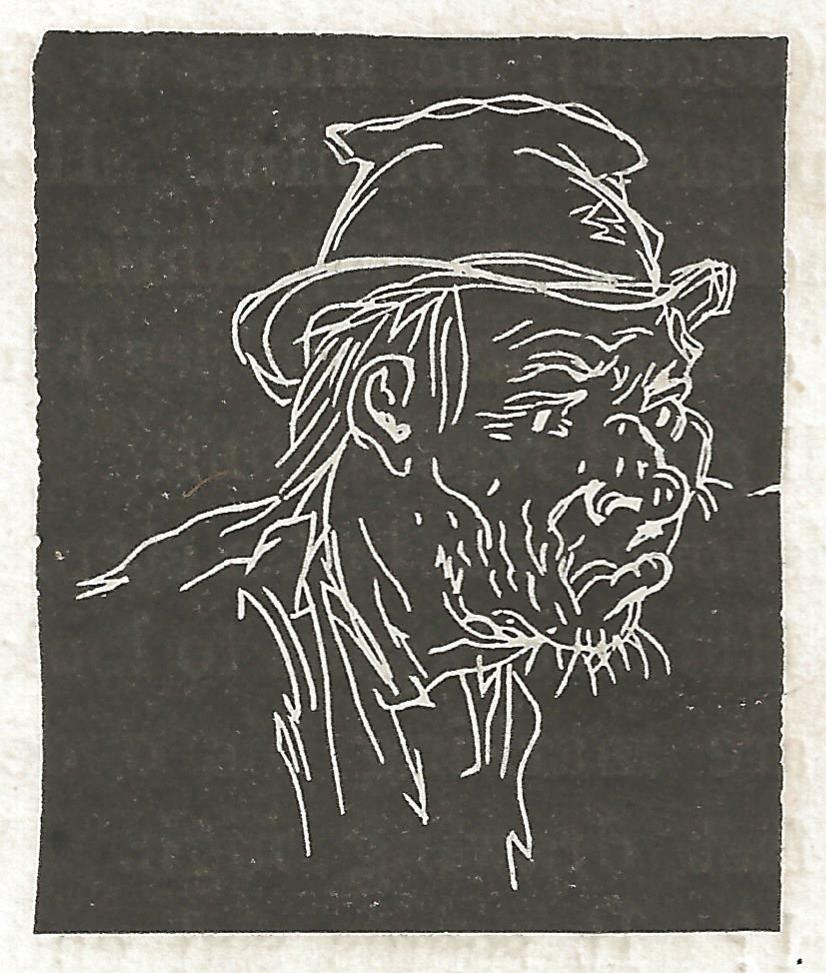
Chalk Ddawing of the head of an old man, hunched over, wearing disheveled clothes and hat.

As Frank continued the lesson, he amended and enhanced his original drawing to show the progressive results of the choices the young man made in his life.

Wherever he gave his Chalk Talks, he was well received, and his reputation grew. But not everyone was a fan of using a blackboard and chalk as teaching tools in the Sunday-school. Frank shared a story about one church that decided to use a man in their congregation—they assumed he had talent because he was a sign painter by profession—to illustrate Sunday-school lessons. The man decided to illustrate the story of Samuel as a child, entering the apartment of the high priest Eli in answer to his summons. His efforts were not well received.

Chalk drawing of Samuel running towards Eli who is in bed.

“Some objected to the bed-posts,” Frank said. “Some didn’t exactly know why, but the drawing didn’t conform to their idea of Samuel at all, and, more over, Eli’s nose was out of proportion.”
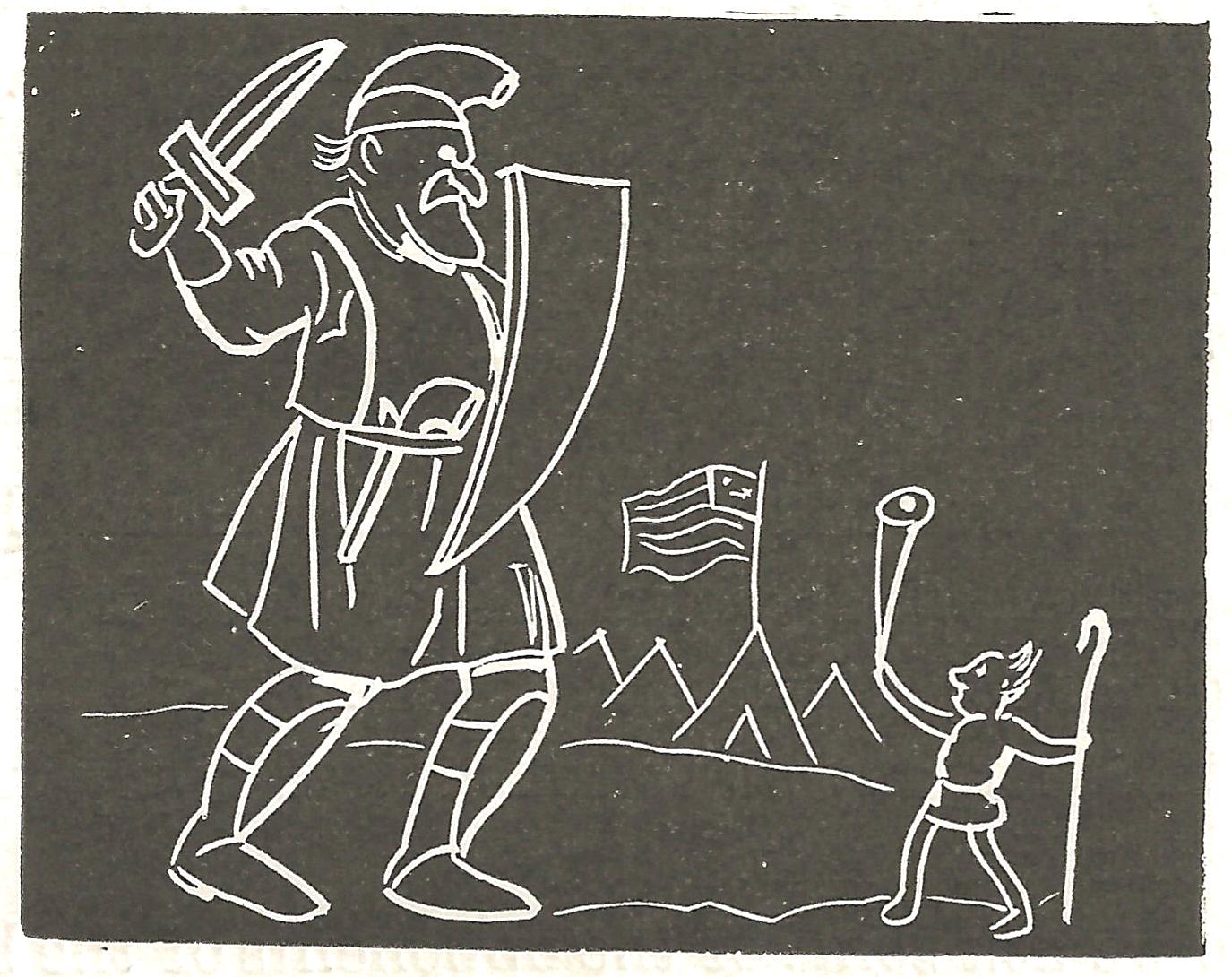
Chalk drawing of the Bible story of David and Goliath

The man’s next attempt didn’t fare any better, when he drew Goliath about thirty-five feet high in proportion to David. In fact, the congregation didn’t like anything at all about the poor sign-painter’s efforts at the blackboard.

Isabella Alden’s book Links in Rebecca’s Life featured a character who also disliked Chalk-Talk style lectures. She was a Sunday-school teacher who hated chalk and blackboards.

“They are such horrid dusty things. You get yourself all covered with chalk, and just ruin your clothes. I can hardly wear anything decent here as it is. If I had a blackboard, I should give up in despair.”

“I should think it would be a great help in teaching children,” Rebecca said.

“Well, I don’t know. What could I do with it? I don’t know how to draw, and as for making lines and marks and dots, I am not going to make an idiot of myself. What’s the use?”

But Frank Beard believed no special talent was required for a teacher to incorporate chalkboard drawings into Sunday-school lessons.

“Many are apt to think some extraordinary genius is necessary to fit a teacher to use the blackboard,” he said. “It is a mistake. You can teach better with a pencil than without. You can learn to draw far better than you ever imagined possible.”
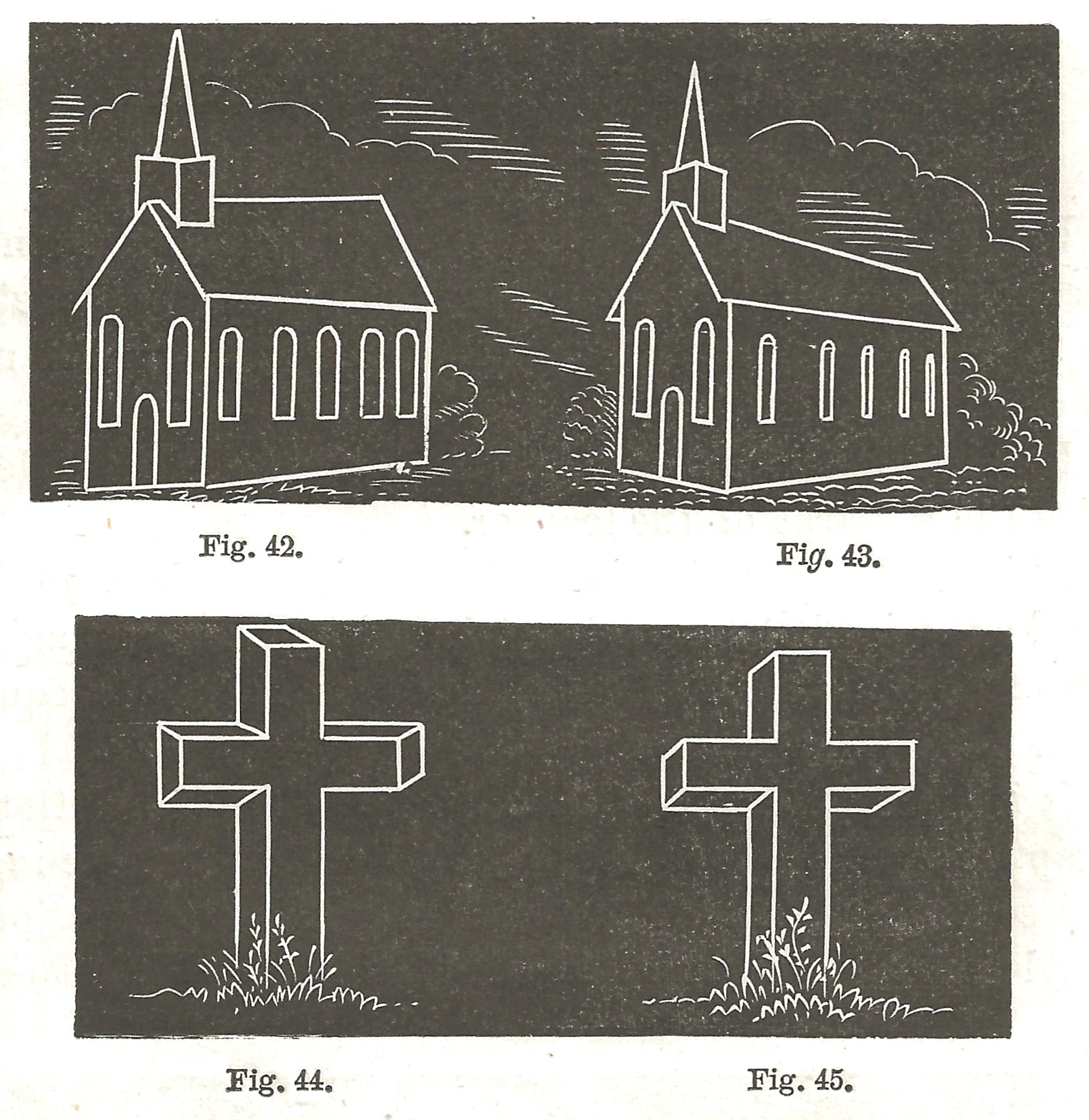
Drawings of two different versions of a church and a cross; one version showing the wrong perspective and one version showing the correct perspective.
Illustrations from Frank’s book showing the right (Figures 43, 45) and wrong (Figures 42, 44) way to draw an image in perspective.

In 1896 Frank published a book for Sunday-school workers; in it he gave simple instructions for using the blackboard to illustrate Bible lessons.

Example of a simple but artistic way to write "The Lord is my shepherd" in chalk on the blackboard

Two examples of chalk talk methods for writing "what a friend we have in Jesus" on the chalkboard.

His book included how-to’s on perspective, lettering, and using easy-to-draw symbols as illustrations. Here are some of the symbols he illustrated:
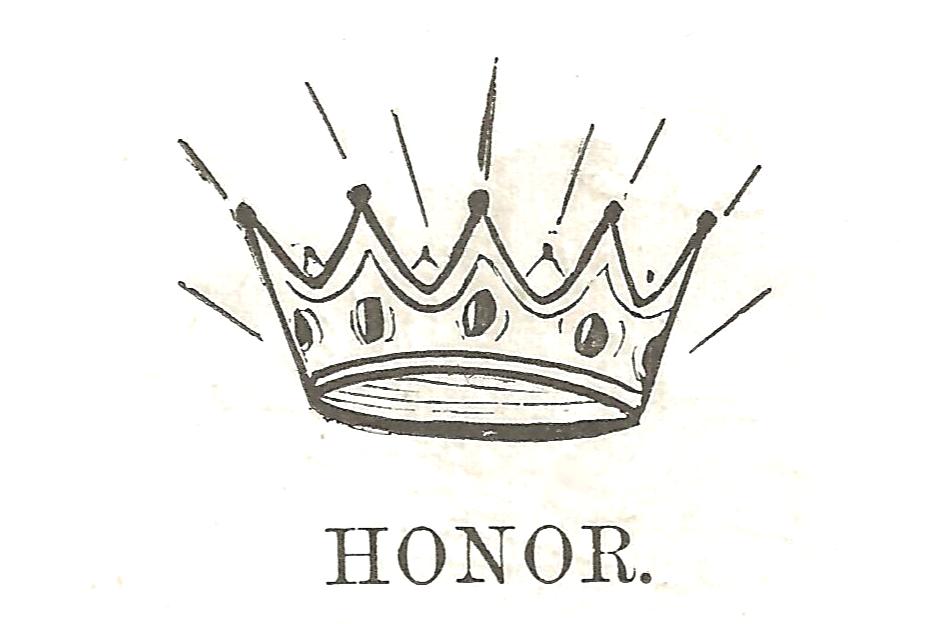
Drawing of a crown with the word "Honor" written below. Drawing of a key with the word "Knowledge" written below. Drawing of a star with the word "Promise" written below. Drawing of a cross with the word "Salvation" written below. Drawing of an ancient oil lamp with the word "Wisdom" written below.

The purpose of writing the book, he said, “is to show how the blackboard can be used in the Sunday-school, and to furnish such instruction in drawing upon it” so it can be done in the most effective way.

drawing of a Victorian-era woman darwing with chalk on a blackboard in front of children seated on chairs in front of her
Illustration from Frank Beard’s book, Chalk Lessons

He was quick to say that he didn’t want the blackboard to monopolize the Sunday-school or supplant other useful forms of instruction. But, if used correctly, Frank Beard proved that the blackboard—and Chalk Talks—could be the “instrument which proves effective as a means of winning souls to Christ.”


"Taught by Pictures." "Frank Beard believes in the cartoon in religion." A Chat with the Artist." "How He Came to Invent the Chal Talk." "War-Time Caricatures"In 1895 Frank Beard gave an interview to the Washington D.C. newspaper The Evening Star. Click on this image to read the interview in which Frank tells how he invented the Chalk Talk:

.

.

Cover_Links in Rebecca's LifeClick on the book cover to learn more about Links in Rebecca’s Life.

.

.

Cover Box Set books 1-3 Click on the book cover to learn more about Four Girls at Chautauqua.


Aunt Hannah’s Advice

Aunt Hannah Adams is one of Isabella Alden’s most popular fictional characters. Aunt Hannah was a woman who loved the Lord, knew her mind, brooked no nonsense, and appreciated daily blessings. Most importantly, she knew when to give advice to others  . . . and when not to. With all her life experiences, she grew wise in her older years; but, like any wise person, she also held her tongue until the time was right to share her own special insight with others.

Here are some of Aunt Hannah’s wise thoughts and marriage advice that she shared with newlyweds John and Martha Remington:

It is best for young ones after they once fly from the home nest to set up independent of the old birds. I tried once to help two young robins. They were building a nest in the old apple tree right under my bedroom window, and they weren’t making it a bit comfortable according to my way of thinking. I watched them until I couldn’t stand it any longer. Then I hung little bunches of ravelings on the limbs in plain sight. The stubborn little things wouldn’t notice them, but kept on weaving in bits of straw and hay, as if, of course, they knew best.

One day they were both gone. I took a soft bit of wool and tucked it nicely into the nest. I thought when they once knew how warm it felt to the feet they would like it. But when that little housekeeper got back she was mad enough! She made angry sort of chirps that sounded for all the world like scolding, and he helped her along in it, like any foolish young husband. They flew around as if they were crazy, and tore that nest to pieces in no time. That taught me a lesson. I shall never meddle with any more nests.

When I married Nathaniel Adams it was because I should have been a most unhappy creature if I hadn’t. I don’t pretend to understand it all, how one year I never had seen him and the next I cared more for him than anybody in the world. It’s a great mystery. I always thought the Lord sent him to me. The Bible says that a good wife is from Him, and so, of course, a good husband must be. I only know that I never got tired of him. To the last day of his life a room was always pleasanter to me if he was in it.

Satan is never more busy with young people than he is the first year or two of their married life. The trouble is, a young couple start out, in spite of anything that is told them, expecting to find each other perfect. Of course, they are not; and so they are both disappointed. Now, if they would be more reasonable, and believe that they will discover some faults in each other, and that they must bear and forbear, and seek the help of the Lord in it, loving each other, faults and all, Satan would not get the hold of them that he does.

If a wife would speak out frankly to her husband when something worries her, it would be far better–not in a fault-finding way–little misunderstandings could be cleared up at once, but instead of that she takes some little thing that has hurt her and broods over it and sheds oceans of tears over it, and it grows and grows, and then she puts on the face of a martyr, and her answers are all in one syllable, and her eyes have a red rim around them. Her husband doesn’t know what is the matter, or he has forgotten if he ever did know. That is oftentimes the history, I dare say, of the beginning of trouble in unhappy marriages.

The right sort of a wife, who has a good husband, will not allow herself to worry about mere trifles–that is, if she has good sense. If she hasn’t, more’s the pity for both of ’em. When she is tempted to go distracted over some little thing about as big as the point of a pin, she will say, “Get thee behind me, Satan. You are not going to pick a quarrel this time. My husband means all right, and I shall trust him, even if he does forget some of the little attentions I’m used to.”

You know marriage is used again and again in the Scriptures as a figure of the union between Christ and the church. The marriage supper stands for the most glorious and joyful day that can ever come to us. And would He have said that a man was to leave everything and go with his wife, and that they should be one, if it was intended to be only a sort of partnership for convenience?

Did you notice that rose-vine at the east end of the front porch putting out new branches all over it? It will be full of roses pretty soon. That vine has been the wonder of the neighborhood for ten years. Now suppose I never watered it, or fed it with good rich earth from the woods, or dug about it, what a stunted, sickly thing it would have been! You have to take care of everything that’s worth having in this world. Love will die from neglect and abuse as quick as a rose-bush.

 If there are any two in the world who should be one in principles and aims, it is those who are to spend their lives together. God meant it so. There is no happiness where a husband pulls one way and the wife another. Why should they wish to be together unless they are in harmony on what you might call the keynotes of life? It will only be one long discord. If a man and woman jar each other before marriage, a few words spoken by a minister is not going to change them.

What do you think of Aunt Hannah’s advice? What’s your favorite piece of advice from Aunt Hannah and Martha and John? What special advice has someone given you? Feel free to use the comments section to share your thoughts.

100 Years Ago at Chautauqua

For many reasons, 1914 was a banner year at Chautauqua Institution. Here are a few of the highlights:

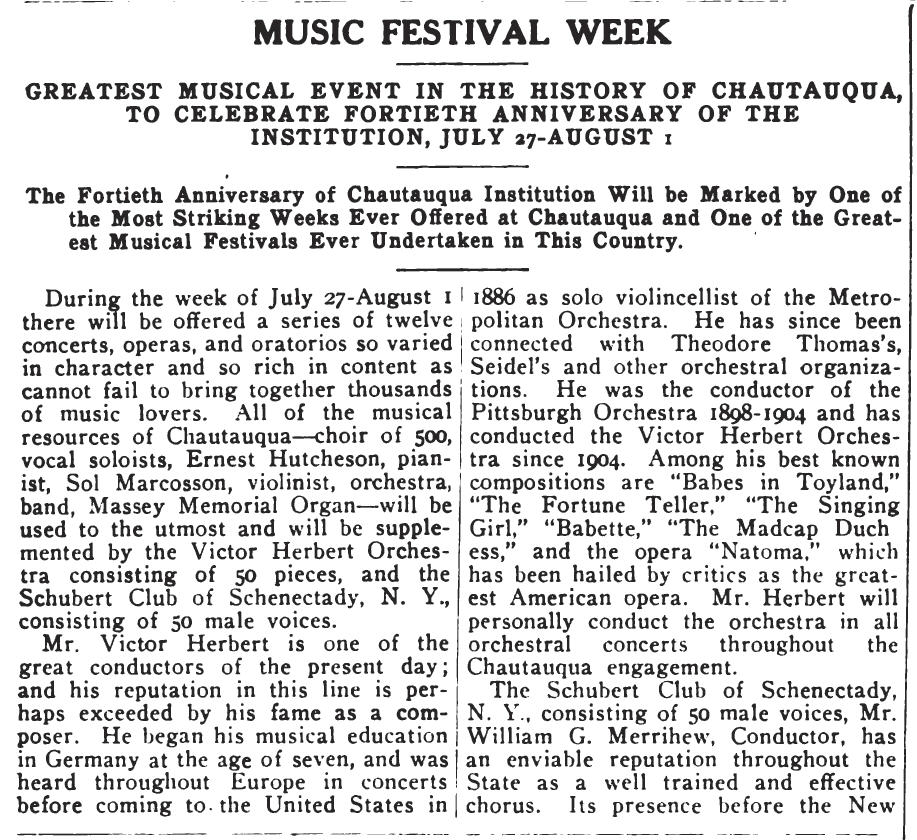
Announcement in a 1914 edition of The Chautauquan
Chautauqua Institution marked its 40th anniversary.

The anniversary was celebrated with a week-long music festival of exceptional entertainment, described in this announcement as the “greatest musical event in the history of Chautauqua.” You can click on the announcement to view a larger image.

.

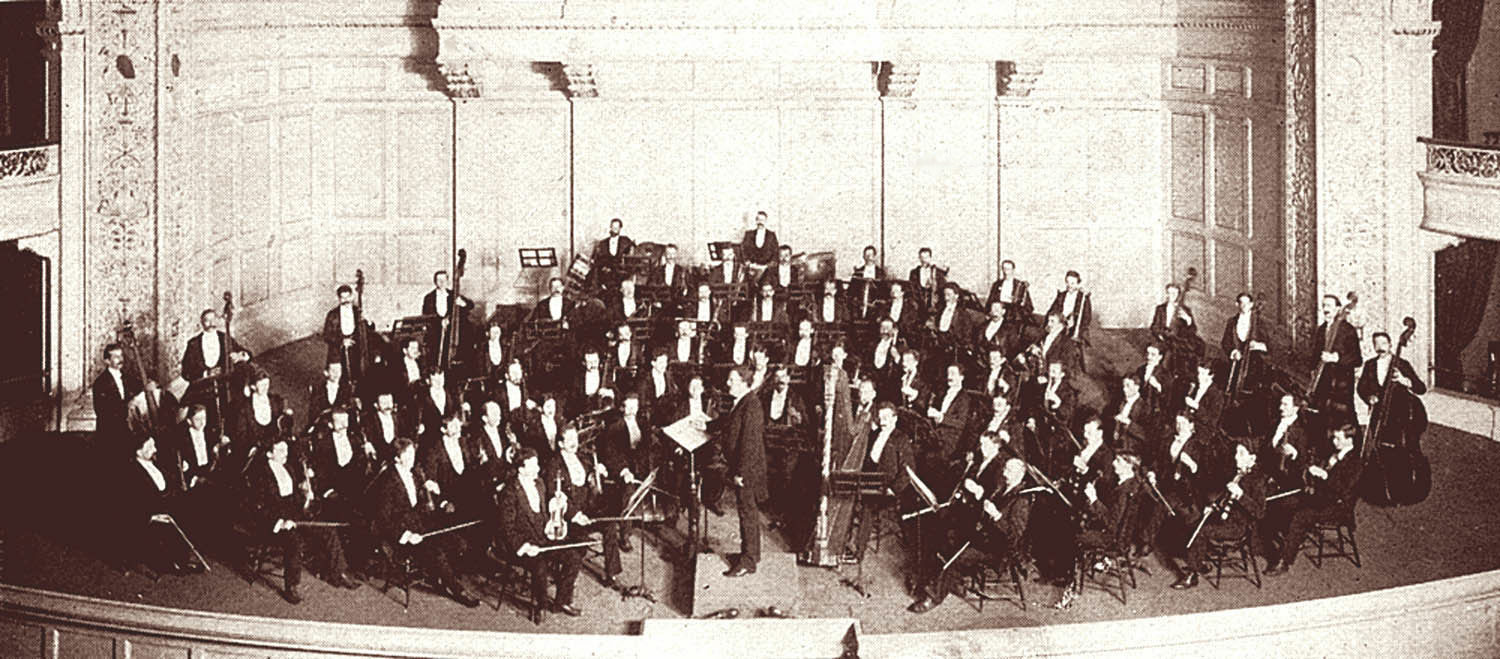
The Victor Herbert Orchestra gave two concerts a day during Music Festival Week.

Victor Herbert program 1904Celebrated composer/conductor Victor Herbert performed during the music festival. Famous for his operettas Babes in Toyland and Naughty Marietta, he was also the founder of the Pittsburgh Symphony Orchestra. When he came to Chautauqua, he came big, with a 50-member orchestra and a choir of 50 male voices. You can read more about it in the above announcement.

Victor Herbert conducting the Pittsburgh Orchestra in 1901

.

The Chautauqua Players took the stage.
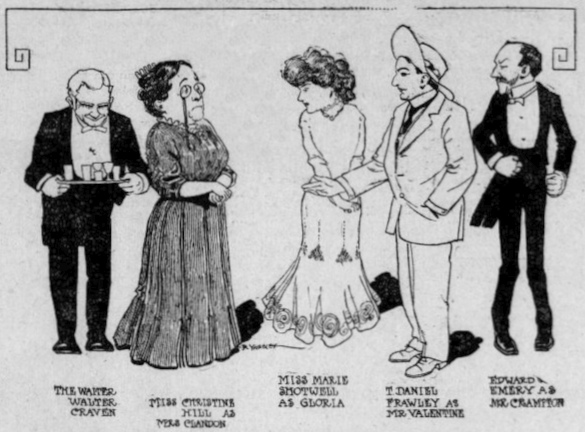
Caricatures of cast and characters in a 1907 production of You Never Can Tell

Theater productions came late to Chautauqua, due, in large part, to the Methodist Church’s ban on theater attendance that lasted into the 1920s. Chautauquans were content with illustrative lectures and pageants; but those entertainments gradually gave way to dramatic readings, then to pantomime performers. By the early 1900s, stage plays found a place at Chautauqua. To commemorate the anniversary, Chautauqua Institution’s very own Chautauqua Players presented two performances each of three different plays:

The Passing of the Third Floor Back
Ulysses by Stephen Phillips
You Never Can Tell by George Bernard Shaw

.

Normal Hall was remodeled.

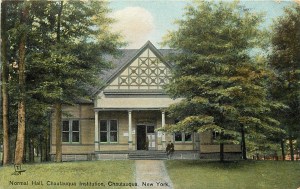
Built in 1885, Normal Hall is one of the oldest buildings on the Chautauqua grounds. It was originally designed as a recitation hall but in the anniversary year of 1914, it was remodeled for class rooms. Today, Normal Hall is known as the Bratton Theater, home to the Chautauqua Theater Company.

Click on the image to see how Normal Hall looks today.

Normal Hall Exterior in 1908

.

The golf course opened.

Golfhere was no golf at Chautauqua in 1874 but forty years later, Chautauquans were hitting the links in addition to the traditional croquet balls. Click here to see period photos of the golf course and to read about the famous people who have played the course.

.

.

Dean Percy H. Boynton became Principal of the Chautauqua Summer Schools.

Percy H BoyntonEducated at Amherst and Harvard universities, Percy Boynton became a Professor of English at the University of Chicago in 1903, the same year he became Secretary of Instruction at the Chautauqua Institution. He served as Chautauqua’s Principal of Summer Schools from 1914 to 1916.

He was also a noted writer and lecturer. After his retirement from teaching, he joined the Chautauqua circuit and toured the country presenting lectures on a variety of topics.

.

A new highway and entrance gate opened for business.

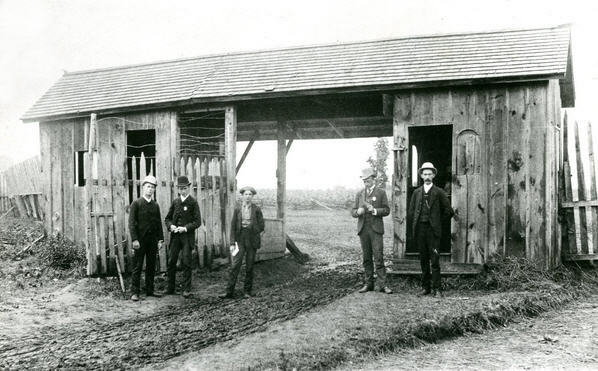
In 1914 over 50,000 people attended the summer session at Chautauqua. With so many guests arriving—many over land from nearby Jamestown and Maywood—Chautauqua had to ensure those guests entered the grounds quickly and efficiently. The entire west border of the grounds—where guests entered from the road—was renovated. The highway was widened and paved with brick. Over time, that brick highway was extended to span the length of the grounds.

In addition, a “handsome new station for the Chautauqua Traction Company” was erected to accommodate a trolley line, along with a “suitable Chautauqua gateway.”

Chautauqua Entrance Gate original gateYou can determine for yourself whether the new entrance gate was “suitable.” Here’s an undated photo of the original entrance gate:

.

.

Chautauqua Entrance GateAnd this photo shows the new entrance gate shortly after it opened. The new gate is still in use today.

.

In 1914 Chautauqua Institution grew, adapted and expanded; and changed the entire physical front it presented to the world.

New Free Read: Sidney Martin’s Christmas

Image of the cover for Sidney Martin's ChristmasHere’s a charming Christmas short story for boys and girls of all ages.

For the first time in his young life, Sidney Martin must spend Christmas alone in the big city. How he wishes he could see his family and share in their spirit of Christmas! Instead, he must spend the long day alone, doing nothing in particular and mattering to no one.

But an odd circumstance may help Sidney realize that the spirit of Christmas is alive in his heart, after all.

Click on the book cover to begin reading Isabella Alden’s 1879 short story, Sidney Martin’s Christmas.

You can find more Isabella Alden free reads by clicking on the Free Reads tab above.

Do You Speak Pansy?

Image of woman in gown and shawl holding an open bookIsabella Alden sometimes used terms or phrases that were common at the time, but have since gone out of use . . . and today’s readers may not have a clue what she means.

On this blog you can now easily find posts that explain some of those words and phrases. Under the Categories list on the right you’ll  see a new category for Pansy’s Dictionary. Follow the link to read blog posts that define peculiar words in Isabella’s books. Here are some of the terms we’ve already defined:

Have you come across a word or phrase in Isabella’s books that stumped you? Share it using the comment section below and we’ll define the term in future posts. You’ll be speaking fluent Pansy in no time!

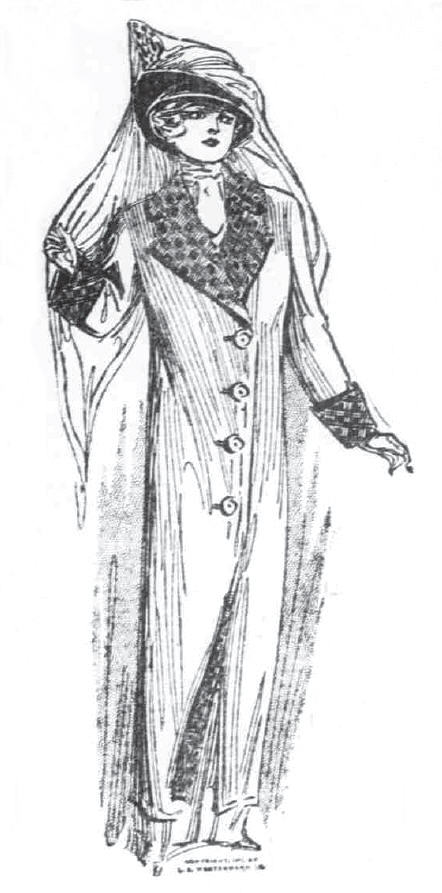
Flossy’s Pongee Coat

Fashion Retailer's newspaper ad for spring coats 1911

In the book Four Mothers at Chautauqua a certain pongee coat played an important role in the story. It was because of the pongee coat that Miss Hazel Harris met handsome Burnham Roberts. It was the pongee coat that made Burnham’s mother, Flossy Roberts, realize how much Hazel’s family neglected her. And it was gossip about Hazel wearing the pongee coat that set off a fearful argument between Hazel and her aunt.

Ladies Coat Styles for Summer 1911So what, exactly, is a pongee coat? And what was so special about that coat that everyone in the story seemed to notice it?

When the book was published in 1913, pongee coats were very popular, although not everyone could afford to own one. In those days women’s coats were made out of many different fabrics: serge and wool tweed were staples in cool weather; taffeta and linen in warmer months.

But in summer, when days were warm and nights were only slightly cooler, ladies needed their coats to not only ward off potential chills, but to protect their gowns, skirts and blouses from soiling.

Pongee coat style in 1911So in summer, women’s coats had to be serviceable but light-weight and cool. Linen and taffeta were, for a long time, the fabrics of choice for summer coats; but about 1903 the fashionable world rediscovered pongee, a type of silk that originated in Shantung China over 3500 years ago.

Pongee silk was a favorite for summer wear because it was cool, soft to the touch, long-wearing, and could be bought in varying weights.

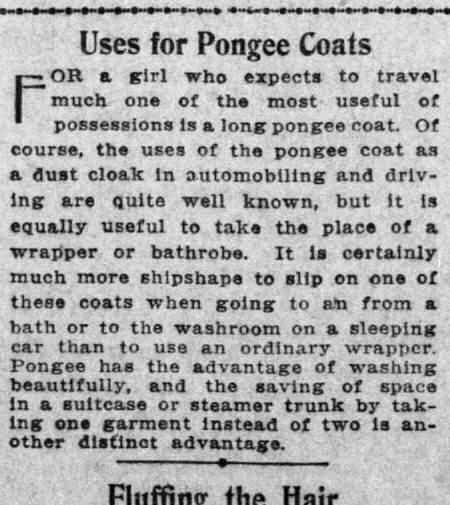
Pongee had one other advantage as a summer fabric . . . it was washable. Unlike taffeta and linen, pongee silk could go right into the laundry tub.

Ivory Soap ad 1920
Ivory Soap Flakes included pongee in its list of washable fabrics in this 1920 ad.

An expensive silk that could also be laundered was a fashion game-changer in the early 1900s. By 1905 dressmakers and garment manufacturers had integrated the fabric into their summer designs.

Click on this image to read the full fashion page from the March 20, 1910 edition of the Omaha Sunday Bee.

Pongee’s natural color was a soft ecru, which was very much in vogue; but once a reliable method for dying pongee silk was developed, the fabric could be bought in every imaginable color.

Pongee Coat Style in 1911It was also available in varying weights, which meant it could be used in making everything from light-weight blouses and dresses, to parasols, belts and gloves.

It was flexible enough to lend itself to tiny “pinch-tuck” details, and sturdy enough (in medium and heavier weights) to pleat nicely in skirts and tailored jackets.

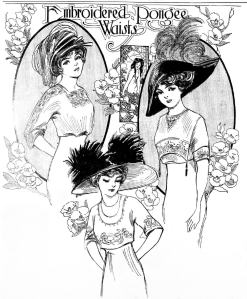
Click on the image to read the full fashion article about embroidered pongee shirtwaists in a 1911 edition of The Washington Herald.

The fabric was even used to make hats. Pongee silk held shapes well; in lighter weights it was perfect for the layered scarf look so popular in driving hats.

Click on the image to read the full-page article from a 1911 edition of The Washington Herald.

Budget-minded consumers may have made do with shirtwaists and dresses made of gingham (which cost about 6 cents a yard) or cotton muslin (8 cents a yard). But if you wanted your summer clothes to be made of finer fabrics, you had to pay for it.

Article from The San Francisco Call, August 29, 1909.
Article from The San Francisco Call, August 29, 1909. Click on the image to see a larger version.

Prices for pongee silk varied widely. American-made pongee in natural ecru ran about 70 to 80 cents a yard.

By comparison, genuine heavy Chinese pongee suitable for making coats cost $2.00 or more per yard.

Pongee was available in colors, but dyed pongee cost much more than the natural ecru color. Lighter weights of pongee silk also cost more, and they were highly desired because they were used to tailor gowns and shirtwaists.

.

Click on the image to read the full fashion article from the May 26, 1907 edition of The Evening Star.

That may explain why Flossy’s pongee coat was so eye-catching. Flossy lent her coat to Hazel Harris because Hazel had nothing to wear for a drive out in Flossy’s carriage. Flossy convinced Hazel to wear her long pongee coat so it would cover Hazel’s cheap and ragged clothes.

A gossip remembered seeing Hazel riding in Flossy’s carriage because Hazel’s coat caught her eye:

“I confess that I stared, especially at her lovely coat; it attracted me almost as much as her face.”

“Her ‘lovely coat’!” repeated Josephine, dazed.

“Yes, she had on a perfectly beautiful coat, heavily embroidered. I don’t think I ever saw a handsomer one. I am very fond of pongee.”

Hazel herself described the coat as a “beautiful coat that fitted her to perfection.”

But generous Flossy believed that it was Hazel who made the coat beautiful:

“She looked lovely in it,” Mrs. Roberts said, thoughtfully. “I didn’t know it was so pretty until I saw it on her.”

A heavily embroidered, colored pongee coat, tailored so it fit close to the body, would have been extravagantly expensive in 1913, and Marion Dennis mentioned that Flossy’s coat cost $30. Compare that with the prices of pongee coats in this ad from a 1910 edition of the Omaha Daily Bee newspaper (click on the image to see a larger version):

Ad for Pongee Coats from the Omaha Daily Bee, June 19 1910

Flossy described the moment when the carriage ride came to an end and Hazel had to take the pongee coat off:

“She slipped the coat off in the quietest way as we turned the corner into Terrace Avenue and patted it lovingly as she laid it on the seat and said to it—not to me, mind you, but to it—’Thank you, darling; you are beautiful and I have worn you for two whole hours. I shall never forget you.’ Wasn’t that original and pathetic? She is certainly a very interesting girl. I am quite determined to know more of her.”

And Flossy did get to know Hazel quite well; and since Four Mothers at Chautauqua had a very happy ending, it’s entirely possible that Hazel was one day able to own a pongee coat of her very own.


Now Available: Docia’s Journal

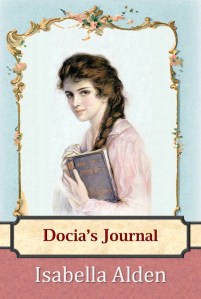
Cover image for Docia's JournalDocia’s Journal is now available!

Docia Myers just received the best birthday gift a girl could get: a new journal of her very own. Now, if only something exciting would happen in her life to write about!

In due course, wonderful things happen for Docia as she grows to womanhood in the care of her loving Christian family. But Docia is not a Christian, and her resistance to accept Christ as her Savior and Friend perplexes everyone around her—until God uses a series of events to reveal to Docia just how much more blessed her life can be when she chooses to walk with Him.

This edition of the 1874 classic Christian novel includes a biography of the author and additional bonus content.

Follow this link to download Docia’s Journal for your Kindle, PC, Mac or mobile device.

Click here to read Docia’s Journal on your Nook.