Blog

Advice About Righting the Wrong Marriage Proposal

For many years Isabella had an advice column in a popular Christian magazine. She used the column to answer readers’ concerns—from a Christian perspective—on a variety of topics.

In 1897 she received a surprising letter from a young woman who regretted turning down a marriage proposal.

Here is the letter:

Suppose a gentleman had proposed marriage to a lady by letter, although he lived in the same town with her, and she, vexed at this, had simply returned the letter without other reply. Yet suppose that she loved the man, and believed him in every way worthy. What could she do to right matters?

Illustration of letter envelopes with wax seals on the flaps and hand-written "For You" on the front of one, against a background of a quill feather pen and small blue flowers.

Here is Isabella’s reply:

Yours is an extremely difficult question to answer. If I were the gentleman, it would take a good deal to “right matters.”

I am simply amazed at the number of young women who seem to be interested in a question of this kind. Why, in the name of common sense, should not a gentleman propose marriage by letter if that method suits him best? Certainly there is no discourtesy in such a letter. If he felt that in the quiet of his own room he could express the thought and desire of his heart better than he could by speech, the probabilities are that he is a thoughtful, earnest, sensible man. For such a man to condone the discourtesy of returning him his honest letter without other answer would, I should think, be very difficult.

A young couple stands near an outdoor bench. She is facing away from him, looking angry with her nose in the air. He looks down at the ground, dejected.

Honestly, the possibilities are that he would decide that he had been mistaken in the character of the lady, and had made a narrow escape.

It is all very well to cultivate dignity and a certain fine self-respect; every true woman, even though she be quite young, should be enveloped by these as with a garment; but there is in some natures a tendency to let these degenerate until the persons become—what shall I say? Finical? Over nice? Neither of these quite covers the thought, but perhaps you understand me.

A young man tips his hat to a young woman who looks annoyed.

Do you not know people who seem to be on the watch for something at which to take offence, people who will not hesitate to stab the deepest feelings of their dearest friends because of some fancied slight or discourtesy?  I know young ladies who pride themselves upon their extreme sensitiveness in such directions, and seem to think that they are made of finer grain than others, when the fact is that there is really no trait easier to cultivate. To think much about one’s self, and to imagine that others do not think enough about us, seems to be first, instead of second, nature to many.

Now, after this lengthy digression, let me try to answer the question, “What can be done to right matters?”

A young couple sits outside on a fence rail, facing away from each other as if they have had a disagreement.

My dear, if you are really a sincere, self-respecting girl, and the gentleman has the character that you ascribe to him, write him a letter stating frankly that you unwittingly insulted him; that you are ashamed of yourself, and want to be forgiven. That may “right matters” in your individual case, and it may not. It depends on whether the gentleman is high-minded and unselfish, and so deeply attached to you that he is able to overlook your faults.


Oh, dear! Isabella wasn’t very sympathetic to the young lady’s plight, was she?

Do you think Isabella gave her good advice?

How would you react if you received a marriage proposal by mail?

New Free Read: A Long Christmas

Last week’s post was about some of the ways Isabella’s encouraged readers to “remember the poor always, but especially at Christmas.” Our December free read continues that theme.

“A Long Christmas” is a short story Isabella wrote in 1891 about a group of children—all cousins in the same family—who discovered their enjoyment of Christmas lasted much longer when they focused on giving instead of getting.

“We have everything imaginable already. We need Christmas presents less than any young folks in the kingdom, I suppose.” That’s what sixteen year old Holly tells his cousins when they gather together on Christmas morning, and his cousins agree! But which child should receive the cousins’ unwanted toys and books?

Cover of "A Long Christmas" showing a man and dog outside a small cabin, with tall pine trees covered in snow and a mountain peak in the background.

You can read “A Long Christmas” for free!

Choose the reading option you like best:

You can read the story on your computer, phone, iPad, Kindle, or other electronic device. Just click here to download your preferred format from BookFunnel.com.

Or you can select BookFunnel’s “Read on My Computer” option to print the story and share it with friends.

Making Christmas Bright

Isabella Alden knew all about the Christmas shopping season. She had a large extended family, and she either bought or made gifts for each family member.

Her niece, author Grace Livingston Hill, recalled what it was like when the Aldens, Livingstons, and Macdonalds got together:

Our Christmases were happy, thrilling times. There were many presents, nearly all of them quite inexpensive, most of them home-made, occupying spare time for weeks beforehand; occasionally a luxury, but more often a necessity; not any of the expensive nothings that spell Christmas for most people today.

Isabella—being a clever and creative person—made many of the gifts she gave.

Sometimes she got gift-making ideas from magazines. She subscribed to The Ladies’ Home Journal and Harper’s Bazar, both of which regularly printed directions for making items to use or give as gifts. Sometimes she passed those ideas and directions on to her own readers.

For example, an 1898 issue of The Ladies’ Home Journal published instructions for making this pretty wall pocket:

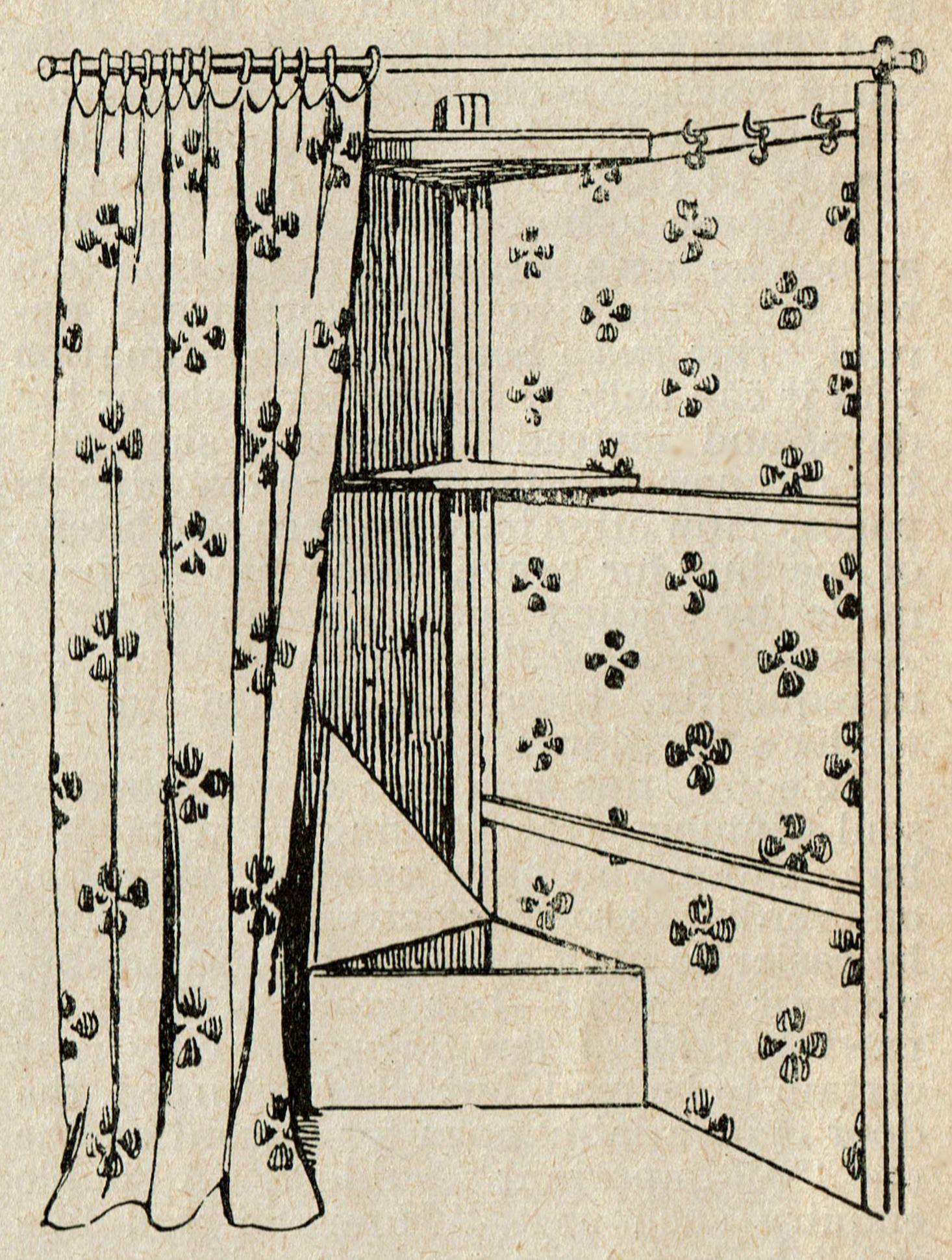
Drawing of a wall pocket made of a long board or cardboard. At one end is a ribbon so it can be hung vertically on the wall. Spaced evenly down the board are three fabric pockets decorated with different trims.

Isabella liked the idea so much, she wrote simplified instructions that children could follow and printed them in an issue of The Pansy magazine. She told her readers how to make the wall pocket from pine board, calico, buttons, and felt, and hinted it would make a lovely gift “for mamma.” She wrote:

I get the idea and most of the details from Harper’s Bazar. The article from which they are taken says the contrivance is for an invalid, but let me assure you that mamma will like it very much, or, for the matter of that, papa also.

At Christmas she encouraged boys and girls to make gifts not only for family members and friends, but for strangers, too. She wrote this to readers of The Pansy magazine:

How many Pansies are planning the Christmas gifts they will make? In all the merry bustle and happy, loving thoughts, don’t forget to throw a bit of kindly cheer into those poor little lives darkened by distress and want.

If every member of The Pansy Society would make some little gift as a loving reminder to one who otherwise would have none, how many children, think you, would be made happy?

Remember, you do it “For Jesus’ sake.”

There were instructions for making this simple knitting bag, made of fabric, ribbon, and embroidery hoops:

Illustration of a cloth bag made with hoops for handles.

And this case, made from pieces of cardboard and colored ribbons, to hold photos, greeting cards, or pictures cut from magazines.

Drawing of a "case for Christmas cards." Made of square cardboard, it has a photo pasted in the center. It is bound on the left with pieces of ribbon and tied on the right to keep it closed.

She wrote:

What a delightful present that will be when you get it done! I can imagine an ingenious girl and boy putting their heads together, and making many variations which would be a comfort to the fortunate owner.

Isabella always knew how to give those gentle reminders that children (and adults!) sometimes need about the true spirit of Christmas.

Isabella Alden quote: Remember the poor always, but especially at Christmas. It is the kind of giving which our Lord, the Gift of gifts, would most approve.

What is your favorite way to share the message of Christmas with people in need?

Have you ever made a Christmas gift for someone? How was it received?

“Real” Lace

“Look, mamma, this is the lace I want; just the right pattern,” said Eva Dunlap in Isabella’s short story, “Mrs. Dunlap’s Commentary.”

“Is it real?”asked Mrs. Dunlap, bending over it with anxious eyes.

1912 illustration of a lady examining lace collars in a store as a sales clerk looks on.

“That is what I don’t know,” said the daughter, lowering her voice. “I wonder if Mrs. Stuart is a judge?”

On being appealed to, Mrs. Stuart came forward and bent over the lace with careful gaze. “It is really quite impossible to tell;” she said at last. “The imitations are so very perfect, nowadays; I have to judge by the price of the article. Do you want real?”

“Oh, yes indeed!” chorused mother and daughter, emphatically.

“Well I buy the imitation, nowadays; it is just as good, and no one can tell them apart.”

“I won’t have imitation,” said Miss Eva, with decision.

“I never buy imitation,” said her mother, with firmness. “I dislike shams of any sort. I take real things or none.”

The Stuarts, mother and daughter looked at each other, and directly they were on the street they said, “How awfully extravagant the Dunlaps are! I don’t see how Mr. Dunlap endures the drain.”

And said the mother: “I don’t see how a Christian woman can think it is right to spend so much on things; the idea that she won’t wear anything but real lace—and she can’t tell it from the imitation—that is nothing but pride. I don’t understand how Christians justify themselves in these things.” There was actually an undertone of complaisance that she, at least, was not a Christian.

Old photo of young woman in dark dress with white lace at cuffs and throat.

In Isabella’s world, when people mentioned “real lace” they meant hand-made lace. Skilled lace makers used fine threads to create delicate motifs—such as flowers, leaves, animals, urns, and even people—in their designs.

1894 Illustration of a woman making lace as she sits in a chair and refers to an instruction book open on a table beside her.

But machine-made lace was also available (and had been for over one hundred years). As Mrs. Stuart said in the excerpt above, it was difficult to tell machine-made laces from “real” hand-made laces, but a sharp eye could tell the difference.

old photo of a woman in dark clothing  At her throat is a bow with lace, secured with a small brooch.

One hint was the feel of the lace. Hand-made lace had texture; there was a rise and fall to the stitches, while machine lace felt flat when you ran your fingers across it.

The stitches were another tell; machine lace could unravel because large areas were made from one continuous thread. 

Photo of a woman wearing a shirtwaist made of lace.

Unlike Mrs. Dunlap, Mrs. Solomon Smith (in Mrs. Solomon Smith Looking On) was something of an expert when it came to lace. She had a keen eye and knew the value of a dollar. But when she attended her niece’s wedding in the big city, she went shopping in a department store for the first time, where she found herself dealing with a less-than-honest sales clerk when she tried to buy “real lace:”

[He was] showing me cotton laces of half a dozen kinds, and imitation laces, calling this machine-made stuff ‘real Valenciennes,’ and this cotton imitation ‘real Spanish lace,’ until I got out of all sort of patience with him, and says I, at last, ‘I don’t bear you no ill-will, but for your own sake, if I was you, I would get out of this habit of telling lies. Now I knew real lace of almost every kind you can think of long before you was born, and it is real lace and no other that I’m after, and if you’ve got any I’d like to see it.’

Photo of a young woman wearing a shirtwaist with lace trim on the bodice, neckline and sleeves.

In Household Puzzles, another one of Isabella’s novels, Helen Randolph’s love of fine things was well documented. Helen insisted  upon buying only the most expensive trims and “real lace” for her gowns, even if it meant her family had to go without basic necessities.

But on the eve of her wedding day Helen read a Bible verse that made her realize how wrong she had been to value earthly possessions:

“Whereas ye know not what shall be on the morrow. For what is your life? It is even a vapor that appeareth for a little time, and then vanisheth away.”

She closed the book suddenly, and laid it back in its place. If this were all there were of life—a vapor—of what use were lavender silks and real lace, after all?”

Photo of a young woman wearing a gown of lace.

In each of these passages from Isabella’s books, she used “real lace” as a way to show readers her characters’ personalities and priorities, and to illustrate Christian life lessons.

What lesson do you think Isabella intended readers to learn when she wrote the exchange between the Dunlaps and the Stuarts? On the surface, she might have wanted to illustrate the Dunlap women’s love for finery, and the Stuart women’s more practical approach to shopping.

Or maybe she wanted to show that Mrs. Dunlap took a strong stand for truth, not realizing that her behavior could be interpreted as extravagant and proud by others.

Old photo of a woman wearing a gown with a lace wrapper; she also wears a wide-brimmed hat trimmed with lace.

In the scene with Mrs. Solomon Smith, she may have wanted to show how wrong it is to judge a person based on their appearance. Or maybe she wanted to show that everyone is deserving of respect and kindness.

That’s the beauty of Isabella Alden’s novels; her stories always give readers something to think about. And the lessons her characters learn make us examine our own actions.

Is there an Isabella Alden story that made you pause and reflect on your own behavior?

Has one of her stories made you think of changes you can make in your own life?

By the way, Isabella mentioned “real lace” in these stories, too:

  • Doris Farrand’s Vocation
  • Ester Ried
  • Julia Ried
  • Household Puzzles
  • Modern Prophets
  • Only Ten Cents
  • The Hall in the Grove
  • The Pocket Measure
  • Wise and Otherwise
  • Workers Together; An Endless Chain

Advice to Readers about Shortcomings

For many years Isabella wrote a popular advice column for a Christian magazine in which she answered readers’ letters about their problems and concerns.

In 1912 she received a letter from a very disappointed person who signed her letter, “Honest.”

Here is the letter:

I don’t know as there is any sense in my writing to you, but I kind of want to talk to somebody. I’m pretty near discouraged, and that’s the truth. And of all things to be discouraged about it’s religion. Isn’t that dreadful?

Folks disappoint me so! There isn’t anybody half as good as I thought they were; nor one-quarter as good as they ought to be, considering what they profess.

There’s a man here that I used to think was too good for earth, and I’ve found out he’s got an awful temper. And another man that they boast about being excellent is almost too stingy to eat his own dinner. And so it goes—everybody disappointing; and I’m disappointed in myself, too; maybe that’s the worst or it.

It seems as though religion has gone back on us, somehow, or we would all be different. What do you honestly think about it? I’m not “young people,” but I have lots to do with young folks and they disappoint me fully as much as the older ones.

Honest.

Here is Isabella’s reply:

I am especially glad to receive this honest letter just at this time. I wish very much that you could all have been at the devotional service this morning in the great amphitheater or the New York Chautauqua, and heard President Frost, of Berea College, Kentucky, on “Good People’s Shortcomings.” It was so entirely in line with your experience, and so helpful. I wonder if I can tell you enough about it to pass on the helpfulness?

His Bible illustrations interested me; they were in a line of which I had never thought before. For instance, there was Terah, who started to go with his family to Canaan, pulled up stakes and got out of the old home, and on his way to the new. But he found a pleasant place to stay, and tarried.

And they departed together from Ur to the Chaldeans to go to the land of Canaan; and they went as far as Haran and settled there. Genesis 11:31.

He meant to go on; he fully meant to. He thought about it quite often; but what is the record?

“And Terah died in Haran.”

Isn’t it a striking analogy? So many of us, having started for the promised land, tarry by the way, are willing to do so, feed ourselves on good resolutions and let the days slip by, not getting on an inch. Doesn’t that account for some of your disappointment?

Then read the story of Azariah. He “did that which was right in the eyes of Jehovah.” Ah, doesn’t that sound well? It encourages us; but just read on. There is a “howbeit”’ in his record.

“Howbeit the high places were not taken away.”

He did well, in most things, even in the sight of God; but he didn’t reach up to his opportunities. He left those idolatrous high places standing, to lead the people astray.

Howbeit the high places were not taken away, and the people still sacrificed and burned incense on the high places. 2 Kings 1:4.

Then there was Noah, the famous ark builder, so remarkable for his exact and persistent obedience that he stands out in history as an example, and was given the rainbow for a pledge that God would have him in remembrance. Yet, read in Genesis of Noah’s sad lapse into sin. The truth is told plainly: Noah began to be drunken.

And he drank of the wine, and was drunken. Genesis 9:21.

That final record of human weakness and imperfection stands; it must have been for a purpose.

Now, come over to the New Testament and see those two friends — Nicodemus and Joseph of Aramathea — creep out of the shadow to minister to the body of Jesus the crucified. They must have been good men, great men, admirable men in character. In fact, we know that they were. But how much more we could have thought of them if they had not followed him secretly!

And there came also Nicodemus, which at the first came to Jesus by night, and brought a mixture of myrrh and aloes. John 19:39.

So we might go on indefinitely, always finding a “howbeit” or a “but” in the record.

Suppose we were to write a few chapters of the Bible ourselves, this morning? About Deacon Justice, and Elder Earnest, and Mistress Lofty, and Miss Tearful. Good, honest, sympathetic, devoted, “but” ….

The fact is, we are all strung up on disjunctive sentences, every one of us.

The record of imperfection, failure, missing the mark, lapsing into sin, was all made for a purpose. What was that purpose? Certainly not to discourage us. Wasn’t it, rather, the contrary? Even those who walked with God failed or fell short. They need not have done so, but they did. Search where we may, we find one perfect Pattern only. Was not this record made to give us courage to try forever to measure up to it?

It is pleasant and helpful to find the people who are traveling with us gaining in strength, in courage, in self-control, in all the graces that we need for the journey; but, after all, we need but one perfect Leader. If we keep our eyes fixed upon him, we need not stumble, even though those just ahead of us do.

It is no wonder we are disappointed with ourselves. We ought to be, but not to the point of giving up or of laying the blame on others. Our lapses should simply drive us closer to the Guide who has promised, someday, to present us to his Father “without spot or wrinkle, or any such thing,” and to cultivate a living faith that “what he has promised he is able also to perform.”

That he might present it to himself a glorious church, not having spot, or wrinkle, or any such thing. Ephesians 5:27.

This will keep us from discouragement, and help us each day to grow more sure that, while we are none of us by any means what we might be, it is not “religion” that has “gone back on us,” but our own weak following.

As for our “professions,” what do we profess, my friend, but that we are sinners, trusting in the redemption that is in Christ Jesus to save us and pledged to look to him for daily grace to help us follow closely?

Be sure that he will do his part; let us begin anew each morning and try hard at ours.


What do you think of the advice Isabella gave?

Do you think Isabella’s advice helped give “Honest” a different perspective?  

New Free Reads about the Mackenzies

Isabella’s writing career was launched when her best friend Theodosia Toll Foster entered one of Isabella’s stories in a contest, and it won! (Read more about it here).

Theodosia began her own writing career years later. When she was 34 years old her husband died, leaving her with a toddler son and a second baby on the way. Theodosia had to find a means of supporting her family, and writing provided the answer.

Under her pen name, Faye Huntington, Theodosia co-authored novels with Isabella, and regularly contributed to The Pansy and other Christian magazines.

She also wrote full-length novels, some of which can still be found today, but because the majority of her novels were published as pamphlets in the late 1800s, very few have survived over the years. However …

Two of her most popular books were about the Mackenzie family and you can read both books for free!

Book 1: Mr. Mackenzie’s Answer

When Miss Marvie Anderson first saw Mr. Mackenzie at a prayer meeting, she thought, “What a saintly man!” But after staying in Mr. Mackenzie’s home as the guest of his daughter Delia, Marvie doesn’t know what to think! How can a man who prays with such fervor and devotion be so inconsistent when it comes setting a Christian example in his daily life?

Raised by her minister father, Marvie thought she knew how to lead a Christian life; but as her visit continues, she finds herself succumbing to Mr. Mackenzie’s influence, and leaving her own Christian upbringing behind.

Click here to go to BookFunnel and read Mr. Mackenzie’s Answer. You can download it to your computer, phone, tablet, Kindle or other electronic device. Or choose “Read on My Computer” to print the story as a PDF to read and share with friends.

Book 2: Ripley Parsonage

At Ripley Parsonage, the Reverend Mr. Anderson works earnestly for his flock and for the town, even as he leads the local temperance cause with unfailing devotion. He has seen first-hand the wreck alcohol can make in the lives of his congregation and community; little wonder, then, that his most constant prayer is that the town elders will come to their senses and vote for prohibition.

But Mr. Anderson has other worries, too, especially for his daughter, Marvie. He’s not certain what the future may hold for her and her two best friends: Delia Mackenzie, the society girl who tries so hard to live a Christian life despite her own father’s disapproval; and Tina Stevens, the quiet infidel who was taught at an early age to disbelieve anything related to the Bible.

In this 1877 sequel to Mr. Mackenzie’s Answer, Mr. Anderson’s faith and devotion are brought to a head that will test one of the very foundations of his religion: the sacred communion service.

Click here to go to BookFunnel to download the book in the format you like best.

High Spirits and Halloween

Today we think of Halloween as a children’s holiday, but in Isabella’s lifetime, celebrations of All Hallow’s Eve focused primarily on teens and adults.

Hay rides, parties, and church socials gave single men and women a chance to mix and mingle and, perhaps, meet the special someone they would eventually marry.

Under the watchful eye of trusted chaperones guests played traditional games that centered around romance and love, fate and fortune.

That was exactly the kind of party Sarah Thompson wanted to attend in By Way of the Wilderness.

As a young school teacher Sarah dedicated her life to educating the children in her small town. Although she very much wanted to attend the Halloween party, she found herself forgotten by her neighbors:

They grew to admiring Sarah, being proud of her, boasting of her among themselves, and letting her alone. The first time they seemed actually to forget to invite her to a Halloween frolic, she cried a little. She had not been to any of the neighborhood gatherings for months, she had been so busy; but to be forgotten!

Why was the party so important to Sarah? Perhaps it was because she had fallen in love with Wayne Pierson, the story’s protagonist. The games that were played at Halloween parties in 1900 (when the book was published) might have helped her figure out if Wayne felt the same way about her.

One of the games that might have been played was a variation of bobbing for apples, where the names of the party-goers were scratched into apples before they were placed in separate tubs of water (boys’ names in one tub; girls’ in the other). The apple each guest caught—without using their hands, of course—would name his or her true love.

Sometimes they hung an apple from the ceiling or door frame, and balanced it with a lighted candle. The first person to catch the apple in their mouth (without getting singed by the flame!) would be the first to marry.

In another traditional game a young woman who wanted to know her future husband’s name had to be handy with a knife.

If she could peel an apple or orange in a single, long, winding strip and toss it over her shoulder, the peel would land on the floor in the form of the initial of the man she was to marry.

Players also used walnuts to guess the names of their spouse to be. After writing the names of the guests on walnuts, each person took turns throwing two walnuts into the fire. The walnut shell that cracked first from the heat signified the name of the person they’d marry.

When it came time to serve refreshments, party guests gathered to slice the Halloween cake, which was baked with charms in it. A guest who got a slice of cake with a coin in it could expect a life of wealth; a key meant travel; and a doll meant children. Of course, a ring found in a slice of cake always meant marriage.

Another game was “Bowls of Fate,” where three bowls were filled with colored water: red for good fortune, blue for a trip across the water, and clear for an upcoming honor. Blindfolded guests took turns dipping a hand in one of the bowls (which were rearranged after each person) to learn what their future held.

In other games, mirrors and candles served as props. One variation was for women with strong wills; they walked down the cellar steps backward, with a mouthful of salt, a candle in one hand, and a mirror in the other. If she performed the ritual correctly, the young woman should see the image of her future husband over her shoulder in the glass.

In a variation, at the stroke of midnight a young woman or man had to go to their bedroom with a candle and mirror. If they held both objects correctly and at the right angle, they would see the face of the person they’d marry.

With so many traditional games to play on Halloween, it was no wonder Sarah Thompson was disappointed to realize she would not be attending any Halloween parties.

If you’d like to know if Wayne Pierson ever returned Sarah’s love, you can read By Way of the Wilderness by clicking here. No candles or mirrors required!

Have you ever bobbed for apples or played a variation of any of these Halloween games?

Character Sketches of Grace Livingston Hill and Her Husband

As a popular author, Isabella received plenty of publicity and media coverage, and she was probably used to seeing her name in print.

In 1893 her niece, Grace Livingston Hill was just beginning to garner some publicity of her own. A few of Grace’s stories had been published in magazines, including The Pansy, so she was already building a following of loyal readers.

Then, in April 1893, the following article about Grace appeared in a Christian magazine:


THE REVEREND AND MRS. FRANKLIN HILL

Pansy’s niece, Grace Livingston (now Mrs. Franklin Hill) has perhaps almost as warm a corner in the hearts of our readers as their older friend “Pansy,” and therefore we are glad to give the photographs of herself and her husband. Mr. Hill. [He] is pastor of a flourishing church in one of the suburbs of Pittsburgh, Pennsylvania—a young man of noble character and fine intellectual gifts.

To quote from a paper giving an account of their recent marriage:

“When two souls such as these, energetic, consecrated, and peculiarly gifted, unite their lives and aims, there is promise of much good work for the Master.”

Doubtless thousands who never saw Grace Livingston’s face, feel acquainted with her, and really are acquainted with her through her writings, for a true author’s true self goes into her works. She has a bright and charming style, which reminds one of that of her aunt, Mrs. Alden (“Pansy”), and of her mother, Mrs. C. L. Livingston, who is often a collaborator with Mrs. Alden.

Mrs. Hill is not an imitator, however, or an echo of anyone else, but has a genuine style and literary character of her own. She is, moreover, much more than a mere writer. The daughter of a Presbyterian Minister, trained from her earliest days to work for the Master, she has thrown herself enthusiastically into His service.

“She has,” writes a friend, “a passion for soul-saving, and will not give up a bad boy when all others do, but pleads with him, and prays, and has patience, and often has the joy of reward, in the changed character of boys who will remember her gratefully through life. She sometimes gathers about her on Sabbath afternoons a group of older boys, and leads them on to discuss Christian evidences and the moral questions of the day, amusements, etc. On these subjects she takes high ground, setting them to search for the opinions of master minds in religious thought, and to learn what Scripture teaches on the themes under discussion. This will go on for months, each of the informal meetings delightful to the boys.”
The work of the Christian Endeavor Society is very near her heart, and she has given much time and strength to it, as her writings prove. Of late she has been especially identified with the Chautauqua Christian Endeavor reading course, whose success in the future will be largely due to her energy. While in Chautauqua during the summer, she spends much of her time in promoting the interests of the Chautauqua Christian Endeavor Society.

How can we end this brief sketch better than by quoting the words of a friend, who says:

“She loves dearly to have her own way, and yet she is one of those rare characters who knows how to yield her will sweetly for peace sake, and so for Christ’s sake.”


What a lovely article! It gives readers hints of the great work (in addition to her writing) that Grace would accomplish in the years to come.

The article appeared only four months after Grace and Thomas Franklin “Frank” Hill were married. After their marriage they both stayed involved in the Christian Endeavor Society. Together they wrote The Christian Endeavor Hour with Light for the Leader, a guide book that contained lessons and Bible verses CE societies could use in conducting their meetings. The book was published in 1896.

Grace’s “passion for soul-saving” flourished, as well. In later years she established a mission Sunday School for immigrant families in her community. It was just one of the many endeavors Grace undertook that resulted in “good work for the Master.”