Dell Bronson’s Decorating Style

Many of Isabella Alden’s stories were about resourceful women who, seeing a problem, immediately set their minds to finding ways to solve it. For these ladies, no obstacle was too big or too small.

One such heroine was Dell Bronson in The King’s Daughter. After living most of her life in the lap of luxury with a loving aunt and uncle, Dell was suddenly called home to live with her father, who ran a run-down saloon and kept an equally run-down home.

Beauty-loving Dell was dismayed when she first saw the bedroom her father had set aside for her:

In one corner stood a single bedstead, on which was mounted a feather bed, suggestive of a sweltering night, and the finishing touch was a blue and green patchwork quilt put on crooked.

There was … a queer, old-fashioned, twisted-legged table, a square wooden washstand with the paint worn off, and with one leg shorter than the others, so that it tottled whenever it was touched, making a racket over the nicked washbowl and dingy pitcher; three chairs, one a dingy rocker, with a pitiful green and purple cushion on the seat. These completed the furnishing of the room, except, indeed, a faded red and green and yellow carpet, which in its best and brightest days could not have been pretty.

But Dell didn’t spend time dwelling on the shabbiness of her surroundings. Instead, she reminded herself:

“Oh, Dell Bronson, you must not forget that your Father’s house is a palace, and that you are a King’s daughter; never mind the place in which you may have to stay for a little while, just to make your preparations, you know.”

So Dell immediately began making changes in the house that would benefit (and hopefully influence) her father. But at the same time, she began to make a few changes in her own bedroom.

When The King’s Daughter was first published, ladies’ magazines regularly published do-it-yourself articles about decorating on a budget.

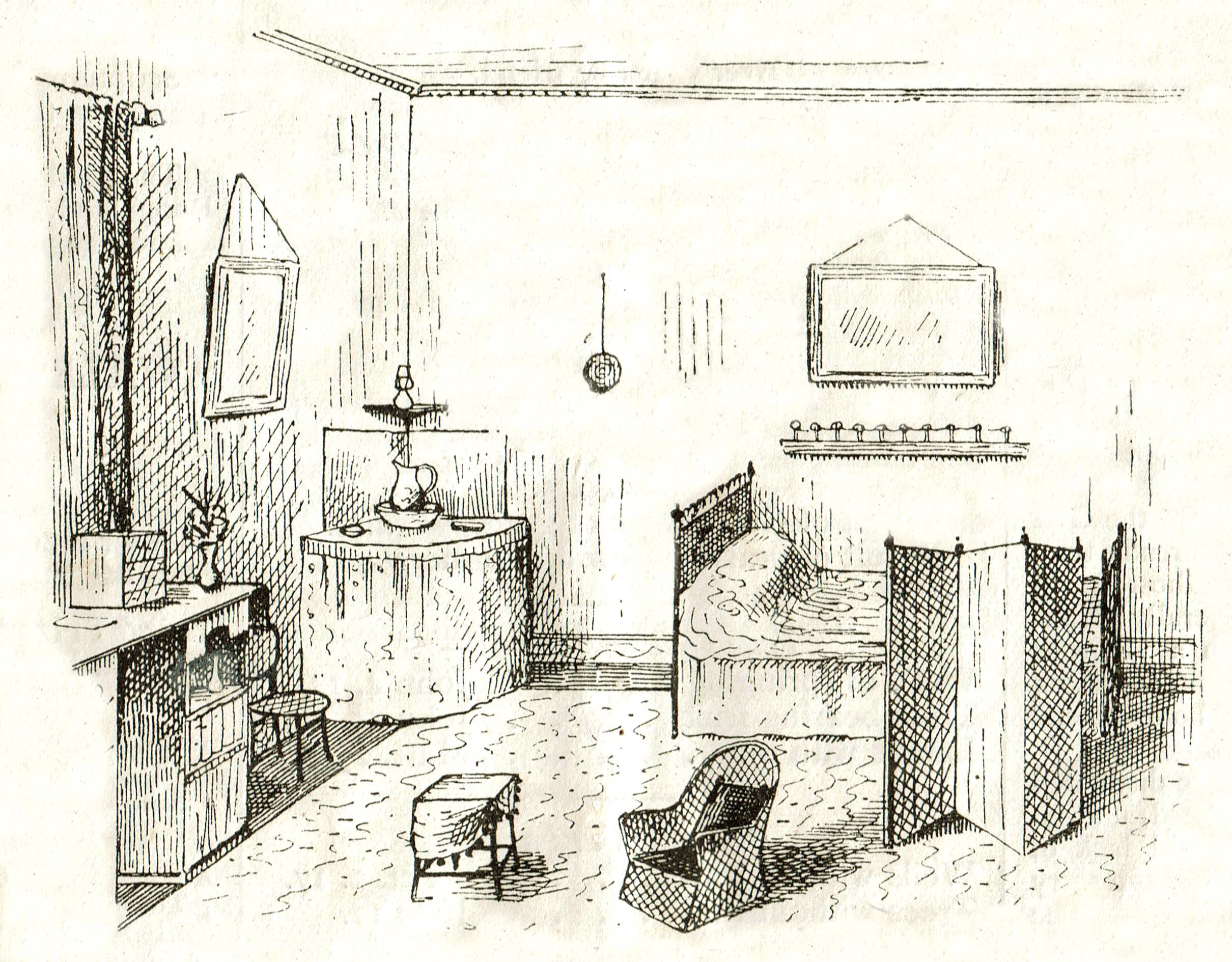
One magazine provided a sample layout for a bedroom, including the best position for a washbowl and pitcher, like the one in Dell’s room:

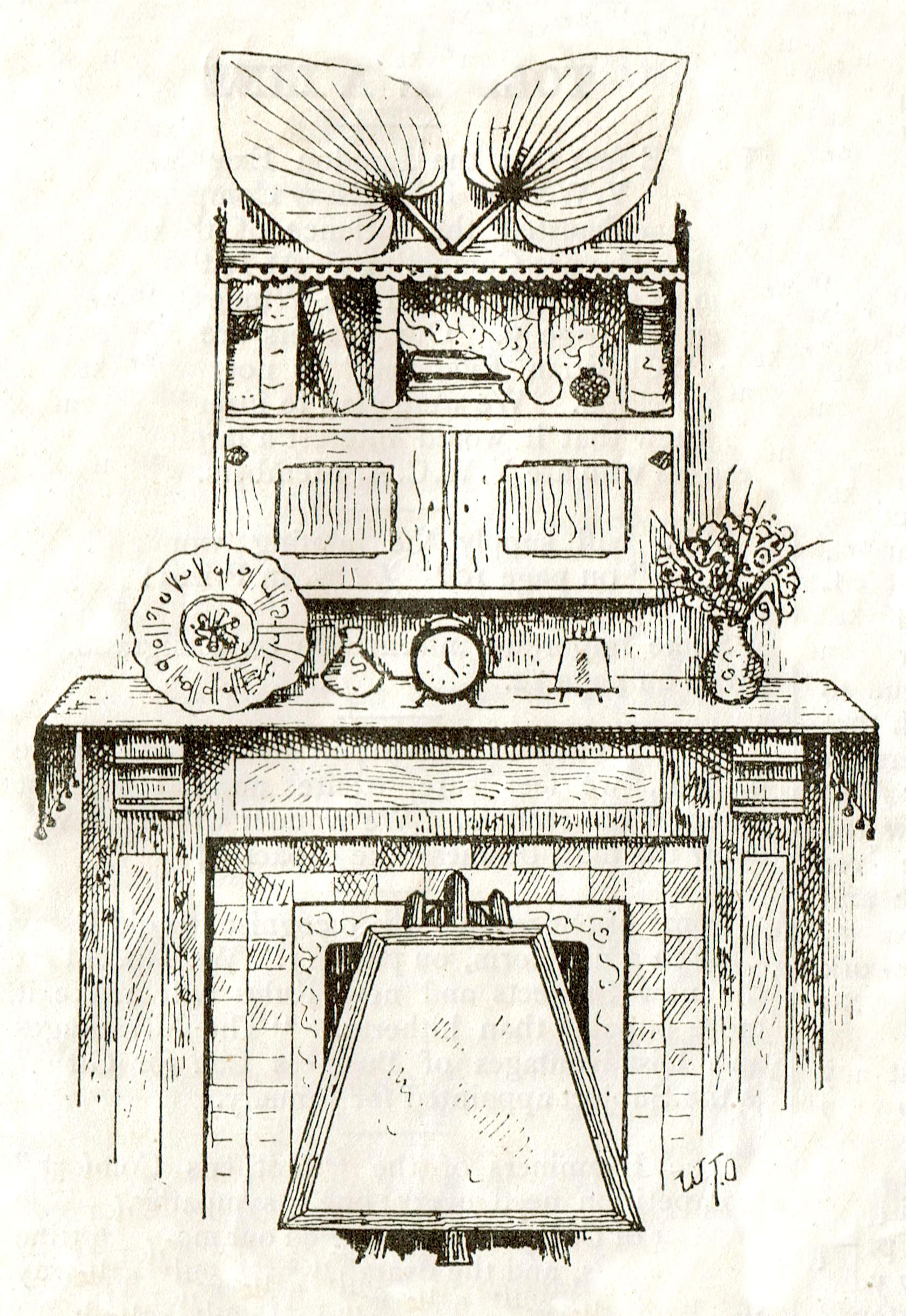
Dell might have had a fireplace in her room to provide warmth in the winter months. One magazine published this design for “an artistic fireplace,” with screen made of cardboard and covered in an embroidered fabric, which could be made for about five cents.

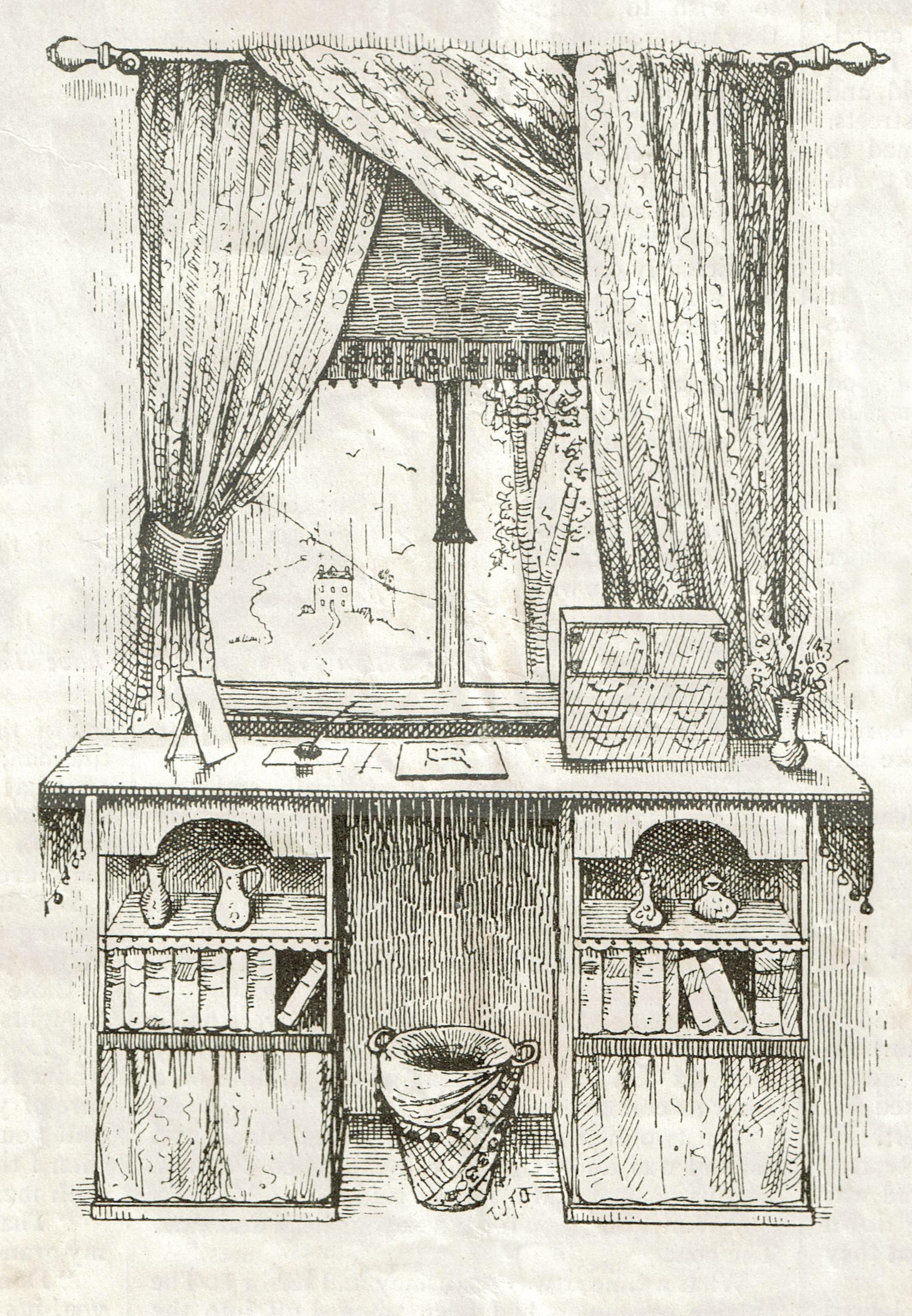
Another magazine suggested making a “writing cabinet” from two small bookcases:


The shaped insert on the bookcases is cut from sturdy cardboard and covered with paper. The magazine also suggests using short pieces of muslin left over from making the curtains to cover the bottom shelves where less-than-dainty items may be stored.

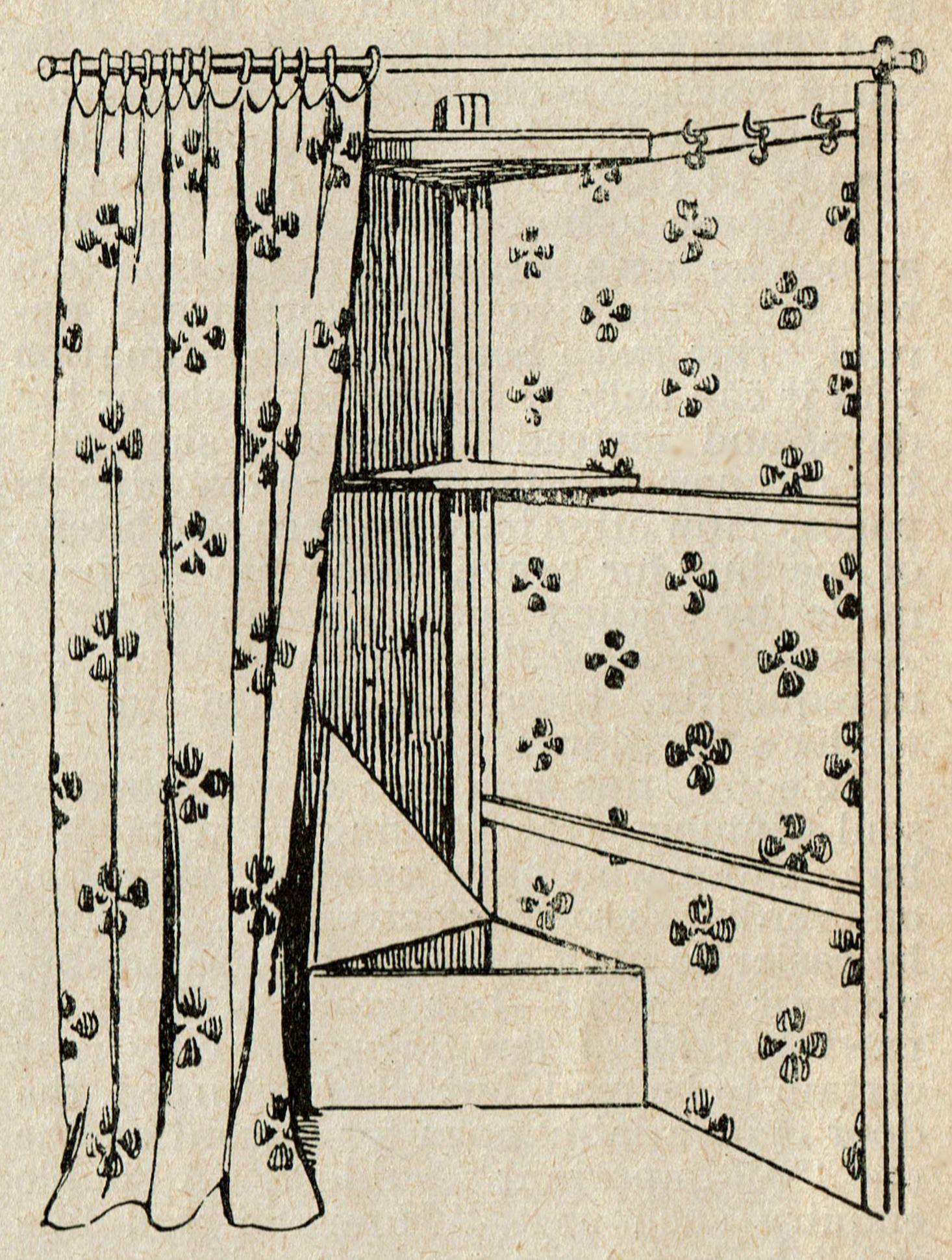
Another magazine reminded young ladies they should not ignore the corners of their rooms, and gave simple instructions for making of a corner closet for storing clothes and shoes:

Resourceful Dell Bronson set about making changes to her plain and somewhat shabby bedroom. Within two weeks:

The blue paper curtains had given place to full white muslin ones, the bed was spread in white, as also was the little toilet table, and many little feminine graceful touches had softened its hard corners, and given it a look of home.

By the end of the story, Dell’s decorating efforts resulted in more than just a pleasant place to live; the lovely rooms she created helped influence her father and several townspeople to make positive changes in their lives.

Have you read The King’s Daughter? You can learn more about the book here.

Do you like do-it-yourself decorating projects? Where do you get your ideas?

What’s the best DIY project you ever completed?

New Free Read: A Long Christmas

Last week’s post was about some of the ways Isabella’s encouraged readers to “remember the poor always, but especially at Christmas.” Our December free read continues that theme.

“A Long Christmas” is a short story Isabella wrote in 1891 about a group of children—all cousins in the same family—who discovered their enjoyment of Christmas lasted much longer when they focused on giving instead of getting.

“We have everything imaginable already. We need Christmas presents less than any young folks in the kingdom, I suppose.” That’s what sixteen year old Holly tells his cousins when they gather together on Christmas morning, and his cousins agree! But which child should receive the cousins’ unwanted toys and books?

Cover of "A Long Christmas" showing a man and dog outside a small cabin, with tall pine trees covered in snow and a mountain peak in the background.

You can read “A Long Christmas” for free!

Choose the reading option you like best:

You can read the story on your computer, phone, iPad, Kindle, or other electronic device. Just click here to download your preferred format from BookFunnel.com.

Or you can select BookFunnel’s “Read on My Computer” option to print the story and share it with friends.

“Real” Lace

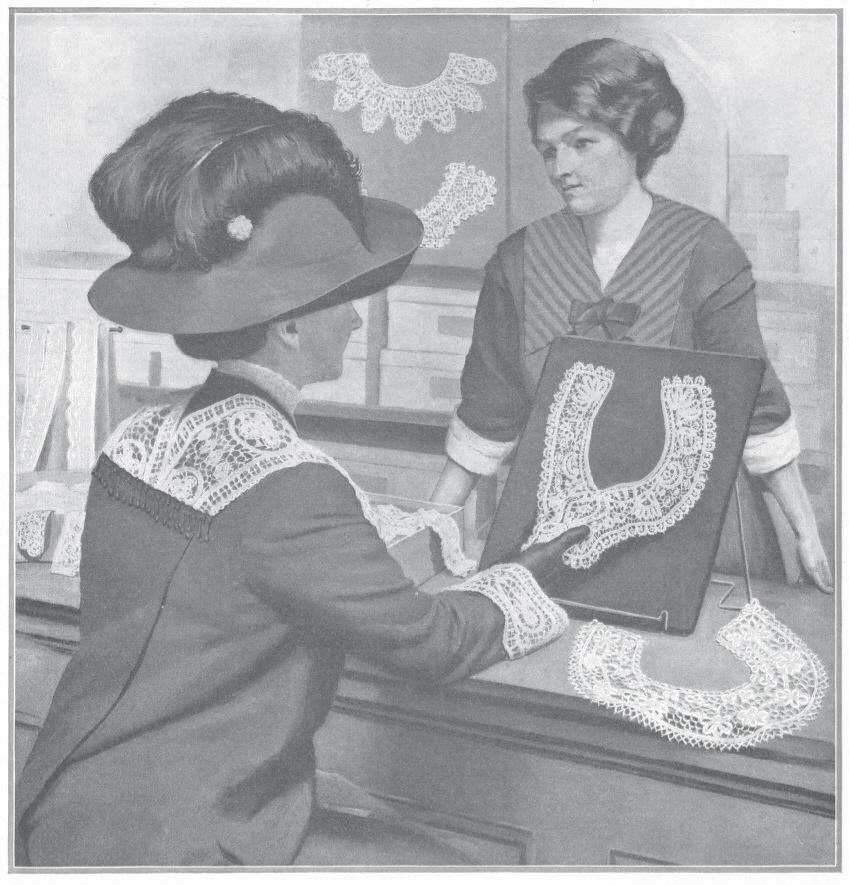
“Look, mamma, this is the lace I want; just the right pattern,” said Eva Dunlap in Isabella’s short story, “Mrs. Dunlap’s Commentary.”

“Is it real?”asked Mrs. Dunlap, bending over it with anxious eyes.

1912 illustration of a lady examining lace collars in a store as a sales clerk looks on.

“That is what I don’t know,” said the daughter, lowering her voice. “I wonder if Mrs. Stuart is a judge?”

On being appealed to, Mrs. Stuart came forward and bent over the lace with careful gaze. “It is really quite impossible to tell;” she said at last. “The imitations are so very perfect, nowadays; I have to judge by the price of the article. Do you want real?”

“Oh, yes indeed!” chorused mother and daughter, emphatically.

“Well I buy the imitation, nowadays; it is just as good, and no one can tell them apart.”

“I won’t have imitation,” said Miss Eva, with decision.

“I never buy imitation,” said her mother, with firmness. “I dislike shams of any sort. I take real things or none.”

The Stuarts, mother and daughter looked at each other, and directly they were on the street they said, “How awfully extravagant the Dunlaps are! I don’t see how Mr. Dunlap endures the drain.”

And said the mother: “I don’t see how a Christian woman can think it is right to spend so much on things; the idea that she won’t wear anything but real lace—and she can’t tell it from the imitation—that is nothing but pride. I don’t understand how Christians justify themselves in these things.” There was actually an undertone of complaisance that she, at least, was not a Christian.

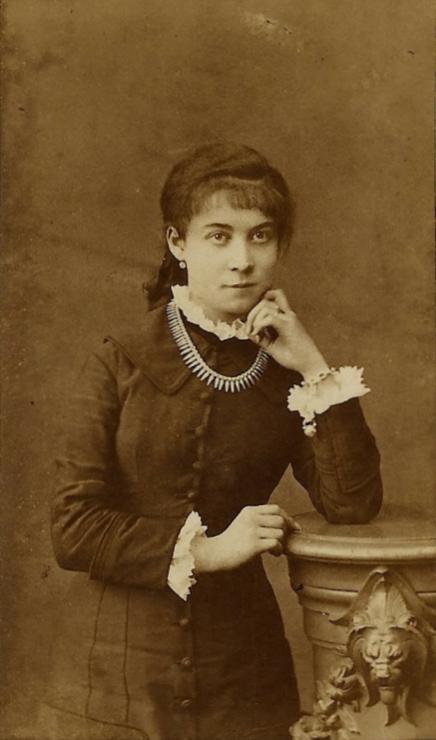
Old photo of young woman in dark dress with white lace at cuffs and throat.

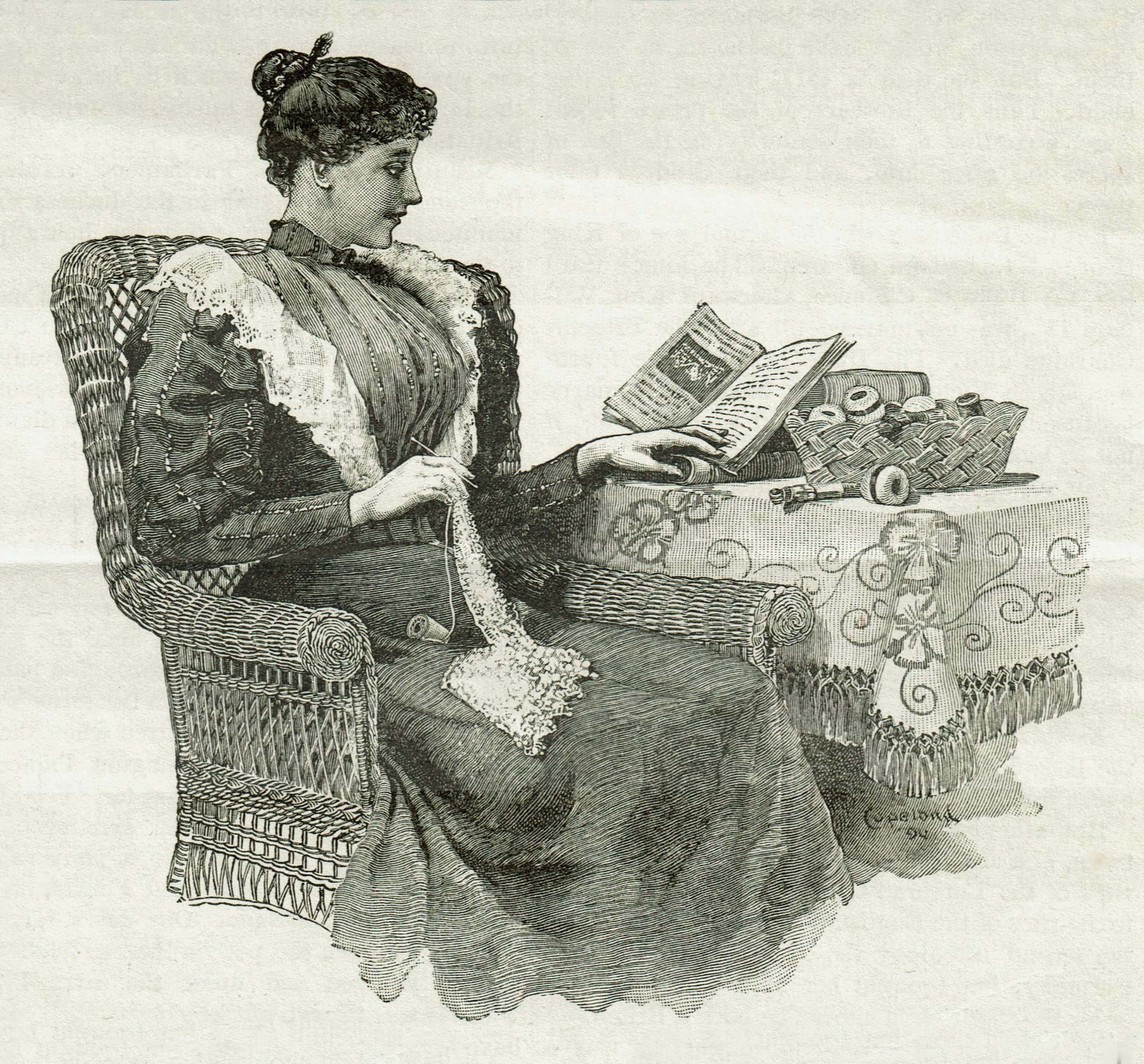
In Isabella’s world, when people mentioned “real lace” they meant hand-made lace. Skilled lace makers used fine threads to create delicate motifs—such as flowers, leaves, animals, urns, and even people—in their designs.

1894 Illustration of a woman making lace as she sits in a chair and refers to an instruction book open on a table beside her.

But machine-made lace was also available (and had been for over one hundred years). As Mrs. Stuart said in the excerpt above, it was difficult to tell machine-made laces from “real” hand-made laces, but a sharp eye could tell the difference.

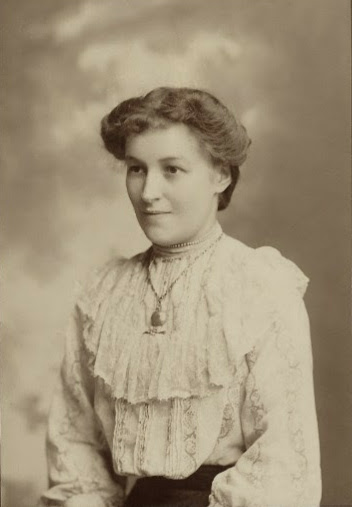
old photo of a woman in dark clothing  At her throat is a bow with lace, secured with a small brooch.

One hint was the feel of the lace. Hand-made lace had texture; there was a rise and fall to the stitches, while machine lace felt flat when you ran your fingers across it.

The stitches were another tell; machine lace could unravel because large areas were made from one continuous thread. 

Photo of a woman wearing a shirtwaist made of lace.

Unlike Mrs. Dunlap, Mrs. Solomon Smith (in Mrs. Solomon Smith Looking On) was something of an expert when it came to lace. She had a keen eye and knew the value of a dollar. But when she attended her niece’s wedding in the big city, she went shopping in a department store for the first time, where she found herself dealing with a less-than-honest sales clerk when she tried to buy “real lace:”

[He was] showing me cotton laces of half a dozen kinds, and imitation laces, calling this machine-made stuff ‘real Valenciennes,’ and this cotton imitation ‘real Spanish lace,’ until I got out of all sort of patience with him, and says I, at last, ‘I don’t bear you no ill-will, but for your own sake, if I was you, I would get out of this habit of telling lies. Now I knew real lace of almost every kind you can think of long before you was born, and it is real lace and no other that I’m after, and if you’ve got any I’d like to see it.’

Photo of a young woman wearing a shirtwaist with lace trim on the bodice, neckline and sleeves.

In Household Puzzles, another one of Isabella’s novels, Helen Randolph’s love of fine things was well documented. Helen insisted  upon buying only the most expensive trims and “real lace” for her gowns, even if it meant her family had to go without basic necessities.

But on the eve of her wedding day Helen read a Bible verse that made her realize how wrong she had been to value earthly possessions:

“Whereas ye know not what shall be on the morrow. For what is your life? It is even a vapor that appeareth for a little time, and then vanisheth away.”

She closed the book suddenly, and laid it back in its place. If this were all there were of life—a vapor—of what use were lavender silks and real lace, after all?”

Photo of a young woman wearing a gown of lace.

In each of these passages from Isabella’s books, she used “real lace” as a way to show readers her characters’ personalities and priorities, and to illustrate Christian life lessons.

What lesson do you think Isabella intended readers to learn when she wrote the exchange between the Dunlaps and the Stuarts? On the surface, she might have wanted to illustrate the Dunlap women’s love for finery, and the Stuart women’s more practical approach to shopping.

Or maybe she wanted to show that Mrs. Dunlap took a strong stand for truth, not realizing that her behavior could be interpreted as extravagant and proud by others.

Old photo of a woman wearing a gown with a lace wrapper; she also wears a wide-brimmed hat trimmed with lace.

In the scene with Mrs. Solomon Smith, she may have wanted to show how wrong it is to judge a person based on their appearance. Or maybe she wanted to show that everyone is deserving of respect and kindness.

That’s the beauty of Isabella Alden’s novels; her stories always give readers something to think about. And the lessons her characters learn make us examine our own actions.

Is there an Isabella Alden story that made you pause and reflect on your own behavior?

Has one of her stories made you think of changes you can make in your own life?

By the way, Isabella mentioned “real lace” in these stories, too:

  • Doris Farrand’s Vocation
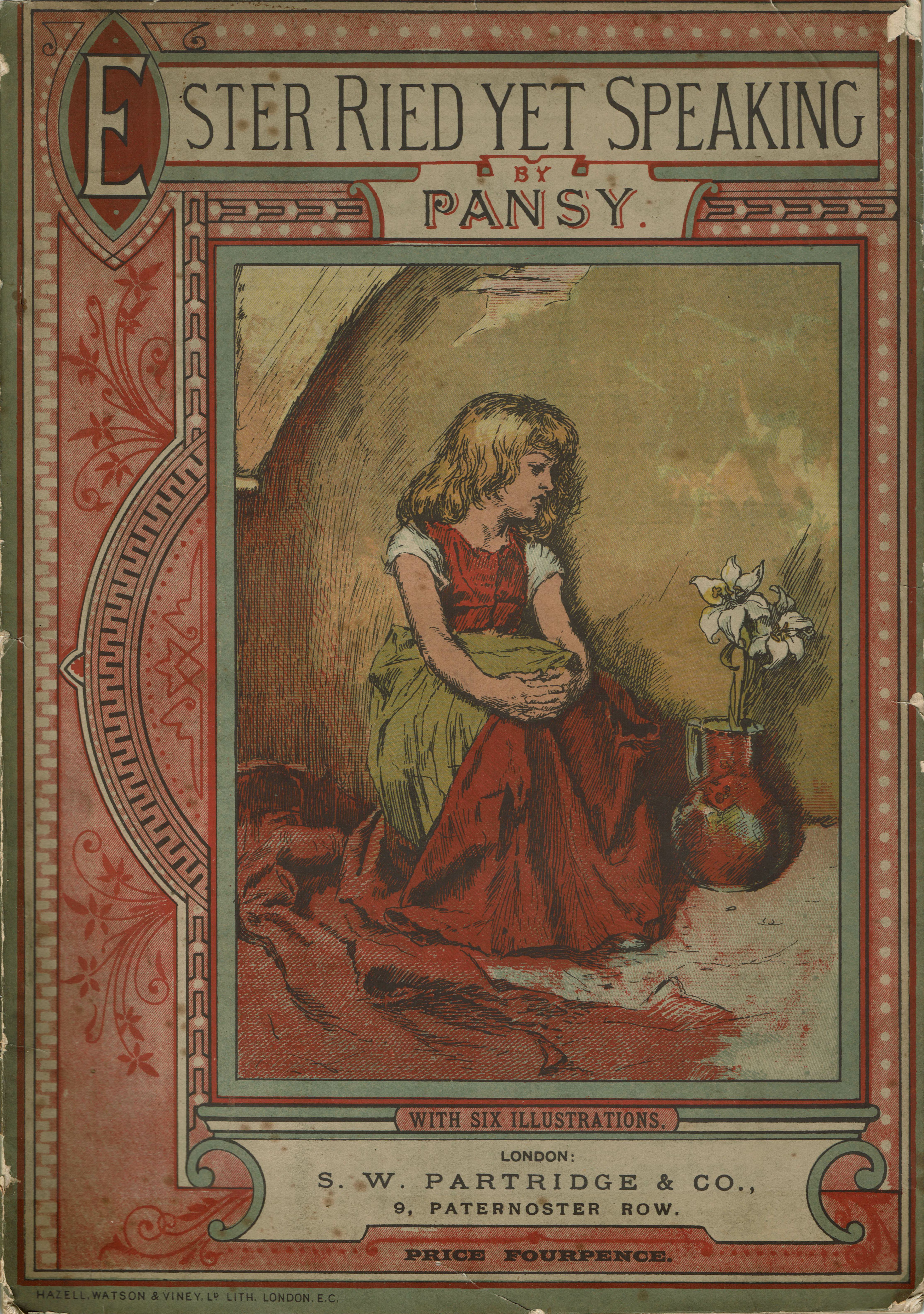
  • Ester Ried
  • Julia Ried
  • Household Puzzles
  • Modern Prophets
  • Only Ten Cents
  • The Hall in the Grove
  • The Pocket Measure
  • Wise and Otherwise
  • Workers Together; An Endless Chain

High Spirits and Halloween

Today we think of Halloween as a children’s holiday, but in Isabella’s lifetime, celebrations of All Hallow’s Eve focused primarily on teens and adults.

Hay rides, parties, and church socials gave single men and women a chance to mix and mingle and, perhaps, meet the special someone they would eventually marry.

Under the watchful eye of trusted chaperones guests played traditional games that centered around romance and love, fate and fortune.

That was exactly the kind of party Sarah Thompson wanted to attend in By Way of the Wilderness.

As a young school teacher Sarah dedicated her life to educating the children in her small town. Although she very much wanted to attend the Halloween party, she found herself forgotten by her neighbors:

They grew to admiring Sarah, being proud of her, boasting of her among themselves, and letting her alone. The first time they seemed actually to forget to invite her to a Halloween frolic, she cried a little. She had not been to any of the neighborhood gatherings for months, she had been so busy; but to be forgotten!

Why was the party so important to Sarah? Perhaps it was because she had fallen in love with Wayne Pierson, the story’s protagonist. The games that were played at Halloween parties in 1900 (when the book was published) might have helped her figure out if Wayne felt the same way about her.

One of the games that might have been played was a variation of bobbing for apples, where the names of the party-goers were scratched into apples before they were placed in separate tubs of water (boys’ names in one tub; girls’ in the other). The apple each guest caught—without using their hands, of course—would name his or her true love.

Sometimes they hung an apple from the ceiling or door frame, and balanced it with a lighted candle. The first person to catch the apple in their mouth (without getting singed by the flame!) would be the first to marry.

In another traditional game a young woman who wanted to know her future husband’s name had to be handy with a knife.

If she could peel an apple or orange in a single, long, winding strip and toss it over her shoulder, the peel would land on the floor in the form of the initial of the man she was to marry.

Players also used walnuts to guess the names of their spouse to be. After writing the names of the guests on walnuts, each person took turns throwing two walnuts into the fire. The walnut shell that cracked first from the heat signified the name of the person they’d marry.

When it came time to serve refreshments, party guests gathered to slice the Halloween cake, which was baked with charms in it. A guest who got a slice of cake with a coin in it could expect a life of wealth; a key meant travel; and a doll meant children. Of course, a ring found in a slice of cake always meant marriage.

Another game was “Bowls of Fate,” where three bowls were filled with colored water: red for good fortune, blue for a trip across the water, and clear for an upcoming honor. Blindfolded guests took turns dipping a hand in one of the bowls (which were rearranged after each person) to learn what their future held.

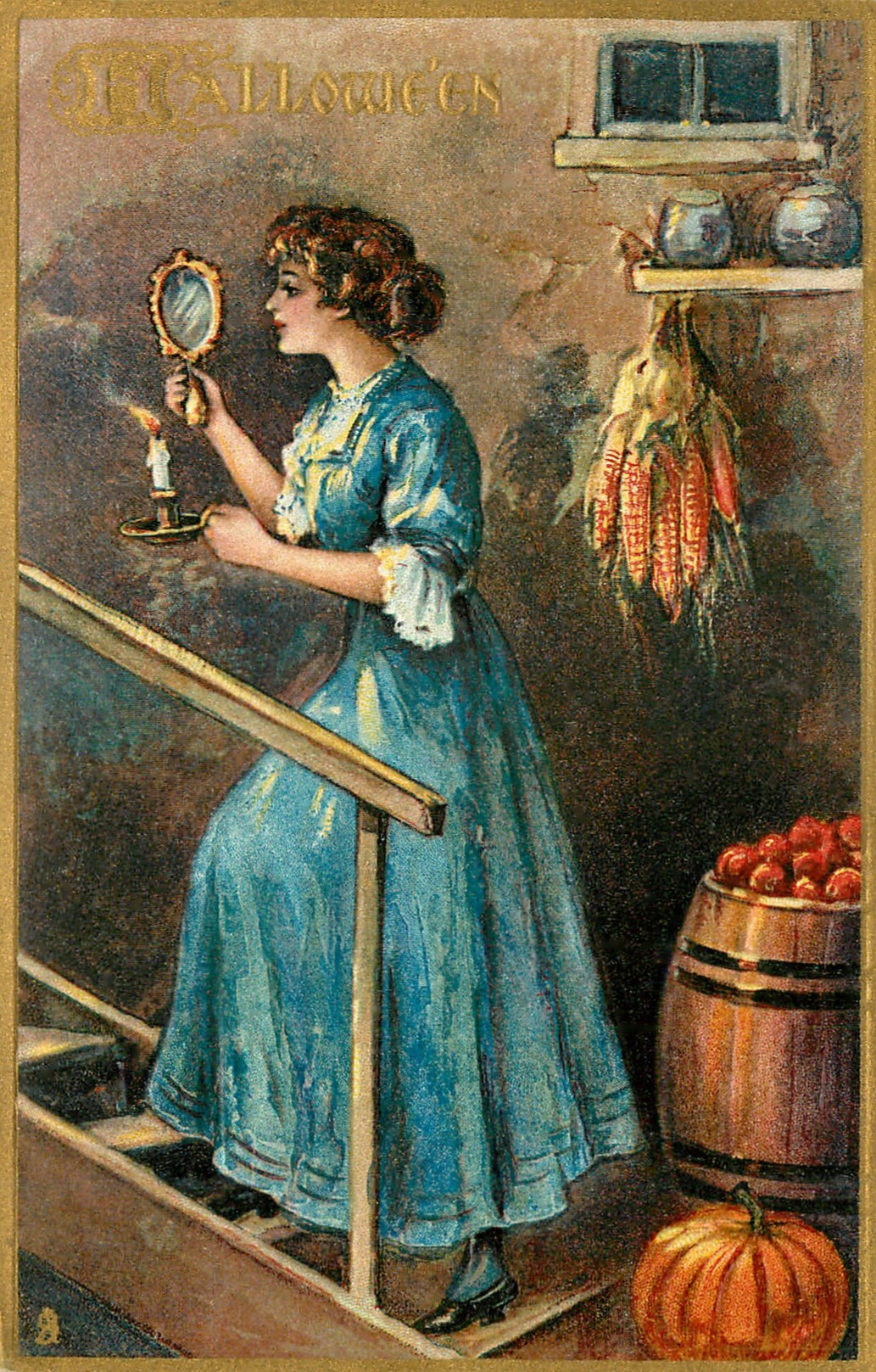
In other games, mirrors and candles served as props. One variation was for women with strong wills; they walked down the cellar steps backward, with a mouthful of salt, a candle in one hand, and a mirror in the other. If she performed the ritual correctly, the young woman should see the image of her future husband over her shoulder in the glass.

In a variation, at the stroke of midnight a young woman or man had to go to their bedroom with a candle and mirror. If they held both objects correctly and at the right angle, they would see the face of the person they’d marry.

With so many traditional games to play on Halloween, it was no wonder Sarah Thompson was disappointed to realize she would not be attending any Halloween parties.

If you’d like to know if Wayne Pierson ever returned Sarah’s love, you can read By Way of the Wilderness by clicking here. No candles or mirrors required!

Have you ever bobbed for apples or played a variation of any of these Halloween games?

Back to School with Doris Farrand

August is back-to-school month for students across America, much as it was in Isabella’s lifetime. As teenagers prepared to fill their days with classes and studies, they also prepared their wardrobes.

Young woman reads a thick book open on top of two other thick books. In her hand is a pencil.

Isabella knew what it was like for girls and their parents to shop for new wardrobes and school supplies. In the late 1800s/early 1900s, the right hat and a pair of new gloves were essential for a high school or college student. Luckily there were plenty of articles in newspapers and magazines to help students and their parents solve their back-to-school fashion dilemmas.

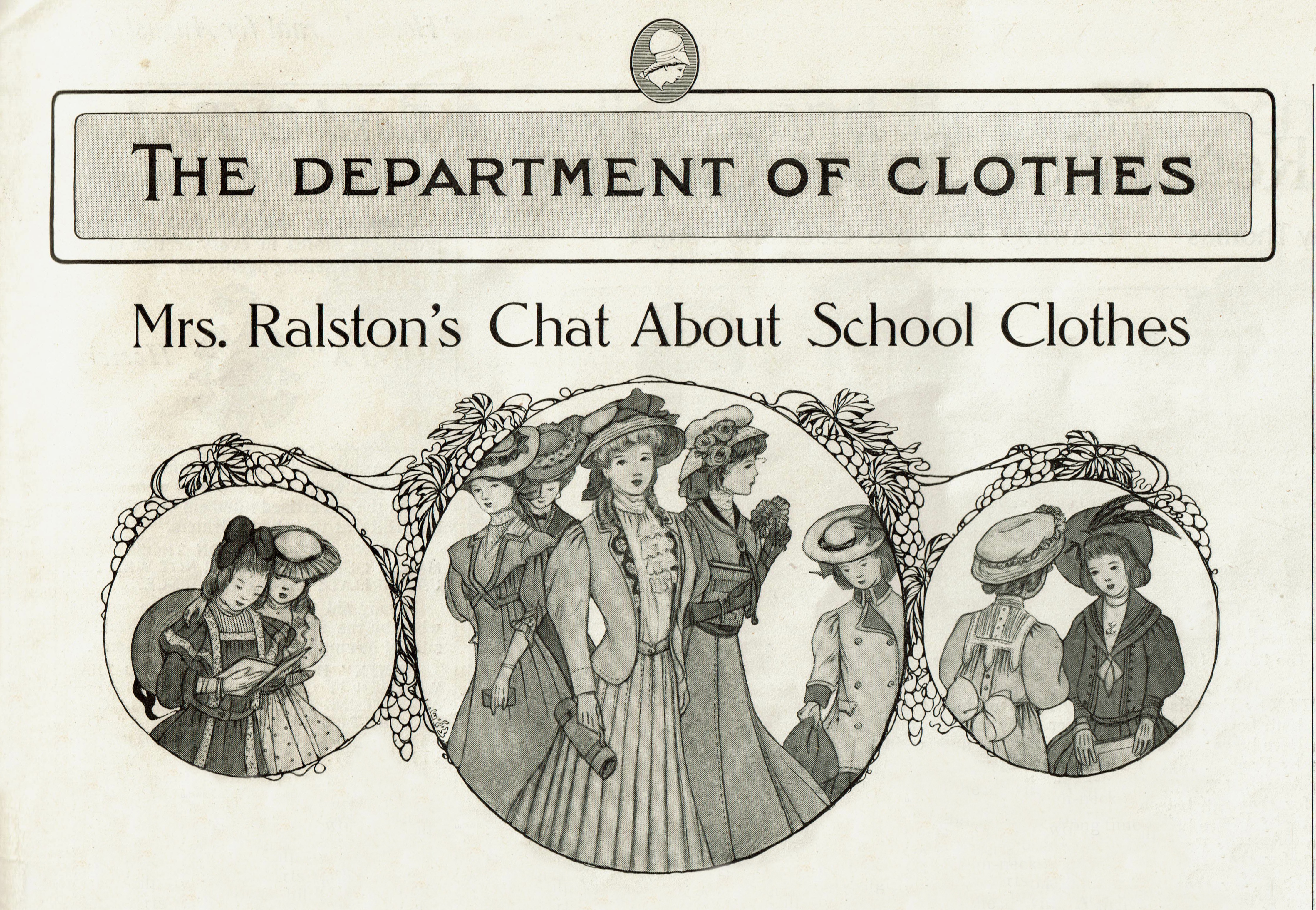
Article headline from a 1907 fashion magazine: The Department of Clothes. Beneath it is a subheading: Mr. Ralston's Chat about School Clothes. Beneath it are 3 illustrations; 2 featuring young girls wearing school clothes; 1 features drawings of teenage girls wearing different styles of school clothes.
From the Ladies Home Journal, August 1907.

Isabella began her novel Doris Farrand’s Vocation with one of those fashion dilemmas:

What should college student Doris Farrand wear to a school reception where she and her classmates were being honored?

Doris was indifferent to the problem, but her sister Athalie took on the task of updating her wardrobe, because …

“unless somebody else planned her clothes for her, [Doris] would go in rags.”

Thanks to Athalie’s efforts, Doris had a new hat to wear to the ceremony.

Drawings of "The Girl's Every-Day Hat from about 1908, featuring illustrations of eight different hat styles.

Like Doris, Miss Esther Randall (in Ester Ried’s Namesake) also struggled to stretch her college wardrobe, sometimes beyond its limits. She had a picnic to attend, and, perhaps, an evening at the theater, and she hadn’t a thing to wear. Isabella summed up Esther’s lament:

“Wherewithal shall she be clothed?”

Poor Esther’s wardrobe was so limited, she once wrote home to her parents:

I don’t think I shall accept any more social invitations. I haven’t time for them—nor gowns, for that matter. Sometimes I feel like a queer little nun in my one good dress that has to do duty on all occasions.

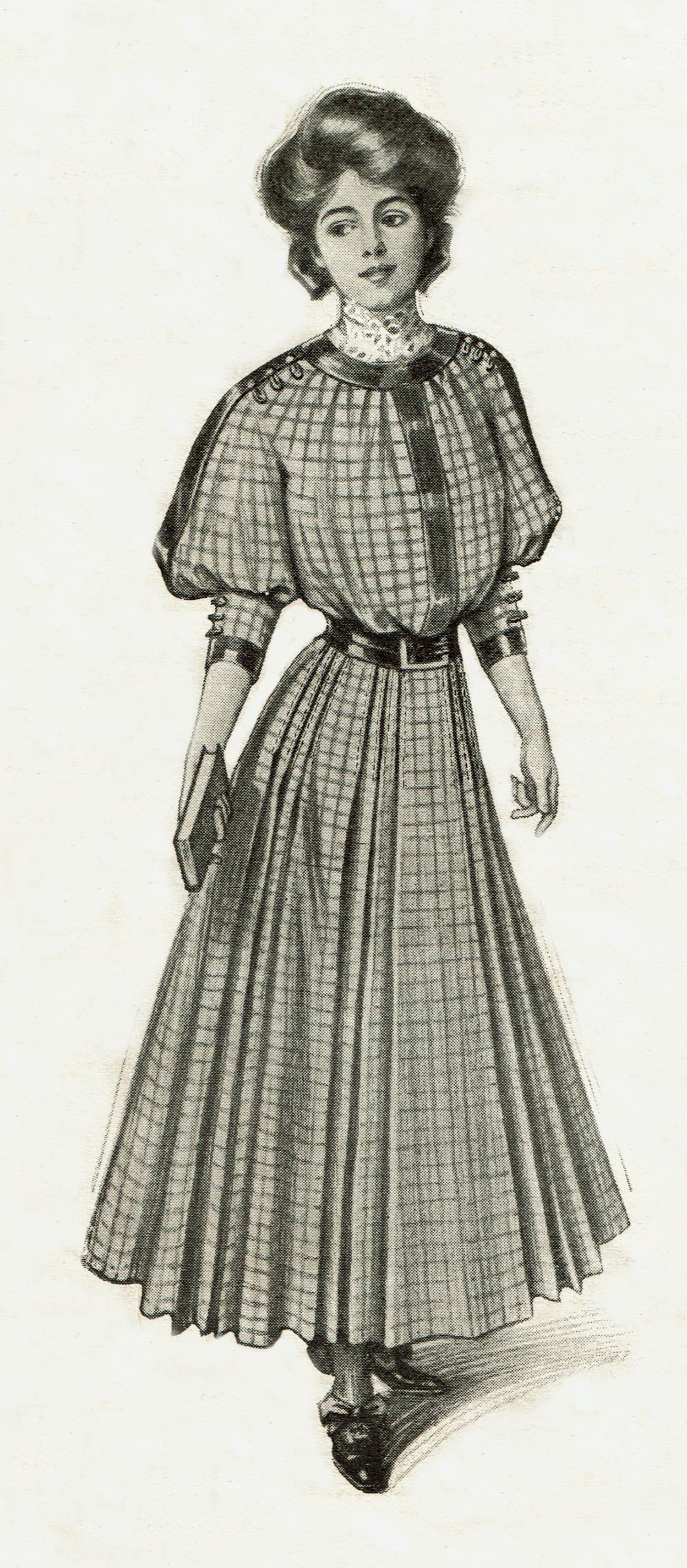
A teenager’s school dress, illustrated in The Ladies Home Journal, August 1907.

Unfortunately for Esther, it was the fashion for young women to wear white to their college graduation. As much as Esther dreamed of having a white dress like the ones her wealthy college friends would wear, she knew such a gown was out of reach; her missionary parents could never afford to buy her one.

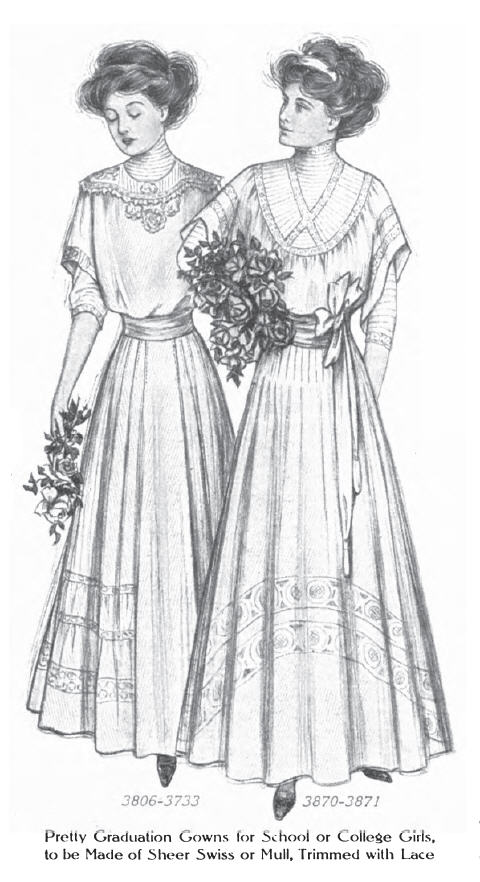
Illustration of two young women wearing white gowns. The caption reads, "Pretty graduation gowns for school or college girls "to be made of sheer swiss or mull, trimmed with lace."

Like many of Isabella’s characters, Doris and Esther wore “made over” wardrobes. Doris’ sister Athalie could take an old shirtwaist, for example, and updated it with a new collar and cuffs she made herself.

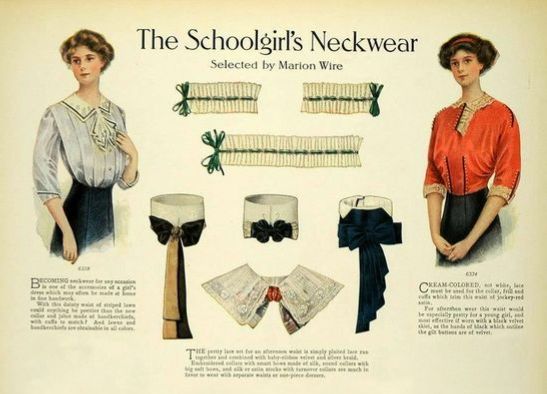
Magazine illustrations of two young women; one wears a white shirtwaist; the other wears red. Displayed between them are different styles of collars and cuffs to go with either shirtwaist.

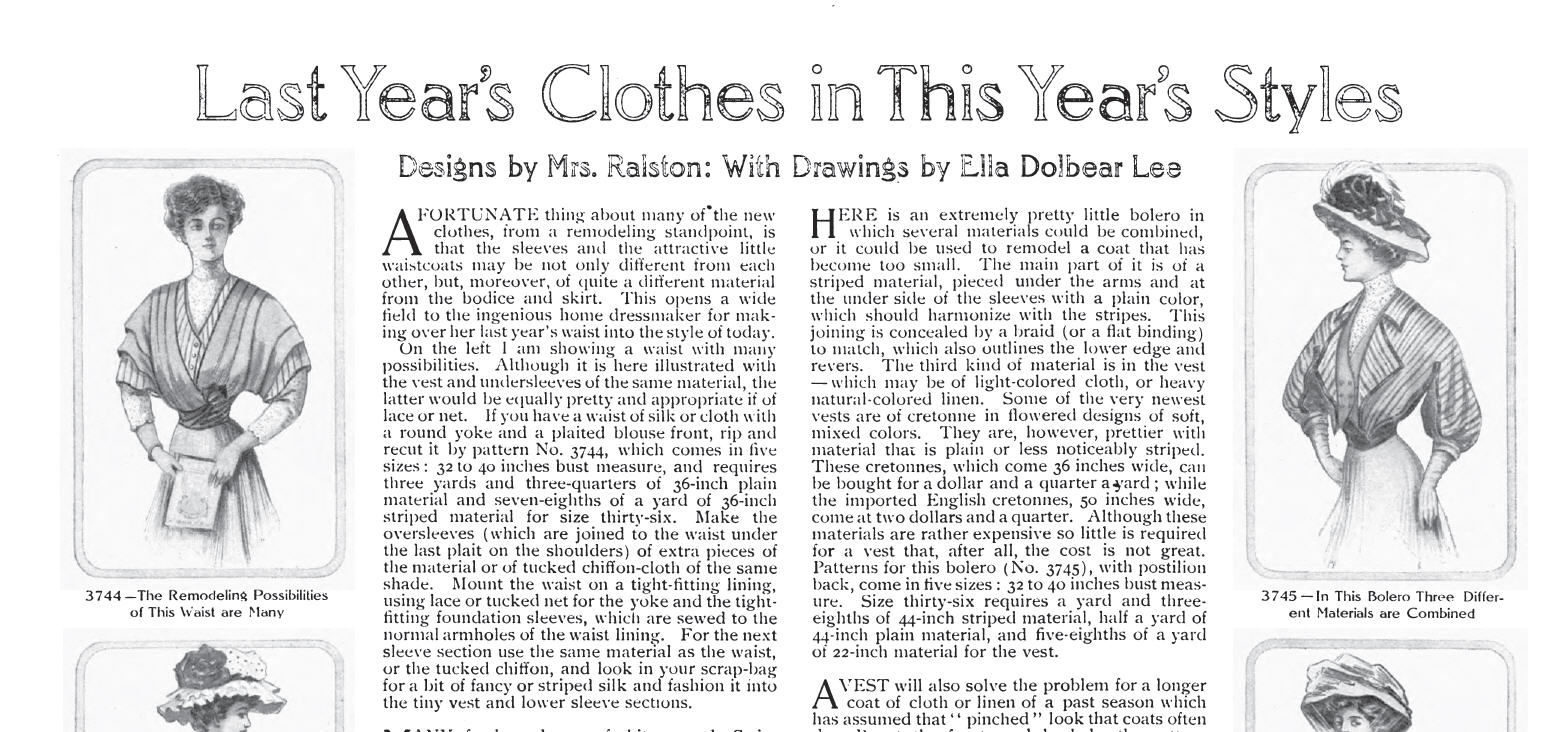
Women’s magazines of the time often gave instructions on how to accomplish it. Here’s one such article from a 1907 issue of The Ladies Home Journal:

Headline of a 1907 article in  The Ladies Home Journal titled "Last Year's Clothes in This Year's Styles."

And Esther’s mother—being a skilled needlewoman—could refresh an old skirt by adding a new band of fabric to the hem, in much the same way as The Ladies Home Journal recommended in a 1908 issue:

"A Fisherwoman's Hem." How can I lengthen a seven-gored dark blue serge skirt? Are hip yokes fashionable? [signed] Amateur.
It is not practicable to lengthen a skirt by adding a yoke. I should suggest that you add a "fisherwoman's hem" of dark blue chiffon broadcloth, if you cannot match your serge. 
The advice is accompanied by an illustration of a young woman dressed in shirtwaist and floor-length skirt standing before a full-length mirror.

But no amount of sewing or alterations could help Esther as graduation day neared. As much as she dreamed of graduating in a beautiful white gown, she knew she had only that one “good” dress to wear, which had already done faithful duty during two seasons.

Illustration of girl wearing graduation cap and gown over a long dress that reaches the floor. Her hair is styled about 1910. She holds an open book.

She knew how utterly impossible it would be to buy a new white dress—so impossible she never even considered praying about the matter. But someone else prayed on her behalf!

If you’ve read Esther Randall’s story, then you already know whether or not she ever received her heart’s desire and got to wear that coveted white dress. If you have not yet read Ester Ried’s Namesake or Doris Farrand’s Vocation, you can click on the book covers below to learn more:

Pansy Approved Bicycles

Did you know Chautauqua Institution had its own commercial printing office? It produced brochures, maps of the grounds, programmes, daily schedules, and a newspaper called The Chautauqua Assembly Herald.

Published six days a week, The Chautauqua Assembly Herald filled eight to ten pages of every issue with news about Chautauqua, including the comings and goings of some of its residents and visitors.

On July 24, 1895 one of the newspaper’s reporters spotted Isabella’s familiar face at a concert in Chautauqua’s amphitheater:

Pansy’s placid, pleasant face was seen in the veritable sea of faces at the concert in Chautauqua’s amphitheater Wednesday. From her very looks one would judge Mrs. Alden as a woman who loves little people, even if one had never heard of the famous Pansy books.

Naturally, the reporter sought Isabella out as soon as the concert was over, and asked about her summer plans and whether she was writing anything special. Isabella confirmed she was indeed working on a story, and added:

“All of my stories, you know, are published in serial form in my magazine before they are put out in book form. My magazine work occupies most of my time.”

“For the past 19 years we have spent every summer at Chautauqua. We have our summer home here, but for many years past I have had to give up my Assembly work. I am much interested, however, in the Woman’s Club here.”

Knowing the Woman’s Club was to meet the next day, the reporter asked Isabella if she was going to read a new, unpublished story to club members.

“It is a story which not only has not been published, but which is not yet all written,” replied Pansy smiling.

Their conversation drifted into other topics, including an observation about the new phenomenon of women using bicycles as a means of getting around Chautauqua.

Studio photograph from late 1890s of young woman posed beside her bicycle. She is wearing a long dark dress with long sleeves and a high collar, and a bonnet.

Progressive-thinking Isabella had no problem with the new “wheelwomen” (as lady cyclists were called in 1895):

“I think the bicycle must offer a pleasant, healthful form of recreation to women, but I do like to see them dress inconspicuously and neatly when riding, and I do not like to see them wear bloomers.”

Photograph dated 1912 of woman standing beside her bicycle. She is wearing a long skirt, long-sleeved shirt with high collar, and a bonnet.

Any guesses which story Isabella was writing and publishing as a serial in The Pansy magazine during the summer of 1895?

It was Reuben’s Hindrances! Chapter eight of Reuben’s Hindrances appeared in the July 1895 issue of The Pansy; monthly installments continued into 1896 until all twenty-four chapters appeared in the magazine.

Isabella’s “Little Card” Giveaway!

If you’ve read many of Isabella’s stories, you’ve probably noticed how often she wrote about a character’s life being changed by a Bible verse written on a little card.

Often, one character would give the card to another for encouragement or to serve as a reminder of God’s love and promises to protect and guide those who follow Him.

More often than not, those “little bits of cardboard” had a big impact on characters who faced challenges or were going through difficult times.

Photo of card with Bible verse: "I will give you peace, at all times and in every situation." 2 Thessalonians 3:16

In real life, Isabella also handed out small cards on which she wrote a meaningful Bible verse chosen especially for the recipient. Here’s one of her handwritten cards:

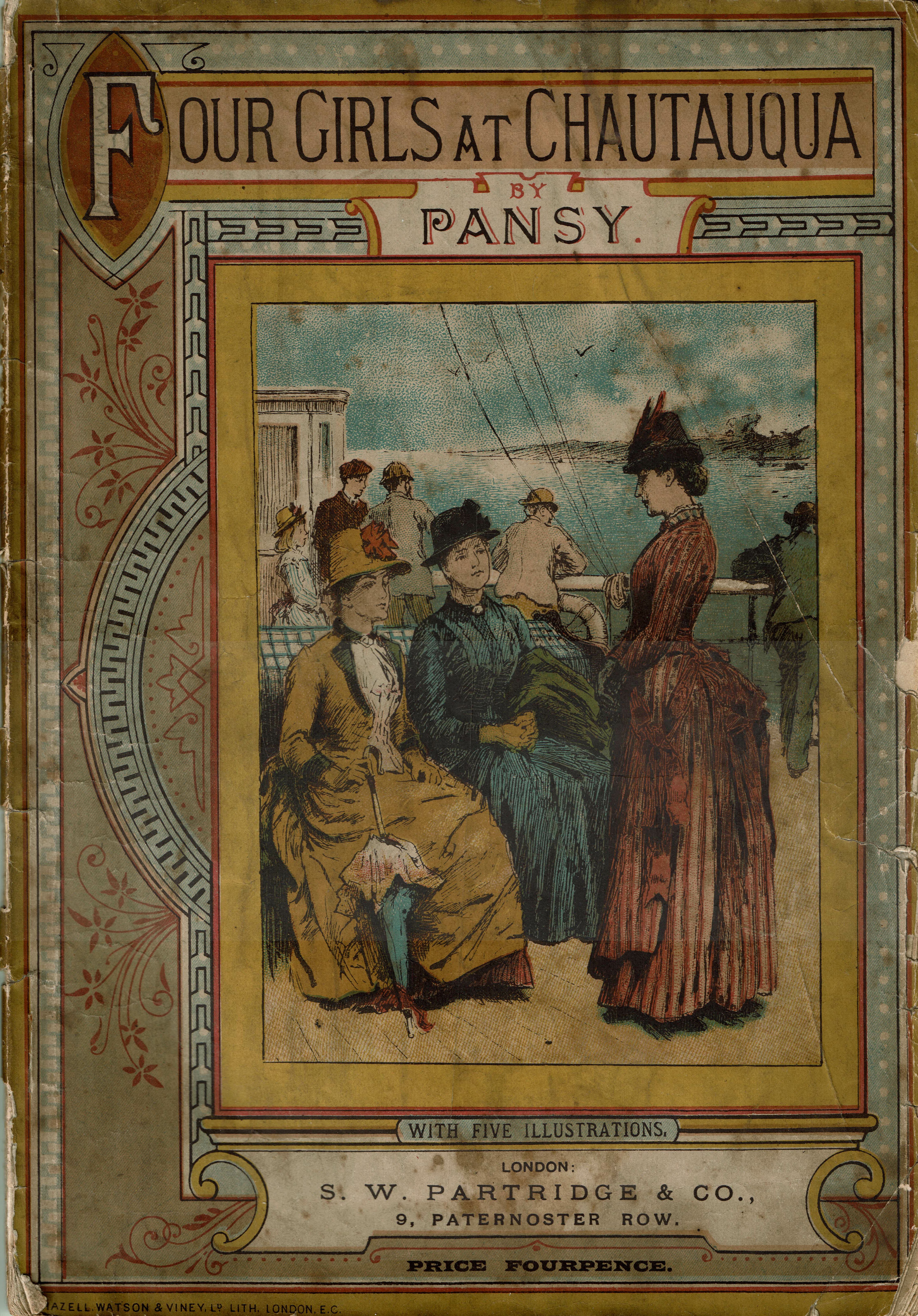
Small card written in ink by Isabella Alden reads: "Either for or against Christ, every life must be, whether we will it, or not." Four Girls at Chautauqua. Yours truly. Isabella M. Alden. Pansy.

The Giveaway!
You can follow Isabella’s example! We’re giving away sets of “little cards” to four U.S. readers of Isabella’s blog!

Photo of small box labeled "bloom Prayer Cards." The end of the box slides open like a drawer, where you can see a portion of a card inside.

Each card set holds 30 cards. On the front is a beautifully illustrated Bible verse of promise, much like the ones Teenie Burnside might have created in Isabella’s short story “The Little Card.”

Photo of a woman holding three sample cards, one of which reads "I am full of mercy and grace, and I will overflow with love for you." Psalms 103:8.

The back of each card is blank, so you can add your own personalized message of love or encouragement for the recipient, just as Isabella did.

To enter the drawing, just leave a comment below no later than midnight (EDT) on Sunday, May 24. (Unfortunately, we can only mail card sets to readers who live in the United States.)

We’ll announce the four winners on Tuesday, May 25. Good luck!

If you haven’t yet read “The Little Card,” you can read it for free! Just click here to go to BookFunnel.com and choose the reading option you like best:

  • You can read the story on your computer, phone, iPad, Kindle or other electronic device. Just choose the your preferred reading format.
  • Or you can choose the “My Computer” option to read a PDF version, which you can also print and share with friends.

Let Them Eat Cake!

Isabella Macdonald married Gustavus Rossenberg “Ross” Alden on May 30, 1866 in her home town of Gloversville, New York. They were married fifty-seven years. Isabella described her husband as unfailingly courteous, good-natured, patient, and principled. As a minister, those traits must have served him well.

Almost immediately after their marriage ceremony, Ross and Isabella boarded a train bound for the tiny town of Almond, New York, where Ross was given his first church after receiving his ordination.

Image of a slice of yellow cake with chocolate icing on a plate with a fork. in the background are a cup of coffee, a cream pitcher, and a sugar bowl filled with sugar cubes.

Isabella had very fond memories of that first church. Not all the parishes to which Ross was assigned, she said, “were as kind and considerate as the choice souls in that first beloved one.”

She had plenty of tales to tell about some of the congregations her husband led over the years, and she often included those tales in her novels. If you’ve read Aunt Hannah and Martha and John, you might remember one of the congregants gave Martha a perfectly ugly bonnet as a gift, leaving poor Martha undecided about whether to wear the bonnet to church. That “bonnet dilemma” was a true story that actually happened to Isabella!

Image of a three-tier chocolate cake with white icing.

In other novels, Isabella wrote about congregations that did not want to pay their ministers living wages, and decided to make up for the short-falls with fairs and bazaars to raise money for the minister and his family. That, too, was something Isabella and Ross had to deal with far more often that they would have liked.

In one particular parish, the people decided that instead of meeting Reverend Alden’s salary requirements, they would pay him less, but supplement the short-fall with food donations. The only problem was that nearly every woman in the church decided to make her contribution a marble cake.

Photo of a chocolate-iced marble cake on an ornate silver serving stand.

Isabella wrote about her growing dismay every time another marble cake was delivered.

“Marble cake! I don’t believe some families in this village can have anything else to live on, they make so much of it.” 

Photo of a marble cake sliced open to show the marble pattern

Before long Isabella’s pantry shelves were filled with cake. She wrote there was …

…enough marble cake to pave a walk from the kitchen door to the barn door.

She and Ross probably did their best to eat as much marble cake as they could, but days later it was becoming quite dry and stale, and Isabella wanted nothing more than to have “that obnoxious marble cake out of our sight!” But there seemed no way to get rid of it without hurting their parishioners’ feelings.

That’s when Ross came up with a plan. In the dark of night, with a spade and a lantern, he went behind the barn, dug a deep hole, and buried the remaining marble cakes. Isabella wrote:

“We have never cared for marble cake since!”


Click here to learn more about Isabella’s novel Aunt Hannah and Martha and John, which included fictionalized accounts of the “ugly bonnet” story, more about marble cake, and other anecdotes from Isabella’s life as the wife of a Presbyterian minister.

Fun on a Cold Winter Evening

Isabella didn’t have television or electronic devices during her lifetime (even radios weren’t common in homes until the 1930s). So on long cold winter days and evenings, when people had to stay indoors out of necessity, they had to come up with ways to entertain themselves.

Then, as now, board games like chess, checkers, and backgammon were popular; but they limited play to only two people. What was a family to do to pass the time?

Family members often read aloud to each other (click here to read more about Isabella’s skill at reading aloud) or joined together to sing hymns or popular songs.

Newspapers and magazines published word games, and families often joined together to solve riddles like this:

We are a curious family, Just five our numbers are. In every word you read or write one of us must be there; without the aid of one of us, not a single word you'll form; we're found in palace, cot and ship, and even in the storm!

Or this word scramble from a 1907 magazine:

I Dust Ned's Room. Re-arrange the letters in this sentence to make one word.

(Scroll to the bottom of this post to see the answers to these two puzzles.)

But when friends came to call, or neighbors got together, playing parlor games was the most common way for people to pass those cold winter evenings.

Children playing Blind Man’s Bluff.

The rules for most games were simple, and the games could accommodate any number of players, so they were ideal for entertaining children and adults. Here are a few parlor games that were in vogue during Isabella’s lifetime:

Blind Man’s Bluff:

Versions of Blind Man’s Bluff have been around since ancient Greece. The rules were simple; players were confined to a single room or space; one player was blindfolded and roamed the room/space freely, trying to catch one of the players. Once a player was caught, the “blind man” had to correctly identify him or her in order to win the round.

Savvy parents and alert chaperones usually limited this game to children, because teenagers and adults too often used it as a thin excuse to lay hands on each other.

Isabella hinted at Blind Man’s Bluff in her novel, As in a Mirror, when teenaged Elfrida Elliott snuck out of her parents’ house to join a group of friends for a night of games:

Very foolish games they seemed to be for the most part, having the merest shred of the intellectual to commend them, and that so skillfully managed that the merest child in intellect might have joined in them heartily. But the distinctly objectionable features seemed to be connected with the system of forfeits attached to each game. These, almost without exception, involved much kissing. Of course the participants in this entertainment were young ladies and gentlemen. There seemed to be a certain amount of discrimination exercised by the distributor of the forfeits, yet occasionally such guests as “Nannie” and “Rex” and others of their class would be drawn into the vortex, and seem to yield, as if to the inevitable, with what grace they could. [There was] a laughing scramble between the said Nannie and an awkward country boy, who could not have been over fifteen. He came off victorious, for she rubbed her cheek violently with her handkerchief, and looked annoyed, even while she tried to laugh.

Pass the Parcel:

A favourite game for all ages was Pass the Parcel. Here’s how it’s played: a small object is wrapped in multiple layers of paper or cloth, and passed around the circle to music. Each time the music stops, the person caught holding the parcel gets to remove one layer of wrapping. The win goes to the first person who can correctly identify the object before it is unwrapped; or to the person who ultimately removes the final wrap to reveal the object.

Wink Murder:

Another favorite was Wink Murder. To play, everyone sits in a circle and closes their eyes, while one person walks around the circle of players, choosing a murderer by tapping him or her once on the head. They then choose the detective by tapping a player twice on the head.

The players then open their eyes and engage in conversation, while the detective moves to the center of the circle and is allowed three tries to guess who the murderer is. Meanwhile, the murderer “kills” the other players by making eye contact and winking at them, trying not to be caught by the detective in the process.

To add to the fun, the victims “die” dramatically before they leave the circle. If the detective doesn’t identify the murderer in three attempts, he or she remains detective for the next round. If the detective guesses correctly, the murderer becomes the detective for the next round.

Have you played any of these parlor games before? What are your favorite games to play with your family, friends, or church group?

The answer to the word riddle is: Vowels

The answer to the word scramble is: Misunderstood

Pansy’s Typical Day

In 1892 Isabella’s husband was made assistant pastor of a brand new church in Washington, D.C. The Eastern Presbyterian Church was only blocks from the nation’s Capitol, and the Capitol dome could be seen from the top of the church’s 130-foot bell tower.

Eastern Presbyterian Church, about 1920 (from the Library of Congress).

The Aldens moved into a house about four blocks away on Maryland Avenue.

A view of U. S. Capitol from Maryland Avenue, which was unpaved until about 1930 (from the Library of Congress).

It’s likely the Aldens lived in a single-family house, instead of one of the row houses that were erected on Maryland Avenue and on many other streets in the District in the early 1900s. The photo below—taken from the top of the Capitol Dome looking northeast—shows a view of the Alden’s neighborhood.

View from Capitol Dome looking northeast toward Maryland Avenue (from the Library of Congress).

In an 1893 interview, Isabella spoke about how much she “dearly loved” her D.C. home. It was “cheery” and “bright” and Isabella took great care “in all that pertains to its comfort and happiness.”

The Aldens—Isabella, her husband Ross, and their son Raymond—had a daily routine in their Maryland Avenue home. Early in the morning, the family gathered in the back parlour of the house before breakfast “to sing a few verses of praise, to read a chapter in the Bible, and to ask God’s help and blessing on the work to be done.”

After breakfast, Isabella went right to work in her study—a place that was off limits to visitors or interruptions (except in a case of emergency). For the remainder of the morning, Isabella was at her typewriter, typing stories, writing Sunday-school lessons, working on a chapter of her next novel, or answering the volumes of fan mail she received daily—some days quickly turning from one task to another.

An advertising card for a Smith Premier model typewriter from 1900.

Isabella once said that she didn’t have to “think” when she typed. Much of her thinking, plotting and composing was done in her head as she went about her household chores. Then, when she sat down to write, her thoughts were “drilled like a well-ordered army, ready to march at the word.”

A comfortable study, about 1910.

An interviewer once described Isabella’s workplace as “a pretty study, lined with books.” In the room were two typewriters—one for Isabella, and one for her husband; they often worked side by side.

Typewriters weren’t the only modern gadgets in her home. Isabella employed all kinds of appliances and machinery, and was always on the look-out for a new labor-saving device. One reason: from a young age Isabella suffered from constant headaches (you can read more about her condition and the treatments she sought for it here), and she was seldom able to use her typewriter more than a few hours a day.

But she found that she could instead use a stenograph machine (similar to the ones court reporters use today) because her eyes didn’t tire as they did when she used a typewriter.

She taught herself to use a stenograph, and was soon able to extend her working hours a little longer each day. When she was done with work in the early evening, she handed the machine’s cryptic shorthand to a secretary, who transcribed it on the typewriter.

Bartholomew Stenograph machine, 1882 (from Typewritercollector.com).

Dictation machines were another type of equipment that was just coming into use during the time Isabella lived in Washington D.C.

An early wax cylinder phonograph for dictation, 1897 (from Wikicommons).

The early machines were expensive, but effective; and, as she did with her stenograph machine, Isabella could employ a secretary to transcribe the recorded text for her.

A typist transcribing a stenography printout, 1904.

Isabella sometimes wove descriptions of new and innovative appliances into her stories. She wrote about early typewriters in her novel Miss Dee Dunmore Bryant (read a previous blog post about it here).

And in the sequel, Twenty Minutes Late, she described Caroline Bryant’s astonishment upon seeing an early dish washing machine.

An 1896 magazine ad for The Faultless Quaker Dish Washer.

After the work day was done, Isabella and her family gathered again in the back parlour of the house. If they did not have a special engagement to attend, the family spent the evening reading together. More often than not, Isabella read aloud to Ross and Raymond, and anyone else who happened to be a guest in the house.

Different newspaper accounts of her public readings describe Isabella as a charming reader, with a “sweet voice” and “perfect intonations” that must have been delightful to hear.

What do you suppose Isabella read aloud to her family in the evenings?

Are you surprised to learn Isabella used the latest technology to work efficiently and streamline her housekeeping tasks?

Which of our 21st Century devices or appliances do you think Isabella would be most likely to use?