Free Read: The Book that Started it All

It’s hard to imagine a world without Isabella Alden’s wonderful books and stories; but, left to her own devices, Isabella never would have become a published writer.

Advertising Card 1919

From a young age she had been taught to let her imagination soar. She began keeping a diary at the age of six, filling it with records of daily events and bits of stories. And even before she could write, Isabella’s mother encouraged her to make up little stories—perhaps from a picture Isabella would show her, or out of a few toys or some flowers. “Make a story out of it for mother,” was a most familiar sentence.

Out of those beginnings, Isabella developed her writing skills, and she continued to craft stories for the amusement of her friends and family. Her talent showed in school assignments, too; her compositions always earned good grades and won her recognition and prizes.

It was at school that Isabella Alden met her good friend, Theodosia Toll, nicknamed Docia. They were students together at Oneida Seminary in New York. After they graduated, Isabella returned to the school as a teacher; and since Docia’s family home was nearby in a neighboring town, the young women saw each other often.

Laude-Calthrop-Old-LettersAfter the close of one particular school year, Docia arrived to help Isabella pack up her things. Isabella was leaving the next morning to spend the long vacation at her family’s home, some eighty miles away.

While Isabella packed, she tasked Docia with sorting through the papers and books she had stored in a large trunk. As Docia went through the trunk, she came across a story Isabella had written as an entry for a writing contest. Here is Isabella’s description of what happened next:

“Why, Belle!” she suddenly exclaimed. “Here is that story you were to send to Cincinnati! Didn’t you do it after all?”

“No, I didn’t,” I said.

“But you promised!”

“No, not exactly. I said I would, if I didn’t change my mind, and I changed it.”

“Well! I think you were a perfect simpleton! It might have taken the prize. I thought it was the best thing you had written. What do you want done with it? Oh, say! Don’t you believe! The time for sending manuscripts isn’t up yet! Here is the printed slip that tells about it. There are seven days yet. Now do be sensible and send it on. Just think what fun it would be if it should win the prize!”

Then I appeared in the doorway and spoke with decision.

“I’ll do no such thing. If I can’t write a better story than that, it proves that I ought never to write at all. Tear the thing into bits and throw it in the grate with the other rubbish. I’ll set fire to them tonight.”

Luckily, Docia saw the promise in that story and instead of tearing it to bits so it could be set on fire, she submitted it to the contest under Isabella’s name.

Postman 1909Two months later, Isabella was shocked to receive a letter from the Western Tract & Book Society in Cincinnati, congratulating her on her win. Enclosed with the letter was a check for fifty dollars!

After she got over the initial shock of winning a prize for a story she thought she had burned, Isabella realized that Helen Lester was something to be proud of—especially once the contest judges explained the reason the story won:

“In the opinion of the carefully chosen committee of award, it met the condition imposed by the grand old Christian gentleman who offered the prize. It was to be given for the manuscript that would best explain God’s plan of salvation, so plainly that quite young readers would have no difficulty in following its teachings if they would, and so winsomely that some of them might be moved to take Jesus Christ for their Saviour and Friend.”

Original 1865 Cover of Helen Lester

And how did Isabella spend that fifty-dollar prize money? She made two packets, each containing “the enormous sum of twenty-five dollars.” She placed one of the packets inside a bound volume of her first book, Helen Lester. On the fly leaf she wrote:

“Presented to my honored father.”

The second packet went into another copy of the book; and on the fly leaf she wrote:

“To my precious mother.”

Then, in both books she wrote those “wondrous words that must have trembled with excitement, and ought to have been written in capitals”:

“From the Author.”

Book 3Helen Lester was published in 1865 and with it, Isabella’s writing career was launched. The following year she published another children’s book, Nanie’s Experiment; Jessie Wells was published in 1867, quickly followed by Tip Lewis and His Lamp. After that, she published multiple titles each year, demonstrating both her talent and her discipline as a writer.

Since then, her stories that explain salvation through Christ and the rewards of abiding faith in God have enlightened and entertained generations of readers around the world.

Cover_Helen Lester resized

You can read Helen Lester for free. Click on the cover to begin reading.

You can learn more about Isabella’s friendship with Docia by clicking here.

.

Revivals and Milk Carts

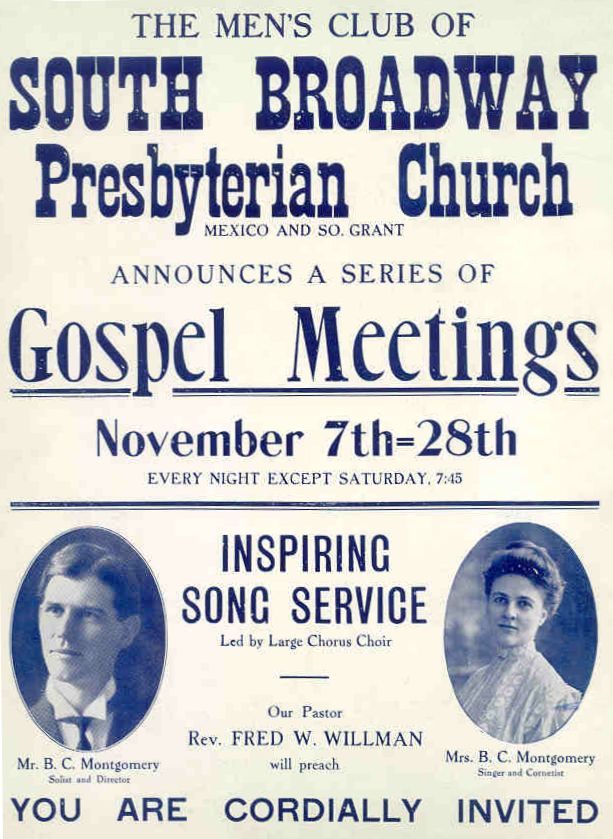
Gospel Meeting announcement

In 1911 a resurgence of spiritual awakening was sweeping across the United States. Even in the mid-west states—where “that old time religion” was firmly entrenched—people were undergoing a revival of spirit and rededication to the Christian life.

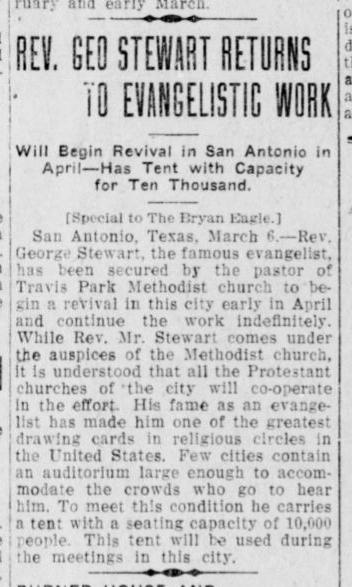
Revival meeting announcement in The Bryan Eagle (Bryan, TX) newspaper; March 9, 1911
A revival meeting announcement in The Bryan Eagle (Bryan, TX) newspaper; March 9, 1911

.

When Isabella Alden wrote Lost on the Trail in 1911, the concept of tent revival meetings wasn’t new. Only four years earlier a great Christian revival had spread across the U.S. and Canada, led by two Australian ministers who traveled the Americas converting thousands of souls.

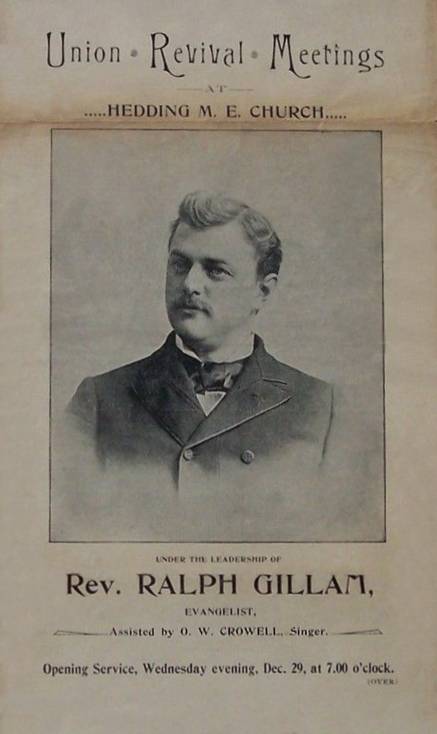
1897 newspaper announcement
1897 newspaper announcement of a revival meeting

.

And in 1897, when America suffered a tremendous economic crash, people turned to revival meetings for hope and comfort in a very tough time.

But by the early 1900s the Christian revival meeting had reached new levels, thanks, in many ways, to the emergence of great revival preachers and the power of the American newspaper.

Billy Sunday in 1906

.

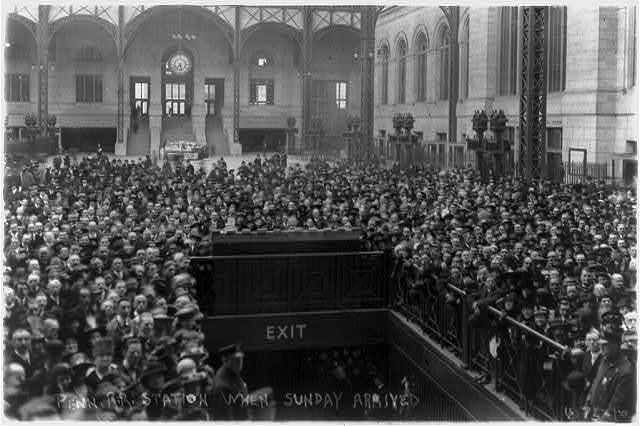
Many popular ministers traveled the country and drew large crowds, but Billy Sunday was the rock star of the revival circuit.

A crowd awaits Billy Sunday's arrival at Penn Station, New York City
A crowd awaits Billy Sunday’s arrival at Penn Station, New York City

.

When Billy Sunday preached, forty to fifty thousand people went to hear him each day. He spoke in tents, open fields, and huge tabernacle structures built especially for him in Michigan, Indiana, Ohio, and New York. Newspapers reported that wherever he went, the crowds were so great police could not control them.

In Pittsburgh, the newspaper reported 3,000 club women paraded down the main street of town to a Billy Sunday revival meeting. In Chicago, the entire office force of the courthouse abandoned their desks to march to the meeting tent, accompanied by a brass band.

Women parade down the street

.

In the 1880s Billy Sunday was a baseball player. He played outfield, first for the Chicago White Sox and then the Pittsburgh Alleghenies (later, the Pittsburgh Pirates). He was a good player; he had a .291 battering average and he set a record for stolen bases. But his real calling, he believed, was giving regular locker-room sermons to his teammates about the evils of alcohol and tobacco.

Billy Sunday baseball

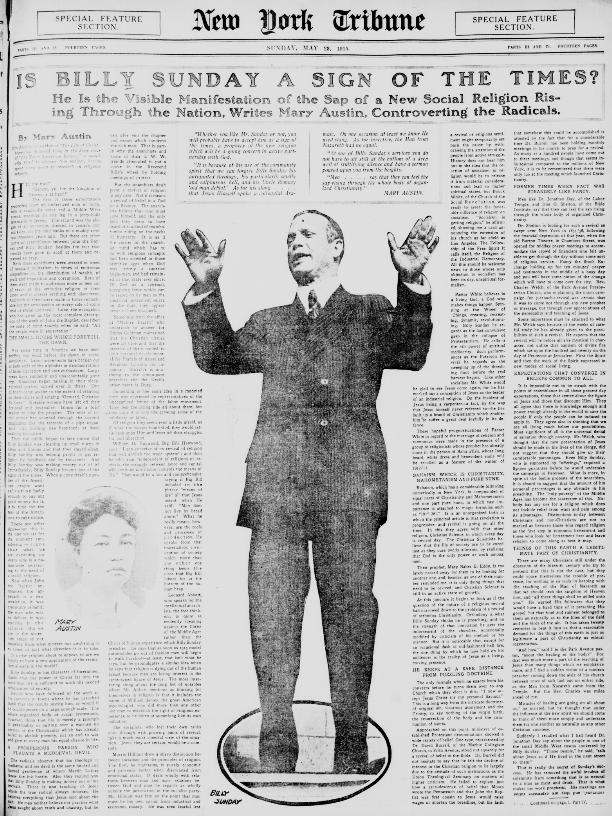
After he left baseball, Billy Sunday was ordained by the Presbyterian Church, and embarked on a career as an evangelical minister.

New York Times article on Billy Sunday. May 23, 1915

.

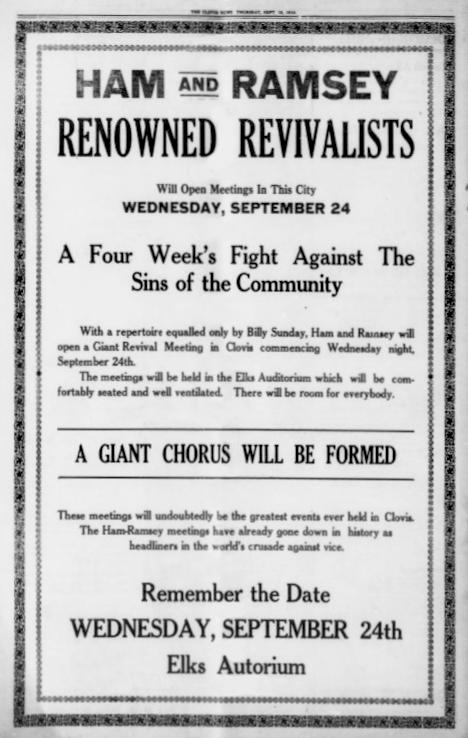
Not every revival meeting was led by a minister of Billy Sunday’s calibre. In small towns and large cities across the country, revival meetings of every size popped up during spring and summer months.

The Clovis News, September 18, 1919
The Clovis News (Clovis, NM), September 18, 1919

.

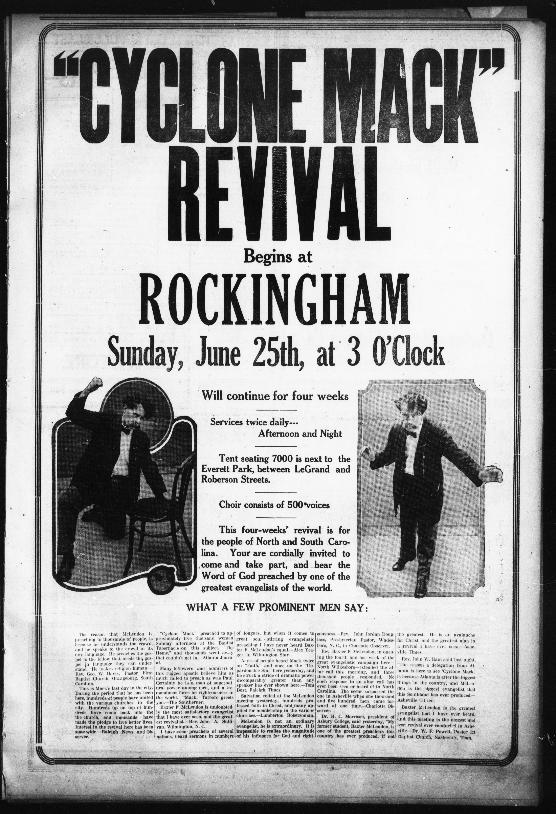
While Billy Sunday might spend up to six weeks in a single city and convert forty thousand people, most small revivals lasted one to two weeks with considerably fewer attendees—but the effect was the same: people found new faith and hope by becoming Christians, and established Christians renewed their walk with God.

Rockingham Post Dispatch (Rockingham, North Carolina), June 22, 1922

.

Revival meetings were big news. Newspapers promoted them and reporters covered the events. In 1905 The Seattle Republican actively encouraged readers to attend an upcoming revival meeting led by Reverend J. Wilbur Chapman, writing:

The thing to do is attend. Let us attend these meetings and, as Mr. Chapman says, feel every time he speaks that he is addressing you individually. Then we will be able to measure ourselves by the standard he represents and see if we are found wanting. The meetings are for the rich and the poor, for the people who are and would become Christians.

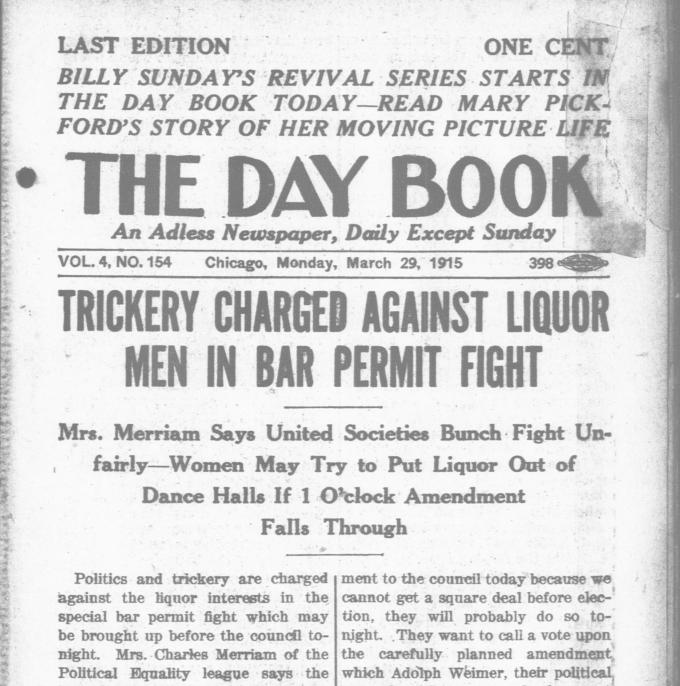
And in 1915 the Chicago Day Book invited Billy Sunday to “preach” a revival sermon via a daily column of the newspaper for five consecutive days. The Day Book promoted Rev. Sunday’s guest column in front page headlines and full-page spreads:

The Chicago Day Book announced Billy Sunday's written sermons with the same enthusiasm it gave an interview with Mary Pickford
The Chicago Day Book announced Billy Sunday’s written sermons with the same enthusiasm it gave an interview with Mary Pickford; March 29, 1915


Full-page promotion of Billy Sunday's upcoming written sermons in the Chicago Day Book. March 27,1 915
Full-page promotion of Billy Sunday’s written sermons to be published in upcoming editions of the Chicago Day Book. March 27,1 915

.

Newspapers in smaller towns and throughout America’s Bible belt gave revival meetings front-page attention:

Front Page of the Guthrie Leader (Guthrie, OK) ; March 7, 1914

.

Front page coverage of an evangelical revival in the Pacific Commercial Advertiser (Honolulu, HI); April 6, 1905

.

Isabella Alden drew on her experience with tent revival meetings in her allegorical novel, Lost on the Trail. In the book, a young woman named Weewona was raised from an early age by people in an isolated mountain cabin.

From Bismarck Daily Tribune (Bismarck, ND), November 26, 1910
Announcement of a Methodist revival meeting in the Bismarck Daily Tribune (Bismarck, ND), November 26, 1910

.

Cover_Lost on the TrailBut one day Weewona ventured down the mountain and stumbled upon a tent revival meeting where she heard the Christian message for the first time. Isabella used Weewona’s story to illustrate the ignorance and uncertainty we all suffer until we accept salvation through Christ.


After that first taste of God’s message, Weewona felt compelled to seek God. She headed down the mountain again, determined to learn more about the message of the revival meeting.

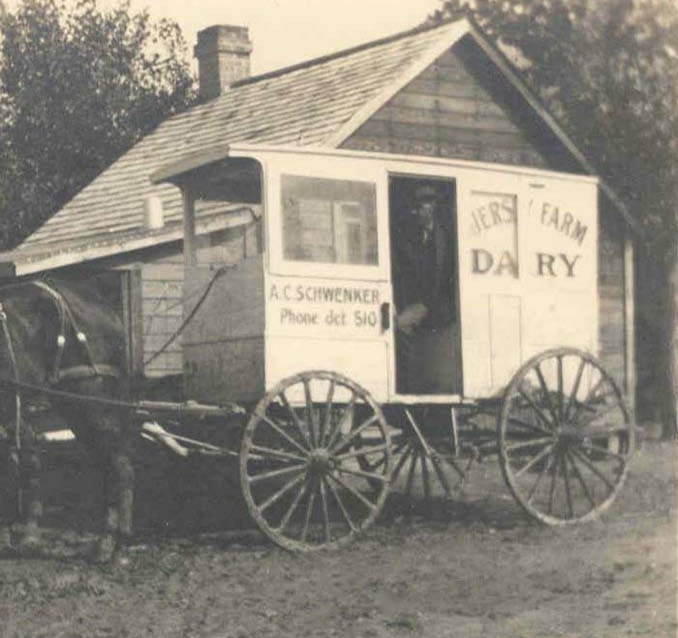
Dairy delivery wagon

For the first time in her life she was entirely on her own and unschooled in the ways of the civilized world. Finally, a kindly milk man helped her find a home . . . and took her on her first wagon ride. After Mr. Best got her settled in his milk wagon, he tried to put her at ease by asking if she’d traveled far.

“Y-yes,” said Weewona, breathlessly, for they were in motion now, and she had never felt anything like it. Pete had told her much about horses and wagons, but it is one thing to be told about a horse, and quite another not only to see one for the first time, alive and moving, but actually to be seated on a board behind him!

“Don’t it make you afraid?” she gasped, holding on firmly with both hands.

The old man looked at her curiously; then threw back his head and laughed, an entirely fearless, reassuring laugh.

“Afraid of Old Gray!” he chuckled. “Well, now, if that ain’t a joke! I shall have to tell mother that, sure. Why, Old Gray is the gentlest, reliablest horse that ever put foot on the ground! He wouldn’t hurt a fly, even after it had bit him, if he could help it. I guess you ain’t used to horses, are you?”

She answered with a single word, but her voice made the old man look closely at her again, and speak soothingly: “You needn’t be a mite scared. There ain’t anything going to happen to you as long as Old Gray and Stephen Best have you in charge.”

Riding in the dairy wagon was the first of Weewona’s adventures, but as she learned more about God and what it meant to live a Christian life, she blossomed and found the courage, with God’s help, to make a place for herself in the world.


Billy Sunday Sermon 01 01You can read Billy Sunday’s five-part revival sermon as it appeared in the Chicago Day Book in 1915. Click on the image to begin reading:

.

.

Here’s a short video that illustrates Billy Sunday’s style of preaching:

Cover_Lost on the Trail

Find out more about Lost on the Trail by clicking on the book cover:

.

.

.

Chrissy’s Endeavor Pin

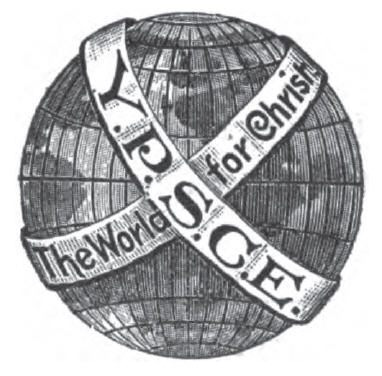
.  Logo Young Peoples Society of Christian Endeavor

When Chrissy Hollister arrived to spend the summer with her friend Grace, she was shown to a guest room that was decorated in blue and white and was “just as sweet and cool and charming as it can be.”

Presently her eyes rested on the blue satin pincushion, covered with white lace. Across it lay a ribbon—a badge of some sort. Chrissy laughed as she noticed that even the ribbon, which had evidently been dropped there by accident and forgotten, partook of the general character of the room, being of white satin, and bearing on its surface, painted in delicate tints of blue, five mystic letters: “Y. P. S. C. E.”

Victorian pin cushion smallChrissy studied them curiously, admiring the graceful curves of the rustic work, but wondering much what those letters could represent.

As Chrissy would later discover in a rather embarrassing way, those initials stood for Young People’s Society of Christian Endeavor. She would also discover just how important that distinctive pin was.

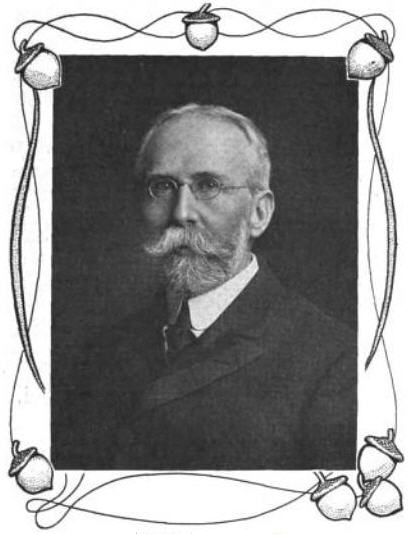
The design of the official Christian Endeavor emblem is attributed to Reverend Howard Benjamin Grose, a Baptist minister and editor of The Home Mission Monthly magazine. As a Christian Endeavor trustee, he felt strongly that the Society needed to adopt an official emblem, but the designs he’d seen were either too elaborate or expensive to produce. He wanted a simple design and felt, given the long name of the organization, the letters C and E should be made prominent.

Reverend H. B. Grose

.

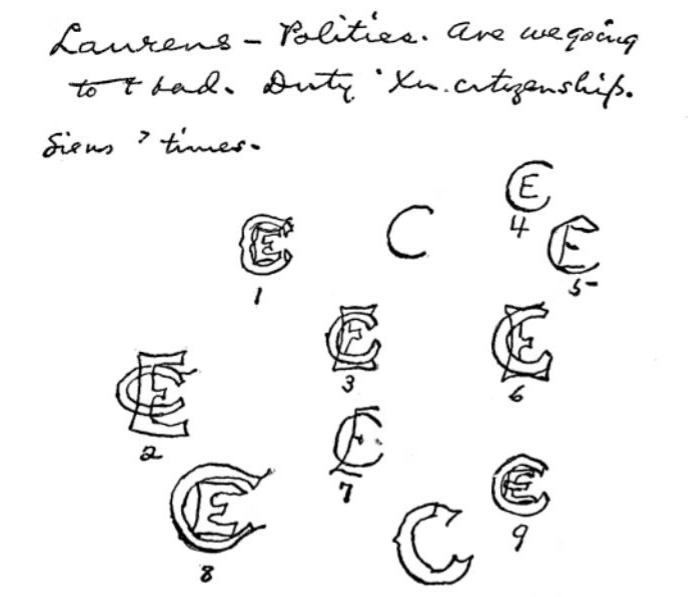
Reverend Grose began to doodle, putting the C and E together in different ways:

Pin sketches

He proposed sketch No. 9 to the trustees, and the monogram pin was unanimously adopted in 1887.

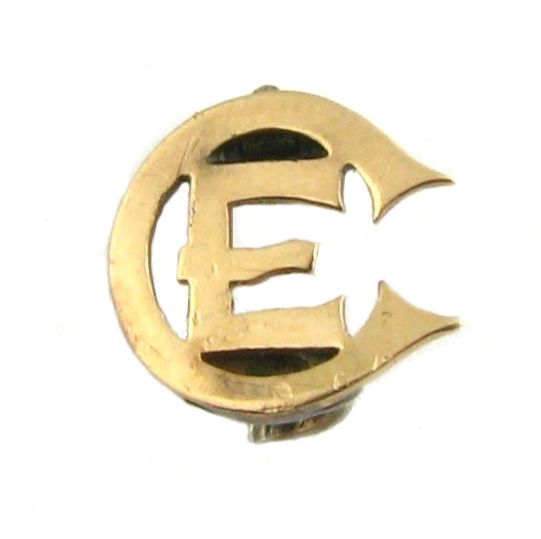
The C embraces the E. The Endeavor is all within the Christ.

Christian Endeavor_PinMany emblems are more showy, more glittering, more ornamental, perhaps; but I see none that satisfies me so well, or that awakens so many feelings of affection, gratitude, consecration, and hope,  as the strong, simple, speaking monogram in which the E that means Endeavor is made sublimely significant by the encompassing C that marks it all as Christian.

—Rev. Francis Bell, Founder, the Society of Christian Endeavor

.

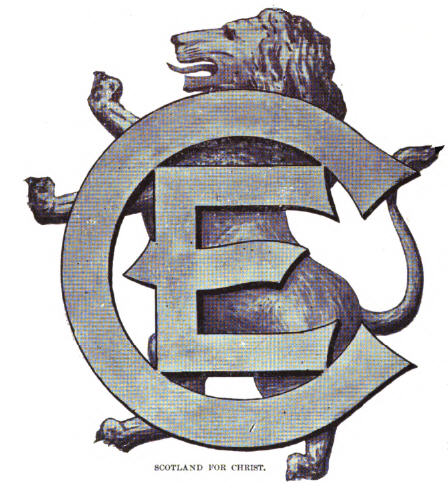
Once adopted, the Christian Endeavor emblem remained unchanged for generations. The distinctive design was enhanced only slightly for pins produced for the children’s society and Christian Endeavor organizations in other countries, such as this pin from Scotland:

Christian Endeavor_Pin Junior    Christian Endeavor_Pin Scotland

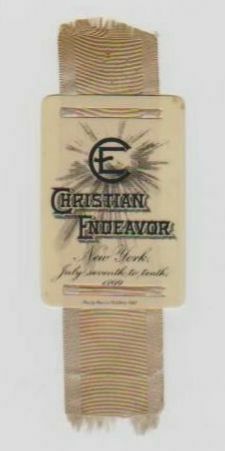
The ribbon badge Chrissy saw in the guest room at Grace’s house may have been a local Christian Endeavor badge. Many state and local societies adopted their own unique Christian Endeavor colors, which they wore as ribbons on their lapels. The ribbons were usually printed or embroidered with the state name, as well as the initials Y.P.S.C.E. and the words Christian Endeavor.

Ribbon badges were also created to commemorate Christian Endeavor annual conferences. Below is an example of the badge worn by attendees at the 1892 annual conference in New York:

Christian Endeavor Badge 1892 New York

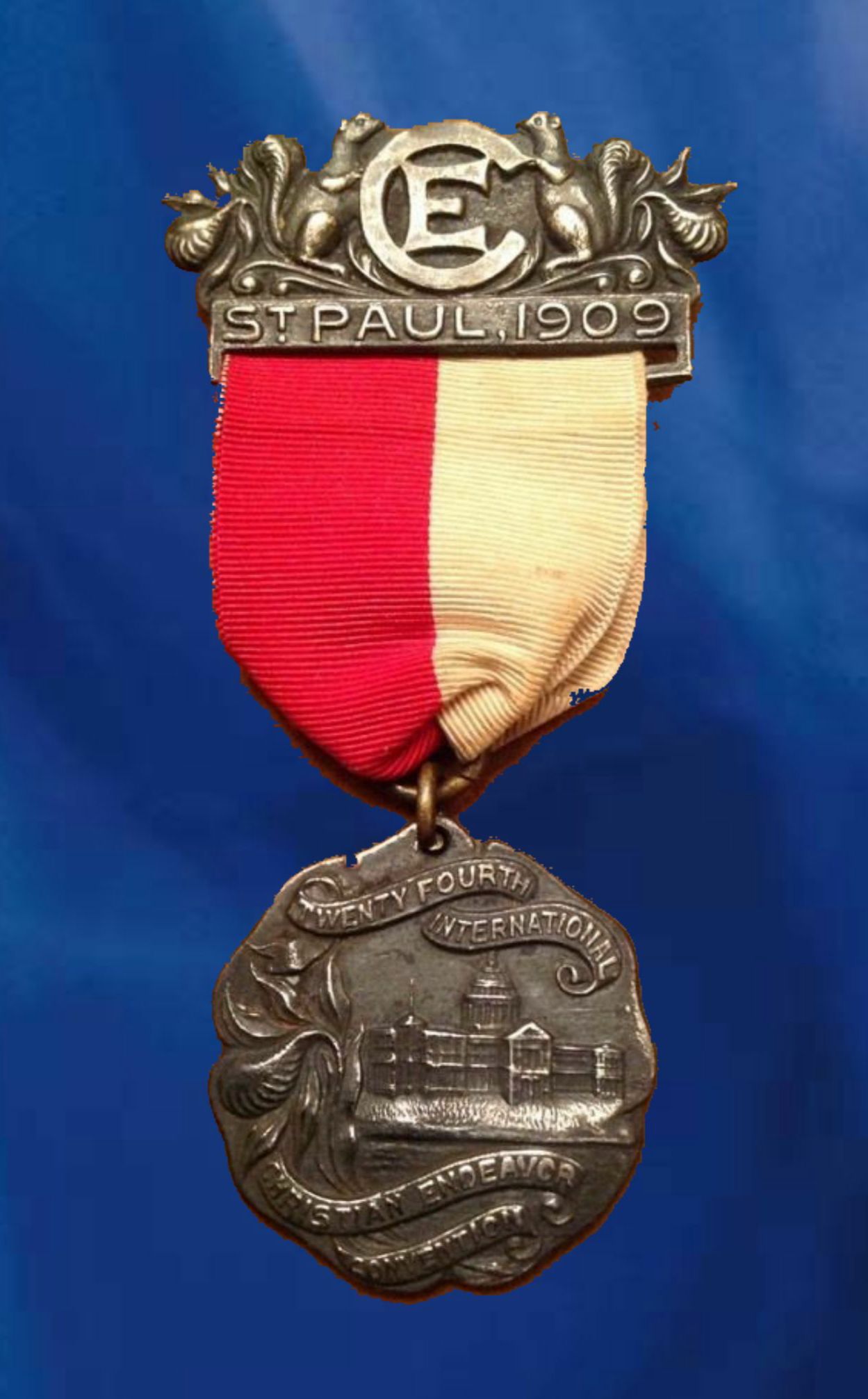
And this badge is from the 1909 national convention in Minnesota:

Christian Endeavor Badge 1909 Convention

After Chrissy became a Christian and organized a Christian Endeavor Society in her own town, she learned the power of the little pin while riding the streetcar one day:

A plainly-dressed girl of about her own age, with a good earnest face, sat opposite her, watching her with an intentness that was only excusable because of the absorbed and almost tender light in the girl’s eyes, which lifted her act far above the commonplace stare. At last, seeming to have gathered courage for a resolve, she arose and took a vacant seat beside Chrissy.

“I beg your pardon,” she said in low, well-bred tones, “may I speak to you? I am a stranger, but I see that we are kindred.” Touching as she spoke, the tiny silver badge she wore, bearing the magic letters “C. E.,” and glancing significantly at the corresponding one of gold, which fastened Chrissy’s linen collar.

There was an instant clasping of hands, and an exchange of cordial smiles.

The plainly-dressed girl explained that a friend of hers had attended a Christian Endeavor meeting—the very Christian Endeavor Chrissy organized in her town.

‘And she liked it all so much, that she came home and told about it, and did not rest until she had started a society out of our class in Sunday school. I joined as an associate member, because I was ready to do whatever the others did, but I got acquainted in that society with Jesus Christ. I signed the pledge, and gave myself to Him forever; and I’ve had a good winter.”

Chrissy was surprised and humbled to know that her efforts resulted in a soul being won for Christ. “Unfaithful, unreliable in every way, yet He had used her in the harvest field!” wrote Isabella Alden.

Posing in the shape of the CE monogram ca 1898
Members of two Christian Endeavor Societies pose on the steps of Antioch College in the shape of the CE monogram, circa 1895.

.

Isabella and her husband, Reverend Alden were tireless workers for Christian Endeavor. Isabella featured the society in her books Chrissy’s Endeavor, Her Associate Members, Pauline, and What They Couldn’t. She also wrote several short stories about Christian Endeavor: One Day’s Endeavoring and A Christian Endeavor Revenge were published in the Christian Endeavor magazine, The Golden Rule. And her book Grace Holbrook was a compilation of several short stories that illustrated the principles of Christian Endeavor for children.


You can learn more about today’s Christian Endeavor by clicking here to visit their site.

Click on the book covers below to find out more about the books mentioned in this post.

Cover_Chrissys Endeavor v3    Cover_Her Associate Members v2 resized

Cover_Pauline    Cover_What They Couldnt 02 resized


New Free Read: Memory’s Picture Gallery

Cover_Memory's Picture Gallery resized

Just in time for Valentine’s Day, this charming short story chronicles a young couple’s journey of true love and abiding faith.

Click on the book cover to begin reading Isabella Alden’s 1885 short story, “Memory’s Picture Gallery.”

You can find more Isabella Alden free reads by clicking on the Free Reads tab above.

Sally Lunn at Mount Hermon

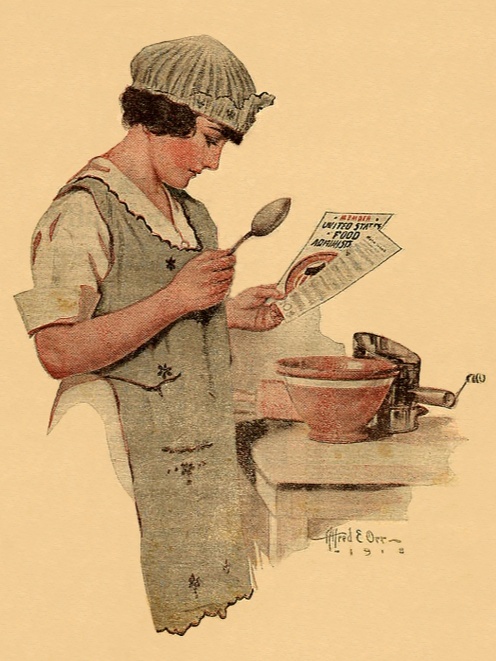
In The Browns at Mount Hermon, Mrs. Roberts was overjoyed when her most fervent prayer was answered—her daughter, Ailene gave herself to the Lord. Mrs. Roberts wanted to celebrate the blessing in the best way she knew how: by preparing a special breakfast for everyone to enjoy.

Illustration of woman reading a recipe.“Oh, well, we won’t mind if we don’t have muffins for breakfast tomorrow morning. What does it matter what we have to eat? Yes, it does, it matters a great deal. We want the best breakfast tomorrow morning that was ever had in this house. I should like to feed everybody on roses! Though after all, I don’t suppose they would like them to eat half so well as they do muffins. Or Sally Lunn; I’ll have Sally Lunn tomorrow, whole sheets of it. Mr. Brown says nothing was ever better to eat than my Sally Lunn; and Ailene likes it better than anything else; I wonder I didn’t think of it the first thing. Oh, Mary Brown! I’m that happy tonight over the child, that it is a wonder I can think of anything to eat! I feel as though I could fly, without wings. Don’t you think she’s settled it! She belongs to the Lord!”

Sally Lunn was a type of cake that originated in England; and there are American versions of the Sally Lunn recipe in cook books dating back to early 1800s. By 1907, when The Browns at Mount Hermon was written, Sally Lunn had become a favorite pastry on American tables, too.

Henry's Cook Book and Household Companion (1883)
Henry’s Cook Book and Household Companion (1883)

There were as many versions of Sally Lunn as there were cooks; but, in general, Sally Lunn was a rather dense cake, much like sponge cake, that could be baked in a variety of ways.

For breakfast, it was usually made up in loaves, then served toasted and spread with butter.

from The Winston Cook Book by Helen Cramp (1913)
A Sally Lunn cake, pictured in The Winston Cook Book by Helen Cramp (1913)

It was also baked in muffin tins and served as tea-cakes with honey, fruit jelly, or sweet sauce.

Black and white photo of three individual cakes arranged on a plate.
Sally Lunn tea cakes. From Good Housekeeping magazine, 1907

If you made several sheets of Sally Lunn, as Mrs. Roberts planned to do, and it happened to go stale because you didn’t eat it fast enough, never fear. A 1903 edition of The Epicure magazine recommended cutting stale Sally Lunn cake into small slices or shapes, soaking then in a thin custard, and frying them in clarified butter. Sprinkle the top with sugar, and “you had very good Beignets.”

Here’s a recipe from 1913 that may have been close to the recipe Mrs. Roberts followed for her Sally Lunn cake:

Recipe Sally Lunn Cake

Click on the image to see a larger version you can print out.

You can learn more about the history of Sally Lunn cake. Click here to read a post at Smithsonian.com about Sally Lunn cake.


Cover_The Browns at Mount HermonClick on the book cover to find out more about The Browns at Mount Hermon.


A Woman’s Voice

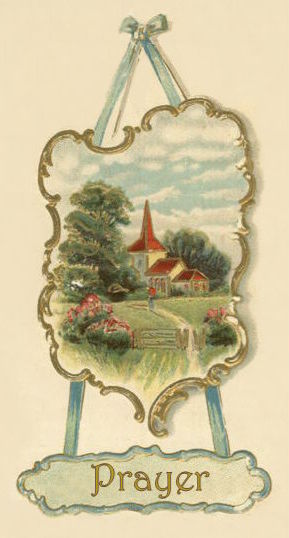
Colored drawing of a country church displayed above the word Prayer In her memoirs, Isabella Alden wrote about the first time her father and mother visited her after she was married. It happened when Isabella’s minister husband was new to his church and was working hard to make the Wednesday prayer meetings a success. He wanted the prayer meeting attendees to participate, so on Sunday mornings he would announce from the pulpit the topic for the Wednesday meeting. He asked everyone to come on Wednesday with a Bible verse that supported or illustrated the topic.

One Tuesday, Isabella’s mother and father arrived unexpectedly for a visit. The next evening Isabella proudly escorted her parents to the church and sat beside her father as her husband, Reverend Alden, led the prayer meeting. But something happened that forced her to make a terrible choice.

Her father had always strongly opposed women speaking in public and that opposition extended to prayer meetings.

Yet Isabella had prepared a Bible verse to recite aloud if necessary to help and support her husband. None of the other attendees were responding to Reverend Alden’s call to participate and an uncomfortable silence stretched on for several minutes. Isabella wrote:

“I sat in distressed silence for several minutes; so did everybody else. Suddenly I looked at my husband. I had promised him, had even talked with him about some of the thoughts that I wanted to present. What must he think of me now?

“Oh, Christ!” I prayed in my heart. “Tell me what to do!”

And the answer came, she said, as plainly as spoken words. She broke the silence and recited aloud the verse she had prepared:

“Thus saith the Lord who created thee:
 “Fear not, for I have redeemed thee; I have called thee by thy name; thou art mine.”

As soon as she finished, others followed in quick succession, and the prayer meeting continued on.

But Isabella was keenly aware that her father never said a word to her about the meeting or the verse.

“He was kind and tender toward me, but graver than usual; I had a feeling that I had hurt him by showing no respect for his opinions.”

Her mother and father left early the next morning and never visited the Alden home again.

A black and white illustration of a woman in Victorian era dress speaking before an audience of men and women.That was an experience that stayed with Isabella. In fact, it made such an impression on her that she described that scene—in different ways—in many of her books.

In Workers Together: An Endless Chain, Miss Joy Saunders knew that the church she belonged to “believed in woman’s sphere, and desired her to keep strictly within its limits” and “on no account to let her voice be heard” in its religious meetings.

But when Joy followed her conscience and spoke a simple verse in an otherwise very quiet prayer meeting, she “set in motion forces that are pulsing yet” because the verse she recited touched so many hearts.

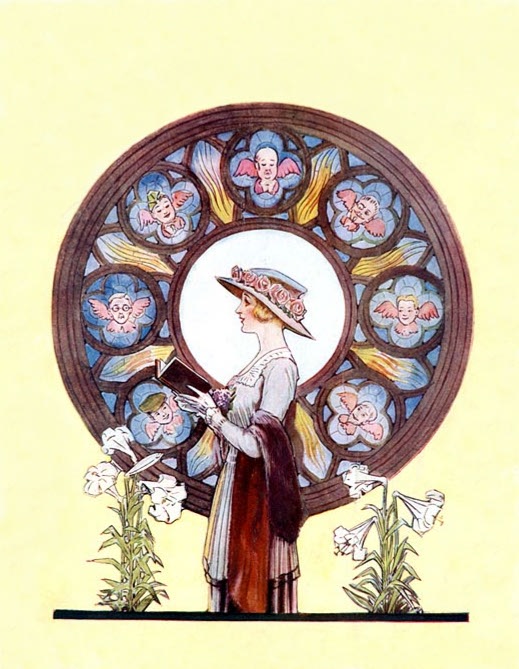
Profile of a young woman standing in church. Behind her is a stained glass window; but instead of Christian icons, the window  features faces of people looking down upon her, some forwning, some laughing.
Scrutiny

.

Rebecca Harlow, the heroine of Links in Rebecca’s Life, was well aware that people in her church thought women and girls should keep silent when they were at prayer meeting. But after one of those long “awful pauses” in which no one at the meeting said a word, Rebecca spoke up and asked the people to pray for a friend who was in temptation.

That was all she said and though she couldn’t see anything wrong in her words, she knew there were some in the room who “thought it was out of taste.”

And when Ester Ried attended her first prayer meeting in New York, she was astonished by the proceedings:

“Now,” said the leader briskly, “before we pray, let us have requests.” And almost before he had concluded the sentence a young man responded.

“Remember, especially, a boy in my class, who seems disposed to turn every serious word into ridicule.”

“What a queer subject for prayer,” Ester thought.

“Remember my little brother, who is thinking earnestly of those things,” another gentleman said, speaking quickly, as if he realized that he must hasten or lose his chance.

“Pray for everyone of my class. I want them all.” And at this Ester actually started, for the petition came from the lips of the blue-ribboned Fanny in the corner. A lady actually taking part in a prayer meeting when gentlemen were present! How very improper. She glanced around her nervously, but no one else seemed in the least surprised or disturbed; and, indeed, another young lady immediately followed her with a similar request.

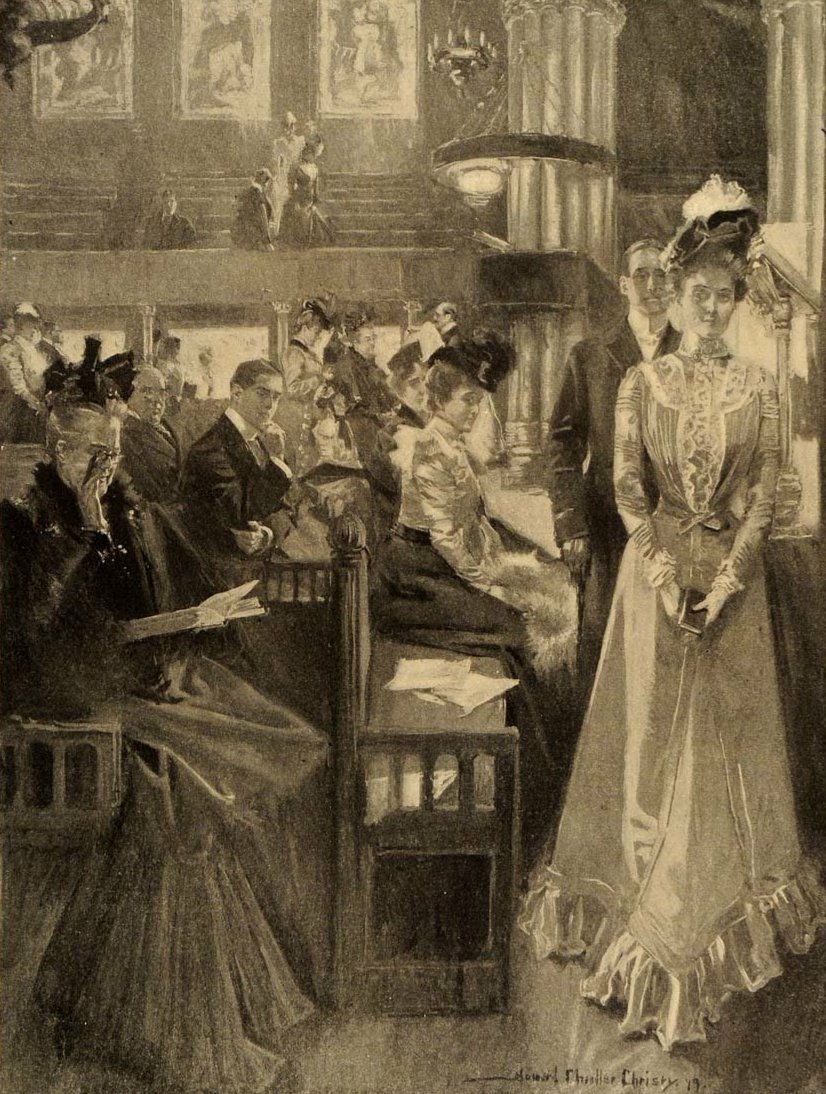
Illustration of a young woman going to her seat in church, with the yes of several members of the congregation following her.
An American Girl in Church
by Howard Chandler Christy

.

In Ruth Erskine’s Crosses, Isabella described the reaction when Ruth’s half-sister spoke up at the weeknight prayer meeting:

The words she uttered were these: “Therefore being justified by faith, we have peace with God, through our Lord Jesus Christ.”

Now, if it is your fortune to be a regular attendant at a prayer-meeting where a woman’s voice is never heard, you can appreciate the fact that the mere recitation of a Bible verse, by a “sister” in the church, was a startling, almost a bewildering innovation. Only a few months before, I am not sure but some of the good people would have been utterly overwhelmed by such a proceeding. But they had received many shocks of late. The Spirit of God coming into their midst had swept away many of their former ideas, and therefore they bore this better.

A Happy Ending:

Not long after that Wednesday night prayer meeting when Isabella spoke out in front of her parents, her father became very ill and she traveled to his home to be with him in his final days. One evening she was alone with her father when he said, unexpectedly:

“Thus saith the Lord who created thee.”

He explained to Isabella that he well remembered that Wednesday night prayer meeting and the verse she recited.

“The first time I ever heard it, your beloved voice gave it to me,” he said. “I can’t begin to tell you what [those words] are to me now, lying here. ‘Fear not; for I have redeemed thee; I have called thee by thy name; thou art mine.’”

That was the last private talk Isabella had with her father and she cherished the memory of it.

“I thank the dear Lord,” she later wrote, “that one night He gave me courage to repeat words which brought joy to Father’s heart.”


Click on the “Isabella’s Books” tab at the top of this page to read more about the books mentioned in this post.

Jessie’s Jockey

Jessie Wells, the heroine of Isabella Alden’s 1880 novel by the same name, never went anywhere without her jockey. Of course, when Isabella wrote about Jessie’s jockey, she didn’t mean someone who rides a horse . . . she meant Jessie’s hat.

Jockey hats were very fashionable from the 1860s through the early 1900s. The style of jockey hats changed over the course of those years, but the basic design remained the same: a jockey hat had a brim or peak that protruded in front and a rounded, narrow crown that fit close to the top and sides of the head. Jockeys were usually trimmed with a tassel or feather.

Elisabeth McClellan illustrated the 1860s style of jockey hat in her book, Historic Dress in America.

Drawing of a woman in Victorian-era dress and hairstyle wearing a hat that sits high on her head with several feathers swept back from the brim.
Illustration of a jockey hat from Historical Dress in America by Elisabeth McClellan.

.

The style of hat was so much in vogue in 1860s America, a popular song was written about it. You can click on the image below to read the song’s lyrics.

Cover illustration showing a woman in Civil War era dress wearing a hat that fits against her head, with a turned up brim and a tassle on one side.
Cover to the sheet music for the 1860s song Jockey Hat and Feather.

.

Perhaps the most famous illustration of a jockey hat was the one fashioned for the character of Scarlett O’Hara to wear in post-Civil War Georgia in the movie, Gone with the Wind.

The famous jockey hat worn by Scarlett O’Hara in Gone with the Wind.

.

Though it was made of drapery fabric (as we all know), Scarlett’s jockey was quite fashionable with its styling and trim.

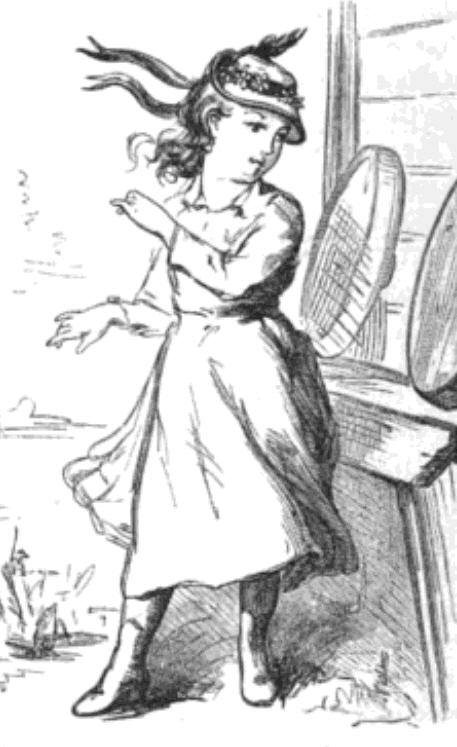
Jessie’s jockey hat would not have been as fashionable or as luxurious as Scarlett’s. Jessie’s jockey may have been made of straw, and the brim might have been more like a visor than a peak pulled low on her forehead, as this 1878 illustration shows:

Drawing of a young girl wearing a straw jockey hat with ribbons trailing down the back.

.

Straw jockeys were in fashion in the 1870s and 1880s. Isabella may have imagined Jessie’s hat of straw, because she wrote scenes in the book where Jessie set her jockey down on the ground (an action that would have soiled a jockey made of fabric) and she often used her jockey to fan herself.

Illustration of a woman with her arms around a young girl who is wearing a straw jockey hat trimmed with flowers and pulled forward over her forehead.
Version of a girl’s jockey hat from La Mode Illustrée.

.
In the late 1800s the styling of jockey hats changed again. Godey’s Lady’s Book and Magazine described the latest version in their November, 1883 issue:

Article describing jockey hats made of felt or velvet. This has a visor, front, and band of the close cap worn by jockeys, but the crown is higher, has a crease or fold front to back, and the back of the crown is cut off so that it rests lightly upon the knot of hair..

Interestingly, what was fashionable in America was not so fashionable in other parts of the world. The British magazine, Household Words, published this warning about jockey hats in 1884:

Article condemning jockey hats for grown-up girls because they make the wearer look "fast."

.

In America, there were no such restrictions, however, and ladies wore their jockey hats sitting forward on their foreheads at a fashionably jaunty angle.

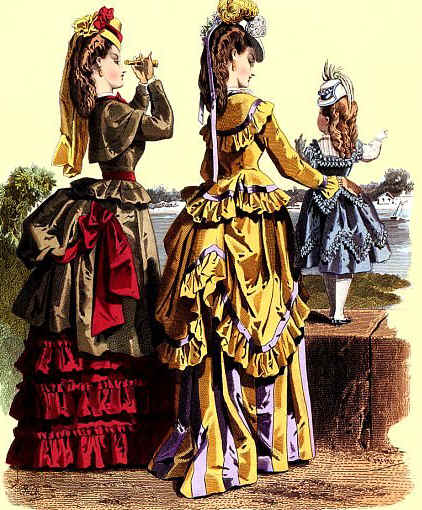
Color illustration showing two women and a young girl dressed in Victorian-era attire and wearing embellished straw jockey hats pulled forward so the brim covers their foreheads.
Fashionable jockey hats for ladies and young girls, from La Mode Illustrée.

.

Many thanks to blog reader Merry Chris for suggesting this topic.

Cover_Jessie WellsYou can click on the book cover to read more about Isabella Alden’s book, Jessie Wells.

Frank Beard’s Chalk Talk

Chalk Talk

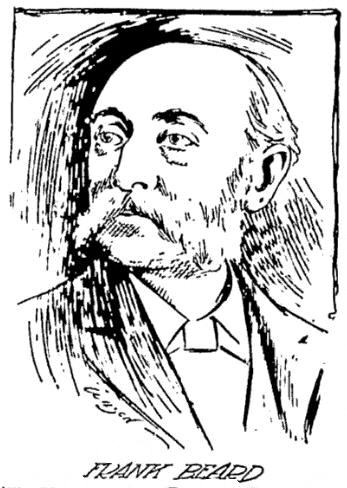
Frank Beard was one of the most popular lecturers at Chautauqua Institution. His Chalk Talk lectures drew standing-room-only crowds because of their pitch-perfect blend of humor, art and Biblical truths.

Black and white sketch of the artist Frank Beard.In an 1895 interview, Frank recalled how his Chalk Talks came to be:

“I was a young artist in New York, and had just been married. My wife was an enthusiastic churchgoer; and a great deal of our courtship was carried on in going to and from the Methodist church. The result was that I struck a revival and became converted. This occurred shortly after I was married, and like other enthusiastic young Christians, I wanted to do all I could for the church.”

Soon after he joined the church, the congregation put together an evening of entertainment. The ladies, knowing of his talent, suggested that Frank draw some pictures as part of the program. Frank agreed, but he felt that just standing in front of an audience and sketching without saying anything about the pictures “would be a very silly thing.”

He decided instead to make a short talk and draw sketches to illustrate his points. The talk was to be given as part of a Thanksgiving celebration, and Frank later joked that he rehearsed in front of his wife, his mother-in-law, and the turkey. “Well, my wife survived, my mother-in-law did not die while I was talking, and the turkey was not spoiled.”

Black and white sketch of Frank Beard drawing at an easel. Seated in chairs watching are a young woman, an older woman and a plucked, headless turkey strapped in the third chair.

When he gave his talk in front of the congregation, it was a great success. Soon, other churches asked him to repeat his talk, and in very short order he had more invitations to speak than he could ever hope to accept. His wife suggested charging a fee for each lecture, hoping that the cost would deter organizations from inviting him to talk at their functions. So Frank dutifully began charging $30 per talk. The requests continued to pour in. He increased his fee to $40, then $50, but his talks continued to be in great demand.

Newspaper announcement of a Freank Beard lecture from the 10 Mar 1890 edition of the Rock Island Argus
Announcement in the March 10, 1890 edition of the Illinois newspaper, The Rock Island Argus

That was the birth of the Chalk Talk, and Frank soon hit the lecture circuit. He was one of the first speakers at Chautauqua Institution in New York; and he lectured at many of the daughter Chautauquas. This 1899 clipping from the Los Angeles Herald recounts Frank’s Chalk Talk at the Long Beach Chautauqua (which named July 19, 1899 Frank Beard Day):

Announcement of Frank Beard Day at the Long Beach Chautauqua; from The Los Angeles Herald, 20 Jul 1899

The topics of his Chalk Talks ranged from morality tales to stories from the Bible, each told in a casual, funny, but reverent, way. He knew that people who wouldn’t listen to a “sermon” would listen to his Chalk-Talk if the truths were presented in an entertaining fashion.

In Four Girls at Chautauqua, Eurie Mitchell proved that very point. Eurie was so opposed to listening to “sermons” at Chautauqua, she refused to go to any of the lectures; but when she heard about Frank Beard’s caricatures, she decided to go see him for herself.

If you have never seen Frank Beard make pictures, you know nothing about what a good time she had. They were such funny pictures! Just a few strokes of the magic crayon and the character described would seem to start into life before you, and you would feel that you could almost know what thoughts were passing in the heart of the creature made of chalk. Eurie looked and listened and laughed.

In Isabella’s book, Frank’s Chalk Talk was able to do what no other lecture at Chautauqua could: reach Eurie’s heart and lead her, ultimately, to salvation through Christ.

“Pictures can often tell stories quicker and better than words,” Frank once said, “and I believe that cartoons can be used in the service of religion, righteousness, truth, and justice.”

Black and white drawing of a man standing at a blackboard drawing a circle by moving his arm in a wide round motion

To prove his point, he once asked, “If you were commissioned to teach a child the nature of a circle, would you begin by stating that a circle is an area, having for its center a point, and bounded by a circumference in the nature of an endless imaginary line, which at all points is at an equal distance from the center? No! You would do nothing of the sort, but you would [show] its nature and properties [by drawing a circle] in black and white.”

Sometimes the subjects of his Chalk Talks were very simple. He told a story, for example, of how a blackboard and chalk could be used to teach a Sunday-school class of young children who had never before seen the Christian symbol of a cross inside the shape of a heart. He started by drawing the simple outline of a heart on the blackboard.

A simple sketch of a heart-shape in white chalk against a black background“What is this?”

“A heart!”

“Yes, a heart. Now, I mean this to represent a particular heart—I mean it for my heart. What is it now?”

“Your heart!”

“Don’t forget that. Now, see what else I will draw.” And he drew a child’s face within the heart.

“Now what have I made?”

Drawing in white chalk of a child's face inside the shape of a heart“A little boy!” “A little girl!” “A little child!” Variously cried the children.

“Yes, a little child; but where is the child?”

“In the heart.”

“In the heart?”

“In your heart.”

“That’s right. Now, what does it represent? When I tell you that I have a little child in my heart, what does it mean?”

A chalk sketch of a cross inside the shape of a heart against a black background“You mean you love the child.”

“Exactly. Now I will rub out the child and put a cross in the heart. What does that mean?”

“You love the cross.”

Then he went on to explain in a simple way what loving the cross meant.

He also shared an example of one of his lessons for older children and adolescents. He used this lesson to illustrate the concept of the narrow Christian path described in Matthew 7:13-14:

A young man is attracted by the appearance of beauty and the pleasure along the broad way. Timidly at first, for he is not bad and rather fears evil—but he loves play and pleasure—so he steps into it. He knows it is not the right way to take but he thinks to himself:

Chalk drawing of the head of a nicely-dressed young man wearing a hat.

“After a while, after I have had a good time, I will go over to the right path and come out all right after all.”

Chalk Drawing of the head of a frowning young man wearing a hat and smoking a cigarette

Frank went on to explain how the young man fell in with evil companions and was drawn further away from the good path.

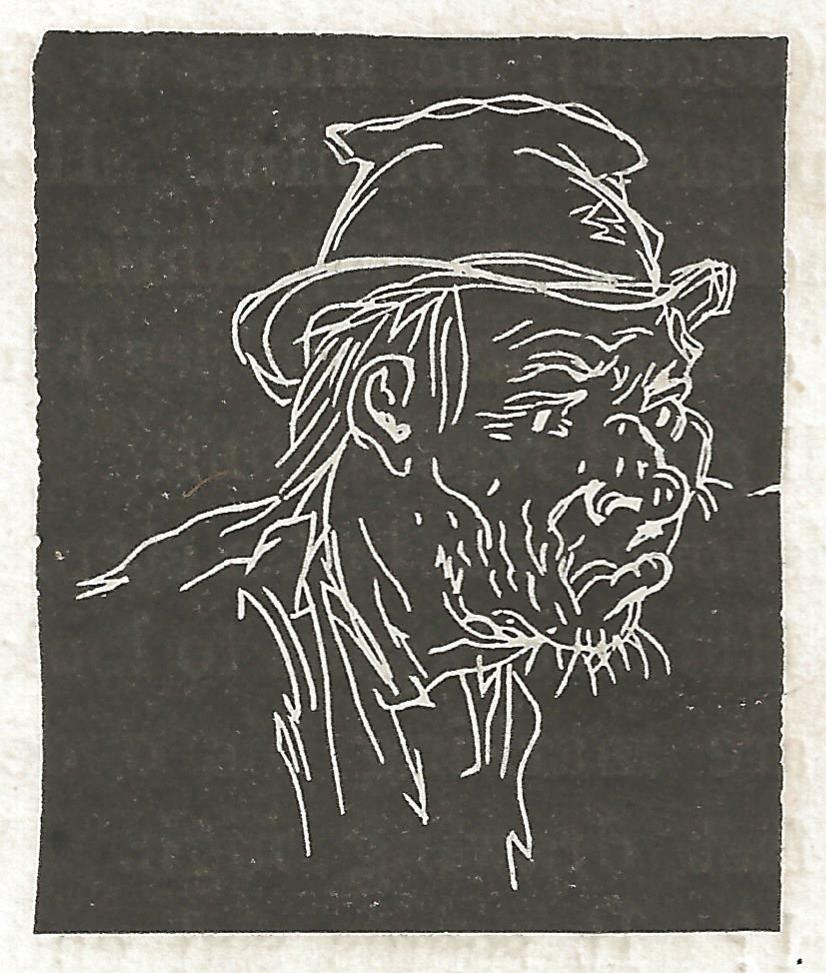
Chalk drawing of the head of an old man with disheveled clothes and hat, smoking rumbled cigarette.

The young man learned to smoke and chew tobacco and read books “which mislead and give us wrong notions in life, that make heroes of scamps, thieves and liars.”

Chalk Ddawing of the head of an old man, hunched over, wearing disheveled clothes and hat.

As Frank continued the lesson, he amended and enhanced his original drawing to show the progressive results of the choices the young man made in his life.

Wherever he gave his Chalk Talks, he was well received, and his reputation grew. But not everyone was a fan of using a blackboard and chalk as teaching tools in the Sunday-school. Frank shared a story about one church that decided to use a man in their congregation—they assumed he had talent because he was a sign painter by profession—to illustrate Sunday-school lessons. The man decided to illustrate the story of Samuel as a child, entering the apartment of the high priest Eli in answer to his summons. His efforts were not well received.

Chalk drawing of Samuel running towards Eli who is in bed.

“Some objected to the bed-posts,” Frank said. “Some didn’t exactly know why, but the drawing didn’t conform to their idea of Samuel at all, and, more over, Eli’s nose was out of proportion.”

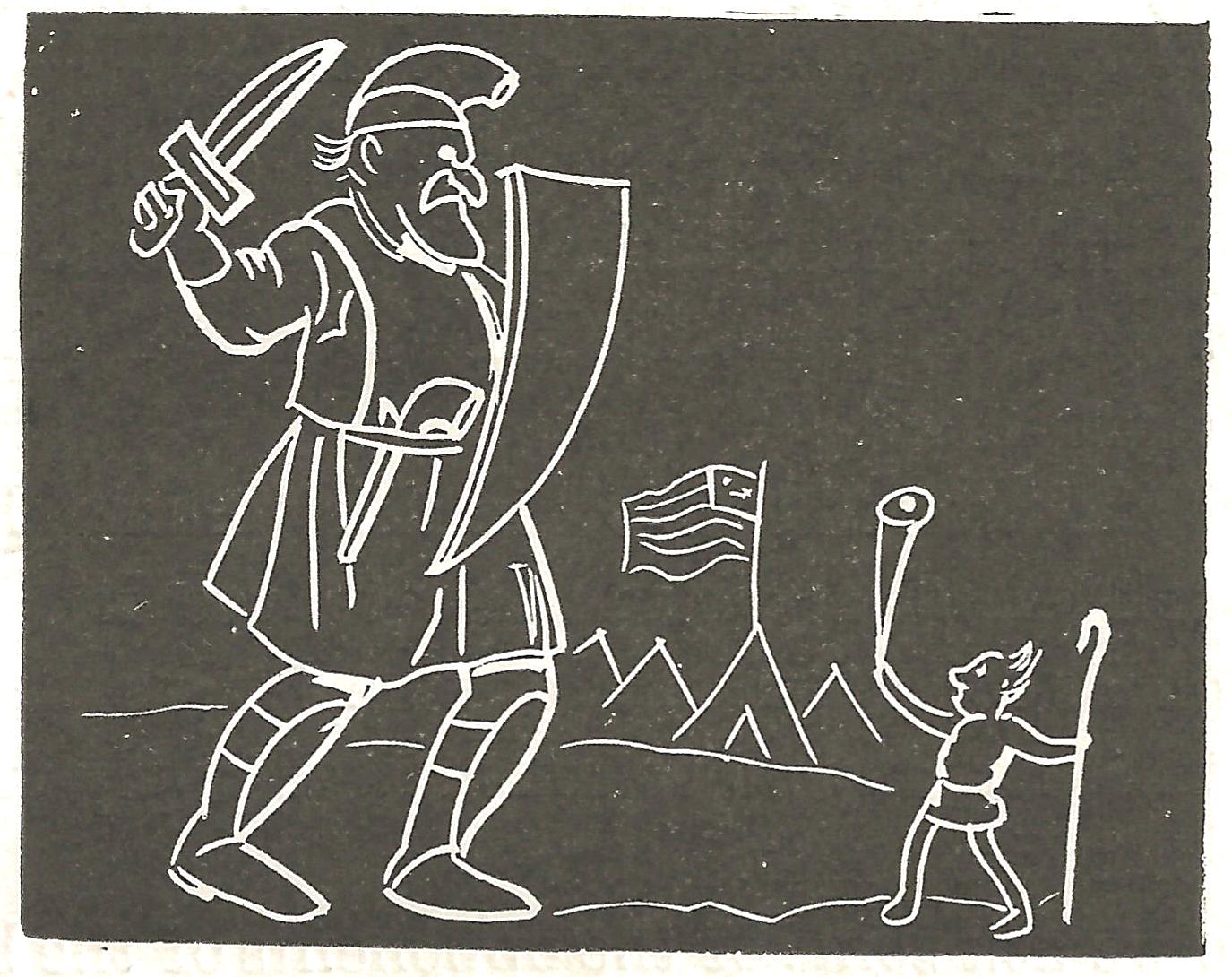
Chalk drawing of the Bible story of David and Goliath

The man’s next attempt didn’t fare any better, when he drew Goliath about thirty-five feet high in proportion to David. In fact, the congregation didn’t like anything at all about the poor sign-painter’s efforts at the blackboard.

Isabella Alden’s book Links in Rebecca’s Life featured a character who also disliked Chalk-Talk style lectures. She was a Sunday-school teacher who hated chalk and blackboards.

“They are such horrid dusty things. You get yourself all covered with chalk, and just ruin your clothes. I can hardly wear anything decent here as it is. If I had a blackboard, I should give up in despair.”

“I should think it would be a great help in teaching children,” Rebecca said.

“Well, I don’t know. What could I do with it? I don’t know how to draw, and as for making lines and marks and dots, I am not going to make an idiot of myself. What’s the use?”

But Frank Beard believed no special talent was required for a teacher to incorporate chalkboard drawings into Sunday-school lessons.

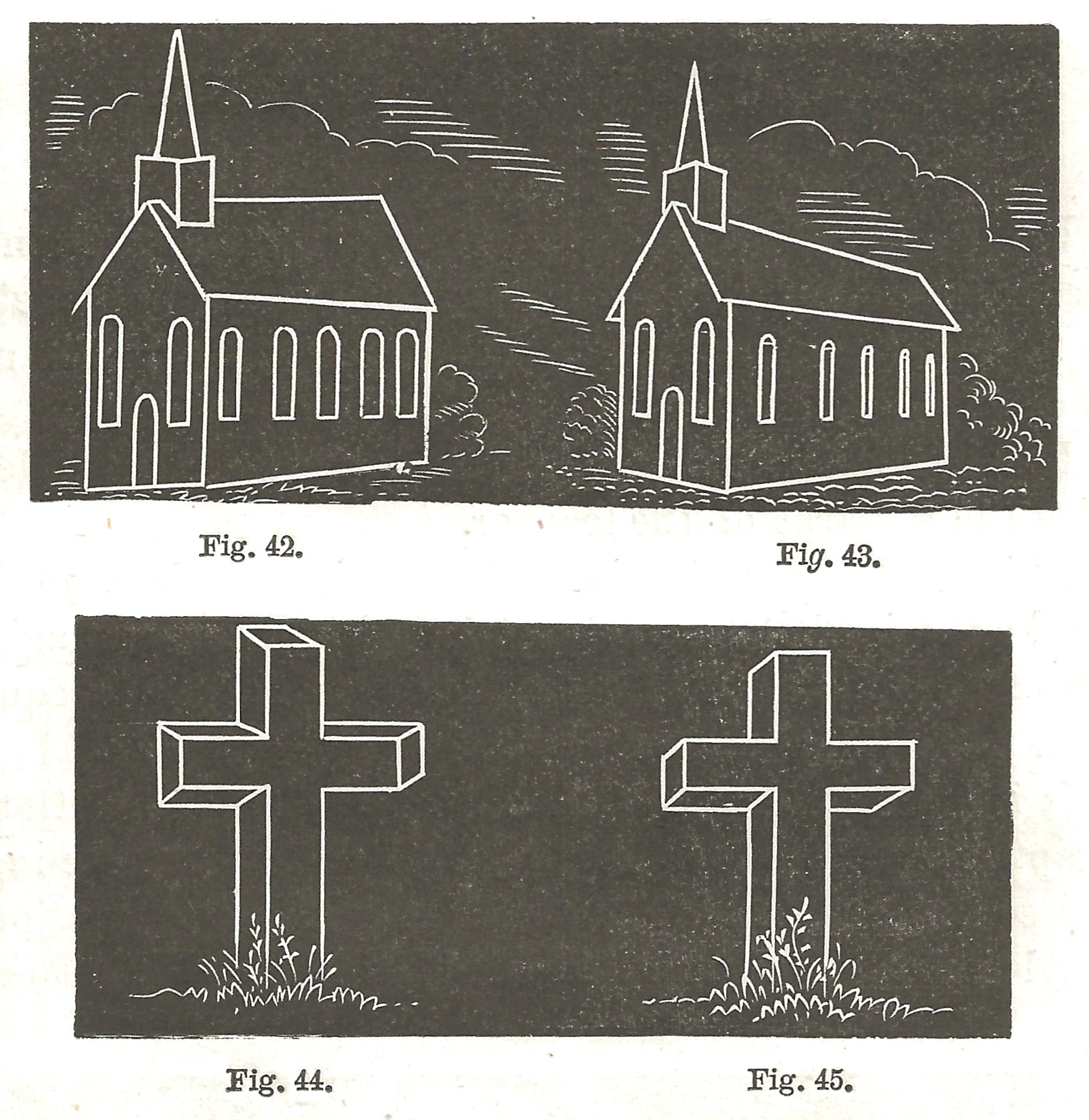
“Many are apt to think some extraordinary genius is necessary to fit a teacher to use the blackboard,” he said. “It is a mistake. You can teach better with a pencil than without. You can learn to draw far better than you ever imagined possible.”

Drawings of two different versions of a church and a cross; one version showing the wrong perspective and one version showing the correct perspective.
Illustrations from Frank’s book showing the right (Figures 43, 45) and wrong (Figures 42, 44) way to draw an image in perspective.

In 1896 Frank published a book for Sunday-school workers; in it he gave simple instructions for using the blackboard to illustrate Bible lessons.

Example of a simple but artistic way to write "The Lord is my shepherd" in chalk on the blackboard

Two examples of chalk talk methods for writing "what a friend we have in Jesus" on the chalkboard.

His book included how-to’s on perspective, lettering, and using easy-to-draw symbols as illustrations. Here are some of the symbols he illustrated:

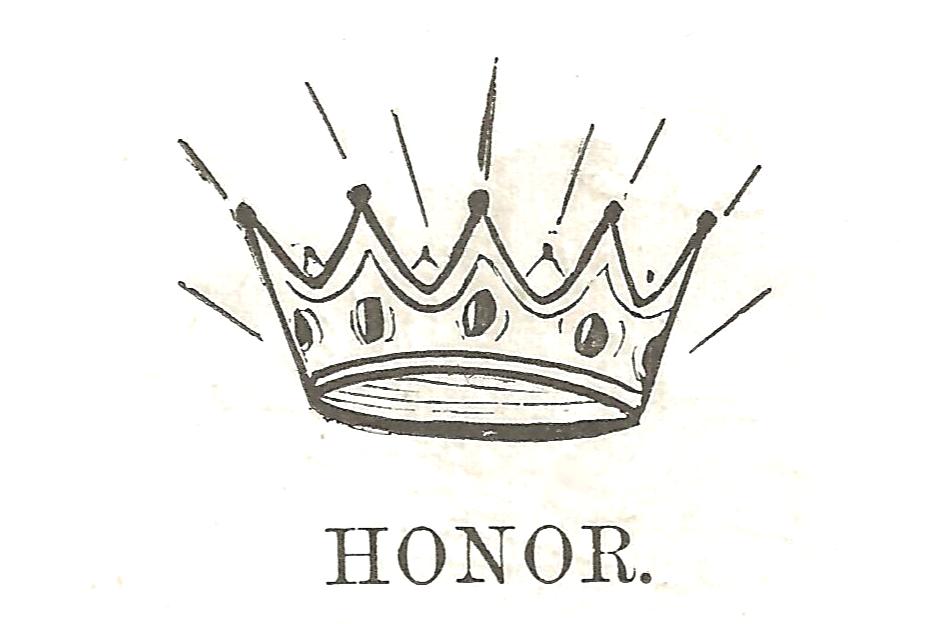
Drawing of a crown with the word "Honor" written below. Drawing of a key with the word "Knowledge" written below. Drawing of a star with the word "Promise" written below. Drawing of a cross with the word "Salvation" written below. Drawing of an ancient oil lamp with the word "Wisdom" written below.

The purpose of writing the book, he said, “is to show how the blackboard can be used in the Sunday-school, and to furnish such instruction in drawing upon it” so it can be done in the most effective way.

drawing of a Victorian-era woman darwing with chalk on a blackboard in front of children seated on chairs in front of her
Illustration from Frank Beard’s book, Chalk Lessons

He was quick to say that he didn’t want the blackboard to monopolize the Sunday-school or supplant other useful forms of instruction. But, if used correctly, Frank Beard proved that the blackboard—and Chalk Talks—could be the “instrument which proves effective as a means of winning souls to Christ.”


"Taught by Pictures." "Frank Beard believes in the cartoon in religion." A Chat with the Artist." "How He Came to Invent the Chal Talk." "War-Time Caricatures"In 1895 Frank Beard gave an interview to the Washington D.C. newspaper The Evening Star. Click on this image to read the interview in which Frank tells how he invented the Chalk Talk:

.

.
Cover_Links in Rebecca's LifeClick on the book cover to learn more about Links in Rebecca’s Life.

.

.
Cover Box Set books 1-3 Click on the book cover to learn more about Four Girls at Chautauqua.


Aunt Hannah’s Advice

Aunt Hannah Adams is one of Isabella Alden’s most popular fictional characters. Aunt Hannah was a woman who loved the Lord, knew her mind, brooked no nonsense, and appreciated daily blessings. Most importantly, she knew when to give advice to others  . . . and when not to. With all her life experiences, she grew wise in her older years; but, like any wise person, she also held her tongue until the time was right to share her own special insight with others.
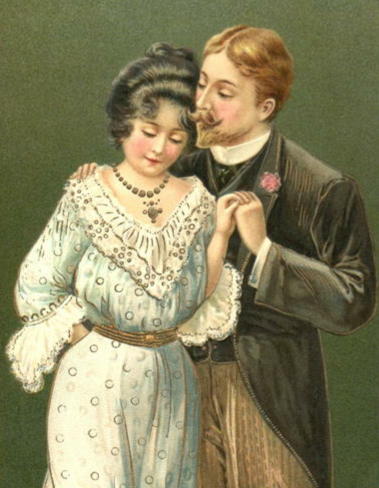
Here are some of Aunt Hannah’s wise thoughts and marriage advice that she shared with newlyweds John and Martha Remington:

It is best for young ones after they once fly from the home nest to set up independent of the old birds. I tried once to help two young robins. They were building a nest in the old apple tree right under my bedroom window, and they weren’t making it a bit comfortable according to my way of thinking. I watched them until I couldn’t stand it any longer. Then I hung little bunches of ravelings on the limbs in plain sight. The stubborn little things wouldn’t notice them, but kept on weaving in bits of straw and hay, as if, of course, they knew best.

One day they were both gone. I took a soft bit of wool and tucked it nicely into the nest. I thought when they once knew how warm it felt to the feet they would like it. But when that little housekeeper got back she was mad enough! She made angry sort of chirps that sounded for all the world like scolding, and he helped her along in it, like any foolish young husband. They flew around as if they were crazy, and tore that nest to pieces in no time. That taught me a lesson. I shall never meddle with any more nests.

When I married Nathaniel Adams it was because I should have been a most unhappy creature if I hadn’t. I don’t pretend to understand it all, how one year I never had seen him and the next I cared more for him than anybody in the world. It’s a great mystery. I always thought the Lord sent him to me. The Bible says that a good wife is from Him, and so, of course, a good husband must be. I only know that I never got tired of him. To the last day of his life a room was always pleasanter to me if he was in it.

Satan is never more busy with young people than he is the first year or two of their married life. The trouble is, a young couple start out, in spite of anything that is told them, expecting to find each other perfect. Of course, they are not; and so they are both disappointed. Now, if they would be more reasonable, and believe that they will discover some faults in each other, and that they must bear and forbear, and seek the help of the Lord in it, loving each other, faults and all, Satan would not get the hold of them that he does.

If a wife would speak out frankly to her husband when something worries her, it would be far better–not in a fault-finding way–little misunderstandings could be cleared up at once, but instead of that she takes some little thing that has hurt her and broods over it and sheds oceans of tears over it, and it grows and grows, and then she puts on the face of a martyr, and her answers are all in one syllable, and her eyes have a red rim around them. Her husband doesn’t know what is the matter, or he has forgotten if he ever did know. That is oftentimes the history, I dare say, of the beginning of trouble in unhappy marriages.

The right sort of a wife, who has a good husband, will not allow herself to worry about mere trifles–that is, if she has good sense. If she hasn’t, more’s the pity for both of ’em. When she is tempted to go distracted over some little thing about as big as the point of a pin, she will say, “Get thee behind me, Satan. You are not going to pick a quarrel this time. My husband means all right, and I shall trust him, even if he does forget some of the little attentions I’m used to.”

You know marriage is used again and again in the Scriptures as a figure of the union between Christ and the church. The marriage supper stands for the most glorious and joyful day that can ever come to us. And would He have said that a man was to leave everything and go with his wife, and that they should be one, if it was intended to be only a sort of partnership for convenience?

Did you notice that rose-vine at the east end of the front porch putting out new branches all over it? It will be full of roses pretty soon. That vine has been the wonder of the neighborhood for ten years. Now suppose I never watered it, or fed it with good rich earth from the woods, or dug about it, what a stunted, sickly thing it would have been! You have to take care of everything that’s worth having in this world. Love will die from neglect and abuse as quick as a rose-bush.

 If there are any two in the world who should be one in principles and aims, it is those who are to spend their lives together. God meant it so. There is no happiness where a husband pulls one way and the wife another. Why should they wish to be together unless they are in harmony on what you might call the keynotes of life? It will only be one long discord. If a man and woman jar each other before marriage, a few words spoken by a minister is not going to change them.

What do you think of Aunt Hannah’s advice? What’s your favorite piece of advice from Aunt Hannah and Martha and John? What special advice has someone given you? Feel free to use the comments section to share your thoughts.