Here’s a scenario that is often played out on Sunday mornings across the country: Imagine you’re in church, waiting for the service to start, and you realize your friend isn’t sitting in his or her regular place. You pick up your phone and type out a text message:
Where are you?
Or after the service ends, you send off a quick email:
You missed a great sermon this morning. Everything okay?
With just those few words, you let that person know that you care. Your words are a subtle encouragement to worship regularly.
But during Isabella Alden’s time, there were no electronic text messages or emails. Daily mail service was the fastest way for people to communicate, until the telephone came into wide use around the turn of the century.
In Isabella’s day, the scene described above would have played out using posted mail instead of wireless technology.
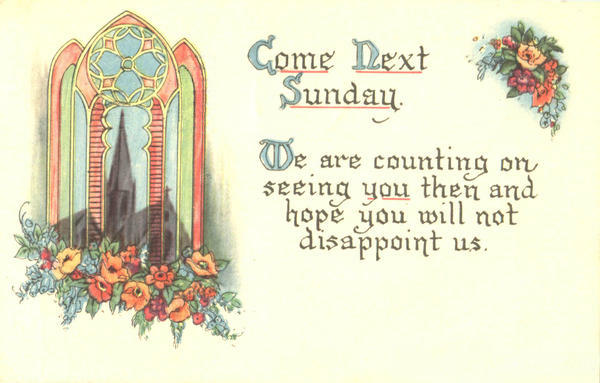
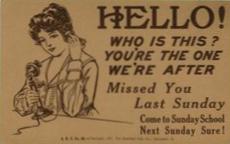
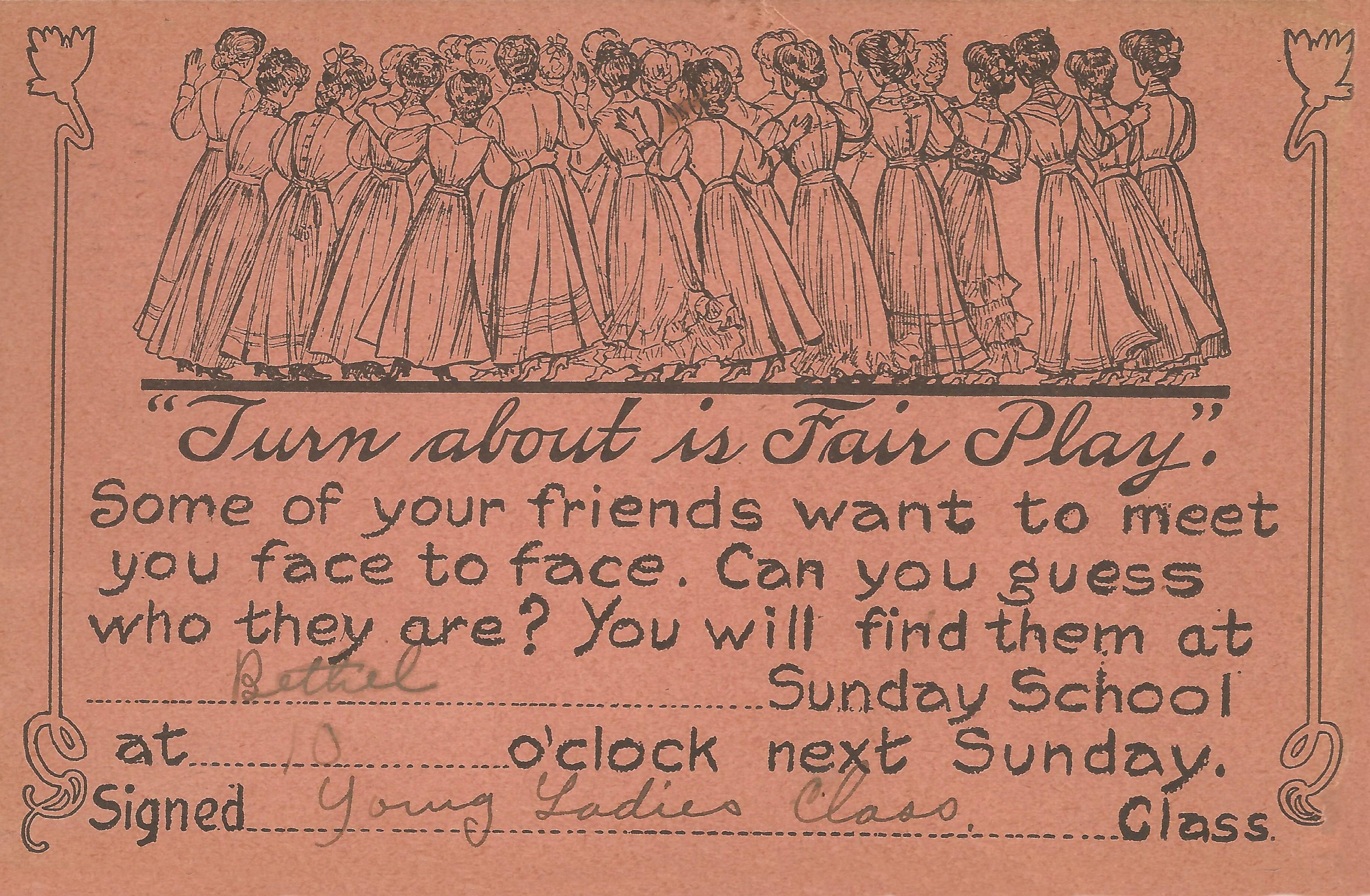
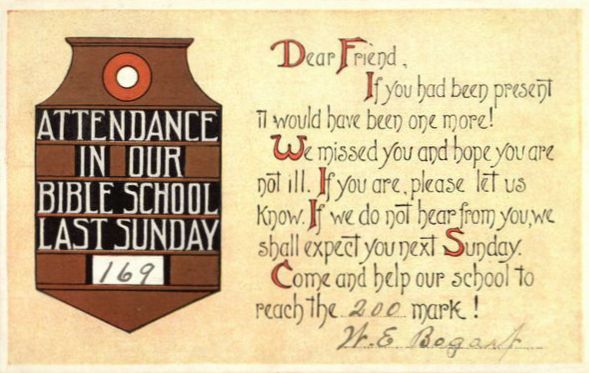
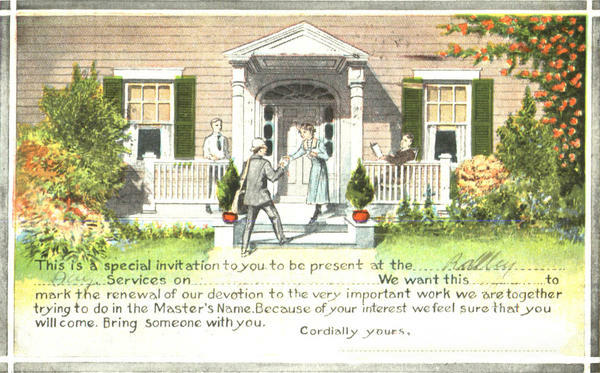
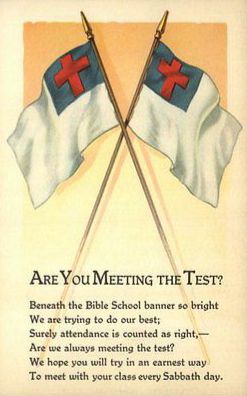
Back then, caring church leaders and Sunday school teachers sent out brief notes and post cards like the ones here.
Some were signed by the sender, and others were personalized with the time and place for the next service or meeting. On Monday afternoons, the “come to church” cards appeared in mail boxes across the country.
As a minister’s wife, Isabella probably sent quite a few cards herself over the years, to let someone know he or she was missed at church.
Churches still use similar communications to reach out to people today. A website called Ministry Greetings is one of many that offers different styles of cards for churches to send through the mail. And for those who prefer to text or email, there are plenty of fun or thought-provoking memes to choose from for encouraging a friend to go to church.
From memegenerator.net
Over ninety years after Isabella’s duties as a minister’s wife came to an end, it’s nice to see a tradition like sending off “come to church” cards still goes on in today’s busy world.
An 1895 issue of Golden Rule magazine included an article about working women that caught Isabella Alden’s attention.
Clerks examining newly-printed money at the U.S. Bureau of Engraving and Printing, 1904.
Here’s what she shared on the Christian Endeavor page of her own magazine later that year:
“REST ROOMS.”
The Golden Rule suggests a beautiful idea. It advocates the renting and furnishing, in large towns and cities, of what it calls Rest Rooms, for the use of working-girls during the noon hour. It proposes pretty furnishings, lounges, easy chairs, books, papers, pleasant games, etc. It also suggests that a small fee might be charged for the use of the room, because most girls would prefer to pay a little each week towards its expenses. The thought is certainly an important one. Let all the Endeavorers talk it up. Why could not a neat plain restaurant or lunch room be added, where coffee, and. sandwiches, and milk, and cookies, and crackers, and fruits might be had at very low prices?
Many working-girls now have such dreary places in which to eat their lunches and such dreary lunches to eat, that it would seem as though improvements were needed here.
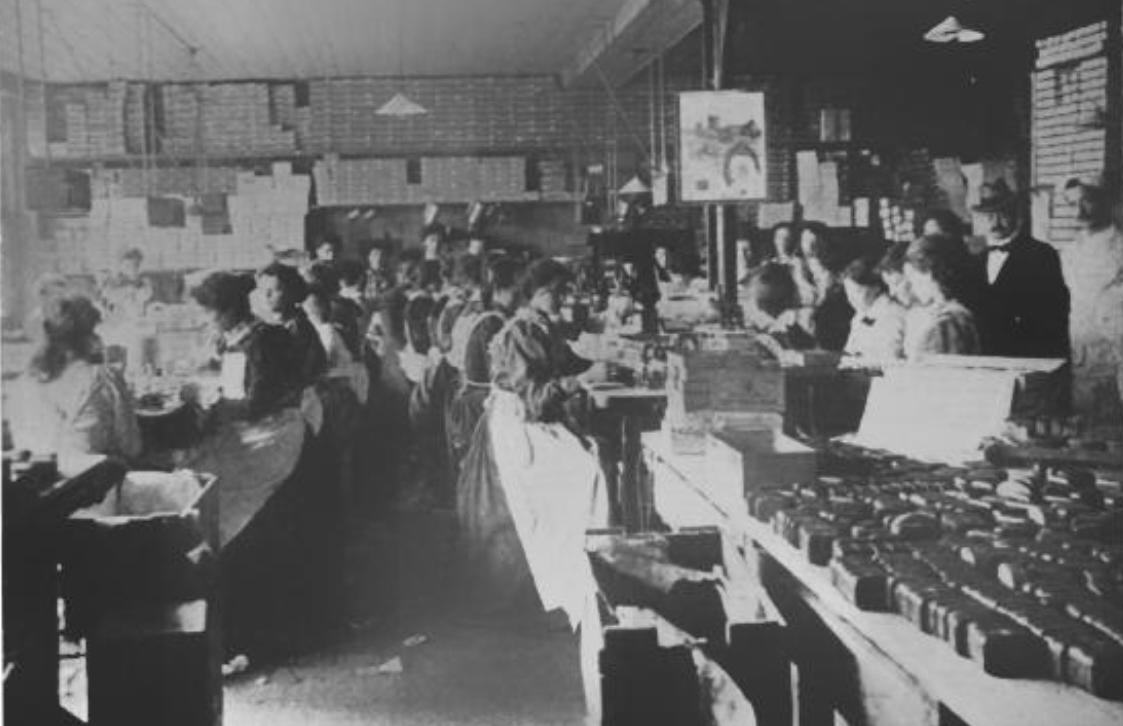
Workers labeling and wrapping perfums and soaps, 1900.
Isabella’s description of a ladies’ rest room doesn’t sound at all like the cold, utilitarian washrooms we know today; but back in 1985, it was an idea whose time had come. Workers had few rights; they worked long hours under sometimes difficult conditions. Employers could give workers as many—or as few—breaks during the work day as they wanted.
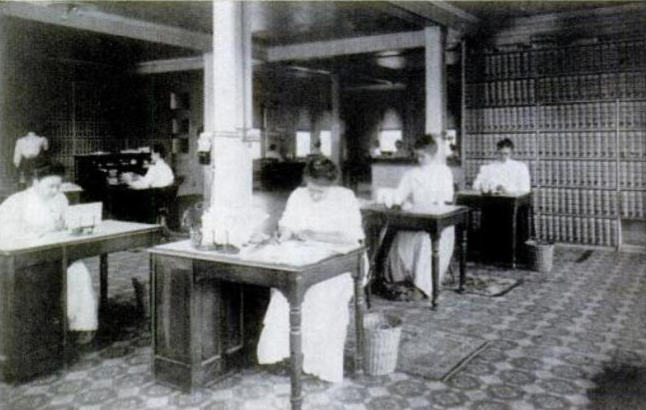
Members of a typing pool with their male supervisor.
So the idea of a rest room for workers was somewhat revolutionary, and it quickly caught on.
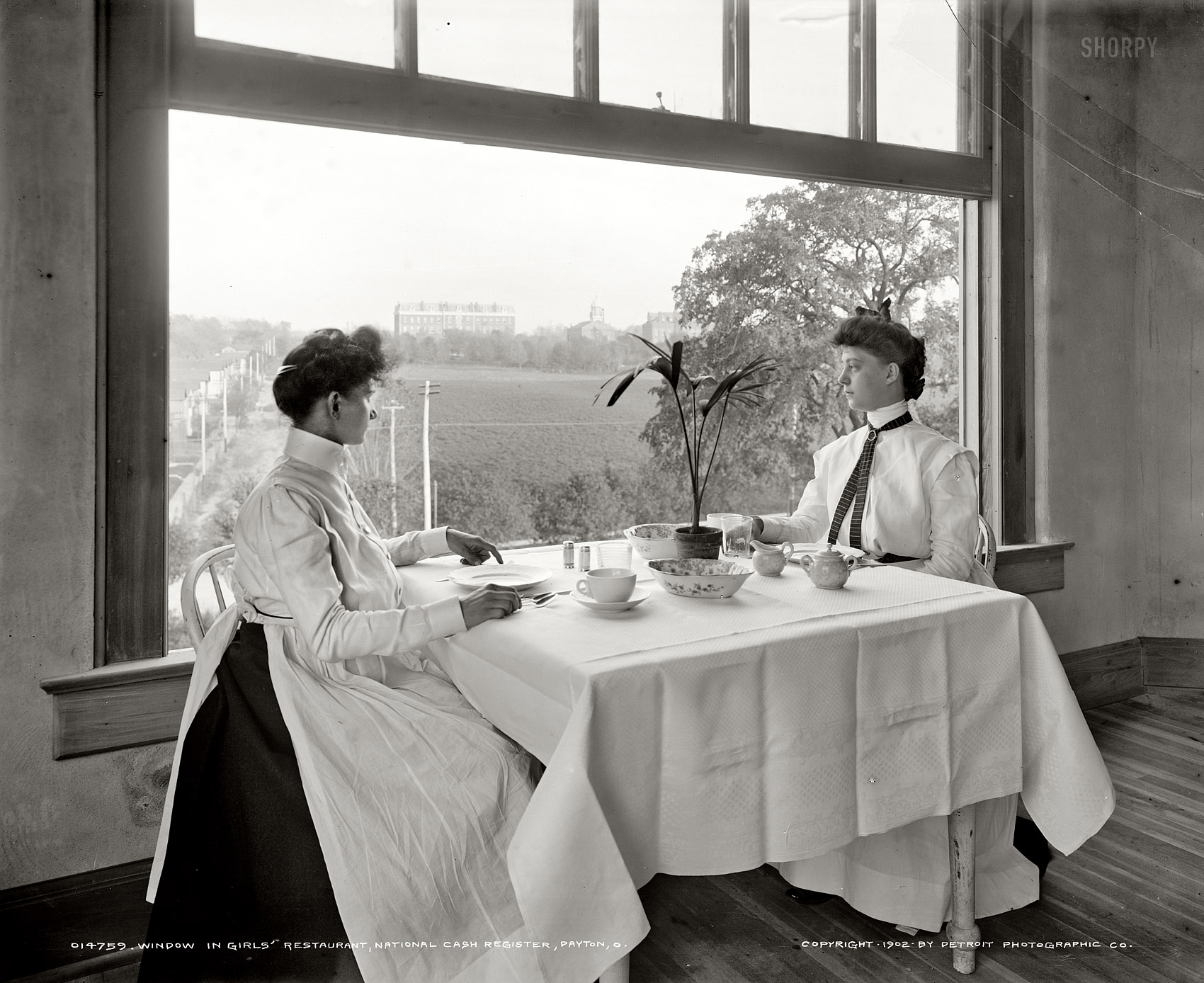
The ladies’ lunch room at the National Cash Register Company, 1902. From Shorpy Archive.
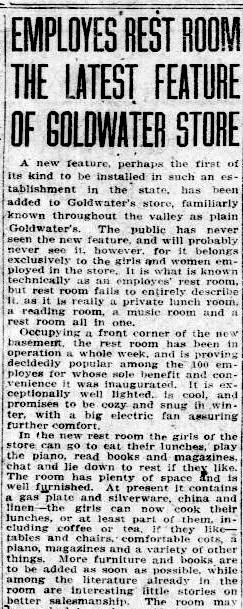
Progressive and far-thinking employers recognized the benefits of providing a dedicated rest room to their employees:
From the Arizona Republican, 1920.
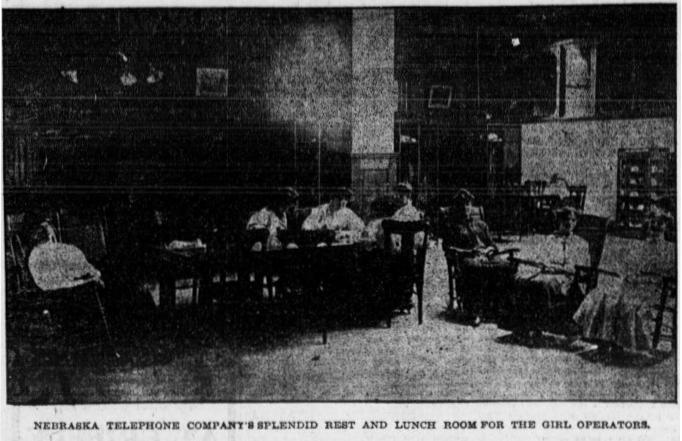
In some towns, Women’s Trade Unions or the YWCA repurposed space to create rest rooms for female workers.
Telephone operators enjoying their rest room, 1906.
And in Tulsa, Oklahoma, the city took the initiative to furnish a dedicated room for the use of “strangers, tired shoppers, and working girls.”
From the Tulsa Daily World, 1915.
The concept of a rest room proved so popular, businesses began offering dedicated ladies’ rest rooms to customers, as well.
Newspaper ad for Lansburgh & Bro. department store in Washington DC, 1918.
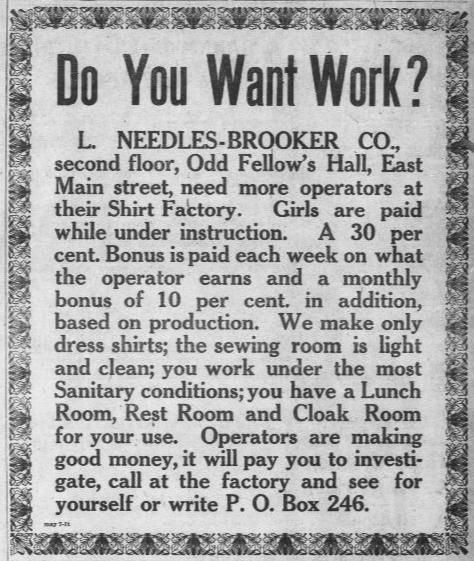
And by the 1920s, companies listed rest rooms for female workers as a benefit when trying to recruit new employees.
Want ad in the Democratic Advocate newspaper, College Park, Maryland, 1920.
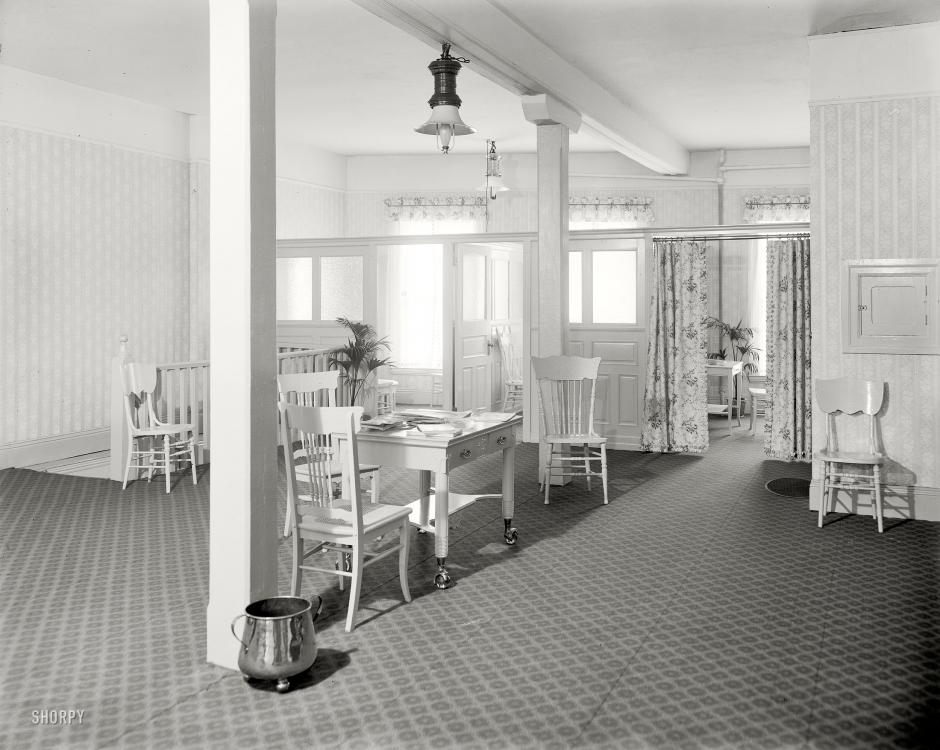
What began as a germ of an idea in 1895 became a wide-spread reality in the 20th century as retailers, factories, and municipalities established clean, comfortable restrooms for workers, customers, and visitors.
The ladies’ lounge at E. M. Bigsby department store, Detroit, Michigan, 1915.
You can read more about women’s working conditions during Isabella’s lifetime by viewing these previous posts:
On May 30, 1866, twenty-four-year-old Isabella Macdonald married Ross Alden. Ross (whose full name was Gustavus Rossenberg Alden) was a thirty-four-year-old seminary student.
Six months later, Ross was ordained by the Presbyterian Church, and they embarked on a life together of ministering to congregations and sharing their Christian faith.
You can read more about Isabella and Ross’s early years of courtship and marriage in these posts:
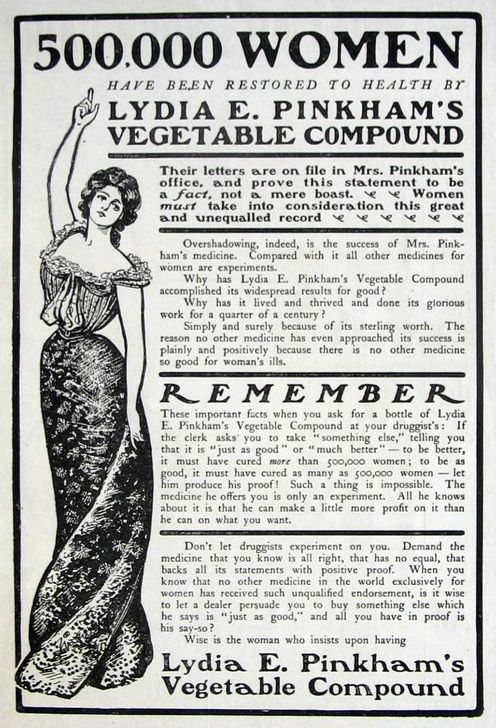
Thumb through the pages of almost any ladies’ magazine printed before 1906 and you’ll undoubtedly find an advertisement for Lydia Pinkham’s Vegetable Compound.
Lydia Pinkham’s products—in pill and liquid tonic form—were the “go to” cure-alls for generations of women.
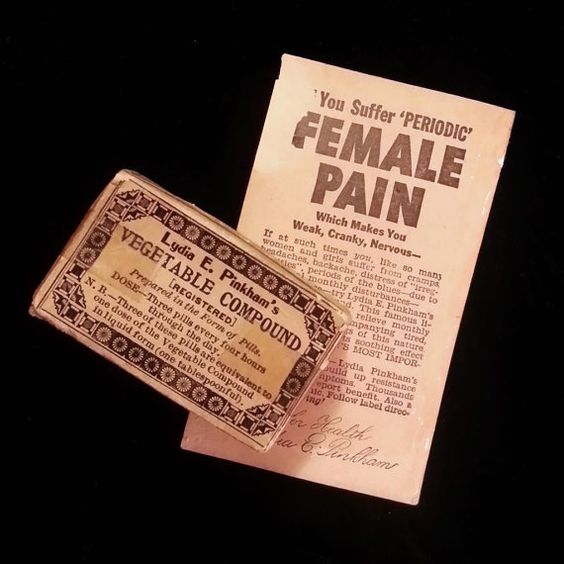
Original early 1900s packaging with insert for Lydia Pinkham’s Vegetable Compound pills. (From Pinterest.)
The principal ingredients of Lydia Pinkham’s Vegetable Compound were licorice and alcohol (anywhere from 18-20%), so it wasn’t taste that drove women to consume the product in record numbers.
It was, instead, Lydia Pinkham and her incredible marketing skills that turned her home-made tonic into a multi-million dollar business in less than ten years.
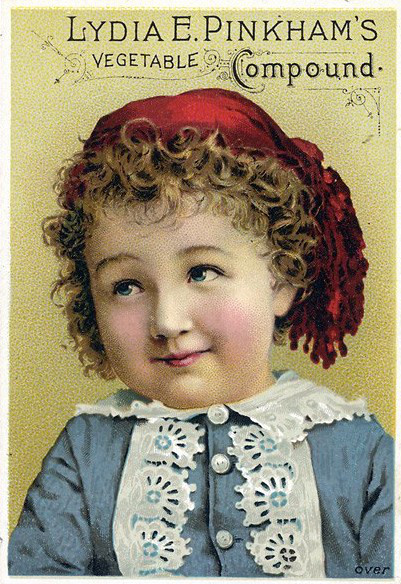
A typical Lydia Pinkham trade card.
Timing also played a role in Lydia Pinkham’s success. In the late 1800s mainstream medical science spent little time studying female anatomy; and strict standards of modesty ensured that generations of women were woefully ignorant about their own bodies and how they functioned.
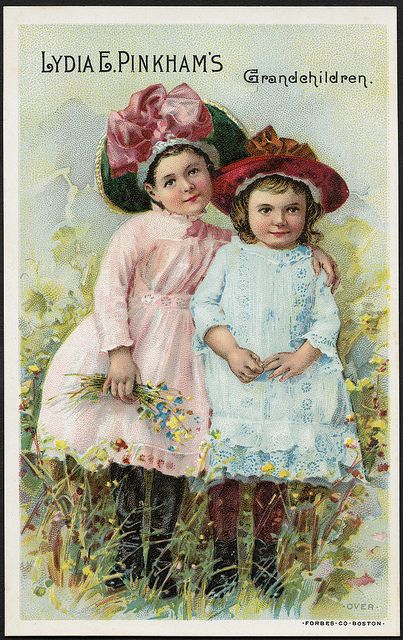
Many Lydia Pinkham’s trade cards featured pleasant artwork, a “soft sell” that was pleasing to women.
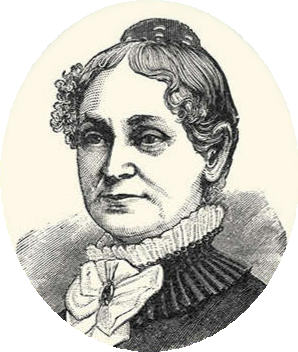
Enter Lydia Pinkham, who established herself as a kindly grandmother who patiently and delicately taught ladies about menstrual cramps, menopause, and everything in between.
One of the images of Lydia Pinkham that adorned the company’s labels over the years.
Labels for her products bore her likeness. Her pills and tonics promised to cure menstrual cramps, correct a prolapsed uterus, reverse diseases of the ovaries, and chase the blues away.
The company’s advertising cards encouraged women to think of Lydia Pinkham as a member of the family, as with this trade card which purports to show an image of her grandchildren.
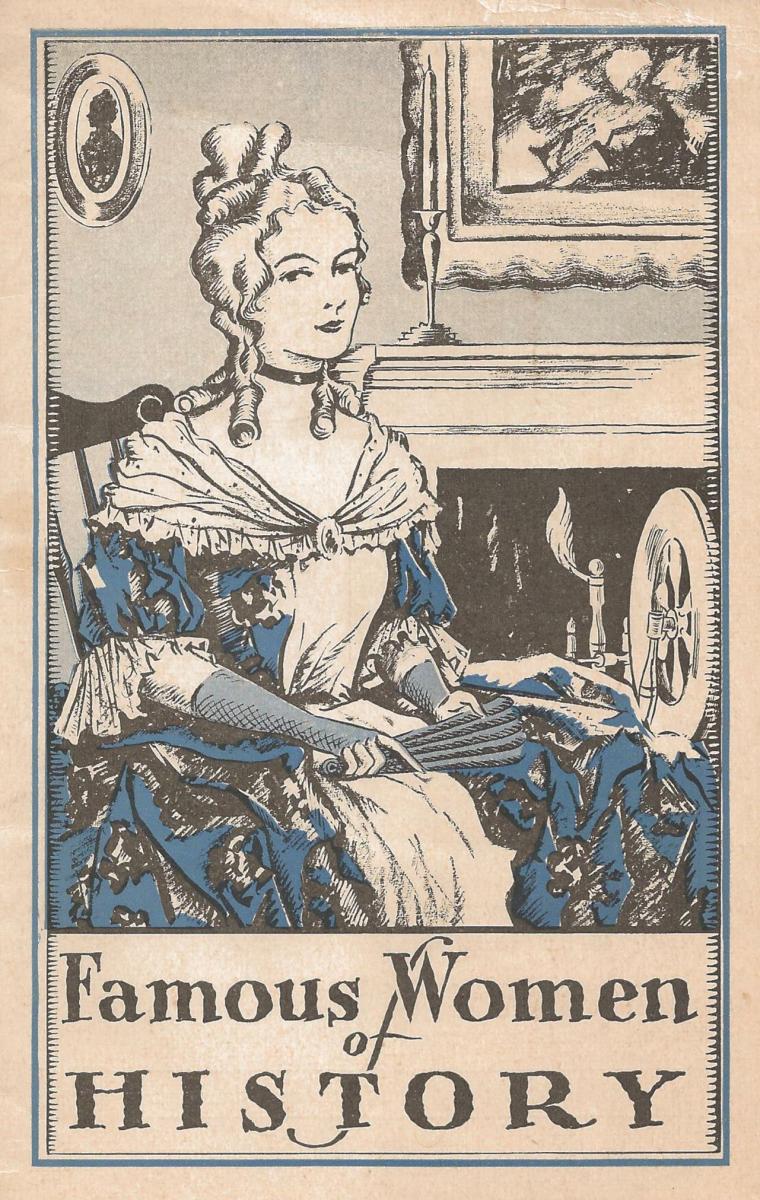
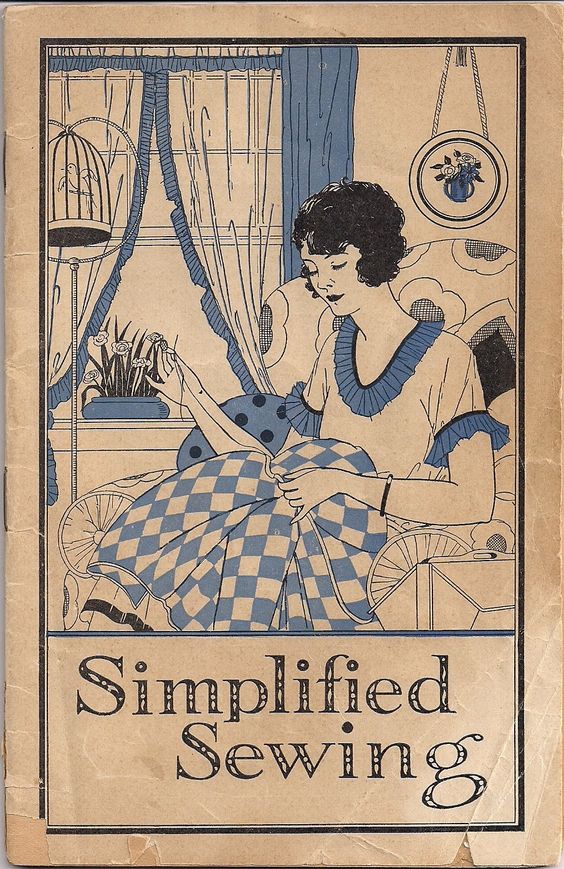
She gave away millions of free “educational” pamphlets, with topics covering sewing, cooking, history, and women’s common health issues; throughout each publication, the benefits of Lydia Pinkham’s products were extolled and promoted.
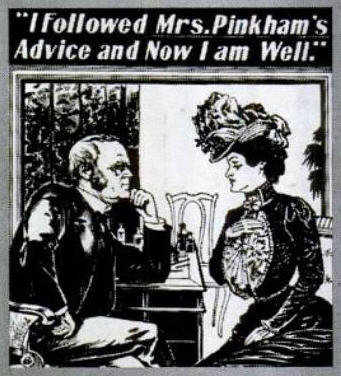
This example of the company’s “Famous Women in History” pamphlet included several typical “testimonials” used in many Lydia Pinkham ads. Click on the cover to view the entire pamphlet.
Lydia herself received thousands of letters from women every year, and each letter received a personal answer.
Cover of Lydia Pinkham’s pamphlet, “Simplified Sewing.”
But there were secrets about Lydia Pinkham and her business empire. The most incredible secret was that by the time Lydia’s products became famous nation-wide, she had been dead for decades.
And those reply letters written to women asking for help with a health problem—they were not written by Lydia Pinkham. Instead, they were written by employees, copied from proscribed templates, and they always included a recommendation to buy more Lydia Pinkham products.
Female employees answering mail. After the company was forced to admit Lydia Pinkham did not personally answer all letters, it used the revelation to its advantage, publishing this and other photos of its team of female employees answering mail. The company advertised: “Every letter opened by a woman, seen only by a woman. No boys around.”
When Congress passed the Pure Food and Drug Act in 1906, the company was forced to disclose the contents of Lydia Pinkham’s Vegetable Compound in clear terms on their labels. For the first time, women—including members of the Women’s Christian Temperance Union—discovered that their favorite tonic contained a high level of alcohol.
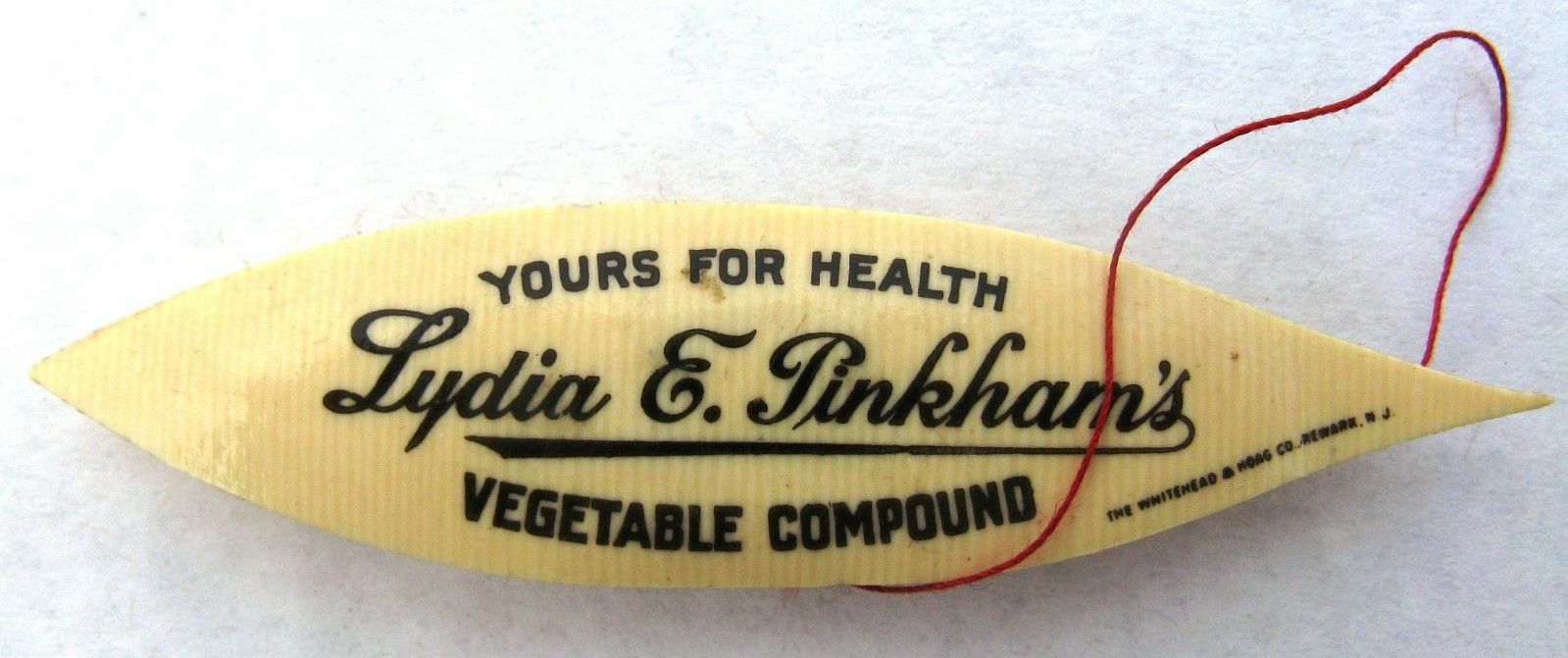
In addition to print ads, the company gave away millions of free promotional items, such as sewing kits, thimbles, tape measures, and this lace tatting shuttle.
The new government requirements also forced the company to curtail its previous advertising claims that it could, among other things, cure “all weaknesses of the generative organs” and that it was “the greatest remedy in the world” for diseases of the kidneys.
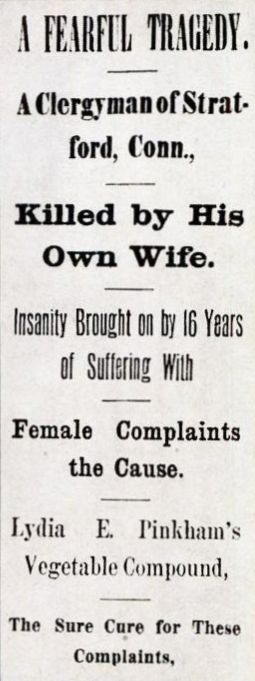
A Lydia Pinkham newspaper ad from the 1920s, cleverly disguised as “real” news.
Thanks to the company’s inventive advertising, Lydia Pinkham’s products saw strong sales throughout World War I, Prohibition (despite the tonic’s alcohol content), the 1930s and 1940s. In fact, Lydia Pinkham’s Vegetable Compound is still sold today in major drug stores and online sites like Amazon. And just as previous generations of women used to write letters extolling the virtues of the products, today’s customers post reviews of Lydia Pinkham’s Vegetable Compound on the Internet, demonstrating, once gain, that the company remains as adaptive as ever.
In honor of Mothers’ Day, here is a letter Isabella published in an 1895 issue of The Pansy magazine:
Dear Young People:
I notice that the Juniors all over the country are going to talk about “Troubles” at one of their [Christian Endeavor] meetings this month. Some people think that boys and girls never have troubles. I know better.
I remember distinctly when I was twelve years old, I had a very large trouble one day. I wanted to take a ride with my brother, and mother thought it was too cold for me to go out. I coaxed a good deal, until father told me in a very decided tone to say no more about it; that of course I could not go.
I remember I went upstairs to my room, which was not warmed, and sat down in a dreary little heap in the corner and cried. I told myself that I was a most unfortunate little girl; that I could never go anywhere nor do anything like other girls, because my mother and father were always afraid of my taking cold. I said I wished I was old enough to do as I liked; and I should be too happy to live when the day arrived that I could do as I pleased, and have nobody say, “You cannot go here, or do this, or that.”
Poor silly me! Did you ever know a girl who acted like that? But I honestly thought it was real trouble. Let me tell you something. A good many years have passed since then. Mother and father have long since gone away where I cannot hear their voices. Nobody says to me now, “You cannot go to such a place, or wear such a thing.” I am free to do as I please, so far as words are concerned; but sometimes I sit and think it all over, and it seems to me I would give almost anything I have in the world, just to hear my dear mother’s voice saying, “No, my daughter, you cannot go this morning.”
Do you get my thought? Some of the things which we call troubles, grow in after-years into blessings which we miss and mourn.
Another thing, out of my imaginary trouble I made a real one. I sat in that chilly room brooding over my wrongs until I took cold, and was ill for days. Mother had to watch with me at night, and father had to go more than once over the long cold road for the doctor. I have seen people since who made their troubles for themselves.
All the same, I know that young people have real troubles, sometimes; and whether real or imaginary, they want, every one of them, to be taken to the same great Physician. Pity the boy or girl who does not know Him well enough to call upon Him for help.
Women toiled long hours in kitchens to make meals, preserve food for future use, launder clothing and linens, and heat water for baths and house-cleaning tasks.
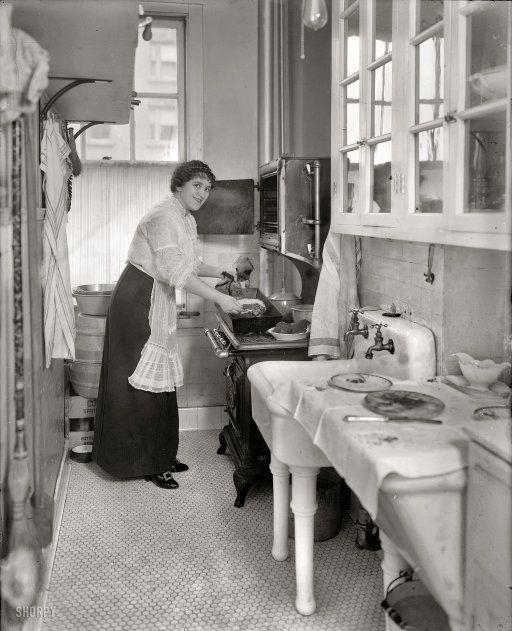
A modern kitchen in 1914
Even when the lady of the house had help in the kitchen—a live-in maid or a local “girl” who came for the day—they still spent the majority of their time in the kitchen, where conditions could be extreme.
An American kitchen, circa 1900
In many households the kitchen stove burned 24 hours a day. The stove was stoked early in the morning to raise the heat so water could be boiled and breakfast could be cooked. It then burned throughout the remainder of the day until bedtime. In winter the kitchen was the warmest room in the house. In summer the kitchen was sweltering, with inadequate ventilation and no escape from the heat.
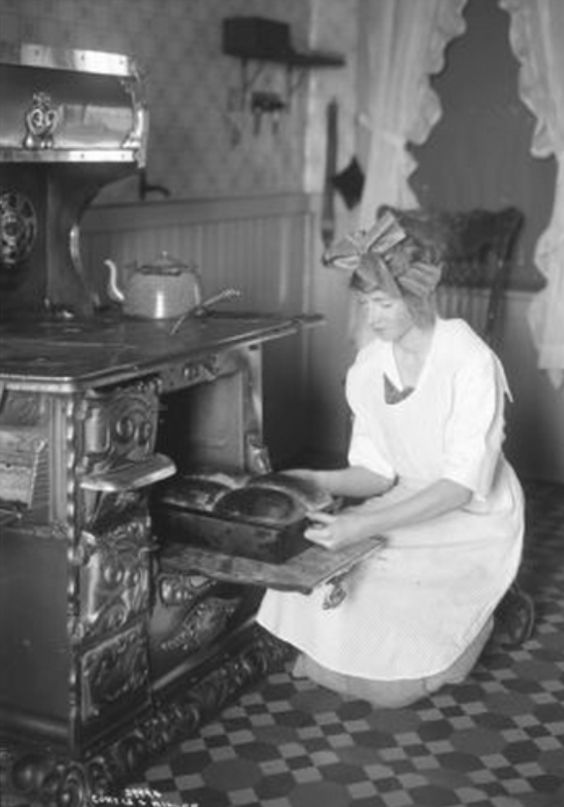
Baking Bread in 1914
Isabella’s book Ester Ried opens with a scene in the Ried kitchen, with Ester toiling in the kitchen on a hot day:
It was a very bright and very busy Saturday morning.
“Sadie!” Mrs. Ried called, “can’t you come and wash up these baking dishes? Maggie is mopping, and Ester has her hands full with the cake.”
“Yes, ma’am,” said Sadie, appearing promptly from the dining-room, with Minnie perched triumphantly on her shoulder. “Here I am, at your service. Where are they?”
Ester glanced up. “I’d go and put on my white dress first, if I were you,” she said significantly.
And Sadie looked down on her pink gingham, ruffled apron, shining cuffs, and laughed.
“Oh, I’ll take off my cuffs, and put on this distressingly big apron of yours, which hangs behind the door; then I’ll do.”
“That’s my clean apron; I don’t wash dishes in it.”
“Oh, bless your careful heart! I won’t hurt it the least speck in the world. Will I, Birdie?”
And she proceeded to wrap her tiny self in the long, wide apron.
Later in the book, when Ester returned home after a lengthy visit with her cousin:
Ester was in the kitchen trimming off the puffy crusts of endless pies—the old brown calico morning dress, the same huge bib apron which had been through endless similar scrapes with her.
Not all aprons were as large as the kitchen apron Ester wore. In fact, ladies often had different aprons for different tasks.
Work aprons were large and covered the entire front of a woman’s dress. They had plenty of pockets for thimbles, spools of thread, needles and pins, or any other household item the lady of the house wanted to have immediately at hand as she went about her daily housekeeping chores.
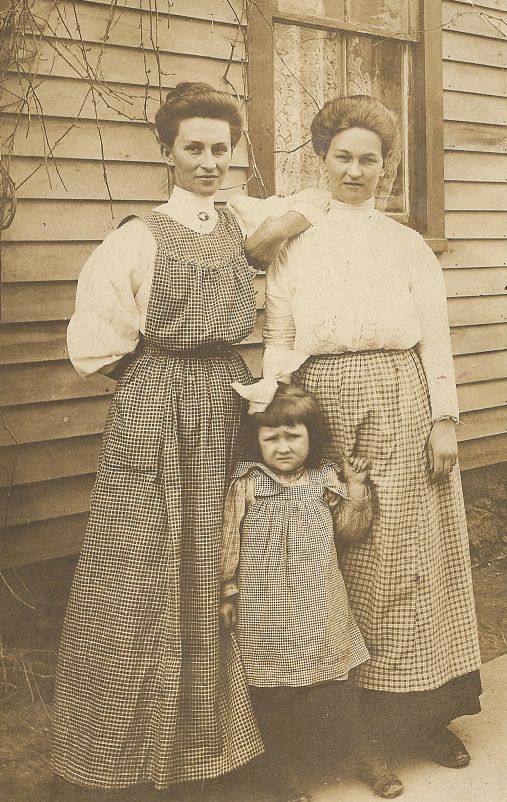
A 1910 photograph with the women of the family wearing three different styles of apron.
At the other end of the spectrum, tea aprons were feminine half-aprons that tied around a lady’s waist and covered her lap as she entertained family and guests at tea or luncheon.
Aprons were relatively simple to make; popular ladies’ magazines often featured apron patterns or embroidery and trim designs to customize a home-made apron. In 1922 the Woman’s Institute of Domestic Arts and Sciences published a pamphlet of instructions for making a variety of different aprons. You can download a copy of here.
A 1904 magazine ad for Green Brand aprons.
Now, as in Isabella’s time, aprons come in many styles. And though they are no longer a staple in a woman’s wardrobe, there are many women today who love to make and wear aprons.
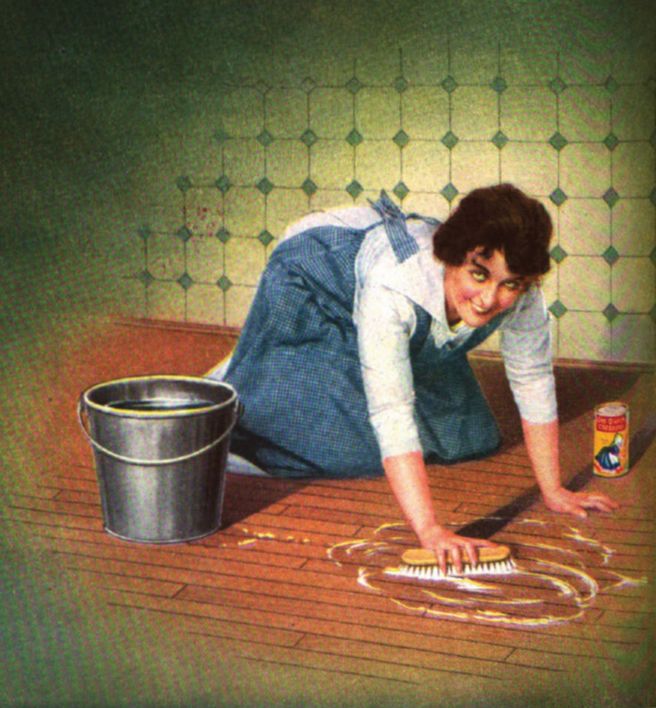
A 1914 ad for Dutch Cleanser
Want to see what’s hot in aprons today? Here are two sites that sell aprons:
An 1894 issue of the Christian Intelligencer printed this letter from a young reader of the magazine:
“We have a league in our school; perhaps you have heard of it before? It is called the Anti-Cigarette League. I am a member of it. Arthur Brown.”
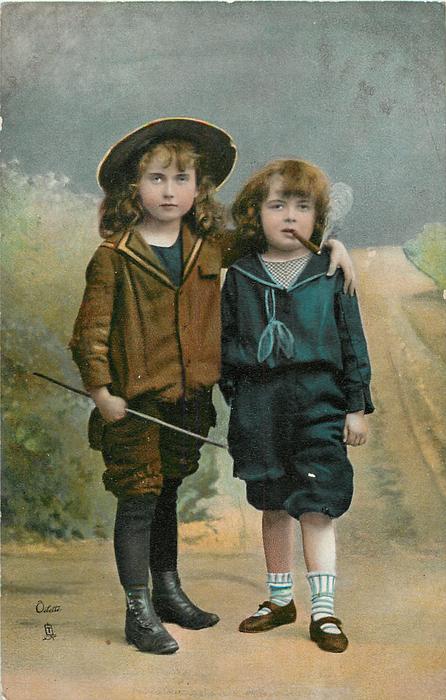
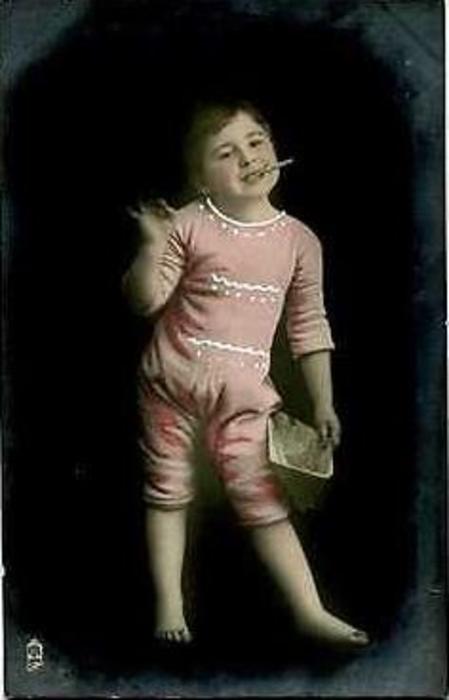
A 1903 hand-colored photgraph
When Isabella Alden saw that brief letter, she took up the cause of promoting the Anti-Cigarette League to young readers of her own magazine, The Pansy.
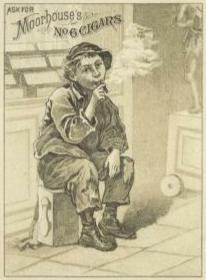
An undated ad for Moorhouse’s Cigars
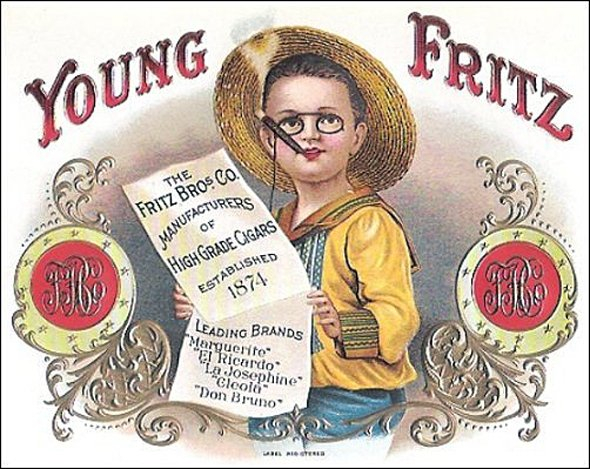
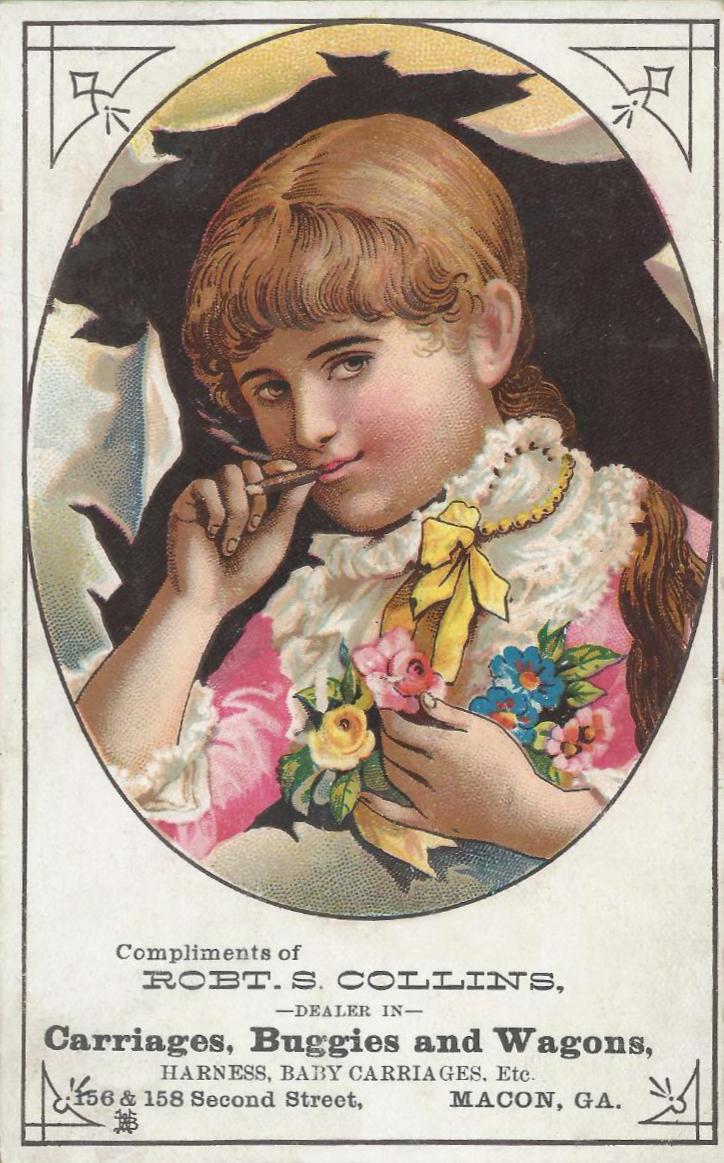
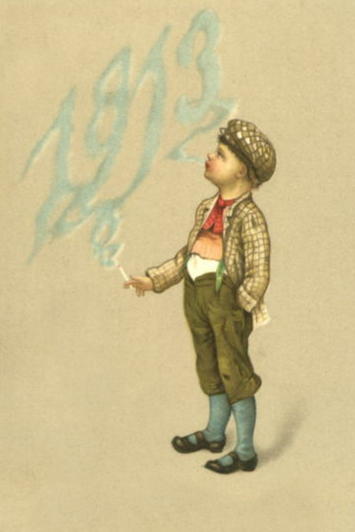
Smoking among boys—and even some girls—was not uncommon in the late 1800s. Cigarettes were readily available and manufacturers targeted their cigarette ads directly at children.
For over 50 years tobacco companies inserted collectable cards into their product packages and encouraged consumers to “collect them all.” This card, one of a series of 50, equated the wholesome Boy Scout organization with cigarettes.
There were no restrictions on how cigarettes were made, so cigars and cigarettes were often laced with opium, strychnine, and arsenic.
Illustration on the lid of The Fritz Bros. & Co. cigar box.
They were inexpensive, too; cigarettes made of inferior tobacco and paper sold for mere pennies, and some saloons and retailers gave cigarettes away to children so they would become addicted and return to purchase more.
Cigarette pack trade card, 1908.
Isabella was disgusted by such practices and wrote an article on the topic that appeared in Christian magazines, including The Pansy. Her opening paragraph was powerful:
The “Boy-Killer”
This is a startling name which a prominent New York physician gives to the cigarette. He describes the vile thing as made of tobacco soaked in nicotine, which has in it several other deadly poisons. Even the paper in which it is wrapped is whitened with arsenic. He declares that the lists of deaths found daily in our papers, caused by “heart-failure,” ought most of them to read, “caused by cigarette smoking.”
She was fighting an up-hill battle. For every physician who believed cigarettes were dangerous, there were dozens who believed cigarette smoking was helpful to patients. Doctors prescribed cigarettes to cure a variety of complaints, from asthma to stuttering to nervous conditions.
An undated trade card for a carriage and buggy dealer
But Isabella was convinced cigarette smoking was dangerous, especially for growing boys. She wrote:
One cannot walk the streets of any town or village without having cigarette-smoke puffed in one’s face, from the lips of mere boys.
She felt it was her duty to explain to parents the risks of smoking for children, and she didn’t shy away from using her pen to spread the word.
Artwork from a promotional calendar distributed by a tobacco company in 1893.
To put it in brief: at the time our story opens, Paul Adams was an ignorant, good-natured, tobacco-chewing, cigar-smoking street loafer. He smoked cigars when he could get them. Not that he began by being particularly fond of them—in fact, he found it unusually hard work to learn. He had to devote to this accomplishment the courage and perseverance that would have told well for him in other directions; but it is a taste that once acquired a boy will gratify if he can.
In Chrissy’s Endeavor, Chrissy Hollister learns her own brother Harmon is heading down a dangerous path, when his health begins to fail. Chrissy’s father gives her the bad news and asks her to “get such an influence over Harmon as would induce him to give up late hours, and late suppers, and cigarettes.”
The Women’s Christian Temperance Union, of which Isabella was an active member, used their regular weekly newspaper columns to warn parents of the perils of tobacco.
From The Enterprise (Wellington, Ohio). September 13, 1893.
By the early 1900s the tide shifted; the public and the medical community began to reconsider the effects of smoking on health. Although the tobacco companies continued to glamorize cigarette smoking, churches and communities banded together to raise public awareness about the dangers of smoking. They petitioned lawmakers to enact legislation to eliminate tobacco sales and ran articles and warnings in newspapers across the country.
From The Bemidi Daily Pioneer (Bemidji, Minnesota). May 18, 1907.
Schools began educating children about the dangers of smoking and found unique ways—like this essay contest—to drive the lesson home:
The Willmar Tribune (Willmar, Minnesota). June 7, 1922.
These efforts—and millions more like them—laid the foundation for the regulations and laws we have today that prohibit cigarette companies from selling and marketing tobacco products to children.
Would you like to learn more? Stanford School of Medicine researched the impact of tobacco advertising. Click here to see more examples of tobacco company advertising.
You can also click here to see vintage advertising from the late 1800s and early 1900s on Isabella’s Pinterest board.
If you’re a female born before 1970, there’s a good chance you played with paper dolls when you were young.
Paper dolls were a popular toy because they were inexpensive to produce and they were often free to consumers. To play paper dolls, a little girl only needed a pair of scissors and a modicum of adult supervision during the cutting phase.
In the early 1900s newspapers printed paper dolls with educational themes. In 1909, for example, major newspapers printed the syndicated Dorothy Dot paper dolls that featured Dorothy traveling the world, meeting new friends and learning about foreign lands.
Dorothy Dot paper doll in a 1909 edition of the Washington DC newspaper Evening Star
On her travels, the fictional Dorothy Dot visited “Antoinette,” a French paper doll (published in the Los Angeles Herald newspaper in 1909).
Companies used paper dolls in advertisements for many different products, from ladies’ corsets to sewing threads.
Paper doll printed by Bortree Corsets
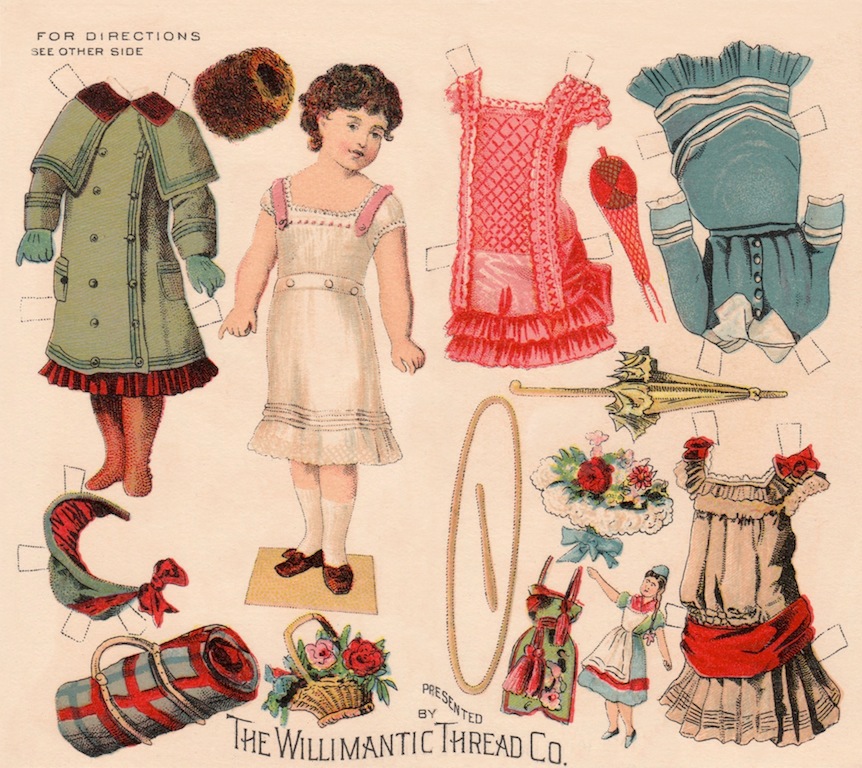
The Willimantic Thread Company published this paper doll
A paper doll compliments of Brook’s Spool Cotton Thread.
Sunshine Biscuits (still in business today as the makers of Hydrox cookies and Cheez-It crackers) often included free paper dolls in their product packaging.
Paper doll from Sunshine Biscuits
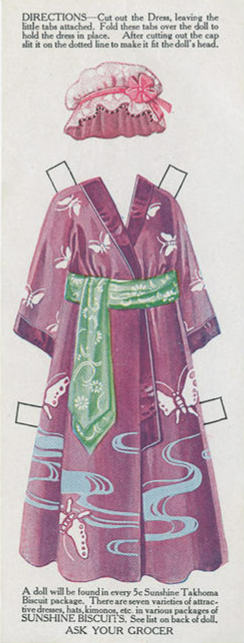
Other times, they used paper dolls to increase sales. For example, they included this paper doll kimono in one of their magazine advertisements, but the doll could only be found in packages of Sunshine cookies.
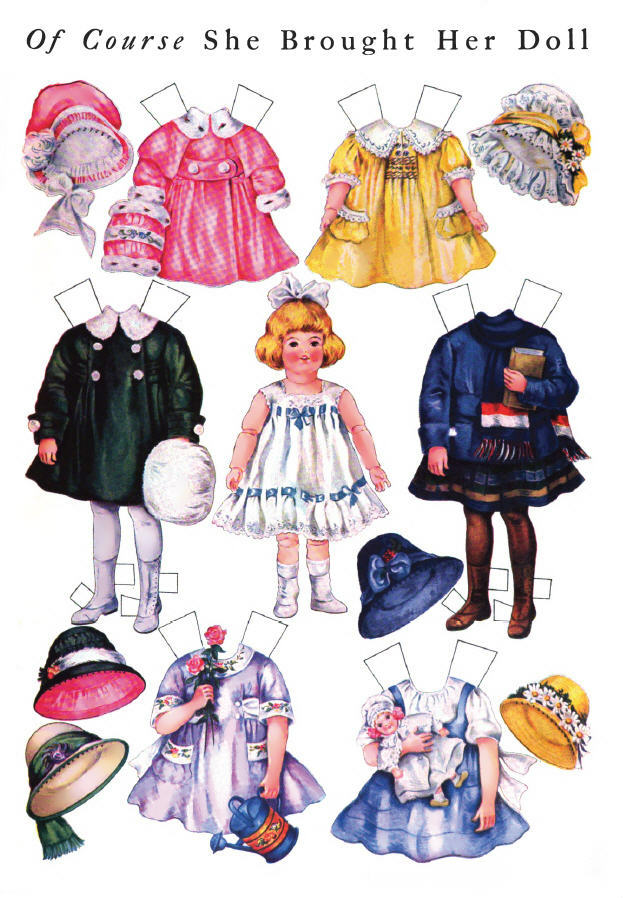
But it was American magazines that really popularized girls’ paper dolls. The Ladies’ Home Journal and Good Housekeeping magazines led the way, publishing high-quality paper dolls with wardrobes in color. This two-page spread from a 1919 edition of Good Housekeeping was typical for the magazine:
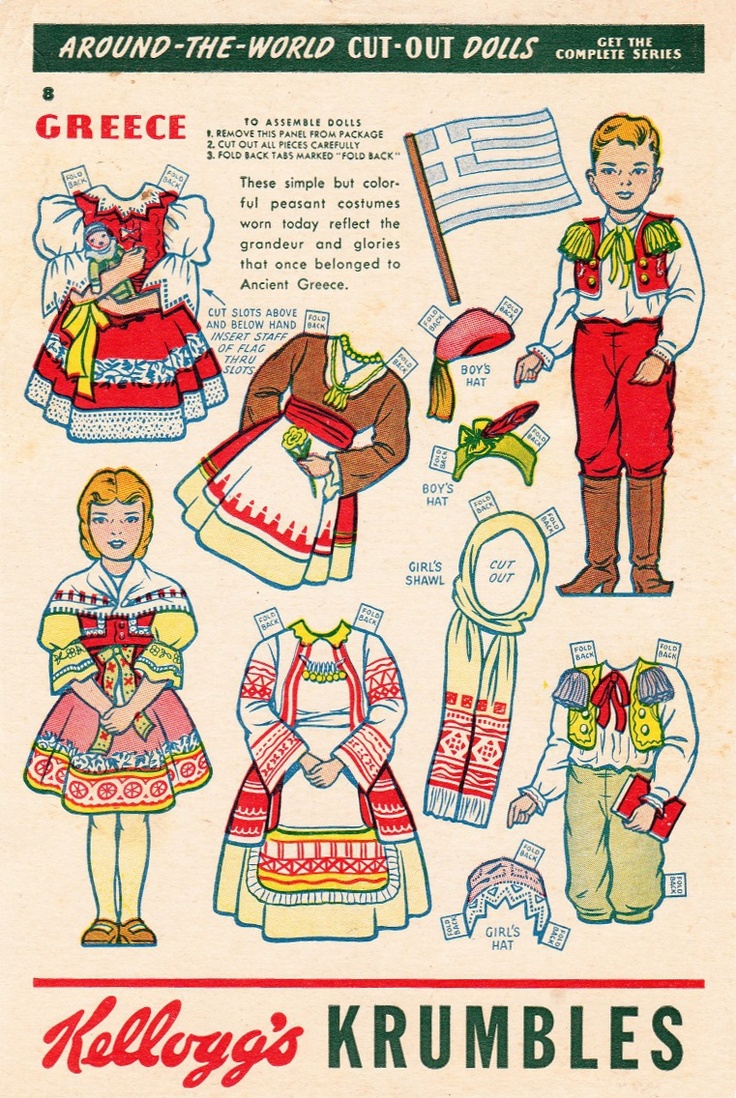
By the time paper dolls really hit their zenith of popularity in the 1950s, they were even on cereal boxes, like this Kellogg’s cereal:
Isabella Alden didn’t mention specific paper dolls in her books, but given their popularity, there were probably many girls of Isabella’s acquaintance who played with paper dolls.
And there are many adults who love them, too! Visit Etsy and you’ll find many vendors who create new paper dolls or reproduce vintage paper dolls from different eras.
And we found a great site that explains the history of paper dolls and features an interesting blog with many examples of dolls from different decades. Just click here to visit.
How about you? Did you ever play with paper dolls? Which was your favorite?
In her novels, Isabella often wrote about the unique challenges of being a step-parent.
In By Way of the Wilderness, Wayne Pierson saw his new step-mother as an interloper and a rival for his father’s attention, causing much heart-ache for himself and his family.
Ruth Erskine, the main character in Ruth Erskine’s Crosses, disliked her step-mother to the point of being ashamed of her; and when Ruth later married a man with two daughters of his own (in Judge Burham’s Daughters), Ruth taught her step-children proper manners, but failed to address their spiritual needs.
Like all Isabella’s novels, By Way of the Wilderness and the Chautauqua Books were allegorical stories, written to convey specific messages and lessons about living the Christian life.
But what many people don’t know is that Isabella was herself a step-mother. When she married Gustavus “Ross” Alden in 1866, Ross had a ten-year-old daughter from his first marriage to Hannah Bogart.
Like Ross Alden’s family, Hannah’s ancestors were among the earliest emigrants to America; her ancestors arrived as far back as 1652 and settled the New Netherlands (now New York) in the time of Peter Stuyvesant.
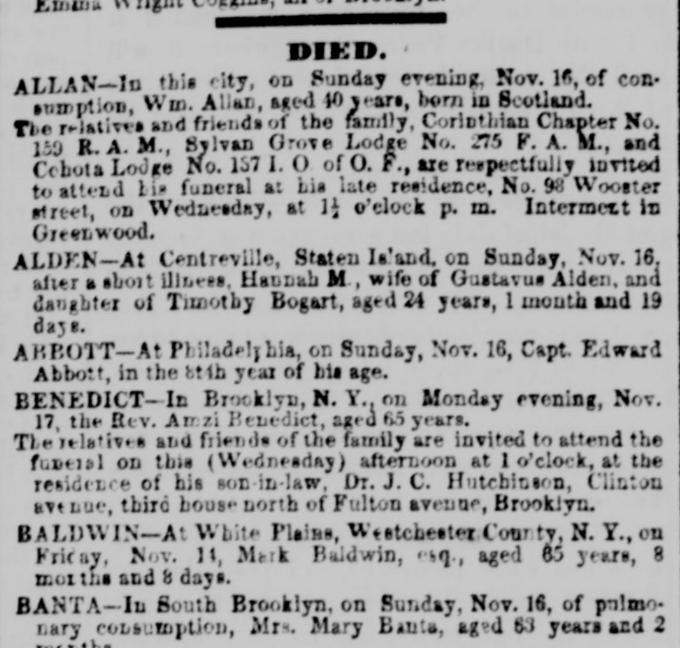
Ross and Hannah met in New York and married when they were both in their early twenties. Nine months later, little Anna Maria Alden was born. Tragically, Hannah died just two months later.
Death notice of Hannah Bogart Alden. From the New York Daily Tribune, November 19, 1856.
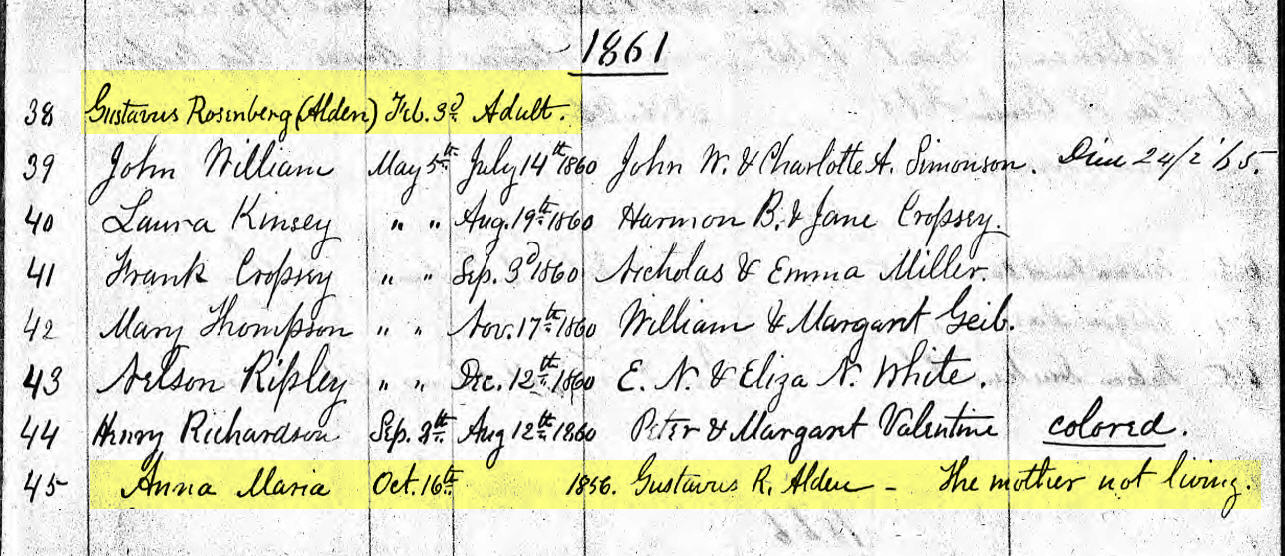
Very few records exist to tell us how Ross coped with the daunting responsibility of raising an infant daughter after the death of his wife. We do know he stayed in New York, close to where Hannah’s family lived, and probably had much help from them. Census records show that by the time little Anna was four years old, she was living with her maternal grandparents, without Ross.
St. Andrews Church, Richmond. New York. Here Hannah Bogart Alden was buried, and Ross and Anna were baptized.
Three years after Hannah’s death, Ross made a decision that would influence the rest of his life. He “united with the Reformed Church in Richmond, Long Island”—the same church, which, for generations, had been the church of Hannah’s family—and he began laying the foundation for becoming a minister.
Membership records from the Dutch Reformed Church of New York.
Ross was baptized, and a few months later his daughter Anna was baptized in the same church.
Baptism records from St. Andrews Church, Richmond, Staten Island, New York.
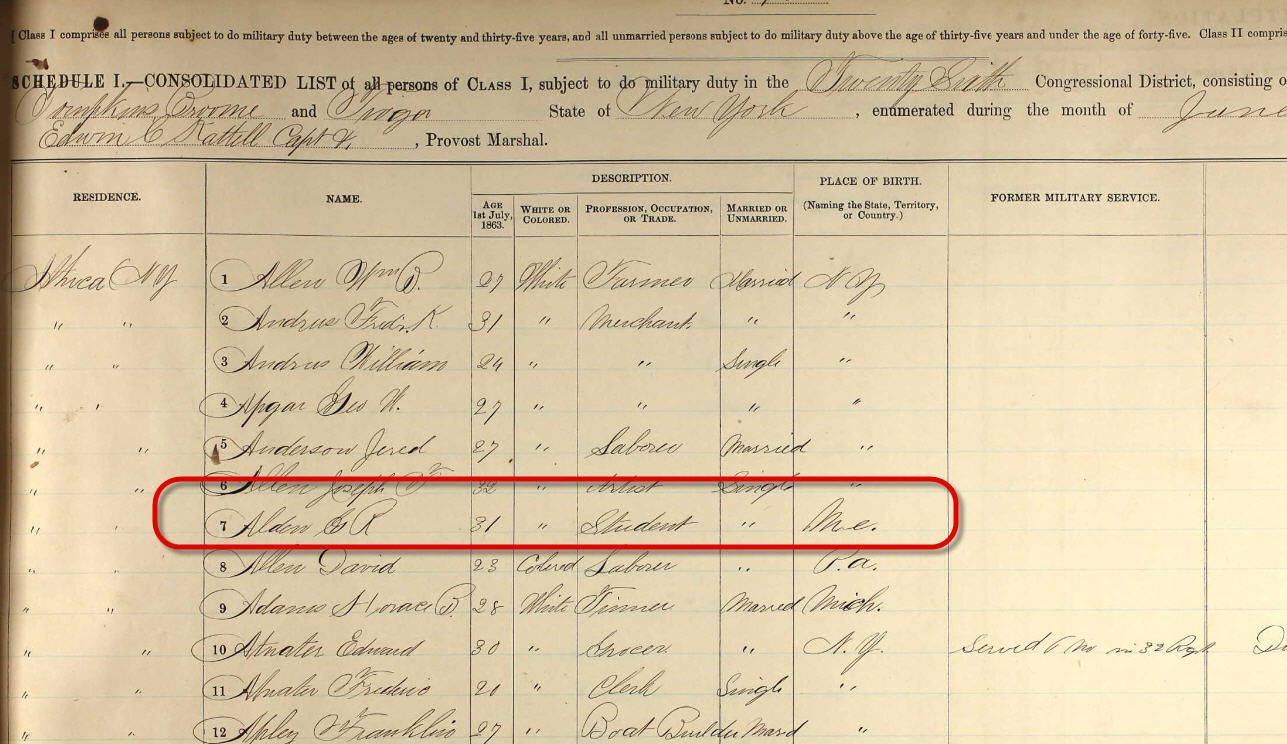
While Anna remained with her grandparents, Ross moved 300 miles away to begin studies at Auburn Theological Seminary. There he met Isabella Macdonald, who was visiting her sister Marcia and brother-in-law, Charles Livingston, who was also a theology student.
An 1863 Union Army record showing Ross Alden’s registration for the draft. He lists his occupation as “student.”
Ross and Isabella fell in love and married in 1866, the same year Ross graduated. The evening of their wedding day they boarded a train and left for Ross’s first church pastorate.
None of the records about that happy and blessed day mention whether Ross’s ten-year-old daughter Anna was at the wedding. Isabella’s good friend Theodosia Toll Foster was there, though, and that may have been the occasion when Theodosia and Anna met. Theodosia had younger sisters, the youngest of whom was just about Anna’s age.
An undated photo of Theodosia Toll Foster
Though we can’t be certain when exactly Theodosia and Anna met, but we do know that very soon after Ross and Isabella’s marriage, Anna went to live with Theodosia at the Toll homestead in Verona, New York.
While Ross and Isabella led an almost itinerant life, moving from one church to another every two or three years, Anna enjoyed a very stable home life with Theodosia and her sisters. They called Anna their “truly sister” and she quickly became a much-loved and integral member of the family.
When Anna was 16, she lived with Ross and Isabella in Cooperstown, New York, where they were in charge of yet another congregation. And when Ross and Isabella moved two years later to New Hartford, New York, Anna went with them … as did the entire Toll family. Theodosia, her elderly father and her younger sisters all moved to New Hartford. There Theodosia put her talents for teaching to good use. She and her sisters set up a boarding and day school, and their journals reveal that Anna helped run the enterprise.
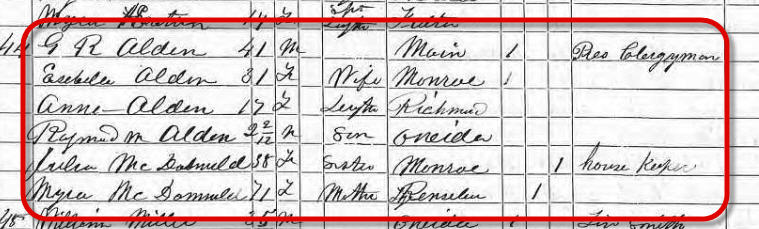
By then, Ross and Isabella had a son (two-year-old Raymond), and Isabella’s mother and sister Julia were also living with them in New Hartford. It must have been wonderful to have had their large, extended family so close together again!
The 1875 Federal Census showing the members of the Alden household in New Hartford, New York.
But their reunion didn’t last long. Within months, Ross received a call to minister at a church in Indiana. Once again he and Isabella left New York for a new city. This time, 20 year old Anna stayed behind with Theodosia.
There is only one other instance recorded of Anna living with Ross and Isabella. When the 1880 Federal Census was taken, Anna was 24 years old and the Census shows her living with Ross and Isabella in Cumminsville, Ohio (a suburb of Cincinnati), where Ross had a church. That same year, Alida, the youngest of Theodosia’s sisters, wrote in her journal that she was excited over an upcoming trip to visit Anna in her Ohio home.
Sometime after that visit in Cumminsville, Anna once again returned to New York to live with the Tolls. And when the Toll sisters closed their school in New Hartford and returned to their home town of Verona, New York, Anna went with them; and there she remained for the rest of her life.
In Verona Anna was a long-time member of the Presbyterian Church, and she was deeply involved in church matters. Friends described her as “a consistent Christian woman” who “won the sincere love and respect of all who knew her.
Anna was just 57 years old when she passed away from complications of pneumonia. Theodosia’s sister Eunice marked the sad day in her journal with the notation, “Our Anna died.”
Obituary of Anna Alden. From the Rome Daily Sentinel, December 21, 1914.
Unfortunately for us, none of Isabella’s correspondence with Theodosia has ever been found, so we cannot know the initial reason Anna first went to live with the Toll family; but we do know, from records that do exist of her life, that no matter where Anna lived, she was very much loved by her family and community.
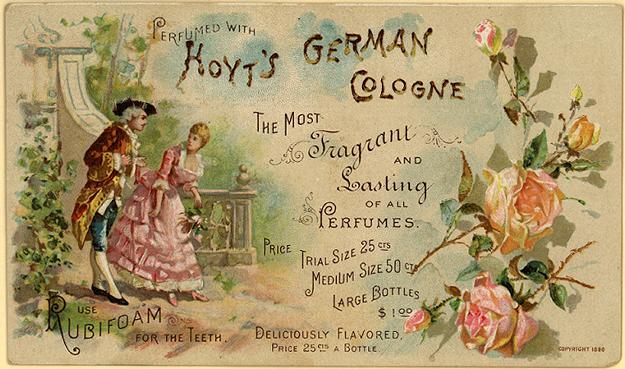
Isabella Alden has a new Pinterest board for you to view: Vintage Advertising is a collection of trade cards, magazine ads, and newspaper advertisements for products that were available to consumers during the years Isabella wrote and published her books.
Many of the advertising images date from the 1890s to the 1920s. Some feature simple illustrations (like the 1916 Cuticura Soap magazine ad above), while others are colorful, detailed works of art.
Altogether, they provide a glimpse into what life was like for Isabella Alden and the characters she brought to life in her books.
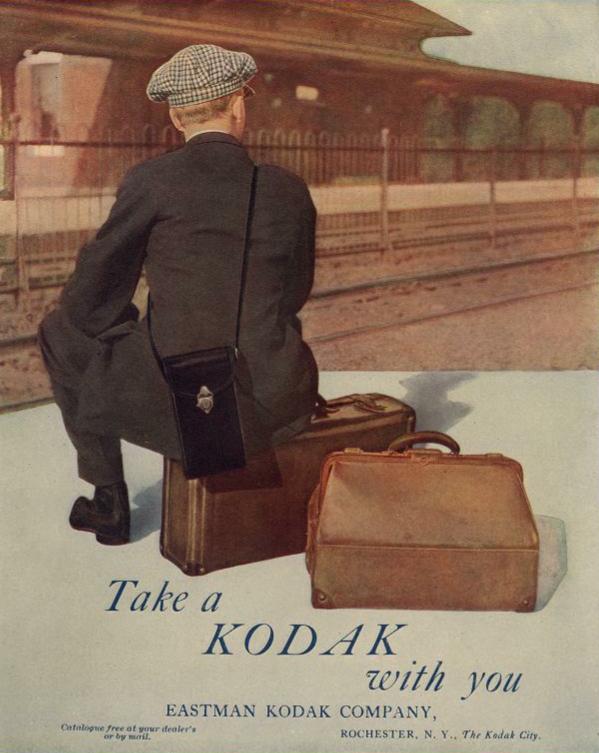
This early Kodak magazine ad from 1916 was one of the first of its kind to be printed in color.
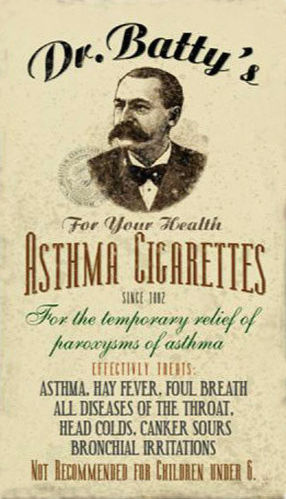
The trade card below for Dr. Batty’s Asthma Cigarettes harkens back to a time when people believed smoking cigarettes could cure asthma. Interestingly, the trade card suggests children under the age of 6 should not smoke the cigarettes (suggesting that children as young as age 7 could!).
Please stop by Isabella’s new Pinterest page. New images are added frequently so be sure to follow her board or visit often.
Reviews and giveaways for Christian fiction and sweet, clean fiction. Bringing readers information on great stories and connecting authors with their readers.



































 Isabella Alden