Karen, a long-time reader of this blog, asked a question about Isabella’s novel, Interrupted.
Twice in the book, Isabella used the term “real Russia.”
The first instance occurs when our heroine, Claire Benedict, and her Sunday school class take it upon themselves to renovate the church, and they turn their attention to fixing up the cast-iron stove that heats the sanctuary.
As the ladies try to decide what improvements to make next, one of the girls says:
“Look here! Don’t you think our very next thing, or, at least, one of the next, ought to be a furnace? I don’t like those stove pipes, if they are Russia. A furnace would heat more evenly, and with less dust.”
That’s the first mention of “Russia” in the book, referring to the pipes that vent the stove.
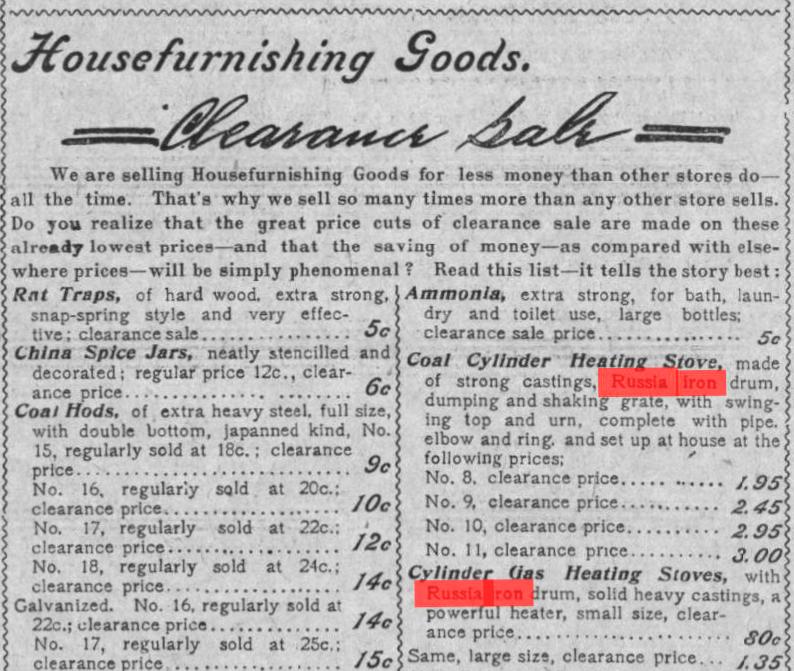
An 1899 newspaper ad for Siegel Cooper Department Store (New York) featuring Russia iron heating stoves.
.
Later, Isabella used the same Russia reference in describing the stove after the ladies cleaned it up:
And really, the stove pipe, though it wandered about according to some wild freak that was considered necessary in order to “draw,” did not look so objectionable now that it was real Russia; and nothing could glow more brilliantly than the stove, which smoked no more.
No wonder Karen was curious! “Real Russia”—whatever that is—played a big role in the ladies’ efforts to beautify the sanctuary.
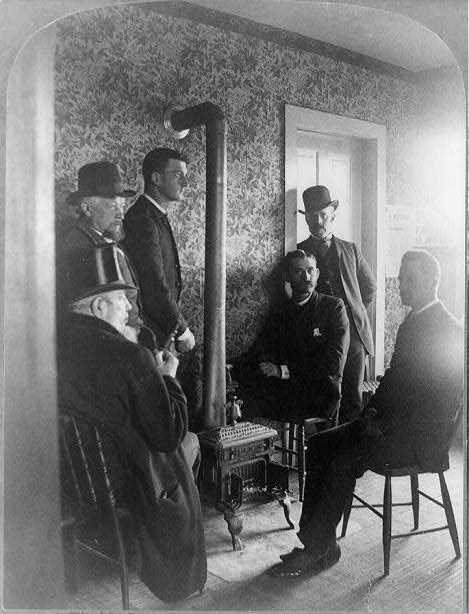
Men gathered around a cast iron heating stove in 1886.
.
So, what was “real Russia”?
Isabella was referring to Russia iron. It was produced in Russia and was highly prized throughout the world for its ability to resist rusting and protect engines, boilers and stoves.
Another key feature that made Russia iron the wonder of its time was that it did not flake or lose any of its protective properties when it was bent, as American iron did.
For many years Russia iron could only be obtained from Russia. The manufacturing process was highly secretive, which kept demand high and prices even higher.
In the mid-1800s American engineers finally cracked the code for manufacturing Russia iron; and by the latter part of the century, American foundries were gearing up to produce their own version of the much-sought-after sheet iron.
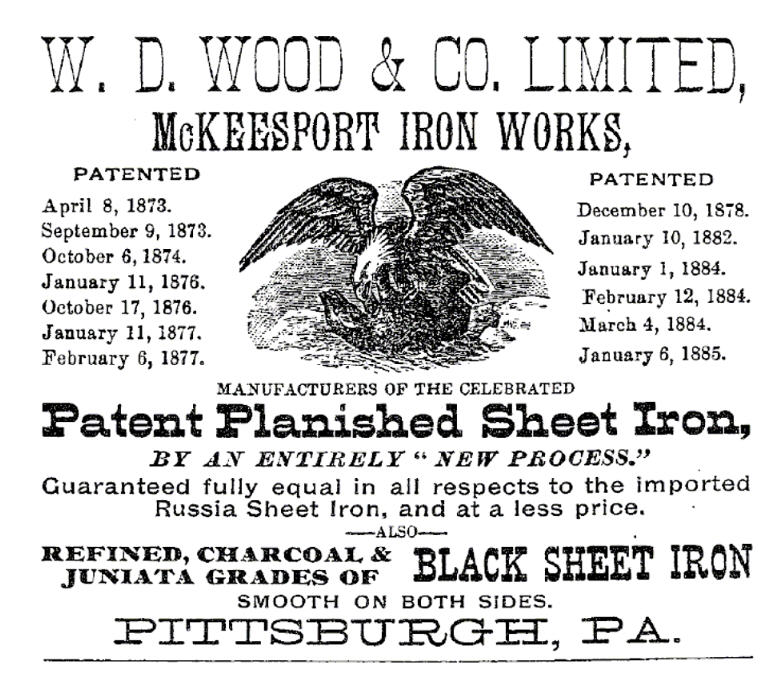
Ad from Pittsburgh and Western Pennsylvania-Their Industries and Commerce, published in 1885 by the Pittsburgh Chamber of Commerce; found at Penn state Universities library.
.
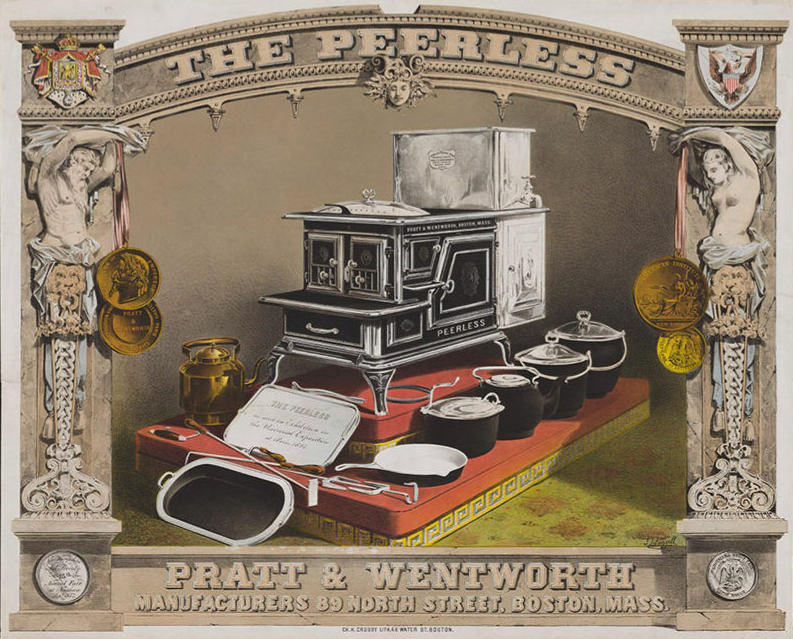
There was, after all, real money to be made from such a product. Sheet iron was used in the manufacture of many things, such as parlor stoves and cooking ranges.
An 1867 ad for Peerless kitchen stoves.
.
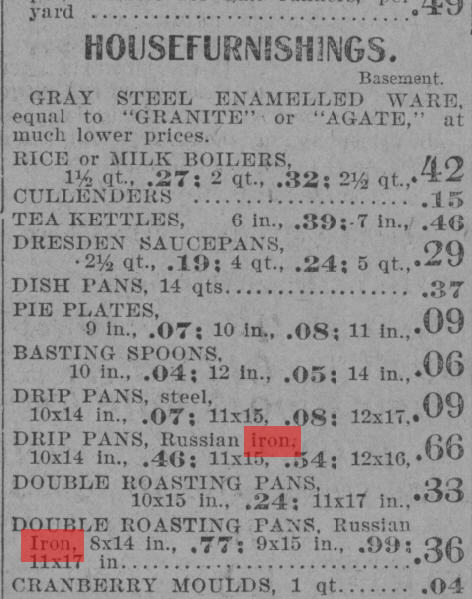
In addition to stoves, consumers used iron pots and pans on their iron cooking ranges.
Portion of a Macy’s Department Store ad in the New York Journal, November 21, 1897
.
Commercially, sheet iron was used to clad boilers and the engines on locomotives.
Even though American business was producing a creditable version of Russia iron by the 1880s, most consumers and industries were not fooled. They often referred to American iron products as “imitation Russia iron.”
A 1906 postcard showing a portion of the sprawling Carnegie Steel Works in New Castle, Pennsylvania.
.
But as more and more American-made products began to be advertised as made of Russia iron, consumers had a difficult time distinguishing between “real Russia” and the imitation. In many cases, the only way to tell the difference between the genuine product and the American version was to find the tell-tale Cyrillic characters embossed on the original full sheets of iron. Click here to see a sample of those Russian characters.
It took many years for American industry to overcome the stigma of producing “imitation” Russia iron; but in 1885, when Interrupted was written, Russia iron was still the gold standard by which all other iron was measured.
So when Isabella wrote that the stove pipes in the church were made of “real Russia,” she was actually commenting on the high quality of the improvements Claire Benedict and her friends made to the church sanctuary.
Would you like to learn all the ways Claire and her friends beautified the church sanctuary in Interrupted? Click here to read the post.
You can also read about other unique terms Isabella used in her different novels. Just click on “Pansy’s Dictionary” under the Categories header on the right side of this page.
Last week Apple unveiled its new iPhone with the latest innovations in communication technology. Its release came 130 years after Isabella Alden first mentioned the telephone in the plot of one of her novels.
As convenient and indispensable as phones have become in our modern age, the same could be said of telephones in Isabella’s time. In the late 1800s and early 1900s, telephones changed the way Americans lived.
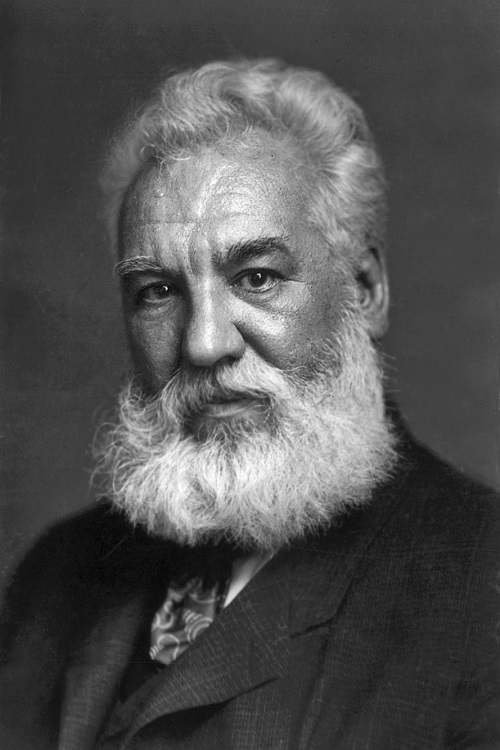
Isabella was 35 years old when Alexander Graham Bell patented his version of the telephone in 1876; but that first model had very limited capabilities.
Inventor Alexander Graham Bell
.
Although the early Bell telephones certainly transmitted sound, they only worked between two locations that were hard-wired to each other.
An illustration of Bell demonstrating his invention in 1877
.
Then, in 1878, a man named George Coy invented the telephone exchange and immediately turned the telephone into a much more practical invention.
Instead of telephone lines being strung between two locations as Bell had envisioned, Coy’s exchanges linked any number of telephones to a single point: a switchboard.
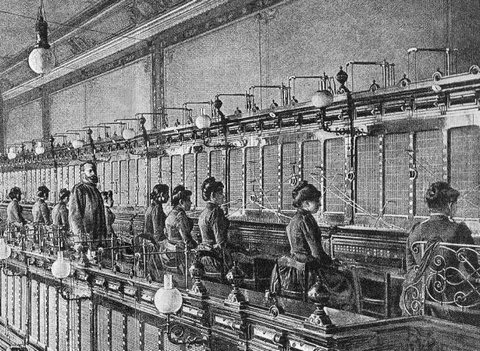
An 1890 illustration of women working a switchboard at a telephone exchange.
,
At the exchange, legions of trained switchboard operators used a series of cords and sliding keys to connect and reroute incoming calls to other telephones linked to the exchange.
An early telephone exchange, about 1898
.
Thanks to those exchanges, telephone line construction exploded with growth over the next few years. By 1880, there were 47,900 telephones across America. By 1881, telephone service between Boston and Providence was established. By 1892, a telephone line had been constructed between New York and Chicago; and two years later New York and Boston were connected.
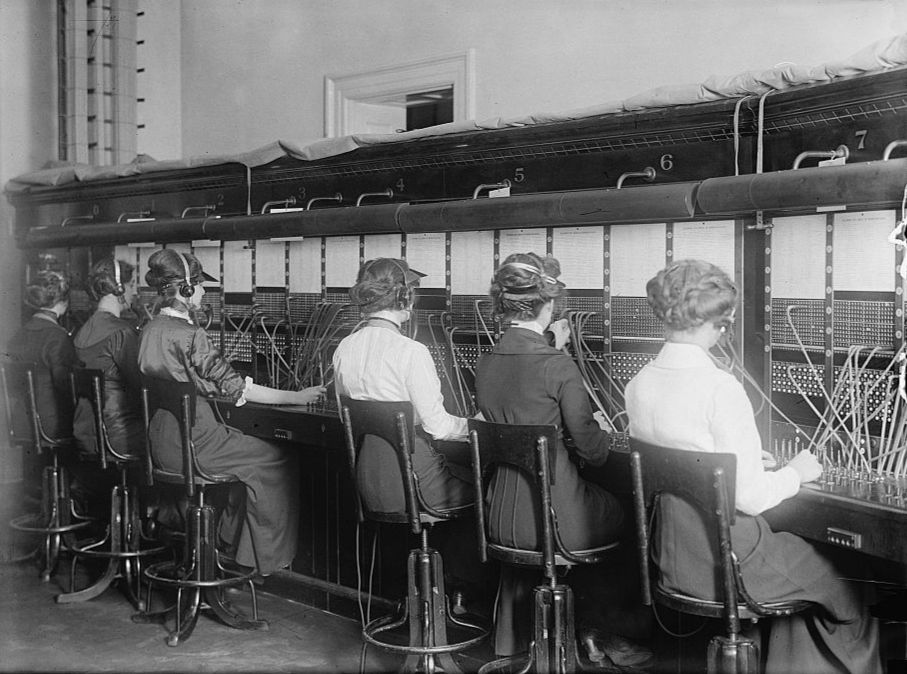
Switchboard operators at the Chesapeake and Potomac Telephone Company near Washington, D.C.
.
Another benefit of those exchanges: jobs. As telephone service expanded, more and more trained switchboard operators were needed to connect calls; and the majority of the operators hired were women.
A 1911 photograph of a switchboard telephone operator.
.
When Isabella published her novel Eighty-Seven, she included a character who worked as a switchboard operator. Her name was Fanny Porter, and she worked in the Dunbar Street Telephone Office. Another character in the story described Fanny as …
… a bright, pretty girl, young, and quite alone here. She lives in a dreary boarding-house, and used to have some of the most desolate evenings which could be imagined.
Switchboard operators in 1914
.
Fortunately, not all switchboard operators lived and worked under such conditions. While the majority of switchboard jobs required working for a Bell Telephone Company, there were other positions available. For example, some large businesses that required multiple telephone extensions were equipped with their own exchanges and hired operators to run them.
Switchboard operators in an office, about 1910.
In fact, businesses were the foremost users of the telephone in the late 1890s. That’s because, in general, phones were too expensive for individual homeowners to install and maintain; but Mr. Mackenzie, the wealthy businessman in Isabella’s novel Wanted, could afford to have a telephone in his home.
In fact, the telephone plays a small but pivotal role in the story. When Rebecca Meredith, the novel’s heroine, first meets Mr. Mackenzie, she thinks he’s hateful and selfish, until she mentions one evening that his young daughter is a little hoarse. To her surprise, Mr. Mackenzie immediately telephones the doctor and …
… administered with his own hand the medicine ordered. Even after the doctor had made light of fears and gone his way, the father sat with his finger on Lilian’s small wrist and counted the beats skillfully and anxiously.
After witnessing his tenderness for his daughter, Rebecca begins to change her opinion about Mr. Mackenzie.
In her 1892 book, John Remington, Martyr, Aleck Palmer was also a young man of great fortune; he, too, had a telephone in his home and business, which caused Mrs. Remington some concern. You see, she was intent on playing matchmaker between Aleck Palmer and her friend Elsie Chilton and invited the unsuspecting couple to dinner without letting either know the other had been invited. As Mrs. Remington explained to her husband:
Elsie is getting to be such a simpleton that I am afraid she would run home if I should let her know he was coming; and as for him, he is developing such idiotic qualities in connection with her, that I feel by no means certain he would not get up a telephone message or something of the sort to call him immediately to the office, if he should know before the dinner bell rang that Elsie was in the house.
But by the time the 20th Century dawned, the demographics and cost of telephone usage changed dramatically. Telephone companies had connected most major cities and strung sufficient telephone lines across the country to bring costs down, and phone company executives began to set their sights on a new goal: providing service to residential customers.
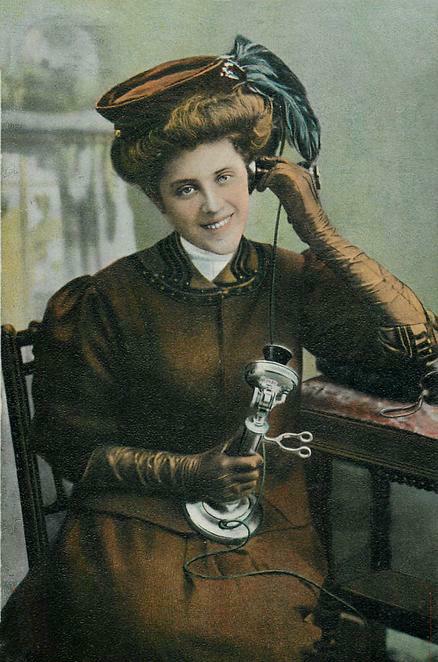
At first, advertising to consumers stressed the obvious: keep in touch with friends and family.
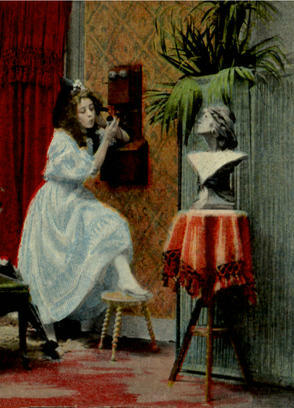
Blowing kisses over the phone, 1908.
.
Then, in 1910 the Bell Telephone Companies developed several strong marketing campaigns that offered different reasons why every home should have a telephone. One campaign was directed specifically at the lady of the house.
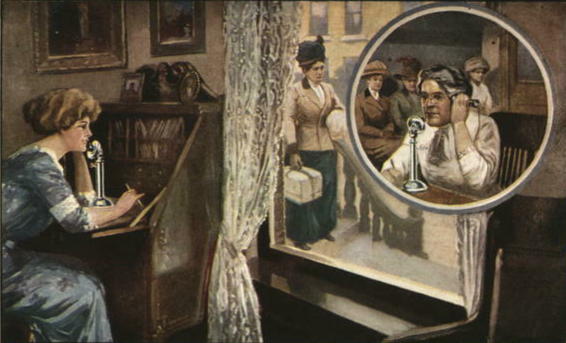
The ads had strong visual cues, like this one illustrating how a phone in the home meant a family could summon a doctor quickly:
The series of ads was printed in magazines and on postcards, showing how a Bell telephone …
… keeps travelers in touch with home …
… guards the home by night as well as by day …
… summons help during household emergencies …
… relieves anxieties over a loved one …
… and quickly helps arrange replacements when servants fail you.
The ad campaigns were extremely successful. People began to think of telephones as an essential tool for the home, instead of a mere convenience. Soon, telephone companies across the country were installing residential telephones at an astonishing pace.
This Bell Companies business card for the Philadelphia area cites the number of installations locally and nationally. The blank space was filled in by an installation or service subcontractor with his own contact information.
.
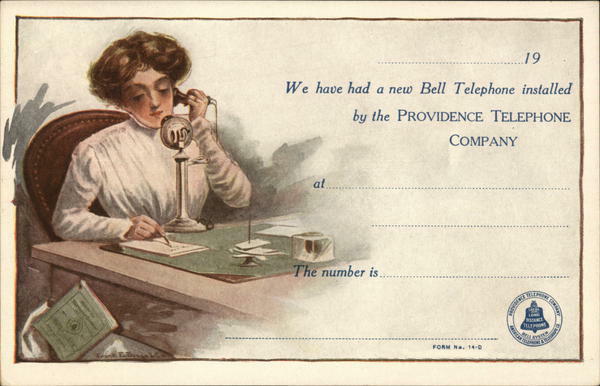
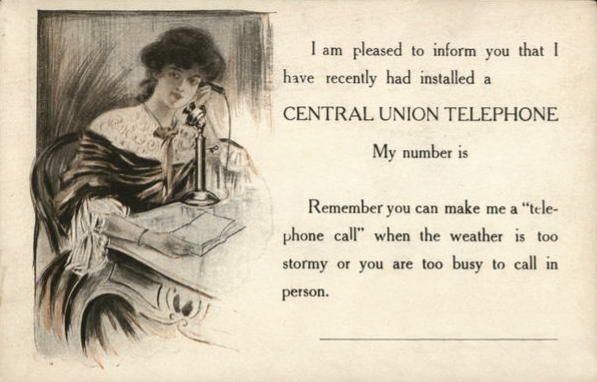
And after each new installation was complete, telephone residential customers notified friends and family of their new phone number by sending out cards like these:
.
Soon telephones became not only an essential device for the home, but a convenient tool for the lady of the house. In Ester Ried’s Namesake, published in 1906, Ester Randall worked as a cook in the home of the Victor family. And being a stylish family, the Victors, of course, had a telephone, which Mrs. Victor used regularly, as in this scene where she explained to Ester her plans for dinner:
We’ll make the dinner light and easy to manage; just a steak and some baked potatoes and canned corn. Did you say there was no corn? Oh, I remember, you told me yesterday, didn’t you? Well, just phone for it. Call up Streator’s, they are always prompt; tell them they must be. And we’ll just have sliced tomatoes with lettuce for salad; all easy things to manage, you see. As for dessert, make it cake and fruit—strawberries, or peaches, it doesn’t matter which. Why, dear me, that dinner will almost get itself, won’t it?
It’s amazing to think that Isabella Alden saw the development of one of the greatest inventions of the Twentieth Century. In her time the telephone was innovative and exciting. It opened new avenues of jobs for women and changed the way people interacted with each other; and Isabella reflected those changes in her novels and stories that we still read and appreciate today.
You can read more about Isabella’s novels mentioned in this post by clicking on the book covers below:
Mrs. Dunlap is a model wife, mother, and homemaker. She’s the perfect hostess when guests enter her home, and out of the goodness of her heart she has taken a poor neighbor girl under her wing. Why, Mrs. Dunlap even teaches a Sunday-school class and remembers to keep the Sabbath holy!
Given such stellar qualities, Mrs. Dunlap must surely be a model Christian; but one unusually trying Monday begins to reveal the truth of Mrs. Dunlap’s character.
When Isabella wrote The King’s Daughter in 1873, she wrote a novel that was contemporary for her time. In the book, she referenced household items and songs that were popular in 1873.
For example, in chapter eight, Miss Dell Bronson tries to convince Sam Miller to attend a temperance meeting with her.
At first Sam—a man who described himself as having gone to wreck and ruin—is aghast at the idea, but Dell won’t take no for an answer.
Instead, she uses all her powers of persuasion to entice Sam to the temperance meeting:
“Go and try one. I don’t believe you have ever been. We are going to have singing. I know you are fond of music. I heard you singing ‘Molly Bawn’ this morning. I like your voice. I want you to come and help us sing.”
Of course, songs sung at a temperance meeting would not include Molly Bawn; but by mentioning the song in her book, Isabella referenced a popular song her readers would instantly recognize.
Oddly enough, there are many versions of the Molly Bawn song. An Irish version tells the story of Molly Bawn being shot by her lover when he mistakes her for a swan as she hides in the forest.
But the American version—which is probably the version Isabella had in mind—is about a young man hoping to rendezvous with the girl he loves: Molly Bawn.
This sheet music, published in 1881, gives the lyrics to Molly Bawn:
The sheet music for Molly Bawn. Click on the image to see the music and lyrics.
.
Molly Bawn was an incredibly popular song that captured and held America’s imagination. The melody was easy; the lyrics were romantic; and if you happened to have the singing voice of an Irish tenor—which may have been true of Sam Miller—the song was practically written for you.
In 1878 a writer named Margaret Wolfe Hamilton (who published under the pseudonym Mrs. Hungerford) wrote a novel loosely based on the song.
The 1904 paperback version of the novel Molly Bawn.
.
The book version of Molly Bawn was an instant success in America. In fact, one of the novel’s characters utters for the first time in print, a phrase we still repeat today:
Beauty is in the eye of the beholder.
Hamilton’s novel was so popular, it remained in print for decades.
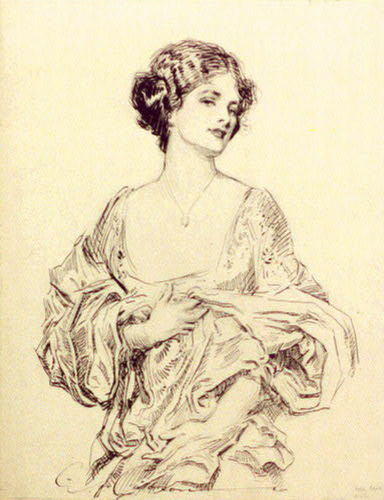
Artist Charles Dana Gibson—famed for his illustrations of The Gibson Girl—was so inspired by the story, he created his own depictions of Molly Bawn:
“Molly Bawn” by Charles Dana Gibson, 1911.
.
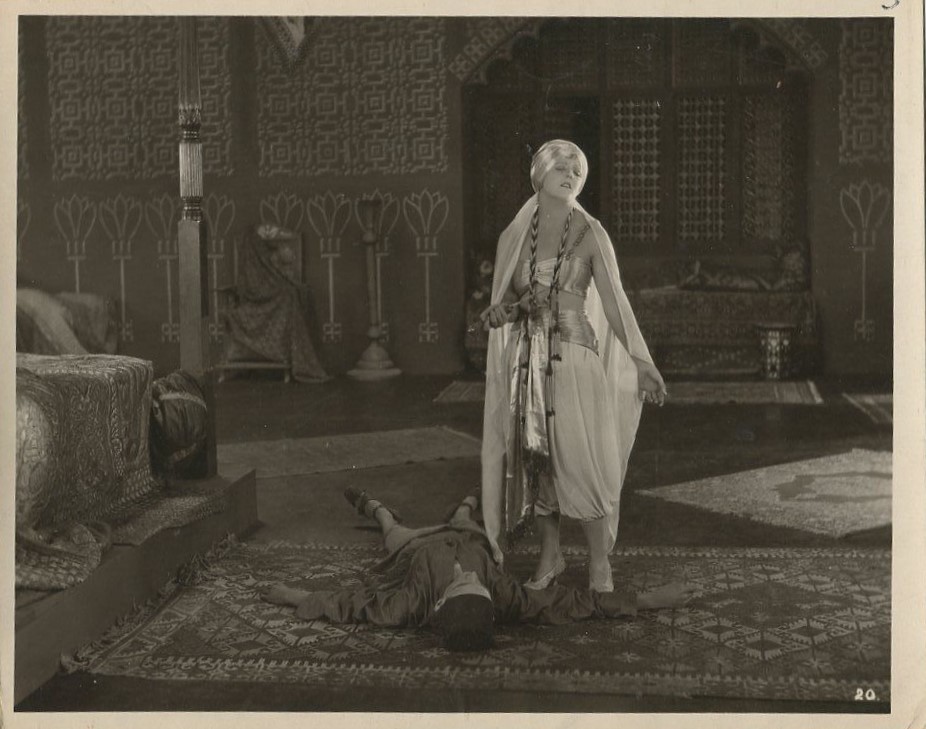
In 1916 a movie of the Molly Bawn story hit theaters. It starred silent film actress Alma Taylor in the lead role.
Film actress Alma Taylor in a scene from the 1924 silent film Shadow of Egypt. She played Molly Bawn in a 1916 film adaptation of the novel by Margaret Wolfe Hamilton (aka Mrs. Hungerford).
.
Clever Isabella! When she dropped the name of the song ‘Molly Bawn’ in chapter eight of The King’s Daughter, she knew she was giving her readers a reference they—and subsequent generations—would readily understand.
Reviews and giveaways for Christian fiction and sweet, clean fiction. Bringing readers information on great stories and connecting authors with their readers.



 You can also read about other unique terms Isabella used in her different novels. Just click on “Pansy’s Dictionary” under the Categories header on the right side of this page.
















 Isabella Alden