Blog

What Can I Do for Jesus?

For many years Isabella Alden wrote a regular column for Sabbath School Monthly magazine. Titled “Primary Department,” the column provided complete children’s Sunday school lessons for each week of the month. Isabella also contributed stories to the magazine, and sometimes released one of her new novels in serial form, publishing a chapter in successive issues.
Sabbath School Monthly header

In one issue of the magazine, Isabella gave an account of a ladies’ prayer-meeting she attended that had such an impact on her, she wanted to share the experience with other Sunday school teachers:

The subject was, “What can I do for Jesus?” It was to be answered first by Bible verses. How wonderfully pertinent they were!

“Walk worthy of the Lord unto all pleasing,” said one.

“Increase in the knowledge of God,” said another.

“Be strengthened with all might, according to his glorious power,” said a third.

Then one summed up, as it were, the whole question in that marvel of condensation, “Whether, therefore, ye eat or drink, or whatsoever ye do, do all to the glory of God.”

“It all resolves itself into this,” one lady said; “if we have our own hearts right, then, whatever we do, or say, or think, may be to the glory of God. What we want, more than anything else, is to put on Christ in his fullness, so that his will shall be ours, and so that, in any event, we can rest in him. Then he will accept all work, and all waiting, as done for him.”

“Isn’t it a great help,” a dear, earnest, loving woman said, “to think that all our little, everyday work may be done in such a spirit, that it shall be to his glory? That just glorifies the meanest thing that we may have to do, and sweetens the heaviest toil.”

“Doesn’t it make less of the toil?” A lady asked, quickly, and her face shown with the reflected light of Him from whom she had learned her message.

“How?” another asked, puzzled at the expression, not being able to take in its fullness.
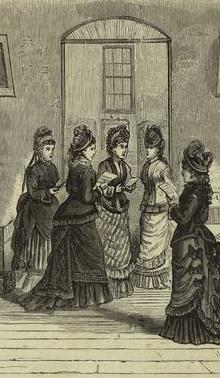
Ladies Praying and Singing 1879 ed“Why, if whatever we do, even the eating and drinking, is to be done to the glory of God, will it not make us careful that we glorify Him by not expending unnecessary time or strength in this work, but keeping ever before us the great aim—His glory. It will lessen the work, depend upon it. You cannot do that which is simply unnecessary, and worse than unnecessary, being often unhelpful, if you have this end in view.”

There were those present to whom these words came as a revelation. They drew new meaning from the familiar text. One’s thoughts could not help going rapidly over other things than the eating and drinking. What about dressing? Did this new idea take less ruffles and puffs and flounces? Could they, also, be managed for the glory of God? So long as one held the thought, it seemed to grow and expand. The rich crumbs still fell around us.

“It is just this spirit, I think,” said a sweet-faced sister, “that makes it possible to live the life that we are directed. ‘Pray without ceasing,’ I have heard one say. How is that possible, when life is crowded full of hard and incessant work? But I see how it is possible; if the work is done with that grand end in view, what is more natural than to look constantly to Him for help to carry it out, to turn our thoughts to Jesus in every trial, or annoyance, or perplexity? I think it rests one as nothing else will. Isn’t it possible, don’t you think, even in the midst of perplexing business cares that try heart and brain, to have this spirit of prayer?”

There came instant answer to the query. A bright-faced lady, who had hitherto listened with eyes, and heart, and glowing face, said quickly:

“I am not sure how it would be in mental work. But I know one can run the sewing machine and pray earnestly and eagerly at the same time; I’ve done it often.”

Sweet Hour of PrayerThus the talk went on, each adding her crumb, or her rich slice, according as the Spirit had given her a precious thought. The name of it was a prayer-meeting—a female prayer-meeting at that; but the utter absence of all the stiffness and horrible decorum that usually characterize such gatherings made one forget that it was called by so dignified a name. It was just a little social talk about our hopes, and plans, and prospects, and privileges—as we might have met together and talked about our journey to Europe, and our preparations for the journey, if we were expecting to go. At intervals there came in sweet, short, tender, helpful prayers, and a verse of a hymn sung now and then.

When the hour was gone we felt a sense of wonder that so much could be crowded into one hour of time, and that an hour could be made to pass so quickly; and we went out from that parlor feeling a new and closer link added to the chain that bound our Christian hearts together. We had taken a step forward.

“Why,” I said to myself, as I came down the street, “why could there not be teachers’ prayer-meetings somewhat after this type, where they could meet to gather up the treasure crumbs from the coming lesson, and to pray for each other’s classes? I mean to tell the teachers of the Sabbath School Monthly about our dear little meeting; and so teachers, I have told you.”

“A word to the wise,” etc. 

—Pansy

A New Brother

In her memoirs Isabella Alden recalled the day she met the man who would become her brother and an important influence in her life.

Woman picking blackberries 1905It started out like any other day for eleven-year-old Isabella. She and her older sisters—Mary (age 26 at the time), Marcia (age 20) and Julia (age 17)—set off with their father in the family’s old-fashioned wagon to ride to Clip Hill. Clip Hill was an area about seven miles from their home where wild blackberries grew. Isabella and her sisters were charged with picking as many berries as they could so their mother could bake pies and put up berry preserves to last through the winter.

Their route took them through town, and as they drove down the main business street of Johnstown, New York, they saw a young man who stood out from the scores of other people moving up and down the sidewalk. Isabella wrote:

Perhaps his garments had a more stylish cut. For one thing, he carried a cane. I was used to seeing only old and lame people carry canes, but this man didn’t seem to need it, or anything else to help him! He walked as though he enjoyed walking and he looked all dressed up, even so early in the morning. I liked him.

Mary knew exactly who the aristocratic stranger was.

“Don’t you know that fine old house with splendid trees all around the grounds, the handsomest place in this part of the country?”

“The Livingston homestead?” said Father. “Yes, I know it.”

“Well, he is the youngest son, just graduated from college where he took all the honors they had to give. To hear the girls go on about him one would think there wasn’t any ground fit for him to walk on.”

By this time we had passed him. I saw my sister Marcia turn and look back at him again, so I twisted myself around in the hope of another glimpse as I said, “I like his looks.”

That young man was Charles Montgomery Livingston. He was descended from the distinguished Livingston family of New York. From the late 17th century to the early 19th century, the Livingstons were one of America’s richest and most aristocratic families. Their land holdings in New York alone were larger than the entire state of Rhode Island. By the early 1800s the family had built almost 40 mansions along the Hudson River, surrounded by more than one million acres of prime Hudson Valley land the family collectively owned.

Clermont, one of the Livingston mansions in New York State

But the Livingstons’ fame didn’t come from wealth. Rather, the family was distinguished because of their contributions to molding early America. Long before the Kennedys or the Roosevelts, the Livingstons shaped the course of the country.

The Mills Mansion in New York State

During the American War of Independence, General George Washington used one of the Livingston mansions as his headquarters; and it was a Livingston who administered the presidential oath of office to George Washington.

Robert Livingston administers the Presidential Oath of Office to George Washington

Another Livingston helped draft the Declaration of Independence and negotiate the Louisiana Purchase. Yet another Livingston became a Justice of the United States Supreme Court.

Philip Livingston, signer of the Declaration of Independence

But it was Philip Livingston, Delegate to the Continental Congress and Signer of the Declaration of Independence, from whom Charles Livingston was descended.

When Isabella and her family finally reached Clip Hill, they were still talking about “the handsome gentleman with his cane.” While they picked berries, Marcia selected a branch from the ground and paraded up and down using her improvised cane to make everyone laugh.

Their father laughed, too; but he predicted, “If what I heard about that young man is true, you may see the time when you would be glad to imitate him in more ways than handling a cane.”

No prophecy could have proved more true, as Isabella later wrote. Only three months later, Charles Livingston married Isabella’s sister, Marcia—the very same sister who imitated him so ridiculously in the blackberry patch on Clip Hill!

Charles Livingston in an undated photo

By the day of the wedding, Isabella called Charles “brother” and he was as kind and loving to her as a brother could be. In fact, he asked Isabella and his niece, Maria (who was about Isabella’s age), to ride with the bride and groom to the railroad station after the marriage ceremony. It was quite an honor, and Isabella was thrilled to be singled out for such a special invitation. But in the confusion following the ceremony, Isabella and Maria never made it into the carriage. Instead, they watched as the carriage rolled away with the bride and groom … leaving Isabella and Maria standing at the curb!

Moments later the carriage came to a stop and then turned around. Marcia later told Isabella that it was Charles who insisted that they go back as fast as they could to pick up the girls, knowing it would break their hearts to be forgotten and left behind.

In later years, Isabella remembered that day and her new brother’s thoughtfulness. “I don’t believe there is another man like him in all the world. It was ‘just like him.’ And he was like that all through the beautiful years of his life, always thinking of others, and not considering his own plans or convenience.”


Click here to read a previous post about Charles Livingston and his influence on Isabella’s life.

You can learn more about the Livingston Mansions of New York by clicking this link.

Find out more about Philip Livingston, Signer of the Declaration of Independence at these websites:
www.dsdi1776.com

www.iment.com

New Free Read by Grace Livingston Hill

Isabella Alden was very close to her sister Marcia Livingston. Like Isabella, Marcia was a writer and they often co-wrote stories together.

Isabella Alden and her sister, Marcia Livingston in an undated photo
Isabella Alden (left) and her sister, Marcia Livingston (right) in an undated photo

After the sisters married, the Alden and the Livingston families remained close. They spent much of their time together, and Marcia’s daughter Grace grew up in the creative atmosphere of writers and books.

Grace learned her ABCs on her “Aunt Belle’s” typewriter. At the age of ten she wrote a story of her own called, “The Esselsltynes; or, Marguerite and Alphonse,” which the family published for her as a surprise. That gift, along with the encouragement and work example set by her family, inspired Grace to continue writing.

She followed the adage of “write what you know.” When Grace became involved in the Young People’s Society of Christian Endeavor, she wrote stories about that experience; many of those stories were published in Christian Endeavor World magazine.

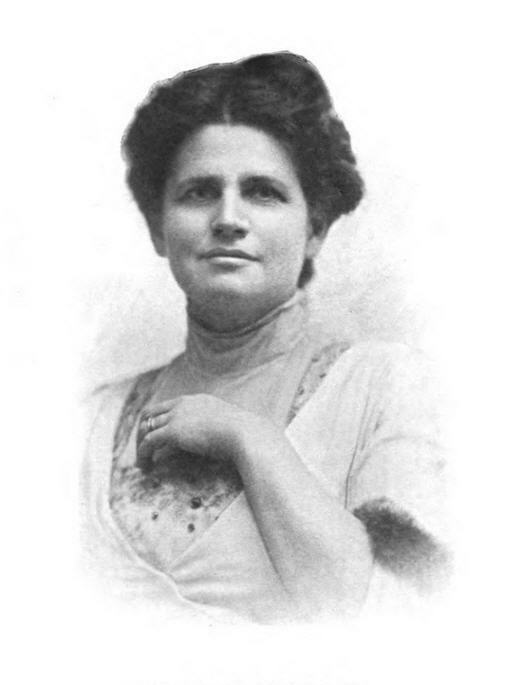
Grace Livingston Hill-Lutz, about 1912

The Epworth Herald also published Grace’s stories that illustrated simple truths about the Christian life. One such story was “Hazel Cunningham’s Denial,” which described a young woman’s dilemma while vacationing at a summer resort

“Hazel Cunningham’s Denial” first appeared in The Epworth Herald on August 9, 1902, and it’s available for you to read for free.

Click on the cover below to begin reading “Hazel Cunningham’s Denial” by Grace Livingston Hill.

Cover_Hazel Cunninghams Denial by GLH scaled

Chautauqua Advice from Bishop Vincent

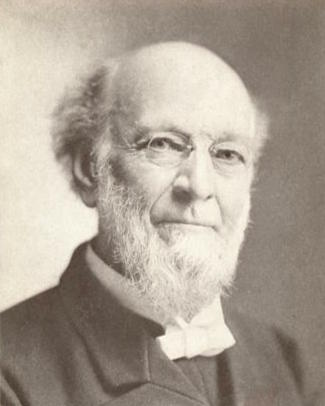
John Heyl Vincent
John Heyl Vincent

By 1890 the Summer Assembly at Chautauqua Institution was in its seventeenth year. Its success inspired similar assembly locations on four continents. People who could not travel to the original New York location could attend an assembly in Iowa, Illinois, Missouri or forty other locations across the United States.

Bishop John Heyl Vincent (Chautauqua’s co-founder) believed everyone could benefit from even a few days at a Chautauqua assembly.

He wrote an article for an 1890 issue of The Chautauquan magazine in which he gave plenty of advice for anyone planning to undertake the trip for the first time.

Chautauqua camping in 1908

Here’s the advice he gave about tent kife:

If you live in a tent, remember a little fact that some innocent and unconscious souls so easily forget, or which, perhaps, they never knew: tent lights cause most curious shadows on tent walls; and folks outside, if they happen to pass, see some ludicrous pantomimic shadow effects, which, if the lights were lower, might be lost. “Let the lower lights be burning,” or study the laws of light and abridge the unprogrammed entertainments of the Assembly.

Tent Shadows

The Christian Calling Card

In 1922 Emily Post wrote, “with a hair-pin and a visiting card, [a woman] is ready to meet most emergencies.”

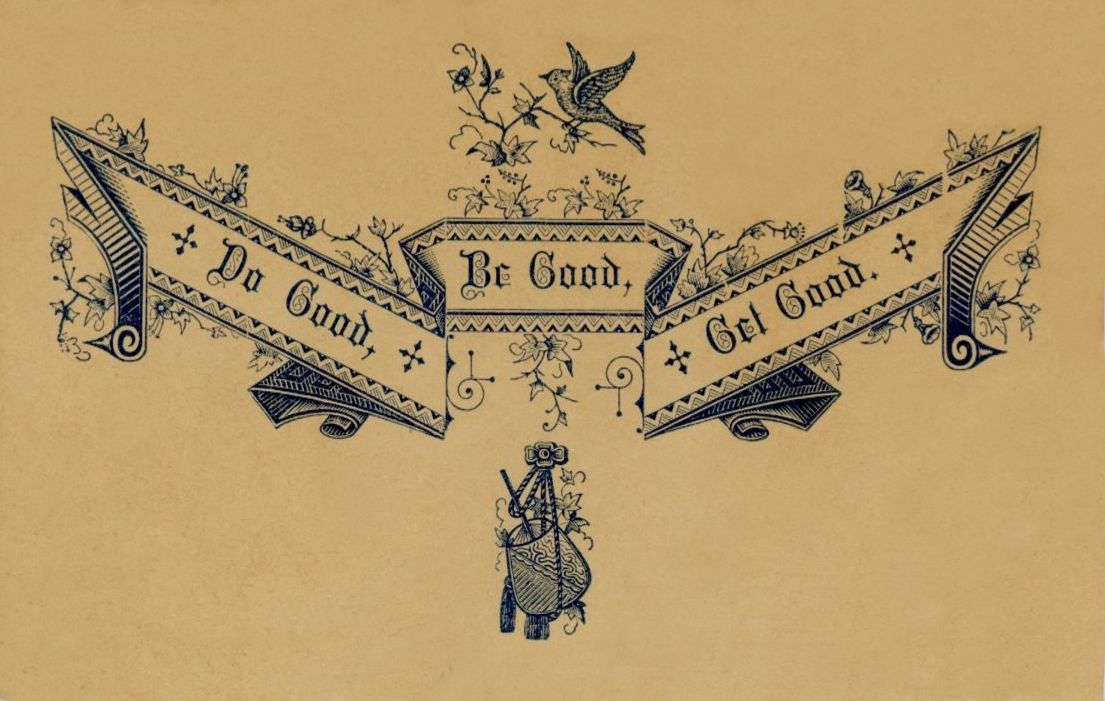
Do Good

There’s evidence of that maxim in Isabella Alden’s books. In several of her stories a simple calling card played a prominent role in the life of one of her characters.

Card Luke

In Spun from Fact, Jeanie Barrett had cards printed with only her name and this sentence in plain text:

“Are you saved by grace?”

Each time she gave away one of her cards, she did so with a purpose, and knew exactly how she wanted to engage that person in conversation about the straight-forward question printed on the card.

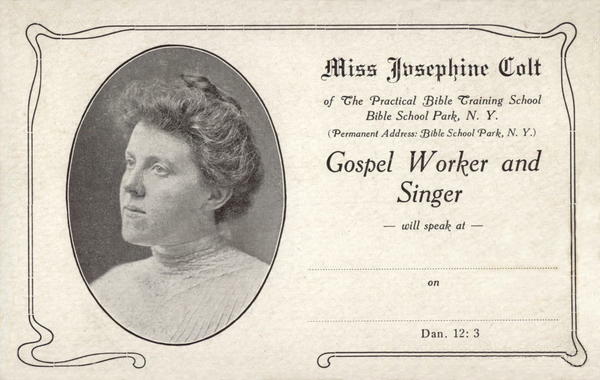
Spun from Fact Bible School training
A card used to announce dates and times of a Gospel worker’s upcoming speaking engagements.

In Workers Together; An Endless Chain, Dr. Everett’s calling card was printed on both sides. The front of the card gave the address and hours for his medical practice. On the other side he listed the times for Sunday worship services, Sunday School classes and weekly prayer meetings at the church where he was superintendent of the Sunday School.

card00495_fr

In A New Graft on the Family Tree, John Morgan received a calling card that changed his life. He was hungry and homeless, hopping one rail car after another to find anyone who would feed him in exchange for doing some work.

Spun from Fact card00555_frJohn’s situation was desperate; he was weak from hunger when he came across neat-looking house, with a neat kitchen-door; he knocked at it, and asked for a bit of bread. A trim old lady answered it. To his surprise she invited him in and fed him a savoury breakfast. And while John ate, the old woman talked to him:

“Well, there are a good many homeless people in the world. It must be hard; but then, you know, the Master himself gave up his home, and had not where to lay his head. Did it for our sakes, too. Wasn’t that strange! Seems to me I couldn’t give up my home. But he made a home by it for every one of us. I hope you’ve looked after the title to yours, young man.”

No answer from John, The old lady sighed, and said to herself, as she trotted away for a doughnut for him:

“He doesn’t understand, poor fellow! I suppose he never has had any good thoughts put into his mind. Dear me! I wish I could do something for him besides feeding his poor, perishing body!”

The little old lady trotted back, a plate of doughnuts in one hand, and a little card in the other.

“Put these doughnuts in your pocket; maybe they’ll come good when you are hungry again. And here is a little card; you can read, I suppose?”

The faintest suspicion of a smile gleamed in John Morgan’s eyes as he nodded assent.

“Well, then, you read it once in a while, just to please me. Those are true words on it; and Jesus is here yet trying to save, just the same as he always was. He wants to save you, young man, and you better let him do it now. If I were you I wouldn’t wait another day.”

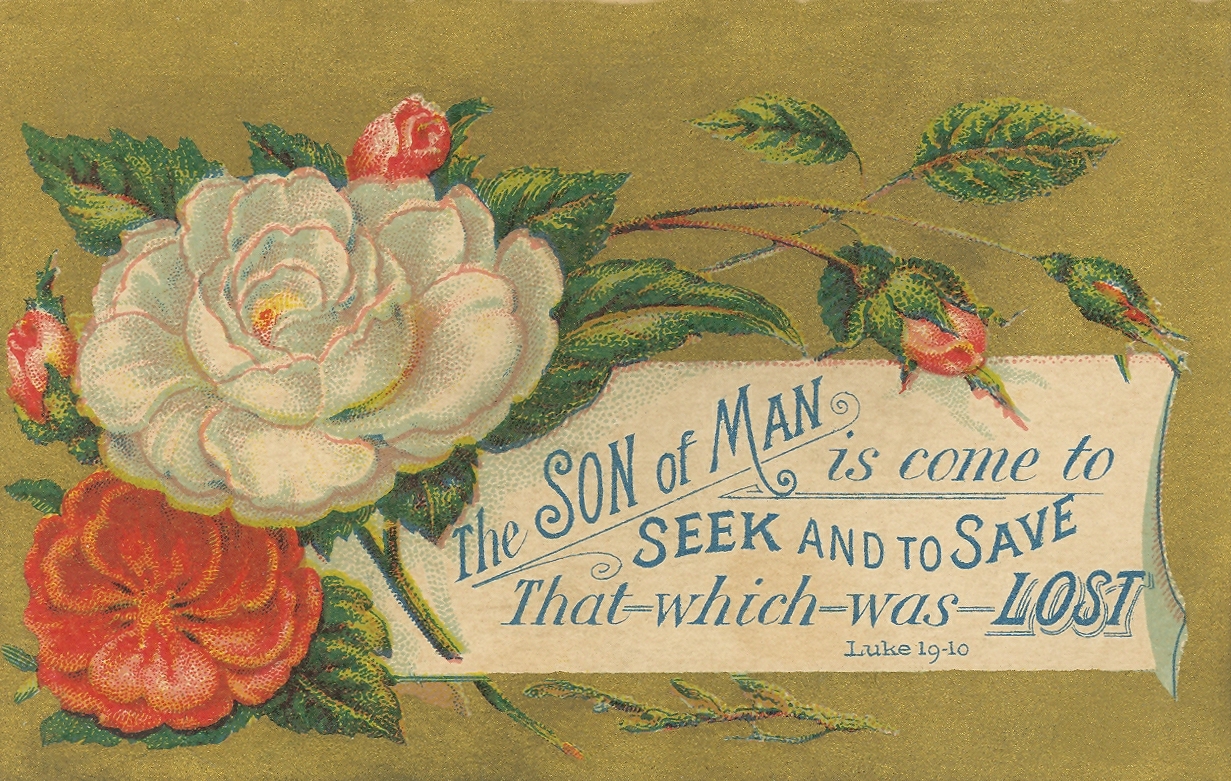
Card Proverbs

John waited until he left the woman’s house and was tramping down the street before he looked at the card she gave him.

It was a simple enough card, printed on it in plain letters these words:

“It is a faithful saying, and worthy of all acceptation, that Jesus Christ came into the world to save sinners.”

Then, underneath:

“I am the bread of life. He that believeth on me shall never hunger.”

Still lower on the card, in ornamented letters, the words:

“The Master has come, and calleth for thee.”

Then a hand pointing to an italicized line:

“I that speak unto thee am he.”

John thrust the card into his pocket and strode towards the village depot to board another train, unaware that the little card would eventually change his life.

Card Isaiah

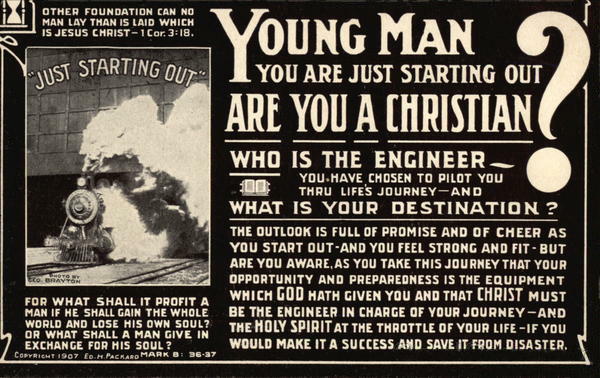
You can still find examples of religious calling cards on ebay, Etsy and other Internet sites. But Isabella’s books demonstrated that religious calling cards by themselves were not enough to change a person’s life. In her stories, a calling card may have opened the door to a conversation about salvation, but it was the act of the person who gave the card—their kindness and concern for someone else—that turned those small pieces of cardstock into the means by which a soul was saved.

ROX9F19

You can read more about the vagabond life John Morgan would have lead. Click here to read our previous post, The Fraternity of the Tramp.


Click on a book cover to read more about Isabella’s books mentioned in this post.

Cover_Workers Together v2   Cover_Spun from Fact   Cover_A New Graft on the Family Tree

Fred and Maria and Me

In her books Isabella Alden often mentioned the works of other authors she read and admired.

One such example was in Isabella’s book, Links in Rebecca’s Life. In that story, newly-married Rebecca Edwards was settling into her new life in the home of her very critical mother-in-law.

At breakfast one morning, Mrs. Edwards criticized Rebecca for drinTea_Party1king coffee that was too hot, in Mrs. Edwards’ opinion.

“I wonder at you, Rebecca, for drinking your coffee so hot; it is very bad for the teeth.”

Rebecca laughed in her old gleeful way, and replied:

“I am like ‘Fred and Maria and Me,’ I like my coffee ‘bilin’. Frank, did you ever read that delightful book?”

“Never heard of it. What an extraordinary title! Is it good?”

“It is capital,” Rebecca had said, ignoring, as Frank did, his mother’s question.

“Do you mean the book, or the title, my son?” Then she had turned to Rebecca. “Did you say that was the title? How very singular! One would suppose the editor would have corrected so remarkable a grammatical error as that!”

And Rebecca’s eyes danced as she answered, “It is by Mrs. Dr. Prentice, you remember. She is one of our most popular authors. I suspect she wanted the grammatical part of it to appear just as it did.”

Mrs. Prentiss did, indeed. Fred and Maria and Me was written by Elizabeth Prentiss in the perspective of an elderly woman from Goshen, Maine. The heroine, Aunt Avery, made generous use of the local Maine dialect.

Elizabeth Prentiss right
Elizabeth Prentiss

Throughout the story, Mrs. Prentiss’s characters used words like “t’wasn’t,” “your’n,” “p’inted” (instead of “pointed”), and other grammatically incorrect terms that would have made prim Mrs. Edwards swoon.

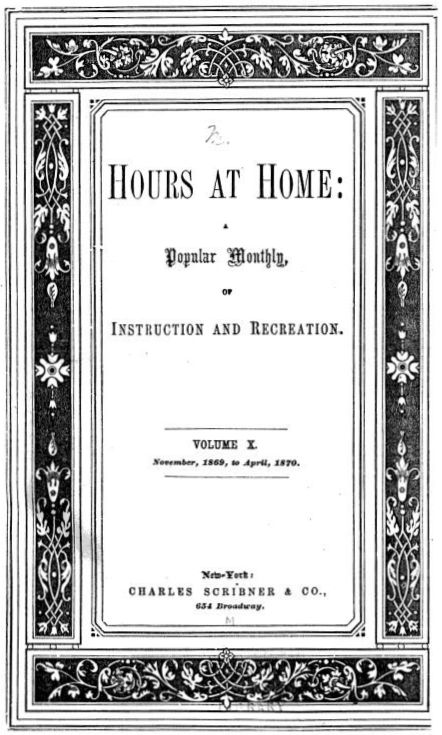
Originally, Fred and Maria and Me was published as a serial in Hours at Home: A Popular Monthly of Instruction and Recreation in 1865. When Elizabeth Prentiss first saw her story in the magazine, she wasn’t happy:

“I have jHours at Home magazineust got hold of the Hours at Home. I read my article and was disgusted with it. My pride fell below zero, and I wish it would stay there.”

But the reading public disagreed. Reviewers praised the story and declared Aunt Avery was “a very quaint and interesting type of New England religious character.”

Elizabeth Prentiss soon changed her mind about the story.

“Poor old Aunt Avery! She doesn’t know what to make of it that folks make so much of her and has to keep wiping her spectacles.”

The popularity of Fred and Maria and Me may have surprised Elizabeth Prentiss, but not the publishing industry. The story’s “quaintness, simplicity, and truthfulness” created such a demand that it was published as a book in 1867 to great acclaim. A second printing appeared in 1872, six years before Isabella wrote Links in Rebecca’s Life.

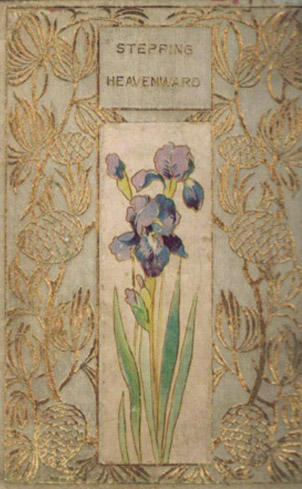
Stepping Heavenward cover 1907
1907 cover of Stepping Heavenward by Elizabeth Prentiss

Elizabeth Prentiss went on to write several books, including Stepping Heavenward, the classic story of a teenage girl’s Christian journey into womanhood. Stepping Heavenward is still widely read today. Click here to find out more about Stepping Heavenward.

She was also a talented poetess and penned lyrics for beloved hymns, including “More Love to Thee, O Christ.”

You can read Elizabeth Prentiss’s delightful book, Fred and Maria and Me and discover why Isabella Alden called it a “capital” story. Click on the book cover to begin reading now.

Cover_Fred and Maria and Me

Would you like to know more about Elizabeth Prentiss? Click here to read a very nice biography of her life and works.

Click on the link below to listen to her hymn, “More Love to Thee, O Christ”:

Follow this link to find out more about Links in Rebecca’s Life by Isabella Alden.