A Tour of Chautauqua: Strolling the Grounds

Chautauqua Bay 1908.
Chautauqua Bay 1908. You can see the tower of the Hotel Athenaeum peeking above the treetops.

The Chautauqua Institution was constantly evolving and improving. From its humble beginnings as a camp-meeting for the purpose of educating Methodist Sunday School teachers, it grew into an esteemed and respected institution of general education for anyone willing to take on the curriculum and abide by Chautauqua’s basic principles. Over the course of several decades, buildings were erected and dismantled; surrounding acres were acquired; and landscapes changed.
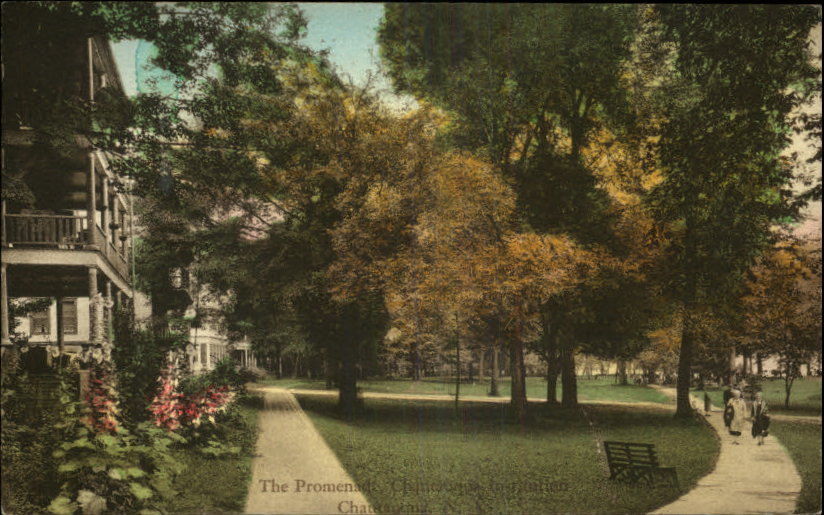
The Promenade, with Chautauqua cottages on the left and the lake visible through the trees on the right.

Isabella Alden wrote about Chautauqua’s transformations in Four Mother’s at Chautauqua. When Flossy, Eurie, Marian and Ruth stepped off the steamer onto Chautauqua’s dock in 1913, they gazed about in wide-eyed wonder.

“It isn’t the same place at all!” was Mrs. Roberts’s final exclamation. “Marian, don’t you remember the mud we waded through on that first night? We must have gone up that very hill, only, where is the road? Look at those paved streets! The idea! What is the name on that large building over there?”

“That’s the arcade,” volunteered a brisk young man who was looking out for possible boarders. “The jewelry store is there, and the art store; and all sorts of fancy-work classes meet there.”
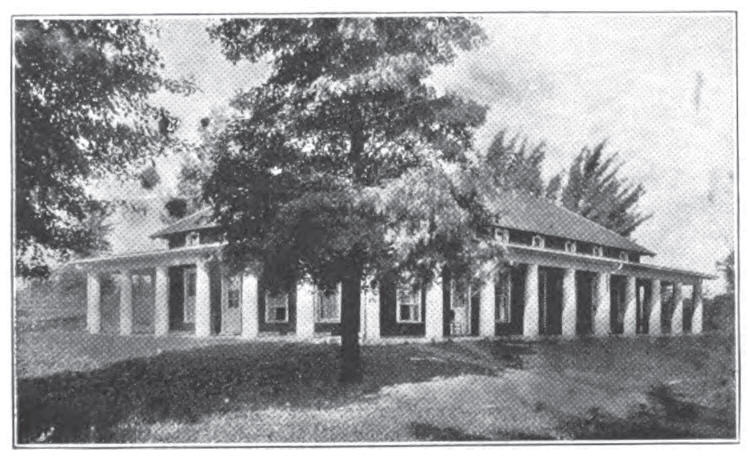
Sherwood Memorial Studios and Arcade
Arcade and Sherwood Hall circa 1920

“Fancy-work classes!” repeated the dazed little woman. “Who imagined such frivolities at Chautauqua!”

Mrs. Dennis laughed. “You will have to accustom yourself to more startling changes than those,” she said. “Aren’t we all going to a hotel for the night? Imagine a hotel of any sort at Chautauqua! I confess I had some fears lest it should not be large enough for our party, but those houses in the distance reassure me. Do you remember the dining-halls and the man who told us which ever one we went to we should wish that we had taken the other?”

“I wonder where they were located?” said Mrs. Burnham. “One was on a hill, I remember; the hill must be here still, but I don’t seem to recognize even hills.”
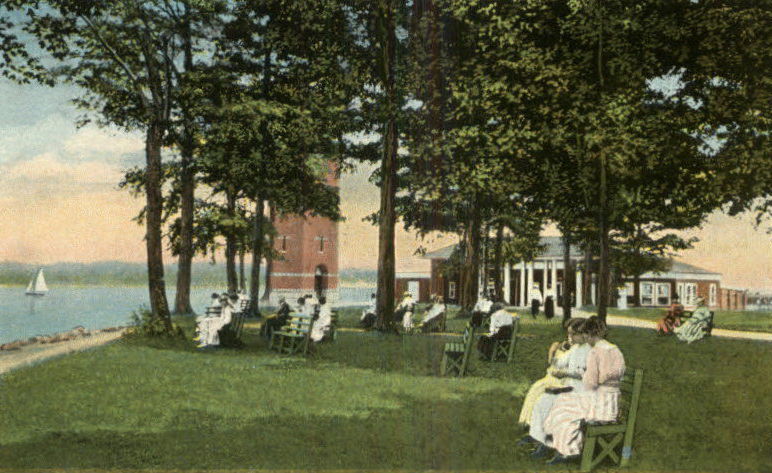
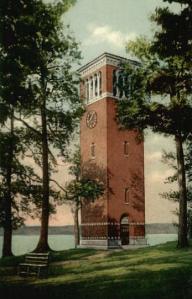
Miller Park, 1906. In the background are the Miller Bell Tower and the steamboat landing.
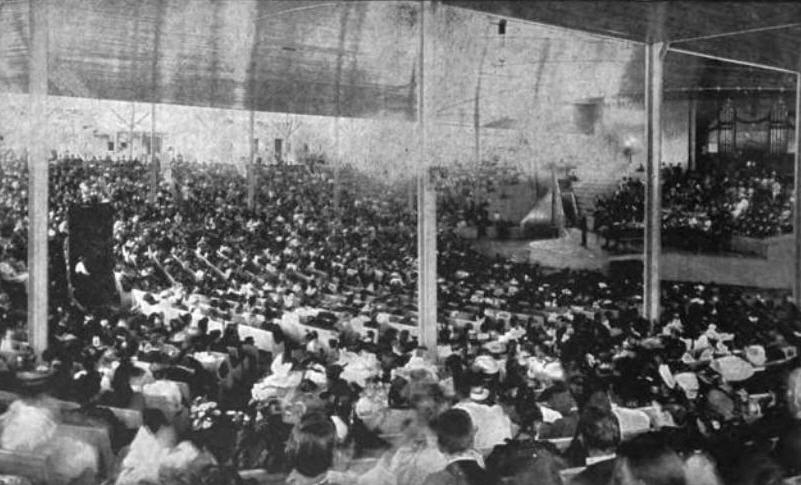
Standing room only at the old Amphitheater. July 1895

Many things had changed since the girls’ first visit. By 1921 there were six to eight hundred all-year residents on the Chautauqua grounds; the summer session lengthened from twelve days to fifty; and Chautauqua’s summer population swelled to the thousands. But whether resident, worker or visitor, everyone who entered Chautauqua’s grounds had one thing in common: they had a ticket.

Before the Assembly opened each summer, every family had to obtain tickets. The only exceptions to the rule were children under the age of 9 and bedridden invalids. Even those who leased property on the grounds had to have tickets to enter and exit the grounds. Ticket prices were nominal, as illustrated in this table of charges from 1908:

Ticket Prices in 1908

On Sundays the gates were closed. No one was allowed to enter or exit on Sunday with one notable exception: Sunday passes were issued to any members of churches not represented at Chautauqua who wished to attend services in nearby Jamestown. Otherwise, Sunday passes could only be obtained in emergencies.

Once you were inside the gates, you had free access to the grounds and most classes or lectures. A map like this one from 1874 helped visitors navigate the streets and get to lectures on time. Click on the image for a larger view.

Map of Chautauqua 1874
Map of Chautauqua, 1874

Isabella Alden incorporated many of the Chautauqua Institution buildings and locations in her novels. Her descriptions were so vivid, it isn’t hard to imagine how the buildings looked in their natural, woodland settings. Here are some of the buildings and settings Isabella wove into her stories; many of them are marked on the 1874 map.

Chautauqua Amphitheater empty undatedAmphitheater. Located at the intersection of Clark and Waugh avenues, this remodeled venue seated almost 6,000 people. The choir gallery had seats for 500. In 1907 the Massey Memorial Organ was installed. Under the choir-loft and on either side of the organ were the Department of Music classrooms and offices.
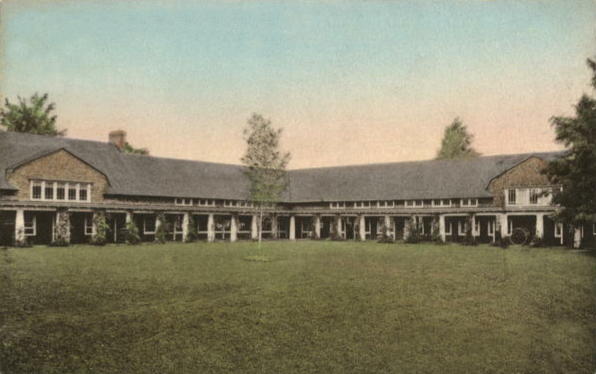
Arts and Crafts Building in 1936

Arts and Crafts Building. On Vincent Avenue, this 1903 complex housed the Arts and Crafts School as well as shops. Henry Turner Bailey, who directed the Arts and Crafts School, was famous for delivering entertaining lecturing at the same time he drew pictures on the blackboard with both hands at once.

Miller Bell Tower and Pier, 1915

Bell Tower. Located at the Point beside the pier, the Miller Bell Tower was dedicated in 1911. The bells rang five minutes before the lecture hours and at certain times throughout the day. After the final bell each night, silence was supposed to reign across the grounds. It was near the Miller Bell Tower that Ruth first encountered Hazel crying near the shore in Four Mothers at Chautauqua.

Chautauqua The Colonnade 1909
The Colonnade Building circa 1909

Colonnade. Facing Miller Park from the intersection of Pratt and Morris avenues, the Colonnade was the business center of Chautuaqua. It housed the post office, a barber shop, a hair salon, a tea room, and various stores, including grocery, dry-goods, shoe, hardware and drug stores. Visitors approaching the Colonnade building from the right passed through a vine-covered pergola.

Chautauqua Vine Clad Pergola
The Vine Clad Pergola with The Colonnade in the background, 1909
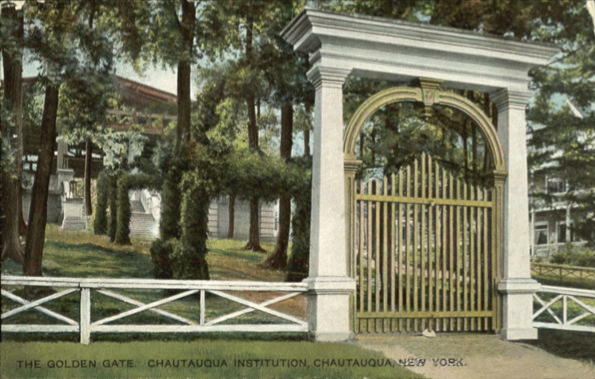
The Golden Gate. Behind the gate you can see the steps leading up to the Hall of Philosophy, which was also known as “The Hall in the Grove”.

Golden Gate. The Golden Gate at St. Paul’s Grove was used once a year as part of the C.L.S.C. Recognition procession. No one was allowed to pass through the Gate except those who had completed a C.L.S.C. course of study. We’ll share more about the Golden Gate in future posts about the C.L.S.C.

The Hall of Christ from a 1909 postcard.

Hall of Christ. This monumental stone and brick building sat at the corner of Wythe and South avenues. Created by Bishop Vincent, it was used as a chapel for meditation and prayer; and as a place of quiet, spiritual fellowship.

.

Chautauqua Hall of Philosophy 1908 edited
The Hall of Philosophy. The long flight of steps led down toward The Golden Gate.

The Hall of Philosophy. Known as “The Hall in the Grove” to Isabella Alden fans, this structure, modeled after a Greek temple, was located in St. Paul’s Grove. It was a regular meeting place of the C.L.S.C. conferences and gatherings.

When Caroline Raynor first arrived at Chautauqua in the book, The Hall in the Grove, young Robert Fenton took her to see his favorite building.

“Now which way do you want to go?”

“Whichever way you are pleased to take me. I have not seen anything save what I couldn’t help looking at when we arrived.”

“Then I’m just going to take you to the Hall. The rest rush to the Auditorium first and rave over that. It is splendid, I suppose; large, you know, and makes one think of crowds and grand things. But I can’t imagine people enough here to fill it—not to begin! With the Hall, now, it is different; just a nice audience would fill that, and it is so white, and so—Oh, well! I can’t explain, only it’s nice, and you will like it. Some people don’t care about it much; but I know you will.”

“Thank you,” said Caroline, and her heart was smiling as well as her eyes. She understood the boy; imagined something of what he would have said if he could have expressed his feelings, and she understood and appreciated the delicately-sincere compliment.

“This is a lovely avenue that leads to your favorite building,” she said, as she turned back to look at the straight wide road they had traversed, lying clear-cut amid the shadows of the overhanging trees.
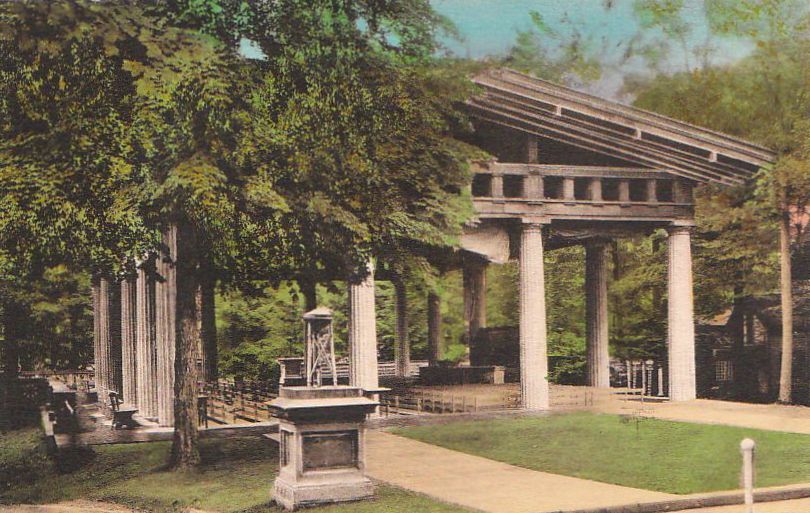
The Hall of Philosophy, viewed from the side.

“Isn’t it!” declared Robert, with ever-increasing enthusiasm. “This is another thing I like so much—this avenue. I’ll tell you, Caroline, when it must be just grand, and that is in full moonlight. Ha! There it is!”

It is impossible to describe to you the delight that was in the boy’s tones as the gleaming pillars of the Hall of Philosophy rose up before him; something in the purity and strength, and quaintness, seemed to have gotten possession of him. Whether it was a shadowy link between him and some ancient scholar or worshipper I cannot say, but certain it is that Robert Fenton, boy though he was, treading the Chautauquan avenues for the first time, felt his young heart thrill with a hope and a determination, neither of which he understood, every time he saw those gleaming pillars.

In the Hall’s concrete floor are inserted tablets in honor of the C.L.S.C. classes that contributed toward construction of the building. This diagram shows where each tablet was inlaid. You can see the tablet for Isabella Alden’s class of 1887 near the lower left corner. Click on the image to view a larger version.


.

.

.

Kellogg Memorial Hall, 1895.

Kellogg Hall, at Pratt-Ramble-Scott-Wythe avenues, was erected in 1889. The Kindergarten Department, Ceramics Department and the Woman’s Christian Temperance Union had headquarters here.

.

.
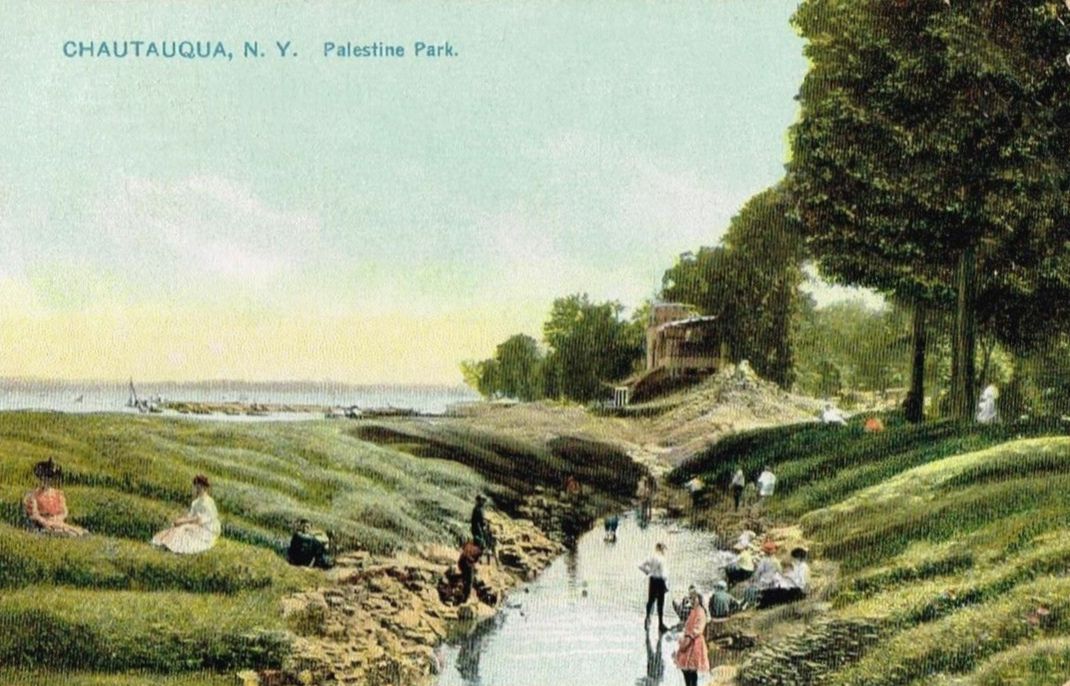
Palestine Park, 1908.

Palestine Park. Located on the shore of Lake Chautauqua near Miller Park, this model of old Palestine was constructed as a teaching tool to illustrate lessons from the Bible. Watch for more on Palestine Park in a future Tour of Chautauqua blog post.

.
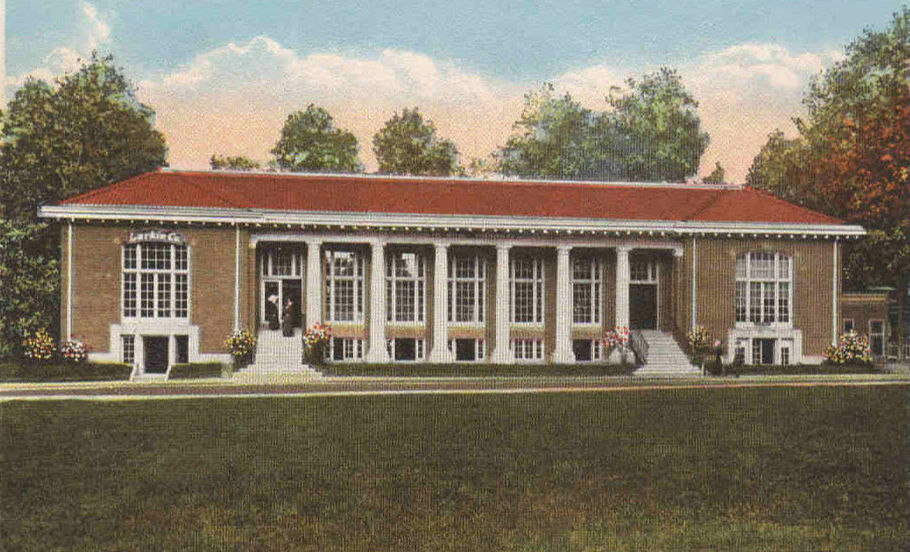
The Post Office as it looked in the 1920s.

Post Office. The Post Office was located on the same plaza as The Colonnade. It was in the post office that Burnham Roberts encountered the charming Hazel Harris in Four Mothers at Chautauqua.

.

The Post Office in 1913.

This photo from 1913 shows the busy Post Office. The number of people strolling through the plaza hints that it may have been a convenient thoroughfare for going from building to building on the grounds.

.

.

Chautauqua Post Office and Colonnade
The Plaza showing the Post Office on the right and the front of The Colonnade Building on the left. The ladies walking on the flower-bordered path will approach The Colonnade through the Vine-Clad Pergola.

There are many other places to explore at Chautauqua.

Next stop on our Tour of Chautauqua: Having fun.


A Tour of Chautauqua – Where to Stay

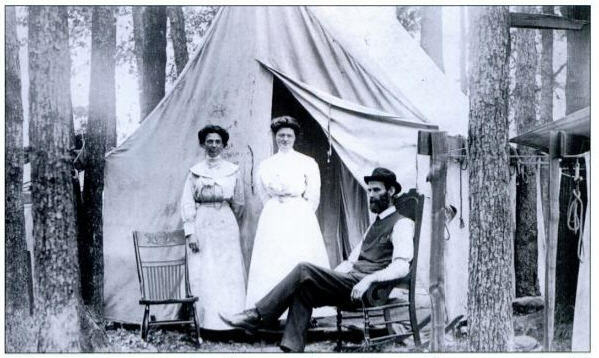
Chautauqua tent life in 1910

In the early days of Chautauqua, there were no hotels or boarding houses where visitors could stay. Instead, visitors rented tents or small cottages erected on the grounds. Some cottagers with room to spare rented out rooms to paying guests, but Chautauqua rules prohibited anyone from providing meals for pay.

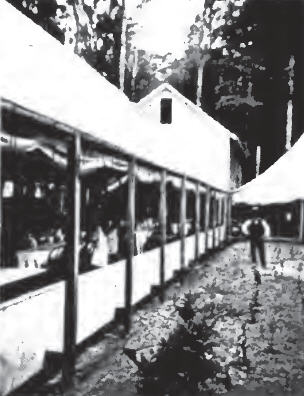
If you were not lucky enough to have a kitchen of your own in which to prepare your meals, you had to eat in the dining-hall, which was a long, open-air building furnished with rough, unpainted tables and benches.

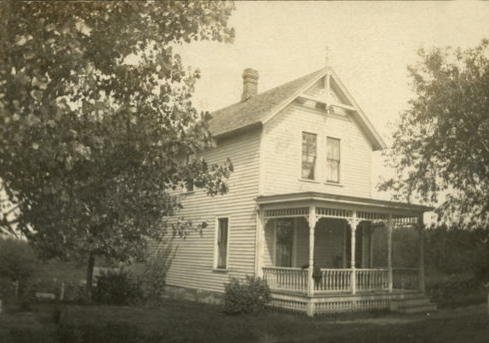
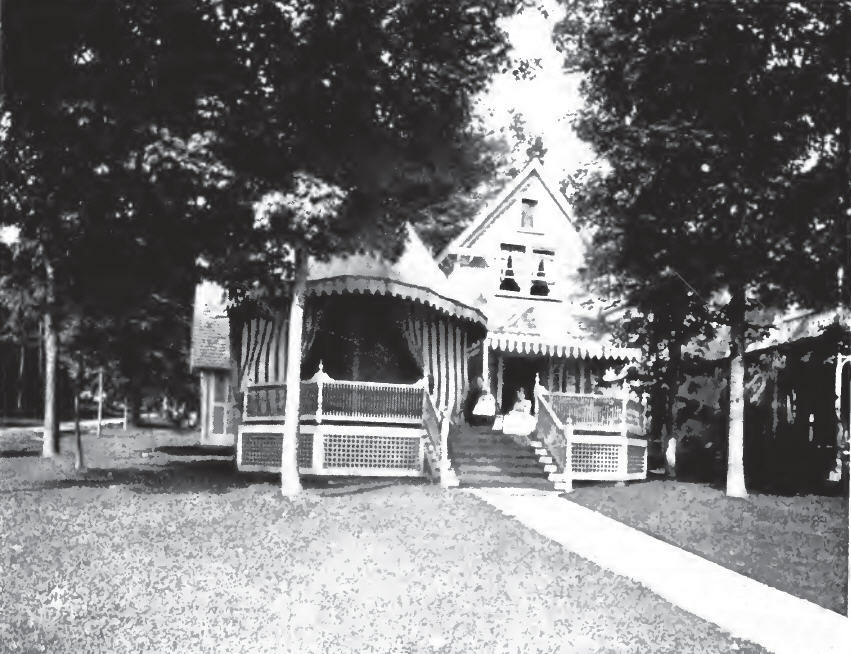
A Chautauqua cottage in 1908

Visitors often complained that the roof leaked and the backless benches were uncomfortable, but the dining hall was the only place visitors could have meals unless they prepared food themselves.

In Four Girls at Chautauqua, Isabella Alden used the no-board-for-profit rule to show the difference in personalities between practical Marion and wealthy Ruth as they ate in the dining hall:

Chautauqua Old Dining Hall
The old dining hall.

It was a merry dinner, after all, eaten with steel forks and without napkins, and with plated spoons—if you were so fortunate as to secure one. The rush of people was very great, and, with their inconvenient accommodations, the process of serving was slow.

Marion, her eyes being opened, went to studying the people about her. She found that courteous good-humor was the rule, and selfishness and ungraciousness the exception. Inconveniences were put up with and merrily laughed over by people who, from their dress and manners, could be accustomed to only the best.

Ruth did not recover her equanimity. She was rasped on every side. Those two-tined steel forks were a positive sting to her. She shuddered as the steel touched her lips. She had no spoon at all, and she looked on in utter disgust while Eurie merrily stirred her tea with her fork. When the waiter came at last, with hearty apologies for keeping them waiting for their spoons, and the old gentleman said cordially, “All in good time. We shall not starve even if we get no spoons,” she curled her lip disdainfully, and murmured that she had always been accustomed to the conveniences of life, and found it somewhat difficult to do without them.

In 1876, the meal restriction was removed and anyone could provide rooms and meals for a fee, as long as a specified percentage of the amount charged was given to the Institution. Within a year, boarding houses had sprung up as if by magic, while a vast number of individual cottages sported signs offering “Rooms and Board.”

Chautauqua cottages along Miller Park in early 1920s. To the right, just out of view, is Chautauqua Lake.

In Four Mothers at Chautauqua, Mrs. Bradford and her daughters rented a cottage for the summer, despite the fact they could ill afford it. Mrs. Bradford was always on the look-out for ways to economize and found one way to make her pennies go further at Chautauqua:

.

Before Mrs. Bradford’s table economies reached what Josephine called the “starvation point” a method of relief was discovered. It was learned that among the numerous boarding houses scattered over the grounds, certain of them furnished fairly good meals for twenty-five cents. They were named lunches, to be sure, but on occasion they would serve excellently well for dinners. Pencil and paper together with a vigorous exercise of Josephine’s computation powers proved that seventy-five cents would afford three of them better dinners than that sum would produce in the kitchenette.

The Longfellow in 1907

The Longfellow Cottage was a large boarding house. Centrally located on Roberts Avenue, it was only one block away from The Amphitheatre, the C.L.S.C. Building, the Children’s Temple,the Administration Building, The Colonnade and the Post Office (which will be featured in the next leg of our tour).

The Palace Hotel was the first hotel on the Chautauqua grounds, but it was far from luxurious. It was little more than a three-story, wood-framed tent, with canvas partitions to divide the guest “rooms.”

The Palace Hotel

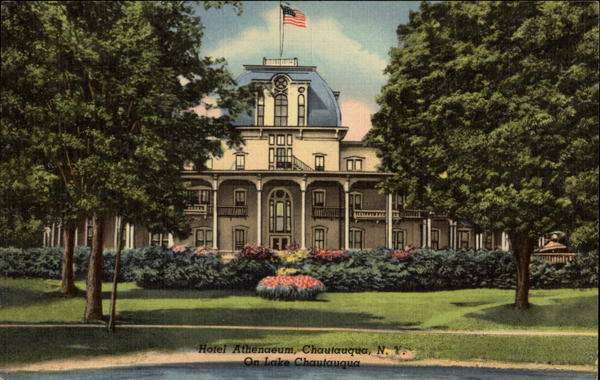
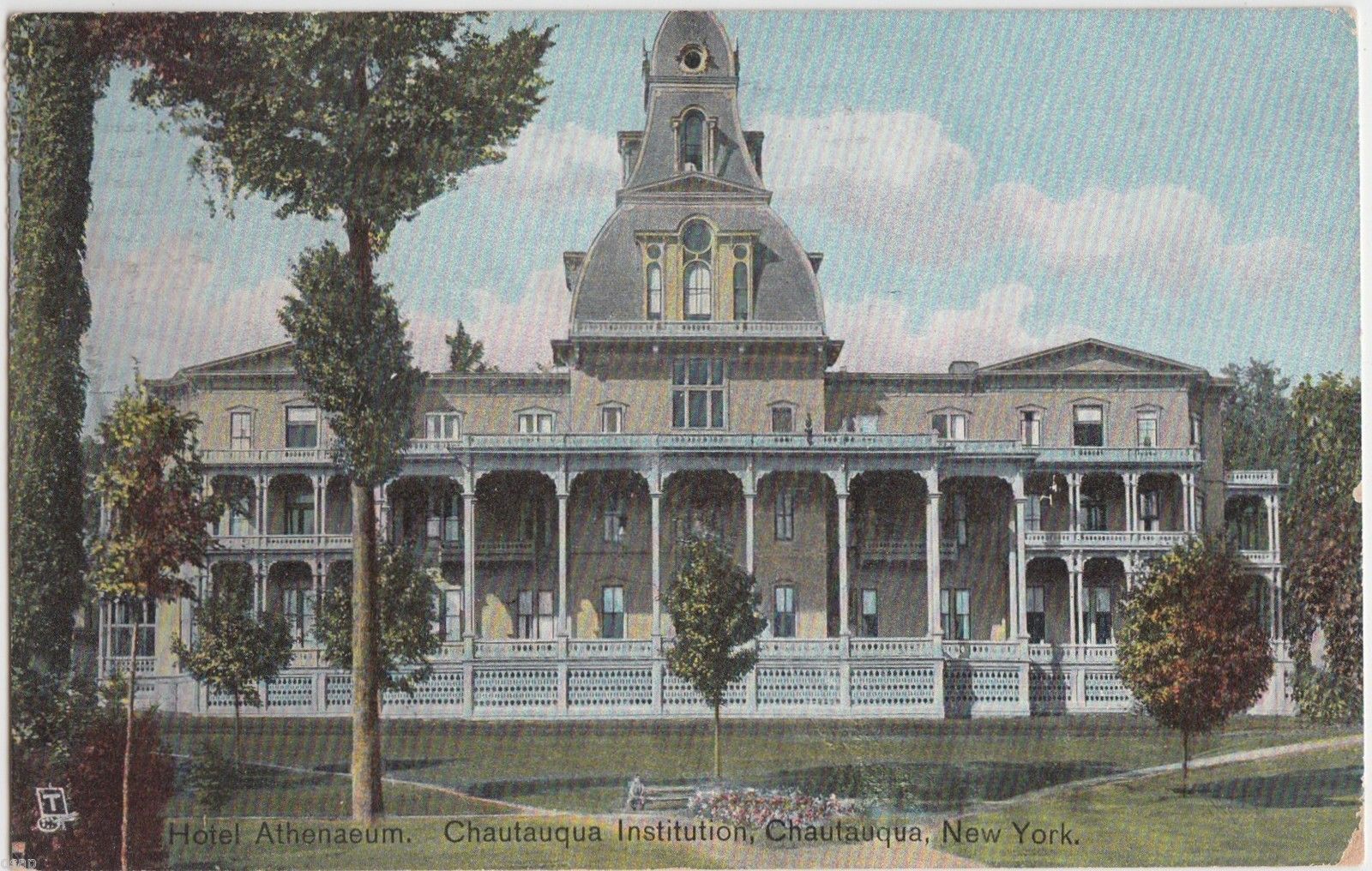
In 1881 the Palace Hotel was replaced by The Athenaeum, a proper hotel that featured elegant accommodations and beautiful views of the lake.

Chautauqua Athenaeum Hotel edited
An undated postcard from The Hotel Athenaeum

As the Athenaeum attracted more guests, the cottages and boarding houses grew in number, size and comfort in order to compete for their share of paying boarders.

The Hotel Athenaeum as it looked in 1908. The hotel is still in use today.
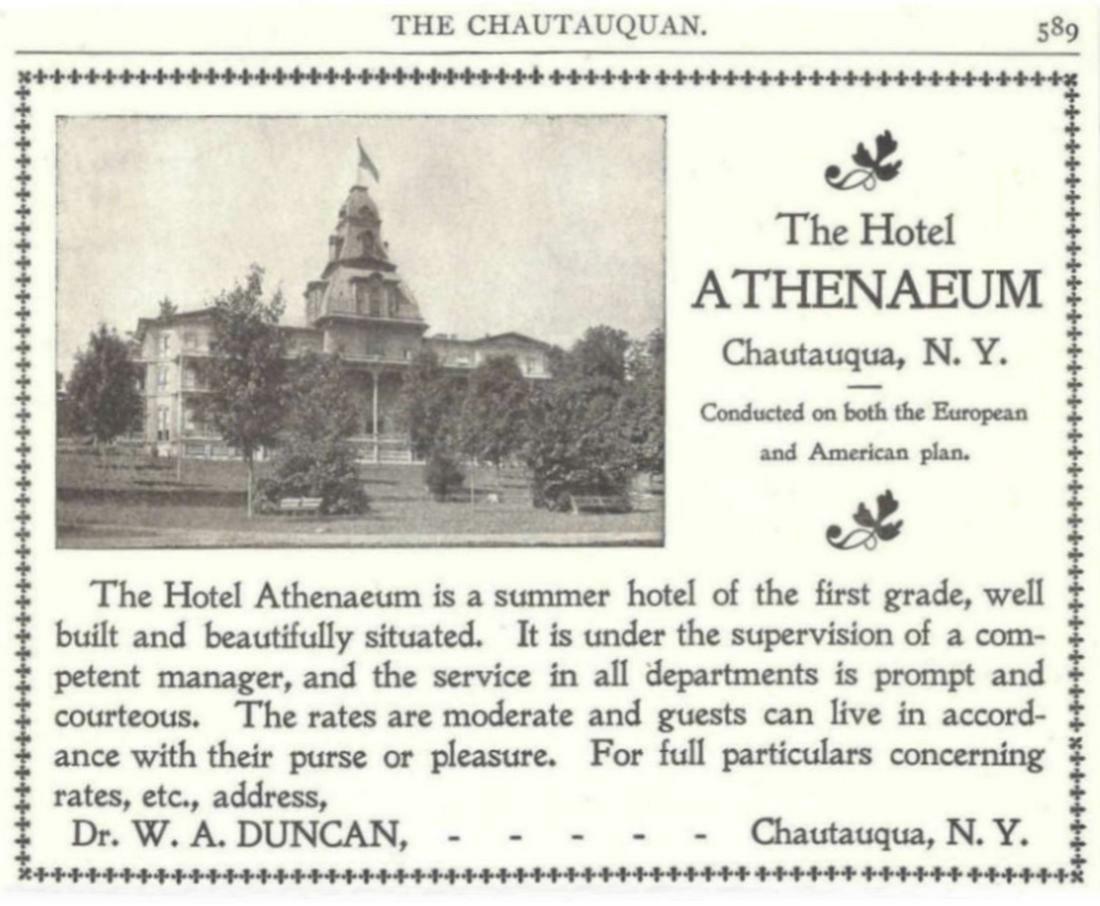
An 1897 magazine advertisement for The Hotel Athenaeum

When the Four Mothers returned to Chautauqua with their children and grandchildren, they stayed at a hotel that sounded very much like The Athenaeum. Isabella Alden set many scenes on the hotel’s upper and lower verandas and her characters made great use of the lush lawns that led from the hotel down to the lake.

.

This image of The Hotel Athenaeum and its verandas is dated 1911, just two years before Four Mothers at Chautauqua was published.

Chautauqua Athenaeum Hotel 1911

Visitors to Chautauqua used a Handbook of Information to locate places to stay. These sample pages from the 1908 Handbook list hotels and boarding houses on the grounds, their addresses, and the owners of the establishments. The Longfellow boarding house (pictured earlier in this post) is listed on the top of the second page.

1908 handbook appendix d highlighted

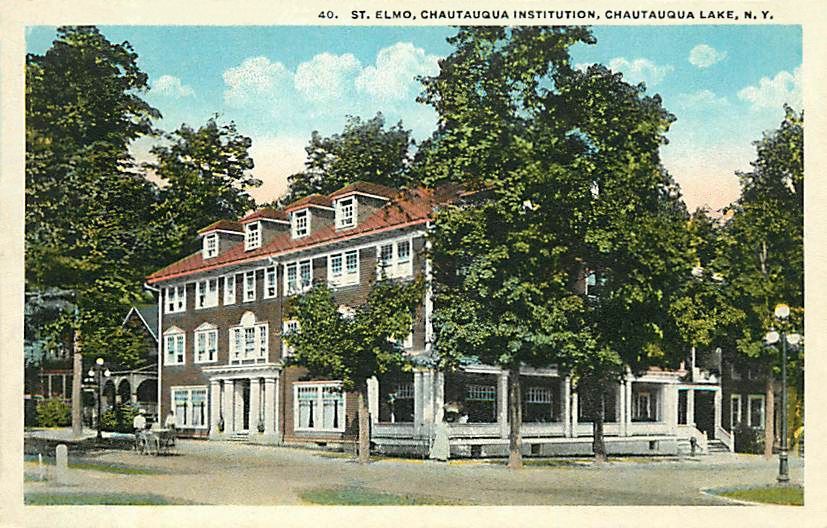
The St. Elmo was another hotel on the Chautauqua Institution grounds that was listed in the 1908 Handbook. Here’s how The St. Elmo looked in 1920, as it stood at the corner of Ames and Pratt Avenues.

Chautauqua Hotel St Elmo edited
St. Elmo Hotel in the 1920s

With all the boarding and hotel options, tent living still thrived. Chautauqua’s founders, John Heyl Vincent and Lewis Miller, maintained residences that were hybrids of cottage and tent.

Bishop Vincent’s Tent Cottage


Lewis Miller’s cottage. He accommodated overnight guests in a tent he erected on the lawn.

As Chautauqua grew and offered more and more styles of accommodations, many visitors still chose a simple summer of tent life in God’s great outdoors.

Chautauqua Institution by William Flanders edited

Next  on our Tour of Chautauqua:  Touring the Grounds


The Evils of Baking Powder

Learning to live with her mother-in-law was an understandable challenge for Rebecca Edwards, but never more so than when Mrs. Edwards’ constant criticisms and complaints drove her cook to quit on the very day guests were expected for dinner.

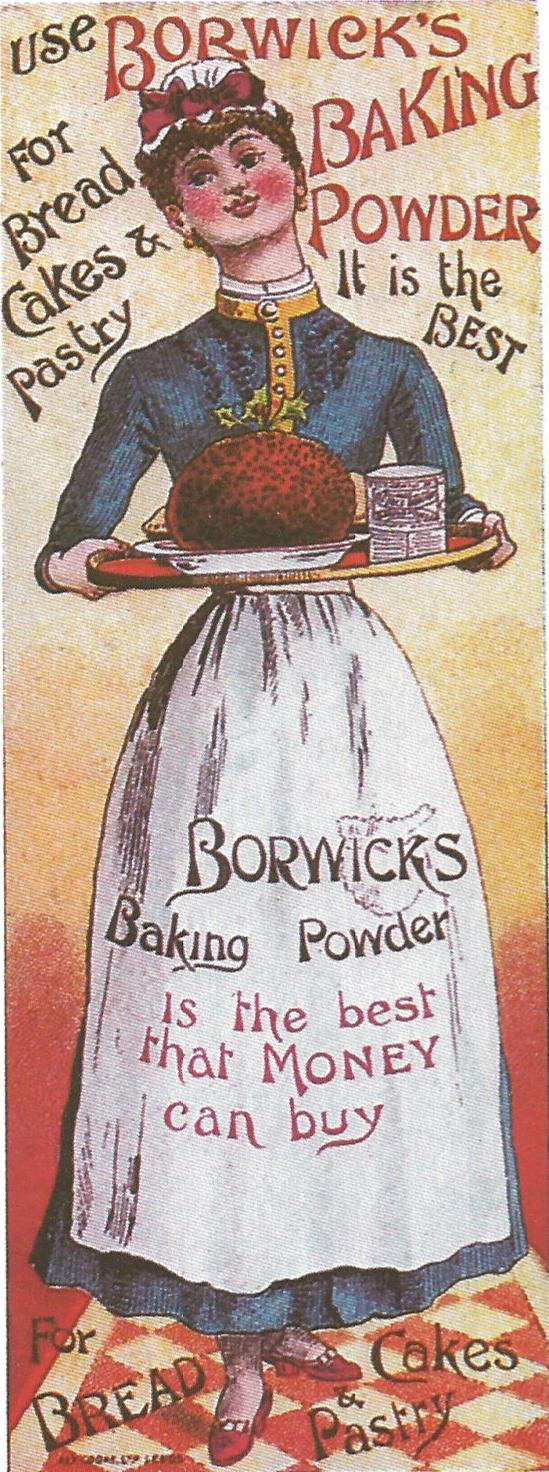
Links in Rebeccas Life-Baking Powder ad 1912
A 1912 advertisement

Sensing the woman’s dilemma, Rebecca confidently said:

“I can get dinner—as good a one as Mr. Romaine gets at a New York boarding-house, I dare say. Just install me in the kitchen for the day, and see what I can do.”

Mrs. Edwards had no choice but to accept Rebecca’s offer . . . even if her acceptance was somewhat ungracious.

Here’s how Rebecca described her day in her mother-in-law’s kitchen:

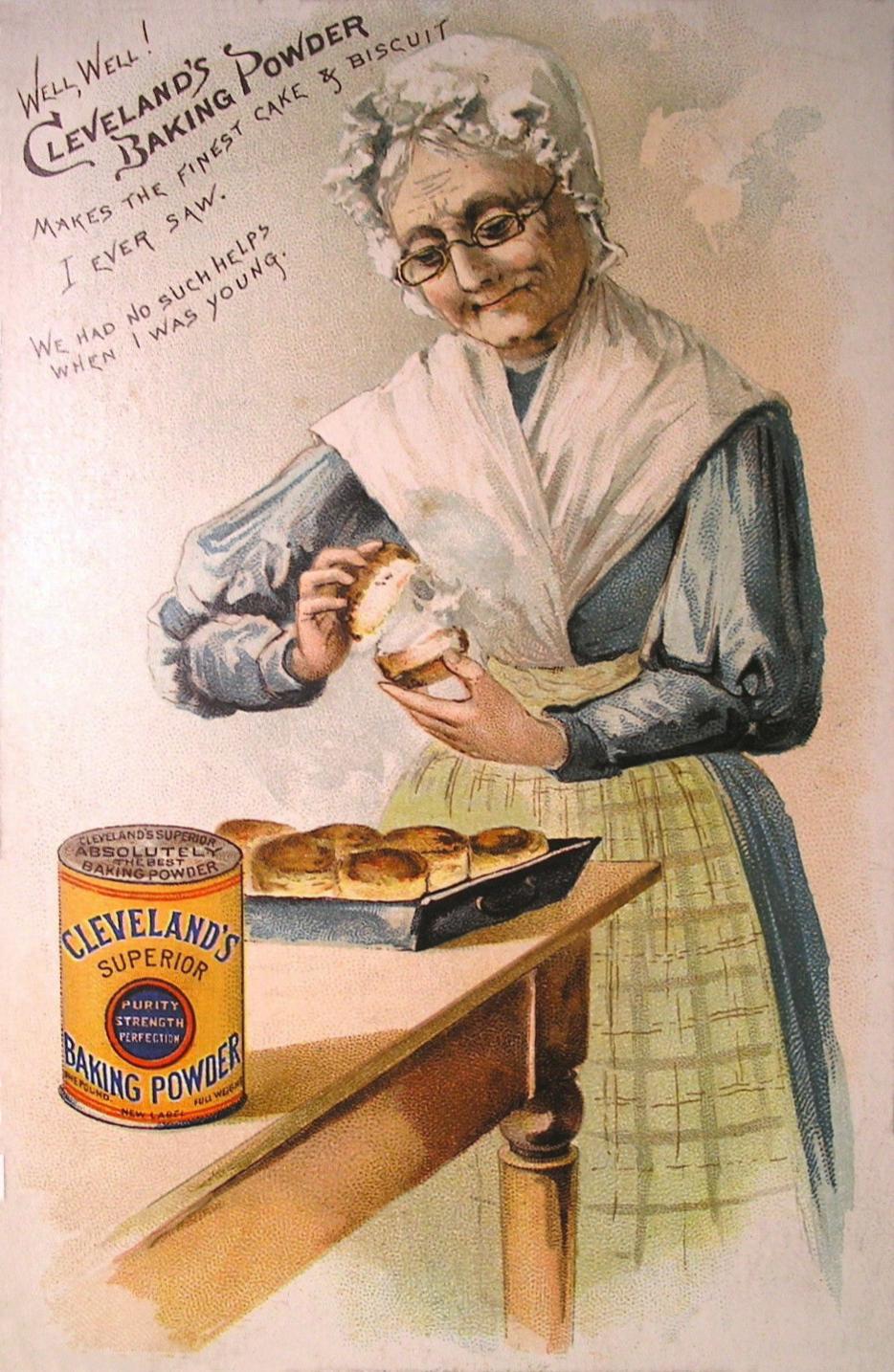
Links in Rebeccas Life-Baking powder card 1895
1895 Trade Card

 Mrs. Edwards was there, looking distressed and perplexed over every single thing that I touched. It was in vain that I assured her that I was perfectly well acquainted with legs of lamb, and that I had cooked as many fishes as there were in the sea, and that the summer Mrs. Demarest, of Boston, boarded with us, she asked me for the recipe for our fish sauce, because it was the best she ever tasted.

 With the question of dessert came up new trouble. It so happens that, not having had much time for studying the accomplishments common to girls, I gave much time and fuss to the getting up of especially dainty desserts. During the season we kept those dreadful Boston boarders I really became an adept at that sort of work.

1895 British advertisement

 But Mrs. Edwards didn’t believe it. She hovered over those eggs and that butter and sugar, and was sure I had too little butter and too much powder, and not the right kind of flavoring. I became almost distracted. Several times my tongue fairly ached to drop egg-beater and spoon, and say: “Well, now, Mrs. Edwards, if you understand this business better than I do, please attend to it, and I will go and take my ride.” I am so glad I didn’t do it.

 We nearly quarreled over the merits of soda and cream of tartar versus baking powder. Mrs. Edwards is certain that powder is an out-growth of this degenerate age; says the cake is neither so nice-looking nor so delicate that is made of it; that she always tastes the powder, and that she would never use it, if she went without cake. I was really obliged to be firm in that, for I understand the art of making cake with powder, and I don’t know how to make it with those other vile articles that must be balanced just so or they make a fuss.

Links in Rebeccas Life Kitchen baking powder front 1890
An 1890 trade card.

Still, I might have got along without saying: “So far as that is concerned, I can tell at the first mouthful whether there is cream of tartar in cake. I always taste it.”

Whenever I say anything of that sort, Mrs. Edwards is sure to remind me of my youth.

 “Young people are, and always have been, remarkable for their discernment,” she said, very dryly. “Their mothers managed to make very palatable cake with the despised stuff before they were born, and long afterward. But as soon as the daughters get so they can stir up a gingerbread they, of course, know more than their elders ever did.”

Links in Rebeccas Life-Baking flour trade card 1890
Perhaps another symptom of a degenerate age. An 1890 trade card for self-rising flour.

Now, what had that to do with the subject under discussion? I am sure I can’t see.

The simple truth is that Mrs. Edwards can’t even stir up a gingerbread. She knows nothing about cake-making; she has never been obliged to know. And I confess myself unable to see why, because a person has lived sixty years, she should be deferred to by one who has only lived twenty years, on a subject of which she knows nothing, while the other has given six or eight of her twenty years to the learning of that subject.

I wanted to tell my respected mother-in-law that such was my opinion, but I forbore, and meekly asked her if Jane, the second girl, could be trusted to set the table, or whether she would rather have me do it.

Rebecca’s dinner was a success. The guests ate serenely, and Mrs. Edwards, after the first taste, lost her anxious expression and regained her quiet composure that was so much admired in the fashionable world. In the end, Mrs. Edwards discovered that Rebecca really could cook a delicious dinner and Rebecca discovered that she could keep her temper in the face of her mother-in-law’s taunts and complaints.Cover_Links in Rebecca's Life 2 resized

You can read more about Rebecca Edwards’ life with her mother-in-law in Links in Rebecca’s Life.

A Tour of Chautauqua – Getting There

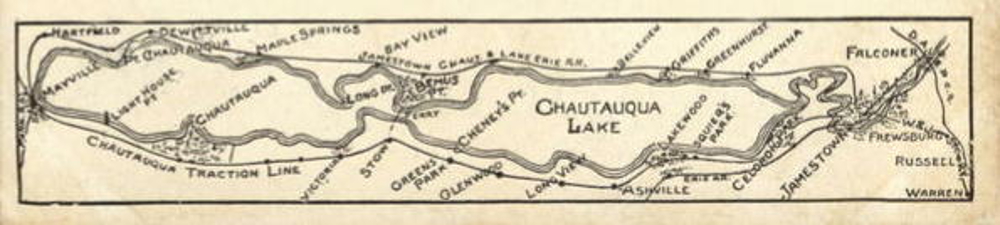
When Eurie, Marion, Ruth and Flossy embarked on their journey to Chautauqua in August, 1875 they traveled by railroad to Mayville. From there they took a steamer to Chautauqua. The map below shows the towns that lined Chautauqua Lake in 1906 (several years after the girls first journeyed there). You can see Mayville on the far left side of the map (click on the map to see a larger version).

Chautauqua Lake Map 1906 edited large

In Mayville, the girls boarded a steamer named, The Colonel Phillips, and boated along the southern shore of the lake to Chautauqua. As luck would have it, they arrived at Chautauqua under less than perfect conditions: it was raining and well past dark when they reached their destination.

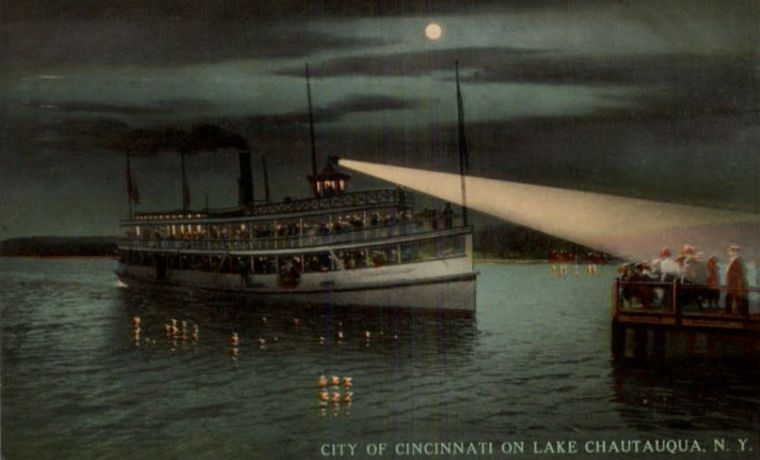
From the deck of The Colonel Philips, their first glimpse of the institute was probably the Chautauqua Institution dock, which stood at the tip of a point that jutted out into the lake. Incoming steamboats used the dock to  let passengers on and off. The vintage postcard below shows the steamer, City of Cincinnati, docking at Chautauqua after dark, in much the same way as The Colonel Phillips would have docked (click on any of the images below to see a larger version).

Chautauqua Lake Dock at night edited

In 191Chautauqua Miller Bell Tower v2 edited1 the Miller Bell Tower was erected alongside the dock. It was built to commemorate the life and contributions of Chautauqua co-founder Lewis Miller. When the girls returned in 1913 (as described in Isabella Alden’s book, Four Mothers at Chautauqua), they would have seen the beautiful new bell tower as they approached the dock; and they would pass it as they stepped off the boat and entered the Institute grounds.

The hand-colored postcard below shows the tower and dock looking northeast toward the direction from which the girls’ steamer would have arrived from Mayville. The postcard also shows South Lake Drive, which ran along the shore from the bell tower to the south end of the Institute grounds. From the vantage point presented in this picture, the Chautauqua Auditorium was just out of view to the left.
Chautauqua Lake 1943 edited

During the girls’ first visit to Chautauqua, The Auditorium was an open-air arena with “rows and rows and rows of heads, men and women, and even children. A tent larger than they had imagined could be built and packed with people.”  Here’s how Isabella Alden described it in Four Girls at Chautauqua:

Lake Chautauqua outdoor auditorium. Photo courtesy of http://chautauqua.palmerdividehistory.org

For the benefit of such poor benighted beings as have never seen Chautauqua, let me explain that the auditorium was the great temple where the congregation assembled for united service. Such a grand temple as it was! The pillars thereof were great solemn trees, with their green leaves arching overhead in festoons of beauty. I don’t know how many seats there were, nor how many could be accommodated at the auditorium. Eurie set out to walk up and down the long aisles one day and count the seats, but she found that which so arrested her attention before she was half-way down the central aisle that she forgot all about it, and there was never any time afterward for that work. I mean to tell you about that day when I get to it. The grandstand was down here in front of all these seats, spacious and convenient, the pillars thereof festooned with flags from many nations. The large piano occupied a central point; the speaker’s desk at its feet, in the central of the stand; the reporters’ tables and chairs just below.

The Auditorium was used for the first four years, then the Amphitheatre—a more permanent, open-air structure—was erected that could hold many more people. The Amphitheatre’s crowning glory was its magnificent pipe organ. The seats behind the Amphitheatre stage were typically occupied by speakers, performers, choirs and orchestras.

Chautauqua Amphitheater edited

The photo below from about 1895 shows The Amphitheatre in service, with every possible seat taken. The view looks across The Amphitheatre, with the stage and speakers on the right. You can just make out the shape of the huge organ pipes.

Chautauqua Amphitheater full house 1895

After the girls attended their first lecture in the Chautauqua Auditorium, they decided to stay on the grounds, rather than at a nearby hotel. They appealed to the Institute President to help them find a suitable place to stay. As he showed them the available tents to rent, Ruth couldn’t hide her dismay.

Chautauqua camping 1908_Ladies
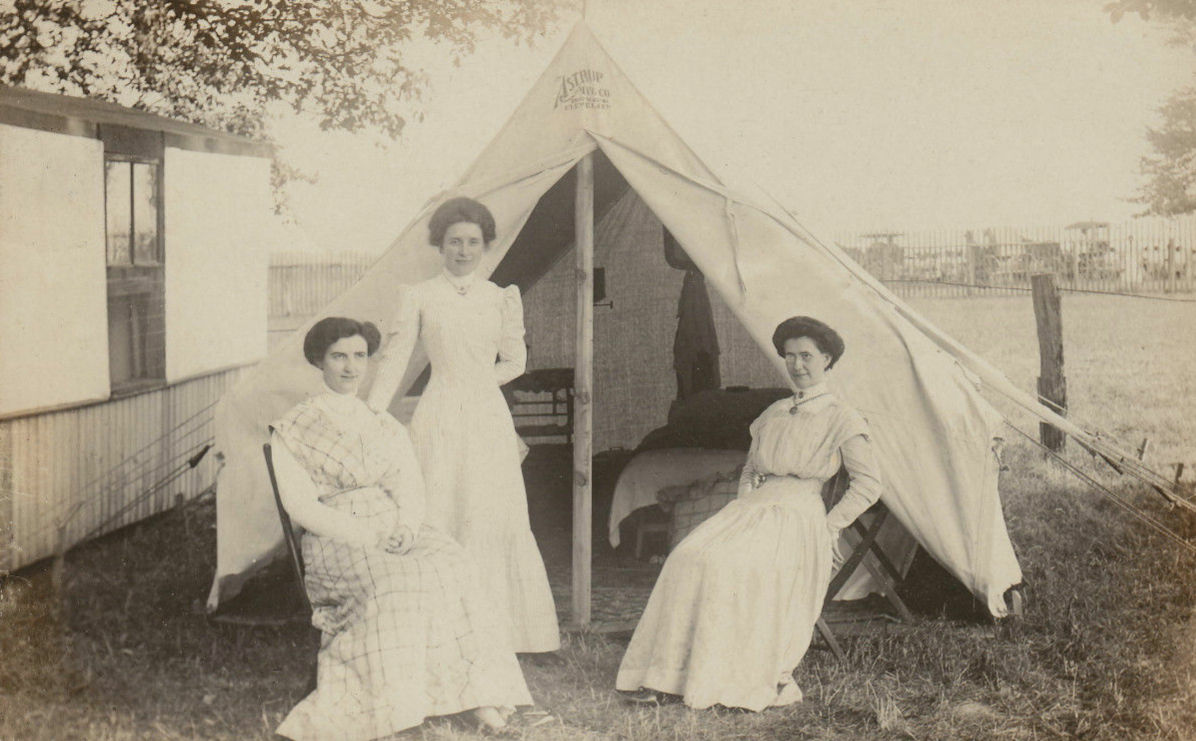
Ladies camping in a typical Chautauqua tent in 1908.

“Why, the bed isn’t made up! Pray, are we to sleep on the slats?”

“Oh, no. But you have to hire all those things, you know. Have you seen our bulletin? There are parties on the ground prepared to fit up everything that you need, and to do it very reasonably. Of course, we cannot know what degree of expense those requiring tents care to incur, so we leave that matter for them to decide for themselves. You can have as many or as few comforts as you choose, and pay accordingly.”

“And are all four of us expected to occupy this one room?” There was an expression of decided disgust on Miss Erskine’s face.

Tent Life 1875 Hurlburt Beard and Worden
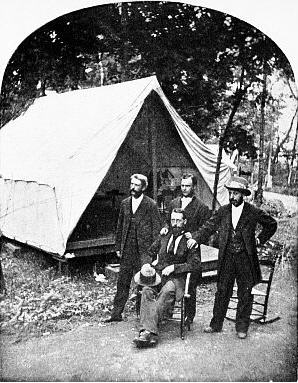
Chautauqua Speakers in front of their tent in 1875. J. L. Hurlbut, J. A. Worden, Frank Beard (famous for his “chalk talk”), and J. L. Hughes.

“Why, you see,” explained the amused President, “this tent is designed for four; two good-sized bedsteads set up in it; and the necessity seems to be upon us to crowd as much as we can conveniently. There will be no danger of impure air, you know, for you have all out-doors to breathe.”

“And you really don’t have toilette stands or toilette accommodations! What a way to live!”

Another voice chimed in now, which was the very embodiment of refined horror. “And you don’t have pianos nor sofas, and the room isn’t lighted with gas! I’m sure I don’t see how we can live! It is not what we have been accustomed to.” This was Marion, with the most dancing eyes in the world, and the President completed the scene by laughing outright. Suddenly Ruth discovered that she was acting the part of a simpleton, and with flushed face she turned from them, and walked to a vacant seat, in the opposite direction from where they were standing.

Chautauqua Tents and Cottages, 1910

“We will take this one,” she said, haughtily, without vouchsafing it a look. “I presume it is as good as any of them, and, since we are fairly into this absurd scrape we must make the best of it.”

“Or the worst of it,” Marion said, still laughing. “You are bent on doing that, I think, Ruthie.”

By a violent effort and rare good sense Ruth controlled herself sufficiently to laugh, and the embarrassment vanished. There were splendid points about this girl’s character, not the least among them being the ability to laugh at a joke that had been turned toward herself.

The girls survived their first night in the tent. The next day, they split up, each going in different directions; and Flossy soon found herself lost and alone on the grounds.

Meantime Flossy was being educated. The morning work had touched her from a different standpoint. She had not heard Dr. Walden; instead she had wandered into a bit of holy ground. She began by losing her way. It is one of the easiest things to do at Chautauqua. The avenues cross and recross in an altogether bewildering manner to one not accustomed to newly laid-out cities; and just when one imagines himself at the goal for which he started, lo! There is woods, and nothing else anywhere. Another attempt patiently followed for an hour has the exasperating effect of bringing him to the very point from which he started. Such an experience had Flossy, when by reason of her loitering propensities she became detached from her party, and tried to find her own way to the stand. A whole hour of wandering, then a turn into perfect chaos. She had no more idea where she was than if she had been in the by-ways of London. Clearly she must inquire the way.

While trying to find her way, Flossy may have walked down Clark Street, which is pictured below in 1907, looking south from Miller Avenue (named after Lewis Miller). The Chautauqua Literary and Scientific Circle (C.L.S.C.) building is on the left.

Chautauqua Clark Street 1907 edited

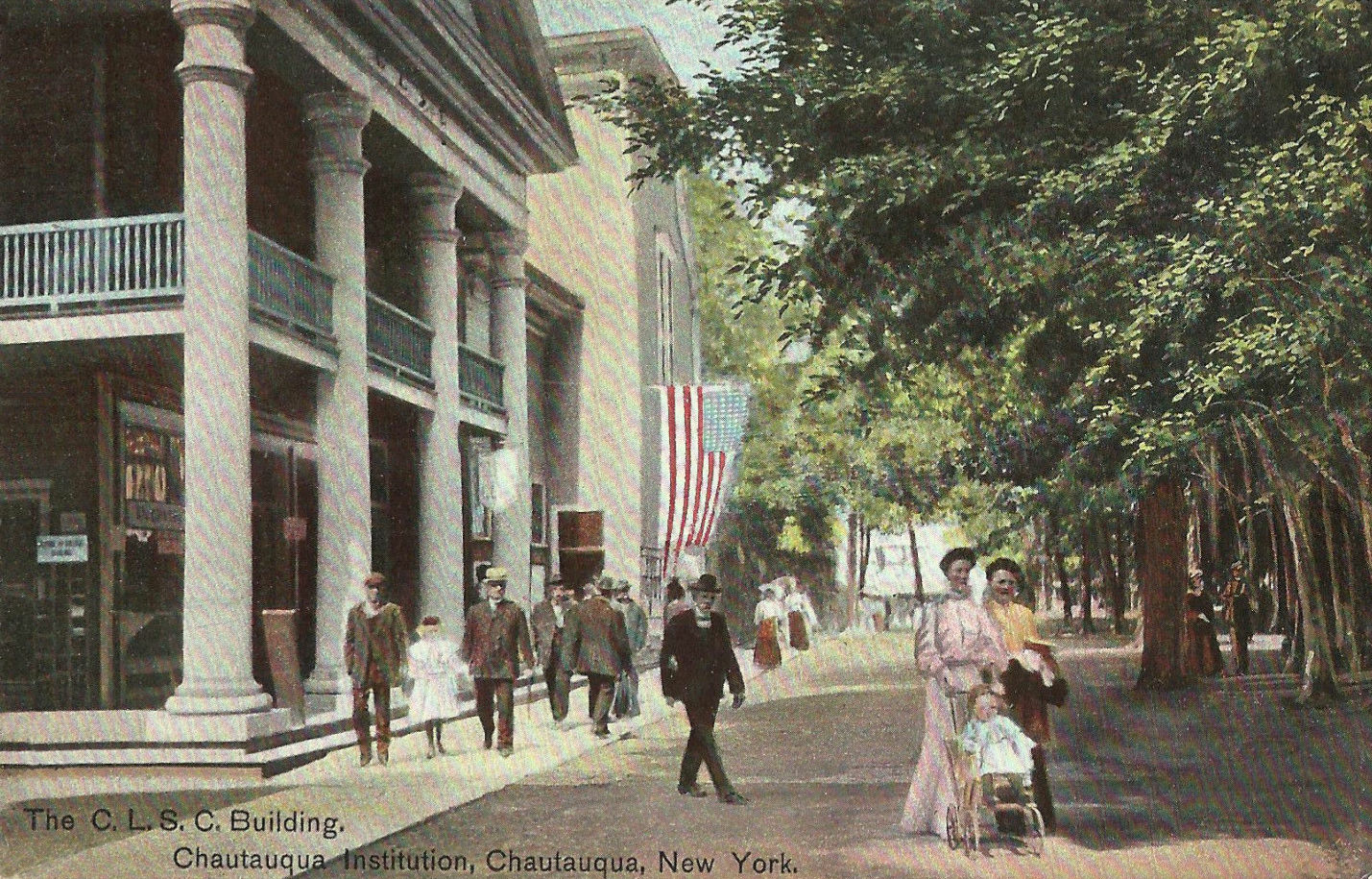
Here’s a closer view of the C.L.S.C. building, as it looked in 1908:

Chautauqua CLSC Building 1908 edited

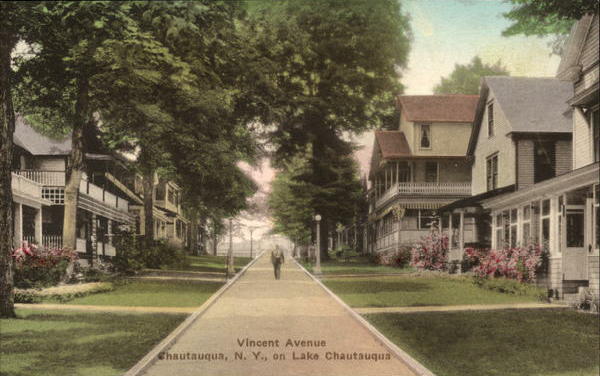
And below is a photo of Vincent Avenue, named for Methodist Bishop John Heyl Vincent, one of the founders of the Chautauqua Institute. The photo was taken in 1930, long after the girls’ first visit.

Chautauqua Vincent Avenue 1930

Little did Flossy, Ruth, Eurie and Marion know that those first days in Chautauqua were the prelude to life changing experiences for each of them!

Next  on our Tour of Chautauqua:  Where to Stay


Links in Rebecca’s Life

Links in Rebecca’s Life is now available on Amazon!

Rebecca Harlow is an eager and tireless worker for the church. She never misses a prayer meeting, she dutifully prepares for each Sunday school lesson, and she schedules social calls with friends to encourage them to attend church.

But not all lessons are learned on Sunday; and not all Christian witness is delivered by appointment. When her careless words spread like wildfire through town, Rebecca must learn that it’s her everyday actions that have the power to influence others for Christ.

Click on the cover to read sample chapters on Amazon and learn more about Links in Rebecca’s Life.

“She’s a Beauty”

In Miss Dee Dunmore Bryant, Ben Bryant’s life was changed when he met Miss Webster and she, in turn, introduced him to her neighbor, Mr. Reynolds. It was due to Mr. Reynolds that Ben got his first glimpse at what he called a “writing machine.”

Remington No. 5 Model 1886.

What Ben actually saw was a typewriter, probably a machine like the Remington 1886 model here (click on the images to see a larger version). Like most machines of the time, the keys struck upward against the paper. The machine also had four rows of keys: two rows of upper case letters and two rows of lower case letters.
Mr. Reynolds happily showed him how it worked.
 “She’s a beauty,” Mr. Reynolds said, seating himself before her, “a regular beauty. I’ve never worked one who behaved quite so well; some of them get rather confused in their minds after being knocked about on the railroad for a few weeks, especially if they are not carefully packed; but this one is as clear-headed as she was the day we left home. Did you ever see one work, young man? Then we’ll start her off.”

Bar-Lock No. 4

 Mr. Reynolds spoke of the little creature as though she were alive, and really it almost seemed to Ben that she was. He bent over her with parted lips and quick breathing, amazed beyond measure, when after the lapse of a few seconds the performer lifted the roller, and revealed in neat print the words:

 “John quickly extemporized five tow bags.”

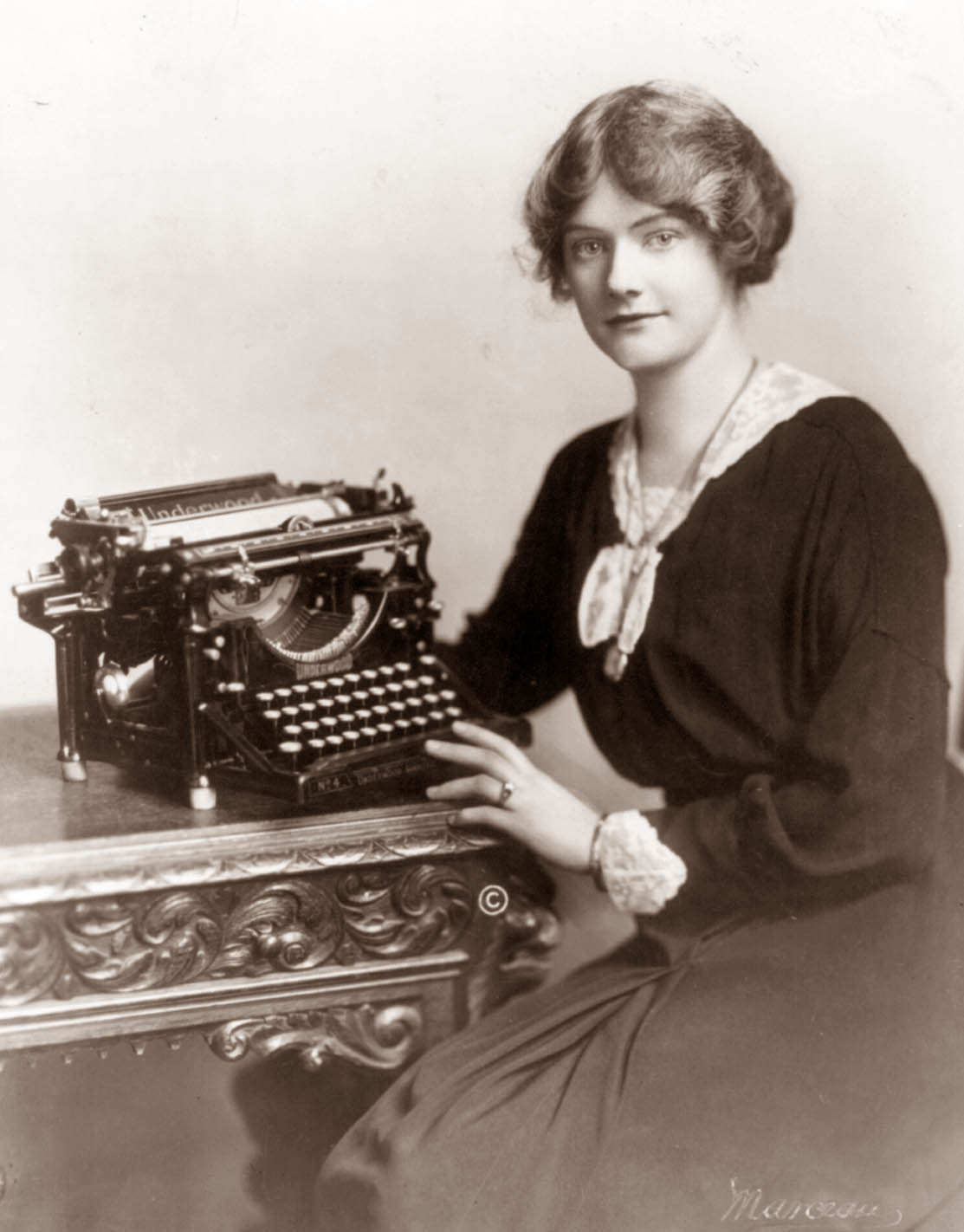
Mr. Reynolds had to lift the roller to show Ben what he had typed. Early typewriters required “blind typing” because the roller and mechanics of the machine blocked the typist from seeing the page as it was typed. By necessity, accurate typing was a treasured skill.

An ad for the Underwood Typewriter Company, featuring their innovative design that allowed typists to see printed words as they were typed.


Ben’s intelligent and perceptive questions prompted Mr. Reynolds to let Ben try the typewriter himself.

“I don’t understand,” he said. “Where is the ink?”

“Not a bit of ink about it,” Mr. Reynolds declared, enjoying the puzzled face.

“Then it isn’t a self-inker? But it prints with ink! Is that a ribbon running through there? Why, it rolls itself up on those wheels, and the ribbon is inked, or colored, or something; I begin to understand. But where are the type?”

Mr. Reynolds silently lifted the roller, then the ribbon, and pointed to the type with his finger, at the same time going through a pantomime which told Miss Webster that he considered the boy’s intelligence and curiosity worthy of response.

The Crandall Universal No. 3 was one of the first typewriters to feature a QWERTY keyboard.

Before long, Mr. Reynolds invited Ben to sit down and type out his mother’s name. Ben did just that, and took to the machine so quickly, Mr. Reynolds offered to teach him how to use the typewriter in exchange for helping him with his work. Ben jumped at the chance.

Ben learned to use the typewriter by fashioning a template of the keyboard, which he used to practice typing at home. He told his friend, Rufus all about the experience:

“I wrote mother’s name. I’m going to learn to write on it; that is, if I can spare the time; he offered me the chance. He wants some work done, and he says if I will give him two evenings, part of the time, I can write on the machine the other part and learn how. Isn’t that a good chance?”

“Humph!” said Rufus. “A dirt cheap way of getting a fellow to work for you, I should say. Of what earthly use does he suppose it will be for you to learn to write on that machine? In two months at the latest he will take it away, and you’ll never see another, and what good will your knowledge do you?”

“How do you know I’ll never see another? Perhaps I’ll have one of my own, some day.”

“Oh, well! Perhaps I’ll have a balloon and take a ride in it to the moon some day, but I don’t believe I will.”

“I don’t either,” said Ben, with a good-natured laugh, “because you wouldn’t know how to manage one; if you ever had a chance to learn, you would say ‘What’s the use?’ and let it slip.”

“I know the difference between chances and shams, I hope,” Rufus said sharply. “I call this a sham—to get a fellow to work for nothing. He offered it to me, and I let him know what I thought about it—at least I hope he understood.”

“I think he did,” Ben said significantly. “Good-night, old fellow! I’m at home, and, as the man in the paper said, ‘I wish you were.’ Just because you hate to walk alone so badly, you know, and have been walking out of your way to keep me company.” And Ben went in at the kitchen door, confirmed in his resolve to learn to run the writing machine, if possible.

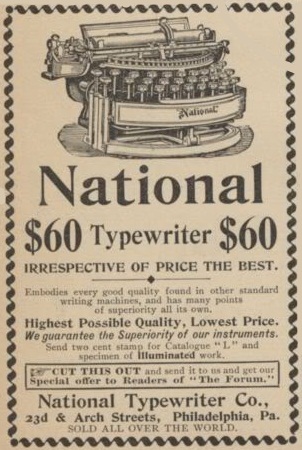
1899 Advertisement


When Miss Dee Dunmore Bryant was published in 1890, typewriters were in use in many offices, but at $95 to $100, their cost prohibited most individuals and many small businesses from owning a one.

A few years later, the cost had dropped to more affordable levels, fueling Ben’s ambition to someday own his own typewriter, and use it to make his living.

Typewriter ad 1896

Advertising Card for Underwood Typewriters


Light the Lucifer

Cook

In Household Puzzles, practical Maria Randolph took on the responsibility of cooking the family’s meals.

.

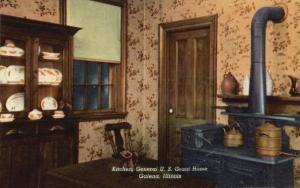
Her kitchen in 1874 might very well have looked like the kitchen in the photograph below of the Ulysses S. Grant home in Galena, IL.

U S Grant Kitchen 1865

The iron cook stove in the picture was typical for 1865 (nine years before Household Puzzles was published) but its fittings, including the warming oven and iron kettles, were built to last and would have remained in operation for decades.

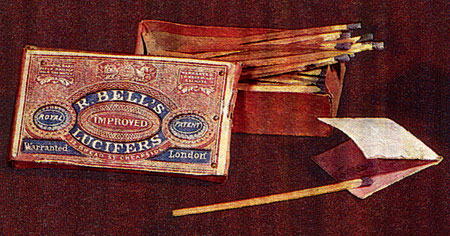
Lucifer Matches 2

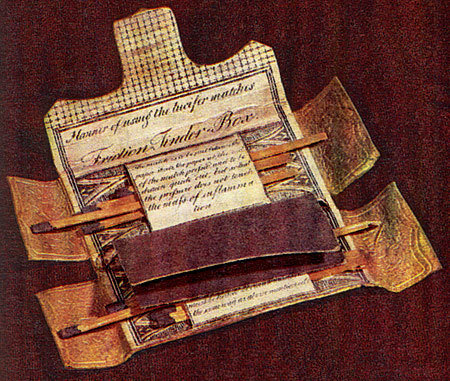
Stoves of the period were fueled by wood or coal. To light the fuel, cooks like Maria used friction matches, commonly called lucifers. Originally, Lucifer matches were developed by a man named Samuel Jones in 1830. Like many other match manufacturers, Mr. Jones made his Lucifers with sulphur tips which were then dipped in phosphorus; but Mr. Jones’s real claim to fame was his packaging. He was the first to sell his matches in small, rectangular cardboard boxes along with sandpaper on which to strike the match. The box even included instructions (in case there was any doubt) on how to light a match.

Lucifer Matches

The packaging proved so popular, “lucifer” soon became a generic name for matches.

In addition to instructions, the lucifer box also included a warning:

“If possible, avoid inhaling gas that escapes from the combustion of the black composition. Persons whose lungs are delicate should by no means use the lucifers.”

In fact, the phosphorus tips not only gave off fumes, they were deadly if swallowed. Ingesting match heads was a common method of committing suicide and small children were often accidentally poisoned by swallowing match heads.

 Household Puzzles describes how Maria fumbled for the match-safe on the kitchen table and muttered “as the vile fumes of the lucifer curled into her nose.”

Maria was a smart housekeeper to hold her matches in a match safe. Because lucifers were highly combustible, they were kept in match safes made of metal. These examples of match-safes hung on the wall and kept lucifers dry, safe, and out of reach of children’s fingers.

Match Safe 2    Match Safe 1860

New Free Read Available

Cover_Spun from Fact resizedIn 1886 Isabella Alden published Spun from Fact. The book is a fictional tribute to a young woman Isabella admired for her unwavering faith and courage during times of trial.

Spun from Fact is an inspiring story, unlike any other Isabella Alden novel.

Click on the book cover to begin reading Spun from Fact. Enjoy!

Taking the Pledge

Cover_Interrupted resized

Claire Benedict, the main character in Interrupted, is a woman who is dedicated to making a difference in people’s lives. She regularly prays for friends and acquaintances; and when she meets someone new, she immediately begins looking for opportunities to help that person.

That’s certainly the case with Harry Matthews. As soon as Claire meets him, she realizes Harry may have a problem with alcohol.

Alcohol drunk men

Later in the book, Harry finds himself indebted to Claire and tells her that if he can ever do anything for her, she has only to ask and it will be done.

.

There was a flush on Claire’s cheeks as she replied, holding forward a little book at the same time.

She could think of scarcely anything else, so easily done, that would give her greater pleasure than to have him write his name on her pledge book; she had an ambition to fill every blank. There was room for five hundred signers, and she and her sister at home were trying to see which could get their pledge-book filled first. Would he give her his name?

And so, to his amazement and dismay, was Harry Matthews brought face to face with a total abstinence pledge. What an apparently simple request to make! How almost impossible it seemed to him to comply with it!

He made no attempt to take the little book, but stood in embarrassment before it.

Page from Pledge Book 2
Click on the image to enlarge

“Isn’t there anything else?” he said, at last, trying to laugh. “I hadn’t an idea that you would ask anything of this sort. I can’t sign it, Miss Benedict; I can’t really, though I would like to please you.”

“What is in the way, Mr. Matthews? Have you promised your mother not to sign it?”

The flush on his cheek mounted to his forehead, but still he tried to laugh and speak gaily.

“Hardly! My mother’s petitions do not lie in that direction. But I really am principled against signing pledges. I don’t believe in a fellow making a coward of himself and hanging his manhood on a piece of paper.”

This was foolish. Would it do to let the young fellow know that she knew it was?

“Then you do not believe in bonds, or mortgages, or receipts, or promises to pay, of any sort—not even bank-notes!”

He laughed again.

“That is business,” he said.

“Well,” briskly, “this is business. I will be very business-like. What do you want me to do, give you a receipt? Come, I want your name to help fill my book, and I am making as earnest a business as I know how, of securing names.”

“Miss Benedict, I am not in the least afraid of becoming a drunkard.”

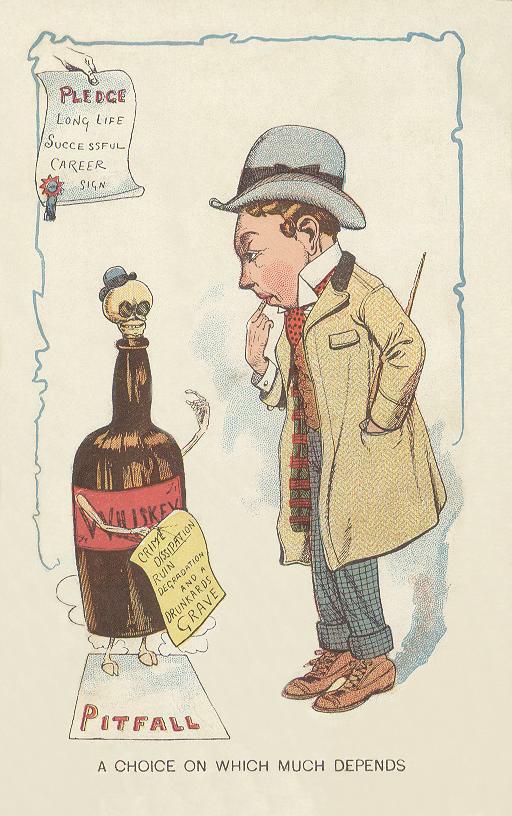
Alcohol Choice

“Mr. Matthews, that has nothing whatever to do with the business in hand. What I want is your name on my total abstinence pledge. If you do not intend to be a drinker, you can certainly have no objection to gratifying me in this way.”

“Ah, but I have! The promise trammels me unnecessarily and foolishly. I am often thrown among people with whom it is pleasant to take a sip of wine, and it does no harm to anybody.”

“How can you be sure of that? There are drunkards in the world, Mr. Matthews; is it your belief that they started out with the deliberate intention of becoming such, or even with the fear that they might? Or were they led along step by step?”

“Oh, I know all that; but I assure you I am very careful with whom I drink liquor. There are people who seem unable to take a very little habitually; they must either let it alone, or drink to excess. Such people ought to let it alone, and to sign a pledge to do so. I never drink with any such; and I never drink, anyway, save with men much older than I, who ought to set me the example instead of looking to me, and who are either masters of themselves, or too far gone to be influenced by anything that I might do.”

Was there ever such idiotic reasoning!

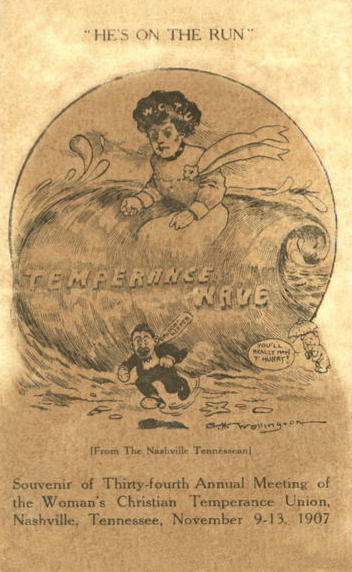
WCTU 1907

When Isabella Alden wrote Interrupted in 1885, there was a strong temperance movement sweeping across America. Driving that wave was the Women’s Christian Temperance Union (WCTU), which worked tirelessly toward the elimination of alcohol “with a mother’s love.”

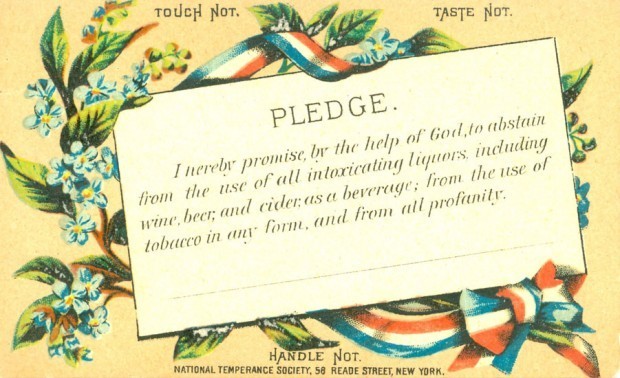
The WCTU and other Christian temperance organizations used temperance pledges as a device to secure individuals’ promises to abstain from the consumption of alcohol.

.

.

Alchol Temperance Pledge Card
Click on the card to enlarge

The WCTU and organizations like them distributed pledge books and pledge cards liberally. Click on each of the pledge cards to see a larger image.

Alcohol WCTU pledge card 1917    Alcohol WCTU pledge card

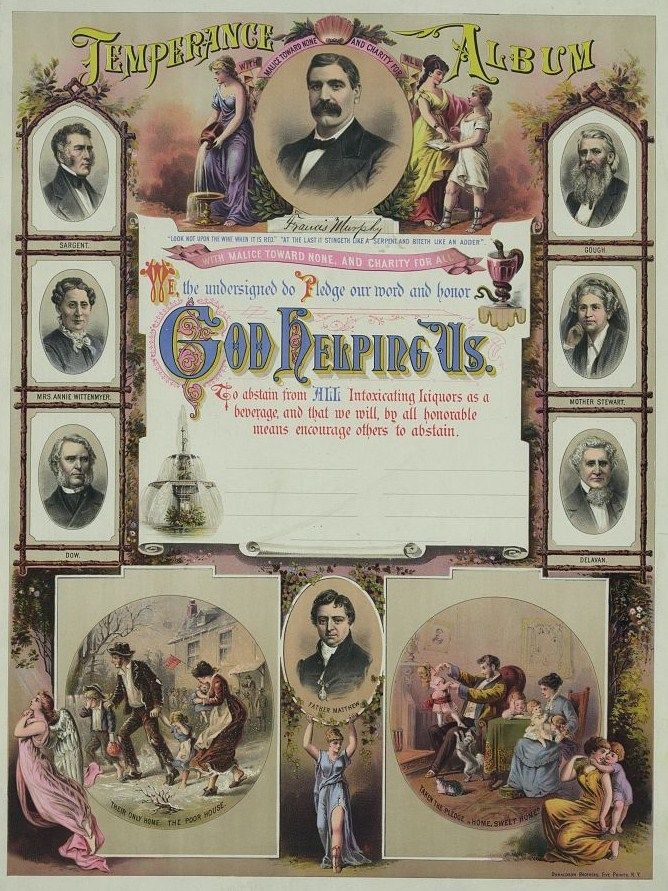
Alcohol WCTU& pledge card 1887    Pledge Album

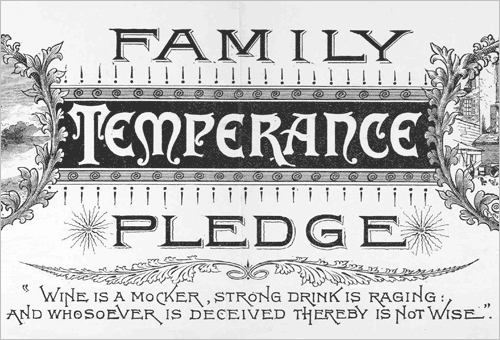
Family pledge documents were also distributed so entire families could take the pledge together, with family members often serving as witnesses to each others’ signatures.

Alcohol Temperance Pledge

Once signed, the pledges were often kept in family Bibles at a time in America when the family Bible was the most important possession in the home.

Family Pledge
Click on the image to enlarge

The temperance pledge was an effective tool for the WCTU because it tied abstinence to virtue, morality, and, most importantly, a pledge before God.

The Browns at Mount Hermon

Cover_The Browns at Mount Hermon resizedThe Browns at Mount Hermon is now available for Kindle and Nook!

Mary Brown may have fortune and beauty, but she’s the loneliest heiress in town. She longs for a family and close friends, but she has only her bank account to keep her company. Then she receives an unexpected invitation to spend the summer at Mount Hermon, a Christian camp in California. It doesn’t take long for Mary Brown, the heiress, to realize the misdirected invitation is actually meant for a different Mary Brown—but that doesn’t stop Mary’s imagination from running wild.

Before she can change her mind, Mary is on her way to California, determined to spend her summer living in a tent at Mount Hermon … even if it means she must pretend to be the “other” Mary Brown. It’s a radical change for Mary, and she enjoys every minute of her new life. But is a summer at Mount Hermon the only change Mary needs, or will her soul be made new, as well?

Click on the cover to read sample chapters and find out more about The Browns at Mount Hermon.