When Isabella edited The Pansy magazine, she made sure each issue included (in addition to her own stories) a wide variety of content, such as essays on science, history, life in foreign countries, and biographies of famous people.
Her family members regularly contributed articles, anecdotes, stories, and poems.
Isabella’s husband, her son, her sister, and even her niece Grace Livingston (who, as Grace Livingston Hill, later became a best-selling author just like her aunt Isabella) all wrote poems for The Pansy.
The Giveaway
Today’s giveaway is an e-book of some of the best-loved poems from the pages of The Pansy magazine.
Sometimes soulful, sometimes charming or funny, Poems of Faith from The Pansy is the perfect read when you’re in the mood for a bit of whimsy or a quiet moment of reflection.
You can read Poems of Faith from The Pansy for Free!
Before Isabella published a new novel, she often shared the story in chapter-by-chapter installments in magazines. One example is her novel Christie’s Christmas. Before it was published in 1885, part of it appeared in The Pansy magazine under the title “Christie at Home.” Then the magazine’s publisher advertised the story in newspapers across the country:
From The Perry County Democrat (Pennsylvania) newspaper, November 5, 1884.
When Isabella’s niece, Grace Livingston Hill began her writing career, she followed suit. Several of her short stories and novels first appeared as serials in magazines before the complete story was published in book form.
In 1905 Grace’s novella The Governor’s Son was published as a serial in a Christian magazine. Then, in 1909, the same story appeared as a serial in a British magazine. Both publications included lovely pen and pencil illustrations of some of the story’s key scenes.
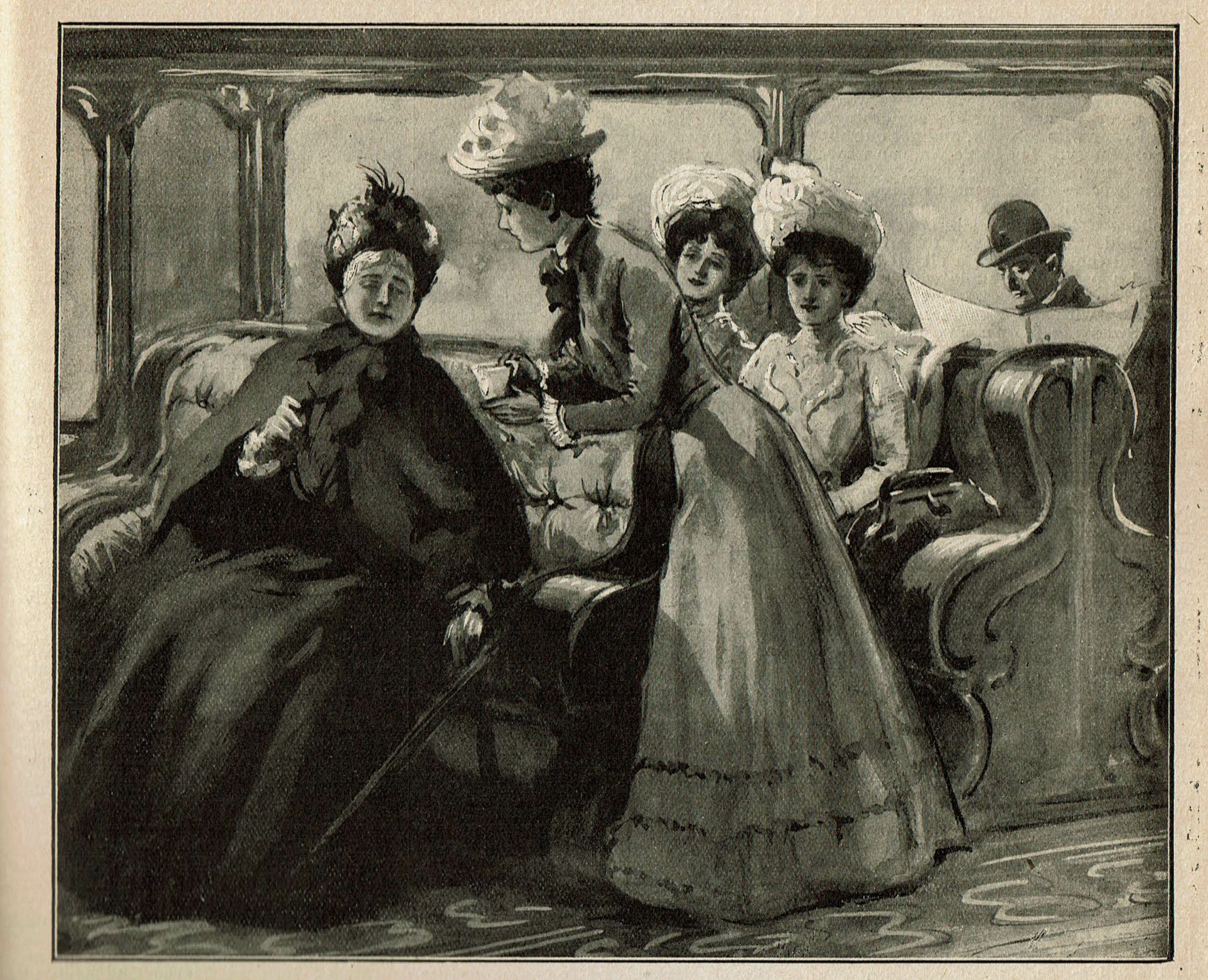
The Governor’s Son is about a young woman named Leslie who spends the summer with her sister and cousin at a seaside resort. Here’s one of the magazine illustrations showing Leslie befriending an elderly woman while on the train to the resort, as her sister and cousin look on.
That small act of kindness earns Leslie a new friend, and she and the elderly woman spend quite a bit of time together on the seashore.
The Governor’s Son was never published in book form, but all the complete magazine issues survived, so the story could be pieced together; and it’s now available for purchase on Amazon.com.
The Giveaway:
We’re giving away five e-book copies of The Governor’s Son by Grace Livingston Hill!
Shy, lovely Leslie Graham would rather spend her summer at home reading a book, but her parents insist she accompany her sister Anna to a seaside resort, where the sisters’ differences quickly come to light. While Anna tries to mingle with the resort’s most fashionable and wealthy inhabitants, Leslie makes friends with sweet, elderly Mrs. Hamilton, who likes to watch the ocean, quote Bible verses, and talk about her son. And when Mrs. Hamilton’s son arrives, Leslie realizes Chauncey Hamilton is just as thoughtful and handsome as his mother described. In the face of such kindness, Leslie can’t help but prefer to spend her days and nights with Chauncey and his mother, even as Anna plots to pull her in a more worldly and dangerous direction.
To enter the drawing, just leave a comment below or on Isabella’s Facebook page no later than midnight (EDT) on Thursday, September 14.
The five winners will be announced on Friday, September 15. Good luck!
If you love Grace Livingston Hill stories and can’t wait until Friday to read The Governor’s Son, you can purchase your copy of the novella by clicking here.
Remember: You don’t have to own an Amazon Kindle to read The Governor’s Son. Just download Amazon’s e-reader app to read the story on any electronic device.
This post is part of our 10-Year Blogiversary Celebration! Join us every weekday in September for a fun drawing, giveaway, or Free Read!
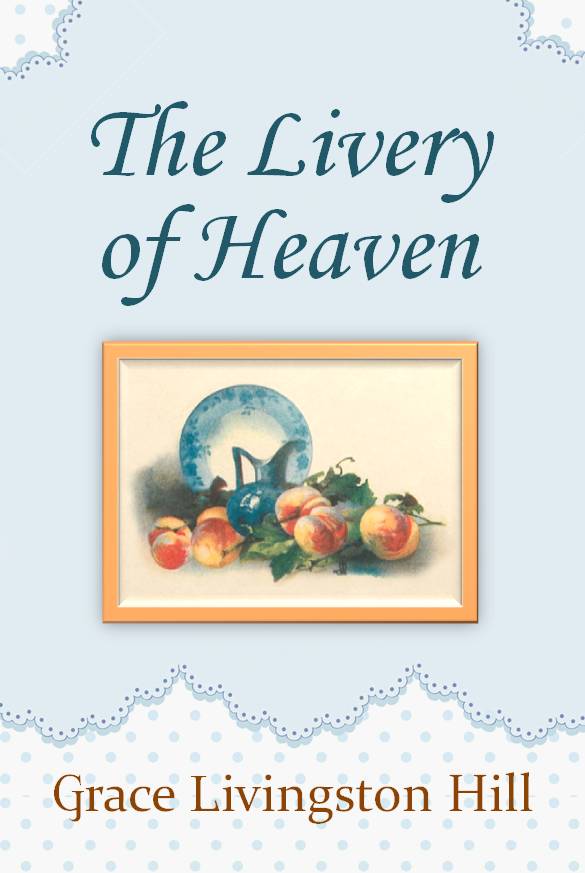
When Grace Livingston Hill’s short story “The Livery of Heaven” was published in a popular Christian magazine in 1897, she probably had no idea the controversy it would cause.
Magazine illustration for Grace’s story, “The Livery of Heaven.”
After all, Grace was 31 years old and had been writing and publishing her stories and novels since 1889, and they all sold very well. So it might have been a bit surprising that the magazine that published “The Livery of Heaven” began to receive letters from readers like this one:
The Letter:
I have been reading “The Livery of Heaven,” and, as one hoping your paper meets the highest standard of merit and helpfulness, I desire to make an emphatic protest against the unreality of some of the characters and descriptions of that story.
The character of Mrs. Wallace, for instance, seems to me too absurd even for a story. Is it possible that a woman of her intelligence and honesty of purpose could be so absolutely blind as not to know the inevitable consequences of giving to one with a passion for liquor “brandy peaches” so strong with brandy as to scent a whole room?
Or that she could be so utterly inconsistent as to go out and work zealously in the cause of temperance reform when she had just finished putting up a lot of peaches saturated with brandy, which she purposed to serve indiscriminately?
Impossible! Unless she were a bold hypocrite, and obviously hypocrisy is not intended or thought of.
And if not a hypocrite, such rank inconsistency and incongruity of character could not exist except in a vivid imagination. It is not real life.
If my ideas are wrong, I would like to be set right.
It just so happened that Grace’s aunt, Isabella Alden, was one of the magazine’s editors, and she decided she would personally answer the critics who wrote in about Grace’s story and “set them right.”
Here is Isabella’s response:
There is more to this letter, and I wish we had room for its entirety, for it is carefully and thoughtfully written.
It seems to me that the writer is wrong, not in his deductions, but in his statement of facts. He distinctly states the impossibility of so inconsistent a woman as Mrs. Wallace. What will he do with her if I own that she, to my certain knowledge, exits—that she is not only “true to life,” but she is life? I have no means of knowing whether the Mrs. Wallace about whom the author in question writes is the Mrs. Wallace of my acquaintance; but I do know that exactly such an instance of moral blindness occurred but a few years ago.
I knew a woman who would walk miles on hot summer afternoons to secure signers to a “no-license” petition within the precincts of her ward, and would discourse eloquently on the evils of the saloon and the dangers attending her young son, and the miseries resulting from “acquiring a taste for intoxicants;” and then offer that same young son at her own dinner table a pudding, the sauce of which was so highly flavored with wine as to make its very presence offensive to certain of her guests.
I knew another woman who wept copious tears over the downfall of a beloved brother, and besought us earnestly to help her plan ways and means of reaching and saving him “even yet”; and then offered us in the next breath a bit of her fruit-cake so well flavored with brandy as to be detected by the sense of smell as well as that of taste; and she remarked that she always kept it on the sideboard where her brother could help himself.
The dense ignorance that exists in regard to these matters on the part of many people who consider themselves almost temperance fanatics, is proverbial among workers who have studied into the subject.
In our mothers’ meetings that I conducted for years this matter of cookery was continually coming to the front; and at not a single meeting did we fail to have represented the puzzled woman who said:
“Why, do you suppose, that the little bit of brandy that I put in my mince-pies to keep them, or the few drops with which I flavor my sauces, can have any effect on a person’s appetite for liquor? Won’t such strained notions as these do more harm than good?”
Also, almost as regularly, we had that other woman who said:
“Well, there’s no use in talking to me about such things. John wouldn’t eat mince-pies if they hadn’t brandy in them. He doesn’t like the flavor without it; and I’m not afraid of its doing any harm in my family.”
Understand, these are good temperance women—every bit as good as Mrs. Wallace; much like her in every respect; women who, by reason of their upbringing and their present environment, are utterly unable to see the connection between liquor-eating and liquor drinking; women who believe that what their mothers and their mothers’ mothers always did must be right and best.
What the temperance cause needs today, in my judgment, more than any other thing, is some apostle who will undertake to open the eyes of the army of Mrs. Wallaces that infest the land, who labor zealously with their strong right hands to put out the fires of rum, and industriously feed the flames with their ignorant left hands all the while.
.
What did you think of Grace’s story? Do you agree with the letter writer’s critique?
Like everyone in her immediate and extended family, Grace Livingston Hill was a dedicated temperance worker. She was well-educated in the effects alcohol had on individuals and their families.
And because the production and sale of alcohol was unregulated at the time (and often included addictive ingredients such as cocaine, morphine, cannabis, and chloroform), she knew it was not uncommon for people to become addicted to some alcoholic beverages.
She wrote about the harm alcohol caused in a short story titled, “The Livery of Heaven.”
Mrs. Wallace is proud of her work in the temperance cause. Her latest project is raising money to build a play-ground at the Home of Inebriates’ Children. It’s a worthy cause, so when she has a chance to host a famous temperance lecturer in her very own home, she jumps at the chance, certain that his lecture will draw the support and donations she needs.
But little does Mrs. Wallace realize, a dark force is using her efforts to harm the people she loves the most.
At the core of the story is a lesson about the seemingly small and thoughtless ways Christians can cause others to stumble in their daily walk with Christ.
Magazine illustration for Grace’s story, “The Livery of Heaven.”
After a Christian magazine published the story in 1896, “The Livery of Heaven” set off a bit of a fire storm.
Join us next week to find out how some readers reacted to Grace’s story “The Livery of Heaven.”
You can read “The Livery of Heaven” for free!
Choose the reading option you like best:
You can read the story on your computer, phone, tablet, Kindle, or other electronic device.
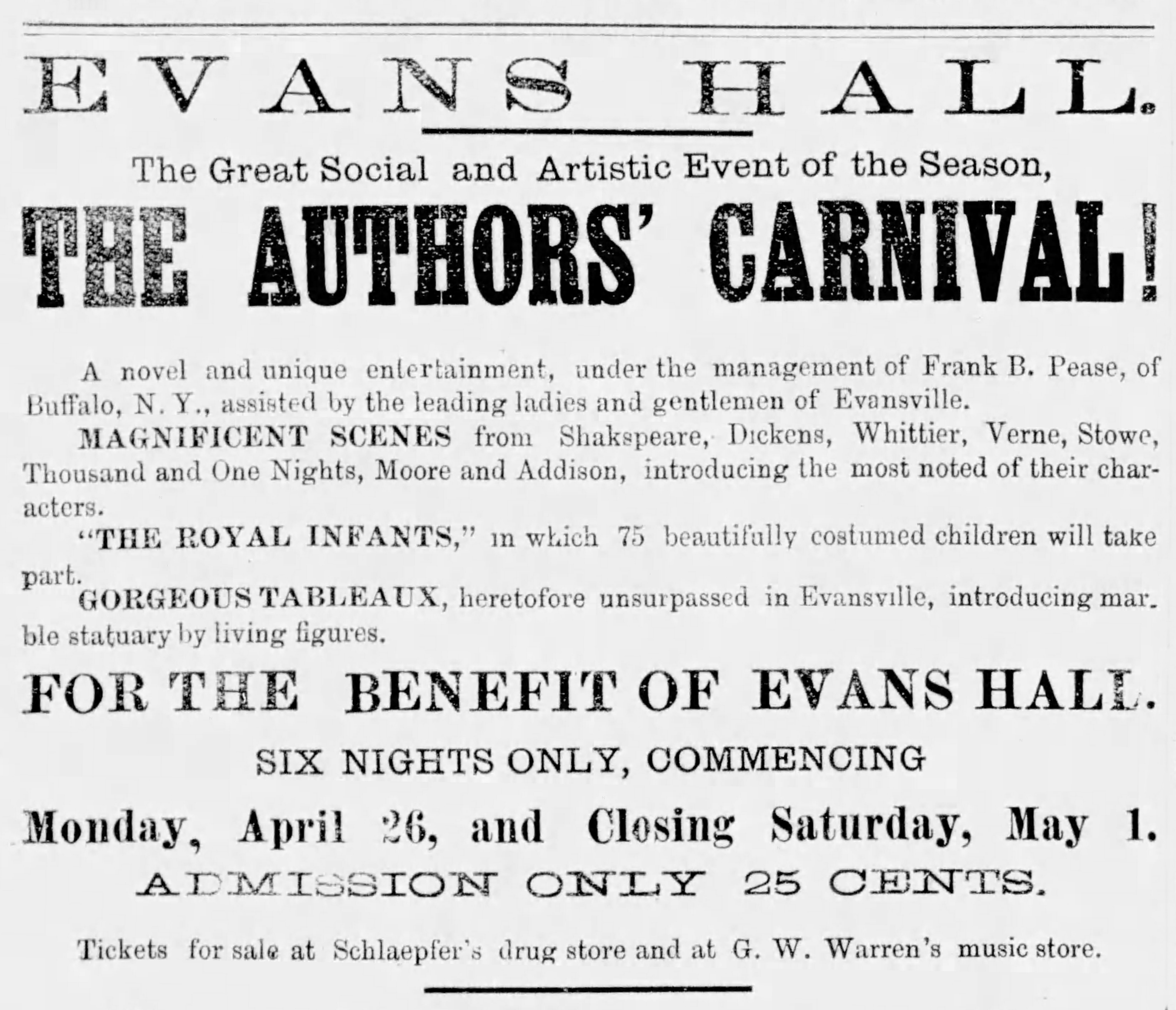
From the Evansville, Indiana Daily Courier, April 18, 1880
In the late 1800s a new and exciting form of entertainment swept across America. It was called the Authors’ Carnival. It had all the fun of a community fair, as well as dazzling theatrics on a magnificent scale.
Women in costume for an Authors’ Carnival in Washington DC
The Authors’ Carnival drew great crowds in every city in which it was staged, so it had to be set up in a large space, such as a town hall or tabernacle. The concept, though, was simple: the Carnival was comprised of a number of booths, each of which depicted a scene from a famous author’s works.
For example, there was a booth devoted to Twenty Thousand Leagues Under the Sea by Jules Verne. Costumed actors portrayed scenes from the book in an elaborately decorated submarine compartment behind a gauze curtain that simulated water.
A booth devoted to Sir Walter Scott’s Baronial Hall, from The Buffalo Times
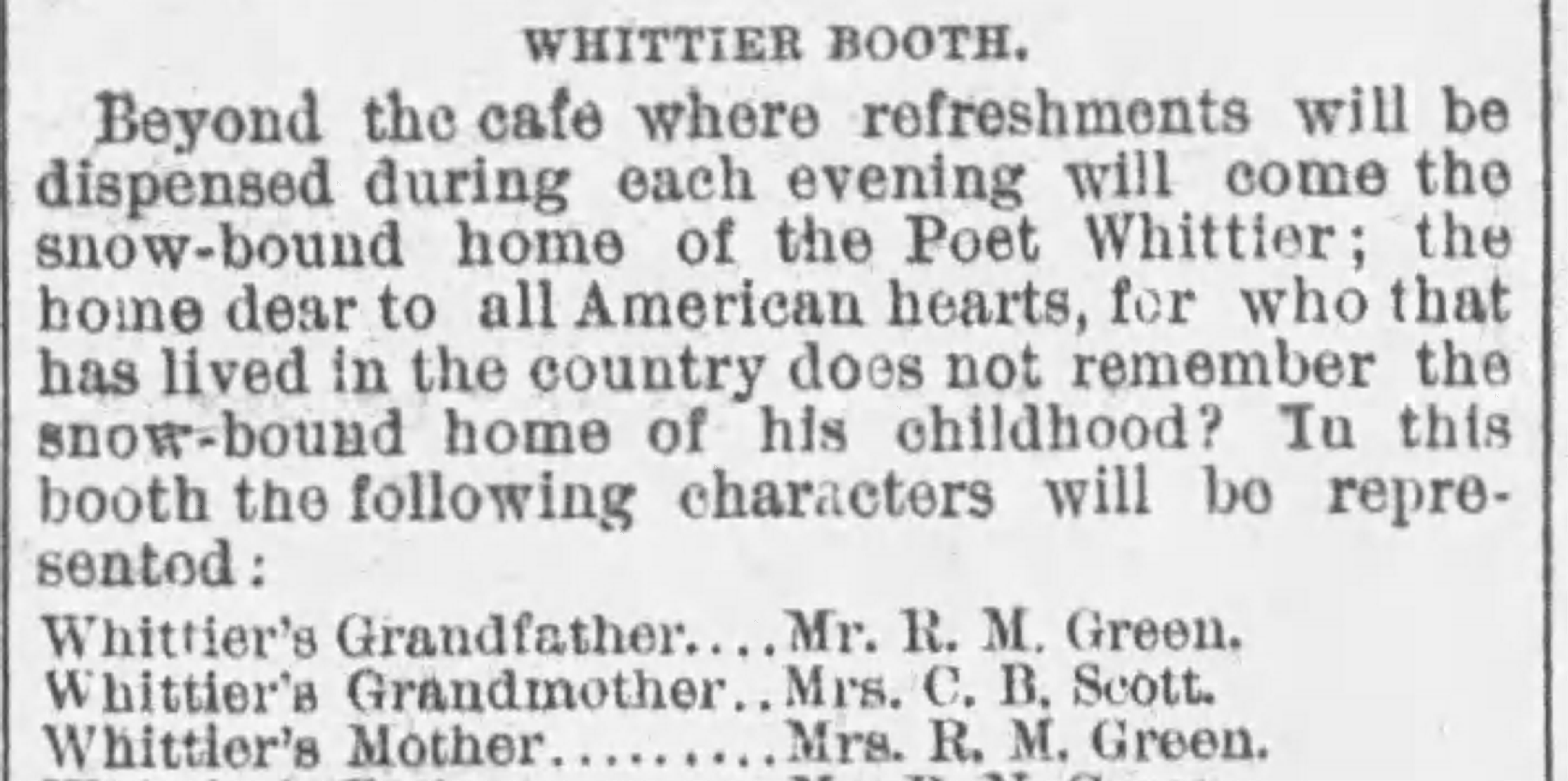
Another booth was devoted to John Greenleaf Whittier’s poem, “Snow-Bound: A Winter Idyll.”
A description of the Whittier booth, from The Scranton Republican, April 23, 1886
There were booths dedicated to Shakespeare, Longfellow, and Washington Irving, and many more literary figures, including Mother Goose. One of the most popular booths was lavishly decorated as Aladdin’s Cave.
In many cases, booths were set up so the costumed actors could interact with the people passing by.
Victor Hugo’s Paris Garden booth, from The Buffalo Times
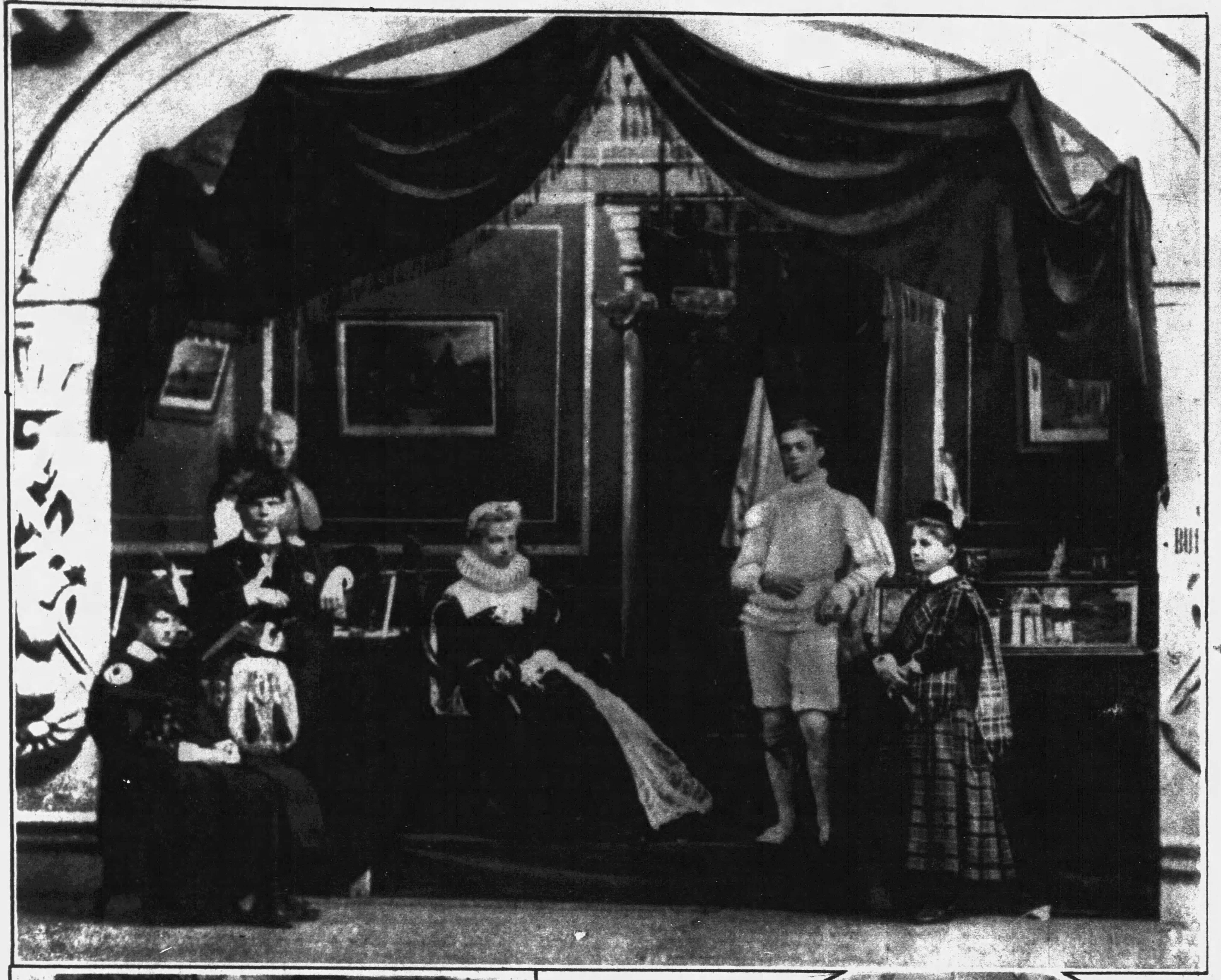
The highlight of the Authors’ Carnival occurred on a center stage where tableaux vivant were enacted at intervals throughout the day and evening. The most popular tableau was the colorful, well-choreographed “The Fan Brigade.” It illustrated an essay by British satirist Joseph Addison on how ladies in the eighteenth century used their fans as weapons in flirtation and romance.
Fan Brigade, from Authors’ Carnival Album, 1880, Library of Congress
In 1881 the Authors’ Carnival arrived in Cleveland, Ohio, where sixteen-year-old Grace Livingston lived with her father Charles and mother Marcia (who was Isabella Alden’s older sister). Already an aspiring author, Grace visited the Authors’ Carnival one afternoon and wrote the following account of her experience:
The Author’s Carnival in Cleveland
By Grace
It was impossible for me to attend the evening entertainment of the Author’s Carnival, but when a matinee was announced for the next afternoon, I thought I would go.
It was held in the tabernacle. As you entered the door, directly opposite you was the stage, where the most beautiful tableaux were exhibited every twenty minutes, the performers never having rehearsed before, but being picked out and arranged on the spot, from the different booths.
The booths were ranged around the sides, and the center left for the audience to promenade. We took a look at the booths before the first tableaux.
The “Alhambra,” which, having a piano, and a few good players, managed to keep such a crowd around it all the time, that one could hardly get a peep at it.
Whittier’s “Snow Bound,” with its soft gray costumes, which harmonize wonderfully with the neat room, and fire-place, and cupboard, with its rows of bright, shining dishes, and the strings of dried apples hanging from the ceiling. Whittier’s “grandmother” happened to be a friend of mine, so I stepped up to her, and she said, “How does thee do, friend Grace?”
There was the “Arabian Nights” booth, where they sold miniature “Aladdin Lamps,” said to be exact copies from the original.
“Lalla Rookh” and the “Jules Verne” booths were beautiful and picturesque, with their mermaids, and flowers, and sea-weeds.
Longfellow’s “Hiawatha,” where the Indians flourished their tomahawks, and gave war-whoops, attracted a great deal of attention, and really was one of the most fascinating.
The “Egyptian” booth had beautiful, rich costumes.
The “Addison” booth had, perhaps, the most beautiful costumes, but the characters were all ladies.
The “Dickens” booth, with all its comical characters, was just refreshing.
As I walked up to the “Shakespeare’s” booth, the “Duke of York,” an old schoolfellow, stepped forward and shook hands with me.
The tableaux-bell rang, and we all rushed to the center of the floor, each one trying to get the best position for seeing. The most beautiful and quaint pictures succeeded each other; lastly, the beautiful “Fan Drill.” If you have never seen it, seen the perfect time and graceful motions, you cannot imagine how beautiful it was.
But there was one blight on all this beauty. At the “Spanish” booth they sold cigars and cigarettes, and some ungentlemanly persons even smoked among all that company of ladies. It was Satan’s way of joining in the Author’s Carnival.
Tableaux and theatricals were common forms of entertainment during Isabella Alden’s lifetime, and she wrote about them in several of her novels. You can read more about tableaux in these previous posts:
Isabella loved her niece Grace Livingston, and she was very proud of Grace’s talent for writing.
When Grace was only twelve years old she wrote her first book, The Esselstynes. It was a story about the life changes a brother and sister experience when they are adopted by a Christian couple. Isabella was so impressed by the story, she had it printed and bound as a book, and she encouraged Grace to write more.
Grace obliged and wrote poems, as well as stories. She wrote the poem below, which Isabella published in an issue The Pansy magazine in April 1881—just in time for Grace’s 16th birthday!
Here’s how the poem appeared in the magazine:
.
And here’s a transcript of the poem:
THE EVENING STAR
BY GRACE
You beautiful star,
Shining afar,
Above the depths of sin,
Unbar the door
Of the heavenly floor,
And give me one glimpse in.
Into the bright
And golden light,
In the presence of the King,
Where the angels play
Night and day,
And the choirs forever sing.
The streets of gold,
The glories untold,
Oh, how I long to see!
Star, if you could,
Bright star! if you would
Show those glories to me!
What do you think of Grace’s poem?
When you were young, did you have a relative, teacher or friend in your life who encouraged you to develop a talent?
Isabella was born and raised in upstate New York, so she was very familiar with east coast winters.
After she and Reverend Alden married, they served congregations in Pennsylvania, Ohio, New Jersey, and Washington D.C. where winter storms often brought snow, wind, and dangerous ice.
Fortunately, Isabella’s book sales allowed the Alden family to sometimes spend a portion of their winter months in sunny Florida; still, there were times Reverend Alden’s duties kept them in the cold and snowy north instead.
When the good reverend retired in 1910 the Aldens moved to California, where they built their dream house in Palo Alto (click here to read more about their house).
Never again did they have to deal with harsh winters, extreme cold, or deep drifts of snow that had to be cleared from walkways and roads.
A postcard Isabella might have sent from California.
The Aldens found California winters delightful. Januarys were warm and mild; Februarys boasted average temperatures around 60 degrees. For them, snow banks and ice dams were things of the past.
A 1918 postcard.
In her letters to old friends and relatives in the east, Isabella might have mentioned the perfect weather she enjoyed, free of “fierce storms and slushy spring thaws.”
And when she hadn’t time to write letters, she could send off a quick postcard that made her point for her about California winters.
Sunshine, Fruits, Flowers, and Snow.
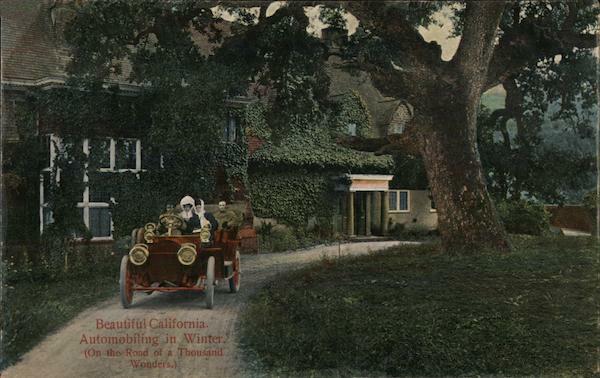
Picture postcards made up a large portion of the California printing industry. They featured color photographs that depicted what it was like to spend a winter in that state.
Beautiful California. Automobiling in Winter, about 1909.
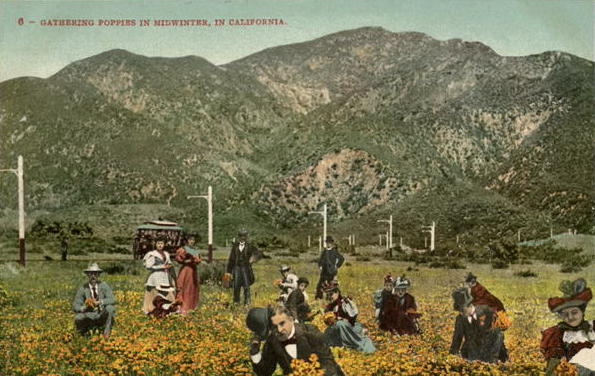
Some postcards featured images of flowers that bloomed in the winter months, like poppies and bougainvillea.
Gathering poppies in midwinter in California.
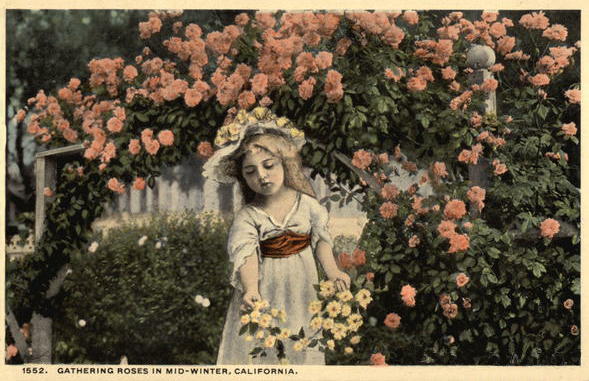
Isabella loved flowers and often marveled over the varieties of roses that bloomed beside her porch in California:
“Red, cream, salmon, pure white, and every shade of pink. Hundreds and hundreds and hundreds of them! The world seems made of roses!”
Gathering Roses in Mid-Winter, California
Other postcards showed people boating on lakes or swimming in the ocean in the middle of winter.
A winter’s day in Westlake Park about 1909.
Each postcard was like a little advertisement for the state of California, teasing and enticing people to come live the good life among the orange groves and poppy fields of the west coast.
Isabella was an ambassador for the state, as well, because California life certainly seemed to agree with her. One day in November she wrote to her niece, Grace Livingston Hill:
“Today is glorious sunshine, and the grass and trees glow in their freshly painted garments of green after the rain of yesterday.”
It sounds like Isabella was very happy in her California home!
Isabella Alden knew all about the Christmas shopping season. She had a large extended family, and she either bought or made gifts for each family member.
Her niece, author Grace Livingston Hill, recalled what it was like when the Aldens, Livingstons, and Macdonalds got together:
Our Christmases were happy, thrilling times. There were many presents, nearly all of them quite inexpensive, most of them home-made, occupying spare time for weeks beforehand; occasionally a luxury, but more often a necessity; not any of the expensive nothings that spell Christmas for most people today.
Isabella—being a clever and creative person—made many of the gifts she gave.
Sometimes she got gift-making ideas from magazines. She subscribed to The Ladies’ Home Journal and Harper’s Bazar, both of which regularly printed directions for making items to use or give as gifts. Sometimes she passed those ideas and directions on to her own readers.
For example, an 1898 issue of The Ladies’ Home Journal published instructions for making this pretty wall pocket:
Isabella liked the idea so much, she wrote simplified instructions that children could follow and printed them in an issue of The Pansy magazine. She told her readers how to make the wall pocket from pine board, calico, buttons, and felt, and hinted it would make a lovely gift “for mamma.” She wrote:
I get the idea and most of the details from Harper’s Bazar. The article from which they are taken says the contrivance is for an invalid, but let me assure you that mamma will like it very much, or, for the matter of that, papa also.
At Christmas she encouraged boys and girls to make gifts not only for family members and friends, but for strangers, too. She wrote this to readers of The Pansy magazine:
How many Pansies are planning the Christmas gifts they will make? In all the merry bustle and happy, loving thoughts, don’t forget to throw a bit of kindly cheer into those poor little lives darkened by distress and want.
If every member of The Pansy Society would make some little gift as a loving reminder to one who otherwise would have none, how many children, think you, would be made happy?
Remember, you do it “For Jesus’ sake.”
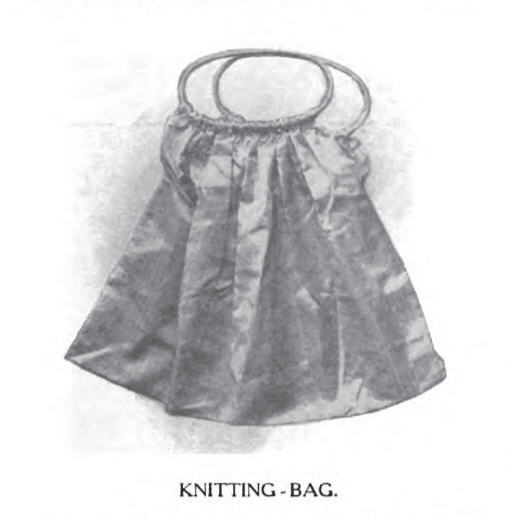
There were instructions for making this simple knitting bag, made of fabric, ribbon, and embroidery hoops:
And this case, made from pieces of cardboard and colored ribbons, to hold photos, greeting cards, or pictures cut from magazines.
She wrote:
What a delightful present that will be when you get it done! I can imagine an ingenious girl and boy putting their heads together, and making many variations which would be a comfort to the fortunate owner.
Isabella always knew how to give those gentle reminders that children (and adults!) sometimes need about the true spirit of Christmas.
What is your favorite way to share the message of Christmas with people in need?
Have you ever made a Christmas gift for someone? How was it received?
As a popular author, Isabella received plenty of publicity and media coverage, and she was probably used to seeing her name in print.
In 1893 her niece, Grace Livingston Hill was just beginning to garner some publicity of her own. A few of Grace’s stories had been published in magazines, including The Pansy, so she was already building a following of loyal readers.
Then, in April 1893, the following article about Grace appeared in a Christian magazine:
THE REVEREND AND MRS. FRANKLIN HILL
Pansy’s niece, Grace Livingston (now Mrs. Franklin Hill) has perhaps almost as warm a corner in the hearts of our readers as their older friend “Pansy,” and therefore we are glad to give the photographs of herself and her husband. Mr. Hill. [He] is pastor of a flourishing church in one of the suburbs of Pittsburgh, Pennsylvania—a young man of noble character and fine intellectual gifts.
To quote from a paper giving an account of their recent marriage:
“When two souls such as these, energetic, consecrated, and peculiarly gifted, unite their lives and aims, there is promise of much good work for the Master.”
Doubtless thousands who never saw Grace Livingston’s face, feel acquainted with her, and really are acquainted with her through her writings, for a true author’s true self goes into her works. She has a bright and charming style, which reminds one of that of her aunt, Mrs. Alden (“Pansy”), and of her mother, Mrs. C. L. Livingston, who is often a collaborator with Mrs. Alden.
Mrs. Hill is not an imitator, however, or an echo of anyone else, but has a genuine style and literary character of her own. She is, moreover, much more than a mere writer. The daughter of a Presbyterian Minister, trained from her earliest days to work for the Master, she has thrown herself enthusiastically into His service.
“She has,” writes a friend, “a passion for soul-saving, and will not give up a bad boy when all others do, but pleads with him, and prays, and has patience, and often has the joy of reward, in the changed character of boys who will remember her gratefully through life. She sometimes gathers about her on Sabbath afternoons a group of older boys, and leads them on to discuss Christian evidences and the moral questions of the day, amusements, etc. On these subjects she takes high ground, setting them to search for the opinions of master minds in religious thought, and to learn what Scripture teaches on the themes under discussion. This will go on for months, each of the informal meetings delightful to the boys.”
The work of the Christian Endeavor Society is very near her heart, and she has given much time and strength to it, as her writings prove. Of late she has been especially identified with the Chautauqua Christian Endeavor reading course, whose success in the future will be largely due to her energy. While in Chautauqua during the summer, she spends much of her time in promoting the interests of the Chautauqua Christian Endeavor Society.
How can we end this brief sketch better than by quoting the words of a friend, who says:
“She loves dearly to have her own way, and yet she is one of those rare characters who knows how to yield her will sweetly for peace sake, and so for Christ’s sake.”
What a lovely article! It gives readers hints of the great work (in addition to her writing) that Grace would accomplish in the years to come.
The article appeared only four months after Grace and Thomas Franklin “Frank” Hill were married. After their marriage they both stayed involved in the Christian Endeavor Society. Together they wrote The Christian Endeavor Hour with Light for the Leader, a guide book that contained lessons and Bible verses CE societies could use in conducting their meetings. The book was published in 1896.
Grace’s “passion for soul-saving” flourished, as well. In later years she established a mission Sunday School for immigrant families in her community. It was just one of the many endeavors Grace undertook that resulted in “good work for the Master.”
Isabella Alden was deeply involved in the Christian Endeavor movement that took root in America and swept around the world in the late 1800s. She regularly contributed to the Christian Endeavor newspaper; and she wrote about Christian Endeavor in of her novels Chrissy’s Endeavor, Her AssociateMembers, and others.
Isabella’s family was involved in Christian Endeavor, as well. Her niece, Grace Livingston Hill, served as president of a Christian Endeavor chapter. One of Grace’s early novellas was a Christian Endeavor story called “The Parkerstown Delegate;” and with her husband Grace published a guide for Christian Endeavor leaders that was widely used by C. E. chapters.
The Christian Endeavor Society held regular annual conventions in the U.S. that were very well attended by people from all over the country; but in 1896 the society held an international convention in Washington D.C. Thousands of Christians of all ages, nationalities, and denominations, descended upon the U.S. Capitol for five days of non-stop meetings, worship services, training classes, and Bible studies.
Newspaper headline about the convention, from the Evening Star, Monday, July 13, 1896.
Isabella knew Washington, D.C. very well. She and her family lived there for three years when her husband served as assistant pastor of The Eastern Presbyterian Church, located just blocks from the Capitol building (read about her D.C. home here). In early 1896 the Aldens moved to New Jersey, just a short train ride away from Washington; so it’s entirely possible the Aldens attended all or part of the international convention that year.
The convention opened on Thursday, July 9 and ended the following Monday. Convention attendees were given a schedule of events and a map to help them travel from venue to venue, most commonly by foot.
The Christian Endeavor Society distributed this map of Washington, D.C. to conventioneers in 1896.
Attendees braved the heat, the humidity, and the stifling crowds of fellow Endeavorers that thronged the mall from the Lincoln Memorial to the Capitol building.
“The Army of the King.” Christian Endeavorers crowd Washington, D.C. in 1896. From the New York Public Library Digital Collection.
On The Ellipse, located between The White House and the Washington Monument, enormous tents were erected where meetings and lectures were held.
A newspaper photo of the meeting tents, with the Washington Memorial in the background.
Each tent was designed to hold hundreds of people, but some evening gatherings drew enormous crowds. At times there were so many people, and the interiors of the tents became so hot, the tent sides had to be raised to allow fresh air to circulate.
A tent interior layout, printed in the Evening Star on Wednesday, July 8, 1896.
But of all the activities that took place over the five-day convention, there was one event that stood out and was talked about for months afterward.
On Saturday evening, July 9, a patriotic service was planned to take place on the east front of the Capitol Building.
The east front of the United States Capitol building, photographed in 1904.
The service was described as “a great song service” of patriotic songs and hymns led by a chorus of four thousand voices.
An announcement of the service in the Evening Star on July 11, 1986.
A photographer captured this image of the chorus assembling on the steps of the Capitol:
One newspaper enthusiastically wrote that the patriotic service was “grand music to listen to, and something to remember.”
At the conclusion of the service, the chorus, the Marine band, and the audience left the Capitol steps to march down the National Mall to the Ellipse, where they gathered at Tent Endeavor.
The Ellipse and the Capitol Grounds shown on a map published in the Evening Star.
The song service was a tremendous success! While there was no official count, attendees believed there were just as many singers among the audience as there were on the Capitol steps.
If that’s true, there were over eight thousand people at the service, all raising their voices together in songs of praise!
What do you think it was like to sing hymns with thousands of other people?
Have you ever participated in an outdoor sing-a-long where your voices could be heard for blocks?
Reviews and giveaways for Christian fiction and sweet, clean fiction. Bringing readers information on great stories and connecting authors with their readers.