Clothes Pansy’s Characters Might have Worn

There’s a new Isabella Alden Pinterest board for you to view: “Clothes Pansy’s characters might have worn” is a budding collection of clothing, jewelry, hats and shoes from the time period in which Isabella wrote her books.

This brown suit (from about 1880) might have been similar to the suit Marian Wilbur wore in Four Girls at Chautauqua.

Brown gown

And this delicate gown may remind you of the gown Flossy Shipley ruined in the rain on her first visit to Chautauqua.

Wool Twill Embroidered Dress c 1885

You’ll also see several black gowns that Ruth Burnham might have worn (she never wore any other color) in the book Ruth Erskine’s Crosses.

Ruth Erksine black dress

You’ll find examples of traveling costumes, day dresses, tea gowns, and walking suits, as well as some jewelry, purses, and shoes to help you visualize Isabella’s beloved characters as you read her books. Click here to view Isabella’s Pinterest board now.

The Heroine of the Temperance Cause

Isabella Alden was a great campaigner for the temperance movement. She had seen for herself the consequences of an unregulated alcohol industry. Alcoholic drinks in her time were often far more potent than commercial beer, wine and distilled liquor we’re used to today, making them much more addictive. Sometimes alcoholic beverages were laced with other substances, like cocaine; and alcohol was openly marketed to children.

This short video by documentary film maker Ken Burns describes the influence of  liquor on America at the turn of the Twentieth Century.

.

Isabella’s dear friend Theodosia Toll Foster (whose nom de plume was Faye Huntington) was another tireless worker for the cause of temperance. Many of her novels were written for publication by the National Temperance Society and described the impact of alcoholism on the lives of individuals and communities.

Cover_John Remington MartyrAnd in her own books, Isabella often wove stories around the impact alcoholism had on families. She and her sister Marcia Livingston co-authored the novel, John Remington, Martyr, which chronicled one man’s efforts to fight the power of the alcohol industry and its hold on society.

Isabella, Theodosia and Marcia, as well as Marcia’s daughter, Grace Livingston Hill, were active members of the Women’s Christian Temperance Union. The W.C.T.U. began in 1874 as a “crusade” of 208 dedicated temperance workers.

The Baptist Church in Fredonia, NY. Here on December 15, 1873 208 crusaders met and organized the Women's Christian Temperance Union
The Baptist Church in Fredonia, NY. Here on December 15, 1873 208 crusaders met and organized the Women’s Christian Temperance Union

When Frances Willard was named the W.C.T.U.’s president in 1879, she inherited an organization comprised of several autonomous chapters with no unified action plan to achieve the group’s goal of reforming the distribution and sale of alcohol in America.

Up to that point, the organization was known for it crusades—bands of women visiting local saloons to pray and ask saloonkeepers to close their doors and stop selling spirits. For the most part, they were seen as teetotaling moral zealots.

An 1874 illustration of crusaders

.

Frances Willard had a different vision for the organization. By profession she was a teacher. She was educated, dynamic, and persuasive; she used those talents to redefine the W.C.T.U. Knowing that America’s high rate of alcoholism was directly related to crime, sexual assault, poverty, and domestic violence, she redirected the organization to focus on social reform and political activism.

Frances Willard in an undated photo

.

She formed alliances with politicians, instilled a sense of sisterhood in W.C.T.U. members, and cultivated powerful and influential allies.

W.C.T.U. card from about 1912

.

Lewis Miller, co-founder of Chautauqua Institution and a multi-millionaire industrialist, was a staunch supporter of the W.C.T.U.; his wife Mary was one of the first members of the Ohio W.C.T.U., a well-organized and militant branch of the organization.

Mina Miller at about age 19

Their daughter Mina recalled how her mother, with other “dauntless women” visited saloons and pleaded with the male proprietors to close their doors. They were often subjected to insults and even had buckets of water thrown on them.

After Mina Miller married Thomas Edison, the great American inventor, she used her influence as “Mrs. Edison” to further the W.C.T.U.’s programs.

And what programs they were! W.C.T.U. members developed and taught temperance lessons to children in Sunday schools and visited drunkards in prison. They lobbied for free public kindergartens and prison reform. By 1889 W.C.T.U. chapters were operating nurseries, Sunday schools, homeless shelters, and homes for fallen women. Members supported labor reform, suffrage, disarmament, and the eight-hour work day.

The W.C.T.U. Marching Song

.

Isabella often wrote about the activities of the W.C.T.U. in her books. Most striking was her novel One Commonplace Day. In that story, a group of people come together on their own to help one family overcome the effects of alcoholism; and they employ many of the  W.C.T.U. methods to do so.

W.C.T.U. headquarters building at Chautauqua Institution, New York

.

Isabella and Frances Willard often lectured together, speaking before different chapters of the Sunday School Assembly and at regional Chautauqua locations.

Statue of Frances Willard in the United States Capital, Washington D.C.

By the time Frances Willard passed away in 1898 the W.C.T.U. was an acknowledged political and social force in the United States. Under her leadership the organization united women from varied backgrounds, educated them and empowered them to form one of the strongest and most influential women’s organizations in American history.

In 1905 a statue of Frances Willard was erected in National Statuary Hall at the United States Capital in Washington D.C. Her statue was the first honoring a woman to be chosen for the National Statuary Hall Collection.


Would you like to learn more about Frances Willard and the W.C.T.U.? Click here to visit the organization’s website.

Click on this link to read more about the statue of Frances Willard in Statuary Hall at the United States Capital.

Grace Livingston Hill wrote a short biography of Frances Willard’s early years. Click here to read her 1909 article.

You can watch the full 90-minute Ken Burns documentary “A Nation of Drunkards” here:

What Can I Do for Jesus?

For many years Isabella Alden wrote a regular column for Sabbath School Monthly magazine. Titled “Primary Department,” the column provided complete children’s Sunday school lessons for each week of the month. Isabella also contributed stories to the magazine, and sometimes released one of her new novels in serial form, publishing a chapter in successive issues.

Sabbath School Monthly header

In one issue of the magazine, Isabella gave an account of a ladies’ prayer-meeting she attended that had such an impact on her, she wanted to share the experience with other Sunday school teachers:

The subject was, “What can I do for Jesus?” It was to be answered first by Bible verses. How wonderfully pertinent they were!

“Walk worthy of the Lord unto all pleasing,” said one.

“Increase in the knowledge of God,” said another.

“Be strengthened with all might, according to his glorious power,” said a third.

Then one summed up, as it were, the whole question in that marvel of condensation, “Whether, therefore, ye eat or drink, or whatsoever ye do, do all to the glory of God.”

“It all resolves itself into this,” one lady said; “if we have our own hearts right, then, whatever we do, or say, or think, may be to the glory of God. What we want, more than anything else, is to put on Christ in his fullness, so that his will shall be ours, and so that, in any event, we can rest in him. Then he will accept all work, and all waiting, as done for him.”

“Isn’t it a great help,” a dear, earnest, loving woman said, “to think that all our little, everyday work may be done in such a spirit, that it shall be to his glory? That just glorifies the meanest thing that we may have to do, and sweetens the heaviest toil.”

“Doesn’t it make less of the toil?” A lady asked, quickly, and her face shown with the reflected light of Him from whom she had learned her message.

“How?” another asked, puzzled at the expression, not being able to take in its fullness.

Ladies Praying and Singing 1879 ed“Why, if whatever we do, even the eating and drinking, is to be done to the glory of God, will it not make us careful that we glorify Him by not expending unnecessary time or strength in this work, but keeping ever before us the great aim—His glory. It will lessen the work, depend upon it. You cannot do that which is simply unnecessary, and worse than unnecessary, being often unhelpful, if you have this end in view.”

There were those present to whom these words came as a revelation. They drew new meaning from the familiar text. One’s thoughts could not help going rapidly over other things than the eating and drinking. What about dressing? Did this new idea take less ruffles and puffs and flounces? Could they, also, be managed for the glory of God? So long as one held the thought, it seemed to grow and expand. The rich crumbs still fell around us.

“It is just this spirit, I think,” said a sweet-faced sister, “that makes it possible to live the life that we are directed. ‘Pray without ceasing,’ I have heard one say. How is that possible, when life is crowded full of hard and incessant work? But I see how it is possible; if the work is done with that grand end in view, what is more natural than to look constantly to Him for help to carry it out, to turn our thoughts to Jesus in every trial, or annoyance, or perplexity? I think it rests one as nothing else will. Isn’t it possible, don’t you think, even in the midst of perplexing business cares that try heart and brain, to have this spirit of prayer?”

There came instant answer to the query. A bright-faced lady, who had hitherto listened with eyes, and heart, and glowing face, said quickly:

“I am not sure how it would be in mental work. But I know one can run the sewing machine and pray earnestly and eagerly at the same time; I’ve done it often.”

Sweet Hour of PrayerThus the talk went on, each adding her crumb, or her rich slice, according as the Spirit had given her a precious thought. The name of it was a prayer-meeting—a female prayer-meeting at that; but the utter absence of all the stiffness and horrible decorum that usually characterize such gatherings made one forget that it was called by so dignified a name. It was just a little social talk about our hopes, and plans, and prospects, and privileges—as we might have met together and talked about our journey to Europe, and our preparations for the journey, if we were expecting to go. At intervals there came in sweet, short, tender, helpful prayers, and a verse of a hymn sung now and then.

When the hour was gone we felt a sense of wonder that so much could be crowded into one hour of time, and that an hour could be made to pass so quickly; and we went out from that parlor feeling a new and closer link added to the chain that bound our Christian hearts together. We had taken a step forward.

“Why,” I said to myself, as I came down the street, “why could there not be teachers’ prayer-meetings somewhat after this type, where they could meet to gather up the treasure crumbs from the coming lesson, and to pray for each other’s classes? I mean to tell the teachers of the Sabbath School Monthly about our dear little meeting; and so teachers, I have told you.”

“A word to the wise,” etc. 

—Pansy

A New Brother

In her memoirs Isabella Alden recalled the day she met the man who would become her brother and an important influence in her life.

Woman picking blackberries 1905It started out like any other day for eleven-year-old Isabella. She and her older sisters—Mary (age 26 at the time), Marcia (age 20) and Julia (age 17)—set off with their father in the family’s old-fashioned wagon to ride to Clip Hill. Clip Hill was an area about seven miles from their home where wild blackberries grew. Isabella and her sisters were charged with picking as many berries as they could so their mother could bake pies and put up berry preserves to last through the winter.

Their route took them through town, and as they drove down the main business street of Johnstown, New York, they saw a young man who stood out from the scores of other people moving up and down the sidewalk. Isabella wrote:

Perhaps his garments had a more stylish cut. For one thing, he carried a cane. I was used to seeing only old and lame people carry canes, but this man didn’t seem to need it, or anything else to help him! He walked as though he enjoyed walking and he looked all dressed up, even so early in the morning. I liked him.

Mary knew exactly who the aristocratic stranger was.

“Don’t you know that fine old house with splendid trees all around the grounds, the handsomest place in this part of the country?”

“The Livingston homestead?” said Father. “Yes, I know it.”

“Well, he is the youngest son, just graduated from college where he took all the honors they had to give. To hear the girls go on about him one would think there wasn’t any ground fit for him to walk on.”

By this time we had passed him. I saw my sister Marcia turn and look back at him again, so I twisted myself around in the hope of another glimpse as I said, “I like his looks.”

That young man was Charles Montgomery Livingston. He was descended from the distinguished Livingston family of New York. From the late 17th century to the early 19th century, the Livingstons were one of America’s richest and most aristocratic families. Their land holdings in New York alone were larger than the entire state of Rhode Island. By the early 1800s the family had built almost 40 mansions along the Hudson River, surrounded by more than one million acres of prime Hudson Valley land the family collectively owned.

Clermont, one of the Livingston mansions in New York State

But the Livingstons’ fame didn’t come from wealth. Rather, the family was distinguished because of their contributions to molding early America. Long before the Kennedys or the Roosevelts, the Livingstons shaped the course of the country.

The Mills Mansion in New York State

During the American War of Independence, General George Washington used one of the Livingston mansions as his headquarters; and it was a Livingston who administered the presidential oath of office to George Washington.

Robert Livingston administers the Presidential Oath of Office to George Washington

Another Livingston helped draft the Declaration of Independence and negotiate the Louisiana Purchase. Yet another Livingston became a Justice of the United States Supreme Court.

Philip Livingston, signer of the Declaration of Independence

But it was Philip Livingston, Delegate to the Continental Congress and Signer of the Declaration of Independence, from whom Charles Livingston was descended.

When Isabella and her family finally reached Clip Hill, they were still talking about “the handsome gentleman with his cane.” While they picked berries, Marcia selected a branch from the ground and paraded up and down using her improvised cane to make everyone laugh.

Their father laughed, too; but he predicted, “If what I heard about that young man is true, you may see the time when you would be glad to imitate him in more ways than handling a cane.”

No prophecy could have proved more true, as Isabella later wrote. Only three months later, Charles Livingston married Isabella’s sister, Marcia—the very same sister who imitated him so ridiculously in the blackberry patch on Clip Hill!

Charles Livingston in an undated photo

By the day of the wedding, Isabella called Charles “brother” and he was as kind and loving to her as a brother could be. In fact, he asked Isabella and his niece, Maria (who was about Isabella’s age), to ride with the bride and groom to the railroad station after the marriage ceremony. It was quite an honor, and Isabella was thrilled to be singled out for such a special invitation. But in the confusion following the ceremony, Isabella and Maria never made it into the carriage. Instead, they watched as the carriage rolled away with the bride and groom … leaving Isabella and Maria standing at the curb!

Moments later the carriage came to a stop and then turned around. Marcia later told Isabella that it was Charles who insisted that they go back as fast as they could to pick up the girls, knowing it would break their hearts to be forgotten and left behind.

In later years, Isabella remembered that day and her new brother’s thoughtfulness. “I don’t believe there is another man like him in all the world. It was ‘just like him.’ And he was like that all through the beautiful years of his life, always thinking of others, and not considering his own plans or convenience.”


Click here to read a previous post about Charles Livingston and his influence on Isabella’s life.

You can learn more about the Livingston Mansions of New York by clicking this link.

Find out more about Philip Livingston, Signer of the Declaration of Independence at these websites:
www.dsdi1776.com

www.iment.com

New Free Read by Grace Livingston Hill

Isabella Alden was very close to her sister Marcia Livingston. Like Isabella, Marcia was a writer and they often co-wrote stories together.

Isabella Alden and her sister, Marcia Livingston in an undated photo
Isabella Alden (left) and her sister, Marcia Livingston (right) in an undated photo

After the sisters married, the Alden and the Livingston families remained close. They spent much of their time together, and Marcia’s daughter Grace grew up in the creative atmosphere of writers and books.

Grace learned her ABCs on her “Aunt Belle’s” typewriter. At the age of ten she wrote a story of her own called, “The Esselsltynes; or, Marguerite and Alphonse,” which the family published for her as a surprise. That gift, along with the encouragement and work example set by her family, inspired Grace to continue writing.

She followed the adage of “write what you know.” When Grace became involved in the Young People’s Society of Christian Endeavor, she wrote stories about that experience; many of those stories were published in Christian Endeavor World magazine.

Grace Livingston Hill-Lutz, about 1912

The Epworth Herald also published Grace’s stories that illustrated simple truths about the Christian life. One such story was “Hazel Cunningham’s Denial,” which described a young woman’s dilemma while vacationing at a summer resort

“Hazel Cunningham’s Denial” first appeared in The Epworth Herald on August 9, 1902, and it’s available for you to read for free.

Click on the cover below to begin reading “Hazel Cunningham’s Denial” by Grace Livingston Hill.

Cover_Hazel Cunninghams Denial by GLH scaled

Like Mother, Like Son

Isabella Alden’s first published book Helen Lester was written as an entry to a contest . . . which she won! Isabella’s prize was a check for $50 and publication of her book Helen Lester in 1865.

Raymond Alden in an undated photo

Her son, Raymond, was also a writer. Like his mother, he began writing at a young age. As an associate professor at Stanford University in California he authored several text books. He also contributed stories to The Pansy magazine, which his mother edited; and in 1909 his Christmas book for children, Why the Chimes Rang, was published.

The 1909 cover of Why the Chimes Rang by Raymond Alden

Forty years after his mother took her first writing prize, Raymond entered a writing contest. In 1905 he submitted a short story titled “In the Promised Land” to a writing contest sponsored by Collier’s Weekly magazine. His short story took third prize in the national contest and Raymond was awarded $1,000. That was a substantial prize—the equivalent of $26,000 in today’s economy.

Article in The Los Angeles Herald, February 13, 1905

Raymond’s story was published in the June 1905 issue of Collier’s Weekly, and you can read it, too. Click here to read Raymond Alden’s prize-winning story, “In the Promised Land.”

Click here to read an earlier post about Isabella’s prize-winning book Helen Lester.

The Accusation

Isabella Alden often drew on her own life experiences when she crafted her short-stories and novels. The incidents she wrote about weren’t necessarily historic or even life-changing, but she had a talent for sharing her own memories in a way her readers could identify with.

Girl writingOne of Isabella’s school experiences ended up as a short story titled “When I Was a Girl.” It happened when Isabella was a young student at Oneida Seminary in New York.

Gathered in the school assembly hall one day were all the teachers and pupils, as well as friends and parents of many of the students. Isabella was one of six young students chosen to read their own compositions at the assembly, and the audience was to vote by ballot for the best essay.

Being a talented writer from a young age, Isabella won the prize; but soon after she received her award, a rumor began to spread through school that the composition she read was not her own—that she had copied the words from a printed book!

Soon Isabella was in the office of Dr. Branner, the school principal. He confronted Isabella with the allegation, which she hotly denied.

Moments later, another student named Ophelia entered the office. Ophelia had been one of the five other students who read before the assembly, and she had been bitterly disappointed at not winning the prize awarded to Isabella—and it was Ophelia who was the source of that horrible rumor.

In her memoirs, Isabella described what happened next:

Dr. Branner’s manner was coldly dignified as he asked Ophelia:

“Am I to understand that you still insist that there is a book in your father’s library which has in it every word of the essay that took the prize in our school last week?”

Ophelia’s face as she answered the question was almost smiling, and she answered briskly:

“Of course, word for word. I didn’t suppose you were accusing me of telling lies!”

“Very well,” said the principal quietly. “Then you may go home at once and bring that book to me. We will wait here till you come.”

A high school in Hoosick Falls, New York, 1907

Isabella spent many anxious minutes waiting for Ophelia to come back with the book. In her story, “When I Was a Girl,” she described the moment when Ophelia returned. She made a few minor changes to some of the details in the story. For example, she changed the names of the school principal and the other student involved; she also added additional description she didn’t mention in her memoirs; but the finale—the truth of what happened when Ophelia returned to the principal’s office that day—is straight from Isabella’s childhood memory.

Click on the covCover_When I Was a Girl resizeder to the read Isabella’s short story, “When I Was a Girl” and find out how the story ended.

Pansy’s Public Readings

Photo of Isabella Alden about 1880 (age 39)

Isabella Alden was a busy woman. She had full-time duties as a minister’s wife, visiting members of the congregation, leading ladies’ prayer meetings, organizing mission bands, and teaching Sunday school classes. She wrote stories for and edited The Pansy magazine every month—all this at a time when she was producing an average of two books a year!

Somehow, she also found the time and energy to lecture before large audiences at Sunday School conventions, Chautauqua Assemblies, and women’s groups. She regularly addressed members of local CLSC chapters and traveled the country to meet with devoted readers of her books and The Pansy magazine.

This notice of one of Isabella’s lectures appeared in the Brooklyn Daily Eagle (New York) on January 14, 1882:

Notice in the Brooklyn (New York) Daily Eagle, January 14, 1882

.

And this announcement for one of Isabella’s addresses before a Sabbath-school convention appeared in The Bloomfield Record (New Jersey) on March 11, 1882:

The Bloomfield NJ Record_March 11 1882

.

When she could, Isabella combined her speaking engagements with visits to family and friends. That was the case in 1878 when she visited her home town of Gloversville, New York.

Reverend Gustavus Rossenberg Alden

Years before (in 1866) Isabella married Reverend Gustavus “Gus” Alden and moved away from Gloversville; but her family remained in the area and she visited them as often as possible. In that late summer of 1878, she was able to visit her family in combination with an author speaking tour.

Isabella had just finished writing a short story she called, “People Who Haven’t Time.” The story was not yet published but she was ready to share it with her fans.

On Friday, September 20, 1878, she appeared at the Gloversville Baptist Church to give a public reading of the story.

The Baptist Church in Gloversville, New York
Undated photo of the Baptist Church in Gloversville, New York

.

The local paper, The Gloversville Intelligencer, announced the event and encouraged attendance:

Gloversville NY Intelligencer-Sept 26 1878

.

In the next edition, the newspaper gave a full account of the evening and proudly listed the many accomplishments of Gloversville’s favorite home-town girl. Here’s the full 1878 article from  The Gloversville Intelligencer:

Gloversville NY Intelligencer 1878 detail

The story Isabella read at the church that night would eventually be given a final edit and named “People Who Haven’t Time and Can’t Afford It.” In 1880 the story was published in a volume that included another Pansy short story, “What She Said … and What She Meant.”

Cover_What She Said
Original cover of Isabella’s book What She Said, published in 1880

.

There are other accounts of Isabella reading her stories before audiences. For example, in 1879 she appeared before a Sunday-School convention in New York to read an original story:

Auburn NY Daily Bulletin Aug 15 1879


And in 1895 she read her story “Miss Priscilla Hunter” to an audience at the Presbyterian church to help raise funds for the Young Ladies’ Missionary society:

From the Gloversville, New York "Daily Leader," September 18, 1895
From the Gloversville, New York “Daily Leader,” September 18, 1895

.


If you haven’t yet read Isabella’s story, “What She Said . . . and What She Meant,” you can read it for free. Click here to begin reading the stories mentioned in this blog post.
 

Deerville, My Home Town

Isabella Alden called Gloversville, New York her home town. And Gloversville, in turn, proudly published Isabella’s accomplishments in the local newspaper and ensured her books were prominently displayed in the town library.

Gloversville Library 1908
The Gloversville Free Library, 1908

.

Gloversville is a small community nestled in the foot of the Adirondack Mountains. It was settled soon after the American Revolution in 1783. Originally, it was called Stump City because the early settlers felled so many of the surrounding hickory trees, leaving just their stumps behind. In those days, Stump City had about 100 residents and only 14 houses.

An undated postcard of Gloversville

.

But in the early 1800s a change took place. An enterprising citizen began a leather tannery, which quickly expanded to add a leather mitten manufacturing business. By 1830 there were about 100 people living in Stump City, most of them involved in the leather business. Residents began calling the place Gloversville, as a tribute to the merchandise that was proving to be very profitable for them.

A 1922 magazine ad for buckskin gloves made in Gloversville.

.

By 1857 the village of Gloversville had over 3,000 residents and was the leading supplier of gloves in the country. The village mills were responsible for 80% of the leather gloves sold and worn in the U.S. The village’s prosperity attracted more residents and new businesses.

Glove Illustration

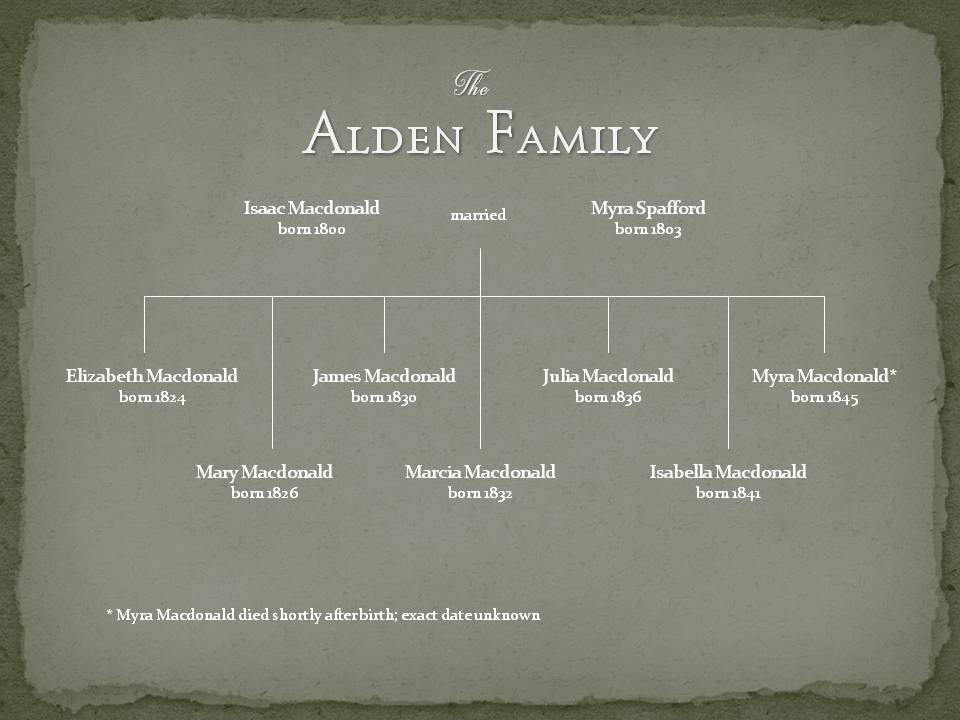
Isaac Macdonald, Isabella’s father, earned his living as a supplier to the leather mills. He owned a paper box factory that sold the containers used by leather mills to ship their finished goods to stores and wholesalers across the country.

Entry from an 1870 county directory listing Isaac Macdonald's business
Entry from an 1870 county directory listing Isaac Macdonald’s business

.

In the mid-1880s residents cast their ballots on the question of whether the thriving village should incorporate as a city. At the same time, a few residents began a campaign to change the name from Gloversville to Kingsborough.

1903 photo of Gloversville Fire Station No. 3

.

Kingsborough is a name that runs consistently through the community. There’s a Kingsborough church and tree-shaded Kingsborough Avenue, a pretty thoroughfare that spans the length of Gloversville.

Kingsborough Avenue, about 1905

.

And the Kingsborough Hotel was a grand building that any town would be proud of. In fact, many residents thought the name Kingsborough would fit the town like, well, a glove.

Kingsborough Hotel as it appeared in 1913

.

Isabella Alden had her own opinion about the name the newly-chartered city should adopt. Here’s an article she wrote for an 1888 local magazine that explained her recommendation:

A City Founded by a Deer

Now, I am going to tell you how this deer, or one that looked like it, founded a city. Of course, you’ll believe what I tell you because I was there and saw it done, having been born there.

Rome, you know, was founded by Romulus; that is to say, he was the “chief spoke in the wheel” when it began to be. Maybe there would never have been built so much as a hut, but for the wide-awake Romulus.

Some years ago, and 150 miles north of New York and about 50 miles west of Albany, there lived a few families in a placed called “Stump City.” It was wild and cold in the winter, almost as Greenland. I have often seen the snow there six feet deep!

Oh, the long and dreary winter! Most of the land was as poor as the snow was deep.

Now this was the very spot where our city was “builded together.” And it was done by the deer, as was said. And it was on this wise: one of those neighbors came home with a deer skin and another neighbor happened in at the time and they said, “What’s the use of a deer skin unless it is tanned and dressed?” So they dressed it after a fashion.

The next thing was to make mittens out of it. And they did that after a fashion, too.

But no sooner were the mittens made than everyone in the neighborhood wanted a pair.

So other skins were bought and they were soon turned into mittens and gloves and moccasins, after a better fashion. And distant neighbors heard of the wonderful wares for the hands and feet in the winter and they came miles to get them.

Then poor cold “Stump City” with its three or four families began to look up. Every man, woman and child went into the business. Even then they could not supply the demand.

Distant towns sent word. “We want some.” Then peddlers started out with horse and sleigh in mid-winter, often with a great load of the precious wares tied with buckskin strings in dozens, and all packed nicely in a big box, so neither snow nor thieves could harm them. Away they would dash, east, west, north, south.

A real city now occupies the place of “Stump City” and its name is Gloversville. It is one of the finest towns in all the great State of New York.

Go through the streets and you’ll be surprised to see how busy every man, woman and child still is. It’s one of the last places to go if you want to . . . rust.
There are machines and machines—often many in the same house, and from early morn till long after sunset they hum and buzz till you’d think everybody and the very air would go crazy. No one goes crazy, however; the hum has become sweetest music to Gloversvillians. It annually makes money for them to the tune of millions, and I am glad to say they pour thousands of it into the Lord’s treasury.

So much for what the deer did. The place should be called Deerville. Go and see it.
As entertaining as it was, Isabella’s story didn’t convince voters to change the town’s name to Deerville . . . but the people who pushed for naming it Kingsborough were disappointed, as well. The citizens voted to keep the name of Gloversville and Isabella’s home town continues to thrive to this day.

A busy intersection: West Fulton Street and Main Street, about 1900
A busy Gloversville intersection: West Fulton Street and Main Street, about 1900


BFFs at Oneida Seminary

Young Isabella Alden in an undated photo

For most of her young life, Isabella Alden was educated at home by her parents and an occasional tutor. But all that changed when she was about fourteen years old.  That’s when her parents enrolled her in Oneida Seminary in Oneida, New York.

The school was almost 80 miles away from her family’s home in Johnstown, New York; but that didn’t mean Isabella would be at the school alone.

Her older sister Marcia and Marcia’s husband Charles Livingston were also at Oneida Seminary. Marcia and Charles lived in apartments on the campus because Charles was a professor at the school; so Isabella had family close by.


Oneida Seminary
Oneida Seminary


At Oneida Seminary the male and female students were separated in their classrooms, study areas and living quarters; so making strong friendships with other female students would have been natural for Isabella. She often crossed paths with Theodosia Toll, who was called Docia. Docia was one of the most popular girls at Oneida Seminary. Her family owned a large farm called Locust Shade about 7 miles away in nearby Verona, New York.

Docia was three years older than Isabella. She was a better scholar, too. She had a reputation for being keen and quick-witted, good-humored and kindly. Everyone thought well of her.

Undated photo of Theodosia Toll


Knowing Isabella was far from her family home, Docia invited her to spend her weekends at Locust Shade but Isabella always refused the invitation. Isabella wrote in “Memories of Yesterdays”:

“I had taken a great dislike to that girl in the earliest days of our acquaintance. . . I avoided her on every occasion possible and declined her invitations for the weekends so haughtily that I wonder she ever asked me again.”

One day Isabella went out of her way to avoid Docia by visiting her sister Marcia in her apartments. She didn’t hold back in complaining to Marcia about “that insufferable girl,” Docia.

Undated photo of Charles Livingston


“If she ever asks me again to go home with her for over Sunday, I’m going to tell her that it takes all the skill I have to invent ways of escaping her society here, and I can’t be expected to follow her home, even though it would be a treat under pleasanter conditions to have a ride.”

Charles had been in the next room and overheard everything Isabella said.

“What a foolish girl you are,” he said almost sadly. “I was saying to Marcia this morning that I could not imagine why you had taken such a dislike to Docia. She is the best scholar in her class, and every teacher in the school speaks highly of her. Certainly her character is above reproach. As for her family, if you knew them you would consider it an honor to be invited to their home. I should.”

After Charles’s scolding—and much prayer and soul searching—Isabella realized why she disliked Docia . . . she was jealous of her!

“My aroused conscience showed me just where I stood. Faint and faulty as were the proofs of it in my life, I knew even then that I belonged to the Lord Jesus Christ; and He came graciously to my help at that hour and showed me plainly not only how offensive in his sight had been my attitude, but also how I had misjudged the other girl.”

The next time Docia invited Isabella to go home with her for the weekend, Isabella accepted. Three weeks later she drove in the Toll family carriage with her new friend Docia to Locust Shade, where she was made a welcome addition to the family. After that first visit, Isabella spent many weekends and school vacations at Locust Shade.

Greeting the Guest by Edward Lamson Henry


That was the beginning of Isabella’s lifelong friendship with Docia Toll. In later years they would both marry, have families of their own, and move away to different parts of the country; but they remained fast friends and confidants who loved each other and collaborated in creating short stories and novels that bore witness to God and their Christian faith.

Who is the Tallest? by Jerry Garrett