At the end of every year, instead of writing about resolutions and goals for the new year, Isabella always posed an important question to readers of The Pansy magazine:
What lesson did you learn from the past year?
Isabella wrote:
I know a boy who has learned during the past year that he can forgive another boy who has done him a great wrong; that he can be pleasant to him, and even help him over a hard place in his school work. I think that is a grand thing to have learned.
I know a girl who has learned by sad experience during the past year that she cannot play with temptation without getting hurt. Seven times she did what she knew mother, and teacher, and friend did not want her to do, without any harm coming from it; but the eighth time—Oh, dear! I will not tell that sad story. I only hint at it to remind you that there are sad ways of learning, as well as pleasant ones.
Well, I could tell you of dozens of others whom I have watched during the year, and of the lessons they have learned, but all that might not help you.
The important question is, What have you learned?
Will you think it over? Let everyone who reads this get pencil and paper and sit down alone to a careful study of the year. You might make two columns, headed:
If you find you have learned you are a bit selfish in your plans, when you did not suspect it, put down the word “Selfishness” in good honest letters in the “Avoid” column. You will understand what it means, and nobody else need know about it.
If you find that you are inclined to be persistent in trifles which have no moral character, give it the true name and write “Obstinacy” in the right column.
If you find that by taking a little care, you have made sunshine in your home, or some other home, print the word “Care” under “Lessons to Practice.”
What interesting columns they will be after you have carefully filled them!
I should like to see the record, but of course, you will not let me. All that will be between you and your best friend, Jesus.
Isabella’s question— What lesson did you learn from the past year?—became an annual question she posed to her readers. And every year she received letters from hundreds of readers, eager to share their lessons learned with their beloved Pansy.
What do you think of this idea?
Do you think adults can benefit from reviewing lessons learned just as much as children can?
Do you make a list of lessons learned or do you make resolutions for the new year? Or both?
In additional to writing novels, Isabella Alden wrote articles and short stories for many different publications.
Her stories and articles were so popular she found herself in a unique position for a writer: She never had to submit her work for publication.
Instead, publishers went to her. Elias Riggs Monfort, the long-time editor of The Herald and Presbyter (a weekly Presbyterian newspaper), gave her a lifetime contract to publish any serials she wrote.
Elias Riggs Monfort, about 1870 (Wikipedia).
Mr. Montfort was such a fan of Isabella’s, he wrote to his friend, Daniel Lothrop, full of praises about Isabella and her stories.
Daniel Lothrop was the owner of D. Lothrop & Company, a Boston publishing house that specialized in books for young people.
Daniel Lothrop.
Daniel Lothrop had been a great reader from his childhood; while he was still a boy himself he developed an ambition to publish books specifically written for children—a novel idea at the time. Even more radical: he believed the books should be beautifully illustrated to serve the story and keep children’s attention.
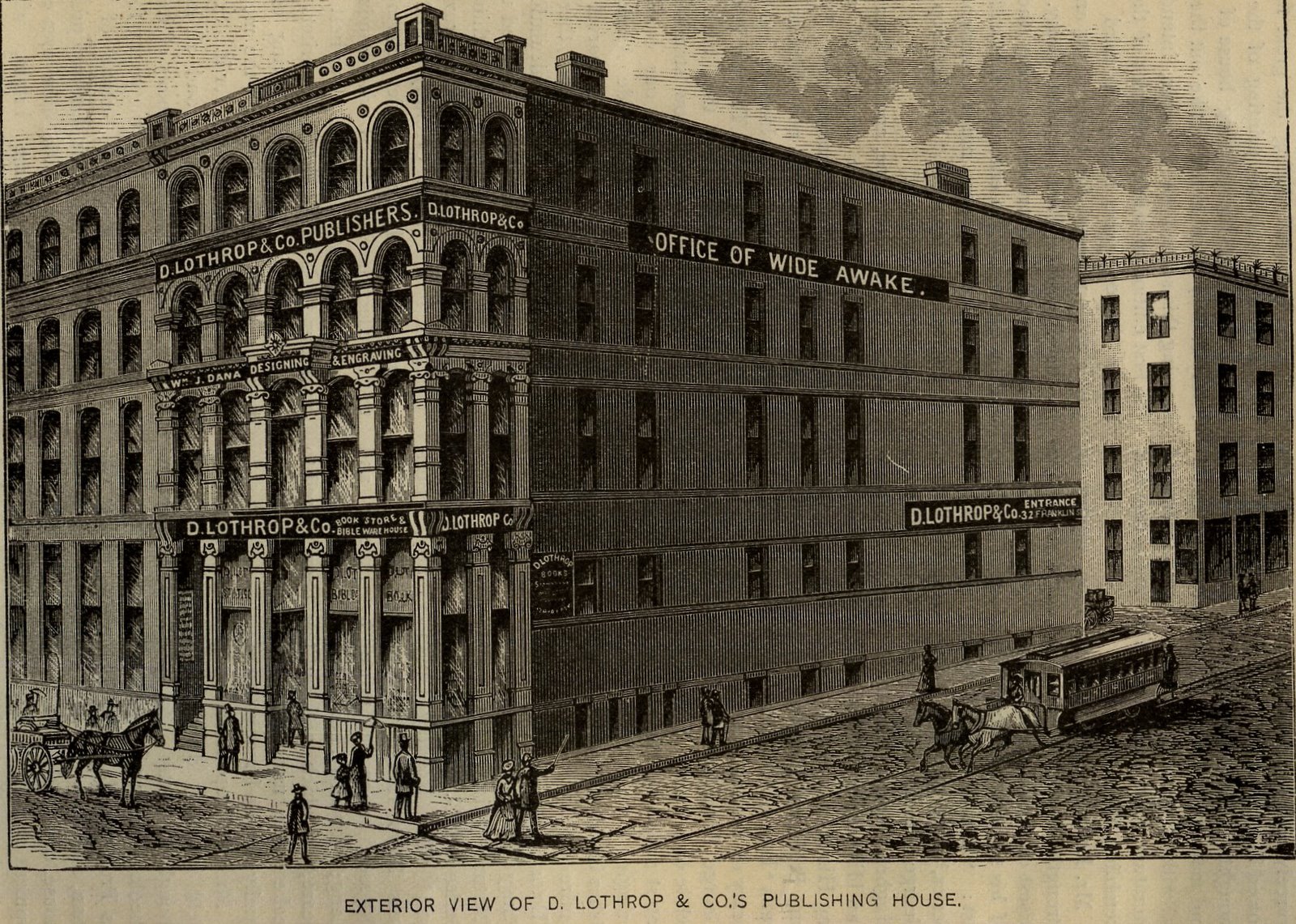
An undated artist’s rendering of the D. Lothrop and Co. Publishing building in Boston, Massachusetts.
But he persisted, believing that it was possible to publish children’s books that were not only entertaining, but encouraged “true, steadfast growth in right living.”
The interior of D. Lothrop and Company.
He often said to the people in his employ: “I publish books to do good as well as to make money. I always ask first, ‘Will this book help the young people?’ rather than ‘How much money is there in it?’”
His long partnership with Isabella began around 1874. After Elias Monfort sang Isabella’s praises to him, Daniel Lothrop invited Isabella to contribute stories to be published in a small weekly Sunday School newspaper he published.
Little One’s Friend, one of D. Lothrop and Company’s beautifully illustrated books for children.
By 1877 that short weekly paper had grown considerably in size and content—and Isabella was its editor!
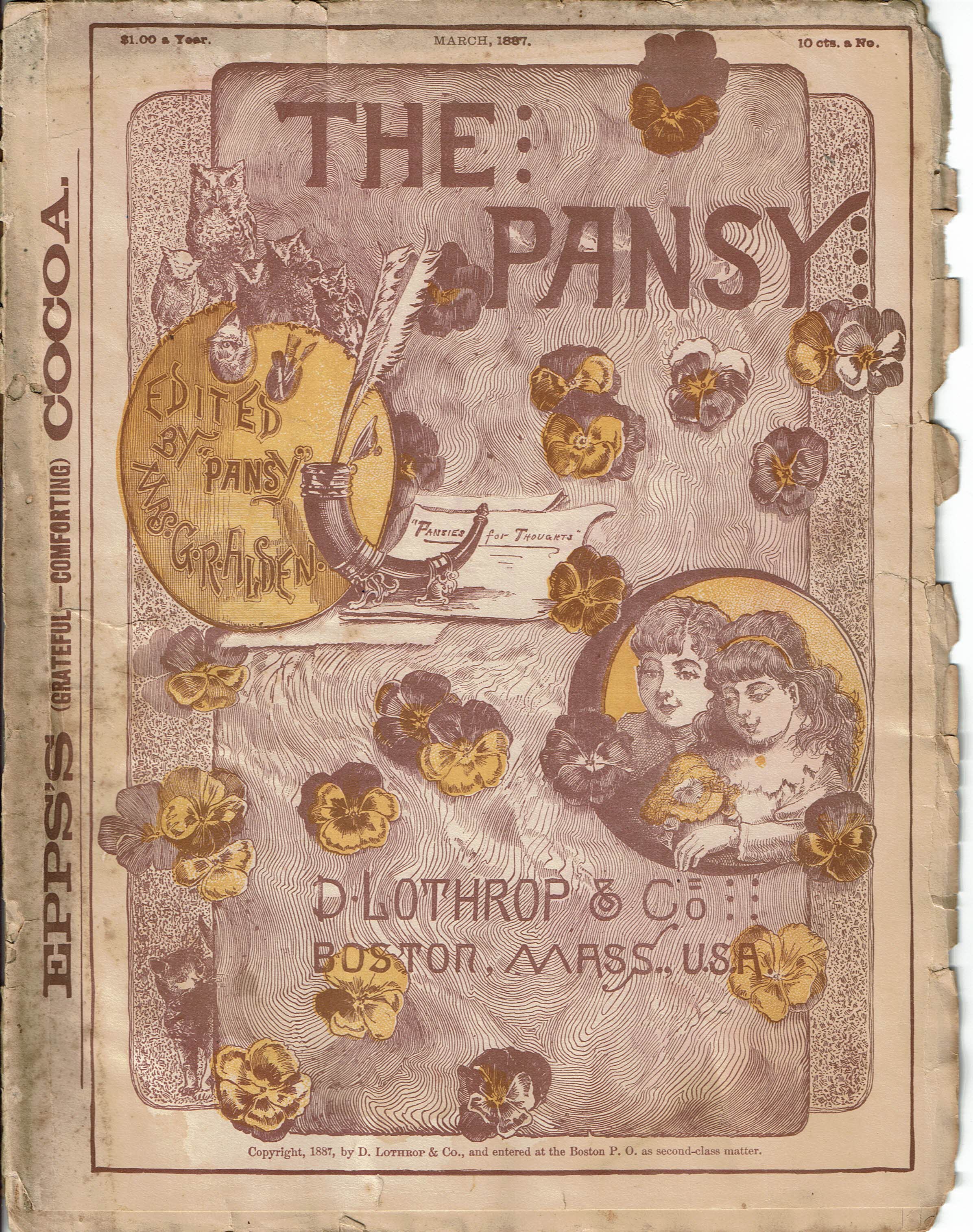
Called The Pansy, each issue was filled with inspiring stories, delightful illustrations, short poems, and descriptions of exotic and far-away places to spark children’s imaginations.
Isabella wrote a short story for each issue, and other members of her family did, too, including her husband, her sister Marcia, niece Grace Livingston, and later, once he was old enough, her son Raymond.
Another frequent contributor was Daniel Lothrop’s wife Harriett, who wrote under the pen name “Margaret Sidney.”
Author Harriet Stone Lothrop, who wrote under the name “Margaret Sidney.”
Isabella wrote that Mr. Lothrop always had “a very warm place in his great warm heart” for The Pansy magazine.
Not only was he fertile in suggestions calculated to make it better, but he was ready always to heartily second the suggestions of others, and to aid in carrying them out.
The Pansy Society in particular was very dear to him. He was interested in everything about the Society, from the content of the letters children wrote to the magazine, to the design of the badges that Isabella sent to Pansy Society members. Isabella said:
“It would be difficult—impossible, indeed—to tell you in how many ways he helped along the cause of truth and right in the world.”
Another common interest Isabella and Lothrop shared was the Christian Endeavor Society. From the early days of the Society, Daniel Lothrop saw an opportunity to use his publishing company to further the Society’s message. He recruited authors to write books of interest to Christian Endeavor members. Margaret Sidney, Faye Huntington, and Grace Livingston were among those who answered the call.
An 1897 newspaper ad showing new Lothrop books by the company’s prized authors.
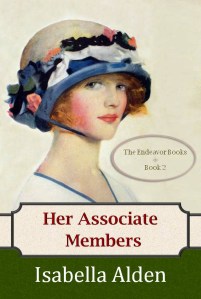
Isabella’s novels, Chrissy’s Endeavor and Her Associate Members were written and published especially for C.E. members.
Isabella’s long partnership with Daniel Lothrop lasted almost twenty years. It ended when he passed away in 1892.
Isabella was heartbroken. In her memoirs she wrote:
“Mr. Lothrop was my true, strong, faithful friend all his life.”
She gently told readers in an issue of The Pansy about the passing of “our friend who loved us, and worked for us and with us.”
It’s impossible to know how many lives were influenced for good by Isabella’s partnership with Daniel Lothrop. Her books alone sold more than 100,000 copies a year, and The Pansy magazine had thousands of subscribers all around the world.
They had formed a perfect partnership. Both Isabella and Daniel Lothrop must have been proud of their accomplishments and the knowledge that they always produced books and stories that were consistently wholesome, pure, and elevating.
You can learn more about The Pansy magazine, The Christian Endeavor Society, and The Pansy Society by reading these previous posts:
When Isabella’s friend Frances Hawley wrote about the Aldens packing up their Chautauqua cottage, she ended her account by saying that the Aldens left for “a prolonged stay in the west.”
For Isabella and her family, “the west” meant California.
Their decision to make the journey had been in the works for some time. By autumn of 1901 the Aldens—Isabella, Ross, and their daughter Frances—were living in Philadelphia, and some key events had taken place in their lives:
Isabella’s husband Ross had retired from the ministry.
Isabella’s son Raymond had completed his Ph.D. at the University of Pennsylvania, and had already moved to Palo Alto, California
Isabella was beginning to feel the passage of time. She was about to turn 60 years old, and Ross was already 69.
Of her advancing age Isabella wrote:
I am really growing old very fast now, you know. It seems to me that I have changed a great deal lately. I cannot do anything as quickly as I once could and I tire very easily.
Their decision to retire to California was probably based on a number of things, the most important of which was that they had always been a tight-knit family; and with the exception of one or two short periods of time, they had always lived together as a family, too.
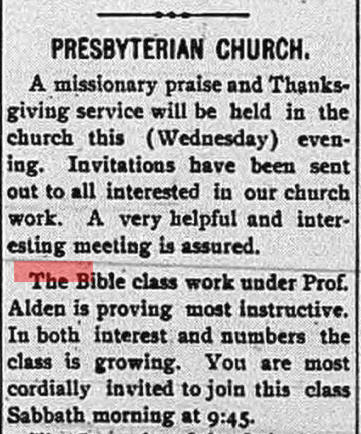
Since Raymond had already moved west, he might have written to them about California’s clean air and warm temperatures. And maybe he had written about the Presbyterian church he was attending and the welcome he received there. By November 1901 he was already teaching a Bible class at church.
From the Palo Alto Press, November 27, 1901.
A Cross-Country Trip
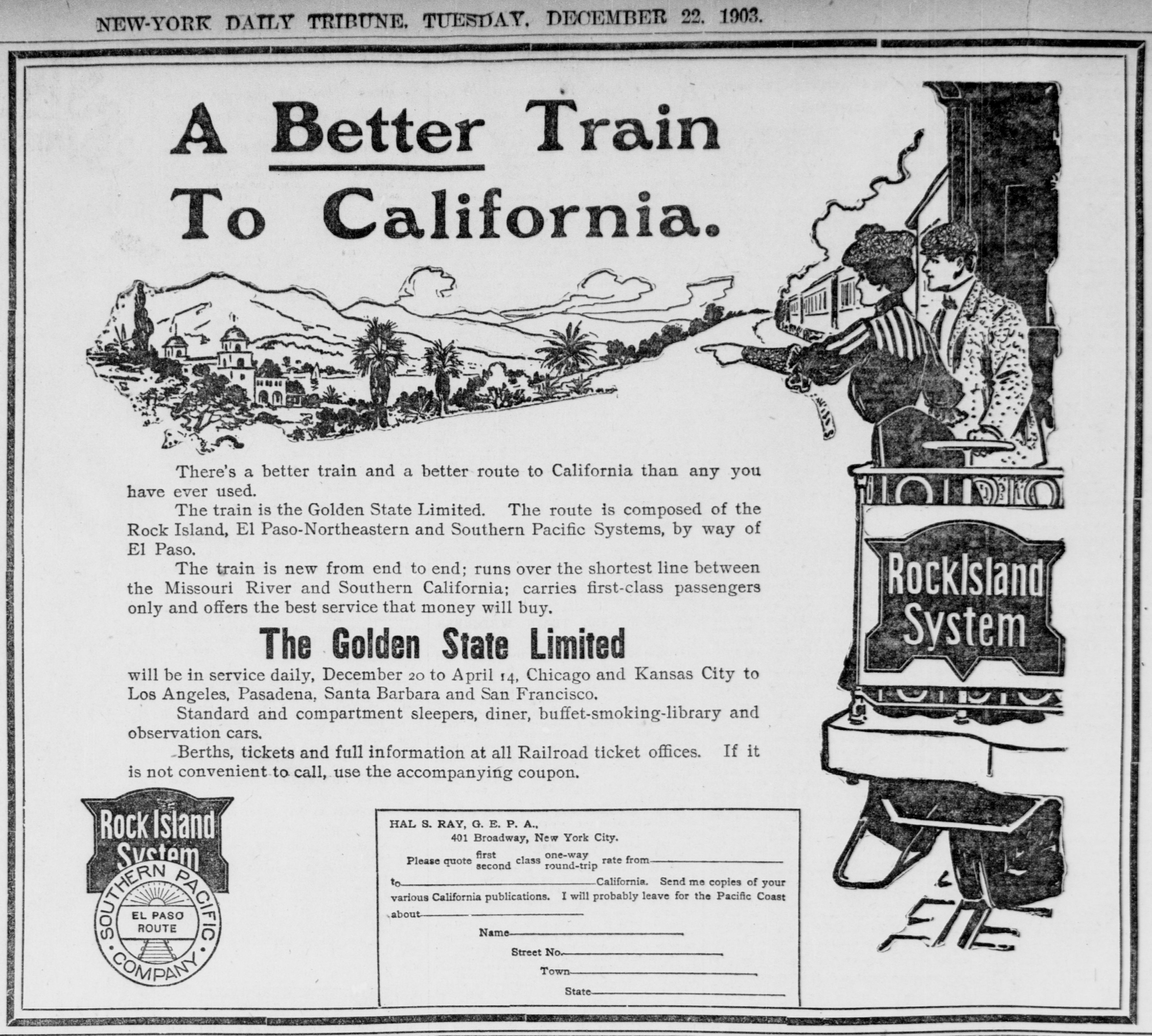
Whatever their reason for make a change, Isabella and Ross finished packing up their belongings at Chautauqua and immediately set out for California to join Raymond.
From the New York Daily Tribune, December 33, 1903.
The first leg of their journey was probably from New York to Chicago. If they took one of the many “express” or “limited” trains, they would have made the journey in about 24 hours. From there, they would have taken a train to California.
From the New York Tribune, December 8, 1903.
A “limited” train, like the one in the ad below, would have taken a direct route from Chicago to San Francisco, and would have made as few stops as possible, bypassing many of the towns on the route.
New York Tribune, April 24, 1902.
On a “limited” train, their journey across the country would have taken about 66 hours, or almost three days. By contrast, travel on a regular train, making all the stops along the way, would have doubled their travel time.
This 1895 map from the Atchison, Topeka and Santa Fe Railroad Company shows the dizzying number of stops a regular train would have made en route from Chicago to San Francisco. Click on the map to see a larger version.
By Christmas 1901 the Aldens were in southern California, staying with their friends, Mr. and Mrs. Carl Johnson.
Isabella’s fame followed her there. A local newspaper, The Los Angeles Herald, caught wind of her visit and arranged to interview her.
In addition to asking Isabella the usual questions (e.g. “How did you get the name Pansy?”) the article listed all Isabella’s work, and noted that in addition to writing novels, Isabella was still:
Editor of the Herald and Presbyter
Associate editor of Christian Endeavor World
Wrote stories every month for The Sunbeam (the Y.W.C.A. Gazette published in London)
Wrote for the Junior Christian Endeavor World
Composed Sunday-school lessons for the Presbyterian church’s “intermediate quarterly”
It’s no wonder Isabella was beginning to feel tired!
The article ended with news that Isabella was going to do a reading the following week from “an unpublished story,” titled David Ransom’s Watch (which was eventually published in 1905).
The interviewer must have asked Isabella what her plans were for the future, because the article ended with this prophetic sentence: “It is probable that the Aldens will make California their home.”
The Aldens continued their stay with the Johnsons through at least the end of January of 1902. Their visit was reported in the Los Angeles Times society page:
From The Los Angeles Times, January 1, 1902.
A New Life in Palo Alto
Sometime in early 1902 the Aldens left Los Angeles and returned to Palo Alto, and they settled into their new life in the Palo Alto community.
They joined the same Presbyterian congregation that had welcomed their son Raymond. By April, Isabella was in San Francisco where she delivered a speech on one of her passions: Mission work at home and abroad.
Around that time the Aldens also began a search for a home large enough to accommodate their entire family and expected houseguests. In the end, they decided to build a custom home that would satisfy their many and unique needs. They purchased property in Palo Alto, hired an architect, and began designing their dream home.
A few years later Isabella and Ross joined other Christians in attending the Mount Hermon Christian Camp when it opened in 1905.
The rustic Mount Hermon train station, about 1910.
Mount Hermon was the first Christian camp west of the Mississippi, and it must have reminded Isabella and Ross of Chautauqua’s early days. Isabella fell in love with the place. She wrote:
I wish I could give you a picture of Mount Hermon, a blessed place where I have spent precious weeks living out under the great redwood trees. It was wild and quaint and beautiful. I have many happy memories connected with it.
For the next few years they made annual trips to Mount Hermon until health concerns prevented them from traveling there.
From Daily Palo Alto Times, 1907.
Through all these new experiences Isabella kept busy writing books. Between 1901 and 1908 she published eight books, most of which were written with her adult readers in mind:
Mag and Margaret: A Story for Girls (1901)
Mara (1902)
Unto the End (1902)
Doris Farrand’s Vocation (1904)
David Ransom’s Watch (1905)
Ester Ried’s Namesake (1906)
Ruth Erskine’s Son (1907)
The Browns at Mt. Hermon (1908)
Isabella Returns to Chautauqua
Isabella also found time to return to Chautauqua on probably two occasions, where she stayed with friends or relatives who had cottages there.
In May 1912 Isabella and Ross traveled to New York, where they first visited her dear friend Theodosia Toll Foster (who co-wrote a number of books with Isabella under the nom de plume Faye Huntington). It is very possible the Aldens went from there to Chautauqua in June when the 1912 season commenced.
from the Rome New York) Daily Sentinel, May 14, 1912.
In 1914 the Aldens were again at Chautauqua, where Isabella and her niece, Grace Livingston Hill were among the authors honored at a C.L.S.C. reception.
By August of that year they were back home in California, where they were “welcomed by many of their friends.”
The Palo Altan, August 21, 1914.
It’s possible Isabella visited Chautauqua again in the years following, but no record of those visits survives.
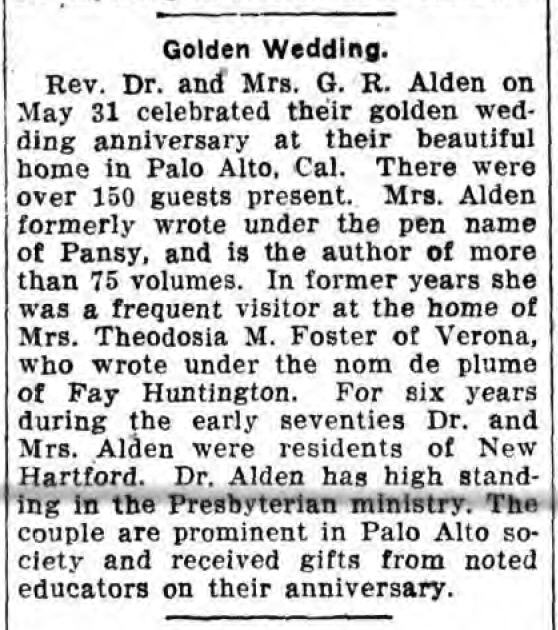
Whether Isabella visited Chautauqua again or not, her friends at Chautauqua and in New York certainly kept track of her as a favorite daughter. In 1916 the newspaper in Rome, New York (located near the town in which Isabella was born and raised) covered Isabella and Ross’s golden wedding anniversary celebration with this article:
The Rome Daily Sentinel, June 6, 1916.
The article’s mention of their prominent place in Palo Alto society is a testament to the loving friendships the Aldens formed in their new home in California.
October 1901 marked a milestone in Isabella’s life.
For decades she and her husband Ross and other members of their family had been deeply involved with Chautauqua Institution. Isabella strongly believed in its core principles, and she immersed herself in furthering Chautauqua’s mission.
Isabella, Ross, Raymond, and family on the steps of their Chautauqua cottage (1875).
Every summer for decades she taught classes at Chautauqua, and encouraged friends and acquaintances to attend the summer session. She helped extend Chautauqua’s outreach by quietly encouraging people she met in all walks of life to embrace the CLSC and its educational offerings.
And more than any other ambassador, she inspired an entire generation of readers to experience the place for themselves after reading about it in Isabella’s many novels about Chautauqua.
During the course of their marriage Isabella and Ross lived in many places; his occupation as a minister often required them to move from one church to another. But almost without fail their summers took them back to Chautauqua. For Isabella, who was born and raised in New York, her annual trips to Chautauqua must have felt very much like a homecoming.
Over the years Isabella and Ross rented different cottages on Chautauqua’s grounds. Many of them have since been demolished and replaced by newer buildings.
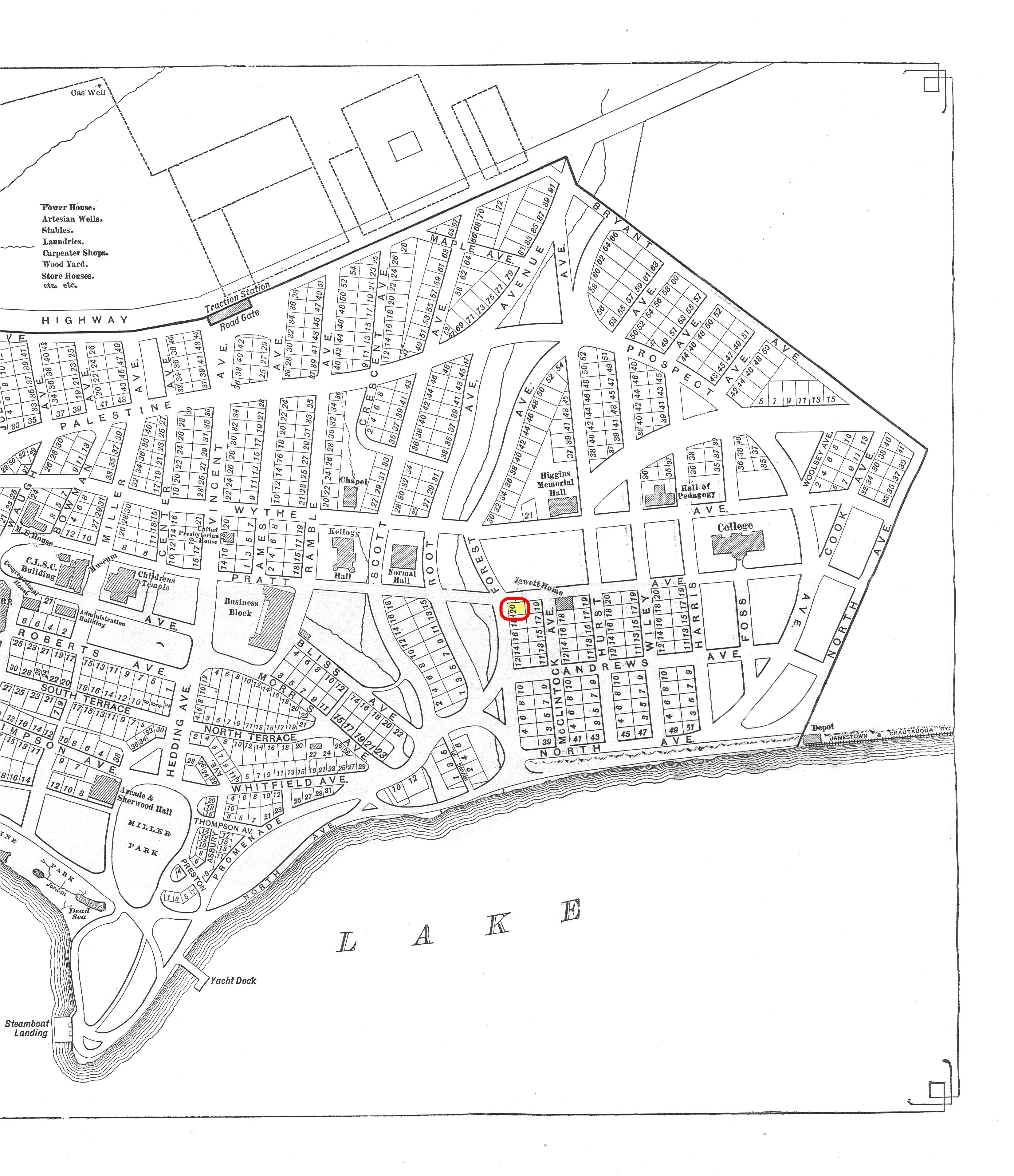
One of the last cottages they occupied was at 20 Forest Avenue, bounded to the north by the shore of Lake Chautauqua and to the east by normal Hall.
Excerpt from a map of Chautauqua with the Alden’s corner lot on Forest Avenue marked in red. Click on the map to see a larger version.
The house was built in 1890 and still stands today dressed in sunny yellow with white trim.
The house at 20 Forest Avenue, Chautauqua as it appears today (from Google Maps 2012).
Isabella and her family spent a few summers in that cottage, including the summer of 1901. And when the Chautauqua season ended in early September they, like all the other summer residents, made their way to the railroad depot and returned to their “regular” home.
Few people know, however, that just a few weeks later Isabella and Ross quietly returned to Chautauqua to pack up their belongings and leave Chautauqua for the last time.
How different Chautauqua must have seemed to them in October; and how quiet it must have been, with its closed cottages, empty meeting halls, and deserted dining rooms!
The empty park in front of the Administration building in January 1902.
Frances Hawley knew what Chautauqua was like off season. She was a year-round Chautauqua resident and Isabella’s friend. She was on hand when Isabella and Ross, along with their little daughter Francis, arrived at Chautauqua to pack up their possessions.
The Aldens intended to stay with Frances only a day or two, but their stay soon lengthened into a week, for there was much to do. Frances wrote:
They were very busy packing books and sorting papers and manuscripts. [Ross] would come in at night utterly weary, but with a big basketful to be looked over during the evening. They were obliged to stop and eat, and were tired enough at meal time to be glad of a little rest; and so three times a day our food was spiced with anecdotes and stories, wise and pithy sayings, and with the jokes that had been perpetrated upon old Chautauquans by the inimitable Frank Beard.
Wouldn’t it have been wonderful to be in that room and hear those stories about Frank Beard and his practical jokes?
Frank Beard giving an impromptu Chalk Talk to a group of young Chautauquans.
Frances said this about her friend Isabella:
The bright and sparkling style that has made Mrs. Alden’s books so attractive is hers outside of book covers, and her sweet and winning ways won all the hearts of the household.
Frances also described the moment when she realized the Alden’s visit was quickly coming to an end:
When at the close of their visit we parted with them and realize that it might be long before we could again have her kindly sympathy or feel the warm pressure of his hand and see the merry twinkle of his eye, the delight that the pleasure of this visit had given us was tinged with sadness and we were loath to let them go.
It’s sad to think that when Isabella and her family left Chautauqua that October day, they did so knowing they might never again see the place they had loved so much for so many years.
Their departure marked the end of an era for Chautauqua Institution. But Isabella and Ross were ready to move on to the next chapter of their life together.
Many of Isabella’s characters played musical instruments, the most common of which was the piano.
Sadie Ried was a talented pianist in Ester Ried, as was Dell Bronson in The King’s Daughter.
Dell’s beloved piano was located “in the little summer parlor,” and she often turned to “her dear piano” for company.
She touched the keys with a sort of tremulous eagerness, and soft, sweet plaintive sounds filled the room.
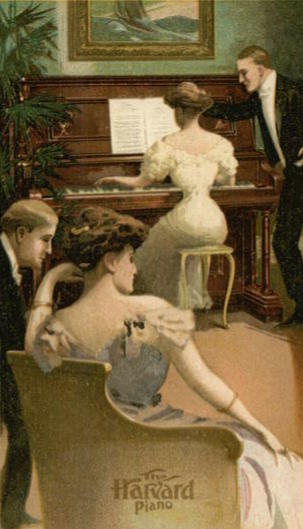
But a piano was an expensive luxury the majority of Americans could ill afford, despite ads like this one that invited buyers to purchase a piano (or organ) on credit.
For those who could not afford to have a piano in their home, there were plenty of other musical instruments to be had.
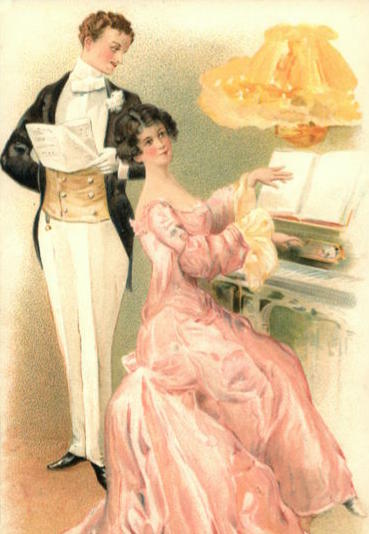
“Leisure Hours” by Hugo Breul.
Many ladies strummed guitars (Louise Morgan played one in A New Graft on the Family Tree), and some even learned to play banjo.
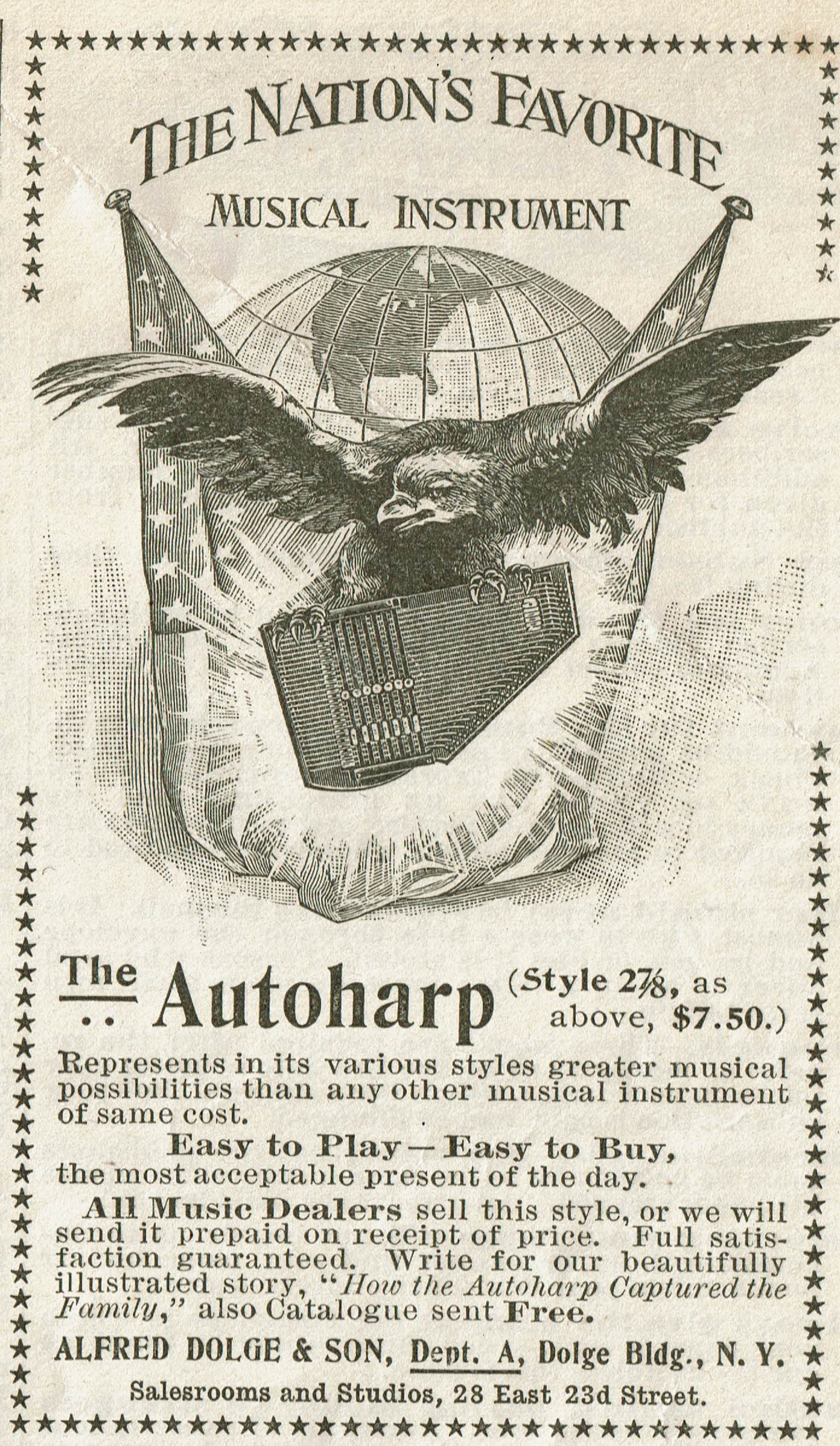
But one of the most popular musical instruments during Isabella’s lifetime was the autoharp.
Autoharps were extremely affordable—some styles were priced as low at $5.00.
Even better, they were easily portable. They went from home to school, from church to social functions—anywhere musical accompaniment was needed.
Autoharps were relatively easy to learn to play, and thanks to some astute publishing houses, sheet music for the autoharp—from hymns to operas to college songs—was plentiful and affordable.
An 1896 newspaper ad for the Dolge Autoharp.
By 1899 manufacturers began advertising the autoharp as “America’s favorite instrument.”
Brothers making music on a banjolele and an autoharp (about 1910).
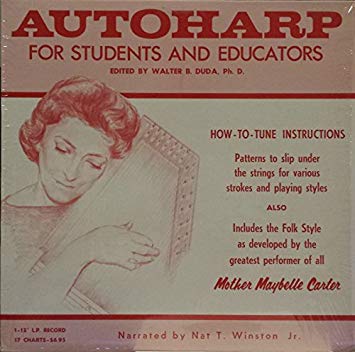
Autoharps remained popular for decades into the twentieth century. School teachers across the country used autoharps to introduce children to the basic principles of music and singing. And their distinctive sound became a mainstay in early country music recordings.
Autoharp for educators booklet, featuring an image of country artist Maybelle Carter on the cover.
Have you ever heard an autoharp played before? Have you ever played one yourself? Tell us about it!
As the wife of a Presbyterian minister, Isabella moved houses fairly regularly, depending on when and where the church assigned her husband.
In the early 1890s Isabella, Ross, and their son Raymond were living in Washington D.C., where Ross was assistant pastor at Eastern Presbyterian Church.
Church listing in an 1892 issue of the Washington, D.C. Evening Star newspaper
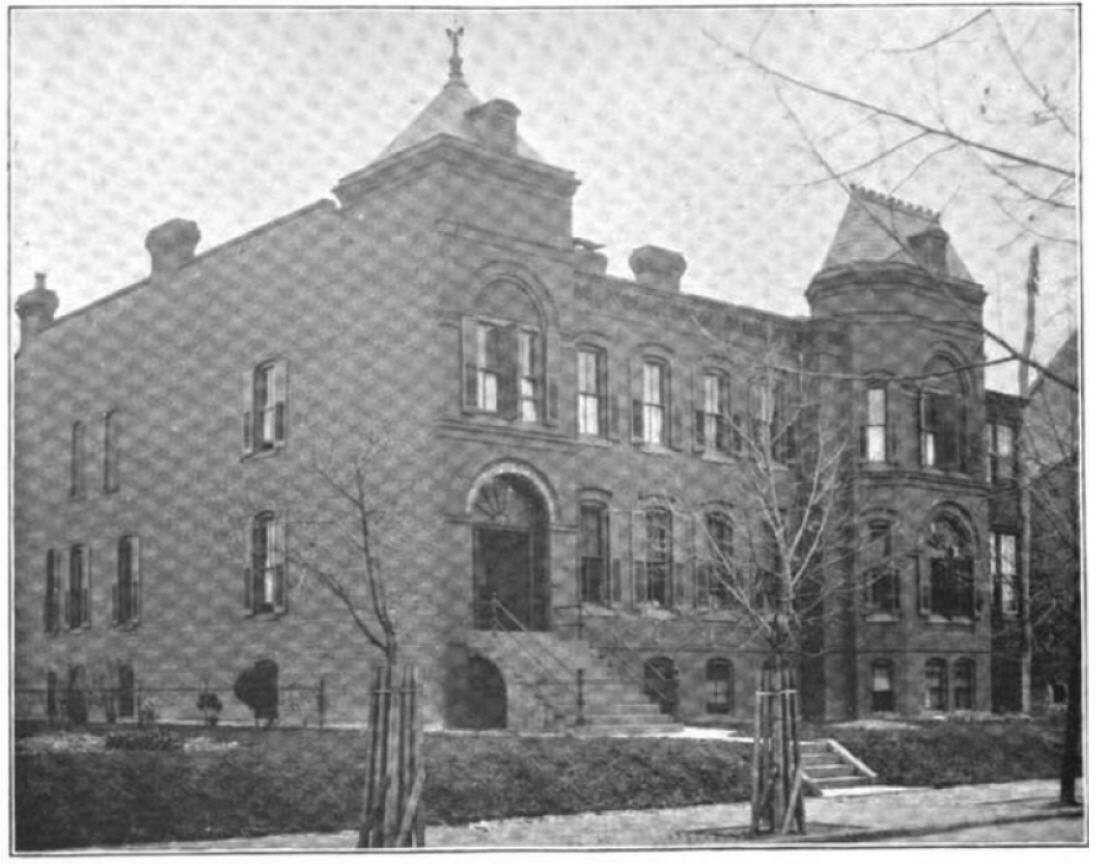
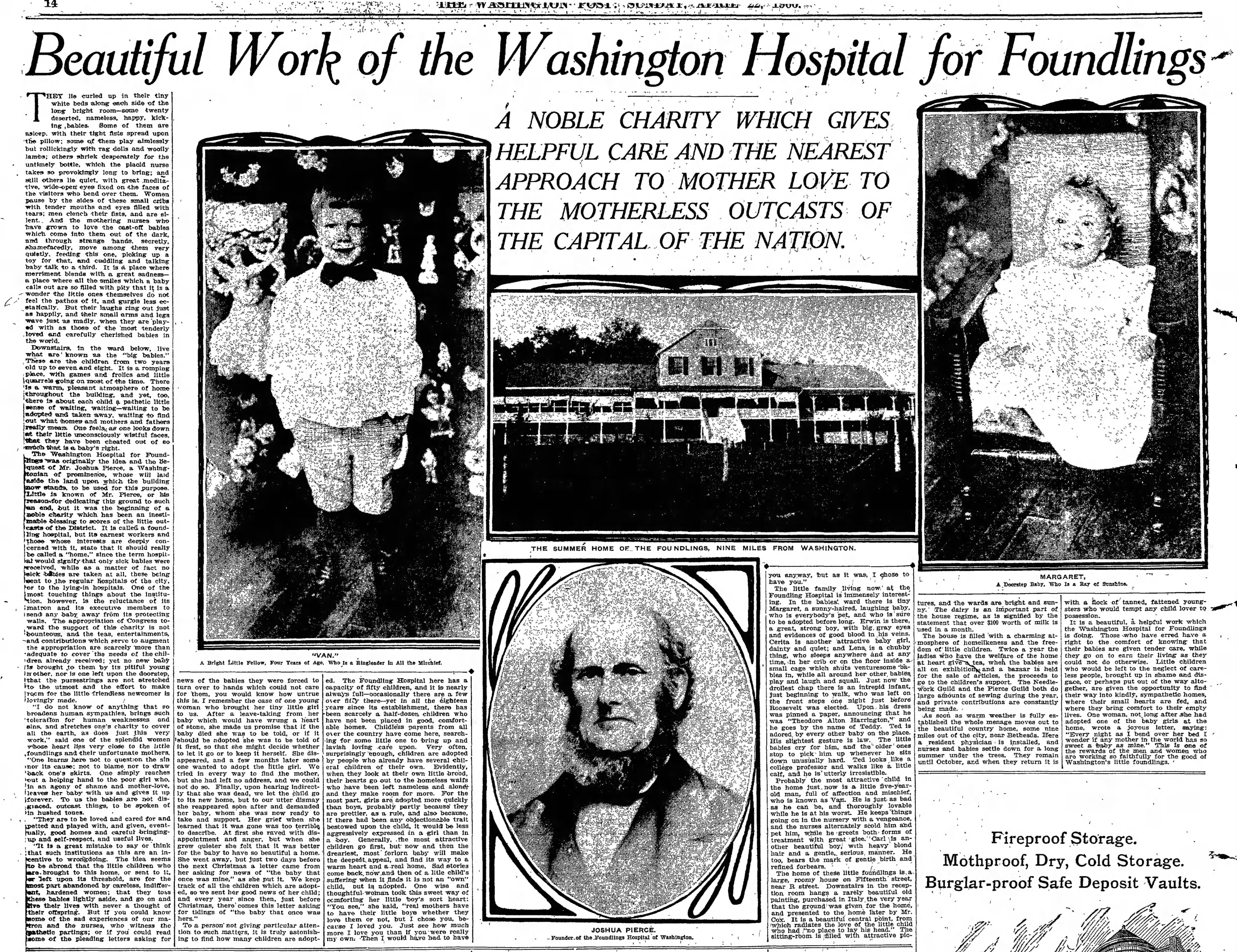
While living in Washington D.C., Isabella became involved with the Washington Hospital for Foundlings, which, at the time, had been in operation for about five years.
The Washington Hospital for Foundlings
Knowing how much Isabella loved children, it’s not surprising she would work diligently on behalf of the foundling hospital; but Isabella didn’t stop there. She went one step further and got her “Blossoms” involved, too.
The foundling hospital playroom in 1905
“Blossoms” was the name Isabella called the children who subscribed to The Pansy Magazine, a weekly magazine Isabella edited for children. Children from around the world subscribed to the magazine, and when Isabella mentioned in an issue of the magazine that the foundling hospital was in need of funds, her little Blossoms went into action.
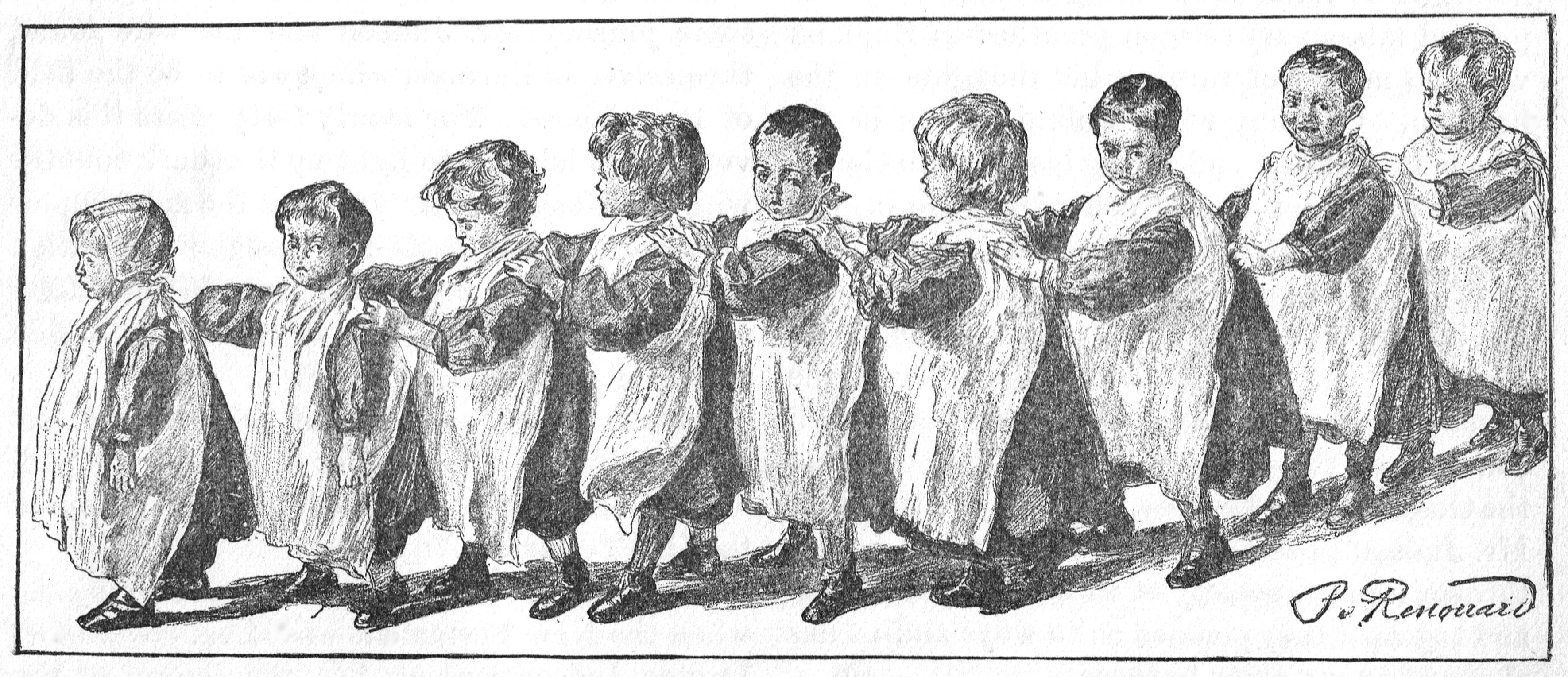
An illustration from The Pansy magazine, 1885.
For a period of about four years, children from around the world sent contributions to the hospital.
Their individual contributions were as large as a 25 cent-piece and as small as a 2-cent postage stamp. That doesn’t sound like a lot, but over time their total contributions amounted to $440.88.
That’s the equivalent of $13,783.00 in today’s money!
In return, Isabella wrote regular descriptions of her visits to the foundling hospital, which were published in the magazine. You can click on the following image to read one of Isabella’s accounts.
Click on this image to read one of Isabella’s reports from 1892.
When you stop to think how hard a child had to work to earn so much as a penny in the late 1800s, the children’s total contribution is astonishing; but they were such devoted readers of Isabella’s magazine, they never failed to answer her call for help.
Interestingly, around this time, Isabella and Ross adopted a baby girl, whom they named Frances. From Federal Census records we know Frances was born in Washington D.C. around 1892, the same time period in which Isabella was regularly involved with the foundling hospital. It’s possible Isabella came across Frances during the course of one of her visits and fell in love with the infant Frances to such a degree she decided to take her home.
With less than thirty days left of summer, it’s natural for Americans to try to spend as much time out of doors as possible before the weather begins to change.
And one popular way to do that is on a bicycle.
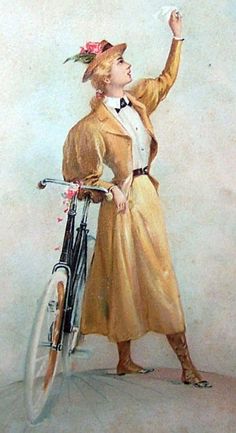
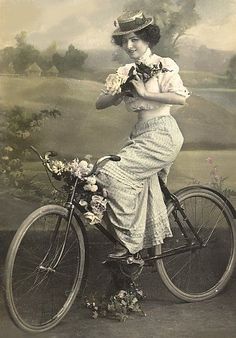
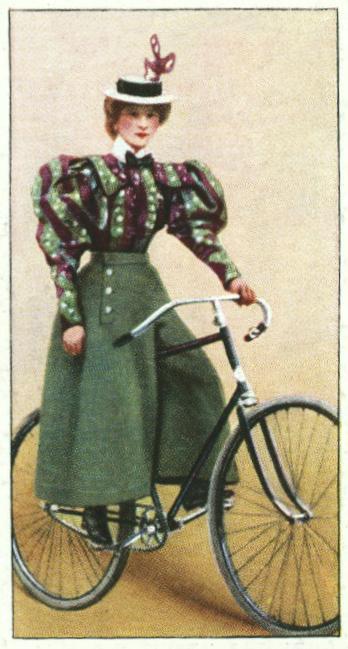
Lady cyclists in 1898. Their outfits include jaunty hats, puffed sleeves, and purses hung from clips attached to their belts.
Bicycle riding was extremely popular during Isabella Alden’s lifetime, especially for women. It gave them instant mobility, and a way to escape the homes they had been confined to for generations.
With a bicycle women could travel to see new sights or tour new towns—and they could do it without being dependent on a man.
Suffragist Susan B. Anthony said bicycling “has done more to emancipate women than anything else in the world.”
The cover of Lippincott’s Magazine, July 1896.
Author and cycling advocate Lillias Campbell Davidson wrote that bicycle riding helped women escape their homes:
The lives of women have been unnaturally cramped and contracted within doors.
She encouraged housewives to take up cycling. She believed a good, healthy ride would help them return to their work “cheered, refreshed and braced to take up the burden of daily commonplace life once more.”
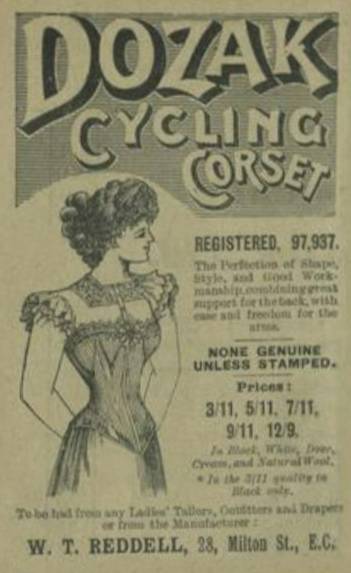
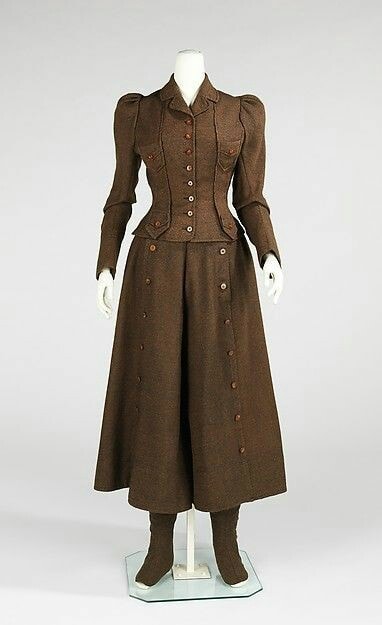
Another advantage cycling had for women was the change it made in their wardrobes. By 1900 women cyclists were wearing split skirts when riding, and many cycling women shed their corsets and petticoats for more practical attire.
From the December 1896 issue of The Lady Cyclist magazine
Not everyone liked the changes. When one Baltimore woman was criticized for wearing “bloomers” (as the divided skirts were called) while riding her bike, she replied:
“I can ride faster than people can talk.”
A ladies’ bicycle suit with divided skirt, 1898.
By 1898 bicycle sales to women were booming, thanks in large part to Sears, Roebuck & Company.
They began marketing affordable bicycles to ladies, and even printed a specialty catalog to market the many different models they offered.
Sears, Roebuck & Co. Bicycles specialty catalog of 1901.
Before long, women across the country were riding Sears bicycles, and discovering for themselves the thrill of healthy exercise and the freedom of traveling under their own power.
Are you a bicycle rider? What do you like most about the sport?
Isabella Alden began keeping a journal at a young age. From the time she was about seven years old she used a journal to take notes during Sunday church services, write Bible verses she wanted to remember, and record topics to discuss with her father.
Keeping a journal was a lifelong habit for Isabella, and in her novels, she sometimes made journalling a habit of her characters, too. (Have you read Docia’s Journal or Gertrude’s Diary?)
Journaling is just as popular today as it was in Isabella’s time.
Do you keep a journal?
Would you like to?
To start you off on the path to using a journal, we’re giving away two Journal Prize Packages to readers of Isabella’s blog!
Each prize package includes:
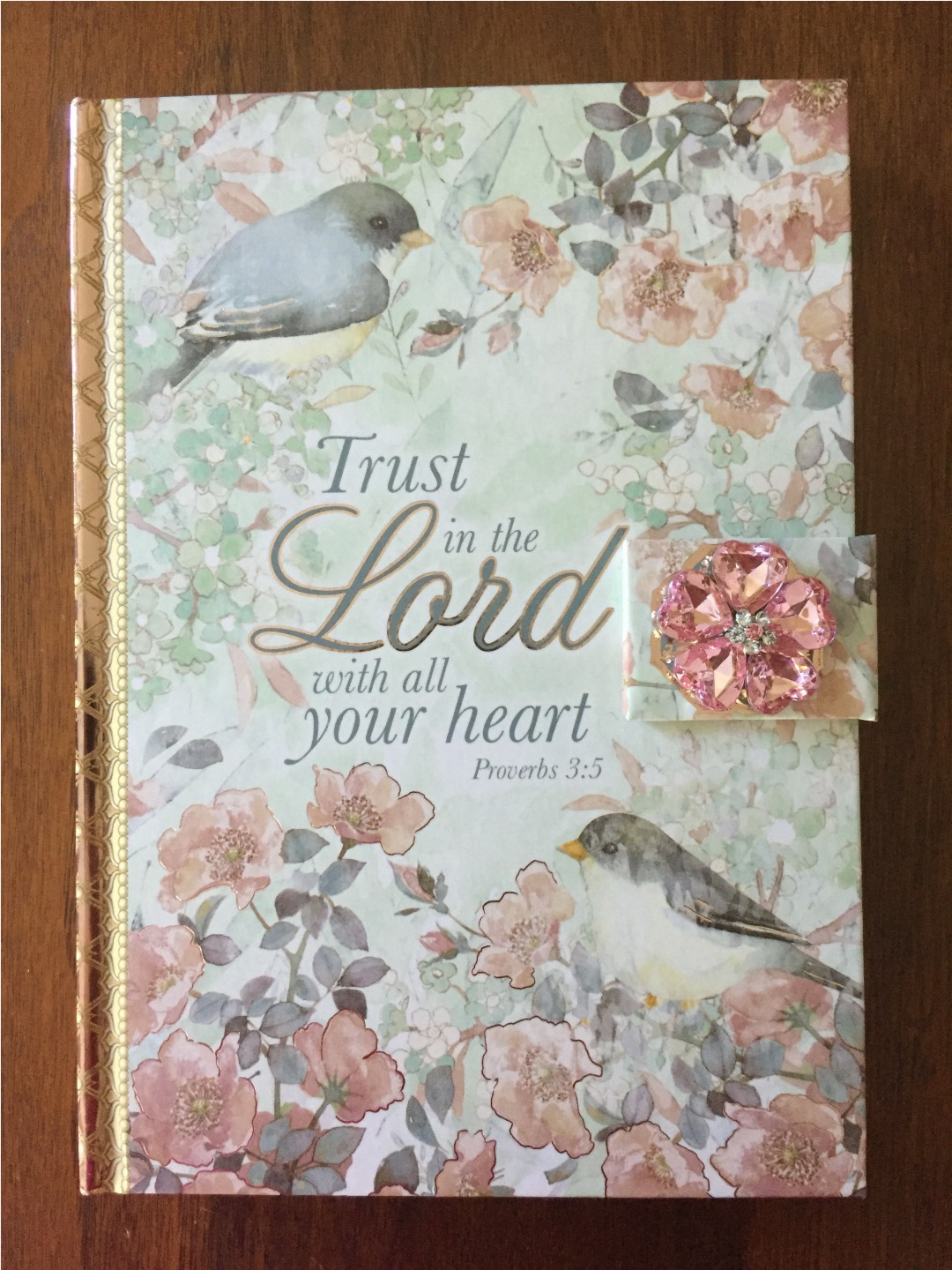
A lovely journal with a magnetic jeweled clasp . . .
.
A coordinating ballpoint pen . . .
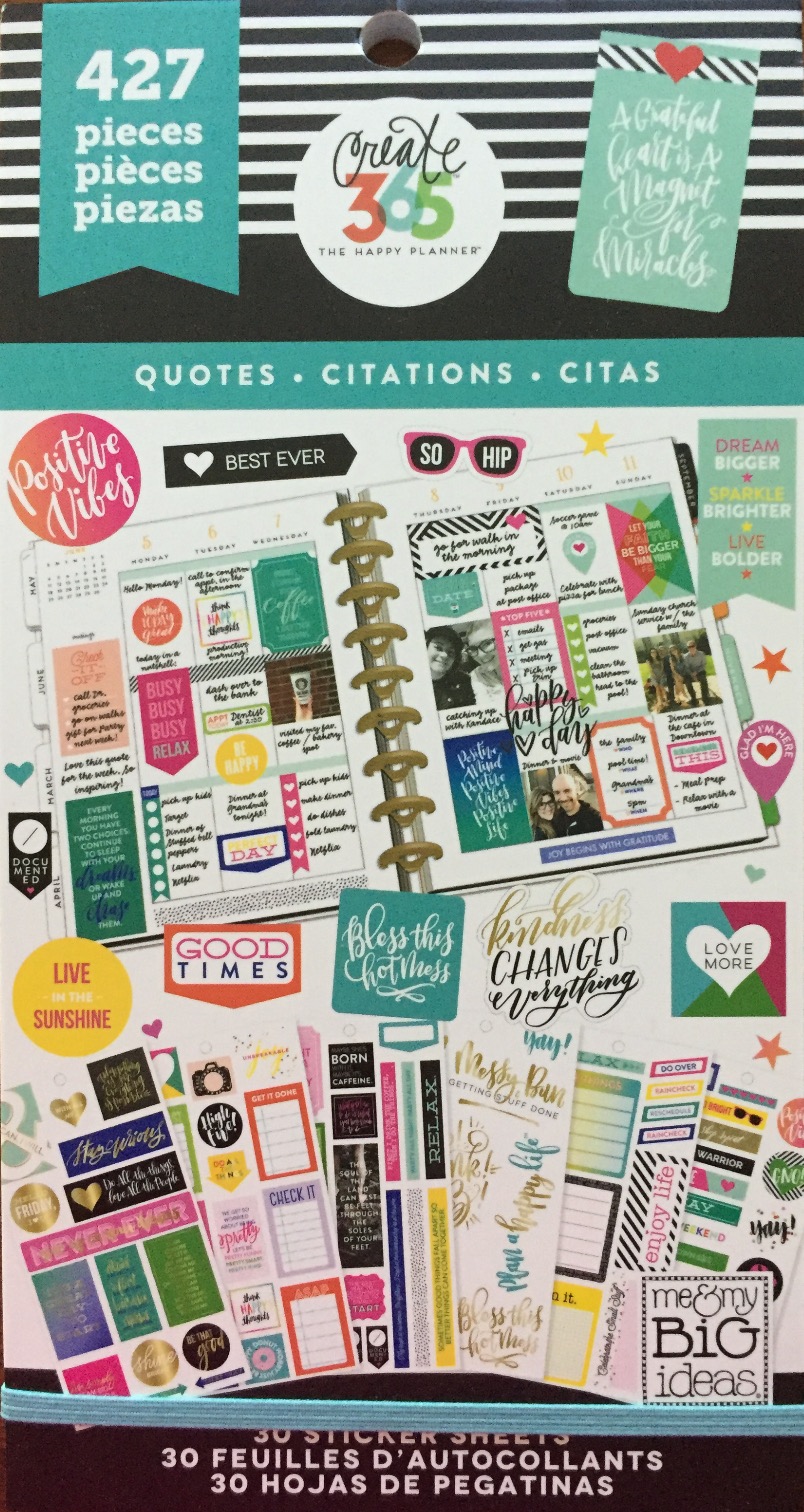
And a book of fun and inspiring stickers to give you a jump start on your journal adventure.
To enter the drawing, just leave a comment below no later than midnight EDST on Sunday, July 28, 2019.
We’ll announce the two winners on Monday, July 29, 2019.
Reviews and giveaways for Christian fiction and sweet, clean fiction. Bringing readers information on great stories and connecting authors with their readers.