Pansy’s Farewell to Chautauqua

October 1901 marked a milestone in Isabella’s life.

For decades she and her husband Ross and other members of their family had been deeply involved with Chautauqua Institution. Isabella strongly believed in its core principles, and she immersed herself in furthering Chautauqua’s mission.

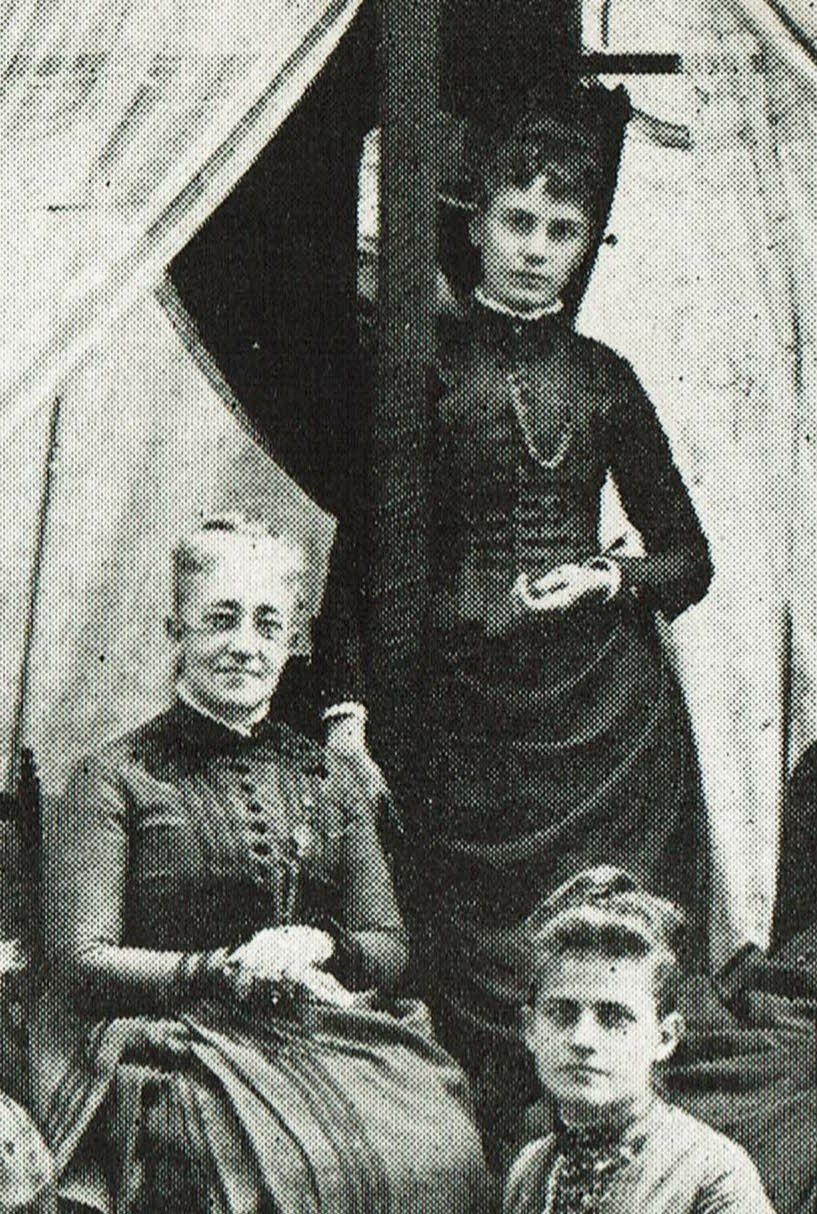
Isabella, Ross, Raymond, and family on the steps of their Chautauqua cottage (1875).

Every summer for decades she taught classes at Chautauqua, and encouraged friends and acquaintances to attend the summer session. She helped extend Chautauqua’s outreach by quietly encouraging people she met in all walks of life to embrace the CLSC and its educational offerings.

And more than any other ambassador, she inspired an entire generation of readers to experience the place for themselves after reading about it in Isabella’s many novels about Chautauqua.

During the course of their marriage Isabella and Ross lived in many places; his occupation as a minister often required them to move from one church to another. But almost without fail their summers took them back to Chautauqua. For Isabella, who was born and raised in New York, her annual trips to Chautauqua must have felt very much like a homecoming.

Over the years Isabella and Ross rented different cottages on Chautauqua’s grounds. Many of them have since been demolished and replaced by newer buildings.

One of the last cottages they occupied was at 20 Forest Avenue, bounded to the north by the shore of Lake Chautauqua and to the east by normal Hall.

Excerpt from a map of Chautauqua with the Alden’s corner lot on Forest Avenue marked in red. Click on the map to see a larger version.

The house was built in 1890 and still stands today dressed in sunny yellow with white trim.

The house at 20 Forest Avenue, Chautauqua as it appears today (from Google Maps 2012).

Isabella and her family spent a few summers in that cottage, including the summer of 1901. And when the Chautauqua season ended in early September they, like all the other summer residents, made their way to the railroad depot and returned to their “regular” home.

Few people know, however, that just a few weeks later Isabella and Ross quietly returned to Chautauqua to pack up their belongings and leave Chautauqua for the last time.

How different Chautauqua must have seemed to them in October; and how quiet it must have been, with its closed cottages, empty meeting halls, and deserted dining rooms!

The empty park in front of the Administration building in January 1902.

Frances Hawley knew what Chautauqua was like off season. She was a year-round Chautauqua resident and Isabella’s friend. She was on hand when Isabella and Ross, along with their little daughter Francis, arrived at Chautauqua to pack up their possessions.

The Aldens intended to stay with Frances only a day or two, but their stay soon lengthened into a week, for there was much to do. Frances wrote:

They were very busy packing books and sorting papers and manuscripts. [Ross] would come in at night utterly weary, but with a big basketful to be looked over during the evening. They were obliged to stop and eat, and were tired enough at meal time to be glad of a little rest; and so three times a day our food was spiced with anecdotes and stories, wise and pithy sayings, and with the jokes that had been perpetrated upon old Chautauquans by the inimitable Frank Beard.

Wouldn’t it have been wonderful to be in that room and hear those stories about Frank Beard and his practical jokes?

Frank Beard giving an impromptu Chalk Talk to a group of young Chautauquans.

Frances said this about her friend Isabella:

The bright and sparkling style that has made Mrs. Alden’s books so attractive is hers outside of book covers, and her sweet and winning ways won all the hearts of the household.

Frances also described the moment when she realized the Alden’s visit was quickly coming to an end:

When at the close of their visit we parted with them and realize that it might be long before we could again have her kindly sympathy or feel the warm pressure of his hand and see the merry twinkle of his eye, the delight that the pleasure of this visit had given us was tinged with sadness and we were loath to let them go.

It’s sad to think that when Isabella and her family left Chautauqua that October day, they did so knowing they might never again see the place they had loved so much for so many years.

Their departure marked the end of an era for Chautauqua Institution. But Isabella and Ross were ready to move on to the next chapter of their life together.

Next week: Isabella Goes West!

Let’s Make Beautiful Music

Many of Isabella’s characters played musical instruments, the most common of which was the piano.

Sadie Ried was a talented pianist in Ester Ried, as was Dell Bronson in The King’s Daughter.

Dell’s beloved piano was located “in the little summer parlor,” and she often turned to “her dear piano” for company.

She touched the keys with a sort of tremulous eagerness, and soft, sweet plaintive sounds filled the room.

But a piano was an expensive luxury the majority of Americans could ill afford, despite ads like this one that invited buyers to purchase a piano (or organ) on credit.

For those who could not afford to have a piano in their home, there were plenty of other musical instruments to be had.

“Leisure Hours” by Hugo Breul.

Many ladies strummed guitars (Louise Morgan played one in A New Graft on the Family Tree), and some even learned to play banjo.

But one of the most popular musical instruments during Isabella’s lifetime was the autoharp.

Autoharps were extremely affordable—some styles were priced as low at $5.00.

Even better, they were easily portable. They went from home to school, from church to social functions—anywhere musical accompaniment was needed.

Autoharps were relatively easy to learn to play, and thanks to some astute publishing houses, sheet music for the autoharp—from hymns to operas to college songs—was plentiful and affordable.

An 1896 newspaper ad for the Dolge Autoharp.

By 1899 manufacturers began advertising the autoharp as “America’s favorite instrument.”

Brothers making music on a banjolele and an autoharp (about 1910).

Autoharps remained popular for decades into the twentieth century. School teachers across the country used autoharps to introduce children to the basic principles of music and singing. And their distinctive sound became a mainstay in early country music recordings.

Autoharp for educators booklet, featuring an image of country artist Maybelle Carter on the cover.

Have you ever heard an autoharp played before? Have you ever played one yourself? Tell us about it!

Pansy and the Orphans

As the wife of a Presbyterian minister, Isabella moved houses fairly regularly, depending on when and where the church assigned her husband.

In the early 1890s Isabella, Ross, and their son Raymond were living in Washington D.C., where Ross was assistant pastor at Eastern Presbyterian Church.

Church listing in an 1892 issue of the Washington, D.C. Evening Star newspaper

While living in Washington D.C., Isabella became involved with the Washington Hospital for Foundlings, which, at the time, had been in operation for about five years.

The Washington Hospital for Foundlings

Knowing how much Isabella loved children, it’s not surprising she would work diligently on behalf of the foundling hospital; but Isabella didn’t stop there. She went one step further and got her “Blossoms” involved, too.

The foundling hospital playroom in 1905

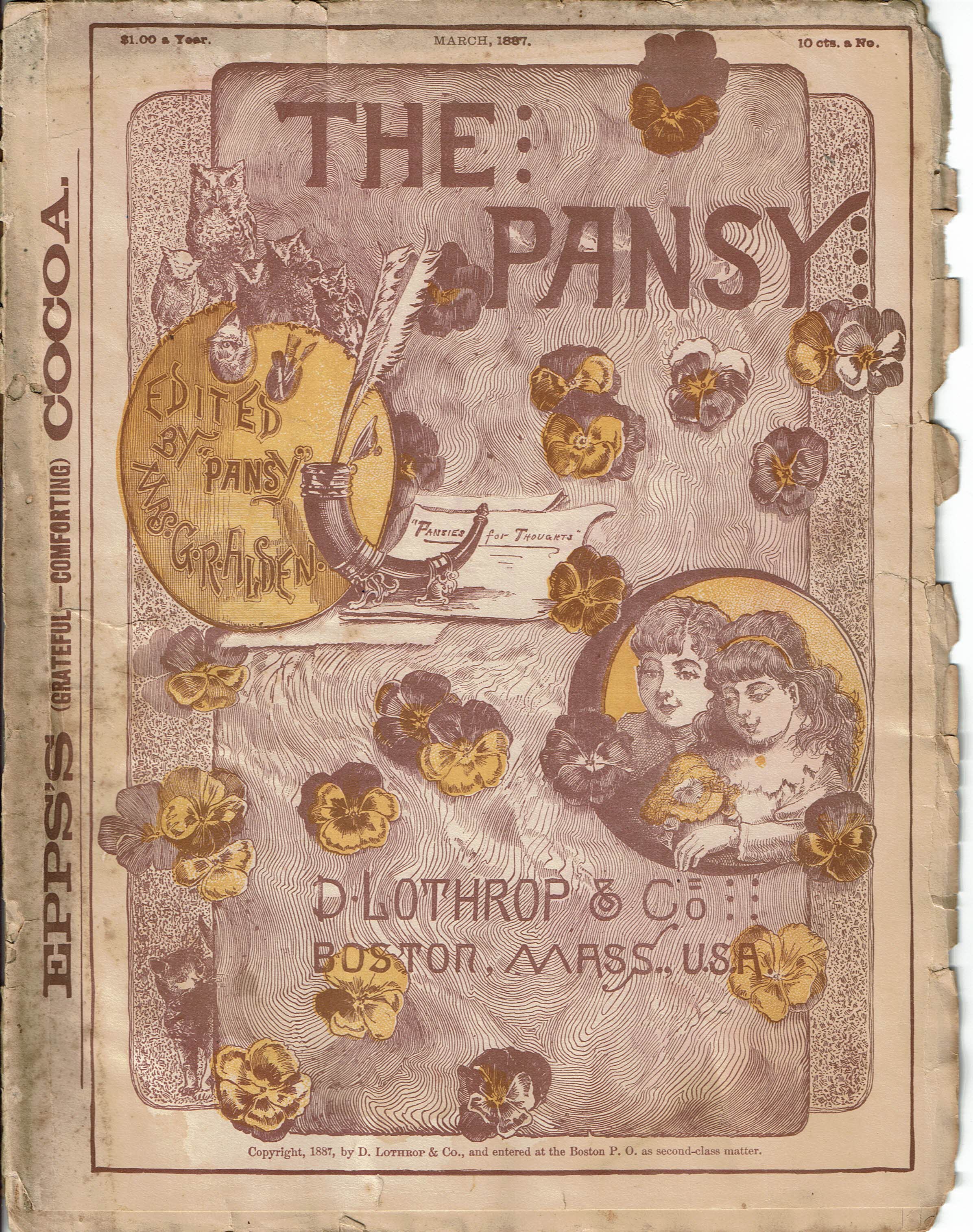
“Blossoms” was the name Isabella called the children who subscribed to The Pansy Magazine, a weekly magazine Isabella edited for children. Children from around the world subscribed to the magazine, and when Isabella mentioned in an issue of the magazine that the foundling hospital was in need of funds, her little Blossoms went into action.

An illustration from The Pansy magazine, 1885.

For a period of about four years, children from around the world sent contributions to the hospital.

Their individual contributions were as large as a 25 cent-piece and as small as a 2-cent postage stamp. That doesn’t sound like a lot, but over time their total contributions amounted to $440.88.

That’s the equivalent of $13,783.00 in today’s money!

In return, Isabella wrote regular descriptions of her visits to the foundling hospital, which were published in the magazine. You can click on the following image to read one of Isabella’s accounts.

Click on this image to read one of Isabella’s reports from 1892.

When you stop to think how hard a child had to work to earn so much as a penny in the late 1800s, the children’s total contribution is astonishing; but they were such devoted readers of Isabella’s magazine, they never failed to answer her call for help.

Interestingly, around this time, Isabella and Ross adopted a baby girl, whom they named Frances. From Federal Census records we know Frances was born in Washington D.C. around 1892, the same time period in which Isabella was regularly involved with the foundling hospital. It’s possible Isabella came across Frances during the course of one of her visits and fell in love with the infant Frances to such a degree she decided to take her home.

You can read more about Frances’ life in a previous post by clicking here.

And you can read a 1906 newspaper article about the Washington Hospital for Foundlings by clicking on the image below:

From The Washington Post, Sunday, April 22, 1906.


A Bicycle Ride with You

With less than thirty days left of summer, it’s natural for Americans to try to spend as much time out of doors as possible before the weather begins to change.

And one popular way to do that is on a bicycle.

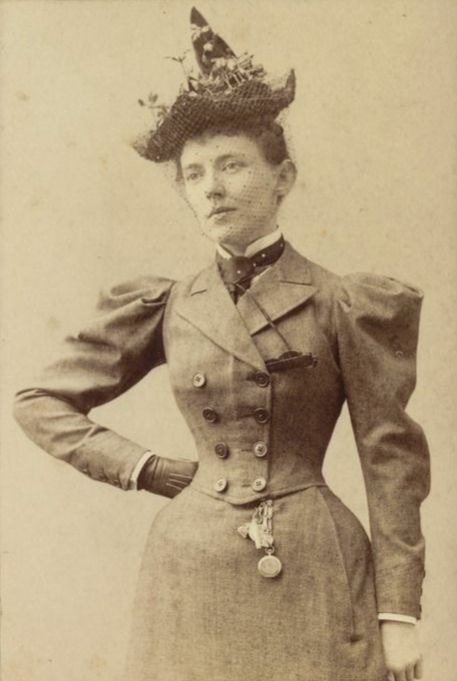
Lady cyclists in 1898. Their outfits include jaunty hats, puffed sleeves, and purses hung from clips attached to their belts.

Bicycle riding was extremely popular during Isabella Alden’s lifetime, especially for women. It gave them instant mobility, and a way to escape the homes they had been confined to for generations.

With a bicycle women could travel to see new sights or tour new towns—and they could do it without being dependent on a man.

Suffragist Susan B. Anthony said bicycling “has done more to emancipate women than anything else in the world.”

The cover of Lippincott’s Magazine, July 1896.

Author and cycling advocate Lillias Campbell Davidson wrote that bicycle riding helped women escape their homes:

The lives of women have been unnaturally cramped and contracted within doors.

She encouraged housewives to take up cycling. She believed a good, healthy ride would help them return to their work “cheered, refreshed and braced to take up the burden of daily commonplace life once more.”

Another advantage cycling had for women was the change it made in their wardrobes. By 1900 women cyclists were wearing split skirts when riding, and many cycling women shed their corsets and petticoats for more practical attire.

From the December 1896 issue of The Lady Cyclist magazine

Not everyone liked the changes. When one Baltimore woman was criticized for wearing “bloomers” (as the divided skirts were called) while riding her bike, she replied:

“I can ride faster than people can talk.”

A ladies’ bicycle suit with divided skirt, 1898.

By 1898 bicycle sales to women were booming, thanks in large part to Sears, Roebuck & Company.

They began marketing affordable bicycles to ladies, and even printed a specialty catalog to market the many different models they offered.

Sears, Roebuck & Co. Bicycles specialty catalog of 1901.

Before long, women across the country were riding Sears bicycles, and discovering for themselves the thrill of healthy exercise and the freedom of traveling under their own power.

Are you a bicycle rider? What do you like most about the sport?

Grace Livingston Hill at 116 (Books)

Isabella Alden was a prolific writer. Her last book, An Interrupted Night, was published in 1929, just a year before Isabella died at the age of 88.

It’s no wonder, then, that her niece, author Grace Livingston Hill, also wrote well into her “golden years.”

In 1945 Grace celebrated a milestone: 116 books published! And at the age of 80, she began work on book number 117!

Grace at the age of 80 in 1945.

To celebrate her accomplishments, Grace gave an interview with the Associated Press.

On August 5, 1945 newspapers across America published the interview, in which she talked about her writing process.

Perhaps most importantly, Grace related one of the reasons she was drawn to writing:

It’s a delightful article that gives readers a glimpse into Grace’s personality and strong work ethic.

You can read the entire article; just click here to open it as a PDF document.

Have you seen our daily posts?

Every weekday we post a fun fact on social media about Isabella and the world in which she lived.

Good news! You don’t have to be on Facebook or Twitter to see our daily posts!

They now appear every day on this blog’s sidebar, right below the “Search” box.

You can scroll through recent posts to see any you might have missed.

And you can click on any image to see a larger version.

Now you never have to miss a daily Isabella post! 

Isabella’s Journals and a Giveaway!

Isabella Alden began keeping a journal at a young age. From the time she was about seven years old she used a journal to take notes during Sunday church services, write Bible verses she wanted to remember, and record topics to discuss with her father.

Keeping a journal was a lifelong habit for Isabella, and in her novels, she sometimes made journalling a habit of her characters, too. (Have you read Docia’s Journal or Gertrude’s Diary?)

Journaling is just as popular today as it was in Isabella’s time.

Do you keep a journal?

Would you like to?

To start you off on the path to using a journal, we’re giving away two Journal Prize Packages to readers of Isabella’s blog!

Each prize package includes:

A lovely journal with a magnetic jeweled clasp . . .

.

A coordinating ballpoint pen . . .

And a book of fun and inspiring stickers to give you a jump start on your journal adventure.

To enter the drawing, just leave a comment below no later than midnight EDST on Sunday, July 28, 2019.

We’ll announce the two winners on Monday, July 29, 2019.

Good luck!

Who’s a Fan of Pansy?

When Isabella Alden published a new novel, readers around the world rejoiced; her fellow authors did, too.

One of Isabella’s biggest fans was novelist Lucy Maud Montgomery, who wrote the famous Anne of Green Gables series of books for girls.

In fact, Ms. Montgomery enjoyed Isabella’s novels so much, she mentioned them in her own book.

If you’ve read Anne of Green Gables, you’ll recall there’s a chapter titled “A Tempest in a School Teapot,” in which Anne Shirley suffers through a terrible day at school.

First, Gilbert Blythe calls her “Carrots” because of the color of her hair, and Anne reacts so angrily, she breaks her slate over Gilbert’s head.

Then, after lunch, Anne and several boys return to class late, and Mr. Phillips, the schoolmaster, decides to make an example of Anne:

“Anne Shirley, since you seem to be so fond of the boys’ company we shall indulge your taste for it this afternoon,” he said sarcastically. “Take those flowers out of your hair and sit with Gilbert Blythe.”

To Anne, this was as the end of all things. It was bad enough to be singled out for punishment from among a dozen equally guilty ones; it was worse still to be sent to sit with a boy; but that that boy should be Gilbert Blythe was heaping insult on injury to a degree utterly unbearable.

Later, when Anne was finally free to walk home with her bosom friend Diana Berry, Anne declared she would never return to school again.

Diana immediately tried to convince her to change her mind, saying:

“Just think of all the fun you will miss,” mourned Diana. “We are going to build the loveliest new house down by the brook; and we’ll be playing ball next week and you’ve never played ball, Anne. It’s tremenjusly exciting. And we’re going to learn a new song—Jane Andrews is practicing it up now; and Alice Andrews is going to bring a new Pansy book next week and we’re all going to read it out loud, chapter about, down by the brook, and you know you are so fond of reading out loud, Anne.”

Diana knew just how to tempt Anne—with a new Pansy book!

And author Lucy Maud Montgomery knew that everyone who read that line would know exactly what Diana Berry was talking about. Perhaps Ms. Montgomery knew that girls who liked to read about Anne of Green Gables would most certainly be fans of Pansy’s books, as well.

Have you read Anne of Green Gables or any other novel by Lucy Maud Montgomery? Which is your favorite?

You can read Anne of Green Gables for free online; just click here.

Happy Anniversary, Isabella!

On this date in 1866 Isabella Macdonald married Gustavus “Ross” Rossenberg Alden.

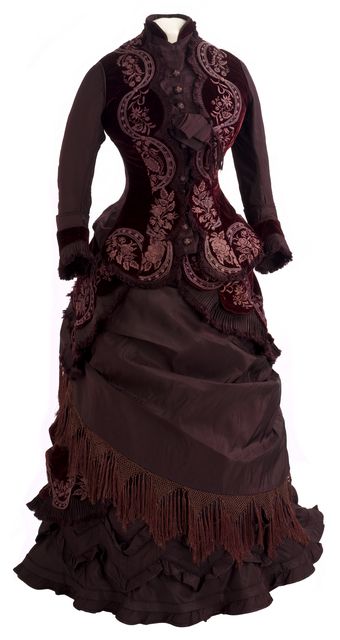
In the writings she left behind, Isabella never gave a description of her wedding gown; however, based on fashion history for the period, we know her gown probably had a wide skirt, long sleeves and a narrow waist.

This wedding gown from about 1870 is an example of what Isabella’s dress may have looked like.

It is made of cream silk gauze, trimmed with cream silk embroidered net lace. Both the bodice (which fastens with hooks and eyes) and the polonaise overskirt are bordered with lace and silk satin ribbon bows. The gown is on display at the Victoria & Albert Museum in London.

An 1870 French fashion plate depicting a fashionable wedding gown for the period.

In 1916 Isabella and Ross celebrated their golden wedding anniversary with about 150 close friends and relatives, who gathered at the Alden’s home in Palo Alto, California.

This photo commemorates the occasion. In the center of the photo stands a tall gentleman in cleric’s collar; that’s Ross Alden; Isabella is the woman holding flowers, and standing between them is their son Raymond.

Left of Ross, dressed in white and wearing a large shawl is Isabella’s sister Julia, who resided with the Aldens. The young woman seated on the right holding a young child is Raymond’s wife Barbara.

The celebration was written up in several newspapers, including a newspaper near Isabella’s home town of Gloversville, New York:

In all, Isabella and Ross were married almost 58 years, before Ross passed away in 1924.

Happy anniversary, Isabella and Ross!

Pansy’s Favorite Author: Amos R. Wells

Isabella Alden was one busy lady! In addition to writing novels and short stories, she wrote Sunday school lessons for teachers, and edited The Pansy magazine for children.

Along the way, she also wrote articles for many different Christian publications, including the monthly magazine Christian Endeavor World. Her good friend Amos R. Wells was the long-time editor of Christian Endeavor World, and through their mutual commitment to both the magazine and the Christian Endeavor movement, Isabella and Amos became good friends.

Isabella’s friend and fellow author, Amos R. Wells in 1901 at the age of 39.

Their friendship was strong enough to withstand a good bit of teasing. In 1902 Amos published a new book of poems for children, titled Rollicking Rhymes for Youngsters.

Isabella promptly obtained a copy of the book and wrote a delightful tongue-in-cheek review , which was published in American newspapers on December 18, 1902:

Dear Mr. Wells:

I owe you a grudge; you have robbed me of an entire morning, and of no end of pocket money! Yesterday, just as I was seated in my study, all conditions favorable for work, the mail brought to me a copy of your latest book, “Rollicking Rhymes for Youngsters.”

I meant only to look at the covers and the type, and wait for leisure; but I took just a peep at the first poem and indulged in a laugh over a droll picture or two, then “Carlo” caught me, and we went together, “over the fields in the sunny weather.” On the way I met the “little laddie of a very prying mind” and—you know the rest.

It is the old story; somebody tempted me, and I fell. How could I remember that the morning was going, and the typewriter waiting, and the editor scolding? I never stopped till I reached the suggestive lines, “Two full hours ago, believe me, was this glorious day begun.” Alas for me, the morning was gone!

How delightful in you to write that which the children and their elders can enjoy together, not one whit the less because, sandwiched all throughout the fun, are charming little lessons that will sink deep into young hearts, and bear fruit. How cruel in you to write a book which a million weary mothers will have to read, and re-read and read again?”

Yours sincerely,
      Isabella Macdonald Alden.

Amos Wells probably had a good laugh over Isabella’s clever “mock review” of his new book, and Isabella probably enjoyed the chance to support her friend and fellow author (and indulge in some good-natured teasing at the same time).

You can read Amos Well’s book, Rollicking Rhymes for Youngsters and see if you agree with Isabella’s review. Click here to read the e-book version on Archive.org.

You can also read many of Amos’ other books online. Like Isabella, he was a prolific writer and published more than 60 titles during his lifetime. And like Isabella, he had a passion for properly educating the men and women who taught Christian Sunday-school lessons; he wrote many books, pamphlets, and articles on the topic. Click here to read some of Amos’ other titles.