Fathers’ Day

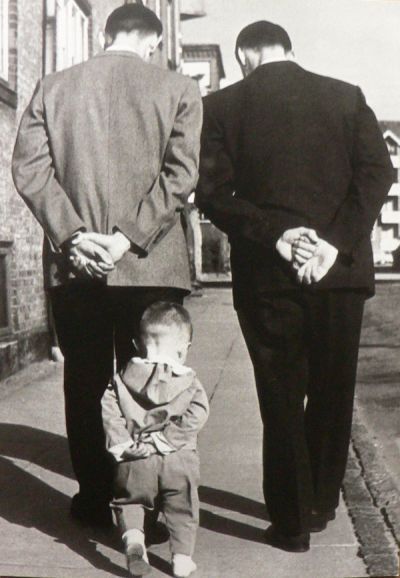
When she was growing up, Isabella was very close to her father. She was twenty-nine years old when he passed away; and throughout her life she remained mindful of the many ways her father set an example for her to live by.

Wise Isabella once wrote this about fathers:

Children like to imitate father. If we are God’s children, let us imitate our Heavenly Father.

On this coming Sunday we wish a happy and blessed Fathers’ Day to dads everywhere!

Advice to Readers Living Humdrum Lives

For many years Isabella served as an editor and contributor to a Christian magazine in which she had a very popular advice column.

Usually her column fielded questions from young people who needed help navigating adolescent life, but in 1912 Isabella published a letter from a grown woman who had a much more adult problem on her hands.

Here is her letter:

I do not belong to the young people, but all the same I’m going to try to get in and get help if I can. I belong to the hum-drum class. Do you know them? I haven’t a grievance in the world that is worthy of the name. I’m a farmer’s wife, living with my husband and one son of nineteen on a fairly prosperous farm.

My husband is a good, kind, hard-working man, and our son is following in his footsteps. We have comfortable and fairly convenient things about us and I don’t have to work too hard. Then what, in the name of common sense, do I want help about? It’s a fair question, and I can’t answer it. I’m not even sure that there is any common sense in my want; but I know that I’m not satisfied.

Mrs. Alden, we work and eat and sleep, and work and eat and sleep again; that’s the whole of our life. Now, is that living? I used not to think so. I married for love and I love my husband, and am sure he loves me, but it would scare either of us to mention it.

Oh, we go to church every Sunday; but we live out a couple of miles—too far, I suppose, for people to walk, and we know no one but the minister, who calls once a year; my boy is timid and doesn’t make acquaintances easily so he has none. We know a number of people by name, and bow to them when we meet, but that is all. We go nowhere, and see no one from month’s end to month’s end. We read, all of us, and have books, and papers, but we have a habit of reading by ourselves, and I don’t know that we ever talk about anything together. We have acquired habits of silence, except for the necessary words. Understand me, we are not cross or “grouty,” but we are each of us alone; and I, at least, am dreadfully lonesome. I have some rather nice clothes, but what is the use of wearing them? Neither husband nor son would know whether I wore a calico wrapper or a blue satin gown; I’ve given up dressing.

I could say a good deal more, but I presume I shall think by tomorrow that I have said a great deal too much. If you print any of this, sign it …

A Farmer’s Wife.

Here is Isabella’s Reply:

Your letter makes me want to tell you a little story about a home that was like, and yet unlike yours, in which I spent some pleasant months. Father, mother and a son past 25 made up the family. The parents were past middle age and lived out of town; the son was in business in town and boarded at home. The usual cares incident to country life were upon them, so that they were very busy people, but their home was the cheeriest, most home-like, most comfortable and restful place that could well be imagined. Even in their busy hours they gave one, somehow, the impression of abundant leisure; I think this was in part due to the fact that their time was carefully systematized.

They, too, went “to church every Sunday,” and had by dint of steady service and genial helpfulness made themselves such a power there that after a time they became not only known, but sought after and leaned upon. In the Sunday school, in the prayer meeting, in the young people’s societies, in the official work of the church, it came to be understood that they could be depended upon.

But it was not so much or such matters that I wished to talk as of the so-called trifles which, in their quiet home-life created an atmosphere that breathed out perfume. Your “nice clothes” reminded me of this home-keeper. She always looked the perfection of neatness and suitability when about her multiform household tasks, and she always carefully dressed for supper; and always there were flowers on the table.

Meal-time in the home was a genuine social gathering, at which time not only the pleasant happenings of the day were considered, but the larger news of the country, of all countries. The mother, although she often deplored the fact that she was not able to carry out her desire for a higher education, is nevertheless a well-educated, cultured woman; both father and mother made such splendid use of the opportunities they had as to be far above the average in general knowledge, and the life they live and the reading they do daily adds to their store.

They had also trained themselves in other ways. You, my friend, do not think husband or son would know whether you wore wrapper or house dress to the supper table, but I doubt that; it is rather that they, like a great many others, have become speechless about many things. This family tells out its pleasant thoughts.

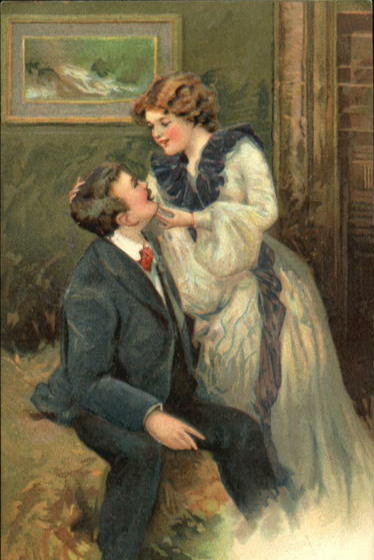
One evening I came suddenly upon a little by-play not intended for my ears and sight. It chanced that the mother’s simple home dress was unusually becoming, and the gray-haired husband, calling her by a pet name, said, “You look pretty enough to kiss,” suiting the action to the word.

The wife’s little laugh showed her pleasure n the token, and also the fact that this was no amazing exception to general rules. As a matter of fact, this husband and wife never separated for even a few hours without exchanging good-by kisses.

“You see, we are a pair of old lovers,” the mother said to me one day, with a half apologetic laugh, adding immediately, “Why not? I never believed that love and kisses were to be confined to the young; do you?”

As for “the boy,” which is the way that father and mother fondly speak of him, he is a man in every sense of the word, taking a man’s part in business, in the church, in civic affairs, and has about him the masculine air of authority and protection, even when he piles the box high with wood, that his mother may take no extra steps, and the masterful air with which he takes the pail or the heavy pitcher from her hand and makes her sit, laughing, to rest a minute, while he waits upon her; yet nothing sweeter or stronger or more holy has been shown to me than the loving comradeship that exists between those two.

The son walks to and from his place of business, and his cheery voice can be heard in the early morning, and again at noon, after his keen eyes have swept kitchen, pantry and porch to see if perchance he may take some further step to save his mother.

“Come mother, are you ready?” and away they tramp down the long, tree-lined avenue to the “lower gate,” chatting, laughing, enjoying each other, for all the word like a boy and girl out for a lark. I have a shrewd suspicion, also, that this is sometimes the hour for confidences.

Once, the father, looking after them with tender eyes, said to me: “She always goes to the big gate with him. If it should have to be given up, I don’t know which would miss it most, the boy or his mother.” And one, an old man, looking thoughtfully after the two from an upper window, said, “Only a good man would care for that.”

Is my little sermon preached, dear friend? There is no humdrum living in that home. There might have been; all the conditions that can so easily degenerate into humdrumness are there; but outspoken love and unselfish service have glorified them.

What do you think of the advice Pansy gave?

Do you think it made a difference the  lives of the farmer’s wife and her family?

Reverend Alden and the Jubilee Singers

In 1883 Isabella was living in the small town of Carbondale, Pennsylvania.

Illustration of an aerial view of the city showing layout of streets, and a river that flows past one end of the town.
A bird’s eye view of Carbondale, Pennsylvania in 1875.

Her husband had become pastor of Carbondale’s Presbyterian Church the year before, and he was already making his imprint upon the congregation.

Illustration showing two churches side by side. The Presbyterian church is constructed in a Gothic style with a square bell tower.
The Presbyterian Church of Carbondale on the left (the Methodist church on the right), as it appeared in 1911. When the Alden’s attended, the church was smaller and had a “beautifully proportioned spire, tall, slender and tapering.”

Reverend Alden was pastor of the Carbondale church for only three years, but decades after his departure, members of his congregation still remembered him as a leader who encouraged his flock to immerse themselves in the Lord’s work.

One member of the church said:

“He brought the church up to a high state of activity.”

In 1883 Reverend Alden brought the great American evangelist Reverend A. B. Earle to Carbondale for a two-week-long revival meeting.

Illustration of A. B. Earle from about 1870.
American evangelist A. B. Earle.

It was a resounding success. Thousands of people attended and hundreds committed their lives to Christ.

The religious revival meetings, held day and night for the two weeks past, close today. There has been no abatement of the interest, and each of the meetings have been largely attended, some of those in the evening crowded to the utmost capacity of the Presbyterian church. About three hundred persons, many of them adults and heads of families, have professed their faith in Christ and given satisfactory evidence of a change of heart.
From The Carbondale Leader, March 16, 1883.

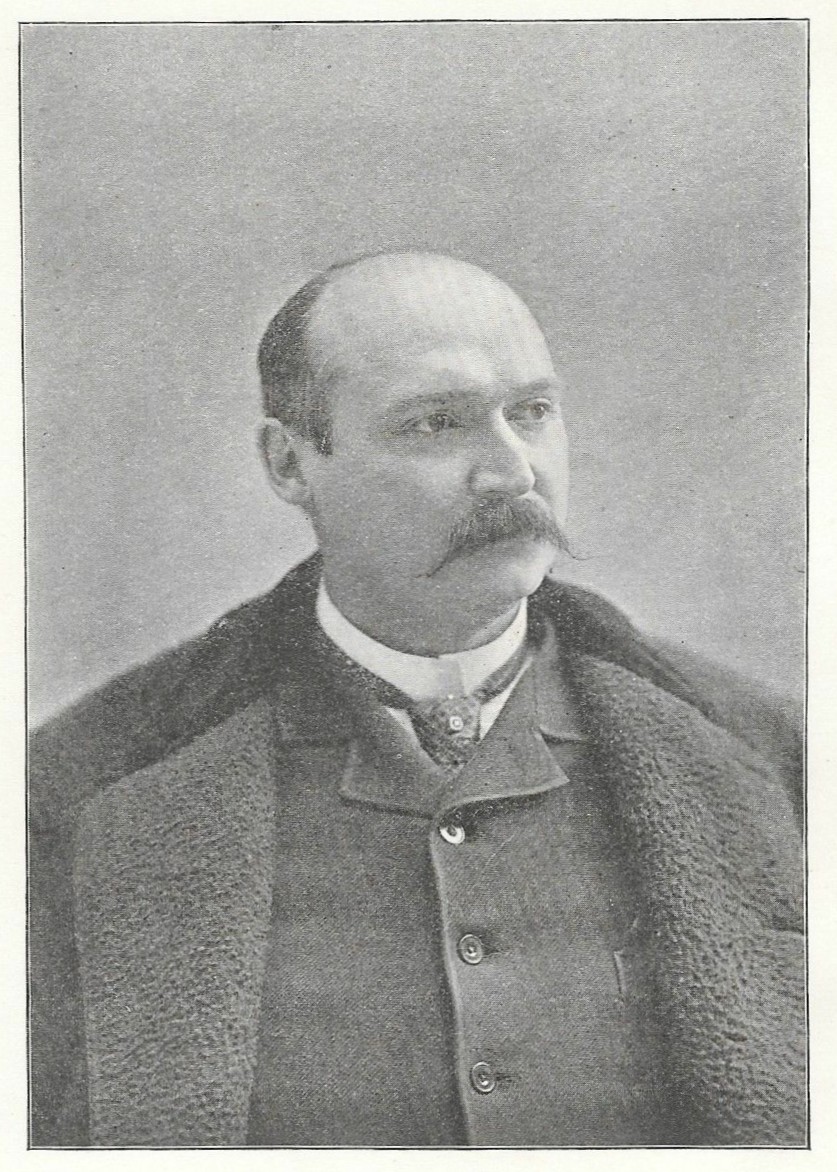
The following year Reverend Alden organized a temperance rally, where the featured speaker was evangelist and temperance advocate P. A. Burdick.

Black and white photograph of P. A. Burdick.
Temperance advocate and evangelist P. A. Burdick.

He, too, drew large crowds and had a profound effect on the community

We are pleased to state that Mr. Burdick will reach here tomorrow and commence his labors on Sabbath evening. The first meeting will be held in one of the churches, and it is hoped that all classes of temperance people will join in the good work. All circumstances promise to be favorable, and we shall be greatly disappointed if a great reformation in this line is not effected in our city.
From The Carbondale Leader, March 21, 1884.

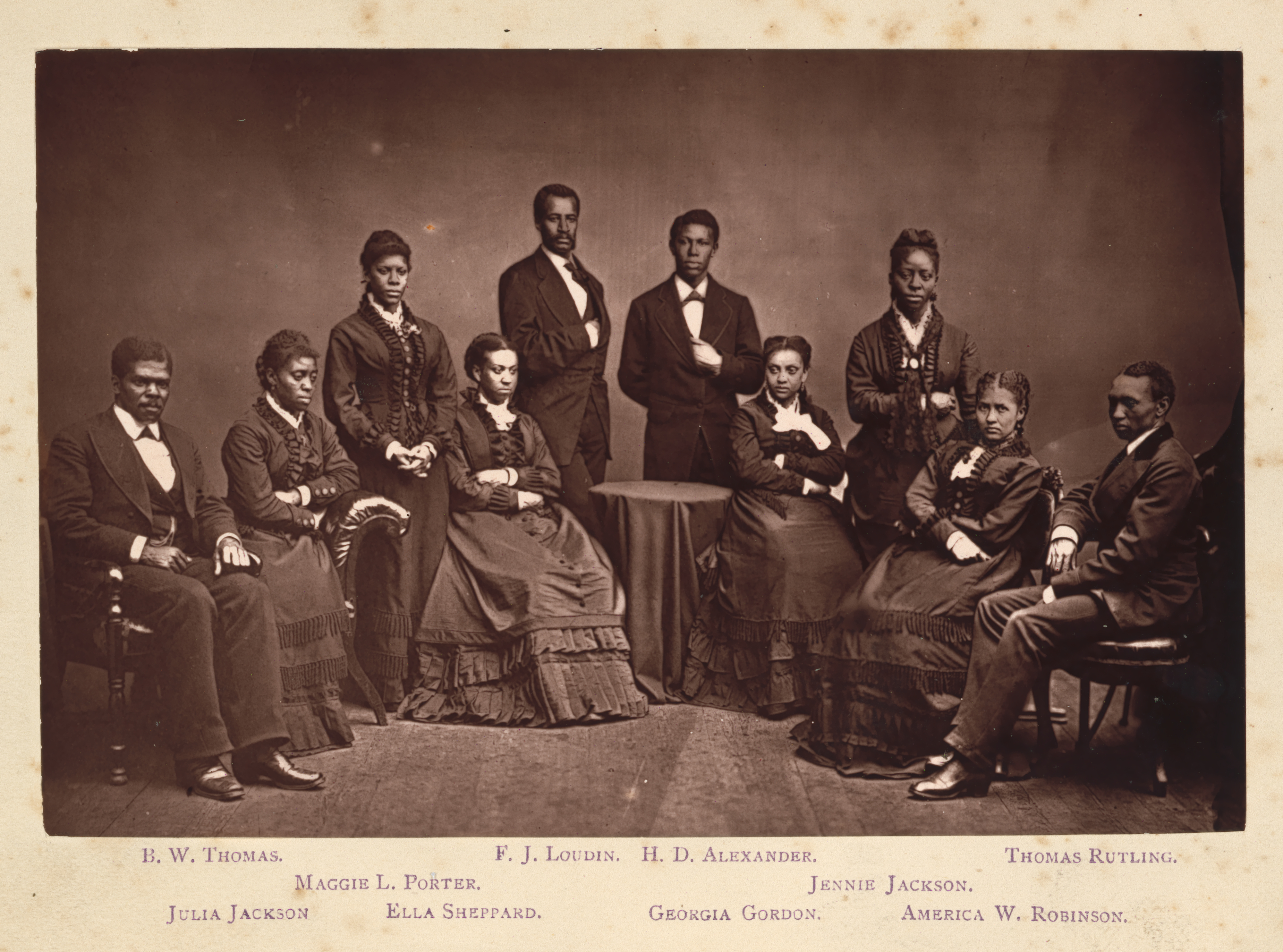
Also in 1883 Reverend Alden organized an event of which he was extremely proud. The previous year, while at Chautauqua Institution, he had heard the Fisk Jubilee Singers perform; and he was so impressed by their performance, he immediately went to work to convince them to perform at his church in Carbondale.

Photo of the Fisk Singers, five women and four men.
The Fisk Jubilee Singers in 1870.

The members of Fisk Jubilee Singers were all students at Fisk University in Nashville, a liberal arts university that opened in 1866. Some of the first students were newly freed or had family members that were freed slaves. To raise funds for the university, music professor George White organized a nine-member chorus to perform in concerts.

They introduced to the world the slave songs that “were sacred to our parents” and had never before been sung in public. The Jubilee Singers’ beautiful performances soon gained a following. They began to receive critical praise, and in 1872 they sang for President Ulysses S. Grant at the White House.

A year later a second company embarked on a tour of England, where they performed before Queen Victoria and Prime Minister William Gladstone.

Photo of the Fisk Singers, six women and three men.
The Fisk Jubilee Singers in 1875.

At home they performed at Carnegie Hall, where Mark Twain was a member of the audience and remarked:

“It’s something I never heard before. I’d walk seven miles to hear them again.”

By 1883 there were different Jubilee troupes touring different parts of the country. One of those troupes performed at Chautauqua, where Reverend Alden heard them, and resolved to bring them to Carbondale.

The Fisk Jubilee Singers performed at the Presbyterian Church of Carbondale on June 12, 1883. You can feel Reverend Alden’s enthusiasm in the press release he wrote (co-authored with Isabella and her brother-in-law, Reverend Charles Livingstone) for the local newspaper:

“Carbondale may now make ready for one of the most enjoyable entertainments ever prepared for mortal ears. The Fisk Jubilee Singers are coming!”

Here’s the full text of that press release:

Carbondale may now make ready for one of the most enjoyable entertainments ever prepared for mortal ears. The Fisk Jubilee Singers are coming! That one sentence should set this city on fire of expectancy. These twelve sons and daughters of former bondsmen render the rarest, most touching, most inspiring most wonderful music, to which we have ever listened. They made a world-wide reputation years ago, and still before Kings and Queens and Presidents, and critics of the highest order, they "hold their high carnival of song," while the immense audience is bound by the strange spell of their voices, or become wild in rapturous applause. If you have read in all the leading papers the seemingly extravagant praise of these wonderful singers, you have only to come to Nealon's Opera House on the evening of June 12th, 1883, to learn that "the half was never told." [signed] Mr. and Mrs. G. R. Alden, Rev. C. N. Livingston
From The Carbondale Leader, June 1, 1883.

Would you like to hear The Fisk Jubilee Singers? Click here to listen to their 1909 recording of “Golden Slippers,” part of a Fisk Jubilee Singers collection at the Library of Congress.

You can learn more about the Fisk University and the history of the Jubilee Singers by clicking here to visit their website.

Free Read: The Opportunity Circle

This month’s free read was written by Isabella’s best friend and frequent co-author, Faye Huntington (whose real name was Theodosia Foster).

“The Opportunity Circle” is the story of Marion Lansing, a young teen whose life is upended when her mother falls ill, and the family physician tells them they must move to Colorado if she is to be cured.

Book cover featuring young woman in gold gown circle 1900. She has a yellow rose tucked into the bodice of her dress and is holding an open book in one hand.

When the story was written in 1901, physicians often prescribed a change of scenery or climate as a cure for common diseases. And although the author doesn’t mention the name of the mother’s ailment in the story, there’s a good chance that she suffered from tuberculosis.

Brief newspaper article titled "The Cold-Air Cure," which claims "Not one death at Denver Sanitarium from Tuberculosis."
From The Topeka Daily Mail, February 13, 1905.

In the late 1800s and early 1900s tuberculosis—known back then as “consumption” or “white death”—was the country’s leading cause of death. There was no vaccine to prevent the disease, nor antibiotics to treat it.

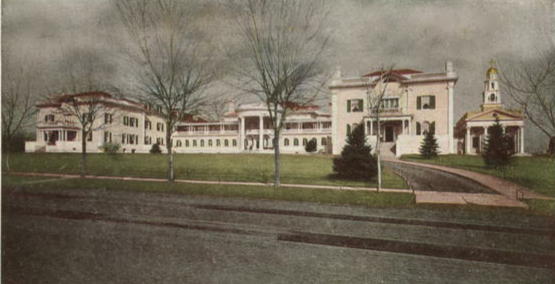
The Glockner Sanitaium in Colorado Springs, about 1910

But physicians did have one course of treatment. They knew that patients who lived in a dry climate with plenty of sunshine seemed to improve. Colorado, with its dry air, high altitude, and sunny skies, was one place where patients found relief and even saw some improvement over the disease.

The sprawling campus of the Agnes Memorial TB Sanitarium in Denver, about 1910.

By the time Faye Huntington wrote “The Opportunity Circle,” Colorado was home to hundreds of sanitariums, spas, and hospitals, all of which catered to tuberculosis patients. But they were pricey, and many TB patients who bought one-way tickets to Colorado didn’t have the money to pay for expensive treatments.

The Oakes Home, a Denver TB sanitarium (about 1907).

Those less affluent patients erected tent cities outside small towns and mining camps, where they rested and spent as many hours as possible in the sun each day.

In Faye’s story, Marion Lansing’s daily two-mile walks to the mining settlement have some basis in fact. While there’s no record that Faye Huntington ever visited a Colorado mining camp or tuberculosis resort, she probably read newspaper accounts of the many patients who flocked to the mile-high state, and might even have known one or two such patients herself.

You can read “The Opportunity Circle” for free!

Click here to go to BookFunnel.com where you can choose the reading option you like best:

  • You can read the story on your computer, phone, iPad, Kindle, or other electronic device. Just choose your preferred format from BookFunnel.com.
  • Or you can choose the “My Computer” option to read a PDF version, which you can also print and share with friends.

Announcing the Winners of the Little Card Giveaway!

Thank you to everyone who entered the Little Card Drawing!

We’re happy to announce the winners are:

Tammie

Anne Cooksey

Crystal Hocker

Donna Ward

Anne, Crystal, Donna and Tammie, you’ll receive an email from Isabella Alden; please respond with your mailing address so we can send your card pack out right away!

If you didn’t win the drawing, but would like to purchase a set of “little cards” to give away or use in your daily devotions, click here to go to the BloomPlanner.com website.

(Note: We do not receive an affiliate commission for providing this link. We just like to pass along great things when we find them.)

Isabella’s “Little Card” Giveaway!

If you’ve read many of Isabella’s stories, you’ve probably noticed how often she wrote about a character’s life being changed by a Bible verse written on a little card.

Often, one character would give the card to another for encouragement or to serve as a reminder of God’s love and promises to protect and guide those who follow Him.

More often than not, those “little bits of cardboard” had a big impact on characters who faced challenges or were going through difficult times.

Photo of card with Bible verse: "I will give you peace, at all times and in every situation." 2 Thessalonians 3:16

In real life, Isabella also handed out small cards on which she wrote a meaningful Bible verse chosen especially for the recipient. Here’s one of her handwritten cards:

Small card written in ink by Isabella Alden reads: "Either for or against Christ, every life must be, whether we will it, or not." Four Girls at Chautauqua. Yours truly. Isabella M. Alden. Pansy.

The Giveaway!

You can follow Isabella’s example! We’re giving away sets of “little cards” to four U.S. readers of Isabella’s blog!

Photo of small box labeled "bloom Prayer Cards." The end of the box slides open like a drawer, where you can see a portion of a card inside.

Each card set holds 30 cards. On the front is a beautifully illustrated Bible verse of promise, much like the ones Teenie Burnside might have created in Isabella’s short story “The Little Card.”

Photo of a woman holding three sample cards, one of which reads "I am full of mercy and grace, and I will overflow with love for you." Psalms 103:8.

The back of each card is blank, so you can add your own personalized message of love or encouragement for the recipient, just as Isabella did.

To enter the drawing, just leave a comment below no later than midnight (EDT) on Sunday, May 24. (Unfortunately, we can only mail card sets to readers who live in the United States.)

We’ll announce the four winners on Tuesday, May 25. Good luck!

If you haven’t yet read “The Little Card,” you can read it for free! Just click here to go to BookFunnel.com and choose the reading option you like best:

  • You can read the story on your computer, phone, iPad, Kindle or other electronic device. Just choose the your preferred reading format.
  • Or you can choose the “My Computer” option to read a PDF version, which you can also print and share with friends.

Let Them Eat Cake!

Isabella Macdonald married Gustavus Rossenberg “Ross” Alden on May 30, 1866 in her home town of Gloversville, New York. They were married fifty-seven years. Isabella described her husband as unfailingly courteous, good-natured, patient, and principled. As a minister, those traits must have served him well.

Almost immediately after their marriage ceremony, Ross and Isabella boarded a train bound for the tiny town of Almond, New York, where Ross was given his first church after receiving his ordination.

Image of a slice of yellow cake with chocolate icing on a plate with a fork. in the background are a cup of coffee, a cream pitcher, and a sugar bowl filled with sugar cubes.

Isabella had very fond memories of that first church. Not all the parishes to which Ross was assigned, she said, “were as kind and considerate as the choice souls in that first beloved one.”

She had plenty of tales to tell about some of the congregations her husband led over the years, and she often included those tales in her novels. If you’ve read Aunt Hannah and Martha and John, you might remember one of the congregants gave Martha a perfectly ugly bonnet as a gift, leaving poor Martha undecided about whether to wear the bonnet to church. That “bonnet dilemma” was a true story that actually happened to Isabella!

Image of a three-tier chocolate cake with white icing.

In other novels, Isabella wrote about congregations that did not want to pay their ministers living wages, and decided to make up for the short-falls with fairs and bazaars to raise money for the minister and his family. That, too, was something Isabella and Ross had to deal with far more often that they would have liked.

In one particular parish, the people decided that instead of meeting Reverend Alden’s salary requirements, they would pay him less, but supplement the short-fall with food donations. The only problem was that nearly every woman in the church decided to make her contribution a marble cake.

Photo of a chocolate-iced marble cake on an ornate silver serving stand.

Isabella wrote about her growing dismay every time another marble cake was delivered.

“Marble cake! I don’t believe some families in this village can have anything else to live on, they make so much of it.” 

Photo of a marble cake sliced open to show the marble pattern

Before long Isabella’s pantry shelves were filled with cake. She wrote there was …

…enough marble cake to pave a walk from the kitchen door to the barn door.

She and Ross probably did their best to eat as much marble cake as they could, but days later it was becoming quite dry and stale, and Isabella wanted nothing more than to have “that obnoxious marble cake out of our sight!” But there seemed no way to get rid of it without hurting their parishioners’ feelings.

That’s when Ross came up with a plan. In the dark of night, with a spade and a lantern, he went behind the barn, dug a deep hole, and buried the remaining marble cakes. Isabella wrote:

“We have never cared for marble cake since!”


Click here to learn more about Isabella’s novel Aunt Hannah and Martha and John, which included fictionalized accounts of the “ugly bonnet” story, more about marble cake, and other anecdotes from Isabella’s life as the wife of a Presbyterian minister.

New Free Read: “Scattered Verses”

This month’s Free Read is “Scattered Verses,” a short story Isabella Alden wrote in 1892.

In “Scattered Verses” Isabella illustrates the sacrifices mothers often make for their families, which makes this a perfect story for Mothers’ Day! Here’s a brief description:

“Such a chance! I never had any such chances, you know. They didn’t study the Bible much when I was a girl, not in this way!”

So says Mrs. Halstead when she, her husband and daughter, take a cottage for the summer at a famous Sunday-school assembly. But those Bible classes, as precious as they are, occupy a good deal of time—time she used to spend caring for her family; and while she may be learning a lot about Paul’s letters to the early churches, her little rented cottage is in chaos from kitchen to bedroom! Before long Mrs. Halstead is faced with a difficult decision: should her devotion to studying the Bible be stronger than her devotion to her family?

You can read “Scattered Verses” for free!

Click here or on the book cover above and choose the reading option you like best:

  • You can read the story on your computer, phone, iPad, Kindle, or other electronic device. Just choose your preferred format from BookFunnel.com.
  • Or you can choose the “My Computer” option to read a PDF version, which you can also print and share with friends.

Quotable

One of Isabella’s great talents (out of many!) was her ability to state Christian truths simply and meaningfully. You can find examples of this in all her writings, from stories and Sunday school lessons, to daily Bible studies.

This “quotable” comes from her Daily Thoughts for June, a monthly column she wrote for The Pansy magazine:

Image of a bouquet of pansies with the words "Christ is the great Peace-maker, and all God's children should have the family likeness. - Isabella Alden"

You can follow these links to read all of Isabella’s Daily Thoughts columns: January, February, March, April, May, June, July, August, September, October, November, December.

You can find more of Isabella’s words of wisdom like the one above, which you can print and share. Just enter “quotables” in the search box on the right to see more.

Advice to Readers on Bashfulness

For many years Isabella served as an editor and contributor to a Christian magazine in which she had a very popular advice column. She used the column to answer readers’ concerns—from a Christian perspective—on a variety of topics.

This letter came from a teen in Kansas:

I want to ask if there is any way to overcome being painfully bashful. I am really a sufferer with this disease. I get good marks in school when the work is largely in writing, but as sure as I am called upon to talk, I am scared out of my wits.

In Voice Culture class it is the same. I am said to have a fine voice and my teachers say my “scares” are all that keep me back. I am always swallowing at the wrong place. I have been so humiliated by this drawback that there are times when I think I would like to run away where no one who knows me would ever see me again.

My dear mother is planning to have me go to college, and I know I shall fail on account of timidity; that is the only drawback, for I like to study.

Kansas.

Here is Isabella’s Reply:

Yours is by no means an uncommon affliction, dear friend. Indeed, it sometimes seems as though the world of young people was made up of two classes: those who have no timidity about anything and rush in where thoughtful persons hesitate, and those who, as the letters quoted from express it, are “painfully bashful.”

Before the remedy can be applied with any degree of success, the cause of the disease must be determined; and at the risk of having some of the afflicted start back in protesting dismay, I am going to diagnose it as pride, overweening self-esteem, egotism, any of the words by which we define undue self-consciousness.

Illustration of an 1888 classroom of young girls. One girl stands; she is holding a book, her head is bent and she holds up her arm to cover her face. The other students are seated; one tries to comfort the embarrassed student. Two others whisper and smile together; while two more are reading a book in the back. A teacher stands near the window of the room.

I know that to some it will sound like a contradiction to say that a timid person has too much self-esteem, yet I believe that in nine cases of “bashfulness” out of ten, this will be found to be the case. The remedy, therefore, suggests itself. Anything that will help us to forget ourselves entirely will go far toward removing the trouble: and there is really nothing else that is likely to do much good.

Photo dated about 1905 of a classroom of female students in their teens. One female students stands beside a large document hung on the wall and uses a pointer to indicate one section of the document. All other students are seeated at desks and are looking in her direction..
A student recites in history class. (Credit: Keystone-Mast Collection, UCR/California Museum of Photography, University of California at Riverside.

In a school recitation, if we have made such close and careful preparation that the subject has got hold of us and we are filled with admiration (or indignation, or curiosity) over the thoughts expressed by the author we study, it will be those thoughts and not ourselves that we will think about when we recite.

Photo dated about 1910. A teacher stands at the classroom blackboard where words and shapes are drawn, and points to one section of the blackboard. One little girl stands facing the teacher (her back to the camera) to answer the teacher's question. All other students sit at desks with their backs to the camera. Some students have their hands raised to answer the question.

In Voice Culture this is harder, because the inane syllables on which the pupil is compelled to practice afford no chance for thought; but as soon as one is allowed to sing words—if they are worth singing—the performer can train himself to be absorbed in the thought they express, and in the wonder that the human voice has power to render varying feeling and emotion; and in curiosity to see what range of expression he has himself, until he forgets entirely to wonder, or to fear, what other people think of his performance, and becomes an artist, lost in his art. Such a singer will not be troubled with timidity. Ordinary singers can train toward this height, and overcome self by degrees.

Illustration of a group of young people in a drawing-room about 1875. Some are seated, some are standing. One man sits at a piano and looks at a young  woman who stands beside the piano, singing and holding sheet music.

In social life the ideal way to overcome the form of self-consciousness that expresses itself in timidity, is to fix one’s attention on some other person, a stranger perhaps, or one not accustomed to society, who, for these or other reasons, is not having a good time; and resolve that he or she shall have a pleasant evening. The reflex result will astonish those who try it for the first time.

I knew a timid, shrinking girl, given to fancying herself awkward or stupid or conspicuous in some unpleasant way, who was one evening roused to sympathy for a young woman not so well dressed as the others, and evidently painfully aware of it. In struggling to make that one forget her too short dress and gloveless hands and other defects of costume and have a good time in spite of them, she forgot all about herself.

Illustration of two young women in old period dress, standing close together with a small branch of a pink flowering bush.

Here is what she told her mother on reaching home.

“We had a lovely time, mamma; and Miss Haven says I sang better than she ever heard me; that my voice didn’t tremble a bit. And don’t you believe I forgot all about being scared! I asked that Bennett girl to take the alto, and I was so interested in having her do well that I never once thought of how I was singing!”

A young woman stands holding sheet music and singing. Beside her another young woman is seated, playing a piano.

All of which goes to prove that the old, old rule which, being freely translated is: ”Think always of others and never mind about yourself.” It’s a good one to apply to the great, and the trivial acts of our lives. Once, a girl told me that she thought it would be irreverent to try to imagine what the Lord Jesus Christ thought of her when she stood up in class, or whether he was pleased with her work.

Do you know, I want no such Savior as that girl must have thought she had? I want one who knows our infirmities, “was tempted in all points” as we are, who is interested in the very hairs of our heads, and in the minutest trivialities of our daily lives. Suppose we thought much more about what he is thinking of us than we do? Would it help?

Pansy.

What do you think of Isabella’s advice to the teen in Kansas?