Free Lecture about Faye Huntington!

Isabella Alden and her best friend Theodosia Toll Foster shared many things: a strong Christian faith; a belief in the values of honesty, kindness, and honor; and a true desire to make the world a better place for everyone. They also shared a talent for writing.

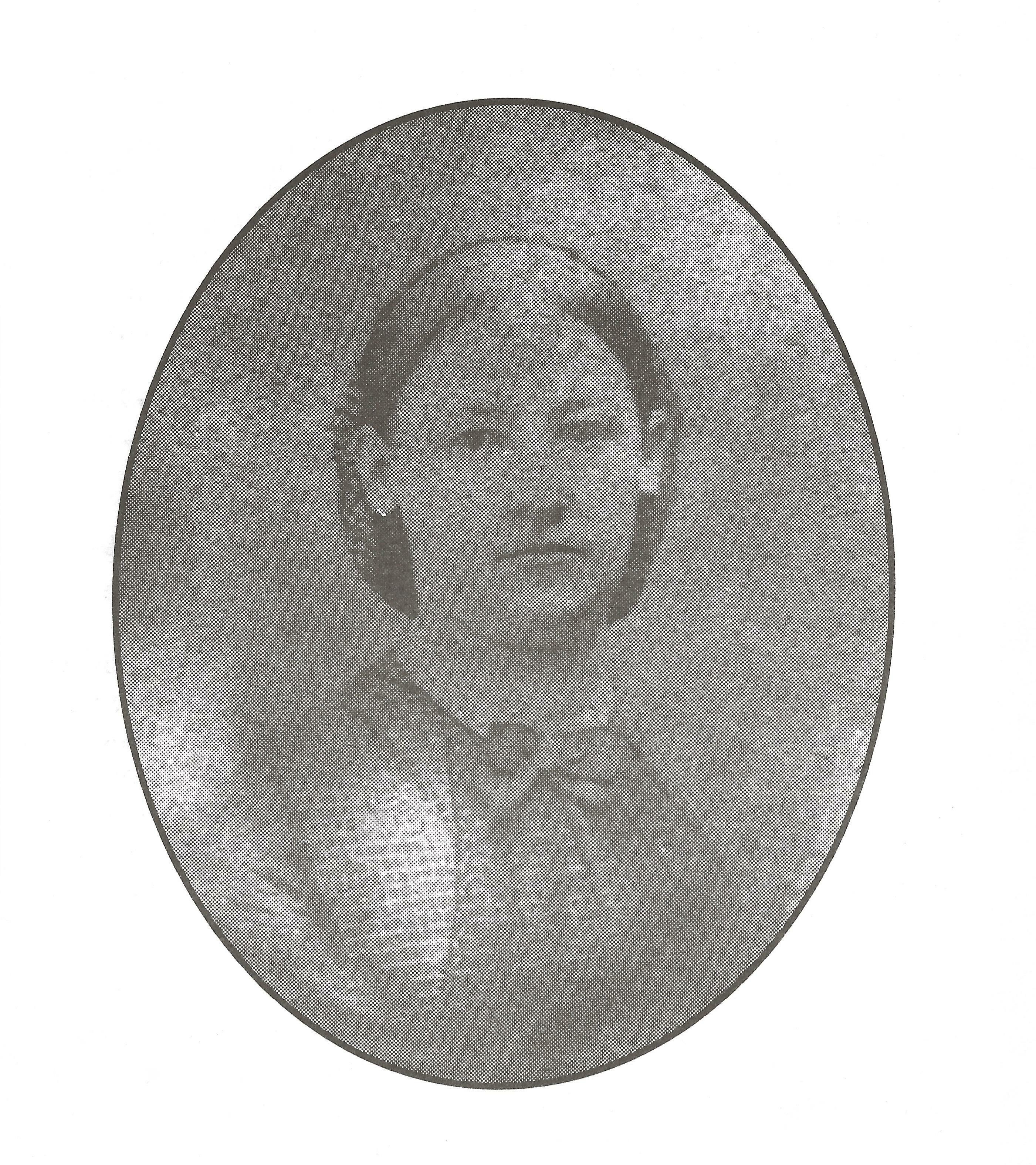
Old black and white photo of Theodosia Toll Foster dated about 1865.
Theodosia Toll Foster (about 1865)

Under the pen-name “Faye Huntington,” Theodosia published over forty books, as well as pamphlets, short stories, histories, and other articles for magazines and newspapers.

Title page of Dr. Deane's Way, and Other Stories by Faye Huntington and Pansy.

But perhaps her most beloved short stories appeared in The Pansy magazine, which Isabella edited. For over a decade they collaborated on the magazine’s contents.

You can meet Theodosia’s Great-granddaughter!

Susan Snow Wadley, Theodosia’s great-granddaughter, will be giving an on-line Zoom lecture on Theodosia’s life and writings.

Hosted by the Erie Canal Museum of New York, the lecture is scheduled for:

Date:  Thursday, March 24, 2022

Time: 12:00 noon (EST)

Cost: Free! (donations to the museum are welcome)

Click on the link below to register.

This is an excellent way to learn more about the times in which Isabella and Theodosia lived and the events that influenced their young lives.

See you on the 24th on Zoom!

p.s. Click here to read some of Theodosia’s stories for free!

What Does it Mean to be a Christian?

In 1891 a Christian weekly magazine mailed letters to America’s most prominent Christian authors and ministers asking one question:

What is it to be a Christian?

Many of the replies from ministers and church elders spoke about adhering to New Testament doctrines. Some replied that being a Christian meant following the example set by the Divine Master.

A famous Unitarian pastor answered that to be a Christian was “to do the will of my father who is in heaven.”

Of course, Isabella was one of the Christian authors who received the letter.

Photograph of Isabella Alden in profile.
Isabella Alden, about 1900.

Here is her answer, which was printed in newspapers across the country on Sunday, March 20, 1892:

“To be a Christian is to love the Lord Jesus Christ so much that I shall desire to have him reign supreme in my heart.”

What do you think of Isabella’s answer?

How would you answer the question?

New Free Read: Their Opportunity

This month’s Free Read is a short story Isabella wrote in 1908. You’ll see that it was a very “modern” story that reflected the times; her characters drove about town in automobiles!

Cover image showing a young woman about 1910 dressed in coat and hat exiting a limousine as her chauffeur holds the door open for her.

Poor Rachel Norse is in need of help! She’s far from home, working a job she dislikes, and thinking of abandoning the Christian principles her mother taught her. Little does Rachel know someone is developing an interest in her; someone who can point her in a brand new direction, if only Rachel will have a little faith.

You can read “Their Opportunity” for free!

Choose the reading option you like best:

You can read the story on your computer, phone, table, Kindle, or other electronic device. Just click here to download your preferred format from BookFunnel.com.

Or you can select BookFunnel’s “My Computer” option to receive an email with a version you can print and share with friends.

Isabella, a Winter Snowbird

When Isabella wrote her short story “Their Day at the Beach” in 1909, she based her story on personal experience.

Cover for short story, Their Day at the Beach, by Isabella Alden.

It was common practice at the time for physicians to prescribe a change of climate for certain medical conditions, particularly ailments of the skin and respiratory system.

Isabella’s son Raymond suffered his entire life from a chronic condition that caused Isabella and her husband to consult numerous doctors in search of a cure. Ultimately their search took them to Florida, where they hoped the sunshine and moderate climate would benefit their son.

An 1897 map of Florida.

There’s a special reason they chose Florida over any other southern state: in 1885 a new Chautauqua Assembly opened on Florida’s gulf coast. Located in what is now Defuniak Springs, the Assembly was built around Lake De Funiak (as it was then called), a naturally circular-shaped lake about a mile in circumference.

A travel brochure advertising the new Florida Chautauqua.

The Aldens found the location very much to their liking. The climate was delightful; the temperature rarely rose above ninety degrees, fruit trees and forests grew in abundance, and a gentle gulf breeze meant the dry air always felt fresh and pure.

The Florida Chautauqua officially opened on February 18, 1885, and the Aldens were there!

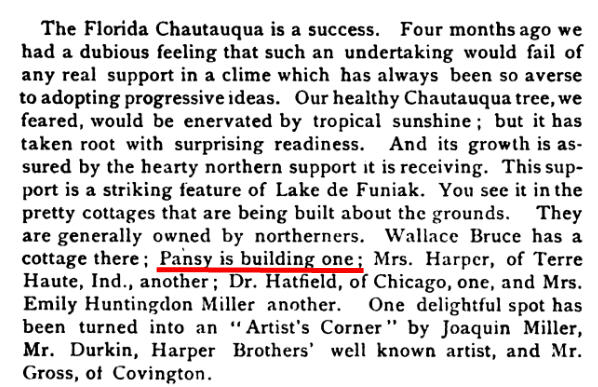
The Florida Chautauqua is a success. Four months ago we had a dubious feeling that such an undertaking would fail of any real support in a clime which has always been so averse to adopting progressive ideas. Our health Chautauqua tree, we feared, would be enervated by tropical sunshine; but it has taken root with surprising readiness. And its growth is assured by the hearty northern support it is receiving. This support is a striking feature of Lake de Funiak. You see it in the pretty cottages that are being built about the grounds. They are generally owned by northerners. Wallace Bruce has a cottage there; Pansy is building one; Mrs. Harper, of Terre Haute, Ind., another; Dr. Hatfield, of Chicago, one, and Mrs. Emily Huntingdon Miller another. One delightful spot has been turned into an "Artist's Corner" by Joaquin Miller, Mr. Durkin, Harper Brothers' well known artist, and Mr. Gross, of Covington.
An announcement in The Chautauquan, May 1885.

As they did in New York, the Aldens built a small house on the Florida Chautauqua grounds and promptly named it Pansy Cottage.

A rendering of Pansy Cottage at Lake Defuniak in 1885.

Their cottage faced the lake and gave the Aldens a lovely view of the lake shore and the promenade.

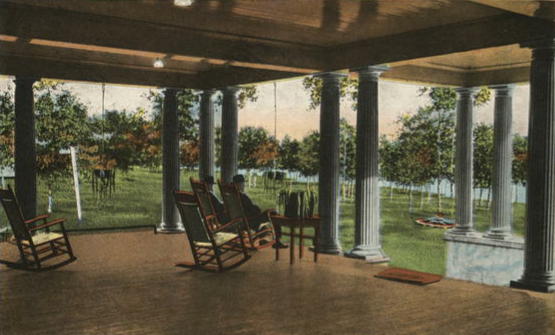
This view of the lake from the porch of Hotel Walton is similar to the view Isabella would have had from her cottage.

With her usual energy, Isabella dove into the Florida Chautauqua experience. Many of the Chautauqua New York programs were duplicated here: A school of Greek, a kindergarten, a school of cookery, an art school, and  the C. L.S.C. all took root in the new Florida location. There was even an amphitheater and a Hall of Philosophy.

Hotel Chautauqua on Lake de Funiak, 1907.

The most marked difference between the two Chautauquas was duration. While the New York assembly remained open for three months every summer, the Florida Chautauqua packed as many speeches, studies and classes as possible into a thirty-day assembly.

When the first Florida assembly came to an end in March 1885, The Aldens began to entertain the idea of staying in Florida for the remainder of the winter months. Eventually, they decided to settle in Winter Park, not far from Orlando, where they built a large home they also named Pansy Cottage. (You can read more about her Winter Park home by clicking the link at the end of this post.)

Isabella’s charming cottage in Defuniak Springs still stands today!

Pansy Cottage as it appears today (Courtesy http://www.DefuniakSprings.net)

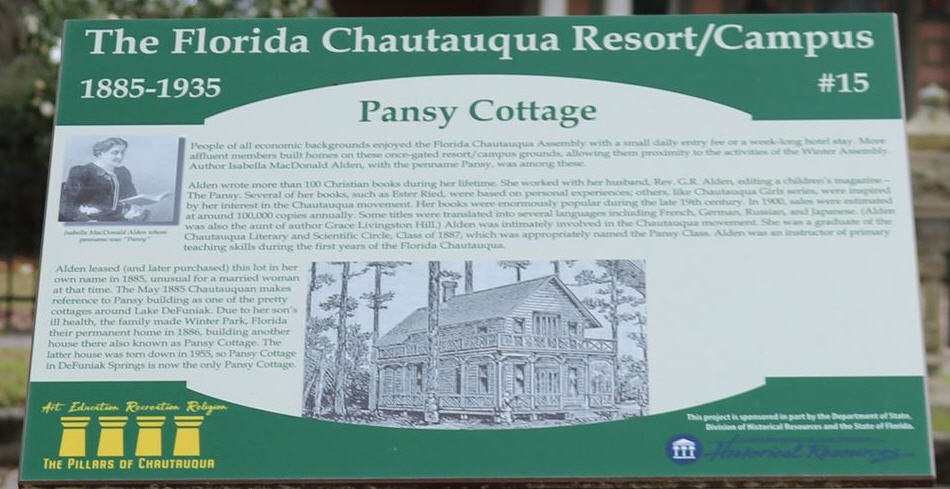
The city of Defuniak Springs has erected a plaque to commemorate its history. The plaque reads:

Pansy Cottage

People of all economic backgrounds enjoyed the Florida Chautauqua Assembly with a small daily entry fee or a week-long hotel stay. More affluent members built homes o n these once-gated resort/campus grounds, allowing them proximity to the activities of the Winter Assembly. Author Isabella MacDonald [sic] Alden, with the penname [sic] Pansy, was among these.

Alden wrote more than 100 Christian books during her lifetime. She worked with her husband, Rev. G.R. Alden, editing a children’s magazine—The Pansy. Several of her books, such as Ester Ried, were based on personal experiences; others, like Chautauqua Girls series were inspired by her interest in the Chautauqua movement. Her books were enormously popular during the late 19th century. In 1900, sales were estimated at around 100,000 copies annually. Some titles were translated into several languages, including French, German, Russian, and Japanese. (Alden was also the aunt of author Grace Livingston Hill.) Alden was intimately involved in the Chautauqua movement. She was a graduate of the Chautauqua Literary and Scientific Circle, Class of 1887, which was appropriately named the Pansy Class. Alden was an instructor of primary teaching skills during the first years of the Florida Chautauqua.

Alden leased (and later purchased) this lot in her own name in 1885, unusual for a married woman at that time. The May 1885 Chautauquan makes reference to Pansy building as one of the pretty cottages around Lake DeFuniak. Due to her son’s ill health, the family made Winter Park, Florida their permanent home in 1886, building another house there also known as Pansy Cottage. The latter house was torn down in 1955, so Pansy Cottage in DeFuniak Springs is now the only Pansy Cottage.

The plaque that marks Isabella’s cottage at the Florida Chautauqua.

You can read Isabella’s Story “Their Day at the Beach” for free! Click here for details.

Welcome to Pansy’s House

Too Much of a Good Thing, and a New Free Read!

Advice to Readers about Keeping Confidences

For many years Isabella had an advice column in a popular Christian magazine. She used the column to answer readers’ questions—from a Christian perspective—on a variety of topics.

In an 1897 column Isabella wrote that she had received several letters in one week about “imprudent confidences.” The letters were from young women who regretted something they said or wrote.

Two or three girls wrote about their mothers in ways they wished they had not.

One young wife wrote “with utmost frankness” about the failings of her husband to a lady friend!

Several young ladies were very harsh in their criticisms of “certain gentleman acquaintances.”

Each ended their letter to Isabella with the same two questions:

“Ought I to take back the words I wrote? And ought I to tell the persons of whom I wrote what I have done?”

Here is Isabella’s advice:

There are really two questions. Let me so divide them.

With regard to the first, I answer: By all means, YES. Perhaps there is no more common error than that of giving vent to one’s anger by putting on paper words concerning others that in our cooler moments we would not even think, much less say.

Moreover, in nearly (if not quite every) case of the kind, the written words are more or less untrue. For the hour they may seem to us strictly true and justifiable; but the next morning, after the mail has been sent, and it is too late, what would we not give to be able to recall them? How sure we are to remember entire sentences that we no know to be false, or—at the very least—to convey entirely false impressions!

In all such cases, what better can we do than to write promptly and frankly:

“I am sorry I told you what I did. I was angry at the time, or so strangely hurt that I did not realize what I was doing. My mother meant what she said in an entirely different way from what I translated it; she did not speak the words in the manner which I ascribed to her; she did not speak quite those words. I see it all now. Please burn my letter, and forgive me.”

Or:

“Dear Friend, I have been unjust to my husband; he is not what I have led you to infer. It is I who was angry, and misinterpreted him.”

Some such reparation as this we owe to our own sense of honor, even though we are quite sure that our mistaken confidences will go no further. Every true correspondent will approve such a course, and think more highly of her friend that she can possibly do without this frankness.

Especially should this course be urged in the case of husband and wife. In a very peculiar and solemn sense these two are pledged to each other, and no third person should be permitted, save in the cases of gravest necessity, to step between them even in thought.

As to the second question, there may be individual cases where confession would be wise; but as a rule I see no reason why the heart of a husband or friend should be made sore by explanations of what they would otherwise never hear. A good general rule in such matters seems to be:

If you are quite confident that silence will do no one any harm, and reasonably certain that speaking would give pain, be silent.

I think I would make one exception to this, in the case of mother and young daughter. Between these two there should be not only implicit confidence, but such deference on the part of the duaghter that it would wound her conscience to keep even such a matter secret. In nine cases out of ten the good mother would rather be told the exact truth, and would be able to help her child to grow stronger.

There is one potent reason why it is best always to take back, so far as possible, confidences of the kind named; and that is because it is a humiliating thing to do, and helps one to be more careful in the future.

The fact is, confidences are very important and choice and troublesome matters. They need to be guarded with great care, and bestowed warily.

What do you think of the advice Isabella gave?

Does it sound like the kind of advice that applies today, too?

New Free Read: Carl Hammond’s Lesson

This month’s free read is “Carl Hammond’s Lesson,” a short story that first appeared in The Pansy magazine in 1892. 

Twelve-year-old Carl Hammond is in big trouble. Not only did he disobey his father’s instructions, he lied about it, too. But Carl’s conscience won’t allow him to forget the incident, which makes him wonder: If he confesses his crimes, will his father ever forgive him?

You can read “Carl Hammond’s Lesson” for free!

Choose the reading option you like best:

You can read the story on your computer, phone, tablet, kindle, or other electronic device. Just click here to download your preferred format from BookFunnel.com.

Or you can select BookFunnel’s “Read on My Computer” option to print the story and share it with friends.

A Hard Text

For over twenty years Isabella Alden and her husband edited a children’s magazine called The Pansy. While their names were credited on the magazine’s cover, the entire endeavor was a family affair.

Cover of the December 1891 issue of The Pansy magazine.

Isabella’s son Raymond regularly contributed poems, short stories, and science-related articles.

Her sister Marcia wrote “Baby’s Corner,” a monthly column for the magazine’s youngest readers.

Marcia’s husband, the Reverend Charles M. Livingston, contributed stories, anecdotes, and news items.

Charles Livingston (from the Livingston Family Album, courtesy GraceLivingstonHill.com)

Rev. Livingston had a talent for explaining the Bible’s most challenging verses in terms young people could understand. He told young readers:

When one thing in one part of the Bible seems to conflict with another part or say something which seems to be wrong, you are to conclude that a little better understanding will set it all to rights in your mind.

In 1888 Rev. Livingston wrote a brief article for The Pansy magazine about a certain Bible verse that young people—and adults—often found very confusing!

Here’s what he wrote:

A Hard Text?

If any man come to me, and hate not his father, and mother, and wife, and children, and brethren, and sisters, yea, and his own life also, he cannot be my disciple. (Luke 14:26)

A hard text? Some readers think it is. But suppose it read this way:

“If any man come to me and love not his family less than me … he cannot be my disciple.”

The other way is simply a strong way of saying this idea, that Christ must always be FIRST to His child. He must have our supreme love, and nothing must stand in the way. Do you get the idea?

Of course it does not teach one to hate anybody, much less a dear father, mother, brother, sister.

You know this same Jesus who spoke Luke 14:26 also said:

“Love,” even one’s enemies, and “Honor thy father and mother.”

Jesus cannot contradict Himself.

Readers of The Pansy enjoyed Rev. Livingston’s lesson so much, he wrote several more installments, and “The Hard Text” became a regular recurring column in The Pansy magazine!

Would you like to see more “The Hard Text” columns by Rev. Livingston?

What do you think? Did Rev. Livingston do a good job of explaining the meaning of this particular Bible verse?

Isabella’s Winters in California

Isabella was born and raised in upstate New York, so she was very familiar with east coast winters.

After she and Reverend Alden married, they served congregations in Pennsylvania, Ohio, New Jersey, and Washington D.C. where winter storms often brought snow, wind, and dangerous ice.

Fortunately, Isabella’s book sales allowed the Alden family to sometimes spend a portion of their winter months in sunny Florida; still, there were times Reverend Alden’s duties kept them in the cold and snowy north instead.

Old photo of two men and a woman standing beside a snow drift that is higher than their heads.

When the good reverend retired in 1910 the Aldens moved to California, where they built their dream house in Palo Alto (click here to read more about their house).

Never again did they have to deal with harsh winters, extreme cold, or deep drifts of snow that had to be cleared from walkways and roads.

Old postcard that reads "I'll eat oranges for you and you throw snowballs for me." On the left is a drawing of a woman and little girl picking oranges from trees above the caption "Winter in California." On the right is a drawing of a boy and girl building a snow man above the caption "Back East."
A postcard Isabella might have sent from California.

The Aldens found California winters delightful. Januarys were warm and mild; Februarys boasted average temperatures around 60 degrees. For them, snow banks and ice dams were things of the past.

1918 postcard. On the left is a drawing of two men and two women swimming in the ocean with sailboats in the background under a caption that reads "How we spend our winter in California." on the right is a boy in the snow at a water pump where the water has frozen as he tries to fill a bucket. Above is the caption "How we spend our winter in the east."
A 1918 postcard.

In her letters to old friends and relatives in the east, Isabella might have mentioned the perfect weather she enjoyed, free of “fierce storms and slushy spring thaws.”

And when she hadn’t time to write letters, she could send off a quick postcard that made her point for her about California winters.

"A Typical California Highway in Midwinter" shows a road with palm trees and flowers on one side, flowers and orange trees on the other side. In the background are mountains with snow on top.
Sunshine, Fruits, Flowers, and Snow.

Picture postcards made up a large portion of the California printing industry. They featured color photographs that depicted what it was like to spend a winter in that state.

Old photo of people in an open Model T car. The are on a driveway in front of a house covered with vines. Beside the driveway the grass is green.
Beautiful California. Automobiling in Winter, about 1909.

Some postcards featured images of flowers that bloomed in the winter months, like poppies and bougainvillea.  

A group of men and women pick wild poppies from a field. Behind them are green mountains.
Gathering poppies in midwinter in California.

Isabella loved flowers and often marveled over the varieties of roses that bloomed beside her porch in California:

“Red, cream, salmon, pure white, and every shade of pink. Hundreds and hundreds and hundreds of them! The world seems made of roses!”

A little girl picks white roses in a garden. Behind her pink roses form a bower that is is taller than she is.
Gathering Roses in Mid-Winter, California

Other postcards showed people boating on lakes or swimming in the ocean in the middle of winter.

A group of people on the shore of a lake. One woman rides by on a bicycle. On the lake are boats and swimmers.
A winter’s day in Westlake Park about 1909.

Each postcard was like a little advertisement for the state of California, teasing and enticing people to come live the good life among the orange groves and poppy fields of the west coast.

Isabella was an ambassador for the state, as well, because California life certainly seemed to agree with her. One day in November she wrote to her niece, Grace Livingston Hill:

“Today is glorious sunshine, and the grass and trees glow in their freshly painted garments of green after the rain of yesterday.”

It sounds like Isabella was very happy in her California home!