“A plainly attired lady of medium hight [sic] wearing a brown dress and lace collar, was introduced to a large audience at the Case avenue Presbyterian church last evening as Mrs. G. R. Alden, or the first “Pansy” of the season after an unusually severe winter.”
Isn’t that a charming way to describe Isabella?
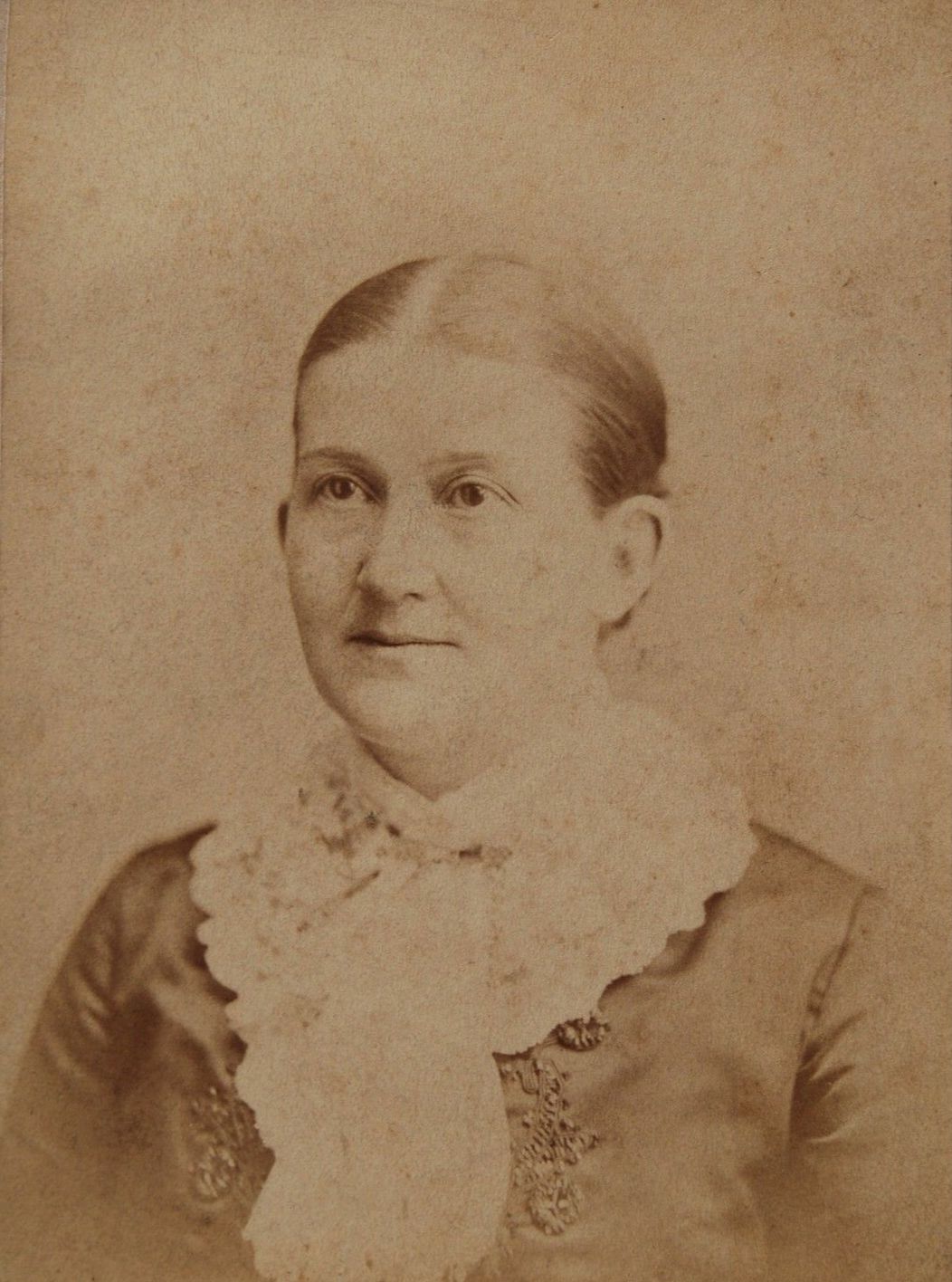
Photo of Isabella Alden about 1880 (age 39)
Those are the first lines of a newspaper article about a public reading she gave at a Cleveland church in 1885.
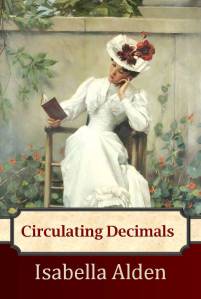
Isabella regularly drew large crowds whenever she appeared at an event, especially if there was a chance she might read one of her stories; and on this particular evening, she read chapters from her short story “Circulating Decimals.”
Here’s the newspaper’s full description of the event:
From the Cleveland Plain Dealer, April 15, 1885
You can read Isabella’s story “Circulating Decimals” for free!
Choose the reading option you like best:
You can read the story on your computer, phone tablet, Kindle, or other electronic device.
When Grace Livingston Hill’s short story “The Livery of Heaven” was published in a popular Christian magazine in 1897, she probably had no idea the controversy it would cause.
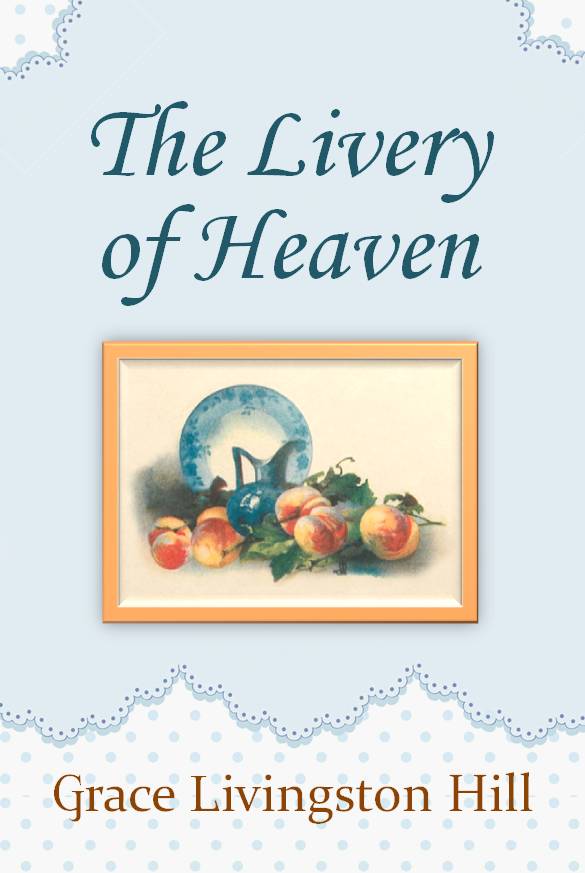
Magazine illustration for Grace’s story, “The Livery of Heaven.”
After all, Grace was 31 years old and had been writing and publishing her stories and novels since 1889, and they all sold very well. So it might have been a bit surprising that the magazine that published “The Livery of Heaven” began to receive letters from readers like this one:
The Letter:
I have been reading “The Livery of Heaven,” and, as one hoping your paper meets the highest standard of merit and helpfulness, I desire to make an emphatic protest against the unreality of some of the characters and descriptions of that story.
The character of Mrs. Wallace, for instance, seems to me too absurd even for a story. Is it possible that a woman of her intelligence and honesty of purpose could be so absolutely blind as not to know the inevitable consequences of giving to one with a passion for liquor “brandy peaches” so strong with brandy as to scent a whole room?
Or that she could be so utterly inconsistent as to go out and work zealously in the cause of temperance reform when she had just finished putting up a lot of peaches saturated with brandy, which she purposed to serve indiscriminately?
Impossible! Unless she were a bold hypocrite, and obviously hypocrisy is not intended or thought of.
And if not a hypocrite, such rank inconsistency and incongruity of character could not exist except in a vivid imagination. It is not real life.
If my ideas are wrong, I would like to be set right.
It just so happened that Grace’s aunt, Isabella Alden, was one of the magazine’s editors, and she decided she would personally answer the critics who wrote in about Grace’s story and “set them right.”
Here is Isabella’s response:
There is more to this letter, and I wish we had room for its entirety, for it is carefully and thoughtfully written.
It seems to me that the writer is wrong, not in his deductions, but in his statement of facts. He distinctly states the impossibility of so inconsistent a woman as Mrs. Wallace. What will he do with her if I own that she, to my certain knowledge, exits—that she is not only “true to life,” but she is life? I have no means of knowing whether the Mrs. Wallace about whom the author in question writes is the Mrs. Wallace of my acquaintance; but I do know that exactly such an instance of moral blindness occurred but a few years ago.
I knew a woman who would walk miles on hot summer afternoons to secure signers to a “no-license” petition within the precincts of her ward, and would discourse eloquently on the evils of the saloon and the dangers attending her young son, and the miseries resulting from “acquiring a taste for intoxicants;” and then offer that same young son at her own dinner table a pudding, the sauce of which was so highly flavored with wine as to make its very presence offensive to certain of her guests.
I knew another woman who wept copious tears over the downfall of a beloved brother, and besought us earnestly to help her plan ways and means of reaching and saving him “even yet”; and then offered us in the next breath a bit of her fruit-cake so well flavored with brandy as to be detected by the sense of smell as well as that of taste; and she remarked that she always kept it on the sideboard where her brother could help himself.
The dense ignorance that exists in regard to these matters on the part of many people who consider themselves almost temperance fanatics, is proverbial among workers who have studied into the subject.
In our mothers’ meetings that I conducted for years this matter of cookery was continually coming to the front; and at not a single meeting did we fail to have represented the puzzled woman who said:
“Why, do you suppose, that the little bit of brandy that I put in my mince-pies to keep them, or the few drops with which I flavor my sauces, can have any effect on a person’s appetite for liquor? Won’t such strained notions as these do more harm than good?”
Also, almost as regularly, we had that other woman who said:
“Well, there’s no use in talking to me about such things. John wouldn’t eat mince-pies if they hadn’t brandy in them. He doesn’t like the flavor without it; and I’m not afraid of its doing any harm in my family.”
Understand, these are good temperance women—every bit as good as Mrs. Wallace; much like her in every respect; women who, by reason of their upbringing and their present environment, are utterly unable to see the connection between liquor-eating and liquor drinking; women who believe that what their mothers and their mothers’ mothers always did must be right and best.
What the temperance cause needs today, in my judgment, more than any other thing, is some apostle who will undertake to open the eyes of the army of Mrs. Wallaces that infest the land, who labor zealously with their strong right hands to put out the fires of rum, and industriously feed the flames with their ignorant left hands all the while.
.
What did you think of Grace’s story? Do you agree with the letter writer’s critique?
Like everyone in her immediate and extended family, Grace Livingston Hill was a dedicated temperance worker. She was well-educated in the effects alcohol had on individuals and their families.
And because the production and sale of alcohol was unregulated at the time (and often included addictive ingredients such as cocaine, morphine, cannabis, and chloroform), she knew it was not uncommon for people to become addicted to some alcoholic beverages.
She wrote about the harm alcohol caused in a short story titled, “The Livery of Heaven.”
Mrs. Wallace is proud of her work in the temperance cause. Her latest project is raising money to build a play-ground at the Home of Inebriates’ Children. It’s a worthy cause, so when she has a chance to host a famous temperance lecturer in her very own home, she jumps at the chance, certain that his lecture will draw the support and donations she needs.
But little does Mrs. Wallace realize, a dark force is using her efforts to harm the people she loves the most.
At the core of the story is a lesson about the seemingly small and thoughtless ways Christians can cause others to stumble in their daily walk with Christ.
Magazine illustration for Grace’s story, “The Livery of Heaven.”
After a Christian magazine published the story in 1896, “The Livery of Heaven” set off a bit of a fire storm.
Join us next week to find out how some readers reacted to Grace’s story “The Livery of Heaven.”
You can read “The Livery of Heaven” for free!
Choose the reading option you like best:
You can read the story on your computer, phone, tablet, Kindle, or other electronic device.
Would you like to learn more about the life of Isabella’s best friend, Theodosia Toll Foster? Under the pen name Faye Huntington she wrote dozens of novels and short stories, many of which Isabella published in The Pansy magazine.
On Saturday, April 29 Theodosia’s great-granddaughter Susan Snow Wadley will be giving a free lecture about Theodosia’s life in New York and her influence on the area’s culture.
Topic:
“The Life and Times of Theodocia Maria Toll Foster”
Where:
Oneida County History Center 1608 Genessee Street Utica, New York 13502
When:
Saturday, April 29, 2023, at 2:00 p.m. Eastern
Presented by:
Susan Snow Wadley, Theodosia’s great-granddaughter
If you live near Oneida County you can attend the lecture in person for free.
Readers often wrote to Isabella asking how they could study the Bible on their own, and Isabella was always happy to suggest a method that seemed to fit their individual circumstance.
Here’s what she wrote to one reader, a harried housewife who had very little time each day to call her own:
As to methods of Bible study, there are numberless ways, and they are all good. The main point is to choose one of them and study. There are books that help wonderfully in the understanding of the Bible. Some of the very little ones contain a great deal of instruction.
This is notably the case with a wee booklet of not more than fifty small pages. It is called “Rightly Dividing the Word of Truth,” and contains ten outline studies on the divisions of the Bible. It is prepared by C. I. Scofield and published by the Asher Publishing Co., St. Paul, Minn.
Dr. C. I. Scofield at work in the library at Princeton University.
You can read the “wee booklet” Isabella recommended.
“Rightly Dividing the Word of Truth” by C. I. Scofield is available online.
You can read an electronic version for free on one of these websites:
From the Evansville, Indiana Daily Courier, April 18, 1880
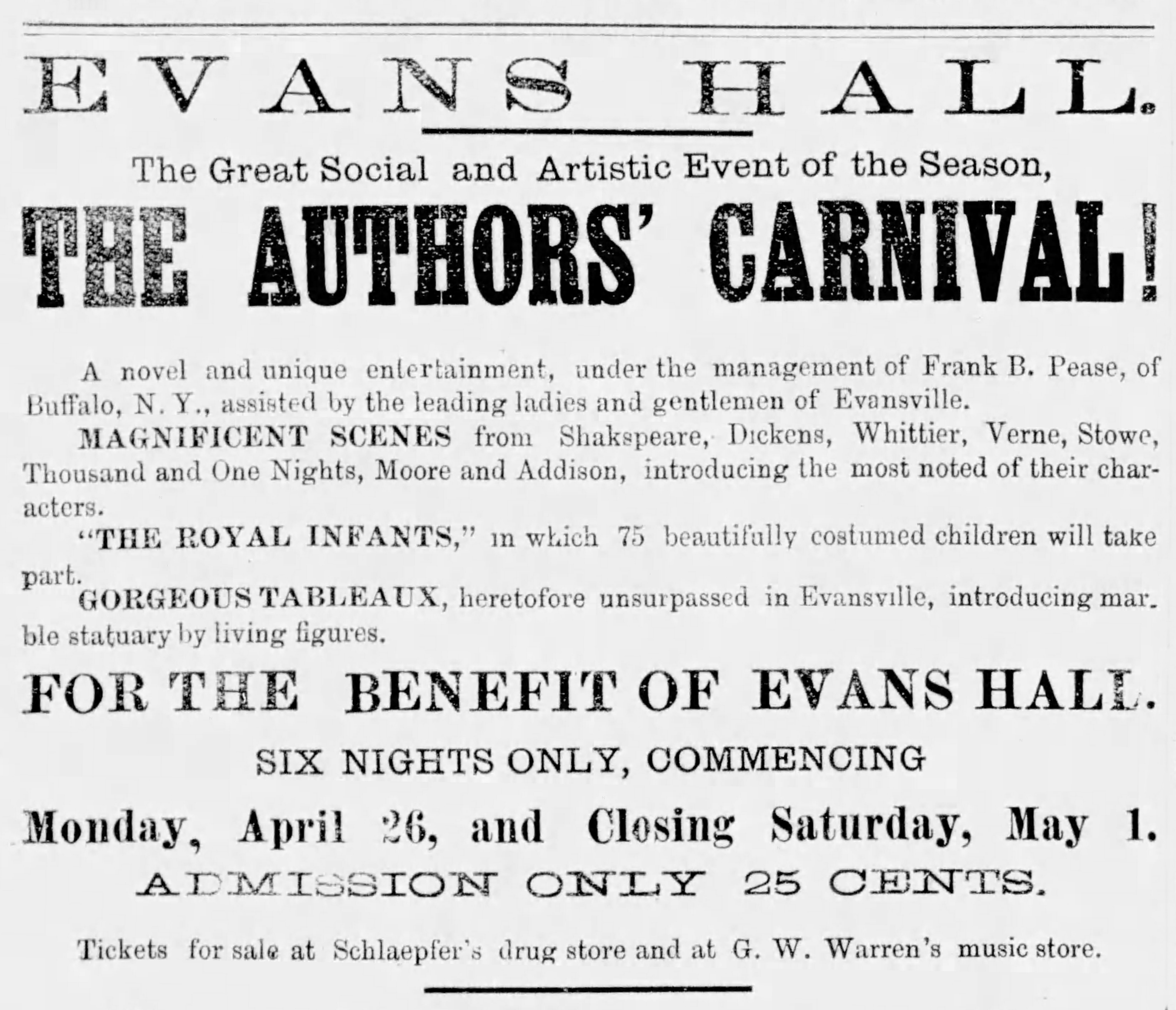
In the late 1800s a new and exciting form of entertainment swept across America. It was called the Authors’ Carnival. It had all the fun of a community fair, as well as dazzling theatrics on a magnificent scale.
Women in costume for an Authors’ Carnival in Washington DC
The Authors’ Carnival drew great crowds in every city in which it was staged, so it had to be set up in a large space, such as a town hall or tabernacle. The concept, though, was simple: the Carnival was comprised of a number of booths, each of which depicted a scene from a famous author’s works.
For example, there was a booth devoted to Twenty Thousand Leagues Under the Sea by Jules Verne. Costumed actors portrayed scenes from the book in an elaborately decorated submarine compartment behind a gauze curtain that simulated water.
A booth devoted to Sir Walter Scott’s Baronial Hall, from The Buffalo Times
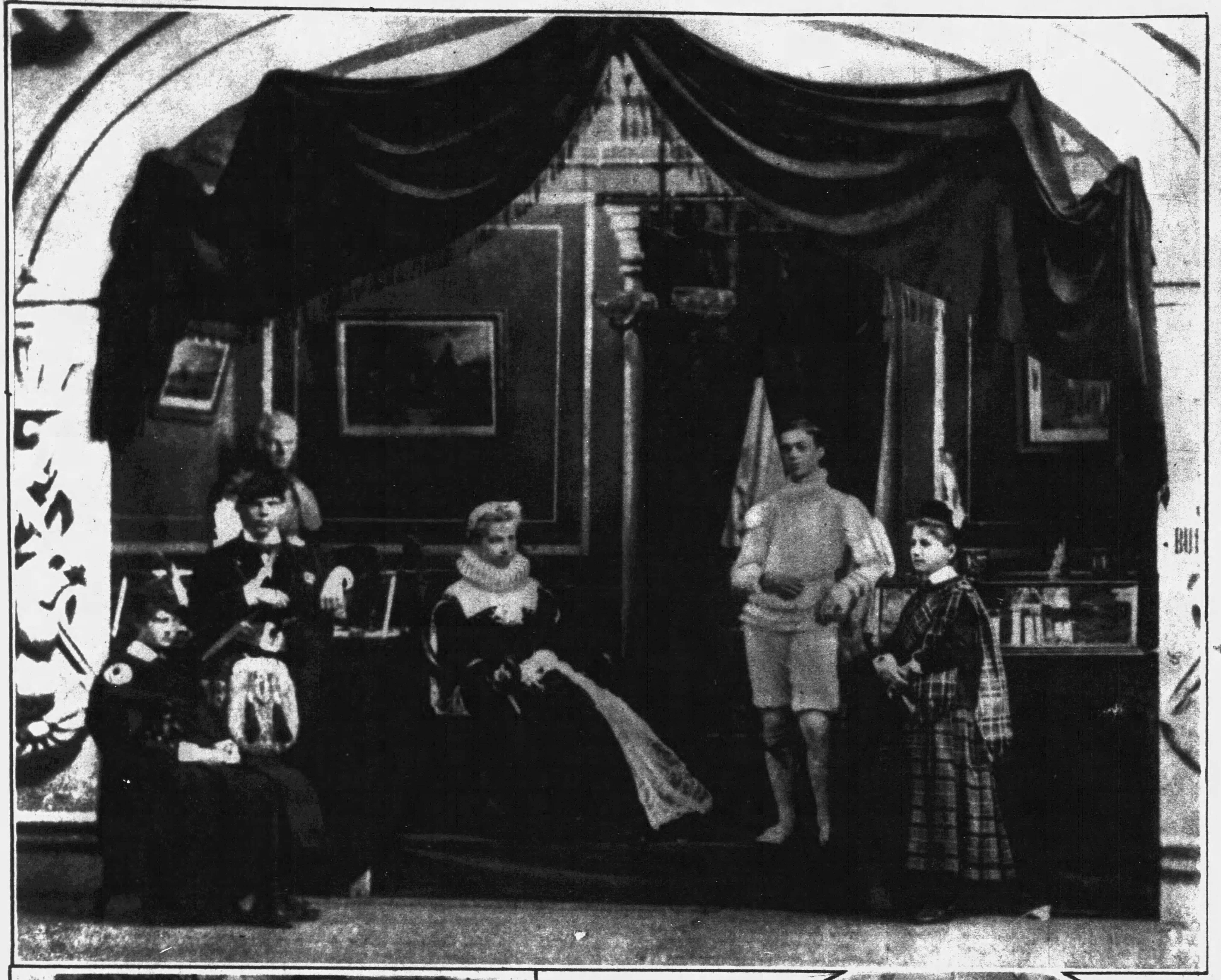
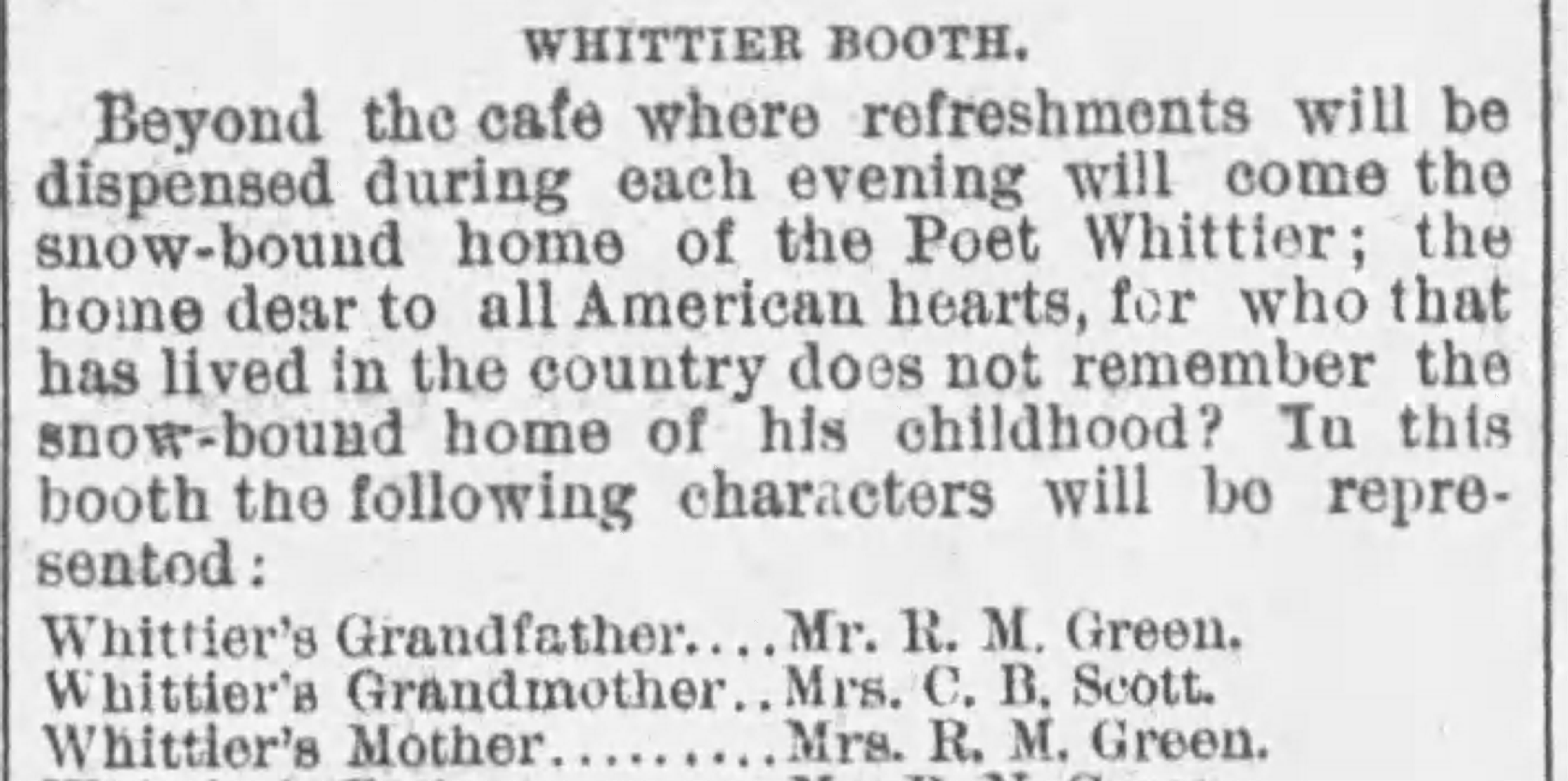
Another booth was devoted to John Greenleaf Whittier’s poem, “Snow-Bound: A Winter Idyll.”
A description of the Whittier booth, from The Scranton Republican, April 23, 1886
There were booths dedicated to Shakespeare, Longfellow, and Washington Irving, and many more literary figures, including Mother Goose. One of the most popular booths was lavishly decorated as Aladdin’s Cave.
In many cases, booths were set up so the costumed actors could interact with the people passing by.
Victor Hugo’s Paris Garden booth, from The Buffalo Times
The highlight of the Authors’ Carnival occurred on a center stage where tableaux vivant were enacted at intervals throughout the day and evening. The most popular tableau was the colorful, well-choreographed “The Fan Brigade.” It illustrated an essay by British satirist Joseph Addison on how ladies in the eighteenth century used their fans as weapons in flirtation and romance.
Fan Brigade, from Authors’ Carnival Album, 1880, Library of Congress
In 1881 the Authors’ Carnival arrived in Cleveland, Ohio, where sixteen-year-old Grace Livingston lived with her father Charles and mother Marcia (who was Isabella Alden’s older sister). Already an aspiring author, Grace visited the Authors’ Carnival one afternoon and wrote the following account of her experience:
The Author’s Carnival in Cleveland
By Grace
It was impossible for me to attend the evening entertainment of the Author’s Carnival, but when a matinee was announced for the next afternoon, I thought I would go.
It was held in the tabernacle. As you entered the door, directly opposite you was the stage, where the most beautiful tableaux were exhibited every twenty minutes, the performers never having rehearsed before, but being picked out and arranged on the spot, from the different booths.
The booths were ranged around the sides, and the center left for the audience to promenade. We took a look at the booths before the first tableaux.
The “Alhambra,” which, having a piano, and a few good players, managed to keep such a crowd around it all the time, that one could hardly get a peep at it.
Whittier’s “Snow Bound,” with its soft gray costumes, which harmonize wonderfully with the neat room, and fire-place, and cupboard, with its rows of bright, shining dishes, and the strings of dried apples hanging from the ceiling. Whittier’s “grandmother” happened to be a friend of mine, so I stepped up to her, and she said, “How does thee do, friend Grace?”
There was the “Arabian Nights” booth, where they sold miniature “Aladdin Lamps,” said to be exact copies from the original.
“Lalla Rookh” and the “Jules Verne” booths were beautiful and picturesque, with their mermaids, and flowers, and sea-weeds.
Longfellow’s “Hiawatha,” where the Indians flourished their tomahawks, and gave war-whoops, attracted a great deal of attention, and really was one of the most fascinating.
The “Egyptian” booth had beautiful, rich costumes.
The “Addison” booth had, perhaps, the most beautiful costumes, but the characters were all ladies.
The “Dickens” booth, with all its comical characters, was just refreshing.
As I walked up to the “Shakespeare’s” booth, the “Duke of York,” an old schoolfellow, stepped forward and shook hands with me.
The tableaux-bell rang, and we all rushed to the center of the floor, each one trying to get the best position for seeing. The most beautiful and quaint pictures succeeded each other; lastly, the beautiful “Fan Drill.” If you have never seen it, seen the perfect time and graceful motions, you cannot imagine how beautiful it was.
But there was one blight on all this beauty. At the “Spanish” booth they sold cigars and cigarettes, and some ungentlemanly persons even smoked among all that company of ladies. It was Satan’s way of joining in the Author’s Carnival.
Tableaux and theatricals were common forms of entertainment during Isabella Alden’s lifetime, and she wrote about them in several of her novels. You can read more about tableaux in these previous posts:
In addition to novels and short stories, Isabella Alden wrote Sunday-school lessons and programs for worship.
In 1895 she wrote a special program for Easter that was carefully crafted so it could be performed by young children, as well as older age groups.
Her Easter program included poems to read aloud, beloved old hymns to sing, and portions of Scripture to be memorized and recited.
Most importantly, the program clearly and simply related the message of Easter: that Christ rose from the dead, bringing eternal life to those who believe in him.
Spring is here and this month’s short free read by Marcia Livingston celebrates the change in season.
Ruth’s mite box is empty! She has only three weeks to earn the pennies needed to fill her offering box for missionary work—but how? It seems like a hopeless situation until her dear grandmother helps Ruth realize God has already provided an answer to her problem.
You can read Spring Blossoms and Tenths for free!
Choose the reading option you like best:
You can read the story on your computer, phone, tablet, Kindle, or other electronic device.
Harriet Lothrop (writing under the pen name of Margaret Sidney) had teenagers in mind when she penned this week’s charming free read in 1884.
She loved children of all ages, and she was constantly on the look-out for ways to help them move “upward and onward,” as she once wrote. She believed every “bright young life” needed stimulus, and she recognized that teenagers especially needed help navigating their way through life. She encouraged adults to “show our interest and sympathy with these young creatures in all their pursuits. The benefit will not be wholly theirs, for we shall gain as much as we give. Let us try it.”
Harriet was a great organizer of parties and clubs for young people (much like the fictional club she wrote about in today’s free read). From experience she knew such gatherings were a way for young people to blossom under the guidance of “wise and congenial older folk.”
She followed her own advice and helped create different clubs in her town of Concord, Massachusetts, each with an aim to both entertain and challenge young people to grow and learn. One of the membership organizations she founded was the Children of the American Revolution, which is still a thriving organization today.
A 1914 lapel pin for Children of the American Revolution, from “Patriotic Societies of the United States and Their Lapel Insignia, by Sydney A. Phillips.
She founded it with the purpose of inspiring “true patriotism and love of country” in young people; and she served as the national president of the organization for many years. You can visit the organization’s website here.
Harriet Lothrop (on the let) and Mrs. Frank Mondell in 1920, after Mrs. Mondell was elected President of the Society of the Children of the American Revolution.
Her novel How They Went to Europe offered another idea for a club where young people and adults could join together for a common purpose:
Disappointed she cannot go to Europe with her wealthy relatives, Miss Carine Hedge decides to form a club to plan an imaginary trip to Europe. To Carine’s surprise, many of her friends are in the same situation: they long to travel abroad, but haven’t the means. Soon, Carine’s club is the most sought-after membership in town; but as she and her friends meet to pore over maps, read guide books, and go through the motions of pretending to plan a trip, Carine can’t help but wonder if her dearest wish might one day become a reality.
You can read How They Went to Europe or free!
Choose the reading option you like best:
You can read the story on your computer, phone, tablet, Kindle, or other electronic device.
Reviews and giveaways for Christian fiction and sweet, clean fiction. Bringing readers information on great stories and connecting authors with their readers.

![“PANSY” ON CHURCH SOCIETIES.
Mrs. Alden and the Adelbert College Glee Club Entertain an Audience.
A plainly attired lady of medium hight [sic] wearing a brown dress and lace collar, was introduced to a large audience at the Case avenue Presbyterian church last evening as Mrs. G. R. Alden, or the first “Pansy” of the season after an unusually severe winter.
Mrs. Alden, who is well known in the literary world as “Pansy” the Sunday school workers’ favorite authoress, read several chapters of her republished book “Circulating Decimal,” to the great delight of her hearers. She is a pleasing and natural reader, and knows how to interest an audience. She read of the trials and tribulations of Sunday school societies, described the efforts of the young ladies to “get up” a church fair and the cantata of “Esther,” how they quarreled over the leading parts and how they netted the enormous sum of $19.02
In the course of the evening the Adelbert college glee club entertained the audience with several excellent selections, capitally sung, among which were “Nellie was a Lady,” “Way Down Upon the Suwanee river” and “George Washington.”](https://isabellaalden.com/wp-content/uploads/2023/05/plain-dealer_cleveland-oh_1885-04-15_page-8.png)







![Newspaper clipping: PANSY'S EASTER SERVICE. Superintendents and Teachers should send for a copy of the April "Pansy," now ready. It contains a beautiful Easter Service carefully arranged and prepared for Christian Endeavor societies, Epworth Leagues, King's Daughters, Mission Bands, and Sunday-schools, by Mrs. G. A. [sic] Alden, known to all Sunday-school workers under the familiar name "Pansy." An extra edition of the April "Pansy" has been issued to meet the demand created by this special Easter Service. Copies will be sent, post-paid, on receipt of 10 cents, or in quantities at seventy-five cents per dozen.](https://isabellaalden.com/wp-content/uploads/2023/04/from-herald-and-presbyter-1895-03-13-pg-359.jpg)