In Lesson One Mr. Moody diagnosed the disease (Understanding Sin) and in Lesson Two, named the cure (The Remedy of the Gospel). Now, in Lesson Three, Mr. Moody outlines the five essential steps of genuine repentance:
Conviction Contrition Confession of Sin Conversion Confession of Christ
Using the biblical examples of King Saul’s shallow confession, David’s broken heart, and Joseph of Arimathea’s courageous stand at Calvary, Mr. Moody explains the difference between true and counterfeit repentance.
You can read Lesson Three for free!Click here to download a large-print PDF version you can print or share with friends.
Then, join us again on January 27, 2026 for Lesson Four of Mr. Moody’s Bible Class.
If you missed Lessons One and Two, you can find them by clicking on the Free Reads tab above.
December 8, 1925—almost exactly 100 years ago—started as any ordinary Tuesday afternoon in Palo Alto, California. Isabella Alden was 83 years old, and was living in the beloved double-home that she and her husband Ross built a decade before on Embarcadero Road.
Ross and her son Raymond had died the year before, so only Isabella and her daughter-in-law Barbara (Raymond’s widow) and her five children were left to share the rambling house.
Barbara Hitt Alden, about 1910.
That afternoon, Isabella, Barbara, and Barbara’s youngest son, Raymond Jr., set out together in the family car. Barbara was behind the wheel. None of them could have known that their simple outing would dramatically change the remainder of Isabella’s life.
A 1925 Lincoln sedan, a popular car style in the 1920s.
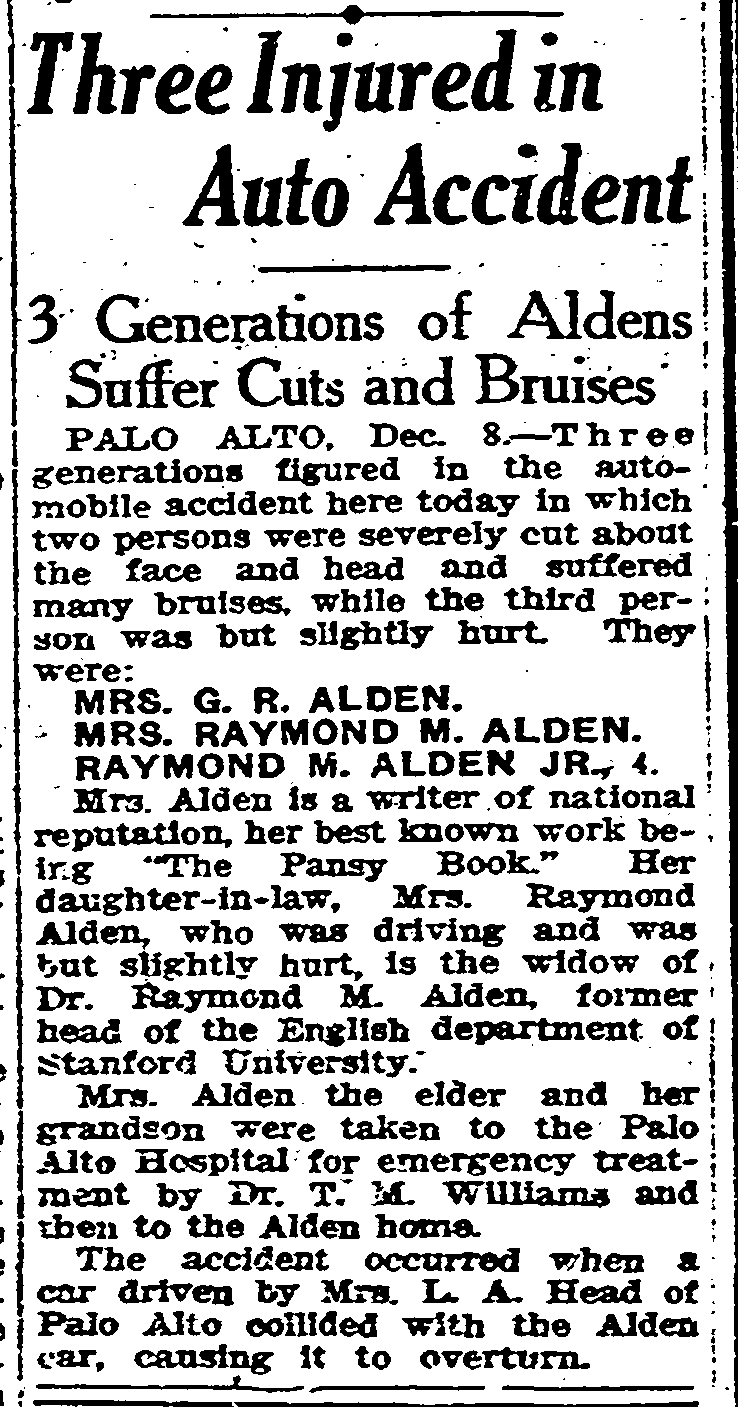
At a street intersection a little less than a mile from their home, another car collided with the Alden vehicle, striking it with enough force to cause it to overturn. The impact shattered the windshield and windows, showering the passengers with broken glass.
The San Francisco Chronicle, December 8, 1925.
Barbara was only slightly hurt. But Isabella and her young grandson suffered “severe cuts about the face and head, and many bruises.” After receiving first aid from a nearby physician, Isabella and Raymond Jr. were taken to Palo Alto Hospital for treatment.
Palo Alto Hospital in the 1920s.
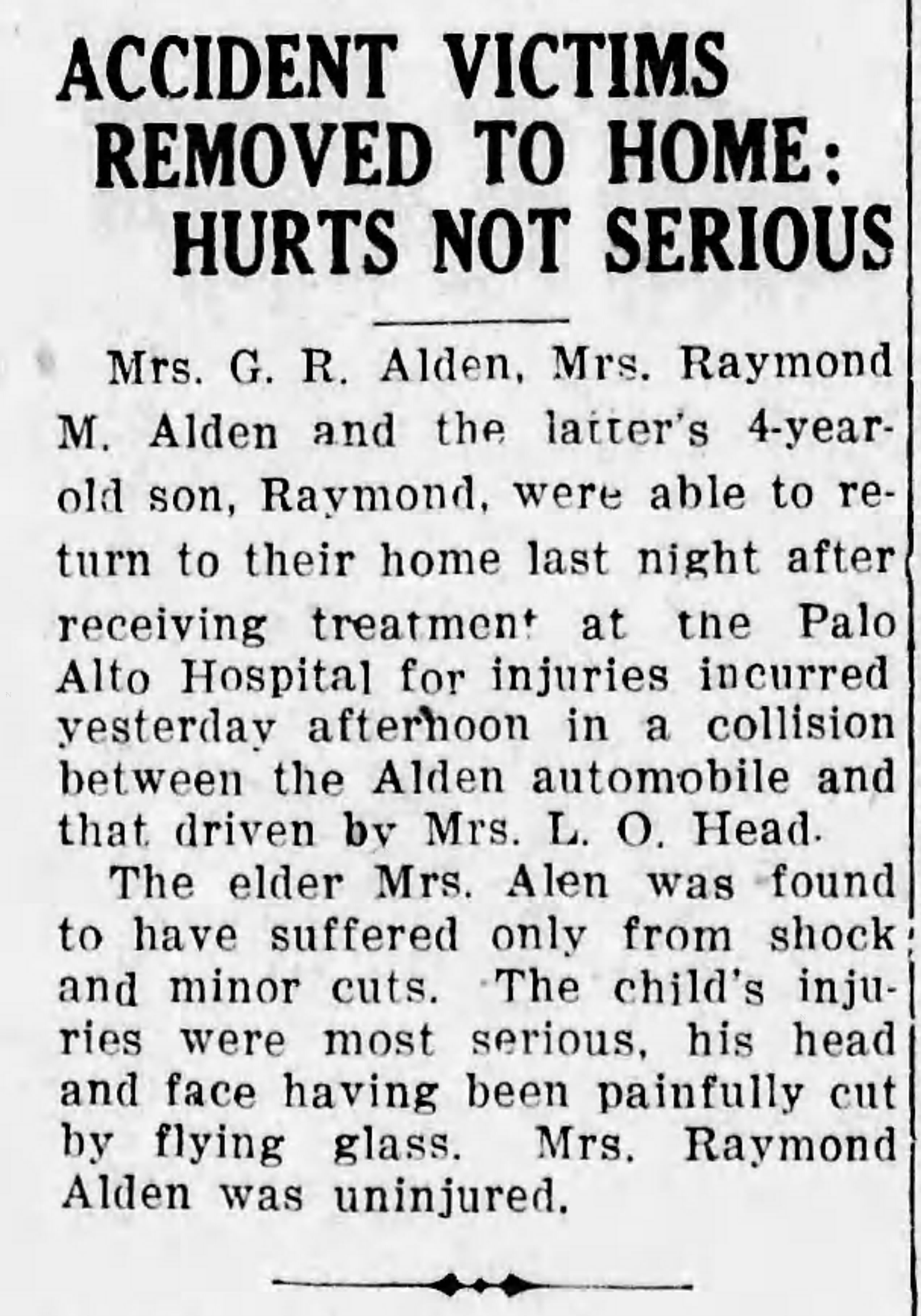
The next day’s newspaper reported reassuring news: the accident victims had returned home, and Isabella “was found to have suffered only from shock and minor cuts.” Her grandson’s injuries were described as the most serious of the three.
The Peninsula Times Tribune, December 9, 1925.
But that assessment would prove tragically wrong.
What those initial medical evaluations missed was the true extent of Isabella’s injuries. The accident left her in considerable pain and, ultimately, confined to a wheelchair for most of the remaining years of her life.
Until the accident, Isabella was a woman who had been remarkably productive well into her eighties—still writing, still engaged with her work and family. The accident didn’t just slow her down; it fundamentally altered how she could live her remaining years.
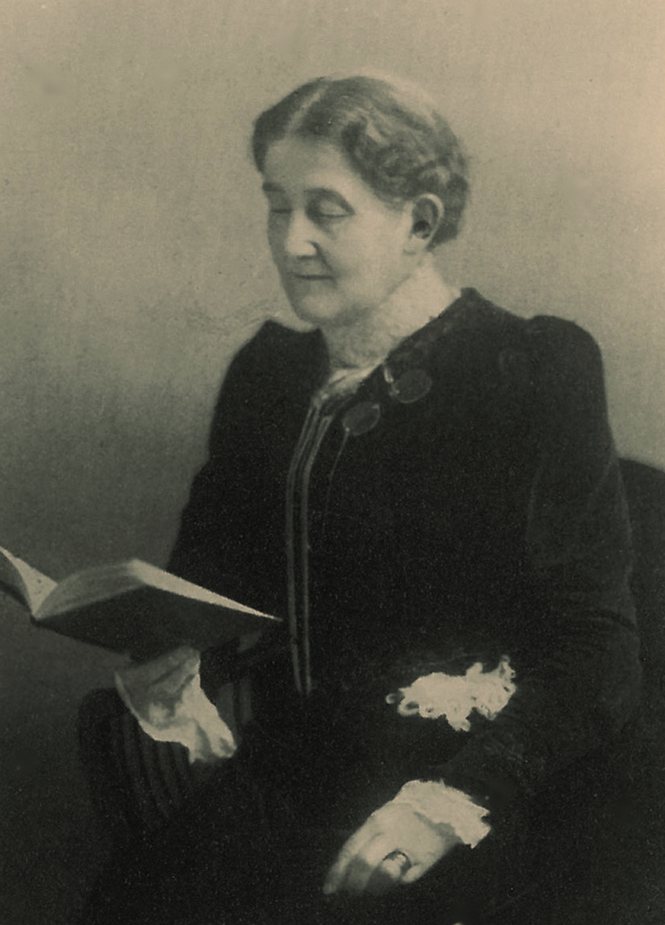
Isabella in later years.
In her memoir “Memories of Yesterday,” which she finished writing after the accident, Isabella documented the physical pain she endured. For a woman who had spent her life in service to others, who had quietly helped so many navigate their own difficulties, those final years must have been particularly difficult for her.
Isabella lived for nearly five more years after the accident, passing away in 1930 at age 88. Those years, spent largely in a wheelchair and dealing with chronic pain, were a far cry from the active, engaged life she had led for more than eight decades.
What is striking about this incident in Isabella’s life isn’t just the tragedy of the accident itself, but what it reveals about her character during her final years. Despite her pain and limitations, she continued to write. She finished her last novel, An Interrupted Night, and entrusted it to her niece, Grace Livingston Hill, to guide it through the publishing process.
She also completed her memoir, Memories of Yesterdays, candidly sharing her memories and reflections on a life well-lived. Even when her body was confined to a wheelchair, her mind and spirit remained active.
That’s the Isabella Alden we’ve come to know through her writings—someone who lived out the principles she wrote about, even when circumstances became difficult. She had spent decades writing about faith, perseverance, and finding purpose in adversity. In her final years, she had to draw on those very principles herself.
A hundred years ago this month, Isabella’s life changed forever on a Palo Alto street corner. While the accident limited her physical abilities, it couldn’t diminish the legacy she’d built through decades of faithful work—or the strength of character that sustained her until the end.
It’s Christmas time, and shopping for the holiday is now in full swing. During Isabella’s lifetime, Christmas ads filled the issues of newspapers and magazines, tempting shoppers with bargains and gift ideas.
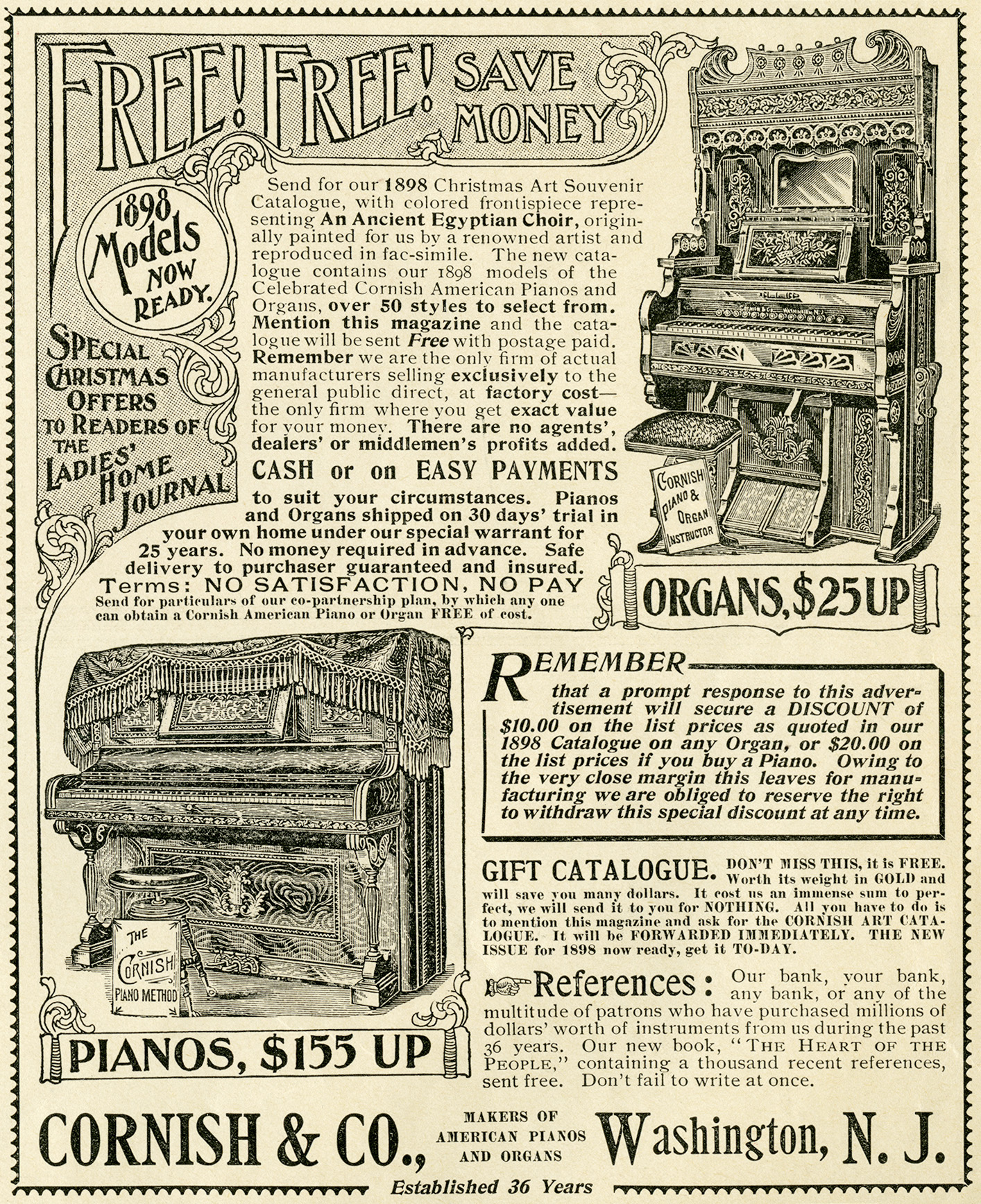
Among the many advertisements for books, handkerchiefs, slippers, and gloves were ads for a gift the whole family could enjoy: a piano.
The idea wasn’t as extravagant as it might sound; by the late 1890s pianos were quite affordable. Dealers and manufacturers offered consumers credit or payment plans that made purchasing a piano within the reach of families with more modest incomes.
Families weren’t the only ones who took advantage of these arrangements. In Pansy’s Advice to Readers, Isabella wrote about a group of school girls who bought a piano for their gymnasium by raising the money themselves and making regular payments to the dealer.
Such arrangements meant pianos were no longer an article of luxury available only to the wealthy. As more families were able to purchase pianos, American social life began to change. Previously, people gathered at churches, concert halls, and other public places to enjoy music; but affordable pianos allowed people to enjoy music at home and within their own family circle.
But even affordable pianos presented a challenge: someone had to learn how to play them.
Once a piano was installed in a home, there were lessons to be had and endless hours of practice in order for a player to become proficient. But in the 1890s self-playing devices came on the market that again changed how families brought music into their homes.
There were two kinds of self-playing devices: those that attached to pianos, and those that were placed inside them.
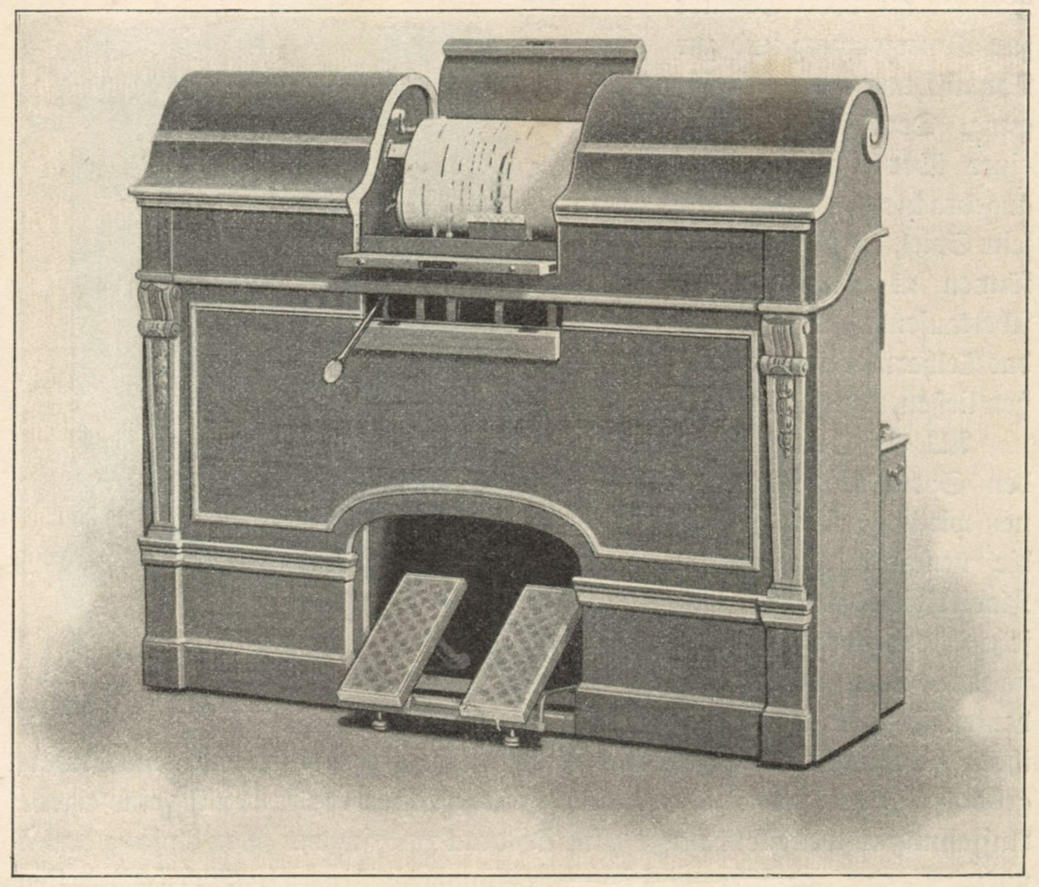
Invented in America, the pianola was a cabinet-type device that was pushed up against a piano keyboard. It depressed the piano keys with protruding felt-covered levers controlled by a perforated paper roll. A person had to be seated at the device to work the pumping pedals so air pressure created suction to rotate the roll.
Pianola cabinet style in 1890.
The other type—the player-piano—operated in the same manner with a rotating perforated roll, but the device was installed within the piano itself.
According to the editor of The Piano and Organ Purchaser’s Guide for 1908, these devices “made tens of thousands of pianos eloquent with good and popular music”—pianos that formerly were silent, except when there was a dance at home, or on a Sunday, when a few hymns were played.
“The present of a pianola is a present to every member of the family.” So declared a magazine advertisement in 1904 that urged consumers to consider buying a mechanical piano player for Christmas.
It wasn’t just families that could now listen to beautiful music in their homes. This ad in a 1904 issue of Booklover’s Magazine suggested a pianola cabinet player was the ideal gift for a bachelor’s home.
Those self-playing piano devices opened up whole new musical worlds for people. Many who never visited the opera or a concert before became thoroughly acquainted with world-class musical and orchestral compositions.
Sales of pianolas and player pianos peaked in the mid-1920s when gramophone recordings and the arrival of radio caused their popularity to wane.
But while in their heyday, pianos, pianolas, and player pianos made an important mark on American culture, bringing music and joy to thousands of families. Isn’t that a wonderful gift to receive?
You can learn more about pianolas and player pianos by clicking here.
This month’s free read is a sweet story about faith and Christmas blessings by Isabella’s sister, Marcia Livingston.
Wealthy Mr. Thornton finds his greatest pleasure in carrying out the quiet, unseen work of “his Friend.” With Christmas fast approaching, he has renovated a beautiful cottage to bestow upon an as-yet-unknown person who is homeless and friendless. When his path crosses that of Lily Winthrop and her grandfather, Mr. Thornton sees a clear object for his charity. Will his act of giving remain anonymous, or will Lily and her grandfather discover the secret donor of their miraculous Christmas gift?
Reviews and giveaways for Christian fiction and sweet, clean fiction. Bringing readers information on great stories and connecting authors with their readers.











 Isabella Alden