A Feather in Her Hat

Rebecca’s dress was entirely appropriate and becoming. She had gone out from her father’s house very well supplied with clothes, and her ability to re-make them herself had stood her in good stead, so that now her dress of fine black cloth, made severely plain, but with minute attention to details, became her well. So did the black felt bonnet, with its three stylish plumes, which she had herself dressed over.

from Wanted, by Isabella Alden, published in 1894

In her stories, Isabella often used the latest fashion to define a character’s financial and social status, and Rebecca Meredith’s outfit was an excellent example. Because her dress was plain and black, her bonnet “with its three stylish plumes” was the centerpiece of her outfit and called attention to her pretty face.

Bonnets with plumes were very much in style when Wanted was published in 1894. Women’s magazines, like Godey’s Lady’s Book and The Ladies Home Journal showed that hats were be made from a variety of materials—straw, for example, or stiffened fabrics like velvet—and that they were quite modest in size.

Black and white illustration of a young woman wearing a long gown in the fashion of 1895 with extremely large puffed sleeves, and a high collar with a large bow at the back. On her head is a bonnet with a short brim, decorated on top with flowers, gathered ribbons, and an aigrette of short bird plumes.
From Godey’s Lady’s Book, August 1895.

Though small, hats at that time were heavily adorned with ribbons, bows, artificial flowers and, most importantly, bird plumes.

A black and white drawing of a woman wearing a short belted coat with long sleeves and a collar that stands up to cover her neck. On her head is a small hat with a short brim, adorned with ribbons, flowers and a cluster of curled bird feathers at the top.
From Godey’s Lady’s Book, October 1897.

Bird feathers were the most desirable decorative elements on a lady’s hat. In 1894 The Ladies Home Journal predicted that actual wings displayed on bonnets would be “all the rage,” while another magazine wrote that “almost every second woman one sees in the streets flaunts an aigrette of heron’s plumes on her bonnet.”

Color illustration of a woman dressed in a coat and hat from about 1900. Her hat has a wide brim and is piled on top with arrangements of ribbons and two long bird feathers set at an angle pointing toward the back of the hat. A wide red ribbon tied beneath the woman's chin keeps the bonnet in place.

Milliners used feathers from egrets, hummingbirds, herons, and even song birds of all kinds as adornments.
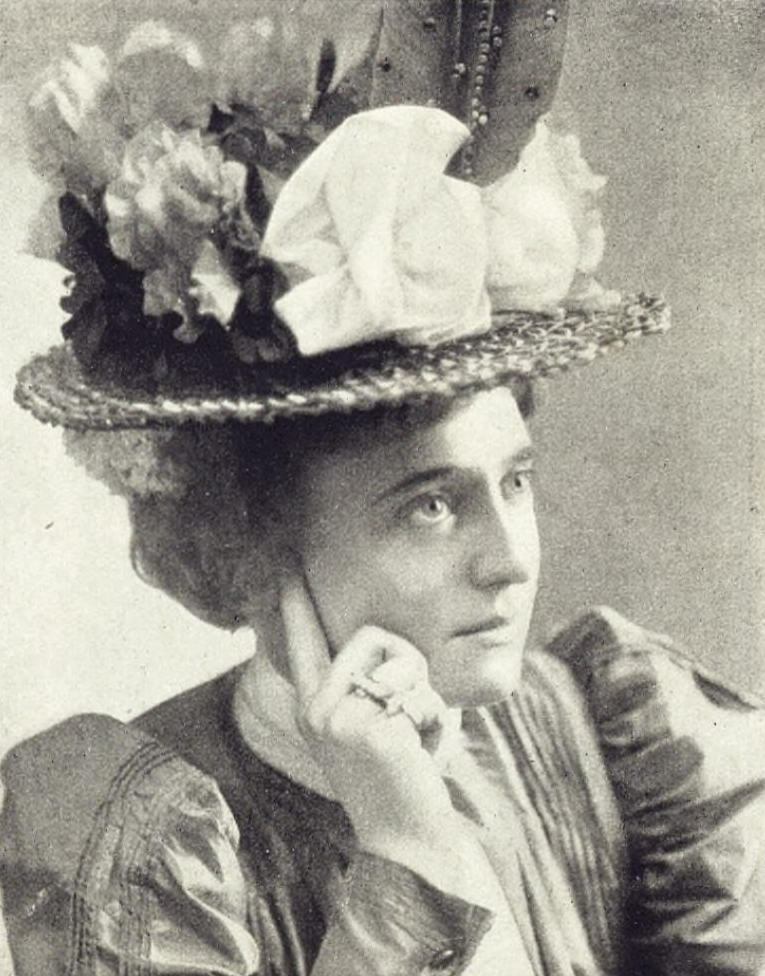
Black and white photo of a woman wearing a dress from the 1890s. On her head is a flat brimmed hat; the crown of the hat is covered with flowers, gathered ribbon, and a single large bird feather in the front. The feather stands straight up on its stem and is adorned with beads.
From Godey’s Lady’s Book, 1898.

The more exotic the bird, the more desirable their feathers; and the millinery industry was willing to pay top dollar to anyone who would supply them, no questions asked.

But some people did ask questions and raise alarms, after nature lovers in England and the United States discovered that some birds, like ospreys and egrets, were hunted so mercilessly, ornithologists feared they would soon be extinct.

Newspaper clipping: BIRDS VICTIMS OF PRIDE. We have received some letters from our readers enforcing the words of Mrs. Aria as the the cruel price that has to be paid for the osprey's feathers, which are in vogue just now in women's headgear. Mrs. Phillips writs to point out that these feathers can only be obtained at breeding time. The plumage is torn from the living parent birds on the nest, which are then flung aside to die, while the young birds are left to starve. Could anything be fore horrible! The bare recital of these facts should be enough to put an instant stop to such a merciless trade.

In London, a Society for the Protection of Birds was formed. Members pledged to never wear feathers of any bird not killed for the purpose of food. Similar organizations were formed in Europe, Canada, and the U.S.

Newspaper clipping: BIRDS IN OUR BONNETS. In response to many inquiries, we would draw attention to the Society for the Protection of Birds, 29 Warwick Road, Maida Hill, London, of which Miss Hannah Poland is the secretary. There is no subscription fee, but any one wishing for a card of Membership can have one by sending two stamps to Miss Poland. Members promise not to wear feathers of any bird not killed for the purpose of food, the ostrich excepted.

The public outcry began to pay off, as women around the world pledged to stop wearing hats with real bird feathers, and American lawmakers enacted state and federal laws to protect certain species of birds by banning them from use in hats and garments.

One bird that was exempt from protection was the ostrich, because its feathers could be harvested without killing the bird. So it was natural that the millinery industry would turn its attention to ostriches as a source for adornments.
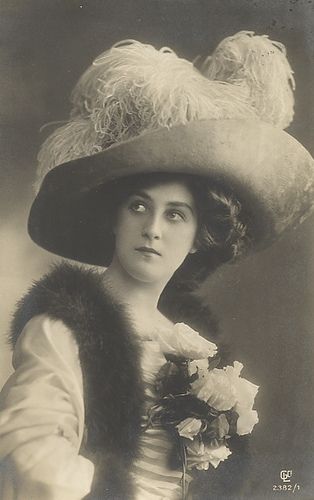
Black and white photo of a woman wearing a hat with a wide brim of 12 to 14 inches deep. The crown of the hat is covered in ostrich feathers that are piled about 12 to 14 inches high, giving a waterfall effect.

Ostrich farms that had been established in the southern United States in the late 1890s in hopes of selling feathers to the millinery industry suddenly saw an increased demand for their wares.

Color photo of a herd of about 40 ostriches running across a fenced enclosure.
An ostrich farm in southern California.

And because ostrich feathers could be plucked every eight or nine months, ostrich farmers with large herds enjoyed a regularly replenished inventory they could sell.

Black and white photo of a woman wearing a short-brimmed hat. A wide ribbon circles the crown of the had and is arranged in multiple loops in front. The stems of two long ostrich feathers are tucked into the ribbon arrangement and the feathers drape back cross the crown of the hat.

With the turn of the century, hat styles changed, and the small bonnets that were popular when Isabella wrote Wanted fell out of fashion. The new bonnet styles of the 1900s featured wide brims and brilliant colors.

Ostrich plumes suited the new styles beautifully. Because of their size, the plumes could cover a large hat’s crown and brim.

Hand-colored photo of a woman wearing a hat with a wide brim of 12 to 14 inches deep. The crown of the hat is covered in ostrich feathers that are piled high, with some parts of the feathers spilling over the brim of the hat.

Even more importantly, ostrich feathers could be dyed to match almost any color. Women and conservationists rejoiced, feeling confident that they could use ostrich feathers for fashion without feeling guilty.
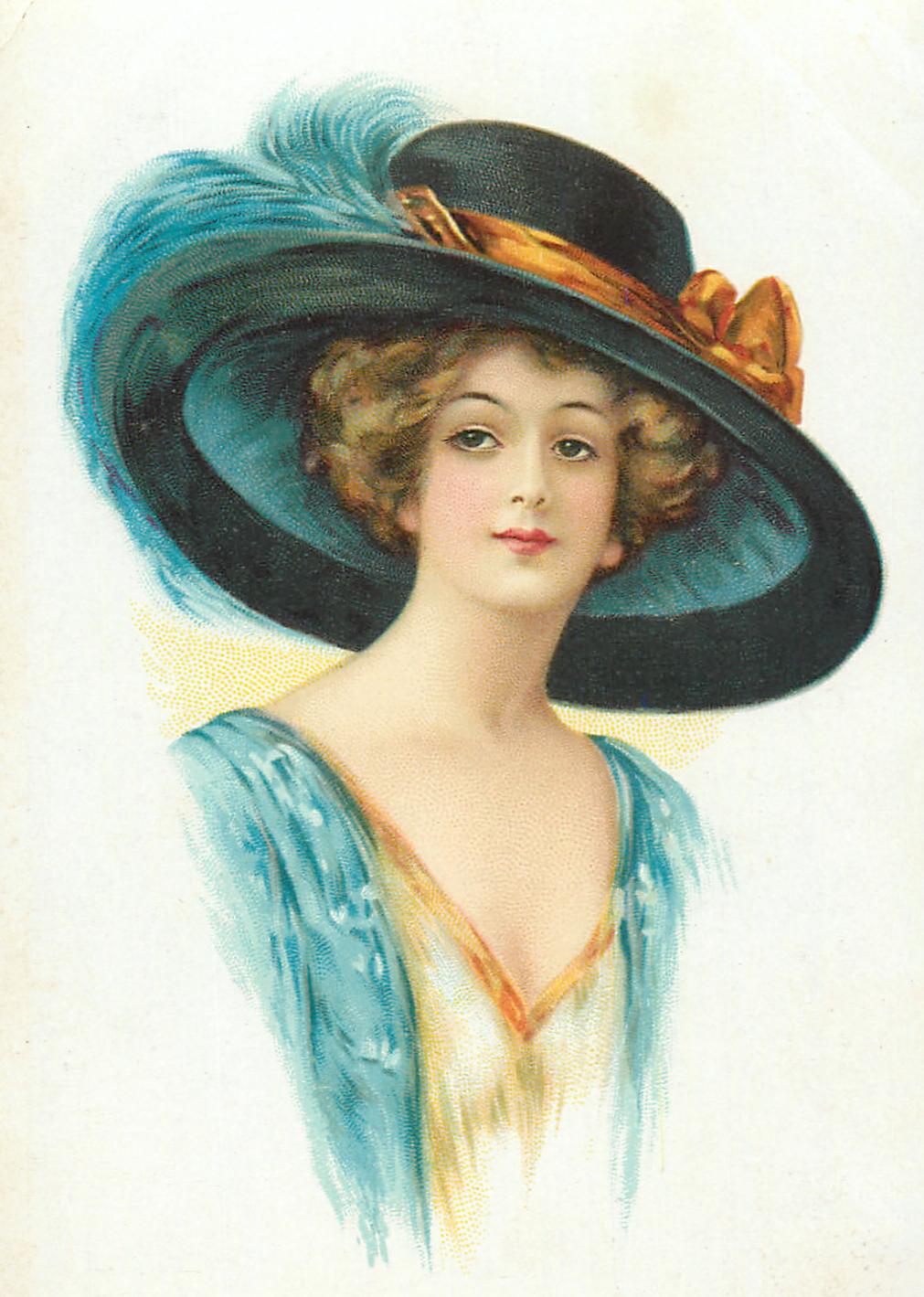
Color illustration of a woman wearing a wide brim bonnet about 14 to 18 inches deep. The bonnet is black but the lining is a brilliant blue. A wide orange-gold ribbon circles the crown of the hat and is tied with a large bow. On the opposite side of the crown feathers of the same brilliant blue are arranged in a cluster across the brim.

In her 1912 novel The Long Way Home Isabella made sure her fashionable characters wore the latest style in bonnets. Newlywed Ilsa Forbes wore a wide-brimmed hat when she boarded the train with her new husband Andy:

But Andrew had no words, just then; never was the heart of bridegroom more filled to overflowing, and he could not yet think about decorations or supper.
“My wife!” he murmured, as his arm encircled her. “Really and truly and forever my wife. Do you realize it, darling?”
She nestled as closely to him as her pretty, new traveling hat would permit and laughed softly.

There was, however, a problem with those stylish large hats adorned with ostrich feathers. In 1908 a letter to the editor of the Oregonian newspaper applauded the ban on exotic bird feathers, but raised a new and troubling concern about ostrich feathers:

Newspaper clipping: The only plumage I have cared to wear is the ostrich feather, and I may yet become convinced that this practice is incompatible with my convictions. Having witnessed many times the plucking of ostriches in Southern California, I have been unable to see that there was any special cruelty attached, though I have no doubt the sensation experienced by the ostrich might be much like we would feel in having a deep-rooted molar drawn.

The letter-writer wasn’t the only one wondering if an ostrich felt pain when its feathers were plucked. Soon the Audubon Society and other conservationists began asking the same question and took their findings to state legislators.

In California, where Isabella was living and where many of the country’s ostrich farms were located, the question was answered by lawmakers. In 1900 the state updated its penal code to make it a crime to intentionally mutilate or torture a living animal, which included plucking live birds like ostriches.
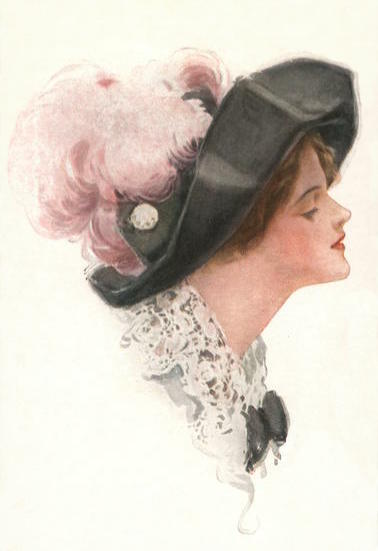
Profile of a young woman wearing a black bonnet with a wide brim turned up in the front. At the back of the crown is a cluster of long, fluffy, pink ostrich feathers.

So ostrich farmers stopped plucking and began snipping feathers, instead. A 1911 article in the Dallas Morning News explained the process:

Newspaper clipping: While the term "plucking' is given to the harvesting of the feathers, the fact is that they are not plucked or pulled out, but are snipped off by means of shears. This process is gone through every eight months, and the quality of the plume depends largely upon how it is cut. There are twenty-five long white plumes on each wing of the male bird. The rest of the feathers are black on the male and a grayish color on the female. Harvesting the plumes is no easy task.
From The Dallas Morning News, November 12, 1911.

Once again, stylish ladies (and Isabella’s equally stylish characters) could wear hats adorned with feathers and maintain a relatively clear conscience.

It’s interesting how Isabella’s attention to details, like hat sizes and adornments, brought her stories to life. While she didn’t preach about fashion in her novels, she paid close attention to these niceties, and used them to bring authenticity to her characters and their world. Contemporary fans of her novels would have noted the subtle changes as keeping up with the times.
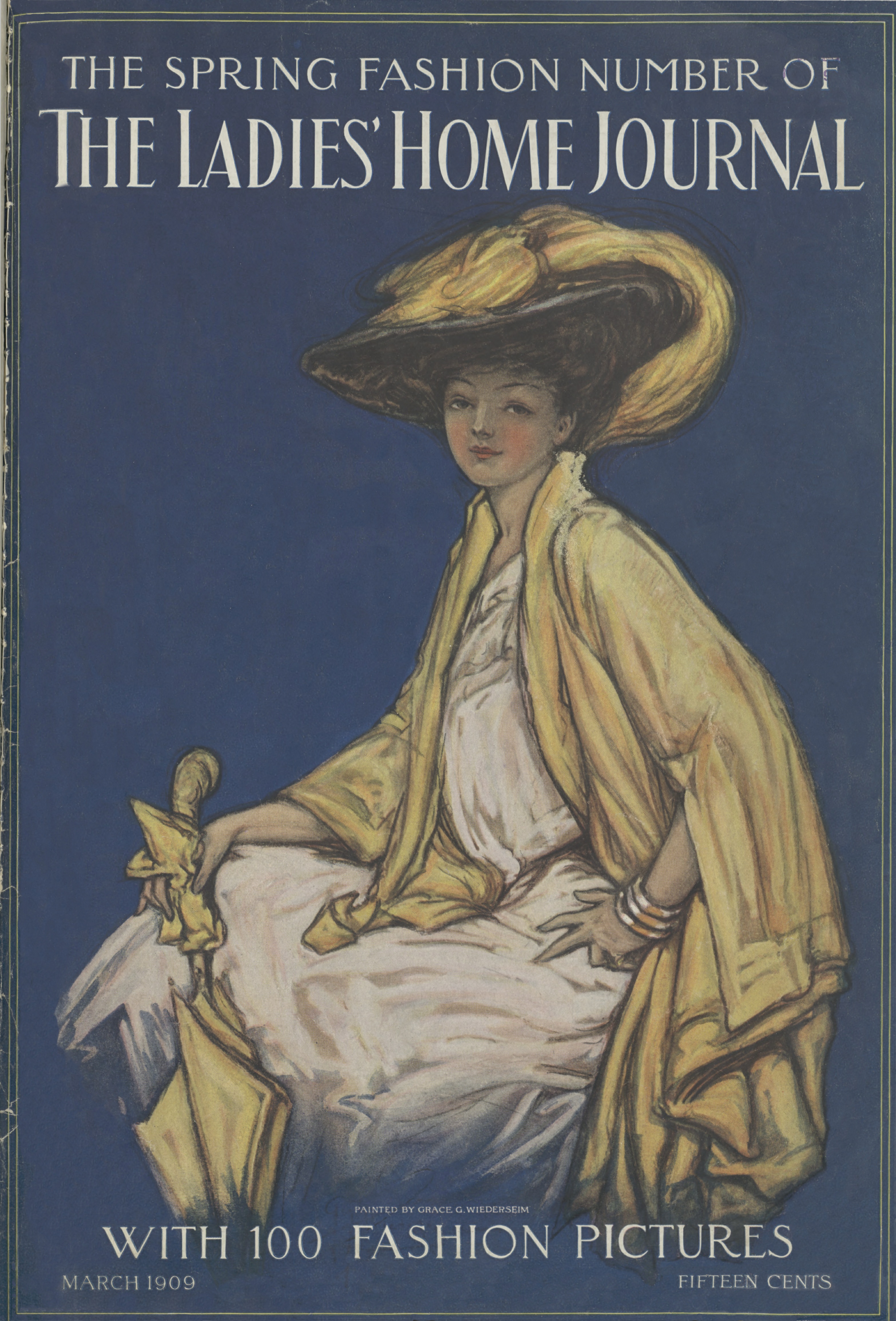
Cover of The Ladies' Home Journal magazine. The color illustration shows a stylish young woman seated, wearing a white dress. A gold colored cape is drawn open with one of her hands. In the other hand she holds a matching pair of gloves and an umbrella. On her head is a wide-brimmed hat fashionable in 1909. Covering the brim of the hat and cascading over the brim at the back is an arrangement of feathers dyed gold to match her outfit.

For us in 2025, it’s fascinating to learn there’s a whole complicated history behind Rebecca Meredith’s feathers—a history about women who were determined to write wrongs and find ways to be fashionable without compromising their conscience.

You can learn more about Isabella’s novels mentioned in this post by clicking on the book covers below:
Full disclosure: these are Amazon affiliate links, which means if you decide to purchase through them, this blog will receive a small commission. It doesn’t cost you anything extra, but it helps us keep this site running and researching Isabella’s life and the fascinating world in which she lived.

About Auntie May

Isabella was the youngest of six siblings. She had one brother, James, and four sisters. With her sisters she enjoyed a close bond, even though there was a wide range of ages between them. Her eldest sister Elizabeth was a married woman with a home of her own by the time Isabella was fourteen months old.

Her sister Mary married George Heaton when Isabella was a girl of 17. Mary and George moved into a house of their own—one that was so close to Isabella’s family home, that the two properties shared a garden gate.

Mary’s husband George was editor of the town’s newspaper; and it was he who was so impressed by the first story Isabella wrote, that he begged Isabella’s parents to allow him to publish the story in the newspaper. Reluctant at first, they eventually gave their permission, but only if Isabella’s name was not used. Instead, the story was published with the author’s name listed as “Pansy,” thus beginning Isabella’s writing career that would span the next eighty years. (You can read more about Isabella’s first published story here.)

Isabella was in her early thirties when she began editing and writing for The Pansy magazine. The enterprise quickly became a family affair when her sisters, brothers-in-law and friends also began to write articles and stories for the magazine.

Sisters Marcia, Julia and Mary were among those writers, and Mary often chose pets as the focus of her stories. In one story Mary explained to her young readers how she came to adopt a sweet little kitten:

“I live in a part of the country that is blessed with cats. I never saw so many gathered in one place before in my life — gray cats and yellow cats, cats with tails and cats without tails, and kittens without number. One day I took pity on a poor little hungry kitty, and set her out a basin of milk. In less than five minutes there were nine kittens, all with their heads in that basin. One late comer could not get into the ring, so she climbed on the backs of the others, and reaching down got her little red tongue into the dish. I said last week that I would adopt one of the orphans, so I kept her in the house all day, and fed and played with her; but at night I let her out. When we came downstairs in the morning there she was waiting at the door for admittance, but she had brought four others with her! She has seemed, however, to settle down, and decide that she belongs; she stays in the house with me all the time, and the others scamper in when they can get a chance, and out again.”

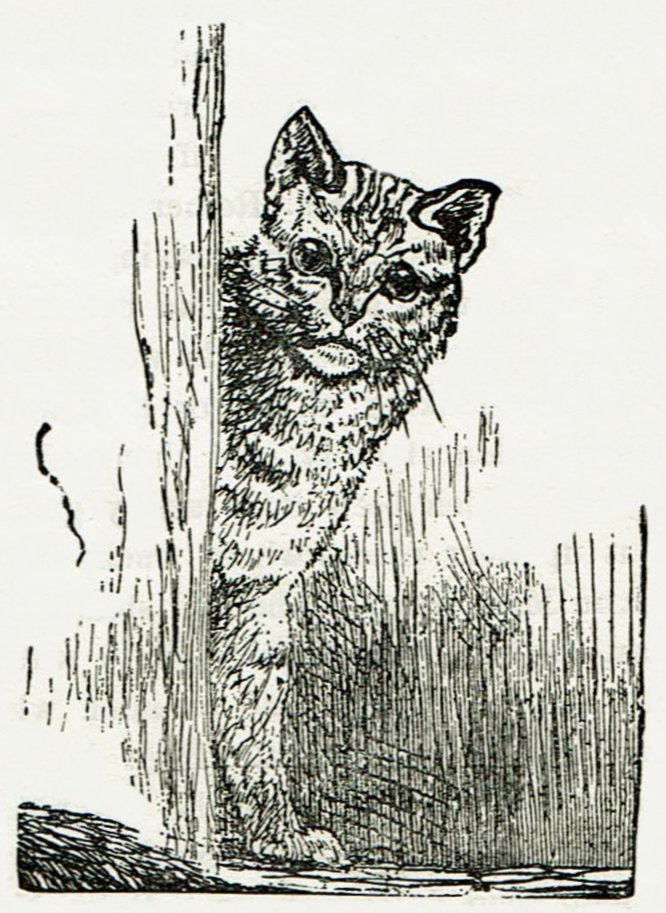
Black and white drawing of a cat outside in the tall grass peeking around the corner of a building.
Illustration from Mary’s story in an 1893 issue of The Pansy magazine.

In another issue of the magazine, she wrote about her new parrots:

“I have named the large one Billy, and the small one Polly. They are very happy together. Every afternoon Billy will spend an hour in petting and dressing Polly. He will oil her feathers, and scratch her head; then he will hold his head down, and try to make her fix him, but she can’t take time. She will just give him two or three little pecks, and then be intent on eating her supper, or playing with a stick, or bit of paper. Whenever she screams, Billy will say, ‘Shut up, Polly; shut up!'”

Black and white drawing of a little girl feeding a morsel to a bird in a cage.
Illustration from Mary’s story in an 1888 issue of The Pansy magazine.

Mary gauged her reading audience to a nicety—don’t all children love to read about friendly kittens and talking birds?

Over the years Mary occasionally wrote more stories for The Pansy under the pen name “Auntie May.”

When Isabella retired from editing the magazine, and her husband retired from the ministry, they moved to Palo Alto, California to be close to their son Raymond and his family. Isabella’s sister Julia, who had never married, also lived with them; so when Mary’s second husband died unexpectedly, Isabella invited her to join them in their spacious California home.

So at the age of 76, Mary packed her belongings and set off across the country to live with Julia, Isabella, and the rest of the Aldens in sunny California. (You can click here to read about the house they all lived in together). She soon found herself happily sharing a home with Isabella’s young grandchildren.

Black and white photo of an elderly woman in her 80s, seated in a chair. On her lap she holds a baby and beside her stands a little girl about 3 years old.
Mary, age 88 in 1914, with two of Isabella’s grandchildren.

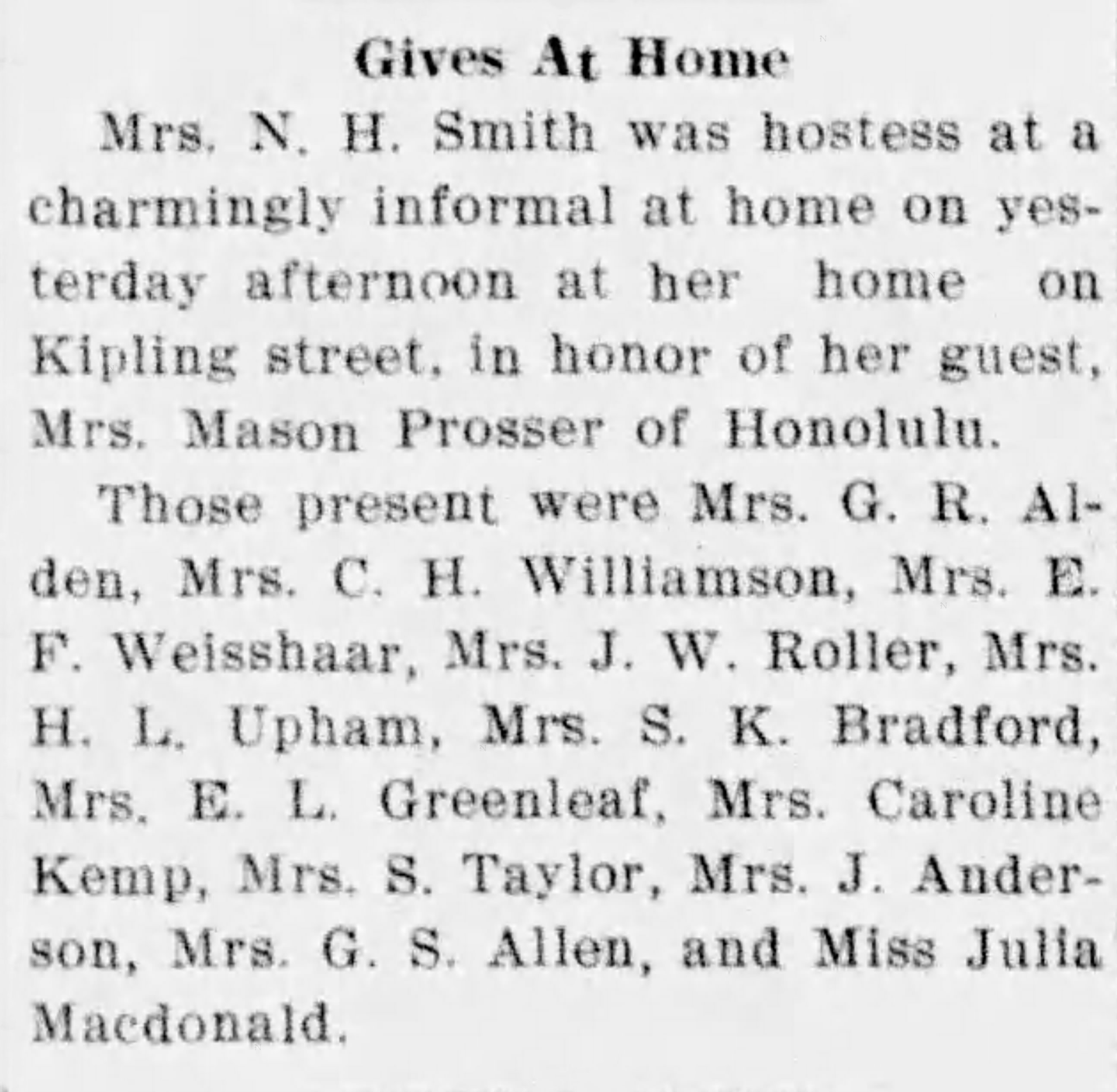
And she quickly joined the Alden’s church and began attending social events with Isabella and Julia. The local newspaper gave this brief account of their attendance at a ladies’ “at home.” (Isabella is listed as Mrs. Alden, Mary as Mrs. Williamson, and Julia as Miss Macdonald.)

Gives At Home. Mrs. N. H. Smith was hostess at a charmingly informal at home on yesterday afternoon at her home on Kipling street, in honor of her guest, Mrs. Mason Prosser of Honolulu. those present were Mrs. G. R. Alden, Mrs. C. H. Williamson, Mrs. E. F. Weisshaar, Mrs. J. W. Roller, Mrs. H. L. Upham, Mrs. S. K. Bradford, Mrs. E. L. Greenleaf, Mrs. Caroline Kemp, Mrs. S. Taylor, Mrs. J. Anderson, Mrs. G. S. Allen, and Miss Julia Macdonald.

No matter their age difference, there seemed to be a close camaraderie and tightly-knit bond between the Macdonald sisters, and Isabella was grateful for the time she had with her sisters in their later years. She wrote:

“I took the very best care I could of my sister Mary for eleven years, and was close beside her when she ceased to breathe. I had the comfort and companionship of my sister Julia for fifty years and knelt beside her bedside when she was called Home.”

It was probably difficult at times for Isabella when she recalled that she was the last member of the family—that her husband and son, brother and sisters, mother and father had all gone on before her to their heavenly home. But as she neared the end of her own life, Isabella wrote to her niece Grace:

“But isn’t it blessed to realize that one by one we shall all gather Home at last to go no more out forever! The hours between me and my call to come Home grow daily less.”

The bond between the Macdonald sisters—Elizabeth, Mary, Julia, Marcia, and Isabella—helped shape Isabella’s entire life. From childhood through old age, through marriages and widowhood, through writing careers and quiet domesticity, the sisters were loving constants in each other’s lives. Their shared faith and genuine affection for one another provided Isabella with both comfort and inspiration. Perhaps the sister relationships that fill Isabella’s novels—tender, loyal, challenging, but always enduring—reflected the very real treasure she found in her own family bonds.