This month’s free read is a sweet story about faith and Christmas blessings by Isabella’s sister, Marcia Livingston.
Wealthy Mr. Thornton finds his greatest pleasure in carrying out the quiet, unseen work of “his Friend.” With Christmas fast approaching, he has renovated a beautiful cottage to bestow upon an as-yet-unknown person who is homeless and friendless. When his path crosses that of Lily Winthrop and her grandfather, Mr. Thornton sees a clear object for his charity. Will his act of giving remain anonymous, or will Lily and her grandfather discover the secret donor of their miraculous Christmas gift?
Like her younger sister Isabella, Marcia Macdonald Livingston was a talented writer. Her stories always contained a message of faith and a happy ending; and she excelled at writing about the trials—small and large—that husbands and wives face together.
This month’s free read is about one of those couples who must learn to cope with an empty nest.
Mrs. Warner is in despair. After her beloved daughter marries a young pastor and moves away, the once-cheerful woman cannot muster a smile for her husband, the Deacon. It will take a lonely November evening and the comforting strains of a few old hymns for this devoted couple to rediscover their faith and their gratitude for one another.
Isabella was the youngest of six siblings. She had one brother, James, and four sisters. With her sisters she enjoyed a close bond, even though there was a wide range of ages between them. Her eldest sister Elizabeth was a married woman with a home of her own by the time Isabella was fourteen months old.
Her sister Mary married George Heaton when Isabella was a girl of 17. Mary and George moved into a house of their own—one that was so close to Isabella’s family home, that the two properties shared a garden gate.
Mary’s husband George was editor of the town’s newspaper; and it was he who was so impressed by the first story Isabella wrote, that he begged Isabella’s parents to allow him to publish the story in the newspaper. Reluctant at first, they eventually gave their permission, but only if Isabella’s name was not used. Instead, the story was published with the author’s name listed as “Pansy,” thus beginning Isabella’s writing career that would span the next eighty years. (You can read more about Isabella’s first published story here.)
Isabella was in her early thirties when she began editing and writing for The Pansy magazine. The enterprise quickly became a family affair when her sisters, brothers-in-law and friends also began to write articles and stories for the magazine.
Sisters Marcia, Julia and Mary were among those writers, and Mary often chose pets as the focus of her stories. In one story Mary explained to her young readers how she came to adopt a sweet little kitten:
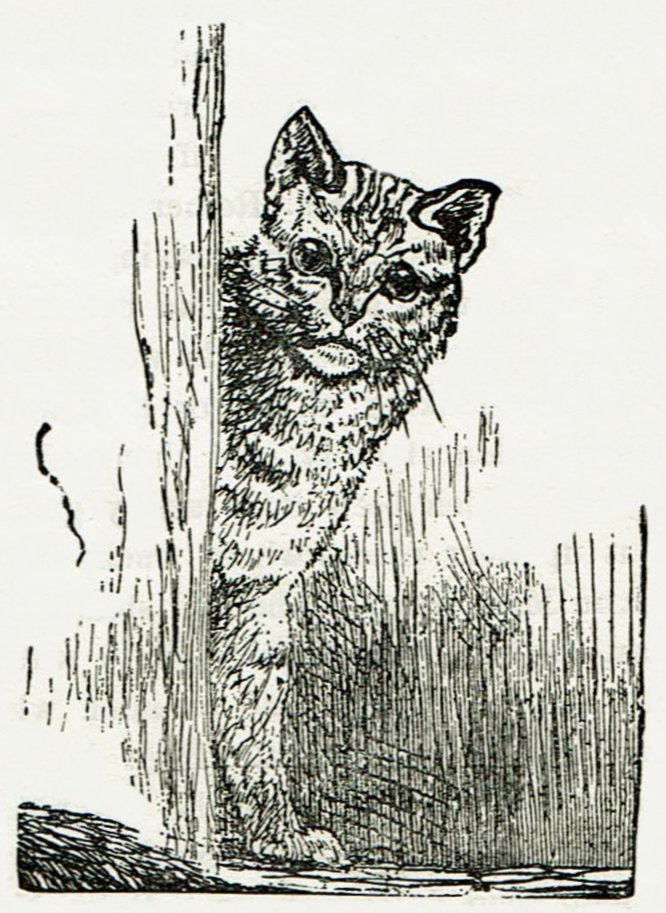
“I live in a part of the country that is blessed with cats. I never saw so many gathered in one place before in my life — gray cats and yellow cats, cats with tails and cats without tails, and kittens without number. One day I took pity on a poor little hungry kitty, and set her out a basin of milk. In less than five minutes there were nine kittens, all with their heads in that basin. One late comer could not get into the ring, so she climbed on the backs of the others, and reaching down got her little red tongue into the dish. I said last week that I would adopt one of the orphans, so I kept her in the house all day, and fed and played with her; but at night I let her out. When we came downstairs in the morning there she was waiting at the door for admittance, but she had brought four others with her! She has seemed, however, to settle down, and decide that she belongs; she stays in the house with me all the time, and the others scamper in when they can get a chance, and out again.”
Illustration from Mary’s story in an 1893 issue of The Pansy magazine.
In another issue of the magazine, she wrote about her new parrots:
“I have named the large one Billy, and the small one Polly. They are very happy together. Every afternoon Billy will spend an hour in petting and dressing Polly. He will oil her feathers, and scratch her head; then he will hold his head down, and try to make her fix him, but she can’t take time. She will just give him two or three little pecks, and then be intent on eating her supper, or playing with a stick, or bit of paper. Whenever she screams, Billy will say, ‘Shut up, Polly; shut up!'”
Illustration from Mary’s story in an 1888 issue of The Pansy magazine.
Mary gauged her reading audience to a nicety—don’t all children love to read about friendly kittens and talking birds?
Over the years Mary occasionally wrote more stories for The Pansy under the pen name “Auntie May.”
When Isabella retired from editing the magazine, and her husband retired from the ministry, they moved to Palo Alto, California to be close to their son Raymond and his family. Isabella’s sister Julia, who had never married, also lived with them; so when Mary’s second husband died unexpectedly, Isabella invited her to join them in their spacious California home.
So at the age of 76, Mary packed her belongings and set off across the country to live with Julia, Isabella, and the rest of the Aldens in sunny California. (You can click here to read about the house they all lived in together). She soon found herself happily sharing a home with Isabella’s young grandchildren.
Mary, age 88 in 1914, with two of Isabella’s grandchildren.
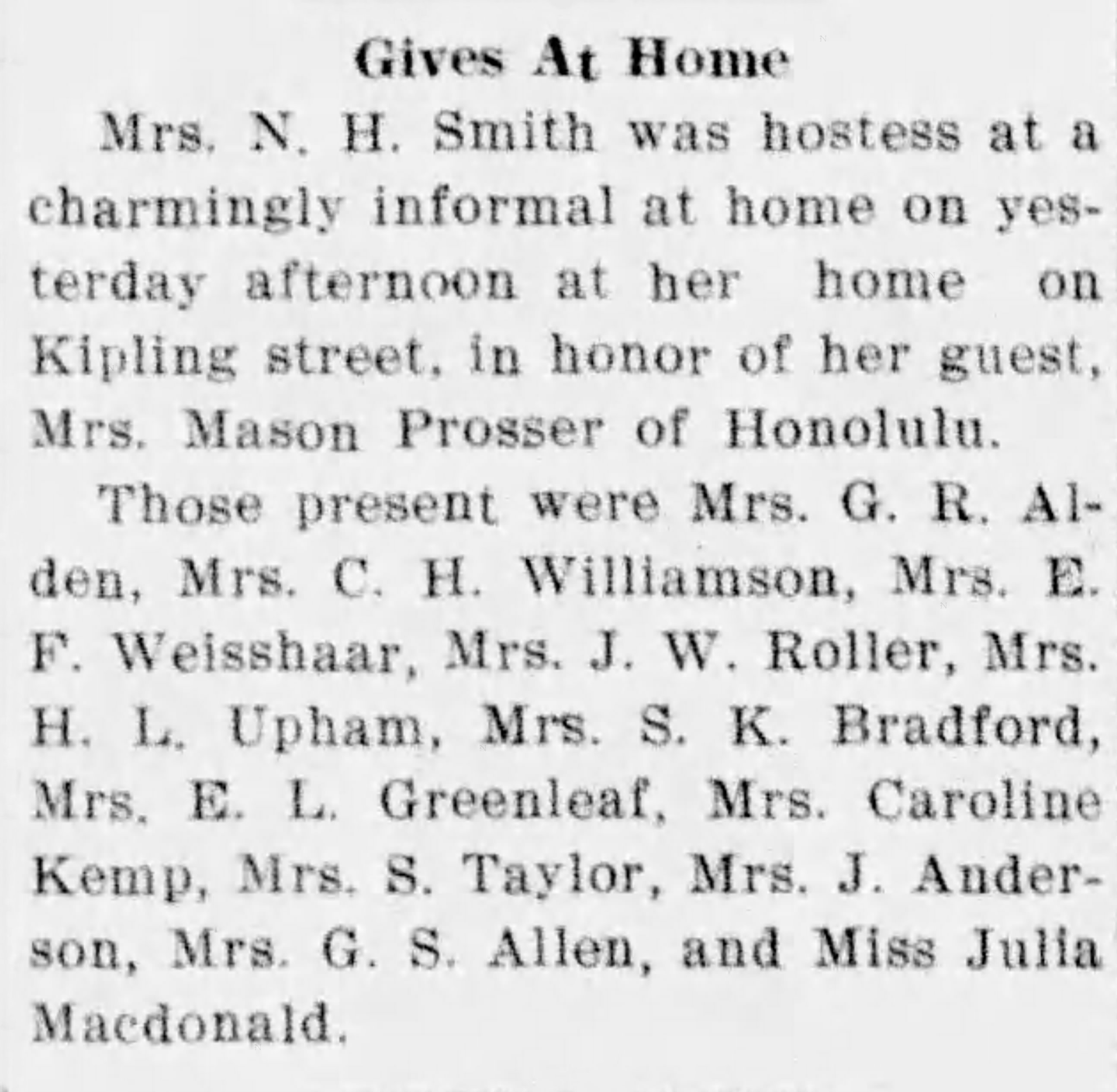
And she quickly joined the Alden’s church and began attending social events with Isabella and Julia. The local newspaper gave this brief account of their attendance at a ladies’ “at home.” (Isabella is listed as Mrs. Alden, Mary as Mrs. Williamson, and Julia as Miss Macdonald.)
No matter their age difference, there seemed to be a close camaraderie and tightly-knit bond between the Macdonald sisters, and Isabella was grateful for the time she had with her sisters in their later years. She wrote:
“I took the very best care I could of my sister Mary for eleven years, and was close beside her when she ceased to breathe. I had the comfort and companionship of my sister Julia for fifty years and knelt beside her bedside when she was called Home.”
It was probably difficult at times for Isabella when she recalled that she was the last member of the family—that her husband and son, brother and sisters, mother and father had all gone on before her to their heavenly home. But as she neared the end of her own life, Isabella wrote to her niece Grace:
“But isn’t it blessed to realize that one by one we shall all gather Home at last to go no more out forever! The hours between me and my call to come Home grow daily less.”
The bond between the Macdonald sisters—Elizabeth, Mary, Julia, Marcia, and Isabella—helped shape Isabella’s entire life. From childhood through old age, through marriages and widowhood, through writing careers and quiet domesticity, the sisters were loving constants in each other’s lives. Their shared faith and genuine affection for one another provided Isabella with both comfort and inspiration. Perhaps the sister relationships that fill Isabella’s novels—tender, loyal, challenging, but always enduring—reflected the very real treasure she found in her own family bonds.
Isabella Alden and her entire family were actively involved in the Young People’s Society of Christian Endeavor, a movement that promoted Christian service and ideals to its teen and young adult members.
Isabella believed in the Endeavor program so much, she founded the Pansy Society for Christian Endeavor, a similar organization specifically designed for children. The Pansy Society focused on teaching children to use Jesus’ life and words as a guide to live by.
This month’s free read is a story by Marcia Livingston that illustrates some of the values The Pansy Society sought to teach children: forgiveness, patience, and kindness toward others.
It was a simple act of kindness when Lily Haines offered Cindy Barker a rose from her garden; but neither young lady could predict how much of a difference the presence of that single rose could make in the Barker family home.
Although there was a nine year age difference between them, Isabella Alden and her older sister Marcia were as close as two sisters could be. They both married ministers in the Presbyterian church, and they both helped their husbands serve their congregations with kindness and compassion.
The two families often lived together, as well. In Florida they combined their resources to build a large home where both families could live together comfortably while Isabella’s son Raymond and Marcia’s daughter Grace attended college. (You can read more about that here.)
The Alden home in Winter Park, Florida, where the Aldens and Livingstons lived while in Florida.
Marcia wrote stories and novels for all age groups, from very young children to adults; and in her adult stories she often wrote about the challenges of adult relationships. This month’s free read is a short story she wrote about newlyweds finding their way through the early days of their marriage.
Newlyweds Annette and Philip Lyman agree on everything. From the books they read to furnishing their house, their tastes are in perfect harmony. But when Philip criticizes Annette’s choices in the kitchen, their first quarrel quickly escalates until they can barely utter a civil word to each other. Who can help this once loving couple find love and harmony again?
This month’s free read is a short story by Isabella’s sister, Marcia Livingston.
Grandma’s bedroom is a welcoming place where all the cousins gather to talk; so when two of the cousins plan a shopping trip to the city for new bonnets, of course all the girls—including Grandma—must be consulted! But amid their happy chatter, it only takes a few thoughtless words to wound a spirit and change one life forever.
You can read “Aunt Maria’s Afterwards” for free!
Choose the reading option you like best:
You can read the story on your computer, phone, tablet, Kindle, or other electronic device. Just click here to download your preferred format from BookFunnel.com.
Or you can select BookFunnel’s “email” option to receive an email with a PDF version you can read, print, and share with friends.
On the surface, it may seem that Isabella led a charmed life. Her husband was beloved a minister and a leader in the Presbyterian Church.
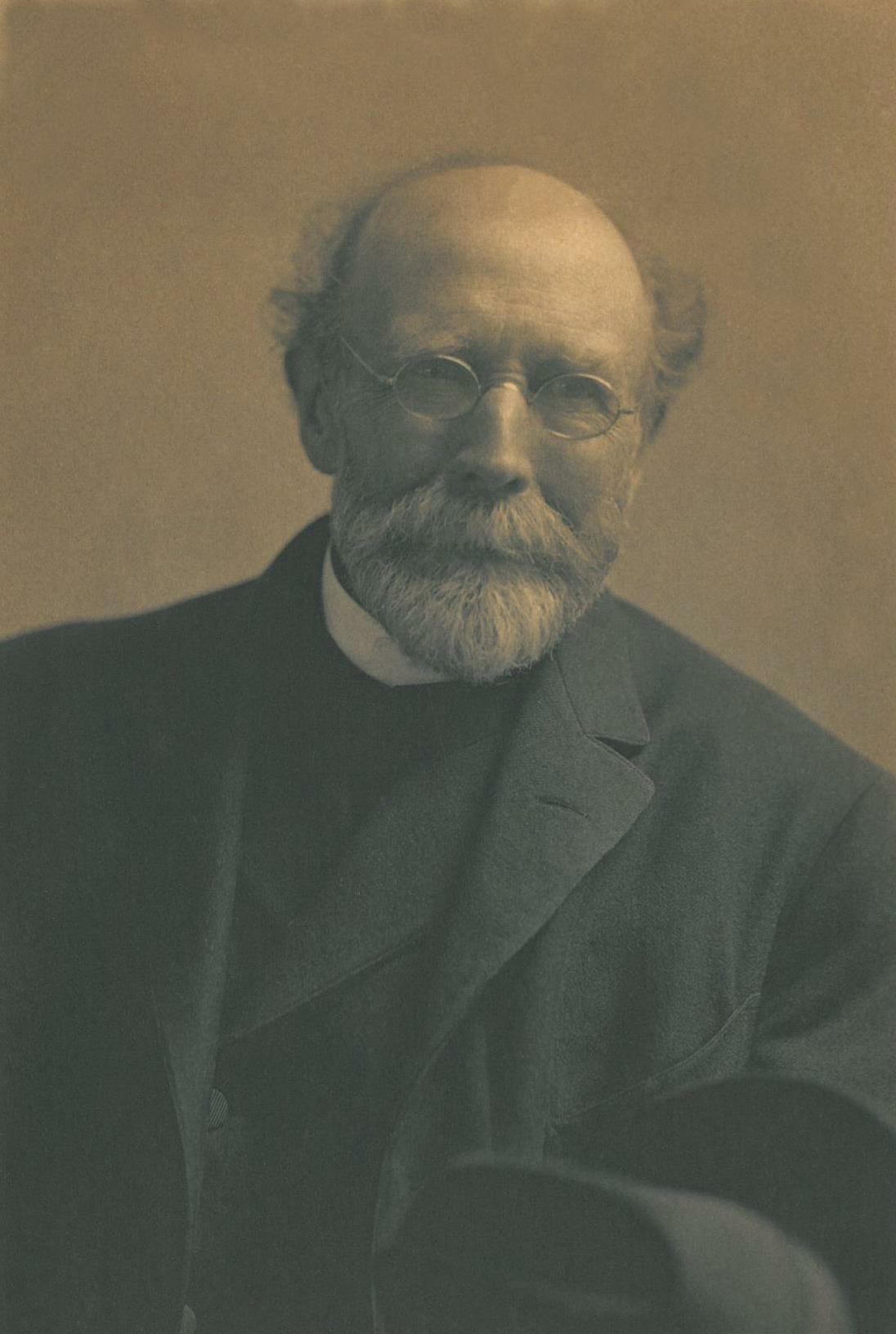
Gustavus “Ross” Alden in later years (about 1912)
Her son Raymond was a talented writer, a beloved teacher, and an esteemed academic.
Isabella Alden, about 1895.
Isabella, herself, had been a successful author for decades, as well as an influential editor of various Christian magazines for young people and adults.
With so many proud accomplishments in her life, it’s hard to remember that Isabella had her share of heartache and loss.
Some of those losses were made all the more difficult because they occurred almost in a back-to-back fashion during one six-month period in her life. And it happened one-hundred years ago.
The year 1924 began on a positive note for the entire Alden family. Isabella’s son Raymond—who was head of the English Department at Stanford University in California—was on sabbatical so he could teach courses at Columbia University in New York. It was an exciting career opportunity for Raymond.
Undated photo of Raymond Macdonald Alden.
His topics during that Spring Session at Columbia were:
English Literature from 1780 to 1830.
Shakespeare
Versification
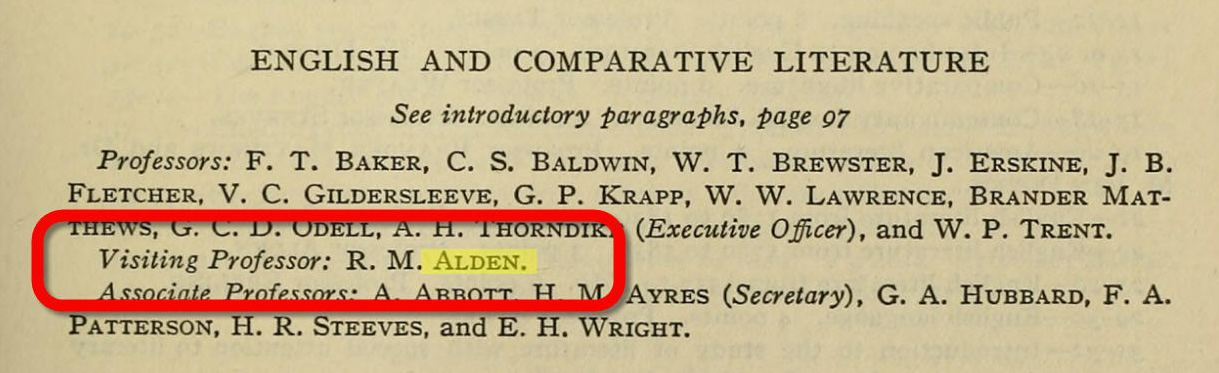
Raymond Alden listed as a Visiting Professor in the English and Comparative Literature department, Columbia Course Catalog for 1923-1924.
Raymond, his wife Barbara, and their five children (ages 2 to 14) made the move east together and rented a home within an easy commute to Columbia’s campus.
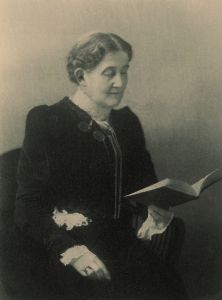
Barbara Hitt Alden, in her early twenties.
Isabella and her husband Ross went, too. Ross was 92 years old and had been officially retired from the ministry for some time, but he still enjoyed excellent health and a quick wit and intellect. Isabella was still writing novels, but she too had “retired” and had adopted a much slower pace when it came to her work.
Isabella and Ross moved into the Swarthmore, Pennsylvania home of Isabella’s sister Marcia Livingston and niece Grace Livingston Hill. Grace often described Marcia and Isabella as “inseparable” sisters, and for the majority of their lives, the Aldens and the Livingstons spent much of their time together.
It was while the Aldens were staying with Marcia and Grace in Swarthmore in the spring of 1924 that tragedy struck.
Grace Livingston Hill’s Home, Swarthmore, PA.
At that time Philadelphia was dealing with an influenza epidemic. The particular strain that prevailed during the spring of 1924 often caused pneumonia.
From The Philadelphia Inquirer, February 18, 1924.
Unfortunately, antibiotics like penicillin and sulfonamides were not as widely available as they are today; so doctors could offer little in the way of treatment for pneumonia, beyond recommending bed rest, and drinking fluids. Almost every day newspapers reported new outbreaks of the influenza virus, as well as the number of deaths, and it often seemed as if no one was safe.
From The Philadelphia Inquirer, March 1, 1924.
Health officials warned that a common cold or a mild case of the flu could quickly turn into a deadly case of pneumonia. Unfortunately, that is exactly what happened to Rev. Alden. At ninety-two years of age he was particularly susceptible to pneumonia, and although the family brought in a physician in to treat him, he died on March 29, 1924.
From The Peninsula Times Tribune, April 14, 1924.
His death was reported in newspapers across the country and the tributes and remembrances came pouring in. People wrote about their memories of when he was their church minister. They related the anecdotes he used to illustrate his sermons and teachings; and they mentioned the close friendships they formed with him in the Sabbath School classes he taught.
Perhaps Isabella had a chance to read some of those tributes. And she no doubt relied upon her sister Marcia’s support, as well as the tender care that Raymond, Barbara and Grace would have provided.
Isabella made the decision to remain in Swarthmore until summer, so Raymond could fulfill his teaching responsibilities at Columbia. Then, the Alden family planned to travel together back to their home in Palo Alto, California, where Rev. Alden’s remains would be laid to rest.
In her remembrances of her uncle, Grace recalled a poem he wrote and had printed as a New Year greeting card. He sent the cards to the members of his Bible class the last winter he was with them before going to Swarthmore. It reads:
TODAY
We are living today—not tomorrow, For no morrow was ever yet seen; And for joy, or for pain, or for sorrow, Only yesterdays ever have been.
God gives us duties—just for today; And His strength He bestows by the hour, “Grace is sufficient” we still hear Him say, So we trust Him for wisdom and power.
And since today is all that He gives, Let us treasure the day as it stands. It matters, then, much how everyone lives For tomorrow God holds in His hands.
Spring is here and this month’s short free read by Marcia Livingston celebrates the change in season.
Ruth’s mite box is empty! She has only three weeks to earn the pennies needed to fill her offering box for missionary work—but how? It seems like a hopeless situation until her dear grandmother helps Ruth realize God has already provided an answer to her problem.
You can read Spring Blossoms and Tenths for free!
Choose the reading option you like best:
You can read the story on your computer, phone, tablet, Kindle, or other electronic device.
As a popular author, Isabella received plenty of publicity and media coverage, and she was probably used to seeing her name in print.
In 1893 her niece, Grace Livingston Hill was just beginning to garner some publicity of her own. A few of Grace’s stories had been published in magazines, including The Pansy, so she was already building a following of loyal readers.
Then, in April 1893, the following article about Grace appeared in a Christian magazine:
THE REVEREND AND MRS. FRANKLIN HILL
Pansy’s niece, Grace Livingston (now Mrs. Franklin Hill) has perhaps almost as warm a corner in the hearts of our readers as their older friend “Pansy,” and therefore we are glad to give the photographs of herself and her husband. Mr. Hill. [He] is pastor of a flourishing church in one of the suburbs of Pittsburgh, Pennsylvania—a young man of noble character and fine intellectual gifts.
To quote from a paper giving an account of their recent marriage:
“When two souls such as these, energetic, consecrated, and peculiarly gifted, unite their lives and aims, there is promise of much good work for the Master.”
Doubtless thousands who never saw Grace Livingston’s face, feel acquainted with her, and really are acquainted with her through her writings, for a true author’s true self goes into her works. She has a bright and charming style, which reminds one of that of her aunt, Mrs. Alden (“Pansy”), and of her mother, Mrs. C. L. Livingston, who is often a collaborator with Mrs. Alden.
Mrs. Hill is not an imitator, however, or an echo of anyone else, but has a genuine style and literary character of her own. She is, moreover, much more than a mere writer. The daughter of a Presbyterian Minister, trained from her earliest days to work for the Master, she has thrown herself enthusiastically into His service.
“She has,” writes a friend, “a passion for soul-saving, and will not give up a bad boy when all others do, but pleads with him, and prays, and has patience, and often has the joy of reward, in the changed character of boys who will remember her gratefully through life. She sometimes gathers about her on Sabbath afternoons a group of older boys, and leads them on to discuss Christian evidences and the moral questions of the day, amusements, etc. On these subjects she takes high ground, setting them to search for the opinions of master minds in religious thought, and to learn what Scripture teaches on the themes under discussion. This will go on for months, each of the informal meetings delightful to the boys.”
The work of the Christian Endeavor Society is very near her heart, and she has given much time and strength to it, as her writings prove. Of late she has been especially identified with the Chautauqua Christian Endeavor reading course, whose success in the future will be largely due to her energy. While in Chautauqua during the summer, she spends much of her time in promoting the interests of the Chautauqua Christian Endeavor Society.
How can we end this brief sketch better than by quoting the words of a friend, who says:
“She loves dearly to have her own way, and yet she is one of those rare characters who knows how to yield her will sweetly for peace sake, and so for Christ’s sake.”
What a lovely article! It gives readers hints of the great work (in addition to her writing) that Grace would accomplish in the years to come.
The article appeared only four months after Grace and Thomas Franklin “Frank” Hill were married. After their marriage they both stayed involved in the Christian Endeavor Society. Together they wrote The Christian Endeavor Hour with Light for the Leader, a guide book that contained lessons and Bible verses CE societies could use in conducting their meetings. The book was published in 1896.
Grace’s “passion for soul-saving” flourished, as well. In later years she established a mission Sunday School for immigrant families in her community. It was just one of the many endeavors Grace undertook that resulted in “good work for the Master.”
This month’s Free Read may strike a chord with anyone who tried to cook something that didn’t turn out right (like a Thanksgiving turkey)!
“The Wife’s Dilemma” is a sweet short story written by Isabella’s sister (and Grace Livingston Hill’s mother) Marcia Livingston. Marcia was a prolific author in her own right. She published many short stories in a variety of magazines, and co-wrote stories with Isabella.
Here’s the blurb for “The Wife’s Dilemma”:
Newlywed Dora Avery is well educated in math and science, and speaks several languages; but Dora has never learned the fine art of keeping house. No matter what dishes she sets before her new husband, they’re either burnt or sour. It isn’t long before Dora realizes that all her logical plans and recipe books won’t fill her husband’s empty stomach!
Somehow she must hire an experienced cook or learn the proper way to prepare meals herself; but how?
Reviews and giveaways for Christian fiction and sweet, clean fiction. Bringing readers information on great stories and connecting authors with their readers.












 Isabella Alden