It’s difficult to describe how incredibly popular The Pansy magazine was. As the editor, Isabella received hundreds of letters every month from parents and children. Sometimes they wrote in response to a question Isabella posed in an article or story. Sometimes children wrote stories of their own and sent them to Isabella for her feedback.
Other times children confided their problems to Isabella and asked for her advice; others simply wrote to tell Isabella about their day.
In 1891 a little girl named Ida White wrote a letter about her family and home life that Isabella found so charming, she published the entire letter in The Pansy magazine for all her readers to see. Here is Ida’s letter.
Dear Pansy:
My hair has grown out in curls about three inches long all about my face and neck.
We have a little baby at our house, which we call Blue-eyed Pansy. His name is George Washington.
Both of my little brothers are tongue-tied, and have two toes on the same foot, grown together. They are as much alike as twins could be, only one is nine years, and the other three months old. Mamma took him to church last Sunday and he squealed; she took him out in the hall, and he squealed there; then she took him out in the yard, and gave him a roll on the grass. He cannot talk, but he has heard the word “look” so much, that he tries to say it, or seems to.
We have a little dog named “Tip.” He is about the size (and my sister thinks he is almost as sweet) as a pound of yellow sugar. We have four little kittens; their names are Adams, Lincoln, Jefferson, and Grant. We live on a farm in a two-story house, a mile and a half west of the village. We have two hundred little chickens.
A little oriole built its nest on a tree in our front yard; then a cuckoo stole the nest, and they brought up their families together. We have pansies blooming on the north side of the house. We have flowers from March till frost; and plenty of beautiful little hummingbirds, and innumerable bumble-bees.
I have an uncle living in California that mamma and I never saw; when he comes to see us, I will tell you about California. I would like to go to New York, and to Niagara Falls, and to see the ocean.
I think it is real good and kind of you to read other people’s children’s scratching, and give them a chance to write; and I love you for it. I hope your Ray will live till he is a man, for I think he will be a good and benevolent gentleman. You may publish my letter if you want to.
Good-by, Ida White.
In the last paragraph of her letter, Ida mentioned Isabella’s son “Ray.” At the time, Raymond Alden was three years old and the apple of Isabella’s eye. She often shared little stories in the magazine about his antics and mentioned him when she replied to children’s letters (“No, we haven’t any dog; but our Ray, whenever we ask him what he would like to have for a birthday present, says, “A big, black dog.”).
By all accounts, Ida’s wish came true, for Raymond Alden grew up to be a well-loved, well-respected and extremely “benevolent gentleman.”
Is there some irritating little thing others do that seems to steadily accumulate until you can’t help but be angry?
Isabella found herself in just such a situation regarding the many letters she received each month from readers of her magazine and books. Here’s what she had to say about it (as published in a Christian magazine):
A Scolding Mood
Isabella Alden at her writing desk.
Perhaps it would be well for me to own at the outset that I am in a scolding mood this morning. On my desk lie three letters written with as much care and thought as I could give them. Out of my busy life I took time to do my best for the three earnest girls who wrote me on important subjects, all of them of such a character that it was either not wise to bring them into print or so important as regards time that it seemed not well to wait for the printed page. Yet what was the result? Within ten days of their writing, all three letters were returned to me with the words, “Person not found,” written on the envelope.
Now whose fault is that? Not the postmasters’ or postmen’s certainly; for, judging from the appearance of the returned letters, much care has been taken to find their owners. In one instance the information has been volunteered, “Address incomplete.” As if the writer did not know that! But how was I to help it? A name, and the name of a certain city in a certain State; this was all. No street, nor number, nor post-office box—nothing to indicate where in the great city the person was to be found.
If this had been my experience but three times in my life, I should indeed be a happy woman; but oh, dear, the innumerable times I have exhausted my knowledge on a given theme for the attempted benefit of another, only to have to consign my work two weeks afterwards to the waste-basket, and to go about with the injured feeling that someone who had opened her heart to me was smarting under the sense of having been rudely treated!
Dear friends, is not the moral plain? Why will you not give a carefully detailed address? If you are visiting in a strange city, expecting to be there but a short time, by all means give the full address of the person whose guest you are, or of the hotel or boarding-house where you are stopping. If it is possible that you may leave the town before the reply to your letter reaches there, consider how it would expedite matters if you would instruct your correspondent to write on the envelope, “If not there, please forward to —,” etc.
While we are on this subject and I am in the mood, suffer me a few more growls.
How many letters do you suppose I get, asking for immediate replies, with not so much as a postage-stamp enclosed? In most cases this is pure forgetfulness; but if one receives—let us say—one hundred letters a week, requiring private replies, and fifty of the writers have forgotten the return stamp, in the course of a year this amounts to quite a sum.
Let me tell you something. Instead of the stamp (which every well-informed person now encloses when he does not forget it), if those who desire a prompt reply would enclose an envelope properly addressed, with the stamp securely stuck on its own proper corner, their chances for very prompt response would be largely increased. One who has not a large list of correspondents can hardly be made to understand what a relief it is to find letters so prepared, nor what an amount of work it saves in the course of months. So small an item for the writer, such a load lifted from the shoulders of the burdened!
What do you think? Did Isabella have a good reason to scold her readers a little bit?
In 1891 a Christian weekly magazine mailed letters to America’s most prominent Christian authors and ministers asking one question:
What is it to be a Christian?
Many of the replies from ministers and church elders spoke about adhering to New Testament doctrines. Some replied that being a Christian meant following the example set by the Divine Master.
A famous Unitarian pastor answered that to be a Christian was “to do the will of my father who is in heaven.”
Of course, Isabella was one of the Christian authors who received the letter.
Isabella Alden, about 1900.
Here is her answer, which was printed in newspapers across the country on Sunday, March 20, 1892:
“To be a Christian is to love the Lord Jesus Christ so much that I shall desire to have him reign supreme in my heart.”
For many years Isabella had an advice column in a popular Christian magazine. She used the column to answer readers’ questions—from a Christian perspective—on a variety of topics.
In an 1897 column Isabella wrote that she had received several letters in one week about “imprudent confidences.” The letters were from young women who regretted something they said or wrote.
Two or three girls wrote about their mothers in ways they wished they had not.
One young wife wrote “with utmost frankness” about the failings of her husband to a lady friend!
Several young ladies were very harsh in their criticisms of “certain gentleman acquaintances.”
Each ended their letter to Isabella with the same two questions:
“Ought I to take back the words I wrote? And ought I to tell the persons of whom I wrote what I have done?”
Here is Isabella’s advice:
There are really two questions. Let me so divide them.
With regard to the first, I answer: By all means, YES. Perhaps there is no more common error than that of giving vent to one’s anger by putting on paper words concerning others that in our cooler moments we would not even think, much less say.
Moreover, in nearly (if not quite every) case of the kind, the written words are more or less untrue. For the hour they may seem to us strictly true and justifiable; but the next morning, after the mail has been sent, and it is too late, what would we not give to be able to recall them? How sure we are to remember entire sentences that we no know to be false, or—at the very least—to convey entirely false impressions!
In all such cases, what better can we do than to write promptly and frankly:
“I am sorry I told you what I did. I was angry at the time, or so strangely hurt that I did not realize what I was doing. My mother meant what she said in an entirely different way from what I translated it; she did not speak the words in the manner which I ascribed to her; she did not speak quite those words. I see it all now. Please burn my letter, and forgive me.”
Or:
“Dear Friend, I have been unjust to my husband; he is not what I have led you to infer. It is I who was angry, and misinterpreted him.”
Some such reparation as this we owe to our own sense of honor, even though we are quite sure that our mistaken confidences will go no further. Every true correspondent will approve such a course, and think more highly of her friend that she can possibly do without this frankness.
Especially should this course be urged in the case of husband and wife. In a very peculiar and solemn sense these two are pledged to each other, and no third person should be permitted, save in the cases of gravest necessity, to step between them even in thought.
As to the second question, there may be individual cases where confession would be wise; but as a rule I see no reason why the heart of a husband or friend should be made sore by explanations of what they would otherwise never hear. A good general rule in such matters seems to be:
If you are quite confident that silence will do no one any harm, and reasonably certain that speaking would give pain, be silent.
I think I would make one exception to this, in the case of mother and young daughter. Between these two there should be not only implicit confidence, but such deference on the part of the duaghter that it would wound her conscience to keep even such a matter secret. In nine cases out of ten the good mother would rather be told the exact truth, and would be able to help her child to grow stronger.
There is one potent reason why it is best always to take back, so far as possible, confidences of the kind named; and that is because it is a humiliating thing to do, and helps one to be more careful in the future.
The fact is, confidences are very important and choice and troublesome matters. They need to be guarded with great care, and bestowed warily.
What do you think of the advice Isabella gave?
Does it sound like the kind of advice that applies today, too?
In Isabella Alden’s novel Twenty Minutes Late, young Caroline Bryant mistakenly takes a wrong train and ends up in a strange city far from home. Alone and afraid, she finds temporary shelter in the home of kindly Dr. Forsythe and his daughter Dorothy.
“Anything for me, Mr. Postman?”
Meanwhile, Caroline’s family anxiously awaits her return. Her brother Ben meets every train at the station, hoping Caroline will be on it; and Caroline’s mother and sister Daisy watch the mail for a letter from Caroline, even as they prepare a celebratory meal to welcome her home:
And now it was nearing the hour when she ought in all reasonableness to be expected, if the day was to bring her. It had been a long, nervous one to get through with. The little family watched for the ten and three o’clock mails, half uncertain whether to hope for or to fear a letter; but when none arrived their hopes grew strong; even the mother allowed her heart to say, “The dear child must surely be coming today.”
Ben had announced, as he dashed in to report no letter in the three o’clock mail, that he should not come home again until he brought Line with him. “I shall go straight to the station from the office,” he announced gleefully; “and as soon as our four feet can bring us you may expect to see us walk in. Have your nose at the window-pane, Daisylinda, for Line will want to see it the first thing.”
When Isabella wrote that the family “watched for the ten and three o’clock mails,” she gave us a hint that the Bryant family lived in a rather large town themselves.
Twenty Minutes Late was published in 1893; at that time the United States Post Office provided “person-to-person delivery” of mail in most major cities.
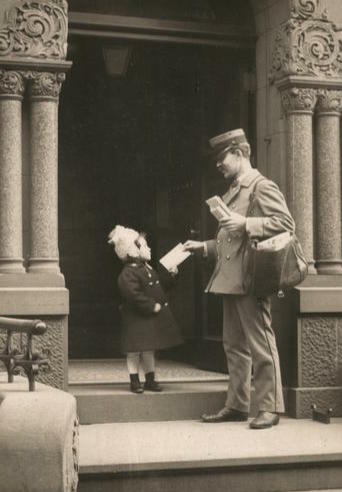
city mail carrier delivers a letter to a customer in Milwaukee, Wisconsin, circa 1908.
“Person-to-Person delivery” meant that mail carriers delivered mail into their customers’ hands . . . literally. If a customer didn’t answer the carrier’s knock, ring or whistle, the carrier kept the customer’s mail in his satchel until the next trip.
By 1914 city mail carriers spent up to an hour a day waiting at doors, trying to complete person-to-person deliveries. That changed in 1923, when all city customers were required to provide mail slots or receptacles in order to receive mail.
Mail delivery in Franklin, Massachusetts, March 1910.
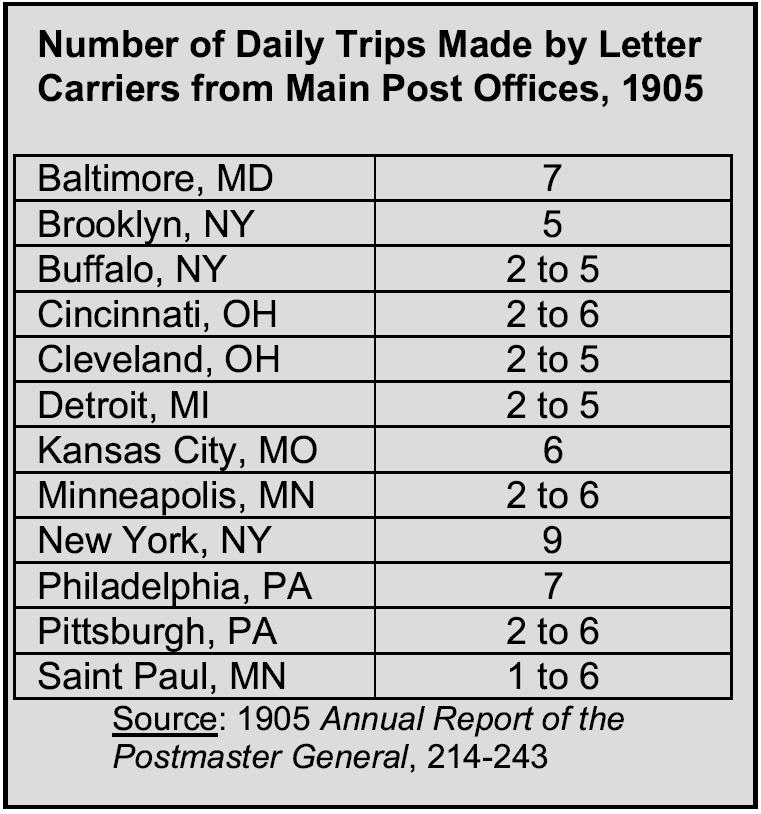
Mail was delivered Monday through Saturday. The number of daily deliveries varied by city.
In 1905 letter carriers employed at New York City’s main post office made nine daily deliveries to businesses and homes.
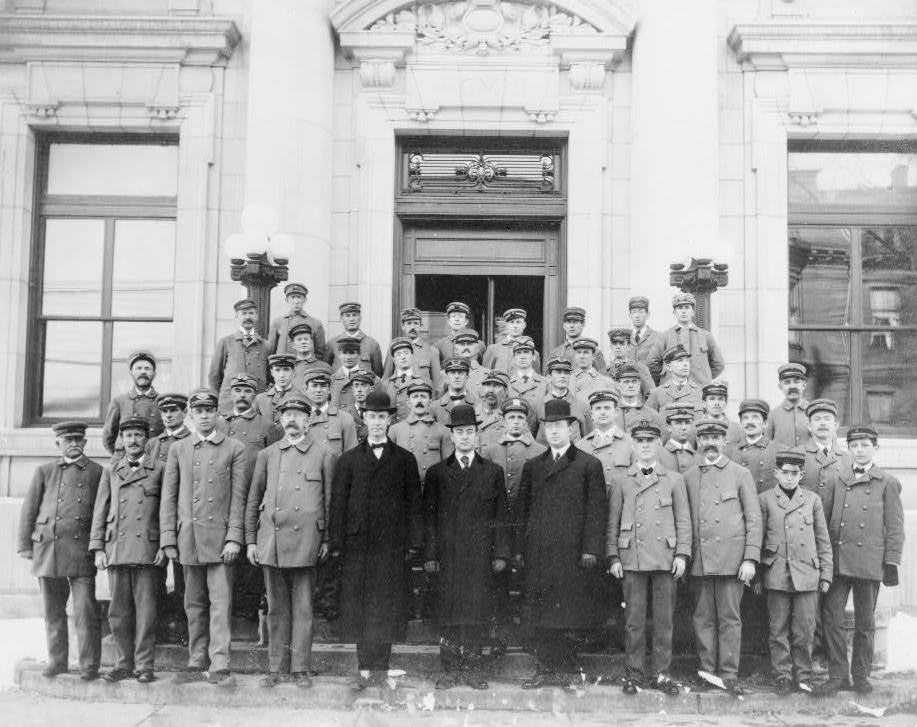
Letter carriers in Lawrence, Massachusetts, 1908.
By contrast, customers in St. Paul, Minnesota received mail once a day, depending on which area of the city they resided.
A rural mail carrier in 1908.
With that kind of delivery schedule, it wasn’t unusual for local mail to be delivered from one part of the city to another within hours of being sent.
Replies to letters traveled at the same speed. “By return mail” was an often used phrase—especially in business letters—requesting an immediate response in time for the next scheduled delivery that day. (Miss Webster used the phrase in Chapter 23 of Miss Dee Dunmore Bryant.)
George L. Baum, who worked 35 years as a mail collector in Washington, D.C.
Although the number of daily deliveries in large cities changed over the years, the U.S. Postal Service maintained this hectic delivery pace until the 1950s, when they finally limited the number of deliveries in residential areas to one per day “in the interest of economy.” For the most part, multiple daily deliveries to businesses ended in the 1970s.
As you read Isabella’s stories, you’ll see that some of her characters wrote quick letters that they wanted to have “ready for the early mail.”
Other times her characters listened for the postman’s whistle, which signaled the arrival of “the morning mail,” or “the ten o’clock mail,” or even “the next mail.”
Isabella’s novels and short stories are little testaments to the fact that there was once a time when the U.S. Postal Service delivered letters, bills, newspapers, greeting cards, catalogs, and advertisements with impressive speed and accuracy—without the aid of Zip Codes, automation, and computers.
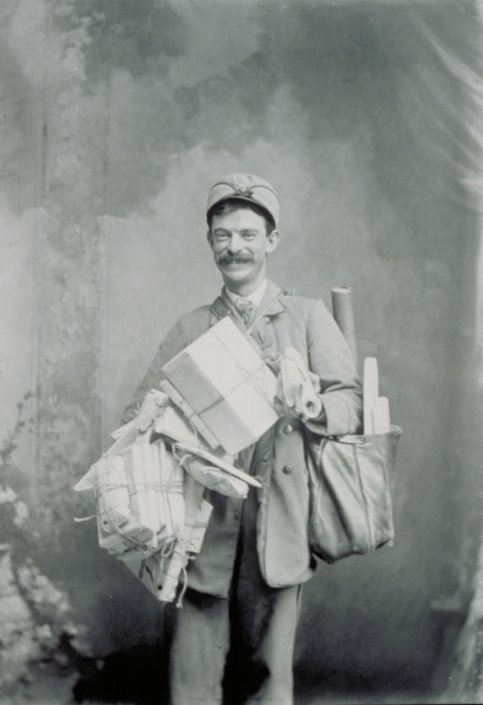
A proud letter carrier.
What do you think? Do you know anyone who works for the U.S. Postal Service? How would you like your mail carrier to personally hand-deliver your mail to you?
You can read more about Isabella’s books mentioned in this post by clicking on the book covers below:
“I was coming down the hill, away off, you know, by the post office…” (Four Girls at Chautauqua)
A walk through Bestor Plaza, toward the fountain and the library beyond.
.
“All the younger portion of the congregation seemed to be rushing back up the hill again…” (Four Girls at Chautauqua)
On day two of my Chautauqua wanderings, I stopped for a breather in lovely Bestor Plaza (the perpetual hill-climbing here is murder!). This carefully tended, beautifully landscaped watering hole and gathering spot commemorates the life and contributions of Arthur Bestor, Chautauqua’s president from 1915 to until his death in 1944.
The keynotes of his presidency are struck in the centrally placed fountain, where monumental icons to Knowledge, Religion, Music, and Art dominate the waterworks.
While I cooled my heels and absorbed the view, I noticed a Post Office in one corner of the Plaza and followed my curiosity there.
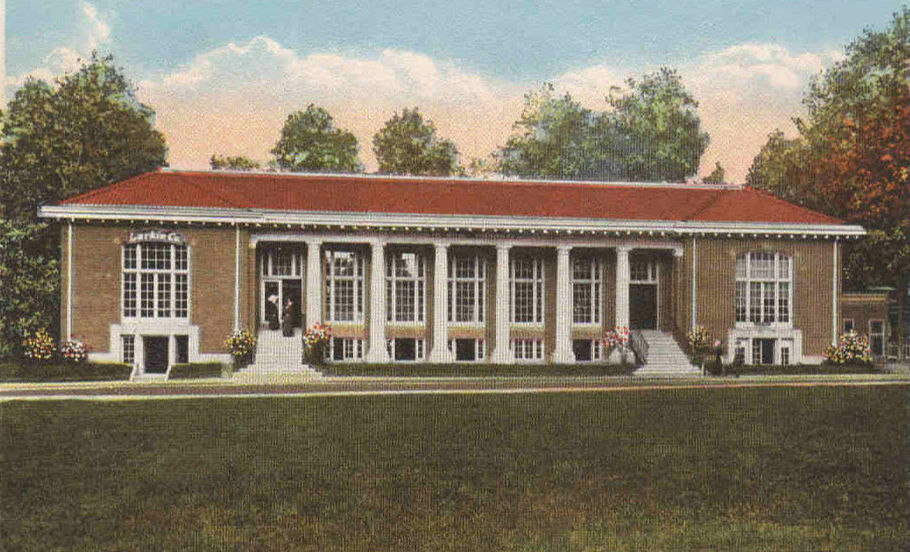
The Chautauqua post office, as it appeared in the 1920s
.
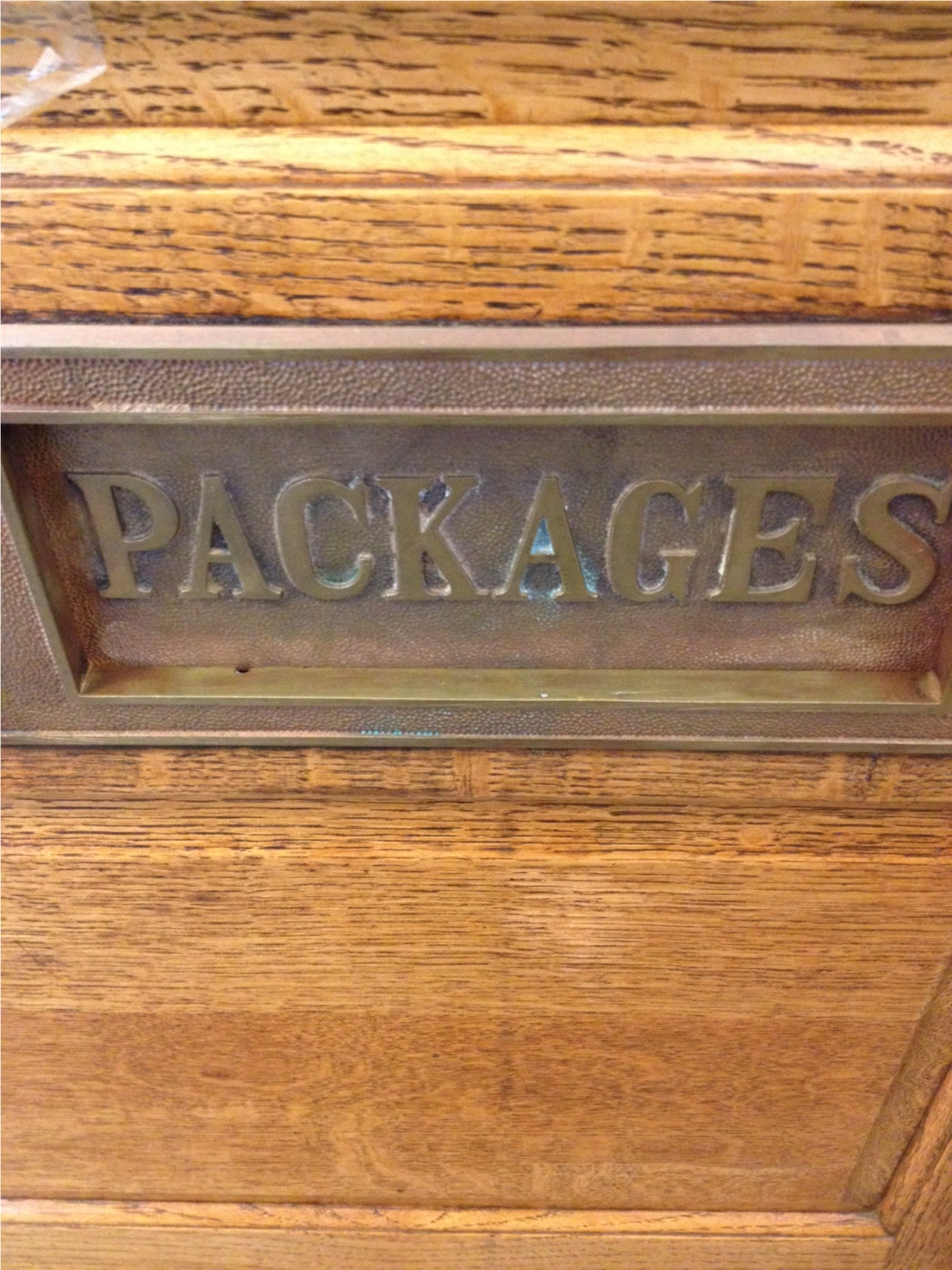
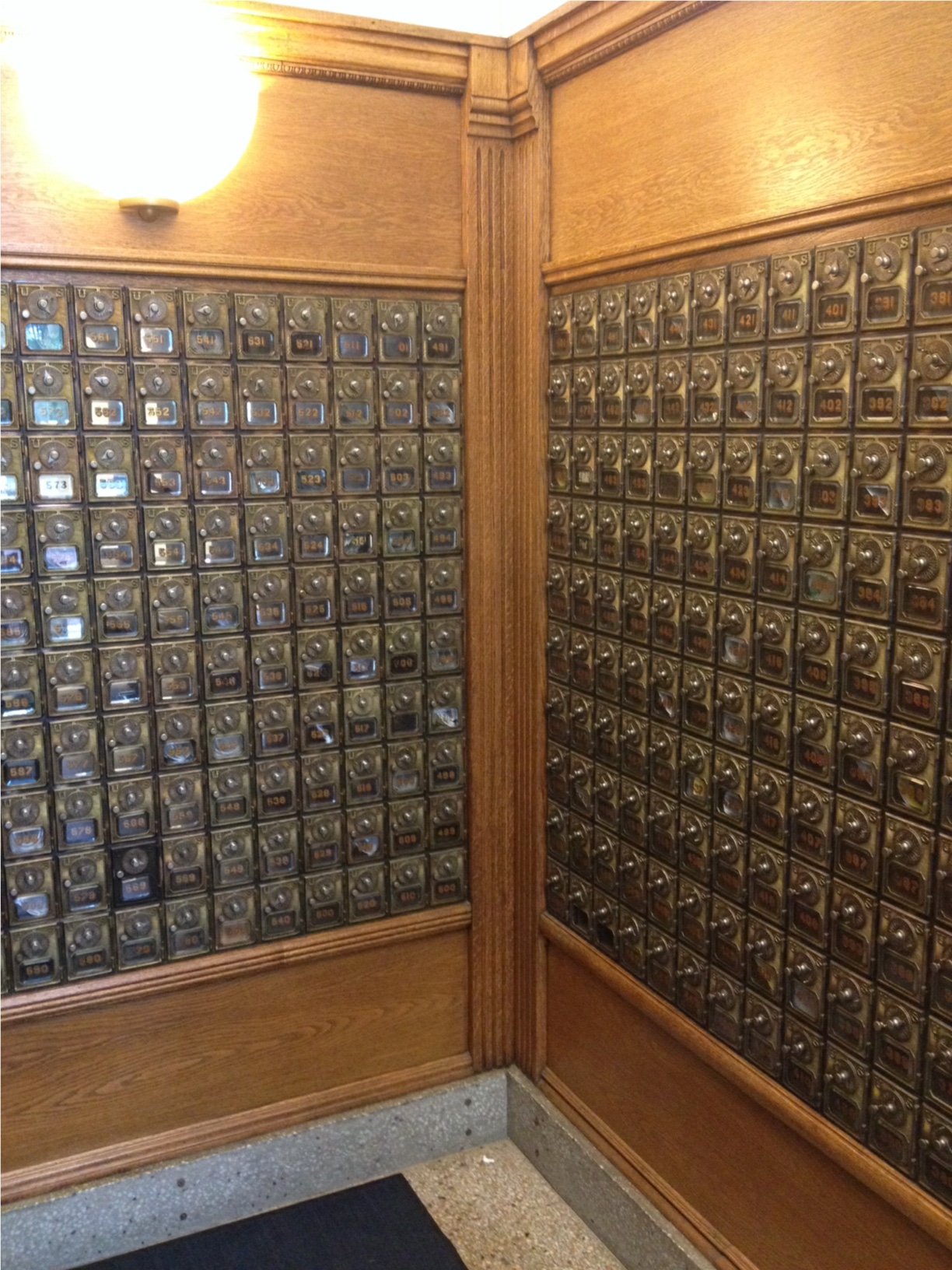
Hoping to find postcards, I instead found a delightful hybrid of contemporary governmental efficiency and mid-Victorian charm. No one was around to quiz about the dates and history, so I let my imagination wander as I snapped these personal postcards.
Did Isabella post a few notes to her friends from this window?
Did Pansy receive some of her fan mail via one of these charmingly designed post office boxes?
Did someone from the Alden household purchase stamps here?
Did Pansy send her niece Grace to claim a package here?
Did this busy hive of cubbies shelter a stirring new work by a favorite author for Pansy to read sitting on a lakeside rustic bench?
How many newspapers passed through here to enlighten and entertain the 19th century crowd?
Discovering artistically elaborate fittings like these for something as pedestrian as mailboxes confirms my belief that Chautauqua’s ongoing commitment to enriching every aspect of life is more than lip service. Their original ideals of glorifying each element of one’s life—dedicating it to the Lord and ennobling the humblest of tasks—is inspiring and convicting.
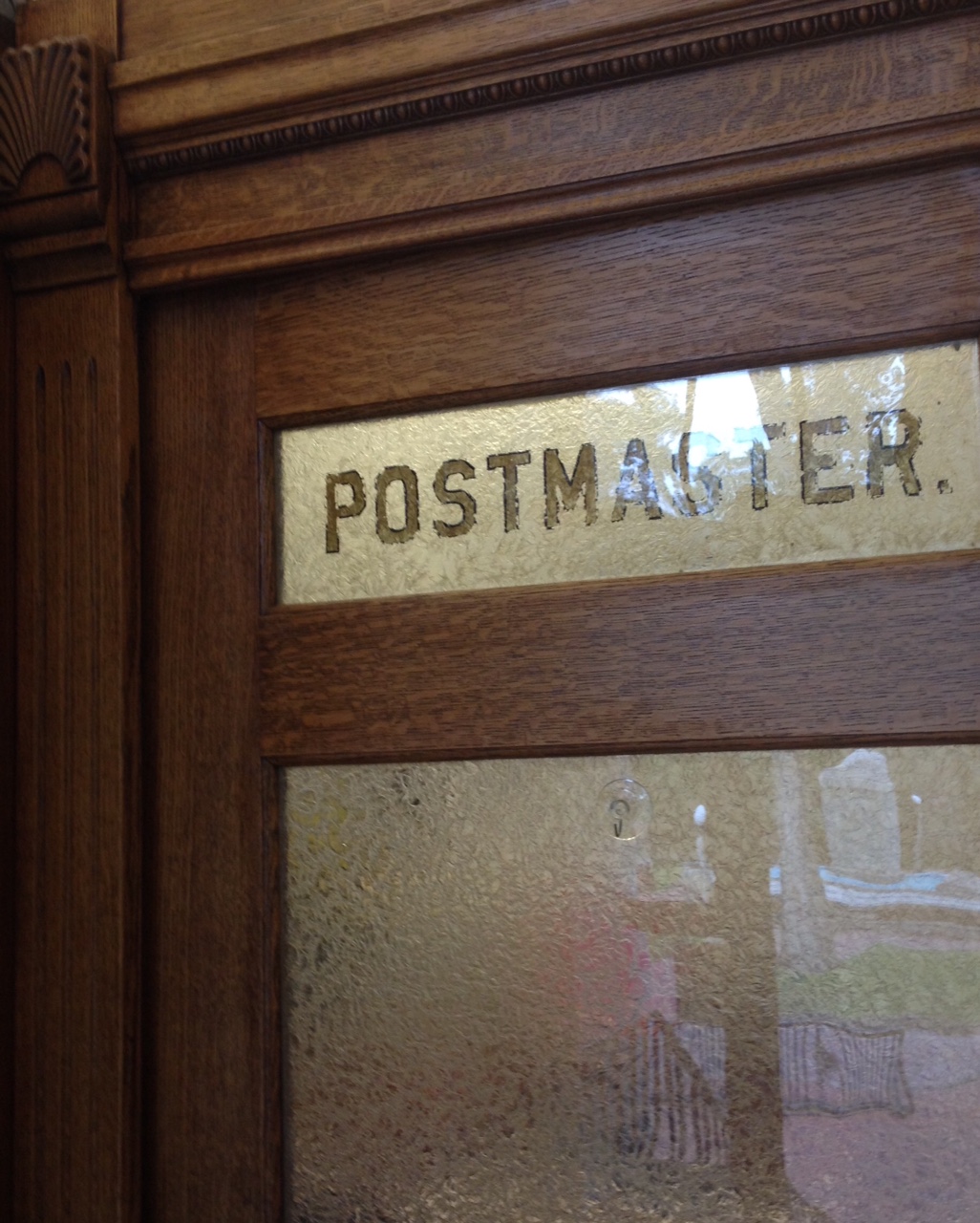
Take a close look at the door frame of the Postmaster’s office. See the totally unnecessary but utterly beautiful detail there? Maybe it’s time for us to imitate those who recognized that every moment of our days, no matter how mundane, can be an opportunity to worship the Creator Who made all things beautiful?
.
Finding my roots (and leaves and blossoms)
“The museum was not; it had not yet been evolved. Neither had the lovely hall. Where it stands was a grove…I dreamed out many a flower-strewn path leading to it…” (Eighty-Seven)
As I left the Post Office, I admired the plaza’s beautiful flower beds, brimming with summer’s prettiest blooms.
The flowers reminded me of yesterday’s pilgrimage to The Hall in the Grove and some touchingly innocent 19th century floral-themed mosaics that wreathed the speaker’s platform, celebrating the C.L.S.C.’s earliest classes. Can you even imagine a contemporary co-ed reading circle allowing themselves to be dubbed “The Pansy Class”? Hardly.
I loved all these timeless tributes, but one class year stopped me in my tracks. There they were, my spiritual, cultural, and literary “ancestors”—the C.L.S.C. Class of 1884: “Irrepressibles.” While I obviously feel a deep kinship with all things Pansy, I must admit everything in me said “Yes!” as I stood, motionless, before this joyful declaration of literary enthusiasm.
So, this day, while I enjoyed the blaze of seasonal glory, I nodded a special ‘hello” to my new favorite flower, the confident, courageous lily. The buoyant Class of 1884 couldn’t have a better floral representation than the trumpet-shaped blossom that symbolically celebrates Christ’s promise of eternal life.
.
Irrepressibly His, Karen.
.
In her final Postcards guest post, Karen guides us on a walk through Chautauqua’s miniature Holy Land.
If you missed previous posts about Chautauqua Institution, you can read them by clicking on the links below:
Reviews and giveaways for Christian fiction and sweet, clean fiction. Bringing readers information on great stories and connecting authors with their readers.



















 Isabella Alden