Flossy and the Street Children

Isabella Alden never actually said so, but there’s an argument to be made Flossy Shipley Roberts may very well have been her favorite character. Of all the characters Isabella created, Flossy made the most appearances in her novels.

Flossy first appeared in Four Girls at Chautauqua. She was also a key character in The Chautauqua Girls at Home, Ruth Erskine’s Crosses, Four Mothers at Chautauqua, and Echoing and Re-echoing.

Cover of Ester Ried Yet Speaking showing a close-up of a young woman with blonde hair dressed in a high-neck red gown. In the background is a large three-story home set amid trees and gardens.

And while she was only mentioned in Judge Burnham’s Daughters and Ruth Erskine’s Son, Flossy made her final appearance—and played a major role—in Ester Ried Yet Speaking.

Perhaps one reason Flossie was so well-loved—by Isabella and by her readers—was that she was honest and truthful, yet deceptively strong. People constantly underestimated Flossy because she was soft spoken and was willing to please others.

But Flossy also had a strong moral sense of right and wrong. She relied on her Christian faith to give her the strength she needed to always do right rather than what others wanted her to do.

She was also kind hearted, especially when it came to children. Flossy was just as willing to teach a Sunday school class full of ragged orphaned street boys as she was to serve tea on her best china to a wealthy church deacon and his wife.

That was the case in Esther Ried Yet Speaking, when Flossy took on the task of teaching a Sunday-school class of rough street boys. During the first class, Flossy took an interest in one of those boys, Dirk Colson and his sister Mart. In the story, Flossy’s concern for them and the rest of the boys—and the actions she took to help them—reflected Isabella’s own principles.

Black and white photo of a narrow alley between two multi-story brick buildings. In the foreground are trash cans and debris, a water pump and buckets. A group of six boys stand in the center of the photo. Behind them are two women wearing long dresses and aprons  from the time period, as well as more children. On the left side of the photo are two young girls, wearing short dresses that appear to be patched.
Boys in Mullens Alley, New York, 1888, by Jacob A. Riis

Isabella was keenly interested in the problem of street children living in large urban areas like New York City. In 1889 she wrote:

There is, in New York City, a meeting known as the “Woman’s Conference.” On the second Friday of every month they meet together to discuss matters of importance and see what they can do to help along the good work which is being done in this world. A few weeks ago they took for their subject the “Street Children’s Sunday,” their object being to see what they can do to help these miserable, neglected, almost forgotten, children to something better than their sorrowful lives have yet known.

The Sun (a New York newspaper) covered that women’s conference and published an account of the meeting, including this paragraph:

At the meeting, which was presided over by Mrs. Lowell of the State Board of Charities, Mrs. Houghton, literary editor of the Evangelist, introduced a subject of the Sunday Life of tenement-house children, a large class of whom do not attend the Sunday schools, and whose Sundays, owing to the drunkenness of their parents, which is more general on that day than any other, and also to the overcrowding of the small rooms in which they live by the presence of the entire family on that day, are full of wretchedness and discomfort. “The children do not laugh enough,” Mrs. Lowell said. “They did not know how to play or to be happy.” This subject has been long of great interest to Mrs. Houghton, and out of this discussion germinated a plan to do something for those little wretched waifs of humanity to brighten their lives, and ultimately to make of them better men and women and more intelligent and worthy citizens.

Isabella strongly believed in the last line of the article: that making the lives of poor boys and girls better will ultimately help them grow to be better men and women.

Black and white photo of three young children sleeping close together in an outdoor alcove of a stone-facade building. The children are barefoot and two are wearing short pants with patches on the knees, as they sleep with their arms around each other.
Children sleeping on Mulberry Street, 1890, by Jacob A. Riis

She also had the example of Jacob Riis, a newspaper reporter who documented living conditions in New York slums. Through his written articles and photographs, he almost single-handedly educated Americans about the necessity of better living conditions for the poor. He advocated for clean drinking water, public parks, and child labor laws, and he was instrumental in implementing these and many other reforms in New York City. Riis and Isabella both attended Chautauqua Institution at the same time, and Riis was close friends with Bishop John Vincent, one of Chautauqua’s co-founders.

Black and white photo of a middle-aged man seated in a chair. He has short, light-colored hair and a mustache, an wears wire-rimmed glasses. He wears a tie and three-piece suit. The chain of a pocket watch is visible on his vest.
Jacob A. Riis in 1904 (from Library of Congress)

Isabella may very well have been thinking of Riis when she wrote about Flossy’s efforts to reach and influence the street boys in her Sunday-school class.

Black and white photo of a row of three two-story attached houses in dilapidated condition, with broken windows and clothes-lines strung from one building to another. The roof of the center home sags dangerously. In the background, a multi-story building hows broken windows and objects cluttering the metal fire escape.
Dwellings of Death by Jacob A. Riis

In one scene, Flossy gets lost in the slums while trying to visit Dirk, and a street boy named Nimble Dick helps her find Dirk’s house.

Mrs. Roberts uttered an exclamation. The house was one of the most forlorn in the row, seeming, if the miserable state of the buildings would admit of comparison, to be more out of repair than the others. It came home to her just then, with a sudden, desolating force, that human beings such as she was trying to reach, and such as she hoped would live in heaven forever, called such earthly habitations as these homes. What possible idea could they ever get of heaven by calling it “home”?

“Do they have the whole of the house?”

She asked the question timidly, for the building looked very large, but she was utterly unused to city tenement life.

“The whole of that house?” Dick fairly shouted the sentence, and bent himself double with laughter. “Well, I should say not, mum! As near as I can calculate, about thirty-five different families have that pleasure. The whole of the house! Oh, my! What a greeny!” And he laughed again.

Mrs. Roberts exerted herself to laugh with him, albeit she was horror-stricken. Thirty-five families in one house! How could they be other than awful in their ways of living?

“I know almost nothing about great cities,” she said. “My home was in a much smaller one.”

This was the truth, but not the whole truth. Instinct kept this veritable lady, in the truest sense of the word, from explaining that she knew nothing about the abject poor, when she was speaking to one of their number.

But Flossy quickly set about learning all she could about Dirk, his sister, and their neighbors because she felt a distinct calling to help them. When she returned a second time to Dirk’s tenement building—this time accompanied by her husband—other residents of the tenement warned her to stay away from Dirk.

It was strange, she could not herself account for it; but with every added word of misery that set poor Dirk Colson lower and lower in the scale of humanity, there seemed to come into this woman’s heart, and shine in her face, an assurance that he was to be a “chosen vessel unto God.”
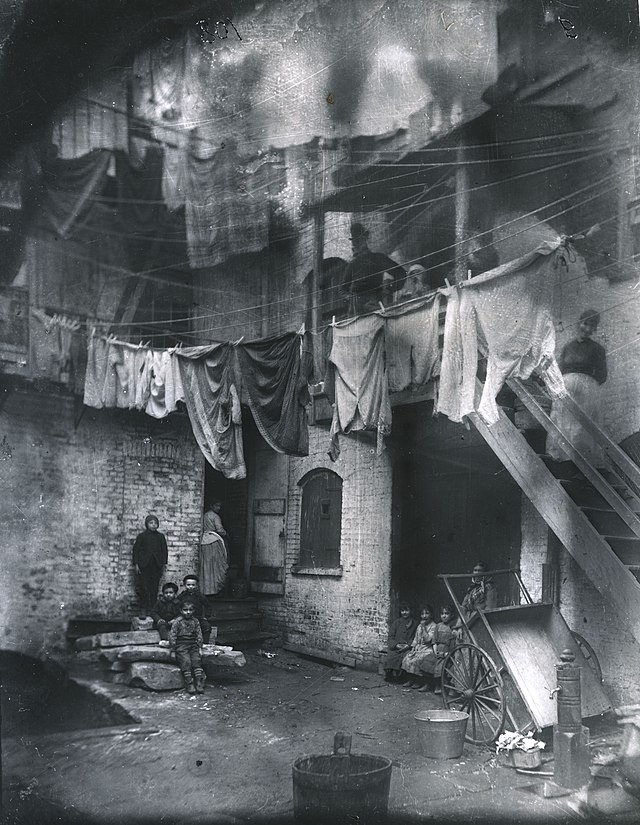
Black and white photo showing a small open area surrounded by four brick buildings. A shaft of light from above illuminates several clothes lines where clothing and blankets have been hung out to dry. On an upper balcony a man stands with children behind him. A woman wearing an apron stands on the stairs leading from the balcony to the count. On the ground an apron-clad woman stands in the doorway with four children of different ages nearby. In another doorway stands a woman with three little girls seated beside her. In the foreground is a two-wheeled pushcart, buckets, a water pump, a and debris.
A Tenement Yard by Jacob A. Riis

To Flossy, helping Dirk and the rest of “her boys” was essential. And when someone tried to change her mind by asking what good Flossy could possibly do for such creatures, she replied:

“Don’t you think that Jesus Christ died to save them? And don’t you think he wants them saved? And will he not be pleased with even my little bits of efforts if he knows that my sincere desire is to save these souls for his glory?”

Her “little bits of efforts” may seem small at first, but Flossy soon begins to see results with “her boys.”

You can read all about the plan Flossy came up with, and how the boys responded, in Isabella’s novel, Ester Ried Yet Speaking.

You can read Isabella’s novel Ester Ried Yet Speaking for only 99 cents! Choose your favorite e-book retailer. (Your purchase from The Pansy Shop helps support this blog.)

Pansy in Paperback

At the height of her popularity Isabella’s books were published in several languages and sold all over the world.

She had a large fan base in England, and in the 1890s a British publisher took the unusual step of publishing Isabella’s novels as pamphlets. Today, we’d call them paperback books.

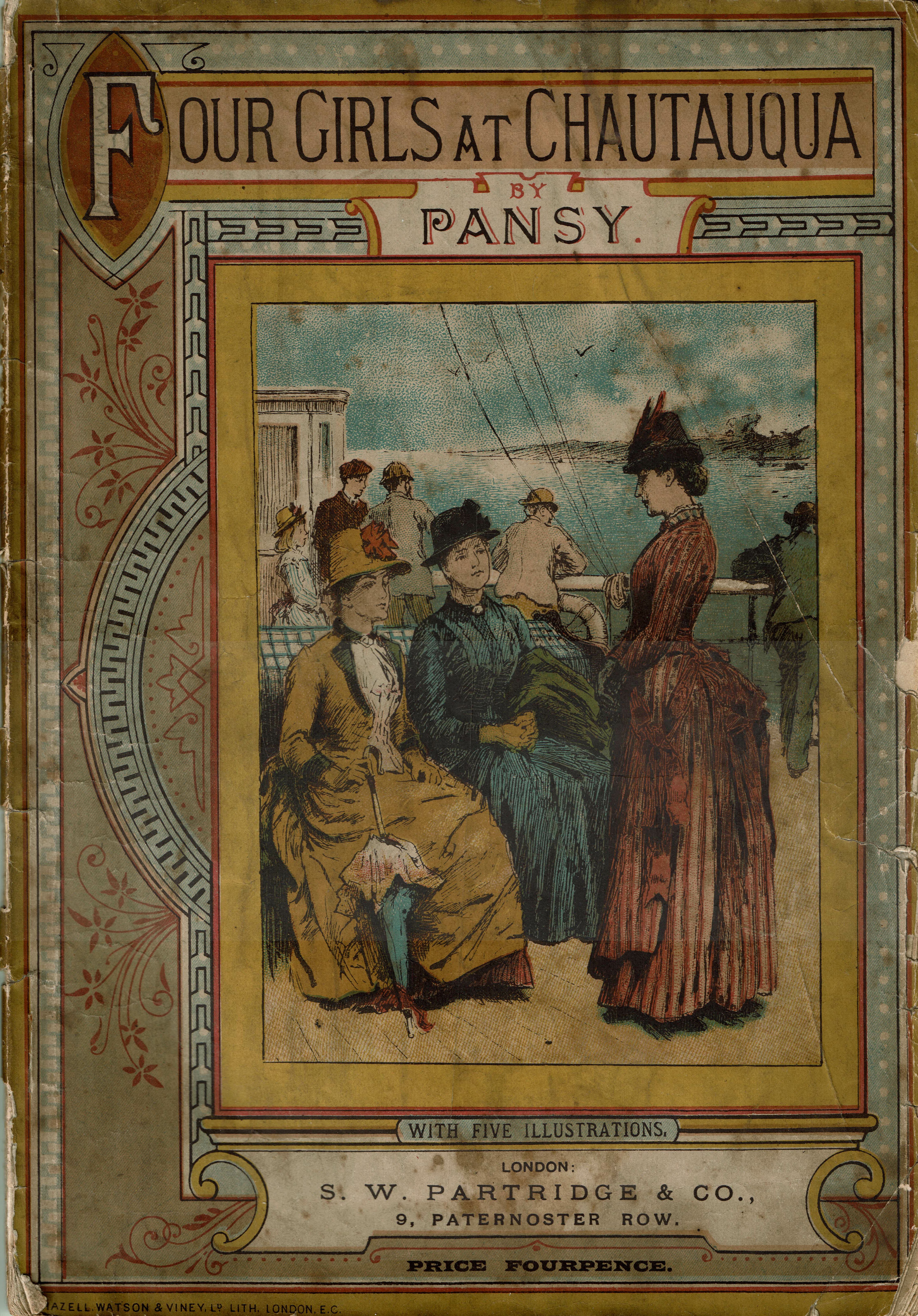
Cover of Four Girls at Chautauqua. Printed in color with Victorian-era borders and flourishes. A central illustration shows three young women dressed in gowns and bonnets of the 1890s on the deck of a boat. Two of the ladies are seated while the third stands facing them. In the background other people stand at the railing and look out over the water at the coastline in the distance.

S. W. Partridge & Co. of London advertised the books as “Partridge’s Cheap Pansy Series.” Each edition included a list of the available titles in the series:

A portion of the front matter contained in the books announcing Partridge's Cheap "Pansy" series at fourpence each. Other books in the series:
Mrs. Solomon Smith Looking On 
Links in Rebecca's Life
Chrissy's Endeavour
The King's Daughter
Ester Ried
Ester Ried Yet Speaking
Ruth Erskine's Crosses
Chautauqua Girls at Home
Three People
Wise an Otherwise
An Endless Chain

The novels measured 7-1/2” by 10-3/4”, making them slightly smaller than the 8-1/2 by 11” standard paper Americans use today. They were only 64 pages long, but thanks to their 2-column layout and small type, each novel was complete and compact enough to fit into a lady’s bag.

Page one of Four Girls at Chautauqua. The text is formatted in two columns in small type.

In fact, Partridge & Co. published them particularly for women travelers. They were sold at newsstands in railway stations throughout England and cost just four pennies.

A portion of the cover of Four Girls at Chautauqua, showing the price of the book: fourpence.

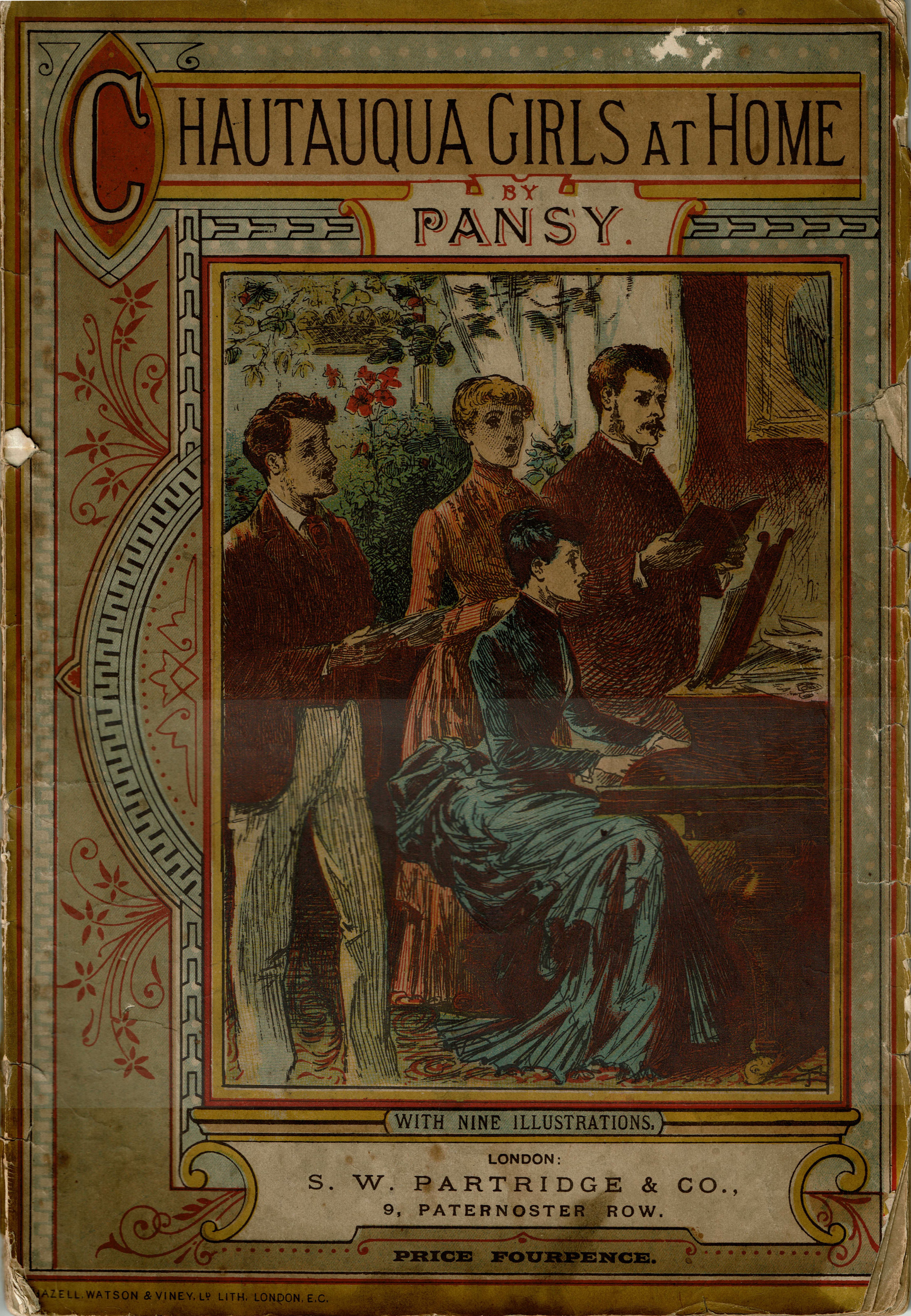
Each book featured a beautifully embellished, full-color cover that illustrated a particular scene from the story. Here’s the cover for Chautauqua Girls at Home:

Cover of Chautauqua Girls at Home. Printed in color with Victorian-era borders and flourishes. A central illustration shows a young woman seated at a piano, playing and singing. Standing behind her are a young woman and two young men, each holding music books and singing.

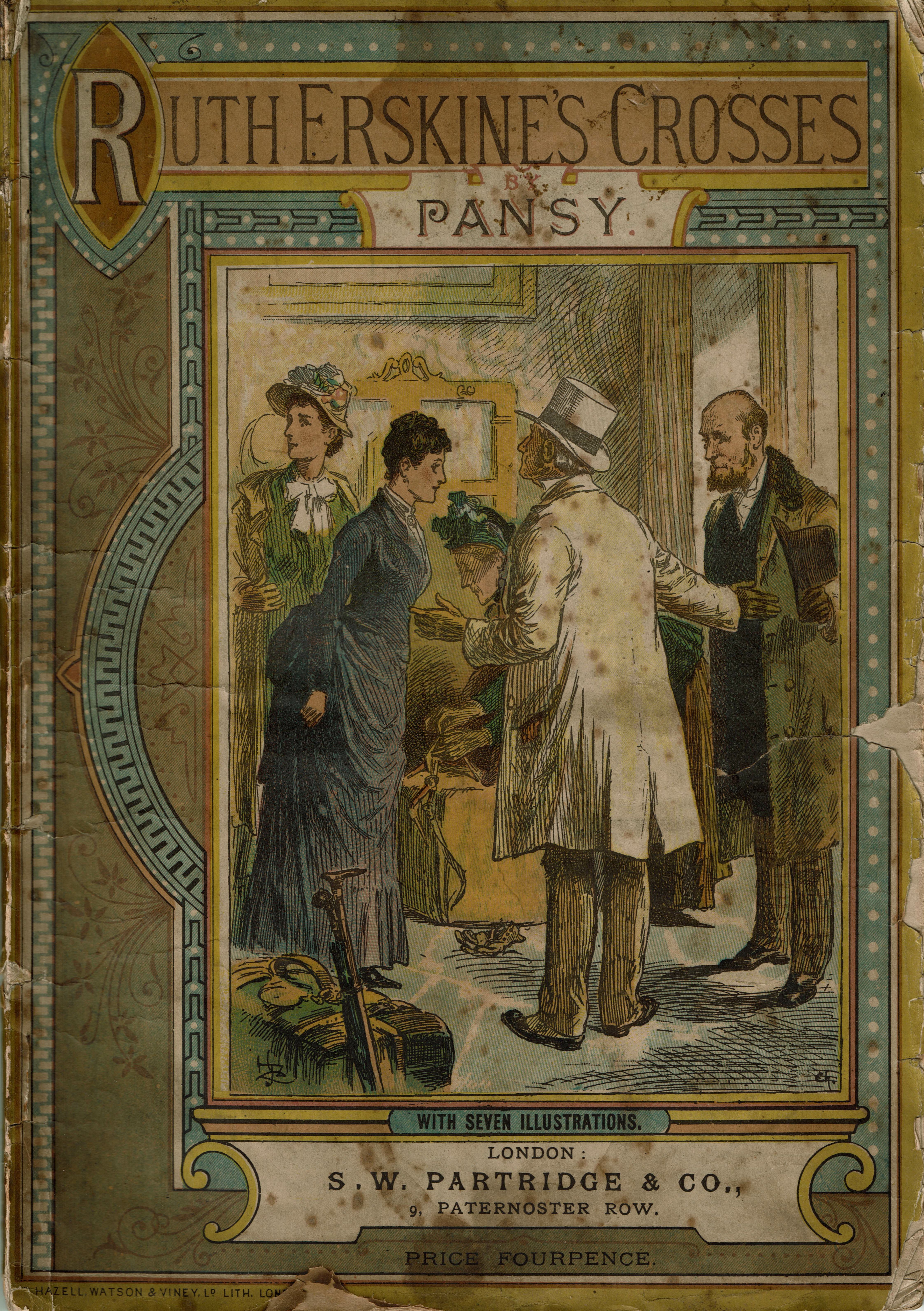
The cover art for Ruth Erskine’s Crosses shows the moment Ruth’s father introduced her to Judge Burnham.

Cover of Ruth Erskine's Crosses. Printed in color with Victorian-era borders and flourishes. A central illustration shows an older man in coat and hat introducing a young woman to an older man who is in the process of removing his hat. In the background are two other women. One is removing her coat while the other unties the cords on a large box.

What do you think of the depiction of this important scene? Is that how you pictured Judge Burnham when you first read Ruth Erskine’s Crosses?

The cover for Julia Ried shows the moment Julia went to apply for the bookkeeping job at the box factory.

Cover of Julia Ried. Printed in color with Victorian-era borders and flourishes. A central illustration shows a young woman dressed in coat and bonnet and carrying a parasol. She has just entered a room and her hand is still on the doorknob. She faces an older man dressed in a suit with a watch fob and chain in the pocket of his waistcoat. The room he is in contains boxes, a table with books on top and shelves with large books or bound ledgers.

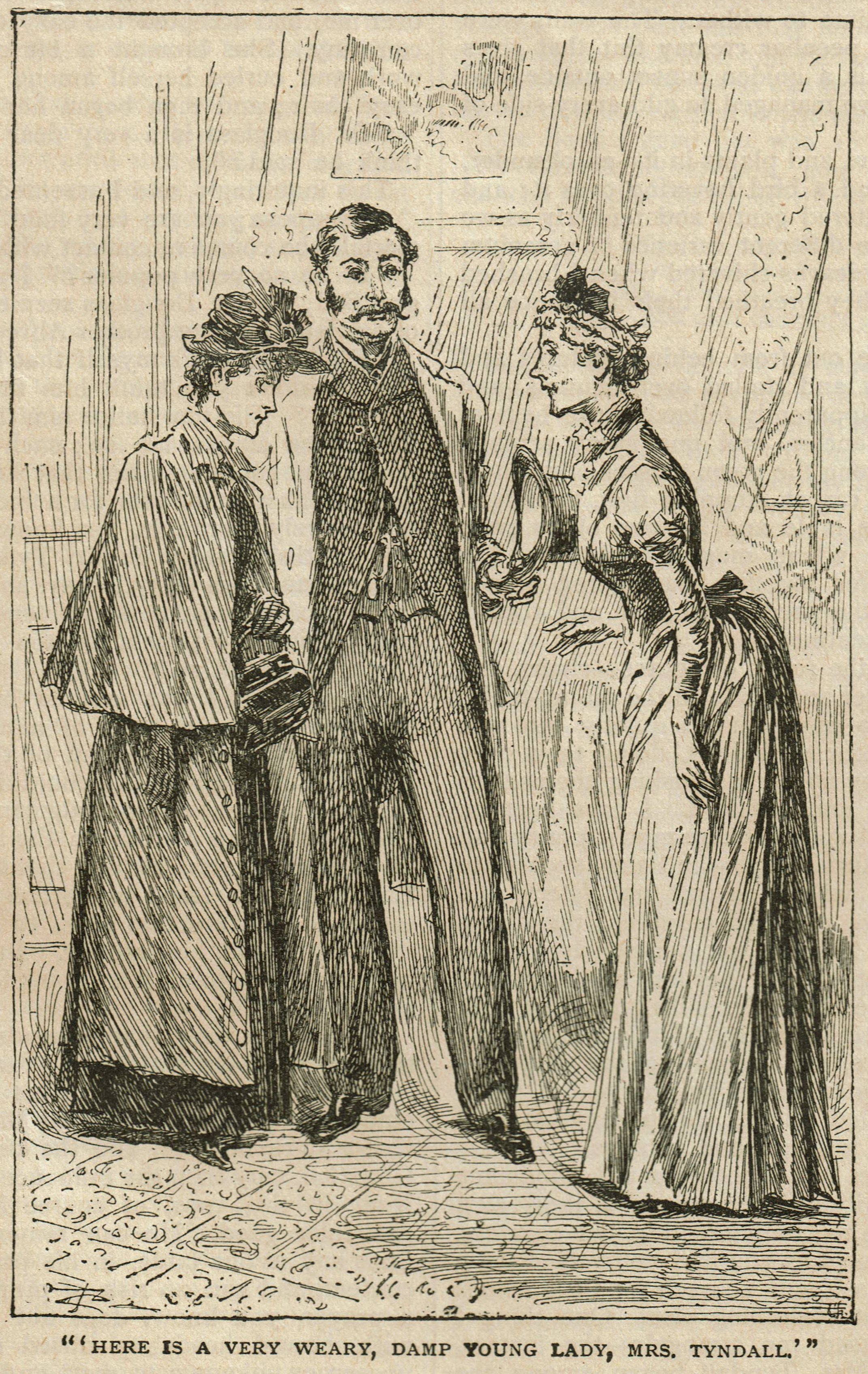
In addition to the cover, each book had anywhere from five to nine black and white illustrations. This one, in Julia Ried, depicts the moment Dr. Douglass introduced Julia to Mrs. Tyndale.

Illustration of a man in 1890s clothing introducing a young woman wearing cape and bonnet to an older woman who is wearing a fashionable gown and a cap.

Mottos were very popular in the 1890s, and this motto appeared at the end of Julia Ried:

Your faith should not stand in the wisdom of men, but in the power of God. (I Cor. II. 5.)

It very nicely sums up one of the lessons Julia learned in the story.

Often, mottoes like this one were used as inexpensive sources of artwork. Ladies cut them from the pages of books and magazines and pasted them into scrapbooks or framed them to hang on the wall.

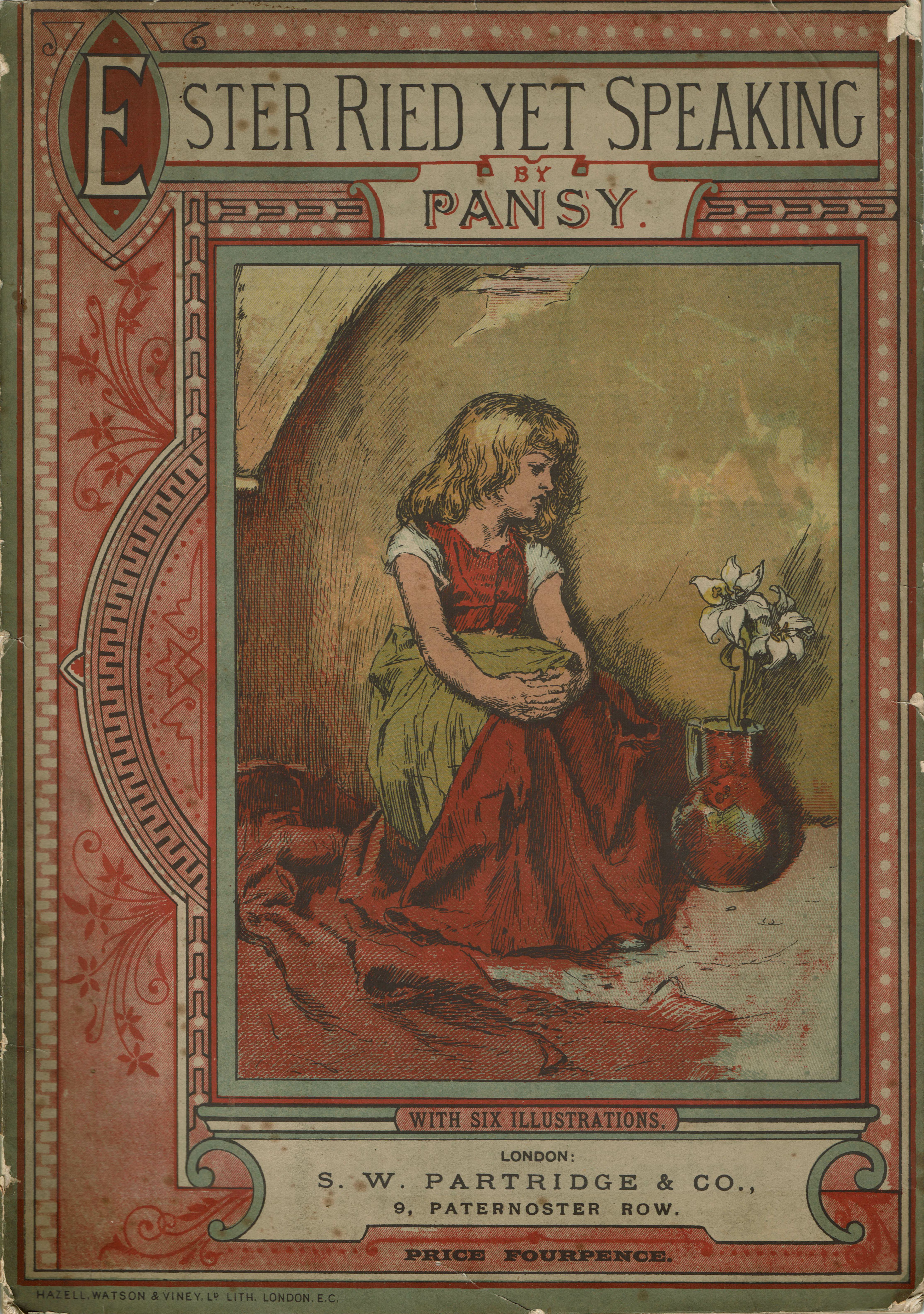
Cover of Ester Ried Yet Speaking. Printed in color with Victorian-era borders and flourishes. A central illustration shows a young girl sitting on the floor beside a vase holding two white flowers.

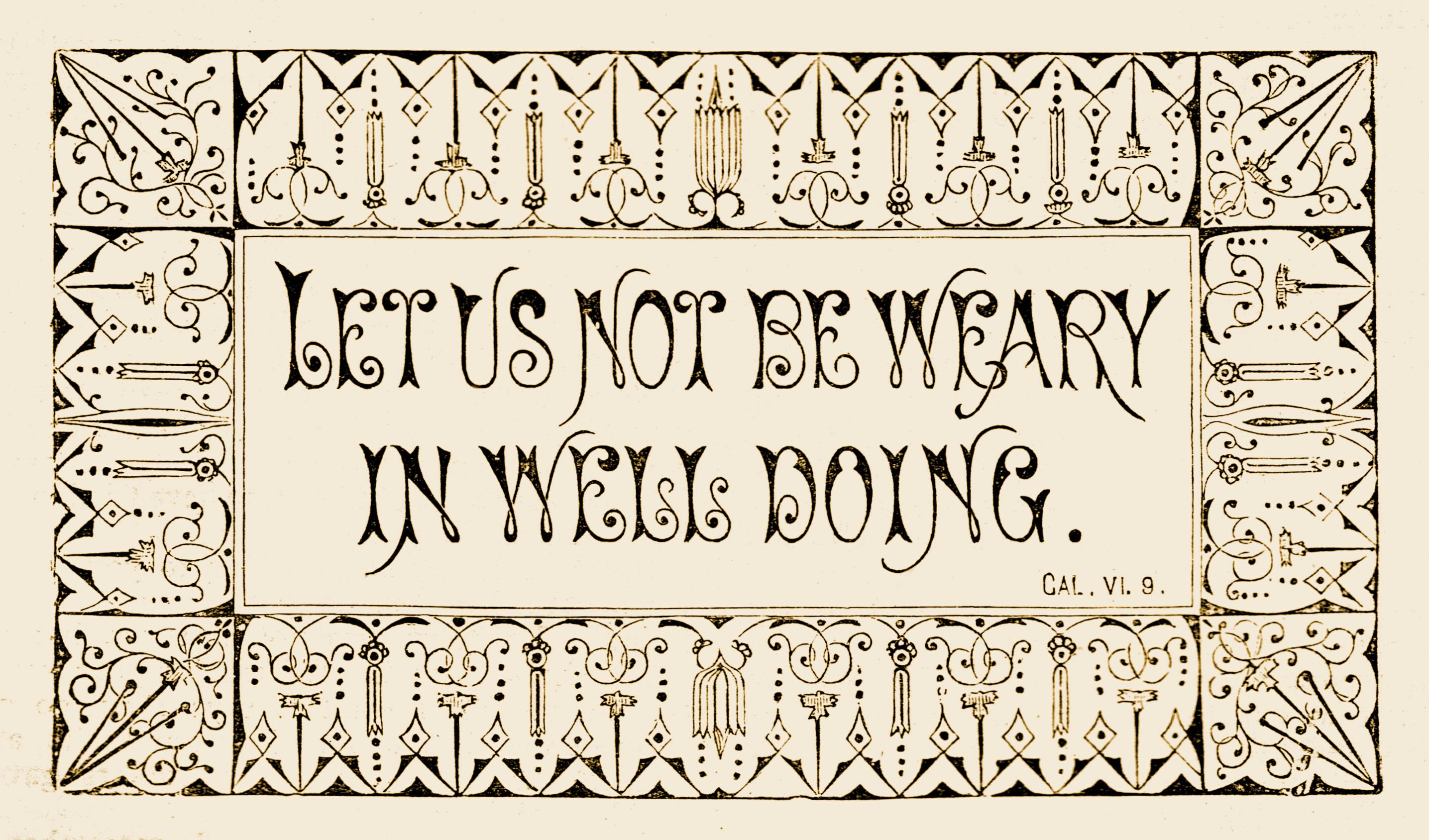
Ester Ried Yet Speaking also ends with a motto related to the story:

Let us not be weary in well doing. (Cal. VI. 9.)
The cover for Interrupted illustrates the moment Claire Benedict learned her father’s money was gone and the family was bankrupt.

Cover of Interrupted. Printed in color with Victorian-era borders and flourishes. A central illustration shows a young woman dressed in black facing three men who are seated, each holding their hats and walking sticks. Beside the young woman is seated an older woman also dressed in black.

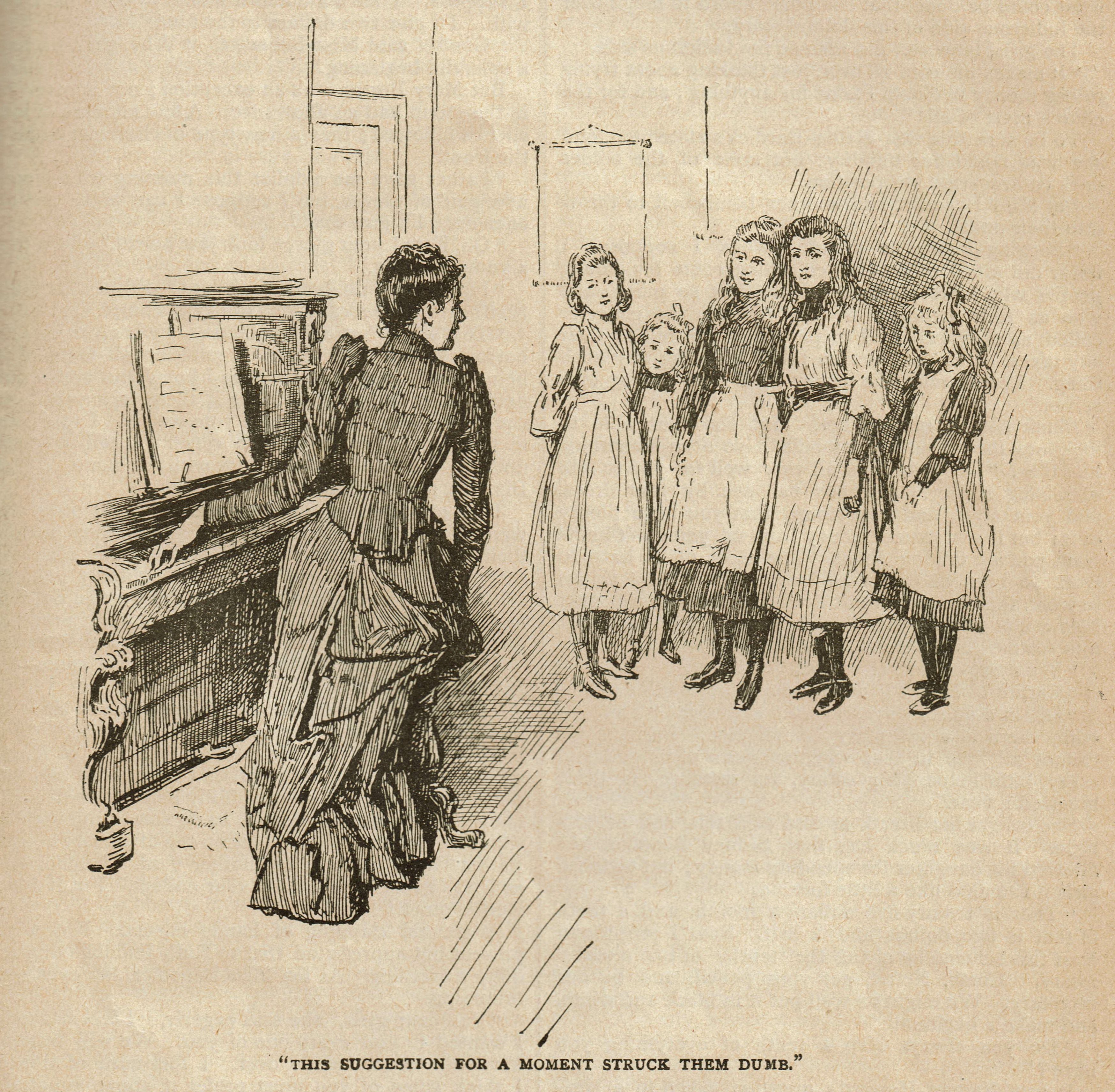
One of the black-and-white illustrations shows the moment Claire suggests to her students that they take on the job of cleaning up the church sanctuary:

Illustration of Claire seated as the piano, one hand on the keyboard, but she has turned slightly to face five girls who are standing nearby. Caption: "This suggestion for a moment struck them dumb."

It wasn’t uncommon for the titles of Pansy’s novels to be changed when they were published in other countries. One Commonplace Day was one such novel; in England it was renamed Wise to Win:

Cover of Wise to Win. Printed in color with Victorian-era borders and flourishes. A central illustration shows a young woman and young man conversing in a parlor or living room. In the background are two women, one standing and one seated at a table near a fireplace.

These paperback books all have some wear and tear, but considering the fact that they’re over 130 years old, they are in remarkably good shape. Perhaps they’ll last another hundred years for a new generation of Pansy readers to enjoy!

What do you think of these paperbacks?

Do you have a favorite cover?

Click here to read a previous post about mottos.

A Quick Bite to Eat

In her novels, Isabella wrote about all kinds of people: from heroic physicians to ladies of wealth and leisure; from mischievous boys to angelic little girls.

But of all the character types who appeared in her novels, the working class clerk was the most common.

Clerks in a grocery store stand by, ready to serve customers.

Alfred Ried (in Ester Ried Yet Speaking) worked long hours for little pay in a busy downtown shop.

Robert Parks and Hester Mason did the same in Workers Together; an Endless Chain.

Clerks pose outside their hardware shop (about 1915).

Isabella seemed to have quite a bit of sympathy for these overworked, underpaid young people. Around the turn of the Twentieth Century the average man earned about $11.00 per week; but young men, like Alfred and Robert, who were just starting out in their careers, earned considerably less.

Because she was female, poor Hester would have earned only half (sometimes less) of what her male counterparts earned.

Shop clerks wait on customers in a department store (around 1910).

After they paid rent for their lodgings, they had little left to live on.

During the work day, when it came time for their mid-day meal break, they had to return to their lodging house for their meal, which was often included in the cost of their rent.

But if their rented rooms weren’t close to the shop where they worked, they had to find a nearby place to eat with menu items they could afford.

Luckily, some small restaurants in large cities catered to working people in that very situation.

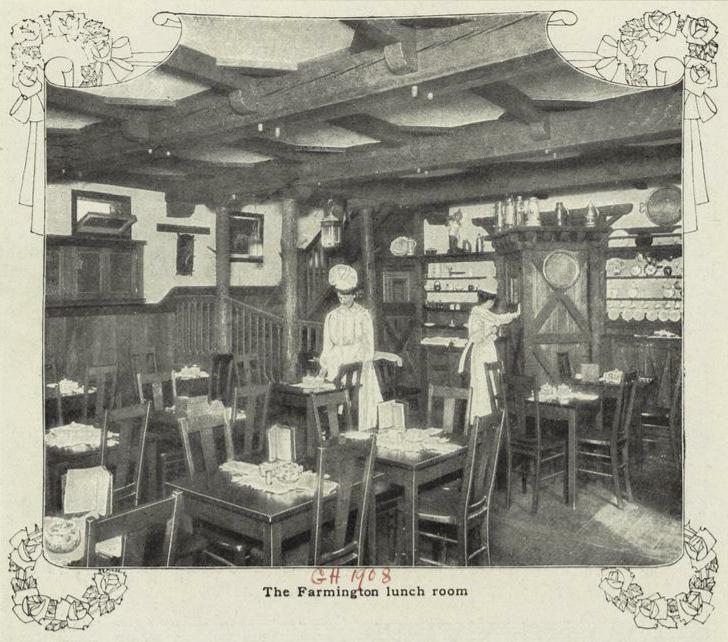
Workers prepare to serve diners at The Farmington Lunch Room in 1908.

Haim’s Quick Lunch Restaurant in New York City was one such place. Every dish on their menu was designed to be served quickly, so working clerks like Robert, Hester, and Alfred could have a simple meal and get back to work.

Trade card for the Riverside Tea Room in New York.

So what kind of dishes did Haim’s serve? Here’s their 1906 lunch menu:

Their heartiest dishes were the most expensive. For about ten cents Alfred could have two eggs cooked to order. And Robert might have a bowl of milk toast or a sandwich.

Since Hester had to make her pitiful wages go farther than Robert or Alfred, she might have ordered one of the less expensive items on the menu, like griddle cakes.

A crowded ladies’ lunch room at A. T. Stewart’s in New York City (about 1875).

Or she might have ordered a bowl of Force, Malta Vita, or Power, which were very much like cold cereal we eat today.

Excerpt from a 1902 Malta Vita newspaper ad.

What do you think of Haim’s menu choices?

If you were a shop clerk and had only 15 or 30 minutes to grab a quick bite of lunch, which Haim’s menu item do you think you would order?


If you’d like to learn more about any of Isabella’s novels mentioned in this post, click on the covers below:


A Nice Oyster Supper

There’s a recurring theme in many of Isabella’s books you may have noticed:

Whenever a group of characters needed to raise money for their church or favorite cause, their first inclination was to earn the money through a social event.

Ad from a 1918 North Carolina newspaper.

Isabella’s characters held fairs and festivals, old folk’s suppers and young folk’s concerts, character parties and tableaux, strawberry soirees and ice cream socials—all in the name of raising money for their church or charity.

Announcement in Fort Mill Times (South Carolina), November 17, 1910.

Carrie Spafford in The Pocket Measure didn’t see the sense of it. She asked:

“Why do you suppose we always think of devices of this kind whenever we talk about money for the cause of Christ?”

Carrie asked a good question. Whenever there was money to be earned, Isabella’s characters—much like the people in churches Isabella observed first hand—spent long hours and lots of money to stage events by which they hoped to receive donations for their cause.

The Camden (Tennessee) Chronicle, February 9, 1912.

The most popular method Isabella’s characters turned to for raising money was the oyster supper.

That’s what happened in Isabella’s short story, “Circulating Decimals.” As soon as the ladies of the Penn Avenue Church realized the church library was in need of new books, they decided to take action.

Up rose the women, the respectable, middle-aged, matronly women. The library must be replenished, the money must be raised. They—the matrons—would do this thing speedily and quietly. They would have an oyster supper on a large scale, make preparation for a great many guests, furnish oysters in every possible style, and with them such coffee as only they could make, to say nothing of the inevitable cake and cream, and side dishes for those who did not relish oysters. So they went to work quietly, skillfully, expeditiously. Baking, broiling, frying, stewing!

A portion of a comic appearing in the Washington DC Evening Star, January 1, 1911.

Oysters were also the go-to choice when Isabella’s characters entertained guests in their home.

Preparing an oyster supper; and 1873 print.

Flossie Roberts served oysters with jellies and sauces to the rough boys in her Sunday-school class in Ester Ried Yet Speaking.

Oysters with Lemon, a painting by Otto Scholderer, 1891.

And when the impoverished Cameron family in What They Couldn’t struggled to find a way to entertain their society friends with little money, they decided to invite their discerning friends to a simple lunch:

Their ideas of simplicity would have bewildered some people. A lunch without salads was not to be thought of, of course; and chicken salads were the best. No matter if chicken was very expensive just now, it did not take a great deal for a salad. Then oysters were just getting nice, and, after the long summer, seemed so new; raw oysters were the very thing with which to begin a lunch. Served on the half-shell and properly garnished, there was no simple dish which looked more inviting.

A plate of oyster patties from Mrs. Beeton’s Book of Cookery, 1907.

In these stories, and many others, Isabella was sharing a very real circumstance of life in late 19th and early 20th century America:

America loved oysters and ate them in abundance.

Business card for an oyster dealer, 1880.

Fresh oysters were prized, but thanks to advancements in canning methods, oysters could be shipped inland to Midwest cities that previously had no means for buying and consuming seafood.

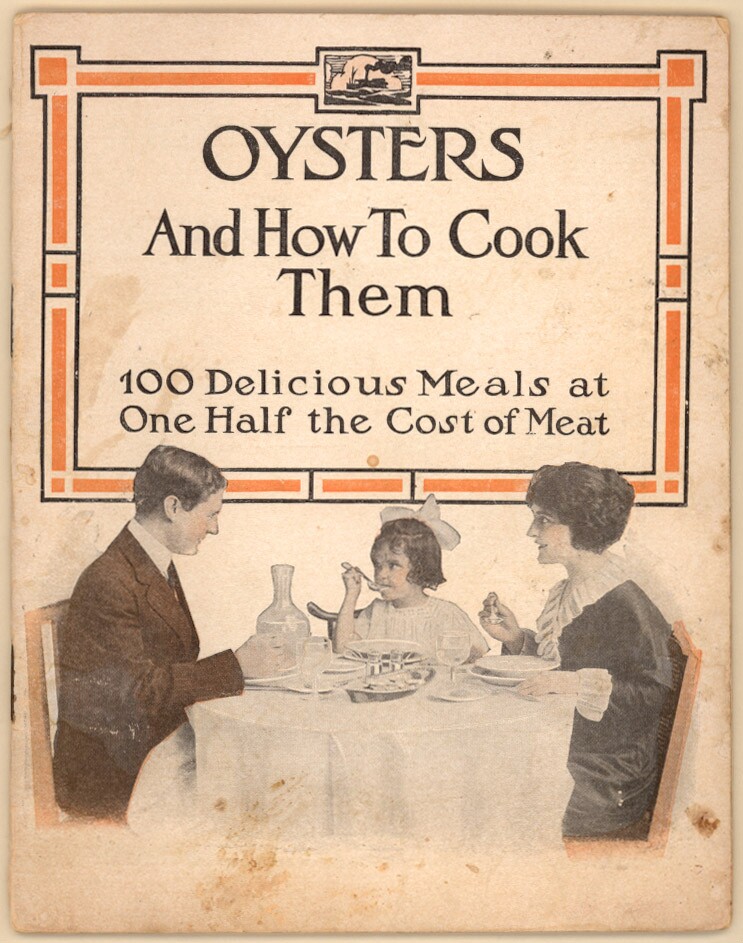
And new techniques for harvesting oysters made them so abundantly available, their cost was half as much as beef, per pound. They were inexpensive and popular, and Americans couldn’t get enough of them.

A plate of grilled oysters, from Mrs. Beeton’s Book of Cookery, 1907.

Cook books of the time had recipes for stewed oysters, fried oysters, broiled oysters, and pickled oysters.

A 1915 cookbook published by the Oyster Growers and Dealers Association of North America. You can click on the cover to see the entire cookbook.

Americans served oyster patties, oyster pies, and soups. They added oysters to their meats, stuffed them in turkeys, and scrambled them with eggs.

For those who didn’t want to prepare oysters themselves, they could find oysters on the menu of most restaurants and public houses.

The Union Oyster House in Boston, Massachusetts was founded in 1826 and is still in business today.

Most major towns in America could boast an oyster parlor or oyster saloon.

A 1903 newspaper ad for a Louisiana oyster saloon offering a ladies’ private parlor.

Many such establishments had private dining rooms for ladies, where they could eat oysters in an environment that did not offend their delicate sensibilities.

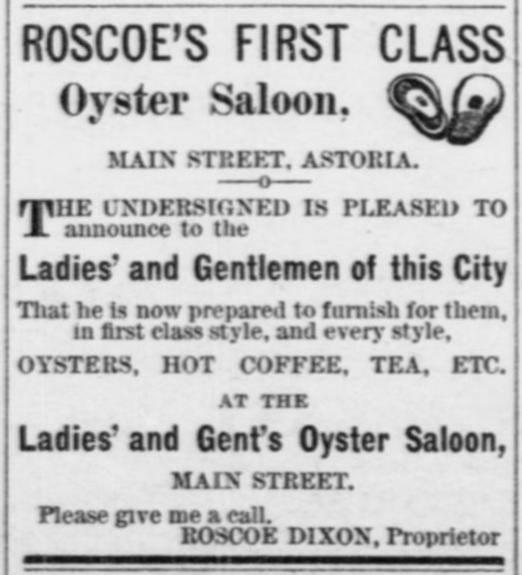
An 1881 ad for an oyster saloon in Astoria, Oregon.

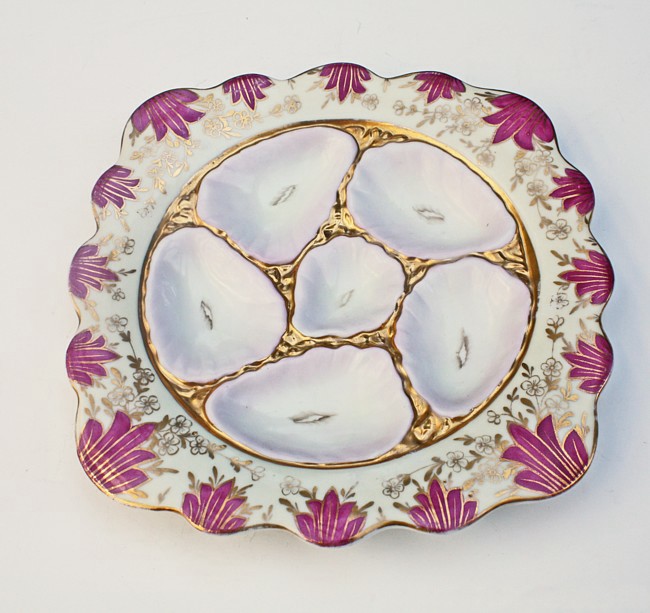
Americans’ love for oysters spawned an entirely new industry of serving plates and utensils designed specifically for oysters.

An oyster plate from the late 1800s. With six oyster wells, it is decorated in the Chinoiserie style popular at the time.

It’s no wonder, then, that when Isabella’s characters planned a dinner or a party, they naturally thought to put oysters on the menu. They were inexpensive, easy to prepare, and almost everyone liked them.

A silver oyster fork from Tiffany & Company, dated 1872

But cooking and selling oysters didn’t guarantee that a fund-raising event would be successful. Though festivals and dinners and other fund-raisers were very stylish, Isabella believed that more money and effort were spent on putting the events together than the organizers ever made from donations.

When talk turned to having a fund-raising festival of some kind in The Pocket Measure, Callie Spafford stated Isabella’s opinion plainly:

“Haven’t you often seen gentlemen eat fifty cents worth of oysters and cake and cream and fruit and celery, and I don’t know what else, and pay twenty-five cents for it all, and think they were being benevolent?”

Despite the questionable economics, oyster suppers remained a favorite form of charity fundraisers in America . . . and in Isabella’s novels.


Fan Mail and Ester Ried

At the height of her popularity, Isabella Alden was one of the most widely-read authors in the world. One of the things that made her so popular—and unique—was the varying ages of her readers: she had just as many children who were dedicated fans of her books as she had adult fans. And they all wrote letters to her.

She received letters by the thousands, addressed to her publisher, to her home, and to the offices of her magazine, The Pansy. And she answered them all!

Isabella Alden in an undated photograph.

Some fans wrote to request her autograph and a photo. Others asked for advice on how to become a great author or they sent their own manuscripts and asked for her opinion.

Some asked for advice on other topics, from how to get a good husband to the best way to stop fingernail biting. One fan even asked for pieces of her best dress so they could be sewn into a patchwork quilt the fan was sewing!

An early cover for Ester Ried

But the fan mail Isabella received most often was about her book Ester RiedEster Ried was incredibly popular and prompted scores of readers to send Isabella letters thanking her for the book’s message.

New cover for the 2016 release of Ester Ried

Fans wrote to Isabella about how they saw themselves in Ester’s struggles and her impatience with life’s daily annoyances. But mostly, readers identified with the lessons Ester learned; they took to heart the promise that God would bring peace and happiness to their lives, if only they trusted in Him.

What started as a single book soon blossomed into an ongoing series. The Ester Ried series gave fans of the original book glimpses into the lives of the characters they loved. Readers grabbed up each new story about the Ried family members and their trials as they grew up, married, and learned to trust God to help them through a sometimes difficult world.

Cover_Julia Ried

Two years after Ester Ried was published came Julia Ried, a sequel that focused on Ester’s younger sister Julia and the lessons she learns about faith in times of temptation. It also brought readers up to date on Abbie Ried’s story after the tragic turn her life took in Ester Ried.

Cover_The King's Daughter

The following year Isabella published the third book in the series, The King’s Daughter. In this book Isabella introduced the character of Miss Dell Bronson. Unlike Ester or Julia, Dell was rock solid in her faith and trusted God in her daily life, but she still had challenges to face. And she still had lessons to learn in Wise and Otherwise, the next book in the series.

Cover_Wise and Otherwise

Isabella commissioned her best friend Theodosia Foster to write book five. Echoing and Re-Echoing (written under Theodosia’s pen name Faye Huntington) centers around Ralph Ried, Abbie’s brother, who, as a new minister, struggles to reach his flock through his Sunday sermons.

Cover_Echoing and Re-echoing

Isabella’s fans particularly loved the sixth book in the series, Ester Ried Yet Speaking, because it included the character of Flossy Shipley. Flossy was originally introduced to readers in Four Girls at Chautauqua. In Ester Ried Yet Speaking readers got to find out what happened to Flossy after her marriage to Evan Roberts. They also met Dr. Everett, Hester Mason, and Joy Saunders, who were the main characters in Isabella’s later book, Workers Together; An Endless Chain.

Cover_Ester Ried Yet Speaking

Isabella waited nine years before she published Ester Ried’s Namesake. It was intended to be the last book in the series, but fans wrote to beg for more.

Cover_Ester Rieds Namesake

Even Isabella’s niece, Grace Livingston Hill, encouraged her to write “one more long story.” Grace suggested she write about Ester Ried’s granddaughter or great-granddaughter, and thereby reach an entirely new generation of readers with the original book’s message.

But by that time, Isabella was 86 years old and in failing health. One more “long story” was beyond her abilities, she told Grace. “You have altogether too high an opinion of me.”

Many fans of the series think the Ester Ried books are perfect, just as they are; the only difference is that today’s readers have the option to read the books electronically. A new generation of Ester Ried e-books is available on Amazon and other e-book retail sites.

Boxed set e-book cover for Ester Ried, the Complete Series.

Have you read the books in the Ester Ried Series? Which book is your favorite?

You can click on any of the book covers in this post to find out more about each title.