A Life-Changing Accident

December 8, 1925—almost exactly 100 years ago—started as any ordinary Tuesday afternoon in Palo Alto, California. Isabella Alden was 83 years old, and was living in the beloved double-home that she and her husband Ross built a decade before on Embarcadero Road.

Ross and her son Raymond had died the year before, so only Isabella and her daughter-in-law Barbara (Raymond’s widow) and her five children were left to share the rambling house.

Barbara Hitt Alden, about 1910.

That afternoon, Isabella, Barbara, and Barbara’s youngest son, Raymond Jr., set out together in the family car. Barbara was behind the wheel. None of them could have known that their simple outing would dramatically change the remainder of Isabella’s life.

Black and white photo of a side-view of an old automobile with four doors and a woman seated in the driver's seat.
A 1925 Lincoln sedan, a popular car style in the 1920s.

At a street intersection a little less than a mile from their home, another car collided with the Alden vehicle, striking it with enough force to cause it to overturn. The impact shattered the windshield and windows, showering the passengers with broken glass.
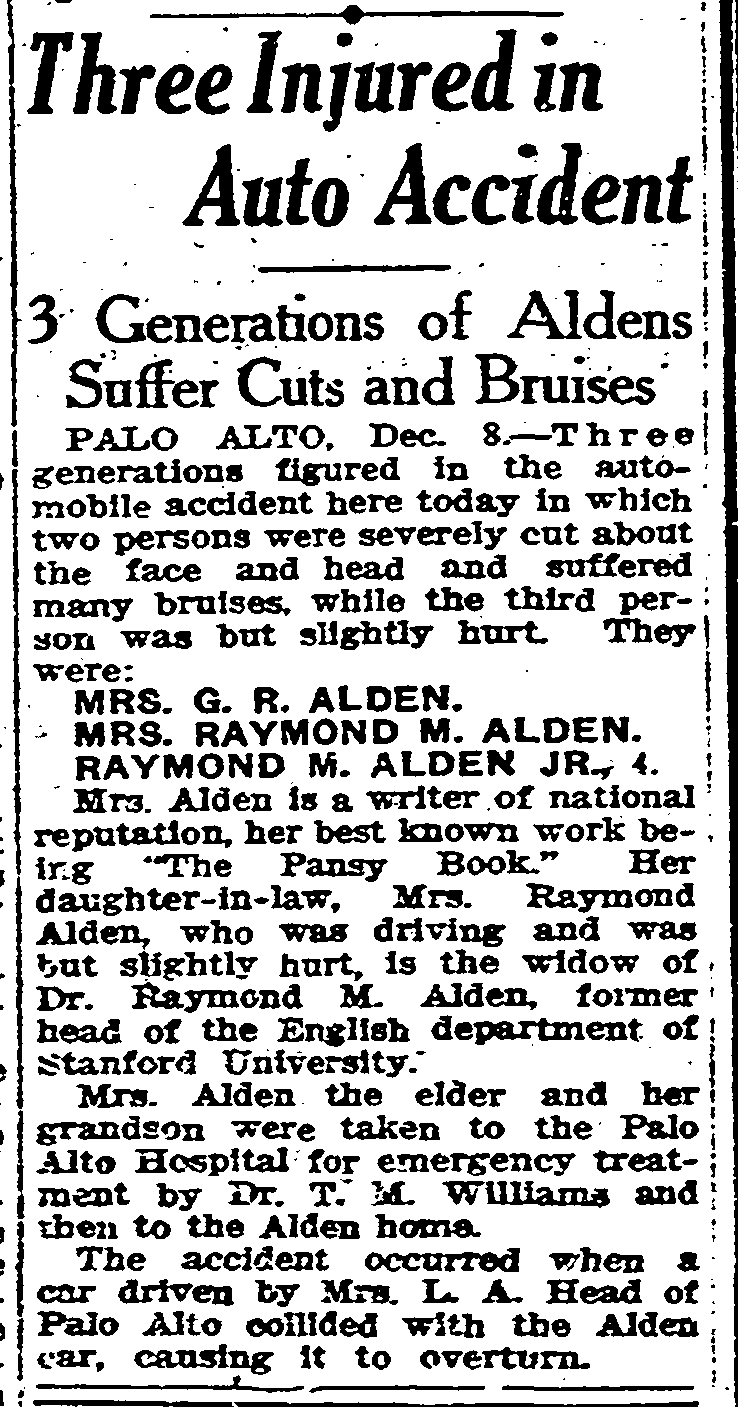
Newspaper Clipping: 3 Generations of Aldens Suffer Cuts and Bruises. Three generations figured in the automobile accident here today in which two persons were severely cut about the face and head and suffered many bruises, while the third person was but slightly hurt. They were: Mrs. G. R. Alden, Mrs. Raymond M. Alden, Raymond M. Alden Jr., 4.
The San Francisco Chronicle, December 8, 1925.

Barbara was only slightly hurt. But Isabella and her young grandson suffered “severe cuts about the face and head, and many bruises.” After receiving first aid from a nearby physician, Isabella and Raymond Jr. were taken to Palo Alto Hospital for treatment.

Palo Alto Hospital in the 1920s.

The next day’s newspaper reported reassuring news: the accident victims had returned home, and Isabella “was found to have suffered only from shock and minor cuts.” Her grandson’s injuries were described as the most serious of the three.
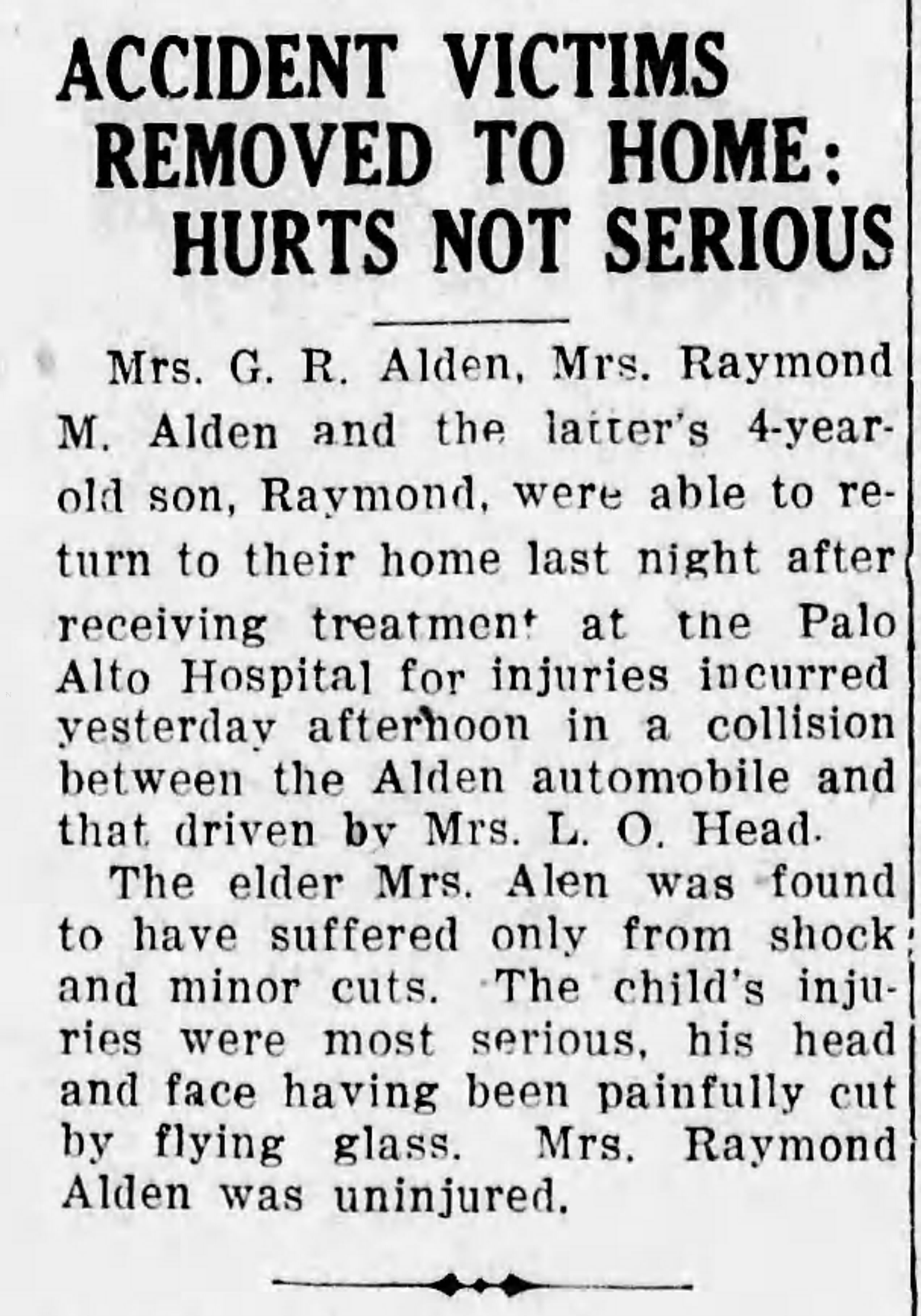
Newspaper Clipping: Accident Victims Removed to Home: Hurts Not Serious. Mr. G. R. Alden, Mrs. Raymond M. Alden, and the latter's 4-year-old son, Raymond, were able to return to their home last night after receiving treatment at the Palo Alto Hospital for injuries incurred yesterday afternoon in a collision between the Alden automobile and that driven by Mrs. L. O. Head. The elder Mrs. Alden was found to have suffered only from shock and minor cuts. The child's injuries were most serious, his head and face having been painfully cut by flying glass. Mrs. Raymond Alden was uninjured.
The Peninsula Times Tribune, December 9, 1925.

But that assessment would prove tragically wrong.

What those initial medical evaluations missed was the true extent of Isabella’s injuries. The accident left her in considerable pain and, ultimately, confined to a wheelchair for most of the remaining years of her life.

Until the accident, Isabella was a woman who had been remarkably productive well into her eighties—still writing, still engaged with her work and family. The accident didn’t just slow her down; it fundamentally altered how she could live her remaining years.
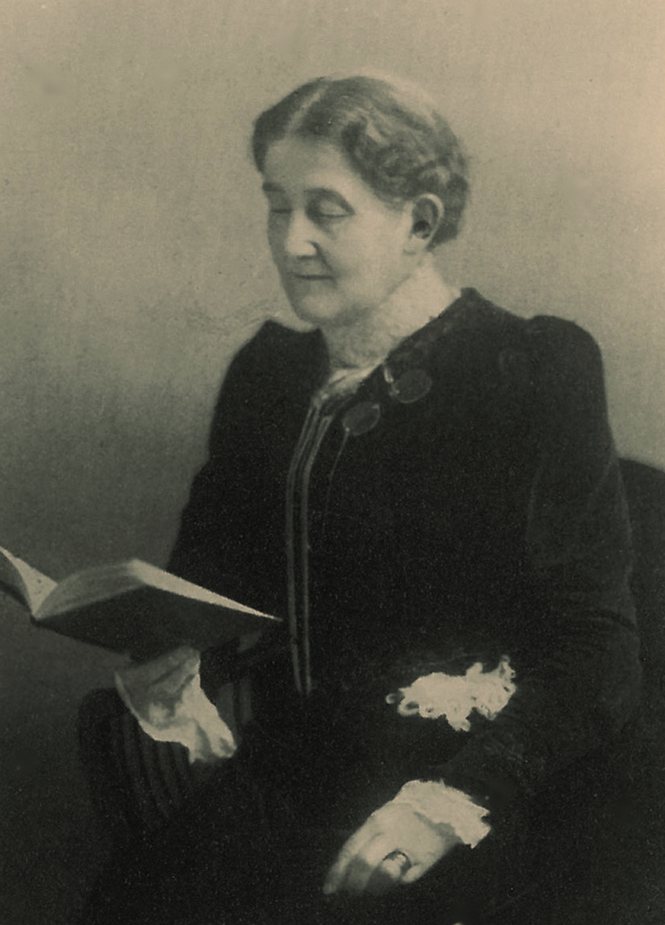
Isabella in later years.

In her memoir “Memories of Yesterday,” which she finished writing after the accident, Isabella documented the physical pain she endured. For a woman who had spent her life in service to others, who had quietly helped so many navigate their own difficulties, those final years must have been particularly difficult for her.

Isabella lived for nearly five more years after the accident, passing away in 1930 at age 88. Those years, spent largely in a wheelchair and dealing with chronic pain, were a far cry from the active, engaged life she had led for more than eight decades.

What is striking about this incident in Isabella’s life isn’t just the tragedy of the accident itself, but what it reveals about her character during her final years. Despite her pain and limitations, she continued to write. She finished her last novel, An Interrupted Night, and entrusted it to her niece, Grace Livingston Hill, to guide it through the publishing process.

She also completed her memoir, Memories of Yesterdays, candidly sharing her memories and reflections on a life well-lived. Even when her body was confined to a wheelchair, her mind and spirit remained active.

That’s the Isabella Alden we’ve come to know through her writings—someone who lived out the principles she wrote about, even when circumstances became difficult. She had spent decades writing about faith, perseverance, and finding purpose in adversity. In her final years, she had to draw on those very principles herself.

A hundred years ago this month, Isabella’s life changed forever on a Palo Alto street corner. While the accident limited her physical abilities, it couldn’t diminish the legacy she’d built through decades of faithful work—or the strength of character that sustained her until the end.

Click on the links below to read more about:
The house on Embarcadero Road
The deaths of Ross and Marcia Livingston
The death of Raymond Alden
Isabella’s final novel, An Interrupted Night

Miss Marion’s Thanksgiving Day

This week, as we approach Thanksgiving, we’re sharing a lovely poem Isabella published in The Pansy magazine in 1886. “Miss Marion’s Thanksgiving Day” is about a wealthy but lonely lady who looks across the hills at the local almshouse and finds her purpose.

MISS MARION’S THANKSGIVING DAY

Two big houses broad and high,
Outlined against an autumn sky.
Set on two hills, the houses stand,
One grim and cheerless, one fair and grand;
One teems with life throughout its walls,
One silent in all its stately halls.
One is of wood, and one of stone,
Each set in broad acres all its own.
One is the almshouse, gaunt and gray,
One the beautiful home of Miss Marion Ray.
Black and white drawing of two hills separated by a road. On top of the left hill is a gaunt two-story wooden building with rows of plain windows. On top of the right hill is a beautiful Victorian-era mansion with turrets and porches, and perfectly landscaped trees and shrubs, surrounded by an iron fence with an ornately scrolled iron gate.
Miss Marion Ray—her kith and kin
All to their rest have entered in.
Now she dwells with servants in lonely state,
In the mansion behind the iron gate.
A lady tall, and sad, and fair,
With a quiet face and a gentle air—
A sweet, worn face, and hair of gray,
Was the lonely lady, Marion Ray.
Sometimes in the night, when all is still,
She has looked at the lights on the other hill,
And wondered much if it were sadder fate
To live in the house with the wooden gate.
But something happened, the other day,
That has stirred the heart of Miss Marion Ray:
A mother went out of the almshouse door,
Went out of it to go back no more;
Went out to be buried under the leaves,
While the wind of November moans and grieves,
And left a wee blossom with eyes of brown,
To the tender mercies of all the town.
Miss Marion has thought of the baby's fate
Till love and pity have grown so great
She has opened her Bible there to see:
"As ye did it to Mine, ye did it to Me;"
And so, on the morn of Thanksgiving Day,
In the early morn, when the sky is gray,
At the almshouse door a carriage stands,
With shining horses in gleaming bands;
And into the eyes of the little child,
The sad-eyed lady looked and smiled.
On the silken shoulder the glittering head,
Then —"I love 'oo, lady," the baby said.
Gathered close to the hungry heart,
The child and the lady never to part—
Carried home to the mansion grand,
The proudest and richest in all the land.
Never a pauper, the lovely child
Into whose face the lady smiled.
"Done to the least it is done to Me."
What grander honor on earth could be?
Oh, a sweet and joyous Thanksgiving Day
Has come to the home of Miss Marion Ray.

The heart of this story—and of so much of Isabella’s work—is the quiet call to charity, the simple act of extending kindness to those in deepest need.

What do you think? Does this poem illustrate Christ’s instruction from Matthew 25:40: “Inasmuch as ye have done it unto one of the least of these my brethren, ye have done it unto me”?