Now what you need to remember is that the Lord is your father, whether you choose to own Him or not; and He has a right to your love, and your help.
—from Miss Priscilla Hunter
There’s no question that Chautauqua Institution had far-reaching influence over the people who attended the summer assemblies at the turn of the Twentieth Century. But one of Chautauqua’s traditions—the Chautauqua salute—transcended the Institution grounds and became popular across the country.

.
You may have read in a previous post how the Chautauqua salute came to be, and how it was used as a gesture of respect and affection for special speakers and instructors at Chautauqua. In that venue, only Bishop John Vincent could initiate the Chautauqua salute.
But outside the Institution, in towns and villages across America, the Chautauqua salute caught on and became something of a sensation.

At the 1897 Society of Christian Endeavor convention in San Francisco there were so many attendees, the newspaper reported that Christian Endeavorers had “conquered the city.” And when Christian Endeavor President Francis Edward Clark tried to address the convention, the crowd gave him a Chautauqua salute that lasted several minutes.
When President Theodore Roosevelt arrived in Tacoma, Washington he was greeted by a crowd of 30,000 people waving their handkerchiefs in a Chautauqua salute.
But American’s didn’t reserve the Chautauqua salute only for respected speakers and past U.S. Presidents. The Los Angeles Herald society page reported on a surprise birthday party for a man named Howard L. Lunt, where “the Chautauqua salute and congratulations” began the program, followed by “dainty refreshments.”
Another 1904 news article told of a group of Christian Scientists who gave the Chautauqua salute to Mary Baker Eddy … who didn’t seem to appreciate the gesture.
.
And a Colorado newspaper reported baseball fans used the Chautauqua salute to cheer for their team after neighbors near the playing field complained about the noise during Sunday games.
.
Not everyone thought giving the Chautauqua salute was a good idea. By 1912 the U.S. Public Health Service (the precursor of today’s U.S. Department of Health and Human Services) began warning the public of increased health concerns caused by crowds of people waving handkerchiefs.
.
For the most part, Americans ignored the warnings and kept enthusiastically fluttering their handkerchiefs, sometimes with comic results:
Isabella Alden considered The Hall of Philosophy one of the most beloved locations at Chautauqua Institution.

.
The Hall of Philosophy—sometimes called the Hall in the Grove because of its location in idyllic St. Paul’s Grove—was an open-air structure that sat under a canopy of trees that shaded and cooled the Hall during the hot summer months. It was a favorite gathering place for Chautauquans, even when no lectures were held there.

.
If you were a Chautauqua visitor, you could stand at the edge of the Hall of Philosophy and look out upon different views of the grounds. From one vantage point, you’d see the Hall of Christ and the spires of the different denominational chapels.


.
From another direction you’d see gingerbread-trimmed cottages and inviting expanses of green lawns.

.
The original Hall of Philosophy was designed by Bishop John Vincent for the Christian Literary and Scientific Circle (C.L.S.C.). Twenty years later, when it was discovered the building needed to be replaced in order to last for future generations, the C.L.S.C. lead a fund-raising campaign and raised the money needed to erect a new Hall of Philosophy in the same location.
When the new concrete floor was poured in 1905, it included 51 different mosaic tiles, each designed by a different C.L.S.C. class, beginning with the class of 1882 (the first class) and ending with the class of 1924. Each tile depicts the class year, name and logo.
.
For instance, the first C.L.S.C. class of 1882 was called “The Pathfinders.” Their emblem was the nasturtium and their motto was “The truth shall make you free.”
The class of 1915 adopted the name “Jane Addams” and used the American laurel as their emblem. Their motto: “Life more abundant.”

.
Isabella Alden was a member of the 1887 class; her fellow classmates honored her by naming their class the Pansy Class. They used the pansy flower as their emblem and “Neglect not the gift that is in thee” as their motto.
Isabella paid tribute to the Hall of Philosophy and her own experience with the C.L.S.C. in her novel The Hall in the Grove. The story centers around a diverse group of people who each spend a summer at Chautauqua for different reasons—and each end the summer changed by their experience. The Hall of Philosophy is almost another character in Isabella’s story, for it plays a prominent role in the different characters’ spiritual journeys. (You can click on the book cover to learn more about the novel.)
Thanks to the determination and rallying spirit of the members of the C.L.S.C. the Hall of Philosophy was rebuilt, and is still in use today.
This short video by Chautauqua Institution gives a brief history of the Hall of Philosophy and shows some examples of the C.L.S.C. class tiles:
There’s a new Isabella Alden Pinterest board for you to view: “Clothes Pansy’s characters might have worn” is a budding collection of clothing, jewelry, hats and shoes from the time period in which Isabella wrote her books.
This brown suit (from about 1880) might have been similar to the suit Marian Wilbur wore in Four Girls at Chautauqua.
And this delicate gown may remind you of the gown Flossy Shipley ruined in the rain on her first visit to Chautauqua.
You’ll also see several black gowns that Ruth Burnham might have worn (she never wore any other color) in the book Ruth Erskine’s Crosses.
You’ll find examples of traveling costumes, day dresses, tea gowns, and walking suits, as well as some jewelry, purses, and shoes to help you visualize Isabella’s beloved characters as you read her books. Click here to view Isabella’s Pinterest board now.
Isabella Alden was a great campaigner for the temperance movement. She had seen for herself the consequences of an unregulated alcohol industry. Alcoholic drinks in her time were often far more potent than commercial beer, wine and distilled liquor we’re used to today, making them much more addictive. Sometimes alcoholic beverages were laced with other substances, like cocaine; and alcohol was openly marketed to children.
This short video by documentary film maker Ken Burns describes the influence of liquor on America at the turn of the Twentieth Century.
.
Isabella’s dear friend Theodosia Toll Foster (whose nom de plume was Faye Huntington) was another tireless worker for the cause of temperance. Many of her novels were written for publication by the National Temperance Society and described the impact of alcoholism on the lives of individuals and communities.
And in her own books, Isabella often wove stories around the impact alcoholism had on families. She and her sister Marcia Livingston co-authored the novel, John Remington, Martyr, which chronicled one man’s efforts to fight the power of the alcohol industry and its hold on society.
Isabella, Theodosia and Marcia, as well as Marcia’s daughter, Grace Livingston Hill, were active members of the Women’s Christian Temperance Union. The W.C.T.U. began in 1874 as a “crusade” of 208 dedicated temperance workers.

.
When Frances Willard was named the W.C.T.U.’s president in 1879, she inherited an organization comprised of several autonomous chapters with no unified action plan to achieve the group’s goal of reforming the distribution and sale of alcohol in America.
Up to that point, the organization was known for it crusades—bands of women visiting local saloons to pray and ask saloonkeepers to close their doors and stop selling spirits. For the most part, they were seen as teetotaling moral zealots.

.
Frances Willard had a different vision for the organization. By profession she was a teacher. She was educated, dynamic, and persuasive; she used those talents to redefine the W.C.T.U. Knowing that America’s high rate of alcoholism was directly related to crime, sexual assault, poverty, and domestic violence, she redirected the organization to focus on social reform and political activism.

.
She formed alliances with politicians, instilled a sense of sisterhood in W.C.T.U. members, and cultivated powerful and influential allies.

.
Lewis Miller, co-founder of Chautauqua Institution and a multi-millionaire industrialist, was a staunch supporter of the W.C.T.U.; his wife Mary was one of the first members of the Ohio W.C.T.U., a well-organized and militant branch of the organization.

Their daughter Mina recalled how her mother, with other “dauntless women” visited saloons and pleaded with the male proprietors to close their doors. They were often subjected to insults and even had buckets of water thrown on them.
After Mina Miller married Thomas Edison, the great American inventor, she used her influence as “Mrs. Edison” to further the W.C.T.U.’s programs.
And what programs they were! W.C.T.U. members developed and taught temperance lessons to children in Sunday schools and visited drunkards in prison. They lobbied for free public kindergartens and prison reform. By 1889 W.C.T.U. chapters were operating nurseries, Sunday schools, homeless shelters, and homes for fallen women. Members supported labor reform, suffrage, disarmament, and the eight-hour work day.

.
Isabella often wrote about the activities of the W.C.T.U. in her books. Most striking was her novel One Commonplace Day. In that story, a group of people come together on their own to help one family overcome the effects of alcoholism; and they employ many of the W.C.T.U. methods to do so.

.
Isabella and Frances Willard often lectured together, speaking before different chapters of the Sunday School Assembly and at regional Chautauqua locations.

By the time Frances Willard passed away in 1898 the W.C.T.U. was an acknowledged political and social force in the United States. Under her leadership the organization united women from varied backgrounds, educated them and empowered them to form one of the strongest and most influential women’s organizations in American history.
In 1905 a statue of Frances Willard was erected in National Statuary Hall at the United States Capital in Washington D.C. Her statue was the first honoring a woman to be chosen for the National Statuary Hall Collection.
Would you like to learn more about Frances Willard and the W.C.T.U.? Click here to visit the organization’s website.
Click on this link to read more about the statue of Frances Willard in Statuary Hall at the United States Capital.
Grace Livingston Hill wrote a short biography of Frances Willard’s early years. Click here to read her 1909 article.
You can watch the full 90-minute Ken Burns documentary “A Nation of Drunkards” here:
For many years Isabella Alden wrote a regular column for Sabbath School Monthly magazine. Titled “Primary Department,” the column provided complete children’s Sunday school lessons for each week of the month. Isabella also contributed stories to the magazine, and sometimes released one of her new novels in serial form, publishing a chapter in successive issues.
In one issue of the magazine, Isabella gave an account of a ladies’ prayer-meeting she attended that had such an impact on her, she wanted to share the experience with other Sunday school teachers:
The subject was, “What can I do for Jesus?” It was to be answered first by Bible verses. How wonderfully pertinent they were!
“Walk worthy of the Lord unto all pleasing,” said one.
“Increase in the knowledge of God,” said another.
“Be strengthened with all might, according to his glorious power,” said a third.
Then one summed up, as it were, the whole question in that marvel of condensation, “Whether, therefore, ye eat or drink, or whatsoever ye do, do all to the glory of God.”
“It all resolves itself into this,” one lady said; “if we have our own hearts right, then, whatever we do, or say, or think, may be to the glory of God. What we want, more than anything else, is to put on Christ in his fullness, so that his will shall be ours, and so that, in any event, we can rest in him. Then he will accept all work, and all waiting, as done for him.”
“Isn’t it a great help,” a dear, earnest, loving woman said, “to think that all our little, everyday work may be done in such a spirit, that it shall be to his glory? That just glorifies the meanest thing that we may have to do, and sweetens the heaviest toil.”
“Doesn’t it make less of the toil?” A lady asked, quickly, and her face shown with the reflected light of Him from whom she had learned her message.
“How?” another asked, puzzled at the expression, not being able to take in its fullness.
“Why, if whatever we do, even the eating and drinking, is to be done to the glory of God, will it not make us careful that we glorify Him by not expending unnecessary time or strength in this work, but keeping ever before us the great aim—His glory. It will lessen the work, depend upon it. You cannot do that which is simply unnecessary, and worse than unnecessary, being often unhelpful, if you have this end in view.”
There were those present to whom these words came as a revelation. They drew new meaning from the familiar text. One’s thoughts could not help going rapidly over other things than the eating and drinking. What about dressing? Did this new idea take less ruffles and puffs and flounces? Could they, also, be managed for the glory of God? So long as one held the thought, it seemed to grow and expand. The rich crumbs still fell around us.
“It is just this spirit, I think,” said a sweet-faced sister, “that makes it possible to live the life that we are directed. ‘Pray without ceasing,’ I have heard one say. How is that possible, when life is crowded full of hard and incessant work? But I see how it is possible; if the work is done with that grand end in view, what is more natural than to look constantly to Him for help to carry it out, to turn our thoughts to Jesus in every trial, or annoyance, or perplexity? I think it rests one as nothing else will. Isn’t it possible, don’t you think, even in the midst of perplexing business cares that try heart and brain, to have this spirit of prayer?”
There came instant answer to the query. A bright-faced lady, who had hitherto listened with eyes, and heart, and glowing face, said quickly:
“I am not sure how it would be in mental work. But I know one can run the sewing machine and pray earnestly and eagerly at the same time; I’ve done it often.”
Thus the talk went on, each adding her crumb, or her rich slice, according as the Spirit had given her a precious thought. The name of it was a prayer-meeting—a female prayer-meeting at that; but the utter absence of all the stiffness and horrible decorum that usually characterize such gatherings made one forget that it was called by so dignified a name. It was just a little social talk about our hopes, and plans, and prospects, and privileges—as we might have met together and talked about our journey to Europe, and our preparations for the journey, if we were expecting to go. At intervals there came in sweet, short, tender, helpful prayers, and a verse of a hymn sung now and then.
When the hour was gone we felt a sense of wonder that so much could be crowded into one hour of time, and that an hour could be made to pass so quickly; and we went out from that parlor feeling a new and closer link added to the chain that bound our Christian hearts together. We had taken a step forward.
“Why,” I said to myself, as I came down the street, “why could there not be teachers’ prayer-meetings somewhat after this type, where they could meet to gather up the treasure crumbs from the coming lesson, and to pray for each other’s classes? I mean to tell the teachers of the Sabbath School Monthly about our dear little meeting; and so teachers, I have told you.”
“A word to the wise,” etc.
—Pansy
In her memoirs Isabella Alden recalled the day she met the man who would become her brother and an important influence in her life.
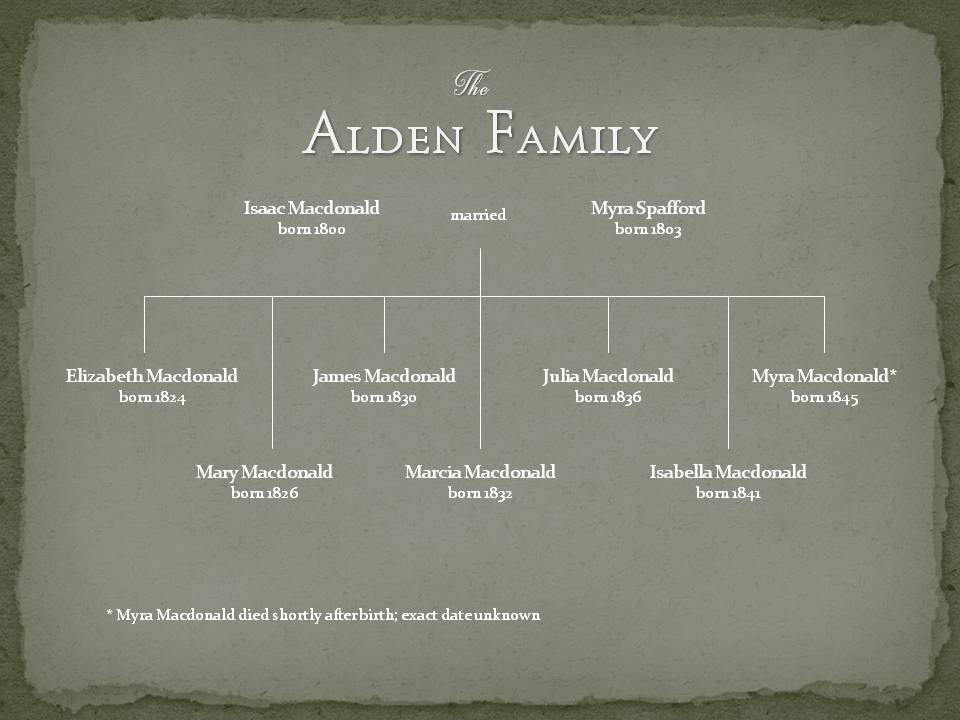
It started out like any other day for eleven-year-old Isabella. She and her older sisters—Mary (age 26 at the time), Marcia (age 20) and Julia (age 17)—set off with their father in the family’s old-fashioned wagon to ride to Clip Hill. Clip Hill was an area about seven miles from their home where wild blackberries grew. Isabella and her sisters were charged with picking as many berries as they could so their mother could bake pies and put up berry preserves to last through the winter.
Their route took them through town, and as they drove down the main business street of Johnstown, New York, they saw a young man who stood out from the scores of other people moving up and down the sidewalk. Isabella wrote:
Perhaps his garments had a more stylish cut. For one thing, he carried a cane. I was used to seeing only old and lame people carry canes, but this man didn’t seem to need it, or anything else to help him! He walked as though he enjoyed walking and he looked all dressed up, even so early in the morning. I liked him.
Mary knew exactly who the aristocratic stranger was.
“Don’t you know that fine old house with splendid trees all around the grounds, the handsomest place in this part of the country?”
“The Livingston homestead?” said Father. “Yes, I know it.”
“Well, he is the youngest son, just graduated from college where he took all the honors they had to give. To hear the girls go on about him one would think there wasn’t any ground fit for him to walk on.”
By this time we had passed him. I saw my sister Marcia turn and look back at him again, so I twisted myself around in the hope of another glimpse as I said, “I like his looks.”
That young man was Charles Montgomery Livingston. He was descended from the distinguished Livingston family of New York. From the late 17th century to the early 19th century, the Livingstons were one of America’s richest and most aristocratic families. Their land holdings in New York alone were larger than the entire state of Rhode Island. By the early 1800s the family had built almost 40 mansions along the Hudson River, surrounded by more than one million acres of prime Hudson Valley land the family collectively owned.

But the Livingstons’ fame didn’t come from wealth. Rather, the family was distinguished because of their contributions to molding early America. Long before the Kennedys or the Roosevelts, the Livingstons shaped the course of the country.

During the American War of Independence, General George Washington used one of the Livingston mansions as his headquarters; and it was a Livingston who administered the presidential oath of office to George Washington.

Another Livingston helped draft the Declaration of Independence and negotiate the Louisiana Purchase. Yet another Livingston became a Justice of the United States Supreme Court.

But it was Philip Livingston, Delegate to the Continental Congress and Signer of the Declaration of Independence, from whom Charles Livingston was descended.
When Isabella and her family finally reached Clip Hill, they were still talking about “the handsome gentleman with his cane.” While they picked berries, Marcia selected a branch from the ground and paraded up and down using her improvised cane to make everyone laugh.
Their father laughed, too; but he predicted, “If what I heard about that young man is true, you may see the time when you would be glad to imitate him in more ways than handling a cane.”
No prophecy could have proved more true, as Isabella later wrote. Only three months later, Charles Livingston married Isabella’s sister, Marcia—the very same sister who imitated him so ridiculously in the blackberry patch on Clip Hill!

By the day of the wedding, Isabella called Charles “brother” and he was as kind and loving to her as a brother could be. In fact, he asked Isabella and his niece, Maria (who was about Isabella’s age), to ride with the bride and groom to the railroad station after the marriage ceremony. It was quite an honor, and Isabella was thrilled to be singled out for such a special invitation. But in the confusion following the ceremony, Isabella and Maria never made it into the carriage. Instead, they watched as the carriage rolled away with the bride and groom … leaving Isabella and Maria standing at the curb!
Moments later the carriage came to a stop and then turned around. Marcia later told Isabella that it was Charles who insisted that they go back as fast as they could to pick up the girls, knowing it would break their hearts to be forgotten and left behind.
In later years, Isabella remembered that day and her new brother’s thoughtfulness. “I don’t believe there is another man like him in all the world. It was ‘just like him.’ And he was like that all through the beautiful years of his life, always thinking of others, and not considering his own plans or convenience.”
Click here to read a previous post about Charles Livingston and his influence on Isabella’s life.
You can learn more about the Livingston Mansions of New York by clicking this link.
Find out more about Philip Livingston, Signer of the Declaration of Independence at these websites:
www.dsdi1776.com
Isabella Alden was very close to her sister Marcia Livingston. Like Isabella, Marcia was a writer and they often co-wrote stories together.

After the sisters married, the Alden and the Livingston families remained close. They spent much of their time together, and Marcia’s daughter Grace grew up in the creative atmosphere of writers and books.
Grace learned her ABCs on her “Aunt Belle’s” typewriter. At the age of ten she wrote a story of her own called, “The Esselsltynes; or, Marguerite and Alphonse,” which the family published for her as a surprise. That gift, along with the encouragement and work example set by her family, inspired Grace to continue writing.
She followed the adage of “write what you know.” When Grace became involved in the Young People’s Society of Christian Endeavor, she wrote stories about that experience; many of those stories were published in Christian Endeavor World magazine.

The Epworth Herald also published Grace’s stories that illustrated simple truths about the Christian life. One such story was “Hazel Cunningham’s Denial,” which described a young woman’s dilemma while vacationing at a summer resort
“Hazel Cunningham’s Denial” first appeared in The Epworth Herald on August 9, 1902, and it’s available for you to read for free.
Click on the cover below to begin reading “Hazel Cunningham’s Denial” by Grace Livingston Hill.
Affordable Christian Fiction
Faith, romance, and a place to belong
Author of Classic Christian Fiction
Reviews and giveaways for Christian fiction and sweet, clean fiction. Bringing readers information on great stories and connecting authors with their readers.