At the end of every year, instead of writing about resolutions and goals for the new year, Isabella always posed an important question to readers of The Pansy magazine:
What lesson did you learn from the past year?
Isabella wrote:
I know a boy who has learned during the past year that he can forgive another boy who has done him a great wrong; that he can be pleasant to him, and even help him over a hard place in his school work. I think that is a grand thing to have learned.
I know a girl who has learned by sad experience during the past year that she cannot play with temptation without getting hurt. Seven times she did what she knew mother, and teacher, and friend did not want her to do, without any harm coming from it; but the eighth time—Oh, dear! I will not tell that sad story. I only hint at it to remind you that there are sad ways of learning, as well as pleasant ones.
Well, I could tell you of dozens of others whom I have watched during the year, and of the lessons they have learned, but all that might not help you.
The important question is, What have you learned?
Will you think it over? Let everyone who reads this get pencil and paper and sit down alone to a careful study of the year. You might make two columns, headed:
If you find you have learned you are a bit selfish in your plans, when you did not suspect it, put down the word “Selfishness” in good honest letters in the “Avoid” column. You will understand what it means, and nobody else need know about it.
If you find that you are inclined to be persistent in trifles which have no moral character, give it the true name and write “Obstinacy” in the right column.
If you find that by taking a little care, you have made sunshine in your home, or some other home, print the word “Care” under “Lessons to Practice.”
What interesting columns they will be after you have carefully filled them!
I should like to see the record, but of course, you will not let me. All that will be between you and your best friend, Jesus.
Isabella’s question— What lesson did you learn from the past year?—became an annual question she posed to her readers. And every year she received letters from hundreds of readers, eager to share their lessons learned with their beloved Pansy.
What do you think of this idea?
Do you think adults can benefit from reviewing lessons learned just as much as children can?
Do you make a list of lessons learned or do you make resolutions for the new year? Or both?
With holiday preparations in full swing, it’s nice to stop every once in a while to remind ourselves of the true meaning of the season.
“A Sweet Old Story” is a short piece Isabella wrote for The Pansy magazine in 1885, telling the story of Christ’s birth in simple terms. The lovely woodcut illustrations below were part of the original magazine issue.
A great many hundred years ago, away and away across the water, one beautiful starry night something happened.
Up among the hills and the rocks the sheep were taking their rest; safe from wolf or tiger because the faithful shepherds watched all night.
They were gathered in a sheltered place around the fire and they were talking. Good men, they were, who believed what God had told them in the Bible, and were watching for his promises to come to pass.
If we had been near I think we might have heard something like this:
“It is a long time that we have been waiting for the King to come.”
“Yes,” says another; “years and years! I remember how my grandmother used to gather us about her and tell us how the Lord was to send us a king to rule over us, and to make all wrong things right. She used to think he might come in her day; and she sat often listening and watching, to see if she could hear his voice.”
“How do you think it will be?” asked a third. “Do you think He will come suddenly from the sky, with bands of music, and guards of angels, and with a crown on his head, speaking in a voice of thunder to all wrong doers?”
The first shepherd shook his head. “I do not know,” he said. “I often wonder how it will be; and I read over and over again the promises of his coming. Some of them sound as though he was to be poor and alone; but how can that be when he is to rule the world? I do not understand it; but I long to see my king.”
Just then a light brighter than the sun shone all around them.
“What is that?” they said.
Could the world be on fire? No, all was quiet down in the valleys; and the earth was sleeping. The shepherds looked at one another and said not a word; but their limbs trembled so that they could hardly stand.
“Look! What is that, coming from the brightness! It must surely be an angel.”
He is speaking. “Fear not,” and his voice was like the sound of music.
As he spoke, the fear seemed all to glide away from the shepherds, and they felt a strange, sweet happiness stealing over them.
Then came the wonderful words: “There was born this day, in the city of David, a Saviour for you; he is Christ the Lord.”
O glorious news! How shall they know where to find him?
“Listen,” the angels tell them. “You will find the baby in a manger.”
What strange news was this! The King of Glory, the Saviour of the world to be found in a manger!
But before they could say a word, suddenly the air was filled with angels. They were singing this song: “Glory to God in the highest; and on earth, peace, good-will toward men.”
The Christ Child surrounded by angels, from Raphael’s painting
The music to which these words were sung was not like any that the shepherds had ever heard before; nor did they hear anything like it again, until the angels opened the golden gates and showed them the way to the palace of their King. Only a few minutes, and the angels soared away, the beautiful light faded, the sweet voices were lost in the blue distance, and there was only the sheep asleep on the hillsides, and the stars smiling down on them.
Do you think they thought it a dream? Oh no. Listen to what they said:
“Let us go right away to find the Lord. He will be in Bethlehem; that is the city of David. The Lord has sent his angels to tell this news; we shall see our King!”
And they hurried away.
Did they find the King? Yes, they found him; a little baby in a manger, his father and mother watching over him.
Oh, I don’t know what they said when they saw that baby. I have often wondered whether they dared to touch him, to put his soft hand on their faces, and kiss his sweet pure lips. But this I know. Wherever they went, they told that the King had come, and they had seen him.
Years and years ago it happened, yet the men and women, boys and girls are talking, singing and thinking about it today. The most wonderful night the world has ever known was that in which the angels sang the song of the new-born King.
The First Christmas.
The shepherds who first told the story have been with the King in his palace, I suppose, for as many as eighteen hundred years, but on Christmas eve in the year eighteen hundred and eighty-five, two sweet little girls are going out with their baskets full of holly leaves and buds, and in the sweet moonlight with the stars looking down on them, are to sing for their sick mother the same sweet old story which I have been telling you.
Singing Christmas carols to mamma.
These are the words they will sing:
The angels, the angels, who sang on Christmas eve,
And waked the shepherds so long ago,
What was the song that they caroled so?
Glad tidings, glad tidings, to you, to you, we bring,
Of peace on earth, good-will to men;
And angels echoed the song again
Glad tidings, glad tidings, to you, to you we bring.
They found Him, they found Him
Beneath the Eastern Star,
And kings and shepherds kneeled down to pray
Around the manger where Jesus lay.
What treasure, what treasure, can little children bring?
And where is the blessed Redeemer now,
That round His cradle we all may bow?
No treasure, no treasure, is half so sweet to Him,
As little children who greet Him here
With loving heart and open ear;
No treasure, no treasure, is half so sweet to Him.
A Note from Jenny:
Isabella often wove her own life experiences—and those of her family—into her stories. I suspect the two little girls and their ailing mother were real people Isabella knew. Unfortunately, I wasn’t able to identify who they were, but one day, I hope to discover “the story behind this story” and share it with you.
Or you can read the story below, and print it to share with friends.
It began in the summer. It was when they were coming home from the closing exercises of the summer school, Harold Fisher and his cousin Lelia Fisher.
Coming home from the closing entertainment.
They did not belong to the school, these two; in fact, they lived in Boston; but they were in the country for the summer, and I don’t know that there was any place which Lelia at least, enjoyed more than she did the queer little country schoolhouse, painted red, having wooden seats from which all the paint was worn, and an odd-looking thing in the middle of the room which the children called a box stove. It was a thing of beauty all summer, for it blossomed out in ferns, and vines, and bright red berries, and Lelia thought it was “just lovely,” and that nothing in Boston could compare with it.
Well, they were coming home from the closing entertainment, where both Lelia and Harold had delighted the scholars by each giving a recitation; and Harold had a treasure grasped in his fat hand which had been given by the teacher; and in Lelia’s blue silk bag was another, a lovely card for herself, and as Lelia thought of it, and of all the happy days she had spent there, and of the fact that in a few weeks she must go back to Boston and perhaps never see the nice old red schoolhouse again, her face was sad, and she drew a long sigh and wished in her heart that all schoolhouses were red, and had lovely box stoves in the middle of them, and a great old tree in front of them, and that Miss Rebecca Smith was the only teacher there was in the world, and she was always to go to her school. Poor little Lelia; the country and the schoolhouse, and Miss Smith, had stolen her heart.
Within the little red schoolhouse.
Harold was not at all sad; he had had a good time, and he expected to have many another. He did not take in the fact that he would probably never sit on the low seat beside Miss Smith in the old red schoolhouse again. The days stretched before him, full of daily coming pleasures. He troubled himself not one whit about the future.
It was just at that moment that they met Thankful Hall. Not that they knew who she was, but she looked so queer to Harold’s city eyes, that he would stop and stare at her, though Lelia tried to pull him along.
She was a neat-looking little girl, with a fair face and pleasant eyes, but her pink calico dress, made to touch the tops of her strong little shoes, and her long-sleeved apron, was so entirely unlike anything that Harold had ever seen that he could not help staring at her. The little girls who went to the red school-house were dressed enough like Boston little girls for Harold not to notice much difference; though Lelia, with older eyes, saw a great deal.
But this little girl, though neither Lelia nor Harold knew it, was dressed after the fashion of the children of fifty years ago. No wonder Harold stared; not much could be seen of the little woman’s face, for it was hidden behind a strange-looking stiff brown gingham something, which neither of the children knew was a sun-bonnet.
“What is your name?” burst forth Harold at last, making the roses grow on Lelia’s cheeks.
The little girl smiled and answered pleasantly, “I am Thankful Hall.” And she made a neat little curtsy to Lelia, who had never seen the like before.
“Thankful!” repeated puzzled Harold. “What makes you thankful? I want to know what your name is!”
“It is that—Thankful.”
“Truly?” asked Harold, his great brown eyes seeming to grow larger.
The little girl laughed.
“Why, yes,” she said; “I wouldn’t have told you so if it hadn’t been.”
“What a queer name! Does your mama call you that? What makes her? It makes me think of Thanksgiving and turkey.”
Then both the little girls laughed merrily, though Lelia blushed a great deal.
“Oh, Harold!” she said, then to Thankful: “Do excuse him; he is such a queer boy! No one ever can think what he is going to say next.”
But what Harold said next was quite as embarrassing. “What makes you wear such a queer hat, and such a funny dress? Do you have turkey, and pumpkin pies, and lots of things at your house for Thanksgiving, and do you be thankful for them?”
Lelia tried to put her hand over the small mouth; but the busy little tongue rushed through this series of questions, and Thankful did not seem to care; she only laughed.
“I’m thankful all the time, whatever we have, because that’s my name,” she said brightly; “but we don’t have turkeys at Thanksgiving, because they cost so much.”
“Don’t have turkey! Then how can you have Thanksgiving?” asked puzzled Harold. Then both little girls broke into laughter, long and merry.
There was more talk, and it ended in this way: “I like you. I want you to come to my house for Thanksgiving, and turkey, and lots of things; to my house way down in Boston. Will you?”
“I will if I can,” said Thankful, and then she said she must hurry, for Aunt Patience would be waiting.
They talked about Thankful all the way home, and after they reached home.
“And mama,” said Lelia, “I did not know what to do with Harold, he would ask such queer questions, but Thankful did not seem to mind it; she was real nice.”
“She is a nice child,” said motherly Mrs. Freeman, who boarded the Boston party that summer. “They have only been here a little while. She lives with her aunt, Miss Patience Hall. A nice woman as ever lived, but land, she doesn’t know any more about a child than I do about an elephant, nor half so much. She dresses that little thing queer enough to make her a laughing stock. Actually puts on her some of the clothes she used to wear herself; and she is sixty if she is a day. Why, yes, she’s poor, to be sure, but calico don’t cost mud, and the little thing ought to look enough like other people not to be a show. I just feel sorry for the time when she will begin to go to school; I’m afraid the children will tease her so. She’s an orphan, poor thing. She has lived with her grandmother until this spring, and then she came to this aunt’s to live. She seems real nice and pretty behaved. I’m sorry for her. Oh, Miss Patience is good enough, but hard; as hard as the shell of this squash,” and good Mrs. Freeman applied her axe to it, and Lelia and her mother went away laughing.
It was but three days before Thanksgiving that Mrs. Freeman took a look in the oven at her pumpkin pies, then seated herself to read a letter; a dainty square-enveloped thing with a Boston stamp.
Such letters rarely fell into Mrs. Freeman’s hands; she was curious.
“Such a singular request to make,” so the letter ran, “but, my dear friend, I know your kind motherly heart will help us if you can. The truth is, our dear little Harold has been sick for four weeks! For a few days he lay at death’s door, and we thought there was no hope whatever. You can imagine what that time was to us! He is gaining rapidly now—is able to be about the house, and is looking forward to Thanksgiving, but he has one great sorrow, his little cousin Lelia who has always been with him at Thanksgiving time, has gone abroad with her parents, and he misses her so that it makes our hearts ache for him. Yesterday, some talk about the pleasant summer that we had in your home recalled to his mind that queer little “Thankful” in whom you remember he was so interested. He exclaimed suddenly that he asked her to come to his house in Boston for Thanksgiving; and since that moment he has talked of nothing else. He even dreamed of the child last night. Now, dear Mrs. Freeman, he has been so sick, and is so lonely without his cousin, and is so determined about this thing, that I haven’t the heart not to try to gratify him. I have promised that I will write to you to see if you cannot borrow the little girl for a few days. We will take the best of care of her, and return her safely in due time, if the aunt will only kindly lend her to our little boy for Thanksgiving. He says he promised her turkey, and lots of things.”
There was more to the letter, as to how little Thankful could be sent, if the aunt would lend her, and how they would arrange for her perfect safety and comfort.
Mrs. Freeman read through to the end, then took off her spectacles and talked to the pumpkin pies. “Well, now, I never! Did anybody ever hear the like? I know they didn’t! To think of not believing in Providence! Josiah, look here! There’s that poor Miss Patience not been three weeks in her grave, and she so troubled about Thankful that she couldn’t hardly die, and here comes an invitation for her, to go to Boston; and I shouldn’t wonder a mite if they kept her a month; for that Harold is a master hand to take a notion and stick to it.”
Well, Thankful went to Boston. She was expressed there; and the carriage met her at the depot; and Harold met her at the parlor, where his nose had been flattened against the glass half the afternoon waiting for her.
How quaint, and queer, and pretty she looked! Mrs. Freeman’s heart and home had taken her in for a time, until they could look about them and see what to do; for no relatives had little Thankful left this side Heaven and Miss Patience, you will remember, had been poor; but there were a few hundred dollars in the bank that she had saved for Thankful. Mrs. Freeman had not touched the money, and had not been able to make any changes in Thankful’s dress, beyond a smart little hat like other children for her to travel to Boston in; so Thankful with her long brown hair braided neatly, and her long brown stuff dress reaching to her toes, and her speck of a white ruffle round her neck, looked for all the world as though she had stepped from one of the old-fashioned picture frames in Grandma Fisher’s room.
And the Thanksgiving dinner was eaten. Such a wonderful dinner as Thankful had never dreamed of before, and Harold asked her, with wistful face, if she were not thankful now? And she smiled and said, oh, she was; he did not know how thankful she was.
And Mrs. Fisher thought she ought to have some Thanksgiving presents, she was such a sweet little thing. So a bright dress, made exactly after the pattern of Lelia’s, was bought her, and some kid boots, because her shoes were rather heavy for the Boston house; and the days passed and the visit was not yet finished. And the time came when Harold cried whenever anybody hinted that Thankful would have to go home. And she was so sweet and quiet and helpful that Mrs. Fisher said, one day, she thought that child was well named, for everybody in the house seemed thankful to have her around.
And the days passed, and then the months; not only Thanksgiving, but Christmas, and New Year’s, and the travelers came home, and in Lelia’s trunk was found so many clothes that she had outgrown which just fitted Thankful, that the two mothers said it really would be economy to have one a little smaller in the families to wear those things out. And Lelia coaxed to have Thankful go to school with her; it was so lonesome to go alone. And the spring opened, and there was Thankful still in Boston.
The box stove.
And the summer came, and they went, all of them, back to Mrs. Freeman’s, and roamed in the woods, and went to the little red school-house, and trimmed the box stove. One morning, Mrs. Fisher said, kissing her:
“Thankful, my child, you really need a new dress to travel in, for we would almost as soon think of going home and leaving our little boy behind as you. You are our Thankful, and we are thankful for you.”
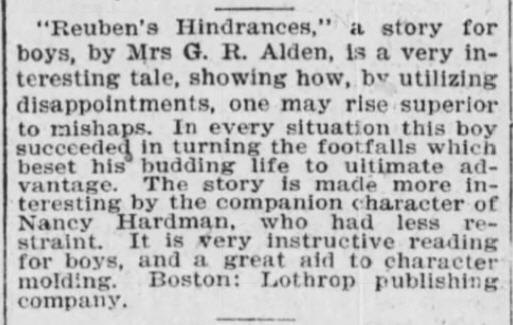
Have you read The Story of a Whim by Isabella’s niece, Grace Livingston Hill?
It’s a tale about mistaken identity, good intentions, and false assumptions. It’s also a story about the power of God’s healing love when we need it most.
The original 1903 cover for “The Story of a Whim”
The Story of a Whim was first published in 1903; then, in 1924 publishers J. B. Lippincott reprinted the novel for a whole new generation of readers.
To celebrate the re-release, Lippincott promoted both the book and the author to newspapers across the country.
Here’s one of those articles; it appeared 95 years ago in the Oakland Tribune (California) on Sunday, November 23, 1924, and summarized the plot of the novel very well:
The article reads:
Grace Livingston Hill has written a story that will take its place beside “Daddy Long-Legs,” for it is that kind of book. It concerns a lonely young man who spelled his name “Christie” and who thereby won happiness.
When a young girl wrote him an affectionate letter, believing he was another girl, Christie fell to the temptation of replying in the role. Representing himself as a spinster of 28, he kept up the writing friendship, adding details. Obligations followed, for the girl gave him work to do. After she had insisted upon his starting a Sunday school and has sent him an organ and music, she came down to investigate the stories she had heard concerning his success. One may guess at the conclusion.
It is a story with plenty of opportunity for gentle humor, a gay and wholesome tale fitted as a gift or a friend. It will be a favorite with a large number of readers.
The article was accompanied by a very nice photo of Grace:
That was 95 years ago! And readers today are just as enthusiastic about Grace’s “gentle humor” and “wholesome tales” as they were when her novels were first published.
Have you read The Story of a Whim? What do you think? Did the newspaper give an accurate summary of the book’s plot?
In additional to writing novels, Isabella Alden wrote articles and short stories for many different publications.
Her stories and articles were so popular she found herself in a unique position for a writer: She never had to submit her work for publication.
Instead, publishers went to her. Elias Riggs Monfort, the long-time editor of The Herald and Presbyter (a weekly Presbyterian newspaper), gave her a lifetime contract to publish any serials she wrote.
Elias Riggs Monfort, about 1870 (Wikipedia).
Mr. Montfort was such a fan of Isabella’s, he wrote to his friend, Daniel Lothrop, full of praises about Isabella and her stories.
Daniel Lothrop was the owner of D. Lothrop & Company, a Boston publishing house that specialized in books for young people.
Daniel Lothrop.
Daniel Lothrop had been a great reader from his childhood; while he was still a boy himself he developed an ambition to publish books specifically written for children—a novel idea at the time. Even more radical: he believed the books should be beautifully illustrated to serve the story and keep children’s attention.
An undated artist’s rendering of the D. Lothrop and Co. Publishing building in Boston, Massachusetts.
But he persisted, believing that it was possible to publish children’s books that were not only entertaining, but encouraged “true, steadfast growth in right living.”
The interior of D. Lothrop and Company.
He often said to the people in his employ: “I publish books to do good as well as to make money. I always ask first, ‘Will this book help the young people?’ rather than ‘How much money is there in it?’”
His long partnership with Isabella began around 1874. After Elias Monfort sang Isabella’s praises to him, Daniel Lothrop invited Isabella to contribute stories to be published in a small weekly Sunday School newspaper he published.
Little One’s Friend, one of D. Lothrop and Company’s beautifully illustrated books for children.
By 1877 that short weekly paper had grown considerably in size and content—and Isabella was its editor!
Called The Pansy, each issue was filled with inspiring stories, delightful illustrations, short poems, and descriptions of exotic and far-away places to spark children’s imaginations.
Isabella wrote a short story for each issue, and other members of her family did, too, including her husband, her sister Marcia, niece Grace Livingston, and later, once he was old enough, her son Raymond.
Another frequent contributor was Daniel Lothrop’s wife Harriett, who wrote under the pen name “Margaret Sidney.”
Author Harriet Stone Lothrop, who wrote under the name “Margaret Sidney.”
Isabella wrote that Mr. Lothrop always had “a very warm place in his great warm heart” for The Pansy magazine.
Not only was he fertile in suggestions calculated to make it better, but he was ready always to heartily second the suggestions of others, and to aid in carrying them out.
The Pansy Society in particular was very dear to him. He was interested in everything about the Society, from the content of the letters children wrote to the magazine, to the design of the badges that Isabella sent to Pansy Society members. Isabella said:
“It would be difficult—impossible, indeed—to tell you in how many ways he helped along the cause of truth and right in the world.”
Another common interest Isabella and Lothrop shared was the Christian Endeavor Society. From the early days of the Society, Daniel Lothrop saw an opportunity to use his publishing company to further the Society’s message. He recruited authors to write books of interest to Christian Endeavor members. Margaret Sidney, Faye Huntington, and Grace Livingston were among those who answered the call.
An 1897 newspaper ad showing new Lothrop books by the company’s prized authors.
Isabella’s novels, Chrissy’s Endeavor and Her Associate Members were written and published especially for C.E. members.
Isabella’s long partnership with Daniel Lothrop lasted almost twenty years. It ended when he passed away in 1892.
Isabella was heartbroken. In her memoirs she wrote:
“Mr. Lothrop was my true, strong, faithful friend all his life.”
She gently told readers in an issue of The Pansy about the passing of “our friend who loved us, and worked for us and with us.”
It’s impossible to know how many lives were influenced for good by Isabella’s partnership with Daniel Lothrop. Her books alone sold more than 100,000 copies a year, and The Pansy magazine had thousands of subscribers all around the world.
They had formed a perfect partnership. Both Isabella and Daniel Lothrop must have been proud of their accomplishments and the knowledge that they always produced books and stories that were consistently wholesome, pure, and elevating.
You can learn more about The Pansy magazine, The Christian Endeavor Society, and The Pansy Society by reading these previous posts:
When Isabella’s friend Frances Hawley wrote about the Aldens packing up their Chautauqua cottage, she ended her account by saying that the Aldens left for “a prolonged stay in the west.”
For Isabella and her family, “the west” meant California.
Their decision to make the journey had been in the works for some time. By autumn of 1901 the Aldens—Isabella, Ross, and their daughter Frances—were living in Philadelphia, and some key events had taken place in their lives:
Isabella’s husband Ross had retired from the ministry.
Isabella’s son Raymond had completed his Ph.D. at the University of Pennsylvania, and had already moved to Palo Alto, California
Isabella was beginning to feel the passage of time. She was about to turn 60 years old, and Ross was already 69.
Of her advancing age Isabella wrote:
I am really growing old very fast now, you know. It seems to me that I have changed a great deal lately. I cannot do anything as quickly as I once could and I tire very easily.
Their decision to retire to California was probably based on a number of things, the most important of which was that they had always been a tight-knit family; and with the exception of one or two short periods of time, they had always lived together as a family, too.
Since Raymond had already moved west, he might have written to them about California’s clean air and warm temperatures. And maybe he had written about the Presbyterian church he was attending and the welcome he received there. By November 1901 he was already teaching a Bible class at church.
From the Palo Alto Press, November 27, 1901.
A Cross-Country Trip
Whatever their reason for make a change, Isabella and Ross finished packing up their belongings at Chautauqua and immediately set out for California to join Raymond.
From the New York Daily Tribune, December 33, 1903.
The first leg of their journey was probably from New York to Chicago. If they took one of the many “express” or “limited” trains, they would have made the journey in about 24 hours. From there, they would have taken a train to California.
From the New York Tribune, December 8, 1903.
A “limited” train, like the one in the ad below, would have taken a direct route from Chicago to San Francisco, and would have made as few stops as possible, bypassing many of the towns on the route.
New York Tribune, April 24, 1902.
On a “limited” train, their journey across the country would have taken about 66 hours, or almost three days. By contrast, travel on a regular train, making all the stops along the way, would have doubled their travel time.
This 1895 map from the Atchison, Topeka and Santa Fe Railroad Company shows the dizzying number of stops a regular train would have made en route from Chicago to San Francisco. Click on the map to see a larger version.
By Christmas 1901 the Aldens were in southern California, staying with their friends, Mr. and Mrs. Carl Johnson.
Isabella’s fame followed her there. A local newspaper, The Los Angeles Herald, caught wind of her visit and arranged to interview her.
In addition to asking Isabella the usual questions (e.g. “How did you get the name Pansy?”) the article listed all Isabella’s work, and noted that in addition to writing novels, Isabella was still:
Editor of the Herald and Presbyter
Associate editor of Christian Endeavor World
Wrote stories every month for The Sunbeam (the Y.W.C.A. Gazette published in London)
Wrote for the Junior Christian Endeavor World
Composed Sunday-school lessons for the Presbyterian church’s “intermediate quarterly”
It’s no wonder Isabella was beginning to feel tired!
The article ended with news that Isabella was going to do a reading the following week from “an unpublished story,” titled David Ransom’s Watch (which was eventually published in 1905).
The interviewer must have asked Isabella what her plans were for the future, because the article ended with this prophetic sentence: “It is probable that the Aldens will make California their home.”
The Aldens continued their stay with the Johnsons through at least the end of January of 1902. Their visit was reported in the Los Angeles Times society page:
From The Los Angeles Times, January 1, 1902.
A New Life in Palo Alto
Sometime in early 1902 the Aldens left Los Angeles and returned to Palo Alto, and they settled into their new life in the Palo Alto community.
They joined the same Presbyterian congregation that had welcomed their son Raymond. By April, Isabella was in San Francisco where she delivered a speech on one of her passions: Mission work at home and abroad.
Around that time the Aldens also began a search for a home large enough to accommodate their entire family and expected houseguests. In the end, they decided to build a custom home that would satisfy their many and unique needs. They purchased property in Palo Alto, hired an architect, and began designing their dream home.
A few years later Isabella and Ross joined other Christians in attending the Mount Hermon Christian Camp when it opened in 1905.
The rustic Mount Hermon train station, about 1910.
Mount Hermon was the first Christian camp west of the Mississippi, and it must have reminded Isabella and Ross of Chautauqua’s early days. Isabella fell in love with the place. She wrote:
I wish I could give you a picture of Mount Hermon, a blessed place where I have spent precious weeks living out under the great redwood trees. It was wild and quaint and beautiful. I have many happy memories connected with it.
For the next few years they made annual trips to Mount Hermon until health concerns prevented them from traveling there.
From Daily Palo Alto Times, 1907.
Through all these new experiences Isabella kept busy writing books. Between 1901 and 1908 she published eight books, most of which were written with her adult readers in mind:
Mag and Margaret: A Story for Girls (1901)
Mara (1902)
Unto the End (1902)
Doris Farrand’s Vocation (1904)
David Ransom’s Watch (1905)
Ester Ried’s Namesake (1906)
Ruth Erskine’s Son (1907)
The Browns at Mt. Hermon (1908)
Isabella Returns to Chautauqua
Isabella also found time to return to Chautauqua on probably two occasions, where she stayed with friends or relatives who had cottages there.
In May 1912 Isabella and Ross traveled to New York, where they first visited her dear friend Theodosia Toll Foster (who co-wrote a number of books with Isabella under the nom de plume Faye Huntington). It is very possible the Aldens went from there to Chautauqua in June when the 1912 season commenced.
from the Rome New York) Daily Sentinel, May 14, 1912.
In 1914 the Aldens were again at Chautauqua, where Isabella and her niece, Grace Livingston Hill were among the authors honored at a C.L.S.C. reception.
By August of that year they were back home in California, where they were “welcomed by many of their friends.”
The Palo Altan, August 21, 1914.
It’s possible Isabella visited Chautauqua again in the years following, but no record of those visits survives.
Whether Isabella visited Chautauqua again or not, her friends at Chautauqua and in New York certainly kept track of her as a favorite daughter. In 1916 the newspaper in Rome, New York (located near the town in which Isabella was born and raised) covered Isabella and Ross’s golden wedding anniversary celebration with this article:
The Rome Daily Sentinel, June 6, 1916.
The article’s mention of their prominent place in Palo Alto society is a testament to the loving friendships the Aldens formed in their new home in California.
October 1901 marked a milestone in Isabella’s life.
For decades she and her husband Ross and other members of their family had been deeply involved with Chautauqua Institution. Isabella strongly believed in its core principles, and she immersed herself in furthering Chautauqua’s mission.
Isabella, Ross, Raymond, and family on the steps of their Chautauqua cottage (1875).
Every summer for decades she taught classes at Chautauqua, and encouraged friends and acquaintances to attend the summer session. She helped extend Chautauqua’s outreach by quietly encouraging people she met in all walks of life to embrace the CLSC and its educational offerings.
And more than any other ambassador, she inspired an entire generation of readers to experience the place for themselves after reading about it in Isabella’s many novels about Chautauqua.
During the course of their marriage Isabella and Ross lived in many places; his occupation as a minister often required them to move from one church to another. But almost without fail their summers took them back to Chautauqua. For Isabella, who was born and raised in New York, her annual trips to Chautauqua must have felt very much like a homecoming.
Over the years Isabella and Ross rented different cottages on Chautauqua’s grounds. Many of them have since been demolished and replaced by newer buildings.
One of the last cottages they occupied was at 20 Forest Avenue, bounded to the north by the shore of Lake Chautauqua and to the east by normal Hall.
Excerpt from a map of Chautauqua with the Alden’s corner lot on Forest Avenue marked in red. Click on the map to see a larger version.
The house was built in 1890 and still stands today dressed in sunny yellow with white trim.
The house at 20 Forest Avenue, Chautauqua as it appears today (from Google Maps 2012).
Isabella and her family spent a few summers in that cottage, including the summer of 1901. And when the Chautauqua season ended in early September they, like all the other summer residents, made their way to the railroad depot and returned to their “regular” home.
Few people know, however, that just a few weeks later Isabella and Ross quietly returned to Chautauqua to pack up their belongings and leave Chautauqua for the last time.
How different Chautauqua must have seemed to them in October; and how quiet it must have been, with its closed cottages, empty meeting halls, and deserted dining rooms!
The empty park in front of the Administration building in January 1902.
Frances Hawley knew what Chautauqua was like off season. She was a year-round Chautauqua resident and Isabella’s friend. She was on hand when Isabella and Ross, along with their little daughter Francis, arrived at Chautauqua to pack up their possessions.
The Aldens intended to stay with Frances only a day or two, but their stay soon lengthened into a week, for there was much to do. Frances wrote:
They were very busy packing books and sorting papers and manuscripts. [Ross] would come in at night utterly weary, but with a big basketful to be looked over during the evening. They were obliged to stop and eat, and were tired enough at meal time to be glad of a little rest; and so three times a day our food was spiced with anecdotes and stories, wise and pithy sayings, and with the jokes that had been perpetrated upon old Chautauquans by the inimitable Frank Beard.
Wouldn’t it have been wonderful to be in that room and hear those stories about Frank Beard and his practical jokes?
Frank Beard giving an impromptu Chalk Talk to a group of young Chautauquans.
Frances said this about her friend Isabella:
The bright and sparkling style that has made Mrs. Alden’s books so attractive is hers outside of book covers, and her sweet and winning ways won all the hearts of the household.
Frances also described the moment when she realized the Alden’s visit was quickly coming to an end:
When at the close of their visit we parted with them and realize that it might be long before we could again have her kindly sympathy or feel the warm pressure of his hand and see the merry twinkle of his eye, the delight that the pleasure of this visit had given us was tinged with sadness and we were loath to let them go.
It’s sad to think that when Isabella and her family left Chautauqua that October day, they did so knowing they might never again see the place they had loved so much for so many years.
Their departure marked the end of an era for Chautauqua Institution. But Isabella and Ross were ready to move on to the next chapter of their life together.
Many of Isabella’s characters played musical instruments, the most common of which was the piano.
Sadie Ried was a talented pianist in Ester Ried, as was Dell Bronson in The King’s Daughter.
Dell’s beloved piano was located “in the little summer parlor,” and she often turned to “her dear piano” for company.
She touched the keys with a sort of tremulous eagerness, and soft, sweet plaintive sounds filled the room.
But a piano was an expensive luxury the majority of Americans could ill afford, despite ads like this one that invited buyers to purchase a piano (or organ) on credit.
For those who could not afford to have a piano in their home, there were plenty of other musical instruments to be had.
“Leisure Hours” by Hugo Breul.
Many ladies strummed guitars (Louise Morgan played one in A New Graft on the Family Tree), and some even learned to play banjo.
But one of the most popular musical instruments during Isabella’s lifetime was the autoharp.
Autoharps were extremely affordable—some styles were priced as low at $5.00.
Even better, they were easily portable. They went from home to school, from church to social functions—anywhere musical accompaniment was needed.
Autoharps were relatively easy to learn to play, and thanks to some astute publishing houses, sheet music for the autoharp—from hymns to operas to college songs—was plentiful and affordable.
An 1896 newspaper ad for the Dolge Autoharp.
By 1899 manufacturers began advertising the autoharp as “America’s favorite instrument.”
Brothers making music on a banjolele and an autoharp (about 1910).
Autoharps remained popular for decades into the twentieth century. School teachers across the country used autoharps to introduce children to the basic principles of music and singing. And their distinctive sound became a mainstay in early country music recordings.
Autoharp for educators booklet, featuring an image of country artist Maybelle Carter on the cover.
Have you ever heard an autoharp played before? Have you ever played one yourself? Tell us about it!
Some of Isabella’s stories contain obvious themes or lessons she wanted to impart to readers.
The lesson in this month’s Pansy story is much more subtle. “Sadie’s Journey” first appeared in The Pansy magazine in 1893, and probably inspired many mothers to have earnest conversations with their children about the dangers of the outside world.
An added bonus: The story included a charming wood-cut illustration of Sadie, which you’ll see below at the end of Part I.
Part I
“It is so very warm,” said Aunt Sarah, stopping in her work of buttoning Sadie’s skirt to wipe the perspiration from her face. “Cannot Sadie have just this short-sleeved apron on, instead of a dress?”
“Why, it is very short, dear,” said Sadie’s mamma. “Think how she would look if anybody but ourselves saw her.”
“Nobody will,” returned Aunt Sarah. “It is too warm for people to come out here this afternoon, and she will stay this side of the gate, won’t you, Sadie?”
Sadie promptly promised, and the little muslin slip which now did duty as an apron was fastened to hide her pretty neck from the sun, leaving her arms bare; then she set her little old sun-hat on the back of her head, and proceeded to coaxing Aunt Louise to go out with her after “f’owers.”
“Louise is Sadie’s slave,” the other aunties said, laughing, as Sadie led her off in triumph; but they every one knew that they were slaves in the same way. Aunt Louise wandered on and on, beguiled by Sadie’s wishes. Several times she proposed going back to the house to wait until the sun dropped lower, but Sadie always wanted to go “just a weenie teeny bit further.” At last Aunt Louise said, with decision in her voice, “Now, pet, I really must go back. I cannot endure this heat any longer; I’m sure I wish I were only five, if it would give me as much energy as you have. You may stay out here by yourself, and pick all the ‘f’owers’ you want, only you won’t go out of the gate, will you? Remember you are not dressed to see people.”
“I’ll ’member,” said Sadie, and in a few minutes she was alone in the great lovely glen. No prettier spot within miles and miles could be found than the McMartins had chosen for their summer home. The house, a wide, old-fashioned rambling affair, although it was set on a hill, was almost hidden from view by great old trees; and before and behind it, and on either side, stretched the beautiful hills, and valleys, and trees, and flowers, and vines, and grasses, and all lovely things. People envied the McMartins this beautiful old-fashioned home. “So quiet,” they said, “and beautiful; it is like being in the depths of the country, yet they are only an hour’s ride from town.”
Left to herself, Sadie roved from flower to flower, going deeper into the glen every moment, until suddenly she turned and followed a winding path which she knew led in a round-about fashion to the lower gate. She had heard the sound of a hand-organ in the distance. The road from town was too hilly to tempt hand-organs in that direction very often, and Sadie felt that she could not afford to lose the treat. She thought of going for Aunt Louise to keep her company, but decided that she was too far from the house for that; the hand-organ might move on before she could get to it. She made all the speed she could over the winding path, and presently reached the lower gate, only to see the “music man” disappearing around the corner.
“He must be going to play for the Benhams,” said Sadie to herself. The Benhams were the McMartins’ nearest neighbors. They lived in the large house where the roads forked, about a quarter of a mile away. Sadie paused at the gate. She “’membered” her promise, but it was really going to be very hard to keep it. She peeped through the bars of the gate, and argued it out with herself.
“The reason Auntie did not want me to go outside the gate was because I wasn’t dressed to see people, but she wouldn’t mind a music man; music men never care how folks are dressed, and there isn’t a single anybody else to be seen on the road. I wouldn’t go all the way to the Benhams, ’course not! I’ll keep away back where folks can’t see me at all, and only listen to the music. That won’t be not keeping my pwomise, ’cause if peoples don’t see me they won’t care.”
Having reached this conclusion Sadie stood on tiptoe to unfasten the gate, and slipping through it walked briskly along the road toward the “music man.” He had seated himself by the side of the road to rest, and also to have a talk with a friend who appeared just then and sat down beside him. As Sadie neared the two she kept going slower, and wondering why the “music man” did not play his music. What if he should play a time just for her? Wouldn’t that be a wonderful thing to have happen?
But it did not happen. The two men had started on together before Sadie reached them, and they turned down a lane before they reached the Benhams’ grounds. So much the better; she could hear the music without seeing any people, for Sadie felt sure that no neighbors lived down this lane. On and on she trudged until her little feet were tired, and until she did not know where she was. The lane had led into a meadow, which the two men had crossed, she following; then from the meadow they slipped through a break in the fence, Sadie following, and crossed a long, sunny field, then struck into a wood which was cool and inviting, but there was no music. At last they stopped to rest again, and Sadie came very close to them, then stopped with a long-drawn sigh. If she only dared to ask the man to make some music just for her.
Some movement which the little feet made just then among the rustling twigs startled the men; they turned quickly and stared at her, then at each other.
“Halloo!” said the music man. “What is all this?”
“More than I know,” said the other. “She ain’t a spirit, is she, from t’other world?” Then they laughed in a way which half-frightened Sadie; she could not have told why, for she was not easily frightened.
“Halloo!” said the man again. “Where did you come from, little Miss?” Sadie had been brought up to answer questions politely, so she explained matters as well as she could.
“Here’s a lark,” said the music man; “she must belong to that big house on the hill.” And while Sadie looked up into the sky to see the “lark” the two men put their heads close together and talked low. Presently the man who had no music said to her, “Look here, young one, do you know your way home?”
“Not quite,” said Sadie timidly; for not finding the lark, she had looked about her and discovered that she was in a strange world, and did not know which way to turn.
“I should think not,” he said. “You’re a long ways from home, an awful long ways, and a dangerous ways. There’s bears in these woods, and snakes, and I don’t know what all. You needn’t be scared, though; if you’ll keep close to me, and don’t make no noise, I’ll see that you get home safe and sound.”
* * * *
In the wide old-fashioned hall of the McMartin home Aunt Louise fanned herself and told how warm it was out of doors, and how wonderful it was that little Sadie did not seem to feel it. Presently she roused from a ten minutes’ nap to say, “I wonder if I ought not to go for Sadie? She won’t wander beyond the grounds, will she?”
“Oh, no!” answered mamma and Aunt Sarah in the same breath. “She promised she wouldn’t go outside the gates.”
“Besides, the child isn’t dressed, you know,” added Aunt Annie. “She would know better than to go on the street in that rig.”
Ten, twenty minutes passed, a half-hour, an hour. Then mamma said, “I wonder at Sadie for staying out alone all this time. She is generally too fond of company for that.”
Then up rose Aunt Louise. “I am going in search of her,” she said. “Why, it is after five o’clock; I did not think it was so late.”
Up and down the winding paths she wandered, calling “Sadie,” “Baby,” “Pet,” all the sweet names which belonged to the child, and receiving no reply. Then came mamma and joined in the search, then the other aunties, and finally Uncle Wells himself; but no Sadie was to be found.
Picking f’owers.
.
Part II
Young Dr. Tremayne swung himself on to the train as it halted at Riverton. The hot day was over, and the air was quite chill. The doctor shivered a little as he took his seat, and told himself that a light overcoat would not be unpleasant. Then he wondered if he would find orders at his office which would take him out for the night, and decided to get a little nap while the train was running into the city. But he didn’t get it. Instead, he sat up straight and looked at a curious couple who were but two seats in front of him.
The man was a young fellow, hardly old enough to be called a man, and perhaps too ugly and shabby-looking to deserve that name; but on the seat beside him, sitting bolt upright and looking about her with half-frightened, half-defiant eyes, was a mouse of a girl, not dressed for the chilly evening; not dressed at all as one would expect a child to be who was in such company. She had on a little white slip, and a white sun hat. Her bare arms looked cold and uncomfortable, and her entire face expressed misery if ever a child’s did. The fellow tried to draw her toward him, and the child resisted. She was crying quietly, and once when the man bent over her and tried to say something, she shook herself, and said, “Let me be.” Then Dr. Tremayne, who had meantime quietly slipped into the next seat, heard him say distinctly:
“Look a-here, little Missy, if you behave yourself and do as I tell you, you won’t come to no harm; but if you make a fuss and get me into trouble, I’ll wallop you within an inch of your life, and you’ll be sorry for it as long as you live. Do you understand that?”
Whether she understood all the words or not, she was evidently frightened. She drew farther away from him, and shuddered, and choked back her sobs.
Dr. Tremayne leaned forward and touched the fellow’s arm. “Who have you there, my man?” he asked, nodding his head toward the child.
“It’s my sister’s girl,” he said quickly. “I found her out in the country; ran away from home, you see, and I’m taking her back.”
The little girl listened intently; she turned her head around so she could see the doctor’s face, then she spoke with eager haste:
“It isn’t true; I just went out of the lower gate to hear the music man, and I didn’t know just which road to go home; and he said he would take me home, and he isn’t. I don’t live on the cars.”
The man nodded his head in response to this story. “She followed a hand-organ, you see,” he said, “and got lost. Now she thinks she knows the way home better than I do; and she doesn’t want to get there, any way, ’cause she knows she will get whipped for running away.”
“I shan’t!” said the child, in a passion of grief and rage. “My mamma doesn’t whip me, and I didn’t run away. I just went down the road where nobody need see me, because I wasn’t dressed up, and you tooked me the wrong way. If I had only kept my pwomise!” With this the little girl’s heart utterly failed her, and she cried aloud.
“Shut up!” said the man sharply. “You needn’t bellow and get all the folks looking at you, just because you have been a bad girl, and run away, Your folks will tend to you when I get you home.”
“Do you live in town?” asked Dr. Tremayne, and a few minutes afterward he went to the rear end of the car and motioned the conductor to him. “There is something wrong up there, I fear,” he said, nodding toward the place where the man and child sat. “The fellow says she is his sister’s child, but I don’t believe it. It is hardly possible for a child with such a face to belong to a man of that stamp. The little one is evidently afraid of him; she says she went out of the gate to hear the ‘music man,’ and did not know the way back, and this man promised to take her home, and didn’t do it.”
“Is that so?” said the conductor. “There was a report of a child lost brought into the station just above Riverton. The country was in an uproar, the man said, but they seemed to think she was lost in the woods. She belonged to the people who have taken the old Singleton place. Do you know the spot?”
“Perfectly,” said Dr. Tremayne. “I believe this is the lost child, and the fellow has made off with her in the hope of securing a large reward.”
All right,” said the conductor; “pity to have him disappointed. We’ll help him to secure his reward, if that proves to be the case. Keep an eye on him, and if he undertakes to leave the train at the next station we’ll stop him; meantime I’ll send a message to Policeman Burns to be on hand when we get in town.”
Dr. Tremayne went back and seated himself behind the rough-looking man, who now began to watch him suspiciously.
“What is your name, my little girl?” he asked.
“Sadie,” said the child promptly.
“And whose little girl are you?”
“Mamma’s and papa’s, only now papa is away across the ocean, and I’m Uncle Wells’ little girl until he gets back. Oh, and I’m Aunt Sarah’s little girl, too, and Aunt Louise’s most of all, ’cause she’s the best auntie.”
“And do you live in the big city?”
“When the snow comes I do,” said Sadie; “but I live away out in the country now, where the glen is, you know, and the wiver. Don’t you know where our house is?” she asked, with a sudden pleading sound in her voice, “and couldn’t you take me home ’stead of this man, ’cause I like you best?”
The man laughed a coarse, hateful-sounding laugh. “I call that cool,” he said. “She’s the greatest young one to go on that you ever heard of; plays she’s Queen Victoria sometimes, you know, and she lives in all sorts of places, according to her notion. Here we are, young one,” he added, as the train whistled for the station. “Now you’ll know pretty soon what your mother thinks of your notions.”
“I thought you said she lived in the city?” said Dr. Tremayne. “This is Brierwood, two miles out.”
“I know, but we branch off here and wait for the accommodation that goes in at the other depot. Come on, quick! The train won’t wait for you more than a week.”
“No,” said Sadie firmly, resisting his attempts to pull her from the seat. “I don’t want to go with you; that isn’t the way home; I didn’t go on the cars to the music man’s. It is just through the woods; you don’t know the way, and you are a bad, naughty man. Won’t you take me home?”
This last sentence was spoken to Dr. Tremayne, who had risen and bent over the child, putting a protecting arm about her.
“You would better not wait for the accommodation tonight,” he said to the man, who was angrily pulling at Sadie’s dress. “It will not be along in more than an hour; you might better take an across-town omnibus than to keep a child waiting in this dress at the station. The evening is chilly.”
And at that moment the train, which had barely halted, sped on.
“There!” said the man, throwing himself back in his seat in great ill-humor. “Now we can’t get off. If I don’t make you pay for this night’s work I’ll know the reason.” This with a threatening shake of his head to Sadie; then to the doctor he said: “Seems to me you meddle with my business a good deal more than is necessary. Let the young one alone.”
“Oh, I’m keeping her warm,” said the doctor, as he wrapped his arms about her, Sadie clinging with all her strength. “The night is very chilly after such a warm day. Little people always take to me.”
“It’s precious little attention I ever pay to them,” said the man sullenly; “but I thought my sister would be howling if I didn’t bring this little plague back; and I’ve gone miles out of my way to do it.”
As the train steamed into the city depot he sprang to his feet again and reached out his arms for Sadie, who had dropped her head on Dr. Tremayne’s shoulder, and was lying perfectly still.
“Come along now,” he said, “and be quick about it.” But he felt at that moment a tap on his shoulder, and turned to meet the keen eyes of Policeman Burns, who had been for some seconds standing on the platform of the rear car, listening to the conductor’s story.
“Halloo, Jack!” he said to the man, who cowed before him. “I didn’t expect to meet you here. When did you adopt a sister? Just come with me, and I’ll give you a bed tonight.”
“Now, Doctor,” said the conductor, as they watched the ill-looking man go off with Policeman Burns, “you have a baby on your hands if she doesn’t prove to be the right one.”
“I’ll take my chances,” said the doctor, smiling, “and I thank you heartily for your help. Let me see, when is the next train for the Glen due? Shall I have time to get some sort of wrap for this little one?”
* * * *
It was Aunt Louise who was leaning over the garden fence two hours later when Dr. Tremayne came with swift strides down the road, Sadie carefully wrapped in a great woolly shawl sleeping peacefully in his arms. All the family, and all the neighbors for miles around, were scouring the country in search of the lost darling. As for Aunt Louise, she haunted the garden, though certainly there could be no hope of finding the child there; but it was there she had last been seen, and it seemed to the half-crazed auntie that if she hovered about the spot where she left the child, she would be more likely to see her again. What she said as Dr. Tremayne halted before her with his burden; how he told his story in few words; how she snatched the sleeping baby from him, almost smothering it with kisses, though Sadie clung sleepily to the doctor, and murmured: “I don’t want to;” how they sent the news far and wide, and had the doctor in the house to tell the wonderful and frightful and blessed story in detail; how they sat up until nearly morning listening, and talking, and crying, and laughing, and rejoicing, you must imagine, as there is not room to tell.
One queer question of Sadie’s you ought to hear. It was several weeks after it all happened. The family were gathered in the large, cheery parlor, and Dr. Tremayne, who had some way come to think of himself as one of the family, sat near Aunt Louise talking eagerly.
Suddenly Sadie turned from the young cousins with whom she was visiting, and ran over to her favorite auntie with her question.
“Aunt Louise, Willie says he guesses you are glad I got lost and stoled. You aren’t, are you?”
A perfect chorus of laughter greeted her, in the midst of which Sadie, wondering, begged for her answer; and Aunt Louise, hiding her blushing face with the child’s curls, said:
“I am glad you were found and brought back, darling.”
What did you think of “Sadie’s Journey”? Do you think Isabella was using the story to convey a specific lesson? Or do you think she wrote it simply to entertain children (and their mothers and aunts)?
Reviews and giveaways for Christian fiction and sweet, clean fiction. Bringing readers information on great stories and connecting authors with their readers.