Isabella loved her niece Grace Livingston, and she was very proud of Grace’s talent for writing.
When Grace was only twelve years old she wrote her first book, The Esselstynes. It was a story about the life changes a brother and sister experience when they are adopted by a Christian couple. Isabella was so impressed by the story, she had it printed and bound as a book, and she encouraged Grace to write more.
Grace obliged and wrote poems, as well as stories. She wrote the poem below, which Isabella published in an issue The Pansy magazine in April 1881—just in time for Grace’s 16th birthday!
Here’s how the poem appeared in the magazine:
.
And here’s a transcript of the poem:
THE EVENING STAR
BY GRACE
You beautiful star,
Shining afar,
Above the depths of sin,
Unbar the door
Of the heavenly floor,
And give me one glimpse in.
Into the bright
And golden light,
In the presence of the King,
Where the angels play
Night and day,
And the choirs forever sing.
The streets of gold,
The glories untold,
Oh, how I long to see!
Star, if you could,
Bright star! if you would
Show those glories to me!
What do you think of Grace’s poem?
When you were young, did you have a relative, teacher or friend in your life who encouraged you to develop a talent?
Isabella wrote a popular advice column for a Christian magazine. Some topics she addressed may sound very familiar to today’s readers, like this one from 1897:
“What can be said to someone who says he can get as much good from reading sermons at home, or communing with nature, as in going to church to hear, perhaps, a poor sermon?”
Here is Isabella’s answer:
I infer from your letter that the person who takes this position is a professing Christian. To that person should come, first, a reminder of this direct command: The church we believe to be a divine institution, and careful study of the Bible shows that the Lord has promised to be in a special sense “in the midst” with those who gather in His name. To argue, then, that as much good can be secured in other ways is to set one’s self in opposition to the Lord’s wisdom, and to thwart His plans of grace for us.
.
Moreover, the first object in attending church is not to hear a sermon—good or poor—but to worship God in united prayer and song. He has planned that we shall gather in companies to do this, in order to be helpful to one another, as well as to ourselves. There is always that question of influence over others to be remembered. The habit of church-going is an unquestioned safeguard to thousands of people who have no deep-seated Christian principle in regard to it; and whatever I can do to confirm and increase this habit I am bound—by the rules that govern good society—to do. So that (leaving myself out of consideration altogether) for the sake of others I should be regular at church; but God has planned so wisely for us that in helping others we are, as it were, compelled to help ourselves.
.
These are some of the reasons for habitual church-going that appear on the surface. But the best remedy for one not inclined to regularity in this matter is to ask the Master who “went into the synagogue on the Sabbath day,” “as his custom was,” what He thinks.
Have you ever heard someone say they believe reading their bible or communing with nature is just as good as attending church?
In 1889 Isabella wrote this charming recollection from her childhood of a very special New Year’s Day:
I close my eyes and go back in fancy to that morning long, long ago. New Year’s morning when I was eight years old.
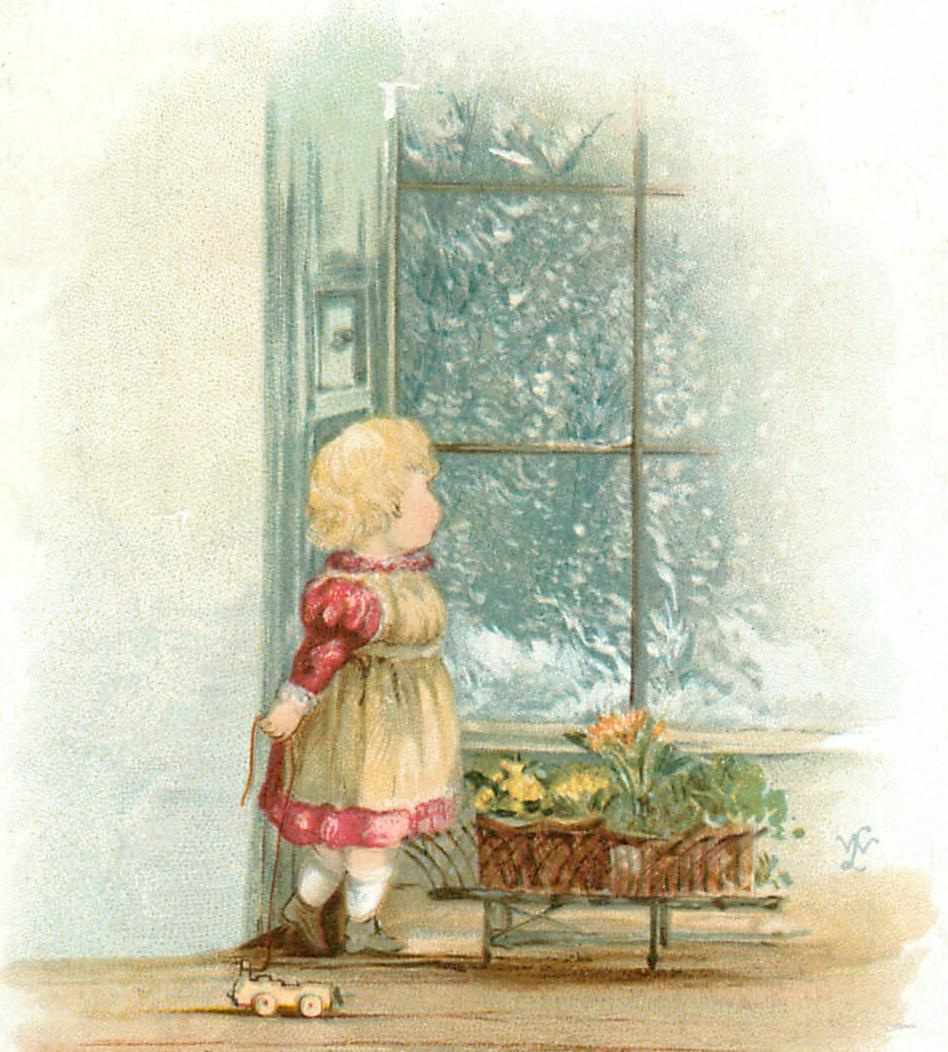
Cold! Oh, how cold it was! Great icicles hanging from the eaves, frost covering the window-panes, snow festooning the trees and hiding the ground, and the whole air a-tingle with the music of sleigh bells. How beautiful it all was.
.
Those frosted window panes, by the way, were a source of never-ending temptation to me. I wouldn’t like to have to try to recall the number of times my fingers had to be “snapped” for forgetting that I was on no account to indulge in my favorite amusement of making “thimble chains.” I don’t quite understand what the fascination was, or is, but to this day I find it almost impossible to pass a frosted window pane, with a thimble anywhere in sight, and not stop to make just a few of those magic chains in which my childhood delighted.
.
What a pity it seemed that the contact of my chubby fingers with the clear glass should soil it, and that my mother, whose artistic taste was not so highly cultivated as mine, would not permit the amusement.
On this particular New Year’s morning the frost was unusually thick, and my sister Mary’s thimble stood on the window-seat. It was father’s warning voice that saved me, just as I was about to make a marvelous chain, which should connect two lovely frost castles.
“Take care,” he said. “Think what a pity it would be if a certain stocking which I saw hanging in the chimney corner should have to hang there all day just because a little girl forgot.”
.
I set the thimble down with an exclamation of dismay. What if I had forgotten again? Mother had decreed that the stocking, which I longed to examine, should remain untouched until after breakfast, because at Christmas time I had been so “crazy” over my presents as to be unable to eat any breakfast. For a small moment I had forgotten the stocking, though it had been on my mind all the morning, and but for father the mischief would have been done.
I went over to him to express my joy in his having saved me, and to ask him privately whether he really believed that breakfast would ever be ready and eaten and prayers be over, so I could have my stocking.
He laughed, and asked me if I supposed I would ever learn patience. “I suppose,” he said gravely, “that time will travel fast enough for you one of these days. I can remember when a week used to seem longer to me than a whole year does now.”
I exclaimed over that. I said I thought a year was a very long time indeed; that I was really almost discouraged with time, it went so slowly. I said it seemed to me that I had been waiting half a lifetime for this day to come.
He laughed again, said I was at the impatient age; then, looking serious, he repeated these lines:
“Eighteen hundred and forty-eight is now forever past: Eighteen hundred and forty-nine will fly away as fast.”
“Oh, dear me!” I said. “If it doesn’t fly faster than this has, I don’t know what I shall do. It does seem too long to wait for Christmases and New Year’s; I wish we could have two of them in a year.”
Instead of laughing at my folly, father evidently decided to give me something else to think about. He was sitting near the door of the kitchen, where my mother was at work. The kitchen walls were painted. “Mother,” he said, “may we write on the walls, since we mustn’t on the windows?”
“I should not think that would be a very great improvement on window-writing,” my mother said, but she smiled as she spoke. It was evident that it made a great difference with my mother whose plan was to be carried out; she never interfered with anything that my father chose to do. He selected from the box nearby a lovely pine board as smooth as a slate, and handed it to me.
“You may use that, and I’ll use the wall,” he said, “and we’ll see which can write our verse the quickest.”
I had been writing for two years, and prided myself on the speed and neatness of my work, but long before I had finished the lines they appeared on the wall.
“Eighteen hundred and forty-eight is now forever past: Eighteen hundred and forty-nine will fly away as fast.”
“Yes,” said my mother, pausing in her swift movements to glance at the couplet, “that it will. It has begun already; the first morning is flying too fast for me. Come to breakfast.”
I am a long while in reaching that waiting stocking, but that is to correspond with the length of time I had to wait. It seemed longer to me then than it does to look back upon it. At last the treasure was in my arms. What do you think it contained? A lovely dollie about as long as my hand, beautifully dressed, not like a fashionable lady ready for a party, but like a dear little home baby, in a long white slip frilled at the neck, precisely as my own baby slips used to be—indeed I learned afterwards that it was made from a piece of one of them. I cannot possibly make you understand, I presume, how precious that little creature was to me.
.
I suppose you are imagining a wax doll with “real” hair, and lovely blue eyes and rosy cheeks? No, she was not made of anything so cold and hard as wax. She was a rag baby—limbs and face and all—made by my mother’s own dear hand, cut from a pattern which she herself had fashioned. What a work it must have been! I never realized it until a few years ago, when I tried to cut a pattern for a dollie for my little son.
This work was beautifully done. Black eyes, my baby had, and black hair, both made carefully with pen and ink! Red checks, she had, too, and lovely rosy lips. Will you love her the less, I wonder, when I confess to you that these were made with beet juice?
.
Oh, but she was a darling! Much the most carefully made dollie I had ever owned. Heretofore I had been content with mother’s little shawl, or her long clean apron rolled up and pinned; now I had a dollie for which clothes had been made not only, but arms and feet; and actually her dress was not sewed on her, but unbuttoned and came off, and a neat little night-gown went on.
Never was I happier in my life than when I made this last crowning discovery.
I named her—you could not guess what, so I’ll tell you at once—Arathusa Angeline, and I thought the name was lovely.
“Take good care of her,” said my father, looking on with a smile of infinite sympathy, “there’s no telling what may happen to her, you know, before ‘eighteen hundred and forty-nine’ has flown away.”
If you’re a writer—or know someone who is—you’re probably aware that the month of November is all about novel writing.
Every November writers from around the world join on-line writing communities (like NaNoWriMo and The King’s Daughters’ Writing Camp) where they record their efforts to write a novel in thirty days. Participants encourage each other, write together, share lessons learned, and talk about the challenges they face.
The most common challenge writers share in their on-line posts is how hard it is to find time to write every day. Many writers have full-time jobs, or small children, or other pressures that make it difficult to write a few paragraphs in thirty days, to say nothing of writing a full-length novel.
Yet, that problem isn’t a new one for twenty-first century writers. In the nineteenth century Isabella Alden faced the very same difficulty as she juggled her writing career with speaking engagements, household tasks, church duties, editing deadlines, and demands from fans and acquaintances.
In 1906, when Isabella was writing Ruth Erskine’s Son, she described a typical writing day that will probably sound very familiar to writers everywhere:
She began her day at seven o’clock by dressing and performing her daily household chores; but even before she finished making beds and doing laundry, she was interrupted by a summons to morning prayers and breakfast.
After that she cleared the breakfast table, put the dining room in order, and went back to bed-making, dusting, laundry, and other tasks.
Then the postman made his delivery, which included a long-awaited letter, so the entire family was summoned to hear Isabella read the letter aloud.
Other delivered letters included:
A request from a woman who wanted Isabella to read her manuscript,
A man asking permission to read one of Isabella’s stories in his church,
Another woman requesting Isabella speak at a temperance meeting,
A little girl wanting Isabella to spend an evening with her Sunday-school class,
And one from her editor asking her to please write her magazine columns a little faster!
By 11:00 Isabella was finally seated at her typewriter, “struggling with an unusually hard problem in the life of that much enduring woman, Ruth Erskine Burnham,” when she was interrupted yet again.
Her sister Julia (who was living with the Aldens at the time) was busy in the kitchen making a ginger cake and she wanted Isabella to taste it. Of course Isabella did not complain about such a delicious interruption!
Back at her work once again, she heard the door bell ring with a delivery.
A few minutes later came a vendor at the door selling “choice spinach, some delicious cauliflower, some fine oranges, and some splendid green peas.”
After dealing with the vendor, she wrote: “I am seated again with Ruth Erskine only to hear, ‘Belle!’ from the front stairway.”
It was her sister Mary volunteering to “fix my scrap basket for me, if I will find the materials for her.”
By the time Isabella returned to her typewriter, she realized the entire morning was gone and it was time for lunch.
After lunch it was time to clear the table, and on entering the kitchen, Isabella discovered Julia had made much more than a ginger cake. She had busily baked “mince pies and apple pies, and a million little ginger cakes in patty tins” as well as five loaves of “splendid bread.”
All of those delicious items resulted in a great number of dishes to wash. Isabella wrote:
“I wash, and wash, and WASH; and scour the sink and clear off shelves and refrigerator and empty more dishes, and sweep the floors, and wash seven dish towels.”
And just as she was hanging her dish towels to dry, “the clock strikes four!”
Determined to write, Isabella went back to her desk, only to be interrupted by the doorbell, then by her husband asking “What do I want from downtown?”
At five o’clock she had a long conversation with a college student who was “consumed with fear that she has not passed” a class of which Isabella’s son Dr. Raymond Alden was the professor. The student made a special request of Isabella:
“Will I, his mother—for whom, they say he will do anything in the world [according to the student]—intercede for her and explain to him how it was? And then for the eleventh time she proceeds to tell me how things were.”
By the time that conversation ended, it was six o’clock and time for dinner. At eight o’clock Isabella wrote:
“I am seated again, not with Ruth Erskine, but giving heart and brain to that explanatory letter which is to move the hard heart of Professor Alden.”
“That being done, Satan enters into me, and instead of working, I write a letter to my beloved sister Marcia three thousand miles away—and then, good night, I’m gone to bed!”
These were—as Isabella called them—“the snares which lie across my path” when she was supposed to be writing.
Does Isabella’s account sound familiar to you?
Have you ever pledged to write—or read, or craft, or exercise—only to be interrupted or have competing priorities intrude on your time?
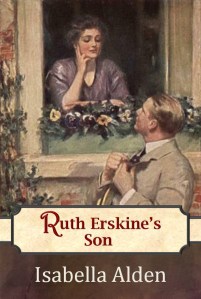
By the way, Isabella did finish writing Ruth Erskine’s Son, and it was published the following year. You can get your copy of Ruth Erskine’s Son by clicking on the book cover below:
Busy Isabella! Even after her husband retired from the ministry and Isabella retired from teaching, they both remained active in the Presbyterian church.
And since Isabella was a long-time member of the Woman’s Christian Temperance Union, she also joined that organization’s local chapter.
Woman’s Christian Temperance Union chapter members about 1910
On Friday, November 20, 1908 Isabella hosted an “At Home” for her fellow W.C.T.U. members.
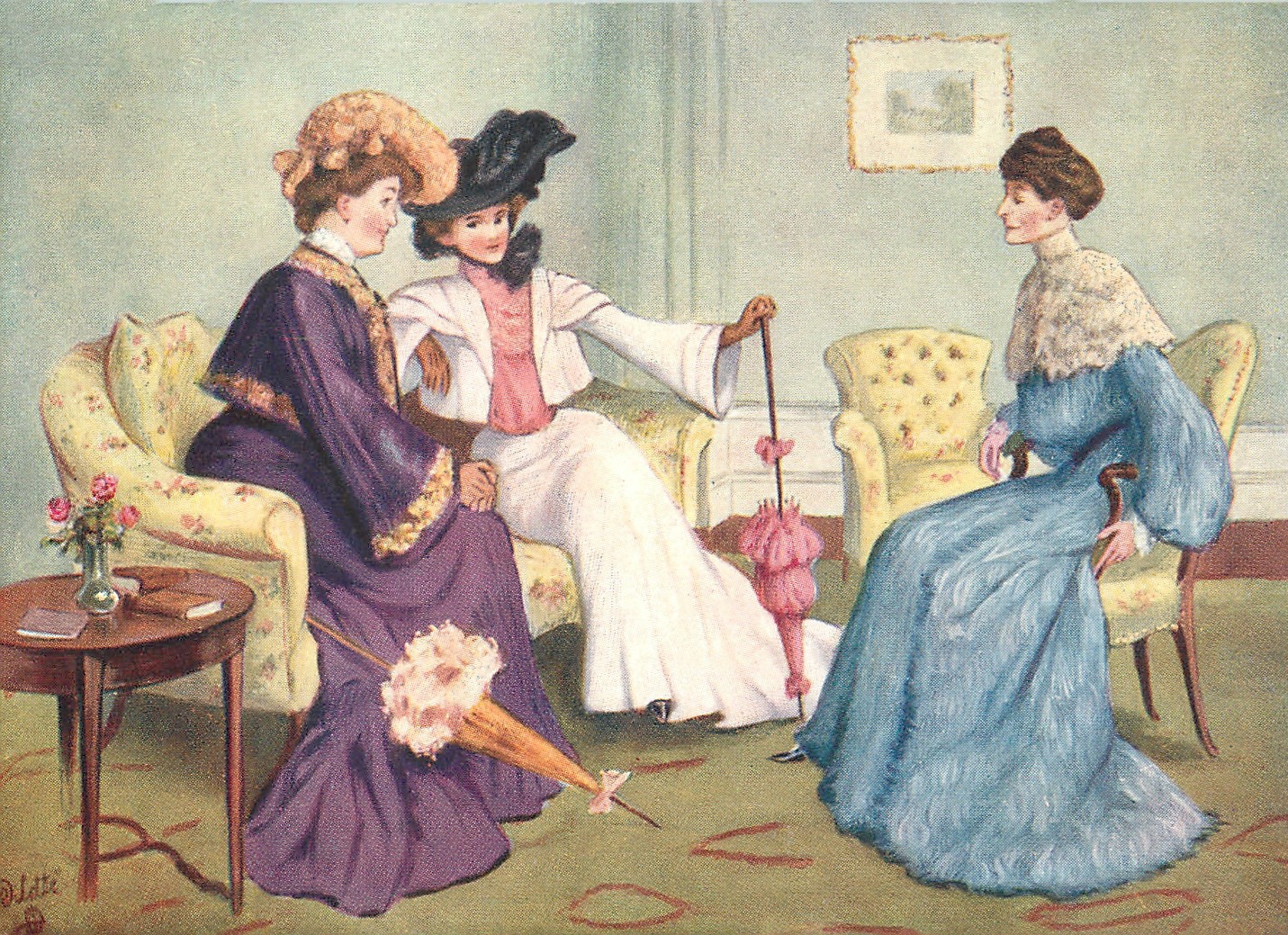
The event was a new spin on an old point of etiquette. For generations society ladies typically designated one afternoon a week where they were “at home” to receive callers.
Paying Calls.
Some ladies even had cards printed up which they handed out to acquaintances or left at the homes of other women to let them know what day they were invited to call.
An undated “At Home” card. Credit: Boston Public Library.
For this event Isabella did the same thing, but instead of inviting people to drop by for an hour or so of conversation, she devised an entire program of meaningful entertainment that lasted well into the evening hours.
There were vocal solos and talks by ministers on the subject of temperance. Isabella’s son Raymond read a selection of popular poems by William Henry Drummond.
.
Isabella gave a talk, and several of the San Francisco Bay area’s leading citizens and ministers also provided entertainment and food for thought.
.
After the program, Isabella served “dainty refreshments.”
.
And it was all reported the following week in one of the local newspapers:
San Jose Mercury News, November 23, 1908.
Busy Isabella certainly knew how to throw a party, didn’t she?
Does Isabella’s “At Home” sound like something you’d like to attend?
Which part of the evening entertainment do you think you would enjoy the most?
Isabella was always interested in new inventions that came her way. When typewriters first came on the market, she began using one to write her stores. She even featured a typewriter in one of her novels (you can read more about that here).
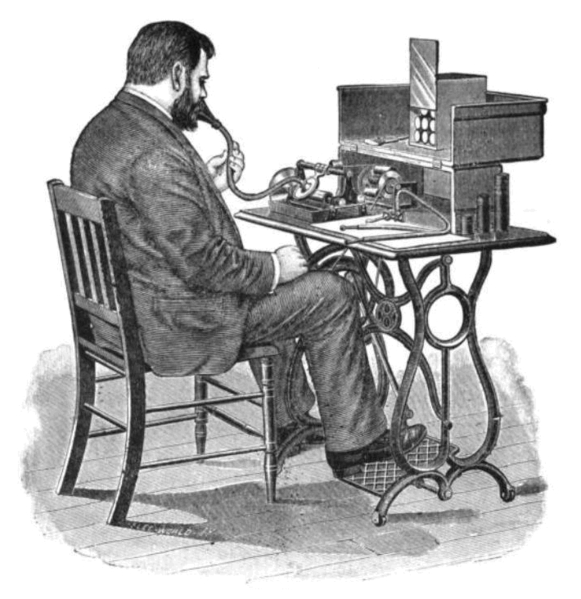
And when her fingers tired from typing, she used dictation equipment and hired a stenographer to transcribe her spoken words into typed pages.
An early wax cylinder phonograph for dictation, 1897 (from Wikicommons).
Add to her love of innovation the fact that she was also very social-minded and had a keen interest in bettering people’s lives, and you can understand her interest in a new trend in health and hygiene that began in the late 1890s.
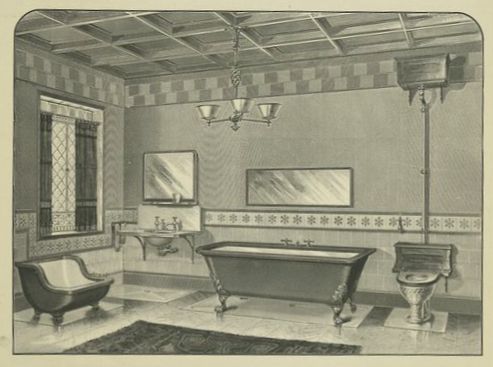
During the majority of Isabella’s life, indoor plumbing was a luxury for most Americans. Only the wealthy could afford to install bathrooms in their homes.
Design for an 1888 bathroom. Credit: New York Public Library Digital Collections.
By contrast, poor residents in large cities lived in tenement buildings that often had only a single source of water; that meant residents had to carry water (sometimes up several flights of stairs) to their apartments in order to bathe or even wash their hands.
“Baby’s Bath” by Arthur J. Elsely
But in the 1890s that began to change. By that time most great cities of the world had implemented public baths. London, Paris, Vienna, and Rome had spacious and magnificent buildings devoted to the purpose of bathing. Isabella’s home state of New York took notice, and began devoting attention to the matter of making bathing facilities available to all citizens, especially the poor.
The New York Board of Health worked with New York City officials to develop plans for a public bath house to be opened in Manhattan. The design included waiting rooms for men and boys, and a separate waiting room for women.
.
More importantly, the design featured an entirely new concept: Rain-baths.
Isabella like this new idea so much, she wrote about it in her magazine, The Pansy, and described the concept to her readers:
One who wishes a bath can set the machinery in motion, and stand under a warm rain, rubbing himself as much as he pleases; using plenty of soap, at first, and then showering off without it.
The water thus used flows away through pipes prepared for it, and without having any bath tub to clean, or water to empty, the bather can dress himself and step out into the world fresh and clean, leaving the room in order for the next one. This has all been planned for the benefit of those who have not homes of their own, with bath rooms and all conveniences.
Shower stalls in a Boston Public Bath House 1898.
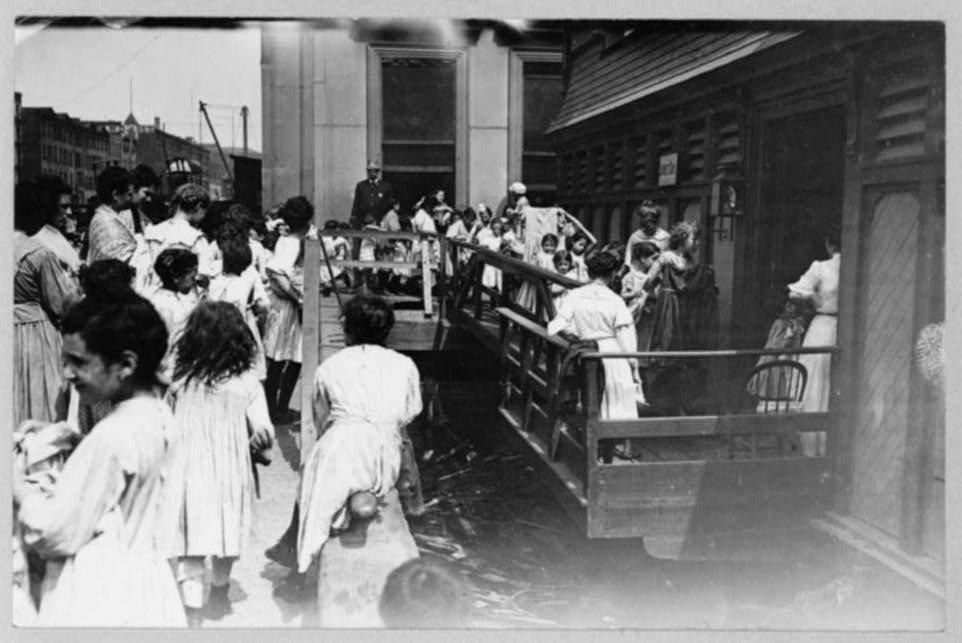
Having seen for herself the tenements and slums in major American cities such as New York, Isabella was well aware that there were few opportunities, if any, for city residents to bathe on a regular basis.
Women and girls in line at a New York City bath house, 1908.
She also knew—having taught homemaking classes at Chautauqua—the health benefits of maintaining a clean body and a clean home. It was natural, then, for her to embrace this new plan for showers in public baths, especially since the facilities would be offered for free to anyone who wanted to use them.
.
She ended her article in The Pansy by reminding her readers about the blessing the new bath houses would be:
I wonder if any Pansy knows what a luxury a warm bath is, when one is tired and soiled with the wear of the day? I am actually acquainted with some Pansies who weep when they are called upon to come in and have their baths! I venture to say that [the children of New York] are more than willing to wait for their turn in the bath room.
[Credit for the two photos of Boston’s Public Baths: Harvard Art Museums/Fogg Museum, Transfer from the Carpenter Center for the Visual Arts, Social Museum Collection.]
In the late 1880s a woman named Martha Wood attended a women’s missionary convention and later wrote a newspaper article about her experience. The highlight of her trip was a chance encounter with Isabella Alden.
By that time Isabella was a best-selling author and her pen name “Pansy” was a household word. You can imagine Martha’s surprise to discover Isabella was not only attending the same convention, but was among the ladies traveling on the very same train!
.
Martha’s account does not mention who made the first overture, but at some point Martha and Isabella fell into conversation. When they arrived at their destination they were greeted by a member of the convention’s entertainment committee, who had been sent to escort Isabella to her hotel. Of course, the committee member was only too happy to include Martha in their party. But when it came time for them to take a cab from the train station to the hotel, they encountered a slight problem:
Amid the bustle of the station we were greeted by the Entertainment Committee, and, as we were assigned to places adjacent, were to occupy the same cab, when, lo! The cab had but one seat, and there were three of us! Quickly the happy thought found expression: Who would not think it an honor to ride in the same cab with Pansy? How much more, then, to ride with her on one’s knee, as she is so petite? Thus we rode to our destination.
Isabella was scheduled to address the convention, and Martha described her performance:
She was on the program, of course, and read one of her exquisitely appropriate stories to an interested audience; but the acoustic properties of the church were so bad that, with straining ears, we failed to hear it well, though it was a real pleasure even to see her, and to hear the silvery voice of one whom we had learned to love already, from her writings.
Later, Martha noticed some devoted Pansy fans were among the convention attendees:
She was constantly surrounded by a bevy of bright young girls, and it seemed quite the fitting thing, too, for had she not devoted herself to them and to their uplifting?
One of them gave her a lovely plaque of wild-wood violets marked as her “country cousins,” to which she laughingly referred as we journeyed homeward together. She was quite as entertaining as her stories, we found, full of a nameless gentle grace, betokening a lady.
On the journey home after the convention, Martha and Isabella traveled with a third woman. Martha never identified the woman by name, but described her as a “leading educator in the state.” The woman had also been a speaker at the convention on the topic of “All I Am, and All I Have, for the Lord.” Martha wrote:
Pansy was even then revolving in her mind a new story and she asked my friend if she could use her name as one of the characters.
Now, this friend was just a trifle old-fashioned in her ideas about story writing, and especially about young people spending their time in reading novels, so she hesitated.
Then Pansy told us how she had been oftentimes solicited to enter the arena of popular fiction, for mere fiction’s sake and pecuniary gain, but that she had always refused. Her solemn purpose was to devote herself entirely to the development of higher Christian character and life, and she had never yet yielded, had never been swerved, from her high resolves.
I wish I could paint the beautiful glow of her cheek, and the clear shining of her dark, glowing eyes, as she talked to us from her heart.
Deeply impressed, I turned to our friend and said, “Remember your subject, ‘All I Am, and All I Have, for Christ,’ and she only asks to use your name. He taught in parables most effectively, and she is only following His example by writing stories to develop true, higher Christian life.”
Of course, she then consented and the story was written, but I do not think I am quite at liberty to reveal all here.
.
Martha’s story—as charming as it is—is full of tantalizing mysteries!
When and where was the missionary convention held? And who was the woman whose name Isabella wanted to use as a character in a story? What was the name of the story Isabella ultimately wrote?
We may never know the answers to these questions, but Martha’s encounter with Isabella sounds delightful!
Did Martha’s recollection give you any new insights into Isabella’s personality? Please share your thoughts in the comments box below.
In The Pansy magazine Isabella used stories, illustrations, and poems to teach young people what it meant to follow Jesus. The following poem was published in an 1893 issue of the magazine, and although it was written for children, it has meaning for adults, too!
I lost a very little word
    Only the other day;
A very naughty little word
    I had not meant to say.
If only it were really lost,
    I should not mind a bit;
I think I should deserve a prize
    For really losing it.
For if no one could ever find
    Again that little word,
So that no more from any lips
    Could it be ever heard,
I'm sure we all of us would say
    That it was something fine
With such completeness to have lost
    That naughty word of mine.
But then it wasn't really lost
    When from my lips it flew;
My little brother picked it up,
    And now he says it, too.
Mamma said that the worst would be
    I could not get it back;
But the worst of it now seems to me,
    I'm always on its track.
If it were only really lost!
    Oh, then I should be glad!
I let it fall so carelessly
    The day that I got mad.
Lose other things, you never seem
    To come upon their track;
But lose a naughty little word,
    It's always coming back.
While no author name was given when the poem was published, Isabella’s husband Ross and son Raymond were both talented poets, as was Isabella.
When she wrote stories about children losing their tempers, she wrote from experience. Isabella shared stories from her own life about how often her anger got her into trouble when she was young.
You can read about some of those instances in these previous posts:
In 1895 Isabella and her family were living in May’s Landing, New Jersey, where her husband, Reverend Gustavus Alden, had charge of the Presbyterian Church.
While her husband was busy with his responsibilities, Isabella paid an early September visit to her hometown of Gloversville, New York.
Her son Raymond (age 22 at the time) and adopted daughter Frances (age 3) accompanied her.
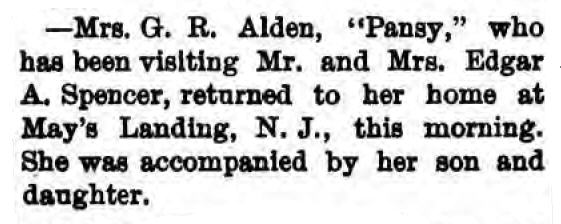
The residents of Gloversville welcomed Isabella back with open arms, and—as they often did—they invited her to speak at one of their assemblies. The evening of Tuesday, September 17 was decided upon, and the local newspaper promoted the event:
The evening began with musical selections, then Isabella took the stage to “an outburst of applause.” She read one her stories, which the newspaper reported was titled “Miss Hunter.”
You may already be familiar with “Miss Hunter.” The character of Miss Priscilla Hunter was one of Isabella’s favorites, and she appeared in four of Isabella’s stories:
Miss Priscilla Hunter
People Who Haven’t Time and Can’t Afford It
The Man of the House
One Commonplace Day
But each of these stories and novels were published well before 1895, and the newspaper reported that Isabella read a brand new story, written specifically for the occasion, that featured a character named Miss Hunter. The newspaper account of the evening noted that the story was “interesting and kept the close attention of the audience,” but gave no additional details about the story.
On Thursday morning, September 19, Isabella left Gloversville and headed back to her home in New Jersey.
She also left us with questions: What was the story she read aloud to the audience at the Presbyterian church? Is there another Pansy story about “Miss Hunter” that has yet to be found?
Until the mystery can be solved, you can read more about the fictional character of Miss Priscilla Hunter—and the stories we she appeared in—by clicking here.
You can also click here to read about Isabella’s charming hometown of Gloversville, New York, and the business her father had there.
Much like the on-line college degree courses we have now, The Chautauqua Literary and Scientific Circle (C.L.S.C.) was a method of self-education people could obtain in the privacy of their own homes. Isabella was a graduate of the C.L.S.C. program and actively promoted in articles and stories.
Every three months C.L.S.C. students received “The Chautauquan,” a 400-plus page “magazine of system in reading” with articles and lessons that covered various topics such as:
The Rehabilitation of the Democratic Party
Food, the Farmer, and the City
Polar Exploration and Moral Standards
Women in the Progress of Civilization
A Reading Journey through Egypt.
History and classic literature were also major components of the curriculum. Bishop John H. Vincent, Chancellor of the C.L.S.C. believed:
The study of classical literature, art, and philosophy supplies a training of the mind based upon models which have stood the test of time [and are] considered universal.”
Aside from obtaining the books for reading, the only other tools required to complete the course were a pencil, some paper, and a good dictionary.
But while the tools were basic, the coursework was not always easy. In 1909 students were required to read Homer’s Iliad. If you’ve ever tried to read this epic poem about the Trojan War, you know what a challenge it can be!
Not to worry; the C.L.S.C. published the following tips to help students successfully complete the required reading:
Think of this volume as a story book and read it for the sake of the stories.
Keep in mind the tales woven about Achilles and Odysseus are typical of the passionate rivalry of war and the steadfast love of country and family we identify with today.
Don’t make reading these stories hard. Relax yourself to the swing of them. Let them carry you along as if you were hearing them recited by a story teller.
These are tales of valiant deeds and daring adventure from beginning to end— “action stories”; and there is no easier reading in the world.
Bishop Vincent knew the value of reading Homer’s Iliad, because he recognized the influence Greek history—and Homer’s epic poem, in particular—had on the formation of the United States and the development of our constitution.
Those influences are still visible today. A mural in the Library of Congress in Washington D.C. depicts one of the stories in the Iliad after Achilles’ mother disguised him as a school girl and sent him to a distant court so he would not be enlisted in the Trojan War. Wily Ulysses set out to find Achilles; dressed as a peddler, he displayed his wares. The girls chose feminine trinkets, but Achilles was attracted to a man’s shield and casque, thereby revealing his identity.
Greek history and mythology influence many murals, statues, and architectural design throughout the U.S. capital.
Have you read Homer’s Iliad? Did you find it difficult reading?
If you haven’t read Homer’s Iliad, you can get a taste for what this reading assignment was like. Click here to read an 1891 version of the epic poem, which would have been similar to the version Isabella and other C.L.S.C. students read.
Reviews and giveaways for Christian fiction and sweet, clean fiction. Bringing readers information on great stories and connecting authors with their readers.

























 Isabella Alden