Defending Grace

When Grace Livingston Hill’s short story “The Livery of Heaven” was published in a popular Christian magazine in 1897, she probably had no idea the controversy it would cause.

Black and White hand-drawn illustration. At the top is a ribbon banner that stretches across the page with "The Livery of Heaven" in all capital letters. Beneath is a table top on which are jars of peaches, bottles of wine, and cocktail and wine glasses. In the center is a drawing of a man kneeling beside a bed. His arms are resting on top of the bed and his face is buried in his arms.
Magazine illustration for Grace’s story, “The Livery of Heaven.”

After all, Grace was 31 years old and had been writing and publishing her stories and novels since 1889, and they all sold very well. So it might have been a bit surprising that the magazine that published “The Livery of Heaven” began to receive letters from readers like this one:

The Letter:

I have been reading “The Livery of Heaven,” and, as one hoping your paper meets the highest standard of merit and helpfulness, I desire to make an emphatic protest against the unreality of some of the characters and descriptions of that story.

The character of Mrs. Wallace, for instance, seems to me too absurd even for a story. Is it possible that a woman of her intelligence and honesty of purpose could be so absolutely blind as not to know the inevitable consequences of giving to one with a passion for liquor “brandy peaches” so strong with brandy as to scent a whole room?

Or that she could be so utterly inconsistent as to go out and work zealously in the cause of temperance reform when she had just finished putting up a lot of peaches saturated with brandy, which she purposed to serve indiscriminately?

Impossible! Unless she were a bold hypocrite, and obviously hypocrisy is not intended or thought of.

And if not a hypocrite, such rank inconsistency and incongruity of character could not exist except in a vivid imagination. It is not real life.

If my ideas are wrong, I would like to be set right.

It just so happened that Grace’s aunt, Isabella Alden, was one of the magazine’s editors, and she decided she would personally answer the critics who wrote in about Grace’s story and “set them right.”

Here is Isabella’s response:

There is more to this letter, and I wish we had room for its entirety, for it is carefully and thoughtfully written.

It seems to me that the writer is wrong, not in his deductions, but in his statement of facts. He distinctly states the impossibility of so inconsistent a woman as Mrs. Wallace. What will he do with her if I own that she, to my certain knowledge, exits—that she is not only “true to life,” but she is life? I have no means of knowing whether the Mrs. Wallace about whom the author in question writes is the Mrs. Wallace of my acquaintance; but I do know that exactly such an instance of moral blindness occurred but a few years ago.

I knew a woman who would walk miles on hot summer afternoons to secure signers to a “no-license” petition within the precincts of her ward, and would discourse eloquently on the evils of the saloon and the dangers attending her young son, and the miseries resulting from “acquiring a taste for intoxicants;” and then offer that same young son at her own dinner table a pudding, the sauce of which was so highly flavored with wine as to make its very presence offensive to certain of her guests.

I knew another woman who wept copious tears over the downfall of a beloved brother, and besought us earnestly to help her plan ways and means of reaching and saving him “even yet”; and then offered us in the next breath a bit of her fruit-cake so well flavored with brandy as to be detected by the sense of smell as well as that of taste; and she remarked that she always kept it on the sideboard where her brother could help himself.

The dense ignorance that exists in regard to these matters on the part of many people who consider themselves almost temperance fanatics, is proverbial among workers who have studied into the subject.

In our mothers’ meetings that I conducted for years this matter of cookery was continually coming to the front; and at not a single meeting did we fail to have represented the puzzled woman who said:

“Why, do you suppose, that the little bit of brandy that I put in my mince-pies to keep them, or the few drops with which I flavor my sauces, can have any effect on a person’s appetite for liquor? Won’t such strained notions as these do more harm than good?”

Also, almost as regularly, we had that other woman who said:

“Well, there’s no use in talking to me about such things. John wouldn’t eat mince-pies if they hadn’t brandy in them. He doesn’t like the flavor without it; and I’m not afraid of its doing any harm in my family.”

Understand, these are good temperance women—every bit as good as Mrs. Wallace; much like her in every respect; women who, by reason of their upbringing and their present environment, are utterly unable to see the connection between liquor-eating and liquor drinking; women who believe that what their mothers and their mothers’ mothers always did must be right and best.

What the temperance cause needs today, in my judgment, more than any other thing, is some apostle who will undertake to open the eyes of the army of Mrs. Wallaces that infest the land, who labor zealously with their strong right hands to put out the fires of rum, and industriously feed the flames with their ignorant left hands all the while.

.

What did you think of Grace’s story? Do you agree with the letter writer’s critique?

Do you think Isabella gave the right response?

If you haven’t yet read Grace’s story “The Livery of Heaven,” you can read it here.

FREE Lecture about Faye Huntington!

Would you like to learn more about the life of Isabella’s best friend, Theodosia Toll Foster? Under the pen name Faye Huntington she wrote dozens of novels and short stories, many of which Isabella published in The Pansy magazine.

On Saturday, April 29 Theodosia’s great-granddaughter Susan Snow Wadley will be giving a free lecture about Theodosia’s life in New York and her influence on the area’s culture.

Topic:“The Life and Times of Theodocia Maria Toll Foster”
Where:Oneida County History Center
1608 Genessee Street
Utica, New York 13502
When:Saturday, April 29, 2023, at 2:00 p.m. Eastern
Presented by:Susan Snow Wadley, Theodosia’s great-granddaughter

If you live near Oneida County you can attend the lecture in person for free.

Or click here to register for the virtual lecture via Zoom.

Susan presented a similar program last year and shared some delightful information about the times in which Isabella and Theodosia lived.

If you’d like to read some of Theodosia’s novels and short stories, click here to read them for free!

A Wee Booklet

Readers often wrote to Isabella asking how they could study the Bible on their own, and Isabella was always happy to suggest a method that seemed to fit their individual circumstance.

Here’s what she wrote to one reader, a harried housewife who had very little time each day to call her own:

As to methods of Bible study, there are numberless ways, and they are all good. The main point is to choose one of them and study. There are books that help wonderfully in the understanding of the Bible. Some of the very little ones contain a great deal of instruction.

This is notably the case with a wee booklet of not more than fifty small pages. It is called “Rightly Dividing the Word of Truth,” and contains ten outline studies on the divisions of the Bible. It is prepared by C. I. Scofield and published by the Asher Publishing Co., St. Paul, Minn.

Black and White photo of Cyrus Ingerson Scofield in his later years. His hair is white and he is dressed in a three-piece suit. He is seated at a table.  In one hand he holds a pair of glasses. His other hand points to a passage of text in a Bible open on the table before him. Behind him are bookcases lined with books.
Dr. C. I. Scofield at work in the library at Princeton University.

You can read the “wee booklet” Isabella recommended.

“Rightly Dividing the Word of Truth” by C. I. Scofield is available online.

You can read an electronic version for free on one of these websites:

BibleCentre.org

BibleBelievers.com

Or you can purchase a paperback copy from Amazon by clicking here.

Have you read Scofield’s booklet?

Do you think it’s a helpful guide for someone who is new to studying the Bible?

Grace Livingston Hill and the Authors’ Carnival

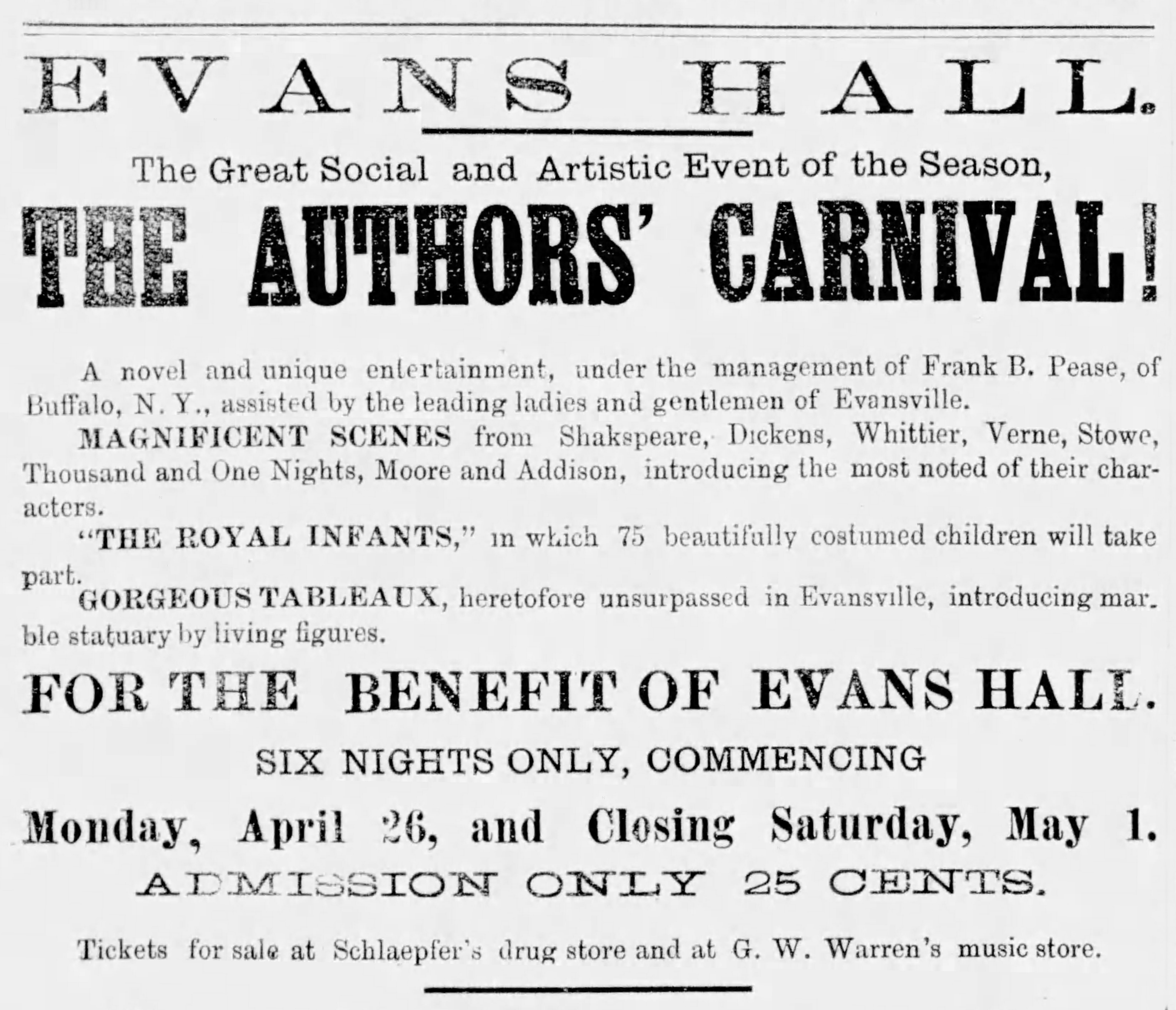
Newspaper Headline: The Great Social and Artistic Event of the Season, THE AUTHORS' CARNIVAL! A novel and unique entertainment, under the management of Frank B. Pease, of Buffalo, N.Y., assisted by the leading ladies and gentlemen of Evansville. MAGNIFICENT SCENES from Shakespeare, Dickens, Whittier, Verne, Stowe, Thousand and One Nights, Moore and Addison, introducing the most noted of their characters. "THE ROYAL INFANTS," in which 75 beautifully costumed children will take part. GORGEOUS TABLEAUX, heretofore unsurpassed in Evansville, introducing marble statuary by living figures. FOR THE BENEFIT OF EVANS HALL. SIX NIGHTS ONLY, COMMENCING Monday, April 26, and Closing Saturday, May 1. ADMISSION ONLY 25 CENTS.
From the Evansville, Indiana Daily Courier, April 18, 1880

In the late 1800s a new and exciting form of entertainment swept across America. It was called the Authors’ Carnival. It had all the fun of a community fair, as well as dazzling theatrics on a magnificent scale.

Old photo of ten women standing on the steps of a building. Each woman is dressed in a different costume, such as Native American, Arabian, Western, etc.
Women in costume for an Authors’ Carnival in Washington DC

The Authors’ Carnival drew great crowds in every city in which it was staged, so it had to be set up in a large space, such as a town hall or tabernacle. The concept, though, was simple: the Carnival was comprised of a number of booths, each of which depicted a scene from a famous author’s works.

For example, there was a booth devoted to Twenty Thousand Leagues Under the Sea by Jules Verne. Costumed actors portrayed scenes from the book in an elaborately decorated submarine compartment behind a gauze curtain that simulated water.

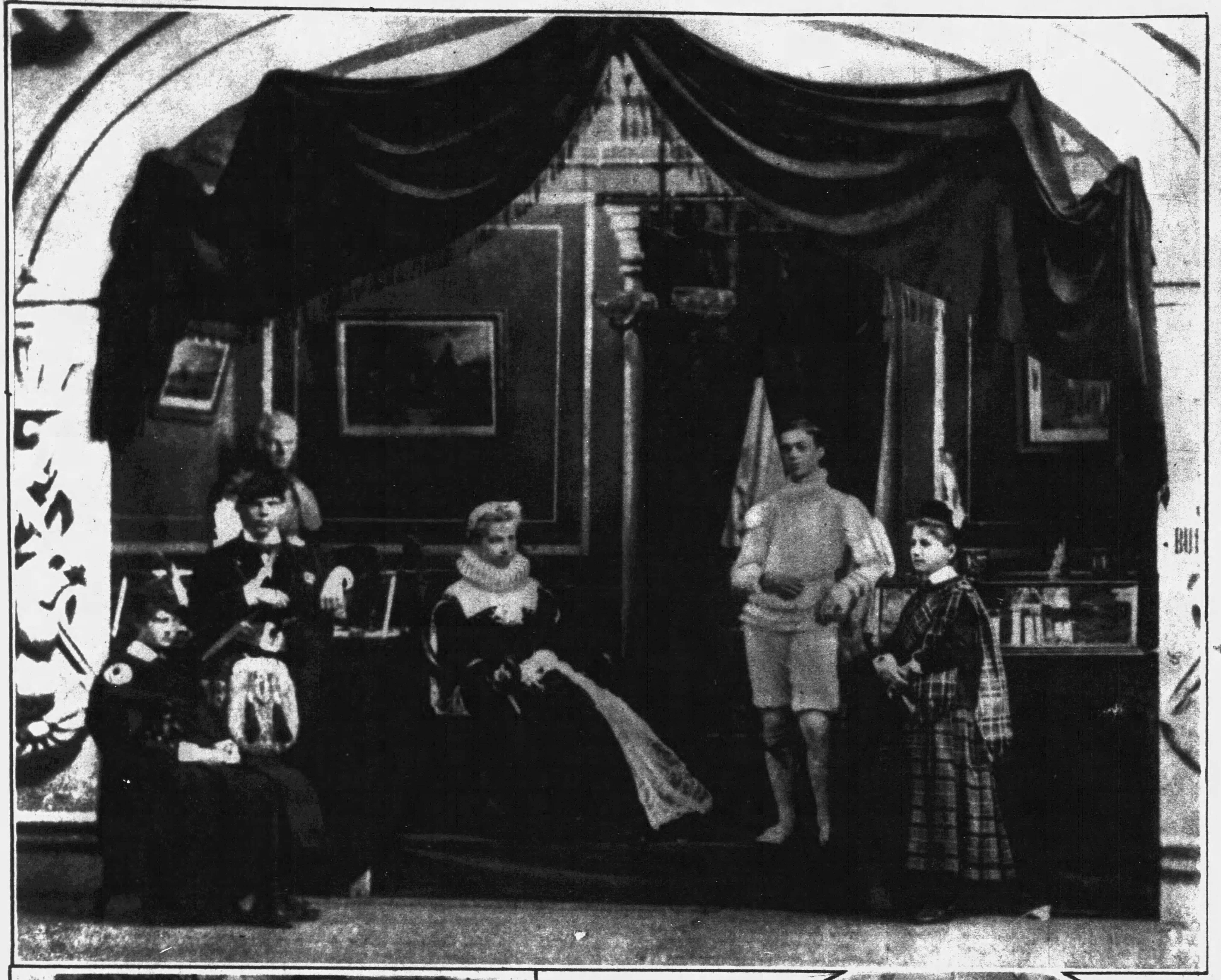
Black and white photo of a woman, a man, and three children dressed in costumes of Sixteenth Century Scotland. The woman wears a headpiece and neck ruff from the Elizabethan period. Then man and one child wear kilts. They are in a well-decorated parlour with art on the walls and paneled moulding.
A booth devoted to Sir Walter Scott’s Baronial Hall, from The Buffalo Times

Another booth was devoted to John Greenleaf Whittier’s poem, “Snow-Bound: A Winter Idyll.”

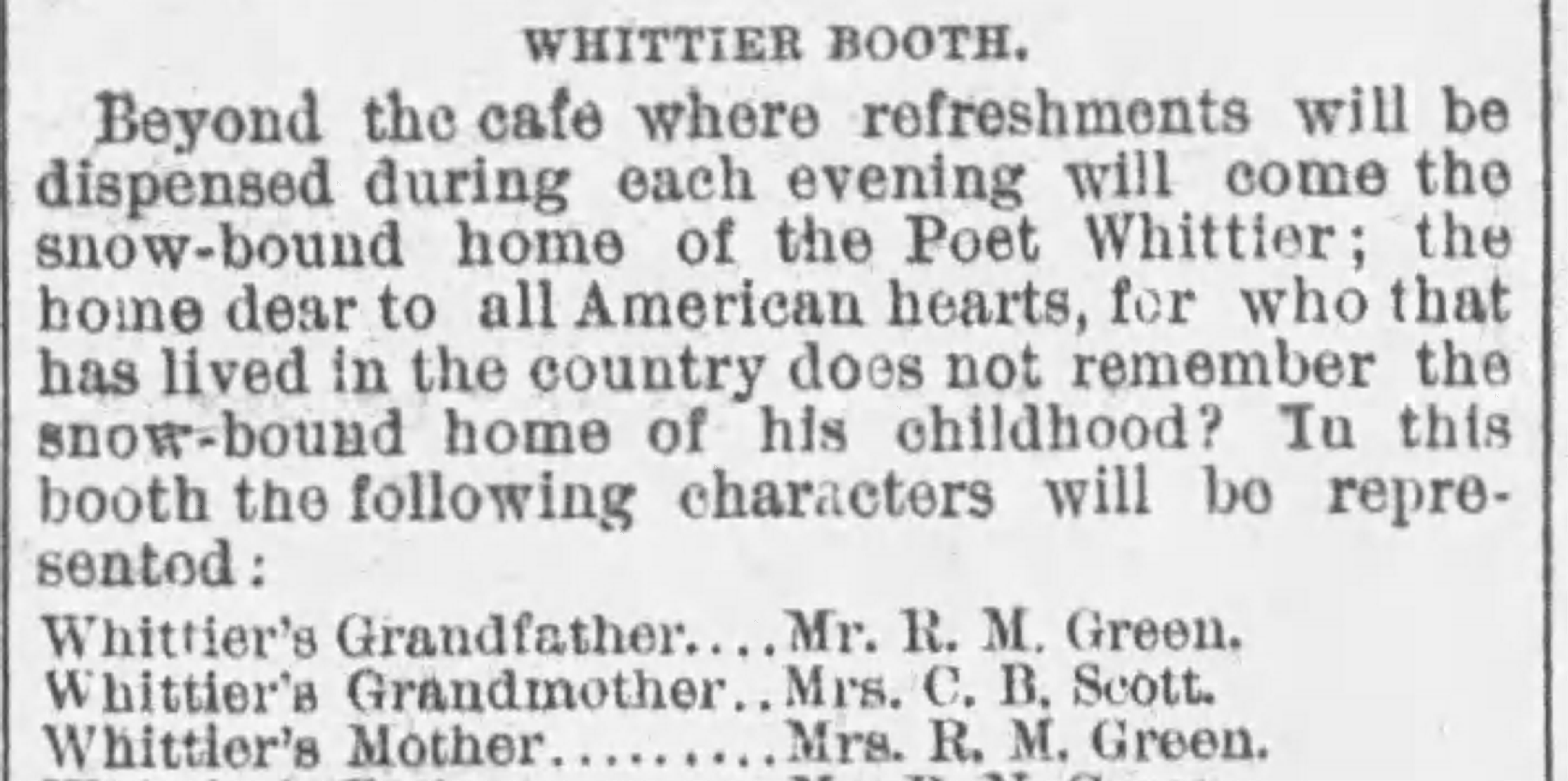
Newspaper excerpt that reads: WHITTIER BOOTH. Beyond the cafe where refreshments will be dispensed during each evening will come the snow-bound home of the Poet Whittier; the home dear to all American hearts, for who that has lived in the country does not remember the snow-bound home of his childhood? In this booth the following characters will be represented: Whittier's Grandfather, Whittier's Grandmother, Whittier's Mother.
A description of the Whittier booth, from The Scranton Republican, April 23, 1886

There were booths dedicated to Shakespeare, Longfellow, and Washington Irving, and many more literary figures, including Mother Goose. One of the most popular booths was lavishly decorated as Aladdin’s Cave.

In many cases, booths were set up so the costumed actors could interact with the people passing by.

Old black and white photo showing a group of people dressed in costumes from the 1770s. Some men are standing; others are seated beside women. There is a statuary urn with a plant between the chairs. Behind them is a background painting of a garden scene with more statues.
Victor Hugo’s Paris Garden booth, from The Buffalo Times

The highlight of the Authors’ Carnival occurred on a center stage where tableaux vivant were enacted at intervals throughout the day and evening. The most popular tableau was the colorful, well-choreographed “The Fan Brigade.” It illustrated an essay by British satirist Joseph Addison on how ladies in the eighteenth century used their fans as weapons in flirtation and romance.

Old photo of eight women dressed in gowns from the late eighteenth century. Some of them have powdered hair; all wear tall headdresses and carry fans. Two of the women stand between a large open fan mounted on top of a pole that is about seven to eight feet tall. Behind them is a painted backdrop of the stone columns and balustrade of terrace, with a landscape beyond.
Fan Brigade, from Authors’ Carnival Album, 1880, Library of Congress

In 1881 the Authors’ Carnival arrived in Cleveland, Ohio, where sixteen-year-old Grace Livingston lived with her father Charles and mother Marcia (who was Isabella Alden’s older sister). Already an aspiring author, Grace visited the Authors’ Carnival one afternoon and wrote the following account of her experience:

The Author’s Carnival in Cleveland

By Grace

It was impossible for me to attend the evening entertainment of the Author’s Carnival, but when a matinee was announced for the next afternoon, I thought I would go.

It was held in the tabernacle. As you entered the door, directly opposite you was the stage, where the most beautiful tableaux were exhibited every twenty minutes, the performers never having rehearsed before, but being picked out and arranged on the spot, from the different booths.

The booths were ranged around the sides, and the center left for the audience to promenade. We took a look at the booths before the first tableaux.

The “Alhambra,” which, having a piano, and a few good players, managed to keep such a crowd around it all the time, that one could hardly get a peep at it.

Whittier’s “Snow Bound,” with its soft gray costumes, which harmonize wonderfully with the neat room, and fire-place, and cupboard, with its rows of bright, shining dishes, and the strings of dried apples hanging from the ceiling. Whittier’s “grandmother” happened to be a friend of mine, so I stepped up to her, and she said, “How does thee do, friend Grace?”

There was the “Arabian Nights” booth, where they sold miniature “Aladdin Lamps,” said to be exact copies from the original.

“Lalla Rookh” and the “Jules Verne” booths were beautiful and picturesque, with their mermaids, and flowers, and sea-weeds.

Longfellow’s “Hiawatha,” where the Indians flourished their tomahawks, and gave war-whoops, attracted a great deal of attention, and really was one of the most fascinating.

The “Egyptian” booth had beautiful, rich costumes.

The “Addison” booth had, perhaps, the most beautiful costumes, but the characters were all ladies.

The “Dickens” booth, with all its comical characters, was just refreshing.

As I walked up to the “Shakespeare’s” booth, the “Duke of York,” an old schoolfellow, stepped forward and shook hands with me.

The tableaux-bell rang, and we all rushed to the center of the floor, each one trying to get the best position for seeing. The most beautiful and quaint pictures succeeded each other; lastly, the beautiful “Fan Drill.” If you have never seen it, seen the perfect time and graceful motions, you cannot imagine how beautiful it was.

But there was one blight on all this beauty. At the “Spanish” booth they sold cigars and cigarettes, and some ungentlemanly persons even smoked among all that company of ladies. It was Satan’s way of joining in the Author’s Carnival.

Tableaux and theatricals were common forms of entertainment during Isabella Alden’s lifetime, and she wrote about them in several of her novels. You can read more about tableaux in these previous posts:

Tableaux: Bringing Pictures to Life

A Nice Oyster Supper

Pansy’s Easter Service

In addition to novels and short stories, Isabella Alden wrote Sunday-school lessons and programs for worship.

In 1895 she wrote a special program for Easter that was carefully crafted so it could be performed by young children, as well as older age groups.

Newspaper clipping: PANSY'S EASTER SERVICE. Superintendents and Teachers should send for a copy of the April "Pansy," now ready. It contains a beautiful Easter Service carefully arranged and prepared for Christian Endeavor societies, Epworth Leagues, King's Daughters, Mission Bands, and Sunday-schools, by Mrs. G. A. [sic] Alden, known to all Sunday-school workers under the familiar name "Pansy." An extra edition of the April "Pansy" has been issued to meet the demand created by this special Easter Service. Copies will be sent, post-paid, on receipt of 10 cents, or in quantities at seventy-five cents per dozen.

Her Easter program included poems to read aloud, beloved old hymns to sing, and portions of Scripture to be memorized and recited.

Newspaper clipping: PAMPLETS. 
Mrs. G. R. Alden has prepared an exercise for Easter, which will appear in the April Pansy, which is issued the middle of March in order to afford ample time for committees to prepare the exercise for Easter Sunday. It is arranged especially for Christian Endeavor and kindred societies, but may be used by Sabbath-schools or other organizations. There are many Easter services, but some of them are too difficult for children, and some are too simple for the older ones. This has been prepared with great care, and the selections for recitation, especially will commend themselves.

Most importantly, the program clearly and simply related the message of Easter: that Christ rose from the dead, bringing eternal life to those who believe in him.

You can read Isabella’s entire Easter service program. Just click here or on the image below.

A Month of Margaret Sidney!

Publishing The Pansy magazine was more than just a family affair for Isabella Alden. Writers outside her family circle also contributed poems, biographies, science articles, and other content for the magazine issues. One of those contributors was Harriet Lothrop, who wrote children’s fiction under the pen name of Margaret Sidney.

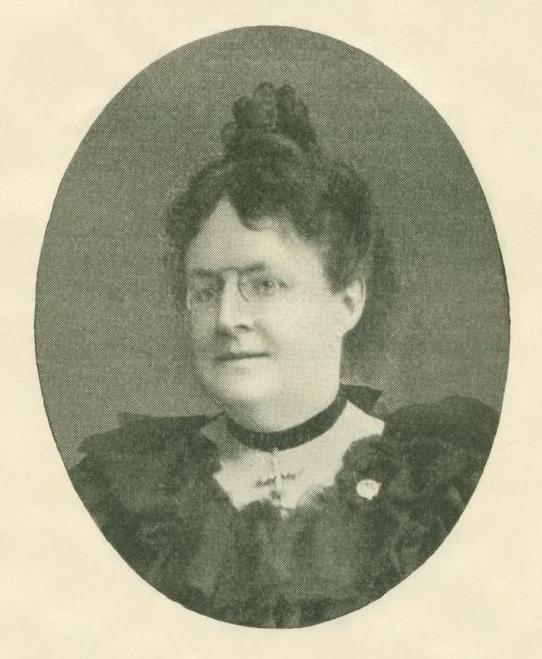
Black and white photo of Margaret Sidney from the 1890s. She has dark hair worn in the style of the period in a curly knot on top of her head. She wears pince nex glasses. Her gown has a modest scoop neckline surrounded by deep rows of ruffles. Around her throat is tied a wide black ribbon from which a jeweled cross is hung.
Margaret Sidney about 1895, image from the New York Public Library

Harriet’s books were incredibly popular, especially the Five Little Peppers—a series she wrote about brothers and sisters in the fictional Pepper family. Daniel Lothrop, the publisher of the Pepper books, also published Isabella’s books, as well as The Pansy magazine.

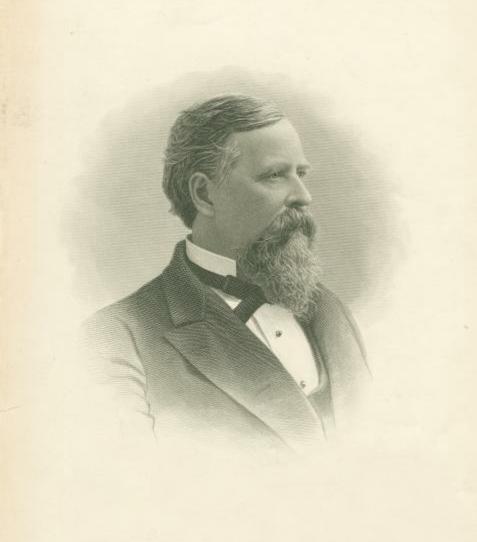
Black and white photo of Daniel Lothrop. His hair is neatly cut with touches of grey at his temples and above his ears. He has a very full beard and mustache, which also have touches of grey. He wears a high-collar shirtfront with a thin black bow tie, a vest and suit coat with wide lapels.
Daniel Lothrop

Mr. Lothrop was immediately charmed by Harriet’s Pepper books. In fact, he was so impressed, he asked to personally meet Harriet. One thing lead to another, and they eventually married!

Embossed hard cover of the book, The Stories Polly Pepper Told. The cover is in green with gold embossed letters and figures of children. Decorative embellishments of vines and patterns are printed in brown.
An 1899 cover of one of the Pepper books, The Stories Polly Pepper Told

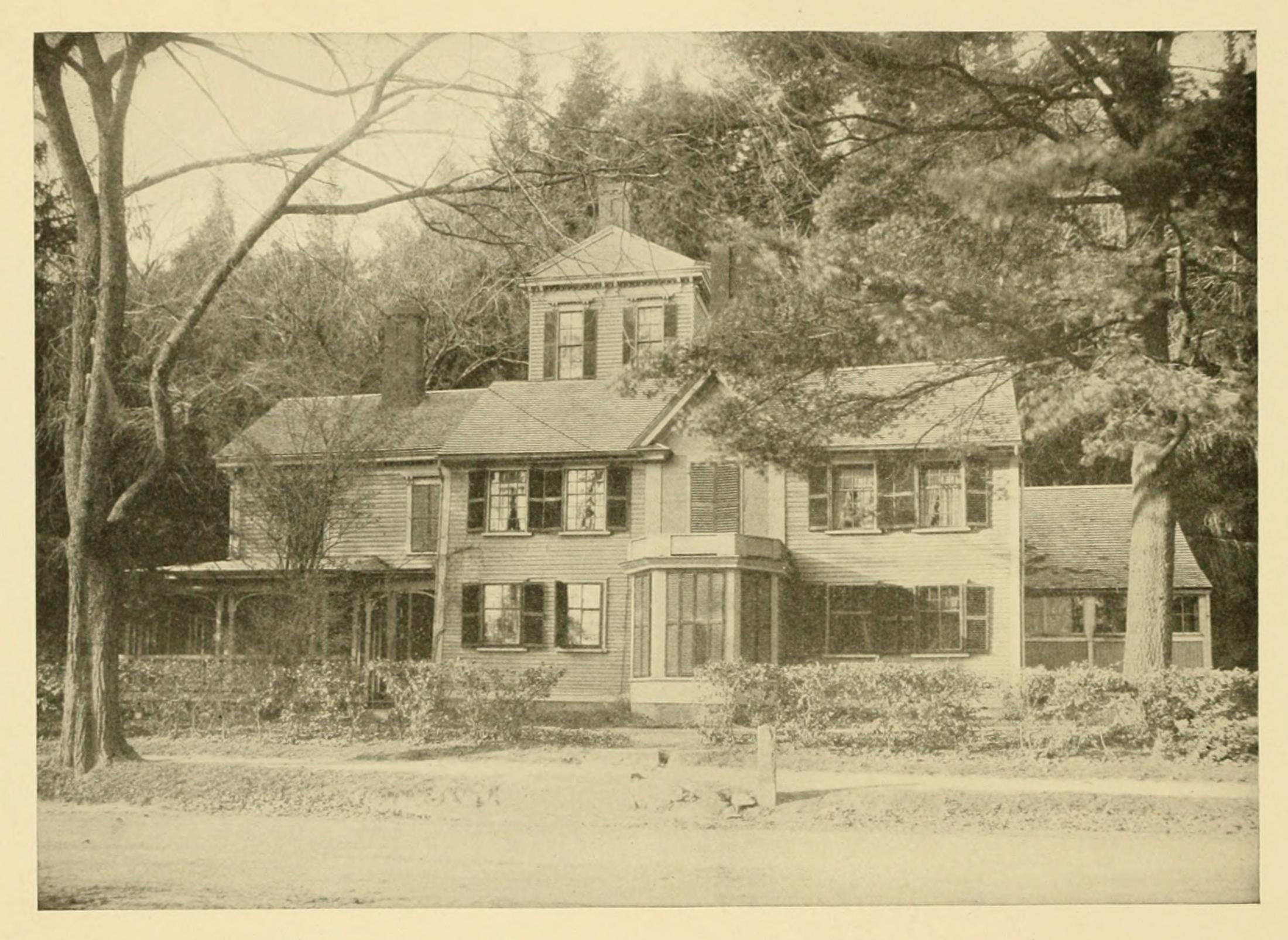
Together they became a powerhouse in the publishing and literary communities. They purchased Wayside, the Concord, Massachusetts home that previously belonged to American author Nathaniel Hawthorne. There Harriet continued to write her stories and novels; and Daniel enjoyed his weekends there as respite from the hustle and bustle of downtown Boston where his publishing house was located. 

Black and white photo of Wayside, a three-story home with clapboard siding and shutters at the windows. On the left side of the home is a Victorian trimmed veranda that circles around to the side of the house. A first floor bay window has a balcony above it that is accessed through french shuttered doors. A split rail fence, covered in a flowering vine, separates the front lawn from the sidewalk.
Wayside, as it appeared in 1908.

As individuals, Isabella Alden and Harriet Lothrop could not be more different. Isabella lived a rather quiet life, supporting her husband’s ministry, raising her son, writing her books, teaching at Chautauqua, and giving talks and readings of her stories at churches across the country.

By comparison, Harriet loved a good party. She was a leading force in Concord society. When her daughter Margaret turned nine years old, Harriet, in typical style, threw an all-day celebration. She invited children and adults from around the area to join the birthday celebration.

The highlight of the event was when the children formed a circle around a large artificial rose that had been set up on the lawn. And when the rose petals parted and spread, they revealed little Margaret setting in the center of the rose. Here’s an illustration that appeared in a magazine that printed an account of the event.

Harriet was definitely an imaginative hostess, and knew how to throw a party to please children and adults!

The same was true of her stories. Although Harriet was best known for her children’s books, she also wrote novels for teens and young adults.

One such novel was How Tom and Dorothy Made and Kept a Christian Home.

Cover image for novel, How Tom and Dorothy Made and Kept a Christian Home.

Newlyweds Tom and Dorothy Foster have a bright future together, but very little money. They’ve pledged to spend their earnings for God’s good, but it seems each new day brings new temptations. Will they be able to keep the promises they made to God and to each other?

You can read How Tom and Dorothy Made and Kept a Christian Home for free!

Choose the reading option you like best:

You can read the story on your computer, phone, tablet, Kindle, or other electronic device. Just click here to download your preferred format from BookFunnel.com.

Or you can select BookFunnel’s “My Computer” option to receive an email with a version you can read, print, and share with friends.

We’re celebrating Margaret Sidney all month long!

Join us next week for another story by Margaret Sidney you can read for free!

Growls

In 1876, when she was just thirty-five years old, Isabella presided over a very busy household.

Her husband Ross had just been given the ministry of a Presbyterian church in Cincinnati, Ohio.

At the same time Isabella’s writing career was in full swing. Not only was she publishing an average of three novels a year, she was also the editor and principal contributor to The Pansy magazine, which, at that time, was published once a month.

Banner for The Pansy magazine.

.

Her son Raymond (whom she lovingly called Ray) was just three years old. To round out the household, Isabella’s mother Myra, and Anna Alden, Ross’s daughter from his first marriage, were also living with them.

In those early days Isabella was very candid about sharing her family life with readers of The Pansy magazine. She often shared brief anecdotes about her life and, in particular, about her son Raymond.

Not only did her readers love those stories, they also came to feel they knew Raymond personally. They even sent him cards and small gifts in the mail.

Isabella had a special column in The Pansy called “Pansy’s Letter-Box” in which she thanked readers for all their letters, including those addressed to Raymond.

Pansy's Letter-Box, written in fancy type-face.

.

One of her 1876 entries in the column was to a reader named Ida, who must have sent Raymond a gift with her letter. Here’s Isabella’s reply:

Ida F. Derby: Ray was very much pleased with your heart. He speaks as plainly as anyone can, except that he says “flead” for “thread.” That, however, is not because he cannot speak the word correctly, but because he thinks that is the right way.

.

Then in November of that same year, Isabella shared this story about Raymond and her mother Myra, who was living with them at the time:

Growls

Ray was at the piano playing a tune; that is, he was running his fingers up and down the keys, and making a discord that frightened even the cat. Grandma sat in the arm-chair, and was singing to Ray’s music. Between them both, it was as much as we could do to stay in the room. At last something about grandma attracted Ray’s attention; the music grew slower and softer, and he kept a steady gaze on grandma’s face. At last he stopped playing, and his shrill little voice rang out:

“Grandma, what makes you growl so?”

“Growl!” said grandma, a good deal astonished. “Why, child, I’m singing.”

“I know you are, grandma, but what makes you growl all the time?”

Grandma stopped to laugh. “Pretty compliment that is to my singing!” she said at last. “Here I have been doing my best, and he calls it growling.”

Ray shook himself impatiently. “I know singing, grandma, I don’t mean that. I mean those little growls all over your forehead? Just so they look!” And then the little morsel wrinkled up his fair white forehead till he looked like a scowling patriarch.

The mystery was solved. The child meant “scowls.” Grandma, rather unused to singing to a piano accompaniment, especially to so remarkable a one as that was, had wrinkled her forehead into rows and rows of frowns; a very unusual sight on her smooth kind face. No wonder Ray was astonished. Grandma never made “growls” at him. How long will it take him to get all the long and short words into his little brain? How is he going to know that “growls” and “scowls” are two very different things? Perhaps, after all, they are not so very different? It is surprising how often they are found together!

Advice to Readers about Dissatisfied Lives

For many years Isabella wrote a popular advice column for a Christian magazine. She used the column to answer readers’ questions on a wide variety of topics.

This question came to Isabella in a letter from a woman named Jessie:

What is the meaning of the Bible verse: “He satisfieth the longing soul, and filleth the hungry soul with goodness”?

I am not satisfied and I don't know what I want. I have asked God to help me find out, but I don't get help. I try to do what I think is right, but I seem to be as badly off today as I was yesterday. The soul hunger is still there, and I don't know where to look in the Bible, or out of it. How can I satisfy this hunger, or this longing for something that I haven't got? Can you help me? 
          Jessie

Here is Isabella’s advice:

I think the Bible verse you quoted means exactly what it says; it is the out-pouring of a glad heart in thankful song because God has made good his promise.

“Blessed are they that hunger and thirst after righteousness, for they shall be filled.”

That is the promise, and there are multitudes who can testify to its truth. The first step in securing its fulfillment to the individual soul is to believe it unquestioningly.

As to the reasons why some Christians (who think they are hungry for righteousness) continue from day to day to be “as bad off today as they were yesterday,” they are various. There is a state of longing, of unrest, of desire for something—one hardly knows what—that has very little to do with God. It merely represents a dissatisfied heart that thinks itself willing to take God, or anything else, in order to find happiness; but that is not hunger for righteousness.

The Bible verses quoted have to do, I think, with those who have already had an actual Christian experience that abides. They have settled it once and for all that they belong to the Lord Jesus Christ in covenant relations. That is, they have seen themselves as sinners, and Christ as the only Savior, and have definitely accepted him as their substitute. They recognize that they are not their own, that they have been “bought, with a price,” and have ratified the transaction; that henceforth their time, their talents, their possessions are his—lent to them for use, but absolutely under his control. Such an experience leaves no room for dissatisfaction and vague unrest.

Their days begin with prayer, real prayer—a definite commitment of each hour and each bit of work, each responsibility, each “thorn in the flesh,” each trifle to God, asking and expecting his minute and continuous attention.

Old photo of a woman kneeling in her bedroom in front of her dressing table, her hands are clasped together in prayer.

.

Sometime during the progress of their day there is definite Bible study. Not simply the reading of a few verses in succession, or scattered here and there, without giving careful attention to their meaning, but a real feeding of the mind:

“Whose word is this that I am reading? Is it my Lord’s?”

“Just what does he say here, and how?”

“What part of this is assuredly for me? Is it a promise? Can I claim it? Have I done so, definitely?

“Is there a direction here? Am I obeying it?”

“Is the meaning obscure?

“Am I using my best endeavors to find out just what he meant me to get from this portion?

“Has he explained it somewhere else in my Bible?”

Remember that he will work no miracles for you except those of which you stand in need. He has given you the book and a capacity for studying it; he will no more do the studying for you than he will make the bread in your kitchen while you fold your hands and wait for it.

I speak intentionally of daily Bible study, remembering, as I use the phrase, that there are some lives so crowded with what are known to be duties, that not even a small portion of their day can be claimed for what they call actual study.

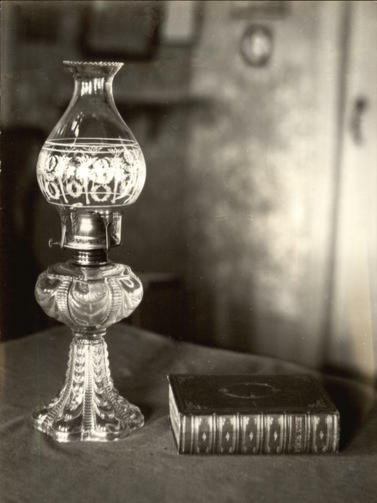
Old photo of a Bible on a table. Beside it is an old oil wick lamp made of etched glass.

.

In those situations there is a delightful and helpful “study,” which one dear saint calls “feeding upon a Bible verse.” Take a little verse, or a piece of a verse, into the duties and perplexities and pin-pricks of the busiest day, and it will often prove a veritable armor.

Think of going into the thick of a Monday morning with a cantankerous parent to appease, with a wide-awake and deeply interested baby at the mischievous age to watch, with two or three heedless and belated children to be buttoned and brushed and smoothed and sent happily off to school; with door bells and telephone bells to answer, with luncheon to manage for seven or eight persons, with a tardy announcement that a friend is coming for luncheon and to spend the afternoon with the neighbor next door running in to borrow, and chat and hinder, with the thousand and one besetments of a wife, and mother, and housekeeper. Think of her as taking hold of all these duties, freshly armored with the verse:

There hath no temptation taken you but such as man can bear; God is faithful who will not suffer you to be tempted above what ye are able: but will, with the temptation, make also the way of escape that ye may be able to endure it.

You can imagine one’s temptations to the hasty word, to undue fault-finding, to feeling sure that she simply cannot endure any more of this.

“No,” says the Word upon which she is feeding, “you must not say that. God will not suffer you to be tempted above what you are able. He says so. He knows the temptations; he will make the way of escape. He says so.”

Did he mean her? Oh, yes, indeed! He had her in mind. “Neither pray I for these alone,” said Jesus, “but for them also which shall believe on me.” That includes her, and she knows that “he ever liveth to make intercession for her.”

Who is going to estimate the effect on the world of that day’s soul-food, as the busy daughter, wife and mother, with quiet face and sweet, low voice, meets and endures her multiform temptations with the armor that her Lord has supplied!

Such Bible reading is Bible study reduced to living. Such a life will grow; will feel more intimate acquaintance with the Lord today than it had yesterday, more joy in his service.

Such a soul will learn to long after fellowship with Jesus Christ, and will daily be given more and more of his felt presence.

Such a soul will “hunger and thirst after righteousness,” not in a sickly, sentimental, dissatisfied way, but with an eagerness and a hopefulness born of experience, and an experience that will refuse to be satisfied with anything less.

I believe real soul-hunger to be a pleasant experience: as when one with a healthy, normal appetite sits down to a well-filled table, knowing that he is very hungry, and knowing, also, that his hunger will be satisfied.

What do you think of Isabella’s advice?

Have you ever tried her method of memorizing a single Bible verse to carry with you throughout the day?

Isabella based some of her novels on the advice she gave here about “feeding upon a Bible verse.”

In Frank Hudson’s Hedge Fence, for example, Frank learns that memorizing one Bible verse a day, and keeping it top of mind all day long, can make a big difference in his outlook and his walk with God. You can get your copy of the book by clicking here.

She used a variation of the method in A Dozen of Them, where a boy named Joseph promised his sister he would choose one Bible verse a month and make it a rule to live by. You can read the book for free by clicking here.

The Home-School

The Home-School. Isn’t that a pretty name for a school? Now I want all the Pansies to listen while I tell them where this school is.

When you get to Utica, on the Central Railroad, you want to take the street cars that always stand at the depot waiting, and half an hour’s pleasant ride up Genesee Street—one of the prettiest streets in New York State—will bring you to New Hartford.

Photo of a trolley, drawn by a single horse. A man wearing a conductor's uniform stands at the front of the trolley, holding the reins.
A horse-drawn street-car.

This is a pretty, pleasant village, just far enough away from the noise and bustle of the city, to give you sweet sights and smells, and pleasant country sounds.

Black and white photo of a trolley stopped in the middle of a residential avenue, where several people wait to board. In the background is a wide, tree-lined avenue with large, Victorian-era homes on one side.
A small town trolley (circa 1910).

A pleasant walk up the hill and you reach a home hiding among great old trees. You never saw a prettier yard than belongs to that house! Lovely little evergreen trees just starting into beauty, snuggling under the great giant trees that tower above them on every side. There are mossy banks, and grassy walks, and a lovely mound of grass, in the center of which plays a fountain. There is a winding graveled carriage drive quite up to the door of the house, and there are flowers, and shrubs, and ferns, and lovely grasses everywhere.

Black and white photo of a large, three-story home, with a wide veranda that spans the width of the house. there is an "ell" addition off the right side of the house. A healthy lawn leads up to the steps of the veranda and the home is surrounded by trees.
Photo of a large house in New Hartford, believed to be about the size and in a similar setting to The Home School (about 1910).

Of course the house hiding behind so much beauty is a large pleasant old house, with many unexpected rooms starting out where you thought there was only a door or, at best, a clothes press. In one of the sunniest of these rooms, the home-school gathers every morning at nine o’clock, some of them boarders, some of them day scholars, all of them happy and bright.

One day last week I peeped in on them. Someway, the pretty little tables covered with green spreads, and comfortable looking chairs standing before them, and the large old-fashioned lounge at one end of the room, and the pictures on the walls, and the flowers in vases everywhere, made this look unlike any other schoolroom that I ever saw. “The home-school,” I said to myself. “Yes, it is rightly named; it does look like a home.”

There is another reason why “home” is a particularly good name for it: there is a mother in it. One of those sweet and quiet women, who seem to be voiceless, where the plannings are concerned; who sit often in quiet corners, with knitting or sewing, while the bustle of life goes on; but who are, after all, the planners, the managers, the grand central wheels in the machinery of home life. Just such a mother is there; and to show you how all the scholars feel the influence of home, let me tell you that by tacit consent they have fallen into the habit of using the familiar “papa” and “mamma” to the heads of this household instead of the colder, more dignified names which are used in speaking of them.

Now let me tell you a bit of a secret. You know Faye Huntington? She has written many a story for us, you remember. Well, she is a power in this school; one of the teachers, one of the helpers, the friend to the scholars, the sympathizer in all their schemes, or troubles, or disappointments.

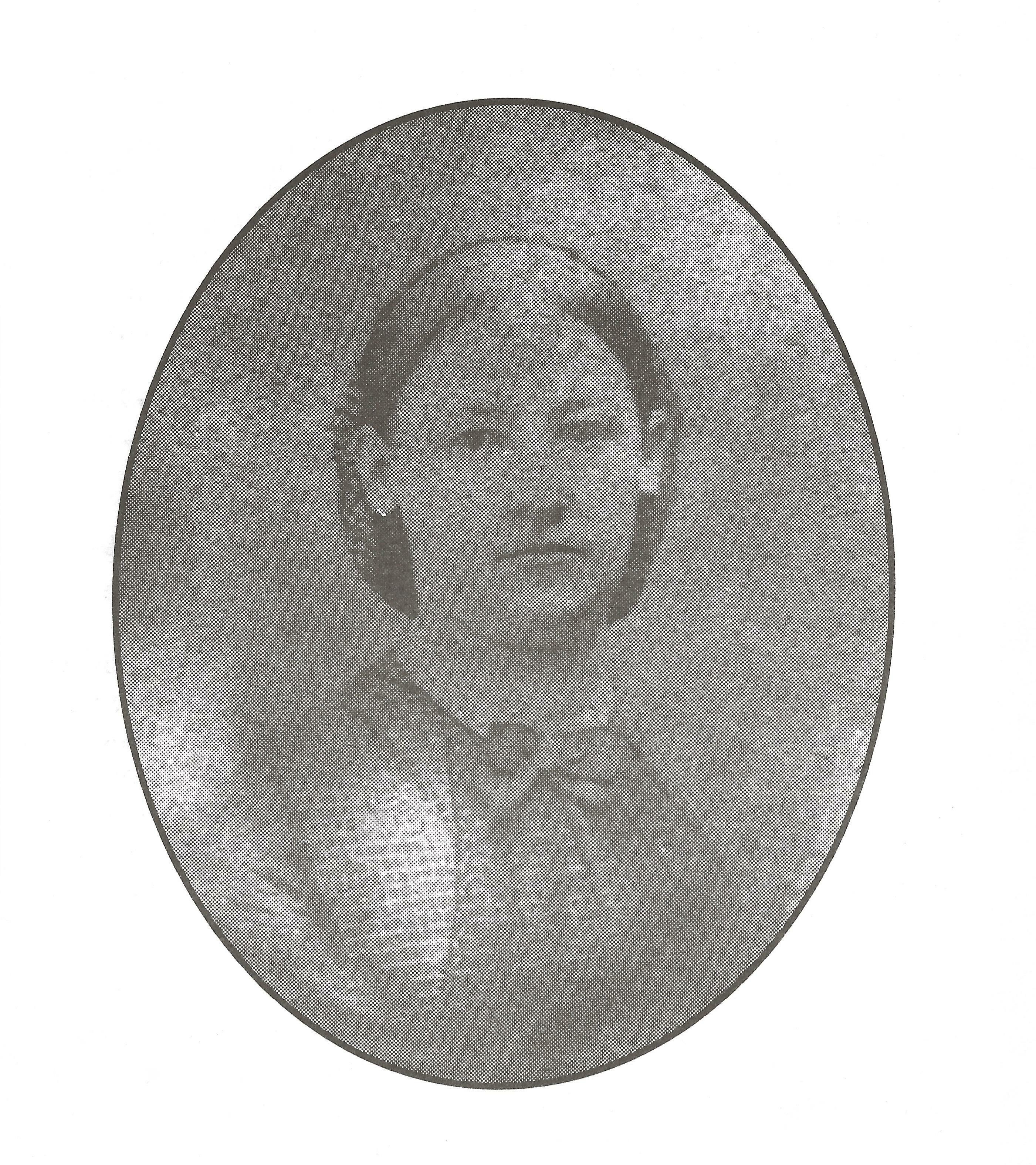
Theodosia Toll Foster (aka Faye Huntington)

The mother there is her own mother, and the young lady teacher who is the principal of this favorite school of mine, is her sister; and they all, from first to last, are among the dearest, and most honored, and most precious friends that Pansy has in this world.

Now, why am I telling you all this? How do I know but you are looking out at this moment a place that just suits you as a school-home? That is, perhaps your mothers and fathers are looking anxiously, and know enough about this matter to have discovered that good, safe, Christian school-homes are very hard to find. I thought you might like to know of one which your friend Pansy knows thoroughly, and endorses with all her heart. The ladies in charge she knew years ago; knew them as scholars, when they were formidable to some of us, because they took all the prizes; knew them as graduates of a seminary which was a power in that region, and which was proud of their scholarship.

If you want, any of you, to know more about that home-school, just address a letter to Miss Nanie Toll, New Hartford, Oneida County, New York, and you will be promptly and carefully answered.

Yours in love,

Pansy


Isabella wrote this sweet article (and glowing recommendation) for an 1876 issue of The Pansy magazine.

Do you like the way Isabella described the school and its surroundings? She was very familiar with the place she described, since she lived in the same small town.

Isabella’s husband was the minister at New Hartford’s Presbyterian church when her best friend Theodosia selected New Hartford, New York as the location for her school.

Can you imagine how wonderful it must have been for Isabella and Theodosia to be able to spend so much time together again, just as they had when they were young girls at boarding school?

You can read more about Isabella and Theodosia’s friendship in these blog posts:

BFFs at Oneida Seminary

Locust Shade … and a New Free Read!

Free Read: The Book that Started it All

I Like Him!

A Real Judge Burnham’s Daughter

Docia’s First Book

Our Fashion Plate

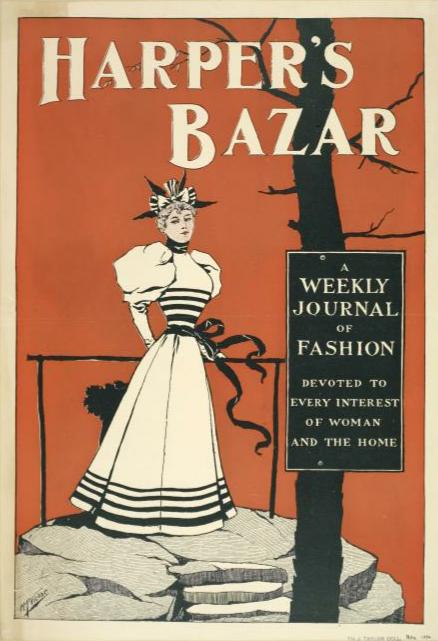
Isabella was 26 years old in 1867, when a new women’s magazine called Harper’s Bazar was launched in America.

Harper’s Bazar was different from other women’s magazines—like Godey’s Lady’s Book—because it was published weekly, rather than monthly. Its content was exclusively directed toward women. Each issue featured stories, decorating advice, recipes, instruction on home economics, needlework patterns, and, of course, fashion plates.

Illustrated cover of Harper's Bazar shows a woman in a white gown with black horizontal stripes at waist and hem. She wears a black and white fascinator-style bonnet. She stands at a metal railing atop a rock lookout. A text box reads, "A weekly journal of fashion devoted to every interest of woman and the home."
An 1896 cover of Harper’s Bazar, from the New York Public Library.

The fashion plates detailed the latest clothing trends from Paris and New York. By the late 1890s, most issues of the magazine featured hand-colored engravings of gowns, coats, bonnets, shoes, and just about every other article of clothing a lady could imagine.

An 1891 fashion plate, featuring a colored illustration of two women modeling clothes. One woman is dressed in a brown gown with a high neck and long sleeves puffed at the shoulders. The neckline, wrist cuffs, and floor-length skirt are trimmed in ribbons. She carries a folding fan and wears a brown bonnet adorned with large ribbon bows. The other woman wears a blue dress, also featuring a high collar and long sleeves with puffs at the shoulder. Her gown is decorated with lace at the neck, bodice, and cuffs. The floor-length skirt is draped in front with bows; in back the skirt is pleated from waist to hem, where more lace decorates the skirt.
An 1891 fashion plate

The magazine had a great influence over women in all walks of life. Isabella wrote about that influence in her novel Divers Women, when she described Kitty, who worked as a clerk in a dry-goods store and devoted almost all of her salary to recreating the fashions she saw in magazines:

Miss Kitty Brown was a tall slender girl with a very small waist, and a pale, rather pretty face. She was gotten up in the style of the last fashion plate. She wore trails and high heels, and bows, and frizzes, and puffs, and jewelry, and a stylish little hat with a long plume. She had a sky-blue silk dress with ruffles, and pleatings, and ribbons innumerable, and a white Swiss muslin and a pink muslin that floated about her like soft clouds.

An 1894 fashion plate, featuring a colored illustration of two women modeling clothes. One woman is dressed in a green skirt, green open jacket and white shirtwaist. Pearl-like trim is attached to the high collar, the lapels and cuffs of the jacket, as well as the hem of the skirt. She carries a parasol and wears a small green bonnet. The other woman wears a pink gown with high collar and floor-length skirt. The sleeves have a large puff from shoulder to elbow; from elbow to wrist is lace. The bodice has a large collar that is fastened at the bosom with a large artificial flower. The skirt has large vertical panels of white lace trim that are attached to the skirt at varying heights. More large panels of lace trim encircle the hem.
An 1894 fashion place

In creating Kitty Brown, and other female characters, Isabella often conveyed the message that ladies who dressed as Kitty did were uneducated, lacking in taste, and prone to take fashion to extremes.

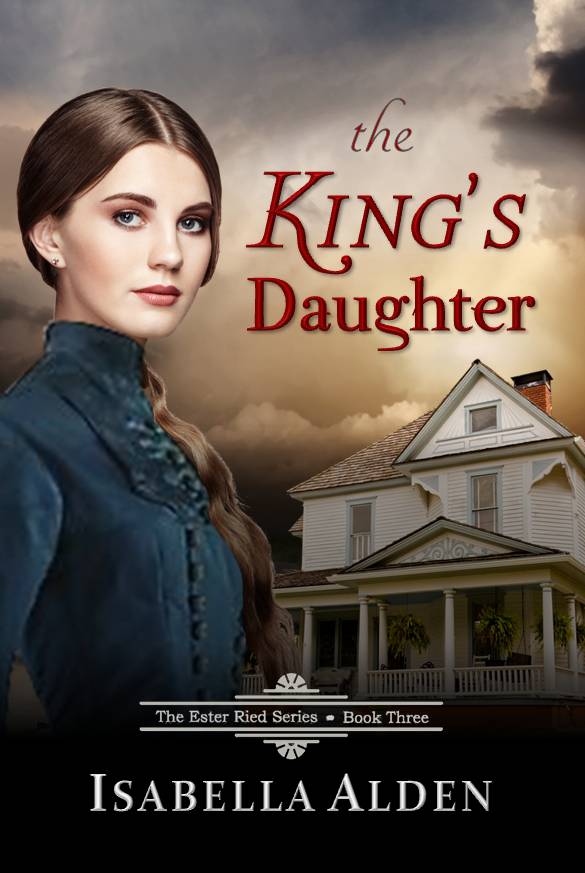
Isabella objected to seeing women dressed in an “accumulation of silk, and lace, and flounce, and ruffle, and fold, and double plaits, and single plaits, and box plaits, and double box plaits, and fringe, and gimp, and ribbons, and bows.” That’s how she described the trends that were fashionable when she wrote her novel, The King’s Daughter.

An 1896 fashion plate, featuring a colored illustration of two women modeling clothes. One woman is dressed in a brown gown with a plain skirt. The bodice has a high neck trimmed with lace. At the shoulders are a large, stiff panels of fabric that extend the gown's shoulder line horizontally. Below the panels are large puff sleeves that extend from the shoulders to below the elbows. The remaining sleeve from below the elbows to the wrists are fitted and adorned with lace. The bodice has a wide lace trim above the bosom; vertical lace panels trim the lower bodice to the waist, where there is a large peplum made of lace and other trimmings. The other woman wears an evening dress of light green. The bodice has a low neckline and lace trim below the bosom. The shoulders are adorned with bunches of small purple flowers. The puff sleeves are large and end just below the elbows. Narrow and deep rows of lace trim the hem of the floor-length skirt. The woman carries an ostrich-plume evening fan and wears long white gloves that reach allmost to her elbow.
An 1896 fashion plate

Later in the same book, she sympathized with the many layers of fabric and trim the fashion magazines required “one poor little suffering body to carry around with her.”

She even wrote a brief article for The Pansy magazine about women’s slavery to fashion—an article she flavored it with just a touch of shade:

Our Fashion Plate

Fashion, you know, is a queer thing. It keeps changing and changing without regard to taste, or even to sense, one would think; and as we are fond of getting fashions from abroad, I present you with the picture of two ladies in full court dress. They are from Bombay, which is certainly a large and important enough place for us to give attention to their style of dress.

Woodcut engraving of two women standing in front of the high wall with beautiful carvings in the stone. They are dressed in traditional clothing of India. On their forearms they wear large cuff bracelets; their feet are bare.

You will notice that they have taken special pains with their embroidery and jewelry. I doubt whether we could match the bracelets in this country, in size, at least. But what about the feet! How should you like a fashion that would banish all the pretty kid boots, and scarlet, and navy-blue, and brilliant plaid stockings, and oblige us to dress just in our “skin and toes” as a certain little miss put it? Oh, well, there is really no telling what we may come to. I have so much faith in our dear American people that I believe they would follow like martyrs in the bare-footed line, if the next orders from Paris should direct it. Yes, and the little girls would lay aside their kid boots and lovely stockings with a sigh indeed, but they would do it.

As to the bracelets, judging from the size which some ladies and even a few little misses wear now, I am not sure but we could put these large ones on without a sigh; that is, if they cost enough money. Meantime, however, I am rather glad that we don’t live in Bombay. Aren’t you?

What do you think of Isabella’s opinions about fashion?

Do you think that women (and men) pay too much attention to fashion styles and trends?

You can read more about Isabella’s novels mentioned in this post by clicking on the covers below:

.