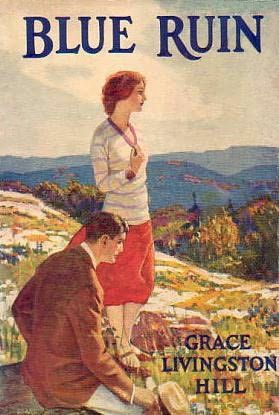
Many people who love to read Isabella Alden’s books also enjoy the novels written by her niece, Grace Livingston Hill.
If you’ve ever searched for some of Grace’s titles, you’re not alone. Used copies of her novels are hard to find. If they are listed for sale on Internet sites, such as Ebay, fans immediately snap them up.
In the days before the Internet, fans had to search through used book stores to find her books. In some cases, they turned to newspapers to try to find copies. Here’s one example:
In the 1990s an Illinois newspaper had a regular column called “Good Neighbors.”
The column shared readers’ advice on a variety of topics, and gave readers a chance to ask or answer questions.
In March 1996 they ran a brief paragraph in the Good Neighbors column:
The newspaper received quite a few responses! Here are some of them:
You can tell there was a little bit of a bidding war going on, with some readers offering to pick the books up and pay for telephone calls (at a time when there were “toll” charges for calling a number in a different area code).
It happened again in 2001, when “M.B. of Lexington” offered to give away dozens of Grace Livingston Hill books:
It sounds like the newspaper was quite surprised to learn so many people were interested in novels that were written (at that time) almost 100 years before. And yet, Grace Livingston Hill’s books are still popular!
How about you? Do you read and collect Grace Livingston Hill novels? Do you have a complete collection? What are the methods you use to hunt down copies of her books?
Today, a soda fountain—when you can find one—is a quaint relic of a by-gone era. Think of soda fountains and you may think of ladies wearing corsets and long skirts, or gentlemen who never leave home without a hat, tie, and pocket watch.
Soda fountains are such benign objects to us, it’s hard to imagine that they ever had the potential to cause harm. But in Isabella’s day, there were hidden dangers in every soda fountain, in every town in America.
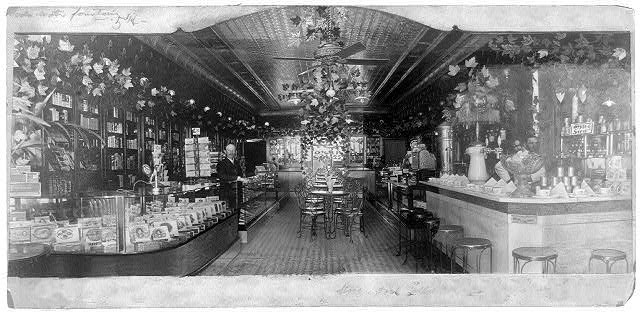
An average American drugstore in 1900. A soda fountain is on the right side of the photo.]
Isabella Alden recognized those hidden dangers and wrote about them, because she knew the dangers were not inconsequential. There were pitifully few laws at the time that regulated the sale or distribution of products that could be bought at the time; and many products included alcohol and addictive ingredients.
Children could obtain alcoholic drinks in saloons. Doctors prescribed alcohol to patients young and old.
A pair of 1894 trade cards depicting “a big spender and his girl” at the soda fountain.
And commonly used tonics and medications often contained alcohol and opiates—sometimes at alarmingly high levels—and most did not disclose their contents on their labels.
In 1888 this cough syrup proudly listed its addictive ingredients—cannabis, morphine, alcohol, and chloroform—on its label. Since no laws required such disclosures, few manufacturers revealed their product contents.
Here’s an example: In 1885 a man named John Pemberton began marketing a beverage he invented. He called it “French Wine Cola—Ideal Nerve and Tonic Stimulant.”
In an 1880 drugstore in Washington DC, this soda fountain sold a beverage called Wine Coca for five cents a glass.
Why such a name? Because every 7 ounce glass contained 9 milligrams of cocaine and a walloping dose of caffeine extracted from the kola bean. Initially, sales were sluggish.
But the following year, when Pemberton renamed the drink “Coca-Cola,” sales picked up. By the 1890s, Coca-Cola was being sold in stores and soda fountains all over the country . . . and it still contained cocaine and caffeine. (Coca-Cola’s formula didn’t change until after 1903.)
An 1890s trade card for Coca-Cola, touting it as the “ideal brain food” for relieving mental and physical exhaustion.
That’s one example of the “hidden dangers” Isabella wrote about.
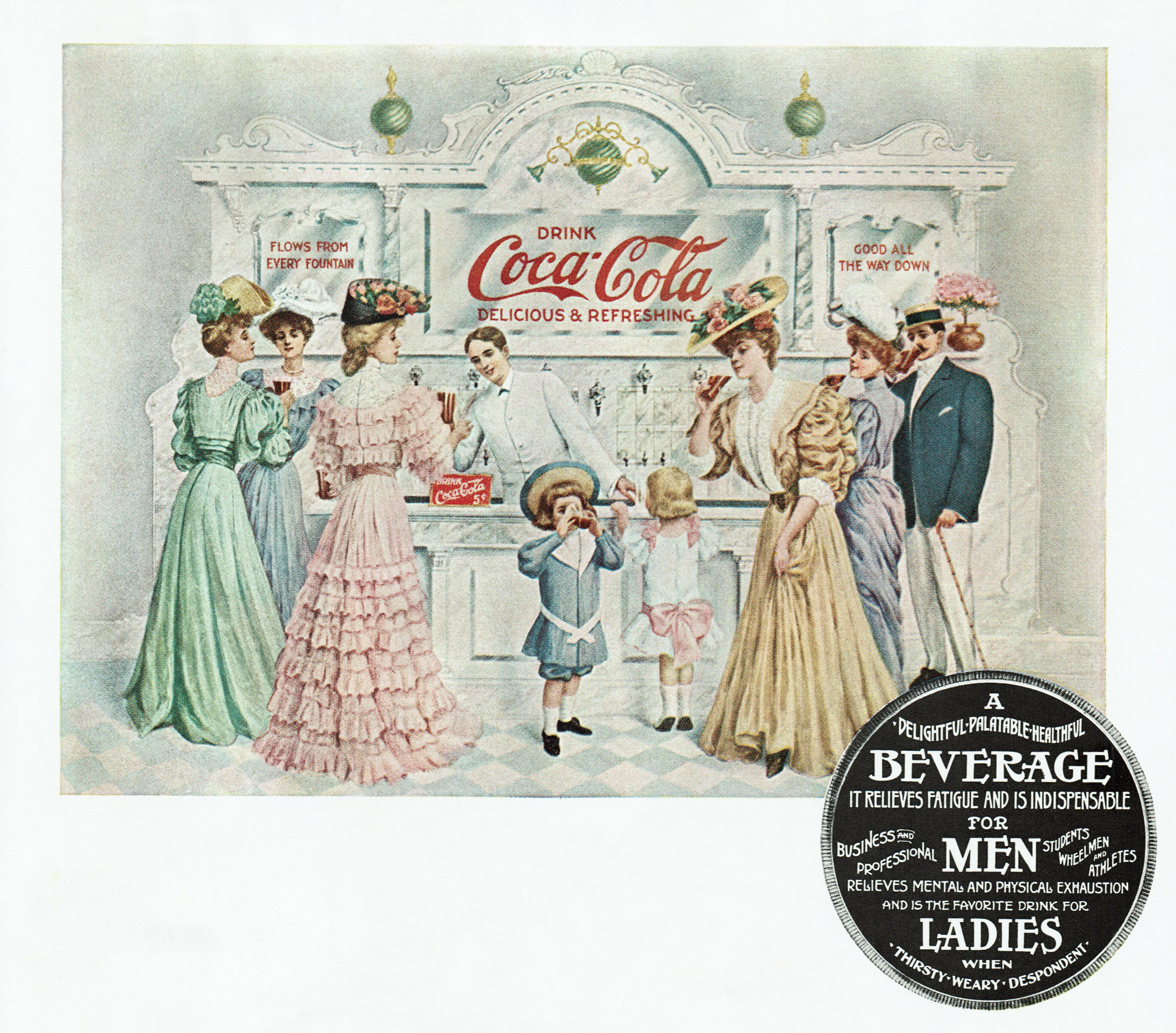
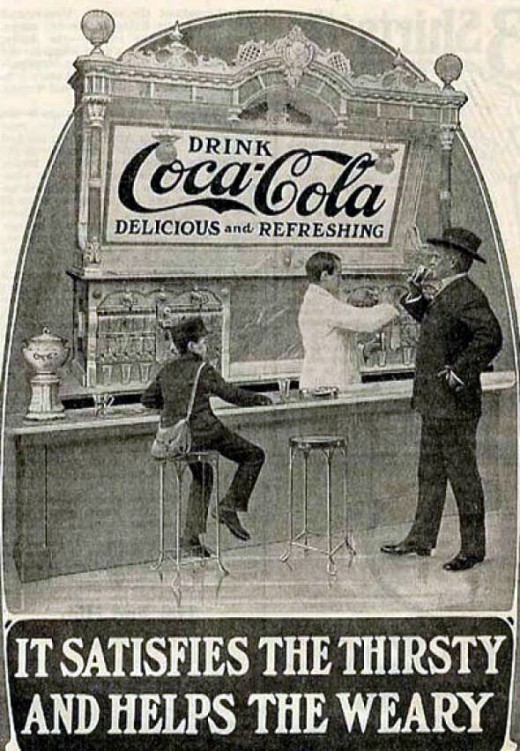
A 1905 magazine ad for Coca-Cola.
In her novel One Commonplace Day, several scenes take place in the town drug store, which Isabella describes this way:
[It was ] glittering with its show of colored glass and brilliant liquids, and arranged with that regard to lovely combinations of color which is common in first-class drug stores. There is at one end a handsome soda fountain, with all the various cooling syrups and elegant appliances of first-class establishments.
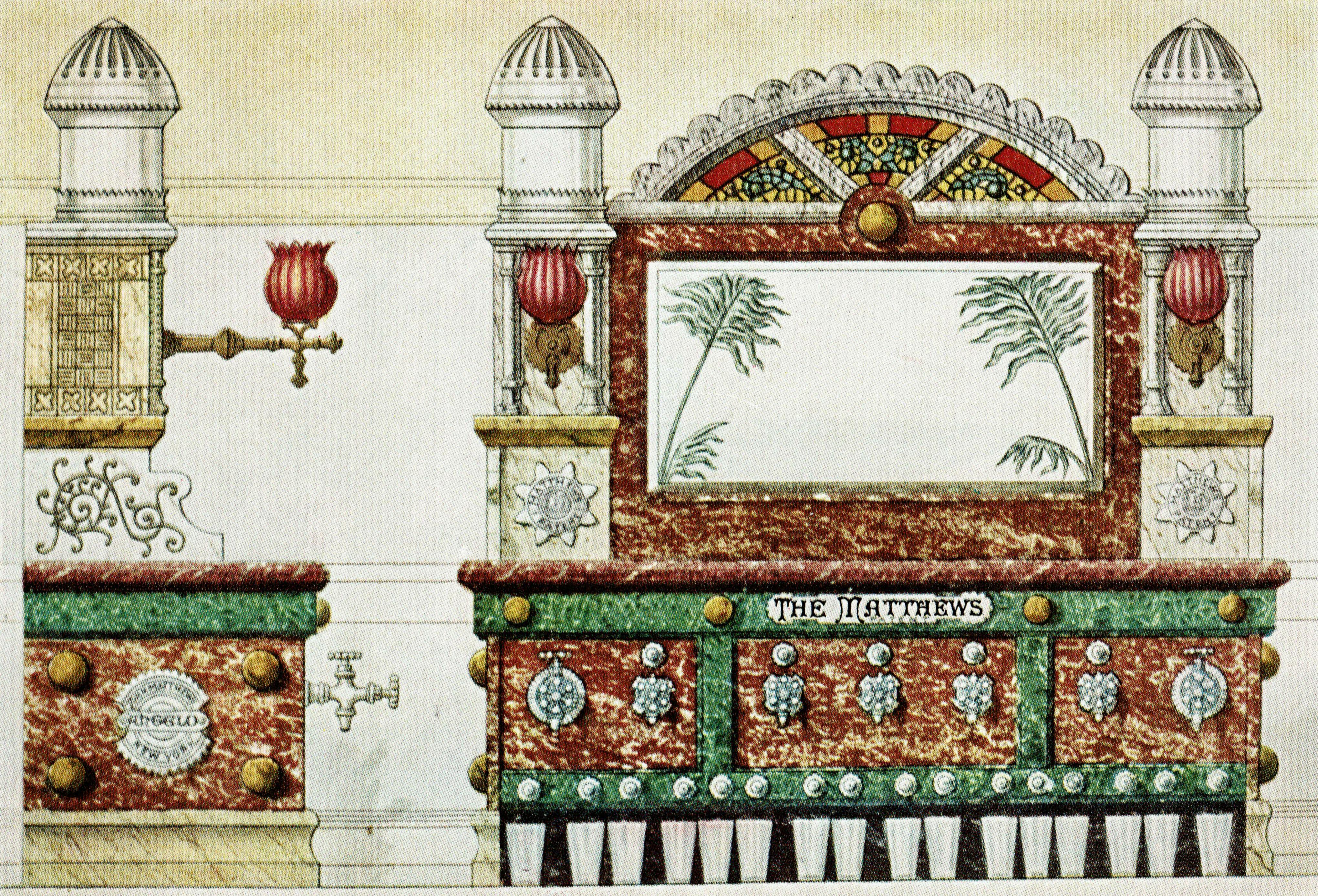
The design for a new soda dispensing unit, showing front and side views, with marble counters and inlays (circa 1900).
Charlie Lambert, one of the characters in the story, was a temperance man who took pride in the fact that he drank no liquor and had no temptation to drink any. But he often took his lunch at the soda fountain, where he drank a soda almost every day during the summer.
An 1890 newspaper ad for Coca-Cola aimed at temperance advocates, despite the drink’s ingredients.
Chances are, Charlie’s soda was laced with wine, cocaine, caffeine, or one of any number of additives that were not disclosed to unsuspecting consumers.
The soda fountain in a Peoples Drug Store, Washington D.C., 1909.
In the book Isabella advances the theory that people often become addicted to alcohol or drugs because they develop a taste for them as children.
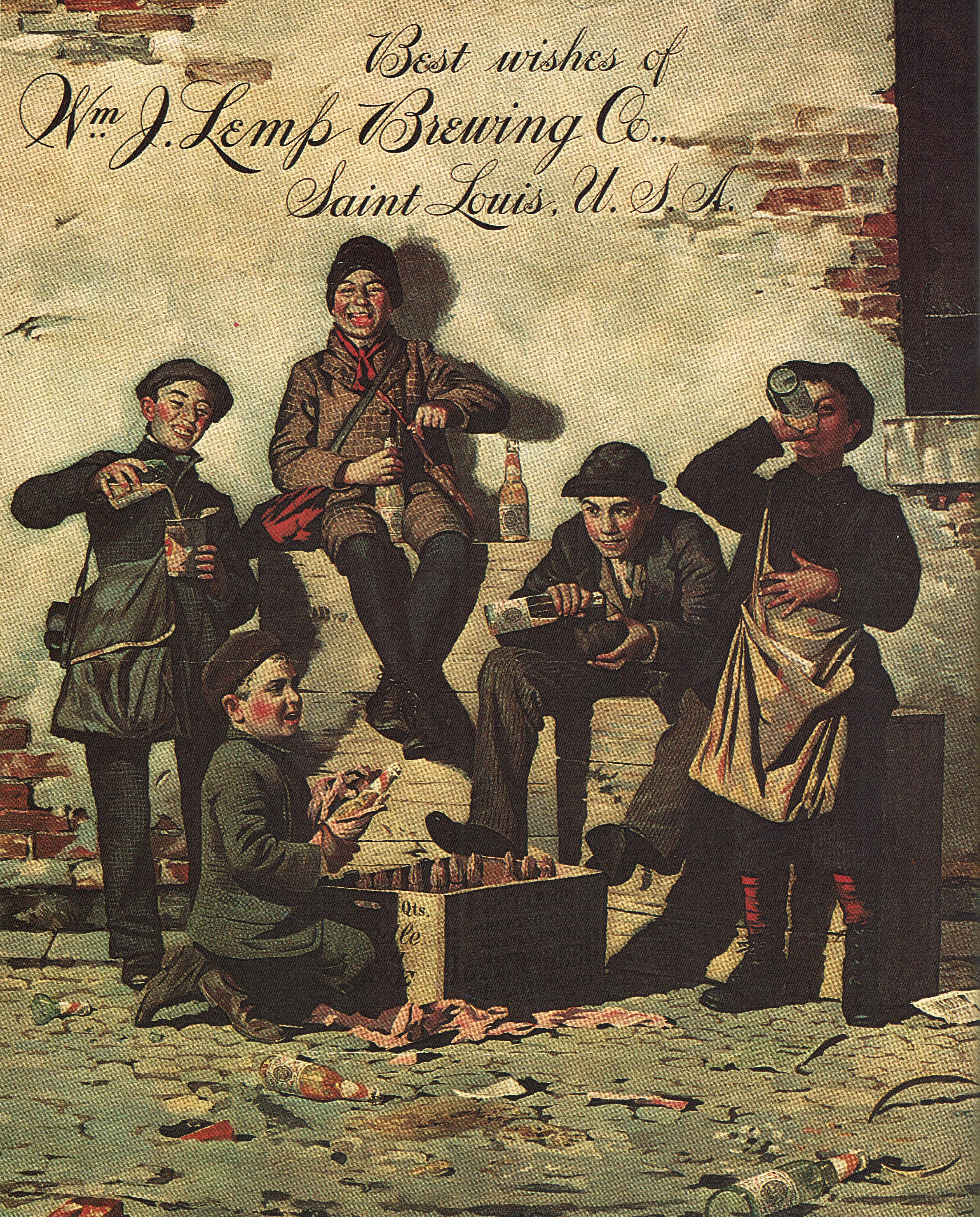
A 1916 advertising broadside showing boys drinking a case of beer or liquor.
When you think of the number of children who sat on soda fountain stools, unconsciously swinging their dangling feet as they enjoyed a glass of Coca-Cola—all the while pumping nine milligrams of cocaine through their veins—Isabella’s theory begins to make sense.
A 1905 ad in Harpers’ magazine.
Advertising for Coca-Cola and similar beverages was everywhere. Ads showed happy, peppy, beautiful people sipping cocaine-laced drinks.
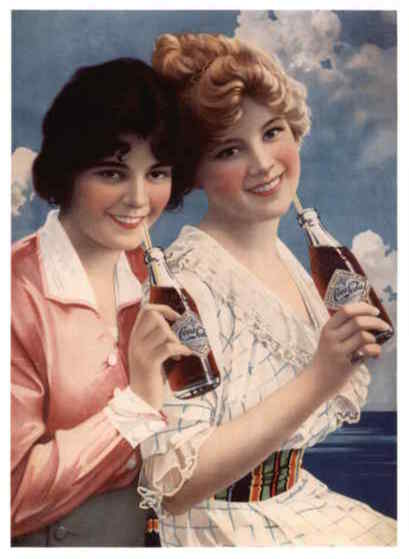
Coca-Cola calendar art, 1915.
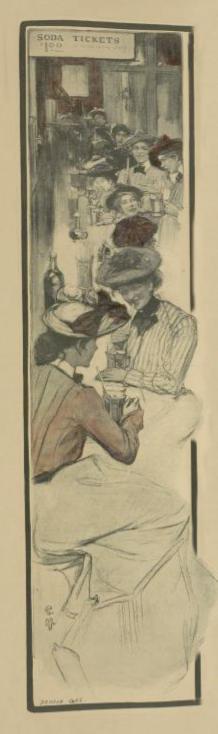
And some soda fountains and saloons distributed tickets to people on the sidewalks, with a buy-one-drink, get-one-free offer.
By today’s standards, Isabella’s novels about temperance and the evils of alcohol may come across as strident and unreasonable. In reality, Isabella was fighting a very real problem in the best way she knew how; by writing stories people could relate to.
An iconic 1890s Coca-Cola advertisement.
And while One Commonplace Day is, on the surface, a story about the American temperance movement in the late 1880s, it carries a deeper message.
In the book, a group of prayerful Christians band together to help one of their neighbors overcome his addiction to alcohol. They formulate a plan to intercede in his life and help put him on the path to sobriety.
A crowded Coca-Cola soda fountain in 1910.
They pray for him, invite him to church, intercept him before he can enter a saloon or drug store, and do everything they can to help him kick his addiction.
Much has changed since Isabella wrote One Commonplace Day in 1886, but Americans still struggle with issues of alcoholism and addiction.
What do you think? In today’s world, is it possible for a group of prayerful Christians—like the people Isabella wrote about in One Commonplace Day—to band together to change the life of one person who struggles with addiction?
Coca-Cola wasn’t the only tonic that promised health benefits from questionable ingredients. You can read more about quack cures and patent medicines on these sites:
This short story, set in a big city during the dead of winter, first appeared in the 1875 book Dr. Deane’s Way. Isabella and her best friend Faye Huntington (whose real name was Theodosia Toll Foster) contributed several stories each to the book.
In Isabella’s story “Choker and Old Stuffy,” Tom Benton and Dick Graves are struggling medical students. They’re so poor they have to take turns wrapping up in a ragged old comforter just to stay warm during the cold winter months! But a chance invitation from an unexpected source will soon change their lives forever.
You can read this story on your phone, ipad, Kindle, or other electronic device.
Or you can read it as a PDF document on your computer screen. You can also print the story to share with friends.
Click on the book cover to choose your preferred format from BookFunnel.com.
It’s the time of year when millions of Americans enjoy the out-of-doors. In Isabella’s novels, her characters spent summer days walking, hiking, and playing sports of all kinds.
A favorite pastime for Isabella’s characters was the game of croquet, and she may very well have played the game herself.
A romantic scene captured on the 1866 cover of a pamphlet on the rules of croquet.
Beginning in her early twenties, Isabella made several trips over the years to the Castille Sanitarium in New York, where she was treated for health concerns. The owner of the sanitarium encouraged all her patients to play croquet, and it’s possible Isabella followed the doctor’s orders.
Whether she played the game herself or not, she certainly appreciated the game. In her books, characters young and old played croquet, as did the rich and poor. No matter what their circumstances, croquet brought her characters together.
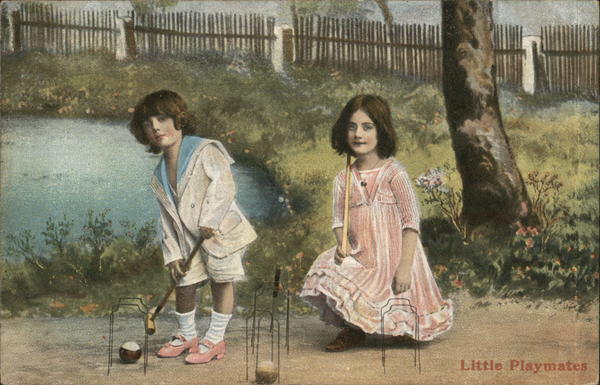
Children Playing Croquet – Little Playmates
In Cunning Workmen, Sunday-school teacher Mr. Hammond attends a young people’s party where he notices that Peter, one of his young charges, isn’t participating in any of the games.
“What about croquet?” he presently asked. “Miss Blake seems to be enjoying the game, and the boys are very patient in their teaching. Why haven’t you joined them?”
Peter’s honest face grew red and troubled.
“I don’t quite know about them,” he said, earnestly. “I was waiting for you to come so I could speak to you about it. Them red and yellow balls look nice, and I’m most sure I could strike them through those little wires, if that’s what they’re after; but …”
“Well?” his teacher said, in kindly inquiry.
“Why, they look so exactly like them billiard things that they play with down at the saloon. Tom Randolph took me in one day. He plays there a good deal, and if them things are wrong, why ain’t these?”
“But it isn’t the red and yellow balls that are at fault, you know. It is the associations. Billiard playing is generally done for money, and croquet is simply for pleasure and exercise. Isn’t there a difference?”
“Yes,” said Peter, slowly and thoughtfully, “there’s a difference. I see that.”
Leave it to Isabella to find a way to teach a lesson through a simple game of croquet!
Playing croquet in Cape May, New Jersey, 1875.
She also used the game to show readers the motivations and mindset of her characters. That was the case with the Reverend Mr. Tresevant in The King’s Daughter, when he decided to play croquet rather than attend a temperance meeting.
Later, in Wise and Otherwise, the next book in the series, Mr. Tresevant makes a fateful decision. When a little neighborhood boy is extremely ill and lay dying in his bed, the entire town, including Dr. Douglass, went in search of the Reverend Mr. Tresevant.
Dr. Douglass’ wife later asked if he ever found the minister:
“Did you tell him about Freddy, and how much they wanted to see him?”
“I did,” relaxing into gloom and laconic answers.
“What did he say?” Mrs. Douglass was entirely accustomed to cross-questioning her husband, and understood the process thoroughly.
“That he would go down there as soon as the game of croquet was concluded.”
The lady opposite him set down her cup that had nearly reached her lips and looked at her husband, while an expression of mingled doubt and dismay spread over her face.
“Dr. Douglass! Did you tell him the child was dying, and that they had been in search of him?” she asked in shocked tones.
“I explained the latter fact to him elaborately, and told him the boy was very sick, and that I feared he might not live until morning.”
For once the ever ready tongue opposite seemed to have not a word to utter. When she found voice again, it was to ask, in a very subdued way, “Do they know it at the house—know that you have found him, I mean? What do they think of it?”
“They know that I found him—and where—for they asked me both questions. I did not enlighten them as to his occupation, and said what I hoped and believed was true, that I thought he would be along very soon; but he had not arrived when I came away, a quarter of an hour ago. The game must have proved a complicated one.”
Now, the question is, was Mr. Tresevant’s heart so bound up in the game of croquet that he could not even leave it to answer a summons from the dying?
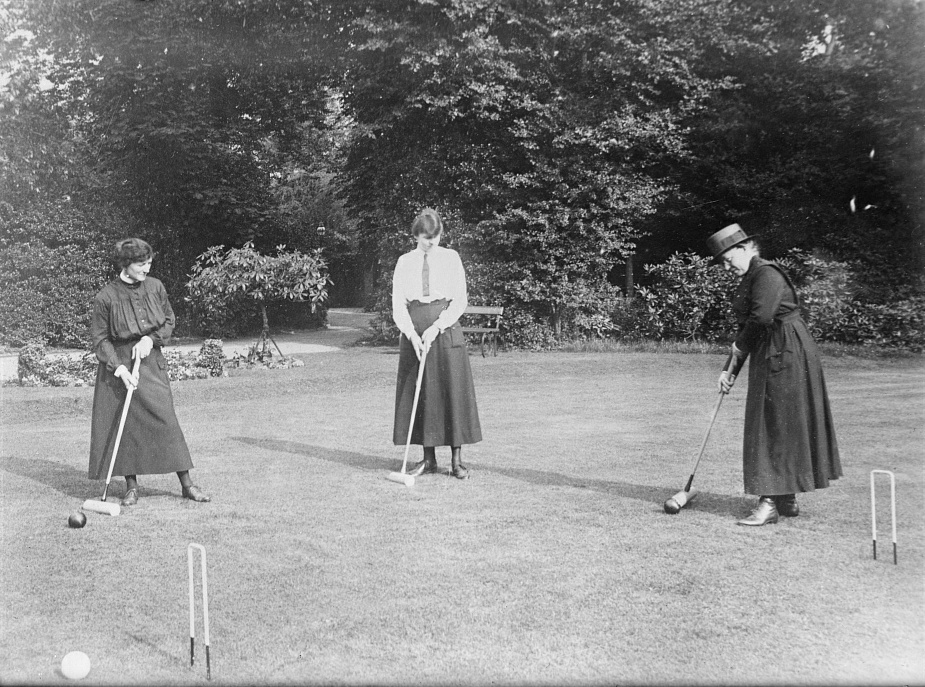
A tense moment in a game of croquet, 1918.
In the novel, Isabella does go on to explain the reasons Mr. Tresevant would not leave his croquet game to pray with the family of a dying child; and in doing so, she tells us much about the state of Mr. Tresevant’s heart and soul.
Students play croquet at girls school in Pennsylvania, 1901.
In all, Isabella mentioned the game of croquet in at least nine novels. Sometimes she used the game to introduce topics of right and wrong Christian behavior, as in the discussion above from Cunning Workmen.
Other times she simply used it as a way for her characters to enjoy each other’s company on a bright summer afternoon.
How about you? Have you ever played croquet? What do you like most about the game?
You can find out more about Isabella Alden’s stay at the Castille Sanitarium in New York. Click here to read the post.
And you can find out more about Isabella’s books mentioned in this post by clicking on any of these book covers:
Reviews and giveaways for Christian fiction and sweet, clean fiction. Bringing readers information on great stories and connecting authors with their readers.




















 Isabella Alden