Isabella’s Most Difficult Year, Part 2

This is the second of two posts about Isabella’s most difficult year. If you missed the first post, you can read it here.

In the spring and summer months of 1924, Isabella and her family carried on without her beloved husband, Ross, who died in March of that year.

The influenza epidemic that precipitated Rev. Alden’s death had waned, but there were still reported cases as late as the summer of 1924. That’s when Isabella’s sister Marcia fell ill.

Black and white photo of a woman of about 60 years of age. Her wavy hair is parted in the middle and softly drawn up into a bun at the back of her head. She wears a dress with a high neckline and a soft shawl-style collar. The sleeves are long and have white cuffs trimmed with lace at her wrists. She holds an open book in her hands.
Marcia Livingston

Again a doctor was called to the house in Swarthmore to treat her, but the virus had weakened her heart. On August 7, Marcia succumbed to myocarditis, a rare but serious condition that causes inflammation of the heart muscle.

It had to have been a devastating blow to Isabella. For their entire lives, she and Marcia had been close. Marcia was the sister who tended Isabella when she was young, who watched over her when she was ill, and prayed that Isabella would choose Christ as her Saviour (you can read more about that here). Marcia helped introduced Isabella to her husband Ross; and after Isabella married, the Livingstons and the Aldens shared a home in Florida, and lived as neighbors at Chautauqua. They were as close as sisters could be.
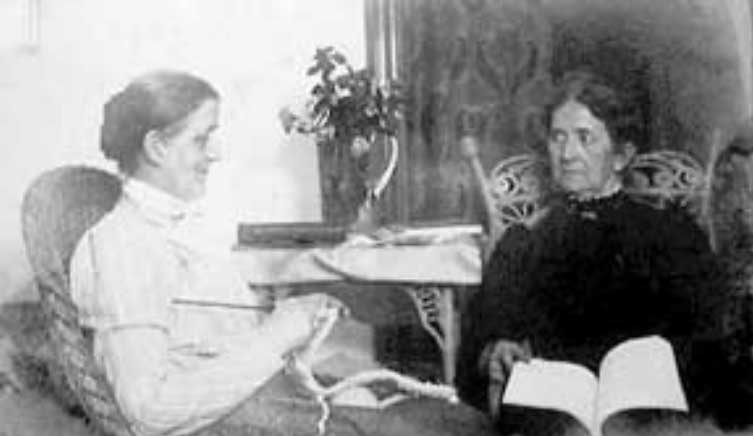
Black and white photograph of two elderly women sitting together. They are both wear their hair parted in the middle and pulled back to a braided but at the back of their heads. Isabella is dressed in a long-sleeved, high-neck blouse and skirt and she is knitting. Marcia wears a dark colored, high neck, long-sleeve dress and holds an open book in her hands.
Isabella Alden (left) and her sister Marcia Livingston (courtesy Daena Creel).

Isabella wrote:

I held the dear hand of my one remaining sister Marcia all that day, and prayed for one more clasp of it, one look of recognition, all in vain. She went, as did my dear husband, without a word or look.

Marcia was laid to rest in Johnstown, New York; that was where Marcia and Isabella grew up, and where Marcia met her husband Charles (you can read more about that here). Her grave is beside Charles’ grave and the grave of their infant son Percy.

Photo of a large stone grave marker that reads: Marcia Macdonald wife of Charles M. Livingston 1832 - 1924.
Marcia Macdonald Livingston’s grave marker in the Johnstown Cemetery.

Although there’s no known record of it, Isabella, Grace, and other family members may have traveled to New York for the interment. If they did make the journey, it’s probable that Isabella’s son Raymond did not accompany them.

By the time Marcia died, Raymond was receiving medical care in Philadelphia for a chronic condition. All his life Raymond endured a painful form of eczema that caused open sores and blisters, leaving him prone to infection. In May of 1924, Raymond’s condition became worse, and he began to regularly see a doctor in Philadelphia.

Black and white full-body photo of a gentleman standing out of doors in front of a large stone building. He wears a three-piece suit, a bowler hat and spectacles. One hand is in his trouser pocket; in the other hand he holds a pair of gloves.
Raymond Alden, from the Stanford University 1923 Yearbook.

By July Raymond’s wife Barbara wrote to her cousin about Raymond’s health, saying that although he was still very sick, he had shown “marked improvement.”
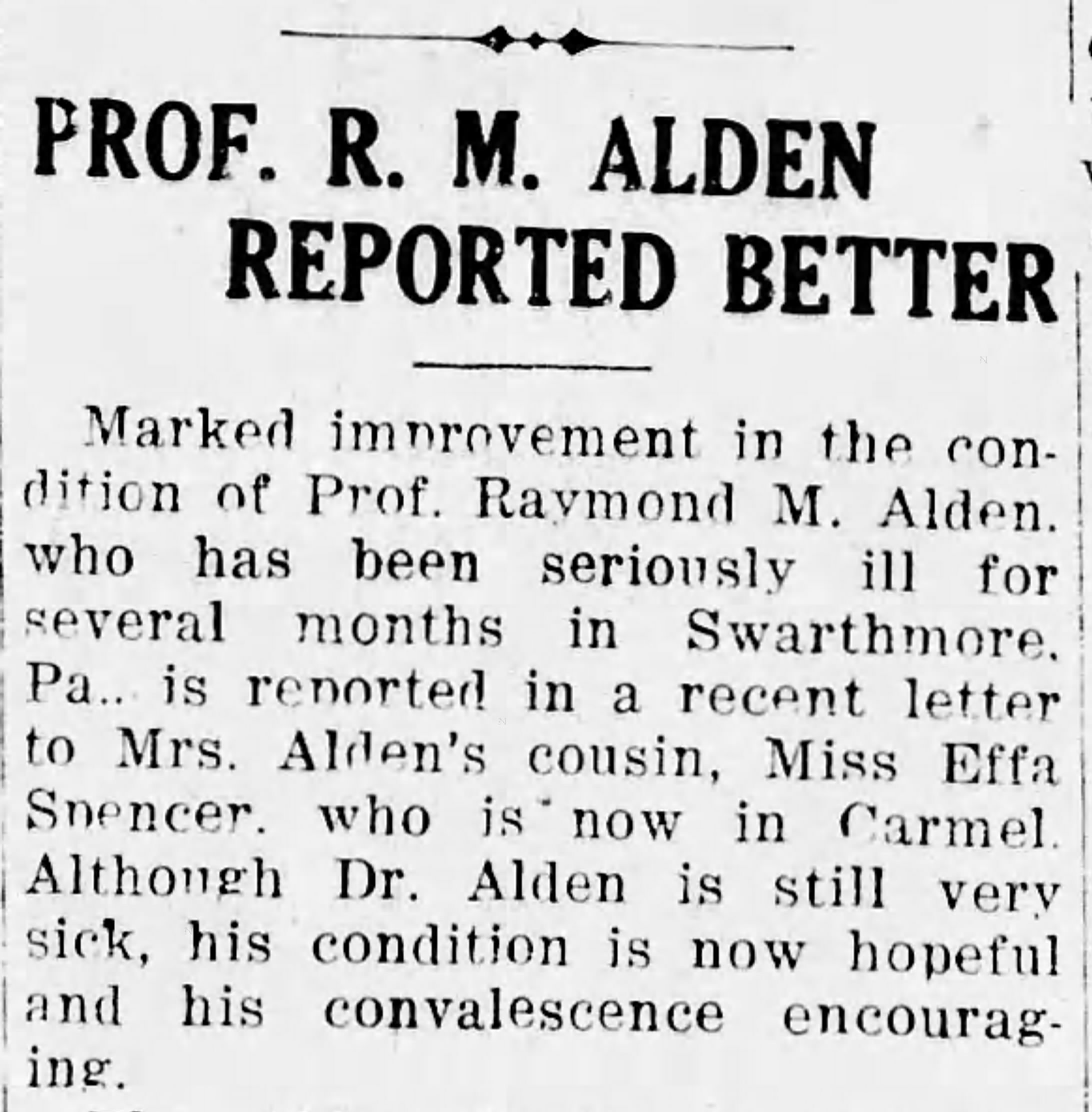
Newspaper clipping. Headline: Prof. R. M. Alden Reported Better. Marked improvement in the condition of Prof. Raymond M. Alden, who has been seriously ill for several months in Swarthmore, PA., is reported in a recent letter to Mrs. Alden's cousin, Miss Effa Spencer, who is now in Carmel. Although Dr. Alden is still very sick, his condition is now hopeful and his convalesence encouraging.
From The Peninsula Times Tribune, July 15, 1924.

But his improvement was short-lived. By September Raymond was suffering from an infection and, possibly, from an allergic reaction to medications he was given.

On September 27, less than two months after the death of his aunt, Raymond Alden died. Isabella was with him at the end.

“Mamma, fan me!” was the quick eager word my dear boy said, and the next minute he was gone.

Grace later wrote:

My saintly uncle went first, then my precious mother, and then my brilliant cousin, Dr. Raymond M. Alden. One blow after another that nearly crushed us all.

The family held a private funeral service for Raymond in Philadelphia; then it was time for the Aldens to leave Swarthmore and return to their Palo Alto home. Grace described it this way:

Then my dear aunt, courageous and wonderful through it all, went back to her California home with her brave daughter-in-law, and her five grandchildren.
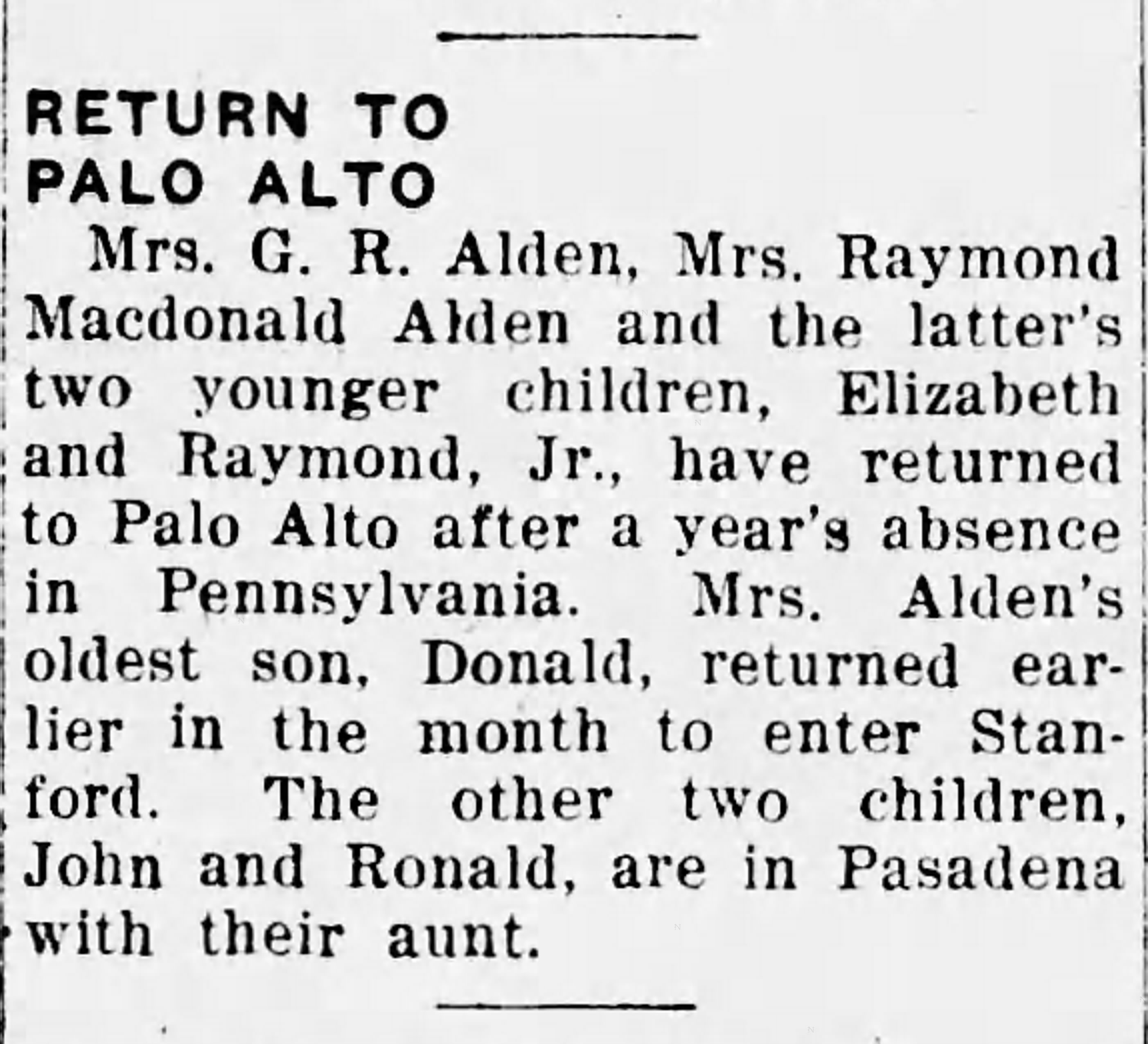
Newspaper clipping. Headline: Return to Palo Alto. Mrs. G. R. Alden, Mrs. Raymodn Macdonald Alden and the latter's two younger children, Elizabeth and Raymond, Jr., have returned to Palo Alto after a year's absence in Pennsylvania. Mrs. Alden's oldest son, Donald, returned earlier int he month to enter Stanford. The other two children, John and Ronald, are in Pasadena with their aunt.
From The Peninsula Times Tribune, October 18, 1924.

There must have been times when Isabella felt the acute loneliness of losing the three most important people in her life. She once wrote to Grace:

There is no one in all the world who needs me any more. I’m too old to help anybody in any way, and too weak to be anything but a burden to those who have already more than they can bear. Why can’t I go now to my eternal rest? Does it seem to you wrong to pray for this?

There were other times when she spoke of the many family members who had died over the years, and asked impishly, “What do they think of us all by this time? Do they meet together and talk us all over?” She thought often of the loved ones who had “gone ahead” and wrote to Grace:

Sometimes I have to put my hands over my eyes in the darkness and say: “Casting all—All—ALL your care upon Him.” Oh, why doesn’t He take me home?

But God did not call her home. Isabella lived with Barbara and her grandchildren in the house she and Ross built on Embarcadero Road in Palo Alto for another six years.

A young woman with dark hair stands facing the camera. She wears a coat and a hat with a wide brim and tall feathers sticking up from the crown. Her hair is styled in a bouffant with a bun on top of her head hidden by the hat.
Barbara Hitt Alden, about 1910

By all accounts, Barbara was loving and kind and “more than a daughter” to Isabella. And despite Isabella’s belief that she was “too weak to be anything but a burden” to Barbara, she would soon find that her work on Earth was not done, and that she had one last novel to write before she would be called Home to her Saviour.

Next Month: Isabella’s Final Novel

You can read more about the house Isabella and Ross built in Palo Alto by clicking here.

Click here to read the story of how Marcia and Charles Livingston introduced Isabella to her husband, Ross.

Brothers and Sisters, Husbands and Wives

Here’s some little-known trivia about Isabella’s family, beginning with Isabella’s mother, Myra Spafford.

Myra was close to her sister Julia; they were born only a year apart in Canaan, near Johnstown, New York.

Myra and Julia’s father (Isabella’s grandfather) was Horatio Spafford. Horatio was a teacher, inventor, author, and—for a few years—a newspaper publisher.

Julia’s husband Duncan Macdonald in an undated photo

.

When she was still a teenager, younger sister Julia married Duncan Macdonald, who also grew up in Johnstown, not far from the Spaffords.

Like his new father-in-law, Duncan was a newspaperman. He was famous for his work as a journalist; and his newspaper, The Schoharie Free Press, was well-known throughout the state of New York.

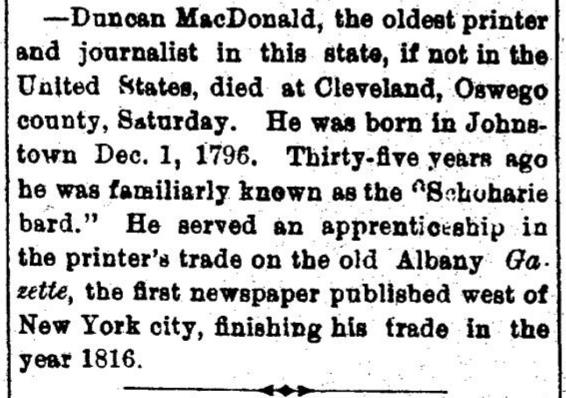
A brief obituary of Duncan Macdonald, which appeared in the Plattsburgh New York Sentinel on September 9, 1887.

.

A few years after Julia’s marriage to Duncan Macdonald, Myra married Duncan’s brother, Isaac.

Myra and Isaac went on to have seven children—the sixth of which was Isabella Macdonald Alden.

Isabella Alden in an undated photograph.

.

Myra and Isaac, Julia and Duncan, lived very near each other and raised their children together in Johnstown, New York.

A view of Main Street in Johnstown, New York, about 1905

.

And just as they lived their lives together, they also went to their final rest together. Myra and Isaac are buried near Julia and Duncan in the Johnstown Cemetery.

Isaac Macdonald’s grave marker.

.

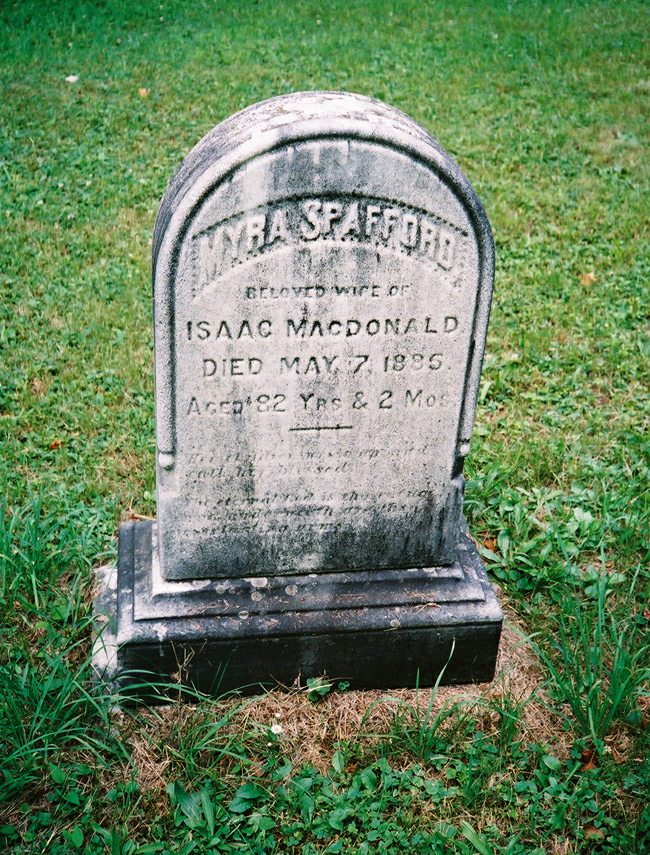
Myra Spafford Macdonald’s grave marker

.

Julia Spafford Macdonald’s grave marker, Johnstown Cemetery in Johnstown, New York.

.

Duncan Macdonald’s grave marker, Johnstown Cemetery in Johnstown, New York.

.

A generation later, Isabella’s family welcomed another pair of siblings to the family. Isabella’s eldest sister Elizabeth married Hiram Titus in 1843. They set up house in Gloversville, not far from Isaac Macdonald’s box-making factory, and had eleven children.

Then, not long after, Isabella’s older brother James married Hiram’s sister Sarah, and they had five children.

In her memoirs, Isabella often mentioned how much her family meant to her, and how close they remained over the course of their lives. Her niece, Grace Livingston Hill, also wrote about their bond, and how they all spent time together as one family.

The days were one long dream. Hard work? Yes, but good fellowship. Everybody working together with a common aim, and joy in the work and the fellowship!

You can read more about Isabella’s family and her life in the Johnstown/Gloversville area in these posts:

A New Brother

BFFs at Oneida Seminary

Pansy’s Public Readings

Julia’s Occupation

Deerville, My Home Town